Cost Allocation Methods
1. Introduction to Cost Allocation
1.1 Understanding Cost Allocation: Definition and Importance
Cost allocation is the process of identifying, aggregating, and assigning costs to cost objects such as products, departments, or projects. It is a fundamental accounting practice that ensures costs are accurately traced or apportioned to the appropriate areas within an organization.
Definition
Cost Allocation refers to the systematic approach of distributing indirect costs (also known as overheads) to different cost centers or products based on a rational and consistent basis.
- Direct Costs: Costs that can be directly traced to a product or service (e.g., raw materials, direct labor).
- Indirect Costs: Costs that cannot be directly traced and need to be allocated (e.g., utilities, rent, administrative expenses).
Importance of Cost Allocation
- Accurate Product Costing: Helps determine the true cost of manufacturing a product or delivering a service.
- Pricing Decisions: Enables businesses to set competitive and profitable prices.
- Profitability Analysis: Identifies which products or departments are more or less profitable.
- Budgeting and Forecasting: Supports better financial planning and control.
- Regulatory Compliance: Ensures adherence to accounting standards and tax regulations.
- Resource Optimization: Helps in identifying cost-saving opportunities by understanding cost drivers.
Mind Map: Core Concepts of Cost Allocation
Example 1: Simple Cost Allocation in a Manufacturing Company
Scenario: A manufacturing company produces two products: Product A and Product B. The company incurs $10,000 in factory rent (an indirect cost) that needs to be allocated.
Step 1: Identify a cost driver. Suppose the factory floor space used by Product A is 60% and Product B is 40%.
Step 2: Allocate rent based on floor space:
- Product A: $10,000 x 60% = $6,000
- Product B: $10,000 x 40% = $4,000
This allocation ensures that each product bears a fair share of the rent expense based on usage.
Mind Map: Example 1 - Rent Allocation
Example 2: Cost Allocation for Service Departments
Scenario: A manufacturing firm has a maintenance department that supports production departments. The maintenance department costs $50,000 annually.
Step 1: Identify cost drivers, such as machine hours used by each production department.
- Department X uses 1,000 machine hours
- Department Y uses 500 machine hours
Step 2: Calculate total machine hours = 1,000 + 500 = 1,500
Step 3: Allocate maintenance costs:
- Department X: $50,000 x (1,000 / 1,500) = $33,333
- Department Y: $50,000 x (500 / 1,500) = $16,667
This allocation reflects the maintenance support each department consumes.
Mind Map: Example 2 - Maintenance Cost Allocation
Summary
Cost allocation is essential for transparent and accurate financial management in manufacturing and finance sectors. By understanding the types of costs and selecting appropriate cost drivers, accountants and cost analysts can ensure costs are fairly distributed, enabling better decision-making and operational efficiency.
1.2 Key Concepts: Direct vs Indirect Costs
Understanding the distinction between direct and indirect costs is fundamental for effective cost allocation in both finance and manufacturing sectors. These concepts help accountants and cost analysts accurately assign expenses to products, departments, or projects, ensuring precise financial reporting and informed decision-making.
What are Direct Costs?
Direct costs are expenses that can be directly traced to a specific cost object, such as a product, service, or department. These costs are easily identifiable and measurable.
Examples of Direct Costs:
- Raw materials used in manufacturing a product
- Direct labor wages paid to workers assembling a product
- Components purchased specifically for a particular product
Example: In an automobile manufacturing plant, the steel used to build car frames is a direct cost because it is directly attributable to each car produced.
What are Indirect Costs?
Indirect costs, also known as overheads, are expenses that cannot be directly traced to a single cost object. Instead, these costs support multiple products or departments and must be allocated using a systematic approach.
Examples of Indirect Costs:
- Factory rent
- Utilities (electricity, water)
- Salaries of supervisors and maintenance staff
- Depreciation of manufacturing equipment
Example: The electricity bill for the entire factory is an indirect cost because it supports all production activities and cannot be assigned to one specific product without allocation.
Mind Map: Direct vs Indirect Costs
Why is the Distinction Important?
- Accurate Product Costing: Direct costs provide a clear picture of the cost to produce a specific item, while indirect costs must be allocated to avoid under- or over-costing.
- Pricing Decisions: Knowing the true cost helps set competitive prices.
- Budgeting and Forecasting: Helps in planning resource allocation.
- Financial Reporting Compliance: Ensures adherence to accounting standards.
Best Practice: Clear Identification and Documentation
- Maintain detailed records to distinguish direct from indirect costs.
- Use cost codes and tracking systems.
- Regularly review cost classifications to reflect operational changes.
Example Scenario: Manufacturing a Custom Furniture Piece
- Direct Costs: Wood, nails, varnish, and wages of carpenters working on the piece.
- Indirect Costs: Factory lighting, rent, and salaries of security personnel.
In this case, direct costs are charged directly to the furniture piece, while indirect costs are allocated based on a reasonable driver, such as labor hours or machine hours.
Mind Map: Cost Allocation Flow
By mastering the concepts of direct and indirect costs, accountants and cost analysts can implement more precise cost allocation methods, leading to improved financial clarity and operational efficiency.
1.3 The Role of Cost Allocation in Finance and Manufacturing
Cost allocation plays a pivotal role in both finance and manufacturing sectors by enabling organizations to accurately assign costs to products, services, departments, or projects. This process is essential for effective budgeting, pricing, profitability analysis, and strategic decision-making.
Why Cost Allocation Matters
- Accurate Product Costing: Helps determine the true cost of manufacturing a product, including direct and indirect expenses.
- Profitability Analysis: Identifies which products or departments are profitable and which are not.
- Budgeting and Forecasting: Facilitates realistic budgeting by understanding cost behavior and drivers.
- Resource Optimization: Enables better allocation of resources by highlighting cost centers.
- Compliance and Reporting: Ensures adherence to accounting standards and regulatory requirements.
Mind Map: Role of Cost Allocation in Finance and Manufacturing
Example 1: Cost Allocation Impact on Pricing in Manufacturing
A company manufactures two products: Product A and Product B.
- Product A requires more machine hours but less labor.
- Product B requires more labor hours but fewer machine hours.
Using cost allocation based on machine hours alone would unfairly burden Product A with higher overhead costs, potentially leading to overpriced products and loss of competitiveness.
By allocating overhead costs using a combination of machine hours and labor hours, the company achieves a more accurate cost distribution, enabling better pricing decisions.
Mind Map: Example - Multi-Factor Cost Allocation
Example 2: Cost Allocation for Financial Reporting
In a manufacturing firm, indirect costs such as utilities, maintenance, and administrative salaries must be allocated to various departments to comply with financial reporting standards.
If these costs are not allocated properly, the financial statements may misrepresent the profitability of each department, leading to poor managerial decisions.
By using a step-down method to allocate service department costs (like maintenance and IT) to production departments, the company ensures transparency and accuracy in financial reporting.
Mind Map: Cost Allocation for Financial Reporting
Summary
Cost allocation is a foundational element that bridges finance and manufacturing functions. It ensures that costs are assigned logically and fairly, providing clarity for pricing, budgeting, and performance evaluation. By integrating best practices and using appropriate allocation bases, organizations can enhance financial accuracy and operational efficiency.
1.4 Overview of Cost Allocation Methods
Cost allocation is a fundamental process in both finance and manufacturing sectors, enabling organizations to assign indirect costs to products, services, or departments accurately. Understanding the various methods available helps accountants and cost analysts choose the most appropriate approach for their specific context.
Key Cost Allocation Methods
Below is a mind map summarizing the primary cost allocation methods:
Traditional Cost Allocation Methods
These methods allocate overhead costs based on a single cost driver, such as labor hours or machine hours. They are simple and widely used, especially in manufacturing environments with homogeneous products.
Example: A factory incurs $100,000 in overhead. It uses 10,000 direct labor hours across all products. Using the Direct Labor Hours method, the overhead rate is $10 per labor hour. If Product A uses 500 labor hours, it is allocated $5,000 of overhead.
Best Practice: Choose a cost driver that closely correlates with overhead consumption to improve accuracy.
Activity-Based Costing (ABC)
ABC assigns costs based on activities that drive costs, providing more precise allocation especially in complex environments with diverse products.
Example: A manufacturing company identifies activities such as setup, inspection, and packaging. Setup costs total $20,000, driven by the number of setups. If Product B requires 10 setups out of 100 total, it is allocated $2,000 of setup costs.
ABC Example Mind Map
Best Practice: Ensure thorough identification of activities and accurate measurement of cost drivers.
Time-Driven Activity-Based Costing (TDABC)
TDABC simplifies ABC by estimating the time required for activities and assigning costs based on time.
Example: If the capacity cost rate is $50 per hour and Product C requires 3 hours of assembly and 2 hours of quality check, the allocated cost is (3 + 2) * $50 = $250.
TDABC Mind Map
Best Practice: Regularly update time estimates and capacity rates to maintain accuracy.
Joint Product Cost Allocation
Used when multiple products are produced from a common process and costs must be split.
Example: A chemical plant produces Product X and Product Y from the same batch costing $100,000. Using market value at split-off, if Product X is worth $60,000 and Product Y $40,000, costs are allocated proportionally: $60,000 to X and $40,000 to Y.
Service Department Cost Allocation
Allocates costs from service departments (e.g., maintenance, IT) to production departments.
Methods:
- Direct: Allocates service costs directly to production departments.
- Step-Down: Allocates service costs sequentially, considering some inter-service usage.
- Reciprocal: Fully recognizes mutual services among service departments.
Example: Maintenance costs $30,000 and IT costs $20,000. Using the step-down method, maintenance costs are allocated first, then IT costs including a portion of maintenance.
Summary
Selecting the right cost allocation method depends on the complexity of operations, accuracy required, and resources available. Traditional methods offer simplicity, while ABC and TDABC provide precision. Joint and service department allocations address specific scenarios common in manufacturing and finance.
By understanding these methods and applying best practices with clear examples, accountants and cost analysts can enhance cost visibility and support better decision-making.
1.5 Best Practice: Aligning Cost Allocation with Organizational Goals
Aligning cost allocation methods with organizational goals is critical for ensuring that financial data drives strategic decision-making, operational efficiency, and overall business success. When cost allocation reflects the company’s objectives, it provides clearer insights into product profitability, resource utilization, and cost control.
Why Alignment Matters
- Supports Strategic Decision-Making: Accurate cost data helps management prioritize products, services, and projects that align with long-term goals.
- Enhances Accountability: Departments and cost centers understand their financial impact and are motivated to optimize costs.
- Improves Resource Allocation: Resources are directed toward high-value activities, reducing waste.
- Facilitates Performance Measurement: Cost allocation tied to goals enables better tracking of progress and outcomes.
Steps to Align Cost Allocation with Organizational Goals
Example 1: Manufacturing Company Focusing on Product Profitability
A mid-sized manufacturing firm aims to increase profitability by focusing on high-margin products. Previously, overhead was allocated using a simple direct labor hour method, which distorted costs for automated product lines.
Best Practice Applied:
- The company identified that machine hours and setup times were significant cost drivers.
- They shifted to an Activity-Based Costing (ABC) approach, allocating overhead based on actual machine usage and setup activities.
- This realignment provided clearer insights into product costs, revealing that some low-volume products were consuming disproportionate resources.
Outcome:
- Management discontinued unprofitable product lines.
- Resources were reallocated to optimize production of high-margin products.
- Profitability improved by 12% within one year.
Example 2: Finance Department Supporting Cost Control Initiatives
A manufacturing firm’s finance department wanted to support the company’s goal of reducing operational costs by 10%.
Best Practice Applied:
- The finance team collaborated with operations to identify major cost centers and their drivers.
- They implemented a step-down method to allocate service department costs more accurately.
- Cost reports were tailored to highlight variances against budget aligned with cost-saving targets.
Outcome:
- Department managers became more aware of their cost impact.
- Targeted cost reduction initiatives were launched.
- The company achieved a 9.5% reduction in operational costs within the fiscal year.
Mind Map: Benefits of Aligning Cost Allocation with Goals
Tips for Effective Alignment
- Engage Cross-Functional Teams: Include finance, operations, and strategy teams in designing cost allocation.
- Use Relevant Cost Drivers: Ensure allocation bases reflect actual resource consumption tied to goals.
- Maintain Flexibility: Be ready to adjust methods as organizational priorities evolve.
- Document Policies: Clear documentation helps maintain consistency and transparency.
- Leverage Technology: Use costing software to simulate and analyze different allocation scenarios.
By embedding organizational goals into cost allocation practices, accountants and cost analysts can provide more actionable insights, driving better financial and operational outcomes.
1.6 Example: Basic Cost Allocation in a Manufacturing Setup
In this section, we will explore a straightforward example of cost allocation in a manufacturing environment. This example will help accountants and cost analysts understand how to allocate indirect costs (overhead) to products using basic allocation methods.
Scenario Overview
A manufacturing company produces two products: Product A and Product B. The company incurs the following costs for the month:
- Direct materials: $50,000
- Direct labor: $30,000
- Manufacturing overhead (indirect costs): $20,000
The overhead costs include utilities, depreciation of equipment, and factory rent.
The direct labor hours worked for each product are:
- Product A: 1,000 hours
- Product B: 500 hours
The goal is to allocate the $20,000 overhead to Product A and Product B based on direct labor hours.
Step 1: Identify the Cost Pool and Allocation Base
- Cost Pool: Manufacturing Overhead ($20,000)
- Allocation Base: Direct Labor Hours (1,000 + 500 = 1,500 hours total)
Step 2: Calculate the Overhead Rate
\[ \text{Overhead Rate} = \frac{\text{Total Overhead}}{\text{Total Direct Labor Hours}} = \frac{20,000}{1,500} = 13.33 \text{ per direct labor hour} \]
Step 3: Allocate Overhead to Each Product
- Product A: 1,000 hours × $13.33 = $13,333
- Product B: 500 hours × $13.33 = $6,667
Step 4: Calculate Total Product Costs
| Cost Component | Product A | Product B |
|---|---|---|
| Direct Materials | $30,000 | $20,000 |
| Direct Labor | $20,000 | $10,000 |
| Allocated Overhead | $13,333 | $6,667 |
| Total Cost | $63,333 | $36,667 |
Note: Direct materials and labor split assumed proportional to overhead allocation for simplicity.
Mind Map: Basic Cost Allocation Process
Additional Example: Using Machine Hours as Allocation Base
Suppose instead the company decides to allocate overhead based on machine hours.
-
Machine hours:
- Product A: 600 hours
- Product B: 900 hours
-
Total machine hours = 1,500
Overhead Rate:
\[ \frac{20,000}{1,500} = 13.33 \text{ per machine hour} \]
Allocated Overhead:
- Product A: 600 × 13.33 = $8,000
- Product B: 900 × 13.33 = $12,000
This changes the overhead allocation significantly, demonstrating the importance of choosing an appropriate allocation base.
Mind Map: Choosing an Allocation Base
Summary
This example illustrates the fundamental steps in allocating manufacturing overhead costs to products using a simple and commonly used method — direct labor hours. It also highlights how the choice of allocation base can impact the cost assigned to each product, affecting pricing, profitability analysis, and decision-making.
By applying these basic principles, accountants and cost analysts can ensure more accurate product costing and better financial insights in manufacturing environments.
2. Traditional Cost Allocation Methods
2.1 Overview of Traditional Methods
Traditional cost allocation methods have been the backbone of cost accounting for decades, especially in manufacturing and finance sectors. These methods primarily allocate indirect costs (overheads) to products or departments based on a single cost driver, such as labor hours or machine hours. While simpler than modern approaches like Activity-Based Costing (ABC), traditional methods remain widely used due to their straightforwardness and ease of implementation.
Key Characteristics of Traditional Methods:
- Use a single, volume-based cost driver
- Easy to understand and apply
- Suitable for homogeneous production environments
- May oversimplify cost behavior leading to less accurate product costing
Common Traditional Cost Allocation Methods
Direct Labor Hours Method
This method allocates overhead costs based on the number of labor hours worked on a product. It assumes that labor hours are the primary driver of overhead costs.
Example:
A manufacturing company has $100,000 in overhead costs and 5,000 direct labor hours for the month.
- Overhead rate = $100,000 / 5,000 hours = $20 per labor hour
- If Product A requires 10 labor hours, overhead allocated = 10 x $20 = $200
Best Practice: Use this method when labor is a major component of production and overhead costs correlate strongly with labor time.
Machine Hours Method
This method allocates overhead based on machine hours used, ideal for automated or machine-intensive manufacturing.
Example:
A factory incurs $150,000 overhead with 3,000 machine hours.
- Overhead rate = $150,000 / 3,000 hours = $50 per machine hour
- Product B uses 8 machine hours, overhead allocated = 8 x $50 = $400
Best Practice: Choose this method when machine usage drives overhead costs more than labor.
Material Cost Method
Allocates overhead based on the cost of materials used in production.
Example:
Overhead costs: $80,000
Total material cost: $400,000
- Overhead rate = $80,000 / $400,000 = 20%
- Product C uses $5,000 in materials, overhead allocated = 20% x $5,000 = $1,000
Best Practice: Use when material consumption is a significant driver of overhead.
Direct Labor Cost Method
Allocates overhead based on the total labor cost rather than hours.
Example:
Overhead: $120,000
Total labor cost: $600,000
- Overhead rate = $120,000 / $600,000 = 20%
- Product D labor cost: $10,000
- Overhead allocated = 20% x $10,000 = $2,000
Best Practice: Useful when labor cost variability better reflects overhead consumption than labor hours.
Summary Mind Map
Conclusion
Traditional cost allocation methods offer simplicity and ease of use, making them suitable for many manufacturing environments with relatively uniform production processes. However, their reliance on a single cost driver can lead to inaccuracies when overhead costs are driven by multiple factors. Accountants and cost analysts should carefully evaluate their production environment and overhead cost behavior to select the most appropriate traditional method or consider more sophisticated approaches when necessary.
2.2 Direct Labor Hours Method: Principles and Application
Overview
The Direct Labor Hours (DLH) method is one of the most traditional and widely used cost allocation techniques in manufacturing and finance. It allocates overhead costs based on the number of labor hours directly involved in producing a product or service. This method assumes that the consumption of overhead resources is directly proportional to the labor hours worked.
Principles of the Direct Labor Hours Method
- Cost Driver: Direct labor hours serve as the cost driver.
- Assumption: Overhead costs increase with labor hours.
- Applicability: Best suited for labor-intensive manufacturing environments.
- Calculation: Overhead Rate = Total Overhead Costs / Total Direct Labor Hours
Mind Map: Principles of Direct Labor Hours Method
Step-by-Step Application
- Identify Total Overhead Costs: Sum all indirect manufacturing costs (e.g., utilities, rent, depreciation).
- Measure Total Direct Labor Hours: Aggregate all labor hours spent on production.
- Calculate Overhead Rate: Divide total overhead by total direct labor hours.
- Allocate Overhead: Multiply the overhead rate by the direct labor hours for each product/job.
Example 1: Basic Overhead Allocation
Scenario:
- Total Overhead Costs: $120,000
- Total Direct Labor Hours: 10,000 hours
- Product A: 200 direct labor hours
- Product B: 300 direct labor hours
Calculation:
- Overhead Rate = $120,000 / 10,000 = $12 per direct labor hour
- Overhead allocated to Product A = 200 * $12 = $2,400
- Overhead allocated to Product B = 300 * $12 = $3,600
Mind Map: Example 1 Breakdown
Best Practices When Using the Direct Labor Hours Method
- Ensure Accurate Labor Tracking: Use timekeeping systems to capture precise labor hours.
- Review Overhead Components: Confirm that overhead costs are relevant and consistently categorized.
- Evaluate Method Suitability: Use DLH primarily in labor-intensive environments; consider alternative methods if automation dominates.
- Regularly Update Rates: Overhead rates should be recalculated periodically to reflect cost changes.
Example 2: Application in a Manufacturing Plant
Scenario: A furniture manufacturer wants to allocate overhead costs for two products: Chairs and Tables.
- Total Overhead Costs: $250,000
- Total Direct Labor Hours: 20,000 hours
- Chairs: 8,000 direct labor hours
- Tables: 12,000 direct labor hours
Calculation:
- Overhead Rate = $250,000 / 20,000 = $12.50 per direct labor hour
- Overhead allocated to Chairs = 8,000 * $12.50 = $100,000
- Overhead allocated to Tables = 12,000 * $12.50 = $150,000
Interpretation: The overhead allocation reflects the labor intensity of each product, helping management understand cost structure and pricing.
Mind Map: Example 2 Application
Advantages of the Direct Labor Hours Method
- Simple to understand and implement.
- Relies on easily measurable data (labor hours).
- Provides a reasonable allocation in labor-intensive settings.
Limitations
- May be inaccurate in automated or capital-intensive environments.
- Assumes overhead correlates only with labor hours, ignoring other drivers.
- Can distort product costs if labor hours do not reflect actual resource consumption.
Summary
The Direct Labor Hours method remains a foundational cost allocation technique, especially effective in environments where labor is a primary driver of overhead. By understanding its principles, applying best practices, and using clear examples, accountants and cost analysts can leverage this method to enhance cost accuracy and support managerial decision-making.
2.3 Machine Hours Method: When and How to Use
Overview
The Machine Hours Method is a traditional cost allocation technique that assigns overhead costs based on the number of machine hours consumed by a product or production process. This method is particularly useful in manufacturing environments where machinery plays a central role in production, and machine usage is a significant driver of overhead costs.
When to Use the Machine Hours Method
- High Machine Intensity: When production relies heavily on machines rather than manual labor.
- Overhead Costs Linked to Machine Usage: When overhead costs such as maintenance, depreciation, electricity, and repairs are closely related to machine operation.
- Consistent Machine Usage: When machine hours can be reliably tracked and are a consistent measure across products.
- Simpler Cost Structures: When the production process is relatively straightforward, and machine hours serve as a reasonable proxy for overhead consumption.
Mind Map: When to Use Machine Hours Method
How to Use the Machine Hours Method
- Identify Total Overhead Costs: Collect all indirect costs related to production that need allocation.
- Determine Total Machine Hours: Calculate the total machine hours used during the period.
- Calculate Overhead Rate per Machine Hour: \[ \text{Overhead Rate} = \frac{\text{Total Overhead Costs}}{\text{Total Machine Hours}} \]
- Allocate Overhead to Products: Multiply the overhead rate by the machine hours consumed by each product.
Mind Map: How to Use Machine Hours Method
Example 1: Basic Application in a Manufacturing Plant
Scenario: A manufacturing plant has total overhead costs of $120,000 for the month. The total machine hours recorded across all products are 4,000 hours.
Step 1: Calculate the overhead rate per machine hour:
\[ \text{Overhead Rate} = \frac{120,000}{4,000} = 30 \text{ USD per machine hour} \]
Step 2: Product A used 150 machine hours, and Product B used 250 machine hours.
Step 3: Allocate overhead:
- Product A: 150 hours × $30 = $4,500
- Product B: 250 hours × $30 = $7,500
This allocation reflects the overhead costs based on machine usage.
Example 2: Applying Machine Hours Method with Multiple Products
Scenario: A factory produces three products: X, Y, and Z. Overhead costs total $200,000, and total machine hours are 5,000.
| Product | Machine Hours Used |
|---|---|
| X | 1,200 |
| Y | 2,000 |
| Z | 1,800 |
Step 1: Calculate overhead rate:
\[ \frac{200,000}{5,000} = 40 \text{ USD per machine hour} \]
Step 2: Allocate overhead:
- Product X: 1,200 × $40 = $48,000
- Product Y: 2,000 × $40 = $80,000
- Product Z: 1,800 × $40 = $72,000
Best Practices for Using Machine Hours Method
- Accurate Tracking: Ensure machine hours are recorded accurately using automated systems or reliable logs.
- Review Overhead Components: Confirm that overhead costs are indeed driven by machine usage to avoid misallocation.
- Combine with Other Methods if Needed: For complex environments, consider supplementing with other allocation bases like labor hours.
- Regular Updates: Recalculate overhead rates periodically to reflect changes in costs or machine usage.
Mind Map: Best Practices
Summary
The Machine Hours Method is a straightforward and effective cost allocation technique when overhead costs are closely tied to machine usage. By carefully tracking machine hours and overhead costs, accountants and cost analysts can allocate costs fairly and support better pricing, budgeting, and financial decision-making in manufacturing environments.
2.4 Material Cost Method: Allocation Based on Material Usage
Overview
The Material Cost Method is a traditional cost allocation approach where overhead costs are allocated to products based on the amount of material cost each product consumes. This method assumes that material usage is the primary driver of overhead costs, making it particularly useful in manufacturing environments where material consumption significantly influences indirect costs.
Why Use the Material Cost Method?
- Simplicity: Easy to calculate and understand.
- Relevance: Effective when material costs form a large portion of total costs.
- Fairness: Allocates overhead in proportion to material consumption.
How It Works
- Determine Total Overhead Costs: Sum all indirect costs to be allocated.
- Calculate Total Material Costs: Aggregate material costs for all products.
- Compute Allocation Rate: \[ \text{Overhead Allocation Rate} = \frac{\text{Total Overhead Costs}}{\text{Total Material Costs}} \]
- Allocate Overhead to Each Product: \[ \text{Overhead Allocated to Product} = \text{Material Cost of Product} \times \text{Overhead Allocation Rate} \]
Mind Map: Material Cost Method
Example: Applying Material Cost Method in a Manufacturing Plant
Scenario: A furniture manufacturer produces two types of chairs: Wooden Chairs and Metal Chairs.
- Total overhead costs for the month: $40,000
- Material costs:
- Wooden Chairs: $120,000
- Metal Chairs: $80,000
Step 1: Calculate total material costs
\[ 120,000 + 80,000 = 200,000 \]
Step 2: Compute overhead allocation rate
\[ \frac{40,000}{200,000} = 0.20 \]
Step 3: Allocate overhead to each product
- Wooden Chairs: $120,000 x 0.20 = $24,000
- Metal Chairs: $80,000 x 0.20 = $16,000
Interpretation: The overhead is allocated proportionally to the material costs, reflecting the assumption that products consuming more materials incur more overhead.
Best Practices for Material Cost Method
- Validate Assumptions: Confirm that overhead costs are indeed driven by material consumption.
- Combine Methods: If overhead costs are influenced by multiple factors, consider blending material cost method with other allocation bases.
- Regular Review: Periodically reassess the allocation base to ensure continued relevance.
- Transparency: Document the rationale and calculations clearly for audit and reporting purposes.
Additional Mind Map: Best Practices in Material Cost Allocation
Limitations
- Overhead costs may not always correlate with material costs.
- Can distort product costing if labor or machine usage is a more significant driver.
- Less suitable for service-heavy or labor-intensive manufacturing.
Summary
The Material Cost Method is a straightforward and effective cost allocation technique when material consumption is a key driver of overhead. By allocating overhead proportionally to material costs, companies can achieve a fair distribution of indirect costs, aiding in accurate product costing and pricing decisions.
2.5 Best Practice: Choosing the Right Traditional Method for Your Business
Selecting the appropriate traditional cost allocation method is crucial for accurate cost management and informed decision-making in manufacturing and finance sectors. The choice depends on the nature of your production processes, cost behavior, and the availability of reliable data. Below, we explore best practices to guide you through this selection process, supported by mind maps and practical examples.
Key Considerations When Choosing a Traditional Cost Allocation Method
Step 1: Understand Your Production Process and Cost Drivers
- Direct Labor Hours are ideal when labor is the primary driver of overhead costs.
- Machine Hours suit highly automated processes where machinery usage drives costs.
- Material Cost allocation works well when material consumption significantly influences overhead.
Example: A small furniture manufacturer relies heavily on skilled carpenters. Since labor is the main cost driver, allocating overhead based on direct labor hours provides a more accurate reflection of resource consumption.
Step 2: Evaluate Data Availability and Reliability
Choose a method supported by accurate and readily available data.
- If machine usage data is logged precisely, machine hours method is feasible.
- If labor hours are tracked through timesheets, direct labor hours method is practical.
- If material costs are well documented per product, material cost allocation is effective.
Example: An electronics manufacturer uses automated machines with digital logs of machine hours, making the machine hours method both reliable and easy to implement.
Step 3: Balance Accuracy and Simplicity
While more detailed methods can improve accuracy, they may increase complexity and administrative burden.
- For small to medium enterprises, simpler methods like direct labor hours may suffice.
- Larger firms with diverse products might benefit from more precise methods.
Example: A startup manufacturing custom apparel opts for direct labor hours due to limited resources and simpler operations, while a large automotive plant uses machine hours for better precision.
Step 4: Test and Review the Method
Implement the chosen method on a trial basis and analyze its impact on cost accuracy and decision-making.
- Compare allocated costs with actual resource consumption.
- Adjust the method if discrepancies are significant.
Example: A food processing company initially used material cost allocation but found overhead allocation skewed. After testing, they switched to machine hours, which better matched actual overhead usage.
Summary Table of Traditional Methods and Best Use Cases
| Method | Best Used When | Data Needed | Pros | Cons |
|---|---|---|---|---|
| Direct Labor Hours | Labor-intensive production | Labor hours | Simple, easy to track | Less accurate if labor not main driver |
| Machine Hours | Automated, machine-driven processes | Machine usage hours | Reflects machine overhead well | Requires reliable machine data |
| Material Cost | Material-heavy production | Material cost per product | Aligns overhead with material use | May ignore labor/machine impact |
Practical Example: Choosing a Method for a Manufacturing Firm
Scenario: A medium-sized electronics manufacturer produces multiple product lines. The production process is a mix of automated assembly and manual inspection.
- Labor accounts for 30% of overhead.
- Machines consume 60% of overhead.
- Material costs are 10% of overhead.
Decision: Machine hours method is preferred due to the dominant machine-related overhead. However, labor hours can be tracked for secondary analysis.
Implementation:
- Collect machine hour data from automated logs.
- Allocate overhead proportionally based on machine hours.
Outcome: More accurate product costing, better pricing decisions, and improved profitability analysis.
Final Best Practice Tips
- Regularly review cost drivers and allocation bases as business processes evolve.
- Engage cross-functional teams (accountants, cost analysts, production managers) to validate assumptions.
- Document the rationale for method selection and maintain transparency.
- Use pilot studies to test methods before full-scale implementation.
By carefully considering these factors and applying the outlined best practices, accountants and cost analysts can select the most appropriate traditional cost allocation method tailored to their business needs, ensuring accuracy, efficiency, and strategic insight.
2.6 Example: Allocating Overhead Using Direct Labor Hours in a Factory
Overview
Allocating overhead costs using direct labor hours is one of the most traditional and widely used methods in manufacturing. This method assumes that overhead costs are incurred in proportion to the amount of direct labor hours worked.
Step-by-Step Example
Scenario: A factory produces two products: Product A and Product B.
- Total overhead costs for the period: $120,000
- Total direct labor hours worked: 6,000 hours
- Direct labor hours for Product A: 4,000 hours
- Direct labor hours for Product B: 2,000 hours
Objective: Allocate the $120,000 overhead to Product A and Product B based on their direct labor hours.
Step 1: Calculate the Overhead Rate per Direct Labor Hour
\[ \text{Overhead Rate} = \frac{\text{Total Overhead Costs}}{\text{Total Direct Labor Hours}} = \frac{120,000}{6,000} = 20 \text{ per direct labor hour} \]
Step 2: Allocate Overhead to Each Product
- Product A Overhead = 4,000 hours * $20 = $80,000
- Product B Overhead = 2,000 hours * $20 = $40,000
Step 3: Summarize Allocation
| Product | Direct Labor Hours | Overhead Allocated |
|---|---|---|
| Product A | 4,000 | $80,000 |
| Product B | 2,000 | $40,000 |
| Total | 6,000 | $120,000 |
Mind Map: Direct Labor Hours Overhead Allocation
Best Practices Highlighted
- Use accurate labor hour tracking: Ensure direct labor hours are recorded precisely to avoid misallocation.
- Review overhead drivers: Confirm that direct labor hours are a reasonable driver of overhead costs in your factory.
- Combine with other methods if needed: For complex operations, consider supplementing with machine hours or activity-based costing.
Additional Example: Impact of Changing Labor Hours
Suppose Product B increases production, raising its direct labor hours to 3,000, while Product A drops to 3,000 hours.
- New total labor hours = 3,000 + 3,000 = 6,000
- Overhead rate remains $20 per hour.
Allocated overhead:
- Product A: 3,000 * $20 = $60,000
- Product B: 3,000 * $20 = $60,000
This shows how changes in labor hours directly impact overhead allocation.
Visual Mind Map: Impact of Labor Hour Changes
Summary
Allocating overhead using direct labor hours is straightforward and effective when labor is a primary cost driver. It provides clear visibility into how overhead is distributed based on workforce effort. However, accountants and cost analysts should evaluate if this method aligns with their factory’s cost structure and consider alternative methods when overhead is influenced by other factors such as machine usage or complexity of operations.
3. Activity-Based Costing (ABC)
3.1 Introduction to Activity-Based Costing (ABC)
Activity-Based Costing (ABC) is a refined approach to cost allocation that assigns overhead and indirect costs to products and services based on the activities that generate those costs. Unlike traditional costing methods that allocate costs broadly (e.g., based on labor hours or machine hours), ABC provides a more accurate reflection of resource consumption by identifying specific activities and their cost drivers.
Why ABC Matters in Finance and Manufacturing
- Accuracy: ABC helps in pinpointing the true cost of producing a product or delivering a service by focusing on activities.
- Decision-Making: Enables better pricing, budgeting, and cost control decisions.
- Cost Management: Identifies non-value-added activities that can be optimized or eliminated.
Core Concepts of ABC
How ABC Works: Step-by-Step
- Identify Activities: Break down the production or service process into distinct activities (e.g., setup, inspection, material handling).
- Assign Costs to Activities: Collect costs related to each activity to form cost pools.
- Determine Cost Drivers: Identify factors that cause the cost of each activity (e.g., number of setups, inspection hours).
- Calculate Activity Rates: Divide total activity cost by total cost driver units.
- Assign Costs to Products: Multiply activity rates by the amount of cost driver consumed by each product.
Example: Applying ABC in a Manufacturing Environment
Scenario: A company produces two products, Product A and Product B. Both products use the same machine but differ in setup time and inspection requirements.
| Activity | Cost Pool ($) | Cost Driver | Total Driver Units | Product A Usage | Product B Usage |
|---|---|---|---|---|---|
| Machine Setup | 10,000 | Number of setups | 50 | 30 | 20 |
| Inspection | 5,000 | Inspection hours | 100 | 60 | 40 |
| Machine Usage | 15,000 | Machine hours | 1,000 | 600 | 400 |
Step 1: Calculate activity rates:
- Setup rate = $10,000 / 50 setups = $200 per setup
- Inspection rate = $5,000 / 100 hours = $50 per inspection hour
- Machine usage rate = $15,000 / 1,000 hours = $15 per machine hour
Step 2: Assign costs to products:
- Product A: (30 setups * $200) + (60 inspection hours * $50) + (600 machine hours * $15) = $6,000 + $3,000 + $9,000 = $18,000
- Product B: (20 setups * $200) + (40 inspection hours * $50) + (400 machine hours * $15) = $4,000 + $2,000 + $6,000 = $12,000
This example illustrates how ABC allocates overhead more precisely based on actual activity consumption rather than a single broad measure.
Best Practice Tips for Introducing ABC
- Start with high-overhead areas where traditional costing is less accurate.
- Engage cross-functional teams to identify relevant activities.
- Use software tools to simplify data collection and analysis.
- Regularly review and update cost drivers to reflect process changes.
Additional Mind Map: Benefits vs Challenges of ABC
By adopting Activity-Based Costing, accountants and cost analysts in finance and manufacturing sectors can gain deeper insights into cost behavior, enabling more strategic financial management and operational improvements.
3.2 Identifying Activities and Cost Drivers
In Activity-Based Costing (ABC), accurately identifying activities and their corresponding cost drivers is fundamental to allocating costs precisely. This process ensures that overhead and indirect costs are traced to products or services based on the actual consumption of resources.
What Are Activities?
Activities are the specific tasks or processes that consume resources within an organization. They represent what causes costs to be incurred.
Examples of Activities in Manufacturing:
- Machine setup
- Quality inspection
- Material handling
- Assembly
- Packaging
What Are Cost Drivers?
Cost drivers are factors that cause changes in the cost of an activity. They serve as the basis for assigning costs to products or services.
Examples of Cost Drivers:
- Number of setups
- Inspection hours
- Number of material moves
- Assembly labor hours
- Number of packages
Mind Map: Identifying Activities
Mind Map: Identifying Cost Drivers
Step-by-Step Process to Identify Activities and Cost Drivers
- Conduct Process Analysis: Map out all processes involved in production or service delivery.
- List All Activities: Break down processes into discrete activities that consume resources.
- Determine Resource Consumption: Understand how each activity uses resources.
- Identify Cost Drivers: Find measurable factors that directly influence the cost of each activity.
- Validate with Data: Use historical data or time studies to confirm the relevance of cost drivers.
Example 1: Identifying Activities and Cost Drivers in a Furniture Manufacturing Plant
| Activity | Description | Cost Driver |
|---|---|---|
| Machine Setup | Preparing machines for production | Number of setups |
| Assembly | Putting parts together | Labor hours |
| Quality Inspection | Checking product quality | Number of inspections |
| Packaging | Packing finished goods | Number of packages |
Explanation:
- The number of setups drives the cost of machine setup because each setup requires time and resources.
- Labor hours are a good driver for assembly since labor intensity varies with assembly time.
- Quality inspection costs are driven by how many inspections are performed.
- Packaging costs depend on the quantity of packages used.
Example 2: Identifying Activities and Cost Drivers in an Electronics Manufacturing Company
| Activity | Description | Cost Driver |
|---|---|---|
| Component Testing | Testing electronic components | Testing hours |
| PCB Assembly | Assembling printed circuit boards | Number of PCBs |
| Rework | Correcting defects | Number of rework hours |
| Shipping | Preparing and sending products | Number of shipments |
Explanation:
- Testing hours directly affect the cost of component testing.
- The number of PCBs assembled drives PCB assembly costs.
- Rework hours reflect the effort spent fixing defects.
- Shipping costs are influenced by the number of shipments.
Best Practice Tips for Identifying Activities and Cost Drivers
- Engage Cross-Functional Teams: Involve personnel from production, finance, and operations to get a comprehensive view.
- Use Time and Motion Studies: Collect data on how long activities take to improve accuracy.
- Focus on Cause-and-Effect Relationships: Ensure cost drivers logically influence the cost of activities.
- Keep It Manageable: Avoid excessive granularity that complicates the system without adding value.
By carefully identifying activities and their cost drivers, accountants and cost analysts can build a robust ABC system that enhances cost accuracy and supports better decision-making.
3.3 Steps to Implement Activity-Based Costing (ABC) in Manufacturing
Implementing Activity-Based Costing (ABC) in a manufacturing environment involves a structured approach to accurately trace overhead and indirect costs to products based on the activities that generate those costs. Below is a detailed step-by-step guide, complemented by mind maps and practical examples to help accountants and cost analysts understand and apply ABC effectively.
Step 1: Identify and Define Activities
The first step is to identify all the significant activities involved in the manufacturing process. Activities are tasks or functions that consume resources and incur costs.
Example: In a furniture manufacturing plant, activities might include cutting, assembling, finishing, quality inspection, and packaging.
Mind Map:
Step 2: Assign Resource Costs to Activities
Once activities are identified, assign the costs of resources (labor, materials, utilities, depreciation) to each activity. This creates activity cost pools.
Example: The electricity cost for running cutting machines is assigned to the “Cutting” activity cost pool.
Mind Map:
Step 3: Identify Cost Drivers for Each Activity
Cost drivers are factors that cause the cost of an activity to increase or decrease. Selecting appropriate cost drivers is critical for accurate allocation.
Example: Number of machine hours for “Cutting”, number of inspections for “Quality Inspection”, or number of setups for “Machine Setup”.
Mind Map:
Step 4: Collect Activity Data
Gather data on the frequency or intensity of each cost driver for the period under analysis.
Example: During the month, the cutting machines ran for 1,200 hours, and there were 300 quality inspections conducted.
Mind Map:
Step 5: Calculate Activity Rates
Divide the total cost in each activity cost pool by the total quantity of its cost driver to get the activity rate.
Formula: \[ \text{Activity Rate} = \frac{\text{Total Activity Cost}}{\text{Total Cost Driver Quantity}} \]
Example: If the total cost assigned to the Cutting activity is $60,000 and total machine hours are 1,200, then:
\[ \text{Cutting Activity Rate} = \frac{60,000}{1,200} = 50 \text{ per machine hour} \]
Mind Map:
Step 6: Assign Costs to Products Based on Activity Usage
Multiply the activity rate by the amount of cost driver consumed by each product to allocate costs accurately.
Example: Product A used 100 machine hours in Cutting, 150 labor hours in Assembling, and underwent 20 inspections.
- Cutting Cost = 100 hours * $50 = $5,000
- Assembling Cost = 150 hours * $50 = $7,500
- Quality Inspection Cost = 20 inspections * $50 = $1,000
Total overhead allocated to Product A = $5,000 + $7,500 + $1,000 = $13,500
Mind Map:
Step 7: Analyze and Review Results
Review the cost allocations for accuracy and reasonableness. Compare ABC results with traditional costing methods to identify discrepancies and areas for improvement.
Example: If traditional costing allocated $10,000 overhead to Product A but ABC shows $13,500, investigate the reasons such as higher activity consumption.
Mind Map:
Summary Example: Applying ABC in a Small Manufacturing Plant
| Activity | Total Cost | Cost Driver | Total Driver Quantity | Activity Rate | Product A Usage | Product A Cost Allocation |
|---|---|---|---|---|---|---|
| Cutting | $60,000 | Machine Hours | 1,200 hours | $50/hour | 100 hours | $5,000 |
| Assembling | $40,000 | Labor Hours | 800 hours | $50/hour | 150 hours | $7,500 |
| Quality Inspection | $15,000 | Number of Inspections | 300 inspections | $50/inspection | 20 inspections | $1,000 |
Total overhead allocated to Product A = $13,500
By following these steps, manufacturing firms can implement ABC to gain more accurate insights into product costs, enabling better pricing, budgeting, and strategic decision-making.
3.4 Best Practice: Ensuring Accurate Activity Identification
Accurate activity identification is the cornerstone of effective Activity-Based Costing (ABC). Without correctly identifying the activities that consume resources, cost allocation will be flawed, leading to poor decision-making and distorted product or service costs. This section explores best practices to ensure precise activity identification, supported by illustrative mind maps and practical examples.
Why Accurate Activity Identification Matters
- Activities represent the fundamental units where costs are incurred.
- Misidentification can lead to under- or over-costing products.
- Enables better understanding of cost drivers and resource consumption.
Best Practices for Accurate Activity Identification
-
Engage Cross-Functional Teams
- Include representatives from production, finance, operations, and quality control.
- Diverse perspectives help uncover hidden or overlooked activities.
-
Use Process Mapping Techniques
- Visualize workflows to identify discrete activities.
- Helps in breaking down complex processes into manageable components.
-
Conduct Interviews and Observations
- Talk to employees performing the work.
- Observe daily operations to capture implicit activities.
-
Classify Activities by Level
- Unit-level: Activities performed for each unit produced.
- Batch-level: Activities performed for a batch of units.
- Product-level: Activities related to specific products.
- Facility-level: Activities supporting overall operations.
-
Validate Activities with Data
- Use historical cost data and time logs.
- Confirm that identified activities correspond to actual resource consumption.
-
Iterate and Refine
- Activity identification is not one-time; revisit periodically.
- Adjust as processes and products evolve.
Mind Map: Steps to Identify Activities Accurately
Example 1: Activity Identification in a Manufacturing Plant
Scenario: A manufacturer produces custom furniture and wants to implement ABC.
- Step 1: Cross-functional team formed including production supervisors, accountants, and quality inspectors.
- Step 2: Process mapping revealed activities such as cutting, sanding, assembling, finishing, and quality inspection.
- Step 3: Interviews uncovered additional activities like machine setup and maintenance.
- Step 4: Activities classified:
- Unit-level: sanding, assembling
- Batch-level: machine setup
- Product-level: design customization
- Facility-level: factory cleaning
- Step 5: Time logs and cost data validated the frequency and resource consumption of each activity.
- Outcome: Accurate activity list enabled precise overhead allocation, revealing that machine setup was a significant cost driver for small batches.
Mind Map: Example Activities in Custom Furniture Manufacturing
Example 2: Activity Identification in a Cost Analyst Role
Scenario: A cost analyst at an electronics manufacturer is tasked with identifying activities for ABC implementation.
- Step 1: Analyst reviews production workflows and consults with line managers.
- Step 2: Observes assembly line and documents activities such as component testing, soldering, packaging.
- Step 3: Identifies support activities like equipment calibration and inventory management.
- Step 4: Classifies activities and assigns preliminary cost drivers.
- Step 5: Uses software to track time spent on each activity for validation.
- Outcome: The analyst discovers that equipment calibration, previously overlooked, is a significant cost driver affecting product quality and warranty costs.
Tips for Accountants and Cost Analysts
- Always corroborate activity lists with multiple data sources.
- Avoid overly broad activities; specificity improves cost accuracy.
- Document assumptions and rationale for activity identification.
- Use technology tools like workflow software and time-tracking systems to enhance accuracy.
By following these best practices, finance and manufacturing professionals can ensure that their ABC systems reflect true resource consumption, leading to better cost control, pricing strategies, and profitability analysis.
3.5 Example: Applying ABC to Allocate Overhead in a Multi-Product Environment
Activity-Based Costing (ABC) is particularly useful in multi-product environments where overhead costs are not uniformly consumed by all products. This example demonstrates how ABC can allocate overhead more accurately by tracing costs to activities and then to products based on their actual consumption.
Scenario Overview:
A manufacturing company produces two products: Product A and Product B. The company incurs the following overhead costs:
- Machine Setup Costs: $50,000
- Quality Inspection Costs: $30,000
- Material Handling Costs: $20,000
The company identifies three main activities driving overhead costs:
- Machine Setups
- Quality Inspections
- Material Handling
The cost drivers and their usage by each product are:
| Activity | Cost Driver | Product A Usage | Product B Usage |
|---|---|---|---|
| Machine Setups | Number of Setups | 100 setups | 50 setups |
| Quality Inspections | Number of Inspections | 200 inspections | 100 inspections |
| Material Handling | Weight of Materials | 10,000 kg | 30,000 kg |
Step 1: Calculate Cost Driver Rates
For each activity, calculate the cost per unit of the cost driver:
- Machine Setup Rate = $50,000 / (100 + 50) setups = $50,000 / 150 = $333.33 per setup
- Quality Inspection Rate = $30,000 / (200 + 100) inspections = $30,000 / 300 = $100 per inspection
- Material Handling Rate = $20,000 / (10,000 + 30,000) kg = $20,000 / 40,000 = $0.50 per kg
Step 2: Allocate Overhead to Products
Multiply the cost driver rate by the usage for each product:
| Activity | Product A Allocation | Product B Allocation |
|---|---|---|
| Machine Setups | 100 setups * $333.33 = $33,333 | 50 setups * $333.33 = $16,667 |
| Quality Inspections | 200 inspections * $100 = $20,000 | 100 inspections * $100 = $10,000 |
| Material Handling | 10,000 kg * $0.50 = $5,000 | 30,000 kg * $0.50 = $15,000 |
Step 3: Total Overhead Allocated
- Product A Total Overhead = $33,333 + $20,000 + $5,000 = $58,333
- Product B Total Overhead = $16,667 + $10,000 + $15,000 = $41,667
Mind Map: ABC Overhead Allocation Process
Best Practice Tips:
- Identify Relevant Activities: Focus on activities that significantly consume overhead resources.
- Use Accurate Cost Drivers: Select drivers that closely correlate with the consumption of resources.
- Gather Reliable Data: Ensure the usage data for each product is accurate and up-to-date.
- Review Periodically: Regularly update cost drivers and rates to reflect changes in operations.
Additional Example: Simplified ABC for a Furniture Manufacturer
- Activities: Wood Cutting, Assembly, Finishing
- Overhead Costs: $60,000 (Wood Cutting), $40,000 (Assembly), $20,000 (Finishing)
- Cost Drivers: Machine Hours, Labor Hours, Number of Finishing Batches
| Activity | Cost Driver | Product X Usage | Product Y Usage |
|---|---|---|---|
| Wood Cutting | Machine Hours | 300 hours | 700 hours |
| Assembly | Labor Hours | 500 hours | 500 hours |
| Finishing | Number of Batches | 20 batches | 30 batches |
Calculate rates and allocate costs similarly to the main example.
This example highlights how ABC provides a nuanced and fair allocation of overhead costs, improving product costing accuracy and supporting better pricing and profitability decisions in multi-product manufacturing environments.
3.6 Benefits and Challenges of Activity-Based Costing (ABC)
Activity-Based Costing (ABC) is a powerful method for allocating overhead costs more accurately by linking costs to specific activities and cost drivers. While ABC offers many advantages, it also presents certain challenges that organizations need to consider.
Benefits of ABC
-
Improved Cost Accuracy
- ABC assigns overhead costs based on actual activities, reducing distortions caused by traditional allocation methods.
- This leads to more precise product costing and better pricing decisions.
-
Enhanced Decision-Making
- By understanding the true cost drivers, managers can identify inefficient processes and areas for cost reduction.
- Supports strategic decisions such as product mix, outsourcing, and process improvements.
-
Better Resource Allocation
- ABC highlights high-cost activities, enabling more focused resource management.
-
Supports Continuous Improvement
- Provides detailed insights into activities, facilitating lean initiatives and process optimization.
-
Facilitates Profitability Analysis
- Helps identify profitable and unprofitable products, customers, or services.
Challenges of ABC
-
Complexity and Implementation Effort
- ABC requires detailed data collection on activities and cost drivers, which can be time-consuming.
- Implementation may need cross-departmental collaboration and training.
-
Data Maintenance
- Maintaining up-to-date activity data and cost drivers requires ongoing effort.
-
Cost of Implementation
- Initial setup and software tools can be expensive.
-
Resistance to Change
- Employees and managers may resist new costing methods due to unfamiliarity or perceived complexity.
-
Potential Overhead
- In some cases, the level of detail may not justify the benefits, especially for smaller organizations.
Mind Map: Benefits of ABC
Mind Map: Challenges of ABC
Example 1: Improved Cost Accuracy in a Multi-Product Manufacturing Plant
A manufacturing company produces three products: A, B, and C. Traditional costing allocated overhead based on direct labor hours, resulting in Product A appearing highly profitable while Product C seemed marginal.
Using ABC, the company identified that Product C required more machine setups and quality inspections, which were costly activities not captured by labor hours alone. By allocating overhead based on actual activities, Product C’s cost increased, revealing its true profitability and prompting management to reconsider pricing and process improvements.
Example 2: Challenge of Data Collection
A mid-sized electronics manufacturer attempted to implement ABC but found that tracking every activity and its drivers was overwhelming. The finance team had to collect data from multiple departments, leading to delays and incomplete information. To address this, they prioritized key activities that consumed the most resources and simplified the ABC model, balancing accuracy with practicality.
Summary
While ABC provides detailed and accurate cost information that can significantly improve financial insights and decision-making, it requires careful planning, commitment, and resources to implement effectively. Organizations should weigh the benefits against the challenges and consider starting with a pilot project or simplified ABC model before full-scale adoption.
4. Time-Driven Activity-Based Costing (TDABC)
4.1 Understanding TDABC and Its Evolution from ABC
Time-Driven Activity-Based Costing (TDABC) is an advanced cost allocation methodology that evolved from the traditional Activity-Based Costing (ABC) system. While ABC focuses on identifying multiple activities and assigning costs based on various cost drivers, TDABC simplifies this process by using time as the primary cost driver, making it more practical and easier to implement, especially in complex manufacturing and finance environments.
What is Activity-Based Costing (ABC)?
ABC assigns overhead and indirect costs to products or services based on the activities required to produce them. It involves:
- Identifying activities that consume resources
- Determining cost drivers for each activity
- Allocating costs based on the usage of these drivers
Example: In a manufacturing plant, activities might include machine setups, inspections, and material handling. Costs are allocated based on how many setups or inspections each product requires.
Limitations of Traditional ABC
- Complexity: Requires detailed data collection on numerous activities and cost drivers.
- Time-consuming: Frequent updates needed to keep cost drivers accurate.
- High implementation and maintenance costs.
These limitations led to the development of TDABC.
What is Time-Driven Activity-Based Costing (TDABC)?
TDABC simplifies ABC by focusing on two parameters:
- Capacity Cost Rate: The cost of supplying resource capacity per unit of time (e.g., cost per minute or hour).
- Time Estimates: The time required to perform each activity.
Costs are allocated by multiplying the capacity cost rate by the time required for each activity.
Mind Map: Evolution from ABC to TDABC
How TDABC Works: Step-by-Step
-
Calculate Capacity Cost Rate:
- Determine total cost of resources (e.g., labor, equipment) available.
- Estimate practical capacity (e.g., available minutes per period).
- Capacity Cost Rate = Total Resource Cost / Practical Capacity.
-
Estimate Time for Activities:
- Measure or estimate the time required to perform each activity.
-
Assign Costs:
- Multiply the time estimate by the capacity cost rate to allocate costs.
Example: Applying TDABC in an Assembly Line
Scenario: A manufacturing company wants to allocate overhead costs for its assembly line.
- Total overhead cost for assembly workers: $600,000 per year.
- Practical capacity: 120,000 minutes per year (accounting for breaks, maintenance).
Step 1: Calculate Capacity Cost Rate
- Capacity Cost Rate = $600,000 / 120,000 minutes = $5 per minute.
Step 2: Estimate Time per Product
- Product A requires 10 minutes of assembly.
- Product B requires 15 minutes of assembly.
Step 3: Allocate Costs
- Product A overhead cost = 10 minutes * $5 = $50.
- Product B overhead cost = 15 minutes * $5 = $75.
This method provides a straightforward and transparent way to allocate overhead based on time, reducing complexity compared to traditional ABC.
Mind Map: TDABC Components
Benefits of TDABC Over ABC
- Simplicity: Requires fewer data points, focusing mainly on time.
- Flexibility: Easier to update as time estimates or capacity change.
- Accuracy: Reflects actual resource consumption more closely when time is a reliable driver.
- Cost-Effective: Lower implementation and maintenance costs.
Practical Tips for Accountants and Cost Analysts
- Use time studies or historical data to estimate activity times accurately.
- Regularly review capacity assumptions to reflect changes in workforce or equipment availability.
- Combine TDABC with other costing methods if certain activities are not time-driven.
Summary
TDABC represents a practical evolution of ABC, focusing on time as the primary cost driver to simplify and improve cost allocation. It is particularly useful in manufacturing environments where time spent on activities directly correlates with resource consumption. By understanding and implementing TDABC, accountants and cost analysts can achieve more accurate product costing with less complexity.
4.2 Calculating Capacity Cost Rate
The Capacity Cost Rate (CCR) is a fundamental component of Time-Driven Activity-Based Costing (TDABC). It represents the cost of supplying capacity for a resource per unit of time, typically expressed as cost per minute or cost per hour. Calculating the CCR accurately allows organizations to assign costs based on the actual time resources are available and used, leading to more precise cost allocation.
What is Capacity Cost Rate?
- Definition: The cost to supply one unit of resource capacity for a given period.
- Purpose: To translate resource costs into a time-based rate that can be applied to activities.
Formula for Capacity Cost Rate
\[ \text{Capacity Cost Rate} = \frac{\text{Total Cost of Resource Supply}}{\text{Practical Capacity of the Resource}} \]
- Total Cost of Resource Supply: Includes salaries, benefits, equipment depreciation, utilities, and other overheads related to the resource.
- Practical Capacity: The actual time the resource is available for productive work, excluding breaks, downtime, and non-productive periods.
Step-by-Step Calculation Process
- Identify the Resource: Determine the resource or department whose capacity cost rate you want to calculate (e.g., machine, labor group).
- Calculate Total Resource Cost: Sum all costs associated with the resource for a specific period (usually annually).
- Determine Practical Capacity: Calculate the total available working time minus non-productive time.
- Compute Capacity Cost Rate: Divide total resource cost by practical capacity.
Mind Map: Calculating Capacity Cost Rate
Example 1: Calculating CCR for a Machine Operator Group
- Resource: Machine Operators
- Total Annual Cost: $600,000 (including wages, benefits, and overheads)
- Working Hours per Year: 2,000 hours (based on 40 hours/week × 50 weeks)
- Non-productive Time: 10% (breaks, meetings, training)
Step 1: Calculate Practical Capacity
\[ \text{Practical Capacity} = 2,000 \times (1 - 0.10) = 1,800 \text{ hours} \]
Step 2: Calculate Capacity Cost Rate
\[ \text{CCR} = \frac{600,000}{1,800} = 333.33 \text{ dollars per hour} \]
Interpretation: Each hour of machine operator capacity costs the company $333.33.
Mind Map: Example 1 Breakdown
Example 2: Calculating CCR for a CNC Machine
- Resource: CNC Machine
- Total Annual Cost: $120,000 (depreciation, maintenance, electricity)
- Available Hours: 2,500 hours/year
- Downtime: 15% (maintenance, setup)
Step 1: Calculate Practical Capacity
\[ \text{Practical Capacity} = 2,500 \times (1 - 0.15) = 2,125 \text{ hours} \]
Step 2: Calculate Capacity Cost Rate
\[ \text{CCR} = \frac{120,000}{2,125} \approx 56.47 \text{ dollars per hour} \]
Interpretation: Operating the CNC machine costs approximately $56.47 per hour of available capacity.
Mind Map: Example 2 Breakdown
Best Practices for Calculating Capacity Cost Rate
- Use Practical Capacity, Not Theoretical: Avoid using 100% capacity; account for realistic downtime.
- Include All Relevant Costs: Factor in all costs related to the resource, including indirect costs.
- Regularly Update Data: Capacity and costs can change; update CCR calculations periodically.
- Segment Resources if Needed: Differentiate CCRs for different shifts or resource types if costs vary significantly.
Summary
Calculating the Capacity Cost Rate is a critical step in TDABC, enabling organizations to assign costs based on the actual time resources are available. By accurately determining the total cost and practical capacity, accountants and cost analysts can improve cost transparency and support better decision-making.
4.3 Assigning Time Estimates to Activities
Assigning accurate time estimates to activities is a critical step in Time-Driven Activity-Based Costing (TDABC). This process involves estimating how much time each activity consumes per unit of cost driver, which then helps in allocating costs more precisely based on actual resource usage.
Why Assign Time Estimates?
- Time is the primary cost driver in TDABC.
- Accurate time estimates ensure fair and realistic cost allocation.
- Helps identify inefficiencies and areas for process improvement.
Steps to Assign Time Estimates
-
Identify Activities Clearly
- Break down processes into discrete activities.
- Example: In a manufacturing line, activities could be “Machine Setup,” “Assembly,” “Quality Inspection.”
-
Determine Time per Activity Unit
- Measure the average time required to complete each activity for one unit of output or per transaction.
- Use direct observation, time studies, or historical data.
-
Validate Time Estimates
- Cross-check estimates with employees and supervisors.
- Adjust for variability and exceptions.
-
Document and Update Regularly
- Keep time estimates transparent and revisit periodically to reflect process changes.
Mind Map: Assigning Time Estimates to Activities
Example 1: Assembly Line Activity
Scenario: A manufacturing company wants to allocate costs for the “Assembly” activity.
- Observation shows it takes 15 minutes on average to assemble one unit.
- The capacity cost rate for the assembly resource is $40 per hour.
Calculation:
- Time per unit = 15 minutes = 0.25 hours
- Cost allocated per unit = 0.25 hours * $40/hour = $10
This means $10 of overhead is allocated to each unit for assembly.
Example 2: Customer Order Processing in Finance Department
Scenario: The finance department processes customer orders, and the activity “Order Verification” takes approximately 10 minutes per order.
- Capacity cost rate for finance staff is $60 per hour.
Calculation:
- Time per order = 10 minutes = 1/6 hour
- Cost allocated per order = (1/6) * $60 = $10
This helps allocate the finance department’s overhead accurately to each processed order.
Best Practices for Assigning Time Estimates
- Use a combination of methods (time studies, interviews, system logs) for accuracy.
- Consider variability by using average times or ranges.
- Engage employees in validating time estimates to improve buy-in and accuracy.
- Regularly update time estimates to reflect process improvements or changes.
Mind Map: Best Practices
By carefully assigning time estimates to each activity, organizations can leverage TDABC to gain a granular and realistic view of cost consumption, leading to better decision-making and cost control.
4.4 Best Practice: Simplifying Cost Allocation with TDABC
Time-Driven Activity-Based Costing (TDABC) offers a streamlined approach to cost allocation by focusing on the time required to perform activities and the cost per unit of time. This method simplifies the traditional ABC process by reducing the complexity involved in identifying numerous cost drivers and activities.
Key Principles to Simplify Cost Allocation with TDABC
- Calculate Capacity Cost Rate: Determine the cost of supplying capacity per time unit (e.g., cost per minute or hour).
- Estimate Time for Activities: Assign time estimates to each activity or process step.
- Multiply Time by Capacity Cost Rate: Allocate costs based on the actual time consumed.
- Minimize Data Collection Complexity: Use time estimates instead of detailed driver data.
Mind Map: Simplifying Cost Allocation with TDABC
Example 1: Assembly Line Cost Allocation
A manufacturing company wants to allocate overhead costs for its assembly line.
-
Step 1: Calculate Capacity Cost Rate
- Total overhead costs for assembly line resources: $600,000 per year
- Practical capacity: 120,000 minutes per year
- Capacity cost rate = $600,000 / 120,000 minutes = $5 per minute
-
Step 2: Estimate time per product
- Product A requires 10 minutes of assembly time
- Product B requires 15 minutes of assembly time
-
Step 3: Allocate overhead costs
- Product A overhead = 10 minutes x $5 = $50
- Product B overhead = 15 minutes x $5 = $75
This simple calculation replaces complex driver analysis and provides clear, actionable cost data.
Mind Map: Assembly Line TDABC Example
Best Practice Tips for Simplifying TDABC Implementation
- Start with High-Level Activities: Focus on major activities before drilling down.
- Use Practical Capacity: Base calculations on realistic available time, not theoretical maximums.
- Leverage Technology: Use time-tracking software or process monitoring tools to gather accurate time data.
- Regularly Update Time Estimates: Reflect changes in processes or resource availability.
- Communicate Clearly: Ensure all stakeholders understand the time-based allocation approach.
Example 2: Maintenance Department Cost Allocation
A maintenance department supports multiple production lines. Instead of tracking numerous cost drivers, the company estimates the average time spent on maintenance per line.
-
Total maintenance cost: $300,000
-
Practical capacity: 60,000 minutes
-
Capacity cost rate: $300,000 / 60,000 = $5 per minute
-
Maintenance time per line:
- Line 1: 2,000 minutes
- Line 2: 3,000 minutes
-
Allocated costs:
- Line 1: 2,000 x $5 = $10,000
- Line 2: 3,000 x $5 = $15,000
This approach reduces the administrative burden and improves transparency.
Mind Map: Maintenance Department TDABC Example
By focusing on time as the primary cost driver and simplifying data collection, TDABC enables finance and manufacturing professionals to allocate costs more efficiently and accurately. This best practice fosters better decision-making and cost management without the complexity of traditional ABC methods.
4.5 Example: Using TDABC to Allocate Costs in an Assembly Line
Time-Driven Activity-Based Costing (TDABC) simplifies cost allocation by assigning costs based on the time required to perform activities, multiplied by the cost per time unit of capacity. This method is particularly effective in environments like assembly lines where time and resource usage can be precisely measured.
Step 1: Calculate Capacity Cost Rate
The capacity cost rate is the cost of supplying capacity divided by the practical capacity of the resource (usually expressed in minutes or hours).
Example:
- Total cost of assembly line resources (labor, equipment, overhead): $600,000 per year
- Practical capacity: 120,000 minutes per year (e.g., 2,000 hours * 60 minutes)
Capacity Cost Rate = $600,000 / 120,000 minutes = $5 per minute
Step 2: Estimate Time Required for Each Activity
Identify key activities on the assembly line and estimate the time each takes per unit.
| Activity | Time per Unit (minutes) |
|---|---|
| Component Assembly | 10 |
| Quality Inspection | 5 |
| Packaging | 3 |
Step 3: Calculate Cost per Activity per Unit
Multiply the time per unit by the capacity cost rate.
| Activity | Time per Unit (min) | Cost per Minute | Cost per Unit ($) |
|---|---|---|---|
| Component Assembly | 10 | $5 | $50 |
| Quality Inspection | 5 | $5 | $25 |
| Packaging | 3 | $5 | $15 |
Total Cost per Unit = $50 + $25 + $15 = $90
Mind Map: TDABC Cost Allocation in Assembly Line
Step 4: Analyze and Interpret Results
- The assembly activity consumes the largest portion of cost ($50), indicating potential areas for efficiency improvements.
- Quality inspection and packaging also contribute significantly and can be analyzed for process optimization.
Step 5: Apply TDABC for Different Product Variants
If the assembly line produces multiple products with different time requirements, TDABC allows easy recalculation.
Example:
| Product Variant | Assembly Time (min) | Inspection Time (min) | Packaging Time (min) | Total Time (min) | Cost per Unit ($) |
|---|---|---|---|---|---|
| Standard | 10 | 5 | 3 | 18 | 18 * $5 = $90 |
| Deluxe | 15 | 7 | 5 | 27 | 27 * $5 = $135 |
Mind Map: TDABC for Multiple Product Variants
Best Practice Tips:
- Regularly update capacity cost rates to reflect changes in resource costs or capacity.
- Accurately measure time estimates through time studies or data collection.
- Use TDABC to identify bottlenecks or inefficiencies by analyzing time-consuming activities.
- Combine TDABC with continuous improvement initiatives to optimize assembly line performance.
This example illustrates how TDABC provides a transparent, flexible, and accurate method for allocating costs in an assembly line environment, enabling accountants and cost analysts to make informed decisions and improve cost management.
4.6 Comparing TDABC with Traditional ABC
Cost allocation is a critical function in both finance and manufacturing sectors, and choosing the right method can significantly impact accuracy, efficiency, and decision-making. Time-Driven Activity-Based Costing (TDABC) and Traditional Activity-Based Costing (ABC) are two prominent approaches. This section provides a detailed comparison between TDABC and Traditional ABC, highlighting their differences, advantages, and practical applications.
Overview Mind Map
Key Differences Between TDABC and Traditional ABC
| Aspect | Traditional ABC | Time-Driven ABC (TDABC) |
|---|---|---|
| Complexity | High complexity; requires detailed activity analysis and multiple cost drivers | Simpler; relies mainly on time estimates and capacity cost rates |
| Data Collection | Requires extensive data on activities and cost drivers | Requires accurate time estimates for activities |
| Cost Driver Identification | Multiple cost drivers per activity possible | Primarily time as the cost driver |
| Implementation Time | Longer due to detailed analysis | Faster due to simplified data requirements |
| Flexibility | Less flexible; changes require re-analysis | More flexible; easy to update time estimates |
| Accuracy | High accuracy if data is precise | High accuracy with reliable time data |
| Maintenance | Labor-intensive to maintain and update | Easier to maintain and update |
Mind Map: Traditional ABC vs TDABC
Practical Example: Allocating Overhead in an Assembly Line
Scenario: A manufacturing company produces two products, Product A and Product B. Overhead costs include machine setup, quality inspections, and material handling.
Traditional ABC Approach:
- Identify activities: Setup, Inspection, Material Handling.
- Collect data on cost drivers: Number of setups, inspection hours, material weight.
- Calculate cost driver rates.
- Allocate overhead based on usage.
| Activity | Cost Driver | Cost Driver Quantity | Cost Driver Rate | Overhead Allocated to Product A | Overhead Allocated to Product B |
|---|---|---|---|---|---|
| Setup | Number of setups | A: 10, B: 20 | $100 per setup | $1,000 | $2,000 |
| Inspection | Inspection hours | A: 50, B: 30 | $50 per hour | $2,500 | $1,500 |
| Material Handling | Material weight | A: 2000 kg, B: 3000 kg | $0.10 per kg | $200 | $300 |
| Total Overhead | $3,700 | $3,800 |
TDABC Approach:
- Estimate time for each activity per product.
- Calculate capacity cost rate (e.g., total overhead cost / total available time).
- Multiply time estimates by capacity cost rate to allocate overhead.
Assuming:
- Total overhead cost: $7,500
- Total available time: 500 hours
- Capacity cost rate = $7,500 / 500 = $15 per hour
| Activity | Time per Unit (hrs) | Units Produced | Total Time (hrs) | Overhead Allocated (Time x Rate) |
|---|---|---|---|---|
| Product A Setup | 0.5 | 20 | 10 | $150 |
| Product A Inspection | 1.5 | 20 | 30 | $450 |
| Product A Material Handling | 0.2 | 20 | 4 | $60 |
| Product B Setup | 0.4 | 30 | 12 | $180 |
| Product B Inspection | 1.0 | 30 | 30 | $450 |
| Product B Material Handling | 0.3 | 30 | 9 | $135 |
| Total | Product A: $660, Product B: $765 |
Note: TDABC simplifies allocation by focusing on time estimates and capacity cost rate, reducing the need for multiple cost drivers.
Best Practices When Choosing Between TDABC and Traditional ABC
-
Use Traditional ABC when:
- Your organization has complex processes with multiple cost drivers.
- Detailed activity data is available and maintained.
- High accuracy is critical and resources for data collection are sufficient.
-
Use TDABC when:
- Processes are time-driven or time estimates are reliable.
- You need a simpler, faster implementation.
- Your organization requires flexibility and easier maintenance.
Summary Mind Map
By understanding the strengths and limitations of both TDABC and Traditional ABC, accountants and cost analysts in finance and manufacturing can select the most appropriate method to improve cost accuracy, operational efficiency, and strategic decision-making.
5. Cost Allocation in Joint Production and By-Products
5.1 Defining Joint Products and By-Products
In manufacturing and cost accounting, understanding the distinction between joint products and by-products is crucial for accurate cost allocation and financial reporting. Both arise from a common production process but differ in their economic significance and how their costs are treated.
What are Joint Products?
Joint products are two or more products that are produced simultaneously from a single raw material or production process, where each product has significant economic value. These products typically require allocation of joint costs because they share the same initial production costs up to a split-off point.
Key Characteristics of Joint Products:
- Produced from a common input or process
- Have relatively significant sales value
- Require cost allocation methods to assign joint costs
Example: A dairy company processes raw milk and produces cream and skim milk as joint products. Both products have substantial market value and are produced simultaneously.
What are By-Products?
By-products are secondary products that are incidental to the main production process. They usually have relatively minor economic value compared to the main products and often result from the waste or residuals of the production process.
Key Characteristics of By-Products:
- Produced incidentally during the manufacturing of main products
- Have relatively low sales value
- Often accounted for by crediting their net realizable value against joint costs or as other income
Example: In lumber manufacturing, sawdust and wood chips are by-products generated during the production of lumber. These by-products have some market value but are not the primary focus of production.
Mind Map: Joint Products vs By-Products
Mind Map: Production Flow and Cost Allocation
Practical Example: Chemical Manufacturing
A chemical plant processes raw materials to produce two joint products: Product A and Product B. During the process, a small amount of waste material is generated, which is sold as a by-product.
- Joint Products: Product A and Product B have significant sales values and share the joint processing costs up to the split-off point.
- By-Product: The waste material has minimal value and is accounted for by deducting its net realizable value from the total joint costs.
This distinction helps the company allocate costs accurately and report financials transparently.
Summary
Understanding the difference between joint products and by-products is essential for cost analysts and accountants in manufacturing. Joint products require careful allocation of joint costs due to their significant value, while by-products are treated as incidental and often credited against costs or recorded as other income.
This foundational knowledge sets the stage for selecting appropriate cost allocation methods in subsequent sections.
5.2 Methods of Allocating Joint Costs: Physical Measures vs Market Value
Joint costs arise when multiple products are produced simultaneously from a common input or process, making it necessary to allocate these shared costs among the joint products. Proper allocation is critical for accurate product costing, pricing decisions, and profitability analysis.
Overview of Joint Cost Allocation Methods
There are two primary approaches to allocate joint costs:
- Physical Measures Method
- Market Value Method
Each method has its own rationale, advantages, and best-use scenarios.
Physical Measures Method
This method allocates joint costs based on a quantifiable physical attribute of the products, such as weight, volume, or quantity.
Key Points:
- Uses measurable units common to all joint products.
- Simple and objective.
- Does not consider the economic value or profitability of the products.
Common Physical Bases:
- Weight (e.g., kilograms, tons)
- Volume (e.g., liters, cubic meters)
- Number of units produced
Mind Map: Physical Measures Method
Example:
A chemical plant produces two joint products, Product A and Product B, from the same process. Joint costs total $100,000.
| Product | Weight (kg) | Allocation % | Allocated Cost |
|---|---|---|---|
| A | 6,000 | 60% | $60,000 |
| B | 4,000 | 40% | $40,000 |
Calculation:
- Total weight = 6,000 + 4,000 = 10,000 kg
- Product A allocation = (6,000 / 10,000) * $100,000 = $60,000
- Product B allocation = (4,000 / 10,000) * $100,000 = $40,000
This method is straightforward but does not reflect the profitability or market demand of each product.
Market Value Method
This method allocates joint costs based on the relative sales value of each product at the split-off point or at the end of the process.
Key Points:
- Reflects economic value and market demand.
- Allocates more cost to higher-value products.
- Can use sales price or net realizable value (NRV).
Variants:
- Sales Value at Split-Off: Uses the market price of products at the point where they become separately identifiable.
- Net Realizable Value (NRV): Sales value minus any additional processing costs after split-off.
Mind Map: Market Value Method
Example:
Using the same chemical plant example, assume the following sales values at split-off:
| Product | Quantity | Price per kg | Total Sales Value |
|---|---|---|---|
| A | 6,000 kg | $15 | $90,000 |
| B | 4,000 kg | $25 | $100,000 |
Total sales value = $90,000 + $100,000 = $190,000
| Product | Allocation % | Allocated Cost |
|---|---|---|
| A | 47.37% | $47,370 |
| B | 52.63% | $52,630 |
Calculation:
- Product A allocation = ($90,000 / $190,000) * $100,000 = $47,370
- Product B allocation = ($100,000 / $190,000) * $100,000 = $52,630
This method allocates more cost to Product B, which has a higher market value, better reflecting economic realities.
Comparison of Physical Measures vs Market Value Methods
| Criteria | Physical Measures | Market Value |
|---|---|---|
| Basis | Quantitative physical units | Economic value (sales price/NRV) |
| Complexity | Simple | More complex, requires market data |
| Reflects Profitability | No | Yes |
| Data Requirements | Minimal | Requires reliable market prices |
| Use Case | When market data unavailable | When market prices are stable |
Mind Map: Comparison Summary
Best Practice Recommendations
-
Use Physical Measures when:
- Market prices are unavailable or unreliable.
- Products are very similar in value.
- Simplicity and speed are priorities.
-
Use Market Value when:
- Reliable market prices exist.
- Products have significantly different values.
- Accurate profitability analysis is needed.
-
Consider hybrid approaches or supplementary analyses for complex scenarios.
Summary
Allocating joint costs accurately is essential for meaningful financial insights. While physical measures offer simplicity, market value methods provide a more economically sound allocation. Accountants and cost analysts should evaluate the context, data availability, and business objectives when selecting the appropriate method.
5.3 Best Practice: Selecting the Appropriate Allocation Base for Joint Costs
Allocating joint costs accurately is critical for manufacturing firms producing multiple products from a common process. Selecting the appropriate allocation base ensures fair cost distribution, supports pricing decisions, and enhances financial reporting accuracy.
Understanding Joint Costs and Allocation Bases
Joint costs are incurred up to the split-off point where products become separately identifiable. Since these costs are shared, choosing the right allocation base is essential to reflect each product’s consumption of resources.
Common Allocation Bases:
- Physical Measures (weight, volume, units produced)
- Sales Value at Split-Off
- Net Realizable Value (NRV)
- Constant Gross Margin Percentage
Mind Map: Factors Influencing Allocation Base Selection
Best Practice Steps for Selecting Allocation Base
-
Analyze Product Characteristics:
- If products are physically similar (e.g., liquids, solids), physical measures like weight or volume may be appropriate.
- For dissimilar products, market-based measures better reflect economic value.
-
Assess Data Availability and Reliability:
- Use data that is consistently measurable and verifiable.
- Avoid allocation bases that rely on estimates or volatile market prices unless necessary.
-
Align with Business Objectives:
- For pricing decisions, sales value at split-off or NRV provides a market-oriented allocation.
- For internal cost control, physical measures may simplify tracking.
-
Consider Regulatory and Reporting Requirements:
- Ensure chosen bases comply with GAAP, IFRS, or industry-specific guidelines.
-
Review and Adjust Periodically:
- Market conditions and production processes change; revisit allocation bases regularly.
Example 1: Physical Measure Allocation in Timber Manufacturing
A sawmill produces lumber and wood chips from raw logs. Both products emerge simultaneously at the split-off point.
- Allocation Base: Weight (tons)
- Reason: Both products are physically measurable and similar in nature.
| Product | Weight (tons) | Joint Costs Allocated ($) |
|---|---|---|
| Lumber | 70 | $70,000 |
| Wood Chips | 30 | $30,000 |
Here, joint costs of $100,000 are allocated based on weight, reflecting resource usage.
Example 2: Sales Value at Split-Off in Chemical Production
A chemical plant produces two products, A and B, from a common process.
| Product | Sales Value at Split-Off ($) |
|---|---|
| A | 150,000 |
| B | 50,000 |
- Joint Costs: $160,000
- Allocation: Based on sales value
| Product | Allocation Ratio | Joint Cost Allocated ($) |
|---|---|---|
| A | 75% | 120,000 |
| B | 25% | 40,000 |
This method reflects the economic value each product contributes at the split-off point.
Mind Map: Pros and Cons of Common Allocation Bases
Summary
Selecting the appropriate allocation base for joint costs requires balancing simplicity, accuracy, and business needs. By understanding product characteristics, data availability, and organizational objectives, accountants and cost analysts can apply best practices to allocate joint costs fairly and effectively.
Regular review and adaptation ensure the allocation method remains relevant and compliant with evolving standards and market conditions.
5.4 Example: Allocating Costs in a Chemical Manufacturing Process
In chemical manufacturing, joint production processes often yield multiple products simultaneously from a common input. Allocating costs accurately among these joint products is crucial for pricing, profitability analysis, and inventory valuation.
Scenario Overview
A chemical plant processes raw materials to produce two joint products: Product A (a primary chemical) and Product B (a secondary chemical). The joint processing costs incurred up to the split-off point amount to $500,000. After the split-off, further processing costs are $100,000 for Product A and $50,000 for Product B.
The plant needs to allocate the joint costs ($500,000) between Product A and Product B before adding the separate processing costs.
Step 1: Identify Allocation Bases
Common bases for joint cost allocation include:
- Physical Measures (weight, volume)
- Sales Value at Split-off
- Net Realizable Value (NRV)
Step 2: Data Collection
| Product | Quantity (kg) | Sales Price at Split-off ($/kg) | Sales Value at Split-off ($) |
|---|---|---|---|
| Product A | 1,000 | 600 | 600,000 |
| Product B | 2,000 | 150 | 300,000 |
Step 3: Allocation Using Physical Measures
Using weight as the basis:
- Total weight = 1,000 + 2,000 = 3,000 kg
- Product A share = (1,000 / 3,000) = 33.33%
- Product B share = (2,000 / 3,000) = 66.67%
Joint cost allocation:
- Product A = $500,000 * 33.33% = $166,650
- Product B = $500,000 * 66.67% = $333,350
Step 4: Allocation Using Sales Value at Split-off
Total sales value = $600,000 + $300,000 = $900,000
- Product A share = 600,000 / 900,000 = 66.67%
- Product B share = 300,000 / 900,000 = 33.33%
Joint cost allocation:
- Product A = $500,000 * 66.67% = $333,350
- Product B = $500,000 * 33.33% = $166,650
Step 5: Allocation Using Net Realizable Value (NRV)
NRV = Sales value at split-off minus separable costs (post split-off processing costs)
| Product | Sales Value at Split-off ($) | Separable Costs ($) | NRV ($) |
|---|---|---|---|
| Product A | 600,000 | 100,000 | 500,000 |
| Product B | 300,000 | 50,000 | 250,000 |
Total NRV = 500,000 + 250,000 = 750,000
- Product A share = 500,000 / 750,000 = 66.67%
- Product B share = 250,000 / 750,000 = 33.33%
Joint cost allocation:
- Product A = $500,000 * 66.67% = $333,350
- Product B = $500,000 * 33.33% = $166,650
Step 6: Summary Table
| Allocation Method | Product A ($) | Product B ($) |
|---|---|---|
| Physical Measures | 166,650 | 333,350 |
| Sales Value at Split-off | 333,350 | 166,650 |
| Net Realizable Value | 333,350 | 166,650 |
Best Practice Mind Map
Practical Tips
- When products have significantly different market values, sales value or NRV methods generally provide more accurate cost allocation.
- Physical measures are simpler but may distort profitability if product values differ greatly.
- Always document assumptions and rationale for chosen allocation method.
- Review allocation methods periodically to reflect market or process changes.
Conclusion
Allocating joint costs in chemical manufacturing requires careful selection of allocation bases. Using real-world data and examples helps finance professionals and cost analysts understand the impact of each method on product costing and profitability, enabling better decision-making.
5.5 Handling By-Product Costs and Revenues
Handling by-product costs and revenues effectively is crucial for accurate cost allocation and profitability analysis in manufacturing. By-products are secondary products recovered incidentally during the manufacturing of the main product. Although their value is usually lower than the main products, proper accounting for by-products can impact the overall cost structure and financial reporting.
Key Concepts in Handling By-Products
- By-Product Definition: Secondary output with relatively minor value compared to the main product.
- Cost Treatment: Costs incurred up to the split-off point are joint costs shared with the main product.
- Revenue Treatment: Revenues from by-products can offset joint costs or be recognized separately.
Mind Map: Handling By-Product Costs and Revenues
Methods to Handle By-Product Costs and Revenues
-
Offsetting Joint Costs Method
- By-product revenues are deducted from total joint costs before allocating to main products.
- Simplifies cost allocation by reducing overall joint costs.
-
By-Product as Other Income
- Revenues from by-products are recorded separately as other income.
- Joint costs are allocated fully to main products.
-
Net Realizable Value (NRV) Method
- Assigns a value to by-products based on their estimated selling price minus any additional processing costs.
- This value is used to reduce joint costs or recognized as revenue.
Mind Map: Revenue Recognition Approaches for By-Products
Example 1: Chemical Manufacturing
A chemical plant produces two main products (A and B) and a by-product (C) during the process. Joint costs up to the split-off point are $500,000. The by-product C can be sold for $30,000 after minimal processing.
- Approach: Offset joint costs method.
- Calculation:
- Adjusted joint costs = $500,000 - $30,000 = $470,000
- Allocate $470,000 between products A and B based on an appropriate cost driver.
Result: By-product revenue reduces the joint costs allocated to main products, improving cost accuracy.
Example 2: Food Processing
A food processing company produces fruit juice as the main product and fruit pulp as a by-product. The pulp is sold for animal feed at $10,000 per month.
- Approach: Recognize by-product revenue as other income.
- Accounting Treatment:
- Joint costs fully allocated to juice production.
- $10,000 recorded separately under other income.
Result: Clear separation of by-product revenue from main product costs for better financial clarity.
Best Practices for Handling By-Product Costs and Revenues
- Consistent Policy: Establish and apply a consistent accounting policy for by-products across the organization.
- Accurate Valuation: Regularly update by-product values to reflect market conditions.
- Clear Documentation: Maintain detailed records of by-product quantities, costs, and revenues.
- Transparency: Disclose by-product treatment in financial statements for stakeholder clarity.
- Integration with Cost Systems: Ensure cost accounting systems can handle by-product transactions effectively.
By carefully handling by-product costs and revenues, accountants and cost analysts can enhance the accuracy of cost allocation, improve profitability analysis, and support better decision-making in manufacturing environments.
5.6 Impact of Joint Cost Allocation on Financial Reporting
Joint cost allocation plays a critical role in financial reporting, especially in manufacturing industries where multiple products are produced simultaneously from a common input or process. The way joint costs are allocated can significantly influence reported profitability, inventory valuation, and decision-making.
Key Impacts on Financial Reporting:
- Inventory Valuation: Joint costs allocated to products become part of the inventory cost on the balance sheet. Incorrect allocation can distort asset values.
- Cost of Goods Sold (COGS): Allocation affects COGS, impacting gross profit and net income.
- Profitability Analysis: Misallocation may lead to inaccurate product profitability, affecting pricing and strategic decisions.
- Compliance and Transparency: Proper allocation ensures adherence to accounting standards (GAAP, IFRS) and audit requirements.
Mind Map: Impact of Joint Cost Allocation on Financial Reporting
Example 1: Chemical Manufacturing Joint Cost Allocation
A chemical plant produces two joint products: Product A and Product B from a single process. The total joint cost is $500,000.
-
Using Physical Measure (weight):
- Product A: 60,000 kg
- Product B: 40,000 kg
-
Using Market Value at Split-off:
- Product A: $900,000
- Product B: $600,000
Allocation Using Physical Measure:
- Total weight = 100,000 kg
- Product A allocation = (60,000 / 100,000) * $500,000 = $300,000
- Product B allocation = (40,000 / 100,000) * $500,000 = $200,000
Allocation Using Market Value:
- Total market value = $1,500,000
- Product A allocation = ($900,000 / $1,500,000) * $500,000 = $300,000
- Product B allocation = ($600,000 / $1,500,000) * $500,000 = $200,000
In this example, both methods yield the same allocation, but this is not always the case.
Financial Reporting Impact:
- Inventory for Product A and B will be recorded at allocated costs.
- If Product B’s market value drops significantly, using market value allocation would reduce its inventory value, impacting profitability.
Mind Map: Example 1 Financial Reporting Effects
Example 2: By-Product Revenue Impact
A lumber mill produces a main product (lumber) and a by-product (wood chips). Joint costs are $1,000,000. The by-product is sold for $100,000.
Allocation Approach:
- Allocate joint costs to main product only, subtract by-product revenue from joint costs.
- Adjusted joint cost for lumber = $1,000,000 - $100,000 = $900,000
Financial Reporting Impact:
- Inventory cost of lumber is lower, increasing reported profit.
- By-product revenue is recorded separately, improving transparency.
Mind Map: Example 2 By-Product Impact
Best Practices for Financial Reporting with Joint Cost Allocation:
- Consistency: Use consistent allocation methods period over period to ensure comparability.
- Documentation: Maintain clear records of allocation bases and calculations.
- Disclosure: Clearly disclose allocation methods in financial statements notes.
- Review: Periodically review allocation bases to reflect changes in production or market conditions.
- Compliance: Ensure methods comply with relevant accounting standards.
Summary
Joint cost allocation directly affects the valuation of inventory and cost of goods sold, which in turn impacts profitability and financial ratios. Choosing an appropriate allocation method and maintaining transparency are essential for accurate financial reporting and informed decision-making.
6. Cost Allocation for Service Departments
6.1 Understanding Service Departments in Manufacturing
In manufacturing, service departments play a crucial role in supporting the core production activities. Unlike production departments that directly contribute to creating the final product, service departments provide essential services that enable production to run smoothly and efficiently.
What Are Service Departments?
Service departments are internal units within a manufacturing organization that do not produce finished goods but provide support functions such as maintenance, quality control, human resources, IT, and facility management.
Importance of Service Departments
- Support Production Efficiency: By maintaining equipment and facilities, service departments minimize downtime.
- Cost Control: Proper allocation of service department costs ensures accurate product costing.
- Resource Optimization: Helps identify areas where services can be improved or streamlined.
Mind Map: Role of Service Departments in Manufacturing
Types of Service Departments Commonly Found in Manufacturing
| Service Department | Description | Example Activities |
|---|---|---|
| Maintenance | Ensures machinery and equipment are operational | Routine checks, emergency repairs |
| Quality Control | Monitors product quality and compliance | Sampling, defect analysis |
| Human Resources | Manages workforce-related functions | Hiring, payroll, training |
| IT Support | Maintains computer systems and networks | Software updates, troubleshooting |
| Facility Management | Oversees physical plant and utilities | Cleaning, HVAC maintenance |
Example: Maintenance Department in a Manufacturing Plant
Imagine a car manufacturing plant where the maintenance department is responsible for ensuring all robotic arms and conveyor belts operate without interruption. When a machine breaks down, the maintenance team quickly repairs it to avoid halting the production line. The costs incurred by the maintenance department (labor, parts, tools) are then allocated to the production departments based on usage or machine hours.
Mind Map: Cost Flow from Service to Production Departments
Best Practice Tip:
Accurately identifying and measuring the activities of service departments is essential for fair cost allocation. For example, tracking the number of maintenance hours spent on each production line helps allocate maintenance costs proportionally.
Summary
Service departments, while not directly producing goods, are vital to manufacturing operations. Understanding their functions and accurately allocating their costs ensures precise product costing and better financial decision-making.
6.2 Methods of Allocating Service Department Costs: Direct, Step-Down, and Reciprocal
In manufacturing and finance sectors, service departments such as maintenance, IT, and human resources provide essential support to production departments. Allocating their costs accurately is crucial for precise product costing and profitability analysis. There are three primary methods to allocate service department costs: Direct, Step-Down, and Reciprocal. Each method varies in complexity and accuracy.
Direct Method
The Direct Method allocates service department costs directly to production departments without recognizing any services provided between service departments.
-
Process:
- Identify total costs of each service department.
- Allocate these costs to production departments based on an appropriate allocation base (e.g., labor hours, machine hours).
-
Advantages:
- Simple and easy to implement.
- Requires less data and fewer calculations.
-
Disadvantages:
- Ignores inter-service department services, which can lead to less accurate cost allocation.
Example:
A manufacturing company has two service departments: Maintenance and IT, and two production departments: Assembly and Packaging.
| Department | Total Service Cost | Allocation Base |
|---|---|---|
| Maintenance | $100,000 | Machine hours |
| IT | $50,000 | Number of employees |
-
Maintenance costs are allocated based on machine hours:
- Assembly: 6,000 hours
- Packaging: 4,000 hours
-
IT costs are allocated based on number of employees:
- Assembly: 30 employees
- Packaging: 20 employees
Allocation:
-
Maintenance:
- Assembly: ($100,000 * 6,000 / 10,000) = $60,000
- Packaging: ($100,000 * 4,000 / 10,000) = $40,000
-
IT:
- Assembly: ($50,000 * 30 / 50) = $30,000
- Packaging: ($50,000 * 20 / 50) = $20,000
Step-Down Method (Sequential Method)
The Step-Down Method recognizes some inter-service department services by allocating service department costs sequentially, starting with the department that provides the most service to other service departments.
-
Process:
- Rank service departments based on the amount of service they provide to other service departments.
- Allocate the costs of the first service department to all other departments (including other service departments).
- Move to the next service department and allocate its costs (including the allocated costs from the previous step) to remaining departments.
- Continue until all service department costs are allocated to production departments.
-
Advantages:
- More accurate than the Direct Method.
- Accounts for some inter-service department services.
-
Disadvantages:
- Allocation order affects results.
- Does not fully recognize reciprocal services.
Example:
Using the previous example, suppose Maintenance provides 20% of its services to IT, and IT provides 10% to Maintenance.
| Service Provided To | Maintenance | IT |
|---|---|---|
| Maintenance | - | 20% |
| IT | 10% | - |
Step 1: Allocate Maintenance Costs
- Maintenance total cost: $100,000
- Allocate 20% to IT: $20,000
- Remaining 80% to production departments based on machine hours:
- Assembly: 6,000 / 10,000 = 60% → $48,000
- Packaging: 4,000 / 10,000 = 40% → $32,000
Step 2: Add allocated Maintenance cost to IT’s cost:
- IT original cost: $50,000
- Plus allocated Maintenance cost: $20,000
- New IT cost: $70,000
Step 3: Allocate IT Costs
- IT provides 10% of its services to Maintenance, but since Maintenance costs have already been allocated, ignore this.
- Allocate 100% of IT costs to production departments based on number of employees:
- Assembly: 30 / 50 = 60% → $42,000
- Packaging: 20 / 50 = 40% → $28,000
Final Allocation:
| Department | Maintenance Allocation | IT Allocation | Total Allocated Cost |
|---|---|---|---|
| Assembly | $48,000 | $42,000 | $90,000 |
| Packaging | $32,000 | $28,000 | $60,000 |
Reciprocal Method
The Reciprocal Method fully recognizes mutual services provided among service departments by solving simultaneous equations.
-
Process:
- Set up equations reflecting the total cost of each service department, including services received from other service departments.
- Solve the system of equations to find the true total cost of each service department.
- Allocate the total costs to production departments based on appropriate allocation bases.
-
Advantages:
- Most accurate method.
- Fully accounts for inter-service department services.
-
Disadvantages:
- Complex and requires more calculations.
- Often requires software or spreadsheet tools.
Example:
Using the same data:
Let:
- M = Total cost of Maintenance
- I = Total cost of IT
Given:
- Maintenance original cost = $100,000
- IT original cost = $50,000
- Maintenance provides 20% of its services to IT
- IT provides 10% of its services to Maintenance
Equations:
\[ M = 100,000 + 0.10I \] \[ I = 50,000 + 0.20M \]
Solving:
Substitute I from second into first:
\[ M = 100,000 + 0.10(50,000 + 0.20M) = 100,000 + 5,000 + 0.02M = 105,000 + 0.02M \]
\[ M - 0.02M = 105,000 \quad \text{ → } \quad 0.98M = 105,000 \quad \text{ → } \quad M = \frac{105,000}{0.98} = 107,142.86 \]
Then,
\[ I = 50,000 + 0.20(107,142.86) = 50,000 + 21,428.57 = 71,428.57 \]
Allocation:
-
Maintenance cost ($107,142.86) allocated to production departments based on machine hours:
- Assembly: 60% → $64,285.72
- Packaging: 40% → $42,857.14
-
IT cost ($71,428.57) allocated based on number of employees:
- Assembly: 60% → $42,857.14
- Packaging: 40% → $28,571.43
Final Allocation:
| Department | Maintenance Allocation | IT Allocation | Total Allocated Cost |
|---|---|---|---|
| Assembly | $64,285.72 | $42,857.14 | $107,142.86 |
| Packaging | $42,857.14 | $28,571.43 | $71,428.57 |
Mind Maps
Mind Map 1: Overview of Service Department Cost Allocation Methods
Mind Map 2: Direct Method Allocation Process
Mind Map 3: Step-Down Method Allocation Process
Mind Map 4: Reciprocal Method Allocation Process
Summary
Choosing the right method depends on the complexity of inter-service relationships and the desired accuracy. The Direct Method is simple but less precise, Step-Down offers a balance, and Reciprocal provides the most accurate allocation at the cost of complexity. For finance and manufacturing professionals, understanding these methods and applying appropriate examples ensures better cost control and decision-making.
6.3 Best Practice: Choosing the Most Accurate Service Cost Allocation Method
Allocating service department costs accurately is crucial for precise product costing and overall financial transparency in manufacturing organizations. Selecting the most appropriate service cost allocation method depends on the nature of services provided, interdepartmental relationships, and the complexity of operations. Below, we explore best practices, supported by mind maps and practical examples, to guide accountants and cost analysts in making informed decisions.
Key Considerations When Choosing a Service Cost Allocation Method
- Nature of Service Departments: Are services provided unidirectionally or reciprocally?
- Complexity of Interactions: Do service departments support each other?
- Accuracy vs. Simplicity: Trade-off between detailed allocation and ease of implementation.
- Availability of Data: Quality and granularity of data to support allocation.
Common Service Cost Allocation Methods
- Direct Method
- Step-Down (Sequential) Method
- Reciprocal Method
Mind Map: Overview of Service Cost Allocation Methods
Best Practice #1: Understand the Interaction Between Service Departments
Before choosing a method, map out how service departments interact. If service departments provide support to each other, methods that ignore this (like the direct method) may distort cost allocation.
Mind Map: Service Department Interaction
Best Practice #2: Balance Accuracy with Practicality
While the reciprocal method is the most accurate, it requires solving simultaneous equations and can be resource-intensive. For smaller organizations or when interactions are minimal, the step-down or direct method may suffice.
Best Practice #3: Use Relevant Allocation Bases
Select allocation bases that reflect the actual consumption of services by production departments. Common bases include:
- Number of service calls (for maintenance)
- Square footage (for facilities)
- Number of employees supported (for HR)
Example:
A maintenance department supports two production departments. Production Dept A has 100 machine hours; Production Dept B has 200 machine hours. Using machine hours as an allocation base ensures costs are allocated proportionally to usage.
Example: Applying Different Methods in a Manufacturing Plant
| Service Dept | Cost ($) | Supports | Allocation Base |
|---|---|---|---|
| Maintenance | 30,000 | Production A, B | Machine Hours |
| IT | 20,000 | Maintenance, Production A, B | Number of Employees |
- Direct Method: IT costs allocated only to Production A and B, ignoring support to Maintenance.
- Step-Down Method: Allocate IT costs first to Maintenance, then Maintenance costs allocated to Production A and B.
- Reciprocal Method: Simultaneously allocate IT and Maintenance costs recognizing mutual support.
Mind Map: Step-Down Allocation Flow Example
Summary of Best Practices
- Map service interactions clearly to select the appropriate method.
- Choose allocation bases that reflect actual service usage.
- Consider organizational size and complexity when balancing accuracy and effort.
- Document assumptions and methods for transparency and audit purposes.
By following these best practices, accountants and cost analysts can ensure service department costs are allocated accurately, supporting better product costing and informed decision-making.
6.4 Example: Allocating Maintenance and IT Department Costs
In manufacturing and finance sectors, service departments such as Maintenance and IT provide essential support to production and administrative departments. Proper allocation of their costs ensures accurate product costing and profitability analysis.
Scenario Overview
A mid-sized manufacturing company has the following departments:
- Production Department A
- Production Department B
- Maintenance Department (Service Department)
- IT Department (Service Department)
The Maintenance and IT departments incur costs that must be allocated to the production departments to reflect the true cost of manufacturing.
Step 1: Identify Costs and Allocation Bases
| Department | Total Costs | Allocation Base |
|---|---|---|
| Maintenance | $120,000 | Machine Hours |
| IT | $80,000 | Number of Employees |
| Production Dept A | Machine Hours: 4,000 | Employees: 50 |
| Production Dept B | Machine Hours: 6,000 | Employees: 30 |
Step 2: Calculate Allocation Rates
-
Maintenance Allocation Rate = Total Maintenance Cost / Total Machine Hours
= $120,000 / (4,000 + 6,000) = $120,000 / 10,000 = $12 per machine hour
-
IT Allocation Rate = Total IT Cost / Total Number of Employees
= $80,000 / (50 + 30) = $80,000 / 80 = $1,000 per employee
Step 3: Allocate Costs to Production Departments
-
Maintenance Costs Allocated:
- Dept A: 4,000 machine hours × $12 = $48,000
- Dept B: 6,000 machine hours × $12 = $72,000
-
IT Costs Allocated:
- Dept A: 50 employees × $1,000 = $50,000
- Dept B: 30 employees × $1,000 = $30,000
Step 4: Summarize Allocated Costs
| Department | Maintenance Cost | IT Cost | Total Allocated Cost |
|---|---|---|---|
| Production Dept A | $48,000 | $50,000 | $98,000 |
| Production Dept B | $72,000 | $30,000 | $102,000 |
Mind Map: Cost Allocation Process for Maintenance and IT Departments
Best Practices Illustrated
-
Use Relevant Allocation Bases: Machine hours for Maintenance costs reflect the usage of equipment, while number of employees for IT costs reflects the demand for IT support.
-
Keep Data Updated: Regularly update machine hours and employee counts to maintain accurate allocations.
-
Document Assumptions: Clearly document why each allocation base was chosen to ensure transparency.
-
Review Allocation Results: Analyze the impact on product costs and adjust if allocations seem disproportionate.
Additional Example: Step-Down Method Incorporating Interdepartmental Services
Suppose the IT department also receives some maintenance services. To allocate costs more accurately, the Step-Down Method can be used.
| Department | Maintenance Cost | IT Cost | Maintenance Hours | IT Employees |
|---|---|---|---|---|
| Maintenance | $120,000 | - | - | 5 |
| IT | $80,000 | - | 2,000 | - |
| Production Dept A | - | - | 4,000 | 50 |
| Production Dept B | - | - | 6,000 | 30 |
Step 1: Allocate Maintenance costs to IT and Production departments based on machine hours.
-
Total machine hours excluding Maintenance: 2,000 (IT) + 4,000 + 6,000 = 12,000
-
Maintenance allocation rate = $120,000 / 12,000 = $10 per machine hour
-
Allocations:
- IT: 2,000 × $10 = $20,000
- Dept A: 4,000 × $10 = $40,000
- Dept B: 6,000 × $10 = $60,000
Step 2: Add allocated Maintenance cost to IT’s original cost:
- IT total cost = $80,000 + $20,000 = $100,000
Step 3: Allocate IT costs to Production departments based on number of employees (excluding Maintenance employees):
-
Total employees excluding Maintenance: 50 + 30 = 80
-
IT allocation rate = $100,000 / 80 = $1,250 per employee
-
Allocations:
- Dept A: 50 × $1,250 = $62,500
- Dept B: 30 × $1,250 = $37,500
Final Allocated Costs:
| Department | Maintenance Cost | IT Cost | Total Allocated Cost |
|---|---|---|---|
| Production Dept A | $40,000 | $62,500 | $102,500 |
| Production Dept B | $60,000 | $37,500 | $97,500 |
Mind Map: Step-Down Allocation Method
This example demonstrates how interdepartmental services can be accounted for, providing a more precise allocation of service department costs to production departments.
6.5 Challenges in Service Department Cost Allocation
Allocating costs from service departments to production departments or final products is a critical yet complex task in manufacturing finance. Service departments such as maintenance, IT, human resources, and quality control provide essential support but do not directly produce goods. Accurately assigning their costs ensures proper product costing, profitability analysis, and informed decision-making.
Below, we explore the key challenges encountered in service department cost allocation, supported by mind maps and practical examples.
Key Challenges in Service Department Cost Allocation
Complexity Due to Multiple Service Departments and Interdepartmental Services
Manufacturing firms often have several service departments that provide services not only to production departments but also to other service departments. This creates a web of interdepartmental services that complicates cost allocation.
Example:
- The IT department supports both the production floor and the HR department.
- Maintenance services are used by production and quality control departments.
Allocating costs without considering these reciprocal services can lead to inaccurate cost distribution.
Difficulty in Identifying Appropriate Cost Drivers
Choosing the right allocation base (cost driver) is essential for fair cost distribution. However, measuring service usage can be challenging.
Example:
- Allocating IT costs based on the number of computers may overlook actual usage intensity.
- Maintenance costs allocated based on machine hours might not reflect the complexity or frequency of repairs.
Best Practice: Use multiple cost drivers or activity-based costing principles to better capture service consumption.
Data Collection and Accuracy Issues
Accurate and timely data on service consumption is often lacking, especially in manual or semi-automated environments.
Example:
- Tracking the exact hours of maintenance spent on each production line can be difficult without proper time-tracking systems.
- IT support tickets may not always specify the department or product line affected.
This can lead to estimates or arbitrary allocations, reducing cost accuracy.
Selecting the Appropriate Allocation Method
There are three primary methods to allocate service department costs:
- Direct Method: Allocates service costs only to production departments, ignoring inter-service department support.
- Step-Down Method: Allocates service costs sequentially, partially recognizing inter-service support.
- Reciprocal Method: Fully recognizes mutual services among service departments using simultaneous equations.
Choosing the right method depends on organizational complexity and available data.
Example:
- A small manufacturing firm may use the direct method for simplicity.
- A complex firm with extensive inter-service support should consider the reciprocal method for accuracy.
Impact on Product Costs and Profitability
Improper allocation can distort product costs, leading to skewed profitability analysis and poor pricing decisions.
Example:
- Over-allocating IT costs to one product line may make it appear less profitable than it actually is.
- Under-allocating maintenance costs to a high-maintenance product can result in underpricing.
Organizational Resistance and Lack of Transparency
Service departments may resist cost allocation if they feel it unfairly burdens their budgets. Similarly, production departments may dispute allocations they perceive as arbitrary.
Example:
- The HR department disputes the allocation of training costs to production units.
- Maintenance challenges the basis used to allocate its costs, arguing it does not reflect actual usage.
Building transparent allocation policies and involving stakeholders in the process helps mitigate resistance.
Summary Mind Map
Practical Example: Allocating Maintenance Department Costs
Scenario: A manufacturing company has a maintenance department that supports two production departments: Assembly and Packaging. It also provides some services to the IT department.
- Maintenance costs: $200,000
- Usage data:
- Assembly: 60% of maintenance hours
- Packaging: 30% of maintenance hours
- IT: 10% of maintenance hours
Challenge: How to allocate maintenance costs considering IT is a service department?
-
Direct Method: Allocate only to Assembly and Packaging (ignoring IT).
- Assembly: $120,000
- Packaging: $60,000
-
Step-Down Method: Allocate some costs to IT first, then IT’s costs to production departments.
-
Reciprocal Method: Recognize mutual services between Maintenance and IT, solving simultaneous equations for precise allocation.
This example highlights the importance of method selection and understanding interdepartmental relationships.
By acknowledging and addressing these challenges, accountants and cost analysts can improve the accuracy and fairness of service department cost allocations, ultimately supporting better financial management and decision-making in manufacturing organizations.
6.6 Impact on Product Costing and Profitability Analysis
Cost allocation in service departments plays a crucial role in accurately determining product costs and, subsequently, profitability analysis. Misallocation or oversimplification can distort product cost information, leading to flawed pricing, budgeting, and strategic decisions.
Why Service Department Cost Allocation Matters for Product Costing
- Service departments (e.g., maintenance, IT, HR) provide essential support that enables production but do not directly produce goods.
- Their costs are indirect and must be allocated to production departments to reflect the true cost of manufacturing.
- Proper allocation ensures that product costs include all relevant overheads, leading to more accurate cost per unit calculations.
Mind Map: Impact of Service Department Cost Allocation on Product Costing
How Allocation Methods Affect Product Costing
-
Direct Method: Simplest, allocates service costs only to production departments.
- Example: Maintenance costs allocated directly to assembly and machining departments based on machine hours.
- Impact: May ignore service department interdependencies, potentially underestimating total costs.
-
Step-Down Method: Allocates service department costs sequentially, considering some interdepartmental services.
- Example: IT department costs allocated first to maintenance and production departments, then maintenance costs allocated to production.
- Impact: More accurate than direct method, better reflects service usage.
-
Reciprocal Method: Fully accounts for mutual services among service departments.
- Example: Maintenance and IT departments allocate costs to each other and production departments simultaneously.
- Impact: Most precise, but complex; leads to the most accurate product cost.
Example: Allocating Service Department Costs and Impact on Product Costing
Scenario: A manufacturing firm has two service departments (Maintenance and IT) and two production departments (Assembly and Packaging). Maintenance costs $100,000; IT costs $50,000.
-
Using the Direct Method, Maintenance costs are allocated based on machine hours: Assembly (60%), Packaging (40%). IT costs allocated similarly.
-
Using the Reciprocal Method, mutual services between Maintenance and IT are considered, increasing allocated costs to production departments.
Result:
- Product costs calculated with the reciprocal method are higher and more accurate.
- Pricing decisions based on direct method may underprice products, reducing profitability.
Mind Map: Profitability Analysis Influenced by Service Cost Allocation
Practical Tips and Best Practices
- Regularly review and update allocation bases to reflect current operations.
- Use the reciprocal method when inter-service department usage is significant.
- Leverage software tools to handle complex allocations efficiently.
- Communicate allocation methodology clearly to stakeholders to ensure transparency.
Summary
Service department cost allocation directly impacts product costing accuracy and profitability analysis. Choosing the appropriate allocation method and applying it diligently ensures that product costs reflect the true consumption of resources, enabling better pricing, budgeting, and strategic decisions.
7. Cost Allocation in Multi-Product and Multi-Department Firms
7.1 Complexity of Cost Allocation in Diverse Operations
Cost allocation becomes increasingly complex in organizations with diverse operations, such as multi-product manufacturing firms or companies with multiple departments and service centers. This complexity arises due to the variety of cost drivers, differing production processes, and the need to fairly assign indirect costs across various products and departments.
Key Factors Contributing to Complexity
- Multiple Products with Different Resource Requirements: Each product may consume resources differently, making a single allocation base insufficient.
- Varied Production Processes: Different departments or plants may have unique cost structures.
- Shared Service Departments: Costs from support functions (e.g., maintenance, IT) must be allocated to production departments.
- Interdepartmental Transfers: Costs may flow between departments, requiring careful tracking.
- Regulatory and Reporting Requirements: Different products or divisions may be subject to distinct accounting or tax rules.
Mind Map: Complexity Factors in Diverse Cost Allocation
Example 1: Multi-Product Manufacturing Firm
A company manufactures three products: A, B, and C. Product A is labor-intensive, Product B requires high machine time, and Product C uses expensive raw materials. Allocating overhead solely based on direct labor hours would unfairly burden Product A and under-allocate costs to B and C.
Solution: Use multiple cost drivers such as labor hours for Product A, machine hours for Product B, and material cost for Product C to allocate overhead more accurately.
Mind Map: Multi-Product Cost Drivers
Example 2: Multi-Department Manufacturing Plant
A manufacturing plant has three departments: Fabrication, Assembly, and Quality Control. The IT department supports all three but generates costs that must be allocated.
Challenge: Allocating IT costs fairly across departments, considering that Assembly uses more IT resources than Fabrication.
Solution: Track IT service usage (e.g., number of computers, helpdesk tickets) per department and allocate costs accordingly.
Mind Map: Service Department Cost Allocation
Best Practice Highlight
Integrate multiple cost drivers and allocation bases to reflect the true consumption of resources by each product or department. This approach improves accuracy and supports better decision-making.
Summary
The complexity of cost allocation in diverse operations demands a nuanced approach that considers the unique characteristics of products, departments, and support functions. Utilizing multiple cost drivers, tracking interdepartmental services, and aligning allocation methods with operational realities are essential to achieving fair and meaningful cost assignments.
7.2 Using Cost Pools and Cost Drivers Effectively
Cost pools and cost drivers are fundamental concepts in cost allocation, especially in complex manufacturing and multi-product environments. Understanding how to use them effectively can significantly improve the accuracy of cost assignments and support better financial decision-making.
What are Cost Pools?
A cost pool is a grouping of individual costs, typically by department, service, or activity, that are accumulated before being allocated to cost objects (products, services, or departments). Grouping costs into pools simplifies the allocation process by reducing the number of allocations needed.
Example:
- A manufacturing company might have separate cost pools for:
- Machine maintenance costs
- Quality control expenses
- Factory utilities
What are Cost Drivers?
A cost driver is a factor that causes or relates to the incurrence of costs in a cost pool. It is the basis on which costs are allocated from the pool to cost objects.
Example:
- Machine hours used
- Number of setups
- Direct labor hours
- Square footage occupied
Best Practices for Using Cost Pools and Cost Drivers
-
Identify Homogeneous Cost Pools: Group costs that behave similarly and are driven by the same factors to improve allocation accuracy.
-
Select Relevant Cost Drivers: Choose cost drivers that have a strong cause-effect relationship with the costs in the pool.
-
Use Multiple Cost Pools: Instead of one large overhead pool, use multiple pools to reflect different activities and drivers.
-
Regularly Review and Update: Cost structures and drivers can change over time; periodic reviews ensure continued relevance.
-
Keep Drivers Measurable and Practical: Drivers should be easy to measure and collect data on to avoid excessive administrative burden.
Mind Map: Cost Pools and Cost Drivers Overview
Mind Map: Steps to Use Cost Pools and Drivers Effectively
Example 1: Allocating Overhead in a Multi-Product Manufacturing Plant
Scenario: A factory produces two products: Product A and Product B. Overhead costs are grouped into two cost pools:
- Machine-related overhead: $120,000
- Setup-related overhead: $80,000
Cost Drivers:
- Machine hours for machine-related overhead
- Number of setups for setup-related overhead
Data:
| Product | Machine Hours | Number of Setups |
|---|---|---|
| Product A | 3,000 | 15 |
| Product B | 2,000 | 5 |
Allocation:
- Machine overhead rate = $120,000 / (3,000 + 2,000) = $24 per machine hour
- Setup overhead rate = $80,000 / (15 + 5) = $4,000 per setup
Allocated Overhead:
-
Product A:
- Machine overhead = 3,000 * $24 = $72,000
- Setup overhead = 15 * $4,000 = $60,000
- Total = $132,000
-
Product B:
- Machine overhead = 2,000 * $24 = $48,000
- Setup overhead = 5 * $4,000 = $20,000
- Total = $68,000
This example shows how using multiple cost pools and relevant drivers leads to a more precise allocation than using a single overhead rate.
Example 2: Service Department Cost Allocation Using Cost Pools and Drivers
Scenario: A manufacturing company has a maintenance department whose costs ($50,000) need to be allocated to production departments based on machine hours.
Data:
| Department | Machine Hours |
|---|---|
| Assembly | 4,000 |
| Packaging | 1,000 |
Allocation:
-
Maintenance cost per machine hour = $50,000 / (4,000 + 1,000) = $10
-
Assembly allocation = 4,000 * $10 = $40,000
-
Packaging allocation = 1,000 * $10 = $10,000
This method ensures that departments using more machines bear a proportionally higher share of maintenance costs.
Summary
Using cost pools and cost drivers effectively involves grouping costs into meaningful categories and selecting drivers that accurately reflect the consumption of resources. This approach enhances cost accuracy, supports better pricing, budgeting, and profitability analysis.
Regular review and practical measurement are key to maintaining an effective cost allocation system.
7.3 Best Practice: Integrating Cross-Departmental Cost Allocation
Cross-departmental cost allocation is essential in multi-department firms to ensure that costs are distributed fairly and accurately, reflecting the true consumption of resources by each department. Proper integration of cost allocation across departments enhances transparency, improves decision-making, and supports accurate product costing.
Key Principles for Integrating Cross-Departmental Cost Allocation
- Identify All Relevant Departments: Both production and service departments should be included.
- Establish Clear Cost Pools: Group similar costs together for easier allocation.
- Select Appropriate Cost Drivers: Drivers should reflect the cause-and-effect relationship between the cost and the department.
- Use Consistent Allocation Bases: Maintain uniformity to avoid confusion and errors.
- Document Allocation Methods: Transparency is critical for audits and internal reviews.
Mind Map: Cross-Departmental Cost Allocation Framework
Step-by-Step Best Practice Approach
- Map Department Interactions: Understand how departments interact and consume resources.
- Define Cost Pools per Department: Aggregate costs logically (e.g., maintenance costs, IT support).
- Select Cost Drivers Reflecting Usage: For example, allocate IT costs based on number of users or devices per department.
- Choose an Allocation Method: For complex interactions, the reciprocal method may be most accurate.
- Implement and Monitor: Regularly review allocations for accuracy and relevance.
Example: Allocating Maintenance and IT Costs Across Departments
Scenario: A manufacturing firm has three departments:
- Production
- Quality Control
- Administration
The Maintenance and IT departments provide services to all three.
Step 1: Identify Cost Pools
- Maintenance Department Costs: $150,000
- IT Department Costs: $100,000
Step 2: Determine Cost Drivers
- Maintenance allocated based on machine hours used by each department.
- IT allocated based on number of employees in each department.
| Department | Machine Hours | % of Total Machine Hours | Employees | % of Total Employees |
|---|---|---|---|---|
| Production | 10,000 | 62.5% | 50 | 50% |
| Quality Control | 4,000 | 25% | 30 | 30% |
| Administration | 2,000 | 12.5% | 20 | 20% |
Step 3: Allocate Costs
-
Maintenance:
- Production: $150,000 * 62.5% = $93,750
- Quality Control: $150,000 * 25% = $37,500
- Administration: $150,000 * 12.5% = $18,750
-
IT:
- Production: $100,000 * 50% = $50,000
- Quality Control: $100,000 * 30% = $30,000
- Administration: $100,000 * 20% = $20,000
Step 4: Review and Adjust
- Confirm allocations reflect actual usage.
- Adjust cost drivers if departmental activities change.
Mind Map: Example of Cost Driver Selection
Tips for Effective Integration
- Engage Department Heads: Their input ensures cost drivers are realistic.
- Use Technology: ERP systems can automate data collection and allocation.
- Regularly Update Data: Cost drivers and departmental activities evolve.
- Train Staff: Ensure accountants and cost analysts understand methodologies.
By integrating cross-departmental cost allocation with these best practices, firms can achieve more accurate cost distribution, leading to improved financial insights and operational efficiency.
7.4 Example: Allocating Overhead Across Multiple Product Lines
Allocating overhead costs accurately across multiple product lines is essential for understanding the true cost and profitability of each product. This example will walk through a detailed scenario in a manufacturing company producing three distinct products: Product A, Product B, and Product C.
Scenario Overview:
- Company: ABC Manufacturing
- Products: Product A, Product B, Product C
- Total Overhead Costs: $300,000 per month
- Cost Drivers: Machine hours, direct labor hours, and material usage
Step 1: Identify Overhead Costs and Cost Drivers
The overhead costs include utilities, maintenance, depreciation, and factory rent. These costs are indirect and need to be allocated based on relevant cost drivers.
| Overhead Cost Component | Monthly Cost | Suggested Cost Driver |
|---|---|---|
| Utilities | $90,000 | Machine Hours |
| Maintenance | $75,000 | Machine Hours |
| Depreciation | $60,000 | Direct Labor Hours |
| Factory Rent | $75,000 | Material Usage |
Step 2: Collect Cost Driver Data for Each Product
| Product | Machine Hours | Direct Labor Hours | Material Usage ($) |
|---|---|---|---|
| Product A | 1,000 | 500 | 200,000 |
| Product B | 1,500 | 1,000 | 300,000 |
| Product C | 500 | 1,500 | 100,000 |
Step 3: Calculate Allocation Rates
Machine Hours Allocation Rate:
- Total Machine Hours = 1,000 + 1,500 + 500 = 3,000
- Utilities + Maintenance = $90,000 + $75,000 = $165,000
- Allocation Rate = $165,000 / 3,000 = $55 per machine hour
Direct Labor Hours Allocation Rate:
- Total Direct Labor Hours = 500 + 1,000 + 1,500 = 3,000
- Depreciation = $60,000
- Allocation Rate = $60,000 / 3,000 = $20 per direct labor hour
Material Usage Allocation Rate:
- Total Material Usage = $200,000 + $300,000 + $100,000 = $600,000
- Factory Rent = $75,000
- Allocation Rate = $75,000 / $600,000 = 0.125 (12.5%) of material cost
Step 4: Allocate Overhead to Each Product
| Product | Machine Hours Cost (55 x MH) | Labor Hours Cost (20 x DLH) | Material Usage Cost (12.5% x Material Cost) | Total Overhead Allocated |
|---|---|---|---|---|
| Product A | 1,000 x $55 = $55,000 | 500 x $20 = $10,000 | 12.5% x $200,000 = $25,000 | $90,000 |
| Product B | 1,500 x $55 = $82,500 | 1,000 x $20 = $20,000 | 12.5% x $300,000 = $37,500 | $140,000 |
| Product C | 500 x $55 = $27,500 | 1,500 x $20 = $30,000 | 12.5% x $100,000 = $12,500 | $70,000 |
Step 5: Analyze and Interpret
- Product B absorbs the highest overhead due to its higher machine hours, labor hours, and material usage.
- Product C, despite having fewer machine hours, has significant labor hours, impacting its overhead allocation.
- Product A has moderate overhead allocation reflecting balanced usage.
Mind Map: Overhead Allocation Process
Mind Map: Cost Drivers and Their Impact
Best Practice Tips:
- Use Multiple Cost Drivers: Avoid allocating overhead using a single driver when multiple drivers better reflect resource consumption.
- Regularly Update Data: Cost drivers and overhead costs can change; update allocation rates periodically.
- Validate Allocation: Cross-check allocations with operational insights to ensure reasonableness.
- Leverage Software Tools: Use ERP or costing software to automate data collection and allocation calculations.
This example illustrates a practical approach to allocating overhead costs across multiple product lines, ensuring that each product bears a fair share of indirect costs based on its consumption of resources.
7.5 Handling Interdepartmental Transfers and Costs
Interdepartmental transfers and costs are a critical aspect of cost allocation in multi-department manufacturing and finance organizations. Proper handling ensures accurate product costing, fair performance evaluation, and effective resource utilization.
Understanding Interdepartmental Transfers
Interdepartmental transfers occur when goods, services, or resources are exchanged between departments within the same organization. These transfers often involve:
- Raw materials moving from procurement to production
- Components passing between sub-assembly and final assembly departments
- Services like maintenance or IT support provided internally
Accurate accounting of these transfers is essential to avoid double counting or omission of costs.
Types of Interdepartmental Costs
- Direct Transfer Costs: Costs directly attributable to the transfer, such as transportation or handling fees.
- Allocated Overhead Costs: Shared overhead costs allocated to departments based on usage or other drivers.
- Service Department Charges: Costs from service departments allocated to production or other departments.
Best Practices for Handling Interdepartmental Transfers and Costs
- Establish Clear Transfer Pricing Policies: Define how transfers are priced internally — at cost, market price, or negotiated price.
- Use Consistent Allocation Bases: Apply consistent and logical cost drivers such as labor hours, machine hours, or material volume.
- Document Transfers Thoroughly: Maintain detailed records of quantities, costs, and dates to ensure traceability.
- Regularly Review Transfer Pricing: Adjust prices periodically to reflect changes in cost structures or market conditions.
- Integrate ERP Systems: Use technology to automate tracking and allocation of interdepartmental transfers.
Mind Map: Key Elements in Handling Interdepartmental Transfers
Example 1: Transfer Pricing in a Manufacturing Plant
Scenario: The Assembly Department receives components from the Sub-Assembly Department. The Sub-Assembly Department incurs $100,000 in costs producing 10,000 components.
Transfer Pricing Approach:
- The company decides to use cost-based transfer pricing.
- Transfer price per component = $100,000 / 10,000 = $10 per component.
Impact:
- Assembly Department records component cost at $10 each.
- Sub-Assembly Department recognizes revenue internally at $10 per component.
Best Practice Highlight: Regularly review component costs to adjust transfer prices for changes in labor or material costs.
Mind Map: Transfer Pricing Example Breakdown
Example 2: Allocating Service Department Costs
Scenario: The Maintenance Department supports Production and Quality Control departments. Maintenance costs total $50,000 monthly.
Allocation Base:
- Production uses 70% of maintenance hours.
- Quality Control uses 30%.
Allocation:
- Production Department allocated $35,000 (70% of $50,000).
- Quality Control Department allocated $15,000 (30% of $50,000).
Best Practice Highlight: Use actual usage data (maintenance hours) rather than arbitrary percentages to allocate costs fairly.
Mind Map: Service Department Cost Allocation
Challenges and Solutions
| Challenge | Solution |
|---|---|
| Double Counting of Costs | Implement centralized tracking and reconciliation systems |
| Disputes Over Transfer Prices | Establish clear, documented pricing policies |
| Complexity in Multi-Level Transfers | Use ERP systems with automated allocation features |
| Inconsistent Allocation Bases | Standardize cost drivers across departments |
Summary
Handling interdepartmental transfers and costs requires a structured approach combining clear policies, consistent allocation methods, thorough documentation, and leveraging technology. By applying best practices and learning from practical examples, accountants and cost analysts can ensure accurate cost allocation that supports strategic decision-making and operational efficiency.
7.6 Tools and Software to Support Complex Cost Allocations
In modern finance and manufacturing environments, managing complex cost allocations manually can be time-consuming, error-prone, and inefficient. Leveraging specialized tools and software can streamline the process, improve accuracy, and provide real-time insights for better decision-making. This section explores popular tools, their features, and practical examples of how they support complex cost allocation tasks.
Key Features to Look for in Cost Allocation Tools
- Multi-level Cost Pool Management: Ability to create and manage multiple cost pools for different departments, products, or activities.
- Flexible Cost Driver Assignment: Support for various cost drivers such as labor hours, machine hours, material usage, and activity-based drivers.
- Automated Allocation Calculations: Automation of overhead and indirect cost allocations based on predefined rules.
- Integration with ERP and Accounting Systems: Seamless data exchange with existing financial and manufacturing systems.
- Reporting and Analytics: Customizable reports and dashboards to analyze allocation results and support decision-making.
- Scenario Modeling: Ability to simulate different allocation methods and assumptions.
Popular Tools and Software for Cost Allocation
SAP ERP (Controlling Module - CO)
SAP’s Controlling (CO) module offers robust cost allocation capabilities, including cost center accounting, internal orders, and activity-based costing.
- Example: A manufacturing firm uses SAP CO to allocate overhead costs from service departments (maintenance, IT) to production departments using activity rates based on machine hours and labor hours.
Oracle E-Business Suite (Cost Management)
Oracle’s Cost Management module supports complex cost allocations with flexible cost pools and driver assignments.
- Example: An electronics manufacturer allocates joint production costs using Oracle’s system, leveraging market value and physical measure methods.
Microsoft Dynamics 365 Finance
Dynamics 365 offers cost accounting features that allow multi-dimensional cost allocations and integration with production and financial modules.
- Example: A food processing company uses Dynamics 365 to allocate service department costs using the step-down method and analyze profitability by product line.
CostPerform
A specialized activity-based costing and performance management software designed to handle complex cost allocation scenarios.
- Example: A multi-product manufacturer implements CostPerform to allocate overhead based on detailed activity drivers, improving product cost accuracy.
Anaplan
Cloud-based planning and performance management platform that supports cost allocation modeling and scenario analysis.
- Example: A manufacturing firm uses Anaplan to simulate different cost allocation methods and optimize resource usage.
Mind Map: Features of Cost Allocation Software
Mind Map: Workflow of Cost Allocation Using Software
Practical Example: Using Microsoft Dynamics 365 for Multi-Department Cost Allocation
Scenario: A manufacturing company has three departments: Production, Maintenance, and Quality Control. Maintenance and Quality Control are service departments whose costs need to be allocated to Production.
Steps:
- Define Cost Pools: Create separate cost pools for Maintenance and Quality Control.
- Select Cost Drivers: Use machine hours for Maintenance and labor hours for Quality Control.
- Input Data: Enter actual costs and driver quantities into Dynamics 365.
- Run Allocation: The system automatically allocates service department costs to Production based on driver proportions.
- Generate Reports: Review detailed reports showing allocated costs per product line.
Outcome: The company gains precise insight into product costs, enabling better pricing and cost control.
Tips for Selecting the Right Tool
- Assess your organization’s complexity and volume of cost allocation tasks.
- Ensure compatibility with existing ERP and accounting systems.
- Prioritize user-friendly interfaces and strong support/training options.
- Evaluate the ability to customize cost drivers and allocation rules.
- Consider cloud-based vs on-premise solutions based on security and accessibility needs.
By leveraging the right tools and software, accountants and cost analysts in finance and manufacturing can significantly enhance the accuracy, efficiency, and transparency of complex cost allocation processes, ultimately supporting better strategic decisions and financial performance.
8. Regulatory and Reporting Considerations in Cost Allocation
8.1 Compliance with Accounting Standards (GAAP, IFRS)
Cost allocation is a critical aspect of financial reporting and management accounting, especially within the finance and manufacturing sectors. Ensuring compliance with established accounting standards such as GAAP (Generally Accepted Accounting Principles) and IFRS (International Financial Reporting Standards) is essential for accuracy, transparency, and regulatory adherence.
Understanding the Frameworks
- GAAP: Primarily used in the United States, GAAP provides detailed guidelines on cost recognition, allocation, and reporting to ensure consistency and comparability.
- IFRS: Adopted internationally, IFRS emphasizes principles-based standards, focusing on fair presentation and substance over form.
Both frameworks require that costs be allocated in a manner that reflects the economic reality and supports reliable financial statements.
Key Compliance Requirements for Cost Allocation
- Costs must be systematically and rationally allocated to cost objects (products, departments, projects).
- Allocation bases should be consistent, measurable, and relevant to the incurred costs.
- Indirect costs must be allocated using appropriate cost drivers to avoid distortion.
- Documentation and transparency are mandatory to support audit trails and verifiability.
Mind Map: Compliance with GAAP and IFRS in Cost Allocation
Example 1: Allocating Manufacturing Overhead under GAAP
Scenario: A manufacturing company incurs $500,000 in overhead costs, which must be allocated to two product lines: Product A and Product B.
Step 1: Identify cost drivers - direct labor hours.
- Product A uses 3,000 labor hours.
- Product B uses 2,000 labor hours.
Step 2: Calculate overhead rate per labor hour:
- Total labor hours = 3,000 + 2,000 = 5,000
- Overhead rate = $500,000 / 5,000 = $100 per labor hour
Step 3: Allocate overhead:
- Product A: 3,000 x $100 = $300,000
- Product B: 2,000 x $100 = $200,000
This allocation complies with GAAP by using a rational and consistent cost driver (labor hours) and supporting documentation.
Example 2: IFRS-Compliant Allocation of Administrative Expenses
Scenario: A manufacturing firm needs to allocate $150,000 of administrative expenses between two departments: Production and Sales.
Step 1: Select allocation base - percentage of revenue generated.
- Production Department revenue: $1,000,000
- Sales Department revenue: $500,000
Step 2: Calculate total revenue: $1,500,000
Step 3: Allocate expenses:
- Production: ($1,000,000 / $1,500,000) x $150,000 = $100,000
- Sales: ($500,000 / $1,500,000) x $150,000 = $50,000
This method aligns with IFRS principles by reflecting the economic substance and ensuring fair presentation.
Best Practices for Compliance
- Document allocation methods and assumptions clearly.
- Use consistent cost drivers across reporting periods.
- Regularly review allocation bases for relevance and accuracy.
- Engage auditors early to validate allocation approaches.
- Train accounting and cost analysis teams on GAAP and IFRS requirements.
Mind Map: Best Practices for Compliance
Summary
Compliance with GAAP and IFRS in cost allocation ensures that financial statements are reliable, comparable, and transparent. By systematically applying rational allocation bases, documenting processes, and adhering to principles of fairness and consistency, accountants and cost analysts can support sound financial management and regulatory adherence within manufacturing and finance sectors.
8.2 Cost Allocation for Tax Reporting and Transfer Pricing
Cost allocation plays a critical role in tax reporting and transfer pricing, especially for multinational manufacturing and finance companies. Proper allocation ensures compliance with tax laws, minimizes tax liabilities, and supports transparent financial reporting.
Understanding Tax Reporting and Transfer Pricing
- Tax Reporting: Allocation of costs affects taxable income calculation. Over- or under-allocating costs to certain jurisdictions can lead to tax risks or penalties.
- Transfer Pricing: Refers to pricing transactions between related entities (e.g., subsidiaries) within a multinational company. Cost allocation impacts the determination of transfer prices to comply with arm’s length principles.
Mind Map: Key Elements of Cost Allocation in Tax Reporting and Transfer Pricing
Cost Allocation Methods Relevant to Tax Reporting and Transfer Pricing
- Direct Allocation: Assigning costs directly to the cost object (e.g., product, department) when identifiable.
- Activity-Based Costing (ABC): Allocating costs based on activities that drive costs, providing more accurate cost tracing.
- Cost Pools and Drivers: Grouping indirect costs into pools and assigning them based on measurable drivers, ensuring fair distribution.
Example 1: Cost Allocation Impact on Taxable Income
A multinational manufacturing company has a production plant in Country A and a sales subsidiary in Country B. The company allocates manufacturing overhead costs to the sales subsidiary to determine transfer prices.
- Scenario: Overhead costs are allocated using machine hours.
- Impact: If overhead is over-allocated to Country B, taxable income in Country B decreases, potentially reducing tax liability there but increasing scrutiny from tax authorities.
Best Practice: Use consistent, defensible allocation bases aligned with economic reality and document the methodology thoroughly.
Mind Map: Transfer Pricing Methods and Cost Allocation
Example 2: Transfer Pricing Using Cost Plus Method
A parent company manufactures components and sells them to its subsidiary. To set transfer prices:
- The parent allocates production costs (direct materials, labor, overhead) to the components using ABC.
- A markup percentage is added to the allocated cost to determine the transfer price.
This ensures the price reflects the cost base plus a fair profit margin, complying with the arm’s length principle.
Documentation and Compliance
- Maintain detailed records of cost allocation methodologies.
- Align allocation methods with OECD Transfer Pricing Guidelines and local tax regulations.
- Prepare transfer pricing documentation to support tax filings and audits.
Best Practices Summary
- Transparency: Clearly document allocation bases and methods.
- Consistency: Apply allocation methods uniformly across periods.
- Alignment: Ensure cost allocation reflects actual economic activities.
- Review: Regularly update allocation methods to reflect operational changes.
Final Thought
Accurate cost allocation for tax reporting and transfer pricing is essential to mitigate tax risks and ensure compliance. Leveraging detailed cost drivers and maintaining robust documentation supports defensible transfer pricing strategies and transparent tax reporting.
8.3 Best Practice: Maintaining Transparency and Documentation
Maintaining transparency and thorough documentation in cost allocation processes is critical for ensuring accuracy, compliance, and trustworthiness in financial reporting. This practice not only supports internal decision-making but also facilitates audits, regulatory reviews, and stakeholder confidence.
Why Transparency and Documentation Matter
- Audit Readiness: Clear documentation helps auditors verify the allocation methods and calculations.
- Regulatory Compliance: Ensures adherence to accounting standards like GAAP and IFRS.
- Internal Controls: Reduces risk of errors and fraud by providing a clear trail.
- Stakeholder Trust: Builds confidence among management, investors, and regulatory bodies.
- Continuous Improvement: Enables review and refinement of allocation methods over time.
Key Components of Transparent Cost Allocation Documentation
Best Practices for Maintaining Transparency and Documentation
-
Clearly Define Allocation Methods and Bases
- Document the rationale for choosing specific allocation bases (e.g., machine hours, labor hours).
- Example: In a manufacturing plant, overhead is allocated based on machine hours because machines are the primary cost drivers.
-
Maintain Detailed Calculation Records
- Keep spreadsheets or software-generated reports showing step-by-step calculations.
- Example: A cost analyst maintains a workbook showing how maintenance costs are allocated across departments using the step-down method.
-
Record Assumptions and Estimates
- Note any assumptions made, such as estimated time spent on activities or forecasted production volumes.
- Example: When using Activity-Based Costing (ABC), assumptions about activity frequency are documented to justify cost driver rates.
-
Implement Version Control and Approval Workflows
- Use document management systems to track changes and approvals.
- Example: Cost allocation policies are reviewed quarterly and approved by the finance director, with all versions archived.
-
Provide Training and Communication
- Ensure all relevant staff understand the cost allocation methods and documentation requirements.
- Example: Conduct quarterly workshops for cost analysts and accountants on updates to allocation procedures.
-
Regularly Review and Update Documentation
- Schedule periodic reviews to ensure documentation reflects current practices and business changes.
- Example: After introducing a new product line, update the cost allocation documentation to include new cost pools.
Example: Transparent Documentation in Practice
Scenario: A manufacturing company allocates overhead costs using Activity-Based Costing.
- The cost analyst documents each activity (e.g., setup, inspection), the cost drivers (e.g., number of setups), and the data sources (e.g., machine logs).
- Calculation worksheets show how overhead costs are assigned to products based on activity usage.
- Assumptions about estimated activity times are recorded with justification.
- The entire documentation package is reviewed and approved by the finance manager and stored in a shared repository.
- Quarterly reports summarize allocation results and any changes made.
This approach ensures that if an auditor or manager requests details, the company can provide a clear, traceable explanation of how costs were allocated.
Mind Map: Documentation Workflow
Summary
Maintaining transparency and comprehensive documentation in cost allocation is a best practice that supports accuracy, compliance, and continuous improvement. By clearly defining methods, recording assumptions, maintaining detailed calculations, and ensuring proper review and communication, finance and manufacturing professionals can enhance the reliability of cost data and support strategic decision-making.
8.4 Example: Cost Allocation Impact on Financial Statements
Cost allocation plays a crucial role in shaping the financial statements of manufacturing and finance companies. Proper allocation ensures that costs are accurately reflected in product costing, profitability analysis, and compliance with accounting standards. Below, we explore how cost allocation impacts key financial statements through detailed examples and mind maps.
Mind Map: Cost Allocation and Financial Statements
Example Scenario: Manufacturing Company “ABC Components”
ABC Components produces two products: Product A and Product B. The company uses Activity-Based Costing (ABC) to allocate overhead costs based on machine hours and inspection hours.
- Total Overhead Costs: $200,000
- Machine Hours: Product A = 1,000 hrs; Product B = 500 hrs
- Inspection Hours: Product A = 200 hrs; Product B = 300 hrs
Overhead is split into:
- Machine-related overhead: $120,000
- Inspection-related overhead: $80,000
Step 1: Allocate Machine-Related Overhead
- Total machine hours = 1,000 + 500 = 1,500 hrs
- Overhead rate per machine hour = $120,000 / 1,500 = $80/hr
| Product | Machine Hours | Machine Overhead Allocation |
|---|---|---|
| Product A | 1,000 | 1,000 x $80 = $80,000 |
| Product B | 500 | 500 x $80 = $40,000 |
Step 2: Allocate Inspection-Related Overhead
- Total inspection hours = 200 + 300 = 500 hrs
- Overhead rate per inspection hour = $80,000 / 500 = $160/hr
| Product | Inspection Hours | Inspection Overhead Allocation |
|---|---|---|
| Product A | 200 | 200 x $160 = $32,000 |
| Product B | 300 | 300 x $160 = $48,000 |
Step 3: Total Overhead Allocation
| Product | Machine Overhead | Inspection Overhead | Total Overhead |
|---|---|---|---|
| Product A | $80,000 | $32,000 | $112,000 |
| Product B | $40,000 | $48,000 | $88,000 |
Impact on Financial Statements
Income Statement
- Cost of Goods Sold (COGS): Overhead allocated to each product is added to direct materials and direct labor to calculate COGS.
- Gross Profit: Accurate overhead allocation affects gross profit margins per product.
Mind Map: Income Statement Impact
Example:
| Product | Direct Materials | Direct Labor | Allocated Overhead | Total COGS | Sales Revenue | Gross Profit |
|---|---|---|---|---|---|---|
| Product A | $150,000 | $50,000 | $112,000 | $312,000 | $400,000 | $88,000 |
| Product B | $80,000 | $30,000 | $88,000 | $198,000 | $250,000 | $52,000 |
Balance Sheet
- Inventory Valuation: Overhead costs allocated to products in ending inventory increase the inventory value.
- Work-in-Progress (WIP): Partially completed products carry allocated overhead costs.
- Fixed Assets: Depreciation (a form of overhead) is allocated to products, affecting asset valuation.
Mind Map: Balance Sheet Impact
Example:
If Product A has $50,000 worth of finished goods inventory, including $20,000 allocated overhead, the inventory value on the balance sheet reflects this overhead.
Cash Flow Statement
- Operating Activities: Changes in inventory and COGS affect cash flows from operations.
- Investing and Financing Activities: Indirectly impacted through asset purchases and depreciation.
Mind Map: Cash Flow Statement Impact
Summary of Best Practices Demonstrated
- Use of Activity-Based Costing: Provides more accurate overhead allocation reflecting actual resource usage.
- Detailed Tracking of Cost Drivers: Machine hours and inspection hours used as bases.
- Impact Awareness: Understanding how allocation affects each financial statement ensures better decision-making.
Additional Example: Misallocation Consequences
If ABC Components allocated overhead solely based on machine hours, inspection overhead would be misallocated, inflating Product A’s costs and understating Product B’s costs, leading to distorted profitability analysis and potentially misguided pricing decisions.
By integrating cost allocation methods thoughtfully, accountants and cost analysts can ensure financial statements accurately reflect operational realities, supporting strategic planning and regulatory compliance.
8.5 Internal Controls and Audit Considerations
Effective internal controls and audit processes are critical to ensuring the accuracy, reliability, and compliance of cost allocation practices within finance and manufacturing organizations. This section explores key internal control mechanisms, audit considerations, and practical examples to help accountants and cost analysts maintain integrity in cost allocation.
Importance of Internal Controls in Cost Allocation
- Safeguard assets and prevent misallocation of costs
- Ensure compliance with accounting standards and regulatory requirements
- Enhance accuracy and consistency in financial reporting
- Facilitate timely detection and correction of errors or fraud
Key Components of Internal Controls for Cost Allocation
Audit Considerations in Cost Allocation
Auditors focus on verifying that cost allocation methods are appropriate, consistently applied, and documented. Key audit procedures include:
- Review of Cost Allocation Policies: Confirm policies align with GAAP, IFRS, or other relevant standards.
- Testing of Cost Drivers: Validate the accuracy and relevance of cost drivers used.
- Sampling Allocations: Select samples of allocated costs and trace back to supporting documentation.
- Examination of Changes: Investigate any significant or unusual changes in allocation methods or rates.
- Assessment of IT Controls: Evaluate controls over ERP or costing software systems.
Mind Map: Audit Focus Areas for Cost Allocation
Example: Internal Controls and Audit in a Manufacturing Company
Scenario: A mid-sized manufacturing firm allocates overhead costs to products using machine hours as the primary cost driver.
Internal Controls Implemented:
- The cost accounting team prepares monthly overhead allocations.
- A separate finance manager reviews and approves the allocation calculations.
- Machine hour data is automatically captured via the production system, with restricted access to prevent tampering.
- Monthly reconciliations compare allocated overhead to actual overhead expenses.
- All allocation policies and assumptions are documented and updated annually.
Audit Procedures:
- The external auditor reviews the documented allocation policy for compliance with accounting standards.
- Samples of machine hour reports are tested against production logs.
- The auditor verifies that the finance manager’s approvals are consistently documented.
- IT controls over the production system are assessed to ensure data integrity.
Outcome:
- The audit confirms that overhead costs are allocated fairly and accurately.
- Recommendations include enhancing documentation for exceptional adjustments and implementing periodic staff training.
Best Practices Summary
- Establish clear, documented cost allocation policies.
- Implement segregation of duties to reduce risk of errors or fraud.
- Maintain comprehensive records supporting all allocations.
- Use automated systems with strong access controls and audit trails.
- Conduct regular reconciliations and variance analyses.
- Engage internal or external auditors to review allocation processes periodically.
- Provide continuous training to staff involved in cost allocation.
By embedding strong internal controls and embracing thorough audit practices, finance and manufacturing organizations can ensure their cost allocation methods are robust, transparent, and compliant, ultimately supporting better decision-making and financial integrity.
8.6 Ethical Considerations in Cost Allocation
Cost allocation is a critical accounting practice that directly impacts financial reporting, pricing decisions, and profitability analysis. Ethical considerations in cost allocation ensure that the methods and outcomes are fair, transparent, and compliant with regulatory standards. This section explores key ethical principles, potential pitfalls, and practical examples to guide accountants and cost analysts in maintaining integrity throughout the cost allocation process.
Key Ethical Principles in Cost Allocation
- Transparency: Clearly documenting and communicating the basis for cost allocations.
- Fairness: Ensuring costs are allocated equitably among products, departments, or services.
- Consistency: Applying allocation methods uniformly over time to avoid manipulation.
- Accuracy: Using reliable data and appropriate methods to reflect true cost consumption.
- Compliance: Adhering to accounting standards, tax laws, and internal policies.
Mind Map: Ethical Principles in Cost Allocation
Common Ethical Challenges
- Cost Shifting: Deliberately allocating more costs to less profitable products or departments to manipulate reported performance.
- Cherry-Picking Allocation Bases: Selecting cost drivers that distort the true consumption of resources.
- Inadequate Documentation: Failing to record the rationale behind allocation decisions, reducing transparency.
- Inconsistent Application: Changing allocation methods frequently to influence financial outcomes.
Mind Map: Ethical Challenges in Cost Allocation
Practical Examples
Example 1: Cost Shifting in a Manufacturing Plant
A manufacturing company produces two products: Product A (high margin) and Product B (low margin). The cost analyst allocates overhead disproportionately to Product B by using machine hours as the sole driver, even though Product A consumes more machine time. This artificially inflates Product B’s costs, making Product A appear more profitable.
Ethical Issue: This misallocation misleads management and stakeholders, potentially affecting pricing and investment decisions.
Best Practice: Use multiple cost drivers that accurately reflect resource consumption, such as combining machine hours with labor hours and setup times.
Example 2: Inconsistent Application of Allocation Methods
An accountant changes the cost allocation method from direct labor hours to material costs mid-year without proper justification or documentation. This change results in a sudden shift in product profitability.
Ethical Issue: Lack of consistency and transparency can undermine trust and distort financial analysis.
Best Practice: Maintain consistent methods and document any changes with clear rationale and stakeholder communication.
Mind Map: Best Practices to Uphold Ethics
Summary
Ethical cost allocation is essential for accurate financial reporting and sound business decisions. Accountants and cost analysts must strive for transparency, fairness, consistency, accuracy, and compliance. By recognizing common ethical pitfalls and applying best practices, organizations can foster trust and integrity in their cost management processes.
Additional Resources
- Institute of Management Accountants (IMA) Statement of Ethical Professional Practice
- GAAP and IFRS guidelines on cost accounting
- Professional training on ethical decision-making in finance
9. Technology and Automation in Cost Allocation
9.1 Role of ERP Systems in Cost Allocation
Enterprise Resource Planning (ERP) systems play a pivotal role in modern cost allocation by integrating various business processes into a unified platform. For accountants and cost analysts in finance and manufacturing sectors, ERP systems streamline the collection, processing, and reporting of cost data, enabling more accurate and timely cost allocation.
Key Functions of ERP Systems in Cost Allocation
- Centralized Data Management: ERP systems consolidate cost data from multiple departments such as production, procurement, and finance, ensuring consistency and reducing data silos.
- Real-Time Cost Tracking: They provide real-time visibility into cost drivers, allowing dynamic allocation based on current operational data.
- Automated Allocation Processes: ERP automates routine cost allocation tasks, reducing manual errors and saving time.
- Integration with Financial Reporting: Cost allocations feed directly into financial statements, ensuring compliance and accuracy.
- Customizable Allocation Rules: ERP systems allow configuration of allocation bases and methods tailored to organizational needs.
Mind Map: ERP System Functions in Cost Allocation
Example 1: Automating Overhead Allocation in a Manufacturing Plant
A manufacturing company uses an ERP system to allocate overhead costs based on machine hours. The ERP captures machine usage data in real-time and automatically applies the predetermined overhead rate to each product batch. This automation eliminates manual calculations, reduces errors, and provides up-to-date cost information for decision-making.
Mind Map: Overhead Allocation Automation
Example 2: Multi-Department Cost Allocation
In a multi-department manufacturing firm, the ERP system is configured to allocate shared service department costs (e.g., maintenance, IT) to production departments based on usage metrics captured within the system. For instance, maintenance costs are allocated based on machine hours logged by each department, while IT costs are allocated based on the number of users.
This integrated approach ensures transparency and accuracy in cost distribution.
Mind Map: Multi-Department Cost Allocation with ERP
Best Practices for Leveraging ERP in Cost Allocation
- Define Clear Allocation Rules: Establish and document allocation bases and methods within the ERP system to ensure consistency.
- Ensure Data Accuracy: Regularly validate input data such as machine hours, labor hours, and usage metrics.
- Customize Reports: Use ERP reporting tools to generate detailed cost allocation reports for analysis and audit.
- Train Users: Provide training for finance and operations teams to effectively use ERP cost allocation features.
- Regularly Review Allocations: Periodically assess allocation methods and rates to reflect changes in operations.
Summary
ERP systems are indispensable tools for cost allocation in finance and manufacturing. By centralizing data, automating calculations, and integrating with financial reporting, they enhance accuracy, efficiency, and transparency. Incorporating ERP best practices ensures organizations can leverage these systems to optimize cost management and support strategic decision-making.
9.2 Leveraging Data Analytics for Accurate Costing
In today’s finance and manufacturing sectors, data analytics has become a cornerstone for enhancing the accuracy and efficiency of cost allocation. By harnessing large volumes of operational, financial, and production data, accountants and cost analysts can uncover insights that traditional methods might overlook.
What is Data Analytics in Costing?
Data analytics involves collecting, processing, and analyzing data to extract meaningful patterns and insights. When applied to costing, it enables organizations to:
- Identify cost drivers more precisely
- Detect inefficiencies and cost-saving opportunities
- Forecast costs with higher accuracy
- Support strategic decision-making
Mind Map: Key Components of Data Analytics for Costing
How Data Analytics Improves Costing Accuracy
-
Granular Data Capture: Modern manufacturing plants use IoT sensors and ERP systems to capture real-time data on machine usage, labor hours, and material consumption. This granular data feeds into costing models, reducing reliance on estimates.
-
Advanced Cost Driver Analysis: Analytics tools can process large datasets to identify which activities or resources truly drive costs, enabling more precise allocation.
-
Anomaly Detection: By analyzing historical cost data, analytics can detect unusual cost spikes or inefficiencies, prompting timely investigations.
-
Scenario Modeling: Predictive analytics allows companies to simulate how changes in production volume or process adjustments impact costs.
Mind Map: Benefits of Data Analytics in Cost Allocation
Practical Example: Using Data Analytics to Refine Overhead Allocation
Scenario: A manufacturing company traditionally allocates overhead based on machine hours. However, they notice discrepancies in product profitability.
Application: By integrating data analytics, the company collects detailed data on:
- Machine idle times
- Setup times
- Maintenance activities
- Energy consumption per machine
Outcome: Analytics reveals that setup times and maintenance significantly impact overhead costs but were previously unaccounted for. The company adjusts its cost drivers to include these factors, resulting in more accurate product costing and better pricing decisions.
Mind Map: Steps to Implement Data Analytics for Costing
Best Practice Tips
- Start Small: Pilot analytics on a specific cost center before scaling.
- Ensure Data Quality: Garbage in, garbage out – invest in data cleaning.
- Cross-Functional Collaboration: Involve IT, finance, and operations teams.
- Use Visualization: Dashboards help stakeholders understand cost insights.
- Continuous Improvement: Regularly update models with new data.
By leveraging data analytics, accountants and cost analysts in manufacturing and finance can transform cost allocation from a static, assumption-driven process into a dynamic, data-driven strategy that enhances accuracy and supports business growth.
9.3 Best Practice: Automating Routine Cost Allocation Tasks
Automation of routine cost allocation tasks is a transformative best practice that enhances accuracy, efficiency, and consistency in financial and manufacturing environments. By leveraging technology to handle repetitive and data-intensive processes, accountants and cost analysts can focus on strategic analysis and decision-making.
Why Automate Cost Allocation?
- Reduce Human Error: Manual data entry and calculations are prone to mistakes.
- Increase Speed: Automation processes large volumes of data quickly.
- Ensure Consistency: Standardized allocation rules applied uniformly.
- Improve Transparency: Clear audit trails and documentation.
- Enable Real-Time Reporting: Faster access to updated cost information.
Key Components of Automation in Cost Allocation
Steps to Automate Routine Cost Allocation Tasks
- Assess Current Processes: Identify repetitive, manual tasks in cost allocation.
- Define Clear Allocation Rules: Ensure allocation bases and drivers are well documented.
- Select Appropriate Technology: Choose ERP modules, costing software, or RPA tools.
- Integrate Data Sources: Connect production, finance, and operational data systems.
- Develop Automation Workflows: Map out the sequence of automated tasks.
- Test and Validate: Run parallel tests to compare manual vs automated results.
- Train Staff: Ensure users understand the new automated processes.
- Monitor and Optimize: Continuously review automation performance and adjust as needed.
Example: Automating Overhead Allocation in a Manufacturing Plant
Scenario: A manufacturing company allocates overhead costs based on machine hours. Previously, cost analysts manually extracted machine hour data, calculated overhead rates, and allocated costs monthly.
Automation Implementation:
- Data Integration: Machine hour data is automatically captured from the production floor via IoT sensors and fed into the ERP system.
- Rule Setup: Overhead allocation rules are configured within the ERP costing module.
- Automated Calculation: The system calculates overhead rates and applies them to products in real-time.
- Reporting: Automated dashboards provide updated cost reports to management.
Benefits Realized:
- Reduced allocation cycle time from days to hours.
- Improved accuracy by eliminating manual data entry errors.
- Enhanced ability to perform real-time cost analysis and pricing decisions.
Mind Map: Automation Workflow for Cost Allocation
Additional Example: Robotic Process Automation (RPA) in Cost Allocation
Scenario: A cost analyst spends significant time extracting data from multiple spreadsheets and ERP reports to allocate service department costs.
RPA Solution:
- Bots are programmed to gather data from various sources automatically.
- Bots perform predefined allocation calculations.
- Results are uploaded back into the ERP system or reporting tools.
Outcome:
- Time spent on routine tasks reduced by 70%.
- Increased focus on analyzing allocation results rather than data gathering.
Tips for Successful Automation
- Start small with pilot projects before full-scale implementation.
- Involve cross-functional teams to ensure all data and process requirements are met.
- Maintain clear documentation of allocation rules and automation workflows.
- Regularly update automation logic to reflect changes in business processes.
- Ensure strong data governance to maintain data quality.
By automating routine cost allocation tasks, finance and manufacturing professionals can significantly improve operational efficiency, reduce errors, and gain deeper insights into cost drivers, ultimately supporting better strategic decisions.
9.4 Example: Using Software to Allocate Overhead in Real-Time
In modern manufacturing and finance environments, real-time overhead allocation is becoming a game-changer for accountants and cost analysts. Leveraging software solutions enables organizations to allocate overhead costs dynamically, improving accuracy, responsiveness, and decision-making.
What is Real-Time Overhead Allocation?
Real-time overhead allocation refers to the process of assigning indirect costs to products, departments, or cost centers as the production or service activities occur, rather than relying on periodic, retrospective calculations.
Benefits of Using Software for Real-Time Allocation
- Accuracy: Automated data capture reduces human error.
- Timeliness: Immediate visibility into cost behavior.
- Flexibility: Ability to adjust allocation bases dynamically.
- Transparency: Clear audit trails and documentation.
Mind Map: Key Components of Real-Time Overhead Allocation Software
Example Scenario: Real-Time Overhead Allocation in a Manufacturing Plant
Company: ABC Manufacturing
Context: ABC Manufacturing produces two products: Product X and Product Y. Overhead costs include utilities, maintenance, and quality control.
Traditional Approach: Overhead allocated monthly based on estimated machine hours.
Software Solution: ABC implements a real-time cost allocation software integrated with their ERP and IoT-enabled machines.
Process:
- Data Capture: IoT sensors track machine hours and energy consumption continuously.
- Cost Driver Update: Labor hours are logged via time-tracking software.
- Allocation Algorithm: The software applies a hybrid Activity-Based Costing method, allocating overhead based on real-time machine hours and labor hours.
- Real-Time Reporting: Managers access dashboards showing overhead costs allocated to Product X and Y throughout the day.
Outcome:
- Immediate visibility into cost fluctuations.
- Ability to identify inefficiencies and adjust production schedules.
- More accurate product costing leading to better pricing decisions.
Mind Map: Real-Time Overhead Allocation Workflow
Additional Example: Software Features Enhancing Real-Time Allocation
| Feature | Description | Benefit |
|---|---|---|
| Integration with ERP | Pulls real-time production and financial data | Ensures data consistency |
| IoT Sensor Connectivity | Captures machine usage, energy consumption, and downtime | Provides granular cost driver data |
| Automated Cost Driver Updates | Adjusts allocation bases based on current production conditions | Improves allocation accuracy |
| Customizable Dashboards | Visualizes cost allocation by product, department, or time period | Enhances decision-making |
| Alert System | Notifies managers of unusual cost spikes or variances | Enables proactive management |
Best Practice Tips for Using Software in Real-Time Overhead Allocation
- Ensure Data Quality: Regularly audit data sources to maintain accuracy.
- Define Clear Cost Drivers: Select drivers that truly reflect resource consumption.
- Train Users: Equip finance and manufacturing teams to interpret real-time data.
- Iterate and Improve: Use feedback loops to refine allocation models continuously.
- Maintain Documentation: Keep detailed records for audit and compliance purposes.
By integrating real-time overhead allocation software, accountants and cost analysts in manufacturing can transform cost management from a periodic, retrospective task into a dynamic, strategic process that supports timely and informed decision-making.
9.5 Challenges and Risks of Automated Cost Allocation
Automated cost allocation systems have revolutionized how finance and manufacturing sectors manage overhead and indirect costs. However, despite their advantages, these systems come with inherent challenges and risks that accountants and cost analysts must carefully consider to ensure accuracy and reliability.
Key Challenges and Risks
Data Quality Issues
Automated systems rely heavily on the quality of input data. If the data fed into the system is inaccurate, incomplete, or outdated, the resulting cost allocations will be flawed.
Example: A manufacturing firm automates overhead allocation based on machine hours. If machine usage logs are not updated in real-time or contain errors, the system may allocate costs disproportionately, leading to distorted product costing.
Best Practice: Implement rigorous data validation checks and real-time data integration to ensure accuracy.
System Complexity and Integration Challenges
Automated cost allocation tools often need to integrate with multiple ERP, production, and financial systems. Complex integration can lead to data mismatches or system downtime.
Example: An ERP upgrade causes temporary disruption in data flow between production tracking and cost allocation modules, resulting in delayed or incorrect cost reports.
Best Practice: Plan phased rollouts and maintain strong collaboration between IT and finance teams.
Algorithm Limitations and Inflexibility
Automated systems use predefined algorithms that may not capture the nuances of certain cost drivers or business changes.
Example: A cost allocation algorithm assumes fixed cost drivers, but a new product line requires a different allocation base. Without timely updates, the system misallocates overhead.
Best Practice: Regularly review and update allocation algorithms to reflect evolving business realities.
Security and Compliance Risks
Automated systems handle sensitive financial data, making them targets for cyber threats. Additionally, improper cost allocation can lead to non-compliance with accounting standards.
Example: A cyberattack exposes confidential cost data, or audit trails are insufficient to verify allocation decisions during regulatory reviews.
Best Practice: Implement robust cybersecurity measures and maintain detailed audit logs.
Cost and Resource Constraints
Implementing and maintaining automated cost allocation systems can be expensive and resource-intensive.
Example: A mid-sized manufacturer invests heavily in automation but underestimates ongoing maintenance costs, straining the finance department’s budget.
Best Practice: Conduct thorough cost-benefit analysis before implementation and allocate resources for continuous support.
Change Management and User Adoption
Resistance from staff unfamiliar with automated processes can hinder effective use.
Example: Cost analysts accustomed to manual methods may distrust automated outputs, leading to parallel manual processes that reduce efficiency.
Best Practice: Provide comprehensive training and involve end-users early in system design.
Summary
While automated cost allocation offers efficiency and accuracy, it is essential to anticipate and mitigate challenges related to data quality, system complexity, algorithm limitations, security, costs, and change management. Proactive best practices and continuous monitoring can help organizations harness the full potential of automation while minimizing risks.
9.6 Future Trends: AI and Machine Learning in Cost Allocation
As finance and manufacturing sectors evolve, Artificial Intelligence (AI) and Machine Learning (ML) are becoming transformative forces in cost allocation. These technologies enable more accurate, dynamic, and insightful allocation processes, helping accountants and cost analysts optimize resource use and improve decision-making.
How AI and ML Enhance Cost Allocation
- Automation of Data Collection and Processing: AI can automatically gather and clean vast amounts of cost data from multiple sources, reducing manual errors and saving time.
- Dynamic Cost Driver Identification: ML algorithms analyze historical data to identify the most relevant cost drivers, adapting as business processes change.
- Predictive Cost Allocation: Using predictive analytics, AI forecasts future costs and allocates them proactively based on anticipated activity levels.
- Anomaly Detection: AI detects unusual cost patterns or misallocations, alerting analysts to investigate potential errors or inefficiencies.
- Scenario Analysis and Optimization: ML models simulate different allocation scenarios to find the most cost-effective and fair distribution methods.
Mind Map: AI and ML Applications in Cost Allocation
Example 1: AI-Driven Dynamic Cost Driver Identification in a Manufacturing Plant
A large automotive manufacturer implemented an ML model to analyze production data and overhead costs. Traditionally, overhead was allocated based on machine hours, but the AI model identified that energy consumption and maintenance frequency were stronger cost drivers.
Outcome:
- More precise overhead allocation reflecting actual resource usage.
- Identification of inefficiencies in maintenance scheduling.
- Improved product costing accuracy leading to better pricing strategies.
Mind Map: Steps in AI-Driven Cost Driver Identification
Example 2: Machine Learning for Predictive Cost Allocation in Electronics Manufacturing
An electronics manufacturer used ML to forecast assembly line costs based on order volume, labor shifts, and supply chain variability. The model predicted cost fluctuations weeks in advance, allowing the finance team to allocate overhead more responsively.
Outcome:
- Reduced cost variances by 15%.
- Enhanced budgeting accuracy.
- Proactive adjustments to production schedules to optimize costs.
Challenges and Considerations
- Data Quality: AI and ML models require clean, comprehensive data to function effectively.
- Change Management: Staff need training to trust and effectively use AI-driven insights.
- Integration Complexity: Seamless integration with existing ERP and costing systems is essential.
- Ethical Use: Transparency in AI decision-making helps maintain trust and compliance.
Best Practice: Combining Human Expertise with AI Insights
While AI and ML provide powerful tools, the best results come from combining these technologies with the judgment and experience of accountants and cost analysts. Continuous monitoring, validation, and adjustment ensure that AI-driven cost allocation remains accurate and aligned with business objectives.
Summary
AI and Machine Learning are revolutionizing cost allocation by automating complex analyses, improving accuracy, and enabling predictive insights. By embracing these technologies, finance and manufacturing professionals can enhance cost transparency, optimize resource allocation, and support strategic decision-making.
For further exploration, consider piloting AI-based cost allocation tools in a controlled environment and gradually scaling as confidence and capabilities grow.
10. Practical Case Studies and Industry Examples
10.1 Case Study: Cost Allocation in Automotive Manufacturing
Overview
In the automotive manufacturing industry, cost allocation is critical due to the complexity of production processes, multiple product lines, and significant overhead costs. This case study explores how an automotive manufacturer allocates costs effectively to improve pricing accuracy, profitability analysis, and operational efficiency.
Company Background
- Name: AutoMotiveX
- Products: Sedans, SUVs, and Electric Vehicles (EVs)
- Operations: Multiple assembly lines, shared service departments (maintenance, quality control, IT), and joint production processes.
Cost Allocation Challenges
- Diverse product lines with varying resource consumption
- High overhead costs from shared facilities and service departments
- Joint production processes where multiple products share inputs
- Need for accurate cost data to support pricing and budgeting decisions
Step 1: Identify Cost Pools and Drivers
Mind Map: Cost Pools and Drivers in AutoMotiveX
Example:
- Machine Maintenance costs allocated based on machine hours used per product line.
- Facility Maintenance costs allocated based on square footage occupied by each department.
Step 2: Apply Activity-Based Costing (ABC)
AutoMotiveX implemented ABC to better trace overhead costs to products.
Mind Map: ABC Implementation Steps
Example:
- Welding activity cost pool = $2,000,000
- Cost per weld = $2,000,000 / (10,000 + 15,000 + 12,000) = $53.33 per weld
- Welding cost allocated to SUVs = 15,000 welds * $53.33 = $799,950
Step 3: Allocate Service Department Costs Using Step-Down Method
Service departments provide support to production departments and each other.
Mind Map: Service Department Cost Allocation
Example:
- IT Support costs allocated 40% to Facility Maintenance, 60% to Production
- Facility Maintenance costs plus allocated IT Support costs then allocated to production departments based on square footage
Step 4: Joint Cost Allocation for Shared Components
Some components are used in multiple vehicle models (e.g., chassis frames).
Mind Map: Joint Cost Allocation
Example:
- Total joint cost for chassis production = $3,000,000
- Sedans: 40% of chassis units
- SUVs: 35% of chassis units
- EVs: 25% of chassis units
- Allocation by physical units:
- Sedans: $1,200,000
- SUVs: $1,050,000
- EVs: $750,000
Step 5: Final Product Cost Compilation
All allocated costs are compiled to determine the total cost per vehicle type.
| Cost Component | Sedans ($) | SUVs ($) | EVs ($) |
|---|---|---|---|
| Direct Materials | 8,000 | 10,000 | 12,000 |
| Direct Labor | 5,000 | 6,500 | 7,000 |
| Allocated Overhead | 4,500 | 5,800 | 6,200 |
| Allocated Service Costs | 1,200 | 1,500 | 1,300 |
| Joint Costs | 1,200,000 | 1,050,000 | 750,000 |
Key Takeaways and Best Practices
- Use multiple cost drivers: Reflect the complexity of manufacturing processes.
- Implement ABC for overhead: Improves accuracy over traditional methods.
- Allocate service department costs carefully: Step-down method balances simplicity and accuracy.
- Joint cost allocation: Choose allocation bases that reflect economic realities.
- Regular review: Update cost drivers and pools as production changes.
Summary
This case study demonstrates how AutoMotiveX leverages a combination of traditional and advanced cost allocation methods to accurately assign costs across multiple vehicle lines. By integrating best practices such as ABC and step-down allocation, the company enhances cost visibility, enabling better pricing and strategic decision-making.
10.2 Case Study: Cost Allocation in Electronics Production
Introduction
In the electronics manufacturing industry, cost allocation plays a crucial role in accurately determining product costs, managing overhead, and improving profitability. This case study explores how a mid-sized electronics producer implemented cost allocation methods to optimize their costing system.
Company Background
- Produces consumer electronics including smartphones, tablets, and accessories.
- Multiple product lines with varying complexity and production volumes.
- Significant indirect costs related to R&D, quality control, and machine maintenance.
Challenges Faced
- Overhead costs were previously allocated using a simplistic direct labor hour method, which distorted product costs.
- High variance in machine usage and complexity across product lines.
- Difficulty in pricing products competitively due to inaccurate cost data.
Approach to Cost Allocation
The company decided to shift from traditional cost allocation to Activity-Based Costing (ABC) to better reflect resource consumption.
Step 1: Identify Activities and Cost Pools
- Activities: Assembly, Testing, Quality Control, Packaging, Machine Setup, Engineering Support
- Cost Pools: Labor costs, Machine maintenance, Utilities, Quality control overhead
Step 2: Determine Cost Drivers
- Assembly hours
- Number of tests performed
- Number of machine setups
- Engineering hours
Step 3: Collect Data
- Time tracking for assembly and testing
- Machine usage logs
- Engineering support hours per product line
Mind Map: Cost Allocation Process in Electronics Production
Example: Allocating Overhead Costs
| Activity | Total Cost ($) | Cost Driver | Total Driver Units | Cost per Driver Unit ($) |
|---|---|---|---|---|
| Assembly | 500,000 | Assembly Hours | 25,000 | 20 |
| Testing | 300,000 | Number of Tests | 15,000 | 20 |
| Quality Control | 200,000 | Quality Control Hours | 10,000 | 20 |
| Machine Setup | 100,000 | Number of Setups | 2,000 | 50 |
For a product line with:
- Assembly Hours: 1,200
- Number of Tests: 600
- Quality Control Hours: 400
- Number of Setups: 30
Overhead Allocation:
- Assembly: 1,200 x $20 = $24,000
- Testing: 600 x $20 = $12,000
- Quality Control: 400 x $20 = $8,000
- Machine Setup: 30 x $50 = $1,500
Total Overhead Allocated: $45,500
Benefits Realized
- More accurate product costing reflecting actual resource consumption.
- Identification of high overhead activities enabling targeted cost reduction.
- Improved pricing strategies based on precise cost data.
- Enhanced decision-making for product mix and process improvements.
Best Practices Highlighted
- Engage cross-functional teams to identify relevant activities and drivers.
- Use detailed data collection methods such as time tracking and machine logs.
- Regularly review and update cost drivers to reflect changes in production.
- Communicate findings with stakeholders to align costing with business strategy.
Mind Map: Best Practices for Electronics Cost Allocation
Conclusion
This case study demonstrates how adopting Activity-Based Costing in electronics production can lead to more precise cost allocation, enabling better financial control and strategic decision-making. By focusing on activities and their drivers, companies can uncover hidden costs and optimize their manufacturing processes effectively.
10.3 Best Practice: Lessons Learned from Real-World Applications
Incorporating best practices from real-world cost allocation applications can significantly improve accuracy, transparency, and decision-making in finance and manufacturing environments. Below, we explore key lessons learned, supported by illustrative mind maps and practical examples.
Key Lessons Learned
- Align Cost Drivers with Actual Resource Usage
- Maintain Flexibility in Allocation Methods
- Ensure Clear Documentation and Communication
- Leverage Technology for Data Accuracy and Efficiency
- Continuously Review and Refine Allocation Models
Mind Map: Core Best Practices in Cost Allocation
Align Cost Drivers with Actual Resource Usage
Example: A mid-sized electronics manufacturer initially allocated overhead based on machine hours alone. However, after implementing Activity-Based Costing (ABC), they discovered that setup time and quality inspections were significant cost drivers. By reallocating costs based on these drivers, product costing became more precise, revealing that some products were previously undercosted.
Lesson: Choose cost drivers that truly reflect resource consumption rather than convenient or traditional metrics.
Mind Map: Aligning Cost Drivers
Maintain Flexibility in Allocation Methods
Example: A chemical manufacturing firm used a traditional direct labor hour method but faced challenges when automation reduced labor input drastically. They shifted to a hybrid model combining machine hours and material costs, which better reflected actual overhead consumption.
Lesson: Be prepared to adjust allocation methods as operational realities evolve.
Mind Map: Flexibility in Cost Allocation
Ensure Clear Documentation and Communication
Example: A multinational manufacturing company documented their cost allocation policies comprehensively and communicated these to all departments. This transparency reduced disputes over cost assignments and improved cross-departmental collaboration.
Lesson: Clear documentation and open communication foster trust and reduce errors.
Mind Map: Documentation & Communication
Leverage Technology for Data Accuracy and Efficiency
Example: An automotive parts manufacturer integrated their ERP system with time-driven ABC software. This automation reduced manual errors, provided real-time cost data, and enabled faster decision-making.
Lesson: Technology enhances accuracy and frees up analysts for strategic tasks.
Mind Map: Technology in Cost Allocation
Continuously Review and Refine Allocation Models
Example: A food processing company scheduled quarterly reviews of their cost allocation methods. Feedback from cost analysts and department heads led to incremental improvements, such as refining cost pools and updating driver rates.
Lesson: Cost allocation is not a one-time exercise; continuous improvement is essential.
Mind Map: Continuous Improvement
Summary
By learning from real-world applications, accountants and cost analysts can adopt best practices that enhance the precision and relevance of cost allocation. Aligning drivers with actual usage, maintaining flexibility, documenting clearly, leveraging technology, and committing to continuous improvement are foundational to successful cost allocation strategies.
Additional Example: Manufacturing Plant Overhead Allocation
A manufacturing plant producing multiple product lines initially allocated overhead using a single cost driver: machine hours. After adopting ABC and applying the lessons above, they:
- Identified activities such as setup, inspection, and packaging as significant cost drivers.
- Documented the new allocation methodology and trained staff.
- Integrated cost data into their ERP system for automated tracking.
- Reviewed allocation results quarterly, adjusting driver rates and pools.
This approach led to more accurate product costing and better pricing decisions, ultimately improving profitability.
10.4 Example: Cost Allocation in a Food Processing Plant
In this section, we explore a practical example of cost allocation in a food processing plant, illustrating how different methods can be applied effectively to allocate overhead and other indirect costs to various products.
Background
A food processing plant produces three main products: canned vegetables, frozen fruits, and packaged snacks. The plant incurs various indirect costs such as utilities, maintenance, quality control, and factory supervision, which need to be allocated to these products to determine accurate product costs.
Step 1: Identify Cost Pools and Cost Drivers
- Cost Pools: Utilities, Maintenance, Quality Control, Factory Supervision
- Cost Drivers: Machine hours, labor hours, number of inspections, production volume
Mind Map: Cost Pools and Drivers
Step 2: Collect Data
| Product | Machine Hours | Labor Hours | Number of Inspections | Production Volume (units) |
|---|---|---|---|---|
| Canned Vegetables | 1,200 | 800 | 300 | 50,000 |
| Frozen Fruits | 1,500 | 1,000 | 400 | 40,000 |
| Packaged Snacks | 800 | 600 | 200 | 60,000 |
| Cost Pool | Total Cost ($) |
|---|---|
| Utilities | 90,000 |
| Maintenance | 60,000 |
| Quality Control | 50,000 |
| Factory Supervision | 40,000 |
Step 3: Choose Allocation Bases and Allocate Costs
- Utilities: Allocated based on machine hours
- Maintenance: Allocated based on machine hours
- Quality Control: Allocated based on number of inspections
- Factory Supervision: Allocated based on labor hours
Mind Map: Allocation Bases
Step 4: Calculate Allocation Rates
- Utilities Rate = $90,000 / (1,200 + 1,500 + 800) = $90,000 / 3,500 = $25.71 per machine hour
- Maintenance Rate = $60,000 / 3,500 machine hours = $17.14 per machine hour
- Quality Control Rate = $50,000 / (300 + 400 + 200) = $50,000 / 900 = $55.56 per inspection
- Factory Supervision Rate = $40,000 / (800 + 1,000 + 600) = $40,000 / 2,400 = $16.67 per labor hour
Step 5: Allocate Costs to Products
| Product | Utilities ($) | Maintenance ($) | Quality Control ($) | Factory Supervision ($) | Total Allocated Cost ($) |
|---|---|---|---|---|---|
| Canned Vegetables | 1,200 x 25.71 = 30,852 | 1,200 x 17.14 = 20,568 | 300 x 55.56 = 16,668 | 800 x 16.67 = 13,336 | 81,424 |
| Frozen Fruits | 1,500 x 25.71 = 38,565 | 1,500 x 17.14 = 25,710 | 400 x 55.56 = 22,224 | 1,000 x 16.67 = 16,670 | 103,169 |
| Packaged Snacks | 800 x 25.71 = 20,568 | 800 x 17.14 = 13,712 | 200 x 55.56 = 11,112 | 600 x 16.67 = 10,002 | 55,394 |
Step 6: Analyze Results and Insights
- Frozen Fruits incur the highest total overhead cost due to higher machine and labor hours and inspections.
- Packaged Snacks, despite having the highest production volume, has the lowest allocated overhead costs due to lower machine and labor usage.
Best Practice Highlight
- Use multiple cost drivers: Allocating costs using multiple relevant drivers (machine hours, labor hours, inspections) improves accuracy compared to a single driver.
- Regularly update data: Cost drivers and cost pools should be reviewed periodically to reflect operational changes.
Additional Mind Map: Best Practices in Cost Allocation
Summary
This example demonstrates how a food processing plant can allocate indirect costs accurately by identifying appropriate cost pools and drivers, calculating allocation rates, and applying them to products. This approach helps accountants and cost analysts in manufacturing sectors make informed decisions about product costing, pricing, and profitability.
10.5 Comparative Analysis of Different Methods in Practice
Cost allocation methods vary widely in complexity, accuracy, and applicability depending on the nature of the manufacturing environment and financial goals. This section provides a detailed comparative analysis of the most commonly used cost allocation methods, highlighting their strengths, weaknesses, and practical examples to help accountants and cost analysts make informed decisions.
Mind Map: Overview of Cost Allocation Methods
Traditional Methods vs Activity-Based Costing (ABC)
| Aspect | Traditional Methods | Activity-Based Costing (ABC) |
|---|---|---|
| Basis of Allocation | Single cost driver (e.g., labor hours) | Multiple cost drivers based on activities |
| Complexity | Simple to implement | More complex, requires detailed data |
| Accuracy | Less accurate for diverse products | More accurate for complex operations |
| Best Use Case | Homogeneous products, simple processes | Multi-product, complex manufacturing |
Example:
- Traditional: A furniture manufacturer allocates overhead based on direct labor hours. Chairs and tables both use labor hours as the basis.
- ABC: The same manufacturer identifies activities like cutting, assembly, and finishing, allocating costs based on actual resource consumption.
Mind Map: Traditional vs ABC
Activity-Based Costing vs Time-Driven ABC (TDABC)
| Aspect | Activity-Based Costing (ABC) | Time-Driven ABC (TDABC) |
|---|---|---|
| Data Requirements | Detailed activity data and cost drivers | Time estimates and capacity cost rates |
| Implementation Time | Longer due to data collection | Faster and simpler |
| Flexibility | Less flexible with changes in processes | More adaptable to process changes |
| Best Use Case | Established processes with stable activities | Dynamic environments with variable times |
Example:
- ABC: An electronics manufacturer tracks multiple activities like testing, packaging, and assembly.
- TDABC: The same manufacturer uses time estimates per unit and capacity cost rates to allocate costs quickly.
Mind Map: ABC vs TDABC
Joint Product Costing Methods
| Aspect | Physical Measures | Market Value Method |
|---|---|---|
| Basis | Quantity or weight of products | Relative sales value at split-off point |
| Simplicity | Simple to calculate | Requires market data and valuation |
| Accuracy | May not reflect economic value | Reflects economic value better |
| Best Use Case | When products have similar physical attributes | When market prices are reliable |
Example:
- Physical Measures: A chemical plant allocates joint costs based on tons of output.
- Market Value: The same plant allocates costs based on the sales price of each chemical product at split-off.
Mind Map: Joint Product Costing
Service Department Allocation Methods
| Aspect | Direct Method | Step-Down Method | Reciprocal Method |
|---|---|---|---|
| Complexity | Simple | Moderate | Complex |
| Interdepartmental Costs | Ignored | Partially Allocated | Fully Allocated |
| Accuracy | Least accurate | More accurate | Most accurate |
| Best Use Case | Small service departments | Medium complexity | Large, interdependent service departments |
Example:
- Direct Method: Allocating IT department costs directly to production departments.
- Step-Down: Allocating maintenance costs first, then IT costs.
- Reciprocal: Simultaneously allocating IT and maintenance costs to each other and production.
Mind Map: Service Department Allocation
Summary Table: Method Selection Guide
| Method | Ease of Implementation | Accuracy | Best Suited For | Example Application |
|---|---|---|---|---|
| Direct Labor Hours | High | Low | Simple, labor-intensive processes | Furniture manufacturing overhead |
| Machine Hours | High | Moderate | Machine-intensive processes | Automotive parts production |
| ABC | Low | High | Complex, multi-product environments | Electronics assembly |
| TDABC | Moderate | High | Dynamic processes with time data | Assembly line with variable cycle times |
| Joint Product Costing | Moderate | Variable | Joint production with multiple outputs | Chemical manufacturing |
| Service Dept. Allocation | Varies | Varies | Support departments cost allocation | IT and maintenance cost allocation |
Final Thoughts
Choosing the right cost allocation method depends on the balance between accuracy, complexity, and resource availability. Traditional methods offer simplicity but may lack precision in diverse manufacturing environments. ABC and TDABC provide detailed insights but require more data and effort. Joint product and service department costing methods address specific scenarios that traditional methods cannot handle effectively.
By understanding these comparative aspects and applying best practices with real-world examples, accountants and cost analysts can enhance cost transparency, improve decision-making, and drive profitability in manufacturing organizations.
10.6 Tips for Continuous Improvement in Cost Allocation Processes
Continuous improvement in cost allocation is essential for maintaining accuracy, relevance, and efficiency in financial management within manufacturing and finance sectors. Here are several actionable tips, supported by mind maps and practical examples, to help accountants and cost analysts refine their cost allocation processes over time.
Regularly Review and Update Cost Drivers
- Why: Cost drivers can change due to shifts in production methods, technology, or organizational structure.
- How: Schedule periodic reviews (quarterly or bi-annually) to validate if existing cost drivers still reflect actual resource consumption.
Example: A manufacturing plant initially used machine hours as a cost driver. After automation upgrades, labor hours became a more relevant driver for some overhead costs.
Leverage Technology and Automation
- Why: Automating data collection and allocation reduces errors and saves time.
- How: Use ERP systems and cost accounting software to automate routine allocations and generate real-time reports.
Example: An electronics manufacturer integrated their ERP with time-driven ABC software, enabling automatic updates of cost allocations based on production time logged.
Foster Cross-Functional Collaboration
- Why: Input from production, finance, and operations ensures cost allocations reflect actual processes.
- How: Establish regular meetings between departments to discuss cost drivers and allocation challenges.
Example: A food processing company formed a cross-departmental team that identified overlooked activities affecting overhead, leading to more accurate ABC implementation.
Conduct Root Cause Analysis on Variances
- Why: Identifying causes of cost variances helps refine allocation bases.
- How: When actual costs deviate significantly from allocated costs, analyze underlying reasons and adjust drivers accordingly.
Example: A cost analyst noticed higher maintenance costs than allocated. Investigation revealed increased machine downtime, prompting a shift to a maintenance-hours cost driver.
Implement Pilot Testing Before Full Rollout
- Why: Testing new allocation methods on a smaller scale reduces risk.
- How: Apply new methods to a single product line or department, analyze outcomes, and refine before company-wide adoption.
Example: Before adopting TDABC, a manufacturer piloted it on one assembly line, which revealed time estimates needed adjustment for accuracy.
Train and Educate Staff Continuously
- Why: Skilled personnel ensure proper application and innovation in cost allocation.
- How: Provide regular training sessions on cost accounting principles, software tools, and emerging methods.
Example: A cost analyst team attended workshops on advanced ABC techniques, enabling them to better handle complex multi-product costing.
Document Processes and Maintain Transparency
- Why: Clear documentation supports audits, compliance, and knowledge transfer.
- How: Maintain detailed records of allocation methods, assumptions, and changes.
Example: A manufacturing firm developed a cost allocation manual outlining procedures, cost drivers, and review schedules, improving consistency.
Benchmark Against Industry Standards
- Why: Comparing with peers helps identify gaps and opportunities.
- How: Use industry reports and networking to understand common practices and emerging trends.
Example: A cost analyst benchmarked their overhead rates against similar-sized firms, discovering opportunities to refine their allocation bases.
Summary Mind Map: Continuous Improvement in Cost Allocation

By integrating these tips into your cost allocation processes, accountants and cost analysts can enhance accuracy, responsiveness, and strategic value, ultimately supporting better financial decision-making in manufacturing and finance environments.
11. Summary and Recommendations
11.1 Recap of Key Cost Allocation Methods
Cost allocation is a fundamental process in finance and manufacturing that ensures indirect costs are fairly and accurately assigned to products, services, or departments. This recap summarizes the key methods discussed throughout the blog, highlighting their principles, best practices, and practical examples.
Mind Map: Overview of Cost Allocation Methods
Traditional Cost Allocation Methods
Principle: Allocate overhead costs based on a single cost driver such as labor hours, machine hours, or material costs.
Best Practice: Choose the cost driver that most closely correlates with overhead consumption to improve accuracy.
Example: A manufacturing plant allocates $100,000 of overhead based on direct labor hours. If Product A uses 1,000 labor hours and Product B uses 500 labor hours, the overhead allocated would be:
- Product A: (1,000 / 1,500) * $100,000 = $66,667
- Product B: (500 / 1,500) * $100,000 = $33,333
This method is simple but may lack precision if overhead costs are driven by multiple factors.
Activity-Based Costing (ABC)
Principle: Allocates costs based on multiple activities and their respective cost drivers, providing a more granular and accurate allocation.
Best Practice: Carefully identify all relevant activities and select cost drivers that truly reflect resource consumption.
Example: A factory produces two products, X and Y. Activities include machine setups and quality inspections:
| Activity | Cost Driver | Total Cost | Product X Usage | Product Y Usage |
|---|---|---|---|---|
| Machine Setups | Number of setups | $40,000 | 10 | 30 |
| Quality Inspections | Number of inspections | $60,000 | 50 | 50 |
Allocation:
-
Machine Setups:
- Product X: (10/40) * $40,000 = $10,000
- Product Y: (30/40) * $40,000 = $30,000
-
Quality Inspections:
- Product X: (50/100) * $60,000 = $30,000
- Product Y: (50/100) * $60,000 = $30,000
Total overhead:
- Product X: $10,000 + $30,000 = $40,000
- Product Y: $30,000 + $30,000 = $60,000
This method improves cost accuracy and helps identify cost drivers.
Time-Driven Activity-Based Costing (TDABC)
Principle: Simplifies ABC by estimating the time required for each activity and assigning costs based on capacity cost rates.
Best Practice: Use precise time estimates and regularly update capacity cost rates to reflect operational changes.
Example: An assembly line has a capacity cost rate of $50 per hour. Product A requires 2 hours of assembly; Product B requires 3 hours.
- Product A overhead = 2 hours * $50 = $100
- Product B overhead = 3 hours * $50 = $150
TDABC reduces complexity and improves scalability.
Joint Product and By-Product Cost Allocation
Principle: Allocates costs incurred before the split-off point among joint products using physical measures or relative market values.
Best Practice: Use market value at split-off when available for fair allocation.
Example: A chemical process produces Product A and Product B jointly. Joint costs are $200,000. Market values at split-off:
- Product A: $120,000
- Product B: $80,000
Allocation:
- Product A: ($120,000 / $200,000) * $200,000 = $120,000
- Product B: ($80,000 / $200,000) * $200,000 = $80,000
Service Department Cost Allocation
Principle: Allocates costs of service departments (e.g., maintenance, IT) to production departments.
Methods: Direct, Step-Down, Reciprocal.
Best Practice: Use reciprocal method for highest accuracy when service departments support each other.
Example: Maintenance department costs $50,000; IT costs $30,000. Production departments A and B use these services differently.
- Direct method allocates based on usage without considering inter-service department support.
Mind Map: Choosing the Right Cost Allocation Method
Summary
- Traditional methods are simple but may lack precision.
- ABC provides detailed insights by linking costs to activities.
- TDABC streamlines ABC by focusing on time and capacity.
- Joint cost allocation requires careful selection of allocation bases.
- Service department allocation impacts product costing and profitability.
Selecting the appropriate method depends on organizational complexity, data availability, and the need for accuracy. Regular review and adaptation of cost allocation methods ensure alignment with business goals and financial reporting requirements.
11.2 Selecting the Right Method for Your Organization
Selecting the appropriate cost allocation method is critical for ensuring accurate financial reporting, effective cost control, and informed decision-making. The choice depends on various factors such as the nature of your business, complexity of operations, available data, and strategic objectives.
Key Considerations When Choosing a Cost Allocation Method
- Business Complexity: Number of products, departments, and activities.
- Cost Behavior: Fixed vs variable costs, direct vs indirect costs.
- Data Availability: Quality and granularity of cost and activity data.
- Purpose of Allocation: Financial reporting, internal decision-making, pricing, or budgeting.
- Resource Availability: Expertise and technology to implement and maintain the method.
Mind Map: Factors Influencing Cost Allocation Method Selection
Overview of Common Cost Allocation Methods and When to Use Them
| Method | Best Suited For | Pros | Cons |
|---|---|---|---|
| Direct Labor Hours | Simple manufacturing with labor-intensive processes | Easy to implement and understand | May oversimplify overhead allocation |
| Machine Hours | Automated or machine-heavy production | Reflects machine usage accurately | Requires reliable machine usage data |
| Material Cost Method | When material cost drives overhead | Simple and intuitive | Ignores other cost drivers |
| Activity-Based Costing (ABC) | Complex, multi-product environments | Accurate, links costs to activities | Data-intensive and costly to maintain |
| Time-Driven ABC (TDABC) | Organizations seeking simplified ABC | Less data intensive, easier to update | Requires accurate time estimates |
| Joint Cost Allocation | Joint production processes | Reflects shared costs fairly | Can be complex to determine allocation bases |
Mind Map: Matching Business Characteristics to Cost Allocation Methods
Example 1: Small Manufacturing Firm with Limited Products
Scenario: A small furniture manufacturer produces three types of chairs. Labor is the main cost driver, and machine usage is minimal.
Recommended Method: Direct Labor Hours
Reasoning: Labor hours directly correlate with overhead consumption, making this method simple and effective.
Implementation: Overhead costs are allocated based on total labor hours spent on each chair type.
Example 2: Electronics Manufacturer with Multiple Product Lines
Scenario: An electronics company produces smartphones, tablets, and laptops. Each product requires different activities such as assembly, testing, and packaging.
Recommended Method: Activity-Based Costing (ABC)
Reasoning: ABC captures the complexity by assigning costs based on actual activities and their drivers, leading to more accurate product costing.
Implementation: Identify key activities (e.g., testing hours, assembly time), assign cost pools, and allocate overhead based on activity consumption.
Example 3: Chemical Plant with Joint Products
Scenario: A chemical plant produces multiple chemicals simultaneously from a single process.
Recommended Method: Joint Cost Allocation Using Market Value
Reasoning: Allocating joint costs based on relative market values of the products ensures fair cost distribution.
Implementation: Determine the sales value at split-off point and allocate costs proportionally.
Mind Map: Step-by-Step Approach to Selecting a Cost Allocation Method
Best Practices for Selecting and Implementing Cost Allocation Methods
- Start Simple: Begin with straightforward methods and evolve as complexity grows.
- Engage Stakeholders: Involve finance, operations, and management teams.
- Pilot Testing: Run trial allocations to validate assumptions.
- Continuous Review: Regularly revisit methods to ensure relevance.
- Leverage Technology: Use ERP and costing software to streamline processes.
By carefully considering your organization’s unique characteristics and objectives, you can select a cost allocation method that balances accuracy, complexity, and resource requirements, ultimately supporting better financial management and strategic decision-making.
11.3 Best Practice: Regular Review and Adjustment of Cost Allocation
Cost allocation is not a one-time task but an ongoing process that requires regular review and adjustment to ensure accuracy, relevance, and alignment with business changes. Regularly revisiting your cost allocation methods helps maintain financial integrity and supports better decision-making.
Why Regular Review is Crucial
- Business Environment Changes: Shifts in production processes, product lines, or organizational structure can impact cost drivers.
- Cost Behavior Changes: Overhead costs and indirect expenses may fluctuate, requiring updates in allocation bases.
- Technological Advances: New systems or automation can affect how costs are incurred and allocated.
- Regulatory Updates: Compliance requirements may evolve, necessitating adjustments.
Key Steps in Reviewing Cost Allocation
Example 1: Quarterly Review in a Manufacturing Plant
A mid-sized manufacturing company producing automotive parts uses machine hours to allocate overhead. Over the last quarter, they introduced a new automated assembly line which significantly reduced machine hours but increased maintenance costs.
Review Process:
- Collected updated machine hour data and maintenance expenses.
- Noticed overhead allocation was skewed, undercharging products made on the new line.
- Adjusted allocation method to include maintenance hours as an additional cost driver.
- Communicated changes to the finance and production teams.
Outcome: More accurate product costing and better pricing decisions.
Example 2: Annual Adjustment in a Multi-Product Firm
A company with diverse product lines allocates overhead based on direct labor hours. Over the year, product mix shifted towards more automated products requiring less labor but more machine time.
Review Process:
- Analyzed cost driver relevance and found direct labor hours no longer reflected resource consumption accurately.
- Transitioned to a hybrid allocation method combining machine hours and labor hours.
- Updated cost pools and reallocated overhead accordingly.
Outcome: Improved cost visibility and profitability analysis.
Tips for Effective Review and Adjustment
- Set a Review Schedule: Define regular intervals (quarterly, semi-annual, or annual) based on business complexity.
- Engage Cross-Functional Teams: Include finance, operations, and IT for comprehensive insights.
- Leverage Technology: Use ERP and costing software to automate data collection and variance analysis.
- Document Changes Thoroughly: Maintain clear records to support audits and regulatory compliance.
- Train Staff: Ensure accountants and cost analysts understand the rationale behind adjustments.
Summary Mind Map
Regular review and adjustment of cost allocation methods ensure that your financial data remains accurate and relevant, supporting strategic decisions and operational efficiency in the dynamic environments of finance and manufacturing.
11.4 Example: Developing a Cost Allocation Policy
Developing a cost allocation policy is a critical step for organizations aiming to ensure consistency, transparency, and accuracy in how costs are assigned across departments, products, or services. A well-crafted policy guides accountants and cost analysts in applying appropriate methods, documenting assumptions, and maintaining compliance with accounting standards.
Step 1: Define Objectives and Scope
- Clarify the purpose of the cost allocation policy (e.g., internal decision-making, financial reporting, regulatory compliance).
- Identify the organizational units, products, or services covered.
- Determine the types of costs to be allocated (e.g., overhead, joint costs, service department costs).
Step 2: Select Appropriate Cost Allocation Methods
- Evaluate traditional methods (e.g., direct labor hours, machine hours) versus activity-based costing.
- Consider complexity, accuracy needs, and data availability.
- Define cost drivers and bases for allocation.
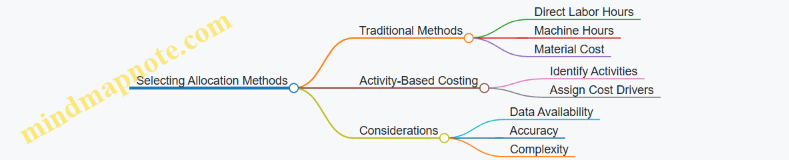
Example:
A manufacturing firm producing two products decides to allocate factory overhead using machine hours because machines are the primary cost driver. For service department costs, the step-down method is chosen to allocate maintenance and IT costs.
Step 3: Establish Documentation and Approval Procedures
- Document the rationale for chosen methods.
- Define roles and responsibilities for cost allocation tasks.
- Set procedures for periodic review and updates.

Step 4: Implement Controls and Monitoring
- Define internal controls to ensure accuracy and prevent manipulation.
- Use technology tools for automation where possible.
- Monitor allocation results and adjust as necessary.
Example:
The finance team implements monthly reconciliations comparing allocated costs against actual expenses and investigates significant variances.
Step 5: Communicate and Train Stakeholders
- Share the policy with all relevant departments.
- Provide training sessions for accountants and cost analysts.
- Encourage feedback to improve the policy.
Complete Mind Map Summary
Real-World Example: Developing a Cost Allocation Policy for a Mid-Sized Manufacturer
Background: A mid-sized electronics manufacturer with multiple product lines and service departments needed a formal cost allocation policy to improve cost transparency and support pricing decisions.
Process:
- Objectives: Improve internal decision-making and comply with financial reporting standards.
- Scope: All manufacturing overhead, service departments (maintenance, IT), and joint costs.
- Methods: Machine hours for manufacturing overhead; step-down method for service departments; market value method for joint products.
- Documentation: Detailed policy document created, reviewed by finance leadership.
- Controls: Monthly variance analysis and quarterly policy reviews.
- Training: Conducted workshops for accounting and production managers.
Outcome:
- Improved accuracy in product costing.
- Enhanced ability to identify unprofitable products.
- Streamlined financial reporting and audit readiness.
By following these structured steps and incorporating best practices, organizations can develop robust cost allocation policies that support accurate financial analysis and strategic decision-making.
11.5 Final Thoughts on Enhancing Financial Accuracy and Decision-Making
Effective cost allocation is a cornerstone for achieving financial accuracy and empowering strategic decision-making in finance and manufacturing sectors. As accountants and cost analysts, refining your cost allocation approach can significantly improve the clarity of financial data, enhance product costing accuracy, and ultimately drive better business outcomes.
Key Principles to Enhance Financial Accuracy and Decision-Making
- Transparency: Clear documentation and rationale behind cost allocation choices build trust and facilitate audits.
- Relevance: Align allocation bases with the actual consumption of resources to reflect true costs.
- Consistency: Apply methods consistently over time to enable meaningful trend analysis.
- Flexibility: Adapt allocation methods as business processes and products evolve.
- Simplicity: Avoid overcomplicating allocation models; balance detail with usability.
Mind Map: Enhancing Financial Accuracy and Decision-Making
Practical Examples
Example 1: Improving Product Pricing Accuracy
A manufacturing company initially used direct labor hours to allocate overhead but noticed discrepancies in product profitability. By switching to Activity-Based Costing (ABC), which considered machine setups and inspection times as cost drivers, the company gained a more accurate picture of product costs. This enabled better pricing strategies and improved margins.
Example 2: Supporting Strategic Decisions with Cost Data
A finance team used Time-Driven Activity-Based Costing (TDABC) to allocate service department costs more precisely. This revealed that certain departments were consuming disproportionate resources. Management used this insight to optimize workflows and reduce unnecessary expenses, improving overall operational efficiency.
Mind Map: Decision-Making Benefits from Accurate Cost Allocation
Final Recommendations
- Regularly Review and Update Allocation Methods: Business environments change; periodic reviews ensure methods remain relevant.
- Engage Cross-Functional Teams: Collaborate with production, operations, and finance to validate cost drivers.
- Leverage Technology: Use ERP and costing software to automate and improve accuracy.
- Train Staff: Ensure all stakeholders understand the cost allocation rationale and methodology.
- Document Everything: Maintain clear records for transparency and audit readiness.
By embracing these practices, accountants and cost analysts can enhance the precision of financial data, support more informed decision-making, and contribute to the sustainable growth of their organizations.
11.6 Resources for Further Learning
To deepen your understanding of cost allocation methods and enhance your practical skills, here are a variety of resources including books, online courses, professional organizations, and useful tools. Additionally, mind maps are provided to help visualize key concepts and pathways for learning.
Recommended Books
-
Cost Accounting: A Managerial Emphasis by Charles T. Horngren, Srikant M. Datar, and Madhav V. Rajan
- Comprehensive coverage of cost accounting principles including cost allocation.
- Includes practical examples and case studies relevant to manufacturing and finance sectors.
-
Managerial Accounting by Ray H. Garrison, Eric W. Noreen, and Peter C. Brewer
- Focuses on managerial decision-making with detailed sections on cost allocation.
-
Activity-Based Cost Management: An Executive’s Guide by Gary Cokins
- Deep dive into Activity-Based Costing and its applications.
Online Courses and Tutorials
-
Coursera: Managerial Accounting Fundamentals (offered by University of Illinois)
- Covers cost allocation methods with real-world examples.
-
LinkedIn Learning: Cost Accounting Foundations
- Practical course focused on cost allocation techniques and best practices.
-
edX: Introduction to Financial Accounting (offered by Wharton School)
- Includes modules on cost behavior and allocation.
Professional Organizations and Certifications
-
Institute of Management Accountants (IMA)
- Offers Certified Management Accountant (CMA) certification with extensive focus on cost management.
- Provides webinars, whitepapers, and industry insights.
-
American Institute of CPAs (AICPA)
- Resources on cost accounting standards and regulatory considerations.
-
Chartered Institute of Management Accountants (CIMA)
- Global certification with strong emphasis on cost and performance management.
Software Tools for Cost Allocation
-
SAP ERP Cost Center Accounting Module
- Automates cost allocation processes in manufacturing environments.
-
Oracle NetSuite
- Cloud-based solution with built-in cost allocation and financial reporting.
-
Microsoft Power BI
- Useful for visualizing cost allocation data and generating actionable insights.
Mind Maps
Mind Map 1: Overview of Cost Allocation Methods
Mind Map 2: Steps to Implement Activity-Based Costing (ABC)

Mind Map 3: Best Practices in Cost Allocation
Practical Examples for Further Study
-
Example 1: Applying ABC in a Multi-Product Manufacturing Plant
- Analyze how overhead costs are traced to activities like setup, inspection, and packaging.
- Calculate product costs based on activity consumption.
-
Example 2: Using TDABC in an Assembly Line
- Estimate time spent on each assembly task.
- Calculate capacity cost rate and allocate overhead accordingly.
-
Example 3: Allocating Joint Costs in Chemical Production
- Use market value method to allocate costs between main products and by-products.
Additional Learning Tips
- Join forums and discussion groups such as Reddit’s r/Accounting or LinkedIn groups focused on cost accounting.
- Subscribe to industry newsletters like Journal of Cost Management.
- Attend webinars and workshops offered by professional bodies.
By leveraging these resources and visual tools, accountants and cost analysts can build a robust understanding of cost allocation methods, improve accuracy in cost management, and support strategic decision-making in finance and manufacturing sectors.