Risk Management for Accountants
1. Introduction to Risk Management in Accounting
1.1 Understanding Risk: Definitions and Types Relevant to Accountants
What is Risk?
Risk, in the context of accounting and finance, refers to the possibility of an event or condition that may negatively impact an organization’s financial health, operations, or reputation. It represents uncertainty about outcomes that can lead to losses or missed opportunities.
Key Definitions:
- Risk: The effect of uncertainty on objectives.
- Risk Management: The process of identifying, assessing, and controlling threats to an organization’s capital and earnings.
- Risk Appetite: The amount and type of risk an organization is willing to pursue or retain.
Types of Risks Relevant to Accountants
Accountants face a variety of risks that can affect financial reporting, compliance, and operational efficiency. Understanding these categories helps in designing effective controls and mitigation strategies.
Mind Map: Types of Risks Relevant to Accountants
Detailed Explanation of Each Risk Type with Examples
-
Financial Risks
- Market Risk: Exposure to losses due to changes in market prices, such as interest rates or foreign exchange rates.
- Example: An accountant managing foreign currency transactions may face losses if exchange rates fluctuate unexpectedly.
- Credit Risk: Risk that a debtor will not fulfill their financial obligations.
- Example: Accounts receivable aging shows overdue payments, increasing the risk of bad debts.
- Liquidity Risk: Risk that the company cannot meet short-term financial demands.
- Example: Insufficient cash flow to pay suppliers on time, causing operational disruptions.
- Market Risk: Exposure to losses due to changes in market prices, such as interest rates or foreign exchange rates.
-
Operational Risks
- Process Failures: Errors or inefficiencies in accounting processes.
- Example: Incorrect data entry leading to misstated financial reports.
- Human Errors: Mistakes made by staff due to lack of training or oversight.
- Example: An accountant accidentally posts a transaction twice.
- System Failures: IT system crashes or software bugs affecting accounting data.
- Example: Accounting software downtime during month-end closing.
- Process Failures: Errors or inefficiencies in accounting processes.
-
Compliance Risks
- Regulatory Non-Compliance: Failure to adhere to laws, regulations, or standards.
- Example: Missing deadlines for tax filings resulting in penalties.
- Taxation Errors: Incorrect tax calculations or reporting.
- Example: Misclassifying expenses leading to underpayment of taxes.
- Regulatory Non-Compliance: Failure to adhere to laws, regulations, or standards.
-
Fraud Risks
- Asset Misappropriation: Theft or misuse of company assets.
- Example: An employee creating fake vendor invoices to divert funds.
- Financial Statement Fraud: Deliberate misrepresentation of financial information.
- Example: Inflating revenue figures to meet targets.
- Corruption: Bribery or unethical behavior influencing financial decisions.
- Example: Accepting kickbacks from suppliers.
- Asset Misappropriation: Theft or misuse of company assets.
-
Reputational Risks
- Public Disclosure Issues: Negative publicity from financial misstatements.
- Example: A restatement of earnings causing loss of investor confidence.
- Ethical Violations: Breaches of professional ethics damaging credibility.
- Example: An accountant ignoring conflicts of interest.
- Public Disclosure Issues: Negative publicity from financial misstatements.
Mind Map: Risk Management Process for Accountants
Example Scenario: Understanding Risk in Accounts Payable
- Risk Identified: Duplicate payments due to manual invoice processing.
- Impact: Financial loss and strained supplier relationships.
- Mitigation: Implement automated invoice matching and approval workflows.
- Outcome: Reduced errors and improved control over cash outflows.
Summary
Understanding the various types of risks relevant to accountants is foundational for effective risk management. By categorizing risks into financial, operational, compliance, fraud, and reputational, accountants can better identify vulnerabilities and apply targeted controls. Integrating these insights into daily accounting practices helps safeguard organizational assets and maintain financial integrity.
1.2 The Importance of Risk Management in Accounting and Finance
Risk management is a critical discipline within accounting and finance that ensures organizations can identify, assess, and mitigate potential threats that could impact financial accuracy, compliance, and overall business sustainability. Without effective risk management, accountants and finance professionals expose their organizations to financial losses, reputational damage, regulatory penalties, and operational disruptions.
Why Risk Management Matters in Accounting and Finance
- Accuracy and Integrity of Financial Reporting: Ensures that financial statements are free from material misstatements, whether due to error or fraud.
- Regulatory Compliance: Helps organizations adhere to laws and regulations such as SOX, IFRS, GAAP, and tax codes.
- Fraud Prevention and Detection: Protects assets by identifying vulnerabilities and implementing controls to prevent fraudulent activities.
- Operational Continuity: Minimizes disruptions caused by financial mismanagement or external risks.
- Stakeholder Confidence: Builds trust among investors, creditors, and regulators through transparent and reliable financial practices.
Mind Map: Importance of Risk Management in Accounting and Finance
Practical Example 1: Preventing Financial Misstatements
A mid-sized manufacturing company failed to implement proper risk management controls around revenue recognition. As a result, their quarterly financial reports included premature revenue entries, leading to overstated earnings. This misstatement was discovered during an external audit, causing a restatement of earnings, loss of investor confidence, and regulatory scrutiny.
By integrating risk management practices such as detailed process reviews, segregation of duties, and automated controls, the company could have detected and prevented these errors early, preserving financial integrity.
Mind Map: Risk Management Controls to Prevent Misstatements
Practical Example 2: Ensuring Compliance with Sarbanes-Oxley (SOX)
A publicly traded company faced significant penalties due to non-compliance with SOX requirements. The accounting team lacked a formal risk assessment process and failed to document internal controls adequately.
Implementing a risk management framework allowed the company to identify compliance gaps, design controls to address them, and maintain detailed documentation. This proactive approach not only avoided penalties but also improved the efficiency of external audits.
Mind Map: Risk Management and Regulatory Compliance
Summary
Risk management in accounting and finance is indispensable for safeguarding the accuracy of financial information, ensuring regulatory compliance, preventing fraud, and maintaining operational stability. By embedding risk management into daily accounting practices, professionals can protect their organizations from costly errors and build a foundation of trust with stakeholders.
Key Takeaways
- Risk management reduces the likelihood of financial errors and fraud.
- Compliance with regulations is streamlined through structured risk processes.
- Effective controls and monitoring enhance operational resilience.
- Transparent risk reporting strengthens stakeholder confidence.
In the next sections, we will explore how to identify, assess, and mitigate these risks with practical tools and best practices tailored for accountants.
1.3 Overview of Risk Management Frameworks and Standards
Risk management frameworks and standards provide structured approaches for identifying, assessing, managing, and monitoring risks. For accountants, understanding these frameworks is essential to embed risk management into daily processes and ensure compliance with industry best practices.
Key Risk Management Frameworks and Standards Relevant to Accountants
-
COSO Enterprise Risk Management (ERM) Framework
- Developed by the Committee of Sponsoring Organizations of the Treadway Commission (COSO).
- Focuses on integrating risk management with strategy and performance.
- Widely used in financial reporting and internal control environments.
-
ISO 31000: Risk Management – Guidelines
- An international standard providing principles, framework, and process for managing risk.
- Flexible and applicable across industries, including accounting and finance.
-
COBIT (Control Objectives for Information and Related Technologies)
- Framework for IT governance and management.
- Important for accountants managing risks related to IT systems and data integrity.
-
Sarbanes-Oxley Act (SOX) Compliance Framework
- U.S. regulation focusing on internal controls over financial reporting.
- Requires rigorous risk assessment and control documentation.
-
Basel Accords (Basel II and III)
- International banking regulations addressing risk management in financial institutions.
- Relevant for accountants working in banking and financial services.
Mind Map: COSO ERM Framework
Example: An accounting team uses the COSO ERM framework to align their risk appetite with the organization’s strategic goals. They identify risks related to revenue recognition and design controls to mitigate those risks, reporting findings regularly to senior management.
Mind Map: ISO 31000 Risk Management Process
Example: An accountant applies ISO 31000 by first understanding the regulatory environment (establish context), identifying risks such as compliance breaches, analyzing their impact, and implementing mitigation strategies like automated compliance checks.
Mind Map: Sarbanes-Oxley (SOX) Compliance Framework
Example: To comply with SOX, an accounting department documents all financial reporting controls, performs regular risk assessments on these controls, and schedules internal audits to ensure controls are effective and risks are minimized.
Practical Integration Example
Imagine a mid-sized company’s accounting team implementing risk management:
- They adopt ISO 31000 as the overarching framework to guide their risk management process.
- For financial reporting risks, they integrate COSO ERM principles to ensure alignment with organizational strategy.
- To meet regulatory requirements, they follow SOX compliance guidelines for internal controls.
- For IT-related risks impacting accounting data, they use COBIT to manage and monitor IT controls.
This multi-framework approach ensures comprehensive coverage of risks from operational to regulatory and technological domains.
Summary
Understanding and applying these frameworks helps accountants:
- Establish a consistent approach to risk management.
- Align risk management with organizational objectives.
- Comply with regulatory requirements.
- Improve internal controls and reduce the likelihood of errors or fraud.
By integrating frameworks like COSO ERM, ISO 31000, and SOX, accountants can build resilient processes that proactively manage risks and support sound financial governance.
1.4 Common Risks Faced by Accountants: Financial, Operational, Compliance, and Fraud
Accountants operate in a complex environment where various types of risks can impact the accuracy, reliability, and integrity of financial information. Understanding these risks is crucial for effective risk management. Below, we explore the four primary categories of risks faced by accountants: Financial, Operational, Compliance, and Fraud. Each section includes mind maps and practical examples to illustrate these risks.
Financial Risks
Financial risks relate to errors or misstatements in financial reporting, which can lead to incorrect decision-making, financial losses, or reputational damage.
Mind Map: Financial Risks
Example: A company prematurely recognizes revenue from a large contract before delivery is complete. This inflates the current period’s revenue and misleads stakeholders about the company’s financial health. An accountant failing to identify this risk could contribute to misstated financial statements.
Operational Risks
Operational risks stem from failures in internal processes, people, or systems that affect the day-to-day accounting activities.
Mind Map: Operational Risks
Example: An accountant manually enters invoice data into the accounting system. Due to fatigue and lack of double-checking, several invoices are entered with incorrect amounts. This causes discrepancies in accounts payable and delays in vendor payments.
Compliance Risks
Compliance risks arise from failing to adhere to laws, regulations, and internal policies, potentially resulting in fines, penalties, or legal action.
Mind Map: Compliance Risks
Example: An accounting team misses the deadline for submitting quarterly tax returns due to poor scheduling and lack of reminders. This results in penalties and interest charges from tax authorities.
Fraud Risks
Fraud risks involve intentional acts to deceive or manipulate financial information for personal or organizational gain.
Mind Map: Fraud Risks
Example: An employee creates fake vendor accounts and submits fraudulent invoices for payment. Without proper segregation of duties and verification controls, these payments go unnoticed, leading to financial loss.
Summary Mind Map: Common Risks Faced by Accountants
Practical Takeaway
Accountants should maintain vigilance across all these risk areas by implementing strong internal controls, continuous monitoring, and regular training. For instance, automating invoice processing with validation checks can reduce operational errors, while regular compliance audits help avoid regulatory penalties. Recognizing fraud red flags and fostering an ethical culture are also essential to mitigate fraud risks effectively.
By understanding and addressing these common risks, accountants can safeguard the integrity of financial information and support sound business decision-making.
1.5 Case Study: How Poor Risk Management Led to Financial Misstatement
Introduction
In this case study, we explore a real-world example where inadequate risk management practices within an accounting department led to significant financial misstatements. Understanding the root causes and consequences helps accountants and risk managers appreciate the critical need for robust risk controls.
Background
A mid-sized manufacturing company, “ABC Manufacturing,” experienced a major financial restatement due to errors in revenue recognition and inventory valuation. The accounting team lacked proper risk identification and mitigation strategies, which allowed errors to go undetected for several quarters.
Mind Map: Root Causes of Financial Misstatement
Detailed Analysis
-
Lack of Internal Controls
- The accounting department did not segregate duties properly. The same individual was responsible for recording sales and reconciling accounts receivable.
- Example: A single employee could manipulate sales records without independent verification, increasing the risk of misstated revenue.
-
Insufficient Risk Identification
- The team failed to identify risks related to recognizing revenue before delivery was complete, violating revenue recognition principles.
- Example: Sales were recorded prematurely to meet quarterly targets, inflating revenue figures.
-
Inadequate Training
- Staff were not trained on the latest accounting standards (e.g., ASC 606), leading to incorrect application.
- Example: Inventory valuation methods were outdated, causing overstatement of assets.
-
Weak Communication
- Risk issues found during audits were not escalated to senior management promptly.
- Example: Early warning signs in audit reports were ignored, delaying corrective action.
Mind Map: Consequences of Poor Risk Management
Outcome
- The company was forced to restate its financials for the past two years.
- The SEC launched an investigation, resulting in fines.
- Several executives, including the CFO, resigned.
- Shareholders filed lawsuits citing misleading financial information.
Lessons Learned and Best Practices
-
Implement Strong Internal Controls: Segregate duties and establish independent review processes.
- Example: Separate the roles of sales recording and account reconciliation.
-
Regular Risk Identification: Continuously assess accounting processes for new or evolving risks.
- Example: Use risk registers updated quarterly.
-
Ongoing Training: Keep accounting staff updated on standards and fraud indicators.
- Example: Conduct quarterly workshops on ASC 606 and fraud detection.
-
Effective Communication: Ensure timely reporting of risks to senior management.
- Example: Establish a formal risk escalation protocol.
Summary
This case study highlights how poor risk management can directly lead to financial misstatements with severe legal, financial, and reputational consequences. Accountants and risk managers must proactively identify, assess, and mitigate risks to safeguard the integrity of financial reporting.
Additional Example: Early Detection Through Risk Analytics
By implementing data analytics tools, ABC Manufacturing could have detected unusual revenue spikes and inventory discrepancies early, prompting investigations before misstatements became material.
This proactive approach exemplifies best practice in integrating technology with risk management.
2. Identifying Risks in Accounting Processes
2.1 Risk Identification Techniques: Checklists, Brainstorming, and Interviews
Risk identification is the foundational step in effective risk management. For accountants, accurately identifying risks ensures that potential issues are addressed before they escalate into financial or compliance problems. This section explores three widely used techniques: Checklists, Brainstorming, and Interviews, each supported by practical examples and mind maps to clarify their application.
Checklists
Checklists are structured lists of potential risks tailored to specific accounting processes or environments. They help ensure that common and known risks are systematically considered.
Why use Checklists?
- Provide a comprehensive overview of typical risks
- Standardize risk identification across teams
- Save time by leveraging past knowledge
Example: Consider an accountant responsible for accounts payable. A checklist might include:
- Duplicate payments
- Unauthorized vendor additions
- Invoice mismatches
- Late payment penalties
- Fraudulent invoices
Mind Map: Checklist for Accounts Payable Risks
Using this checklist, accountants can systematically verify each risk area during process reviews.
Brainstorming
Brainstorming involves gathering a group of stakeholders to generate a wide range of potential risks through open discussion. This technique encourages creativity and uncovers risks that might not be obvious.
Best Practices for Brainstorming:
- Include diverse participants (e.g., accountants, auditors, risk managers)
- Encourage all ideas without immediate judgment
- Use a facilitator to keep the session focused
- Document all risks identified
Example: During a brainstorming session for the month-end closing process, participants might identify risks such as:
- Data entry errors due to manual processes
- Incomplete reconciliations
- System downtime delaying closing
- Misinterpretation of new accounting standards
Mind Map: Brainstorming Risks for Month-End Closing
This collaborative approach helps uncover both technical and operational risks.
Interviews
Interviews involve one-on-one or small group discussions with key personnel to extract detailed insights about risks from their experience and perspective.
When to Use Interviews:
- To explore complex or sensitive risk areas
- When detailed understanding of specific processes is needed
- To validate risks identified through other methods
Example: An accountant interviewing the IT team might uncover risks related to:
- Access controls to financial systems
- Backup and recovery procedures
- Cybersecurity vulnerabilities affecting accounting data
Mind Map: Interview Topics with IT for Accounting Risk
This targeted approach provides deep insights that might be missed in group sessions.
Summary Table of Techniques and Examples
| Technique | Description | Example Use Case | Key Benefit |
|---|---|---|---|
| Checklists | Structured list of known risks | Accounts payable risk identification | Comprehensive and repeatable |
| Brainstorming | Group discussion to generate diverse risks | Month-end closing risk exploration | Creative and inclusive |
| Interviews | One-on-one discussions for detailed insights | IT risk assessment for accounting systems | Deep, specialized understanding |
Practical Tip for Accountants
Combine these techniques for robust risk identification. For example, start with a checklist to cover basics, use brainstorming to explore new or emerging risks, and conduct interviews to validate and deepen understanding.
By integrating these methods, accountants can build a comprehensive risk profile that supports effective mitigation strategies.
2.2 Mapping Accounting Processes to Spot Vulnerabilities
Mapping accounting processes is a critical step in identifying vulnerabilities that could lead to errors, fraud, or inefficiencies. By visually breaking down each step of an accounting workflow, accountants and risk managers can pinpoint weak spots where controls may be lacking or risks may be higher.
What is Process Mapping?
Process mapping is the creation of a visual diagram that outlines the sequence of activities, decision points, inputs, and outputs within a specific accounting process. It helps in understanding how tasks flow, who is responsible, and where potential risks might arise.
Why Map Accounting Processes?
- Identify bottlenecks and inefficiencies
- Spot control gaps and vulnerabilities
- Clarify roles and responsibilities
- Facilitate communication among teams
- Support compliance and audit readiness
Common Accounting Processes to Map
- Accounts Payable
- Accounts Receivable
- Payroll Processing
- General Ledger Closing
- Fixed Asset Management
Example Mind Map: Accounts Payable Process
Identifying Vulnerabilities in the Accounts Payable Process
| Step | Potential Vulnerabilities | Example Scenario |
|---|---|---|
| Invoice Receipt | Fake or duplicate invoices | Duplicate invoice submitted to get double payment |
| Invoice Validation | Incorrect matching or overlooked discrepancies | Invoice amount does not match purchase order but is paid anyway |
| Approval Workflow | Lack of segregation of duties | Same person submits and approves invoices |
| Payment Processing | Unauthorized payments | Payment made to a vendor not on approved list |
| Record Keeping | Missing or incomplete documentation | Invoices not properly archived, causing audit issues |
Example Mind Map: Payroll Processing
Spotting Vulnerabilities in Payroll Processing
| Step | Potential Vulnerabilities | Example Scenario |
|---|---|---|
| Employee Time Tracking | Falsified hours or buddy punching | Employee submits inflated hours; no verification |
| Payroll Calculation | Incorrect deductions or miscalculations | Tax rates not updated, leading to compliance risk |
| Approval and Verification | Lack of independent review | Payroll processed without manager approval |
| Payment Disbursement | Payments to terminated employees | Payments continue after employee leaves |
| Reporting and Compliance | Late or inaccurate tax filings | Penalties due to late submission of payroll taxes |
Best Practices for Mapping and Vulnerability Spotting
- Engage Cross-Functional Teams: Include personnel from accounting, finance, operations, and IT to get a comprehensive view.
- Use Standardized Symbols: Flowcharts, swimlane diagrams, or mind maps help maintain clarity.
- Document Roles and Responsibilities: Clearly identify who performs each step to detect segregation of duties issues.
- Incorporate Control Points: Mark where controls exist and evaluate their effectiveness.
- Review and Update Regularly: Processes evolve; keep maps current to reflect changes.
Practical Example: Mapping the General Ledger Closing Process
Vulnerabilities:
- Missing or late journal entries causing inaccurate financials
- Reconciliations not performed or reviewed
- Adjusting entries made without proper documentation
- Lack of timely approvals delaying closing
By mapping this process, accountants can identify where controls such as reconciliation checklists or approval workflows need strengthening.
Summary
Mapping accounting processes with detailed mind maps and flowcharts enables accountants and risk managers to visualize workflows, identify vulnerabilities, and implement targeted controls. Using real-world examples like accounts payable and payroll processing helps illustrate common risk points and how to address them effectively.
2.3 Practical Example: Identifying Risks in Accounts Payable and Receivable
In the accounting function, Accounts Payable (AP) and Accounts Receivable (AR) are critical processes that directly impact cash flow, financial accuracy, and operational efficiency. Identifying risks in these areas is essential to prevent financial loss, fraud, and compliance issues.
Understanding Accounts Payable Risks
Accounts Payable involves managing outgoing payments to suppliers and vendors. Common risks include duplicate payments, unauthorized payments, late payments leading to penalties, and fraud.
Mind Map: Risks in Accounts Payable
Example 1: Duplicate Payment Risk
A company processes an invoice twice due to poor invoice tracking. This results in overpayment, affecting cash flow.
Mitigation: Implement a centralized invoice tracking system with automated duplicate detection.
Understanding Accounts Receivable Risks
Accounts Receivable involves managing incoming payments from customers. Risks include delayed payments, bad debts, misapplied payments, and revenue recognition errors.
Mind Map: Risks in Accounts Receivable
Example 2: Delayed Payment Risk
A customer delays payment beyond agreed terms, causing cash flow strain.
Mitigation: Establish clear credit policies and use aging reports to monitor overdue accounts.
Step-by-Step Risk Identification in AP and AR
- Process Mapping: Document each step in AP and AR workflows to spot potential risk points.
- Stakeholder Interviews: Engage with AP/AR staff to uncover practical challenges and risk areas.
- Data Analysis: Review historical payment data for anomalies like duplicates or late payments.
- Control Review: Assess existing controls such as approval workflows and reconciliations.
Mind Map: Risk Identification Process
Integrated Example: Identifying Risks in a Mid-Sized Company’s AP Process
- Scenario: The company noticed occasional late payments and occasional vendor complaints.
- Risk Identification:
- Process mapping revealed manual invoice entry prone to errors.
- Interviews uncovered lack of segregation of duties; the same person enters and approves invoices.
- Data analysis found several duplicate payments over the last quarter.
- Control review showed no automated matching between purchase orders and invoices.
Outcome: The company prioritized implementing an automated AP system with three-way matching and segregated duties to mitigate these risks.
Summary
Identifying risks in Accounts Payable and Receivable requires a structured approach combining process analysis, stakeholder input, and data review. By mapping out risks such as duplicate payments, fraud, delayed collections, and compliance issues, accountants can design targeted controls that protect the organization’s financial health.
For further reading, consider exploring tools like risk registers and automated analytics platforms that enhance risk identification in AP and AR.
2.4 Using Data Analytics to Detect Anomalies and Potential Risks
Data analytics has become an indispensable tool for accountants aiming to enhance risk management by identifying anomalies and potential risks early in the accounting processes. By leveraging data analytics, accountants can sift through large volumes of financial data to detect patterns, outliers, and irregularities that may indicate errors, fraud, or operational inefficiencies.
Why Use Data Analytics in Risk Detection?
- Volume Handling: Ability to analyze thousands of transactions quickly.
- Pattern Recognition: Identifies unusual trends that manual reviews may miss.
- Proactive Risk Management: Enables early detection and mitigation.
Key Techniques in Data Analytics for Risk Detection
- Descriptive Analytics: Summarizes historical data to understand what happened.
- Diagnostic Analytics: Investigates why something happened.
- Predictive Analytics: Forecasts future risks based on patterns.
- Prescriptive Analytics: Suggests actions to mitigate identified risks.
Mind Map: Data Analytics Techniques for Risk Detection
Practical Example 1: Detecting Duplicate Payments in Accounts Payable
Scenario: An accounting team suspects duplicate payments are being made to vendors.
Approach:
- Use data analytics software to scan payment records.
- Identify duplicate invoice numbers, amounts, or vendor names.
- Flag transactions with identical or near-identical attributes.
Outcome:
- Discovery of several duplicate payments totaling $15,000.
- Implementation of automated duplicate detection rules.
Practical Example 2: Anomaly Detection in Expense Reports
Scenario: Expense reports occasionally contain outlier amounts that may indicate policy violations.
Approach:
- Analyze historical expense data to establish normal spending patterns.
- Use statistical methods (e.g., Z-score) to detect outliers.
- Review flagged reports for potential misuse or errors.
Outcome:
- Identification of unusually high travel expenses submitted by a few employees.
- Reinforcement of expense policies and additional training.
Mind Map: Steps to Implement Data Analytics for Risk Detection
Best Practices for Accountants Using Data Analytics
- Start Small: Begin with high-risk areas such as cash transactions or vendor payments.
- Use Visualization: Tools like dashboards and heat maps make anomalies easier to spot.
- Collaborate with IT: Ensure proper data access and security.
- Regularly Update Models: Anomaly detection models should evolve with new data.
- Document Findings: Maintain records of detected risks and remediation steps.
Practical Example 3: Continuous Monitoring of Revenue Recognition
Scenario: A company wants to ensure revenue is recognized accurately and timely.
Approach:
- Use data analytics to monitor revenue transactions daily.
- Detect unusual spikes or drops compared to historical trends.
- Flag transactions that deviate from contract terms.
Outcome:
- Early identification of a revenue recognition error due to system misconfiguration.
- Prompt correction avoided potential financial misstatement.
Summary
Data analytics empowers accountants to move from reactive to proactive risk management by detecting anomalies and potential risks efficiently. By integrating these techniques into daily accounting workflows, organizations can safeguard financial integrity and enhance compliance.
Additional Resources
- Introduction to Data Analytics for Accountants (Online Course)
- Tools: ACL Analytics, IDEA, Power BI, Tableau
- Articles on Anomaly Detection Techniques in Finance
2.5 Best Practice: Establishing a Risk Register for Accounting Teams
A risk register is an essential tool for accountants to systematically identify, document, and manage risks within their processes. It acts as a centralized repository that helps teams track risks, assess their impact, assign ownership, and monitor mitigation efforts.
What is a Risk Register?
A risk register is a structured document or database that records all identified risks, their characteristics, and the actions taken to manage them. For accounting teams, it ensures transparency and accountability in managing financial, operational, compliance, and fraud risks.
Why Establish a Risk Register?
- Centralized Risk Tracking: Consolidates all risks in one place.
- Prioritization: Helps prioritize risks based on likelihood and impact.
- Accountability: Assigns risk owners responsible for mitigation.
- Monitoring: Tracks progress on risk mitigation activities.
- Audit Trail: Provides documentation for internal and external audits.
Key Components of a Risk Register for Accounting Teams
| Component | Description |
|---|---|
| Risk ID | Unique identifier for each risk |
| Risk Description | Clear and concise description of the risk |
| Risk Category | Classification (e.g., Financial, Operational, Compliance, Fraud) |
| Likelihood | Probability of the risk occurring (e.g., Low, Medium, High) |
| Impact | Potential effect on the organization (e.g., Low, Medium, High) |
| Risk Score | Combined score based on likelihood and impact |
| Risk Owner | Person responsible for managing the risk |
| Mitigation Actions | Steps planned or taken to reduce the risk |
| Status | Current status (e.g., Open, In Progress, Closed) |
| Review Date | Next scheduled date to review the risk |
Mind Map: Components of a Risk Register
Example: Sample Risk Register Entries for an Accounting Team
| Risk ID | Risk Description | Category | Likelihood | Impact | Risk Score | Risk Owner | Mitigation Actions | Status | Review Date |
|---|---|---|---|---|---|---|---|---|---|
| R001 | Incorrect revenue recognition | Financial | Medium | High | 8 | Senior Accountant | Implement monthly revenue review and reconciliation | In Progress | 2024-07-01 |
| R002 | Unauthorized access to accounting system | Operational | Low | High | 6 | IT Manager | Enforce multi-factor authentication and regular access audits | Open | 2024-06-15 |
| R003 | Non-compliance with new tax regulations | Compliance | High | Medium | 9 | Tax Specialist | Conduct quarterly training and update tax software | In Progress | 2024-06-30 |
| R004 | Payroll fraud | Fraud | Low | High | 6 | HR Manager | Segregate payroll duties and implement whistleblower policy | Open | 2024-07-10 |
Mind Map: Example Risk Register Entry Breakdown
Steps to Establish a Risk Register in Your Accounting Team
- Assemble a Cross-Functional Team: Include accountants, auditors, compliance officers, and IT personnel.
- Identify Risks: Use brainstorming sessions, process reviews, and historical data.
- Document Risks: Capture all relevant details in the risk register template.
- Assess Risks: Evaluate likelihood and impact to prioritize.
- Assign Risk Owners: Designate responsible individuals for each risk.
- Develop Mitigation Plans: Define clear actions to reduce risk exposure.
- Monitor and Update: Regularly review the register and update statuses.
Practical Example: Creating a Risk Register for Accounts Payable
- Risk Identification: Duplicate payments, late payments, invoice fraud.
- Risk Documentation: Each risk is entered with descriptions and categories.
- Assessment: Duplicate payments (Medium likelihood, Medium impact), late payments (High likelihood, Low impact).
- Ownership: Assign to Accounts Payable Manager.
- Mitigation: Implement invoice matching software, establish approval workflows.
Mind Map: Risk Register Process Flow
Tips for Maintaining an Effective Risk Register
- Keep it simple and user-friendly to encourage regular updates.
- Use visual dashboards to highlight high-priority risks.
- Integrate with existing accounting and audit software for automation.
- Schedule periodic reviews aligned with financial reporting cycles.
- Encourage a culture of open communication about risks.
By establishing and maintaining a comprehensive risk register, accounting teams can proactively manage risks, improve internal controls, and contribute to the overall financial health and compliance of the organization.
3. Risk Assessment and Prioritization
3.1 Qualitative vs Quantitative Risk Assessment Methods
Risk assessment is a critical step in the risk management process for accountants. It involves evaluating identified risks to understand their potential impact and likelihood, enabling prioritization and effective mitigation. There are two primary approaches to risk assessment: qualitative and quantitative. Both methods have unique advantages and are often used complementarily.
Qualitative Risk Assessment
Qualitative risk assessment focuses on descriptive analysis rather than numerical data. It uses subjective judgment, expert opinions, and categorization to evaluate risks.
Key Characteristics:
- Uses categories such as High, Medium, Low for likelihood and impact
- Relies on expert judgment and experience
- Easier and faster to perform
- Useful when precise data is unavailable
Common Techniques:
- Risk Matrix
- Risk Ranking
- SWOT Analysis
- Delphi Method
Example in Accounting: An accounting team identifies the risk of revenue recognition errors. Using qualitative assessment, they categorize the likelihood as “Medium” due to recent process changes and the impact as “High” because errors could lead to misstated financial statements and regulatory penalties.
Mind Map: Qualitative Risk Assessment
Quantitative Risk Assessment
Quantitative risk assessment uses numerical data and statistical models to estimate risk levels. It provides measurable and objective evaluations.
Key Characteristics:
- Uses numerical values for likelihood and impact
- Employs statistical, mathematical, or financial models
- More precise but requires reliable data
- Time-consuming and resource-intensive
Common Techniques:
- Monte Carlo Simulation
- Sensitivity Analysis
- Expected Monetary Value (EMV) Analysis
- Value at Risk (VaR)
Example in Accounting: To assess the risk of cash flow shortfalls, an accountant uses Monte Carlo simulation to model various scenarios of receivables collection delays. The simulation estimates a 15% probability that cash flow will drop below a critical threshold in the next quarter.
Mind Map: Quantitative Risk Assessment
Comparative Overview
| Aspect | Qualitative Assessment | Quantitative Assessment |
|---|---|---|
| Data Requirement | Low (expert judgment) | High (historical and statistical data) |
| Precision | Descriptive, categorical | Numerical, measurable |
| Time and Cost | Low | High |
| Use Case | Initial screening, when data is limited | Detailed analysis, when data is available |
| Example | Risk of invoice fraud categorized as High | Probability of cash flow shortfall: 15% |
Integrated Example: Assessing Risk of Accounts Payable Fraud
-
Qualitative Step:
- The accounting team holds a brainstorming session.
- They identify accounts payable fraud as a “High” impact risk with “Medium” likelihood due to recent staff turnover.
-
Quantitative Step:
- Using historical data, they analyze past fraud incidents.
- Applying EMV analysis, they estimate an average potential loss of $50,000 with a 10% probability annually.
-
Outcome:
- The combined approach helps prioritize fraud risk mitigation efforts and allocate resources effectively.
Mind Map: Integrated Risk Assessment Example
Best Practices for Accountants
- Use qualitative methods for initial risk identification and prioritization.
- Apply quantitative methods when sufficient data exists for precise analysis.
- Combine both approaches for a comprehensive risk assessment.
- Document assumptions and data sources clearly.
- Regularly update assessments to reflect changes in processes or environment.
By understanding and applying both qualitative and quantitative risk assessment methods, accountants can better identify, evaluate, and manage risks, ultimately safeguarding financial integrity and compliance.
3.2 Risk Scoring Models Tailored for Accounting Functions
Risk scoring models are essential tools that help accountants quantify and prioritize risks based on their likelihood and potential impact. Tailoring these models specifically for accounting functions ensures that the unique risks inherent in financial processes are accurately assessed and managed.
What is a Risk Scoring Model?
A risk scoring model assigns numerical values to various risk factors, allowing organizations to rank risks objectively. This helps in focusing resources on the most critical risks.
Key Components of Risk Scoring Models for Accounting:
- Likelihood (Probability): How likely is the risk event to occur?
- Impact (Severity): What is the potential financial or reputational damage?
- Detection Difficulty: How easy is it to detect the risk before it causes harm?
Mind Map: Core Elements of Risk Scoring in Accounting
Example: Risk Scoring Matrix for Revenue Recognition Errors
| Risk Factor | Score (1-5) | Description |
|---|---|---|
| Likelihood | 3 | Errors occur occasionally due to manual entries |
| Impact | 5 | Misstatements can lead to significant financial restatements |
| Detection Difficulty | 4 | Errors are often detected late in the audit process |
Total Risk Score = Likelihood x Impact x Detection Difficulty = 3 x 5 x 4 = 60
This score helps prioritize this risk over others with lower scores.
Mind Map: Steps to Build a Risk Scoring Model for Accounting
Tailoring Risk Scoring Models to Specific Accounting Functions
- Accounts Payable/Receivable: Focus on fraud risk, payment errors, and timing delays.
- Payroll: Emphasize unauthorized payments, compliance with tax laws.
- Financial Reporting: Concentrate on misstatements, compliance with accounting standards.
- Tax Accounting: Highlight risks from regulatory changes and filing errors.
Practical Example: Scoring Risk in Payroll Processing
| Risk Factor | Score (1-5) | Explanation |
|---|---|---|
| Likelihood | 2 | Payroll errors are rare due to automation |
| Impact | 4 | Errors can cause regulatory fines and employee dissatisfaction |
| Detection Difficulty | 3 | Some errors detected only during audits |
Total Risk Score = 2 x 4 x 3 = 24
This lower score compared to revenue recognition errors indicates a relatively lower priority.
Mind Map: Example Risk Scoring for Different Accounting Risks
Best Practices for Implementing Risk Scoring Models in Accounting
- Use Historical Data: Leverage past incidents and audit findings to inform likelihood and impact scores.
- Engage Experts: Include accountants, auditors, and risk managers in scoring to ensure accuracy.
- Customize Scales: Adapt scoring scales to reflect the organization’s risk appetite and industry standards.
- Regular Updates: Risk environments change; update scores periodically.
- Integrate with Risk Registers: Use scoring results to populate and prioritize entries in risk registers.
Summary
Risk scoring models tailored for accounting functions provide a structured, quantitative approach to evaluating risks. By combining likelihood, impact, and detection difficulty, accountants can prioritize risks effectively, allocate resources wisely, and strengthen internal controls.
For further reading, consider exploring tools like COSO ERM frameworks and ISO 31000 guidelines, which provide foundational principles for risk scoring and management.
3.3 Example: Assessing the Impact of Revenue Recognition Errors
Revenue recognition is a critical accounting process that directly affects financial statements and business decisions. Errors in revenue recognition can lead to misstated earnings, regulatory penalties, and loss of stakeholder trust. This section explores how to assess the impact of revenue recognition errors using practical examples and mind maps to visualize the process.
Understanding Revenue Recognition Errors
Revenue recognition errors occur when revenue is recorded in the wrong period, amount, or not in accordance with applicable accounting standards (e.g., IFRS 15 or ASC 606). Common causes include:
- Premature recognition of revenue before delivery or performance obligations are met.
- Delayed recognition causing understatement of income.
- Incorrect measurement of revenue due to pricing or contract terms misunderstanding.
Mind Map: Causes and Consequences of Revenue Recognition Errors
Step-by-Step Assessment of Impact
-
Identify the Error
- Example: A software company recognizes full revenue upon contract signing instead of over the service period.
-
Quantify the Error
- Calculate the amount of revenue recognized prematurely.
- Example: $1,200,000 recognized upfront instead of $100,000 monthly over 12 months.
-
Evaluate Financial Statement Impact
- Overstated revenue and net income in the current period.
- Understated revenue in future periods.
-
Assess Compliance and Regulatory Risks
- Potential violation of revenue recognition standards.
- Risk of audit adjustments or fines.
-
Consider Stakeholder Impact
- Investors may make decisions based on inflated earnings.
- Creditors may assess creditworthiness inaccurately.
-
Determine Corrective Actions
- Restate financial statements.
- Implement stronger internal controls.
Mind Map: Assessment Workflow for Revenue Recognition Errors
Practical Example: SaaS Company Revenue Recognition Error
Scenario: A SaaS company signs a 1-year contract for $120,000 but recognizes the entire amount as revenue immediately upon signing.
Assessment:
- Error: Premature revenue recognition.
- Quantification: $120,000 recognized upfront instead of $10,000 per month.
- Financial Impact: Current year revenue overstated by $120,000; next 11 months understated.
- Compliance Risk: Violates ASC 606 which requires revenue recognition over time as services are delivered.
- Stakeholder Impact: Investors see inflated earnings, leading to potential mispricing of stock.
Corrective Action:
- Adjust revenue recognition to a monthly basis.
- Restate financials if prior periods are affected.
- Train accounting staff on revenue recognition policies.
Example Table: Impact Analysis of Revenue Recognition Error
| Aspect | Before Correction | After Correction | Impact Description |
|---|---|---|---|
| Revenue Recognized | $120,000 upfront | $10,000 per month | Overstatement in current period |
| Net Income | Inflated by $120,000 | Adjusted to reflect actual | Earnings misrepresented |
| Compliance Status | Non-compliant with ASC 606 | Compliant | Risk of regulatory penalties reduced |
| Stakeholder Trust | Potentially damaged | Restored with transparency | Investor confidence maintained |
Best Practice Tips for Accountants
- Regularly review contracts and revenue recognition policies.
- Use automated systems to allocate revenue over time.
- Conduct periodic training on updated accounting standards.
- Implement internal audit procedures focused on revenue accounts.
- Maintain a detailed risk register to track revenue recognition risks.
By systematically assessing revenue recognition errors through identification, quantification, and impact evaluation, accountants can mitigate risks effectively and ensure accurate financial reporting.
3.4 Prioritizing Risks Based on Likelihood and Impact
Prioritizing risks is a critical step in the risk management process for accountants. It helps focus limited resources on the most significant risks that could affect financial reporting, compliance, or operational efficiency. This section will guide you through how to prioritize risks by evaluating their likelihood and impact, supported by practical examples and mind maps to visualize the process.
Understanding Likelihood and Impact
- Likelihood refers to the probability that a risk event will occur.
- Impact refers to the severity of the consequences if the risk event occurs.
Both dimensions are usually assessed qualitatively (e.g., low, medium, high) or quantitatively (e.g., probability percentages, monetary loss).
Step 1: Define Scales for Likelihood and Impact
| Scale | Likelihood Description | Impact Description |
|---|---|---|
| Low | Rare or unlikely to occur | Minor financial or operational effect |
| Medium | Possible or occasional occurrence | Moderate effect, manageable with controls |
| High | Likely or frequent occurrence | Significant effect, could threaten objectives |
Step 2: Create a Risk Matrix
A risk matrix helps visualize and prioritize risks by plotting likelihood against impact.
Risk Prioritization Matrix
| Impact \ Likelihood | Low | Medium | High |
|---|---|---|---|
| High | Medium Priority | High Priority | Critical Risk |
| Medium | Low Priority | Medium Priority | High Priority |
| Low | Low Priority | Low Priority | Medium Priority |
Mind Map: Prioritizing Risks Based on Likelihood and Impact
Step 3: Assign Risks to the Matrix
Example: Consider three risks identified in an accounting department:
-
Risk A: Revenue Recognition Error
- Likelihood: Medium (errors occur occasionally)
- Impact: High (could lead to material misstatement)
-
Risk B: Payroll Fraud
- Likelihood: Low (strong controls in place)
- Impact: Medium (financial loss but limited scope)
-
Risk C: Late Tax Filing
- Likelihood: High (tight deadlines and manual processes)
- Impact: Medium (penalties and interest)
Plotting these on the matrix:
| Risk | Likelihood | Impact | Priority |
|---|---|---|---|
| Revenue Recognition | Medium | High | High Priority |
| Payroll Fraud | Low | Medium | Low Priority |
| Late Tax Filing | High | Medium | High Priority |
Mind Map: Example Risk Prioritization
Step 4: Prioritize and Plan Responses
- Critical and High Priority Risks: Require immediate mitigation plans, such as enhanced controls, automation, or additional reviews.
- Medium Priority Risks: Should be monitored regularly and controlled through standard procedures.
- Low Priority Risks: May be accepted but reviewed periodically to ensure they do not escalate.
Practical Example: Prioritizing Risks in Accounts Payable
-
Risk: Duplicate payments
- Likelihood: Medium (manual invoice entry)
- Impact: Medium (financial loss and reconciliation issues)
- Priority: Medium
-
Risk: Unauthorized vendor setup
- Likelihood: Low (vendor onboarding controls)
- Impact: High (fraud risk)
- Priority: High
-
Risk: Late payment penalties
- Likelihood: High (complex approval workflows)
- Impact: Low (small penalties)
- Priority: Medium
This prioritization helps the accounting team focus on tightening vendor setup controls first, then improving invoice processing automation.
Summary
Prioritizing risks based on likelihood and impact enables accountants to allocate resources effectively and address the most critical risks first. Using tools like risk matrices and mind maps simplifies the visualization and communication of risk priorities.
For further reading, consider exploring risk scoring models and software tools that automate risk prioritization tailored to accounting functions.
3.5 Best Practice: Engaging Cross-Functional Teams for Comprehensive Risk Assessment
Engaging cross-functional teams in risk assessment is a best practice that significantly enhances the depth, accuracy, and effectiveness of identifying and prioritizing risks within accounting functions. By involving professionals from different departments and expertise areas, accountants can gain diverse perspectives, uncover hidden risks, and develop more robust mitigation strategies.
Why Engage Cross-Functional Teams?
- Diverse Perspectives: Different departments (e.g., finance, IT, compliance, operations) have unique insights into potential risks.
- Holistic Risk Identification: Risks often span multiple functions; collaboration ensures no risk is overlooked.
- Improved Communication: Facilitates better understanding and alignment across the organization.
- Enhanced Buy-in: Stakeholders are more likely to support risk mitigation efforts if involved early.
How to Engage Cross-Functional Teams Effectively
- Identify Relevant Stakeholders: Include representatives from accounting, internal audit, IT, legal, compliance, operations, and management.
- Define Clear Objectives: Clarify the scope and goals of the risk assessment.
- Facilitate Structured Workshops: Use guided sessions to brainstorm and evaluate risks collaboratively.
- Leverage Collaborative Tools: Utilize shared documents, risk registers, and mind maps.
- Assign Roles and Responsibilities: Ensure accountability for follow-up actions.
Example: Cross-Functional Risk Assessment Workshop
A mid-sized insurance company organized a risk assessment workshop involving the accounting team, IT security, compliance officers, and operations managers to evaluate risks in the monthly financial closing process.
- Outcome: IT highlighted system downtime risks, compliance flagged regulatory reporting deadlines, operations identified data entry bottlenecks, and accountants focused on reconciliation errors.
- Result: The team developed a prioritized risk register and agreed on mitigation steps such as system upgrades, compliance calendar integration, and process automation.
Mind Map: Cross-Functional Risk Assessment Process
Mind Map: Benefits of Cross-Functional Engagement
Practical Tips for Accountants
- Invite IT Early: Technology risks are often underestimated; IT can provide insights on system vulnerabilities.
- Include Compliance: Regulatory risks impact financial reporting and must be integrated.
- Use Visual Tools: Mind maps and flowcharts help clarify complex processes and risks.
- Document Discussions: Keep detailed notes to track risk evolution and decisions.
- Follow Up: Schedule periodic reviews to update risk assessments and monitor mitigation progress.
Additional Example: Fraud Risk Assessment
In a financial services firm, accountants collaborated with the internal audit and HR teams to assess fraud risks related to expense reimbursements.
- Cross-Functional Insights: HR provided data on employee behavior patterns, audit shared past fraud incidents, and accounting reviewed reimbursement processes.
- Outcome: The team identified gaps in approval workflows and implemented dual-approval controls, reducing fraud risk by 40% within six months.
Engaging cross-functional teams transforms risk assessment from a siloed activity into a dynamic, organization-wide effort, enabling accountants to manage risks more comprehensively and effectively.
4. Risk Mitigation Strategies for Accountants
4.1 Internal Controls: Designing and Implementing Effective Controls
Internal controls are the backbone of risk mitigation in accounting. They are processes, policies, and procedures designed to ensure the integrity of financial and accounting information, promote accountability, and prevent fraud. Effective internal controls help accountants reduce errors, detect irregularities early, and comply with regulations.
What Are Internal Controls?
Internal controls can be broadly categorized into three types:
- Preventive Controls: Designed to stop errors or fraud before they occur.
- Detective Controls: Identify and detect errors or irregularities after they have occurred.
- Corrective Controls: Actions taken to correct errors or issues once detected.
Mind Map: Types of Internal Controls
Designing Effective Internal Controls
When designing internal controls, accountants should consider the following principles:
- Segregation of Duties (SoD): No single individual should control all aspects of a financial transaction.
- Authorization and Approval: Transactions should be authorized by appropriate personnel.
- Documentation and Record Keeping: Maintain clear, complete, and accurate records.
- Physical Controls: Safeguard assets through locks, passwords, or restricted access.
- Independent Checks and Reconciliations: Regular reviews and reconciliations to detect discrepancies.
Mind Map: Principles of Designing Internal Controls
Example: Segregation of Duties in Accounts Payable
Scenario: In a mid-sized company, the accountant responsible for processing payments also approves vendor invoices and reconciles bank statements.
Risk: This concentration of duties increases the risk of fraudulent payments or undetected errors.
Control Implementation:
- Assign invoice approval to the purchasing manager.
- Assign payment processing to the accounts payable clerk.
- Assign bank statement reconciliation to an independent finance team member.
This segregation ensures no single person has control over the entire payment cycle, reducing fraud risk.
Implementing Internal Controls: Step-by-Step
- Risk Assessment: Identify key risk areas in accounting processes.
- Control Design: Develop controls tailored to mitigate identified risks.
- Documentation: Document control procedures clearly.
- Training: Educate staff on control importance and execution.
- Monitoring: Regularly review and test controls for effectiveness.
- Continuous Improvement: Update controls based on audit findings and process changes.
Mind Map: Implementing Internal Controls
Example: Authorization Controls in Expense Management
Scenario: Employees submit expense reports without manager approval.
Risk: Unauthorized or fraudulent expenses may be reimbursed.
Control Implementation:
- Require all expense reports to be approved by the employee’s direct manager before processing.
- Use an automated workflow system that blocks reimbursement until approval is logged.
This control prevents unauthorized spending and ensures accountability.
Best Practice: Use Technology to Strengthen Controls
Modern accounting software often includes built-in controls such as:
- Role-based access controls to restrict system functions.
- Automated approval workflows.
- Audit trails that log all changes and transactions.
Example: Implementing an ERP system with configurable user roles ensures that only authorized personnel can approve payments or modify financial data.
Summary
Designing and implementing effective internal controls is essential for accountants to manage risks, prevent fraud, and ensure accurate financial reporting. By applying principles like segregation of duties, authorization, documentation, and continuous monitoring — supported by real-world examples and technology — accounting teams can build a robust control environment that safeguards organizational assets and enhances trust.
For further reading, explore frameworks such as COSO Internal Control – Integrated Framework and ISO 31000 Risk Management.
4.2 Example: Segregation of Duties to Prevent Fraud
Segregation of Duties (SoD) is a fundamental internal control designed to reduce the risk of errors and fraud by ensuring that no single individual has control over all aspects of any critical financial transaction. For accountants, implementing SoD is crucial to maintaining integrity and transparency within financial processes.
What is Segregation of Duties?
Segregation of Duties means dividing responsibilities among different people to reduce the risk of error or inappropriate actions. It typically involves separating the following functions:
- Authorization
- Custody of assets
- Record keeping
- Reconciliation
Why is Segregation of Duties Important?
- Prevents fraud by limiting opportunities for manipulation
- Detects errors early by involving multiple parties
- Enhances accountability and transparency
Mind Map: Core Components of Segregation of Duties
Practical Example: Accounts Payable Process
Consider the accounts payable (AP) process, a common area vulnerable to fraud if duties are not segregated.
| Function | Role 1: Invoice Processing | Role 2: Payment Authorization | Role 3: Payment Execution | Role 4: Reconciliation |
|---|---|---|---|---|
| Receive Invoice | Yes | No | No | No |
| Verify Invoice | Yes | No | No | No |
| Approve Payment | No | Yes | No | No |
| Issue Payment | No | No | Yes | No |
| Reconcile Payments | No | No | No | Yes |
This segregation ensures that no single person can both approve and execute payments, reducing the risk of fraudulent disbursements.
Mind Map: Segregation of Duties in Accounts Payable
Additional Example: Payroll Process
In payroll, segregation of duties might look like this:
- Payroll Preparation: HR or payroll clerk prepares payroll data.
- Payroll Authorization: Manager or finance officer reviews and approves payroll.
- Payroll Disbursement: Treasury or finance team issues payments.
- Payroll Reconciliation: Internal audit or accounting reconciles payroll reports with bank statements.
This separation prevents an individual from creating fictitious employees and issuing unauthorized payments.
Mind Map: Segregation of Duties in Payroll
Best Practices for Implementing Segregation of Duties
- Identify Key Processes: Map out all financial processes and identify critical control points.
- Assign Roles Clearly: Define roles and responsibilities to avoid overlap.
- Use Technology: Employ accounting software with role-based access controls.
- Regularly Review: Conduct periodic audits to ensure SoD is maintained.
- Compensating Controls: When SoD is not feasible (e.g., small teams), implement compensating controls like increased supervision or audit trails.
Example: Using Technology to Enforce SoD
Modern ERP systems allow setting permissions so that users can only perform tasks assigned to their role. For example:
- User A can enter invoices but cannot approve payments.
- User B can approve payments but cannot create invoices.
- User C can run reconciliation reports but cannot modify transactions.
This technological segregation reduces human error and fraud risk.
Summary
Segregation of Duties is a critical control mechanism that helps accountants prevent fraud and errors by dividing responsibilities among multiple individuals. Through practical examples in accounts payable and payroll, and supported by mind maps illustrating key functions, accountants can better understand how to implement SoD effectively within their organizations.
4.3 Automation and Technology as Risk Mitigation Tools
In today’s fast-paced accounting environment, automation and technology play a crucial role in mitigating risks by reducing human error, increasing efficiency, and enhancing control mechanisms. Leveraging these tools allows accountants to focus on higher-value tasks while ensuring accuracy and compliance.
Key Benefits of Automation and Technology in Risk Mitigation
- Error Reduction: Automated calculations and data entry minimize manual mistakes.
- Consistency: Standardized processes ensure uniform application of controls.
- Real-Time Monitoring: Systems can flag anomalies instantly.
- Audit Trail: Automated logs provide transparent records for compliance.
- Efficiency: Faster processing reduces backlog and exposure to operational risks.
Mind Map: Automation and Technology in Risk Mitigation
Practical Examples
Example 1: Robotic Process Automation (RPA) in Accounts Payable
A mid-sized company implemented RPA to handle invoice processing. The bot extracts invoice data using OCR, matches it against purchase orders, and inputs it into the accounting system. This automation reduced data entry errors by 90% and ensured timely payments, mitigating the risk of late fees and supplier dissatisfaction.
Example 2: Continuous Controls Monitoring (CCM) for Expense Approvals
An organization uses CCM software to monitor expense reports in real-time. The system automatically flags expenses exceeding policy limits or duplicate submissions. This proactive approach helped the finance team detect and prevent unauthorized expenses, reducing compliance risk.
Example 3: AI-Powered Fraud Detection in Payroll
A large enterprise deployed AI tools that analyze payroll data patterns to detect anomalies such as ghost employees or unusual overtime claims. The system alerted the risk management team to suspicious entries, enabling early investigation and prevention of potential fraud.
Best Practices for Implementing Automation and Technology
- Start with Risk Assessment: Identify high-risk, repetitive tasks suitable for automation.
- Choose Scalable Solutions: Select tools that can grow with your organization’s needs.
- Integrate Systems: Ensure seamless data flow between accounting, ERP, and risk management platforms.
- Train Staff: Equip your team with skills to manage and interpret automated outputs.
- Regularly Review Controls: Continuously monitor and update automated controls to adapt to changing risks.
Mind Map: Implementation Roadmap for Automation in Risk Mitigation
By thoughtfully integrating automation and technology into accounting processes, organizations can significantly reduce operational and compliance risks. These tools not only improve accuracy and efficiency but also empower accountants and risk managers to proactively identify and address potential issues before they escalate.
4.4 Training and Awareness Programs for Risk Reduction
Effective risk management in accounting relies heavily on the knowledge, vigilance, and proactive behavior of the accounting team. Training and awareness programs are essential tools to equip accountants with the skills and mindset necessary to identify, assess, and mitigate risks before they escalate.
Why Training and Awareness Matter
- Empowers employees to recognize potential risks early.
- Reduces errors and fraud by increasing understanding of internal controls.
- Promotes a risk-aware culture that supports continuous improvement.
- Ensures compliance with regulatory requirements through up-to-date knowledge.
Key Components of Effective Training Programs
- Risk Fundamentals: Basic concepts of risk, types of risks in accounting.
- Internal Controls: How controls mitigate risks, examples of control failures.
- Fraud Awareness: Common fraud schemes, red flags, and reporting mechanisms.
- Regulatory Updates: Changes in laws and standards impacting accounting risks.
- Use of Technology: Tools and software that support risk management.
Mind Map: Components of Training and Awareness Programs
Example: Designing a Fraud Awareness Workshop
Objective: Equip accountants with the ability to detect and prevent payroll fraud.
Agenda:
- Introduction to Payroll Fraud
- Common Payroll Fraud Schemes (e.g., ghost employees, falsified hours)
- Red Flags and Warning Signs
- Case Study: Real-life Payroll Fraud Incident
- Role-playing Exercise: Identifying Fraudulent Activities
- Reporting Procedures and Whistleblower Policies
Outcome: Participants leave with practical knowledge and confidence to identify suspicious activities.
Mind Map: Payroll Fraud Awareness Workshop
Best Practices for Implementing Training Programs
- Regular Scheduling: Conduct sessions quarterly or biannually to keep knowledge fresh.
- Interactive Learning: Use workshops, quizzes, and role-playing to engage participants.
- Tailored Content: Customize training based on specific risks relevant to the accounting team.
- Leverage Technology: Use e-learning platforms and webinars for accessibility.
- Measure Effectiveness: Use feedback surveys and assessments to improve programs.
Example: Continuous Learning Through Microlearning
Microlearning delivers bite-sized training modules focused on specific risk topics, such as “Detecting Expense Report Fraud” or “Understanding SOX Controls.” These short sessions (5-10 minutes) can be delivered via mobile apps or email, allowing accountants to learn on-the-go and retain information better.
Mind Map: Microlearning Approach
Summary
Training and awareness programs are foundational to reducing risks in accounting. By combining structured workshops, interactive sessions, and innovative microlearning techniques, organizations can foster a vigilant, knowledgeable accounting team capable of proactively managing risks. Embedding these programs into the organizational culture ensures sustained risk reduction and compliance.
For accountants and risk managers, investing time and resources into comprehensive training is not just a regulatory checkbox but a strategic imperative to safeguard financial integrity and organizational reputation.
4.5 Best Practice: Continuous Monitoring and Control Testing
Continuous monitoring and control testing are critical components of an effective risk mitigation strategy in accounting. They ensure that internal controls remain effective over time, detect emerging risks early, and provide assurance that processes comply with policies and regulations.
What is Continuous Monitoring?
Continuous monitoring is an ongoing process that involves regularly reviewing and analyzing accounting activities and controls to promptly identify and address risks or control failures.
Why Continuous Monitoring Matters for Accountants
- Detects errors and fraud early
- Ensures compliance with regulatory requirements
- Enhances the reliability of financial reporting
- Supports proactive risk management
Mind Map: Continuous Monitoring in Accounting
What is Control Testing?
Control testing evaluates whether internal controls are designed effectively and operating as intended. It can be performed periodically or continuously depending on the risk profile.
Types of Control Testing
- Design Effectiveness Testing: Verifies if the control is properly designed to mitigate risks.
- Operating Effectiveness Testing: Confirms the control is functioning as intended in practice.
Mind Map: Control Testing Process
Practical Example: Continuous Monitoring and Control Testing in Accounts Payable
Scenario: An accounting team wants to reduce the risk of duplicate payments and fraudulent invoices.
Continuous Monitoring Actions:
- Implement automated software that flags duplicate invoice numbers or vendor details.
- Set up exception reports to review invoices exceeding typical amounts.
- Monitor changes in vendor master data for unauthorized updates.
Control Testing Actions:
- Periodically sample invoices and verify approval signatures.
- Test segregation of duties by reviewing who creates, approves, and pays invoices.
- Confirm reconciliations between purchase orders, invoices, and payments are performed timely.
Outcome: Early detection of anomalies reduces financial loss, and regular testing ensures controls remain effective.
Best Practices for Continuous Monitoring and Control Testing
-
Leverage Technology: Use accounting software with built-in monitoring tools and analytics to automate control checks.
-
Define Clear Metrics: Establish key risk indicators (KRIs) and control performance indicators (CPIs) to measure effectiveness.
-
Schedule Regular Reviews: Set a consistent timetable for control testing based on risk levels.
-
Document Everything: Maintain detailed records of monitoring results and testing procedures for audit trails.
-
Engage Cross-Functional Teams: Collaborate with IT, compliance, and audit teams to enhance monitoring scope.
-
Respond Promptly: Develop protocols to address control failures or risk detections immediately.
Mind Map: Best Practices for Continuous Monitoring and Control Testing
Additional Example: Monitoring Revenue Recognition Controls
Context: Revenue recognition is a high-risk area prone to manipulation.
Continuous Monitoring:
- Automated checks on timing of revenue entries relative to delivery dates.
- Exception reports for unusual revenue spikes or adjustments.
Control Testing:
- Sample contracts reviewed to ensure revenue is recognized per accounting standards.
- Verification that approvals for revenue adjustments are documented.
Result: Strengthened confidence in financial statements and reduced risk of misstatement.
Summary
Continuous monitoring and control testing form a dynamic duo in risk mitigation for accountants. By embedding these practices into daily operations, accounting teams can maintain robust internal controls, quickly identify risks, and uphold the integrity of financial reporting.
Implementing these best practices with real-world examples and leveraging technology will empower accountants to proactively manage risks and support organizational success.
5. Compliance and Regulatory Risk Management
5.1 Understanding Key Regulatory Requirements Affecting Accountants
Accountants operate in an environment heavily influenced by regulatory requirements designed to ensure transparency, accuracy, and ethical financial reporting. Understanding these regulations is crucial to managing compliance risk effectively and avoiding legal penalties or reputational damage.
Major Regulatory Frameworks Impacting Accountants
Below is a mind map illustrating the key regulatory frameworks and their core focus areas:
Financial Reporting Standards
Accountants must prepare financial statements that comply with either IFRS or GAAP, depending on jurisdiction. These standards dictate how financial transactions are recorded and reported.
Example:
A company recognizing revenue prematurely to meet quarterly targets violates GAAP revenue recognition principles, leading to restatements and penalties.
Anti-Money Laundering (AML) Regulations
Accountants often play a role in detecting and reporting suspicious financial activities.
Example:
An accountant notices unusual large cash deposits inconsistent with client business activities. Following AML regulations, they file a Suspicious Activity Report (SAR) to the relevant authority.
Tax Compliance
Accurate tax reporting and timely filing are essential to avoid fines and audits.
Example:
An accountant ensures all deductible expenses are properly documented and reported, minimizing tax liabilities while staying compliant.
Data Protection and Privacy
With increasing digitalization, accountants must safeguard sensitive financial and personal data.
Example:
Implementing encryption and access controls to protect client financial data in compliance with GDPR.
Corporate Governance Regulations
Acts like SOX impose strict internal control requirements to prevent fraud and ensure accurate financial reporting.
Example:
An accountant documents and tests internal controls over financial reporting to comply with SOX Section 404 requirements.
Audit and Assurance Standards
Accountants involved in auditing must adhere to standards ensuring independence, objectivity, and thoroughness.
Example:
Following ISA guidelines, an auditor performs risk assessments and designs audit procedures to detect material misstatements.
Integrated Example: Compliance in Practice
Scenario: An accounting firm is preparing the year-end financial statements for a publicly traded company.
- They ensure revenue recognition aligns with IFRS 15.
- Internal controls are tested and documented per SOX requirements.
- Tax filings are reviewed for accuracy and completeness.
- Client data is handled in compliance with GDPR.
- Any suspicious transactions identified during the audit trigger AML reporting protocols.
This integrated approach reduces regulatory risk and enhances stakeholder confidence.
Summary Mind Map
Understanding and applying these regulatory requirements is foundational for accountants to manage risk effectively and uphold professional integrity.
5.2 Example: Managing Risks Related to Sarbanes-Oxley (SOX) Compliance
Sarbanes-Oxley Act (SOX) compliance is a critical area of risk management for accountants, especially those working in publicly traded companies. SOX was enacted to protect investors by improving the accuracy and reliability of corporate disclosures. Managing SOX-related risks involves ensuring internal controls over financial reporting (ICFR) are effective and compliant.
Understanding SOX Compliance Risks
SOX compliance risks primarily arise from:
- Inadequate internal controls
- Errors or fraud in financial reporting
- Insufficient documentation and audit trails
- Lack of segregation of duties
- Ineffective IT controls impacting financial data
Mind Map: Key SOX Compliance Risk Areas
Practical Example: Managing SOX Risks in Revenue Recognition
Scenario: A company recognizes revenue prematurely, leading to misstated financial statements.
Risk: Non-compliance with SOX Section 404 due to weak controls over revenue recognition.
Risk Management Steps:
- Identify Controls: Establish controls such as approval of sales contracts, verification of delivery, and review of revenue entries.
- Test Controls: Perform walkthroughs and sample testing to verify controls operate effectively.
- Document Findings: Maintain detailed documentation of control design and testing results.
- Remediate Deficiencies: Address any control gaps immediately to prevent misstatements.
Mind Map: SOX Risk Management Process
Best Practices for Managing SOX Compliance Risks
- Regular Training: Educate accounting and finance teams on SOX requirements and their role in compliance.
- Use Technology: Leverage compliance management software to track controls, testing, and remediation.
- Segregate Duties: Ensure no single individual has control over all aspects of a financial transaction.
- Continuous Monitoring: Implement ongoing monitoring to detect control failures early.
- Strong IT Controls: Protect financial data integrity through robust IT security and change management.
Example: Segregation of Duties to Mitigate SOX Risks
In the accounts payable process:
- Requestor: Initiates purchase requisition.
- Approver: Authorizes purchase orders.
- Receiver: Confirms receipt of goods.
- Accountant: Processes payment.
By separating these roles, the company reduces the risk of fraud and errors, supporting SOX compliance.
Summary
Managing SOX compliance risks requires a structured approach to identifying, assessing, and mitigating risks related to internal controls over financial reporting. Accountants play a pivotal role in designing controls, performing testing, and ensuring documentation is thorough. Through practical examples such as revenue recognition and segregation of duties, accountants can effectively manage SOX risks and contribute to organizational compliance and financial integrity.
5.3 Developing Compliance Checklists and Audit Trails
Compliance checklists and audit trails are essential tools for accountants to systematically manage regulatory requirements and ensure transparency, accountability, and traceability in financial reporting and operations. This section explores how to develop effective compliance checklists and audit trails, supported by practical examples and mind maps to visualize the process.
What is a Compliance Checklist?
A compliance checklist is a structured list of regulatory requirements, internal policies, and controls that accountants must verify and adhere to during their workflows. It acts as a proactive guide to ensure nothing is overlooked and helps maintain consistency across teams.
What is an Audit Trail?
An audit trail is a chronological record of all transactions, changes, and activities related to financial data and compliance processes. It provides evidence for audits, supports investigations, and helps detect discrepancies or unauthorized actions.
Developing Compliance Checklists
Step 1: Identify Applicable Regulations and Standards
- Understand the regulatory environment relevant to your organization (e.g., SOX, GAAP, IFRS, GDPR).
- Include internal policies and procedures that impact compliance.
Step 2: Break Down Requirements into Actionable Items
- Translate broad regulations into specific tasks or checkpoints.
- Example: For SOX Section 404, checklist items might include “Verify segregation of duties in accounts payable” or “Confirm monthly reconciliation of bank statements.”
Step 3: Organize Checklist by Process or Function
- Group items by accounting processes such as revenue recognition, payroll, fixed assets, etc.
Step 4: Assign Responsibility and Frequency
- Specify who is responsible for each checklist item and how often it should be reviewed (daily, monthly, quarterly).
Step 5: Incorporate Documentation and Evidence Requirements
- Define what supporting documents or records must be attached or referenced.
Example Compliance Checklist Snippet for Accounts Payable
| Checklist Item | Responsible | Frequency | Documentation Required |
|---|---|---|---|
| Verify vendor invoice matches purchase order | AP Clerk | Daily | Invoice, PO, Receiving Report |
| Approve payments according to authorization matrix | AP Manager | Weekly | Payment approval forms |
| Reconcile vendor statements monthly | Finance Controller | Monthly | Vendor statements, reconciliation reports |
Developing Audit Trails
Step 1: Define Key Transactions and Events to Track
- Examples: Invoice creation, payment approval, journal entry adjustments, user access changes.
Step 2: Determine Data Points to Capture
- Date/time stamp
- User ID
- Description of action
- Before and after values (for edits)
Step 3: Implement System Logging or Manual Logs
- Use accounting software features to automatically log activities.
- For manual processes, maintain detailed logs with signatures and timestamps.
Step 4: Ensure Audit Trail Integrity
- Protect logs from unauthorized modification.
- Use access controls and encryption where possible.
Example Audit Trail Entry
| Timestamp | User ID | Action | Details |
|---|---|---|---|
| 2024-05-10 09:15:32 | jsmith | Created invoice #INV12345 | Amount: $10,000; Vendor: ABC Supplies |
| 2024-05-11 14:22:10 | mroberts | Approved payment for INV12345 | Payment date: 2024-05-15; Method: Wire |
Mind Maps
Mind Map 1: Compliance Checklist Development
Mind Map 2: Audit Trail Components
Practical Example: Implementing a Compliance Checklist and Audit Trail for Payroll
Scenario: A mid-sized company wants to ensure payroll compliance with tax regulations and internal policies.
-
Compliance Checklist Items:
- Verify employee tax withholding forms are up to date.
- Confirm payroll calculations match approved salary rates.
- Ensure payroll tax deposits are made on time.
- Review payroll reports monthly for discrepancies.
-
Audit Trail Elements:
- Record date/time of payroll processing.
- Log user who approved payroll.
- Capture changes to employee salary or tax status.
-
Outcome:
- The checklist guides payroll staff through mandatory compliance steps.
- The audit trail provides a transparent record for auditors and management.
Best Practices
- Regularly update checklists to reflect regulatory changes.
- Train staff on the importance and use of compliance checklists and audit trails.
- Use software tools to automate checklist management and audit trail logging.
- Periodically review audit trails to identify unusual patterns or potential risks.
By developing robust compliance checklists and maintaining detailed audit trails, accountants can significantly reduce compliance risk, improve process transparency, and support effective audits.
5.4 Best Practice: Leveraging Compliance Software for Real-Time Monitoring
In today’s fast-paced regulatory environment, accountants must ensure compliance continuously rather than periodically. Leveraging compliance software for real-time monitoring is a best practice that empowers accounting teams to detect, address, and prevent compliance risks proactively.
What is Compliance Software for Real-Time Monitoring?
Compliance software designed for real-time monitoring automates the tracking of regulatory requirements, internal policies, and controls. It provides instant alerts, dashboards, and audit trails, enabling accountants and risk managers to respond swiftly to potential compliance breaches.
Benefits of Using Compliance Software for Real-Time Monitoring
- Immediate Detection of Issues: Automated alerts notify teams of discrepancies or policy violations as they occur.
- Improved Accuracy: Reduces human error by automating data collection and analysis.
- Enhanced Reporting: Generates real-time reports for management and regulators.
- Audit Readiness: Maintains comprehensive logs and documentation for audits.
- Resource Efficiency: Frees up accountants to focus on higher-value tasks.
Key Features to Look for in Compliance Software
Practical Example: Using Compliance Software to Monitor SOX Compliance
Scenario: An accounting team at a publicly traded company needs to ensure continuous compliance with Sarbanes-Oxley (SOX) requirements, especially around segregation of duties and transaction approvals.
Implementation:
- The team deploys compliance software integrated with their ERP and accounting systems.
- Real-time alerts notify the team if a single user attempts to both initiate and approve a transaction, violating segregation of duties.
- Automated reports are generated monthly, summarizing compliance status and any exceptions.
- Audit trails capture every approval and change, simplifying external audits.
Outcome:
- Early detection of potential compliance breaches.
- Reduced risk of fraud and financial misstatement.
- Streamlined audit process with comprehensive documentation.
Example Mind Map: Real-Time Monitoring Workflow
Best Practices for Maximizing Compliance Software Effectiveness
- Customize Rules and Alerts: Tailor the software’s monitoring rules to your organization’s specific regulatory environment and internal policies.
- Integrate Systems: Ensure seamless integration between compliance software, ERP, and accounting platforms to avoid data silos.
- Train Users: Provide comprehensive training to accounting and risk management teams on using the software effectively.
- Regularly Update Software: Keep the software updated to reflect changes in regulations and emerging risks.
- Establish Clear Response Protocols: Define who is responsible for responding to alerts and how to escalate issues.
Real-World Example: Company XYZ’s Journey to Real-Time Compliance
Company XYZ, a mid-sized insurance firm, faced challenges with manual compliance tracking leading to delayed issue detection. After implementing a compliance software solution:
- They reduced compliance incident response time by 60%.
- Improved audit scores due to better documentation and transparency.
- Empowered accountants to focus on strategic risk management rather than manual compliance checks.
Summary
Leveraging compliance software for real-time monitoring transforms risk management from a reactive to a proactive discipline. Accountants benefit from enhanced visibility, faster issue resolution, and stronger regulatory adherence, ultimately safeguarding the organization’s financial integrity and reputation.
5.5 Case Study: Avoiding Penalties through Proactive Compliance Risk Management
Introduction
In the highly regulated finance and insurance sectors, compliance risk management is critical to avoid costly penalties and reputational damage. This case study explores how a mid-sized accounting firm successfully implemented proactive compliance risk management strategies to navigate complex regulatory requirements and avoid penalties.
Background
The firm was facing increasing regulatory scrutiny due to frequent changes in financial reporting standards and anti-money laundering (AML) regulations. Previous audits had revealed gaps in compliance documentation and delayed reporting, which posed significant risks of penalties.
Proactive Compliance Risk Management Approach
Step 1: Comprehensive Regulatory Mapping
- The firm began by mapping all applicable regulations impacting their accounting processes, including Sarbanes-Oxley (SOX), AML, and GDPR.
Step 2: Risk Identification and Assessment
- Using workshops and interviews, the firm identified key compliance risks such as incomplete audit trails, delayed filings, and inadequate employee training.
Step 3: Implementation of Controls
- Introduced automated compliance checklists integrated into their accounting software.
- Established clear documentation protocols and timelines.
- Rolled out mandatory compliance training programs.
Step 4: Continuous Monitoring and Reporting
- Developed dashboards to track compliance status in real-time.
- Scheduled periodic internal audits to verify adherence.
Step 5: Stakeholder Communication
- Regularly updated senior management and the board on compliance risk status.
Mind Map: Proactive Compliance Risk Management Workflow
Examples of Best Practices Applied
-
Automated Compliance Checklists: The firm used software to ensure all required steps for regulatory filings were completed before deadlines. For example, before submitting quarterly financial reports, the system flagged missing approvals or incomplete reconciliations.
-
Training Programs: Employees underwent quarterly training sessions on new regulatory updates, reducing errors caused by lack of awareness.
-
Internal Audits: Monthly spot checks identified minor documentation lapses early, allowing corrective actions before external audits.
Results
- Zero penalties or fines over two consecutive years despite increased regulatory complexity.
- Improved audit outcomes with fewer compliance-related findings.
- Enhanced confidence from clients and regulators.
Lessons Learned
- Early identification and continuous monitoring of compliance risks are essential.
- Automation reduces human error and ensures consistency.
- Clear communication channels foster accountability and transparency.
Additional Mind Map: Compliance Risk Identification Techniques
Summary
This case study demonstrates that a structured, proactive approach to compliance risk management—combining regulatory mapping, risk assessment, control implementation, monitoring, and communication—can effectively prevent penalties and strengthen an accounting firm’s risk posture.
For accountants and risk managers, adopting similar strategies tailored to their specific regulatory environment can safeguard their organizations against compliance failures and associated penalties.
6. Fraud Risk Management in Accounting
6.1 Recognizing Common Types of Fraud in Accounting
Fraud in accounting can severely damage an organization’s financial health, reputation, and legal standing. Recognizing the common types of fraud is the first step in preventing and mitigating these risks. Below, we explore the most prevalent fraud types, supported by mind maps and practical examples to help accountants identify red flags effectively.
Mind Map: Common Types of Accounting Fraud
Asset Misappropriation
This is the most common type of fraud and involves employees stealing or misusing the organization’s assets.
Examples:
- Theft of Cash: An accounts receivable clerk diverting customer payments into a personal account.
- Inventory Theft: Warehouse staff removing inventory items for personal use or resale.
- Payroll Fraud: Adding fictitious employees to the payroll or inflating hours worked.
Example Scenario: An accountant notices that the cash deposits recorded in the ledger are consistently less than the actual cash received. Upon investigation, it is discovered that a cashier has been pocketing small amounts of cash and manipulating records to cover the theft.
Mind Map: Asset Misappropriation Red Flags
Financial Statement Fraud
This involves intentional misrepresentation or omission of financial information to deceive stakeholders.
Examples:
- Revenue Recognition Manipulation: Recording sales before they occur or inflating sales figures.
- Expense Understatement: Delaying recognition of expenses to inflate profits.
- Overstating Assets: Inflating asset values to improve financial ratios.
Example Scenario: An accountant is pressured to meet quarterly targets and records revenue from a large contract before the delivery of goods. This premature revenue recognition inflates the company’s earnings, misleading investors.
Mind Map: Financial Statement Fraud Indicators
Corruption
Corruption involves employees using their influence for personal gain, often through collusion with third parties.
Examples:
- Bribery: Accepting money or gifts in exchange for favorable treatment.
- Kickbacks: Vendors giving a percentage of sales back to employees who award them contracts.
- Conflict of Interest: An employee awarding contracts to a company they own.
Example Scenario: A purchasing manager awards contracts to a vendor owned by a close relative without competitive bidding. The vendor inflates prices, and the manager receives kickbacks.
Mind Map: Corruption Warning Signs
Summary Table of Fraud Types with Examples
| Fraud Type | Description | Example Scenario |
|---|---|---|
| Asset Misappropriation | Theft or misuse of company assets | Cashier pocketing cash and altering records |
| Financial Statement Fraud | Manipulating financial reports | Premature revenue recognition to boost earnings |
| Corruption | Abuse of position for personal gain | Purchasing manager receiving kickbacks |
Best Practices for Accountants to Recognize Fraud
- Maintain strong internal controls and segregation of duties.
- Regularly review and reconcile accounts and transactions.
- Use data analytics to detect anomalies and unusual patterns.
- Encourage a whistleblower policy and anonymous reporting.
- Stay vigilant for behavioral red flags such as reluctance to share information or lifestyle changes.
By understanding these common fraud types and recognizing their warning signs, accountants can play a pivotal role in safeguarding their organizations against financial losses and reputational damage.
6.2 Practical Example: Detecting Payroll Fraud through Analytical Procedures
Payroll fraud is a common and costly risk in accounting, often involving fictitious employees, inflated hours, or unauthorized salary changes. Analytical procedures are a powerful tool for accountants and risk managers to detect such fraud early by identifying unusual patterns or discrepancies in payroll data.
Step 1: Understanding Payroll Fraud Types
Payroll Fraud Types Mind Map
Example: A company suspects ghost employees are listed on the payroll, inflating payroll expenses.
Step 2: Collecting and Preparing Payroll Data
- Gather payroll registers, employee master files, time sheets, and bank payment records.
- Ensure data completeness and accuracy.
Example: Extract payroll data for the last 12 months to analyze trends and anomalies.
Step 3: Analytical Procedures to Detect Anomalies
- Trend Analysis: Compare monthly payroll expenses over time.
- Ratio Analysis: Calculate ratios such as payroll expense to revenue or number of employees to payroll expense.
- Duplicate Payment Checks: Identify duplicate employee IDs or payments.
- Benford’s Law Application: Analyze the distribution of leading digits in payment amounts.
- Variance Analysis: Compare actual payroll costs against budgeted amounts.
Analytical Procedures Mind Map
Example: A sudden spike in payroll expenses in a particular month without a corresponding increase in headcount or revenue may indicate fraudulent payments.
Step 4: Practical Example Walkthrough
Scenario: The accounting team notices payroll expenses increased by 15% in Q2 without new hires.
- Action: Perform a detailed review of payroll register.
- Finding: Two employees have identical bank account numbers but different employee IDs.
- Further Investigation: Confirm if one employee is a ghost employee receiving payments.
Mind Map:
Step 5: Using Data Analytics Tools
- Utilize spreadsheet functions or specialized software to automate duplicate detection and trend visualization.
- Example: Use pivot tables to summarize payroll by department and month.
Example: A pivot table reveals that one department’s payroll increased by 30% while others remained stable.
Step 6: Best Practices for Payroll Fraud Detection
- Regularly reconcile payroll data with HR records.
- Implement segregation of duties between payroll processing and approval.
- Use continuous monitoring with automated alerts for unusual transactions.
- Conduct surprise audits on payroll.
Summary
Detecting payroll fraud requires a combination of analytical procedures, data validation, and investigative follow-up. By applying trend and ratio analyses, checking for duplicates, and leveraging data analytics tools, accountants can uncover hidden fraud risks early and protect organizational assets.
For more detailed templates and tools, see section 11.3 Risk Register Template and 11.1 Risk Assessment Template.
6.3 Implementing Fraud Risk Assessments and Red Flags
Fraud risk assessments are a critical component of an accountant’s toolkit to proactively identify, evaluate, and mitigate potential fraud risks within an organization. Implementing these assessments systematically helps in uncovering vulnerabilities and establishing controls before fraud occurs.
What is a Fraud Risk Assessment?
A fraud risk assessment is a structured process to identify areas where fraud could occur, evaluate the likelihood and impact of such fraud, and prioritize mitigation strategies. It involves gathering information about processes, controls, and behaviors that might expose the organization to fraudulent activities.
Steps to Implement Fraud Risk Assessments
-
Define the Scope and Objectives
- Determine which business units, processes, or transactions will be assessed.
- Example: Focus on high-risk areas such as procurement, payroll, and revenue recognition.
-
Gather Information
- Conduct interviews with key personnel.
- Review policies, procedures, and prior audit findings.
- Analyze transaction data for anomalies.
-
Identify Fraud Risks and Red Flags
- Use checklists and historical data to pinpoint potential fraud schemes.
- Example: Unusual vendor payments or frequent overrides of controls.
-
Assess the Likelihood and Impact
- Rate each identified risk based on how likely it is to occur and its potential financial or reputational impact.
-
Develop Mitigation Strategies
- Recommend controls, monitoring activities, or process changes.
-
Document and Communicate Findings
- Prepare a fraud risk assessment report.
- Share with management and relevant stakeholders.
-
Monitor and Update Regularly
- Fraud risks evolve; assessments should be revisited periodically.
Mind Map: Fraud Risk Assessment Process
Common Fraud Red Flags for Accountants
| Category | Red Flag Example | Explanation |
|---|---|---|
| Behavioral | Employee living beyond means | Possible indicator of illicit income |
| Accounting Entries | Frequent journal entries made at period-end | Could indicate manipulation of financials |
| Vendor Management | Multiple vendors with same address or bank account | Possible shell companies or fictitious vendors |
| Transaction Patterns | Round-dollar transactions or repeated voids | May signal attempts to conceal fraud |
| Access Controls | Overrides of system controls without proper approval | Weak controls increase fraud risk |
Example: Fraud Risk Assessment in Payroll
- Scope: Payroll process for a mid-sized company.
- Information Gathering: Interviews with HR, payroll staff; review of payroll policies.
- Identified Risks: Ghost employees, unauthorized overtime payments, manipulation of tax withholdings.
- Red Flags: Duplicate bank accounts, employees with no social security numbers, unusual overtime spikes.
- Assessment: High likelihood for ghost employees, medium for overtime manipulation.
- Mitigation: Implement biometric attendance, periodic payroll audits, segregation of duties.
Mind Map: Payroll Fraud Risk Assessment
Best Practices for Fraud Risk Assessments
- Engage cross-functional teams to get diverse perspectives.
- Use data analytics tools to detect unusual patterns automatically.
- Regularly update fraud risk assessments to reflect new threats.
- Train employees to recognize and report red flags.
- Integrate fraud risk assessments into the overall risk management framework.
Example: Using Data Analytics to Detect Red Flags
An accounting team used software to analyze vendor payments and discovered that several payments were made to vendors with identical addresses but different names. This raised suspicion of fictitious vendors. Further investigation revealed a fraud scheme where an employee created fake vendors to siphon funds.
Summary
Implementing fraud risk assessments and recognizing red flags enables accountants to proactively safeguard their organizations. By following a structured process, leveraging examples, and using tools like mind maps and data analytics, accountants can enhance fraud detection and prevention efforts effectively.
6.4 Best Practice: Establishing Whistleblower Policies and Anonymous Reporting
Whistleblower policies and anonymous reporting mechanisms are critical components of an effective fraud risk management strategy within accounting departments. They empower employees and stakeholders to report unethical behavior, fraud, or compliance violations without fear of retaliation. This section explores best practices for establishing these policies, supported by clear examples and mind maps to illustrate the concepts.
Why Whistleblower Policies Matter for Accountants
- Encourage transparency and accountability.
- Detect fraud and irregularities early.
- Protect the organization’s reputation and financial health.
- Comply with regulatory requirements (e.g., SOX Section 806).
Key Elements of an Effective Whistleblower Policy
- Clear definition of what constitutes reportable misconduct.
- Assurance of confidentiality and anonymity.
- Protection against retaliation.
- Multiple reporting channels (hotline, email, web portal).
- Defined investigation procedures.
- Communication and training for employees.
Mind Map: Components of a Whistleblower Policy
Example: Implementing an Anonymous Reporting Hotline
Scenario: An accounting firm noticed an increase in suspicious expense reimbursements but lacked a formal way for employees to report concerns anonymously.
Solution: The firm implemented a third-party anonymous hotline service, advertised it through internal newsletters and training sessions, and integrated it with their compliance team’s workflow.
Outcome: Within three months, multiple reports were received, leading to the discovery of a fraudulent reimbursement scheme. Early detection saved the company significant losses.
Mind Map: Anonymous Reporting Process Flow
Best Practices for Encouraging Use of Whistleblower Channels
- Promote Awareness: Regularly communicate the availability and importance of whistleblower channels.
- Ensure Anonymity: Use technology that guarantees anonymity and secure data handling.
- Protect Whistleblowers: Enforce strict anti-retaliation policies and provide legal protections.
- Respond Promptly: Acknowledge receipt of reports and keep whistleblowers informed where possible.
- Train Leadership: Ensure managers understand how to handle reports ethically and confidentially.
Example: Anti-Retaliation Policy in Action
Scenario: An accountant reports suspected financial misstatement anonymously via the hotline. Shortly after, the accountant notices subtle exclusion from team meetings.
Action: The HR department investigates the retaliation claim, reinforces the anti-retaliation policy with the team, and ensures the whistleblower is protected.
Result: The accountant feels safe to continue reporting concerns, and the company strengthens its risk culture.
Mind Map: Anti-Retaliation Measures
Summary
Establishing robust whistleblower policies and anonymous reporting mechanisms is essential for accountants to detect and prevent fraud effectively. By integrating clear procedures, protecting reporters, and fostering a culture of trust, organizations can significantly reduce fraud risk and enhance compliance.
Additional Resources
- SEC Whistleblower Program
- COSO Fraud Risk Management Guide
- Sample Whistleblower Policy Template
6.5 Using Forensic Accounting Techniques to Investigate Suspicious Activities
Forensic accounting is a specialized field that combines accounting, auditing, and investigative skills to examine financial records for evidence of fraud, embezzlement, or other financial misconduct. Accountants equipped with forensic techniques can uncover hidden irregularities and provide crucial support in legal proceedings.
What is Forensic Accounting?
Forensic accounting involves analyzing financial data to detect and investigate suspicious activities. It often supports litigation, regulatory investigations, and internal audits.
Key Forensic Accounting Techniques
Technique 1: Data Analysis
- Trend Analysis: Comparing financial data over time to identify unusual spikes or drops.
- Ratio Analysis: Checking key financial ratios for inconsistencies.
- Benford’s Law: Statistical tool to detect anomalies in naturally occurring datasets.
Example: An accountant notices an unusually high number of transactions just below the approval limit. Applying Benford’s Law reveals deviations in the frequency distribution of first digits, indicating possible manipulation.
Technique 2: Document Examination
- Verifying the authenticity of invoices and contracts.
- Cross-referencing bank statements with accounting records.
Example: A forensic accountant discovers duplicate invoices submitted for payment by cross-checking invoice numbers and vendor details, uncovering a scheme to siphon company funds.
Technique 3: Interview & Interrogation
- Conducting structured interviews with employees and management to gather information.
- Identifying inconsistencies in statements that may indicate fraudulent behavior.
Example: During an interview, an employee’s vague answers about expense reports prompt further document review, which uncovers falsified receipts.
Technique 4: Digital Forensics
- Analyzing emails and electronic records for evidence of collusion or fraud.
- Recovering deleted files or hidden data.
Example: Metadata analysis of emails reveals that a key document was altered after submission, suggesting intentional tampering.
Technique 5: Reporting and Expert Testimony
- Preparing detailed reports that summarize findings clearly and objectively.
- Presenting evidence in court or regulatory hearings.
Example: A forensic accountant’s report helped a company recover losses by providing clear evidence of embezzlement during a legal trial.
Integrated Example: Investigating Payroll Fraud
Scenario: An accountant suspects payroll fraud due to increased salary expenses. Using forensic techniques, they analyze payroll data to identify ghost employees, verify timesheets, interview payroll staff, and examine system logs. The investigation uncovers fictitious employees receiving payments, resulting in corrective actions.
Best Practices for Accountants Using Forensic Techniques
- Maintain professional skepticism and attention to detail.
- Document all findings meticulously.
- Use technology tools to aid in data analysis.
- Collaborate with legal and IT experts when necessary.
- Stay updated on emerging fraud schemes and forensic methods.
Forensic accounting empowers accountants to proactively detect and investigate suspicious activities, safeguarding organizational assets and ensuring financial integrity.
7. Risk Communication and Reporting for Accountants
7.1 Effective Communication of Risk Findings to Stakeholders
Effective communication of risk findings is crucial for accountants to ensure that stakeholders understand the potential impacts and can make informed decisions. This section explores best practices, techniques, and examples to communicate risk clearly and persuasively.
Why Effective Communication Matters
- Builds trust and transparency between accountants and stakeholders.
- Enables timely decision-making to mitigate risks.
- Helps prioritize risk responses based on stakeholder input.
Key Principles of Risk Communication
- Clarity: Use simple, jargon-free language.
- Relevance: Tailor information to the audience’s needs.
- Conciseness: Present key points without unnecessary detail.
- Visuals: Use charts, graphs, and mind maps to illustrate risks.
- Actionability: Provide clear recommendations or next steps.
Mind Map: Components of Effective Risk Communication
Example: Communicating Risk Findings to Senior Management
Scenario: An accountant identifies a significant risk related to delayed revenue recognition that could impact quarterly financial results.
Communication Approach:
- Prepare a concise report outlining the risk, potential financial impact, and proposed mitigation.
- Use a risk heat map to visually show the risk’s likelihood and impact.
- Schedule a brief presentation highlighting key points.
- Provide actionable recommendations such as process improvements or additional controls.
Sample Summary for Management:
“We have identified a risk of delayed revenue recognition due to manual invoice processing errors. This risk has a high likelihood and could lead to misstated quarterly earnings by up to 5%. We recommend implementing automated invoice validation and additional review steps to mitigate this risk.”
Mind Map: Tailoring Risk Communication by Stakeholder
Best Practice: Using Visual Dashboards
Visual dashboards can help stakeholders quickly grasp risk status and trends.
Example Dashboard Elements:
- Risk heat maps showing severity and likelihood.
- Trend lines for risk occurrence over time.
- Status indicators (e.g., mitigated, in progress, new).
- Summary of key risks with impact scores.
Practical Tips
- Avoid overwhelming stakeholders with data; focus on what matters most.
- Use storytelling to contextualize risks.
- Encourage two-way communication to address concerns.
- Follow up regularly with updates on risk status.
Real-World Example: Transparent Risk Reporting Improves Decision-Making
A mid-sized insurance company’s accounting team implemented monthly risk reports with clear visuals and executive summaries. Senior management used these reports to prioritize resource allocation, resulting in a 30% reduction in compliance-related incidents within a year.
By applying these communication strategies, accountants can ensure that risk findings are understood, prioritized, and acted upon effectively by all stakeholders.
7.2 Example: Preparing Risk Reports for Senior Management and Boards
Effective risk reporting is crucial for enabling senior management and boards to make informed decisions. A well-prepared risk report highlights key risks, their potential impact, mitigation strategies, and progress on risk management initiatives. Below is a detailed guide with examples and mind maps to help accountants prepare comprehensive risk reports.
Key Components of a Risk Report
- Executive Summary: A concise overview of the most critical risks and their status.
- Risk Identification: Description of identified risks relevant to the organization.
- Risk Assessment: Evaluation of risk likelihood and impact.
- Mitigation Actions: Current and planned controls or strategies.
- Risk Trends: Changes in risk levels over time.
- Recommendations: Suggested actions for management and the board.
Mind Map: Structure of a Risk Report
Example: Risk Report Excerpt for Senior Management
Executive Summary:
In Q1 2024, the accounting department identified five critical risks impacting financial reporting accuracy and compliance. The most significant risk remains revenue recognition errors due to system integration challenges, rated as high likelihood and high impact. Mitigation efforts include enhanced reconciliation controls and staff training, which have reduced error rates by 15% compared to the previous quarter.
Risk Identification and Assessment:
| Risk Description | Likelihood | Impact | Risk Rating | Comments |
|---|---|---|---|---|
| Revenue Recognition Errors | High | High | Critical | System integration issues ongoing |
| Payroll Fraud | Medium | High | High | New whistleblower hotline implemented |
| Regulatory Non-Compliance (SOX) | Low | High | Medium | Quarterly compliance audits in place |
| Data Security Breach | Medium | Medium | Medium | Cybersecurity training scheduled |
Mitigation Actions:
- Implemented automated reconciliation tools for revenue accounts.
- Conducted two training sessions on updated accounting standards.
- Launched anonymous whistleblower hotline to detect fraud.
Risk Trends:
- Revenue recognition errors decreased by 15%.
- Payroll fraud risk remains stable but monitored closely.
Recommendations:
- Accelerate system integration fixes to further reduce revenue errors.
- Increase frequency of compliance audits to quarterly.
Mind Map: Risk Assessment and Reporting Workflow
Visual Example: Risk Heatmap for Board Presentation
| Impact \ Likelihood | Low | Medium | High |
|---|---|---|---|
| High | Medium Risk | High Risk | Critical |
| Medium | Low Risk | Medium Risk | High Risk |
| Low | Low Risk | Low Risk | Medium Risk |
Example: Revenue recognition errors fall in the ‘Critical’ zone (High Impact, High Likelihood).
Tips for Effective Risk Reporting
- Use clear, jargon-free language tailored to non-accounting board members.
- Incorporate visual aids like heatmaps, charts, and tables for clarity.
- Highlight trends and changes since the last report to show progress or emerging concerns.
- Provide actionable recommendations rather than just descriptions.
- Ensure data accuracy and validate findings with relevant stakeholders before presentation.
By following this structured approach and using practical examples, accountants can deliver risk reports that empower senior management and boards to proactively manage risks and safeguard organizational objectives.
7.3 Visual Tools and Dashboards for Risk Reporting
Effective risk reporting is crucial for accountants to communicate complex risk data clearly and concisely to stakeholders. Visual tools and dashboards transform raw data into intuitive insights, enabling faster decision-making and better risk management. This section explores key visual tools, how to design impactful dashboards, and practical examples tailored for accounting risk reporting.
Why Use Visual Tools and Dashboards?
- Simplify complex risk data
- Highlight key risk indicators (KRIs)
- Enable real-time monitoring
- Improve stakeholder engagement
- Support data-driven decisions
Common Visual Tools in Risk Reporting
- Heat Maps: Show risk levels by likelihood and impact.
- Bar and Column Charts: Compare risk occurrences or control effectiveness.
- Pie Charts: Display risk category proportions.
- Trend Lines: Track risk metrics over time.
- Gauge Charts: Indicate risk thresholds or tolerance levels.
- Dashboards: Combine multiple visuals and KPIs in one interface.
Designing an Effective Risk Dashboard for Accountants
- Identify Key Risk Indicators (KRIs): Examples include number of control failures, frequency of audit findings, or percentage of overdue reconciliations.
- Use Clear Labels and Legends: Avoid jargon; use accounting terms familiar to your audience.
- Apply Color Coding: Red for high risk, yellow for moderate, green for low.
- Interactive Elements: Filters by department, time period, or risk category.
- Real-Time Data Integration: Connect to accounting systems or risk registers.
Mind Map: Components of a Risk Reporting Dashboard
Example 1: Heat Map for Risk Severity
| Likelihood \ Impact | Low | Medium | High |
|---|---|---|---|
| Rare | Green | Green | Yellow |
| Possible | Green | Yellow | Orange |
| Likely | Yellow | Orange | Red |
Interpretation: This heat map helps accountants quickly identify risks that require urgent attention (red) versus those that are less critical (green).
Example 2: Dashboard Snapshot
Dashboard Widgets:
- Bar Chart: Number of control exceptions by month
- Pie Chart: Distribution of risks by category (Financial, Compliance, Operational)
- Trend Line: Audit findings trend over last 12 months
- Gauge: Percentage of reconciliations completed on time
Use Case: The CFO reviews this dashboard monthly to monitor risk trends and prioritize audit focus areas.
Mind Map: Steps to Build a Risk Dashboard
Practical Tips for Accountants
- Use tools like Microsoft Power BI, Tableau, or Excel for dashboard creation.
- Keep dashboards updated with the latest data to maintain relevance.
- Train stakeholders on interpreting visuals to maximize impact.
- Combine qualitative notes with visuals for context.
By integrating visual tools and dashboards into risk reporting, accountants can enhance transparency, improve risk awareness, and support proactive risk management across their organizations.
7.4 Best Practice: Tailoring Risk Communication to Different Audiences
Effective risk communication is essential for accountants to ensure that the right information reaches the right stakeholders in a manner they can understand and act upon. Tailoring risk communication involves adapting the message, format, and level of detail based on the audience’s role, expertise, and interests.
Why Tailor Risk Communication?
- Different stakeholders have varying levels of technical knowledge.
- Decision-making authority varies; some need high-level summaries, others require detailed data.
- Clear communication reduces misunderstandings and enhances risk mitigation.
Key Audiences in Risk Communication for Accountants
Tailoring Communication Strategies
| Audience | Communication Style | Content Focus | Format Examples |
|---|---|---|---|
| Senior Management | Concise, strategic | Key risks, financial impact | Dashboards, executive summaries |
| Board of Directors | Formal, governance-oriented | Compliance, risk appetite | Risk heatmaps, presentations |
| Internal Audit | Detailed, technical | Control gaps, audit findings | Detailed reports, spreadsheets |
| Operational Teams | Practical, action-oriented | Procedures, risk mitigation steps | Checklists, training materials |
| Regulators | Compliant, transparent | Regulatory adherence | Formal reports, compliance logs |
| External Stakeholders | Clear, non-technical | Financial health, risk disclosures | Annual reports, press releases |
Example 1: Communicating Revenue Recognition Risk
- Senior Management: Provide a dashboard highlighting potential revenue recognition errors and their estimated financial impact.
- Internal Audit: Share detailed transaction-level anomalies detected through data analytics.
- Operational Teams: Distribute updated revenue recognition checklists and training on new policies.
Example 2: Reporting Fraud Risk
- Board of Directors: Present a risk heatmap showing fraud risk areas and mitigation status.
- Operational Teams: Issue clear guidelines on fraud red flags and reporting procedures.
- Regulators: Submit formal reports documenting fraud risk assessments and controls.
Mind Map: Components of Tailored Risk Communication
Tips for Effective Tailored Risk Communication
- Know Your Audience: Conduct stakeholder analysis to understand their needs.
- Use Visual Aids: Simplify complex data with charts, heatmaps, and dashboards.
- Be Concise but Complete: Provide enough detail to inform without overwhelming.
- Encourage Interaction: Allow questions and feedback to clarify risks.
- Regular Updates: Keep communication ongoing to reflect changing risk landscapes.
Summary
Tailoring risk communication is a best practice that enhances understanding and drives better risk management decisions. By customizing the message and format for each audience, accountants can ensure that risk information is actionable, relevant, and impactful.
7.5 Case Study: How Transparent Risk Reporting Improved Decision-Making
Introduction
Transparent risk reporting is a cornerstone of effective risk management in accounting. This case study explores how a mid-sized financial services firm transformed its decision-making process by adopting transparent risk reporting practices. The firm faced challenges with delayed risk information, inconsistent reporting formats, and limited stakeholder engagement, which led to suboptimal decisions and missed opportunities.
Background
- Company: FinServe Solutions
- Industry: Financial Services
- Challenge: Inefficient risk communication causing delays in identifying and mitigating financial and compliance risks.
Initial Situation
- Risk reports were lengthy, technical, and only shared with senior management.
- Lack of visual aids made it difficult to quickly grasp key risk areas.
- Risk data was siloed across departments, causing fragmented understanding.
Steps Taken to Improve Transparency
-
Standardized Risk Reporting Format
- Developed a concise, standardized template highlighting key risks, their likelihood, impact, and mitigation status.
- Included executive summaries for quick overview.
-
Use of Visual Tools and Dashboards
- Integrated risk heat maps and dashboards to visually represent risk levels.
- Enabled drill-down features for detailed analysis.
-
Broadened Stakeholder Access
- Extended risk report distribution beyond senior management to department heads and risk owners.
- Established regular risk review meetings with cross-functional teams.
-
Real-Time Risk Updates
- Implemented a risk management software that allowed real-time updates and alerts.
Mind Map: Transparent Risk Reporting Components
Example: Risk Heat Map Visualization
| Risk Category | Likelihood | Impact | Risk Level (Color) |
|---|---|---|---|
| Revenue Recognition | High | Medium | 🔴 High |
| Compliance | Medium | High | 🟠 Medium-High |
| Cybersecurity | Low | High | 🟡 Medium |
| Operational Errors | Medium | Medium | 🟢 Low |
This heat map allowed decision-makers to quickly identify that revenue recognition was a critical risk requiring immediate attention.
Outcomes and Benefits
- Faster Decision-Making: With clear, concise, and visual risk reports, management could prioritize actions quickly.
- Improved Risk Awareness: Broader access increased risk ownership across departments.
- Proactive Risk Mitigation: Real-time updates enabled timely interventions before risks materialized.
- Enhanced Compliance: Transparent reporting helped ensure regulatory requirements were met consistently.
Mind Map: Impact of Transparent Risk Reporting on Decision-Making
Practical Tips for Accountants
- Use clear, jargon-free language in risk reports.
- Incorporate visual aids like charts, graphs, and heat maps.
- Ensure risk reports are accessible to all relevant stakeholders.
- Update risk information regularly to reflect current status.
- Encourage feedback to continuously improve reporting quality.
Conclusion
This case study demonstrates that transparent risk reporting is not just about sharing information but about empowering stakeholders to make informed, timely decisions. By adopting standardized formats, visual tools, and inclusive communication, accountants can significantly enhance the effectiveness of risk management within their organizations.
8. Integrating Risk Management into Accounting Software and Systems
8.1 Overview of Risk Management Features in Popular Accounting Software
In today’s fast-paced financial environment, accounting software plays a crucial role not only in managing financial data but also in embedding risk management features that help accountants identify, assess, and mitigate risks efficiently. This section explores the key risk management functionalities integrated into popular accounting software platforms, illustrated with practical examples and mind maps to visualize their capabilities.
Key Risk Management Features in Accounting Software
- Automated Internal Controls
- Audit Trails and Activity Logs
- Real-Time Alerts and Notifications
- Segregation of Duties (SoD) Enforcement
- Access Controls and User Permissions
- Data Analytics and Anomaly Detection
- Compliance Management Tools
- Risk Reporting and Dashboards
Mind Map: Core Risk Management Features in Accounting Software
Examples of Risk Management Features in Popular Accounting Software
-
QuickBooks Online
- Automated Controls: QuickBooks allows setting up approval workflows for expenses and bills, reducing the risk of unauthorized payments.
- Audit Trail: Every transaction edit or deletion is logged with user details, enabling easy tracking of changes.
- Access Controls: Role-based permissions restrict sensitive data access to authorized personnel only.
-
SAP S/4HANA Finance
- Segregation of Duties: SAP enforces SoD by preventing conflicting roles from being assigned to the same user, mitigating fraud risk.
- Real-Time Alerts: The system can trigger alerts for unusual transactions or deviations from predefined thresholds.
- Compliance Management: Built-in tools help ensure adherence to global accounting standards and regulatory requirements.
-
Oracle NetSuite
- Risk Reporting Dashboards: NetSuite provides customizable dashboards displaying risk indicators and control effectiveness.
- Data Analytics: Embedded analytics detect anomalies such as duplicate invoices or unusual payment patterns.
- Audit Trails: Comprehensive logs capture all financial activities for audit readiness.
Mind Map: Example Workflow of Risk Management in Accounting Software
Practical Example: Using QuickBooks to Mitigate Payment Risks
Imagine an accounting team managing vendor payments. QuickBooks can be configured so that any payment above $5,000 requires dual approval. When a payment request is entered:
- The system automatically routes the request to the designated approver.
- If the approver rejects or modifies the request, the audit trail records the action.
- Real-time alerts notify the finance manager of any pending approvals exceeding 48 hours.
This embedded risk control reduces the chance of unauthorized or fraudulent payments and ensures accountability.
Summary
Modern accounting software integrates a variety of risk management features that empower accountants and risk managers to proactively manage financial risks. From automated controls and audit trails to advanced analytics and compliance tools, these systems provide a robust framework for safeguarding financial integrity.
By understanding and leveraging these features, accounting professionals can enhance their risk management capabilities, reduce errors, and ensure compliance with regulatory standards.
8.2 Example: Using ERP Systems to Automate Risk Controls
Enterprise Resource Planning (ERP) systems have revolutionized how accounting departments manage risk by automating controls, reducing manual errors, and providing real-time monitoring capabilities. This section explores how ERP systems can be leveraged to automate risk controls effectively, with practical examples and mind maps to illustrate key concepts.
What is an ERP System in Accounting?
An ERP system integrates core business processes, including accounting, procurement, inventory management, and compliance, into a single unified platform. This integration allows for seamless data flow and centralized control, which is critical for managing risks efficiently.
How ERP Systems Automate Risk Controls
ERP systems embed risk controls within their workflows and modules, enabling automatic checks and balances without requiring manual intervention. Key automated risk controls include:
- Segregation of Duties (SoD): ERP systems can enforce role-based access controls to ensure no single user can initiate and approve the same transaction.
- Approval Workflows: Automated routing of transactions for multi-level approvals based on predefined thresholds.
- Audit Trails: Automatic logging of all transactions and changes for traceability.
- Real-Time Exception Reporting: Alerts triggered by unusual or suspicious activities.
- Compliance Checks: Built-in rules to ensure transactions comply with regulatory requirements.
Mind Map: ERP Automated Risk Controls
Practical Example: Automating Invoice Approval Controls
Scenario: A company wants to reduce the risk of fraudulent or erroneous payments by automating invoice approvals within their ERP system.
Implementation:
- Role Definition: Finance team members are assigned roles with specific permissions. For example, the person who creates an invoice cannot approve it.
- Approval Workflow Setup: Invoices below $5,000 require one level of approval; invoices above $5,000 require two levels.
- Automated Notifications: The ERP system sends automatic notifications to approvers when invoices are ready for review.
- Audit Trail: Every action (creation, modification, approval) is logged with timestamps and user IDs.
- Exception Reporting: If an invoice exceeds a predefined threshold or matches suspicious criteria (e.g., duplicate invoice number), the system flags it for review.
Outcome: This automation reduces manual errors, enforces compliance with internal policies, and provides a clear audit trail for external audits.
Mind Map: Invoice Approval Automation in ERP
Additional Example: Automating Bank Reconciliation Controls
Scenario: Manual bank reconciliations are time-consuming and prone to errors, increasing the risk of undetected discrepancies.
ERP Automation Features:
- Automatic import of bank statements.
- Matching transactions based on amount, date, and reference.
- Flagging unmatched transactions for review.
- Generating reconciliation reports automatically.
Benefit: This reduces the risk of financial misstatements and improves the timeliness and accuracy of reconciliations.
Mind Map: Bank Reconciliation Automation
Best Practices for Leveraging ERP Systems for Risk Controls
- Customize Controls to Business Needs: Tailor workflows and controls to reflect the organization’s unique risk profile.
- Regularly Review and Update Controls: As business processes and risks evolve, update ERP configurations accordingly.
- Train Users Thoroughly: Ensure all users understand their roles and the importance of compliance within the ERP system.
- Monitor System Logs: Use audit trails proactively to detect unusual activities.
- Integrate with Other Risk Management Tools: Combine ERP data with external analytics for enhanced risk insights.
Summary
ERP systems provide powerful automation capabilities that help accountants embed risk controls directly into their daily processes. By automating tasks such as approvals, segregation of duties, and reconciliations, organizations can significantly reduce operational risks, improve compliance, and enhance audit readiness.
This integration of technology and risk management exemplifies best practices that accountants and risk managers should adopt to safeguard financial integrity.
8.3 Best Practice: Configuring Alerts and Exception Reporting
In modern accounting systems, configuring alerts and exception reporting is a critical best practice to proactively manage risks and ensure timely intervention. These tools help accountants identify unusual transactions, potential errors, or compliance breaches without manually sifting through vast amounts of data.
What Are Alerts and Exception Reporting?
- Alerts: Automated notifications triggered when specific predefined conditions or thresholds are met within the accounting system.
- Exception Reporting: Reports that highlight transactions or activities deviating from normal patterns or established rules, signaling potential risks or errors.
Why Configure Alerts and Exception Reporting?
- Early Detection: Quickly identify anomalies such as duplicate payments, unusual journal entries, or unauthorized access.
- Efficiency: Reduce manual review time by focusing on flagged exceptions.
- Compliance: Ensure adherence to regulatory requirements by monitoring critical controls.
- Fraud Prevention: Detect suspicious activities before they escalate.
Mind Map: Key Components of Effective Alerts and Exception Reporting
Step-by-Step Guide to Configuring Alerts and Exception Reporting
-
Identify Key Risk Areas:
- Example: High-value transactions, vendor payments, revenue recognition entries.
-
Define Alert Criteria:
- Example: Alert if invoice amount exceeds $10,000 without manager approval.
-
Set Thresholds and Parameters:
- Example: Flag any journal entry posted outside normal business hours.
-
Choose Notification Methods:
- Email alerts, dashboard notifications, or SMS for critical issues.
-
Develop Exception Reports:
- Create reports that list all flagged transactions for periodic review.
-
Assign Roles and Responsibilities:
- Designate team members to monitor alerts and take action.
-
Test and Refine:
- Run pilot tests to ensure alerts are meaningful and not generating false positives.
Practical Examples
-
Example 1: Duplicate Payment Alert
- Scenario: The system is configured to alert when two invoices with the same vendor, amount, and invoice number are entered within a 30-day period.
- Outcome: The alert helps the accountant catch a duplicate payment before it is processed, saving the company from financial loss.
-
Example 2: Exception Report for Missing Approvals
- Scenario: A weekly report lists all expense reports submitted but lacking required managerial approval.
- Outcome: The accounting team follows up promptly, ensuring compliance with internal controls.
-
Example 3: Unusual Journal Entry Alert
- Scenario: An alert triggers when a journal entry exceeds $50,000 and is posted by a junior accountant without supervisor review.
- Outcome: The entry is reviewed immediately, preventing potential misstatements.
Mind Map: Workflow for Managing Alerts and Exceptions
Tips for Effective Configuration
- Avoid over-alerting: Too many alerts can lead to alert fatigue.
- Prioritize alerts based on risk impact.
- Regularly review and update alert criteria to align with evolving risks.
- Integrate alerts with workflow tools to streamline response.
By thoughtfully configuring alerts and exception reporting, accountants can transform their risk management approach from reactive to proactive, ensuring greater accuracy, compliance, and fraud prevention within their organizations.
8.4 Data Security and Privacy Risks in Accounting Systems
Accounting systems hold sensitive financial data, personally identifiable information (PII), and confidential business records. Protecting this data is paramount to maintaining trust, complying with regulations, and preventing financial loss or reputational damage. This section explores the key data security and privacy risks within accounting systems, illustrated with practical examples and mind maps to clarify concepts.
Key Data Security and Privacy Risks in Accounting Systems
Unauthorized Access
Unauthorized access occurs when individuals gain entry to accounting systems without proper permissions. This can be external hackers or internal employees abusing privileges.
Example: An accountant uses a weak password “account123” for the accounting software. A hacker uses a brute-force attack to gain access, then alters financial records to cover fraudulent transactions.
Best Practice: Implement strong password policies and multi-factor authentication (MFA).
Data Breaches
Data breaches expose sensitive financial and personal data to unauthorized parties, often through malware, ransomware, or phishing.
Example: A phishing email tricks an accountant into clicking a malicious link, installing ransomware that encrypts the accounting database, halting operations.
Best Practice: Regular employee training on phishing, updated antivirus software, and network segmentation.
Data Integrity Risks
Data integrity risks involve unauthorized or accidental modification of accounting data, which can lead to inaccurate financial reporting.
Example: An employee manually edits ledger entries without proper authorization or audit trail, leading to misstated revenue figures.
Best Practice: Implement strict change controls, audit trails, and automated validation checks.
Privacy Compliance Risks
Accounting systems often store PII such as employee payroll data or client financial details. Non-compliance with privacy laws can result in heavy fines.
Example: An accounting firm stores client data on unsecured cloud storage without encryption, violating GDPR requirements.
Best Practice: Encrypt sensitive data at rest and in transit, conduct regular privacy impact assessments.
System Availability Risks
Downtime or loss of access to accounting systems can disrupt financial operations and reporting.
Example: A ransomware attack locks the accounting system, and the company lacks recent backups, causing prolonged downtime.
Best Practice: Maintain regular backups, test disaster recovery plans, and use redundant systems.
Summary Table of Risks and Mitigation Examples
| Risk Type | Example Scenario | Mitigation Best Practice |
|---|---|---|
| Unauthorized Access | Weak passwords exploited by hackers | Enforce MFA and strong password policies |
| Data Breaches | Phishing email installs ransomware | Employee training, antivirus, network segmentation |
| Data Integrity Risks | Unauthorized ledger edits without audit trail | Implement audit trails and change controls |
| Privacy Compliance | Unencrypted client data stored on cloud violating GDPR | Encrypt data, conduct privacy impact assessments |
| System Availability | Ransomware locks system, no recent backups | Regular backups, disaster recovery testing |
Practical Example: Securing an Accounting System
Scenario: A mid-sized accounting firm wants to secure its accounting software against data security and privacy risks.
Steps Taken:
- Implemented role-based access control limiting user permissions.
- Enabled MFA for all user accounts.
- Conducted quarterly phishing simulation training.
- Encrypted all sensitive data stored and in transit.
- Set up automated audit trails for all data changes.
- Established daily backups stored offsite.
Outcome: The firm reduced unauthorized access attempts by 90%, detected and prevented phishing attacks early, and ensured compliance with GDPR, avoiding potential fines.
By understanding and addressing these data security and privacy risks, accountants can safeguard critical financial information, maintain regulatory compliance, and uphold the integrity of their accounting systems.
8.5 Case Study: Mitigating Cyber Risk through System Integration
Introduction
In today’s digital age, accountants are increasingly reliant on integrated accounting systems and ERP platforms to manage financial data. While these systems enhance efficiency, they also introduce cyber risks that can compromise sensitive financial information. This case study explores how a mid-sized insurance firm successfully mitigated cyber risks by integrating their accounting systems with robust cybersecurity measures.
Background
The firm, “SecureInsure Ltd.”, faced multiple cyber threats including phishing attacks, unauthorized data access, and ransomware. Their accounting department used a standalone accounting software disconnected from the company’s broader IT infrastructure, leading to inconsistent security controls and increased vulnerability.
Challenges
- Lack of centralized user access controls leading to unauthorized access.
- Manual data transfers increasing risk of data interception.
- No real-time monitoring or alerts for suspicious activities.
- Inconsistent patch management and software updates.
Solution: System Integration with Cybersecurity Focus
SecureInsure Ltd. decided to integrate their accounting software with the company’s ERP system and cybersecurity platform. The integration aimed to create a unified environment where financial data flows securely and risks are continuously monitored.
Key Components of the Integration:
-
Single Sign-On (SSO) and Role-Based Access Control (RBAC):
- Ensured only authorized personnel could access accounting data.
- Example: The CFO had full access, while junior accountants had limited permissions.
-
Automated Data Encryption:
- Data transferred between systems was encrypted using AES-256.
- Example: When accounts payable data moved from the accounting software to the ERP, encryption prevented data interception.
-
Real-Time Monitoring and Alerts:
- Integrated SIEM (Security Information and Event Management) tools monitored unusual login attempts or data access.
- Example: An alert was triggered when a login attempt occurred outside business hours.
-
Patch Management Automation:
- Systems were configured to automatically apply security patches.
- Example: The accounting software received timely updates without manual intervention.
-
Backup and Disaster Recovery Integration:
- Financial data backups were automated and stored securely offsite.
- Example: In case of ransomware, data could be restored quickly.
Mind Map: Cyber Risk Mitigation through System Integration
Results and Benefits
- Reduced Cyber Incidents: Unauthorized access attempts dropped by 85% within six months.
- Improved Compliance: The integrated system helped meet regulatory requirements such as GDPR and SOX.
- Increased Efficiency: Automated processes reduced manual workload by 30%, allowing accountants to focus on analysis.
- Enhanced Data Integrity: Encryption and backups ensured financial data remained accurate and recoverable.
Practical Example: Detecting Suspicious Activity
One morning, the SIEM system flagged multiple failed login attempts to the accounting module from an external IP address. The system automatically locked the account after three failed attempts and notified the IT security team and the accounting manager. This prompt action prevented a potential breach.
Best Practices Highlighted
- Integrate accounting systems with enterprise cybersecurity tools rather than operating in silos.
- Implement role-based access to limit data exposure.
- Use encryption for all data transfers between systems.
- Leverage real-time monitoring to detect and respond to threats quickly.
- Automate patch management to close vulnerabilities promptly.
- Maintain regular backups and test disaster recovery plans.
Conclusion
This case study demonstrates that integrating accounting systems with cybersecurity platforms is critical for mitigating cyber risks. By adopting a comprehensive approach combining access control, encryption, monitoring, and automation, accountants can protect sensitive financial data and support organizational resilience.
Additional Mind Map: Steps to Implement Cyber Risk Mitigation via Integration
By following these integrated practices, accountants and risk managers can significantly reduce cyber risks and safeguard their organization’s financial integrity.
9. Continuous Improvement and Risk Culture in Accounting Teams
9.1 Building a Risk-Aware Culture Among Accountants
Creating a risk-aware culture within accounting teams is essential for proactive risk management and safeguarding the organization’s financial integrity. A risk-aware culture encourages every accountant to recognize, assess, and communicate risks as part of their daily responsibilities rather than viewing risk management as a separate or compliance-only task.
Why Build a Risk-Aware Culture?
- Early Risk Detection: Accountants on the front lines can identify risks before they escalate.
- Improved Decision-Making: Awareness of risks leads to more informed financial decisions.
- Enhanced Compliance: Reduces the likelihood of regulatory breaches.
- Fraud Prevention: Cultivates vigilance against fraudulent activities.
Key Elements of a Risk-Aware Culture
Mind Map: Building a Risk-Aware Culture
Practical Steps to Build a Risk-Aware Culture
-
Leadership Commitment and Role Modeling
- Senior management and accounting leaders must visibly prioritize risk management.
- Example: The CFO holds monthly meetings emphasizing recent risk issues and mitigation efforts.
-
Ongoing Training and Education
- Conduct regular risk management workshops tailored for accountants.
- Example: A quarterly training session on identifying fraud red flags in financial statements.
-
Encourage Open Communication and Reporting
- Create safe channels for accountants to report risks or concerns without fear of retaliation.
- Example: Anonymous digital suggestion boxes or dedicated risk hotlines.
-
Define Clear Roles and Accountability
- Assign risk management responsibilities explicitly within the accounting team.
- Example: Each team member is responsible for reviewing risk controls in their area monthly.
-
Incorporate Risk Metrics into Performance Reviews
- Include risk management objectives as part of individual KPIs.
- Example: An accountant’s performance review includes assessment of their adherence to internal controls.
-
Promote Continuous Learning and Feedback
- After any risk event or audit, hold debrief sessions to discuss lessons learned.
- Example: Post-audit meetings to review control failures and update procedures accordingly.
Example Scenario: Transforming an Accounting Team’s Risk Culture
Before: Accountants viewed risk management as solely the compliance department’s responsibility. Risk issues were often reported late or ignored.
Actions Taken:
- Leadership started monthly “Risk Spotlight” sessions.
- Introduced a risk awareness e-learning module mandatory for all accounting staff.
- Established a confidential reporting system.
- Incorporated risk-related goals into annual appraisals.
After:
- Increased early identification of potential financial discrepancies.
- Higher engagement in risk discussions during team meetings.
- Reduction in compliance breaches and improved audit outcomes.
Additional Mind Map: Risk Communication Flow in a Risk-Aware Culture
Mind Map: Risk Communication Flow
Summary
Building a risk-aware culture among accountants is a strategic process that requires leadership support, continuous education, open communication, accountability, and a commitment to learning from experience. By embedding risk awareness into everyday activities, accounting teams become a vital line of defense against financial, operational, and compliance risks.
References & Further Reading
- COSO Enterprise Risk Management Framework
- “The Importance of Risk Culture in Accounting” – Journal of Finance
- Practical Risk Management Workshops for Accountants (online resources)
9.2 Example: Encouraging Proactive Risk Identification through Incentives
Proactive risk identification is a cornerstone of effective risk management within accounting teams. Encouraging accountants and risk managers to actively seek out potential risks before they materialize can significantly reduce financial losses, compliance issues, and reputational damage. One of the most effective ways to foster this proactive behavior is through well-designed incentive programs.
Why Incentivize Proactive Risk Identification?
- Motivation: Incentives create motivation beyond routine job responsibilities.
- Engagement: Employees feel more engaged and responsible for organizational risk.
- Early Detection: Risks are identified earlier, allowing timely mitigation.
- Culture Building: Reinforces a risk-aware culture throughout the accounting team.
Types of Incentives
- Monetary Rewards: Bonuses, gift cards, or salary increments tied to risk identification.
- Recognition: Public acknowledgment in meetings, newsletters, or internal platforms.
- Career Advancement: Opportunities for promotions or special projects.
- Non-Monetary Perks: Extra time off, flexible schedules, or training opportunities.
Mind Map: Incentive Program Components for Proactive Risk Identification
Practical Example: Incentive Program at XYZ Accounting Firm
Background: XYZ Accounting Firm noticed that many risks were being detected late in the accounting cycle, leading to costly corrections and compliance issues.
Action: They introduced a quarterly “Risk Spotter” program where employees could submit identified risks with detailed descriptions and suggested mitigation steps.
Incentives:
- Top 3 risk reports each quarter received a $500 bonus.
- Winners were featured in the company newsletter.
- Participants gained points towards professional development courses.
Outcome:
- 40% increase in risk reports within the first quarter.
- Several critical risks were mitigated early, saving the firm from potential penalties.
- Enhanced team collaboration and communication around risk.
Mind Map: Steps to Implement an Incentive Program
Additional Example: Gamification to Encourage Risk Identification
Scenario: An insurance company integrated gamification into their risk management platform.
Approach:
- Employees earned points for each valid risk identified.
- Leaderboards displayed top contributors monthly.
- Special badges were awarded for consistent performance.
Result:
- Increased participation across departments.
- Improved quality of risk data collected.
- Created a fun and competitive environment that sustained engagement.
Tips for Success
- Ensure transparency in how risks are evaluated and rewarded.
- Avoid rewarding quantity over quality to prevent frivolous reports.
- Align incentives with organizational risk priorities.
- Provide training on how to identify and document risks effectively.
- Celebrate successes publicly to reinforce positive behavior.
By integrating incentives into the risk management process, accounting teams can transform risk identification from a passive task into an active, engaging, and rewarding part of their daily work. This not only improves risk outcomes but also strengthens the overall risk culture within the organization.
9.3 Best Practice: Regular Risk Management Training and Workshops
Regular risk management training and workshops are essential for fostering a risk-aware culture within accounting teams. These sessions equip accountants and risk managers with the knowledge, skills, and tools necessary to identify, assess, and mitigate risks effectively. Continuous education ensures that teams stay updated on emerging risks, regulatory changes, and best practices.
Why Regular Training Matters
- Keeps knowledge current: Accounting standards and risk landscapes evolve rapidly.
- Enhances risk identification: Well-trained staff can spot subtle risk indicators.
- Improves compliance: Understanding regulatory requirements reduces the risk of violations.
- Promotes proactive risk culture: Encourages employees to take ownership of risk management.
Key Components of Effective Risk Management Training
Mind Map: Components of Risk Management Training
Example: Designing a Risk Management Workshop for Accountants
Objective: Enhance skills in detecting and mitigating fraud risks.
Agenda:
- Introduction to Fraud Risks in Accounting (30 mins)
- Interactive Case Study: Payroll Fraud Scenario (45 mins)
- Group Exercise: Designing Internal Controls (60 mins)
- Tools Demo: Using Analytics to Detect Anomalies (30 mins)
- Q&A and Feedback (15 mins)
Outcome: Participants leave with practical knowledge and a checklist for fraud risk mitigation.
Mind Map: Sample Workshop Flow
Example: Monthly Micro-Training Sessions
To maintain momentum, consider short monthly sessions focused on specific risk topics:
| Month | Topic | Example Activity |
|---|---|---|
| Jan | Risk Identification Basics | Risk checklist creation exercise |
| Feb | Internal Controls | Segregation of duties role play |
| Mar | Compliance Updates | Review recent regulatory changes |
| Apr | Fraud Detection Techniques | Analyzing sample transactions |
| May | Technology in Risk Management | Demo of risk management software |
Mind Map: Continuous Learning Cycle
Tips for Maximizing Training Effectiveness
- Customize content: Tailor training to your organization’s specific risks and processes.
- Engage participants: Use interactive elements like quizzes, role-playing, and group discussions.
- Leverage technology: Use e-learning platforms for flexible access.
- Measure impact: Track improvements in risk identification and mitigation post-training.
- Encourage leadership involvement: Leaders should champion risk management education.
Real-World Example: How a Mid-Sized Accounting Firm Improved Risk Awareness
A mid-sized accounting firm implemented quarterly risk management workshops combined with monthly micro-training sessions. They incorporated real case studies from their own client base and used interactive tools to simulate risk scenarios. Within a year, the firm reported a 30% reduction in control exceptions and improved audit outcomes, attributing success to their ongoing training program.
Summary
Regular risk management training and workshops are vital for empowering accountants to manage risks proactively. By combining theoretical knowledge, practical exercises, and continuous learning, organizations can build resilient accounting teams capable of navigating complex risk environments effectively.
9.4 Using Feedback Loops to Enhance Risk Processes
Feedback loops are essential mechanisms in risk management that allow accounting teams to continuously improve their risk identification, assessment, and mitigation strategies. By systematically collecting, analyzing, and acting on feedback, accountants can ensure that risk processes remain effective, adaptive, and aligned with organizational goals.
What is a Feedback Loop in Risk Management?
A feedback loop is a process where outputs of a system are circled back as inputs, enabling ongoing refinement. In risk management, this means using insights from risk events, audits, control testing, and stakeholder input to enhance risk controls and strategies.
Why Feedback Loops Matter for Accountants
- Continuous Improvement: Helps identify gaps and inefficiencies in risk controls.
- Adaptability: Enables quick response to emerging risks or regulatory changes.
- Engagement: Encourages collaboration and communication across teams.
- Transparency: Builds trust through open reporting and accountability.
Components of an Effective Feedback Loop in Accounting Risk Management
Practical Example: Using Feedback Loops to Reduce Invoice Processing Errors
Scenario: An accounting team notices recurring errors in invoice processing leading to payment delays and vendor dissatisfaction.
- Identify Issues: Errors flagged during monthly reconciliations and vendor complaints.
- Collect Feedback: Team meetings gather input from accounts payable staff; system logs reviewed.
- Analyze Feedback: Root cause analysis reveals manual data entry as the main source of errors.
- Implement Changes: Introduce automated invoice scanning and validation software; update process documentation.
- Monitor Outcomes: Track error rates monthly; conduct spot checks; gather vendor feedback.
Result: Invoice errors drop by 70% within three months, improving vendor relationships and cash flow.
Mind Map: Feedback Loop Applied to Fraud Risk Management
Best Practices for Implementing Feedback Loops
- Establish Clear Channels: Use surveys, meetings, and digital tools to gather feedback regularly.
- Encourage Open Communication: Foster a culture where employees feel safe to report issues without fear.
- Document and Track: Maintain records of feedback received and actions taken for accountability.
- Leverage Technology: Utilize dashboards and automated alerts to monitor risk indicators in real-time.
- Review Periodically: Schedule regular reviews of risk processes incorporating feedback insights.
Additional Example: Enhancing Compliance Risk Management
An accounting department receives feedback from external auditors about incomplete documentation for SOX compliance.
- Action Taken: The team implements a checklist system and digital document management.
- Feedback Loop: Monthly internal audits provide ongoing feedback on checklist effectiveness.
- Outcome: Compliance documentation completeness improves from 80% to 98% within two quarters.
Summary
Using feedback loops in accounting risk management transforms static processes into dynamic systems that evolve with organizational needs and external environments. By embedding feedback mechanisms, accountants can proactively identify weaknesses, implement timely improvements, and foster a resilient risk culture.
References & Further Reading
- COSO Enterprise Risk Management Framework
- “The Feedback Loop: Using Continuous Improvement to Manage Risk” – Journal of Accountancy
- Case studies on risk management from the Institute of Internal Auditors
9.5 Case Study: Transforming an Accounting Department through Risk Culture
Introduction
In this case study, we explore how a mid-sized manufacturing company transformed its accounting department by fostering a strong risk-aware culture. The initiative not only reduced errors and fraud incidents but also improved decision-making and compliance adherence.
Background
The accounting department was facing challenges such as frequent reconciliation errors, delayed financial reporting, and occasional compliance lapses. Risk management was traditionally viewed as a compliance checkbox rather than an integral part of daily operations.
Objectives
- Embed risk awareness into the accounting team’s mindset.
- Improve internal controls through proactive risk identification.
- Enhance communication and transparency around risks.
- Reduce financial errors and compliance issues.
Steps Taken to Transform Risk Culture
-
Leadership Commitment:
- The CFO and department heads openly championed risk management as a priority.
- Regular risk discussions were incorporated into team meetings.
-
Training and Awareness Programs:
- Monthly workshops on risk concepts tailored for accountants.
- Real-life examples and role-playing exercises to identify risks.
-
Establishing a Risk Champion Network:
- Selected team members acted as risk champions to encourage peer engagement.
-
Implementing Open Communication Channels:
- Anonymous reporting tools and suggestion boxes for risk concerns.
- Regular feedback sessions to discuss risk-related issues.
-
Integrating Risk into Performance Metrics:
- Risk management behaviors included in performance reviews.
-
Continuous Monitoring and Improvement:
- Monthly risk assessments and updates to the risk register.
Mind Map: Key Components of Risk Culture Transformation
Example: Role-Playing Exercise
During a workshop, accountants were divided into groups and given scenarios such as:
- Detecting unusual vendor invoices.
- Identifying potential revenue recognition risks.
- Responding to a suspected fraud case.
Each group discussed how to identify, report, and mitigate the risk, followed by a debrief highlighting best practices.
Results Achieved
- Reduction in Errors: 40% decrease in reconciliation errors within six months.
- Improved Reporting Timeliness: Financial reports delivered 15% faster.
- Increased Risk Reporting: Anonymous risk reports increased by 60%, indicating higher engagement.
- Enhanced Compliance: No compliance violations reported in the subsequent audit.
Mind Map: Outcomes of Risk Culture Transformation
Lessons Learned
- Risk culture transformation requires sustained leadership and clear communication.
- Practical, relatable training helps embed risk awareness.
- Empowering employees through risk champions fosters ownership.
- Integrating risk behaviors into performance metrics reinforces accountability.
Conclusion
Transforming the accounting department through a risk-aware culture not only mitigated risks but also enhanced overall team performance and morale. This case exemplifies how embedding risk management into everyday practices can create a resilient and proactive accounting function.
Additional Resources
- Template: Risk Champion Role Description
- Workshop Guide: Risk Identification Role-Playing
- Sample Risk Register Updates
10. Emerging Risks and Future Trends in Accounting Risk Management
10.1 Identifying Emerging Risks: ESG, Digital Transformation, and AI
In the rapidly evolving landscape of accounting and finance, emerging risks are becoming increasingly complex and multifaceted. Accountants and risk managers must proactively identify and manage these risks to safeguard their organizations and maintain compliance. This section explores three critical emerging risk areas: Environmental, Social, and Governance (ESG) risks, risks associated with Digital Transformation, and those arising from Artificial Intelligence (AI).
Environmental, Social, and Governance (ESG) Risks
ESG risks relate to how environmental impact, social responsibility, and governance practices affect an organization’s financial health and reputation. Increasingly, investors, regulators, and stakeholders demand transparency and accountability in these areas.
Key ESG Risk Areas:
Example:
A multinational corporation failed to disclose environmental liabilities related to a contaminated site. This omission led to significant fines and a drop in investor confidence. Accountants involved in financial reporting must now incorporate ESG risk assessments to avoid such pitfalls.
Digital Transformation Risks
Digital transformation involves integrating digital technology into all areas of business, fundamentally changing how organizations operate and deliver value. While it offers efficiency gains, it also introduces new risks.
Key Digital Transformation Risks:
Example:
An accounting firm implemented a new cloud-based ERP system without thorough risk assessment. Shortly after, a data breach exposed sensitive client financial data, resulting in regulatory penalties and reputational damage. This highlights the need for risk identification before digital rollouts.
Artificial Intelligence (AI) Risks
AI is increasingly used in accounting for tasks such as fraud detection, predictive analytics, and automating routine processes. However, AI introduces unique risks that must be managed carefully.
Key AI Risks:
Example:
A company used AI to automate expense approvals. The AI system incorrectly flagged legitimate expenses as fraudulent due to biased training data, causing delays and employee dissatisfaction. Accountants must understand AI limitations and incorporate human oversight.
Integrated Mind Map: Emerging Risks for Accountants
Practical Steps for Accountants to Identify Emerging Risks
- Stay Informed: Regularly update knowledge on ESG regulations, digital trends, and AI developments.
- Engage Cross-Functional Teams: Collaborate with IT, legal, and sustainability experts.
- Leverage Technology: Use data analytics and AI tools cautiously to detect early risk signals.
- Conduct Scenario Analysis: Evaluate potential impacts of emerging risks on financial reporting.
- Update Risk Registers: Incorporate emerging risks with clear descriptions and mitigation plans.
Summary
Emerging risks such as ESG factors, digital transformation challenges, and AI-related uncertainties are reshaping the risk landscape for accountants. By understanding these risks through structured frameworks and practical examples, accounting professionals can enhance their risk management strategies and ensure resilient financial stewardship.
10.2 Example: Managing Risks Related to Cryptocurrency Accounting
Cryptocurrency accounting presents unique challenges and risks due to its evolving regulatory landscape, valuation complexities, and technological nuances. Accountants must be vigilant in identifying, assessing, and mitigating these risks to ensure accurate financial reporting and compliance.
Key Risks in Cryptocurrency Accounting
Example Scenario: Managing Valuation and Regulatory Risks
Scenario: An accounting team at a mid-sized financial firm is tasked with incorporating cryptocurrency holdings into the company’s balance sheet. The firm holds Bitcoin and Ethereum as part of its treasury assets.
Step 1: Identifying Risks
- Volatile market prices can cause significant fluctuations in asset value.
- Regulatory guidance on classification (asset vs. inventory) is unclear.
- Tax implications vary by jurisdiction and transaction type.
Step 2: Risk Assessment and Prioritization
- Valuation risk is high due to price volatility.
- Regulatory risk is medium but increasing due to evolving laws.
Step 3: Mitigation Strategies
- Use a consistent, documented valuation method such as fair value through profit or loss (FVTPL) or cost basis, aligned with accounting standards (e.g., IFRS or GAAP).
- Monitor regulatory updates regularly and consult legal experts.
- Implement internal controls for transaction verification and custody management.
Step 4: Practical Example of Valuation Control
- Daily reconciliation of cryptocurrency wallet balances with blockchain explorer data.
- Use of third-party pricing services to obtain reliable market prices.
Step 5: Reporting and Disclosure
- Clearly disclose accounting policies related to cryptocurrencies in financial statements.
- Report gains/losses transparently, highlighting volatility impacts.
Mind Map: Steps to Manage Cryptocurrency Accounting Risks
Example: Fraud and Security Risk Mitigation
- Risk: Unauthorized access to crypto wallets leading to theft.
- Mitigation: Multi-signature wallets requiring multiple approvals for transactions.
- Example: The accounting team implements hardware security modules (HSMs) and cold storage solutions to safeguard assets.
Example: Operational Risk - Transaction Recording
- Risk: Recording errors due to complex transaction types (staking rewards, forks).
- Mitigation: Develop detailed transaction coding protocols and automated ledger integration.
- Example: Use blockchain analytics tools to verify transaction authenticity and automate journal entries.
Summary Table: Cryptocurrency Accounting Risks and Controls
| Risk Type | Description | Mitigation Practice | Example Implementation |
|---|---|---|---|
| Valuation Risk | Price volatility and valuation method ambiguity | Use standardized valuation methods; daily price checks | Third-party pricing services; daily reconciliations |
| Regulatory Risk | Changing tax and reporting rules | Regular legal reviews; compliance monitoring | Subscription to regulatory update services |
| Fraud & Security | Theft or hacking of digital assets | Multi-signature wallets; cold storage | Hardware wallets; multi-factor authentication |
| Operational Risk | Errors in recording complex transactions | Automated ledger integration; staff training | Blockchain analytics tools; transaction coding protocols |
| Reporting Risk | Misclassification and poor disclosure | Clear accounting policies; transparent disclosures | Detailed notes in financial statements |
By integrating these best practices and examples, accountants can effectively manage the multifaceted risks associated with cryptocurrency accounting, ensuring accuracy, compliance, and security in their financial reporting.
10.3 Preparing for Regulatory Changes and Their Impact on Risk
Regulatory changes are a constant in the finance and accounting world, often driven by evolving economic conditions, political landscapes, technological advancements, and societal expectations. For accountants, staying ahead of these changes is critical to managing compliance risk and ensuring that financial reporting remains accurate and trustworthy.
Understanding the Nature of Regulatory Changes
Regulatory changes can be:
- New regulations: Entirely new laws or standards introduced (e.g., new tax laws, IFRS updates).
- Amendments: Modifications to existing regulations (e.g., changes in reporting thresholds).
- Interpretations and guidance: Clarifications or new interpretations issued by regulatory bodies.
Each type requires a different approach to risk management.
Mind Map: Preparing for Regulatory Changes
Step 1: Monitoring Regulatory Environment
Accountants should establish a systematic process to monitor relevant regulatory bodies and news sources. For example:
- Subscribing to updates from the Financial Accounting Standards Board (FASB) or International Accounting Standards Board (IASB).
- Following tax authority bulletins.
- Participating in professional accounting associations that provide timely regulatory insights.
Example: An accounting team subscribes to FASB newsletters and attends quarterly webinars to stay updated on upcoming changes to lease accounting standards.
Step 2: Impact Assessment
Once a regulatory change is identified, assess its potential impact on:
- Financial Reporting: Will the change affect how revenue or expenses are recognized?
- Tax Compliance: Are there new tax obligations or deductions?
- Internal Controls: Do existing controls need modification to comply?
- Operational Processes: Will workflows or data collection methods change?
Example: When the new lease accounting standard (ASC 842) was introduced, accountants assessed how capitalizing leases would affect balance sheets, requiring updates to accounting policies and systems.
Mind Map: Impact Assessment Areas
Step 3: Implementation Planning
Develop a clear plan to implement necessary changes:
- Training: Educate accounting staff on new requirements.
- System Updates: Modify accounting software or ERP systems.
- Policy Revisions: Update internal accounting policies and documentation.
Example: A company rolling out new revenue recognition rules conducts workshops for its accounting team and works with IT to update their ERP system to capture new data points.
Step 4: Communication
Effective communication ensures all stakeholders understand the changes and their roles:
- Inform senior management of risks and mitigation plans.
- Coordinate with external auditors to align on new compliance expectations.
- Communicate with regulators if necessary.
Example: Prior to the implementation of GDPR-related financial data handling changes, the accounting department coordinated with legal and IT teams to communicate new data privacy controls.
Step 5: Continuous Review and Adaptation
Regulatory environments evolve, so continuous monitoring and reassessment are essential:
- Conduct periodic audits to verify compliance.
- Collect feedback from staff on implementation challenges.
- Update risk assessments accordingly.
Example: After implementing new tax reporting requirements, the accounting team schedules quarterly reviews to ensure ongoing compliance and adjust processes as needed.
Example Scenario: Preparing for a New Tax Reform
Context: A government announces a significant tax reform effective next fiscal year, changing corporate tax rates and introducing new reporting requirements.
Steps Taken:
- Monitoring: The accounting team tracks official government releases and tax authority webinars.
- Impact Assessment: They analyze how the new tax rates affect deferred tax assets/liabilities and cash flow projections.
- Implementation Planning: They update tax calculation models and train tax accountants on new forms.
- Communication: They brief CFO and external auditors on expected impacts.
- Continuous Review: They set up monthly check-ins to monitor any further clarifications or amendments.
Summary
Preparing for regulatory changes requires a proactive, structured approach that integrates monitoring, impact assessment, planning, communication, and continuous review. By embedding these steps into everyday accounting practices, accountants can reduce compliance risks and support organizational resilience.
Additional Mind Map: Risk Impact of Regulatory Changes
10.4 Best Practice: Scenario Planning and Stress Testing for Future Risks
Scenario planning and stress testing are essential tools for accountants to proactively identify, assess, and prepare for potential future risks. These techniques enable finance professionals to visualize different possible futures, evaluate the impact of adverse events, and develop strategies to mitigate those risks effectively.
What is Scenario Planning?
Scenario planning involves creating detailed and plausible narratives about how the future might unfold based on varying assumptions. It helps accountants anticipate changes in economic conditions, regulatory environments, technology, or market dynamics that could impact financial reporting and risk exposure.
What is Stress Testing?
Stress testing is a quantitative approach where accountants simulate extreme but plausible adverse conditions to evaluate the resilience of financial processes, controls, and portfolios. It helps identify vulnerabilities and ensures preparedness for unexpected shocks.
Mind Map: Scenario Planning for Accountants
Mind Map: Stress Testing Process
Practical Example: Scenario Planning in Action
Scenario: A multinational corporation’s accounting team anticipates the introduction of stricter environmental regulations that could increase compliance costs and affect asset valuations.
Steps:
- Identify Driving Forces: Regulatory changes, market demand for sustainability, potential penalties.
- Develop Scenarios:
- Best Case: Regulations are delayed, minimal impact.
- Baseline: Regulations implemented as planned, moderate compliance costs.
- Worst Case: Regulations are stringent, significant asset write-downs and fines.
- Analyze Impact: Assess how each scenario affects financial statements, tax liabilities, and disclosures.
- Response Strategies: Prepare budgets for compliance, adjust asset impairment policies, enhance disclosure transparency.
Outcome: The accounting team is prepared with flexible strategies, reducing surprises and improving stakeholder confidence.
Practical Example: Stress Testing Revenue Recognition
Scenario: An accounting department stress tests the impact of a 30% sudden drop in revenue due to a major client defaulting.
Process:
- Simulate the revenue drop in accounting software.
- Assess effects on cash flow, accounts receivable aging, and financial ratios.
- Evaluate if internal controls detect and respond to delayed payments.
- Develop contingency plans such as tightening credit policies or increasing collections efforts.
Result: The team identifies potential liquidity issues early and implements controls to mitigate credit risk.
Tips for Effective Scenario Planning and Stress Testing
- Engage Cross-Functional Teams: Include finance, risk, compliance, and operational experts to capture diverse perspectives.
- Use Historical Data and Market Intelligence: Ground scenarios in real-world trends and data.
- Incorporate Qualitative and Quantitative Analysis: Combine narrative scenarios with numerical stress tests.
- Regularly Update Scenarios: Reflect changes in business environment and emerging risks.
- Document Assumptions and Outcomes: Maintain transparency and facilitate audit trails.
Summary
Scenario planning and stress testing are vital best practices for accountants aiming to future-proof their organizations against uncertainties. By systematically exploring “what-if” scenarios and testing financial resilience, accountants can enhance risk management, support strategic decision-making, and safeguard financial integrity.
10.5 Leveraging Artificial Intelligence and Machine Learning in Risk Management
Artificial Intelligence (AI) and Machine Learning (ML) are transforming risk management in accounting by automating complex data analysis, detecting anomalies, and predicting potential risks before they materialize. Accountants and risk managers can harness these technologies to enhance accuracy, efficiency, and proactive decision-making.
How AI and ML Enhance Risk Management
- Data Processing at Scale: AI can analyze vast volumes of financial transactions and records rapidly, identifying patterns humans might miss.
- Anomaly Detection: ML algorithms learn normal behavior and flag unusual activities that may indicate errors or fraud.
- Predictive Analytics: AI models forecast potential risks such as cash flow shortages, compliance breaches, or credit defaults.
- Automation of Routine Tasks: Reduces human error and frees accountants to focus on strategic risk analysis.
- Continuous Learning: ML models improve over time by learning from new data and feedback.
Mind Map: AI and ML Applications in Accounting Risk Management
Practical Examples
Example 1: Fraud Detection Using ML
A mid-sized accounting firm implemented an ML-based system that analyzed payment transactions. The system learned typical payment patterns and flagged transactions that deviated significantly, such as unusual vendor payments or duplicate invoices. This early detection helped prevent a potential embezzlement case.
Example 2: Predicting Revenue Recognition Risks
An AI tool was used to analyze contract terms and historical revenue data to predict risks related to revenue recognition. The system highlighted contracts with ambiguous terms or unusual payment schedules, enabling accountants to review and adjust entries proactively.
Example 3: Automating Compliance Checks
A financial institution integrated AI to automatically scan accounting records for compliance with Sarbanes-Oxley (SOX) requirements. The system generated alerts for missing documentation or control failures, reducing manual audit preparation time by 40%.
Mind Map: Steps to Implement AI/ML in Risk Management
Best Practices for Accountants
- Start Small: Pilot AI/ML projects on specific risk areas before scaling.
- Ensure Data Quality: Garbage in, garbage out – clean and accurate data is critical.
- Collaborate with Data Scientists: Partner with experts to build and interpret models.
- Maintain Transparency: Understand how AI decisions are made to ensure trust and compliance.
- Regularly Update Models: Keep models current with evolving data and risk landscapes.
Summary
Leveraging AI and ML in accounting risk management empowers professionals to detect risks earlier, automate routine tasks, and make data-driven decisions. By integrating these technologies thoughtfully, accountants and risk managers can significantly enhance their organization’s resilience and compliance posture.
11. Practical Tools and Templates for Accountants
11.1 Risk Assessment Template Customized for Accounting Functions
Introduction
Risk assessment is a foundational step in managing risks effectively within accounting functions. A well-structured risk assessment template helps accountants systematically identify, analyze, and prioritize risks, ensuring that mitigation efforts are focused where they matter most.
This section provides a detailed risk assessment template tailored specifically for accounting teams, complete with mind maps and practical examples to illustrate each component.
Risk Assessment Template Structure
| Section | Description | Example |
|---|---|---|
| Risk ID | Unique identifier for each risk | RSK-001 |
| Risk Description | Clear and concise description of the risk | Revenue recognition errors due to manual data entry mistakes |
| Risk Category | Classification of the risk (e.g., Financial, Operational, Compliance, Fraud) | Financial |
| Likelihood | Probability of the risk occurring (e.g., Low, Medium, High) | Medium |
| Impact | Potential effect on the organization if the risk materializes (e.g., Low, Medium, High) | High |
| Risk Score | Combined score based on likelihood and impact (can be numeric or qualitative) | 8 (on a scale of 1-10) |
| Existing Controls | Controls currently in place to mitigate the risk | Segregation of duties, monthly reconciliations |
| Control Effectiveness | Assessment of how well existing controls reduce the risk (e.g., Effective, Needs Improvement) | Effective |
| Mitigation Actions | Additional actions required to reduce risk | Implement automated data validation checks |
| Responsible Person | Individual or team responsible for managing the risk | Accounting Manager |
| Target Date | Deadline for completing mitigation actions | 2024-08-31 |
| Status | Current status of the risk or mitigation efforts (e.g., Open, In Progress, Closed) | In Progress |
Mind Map: Risk Assessment Process for Accounting Functions
Example: Completed Risk Assessment Entry
| Section | Example Entry |
|---|---|
| Risk ID | RSK-002 |
| Risk Description | Unauthorized access to accounting software leading to data manipulation |
| Risk Category | Operational |
| Likelihood | High |
| Impact | High |
| Risk Score | 9 |
| Existing Controls | Role-based access controls, regular password updates |
| Control Effectiveness | Needs Improvement |
| Mitigation Actions | Implement multi-factor authentication (MFA), conduct access reviews quarterly |
| Responsible Person | IT Security Lead |
| Target Date | 2024-07-15 |
| Status | Open |
Mind Map: Example Risk - Unauthorized Access
Tips for Using the Template Effectively
- Customize Categories: Tailor risk categories to reflect your organization’s specific accounting processes.
- Engage Stakeholders: Collaborate with cross-functional teams to ensure comprehensive risk identification.
- Use Quantitative Scoring: Where possible, assign numeric values to likelihood and impact for objective prioritization.
- Update Regularly: Keep the risk register and assessment template current to reflect new risks or changes.
- Leverage Technology: Use spreadsheet software or risk management tools to automate scoring and reporting.
Summary
A customized risk assessment template empowers accountants to take a structured approach to risk management. By combining clear documentation, thoughtful analysis, and actionable mitigation plans, accounting teams can proactively manage risks and safeguard financial integrity.
The provided mind maps and examples serve as practical guides to implementing this template effectively within your organization.
11.2 Sample Internal Control Checklist with Practical Examples
Internal controls are essential for accountants to ensure accuracy, reliability, and compliance in financial reporting. This section provides a detailed internal control checklist tailored for accounting functions, accompanied by practical examples and mind maps to visualize key control areas.
Internal Control Checklist for Accountants
| Control Area | Control Activity | Practical Example | Status (Yes/No) |
|---|---|---|---|
| Segregation of Duties | Separate authorization, custody, and record-keeping | Different employees approve invoices, handle cash, and record transactions | |
| Authorization Controls | Require approvals for transactions above thresholds | Manager approval needed for expenses over $1,000 | |
| Reconciliation Procedures | Monthly bank reconciliations performed and reviewed | Accountant reconciles bank statement with ledger monthly | |
| Access Controls | Restrict system access based on roles | Only finance team has access to accounting software | |
| Physical Controls | Secure storage of cash, checks, and sensitive documents | Cash locked in safe; access limited to cashier | |
| Documentation and Record Retention | Maintain proper documentation for all transactions | Invoices and receipts stored digitally for 7 years | |
| Review and Approval | Periodic review of financial reports by supervisors | CFO reviews monthly financial statements | |
| IT Controls | Backup and recovery procedures for accounting data | Daily backups of accounting system data | |
| Fraud Detection Measures | Implement whistleblower policies and fraud training | Anonymous hotline for reporting suspicious activities |
Mind Map: Key Areas of Internal Controls in Accounting
Practical Examples
Segregation of Duties
Scenario: In a small accounting team, the same person processes invoices, approves payments, and reconciles bank statements.
Risk: Increased risk of fraud or errors going undetected.
Control: Assign invoice processing to one employee, payment approval to a manager, and bank reconciliation to another team member.
Outcome: This separation reduces the risk of unauthorized payments and improves error detection.
Authorization Controls
Scenario: An employee submits an expense report for $5,000 without managerial approval.
Risk: Unauthorized or fraudulent expenses.
Control: Implement a policy requiring manager approval for expenses above $1,000.
Outcome: Ensures expenses are reviewed and justified before payment.
Reconciliation Procedures
Scenario: Bank statements are not reconciled monthly.
Risk: Errors or fraudulent transactions remain unnoticed.
Control: Establish a monthly reconciliation process where the accountant compares bank statements with ledger entries.
Outcome: Timely identification and correction of discrepancies.
Access Controls
Scenario: Multiple employees share the same login credentials for accounting software.
Risk: Lack of accountability and increased risk of unauthorized data manipulation.
Control: Assign unique user IDs with role-based access restrictions.
Outcome: Improved security and traceability of actions.
Documentation and Record Retention
Scenario: Paper invoices are lost or damaged.
Risk: Inability to verify transactions during audits.
Control: Digitize documents and maintain backups with secure cloud storage.
Outcome: Enhanced document security and audit readiness.
Mind Map: Example Workflow for Invoice Processing Controls
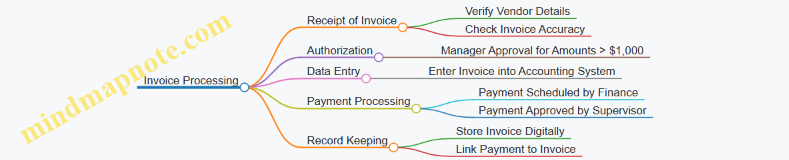
Summary
This internal control checklist, combined with practical examples and visual mind maps, provides accountants with a structured approach to managing risks in their daily operations. Implementing these controls helps safeguard assets, ensure accurate financial reporting, and maintain regulatory compliance.
11.3 Risk Register Template with Real-Life Entries
A Risk Register is a fundamental tool in risk management that helps accountants systematically identify, assess, and monitor risks throughout their processes. It serves as a centralized document to track risk details, mitigation actions, owners, and status.
What is a Risk Register?
A Risk Register is essentially a living document that captures the following key elements:
- Risk ID: Unique identifier for each risk
- Risk Description: Clear and concise explanation of the risk
- Category: Type of risk (e.g., financial, operational, compliance, fraud)
- Likelihood: Probability of the risk occurring (e.g., Low, Medium, High)
- Impact: Potential effect on the organization (e.g., Low, Medium, High)
- Risk Score: Combined rating of likelihood and impact to prioritize risks
- Mitigation Actions: Steps to reduce or manage the risk
- Risk Owner: Person responsible for managing the risk
- Status: Current status (e.g., Open, In Progress, Closed)
- Review Date: Date for next risk review
Risk Register Mind Map
Sample Risk Register Template (Table Format)
| Risk ID | Risk Description | Category | Likelihood | Impact | Risk Score | Mitigation Actions | Risk Owner | Status | Review Date |
|---|---|---|---|---|---|---|---|---|---|
| R001 | Revenue recognition errors | Financial | Medium | High | 8 | Implement monthly reconciliations; training staff | Finance Manager | In Progress | 2024-07-01 |
| R002 | Unauthorized access to accounting system | Operational | Low | High | 6 | Enforce multi-factor authentication; audit logs | IT Security | Open | 2024-06-15 |
| R003 | Non-compliance with SOX documentation | Compliance | Medium | Medium | 6 | Regular internal audits; compliance checklist | Compliance Lead | In Progress | 2024-06-30 |
| R004 | Payroll fraud due to fake employee | Fraud | Low | High | 6 | Segregation of duties; periodic payroll audits | HR Manager | Open | 2024-07-15 |
Real-Life Example Entries Explained
Risk ID: R001 - Revenue Recognition Errors
- Description: Errors in recognizing revenue can lead to misstated financial statements.
- Mitigation: Monthly reconciliations ensure that revenue recorded matches actual sales. Training staff on updated accounting standards reduces errors.
Risk ID: R002 - Unauthorized Access to Accounting System
- Description: Unauthorized users accessing sensitive financial data can cause data breaches or manipulation.
- Mitigation: Multi-factor authentication adds a security layer. Audit logs help detect suspicious activities early.
Risk ID: R003 - Non-compliance with SOX Documentation
- Description: Failure to maintain proper documentation can result in regulatory penalties.
- Mitigation: Regular internal audits and compliance checklists ensure all SOX requirements are met.
Risk ID: R004 - Payroll Fraud Due to Fake Employee
- Description: Fraudsters may create fictitious employees to siphon payroll funds.
- Mitigation: Segregation of duties prevents one person from controlling the entire payroll process. Periodic audits can detect anomalies.
Mind Map: Example Risk Entry Breakdown
How to Use This Template Effectively
- Customize Categories: Adapt risk categories to reflect your organization’s specific accounting environment.
- Regular Updates: Keep the register current by reviewing and updating risk statuses and mitigation progress.
- Assign Clear Ownership: Ensure every risk has a designated owner accountable for mitigation.
- Prioritize Risks: Use the risk score to focus resources on the most critical risks.
- Integrate with Reporting: Use the register to inform risk communication with management and auditors.
Summary
A well-maintained Risk Register is a cornerstone of effective risk management for accountants. By documenting risks with real-life examples and actionable mitigation plans, accounting teams can proactively manage uncertainties and safeguard financial integrity.
11.4 Communication Plan Template for Risk Reporting
Effective communication of risk is critical for ensuring that all stakeholders understand the risks faced by the accounting function and can make informed decisions. A well-structured communication plan helps streamline the flow of risk information, clarifies responsibilities, and ensures timely reporting.
Key Components of a Risk Communication Plan
- Objectives: Define the purpose of risk communication (e.g., awareness, decision-making support).
- Stakeholders: Identify who needs to receive risk information (e.g., accounting team, management, auditors, board).
- Messages: What key risk information needs to be conveyed?
- Channels: How will the information be delivered? (e.g., reports, dashboards, meetings)
- Frequency: When and how often will communication occur?
- Responsibilities: Who is responsible for preparing, reviewing, and delivering the communication?
- Feedback Mechanism: How will feedback be collected and addressed?
Mind Map: Risk Communication Plan Overview
Example: Communication Plan Template for an Accounting Department
| Component | Details |
|---|---|
| Objectives | - Keep management informed of key accounting risks - Facilitate timely risk mitigation decisions |
| Stakeholders | - Accounting team - CFO and Finance Director - Internal Audit - Board Audit Committee |
| Messages | - Monthly risk summary - High-priority risk alerts - Control effectiveness updates |
| Channels | - Monthly risk report via email - Quarterly risk dashboard presentation - Ad hoc risk meetings for urgent issues |
| Frequency | - Monthly reporting - Quarterly deep-dive presentations - Immediate alerts for critical risks |
| Responsibilities | - Risk Officer: Compile and analyze risk data - CFO: Review and escalate as needed - Team Leads: Disseminate to team members |
| Feedback | - Quarterly feedback survey - Open Q&A during meetings - Email feedback channel |
Mind Map: Example Communication Flow
Practical Example: Monthly Risk Report Structure
-
Executive Summary
- Overview of key risks identified during the month
- Summary of risk trends and changes
-
Risk Register Updates
- New risks added
- Changes in risk ratings
- Risks closed or mitigated
-
Control Effectiveness
- Status of internal controls
- Results of recent control testing
-
Mitigation Actions
- Progress on risk mitigation plans
- Upcoming actions and deadlines
-
Emerging Risks
- Identification of new or evolving risks
-
Recommendations
- Suggested actions for management
-
Appendices
- Detailed risk data
- Supporting documentation
Tips for Successful Risk Communication
- Use clear, jargon-free language tailored to the audience.
- Incorporate visual aids such as charts, heat maps, and dashboards.
- Establish regular communication schedules to build trust and consistency.
- Encourage two-way communication to capture concerns and insights.
- Document all communications for audit and compliance purposes.
By implementing a structured communication plan template like the one above, accountants and risk managers can ensure that risk reporting is clear, consistent, and actionable, ultimately strengthening the organization’s risk posture.
11.5 Case Study: Applying Templates to Improve Risk Management Efficiency
In this case study, we explore how a mid-sized accounting firm enhanced its risk management efficiency by adopting standardized templates. These templates streamlined risk identification, assessment, mitigation, and reporting processes, enabling the firm to proactively manage risks and reduce errors.
Background
The firm was facing challenges with inconsistent risk documentation and communication across teams. Risk assessments were often incomplete, and internal controls were not uniformly applied, leading to increased audit findings and compliance risks.
Step 1: Implementing a Risk Assessment Template
The firm introduced a Risk Assessment Template tailored for accounting functions. This template included fields for:
- Risk Description
- Risk Category (Financial, Operational, Compliance, Fraud)
- Likelihood (High, Medium, Low)
- Impact (High, Medium, Low)
- Risk Score (Likelihood x Impact)
- Existing Controls
- Control Effectiveness
- Mitigation Actions
- Responsible Person
- Review Date
Example Entry:
| Field | Entry |
|---|---|
| Risk Description | Revenue recognition errors |
| Risk Category | Financial |
| Likelihood | Medium |
| Impact | High |
| Risk Score | Medium-High |
| Existing Controls | Monthly revenue reconciliation |
| Control Effectiveness | Moderate |
| Mitigation Actions | Implement automated revenue validation |
| Responsible Person | Senior Accountant |
| Review Date | 2024-12-31 |
Step 2: Using an Internal Control Checklist
To ensure consistent application of controls, the firm adopted a Control Checklist Template covering key accounting processes such as:
- Segregation of duties
- Authorization and approval
- Reconciliation procedures
- Access controls
- Documentation standards
Example Checklist Snippet:
- Segregation of duties enforced in accounts payable
- Monthly bank reconciliations performed and reviewed
- Access to accounting software restricted by role
Step 3: Maintaining a Risk Register
The firm consolidated all identified risks into a Risk Register Template to track status and updates. This register allowed for prioritization and monitoring.
Mind Map: Risk Register Structure
Step 4: Communication Plan Template
To improve transparency, the firm developed a Risk Communication Plan Template outlining:
- Audience (e.g., management, audit committee)
- Frequency of reporting
- Reporting format (dashboards, written reports)
- Key risk indicators to highlight
Example: Monthly risk dashboard sent to senior management highlighting top 5 risks with status updates.
Results and Benefits
- Improved Consistency: Templates standardized risk documentation across teams.
- Enhanced Visibility: The risk register and communication plan ensured stakeholders were informed.
- Proactive Mitigation: Early identification and tracking of risks reduced incidents.
- Time Savings: Automated and templated processes reduced time spent on risk management activities.
Mind Map: Workflow of Applying Templates
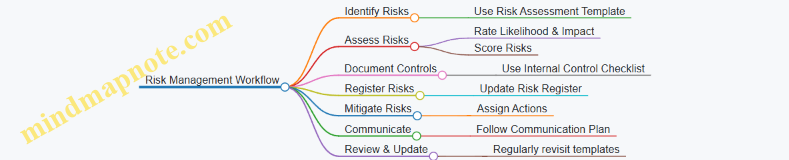
Final Example: End-to-End Use Case
- Risk Identified: Potential misclassification of expenses.
- Risk Assessment: Using the template, likelihood rated as Medium, impact as High.
- Controls Checked: Internal Control Checklist confirms approval process is in place but inconsistently followed.
- Risk Registered: Entered into Risk Register with mitigation action to train staff on approval protocols.
- Communication: Monthly report highlights this risk to management.
- Review: After 3 months, control effectiveness improved, risk score downgraded.
By integrating these templates into daily operations, the accounting firm significantly improved its risk management efficiency, reduced errors, and fostered a stronger risk-aware culture.
12. Conclusion and Key Takeaways
12.1 Recap of Best Practices in Risk Management for Accountants
Risk management is a critical discipline for accountants, helping to safeguard financial integrity, ensure compliance, and mitigate operational vulnerabilities. This section summarizes the key best practices covered throughout the blog, reinforced with practical examples and mind maps to visualize the concepts.
Best Practice 1: Comprehensive Risk Identification
- Description: Systematically identify risks across all accounting processes using techniques like checklists, brainstorming, and data analytics.
- Example: An accounts payable team uses a checklist to identify risks such as duplicate payments, vendor fraud, and late payment penalties.
Best Practice 2: Effective Risk Assessment and Prioritization
- Description: Use qualitative and quantitative methods to score risks by likelihood and impact, enabling prioritization.
- Example: A finance team assesses the risk of revenue recognition errors as high impact and medium likelihood, prioritizing it for immediate control enhancement.
Best Practice 3: Strong Internal Controls and Segregation of Duties
- Description: Design controls that prevent or detect errors and fraud, including segregation of duties to reduce risk exposure.
- Example: Separating the roles of invoice approval and payment processing to prevent fraudulent disbursements.
Best Practice 4: Continuous Monitoring and Control Testing
- Description: Regularly review and test controls to ensure effectiveness and adapt to changing risks.
- Example: Monthly reconciliation of bank statements to detect discrepancies early.
Best Practice 5: Proactive Compliance Management
- Description: Stay updated with regulatory requirements and embed compliance checks into accounting processes.
- Example: Implementing SOX compliance checklists and audit trails to ensure adherence.
Best Practice 6: Fraud Risk Awareness and Prevention
- Description: Recognize fraud red flags, conduct fraud risk assessments, and establish whistleblower policies.
- Example: Detecting payroll fraud by analyzing unusual overtime patterns and implementing anonymous reporting channels.
Best Practice 7: Clear Risk Communication and Reporting
- Description: Tailor risk reports to stakeholders using visual dashboards and concise summaries.
- Example: Presenting a risk heat map to senior management highlighting high-priority risks.
Best Practice 8: Leveraging Technology and Automation
- Description: Use ERP systems and automation tools to embed controls and generate alerts.
- Example: Configuring an ERP system to flag duplicate invoice entries automatically.
Best Practice 9: Cultivating a Risk-Aware Culture
- Description: Encourage proactive risk identification and continuous learning within accounting teams.
- Example: Incentivizing employees to report potential risks and conducting regular risk workshops.
Best Practice 10: Preparing for Emerging Risks
- Description: Stay ahead by scenario planning and adopting AI/ML tools to manage new risks like cryptocurrency accounting.
- Example: Running stress tests on financial models to assess impact of regulatory changes on digital assets.
Summary
By integrating these best practices, accountants can build robust risk management frameworks that not only protect their organizations but also enhance decision-making and compliance. The use of practical examples and visual mind maps helps translate complex risk concepts into actionable steps, fostering a culture of vigilance and continuous improvement.
12.2 How to Implement a Risk Management Program Step-by-Step
Implementing a risk management program in accounting is essential for safeguarding financial integrity, ensuring compliance, and minimizing operational disruptions. This section provides a detailed, step-by-step guide to help accountants and risk managers establish an effective risk management program, complete with practical examples and mind maps to visualize the process.
Step 1: Establish the Context
Before identifying risks, understand the internal and external environment where your accounting function operates.
- Define the scope of the risk management program (e.g., accounts payable, financial reporting).
- Identify stakeholders (internal teams, auditors, regulators).
- Understand regulatory requirements and organizational objectives.
Example: An accounting team at a mid-sized company defines the scope to include financial reporting and compliance with SOX regulations.
Step 2: Risk Identification
Use various techniques to identify potential risks affecting accounting processes.
- Brainstorming sessions with cross-functional teams.
- Reviewing past audit reports and incident logs.
- Using checklists tailored to accounting risks.
- Leveraging data analytics to spot anomalies.
Example: The team identifies risks such as revenue recognition errors, unauthorized payments, and data breaches.

Step 3: Risk Assessment
Evaluate the identified risks to understand their likelihood and potential impact.
- Use qualitative scales (e.g., Low, Medium, High).
- Quantify financial impact where possible.
- Prioritize risks based on combined scores.
Example: Revenue recognition errors are rated as High impact and Medium likelihood, making them a top priority.

Step 4: Risk Mitigation Planning
Develop strategies to reduce or eliminate prioritized risks.
- Design internal controls (e.g., segregation of duties).
- Implement automated checks in accounting software.
- Conduct staff training on compliance and fraud awareness.
Example: To mitigate unauthorized payments, the company enforces a dual-approval process and automated alerts for large transactions.
Step 5: Implementation of Controls
Put the mitigation plans into action.
- Update policies and procedures.
- Configure software systems.
- Communicate changes to all relevant personnel.
Example: The accounting department updates its payment policy and configures the ERP system to require two approvals for payments over $10,000.
Step 6: Monitoring and Review
Continuously track the effectiveness of risk controls and adjust as needed.
- Perform periodic audits and control testing.
- Use dashboards to monitor key risk indicators.
- Solicit feedback from staff and stakeholders.
Example: Quarterly internal audits reveal a slight increase in invoice discrepancies, prompting a review of the accounts payable process.
Step 7: Documentation and Reporting
Maintain thorough documentation of risk management activities and report findings to management.
- Keep risk registers updated.
- Prepare risk reports highlighting key risks and mitigation status.
- Use visual aids like charts and heat maps for clarity.
Example: The risk manager presents a quarterly report to senior management showing reduced fraud risk due to enhanced controls.
Summary Table: Step-by-Step Implementation
| Step | Description | Example |
|---|---|---|
| 1 | Establish Context | Define scope as financial reporting and SOX compliance |
| 2 | Risk Identification | Identify revenue recognition errors, unauthorized payments |
| 3 | Risk Assessment | Rate revenue errors as High impact, Medium likelihood |
| 4 | Risk Mitigation Planning | Implement dual-approval for payments over $10,000 |
| 5 | Implementation | Update policies, configure ERP system approvals |
| 6 | Monitoring & Review | Quarterly audits detect invoice discrepancies |
| 7 | Documentation & Reporting | Present quarterly risk reports to management |
By following these steps, accountants and risk managers can build a robust risk management program that proactively identifies, assesses, and mitigates risks, ensuring greater financial accuracy and compliance.
Additional Practical Example:
A small accounting firm implemented this step-by-step approach to address the risk of data breaches. After identifying the risk, they assessed its impact as high due to sensitive client data. They mitigated the risk by introducing multi-factor authentication and regular staff cybersecurity training. Continuous monitoring through system logs helped detect unusual access attempts, significantly reducing the risk exposure.
This structured approach, supported by clear visualization through mind maps and real-world examples, empowers accounting professionals to embed risk management deeply into their daily operations.
12.3 Final Practical Example: End-to-End Risk Management in an Accounting Cycle
In this section, we will walk through a comprehensive, end-to-end example of risk management applied to a typical accounting cycle. This practical illustration will integrate best practices, risk identification, assessment, mitigation, communication, and continuous improvement.
Step 1: Understanding the Accounting Cycle
The accounting cycle typically includes the following stages:
- Transaction Identification and Analysis
- Journal Entry Recording
- Posting to Ledger
- Trial Balance Preparation
- Adjusting Entries
- Financial Statement Preparation
- Closing Entries
- Reporting and Audit
Step 2: Mind Map of Risks Across the Accounting Cycle
Accounting Cycle Risk Mind Map
Step 3: Risk Identification and Assessment Example
Scenario: A mid-sized company preparing monthly financial statements.
- Risk Identified: Unauthorized journal entries leading to misstated revenues.
- Assessment: Likelihood - Medium; Impact - High.
Risk Scoring:
| Risk | Likelihood | Impact | Score (LxI) |
|---|---|---|---|
| Unauthorized journal entries | Medium (3) | High (5) | 15 |
This risk is prioritized for immediate mitigation.
Step 4: Risk Mitigation Actions
- Control: Implement segregation of duties so that the person recording journal entries is different from the person approving them.
- Control: Use system-enforced approval workflows for journal entries above a certain threshold.
- Control: Conduct periodic reviews and reconciliations by internal audit.
Example: The accounting software is configured to require dual approval for any journal entry exceeding $10,000.
Step 5: Monitoring and Reporting
- Monitoring: Automated alerts generated for any journal entries posted without approval.
- Reporting: Monthly risk report shared with CFO highlighting any control exceptions.
Example: A dashboard visualizes the number of approved vs. unapproved journal entries, highlighting any anomalies.
Step 6: Continuous Improvement
- Feedback from monthly reports is used to refine approval thresholds.
- Training sessions conducted quarterly to reinforce control importance.
- Internal audit findings are integrated into the risk register for ongoing tracking.
Mind Map: End-to-End Risk Management Flow
Summary
This example demonstrates how accountants can apply a structured risk management approach throughout the accounting cycle. By identifying risks early, assessing their potential impact, implementing targeted controls, and continuously monitoring and improving processes, accounting teams can significantly reduce the likelihood of errors, fraud, and compliance failures.
This integrated approach not only safeguards financial integrity but also enhances stakeholder confidence and supports regulatory compliance.
12.4 Encouraging Lifelong Learning and Adaptability in Risk Management
In the fast-evolving landscape of finance and accounting, risk management is not a static discipline. Lifelong learning and adaptability are essential for accountants and risk managers to stay ahead of emerging risks, regulatory changes, and technological advancements. This section explores strategies to foster continuous learning and adaptability within risk management practices.
Why Lifelong Learning Matters in Risk Management
- Dynamic Risk Environment: New risks emerge regularly due to changes in regulations, technology, and market conditions.
- Regulatory Updates: Compliance requirements evolve, requiring accountants to update their knowledge continuously.
- Technological Advances: Automation, AI, and data analytics tools are transforming how risks are identified and managed.
- Improved Decision-Making: Continuous learning enhances critical thinking and proactive risk mitigation.
Strategies to Encourage Lifelong Learning and Adaptability
Example 1: Integrating Continuous Education into Daily Routine
An accounting firm encourages its team to dedicate 2 hours per week to online courses related to risk management and emerging regulations. They subscribe to industry newsletters and hold monthly knowledge-sharing meetings where team members present recent learnings.
Building Adaptability: Embracing Change and Innovation
- Mindset Shift: Encourage a growth mindset where challenges are seen as opportunities to learn.
- Flexibility in Processes: Regularly review and update risk management frameworks to incorporate new insights.
- Technology Adoption: Train staff on new risk management tools and data analytics platforms.
Example 2: Adapting to Regulatory Changes
When a new accounting standard is introduced, the risk management team organizes workshops to understand its implications. They update internal controls and risk assessment templates accordingly, ensuring compliance and minimizing disruption.
Practical Tips for Accountants and Risk Managers
- Set personal learning goals aligned with risk management competencies.
- Use microlearning techniques: short, focused learning sessions for busy schedules.
- Participate in cross-functional teams to gain diverse perspectives on risk.
- Leverage technology such as mobile apps and podcasts for learning on the go.
- Document lessons learned from risk incidents to build organizational knowledge.
Example 3: Using Simulation Exercises to Enhance Adaptability
An insurance company conducts quarterly risk scenario simulations where accountants role-play responses to cyber risk breaches or financial fraud. This hands-on approach builds confidence and adaptability under pressure.
Summary
Encouraging lifelong learning and adaptability in risk management empowers accountants to anticipate and respond effectively to evolving risks. By fostering a culture of continuous education, knowledge sharing, and openness to change, organizations can build resilient accounting teams capable of safeguarding financial integrity.
Further Reading & Resources
- “The Learning Organization” by Peter Senge
- Risk Management Professional (RMP) Certification
- Coursera and LinkedIn Learning courses on Risk Management
- Industry-specific regulatory update portals
12.5 Resources and Further Reading for Accountants
To deepen your understanding and enhance your skills in risk management within accounting, it is essential to leverage a variety of resources, including books, online courses, professional organizations, and practical tools. Below, you will find curated resources along with mind maps to help you organize your learning and examples to illustrate their practical application.
Recommended Books
-
“Risk Management for Accountants” by John J. Hampton
- A comprehensive guide focusing on risk identification, assessment, and mitigation tailored for accounting professionals.
-
“Internal Control and Fraud Prevention for Accountants” by Michael Ramos
- Explores internal controls and fraud risk management with real-world case studies.
-
“COSO Enterprise Risk Management: Establishing Effective Governance, Risk, and Compliance Processes” by Robert R. Moeller
- Delves into the COSO framework, widely adopted for risk management and internal controls.
Online Courses and Certifications
-
Certified Risk Management Assurance (CRMA) by The Institute of Internal Auditors (IIA)
- Focuses on risk management assurance and internal controls.
-
Coursera: Risk Management in the Global Economy
- Provides a broad overview of risk management principles applicable to finance and accounting.
-
LinkedIn Learning: Accounting Foundations: Internal Controls
- Practical course on designing and implementing internal controls.
Professional Organizations
-
The Institute of Management Accountants (IMA)
- Offers resources, webinars, and certifications related to risk management.
-
The Association of Certified Fraud Examiners (ACFE)
- Provides fraud prevention resources and training.
-
The Risk Management Association (RMA)
- Focuses on financial risk management education.
Practical Tools and Templates
-
COSO ERM Framework Documents
- Downloadable PDFs and guides for implementing enterprise risk management.
-
Sample Risk Register Templates
- Available on platforms like Smartsheet and Template.net for tracking risks.
-
Internal Control Checklists
- Templates to evaluate the effectiveness of controls in accounting processes.
Mind Maps
Mind Map 1: Risk Management Learning Path for Accountants
Mind Map 2: Internal Controls and Fraud Prevention
Mind Map 3: Compliance Risk Management
Examples of Applying Resources
Example 1: Using a Risk Register Template
An accounting team at a mid-sized firm downloaded a risk register template from Smartsheet. They customized it to include risks specific to revenue recognition and accounts receivable. By regularly updating the register and assigning risk owners, they improved visibility and accountability, which reduced errors by 15% over six months.
Example 2: Applying COSO ERM Framework
A multinational corporation adopted the COSO ERM framework after reading Moeller’s book and attending a related IIA webinar. They mapped their accounting risks against the framework components, implemented new controls, and enhanced their risk reporting, leading to better audit outcomes and regulatory compliance.
Example 3: Leveraging Online Courses for Team Training
An accounting department enrolled in the LinkedIn Learning course on internal controls. The team applied the learned concepts by redesigning their month-end closing process, introducing automated reconciliations, and reducing closing errors by 20%.
Final Tips
- Regularly update your knowledge by subscribing to newsletters from professional bodies like IMA and ACFE.
- Join relevant LinkedIn groups and forums to discuss risk management challenges and solutions.
- Practice applying concepts through case studies and simulations available in many online courses.
By integrating these resources, mind maps, and practical examples into your continuous learning journey, you will strengthen your risk management capabilities and contribute significantly to your organization’s financial integrity and resilience.