Asset Management for Accountants
1. Introduction to Asset Management in Accounting
1.1 Understanding Asset Management: Definitions and Scope
Asset management is a systematic process of developing, operating, maintaining, upgrading, and disposing of assets in the most cost-effective manner. For accountants, asset management involves tracking and managing an organization’s assets to ensure accurate financial reporting, compliance, and optimization of asset utilization.
Definition of Asset Management
Asset management can be defined as:
“The coordinated activities of an organization to realize value from assets.”
This includes physical assets like machinery, buildings, and vehicles, as well as intangible assets such as patents, trademarks, and software licenses.
Scope of Asset Management in Accounting
The scope covers:
- Asset Identification: Recognizing and cataloging assets.
- Valuation: Determining the financial value of assets.
- Depreciation & Amortization: Allocating the cost of assets over their useful life.
- Maintenance & Optimization: Ensuring assets remain productive and cost-efficient.
- Disposal: Properly removing assets from the books when no longer useful.
- Reporting: Accurate financial statements and regulatory compliance.
Mind Map: Asset Management Overview
Why Asset Management Matters for Accountants
Accountants play a critical role in asset management because:
- They ensure accurate recording of assets for financial integrity.
- They help in compliance with accounting standards (e.g., IFRS, GAAP).
- They provide insights into asset utilization and profitability.
- They support tax planning through proper depreciation and capitalization.
Example: Asset Management in a Small Business
Imagine a small manufacturing company that purchases a new machine for $50,000.
- Identification: The accountant tags the machine with a unique ID and records it in the asset register.
- Valuation: The purchase price is recorded as the asset’s cost.
- Depreciation: Using straight-line depreciation over 10 years, the accountant allocates $5,000 annually as an expense.
- Maintenance: Maintenance costs are tracked and capitalized if they extend the machine’s life.
- Disposal: After 8 years, the machine is sold for $10,000. The accountant calculates gain/loss and removes it from the books.
This example demonstrates how asset management integrates with accounting processes to maintain accurate financial records.
Mind Map: Asset Management Lifecycle Example
Summary
Understanding asset management is foundational for accountants managing financial records. It ensures assets are properly tracked, valued, and reported, supporting organizational decision-making and compliance. Throughout this blog, we will explore best practices and real-world examples to help accountants excel in asset management.
1.2 The Role of Accountants in Asset Management
Asset management is a critical function within finance and accounting, where accountants play a pivotal role in ensuring that an organization’s assets are properly recorded, valued, maintained, and reported. Their responsibilities extend beyond bookkeeping to strategic oversight, compliance, and optimization of asset utilization.
Key Responsibilities of Accountants in Asset Management
- Accurate Asset Recording: Accountants ensure all assets are correctly identified, tagged, and entered into the asset register.
- Valuation and Depreciation: They apply appropriate valuation methods and calculate depreciation to reflect the true value of assets over time.
- Compliance and Reporting: Accountants ensure asset management complies with accounting standards (e.g., IFRS, GAAP) and regulatory requirements.
- Internal Controls: They design and monitor controls to safeguard assets against loss, theft, or misappropriation.
- Financial Analysis: Accountants analyze asset performance and provide insights to optimize asset utilization and investment decisions.
Mind Map: Core Roles of Accountants in Asset Management
Example 1: Accurate Asset Recording in Practice
Imagine a mid-sized manufacturing company acquiring new machinery worth $500,000. The accountant’s role includes:
- Verifying the purchase documentation.
- Assigning a unique asset tag number.
- Recording the asset details (cost, purchase date, useful life) in the asset register.
- Ensuring the asset is categorized correctly (e.g., machinery vs equipment).
This process ensures that the asset is tracked throughout its lifecycle and reflected accurately in financial statements.
Mind Map: Asset Recording Workflow
Example 2: Depreciation Calculation and Reporting
Consider an accountant managing a fleet of delivery vehicles. Using the straight-line depreciation method, they calculate annual depreciation to allocate the cost evenly over the vehicles’ useful life.
- Vehicle cost: $100,000
- Useful life: 5 years
- Annual depreciation: $100,000 / 5 = $20,000
The accountant records this depreciation expense each year, impacting the income statement and reducing the asset’s book value on the balance sheet.
Mind Map: Depreciation Process
Strategic Role: Advising on Asset Optimization
Accountants also provide strategic advice by analyzing asset utilization and recommending whether to repair, replace, or dispose of assets. For example, if maintenance costs for a machine exceed its productivity benefits, the accountant may suggest replacement to improve overall financial performance.
Mind Map: Strategic Asset Management by Accountants
Summary
Accountants are integral to asset management, combining technical accounting skills with strategic insights. Their role ensures assets are accurately recorded, valued, and managed in compliance with standards, while also supporting decision-making to maximize asset value and organizational efficiency.
1.3 Types of Assets: Tangible vs Intangible
In asset management, understanding the types of assets is fundamental for accurate accounting, valuation, and reporting. Assets are broadly classified into two main categories: Tangible Assets and Intangible Assets. Each type has distinct characteristics, accounting treatments, and management considerations.
Tangible Assets
Tangible assets are physical, measurable assets that can be seen and touched. They are often referred to as fixed or tangible property and are essential for the operations of a business.
Examples of Tangible Assets:
- Buildings
- Machinery and Equipment
- Vehicles
- Land
- Furniture and Fixtures
Key Characteristics:
- Physical existence
- Depreciable (except land)
- Used in production or operations
Example: A manufacturing company owns a fleet of delivery trucks. These trucks are tangible assets because they have a physical form, can be used over multiple accounting periods, and depreciate over time.
Intangible Assets
Intangible assets lack physical substance but provide long-term value to the business. They often represent legal rights or competitive advantages.
Examples of Intangible Assets:
- Patents
- Trademarks
- Goodwill
- Copyrights
- Software licenses
Key Characteristics:
- No physical form
- Amortizable over useful life
- Often arise from legal rights or contracts
Example: An accounting firm purchases a software license for a portfolio management system. This license is an intangible asset because it provides value but does not have a physical form.
Mind Map: Overview of Asset Types
Mind Map: Tangible Assets Breakdown
Note: While inventory, cash, and accounts receivable are tangible in nature, this section focuses on fixed tangible assets relevant to asset management.
Mind Map: Intangible Assets Breakdown
Practical Example: Differentiating Tangible and Intangible Assets in Accounting
Scenario: An accounting firm acquires the following:
- Office building
- Accounting software license
- Trademark for its brand
- Office furniture
Classification:
- Office building: Tangible asset (fixed asset)
- Accounting software license: Intangible asset
- Trademark: Intangible asset
- Office furniture: Tangible asset
Accounting Implications:
- Tangible assets like the building and furniture will be capitalized and depreciated over their useful lives.
- Intangible assets like the software license and trademark will be capitalized and amortized based on their estimated useful life or legal protection period.
Best Practice Tips for Accountants
- Maintain Clear Asset Registers: Separate registers for tangible and intangible assets help in tracking and reporting.
- Use Appropriate Valuation Methods: Tangible assets often use historical cost less depreciation, while intangible assets may require impairment testing.
- Review Useful Lives Regularly: Both asset types require periodic review to adjust depreciation/amortization schedules.
- Document Acquisition Details: Include proof of ownership, legal rights, and valuation reports.
Understanding the distinction between tangible and intangible assets enables accountants and portfolio managers to apply the correct accounting treatments, optimize asset utilization, and ensure compliance with financial reporting standards.
1.4 Overview of Asset Life Cycle Management
Asset Life Cycle Management (ALCM) is a comprehensive approach that tracks and manages an asset through all stages of its existence—from acquisition to disposal. For accountants, understanding ALCM is crucial to ensure accurate financial reporting, compliance, and optimization of asset value.
Key Stages of Asset Life Cycle Management
Stage 1: Acquisition
This is the initial phase where the asset is purchased or obtained. Accountants play a key role in verifying the purchase price, ensuring proper documentation, and deciding whether the asset should be capitalized or expensed.
Example: A company purchases a new office printer for $5,000. The accountant verifies the invoice, confirms it meets the capitalization threshold, and records it as a fixed asset rather than an expense.
Stage 2: Utilization
Once acquired, the asset is put into use. Maintenance and monitoring are essential to preserve asset value and functionality.
Example: The printer requires regular maintenance every six months. The accountant tracks maintenance costs and ensures these are correctly recorded, distinguishing between capital improvements and routine expenses.
Stage 3: Depreciation
Depreciation allocates the cost of the asset over its useful life. Accountants select appropriate methods (e.g., straight-line, declining balance) based on asset type and company policy.
Example: Using straight-line depreciation, the $5,000 printer with a useful life of 5 years will depreciate $1,000 annually.
Stage 4: Revaluation
Assets may require revaluation due to impairment or market value changes. Accountants must test for impairment and adjust asset values accordingly.
Example: If the printer becomes obsolete after 3 years, an impairment test may reveal a lower recoverable amount, requiring a write-down.
Stage 5: Disposal
Disposal involves removing the asset from the books through sale, write-off, or scrapping. Proper documentation and accounting treatment are essential.
Example: The company sells the printer for $500 after 5 years. The accountant records the sale, removes the asset from the books, and recognizes any gain or loss.
Integrated Example: Asset Life Cycle of a Company Vehicle
This example shows how accountants must manage each stage carefully to ensure accurate financial records and compliance.
Summary
Asset Life Cycle Management is a vital framework that helps accountants manage assets efficiently and accurately. By understanding each stage—from acquisition through disposal—and applying best practices with real-world examples, accountants can enhance asset control, optimize financial reporting, and support strategic decision-making.
1.5 Importance of Accurate Asset Tracking: A Practical Example
Accurate asset tracking is a cornerstone of effective asset management, especially for accountants who are responsible for maintaining precise financial records and ensuring compliance with regulatory standards. Without accurate tracking, organizations risk financial misstatements, asset misappropriation, and inefficient resource utilization.
Why Accurate Asset Tracking Matters
- Financial Accuracy: Ensures that asset values on the balance sheet reflect reality, supporting accurate depreciation and impairment calculations.
- Regulatory Compliance: Helps meet audit requirements and adhere to accounting standards such as IFRS and GAAP.
- Operational Efficiency: Enables timely maintenance, reduces downtime, and optimizes asset utilization.
- Risk Mitigation: Prevents theft, loss, or misuse of assets through proper oversight.
Mind Map: Key Benefits of Accurate Asset Tracking
Practical Example: Tracking IT Equipment in a Mid-Sized Accounting Firm
Scenario: A mid-sized accounting firm recently invested in new IT equipment, including laptops, servers, and networking devices. The accounting team is tasked with tracking these assets accurately to ensure proper capitalization, depreciation, and maintenance.
Step 1: Asset Identification and Tagging
- Each piece of equipment is assigned a unique asset tag number.
- Details such as purchase date, cost, vendor, and warranty period are recorded in the asset register.
Step 2: Asset Register Maintenance
- The asset register is updated monthly to reflect any changes such as new acquisitions, disposals, or transfers.
Step 3: Depreciation Tracking
- Depreciation is calculated using the straight-line method over the expected useful life.
- Monthly depreciation expenses are recorded in the accounting system.
Step 4: Maintenance and Repairs
- Maintenance activities are logged against each asset.
- Costs related to repairs are tracked separately to analyze asset performance.
Step 5: Disposal and Write-Off
- When equipment becomes obsolete, disposal is recorded with details of sale or write-off.
- Gain or loss on disposal is calculated and reflected in financial statements.
Mind Map: Asset Tracking Workflow Example
Example Impact of Poor Asset Tracking
Imagine if the accounting firm failed to tag and record some laptops:
- Financial Impact: Assets might be underreported, leading to understated depreciation expenses and overstated profits.
- Audit Risk: Auditors may flag discrepancies, causing delays and potential penalties.
- Operational Issues: Maintenance schedules might be missed, resulting in equipment failure and productivity loss.
Summary
Accurate asset tracking is vital for accountants to maintain financial integrity, comply with regulations, and support operational efficiency. By implementing systematic tracking processes, accountants can provide reliable data that informs strategic decisions and safeguards organizational assets.
2. Asset Identification and Classification
2.1 Best Practices for Asset Identification and Tagging
Effective asset identification and tagging are foundational steps in asset management that enable accurate tracking, valuation, and reporting. For accountants, mastering these practices ensures transparency, compliance, and efficient asset lifecycle management.
Why Asset Identification and Tagging Matter
- Provides a unique identity to each asset
- Facilitates accurate record-keeping and audit trails
- Enhances asset tracking and reduces loss or misplacement
- Enables streamlined maintenance and depreciation calculations
Best Practices for Asset Identification and Tagging
Assign Unique Asset IDs
- Use a standardized format (e.g., prefix + numeric code)
- Ensure IDs are non-repetitive and consistent across systems
Use Durable and Visible Tags
- Choose tags resistant to environmental conditions (waterproof, heat-resistant)
- Use barcode, QR code, or RFID tags depending on asset type and tracking needs
Maintain a Centralized Asset Register
- Record asset ID, description, location, acquisition date, cost, and custodian
- Update register promptly with any changes
Categorize Assets Clearly
- Group assets by type, department, or usage
- Helps in reporting and depreciation method selection
Integrate Technology for Efficiency
- Utilize asset management software with tagging capabilities
- Automate scanning and updating processes
Train Staff on Tagging Protocols
- Ensure consistent tagging and data entry
- Regularly audit tagging accuracy
Mind Map: Asset Identification and Tagging Best Practices
Example 1: Implementing Asset Tagging in a Mid-Sized Accounting Firm
Scenario: A mid-sized accounting firm wants to improve its fixed asset tracking to reduce discrepancies during audits.
Steps Taken:
- Developed a unique asset ID format: “ACCT-YYYY-XXX” (e.g., ACCT-2024-001).
- Purchased durable barcode tags and attached them to all computers, printers, and office furniture.
- Created a centralized Excel-based asset register capturing asset ID, description, purchase date, cost, location, and custodian.
- Trained the administrative team on scanning barcodes during asset movement.
- Conducted quarterly audits to verify tag presence and register accuracy.
Outcome:
- Reduced asset misplacement by 30% in the first year.
- Simplified depreciation tracking and improved audit readiness.
Example 2: Using RFID Tags for High-Value Assets in Portfolio Management
Scenario: A portfolio manager overseeing multiple client assets wants real-time tracking of high-value equipment.
Steps Taken:
- Selected RFID tags for their ability to be scanned without line-of-sight.
- Tagged all high-value assets such as servers and specialized software licenses.
- Integrated RFID scanning with asset management software to update asset location automatically.
- Set up alerts for unauthorized asset movement.
Outcome:
- Enhanced security and reduced asset loss.
- Improved real-time visibility of asset location and status.
Summary
Adopting best practices in asset identification and tagging empowers accountants and portfolio managers to maintain accurate, reliable asset records. This foundation supports better financial reporting, compliance, and operational efficiency.
For further reading, consider exploring asset tagging technologies and software solutions tailored for finance and asset management sectors.
2.2 Classification of Assets for Financial Reporting
Asset classification is a fundamental step in financial reporting that helps accountants and portfolio managers present a clear and accurate picture of an organization’s financial position. Proper classification ensures compliance with accounting standards and facilitates better decision-making.
What is Asset Classification?
Asset classification involves grouping assets into categories based on their characteristics, liquidity, usage, and expected life span. This grouping helps in applying appropriate accounting treatments such as depreciation, impairment, and disclosure.
Main Categories of Assets for Financial Reporting
- Current Assets
- Non-Current Assets (Fixed Assets)
- Intangible Assets
- Financial Assets
Mind Map: Asset Classification Overview
Current Assets
Definition: Assets expected to be converted into cash or used up within one operating cycle or one year, whichever is longer.
Examples:
- Cash and Cash Equivalents: Physical cash, bank balances, money market funds.
- Accounts Receivable: Money owed by customers for goods or services delivered.
- Inventory: Raw materials, work-in-progress, and finished goods.
- Prepaid Expenses: Payments made in advance for services or goods.
Example Scenario: A company has $50,000 in cash, $120,000 in accounts receivable, $80,000 in inventory, and $10,000 prepaid insurance. These are all classified as current assets because they will be liquidated or consumed within the year.
Non-Current Assets (Fixed Assets)
Definition: Assets held for use in the production or supply of goods and services, expected to be used for more than one year.
Examples:
- Property, Plant, and Equipment (PPE): Buildings, machinery, vehicles.
- Investment Property: Real estate held for rental income or capital appreciation.
- Long-term Investments: Investments not intended to be sold within the next year.
Example Scenario: An accounting firm owns office equipment worth $200,000 and a building valued at $1,000,000. These are classified as non-current assets and depreciated over their useful lives.
Mind Map: Current vs Non-Current Assets
Intangible Assets
Definition: Non-monetary assets without physical substance but provide future economic benefits.
Examples:
- Goodwill: Value arising from acquisition of another company.
- Patents: Exclusive rights to use inventions.
- Trademarks: Brand names and logos.
Example Scenario: A portfolio manager evaluates a company that recently acquired a competitor. The excess purchase price over fair value of net assets is recorded as goodwill, an intangible asset.
Financial Assets
Definition: Assets representing contractual rights to receive cash or another financial instrument.
Examples:
- Stocks and bonds held for investment.
- Derivative instruments like options and futures.
Example Scenario: An accountant managing a client’s portfolio classifies shares of publicly traded companies as financial assets, recorded at fair value.
Mind Map: Intangible and Financial Assets
Best Practices for Asset Classification
- Consistency: Use consistent classification criteria across reporting periods.
- Documentation: Maintain clear documentation for classification decisions.
- Review: Periodically review asset classifications to reflect changes in use or intent.
- Compliance: Align classification with applicable accounting standards (e.g., IFRS, GAAP).
Integrated Example: Asset Classification in Practice
Scenario: An accountant at a mid-sized manufacturing company is preparing the year-end financial statements. The company owns:
- $100,000 in cash
- $250,000 in accounts receivable
- $500,000 in inventory
- $1,500,000 in machinery
- $300,000 in patents
- $200,000 in equity investments
Classification:
- Current Assets: Cash, Accounts Receivable, Inventory
- Non-Current Assets: Machinery
- Intangible Assets: Patents
- Financial Assets: Equity Investments
This classification ensures accurate presentation on the balance sheet and proper application of depreciation, amortization, and valuation methods.
By mastering asset classification, accountants and portfolio managers can enhance financial transparency, support compliance, and provide valuable insights for strategic asset management.
2.3 Using Asset Registers: Structure and Maintenance
An asset register is a comprehensive record of all the assets owned by an organization. For accountants, maintaining an accurate and up-to-date asset register is critical for financial reporting, compliance, and effective asset management.
What is an Asset Register?
An asset register is essentially a detailed database or ledger that tracks each asset’s key information, including acquisition details, valuation, depreciation, location, and status.
Importance of Asset Registers for Accountants
- Ensures accurate financial statements
- Facilitates depreciation and impairment calculations
- Supports audit and compliance requirements
- Helps in asset tracking and loss prevention
- Provides data for budgeting and capital planning
Structure of an Asset Register
A well-structured asset register typically contains the following fields:
- Asset ID/Tag Number: Unique identifier for each asset
- Asset Description: Clear description of the asset
- Category/Class: Classification such as machinery, vehicles, IT equipment
- Acquisition Date: Date when the asset was purchased or acquired
- Purchase Cost: Original cost of the asset
- Location: Physical location or department
- Custodian: Person responsible for the asset
- Useful Life: Estimated useful life for depreciation
- Depreciation Method: Method applied (e.g., straight-line)
- Accumulated Depreciation: Total depreciation charged to date
- Net Book Value: Current value after depreciation
- Status: Active, disposed, under maintenance
Mind Map: Asset Register Structure
Example: Sample Asset Register Entry
| Asset ID | Description | Category | Acquisition Date | Purchase Cost | Location | Custodian | Useful Life (Years) | Depreciation Method | Accumulated Depreciation | Net Book Value | Status |
|---|---|---|---|---|---|---|---|---|---|---|---|
| A-1001 | Dell Laptop XPS 13 | IT Equipment | 2022-01-15 | $1,200 | HQ Office | John Smith | 5 | Straight-Line | $240 | $960 | Active |
Maintenance of Asset Registers
Maintaining an asset register involves regular updates and audits to ensure data accuracy and completeness.
Best Practices for Maintenance:
- Regular Updates: Record acquisitions, disposals, transfers, and maintenance activities promptly.
- Periodic Physical Verification: Conduct physical asset counts to verify existence and condition.
- Reconciliation: Match physical counts with register data to identify discrepancies.
- Access Controls: Restrict editing rights to authorized personnel to prevent unauthorized changes.
- Backup and Security: Regularly back up the register and secure sensitive data.
Mind Map: Asset Register Maintenance
Example: Asset Register Maintenance Workflow
- Asset Acquisition: New asset purchased and details entered into the register.
- Tagging: Asset tagged with unique ID.
- Physical Verification: Quarterly physical count performed.
- Reconciliation: Differences between physical count and register investigated.
- Update Register: Corrections made to reflect accurate status.
- Disposal: When asset is sold or scrapped, disposal details recorded.
Practical Example: Using Excel for Asset Register
Many small to mid-sized firms use Excel to maintain their asset registers. Here’s a simple example of how to set it up:
- Create columns for each key field (Asset ID, Description, etc.)
- Use data validation for categories and status to maintain consistency
- Apply formulas to calculate accumulated depreciation and net book value
- Use conditional formatting to highlight assets nearing end of useful life
Example Formula: Straight-Line Depreciation in Excel
=IF(Status="Active", Purchase_Cost / Useful_Life * Years_Used, 0)
This formula calculates annual depreciation for active assets.
Summary
A well-maintained asset register is the backbone of effective asset management for accountants. It ensures transparency, compliance, and supports strategic financial decisions. By structuring the register properly and committing to regular maintenance, accountants can significantly enhance asset visibility and control within their organizations.
2.4 Example: Setting up an Asset Register for a Mid-Sized Firm
Setting up an asset register is a foundational step for effective asset management, especially for mid-sized firms where asset tracking can become complex without a structured approach. This section will guide you through the process of creating a comprehensive asset register, including best practices, practical examples, and mind maps to visualize the workflow.
What is an Asset Register?
An asset register is a detailed record of all the assets owned by a firm. It typically includes information such as asset description, acquisition date, cost, location, depreciation, and current status.
Why is it Important?
- Ensures accurate financial reporting
- Facilitates asset tracking and maintenance
- Supports compliance with accounting standards
- Helps in budgeting and forecasting
Step-by-Step Guide to Setting up an Asset Register
Step 1: Define Asset Categories
Start by classifying assets into categories that make sense for your firm. Common categories include:
- Property, Plant & Equipment (PPE)
- Vehicles
- IT Equipment
- Furniture & Fixtures
- Intangible Assets
Mind Map: Asset Categories
Step 2: Determine Required Data Fields
Identify the key data points to capture for each asset. Typical fields include:
- Asset ID (unique identifier)
- Description
- Category
- Purchase Date
- Purchase Cost
- Location
- Responsible Department/Person
- Depreciation Method
- Accumulated Depreciation
- Net Book Value
- Warranty/Service Information
Mind Map: Asset Data Fields
Step 3: Choose a Platform or Tool
For a mid-sized firm, options include:
- Excel or Google Sheets (for simplicity and flexibility)
- Dedicated Asset Management Software (for scalability and automation)
Step 4: Populate the Register
Begin by gathering existing asset information from invoices, purchase orders, and physical verification.
Example Table (Excel Format):
| Asset ID | Description | Category | Purchase Date | Purchase Cost | Location | Department | Depreciation Method | Accumulated Depreciation | Net Book Value |
|---|---|---|---|---|---|---|---|---|---|
| A001 | Dell Laptop XPS 15 | IT Equipment | 2023-01-15 | $1,500 | HQ Office | IT | Straight Line | $250 | $1,250 |
| A002 | Office Desk | Furniture & Fixtures | 2022-06-10 | $300 | HQ Office | Admin | Straight Line | $60 | $240 |
Step 5: Implement Asset Tagging
Assign unique asset IDs physically to assets using barcode or QR code labels to facilitate tracking.
Step 6: Establish Update and Audit Procedures
Set regular intervals (e.g., quarterly) to update the register and conduct physical audits to ensure accuracy.
Practical Example: Setting Up the Asset Register for “MidCo Ltd”
Background: MidCo Ltd is a mid-sized marketing firm with 150 employees. They have recently expanded their IT infrastructure and office space.
Implementation:
- Categorized assets into IT Equipment, Furniture, and Leasehold Improvements.
- Created an Excel-based asset register with the fields outlined above.
- Assigned asset IDs starting with category codes (e.g., IT001, FUR001).
- Tagged all new laptops and office furniture with QR codes.
- Designated the Finance department to update the register monthly.
Sample Entry:
| Asset ID | Description | Category | Purchase Date | Purchase Cost | Location | Department | Depreciation Method | Accumulated Depreciation | Net Book Value |
|---|---|---|---|---|---|---|---|---|---|
| IT001 | MacBook Pro 16 inch | IT Equipment | 2024-03-01 | $2,400 | HQ Office | IT | Declining Balance | $200 | $2,200 |
Mind Map: Asset Register Setup Workflow
Tips for Accountants
- Maintain consistency in naming conventions and data entry.
- Use filters and pivot tables in Excel for easy reporting.
- Collaborate with IT and Operations for accurate asset information.
- Document procedures for onboarding new assets.
By following this structured approach, accountants can establish a reliable asset register that supports accurate financial reporting and efficient asset management in a mid-sized firm.
2.5 Leveraging Technology for Asset Identification
In today’s fast-paced financial and asset management environment, leveraging technology for asset identification is not just a convenience but a necessity. Accurate and efficient asset identification helps accountants and portfolio managers maintain up-to-date records, reduce errors, and streamline reporting processes.
Why Technology Matters in Asset Identification
- Accuracy: Automated systems reduce human error in recording asset details.
- Efficiency: Speeds up the process of tagging and tracking assets.
- Real-Time Updates: Enables instant updates to asset registers.
- Integration: Seamlessly connects with accounting and ERP systems.
Common Technologies Used for Asset Identification
- Barcode Systems
- Radio Frequency Identification (RFID)
- QR Codes
- GPS Tracking
- IoT Sensors
Mind Map: Technologies for Asset Identification
Example 1: Implementing Barcode Systems in a Mid-Sized Accounting Firm
Scenario: An accounting firm manages a fleet of laptops, printers, and office equipment across three locations. Manual tracking led to misplaced items and inaccurate asset records.
Solution:
- Each asset was tagged with a unique barcode.
- Staff used handheld barcode scanners to log asset movements.
- Asset register software automatically updated inventory levels.
Outcome:
- Reduced asset loss by 30% within six months.
- Improved audit readiness with accurate records.
Example 2: Using RFID for Asset Tracking in a Finance Company
Scenario: A finance company manages hundreds of physical documents and IT equipment. Manual tracking was time-consuming and prone to errors.
Solution:
- RFID tags were attached to high-value assets and document storage boxes.
- RFID readers installed at entry/exit points automatically logged asset movements.
- Integration with the accounting system provided real-time asset status.
Outcome:
- Asset check-in/check-out time reduced by 50%.
- Enhanced security and reduced asset misplacement.
Best Practices for Leveraging Technology
- Choose the Right Technology: Consider asset type, volume, and budget.
- Train Staff Thoroughly: Ensure everyone understands how to use the system.
- Integrate Systems: Connect asset identification tools with accounting and ERP software.
- Regularly Update Asset Data: Schedule periodic audits to verify accuracy.
- Plan for Scalability: Select solutions that can grow with your organization.
Mind Map: Best Practices for Technology-Driven Asset Identification
By embracing technology for asset identification, accountants and portfolio managers can significantly improve the accuracy, efficiency, and security of their asset management processes. This not only supports compliance and reporting requirements but also enhances decision-making and operational effectiveness.
3. Asset Valuation and Depreciation Methods
3.1 Principles of Asset Valuation in Accounting
Asset valuation is a fundamental aspect of accounting that ensures assets are recorded and reported at appropriate values on financial statements. Accurate valuation impacts decision-making, financial analysis, and compliance with accounting standards.
Key Principles of Asset Valuation
- Historical Cost Principle: Assets are recorded at their original purchase price, including all costs necessary to bring the asset to its intended use.
- Fair Value Principle: Assets are valued at the price they would fetch in an orderly transaction between market participants at the measurement date.
- Net Realizable Value (NRV): The estimated selling price of an asset in the ordinary course of business, less any costs of completion and disposal.
- Replacement Cost: The cost to replace an asset with a similar one at current market prices.
- Present Value: The current worth of future cash flows expected from the asset, discounted at an appropriate rate.
- Impairment Principle: Assets should be written down if their carrying amount exceeds their recoverable amount.
Mind Map: Principles of Asset Valuation
Explanation and Examples
-
Historical Cost Principle
- This is the most common valuation method used in accounting.
- Example: A company purchases machinery for $100,000 and pays $5,000 for installation. The asset is recorded at $105,000.
-
Fair Value Principle
- Used when assets are revalued or for financial instruments.
- Example: A portfolio manager revalues an investment property to its current market price of $500,000, up from the historical cost of $450,000.
-
Net Realizable Value (NRV)
- Often applied to inventory or receivables.
- Example: Inventory originally costing $20,000 is expected to sell for $18,000 after $2,000 in selling costs. NRV is $16,000.
-
Replacement Cost
- Useful for insurance or asset management decisions.
- Example: Replacing a delivery truck today costs $60,000, although its book value is $40,000.
-
Present Value
- Common in valuing long-term assets or investments.
- Example: A piece of equipment is expected to generate $10,000 annually for 5 years. Discounting these cash flows at 8% gives a present value of approximately $40,000.
-
Impairment Principle
- Applied when asset value declines unexpectedly.
- Example: A machine with a carrying amount of $30,000 is damaged and its recoverable amount is estimated at $18,000. The asset is impaired by $12,000.
Mind Map: Applying Valuation Principles in Practice
Practical Example: Valuing a Company Vehicle
- Purchase Price: $25,000
- Additional Costs (tax, registration): $2,000
- Estimated Useful Life: 5 years
- Residual Value: $5,000
Step 1: Initial Valuation
- Recorded at $27,000 (purchase price + additional costs)
Step 2: Depreciation (Straight-Line Method)
- Annual Depreciation = (27,000 - 5,000) / 5 = $4,400
Step 3: Fair Value Assessment After 3 Years
- Market value estimated at $15,000
- Carrying amount after 3 years = 27,000 - (4,400 * 3) = $13,800
Since fair value ($15,000) > carrying amount ($13,800), no impairment needed.
Summary
Understanding and applying the correct asset valuation principles ensures that financial statements reflect true and fair values. Accountants must select the appropriate valuation method based on asset type, purpose, and regulatory requirements, while documenting assumptions and calculations clearly.
For accountants and portfolio managers, mastering these principles enables better asset management, improved reporting accuracy, and informed strategic decisions.
3.2 Common Depreciation Methods: Straight-Line, Declining Balance, and Units of Production
Depreciation is a key accounting concept that allocates the cost of a tangible asset over its useful life. Understanding the different depreciation methods helps accountants accurately reflect asset value and expense recognition in financial statements. Below, we explore the three most common depreciation methods with detailed explanations, mind maps, and practical examples.
Straight-Line Depreciation
Definition: This method spreads the cost of an asset evenly over its useful life.
Formula:
\[ \text{Annual Depreciation Expense} = \frac{\text{Cost of Asset} - \text{Residual Value}}{\text{Useful Life (years)}} \]
Mind Map:
Example:
An accountant purchases office equipment costing $10,000 with an expected residual value of $1,000 after 5 years.
- Annual Depreciation = (10,000 - 1,000) / 5 = $1,800
Each year, $1,800 is recorded as depreciation expense.
Declining Balance Depreciation
Definition: This accelerated method applies a fixed depreciation rate to the book value of the asset each year, resulting in higher expenses in early years and lower expenses later.
Common Variant: Double Declining Balance (DDB) method uses twice the straight-line rate.
Formula (DDB):
\[ \text{Depreciation Expense} = 2 \times \frac{1}{\text{Useful Life}} \times \text{Book Value at Beginning of Year} \]
Mind Map:
Example:
A delivery truck costs $20,000 with a useful life of 5 years.
- Straight-line rate = 1/5 = 20%
- Double declining rate = 40%
| Year | Beginning Book Value | Depreciation Expense (40%) | Ending Book Value |
|---|---|---|---|
| 1 | $20,000 | $8,000 | $12,000 |
| 2 | $12,000 | $4,800 | $7,200 |
| 3 | $7,200 | $2,880 | $4,320 |
| 4 | $4,320 | $1,728 | $2,592 |
| 5 | $2,592 | $2,592* | $0 |
*In the final year, depreciation is adjusted to fully depreciate the asset.
Units of Production Depreciation
Definition: Depreciation is based on actual usage or output rather than time, ideal for assets whose wear depends on usage.
Formula:
\[ \text{Depreciation Expense} = \frac{\text{Cost} - \text{Residual Value}}{\text{Total Estimated Units}} \times \text{Units Produced in Period} \]
Mind Map:
Example:
A manufacturing machine costs $50,000 with a residual value of $5,000 and an estimated total usage of 100,000 hours.
If the machine is used 10,000 hours in the first year:
- Depreciation Expense = ((50,000 - 5,000) / 100,000) * 10,000 = $4,500
If usage varies each year, depreciation expense will adjust accordingly.
Summary Table of Methods
| Method | Expense Pattern | Best Used For | Example Asset |
|---|---|---|---|
| Straight-Line | Even over useful life | General assets with consistent use | Office equipment |
| Declining Balance | Accelerated (front-loaded) | Assets losing value quickly early | Vehicles, technology |
| Units of Production | Based on actual usage | Usage-dependent assets | Manufacturing machinery |
By understanding these methods, accountants can select the most appropriate depreciation approach to reflect asset consumption accurately, optimize tax benefits, and provide clear financial insights to portfolio managers and stakeholders.
3.3 Selecting the Appropriate Depreciation Method: Case Study
Selecting the right depreciation method is crucial for accurate financial reporting and tax compliance. Different assets and business contexts require different approaches. This section explores a detailed case study to illustrate how accountants can evaluate and choose the most appropriate depreciation method.
Case Study Overview: ABC Manufacturing Company
ABC Manufacturing recently purchased a new piece of machinery for $100,000. The machinery is expected to have a useful life of 10 years with a residual value of $10,000. The company wants to understand which depreciation method best reflects the asset’s usage and financial impact.
Step 1: Understanding Depreciation Methods
Here is a mind map summarizing the common depreciation methods:
Step 2: Applying Each Method to ABC’s Machinery
1. Straight-Line Method
- Formula: (Cost - Residual Value) / Useful Life
- Calculation: ($100,000 - $10,000) / 10 = $9,000 per year
2. Declining Balance Method (Double Declining)
- Rate: 2 / Useful Life = 2 / 10 = 20%
- Year 1 Depreciation: $100,000 x 20% = $20,000
- Year 2 Depreciation: ($100,000 - $20,000) x 20% = $16,000
- Depreciation decreases over time
3. Units of Production Method
- Assumes 100,000 units produced over life
- Depreciation per unit: ($100,000 - $10,000) / 100,000 = $0.90 per unit
- If 12,000 units produced in Year 1: 12,000 x $0.90 = $10,800
Step 3: Evaluating Which Method Fits Best
- Asset Usage Pattern
- Consistent usage each year?
- Yes: Straight-Line preferred
- Heavy usage in early years?
- Yes: Declining Balance preferred
- Usage varies significantly?
- Yes: Units of Production preferred
- Consistent usage each year?
- Financial Reporting Objectives
- Stable expenses for budgeting?
- Straight-Line
- Tax benefits from accelerated depreciation?
- Declining Balance
- Matching expense to actual wear?
- Units of Production
- Stable expenses for budgeting?
Step 4: Decision for ABC Manufacturing
- ABC expects consistent production levels each year.
- They prefer predictable expenses for budgeting.
- Therefore, Straight-Line Method is the most appropriate.
Step 5: Example Journal Entries (Straight-Line)
| Year | Depreciation Expense | Accumulated Depreciation | Book Value |
|---|---|---|---|
| 1 | $9,000 | $9,000 | $91,000 |
| 2 | $9,000 | $18,000 | $82,000 |
Journal Entry:
Dr Depreciation Expense $9,000
  Cr Accumulated Depreciation $9,000
Summary
This case study demonstrates how understanding asset usage, financial goals, and accounting principles guides the selection of depreciation methods. Accountants must evaluate each asset individually and consider both financial and operational factors.
By applying these best practices, accountants and portfolio managers can ensure accurate asset valuation and reporting.
Additional Example: Choosing Declining Balance for Technology Equipment
- Tech equipment becomes obsolete quickly.
- Higher depreciation in early years matches rapid value loss.
- Accelerated depreciation also offers tax benefits.
Mind map:
Additional Example: Units of Production for Vehicle Fleet
- Vehicles’ wear depends on miles driven.
- Depreciation tied to actual usage reflects true value loss.
Mind map:
By integrating these examples and mind maps, accountants can better visualize and apply depreciation methods tailored to their asset portfolios.
3.4 Impairment Testing and Revaluation Procedures
Impairment testing and revaluation are critical components of asset management for accountants, ensuring that asset values reported in financial statements reflect their true economic value. This section will cover the concepts, procedures, and practical examples to help accountants effectively manage asset impairments and revaluations.
What is Asset Impairment?
Asset impairment occurs when the carrying amount of an asset exceeds its recoverable amount, meaning the asset is overvalued on the books and needs adjustment.
- Carrying Amount: The value at which the asset is recognized on the balance sheet.
- Recoverable Amount: The higher of an asset’s fair value less costs of disposal and its value in use.
When to Perform Impairment Testing?
- Annually for intangible assets with indefinite useful lives.
- When there is an indication that an asset may be impaired (e.g., physical damage, obsolescence, market decline).
Mind Map: Impairment Testing Process
Revaluation Procedures
Revaluation involves adjusting the carrying amount of an asset to its fair value, often used for property, plant, and equipment.
- Must be done regularly to ensure carrying amounts do not differ materially from fair value.
- Revaluation increases are credited to other comprehensive income and accumulated in equity under revaluation surplus.
- Revaluation decreases are recognized in profit or loss, unless reversing a previous revaluation surplus.
Mind Map: Revaluation Procedure
Practical Example 1: Impairment Testing of a Manufacturing Machine
Scenario: A manufacturing machine was purchased for $500,000 with accumulated depreciation of $200,000. Due to new technology, the machine’s market value has dropped significantly.
- Carrying amount: $500,000 - $200,000 = $300,000
- Fair value less costs to sell: $220,000
- Value in use (discounted cash flows): $250,000
Recoverable amount: Higher of $220,000 and $250,000 = $250,000
Impairment loss: $300,000 - $250,000 = $50,000
Accounting treatment: Recognize $50,000 impairment loss in profit and loss and reduce the carrying amount of the machine to $250,000.
Practical Example 2: Revaluation of Office Building
Scenario: An office building originally recorded at $1,000,000 with accumulated depreciation of $100,000 is revalued based on a recent appraisal.
- Appraised fair value: $1,200,000
- Carrying amount before revaluation: $900,000
Revaluation increase: $1,200,000 - $900,000 = $300,000
Accounting treatment: Increase the asset’s carrying amount to $1,200,000 and credit $300,000 to revaluation surplus in equity.
Update depreciation based on the new carrying amount and remaining useful life.
Key Best Practices
- Perform impairment reviews regularly and when triggers are identified.
- Document assumptions and calculations thoroughly.
- Use qualified appraisers for revaluations.
- Communicate changes clearly in financial reports.
- Coordinate with portfolio managers to understand asset utilization and market conditions.
By integrating impairment testing and revaluation procedures into your asset management practices, accountants can ensure financial statements reflect accurate asset values, supporting better decision-making and compliance with accounting standards.
3.5 Practical Example: Calculating Depreciation for a Fleet of Vehicles
Depreciation is a key accounting process that allocates the cost of an asset over its useful life. For accountants managing a fleet of vehicles, understanding how to calculate depreciation accurately is essential for financial reporting and tax purposes.
Step 1: Gather Asset Information
Before calculating depreciation, collect the following details for each vehicle:
- Purchase cost
- Estimated useful life (in years or mileage)
- Residual (salvage) value
- Date of acquisition
Example:
| Vehicle | Purchase Cost | Useful Life (Years) | Residual Value | Acquisition Date |
|---|---|---|---|---|
| Car A | $30,000 | 5 | $5,000 | Jan 1, 2023 |
| Car B | $45,000 | 7 | $7,000 | Mar 15, 2023 |
Step 2: Choose Depreciation Method
Common depreciation methods include:
- Straight-Line Method
- Declining Balance Method
- Units of Production Method
For simplicity, we will use the Straight-Line Method in this example.
Step 3: Calculate Annual Depreciation Expense
Formula:
\[ \text{Annual Depreciation} = \frac{\text{Cost} - \text{Residual Value}}{\text{Useful Life}} \]
Calculations:
-
Car A:
\[ \frac{30,000 - 5,000}{5} = \frac{25,000}{5} = 5,000\text{ per year} \]
-
Car B:
\[ \frac{45,000 - 7,000}{7} = \frac{38,000}{7} \approx 5,429\text{ per year} \]
Step 4: Record Depreciation Journal Entries
At the end of each accounting period:
| Account | Debit | Credit |
|---|---|---|
| Depreciation Expense | $5,000 | |
| Accumulated Depreciation | $5,000 |
(For Car A, similarly for Car B with $5,429)
Mind Map: Depreciation Calculation Process
Step 5: Consider Partial Year Depreciation
If a vehicle is acquired partway through the year, calculate depreciation proportionally.
Example: Car B acquired on March 15, 2023.
-
Number of months in service in 2023: 10.5 months (March 15 to Dec 31)
-
Monthly depreciation = $5,429 / 12 = $452.42
-
Partial year depreciation = $452.42 * 10.5 ≈ $4,750
Mind Map: Partial Year Depreciation
Step 6: Example Summary Table
| Vehicle | Annual Depreciation | Months in Service | Partial Year Depreciation |
|---|---|---|---|
| Car A | $5,000 | 12 | $5,000 |
| Car B | $5,429 | 10.5 | $4,750 |
Additional Tips for Accountants Managing Vehicle Fleets
- Maintain an updated asset register including acquisition dates and costs.
- Review residual values annually to reflect market conditions.
- Consider using fleet management software to automate depreciation calculations.
- Coordinate with tax advisors to align depreciation methods with tax regulations.
This practical example demonstrates how straightforward depreciation calculations can be when broken down step-by-step, helping accountants provide accurate financial information and support portfolio managers in asset valuation and decision-making.
4. Asset Acquisition and Capitalization Policies
4.1 Defining Capital vs Expense: Accounting Best Practices
Understanding the distinction between capital expenditures (CapEx) and operating expenses (OpEx) is fundamental for accountants managing asset accounting. This section explores the definitions, accounting treatments, and best practices with clear examples and mind maps to clarify the concepts.
What is Capital Expenditure (CapEx)?
Capital expenditures are funds used by a company to acquire, upgrade, or extend the life of long-term assets. These assets provide benefits over multiple accounting periods.
- Examples: Purchase of machinery, building renovations, software licenses with multi-year use.
- Accounting Treatment: Capitalized on the balance sheet and depreciated or amortized over the asset’s useful life.
What is Operating Expense (OpEx)?
Operating expenses are the costs required for the day-to-day functioning of the business. These expenses are consumed within the current accounting period.
- Examples: Rent, utilities, office supplies, routine maintenance.
- Accounting Treatment: Expensed immediately on the income statement.
Mind Map: Capital vs Expense Decision Factors
Best Practices for Defining Capital vs Expense
-
Establish Clear Capitalization Thresholds
- Define a minimum dollar amount for capitalizing assets (e.g., $5,000).
- Example: A $4,000 purchase of office chairs is expensed, while a $6,000 purchase is capitalized.
-
Evaluate Asset Life Expectancy
- Capitalize expenditures that provide benefit beyond one year.
- Example: Software license for 3 years is capitalized; monthly subscription is expensed.
-
Assess Nature of the Expenditure
- Distinguish between improvements (capitalize) and repairs (expense).
- Example: Replacing an engine in a delivery truck extends life → capitalize; oil change → expense.
-
Document Policies and Train Staff
- Maintain written policies to ensure consistency.
- Provide training to procurement and accounting teams.
-
Review Regularly
- Periodically review thresholds and policies to align with business needs and regulations.
Example 1: Capitalizing a New Computer Purchase
Scenario: A company buys a laptop for $1,200 with an expected useful life of 3 years.
- Threshold: $1,000
- Since $1,200 > $1,000 and useful life > 1 year, capitalize.
Accounting Treatment:
- Record as an asset on the balance sheet.
- Depreciate over 3 years using straight-line method.
Example 2: Expensing Office Supplies
Scenario: The company purchases office supplies worth $300.
- Threshold: $1,000
- Since $300 < $1,000, expense immediately.
Accounting Treatment:
- Record as an expense on the income statement.
Mind Map: Accounting Treatment Flow
Summary
Distinguishing capital expenditures from operating expenses ensures accurate financial reporting, compliance with accounting standards, and effective asset management. By applying clear thresholds, evaluating asset life, and documenting policies, accountants can make consistent and informed decisions.
For further reading, accountants can refer to IAS 16 (Property, Plant and Equipment) or ASC 360 (Property, Plant, and Equipment) depending on their jurisdiction.
4.2 Establishing Capitalization Thresholds
What is a Capitalization Threshold?
A capitalization threshold is the minimum dollar amount at which an asset purchase is recorded as a capital asset rather than an expense. This threshold helps organizations determine which purchases should be capitalized and depreciated over time versus which should be expensed immediately in the income statement.
Why Establish Capitalization Thresholds?
- Consistency: Ensures uniform treatment of asset purchases across the organization.
- Materiality: Avoids tracking and depreciating insignificant assets that do not materially impact financial statements.
- Efficiency: Reduces administrative burden by limiting the number of assets that require detailed tracking.
Factors to Consider When Setting Capitalization Thresholds
Mind Map: Factors Influencing Capitalization Thresholds
Common Practices and Examples
| Company Type | Typical Capitalization Threshold | Rationale |
|---|---|---|
| Small Business | $1,000 - $5,000 | Minimize tracking of low-value assets |
| Medium Enterprise | $5,000 - $10,000 | Balance between control and efficiency |
| Large Corporation | $10,000+ | Focus on material assets, reduce admin load |
Example 1:
A mid-sized accounting firm sets a capitalization threshold of $5,000. A new office printer costing $4,200 is expensed immediately, while a $7,500 server purchase is capitalized and depreciated over its useful life.
Example 2:
A portfolio management company with many intangible assets sets a lower threshold of $2,000 to capture software licenses and subscriptions as capital assets.
Steps to Establish Capitalization Thresholds
Mind Map: Steps to Establish Capitalization Thresholds
Practical Example: Setting a Capitalization Threshold Policy
Scenario:
An accounting firm with annual revenues of $50 million wants to establish a capitalization threshold that balances administrative efficiency with accurate financial reporting.
Process:
- Review past asset purchases and identify that most assets under $3,000 have minimal impact on financial statements.
- Benchmark shows similar firms use $5,000 as a threshold.
- Consult tax advisors to ensure compliance.
- Set threshold at $5,000.
- Draft policy stating all asset purchases above $5,000 are capitalized.
- Policy approved by CFO and audit committee.
- Communicate policy to procurement and accounting teams.
Outcome:
- The firm capitalizes IT equipment, furniture, and software licenses above $5,000.
- Smaller purchases are expensed immediately, reducing tracking burden.
Tips for Accountants
- Regularly review thresholds to reflect inflation and business growth.
- Coordinate with tax professionals to align accounting and tax capitalization policies.
- Document all decisions and rationale for audit purposes.
- Use asset management software to automate threshold enforcement.
Summary
Establishing capitalization thresholds is a critical best practice that ensures consistent, efficient, and compliant asset management. By considering company size, industry norms, regulatory requirements, and administrative capacity, accountants can set thresholds that optimize financial reporting and operational workflows.
4.3 Documentation and Approval Processes for Asset Acquisition
Asset acquisition is a critical process in asset management that requires thorough documentation and a clear approval workflow to ensure accountability, compliance, and proper financial recording. For accountants, understanding and implementing best practices in documentation and approval helps maintain transparency and control over company resources.
Importance of Documentation and Approval
- Ensures asset purchases align with budget and strategic goals.
- Provides audit trail for internal and external reviews.
- Prevents unauthorized or unnecessary acquisitions.
- Facilitates accurate capitalization and financial reporting.
Key Components of Documentation
-
Purchase Request Form
- Initiated by the department needing the asset.
- Details asset description, quantity, estimated cost, and justification.
-
Vendor Quotations and Selection
- Multiple quotes to ensure competitive pricing.
- Documentation of vendor evaluation and selection criteria.
-
Purchase Order (PO)
- Official document authorizing the purchase.
- Includes terms, delivery dates, and payment conditions.
-
Receiving Report
- Confirms delivery and condition of the asset.
- Signed by the receiving department.
-
Invoice and Payment Records
- Invoice matched against PO and receiving report for payment approval.
-
Asset Registration Form
- Captures asset details for the asset register (serial numbers, location, custodian).
Approval Workflow Best Practices
- Multi-level Approval: Depending on asset value, approvals may be required from department heads, finance managers, and senior executives.
- Segregation of Duties: Different individuals handle request initiation, approval, purchasing, and receiving to reduce fraud risk.
- Digital Approval Systems: Use of electronic workflows to track approvals and reduce processing time.
Mind Map: Asset Acquisition Documentation and Approval Process
Example Workflow: From Purchase Request to Capitalization
Scenario: An accounting firm needs to acquire new laptops for its portfolio management team.
-
Purchase Request: The IT department submits a purchase request form detailing 10 laptops, specifications, and justification citing outdated equipment impacting productivity.
-
Vendor Quotes: Procurement obtains three vendor quotes. Vendor A offers the best price and warranty.
-
Approval: The department head reviews and approves the request. The finance manager confirms budget availability and approves.
-
Purchase Order: A PO is issued to Vendor A with agreed terms.
-
Receiving: Upon delivery, the IT department verifies the laptops against the PO and creates a receiving report.
-
Invoice & Payment: The finance team matches the invoice with the PO and receiving report, then processes payment.
-
Asset Registration: The laptops are tagged and entered into the asset register with details including serial numbers, purchase date, and assigned users.
-
Capitalization: The accountant applies the firm’s capitalization policy and records the laptops as fixed assets in the financial system.
Mind Map: Example Laptop Acquisition Workflow
Tips for Accountants
- Maintain a centralized digital repository for all asset acquisition documents.
- Regularly review approval thresholds and update workflows accordingly.
- Train staff on the importance of each documentation step to avoid delays.
- Use checklists to ensure no documentation step is missed.
By following structured documentation and approval processes, accountants can ensure asset acquisitions are transparent, compliant, and efficiently integrated into financial records, supporting sound asset management practices.
4.4 Example Workflow: From Purchase Request to Capitalization
Managing asset acquisition efficiently is critical for accountants to ensure accurate capitalization and compliance with accounting standards. Below is a detailed example workflow illustrating the process from the initial purchase request to the capitalization of the asset.
Step 1: Purchase Request Initiation
- Trigger: Department identifies the need for a new asset (e.g., new office laptops).
- Action: Submit a purchase request form including asset description, estimated cost, justification, and preferred vendor.
Example:
The IT department submits a purchase request for 10 laptops estimated at $1,200 each, citing the need to replace outdated equipment to improve productivity.
Step 2: Review and Approval
- Trigger: Purchase request is received by the finance or asset management team.
- Action: Review request for budget availability, necessity, and compliance with capitalization policy.
- Decision Points: Approve, reject, or request more information.
Example:
The finance team verifies the budget and confirms the laptops meet the capitalization threshold of $1,000 per unit. The request is approved.
Step 3: Purchase Order and Procurement
- Trigger: Approved purchase request.
- Action: Generate purchase order (PO) and send to vendor.
- Follow-up: Track order delivery and verify receipt.
Example:
A PO is created for 10 laptops and sent to the preferred vendor. Upon delivery, the receiving department verifies the quantity and condition.
Step 4: Asset Receipt and Inspection
- Trigger: Delivery of asset.
- Action: Inspect asset for quality and conformity to order.
- Documentation: Record serial numbers, condition, and receipt date.
Example:
The receiving team confirms all 10 laptops are delivered, serial numbers are recorded, and no damages are found.
Step 5: Asset Tagging and Registration
- Trigger: Asset inspection complete.
- Action: Assign asset tags and enter details into the asset register.
Example:
Each laptop is tagged with a unique barcode and entered into the asset register with purchase date and cost.
Step 6: Capitalization and Accounting Entry
- Trigger: Asset registered.
- Action: Capitalize asset according to accounting policies.
- Accounting Entries: Debit Asset Account, Credit Accounts Payable/Cash.
Example:
The total cost of $12,000 (10 laptops x $1,200) is capitalized. Straight-line depreciation over 3 years is selected. Journal entry:
- Debit: Office Equipment $12,000
- Credit: Accounts Payable $12,000
Step 7: Post-Capitalization Monitoring
- Trigger: Asset is capitalized.
- Action: Monitor asset for depreciation, maintenance, and eventual disposal.
Example:
Accountants schedule monthly depreciation entries and coordinate with IT for maintenance updates.
Summary Mind Map of Entire Workflow
This workflow ensures that asset acquisitions are properly documented, approved, and recorded, enabling accountants to maintain accurate financial records and comply with regulatory requirements. Integrating these steps into your asset management process improves transparency, accountability, and financial control.
4.5 Managing Leased Assets and Their Accounting Implications
Leased assets play a significant role in many organizations’ asset portfolios, especially when companies prefer operational flexibility or want to avoid large upfront capital expenditures. For accountants, understanding how to manage leased assets and their accounting treatment is critical to ensure compliance with accounting standards and accurate financial reporting.
Understanding Lease Types
Leases are generally classified into two main types under accounting standards such as IFRS 16 and ASC 842:
- Finance Lease (Capital Lease): Transfers substantially all risks and rewards of ownership to the lessee.
- Operating Lease: Does not transfer substantially all risks and rewards; lessee uses the asset without ownership.
Mind Map: Lease Classification
Accounting Treatment for Leased Assets
Finance Lease:
- Recognize Right-of-Use (ROU) Asset and Lease Liability on the balance sheet.
- Depreciate the ROU asset over the useful life or lease term.
- Interest expense on lease liability recognized separately.
Operating Lease:
- Lease payments are recognized as an expense on a straight-line basis over the lease term.
- No asset or liability recognized on the balance sheet (under previous standards; under IFRS 16 and ASC 842, most leases are recognized on balance sheet).
Mind Map: Accounting Treatment
Practical Example: Accounting for a Finance Lease
Scenario: A company leases machinery for 5 years. The lease payments are $20,000 annually, paid at year-end. The present value of lease payments is $85,000. The useful life of the machinery is 7 years.
Accounting Steps:
-
Initial Recognition:
- Debit Right-of-Use Asset: $85,000
- Credit Lease Liability: $85,000
-
Depreciation:
- Depreciate ROU asset over 5 years (lease term): $85,000 / 5 = $17,000 per year
-
Lease Payment:
- Each year, record interest expense on lease liability (using effective interest method)
- Reduce lease liability by the principal portion of the payment
-
Journal Entry Example (Year 1):
- Debit Interest Expense (e.g., $6,800)
- Debit Lease Liability (principal portion, e.g., $13,200)
- Credit Cash $20,000
-
Depreciation Entry:
- Debit Depreciation Expense $17,000
- Credit Accumulated Depreciation $17,000
Managing Lease Documentation and Controls
Maintaining accurate lease documentation is essential for compliance and audit readiness. Best practices include:
- Keeping signed lease agreements centralized and accessible.
- Tracking lease terms, renewal options, and payment schedules.
- Regularly reviewing lease classification and reassessing if terms change.
Mind Map: Lease Management Best Practices
Example: Lease Reassessment Due to Contract Modification
Scenario: A company initially classified a lease as an operating lease with a 3-year term. After 1 year, the lease term is extended by 2 years.
Accounting Implication:
- Reassess lease classification considering the extended term.
- Adjust ROU asset and lease liability to reflect new lease payments and term.
- Recognize any gain or loss if applicable.
Tax Implications of Leased Assets
- Lease payments under operating leases are generally deductible as expenses.
- Finance leases may allow depreciation deductions on the ROU asset.
- Tax treatment varies by jurisdiction; accountants must coordinate with tax professionals.
Summary
Managing leased assets requires a clear understanding of lease classification, accounting treatment, and ongoing management. Accountants should leverage technology to track leases, maintain documentation, and ensure compliance with evolving standards.
Additional Resources
- IFRS 16 Leases Standard
- ASC 842 Leases Guidance
- Lease Accounting Software Tools
By mastering leased asset management, accountants can provide accurate financial insights and support strategic decision-making.
5. Asset Maintenance and Optimization Strategies
5.1 Importance of Maintenance in Asset Longevity and Valuation
Maintenance plays a pivotal role in preserving the value and extending the useful life of assets. For accountants and portfolio managers, understanding how maintenance impacts asset longevity and valuation is crucial for accurate financial reporting, budgeting, and strategic decision-making.
Why Maintenance Matters
- Preserves Asset Functionality: Regular maintenance ensures assets operate efficiently, reducing the risk of unexpected breakdowns.
- Extends Useful Life: Proper upkeep can delay asset obsolescence, spreading costs over a longer period.
- Maintains Asset Value: Well-maintained assets retain higher market and book values.
- Reduces Repair Costs: Preventive maintenance is typically less costly than major repairs or replacements.
- Compliance and Safety: Maintenance ensures assets meet regulatory and safety standards, avoiding penalties.
Mind Map: Importance of Maintenance
Impact on Asset Valuation
Accountants must consider how maintenance affects asset valuation on financial statements:
- Book Value: Regular maintenance can justify the carrying amount by preventing impairment.
- Depreciation: Maintenance costs are generally expensed, but capital improvements can increase asset value and affect depreciation schedules.
- Impairment Testing: Poor maintenance may trigger impairment losses due to reduced asset utility.
Example: Maintenance Impact on a Manufacturing Machine
A manufacturing firm owns a machine valued at $500,000 with an expected useful life of 10 years. Without maintenance, the machine may fail after 6 years, requiring replacement.
- Scenario A (No Maintenance): Machine fails early, resulting in a $500,000 write-off and unplanned capital expenditure.
- Scenario B (Regular Maintenance): Scheduled maintenance costing $10,000/year extends machine life to 10 years, preserving value and spreading depreciation.
Accounting Implication: In Scenario B, the firm avoids impairment losses and benefits from predictable depreciation expenses, improving financial stability.
Mind Map: Maintenance Impact on Asset Valuation
Best Practices for Maintenance Management
- Develop a Maintenance Schedule: Plan preventive maintenance based on manufacturer recommendations and usage.
- Track Maintenance Costs: Record all maintenance expenses to analyze cost-effectiveness.
- Integrate with Asset Register: Link maintenance records to asset details for comprehensive tracking.
- Use Technology: Employ asset management software to automate reminders and reporting.
- Review and Adjust: Periodically assess maintenance effectiveness and adjust schedules accordingly.
Example: Maintenance Cost Tracking
An accounting team implements a spreadsheet to track maintenance expenses for office equipment:
| Asset | Maintenance Date | Cost | Description |
|---|---|---|---|
| Laptop #123 | 2024-03-15 | $150 | Battery replacement |
| Printer #45 | 2024-04-10 | $75 | Ink cartridge refill |
| HVAC System | 2024-05-01 | $500 | Annual servicing |
This tracking helps the team budget accurately and supports asset valuation discussions.
Summary
Maintenance is not just a technical necessity but a financial imperative. For accountants and portfolio managers, incorporating maintenance considerations into asset management practices ensures assets retain their value, supports accurate financial reporting, and optimizes operational costs.
By adopting structured maintenance programs and integrating them with accounting processes, organizations can maximize asset longevity and enhance overall financial health.
5.2 Integrating Maintenance Schedules with Accounting Records
Effective asset management goes beyond just acquisition and depreciation; it requires ongoing maintenance to preserve asset value and ensure operational efficiency. For accountants, integrating maintenance schedules with accounting records is critical to accurately track costs, forecast expenses, and comply with financial reporting standards.
Why Integrate Maintenance Schedules with Accounting Records?
- Accurate Cost Allocation: Maintenance costs can be capitalized or expensed depending on the nature of the work. Integration helps in proper classification.
- Improved Budgeting & Forecasting: Knowing when maintenance is due allows better cash flow management.
- Enhanced Asset Valuation: Regular maintenance can extend asset life, affecting depreciation schedules.
- Audit Trail & Compliance: Detailed records support audits and regulatory compliance.
Key Components of Integration
Step-by-Step Process for Integration
-
Define Maintenance Types and Their Accounting Treatment
- Preventive maintenance is usually expensed.
- Major repairs or upgrades may be capitalized.
-
Implement a Maintenance Scheduling System
- Use CMMS or calendar-based tools to schedule and record maintenance activities.
-
Link Maintenance Records to Asset Ledger
- Each maintenance event should reference the specific asset ID.
-
Record Costs in Accounting Software
- Maintenance expenses are coded correctly (expense vs capital).
-
Adjust Depreciation if Necessary
- Capitalized maintenance may require recalculating depreciation.
-
Generate Reports for Review
- Regularly review maintenance costs and asset performance.
Example: Integrating Maintenance for Office Equipment
Scenario: A mid-sized accounting firm manages a fleet of printers and computers.
- Maintenance Schedule: Preventive maintenance every 6 months.
- Accounting Treatment: Routine maintenance expensed; major repairs capitalized.
Process:
- The IT department logs maintenance tasks in a CMMS.
- Each task is linked to an asset ID (e.g., Printer #23).
- Maintenance costs are automatically pushed to the accounting system.
- Routine maintenance costs appear as expenses in the Profit & Loss statement.
- A major repair costing $5,000 is capitalized, increasing the asset’s book value.
- Depreciation schedules are updated to reflect the capitalized cost.
Result: The firm has clear visibility on maintenance costs, asset conditions, and accurate financial reporting.
Mind Map: Example Workflow for Maintenance-Accounting Integration
Practical Tips for Accountants
- Collaborate closely with maintenance teams to understand the nature of work.
- Establish clear policies on what qualifies as capital expenditure.
- Use integrated software solutions to minimize manual data entry errors.
- Regularly reconcile maintenance records with accounting entries.
- Train staff on the importance of accurate and timely data capture.
By integrating maintenance schedules with accounting records, accountants can provide more accurate financial insights, support asset longevity, and contribute to better organizational decision-making.
5.3 Cost-Benefit Analysis of Preventive vs Corrective Maintenance
Asset maintenance is a critical component of effective asset management, directly impacting the longevity, performance, and financial value of assets. Two primary maintenance strategies are preventive maintenance and corrective maintenance. Understanding the cost-benefit dynamics between these approaches enables accountants and portfolio managers to optimize asset-related expenditures and improve overall financial outcomes.
What is Preventive Maintenance?
Preventive maintenance (PM) involves regularly scheduled inspections, servicing, and repairs aimed at preventing unexpected asset failures. It is proactive and planned.
What is Corrective Maintenance?
Corrective maintenance (CM) occurs after an asset has failed or broken down. It is reactive and often unplanned.
Mind Map: Overview of Preventive vs Corrective Maintenance
Cost Components
| Cost Type | Preventive Maintenance | Corrective Maintenance |
|---|---|---|
| Labor Costs | Planned, often lower hourly rates | Often higher due to emergency or overtime |
| Parts and Materials | Scheduled replacement, bulk purchasing | Potentially higher due to urgent needs |
| Downtime Costs | Minimal, scheduled during off-hours | Potentially significant, unplanned |
| Equipment Life Span | Extended due to regular care | Reduced due to sudden failures |
| Risk of Secondary Damage | Low due to early detection | High due to cascading failures |
Mind Map: Cost Factors in Maintenance
Benefits Comparison
| Benefit Aspect | Preventive Maintenance | Corrective Maintenance |
|---|---|---|
| Reliability | High reliability and uptime | Lower reliability, unexpected failures |
| Budget Predictability | Easier to forecast and budget | Difficult to predict, can cause budget overruns |
| Safety | Improved safety through early detection | Increased safety risks due to sudden failures |
| Asset Value | Maintains or increases asset value | Potentially decreases asset value |
Mind Map: Benefits of Maintenance Types
Example Scenario: Fleet Vehicle Maintenance
Context: A mid-sized company manages a fleet of 50 delivery vehicles.
Preventive Maintenance Approach:
- Scheduled oil changes every 5,000 miles
- Tire rotations every 10,000 miles
- Brake inspections every 15,000 miles
Costs:
- Labor and parts cost per vehicle per year: $1,200
- Downtime scheduled during off-peak hours
Benefits:
- Average vehicle lifespan extended by 2 years
- Reduced emergency repairs
- Improved fuel efficiency
Corrective Maintenance Approach:
- No scheduled maintenance; vehicles repaired only when they break down
Costs:
- Emergency repair costs average $2,500 per vehicle per year
- Unplanned downtime causes delivery delays costing $500 per incident
Outcome:
- Higher overall costs due to emergency repairs and lost productivity
- Shorter vehicle lifespan
Mind Map: Fleet Maintenance Cost-Benefit Example
How Accountants Can Use This Analysis
- Budget Planning: Incorporate preventive maintenance costs into annual budgets to avoid surprise expenses.
- Financial Reporting: Reflect maintenance strategies in asset valuation and depreciation schedules.
- Decision Making: Use cost-benefit data to recommend maintenance policies that optimize asset life and reduce total cost of ownership.
Summary
Preventive maintenance generally requires higher upfront investment but results in lower long-term costs, improved asset reliability, and better budget predictability. Corrective maintenance may appear cheaper initially but often leads to higher emergency repair costs, increased downtime, and reduced asset life. Accountants and portfolio managers should leverage cost-benefit analysis to advocate for preventive maintenance strategies that align with organizational financial goals and asset management best practices.
5.4 Example: Tracking Maintenance Costs and Impact on Asset Value
Effective tracking of maintenance costs is crucial for accountants managing assets, as it directly influences asset valuation, budgeting, and financial reporting. This section provides a detailed example of how to track maintenance costs and analyze their impact on asset value, supported by mind maps and practical illustrations.
Understanding Maintenance Cost Categories
Maintenance costs can be broadly categorized as:
- Preventive Maintenance: Scheduled activities to prevent breakdowns.
- Corrective Maintenance: Repairs after a failure occurs.
- Predictive Maintenance: Condition-based maintenance using data analytics.
Tracking these costs separately helps in analyzing their impact on asset longevity and value.
Mind Map: Maintenance Cost Tracking Framework
Step-by-Step Example: Tracking Maintenance Costs for Office Equipment
Scenario: An accounting firm manages a fleet of 10 high-end printers. The asset manager wants to track maintenance costs and understand how these costs affect the asset’s book value.
Step 1: Asset Identification
- Asset: Printer #3
- Purchase Cost: $5,000
- Purchase Date: Jan 1, 2021
- Useful Life: 5 years
Step 2: Maintenance Activities Logged
| Date | Maintenance Type | Description | Cost |
|---|---|---|---|
| 2022-03-15 | Preventive | Routine cleaning & update | $150 |
| 2022-07-20 | Corrective | Replaced print head | $400 |
| 2023-01-10 | Preventive | Firmware upgrade | $100 |
Step 3: Total Maintenance Cost Calculation
- Total Maintenance Cost (2022-2023): $650
Step 4: Impact on Asset Value
-
Original Book Value (after 2 years depreciation):
- Straight-Line Depreciation = $5,000 / 5 years = $1,000/year
- Accumulated Depreciation after 2 years = $2,000
- Book Value = $5,000 - $2,000 = $3,000
-
Maintenance costs can be capitalized if they extend useful life or improve asset performance; otherwise, they are expensed.
-
In this example, the corrective maintenance (print head replacement) extends useful life by 1 year.
-
Adjusted Useful Life: 6 years
-
Revised Depreciation:
- New annual depreciation = $5,000 / 6 = $833.33
- Accumulated depreciation after 2 years = $1,666.66
- Book Value = $5,000 - $1,666.66 = $3,333.34
Step 5: Reporting and Decision Making
- Maintenance costs are recorded monthly.
- Capitalized costs are added to the asset’s book value.
- Expense maintenance costs are recorded in the P&L.
- The asset manager uses this data to forecast budgets and decide on asset replacement.
Mind Map: Maintenance Cost Impact on Asset Value
Practical Tips for Accountants
- Use Asset Management Software: Automate tracking of maintenance costs and link them directly to asset records.
- Separate Capitalizable vs Expense Costs: Maintain clear policies to avoid misclassification.
- Regularly Review Asset Useful Life: Adjust depreciation schedules based on maintenance activities.
- Generate Periodic Reports: Include maintenance cost trends and asset value changes for portfolio managers.
By systematically tracking maintenance costs and understanding their impact on asset value, accountants can provide more accurate financial insights and support strategic asset management decisions.
5.5 Using Asset Management Software to Optimize Maintenance
Asset management software (AMS) plays a pivotal role in optimizing maintenance activities by automating scheduling, tracking asset conditions, and analyzing maintenance costs. For accountants and portfolio managers, leveraging AMS can lead to improved asset longevity, cost savings, and more accurate financial reporting.
Key Benefits of Asset Management Software in Maintenance
- Automated Maintenance Scheduling: Ensures timely preventive maintenance, reducing unexpected breakdowns.
- Centralized Asset Data: Consolidates asset history, warranty info, and maintenance records.
- Cost Tracking: Monitors maintenance expenses linked to specific assets for budgeting and reporting.
- Real-Time Alerts: Notifies teams of upcoming or overdue maintenance tasks.
- Integration Capabilities: Syncs with ERP and accounting systems for seamless data flow.
Mind Map: Core Features of Asset Management Software for Maintenance
Example: Implementing AMS to Optimize Maintenance in a Mid-Sized Accounting Firm
Scenario: A mid-sized accounting firm manages a fleet of office equipment including servers, printers, and computers. Previously, maintenance was reactive, causing frequent downtime and unplanned expenses.
Solution: The firm implemented an AMS with the following features:
- Scheduled preventive maintenance for all equipment based on manufacturer recommendations.
- Real-time alerts for upcoming maintenance tasks sent to the IT and facilities teams.
- Maintenance costs tracked per asset, enabling better budgeting.
- Integration with the firm’s accounting software to automatically update maintenance expenses.
Outcome:
- Downtime reduced by 30% due to proactive maintenance.
- Maintenance costs became more predictable and aligned with budget forecasts.
- Accountants could generate detailed reports linking maintenance expenses to specific assets, improving transparency.
Mind Map: Workflow of Maintenance Optimization Using AMS
Practical Tips for Accountants Using AMS to Optimize Maintenance
- Ensure Accurate Asset Data Entry: The quality of maintenance optimization depends on comprehensive and accurate asset records.
- Customize Maintenance Schedules: Tailor schedules based on asset usage patterns and criticality.
- Monitor Maintenance Costs Closely: Use AMS reports to identify high-cost assets and investigate causes.
- Leverage Integration: Connect AMS with financial systems to automate expense tracking and reporting.
- Train Staff: Ensure maintenance and accounting teams understand how to use the AMS effectively.
Example: Using AMS Reports to Support Financial Decision-Making
An accountant reviews the AMS-generated maintenance cost report and notices that a particular server has unusually high repair costs over the past year. Using this insight, they recommend evaluating whether to replace the server or continue repairs, factoring in depreciation and future maintenance projections. This data-driven approach helps optimize capital allocation and asset management strategies.
In conclusion, asset management software is an indispensable tool for accountants and portfolio managers aiming to optimize maintenance. By automating processes, improving data accuracy, and enabling insightful reporting, AMS supports better asset utilization, cost control, and strategic decision-making.
6. Asset Disposal and Write-Off Procedures
6.1 Identifying When to Dispose or Write-Off an Asset
Disposing or writing off an asset is a critical decision in asset management that directly impacts financial statements, tax calculations, and operational efficiency. Accountants must carefully evaluate when an asset no longer provides economic benefit or when its carrying value is no longer recoverable.
Key Indicators for Asset Disposal or Write-Off
- Physical Obsolescence: Asset is physically worn out or damaged beyond repair.
- Technological Obsolescence: Asset is outdated due to new technology making it inefficient or redundant.
- Economic Obsolescence: Changes in market conditions or regulations render the asset less valuable or unusable.
- End of Useful Life: Asset has reached or exceeded its estimated useful life.
- Impairment Losses: Carrying amount exceeds recoverable amount.
- Idle or Surplus Assets: Assets no longer used in operations.
Mind Map: Indicators for Asset Disposal or Write-Off
Practical Example 1: Physical Obsolescence
A manufacturing company owns a machine purchased 10 years ago with a useful life of 8 years. The machine has broken down multiple times recently, and repair costs are exceeding its residual value. The accountant evaluates the asset and determines it should be written off.
- Action: Asset is disposed of and written off.
- Accounting Treatment: Remove asset cost and accumulated depreciation from books; recognize loss if any.
Practical Example 2: Technological Obsolescence
A portfolio manager oversees a set of financial software licenses. A new software version offers significant improvements, rendering the current licenses obsolete. The accountant assesses the carrying value of the old licenses and decides to write off the remaining balance.
- Action: Write-off obsolete software licenses.
- Accounting Treatment: Recognize impairment loss; adjust asset register accordingly.
Mind Map: Decision Process for Asset Disposal or Write-Off
Practical Example 3: Idle Asset Write-Off
An accounting firm has an old server that has been replaced but remains listed as an asset. It is no longer used and incurs maintenance costs.
- Action: Write off the asset as it no longer provides economic benefit.
- Accounting Treatment: Remove asset and accumulated depreciation; recognize any loss.
Summary
Identifying when to dispose or write off an asset requires a holistic approach considering physical condition, technological relevance, economic environment, and financial impact. Accountants should maintain clear documentation and collaborate with operational teams to ensure accurate and timely decisions.
Additional Tips for Accountants
- Regularly review asset registers for idle or obsolete assets.
- Use impairment testing to identify assets with diminished value.
- Establish clear policies for disposal and write-offs to streamline decision-making.
- Document all decisions and approvals to maintain audit trails.
6.2 Accounting for Asset Disposal: Gain, Loss, and Tax Implications
When an asset is disposed of, accountants must carefully record the transaction to reflect the financial impact accurately. This includes recognizing any gain or loss on disposal and understanding the associated tax implications.
Key Concepts in Asset Disposal Accounting
- Book Value (Carrying Amount): The asset’s original cost minus accumulated depreciation.
- Proceeds from Disposal: The amount received from selling or disposing of the asset.
- Gain on Disposal: When proceeds exceed the book value.
- Loss on Disposal: When proceeds are less than the book value.
Mind Map: Asset Disposal Accounting Process
Step-by-Step Example
Scenario: A company sells a machine with the following details:
- Original Cost: $50,000
- Accumulated Depreciation: $35,000
- Sale Proceeds: $20,000
Step 1: Calculate Book Value
Book Value = Original Cost - Accumulated Depreciation = $50,000 - $35,000 = $15,000
Step 2: Determine Gain or Loss
Proceeds ($20,000) > Book Value ($15,000) → Gain on Disposal = $5,000
Step 3: Journal Entry
| Account | Debit | Credit |
|---|---|---|
| Accumulated Depreciation | $35,000 | |
| Cash | $20,000 | |
| Equipment (Asset) | $50,000 | |
| Gain on Disposal of Asset | $5,000 |
Mind Map: Journal Entry Components
Tax Implications
- Taxable Gain: Gains on disposal may be subject to capital gains tax or ordinary income tax depending on asset type and jurisdiction.
- Deductible Loss: Losses can often be deducted, reducing taxable income.
- Depreciation Recapture: Some tax systems require recapturing depreciation as ordinary income when an asset is sold for more than its depreciated value.
Example: Tax Treatment of Disposal Gain
Continuing the previous example, assume the tax rate on capital gains is 25%, and depreciation recapture applies at 30%.
- Gain on Disposal: $5,000
- Portion attributable to depreciation recapture: $35,000 (accumulated depreciation)
Tax Calculation:
- Depreciation Recapture Tax = $35,000 * 30% = $10,500
- Capital Gain Tax on remaining gain ($5,000 - $35,000 = negative, so no additional capital gain tax)
Note: In this simplified example, the entire gain is considered recapture.
Mind Map: Tax Implications on Asset Disposal
Practical Tips for Accountants
- Always verify accumulated depreciation before disposal.
- Maintain detailed records of disposal transactions.
- Consult tax regulations for specific treatment of gains and losses.
- Coordinate with tax professionals to optimize tax outcomes.
Summary
Accounting for asset disposal involves:
- Calculating book value and comparing it to proceeds.
- Recording the appropriate gain or loss.
- Understanding and applying tax rules related to gains, losses, and depreciation recapture.
By following these practices and using clear documentation, accountants can ensure accurate financial reporting and compliance with tax laws.
6.3 Best Practices for Documentation and Authorization
Proper documentation and authorization are critical components in asset disposal to ensure transparency, accountability, and compliance with regulatory requirements. For accountants and portfolio managers, adhering to best practices in this area minimizes risks such as asset misappropriation, inaccurate financial reporting, and tax issues.
Key Elements of Documentation and Authorization
- Disposal Request Form: Initiated by the department or asset custodian, detailing the asset to be disposed, reason for disposal, and proposed method (sale, donation, scrapping).
- Approval Workflow: Multi-level authorization involving asset managers, finance, and senior management depending on asset value and company policy.
- Supporting Documents: Includes asset register entries, valuation reports, disposal agreements, and proof of removal or sale.
- Recording Disposal: Accurate journal entries reflecting gain/loss on disposal and removal of asset from books.
Mind Map: Asset Disposal Documentation and Authorization
Best Practices Explained with Examples
-
Standardize Disposal Request Forms
- Use a uniform template capturing all necessary details.
- Example: A mid-sized firm uses an electronic form where the asset custodian inputs asset ID, disposal reason (e.g., obsolete equipment), and preferred disposal method. This form automatically routes to finance for review.
-
Implement Multi-Level Authorization
- Define approval thresholds based on asset value.
- Example: Assets valued under $5,000 require department head approval; assets above require CFO sign-off. This prevents unauthorized disposals.
-
Maintain Comprehensive Supporting Documents
- Attach valuation reports or market appraisals when selling assets.
- Example: Before selling a company vehicle, the accounting team obtains a third-party appraisal to document fair market value, ensuring accurate gain/loss recording.
-
Ensure Timely and Accurate Recording
- Post disposal entries promptly to reflect true financial position.
- Example: Upon sale of obsolete machinery, the accountant removes the asset cost and accumulated depreciation from the ledger and records the sale proceeds, calculating the gain or loss.
-
Audit Trail and Compliance
- Keep records organized and accessible for internal and external audits.
- Example: The asset disposal folder includes signed approval forms, disposal agreements, and proof of asset removal, facilitating smooth audit processes.
Additional Mind Map: Authorization Workflow Example
Summary
By embedding these best practices into the asset disposal process, accountants and portfolio managers can ensure that disposals are well-documented, authorized appropriately, and accurately reflected in financial records. This reduces risk, supports compliance, and enhances organizational control over assets.
6.4 Example: Recording the Sale of Obsolete Equipment
When an asset becomes obsolete, selling it properly and recording the transaction accurately is crucial for maintaining clean financial records and complying with accounting standards. This section walks through a detailed example of how to record the sale of obsolete equipment, including journal entries, calculations, and best practices.
Step 1: Identify the Asset and Gather Relevant Information
- Asset: Office Printer
- Original Cost: $10,000
- Accumulated Depreciation: $7,000
- Book Value: $3,000 (Original Cost - Accumulated Depreciation)
- Sale Price: $2,500
- Date of Sale: June 30, 2024
Step 2: Calculate Gain or Loss on Sale
- Book Value: $3,000
- Sale Price: $2,500
- Loss on Sale: $3,000 - $2,500 = $500
Since the sale price is less than the book value, the company incurs a loss of $500.
Step 3: Prepare Journal Entries
| Account | Debit ($) | Credit ($) |
|---|---|---|
| Cash | 2,500 | |
| Accumulated Depreciation | 7,000 | |
| Loss on Sale of Equipment | 500 | |
| Equipment (Office Printer) | 10,000 |
Explanation:
- Debit Cash for the amount received.
- Debit Accumulated Depreciation to remove the depreciation related to the asset.
- Debit Loss on Sale of Equipment to recognize the loss.
- Credit Equipment account to remove the asset’s original cost.
Step 4: Record the Transaction in the Asset Register
Update the asset register to reflect:
- Disposal date: June 30, 2024
- Sale price: $2,500
- Accumulated depreciation removed
- Gain/loss recorded
Mind Map: Recording Sale of Obsolete Equipment
Additional Example: Sale with a Gain
- Asset: Delivery Van
- Original Cost: $25,000
- Accumulated Depreciation: $15,000
- Book Value: $10,000
- Sale Price: $12,000
Gain on Sale: $12,000 - $10,000 = $2,000
Journal Entry:
| Account | Debit ($) | Credit ($) |
|---|---|---|
| Cash | 12,000 | |
| Accumulated Depreciation | 15,000 | |
| Equipment (Delivery Van) | 25,000 | |
| Gain on Sale of Equipment | 2,000 |
Best Practices
- Always verify accumulated depreciation before recording the sale.
- Ensure proper authorization and documentation for asset disposal.
- Update asset registers immediately to maintain accurate records.
- Reflect gains or losses in the financial statements to provide transparency.
Summary
Recording the sale of obsolete equipment involves removing the asset and its accumulated depreciation from the books, recognizing any gain or loss on sale, and updating records accordingly. This process ensures accurate financial reporting and compliance with accounting standards.
6.5 Environmental and Compliance Considerations in Asset Disposal
Asset disposal is not just a financial or accounting process; it also involves critical environmental and regulatory compliance considerations. Accountants and portfolio managers must ensure that asset disposals adhere to environmental laws, industry regulations, and internal policies to avoid legal penalties, reputational damage, and financial loss.
Key Environmental and Compliance Factors in Asset Disposal
- Hazardous Materials Handling
- Data Security and Privacy
- Regulatory Reporting Requirements
- Waste Management and Recycling
- Documentation and Audit Trails
Mind Map: Environmental and Compliance Considerations in Asset Disposal
Detailed Explanation and Examples
Hazardous Materials Handling
Many assets, especially electronic equipment, vehicles, or machinery, may contain hazardous materials such as batteries, chemicals, or heavy metals. Improper disposal can lead to environmental contamination and legal penalties.
Example: A finance firm is disposing of old laptops. These laptops contain lithium-ion batteries which are classified as hazardous waste. The firm partners with an e-waste certified recycler who safely removes and recycles the batteries according to EPA guidelines. The accountant ensures that all disposal certificates and manifests are collected and filed for audit purposes.
Data Security and Privacy
When disposing of assets that store sensitive financial or client data, data security is paramount. Simply deleting files is insufficient; data must be securely wiped or the storage media physically destroyed.
Example: A portfolio management company replaces its servers. Before disposal, the IT department uses certified data destruction software to wipe all drives, and the accountant verifies the destruction certificates. This ensures compliance with GDPR and protects client confidentiality.
Regulatory Reporting Requirements
Certain jurisdictions require organizations to report asset disposals, especially when hazardous waste or large quantities of equipment are involved.
Example: An accounting firm disposes of old office furniture and electronics. The firm files the required disposal reports with the local environmental agency and maintains copies of these reports for compliance audits.
Waste Management and Recycling
Implementing environmentally responsible disposal methods, such as recycling or donation, helps reduce landfill waste and supports sustainability goals.
Example: A company donates functional office equipment to a nonprofit organization instead of discarding it. The accountant records the fair market value of the donated assets for tax deduction purposes and ensures proper documentation is maintained.
Documentation and Audit Trails
Maintaining thorough documentation throughout the disposal process is critical for compliance verification and audit readiness.
Example: For every disposed asset, the accounting team maintains a disposal form signed by authorized personnel, disposal receipts from vendors, and environmental compliance certificates. This documentation is reviewed during internal and external audits to demonstrate adherence to policies.
Summary
Environmental and compliance considerations in asset disposal require a multidisciplinary approach involving accounting, IT, legal, and facilities management teams. By following best practices and maintaining detailed documentation, accountants can ensure that asset disposals are compliant, secure, and environmentally responsible.
Additional Mind Map: Steps to Ensure Compliance in Asset Disposal
7. Asset Reporting and Financial Statement Integration
7.1 Preparing Asset-Related Reports for Stakeholders
Asset-related reports are critical tools that accountants and portfolio managers use to communicate the status, performance, and value of assets to various stakeholders. These reports provide transparency, support decision-making, and ensure compliance with regulatory and internal requirements.
Key Objectives of Asset-Related Reporting
- Provide accurate and timely information on asset holdings
- Highlight asset performance and utilization
- Identify risks and opportunities related to asset management
- Support financial statement preparation and audit processes
- Facilitate strategic planning and resource allocation
Stakeholders and Their Reporting Needs
Types of Asset-Related Reports
-
Asset Register Report
- Detailed list of all assets including descriptions, acquisition dates, costs, and current book values.
- Example: “Our asset register report for Q1 2024 lists 150 fixed assets with a total book value of $12 million, including machinery, vehicles, and IT equipment.”
-
Depreciation Report
- Shows depreciation expense by asset or asset category over a period.
- Example: “The depreciation report highlights that the straight-line method applied to office equipment resulted in $50,000 depreciation expense this quarter.”
-
Asset Performance Report
- Tracks utilization, maintenance costs, and operational efficiency.
- Example: “The fleet vehicles report indicates an average utilization rate of 85% and maintenance costs reduced by 10% compared to last year.”
-
Disposal and Write-Off Report
- Details assets disposed of or written off, including gains or losses.
- Example: “In March 2024, three obsolete machines were sold, generating a net loss of $5,000 recorded in the disposal report.”
-
Compliance and Audit Report
- Summarizes adherence to internal controls, regulatory requirements, and audit findings.
- Example: “The audit report confirmed 100% compliance with asset tagging and approval procedures.”
Best Practices for Preparing Asset-Related Reports
Example: Preparing a Monthly Asset Report for Portfolio Managers
Scenario: A portfolio manager needs a monthly report summarizing asset values, depreciation, maintenance status, and upcoming disposals.
Steps:
- Extract asset register data filtered by portfolio.
- Calculate monthly depreciation using the selected method.
- Include maintenance logs and upcoming scheduled maintenance.
- Highlight assets marked for disposal or write-off.
- Present key performance indicators such as asset utilization rate and cost efficiency.
Sample Summary Section:
| Asset Category | Total Value | Monthly Depreciation | Maintenance Cost | Utilization Rate | Notes |
|---|---|---|---|---|---|
| IT Equipment | $2,000,000 | $15,000 | $2,500 | 92% | Scheduled upgrade Q3 |
| Vehicles | $1,500,000 | $10,000 | $5,000 | 85% | 2 vehicles pending sale |
| Machinery | $3,000,000 | $25,000 | $7,500 | 78% | Maintenance overdue |
Visualizing Report Components
Tips for Effective Communication
- Use executive summaries to highlight key insights.
- Incorporate charts such as bar graphs for depreciation trends or pie charts for asset allocation.
- Provide context by comparing current data with previous periods.
- Ensure data integrity by cross-verifying with accounting systems.
By following these guidelines and leveraging structured reporting frameworks, accountants can deliver asset-related reports that empower stakeholders to make informed decisions and optimize asset management strategies.
7.2 Integrating Asset Data into Balance Sheets and Income Statements
Integrating asset data accurately into financial statements is a critical responsibility for accountants and portfolio managers. This process ensures that the organization’s financial health is transparently and correctly represented, enabling informed decision-making by stakeholders.
Understanding the Role of Asset Data in Financial Statements
Assets appear primarily on the Balance Sheet but also influence the Income Statement through depreciation, impairment, and disposal impacts. Proper integration involves:
- Recording assets at historical cost or fair value.
- Accounting for accumulated depreciation or amortization.
- Reflecting impairments or revaluations.
- Recognizing gains or losses on asset disposals.
Mind Map: Asset Data Flow into Financial Statements
Step-by-Step Integration Process
-
Asset Recognition and Initial Recording
- Record asset at purchase cost including all directly attributable costs.
- Example: A company purchases machinery for $100,000 with $5,000 shipping and installation costs. Total asset value = $105,000.
-
Depreciation and Amortization
- Allocate the cost of tangible and intangible assets over their useful lives.
- Example: Using straight-line depreciation on the machinery over 10 years results in an annual depreciation expense of $10,500.
-
Accumulated Depreciation
- Track the total depreciation charged to date as a contra-asset account on the balance sheet.
- Example: After 3 years, accumulated depreciation = $31,500.
-
Impairment and Revaluation Adjustments
- Adjust asset values when recoverable amounts fall below carrying amounts.
- Example: Machinery impaired by $15,000 due to technological obsolescence.
-
Disposal and Derecognition
- Remove asset and related accumulated depreciation from books.
- Recognize any gain or loss on disposal.
- Example: Selling machinery for $60,000 after 5 years with accumulated depreciation of $52,500 results in a gain of $7,500.
Mind Map: Detailed Asset Integration Workflow
Example: Integrating Asset Data into Financial Statements
Scenario:
- Asset: Office Building
- Purchase Price: $500,000
- Direct Costs (Legal, Transfer Fees): $20,000
- Useful Life: 25 years
- Depreciation Method: Straight-line
- Accumulated Depreciation after 5 years: $104,000
- Impairment Loss in Year 6: $30,000
- Disposal in Year 10 for $400,000
Balance Sheet Entries:
| Year | Asset Cost | Accumulated Depreciation | Impairment | Net Book Value |
|---|---|---|---|---|
| 0 | $520,000 | $0 | $0 | $520,000 |
| 5 | $520,000 | $104,000 | $0 | $416,000 |
| 6 | $520,000 | $124,800 (104k + 20.8k) | $30,000 | $365,200 |
Note: Annual depreciation = $520,000 / 25 = $20,800
Income Statement Entries:
| Year | Depreciation Expense | Impairment Loss | Gain/Loss on Disposal |
|---|---|---|---|
| 5 | $20,800 | $0 | $0 |
| 6 | $20,800 | $30,000 | $0 |
| 10 | $20,800 | $0 | $0 (until disposal) |
| Disposal Year | - | - | $14,400 Gain |
Gain Calculation at Disposal:
- Net Book Value at Year 10 = $520,000 - (10 x $20,800) - $30,000 impairment = $312,000
- Sale Price = $400,000
- Gain = $400,000 - $312,000 = $88,000
Note: The gain is recognized in the income statement in the year of disposal.
Tips for Accountants and Portfolio Managers
- Maintain detailed asset registers with cost, accumulated depreciation, and impairment data.
- Regularly reconcile asset sub-ledgers with general ledger balances.
- Use consistent depreciation methods aligned with accounting policies.
- Document assumptions and calculations for audit transparency.
- Collaborate with portfolio managers to understand asset utilization and impairment risks.
By following these best practices and understanding the flow of asset data into financial statements, accountants can ensure accurate reporting and provide valuable insights into asset performance and organizational value.
7.3 Key Performance Indicators (KPIs) for Asset Management
Effective asset management requires monitoring and analyzing key performance indicators (KPIs) that provide insights into how well assets are being utilized, maintained, and contributing to the organization’s financial health. For accountants and portfolio managers, KPIs help ensure assets are managed efficiently, risks are minimized, and returns are maximized.
What are KPIs in Asset Management?
KPIs are quantifiable measures used to evaluate the success of asset management activities against predefined objectives. They help in tracking performance trends, identifying inefficiencies, and making informed decisions.
Core KPIs for Asset Management
Below is a mind map illustrating the main categories of KPIs relevant to asset management:
Detailed Explanation and Examples
Return on Assets (ROA)
- Definition: Measures how efficiently a company uses its assets to generate profit.
- Formula: ROA = Net Income / Average Total Assets
- Example: If a firm has a net income of $500,000 and average assets worth $5,000,000, ROA = 10%. This means the company generates 10 cents for every dollar invested in assets.
Asset Turnover Ratio
- Definition: Indicates how effectively assets generate sales.
- Formula: Asset Turnover = Net Sales / Average Total Assets
- Example: A portfolio manager overseeing assets worth $10 million generates $25 million in sales, resulting in an asset turnover of 2.5, indicating efficient use of assets.
Asset Utilization Rate
- Definition: Percentage of time assets are actively used compared to available time.
- Formula: (Actual Asset Usage Time / Total Available Time) × 100
- Example: A machine is available 200 hours per month but used for 150 hours. Utilization Rate = (150/200)*100 = 75%.
Maintenance Cost per Asset
- Definition: Average maintenance expense incurred per asset over a period.
- Example: Total maintenance cost is $30,000 for 10 assets, so maintenance cost per asset = $3,000.
Downtime Percentage
- Definition: Percentage of time assets are non-operational.
- Formula: (Downtime / Total Available Time) × 100
- Example: If a server is down for 5 hours in a 100-hour period, downtime percentage = 5%.
Mean Time Between Failures (MTBF)
- Definition: Average time elapsed between asset failures.
- Example: If a piece of equipment fails twice over 1,000 hours, MTBF = 500 hours.
Asset Condition Index
- Definition: A qualitative KPI rating the physical and operational condition of assets.
- Example: Assets rated on a scale from 1 (poor) to 5 (excellent) to prioritize maintenance or replacement.
Compliance Rate
- Definition: Percentage of assets compliant with regulatory and internal standards.
- Example: If 95 out of 100 assets meet compliance, compliance rate = 95%.
Asset Age Profile
- Definition: Distribution of assets by age to assess replacement needs.
- Example: 40% of assets are over 10 years old, signaling potential upcoming capital expenditures.
Capital Expenditure (CapEx) Variance
- Definition: Difference between budgeted and actual capital spending.
- Example: Budgeted CapEx was $1 million, actual was $1.2 million, variance = +20%.
Disposal Rate
- Definition: Percentage of assets disposed of or written off during a period.
- Example: 5 assets disposed of out of 100 total assets, disposal rate = 5%.
Mind Map: Financial KPIs Focus
Mind Map: Operational KPIs Focus
Mind Map: Risk & Compliance KPIs Focus
Practical Example: Using KPIs to Improve Asset Management
A portfolio manager notices that the Asset Utilization Rate for a key piece of equipment is only 60%, while the Downtime Percentage is 25%. By analyzing the Maintenance Cost per Asset, they find that reactive maintenance costs are high. Using this data, they implement a preventive maintenance schedule, which increases utilization to 85%, reduces downtime to 10%, and lowers maintenance costs by 15% over six months.
Summary
KPIs empower accountants and portfolio managers to:
- Monitor asset performance quantitatively
- Identify underperforming or high-risk assets
- Optimize maintenance and capital expenditure decisions
- Align asset management with organizational financial goals
By regularly tracking these KPIs and integrating them into reporting dashboards, finance professionals can drive better asset management outcomes and contribute to overall business success.
7.4 Example: Monthly Asset Report for Portfolio Managers
A monthly asset report is a crucial tool for portfolio managers to monitor asset performance, track changes, and make informed decisions. This example will walk through the key components of an effective monthly asset report, integrating best practices with easy-to-understand examples.
Key Components of a Monthly Asset Report
Monthly Asset Report Mind Map
Example Monthly Asset Report Structure
1. Summary Overview
- Total Asset Value: $25,000,000
- Asset Allocation:
- Equities: 50%
- Fixed Income: 30%
- Real Estate: 15%
- Cash & Equivalents: 5%
- Performance Highlights:
- Portfolio gained 2.5% this month
- Equities outperformed fixed income by 1.2%
2. Detailed Asset Breakdown
| Asset Category | Market Value | Monthly Change | Income Generated |
|---|---|---|---|
| Equities | $12,500,000 | +3.0% | $50,000 |
| Fixed Income | $7,500,000 | +1.8% | $30,000 |
| Real Estate | $3,750,000 | +1.0% | $25,000 |
| Cash | $1,250,000 | 0.0% | $0 |
3. Risk Metrics
- Volatility: 8%
- Beta: 1.1
- Value at Risk (VaR): $500,000 at 95% confidence
4. Transactions Summary
| Date | Transaction Type | Asset | Amount |
|---|---|---|---|
| 2024-05-05 | Purchase | ABC Corp Stock | $500,000 |
| 2024-05-15 | Sale | XYZ Bonds | $300,000 |
5. Commentary and Insights
- Equities performed well due to strong earnings reports in the tech sector.
- Fixed income yields remain stable but show slight improvement.
- Recommended increasing exposure to real estate given market trends.
Mind Map: Report Workflow for Portfolio Managers
Best Practice Example: Automating Monthly Asset Reports
Scenario: A portfolio manager uses spreadsheet templates linked to live market data feeds and accounting software.
- Step 1: Import asset balances and transactions from accounting system.
- Step 2: Use formulas to calculate monthly changes and income.
- Step 3: Generate charts for asset allocation and performance.
- Step 4: Export report as PDF and distribute via email.
This automation reduces errors, saves time, and improves report accuracy.
Summary
A well-structured monthly asset report empowers portfolio managers with clear insights into asset performance and risk. Incorporating detailed breakdowns, risk metrics, and actionable commentary ensures the report is both informative and practical for decision-making.
7.5 Leveraging Dashboards and Visualization Tools
In asset management, especially for accountants and portfolio managers, dashboards and visualization tools are invaluable for transforming raw data into actionable insights. These tools help in monitoring asset performance, tracking depreciation, identifying risks, and communicating financial health effectively to stakeholders.
Why Use Dashboards and Visualization Tools?
- Simplify Complex Data: Visuals make it easier to understand large volumes of asset data.
- Real-Time Monitoring: Dashboards provide up-to-date information for timely decision-making.
- Identify Trends and Anomalies: Visualization highlights patterns that might be missed in spreadsheets.
- Improve Communication: Clear visuals help explain asset status to non-accounting stakeholders.
Key Components of an Effective Asset Management Dashboard
- Asset Valuation Summary
- Depreciation Schedules and Trends
- Maintenance Costs and Schedules
- Asset Utilization Rates
- Disposal and Write-Off Status
- Risk Indicators and Compliance Status
Mind Map: Core Elements of Asset Management Dashboards
Example: Creating a Dashboard for Monthly Asset Reporting
Scenario: A portfolio manager needs a monthly snapshot of asset performance to present in a board meeting.
Dashboard Elements:
- Asset Summary: Total assets by category (e.g., equipment, vehicles, software).
- Depreciation Overview: Graph showing monthly depreciation expense by asset class.
- Maintenance Costs: Bar chart comparing planned vs actual maintenance spend.
- Asset Utilization: Pie chart showing percentage of assets in active use vs idle.
- Disposal Status: Table listing assets disposed of in the month with gain/loss.
Visualization Tools Used: Excel PivotTables and Charts, Power BI for interactive reports.
Mind Map: Monthly Asset Reporting Dashboard Components
Practical Tips for Accountants and Portfolio Managers
-
Choose the Right Tool: For smaller firms, Excel or Google Sheets might suffice. Larger organizations benefit from Power BI, Tableau, or specialized asset management software.
-
Automate Data Feeds: Connect dashboards to your accounting or ERP systems to reduce manual data entry and errors.
-
Customize Views: Tailor dashboards for different stakeholders – detailed views for accountants, high-level summaries for executives.
-
Use Color Coding: Highlight critical metrics such as overdue maintenance, assets nearing end-of-life, or compliance issues.
-
Regularly Update and Review: Dashboards are only useful if data is current and reviewed frequently.
Example: Visualizing Asset Depreciation Trends
A line chart showing depreciation expense over 12 months for three asset categories: machinery, vehicles, and IT equipment. This visualization helps identify which asset classes are driving depreciation costs and informs budgeting decisions.
Mind Map: Visualization Types for Asset Management
By integrating dashboards and visualization tools into asset management workflows, accountants and portfolio managers can enhance transparency, improve accuracy, and support strategic decision-making with clear, data-driven insights.
8. Risk Management and Internal Controls in Asset Management
8.1 Identifying Risks Related to Asset Management
Effective asset management requires a thorough understanding of the risks that can impact the value, usability, and compliance of assets. For accountants and portfolio managers, identifying these risks early helps in designing controls and strategies to mitigate potential losses or misstatements.
Key Categories of Risks in Asset Management
Detailed Explanation and Examples
Operational Risks
-
Asset Misuse: When employees use company assets for unauthorized purposes, it can lead to accelerated wear or damage.
- Example: An accountant notices that company vehicles are frequently used for personal errands, increasing maintenance costs.
-
Inadequate Maintenance: Failure to maintain assets properly can reduce their useful life and increase repair costs.
- Example: A portfolio manager delays scheduled software updates, causing system downtime and data loss.
-
Theft or Loss: Physical assets are vulnerable to theft or accidental loss without proper controls.
- Example: Office equipment is stolen due to lack of secure storage and asset tagging.
Financial Risks
-
Valuation Errors: Incorrect asset valuation can distort financial statements.
- Example: An accountant uses outdated market data, overvaluing investment properties.
-
Depreciation Miscalculations: Applying wrong depreciation methods or rates affects profit and tax calculations.
- Example: Using straight-line depreciation on equipment that actually wears out faster, leading to understated expenses.
-
Capitalization Errors: Misclassifying expenses as capital expenditures or vice versa impacts asset base and expenses.
- Example: Small repairs are capitalized, inflating asset values.
Compliance Risks
-
Regulatory Non-Compliance: Failure to adhere to accounting standards (e.g., IFRS, GAAP) can cause legal penalties.
- Example: Not performing impairment tests as required leads to overstated assets.
-
Tax Reporting Errors: Incorrect tax treatment of assets can trigger audits and fines.
- Example: Misreporting asset disposals and gains in tax filings.
-
Documentation Gaps: Missing or incomplete asset records hinder audits and compliance.
- Example: Lost purchase invoices prevent proof of ownership.
Technological Risks
-
System Failures: Dependence on software for asset tracking can be risky if systems crash.
- Example: Asset management software outage causes delays in reporting.
-
Data Inaccuracy: Errors in data entry or integration lead to unreliable asset information.
- Example: Duplicate asset entries inflate asset counts.
-
Cybersecurity Threats: Unauthorized access can compromise sensitive asset data.
- Example: Hackers altering asset valuations in the system.
Strategic Risks
-
Poor Asset Allocation: Investing in underperforming or obsolete assets reduces portfolio returns.
- Example: Holding outdated technology assets that no longer meet business needs.
-
Obsolescence: Assets becoming outdated faster than anticipated.
- Example: New regulatory standards render existing equipment non-compliant.
-
Market Volatility: Fluctuations in market value impact asset worth.
- Example: Sudden drop in real estate prices affects asset valuations.
Environmental Risks
-
Natural Disasters: Physical damage to assets from floods, earthquakes, etc.
- Example: A hurricane damages company warehouses.
-
Environmental Regulations: Non-compliance with environmental laws can lead to fines.
- Example: Improper disposal of hazardous waste from manufacturing equipment.
Mind Map: Operational Risks in Asset Management
Mind Map: Financial Risks in Asset Management
Practical Example: Identifying Risks in a Mid-Sized Firm
Scenario: An accounting team at a mid-sized manufacturing company is reviewing their asset management processes.
- They discover that asset tagging is inconsistent, leading to missing equipment during inventory checks (Operational Risk: Theft/Loss).
- Depreciation schedules are manually calculated, increasing the chance of errors (Financial Risk: Depreciation Miscalculations).
- Some assets were capitalized without proper approval documentation (Compliance Risk: Documentation Gaps).
- The asset management software is outdated and frequently crashes (Technological Risk: System Failures).
Action: The team implements a standardized tagging system, automates depreciation calculations, enforces approval workflows, and upgrades their software.
Summary
Identifying risks related to asset management is a foundational step for accountants and portfolio managers. By categorizing risks into operational, financial, compliance, technological, strategic, and environmental, professionals can systematically address vulnerabilities. Using practical examples and mind maps helps visualize these risks and facilitates better communication within teams.
8.2 Designing Internal Controls to Safeguard Assets
Effective internal controls are essential for accountants and portfolio managers to protect organizational assets from loss, theft, or misuse. Designing these controls involves establishing policies, procedures, and monitoring mechanisms that ensure assets are properly recorded, used, and safeguarded.
Key Components of Internal Controls for Asset Safeguarding
Mind Map: Designing Internal Controls to Safeguard Assets
Practical Examples
Example 1: Segregation of Duties in Asset Acquisition
In a mid-sized accounting firm, the person who requests new computer equipment cannot approve the purchase or receive the delivery. The IT department handles receiving and tagging the asset, while the finance team records the asset in the accounting system. This separation reduces the risk of unauthorized purchases or asset misappropriation.
Example 2: Physical Controls Using Asset Tagging
A portfolio management company uses barcode tags on all laptops and monitors. Each asset is scanned upon issuance and return. Access to the storage room is restricted to authorized personnel only. This ensures assets are tracked and reduces losses.
Example 3: Periodic Reconciliation and Reporting
Quarterly, the finance team conducts a physical count of all fixed assets and compares it to the asset register. Any discrepancies trigger an investigation. Additionally, automated reports flag any asset disposals recorded without corresponding approval documents.
Tips for Implementing Internal Controls
- Start with a risk assessment to identify vulnerable assets and processes.
- Document all control procedures clearly and make them accessible.
- Use technology to automate controls where possible (e.g., asset management software).
- Regularly review and update controls to adapt to organizational changes.
- Foster a culture of accountability and ethical behavior.
By integrating these internal controls, accountants and portfolio managers can significantly reduce risks associated with asset mismanagement, ensuring accuracy in financial reporting and safeguarding organizational value.
8.3 Audit Procedures and Compliance Checks
Asset management is a critical area subject to rigorous audit procedures and compliance checks to ensure accuracy, prevent fraud, and maintain regulatory adherence. For accountants and portfolio managers, understanding these procedures is essential to safeguard assets and uphold financial integrity.
Key Audit Procedures in Asset Management
-
Physical Verification of Assets
- Conducting periodic physical counts to verify the existence and condition of assets.
- Comparing physical assets against the asset register.
-
Review of Asset Registers and Documentation
- Ensuring completeness and accuracy of asset records.
- Verifying acquisition dates, costs, and depreciation schedules.
-
Testing Depreciation Calculations
- Confirming that depreciation methods comply with accounting policies.
- Recalculating depreciation for sample assets.
-
Examination of Asset Acquisition and Disposal Transactions
- Validating approvals and documentation for asset purchases and disposals.
- Checking for proper recognition of gains or losses.
-
Compliance with Internal Controls
- Assessing segregation of duties in asset management processes.
- Reviewing authorization workflows.
-
Verification of Asset Impairment and Write-offs
- Ensuring timely recognition of impaired assets.
- Confirming proper accounting treatment for write-offs.
Mind Map: Audit Procedures Overview
Compliance Checks
Compliance checks ensure that asset management adheres to relevant accounting standards (e.g., IFRS, GAAP), tax regulations, and internal policies.
-
Regulatory Compliance
- Confirming asset valuation methods meet standards.
- Ensuring proper disclosure in financial statements.
-
Tax Compliance
- Verifying depreciation aligns with tax rules.
- Checking capital expenditure classification.
-
Internal Policy Adherence
- Reviewing adherence to capitalization thresholds.
- Ensuring asset tagging and tracking policies are followed.
Mind Map: Compliance Checks
Example 1: Physical Verification Audit
A mid-sized accounting firm conducts a quarterly physical verification of its fixed assets. During the audit, the team discovers that several computers listed in the asset register are missing, and a few assets are recorded but no longer in use. The audit team:
- Updates the asset register to reflect missing and obsolete assets.
- Investigates the cause of discrepancies, identifying lapses in asset tagging.
- Recommends strengthening controls around asset issuance and returns.
This example highlights the importance of physical verification in maintaining accurate asset records.
Example 2: Depreciation Compliance Check
During an internal audit, an accountant reviews the depreciation schedules of a portfolio of machinery. They find that some assets are depreciated using the straight-line method, while others use declining balance without documented rationale. The audit procedure includes:
- Reviewing company policy on depreciation methods.
- Recalculating depreciation for selected assets.
- Ensuring consistent application of methods or proper justification for exceptions.
The outcome leads to a policy update clarifying acceptable methods and mandatory documentation.
Example 3: Compliance Check on Asset Disposal
A portfolio manager reviews asset disposal transactions for the past year. The audit reveals that some disposals lack proper approval signatures and supporting documentation. The compliance check involves:
- Verifying disposal approvals against internal control policies.
- Confirming correct accounting treatment of gains and losses.
- Implementing a checklist to ensure all disposals are properly authorized and documented.
This reduces risk of unauthorized disposals and financial misstatements.
Summary
Audit procedures and compliance checks in asset management are vital for:
- Ensuring asset existence and accurate recording.
- Maintaining adherence to accounting and tax regulations.
- Preventing fraud and misappropriation.
- Supporting reliable financial reporting.
By integrating these practices, accountants and portfolio managers can enhance asset stewardship and organizational trust.
For further reading, consider exploring audit checklists specific to asset management and leveraging technology such as asset management software to automate compliance tracking.
8.4 Example: Implementing Segregation of Duties in Asset Handling
Segregation of Duties (SoD) is a fundamental internal control designed to prevent errors and fraud by dividing responsibilities among different individuals. In asset handling, this ensures that no single person has control over all aspects of an asset’s lifecycle, reducing the risk of misappropriation or misstatement.
Why Segregation of Duties Matters in Asset Handling
- Prevents fraud by requiring collusion for wrongdoing
- Enhances accuracy by introducing checks and balances
- Improves accountability and transparency
Key Functions to Separate in Asset Handling
- Authorization: Approving asset acquisition, disposal, or write-off
- Custody: Physical possession and maintenance of assets
- Record Keeping: Maintaining asset registers and accounting records
- Reconciliation: Verifying records against physical assets
Mind Map: Segregation of Duties in Asset Handling
Practical Example: Implementing SoD in a Mid-Sized Accounting Firm
Scenario: The firm manages a fleet of laptops, office furniture, and software licenses.
| Role | Responsibilities | Example Controls |
|---|---|---|
| Asset Manager | Authorizes asset purchases and disposals | Requires dual approval for purchases > $5,000 |
| IT Department | Custody of laptops and software licenses | Maintains physical custody and access controls |
| Facilities Team | Custody of office furniture | Responsible for physical maintenance and tagging |
| Accounting Team | Record keeping and depreciation | Updates asset register and posts depreciation entries |
| Internal Audit | Reconciliation and review | Conducts quarterly physical inventory and reconciles with records |
Mind Map: Example Roles and Responsibilities
Step-by-Step Implementation
- Define Roles Clearly: Document who is responsible for each function.
- Set Approval Limits: For example, purchases above a certain threshold require multiple sign-offs.
- Use Asset Tags and Access Controls: Physically tag assets and restrict access.
- Maintain an Up-to-Date Asset Register: Ensure the accounting team regularly updates records.
- Schedule Regular Reconciliations: Internal audit verifies physical assets against records quarterly.
- Train Employees: Educate staff on SoD importance and procedures.
Example Scenario: Preventing Fraud through SoD
A single employee responsible for both asset custody and record keeping could conceal theft by removing an asset and not updating the register. By separating these duties, the internal audit team would detect discrepancies during reconciliation, triggering investigation.
Summary
Implementing segregation of duties in asset handling is a practical and effective control to safeguard assets. By clearly defining roles, establishing approval workflows, and conducting regular reconciliations, accountants and portfolio managers can significantly reduce risks associated with asset mismanagement.
For further reading, consider exploring frameworks such as COSO Internal Control and leveraging asset management software that supports role-based access controls.
8.5 Case Study: Preventing Asset Misappropriation
Asset misappropriation is one of the most common types of occupational fraud, especially in asset management where physical and financial assets are involved. This case study explores how a mid-sized asset management firm successfully implemented controls and processes to prevent asset misappropriation, safeguarding their resources and maintaining stakeholder trust.
Background
The firm managed a diverse portfolio of physical assets including office equipment, vehicles, and IT hardware, alongside financial assets. Prior to intervention, the company experienced several incidents of missing equipment and unauthorized asset disposals, leading to financial losses and audit concerns.
Challenges Faced
- Lack of clear asset custody and responsibility assignments.
- Inadequate documentation and approval for asset disposals.
- Weak segregation of duties allowing single individuals to both authorize and record asset movements.
- Insufficient physical security and asset tracking mechanisms.
Implemented Solutions and Best Practices
Segregation of Duties (SoD)
- Practice: Separate responsibilities among different employees for asset custody, record-keeping, and authorization.
- Example: The employee who physically manages assets cannot update the asset register or approve disposals.
Asset Tagging and Tracking
- Practice: Assign unique asset tags (barcodes or RFID) to all physical assets.
- Example: Each asset is scanned upon receipt, movement, or disposal, with records updated in a centralized asset management system.
Authorization and Documentation Controls
- Practice: Implement formal approval workflows for asset acquisition, transfer, and disposal.
- Example: Disposal requests require dual approval from department head and finance manager, with documented reasons.
Regular Physical Audits
- Practice: Conduct surprise and scheduled physical asset counts reconciled against asset registers.
- Example: Quarterly audits revealed discrepancies early, triggering investigations.
Employee Training and Awareness
- Practice: Educate staff on asset management policies, fraud risks, and reporting mechanisms.
- Example: Annual training sessions and anonymous whistleblower channels were introduced.
Use of Technology
- Practice: Deploy asset management software integrated with ERP to automate tracking and reporting.
- Example: Automated alerts for asset movements outside authorized parameters.
Mind Maps
Mind Map 1: Components of Asset Misappropriation Prevention
Mind Map 2: Approval Workflow for Asset Disposal
Example Scenario
Situation: An employee attempts to dispose of an outdated laptop without proper authorization.
Process:
- Employee submits disposal request via asset management system.
- Department head reviews and rejects request due to missing justification.
- Employee escalates to finance manager without department head approval.
- System flags missing approval and prevents disposal record update.
- Audit trail logs attempted unauthorized disposal.
- Compliance team investigates, reinforcing training and controls.
Outcome: Unauthorized disposal prevented, employee educated on policies, and controls strengthened.
Key Takeaways
- Segregation of duties is critical to reduce fraud risk.
- Clear, documented approval workflows ensure accountability.
- Regular audits and technology integration enhance detection and prevention.
- Employee awareness and reporting mechanisms foster a culture of integrity.
This case study demonstrates that a comprehensive, multi-layered approach combining process controls, technology, and human factors is essential to effectively prevent asset misappropriation in asset management environments.
9. Tax Considerations and Regulatory Compliance
9.1 Understanding Tax Depreciation vs Accounting Depreciation
Asset depreciation is a fundamental concept in both accounting and tax reporting, but the methods and purposes can differ significantly. Understanding these differences is crucial for accountants and portfolio managers to ensure compliance, optimize tax benefits, and present accurate financial statements.
What is Depreciation?
- Depreciation is the systematic allocation of the cost of a tangible asset over its useful life.
- It reflects the wear and tear, usage, or obsolescence of an asset.
Key Differences Between Tax Depreciation and Accounting Depreciation
| Aspect | Accounting Depreciation | Tax Depreciation |
|---|---|---|
| Purpose | Reflects asset consumption for financial reporting | Calculates deductible expense for tax purposes |
| Governing Standards | IFRS, GAAP | Tax laws and regulations (e.g., IRS rules) |
| Methods Allowed | Straight-line, Declining balance, Units of production, etc. | Often accelerated methods like MACRS (US), or specific tax codes |
| Useful Life | Based on management’s estimate of asset life | Prescribed by tax authorities |
| Impact on Financials | Affects net income and asset book value | Affects taxable income and tax liability |
Mind Map: Overview of Depreciation Types
Why the Differences Matter
- Financial Statements: Accounting depreciation affects reported profits, influencing investor decisions.
- Tax Reporting: Tax depreciation reduces taxable income, impacting cash flow.
- Timing Differences: Different depreciation schedules can cause temporary differences leading to deferred tax assets or liabilities.
Example 1: Straight-Line vs Accelerated Depreciation
Scenario: A company purchases machinery for $100,000 with a useful life of 5 years.
-
Accounting Depreciation (Straight-Line):
- Annual depreciation expense = $100,000 / 5 = $20,000
- Equal expense each year for 5 years.
-
Tax Depreciation (Accelerated - MACRS simplified):
- Year 1: 30% depreciation = $30,000
- Year 2: 24% depreciation = $24,000
- Year 3: 17% depreciation = $17,000
- Year 4: 12% depreciation = $12,000
- Year 5: 10% depreciation = $10,000
- Year 6: 7% depreciation = $7,000
Impact:
- Tax depreciation front-loads expenses, reducing taxable income early.
- Accounting depreciation spreads expense evenly, showing consistent profit impact.
Mind Map: Depreciation Impact on Financials and Taxes
Example 2: Deferred Tax Asset from Depreciation Differences
Scenario: Using the machinery example above, in Year 1:
- Accounting depreciation expense = $20,000
- Tax depreciation expense = $30,000
Taxable income is lower than accounting income by $10,000.
This difference creates a deferred tax asset because the company pays less tax now but will pay more in future years when tax depreciation is lower than accounting depreciation.
Best Practices for Accountants
- Maintain clear documentation distinguishing accounting and tax depreciation methods.
- Regularly reconcile book and tax depreciation schedules.
- Communicate the impact of depreciation differences to portfolio managers and stakeholders.
- Use software tools to automate tracking and reporting.
Summary
Understanding the nuances between tax and accounting depreciation helps accountants ensure compliance, optimize tax benefits, and provide accurate financial insights. By mastering these concepts, professionals can better manage asset portfolios and support strategic decision-making.
9.2 Compliance with Local and International Accounting Standards
Asset management for accountants requires strict adherence to both local and international accounting standards to ensure transparency, accuracy, and regulatory compliance. This section explores the key standards relevant to asset management, how to comply with them, and practical examples to illustrate their application.
Understanding Key Accounting Standards for Asset Management
- Local Standards: Vary by country, often based on national Generally Accepted Accounting Principles (GAAP).
- International Standards: Primarily International Financial Reporting Standards (IFRS) issued by the IASB.
Mind Map: Overview of Accounting Standards for Asset Management
Key IFRS Standards Impacting Asset Management
-
IAS 16 - Property, Plant and Equipment
- Recognition criteria for assets
- Measurement after recognition (cost model vs revaluation model)
- Depreciation and residual value considerations
-
IAS 38 - Intangible Assets
- Recognition and measurement of intangible assets
- Amortization and impairment
-
IFRS 16 - Leases
- Accounting for leased assets
- Right-of-use asset recognition
-
IAS 36 - Impairment of Assets
- Identifying impairment indicators
- Measuring and recognizing impairment losses
Mind Map: IFRS Standards Relevant to Asset Management
Compliance Best Practices
- Stay Current: Regularly update knowledge on changes in local GAAP and IFRS.
- Documentation: Maintain thorough documentation for asset recognition, valuation, and impairment decisions.
- Consistent Policies: Apply consistent capitalization, depreciation, and impairment policies aligned with standards.
- Training: Provide ongoing training for accounting teams on standards and their practical application.
- Use Technology: Leverage accounting software that supports compliance with multiple standards.
Practical Examples
Example 1: Applying IAS 16 for Asset Revaluation
Scenario: A company owns machinery purchased at $500,000. After 5 years, the fair value is assessed at $600,000.
Application:
- Under IAS 16, the company can choose the revaluation model.
- Increase asset value to $600,000 and recognize revaluation surplus in other comprehensive income.
- Adjust depreciation based on the new carrying amount.
Accounting Entry:
- Debit: Machinery $100,000
- Credit: Revaluation Surplus (Equity) $100,000
Example 2: Lease Accounting under IFRS 16
Scenario: A portfolio manager leases office space for 5 years with annual payments of $50,000.
Application:
- Recognize a right-of-use asset and lease liability at present value of lease payments.
- Depreciate the right-of-use asset over lease term.
Accounting Entry at Lease Commencement:
- Debit: Right-of-use Asset $215,000 (PV of payments)
- Credit: Lease Liability $215,000
Mind Map: Steps to Ensure Compliance
Summary
Compliance with local and international accounting standards is fundamental for accountants managing assets. Understanding key standards like IAS 16, IAS 38, IFRS 16, and IAS 36, combined with best practices and practical application, ensures accurate financial reporting and regulatory adherence. Accountants should leverage mind maps and examples to simplify complex standards and embed compliance into daily asset management processes.
9.3 Handling Asset-Related Tax Incentives and Credits
Asset-related tax incentives and credits can significantly impact the financial outcomes of asset management for accountants. Understanding how to identify, apply, and document these incentives is crucial for maximizing tax benefits and ensuring compliance.
What Are Asset-Related Tax Incentives and Credits?
- Tax Incentives: Reductions in tax liability offered by governments to encourage investment in certain types of assets or activities.
- Tax Credits: Direct reductions in the amount of tax owed, often tied to specific asset purchases or improvements.
These incentives can apply to tangible assets (e.g., machinery, equipment) or intangible assets (e.g., software, patents).
Mind Map: Types of Asset-Related Tax Incentives and Credits
Best Practices for Handling Tax Incentives and Credits
-
Identify Eligible Assets Early:
- Review asset acquisition plans to determine if assets qualify for any tax incentives.
- Example: Purchasing solar panels for office buildings may qualify for renewable energy tax credits.
-
Maintain Detailed Documentation:
- Keep invoices, certifications, and government correspondence.
- Example: For Section 179 deductions, documentation of purchase date and asset use is essential.
-
Coordinate with Tax Professionals:
- Work closely with tax advisors to ensure correct application and maximize benefits.
-
Integrate Incentives into Financial Reporting:
- Reflect tax credits and incentives accurately in accounting records.
- Example: Adjust asset cost basis or record deferred tax assets as needed.
-
Stay Updated on Regulatory Changes:
- Tax laws evolve; continuous education is necessary.
Example 1: Applying Section 179 Deduction for Equipment Purchase
Scenario: A company purchases $150,000 worth of new manufacturing equipment.
- Section 179 allows immediate expensing of up to $1,160,000 (2023 limit) of qualifying equipment.
- Instead of capitalizing and depreciating over several years, the company deducts the full $150,000 in the current tax year.
Accounting Impact:
- Asset recorded at $150,000.
- Tax deduction reduces taxable income immediately, improving cash flow.
Documentation:
- Purchase invoice
- Proof of asset use in business
Example 2: Claiming Energy Efficiency Tax Credits for Building Improvements
Scenario: An asset manager oversees a portfolio of office buildings and invests $50,000 in energy-efficient HVAC systems.
- Eligible for a 10% tax credit on qualified expenditures.
- Tax credit = $5,000 directly reducing tax liability.
Accounting Treatment:
- Capitalize the $50,000 as an asset improvement.
- Record $5,000 tax credit as a reduction in income tax expense.
Mind Map: Steps to Claim Energy Efficiency Credits
Example 3: Utilizing Bonus Depreciation for Software Acquisition
Scenario: A finance firm purchases $80,000 worth of software licenses.
- Bonus depreciation allows 100% immediate write-off of qualified assets.
- Software qualifies as a Section 179 intangible asset.
Impact:
- Immediate tax deduction reduces taxable income.
- Asset value on books adjusted accordingly.
Summary Table: Common Asset-Related Tax Incentives
| Incentive Type | Eligible Assets | Benefit | Documentation Needed |
|---|---|---|---|
| Investment Tax Credit | Renewable energy equipment | % credit on purchase price | Purchase invoices, certifications |
| Section 179 Deduction | Tangible personal property | Immediate expensing up to limit | Purchase date, usage proof |
| Bonus Depreciation | New assets including software | 100% depreciation in year 1 | Asset purchase records |
| Energy Efficiency Credit | Building improvements | % credit on qualified costs | Manufacturer certifications |
| R&D Tax Credit | Software, prototypes | Credit on qualified R&D expenses | R&D documentation, invoices |
Final Tips for Accountants
- Always cross-reference asset purchases with current tax incentive programs.
- Use accounting software modules that support tax credit tracking.
- Educate portfolio managers about the tax benefits tied to asset acquisitions.
- Document thoroughly to withstand tax audits.
By integrating these best practices and examples into your asset management process, accountants can effectively leverage tax incentives and credits to optimize financial performance and compliance.
9.4 Example: Tax Treatment of Capital Improvements
Capital improvements refer to significant upgrades or additions made to an asset that extend its useful life, increase its value, or adapt it to new uses. Understanding the tax treatment of these improvements is crucial for accountants to ensure compliance and optimize tax benefits.
What Are Capital Improvements?
- Enhancements that add value or prolong the life of an asset
- Examples: Roof replacement, HVAC system upgrade, building extension
Tax Treatment Overview
- Capital improvements are capitalized, not expensed immediately
- Costs are added to the asset’s basis and depreciated over the asset’s remaining useful life
- Different from repairs and maintenance, which are expensed immediately
Mind Map: Tax Treatment of Capital Improvements
Differentiating Capital Improvements from Repairs
| Aspect | Capital Improvement | Repair/Maintenance |
|---|---|---|
| Purpose | Increase asset value or life | Maintain current condition |
| Tax Treatment | Capitalized and depreciated | Expensed immediately |
| Examples | Adding a new wing to a building | Fixing a leaking pipe |
Practical Example 1: Building Roof Replacement
Scenario: A company replaces the roof of its office building at a cost of $50,000.
- The old roof was 20 years old, and the new roof is expected to last 30 years.
- The building’s remaining useful life before the replacement was 10 years.
Tax Treatment:
- The $50,000 cost is capitalized as a capital improvement.
- The asset’s basis is increased by $50,000.
- Depreciation is recalculated over the new useful life or remaining life, depending on tax rules.
Example Calculation:
- If using straight-line depreciation over 30 years:
- Annual depreciation = $50,000 / 30 = $1,666.67
Mind Map: Example - Roof Replacement
Practical Example 2: Equipment Upgrade
Scenario: A manufacturing firm upgrades its machinery by installing a new control system costing $15,000.
- The upgrade improves efficiency and extends the machine’s life by 5 years.
Tax Treatment:
- The $15,000 is capitalized as a capital improvement.
- The asset’s basis is increased by $15,000.
- Depreciation is adjusted to reflect the extended useful life.
Example Calculation:
-
Original machine basis: $100,000
-
Original useful life: 10 years
-
Remaining life before upgrade: 4 years
-
New useful life after upgrade: 9 years (4 remaining + 5 extension)
-
New depreciation expense = ($100,000 - accumulated depreciation + $15,000) / 9 years
Mind Map: Example - Equipment Upgrade
Best Practices for Accountants
- Maintain Detailed Documentation: Keep all invoices, contracts, and approvals related to capital improvements.
- Consult Tax Regulations: Verify local tax laws for specific capitalization and depreciation rules.
- Use Asset Management Software: Track improvements and automatically adjust depreciation schedules.
- Coordinate with Tax Advisors: Ensure compliance and optimize tax benefits.
Summary
Capital improvements must be capitalized and depreciated over time, unlike repairs which are expensed immediately. Proper classification and documentation are essential for accurate tax reporting and maximizing tax efficiency.
9.5 Reporting Requirements and Documentation for Tax Audits
Effective reporting and thorough documentation are critical components of asset management, especially when preparing for tax audits. Accountants must ensure that all asset-related transactions are accurately recorded, justified, and readily accessible to satisfy tax authorities and avoid penalties.
Key Reporting Requirements for Asset Management in Tax Audits
- Complete Asset Register: A detailed list of all assets owned, including acquisition dates, costs, depreciation methods, accumulated depreciation, and current book values.
- Depreciation Schedules: Documentation showing the calculation of depreciation expenses for each asset, aligned with tax regulations.
- Capitalization Policies: Clear policies outlining thresholds and criteria for capitalizing assets versus expensing.
- Supporting Purchase Documents: Invoices, contracts, and payment records validating asset acquisitions.
- Disposal Records: Documentation of asset sales, retirements, or write-offs, including gain/loss calculations.
- Maintenance and Improvement Costs: Records distinguishing between routine maintenance (expense) and capital improvements (capitalized).
- Tax Adjustments and Reconciliations: Any adjustments made for tax purposes, including differences between accounting and tax depreciation.
Mind Map: Reporting Requirements for Tax Audits
Example 1: Asset Register Documentation
Scenario: A company purchased a manufacturing machine on January 1, 2022, for $100,000.
| Asset Description | Acquisition Date | Cost | Depreciation Method | Accumulated Depreciation (2022) | Book Value (End 2022) |
|---|---|---|---|---|---|
| Manufacturing Machine | 01-Jan-2022 | $100,000 | Straight-Line (10 years) | $10,000 | $90,000 |
Supporting documents include the purchase invoice, payment receipt, and installation contract.
Mind Map: Documentation Flow for Asset Acquisition
Example 2: Depreciation Schedule for Tax Audit
| Year | Beginning Book Value | Depreciation Expense | Accumulated Depreciation | Ending Book Value |
|---|---|---|---|---|
| 2022 | $100,000 | $10,000 | $10,000 | $90,000 |
| 2023 | $90,000 | $10,000 | $20,000 | $80,000 |
This schedule should be reconciled with tax depreciation rules and any differences clearly documented.
Best Practices for Documentation Preparation
- Maintain digital and physical copies of all asset-related documents.
- Use standardized templates for asset registers and depreciation schedules.
- Regularly update records to reflect disposals, impairments, or revaluations.
- Clearly segregate costs related to maintenance and capital improvements.
- Prepare a reconciliation report highlighting differences between accounting records and tax filings.
Example 3: Disposal Documentation
Scenario: The manufacturing machine was sold on December 31, 2023, for $75,000.
| Description | Amount |
|---|---|
| Book Value (End 2023) | $80,000 |
| Sale Price | $75,000 |
| Loss on Disposal | $5,000 |
Documentation includes the sales contract, payment receipt, and journal entries reflecting the disposal.
Mind Map: Documentation for Asset Disposal
Summary
Proper reporting and documentation are essential to withstand tax audits related to asset management. Accountants should maintain comprehensive, organized, and up-to-date records that clearly demonstrate compliance with tax laws and accounting standards. Utilizing mind maps and standardized examples can help streamline this process and ensure readiness for any audit inquiries.
10. Leveraging Technology in Asset Management
10.1 Overview of Asset Management Software Solutions
Asset management software solutions have become indispensable tools for accountants and portfolio managers aiming to efficiently track, manage, and optimize their asset portfolios. These platforms streamline asset lifecycle management, improve accuracy in reporting, and reduce manual errors.
What is Asset Management Software?
Asset management software is a digital system designed to help organizations track and manage their physical and intangible assets throughout their lifecycle—from acquisition to disposal. It integrates various functions such as asset tracking, depreciation calculation, maintenance scheduling, and reporting.
Key Features of Asset Management Software
- Asset Tracking: Real-time monitoring of asset location, status, and ownership.
- Depreciation Management: Automated calculation of depreciation using multiple methods.
- Maintenance Scheduling: Alerts and logs for preventive and corrective maintenance.
- Reporting & Analytics: Customizable reports and dashboards for financial and operational insights.
- Compliance Management: Tools to ensure adherence to accounting standards and regulatory requirements.
- Integration Capabilities: Seamless connection with ERP, accounting, and inventory systems.
Mind Map: Core Components of Asset Management Software
Types of Asset Management Software Solutions
- Standalone Asset Management Systems: Focus solely on asset tracking and management.
- Integrated ERP Modules: Asset management as part of a broader enterprise resource planning system.
- Cloud-Based Solutions: Accessible from anywhere, often subscription-based.
- Industry-Specific Solutions: Tailored for sectors like finance, manufacturing, or healthcare.
Example: Using Cloud-Based Asset Management Software in a Finance Firm
Scenario: An accounting firm managing a diverse portfolio of IT equipment, office furniture, and software licenses implements a cloud-based asset management system.
- Implementation: The firm tags all assets with QR codes and uploads asset details into the software.
- Benefits: Real-time asset location tracking, automated depreciation schedules aligned with accounting policies, and maintenance reminders for IT hardware.
- Outcome: Reduced manual errors, improved audit readiness, and enhanced reporting accuracy for portfolio managers.
Mind Map: Benefits of Asset Management Software for Accountants
Selecting the Right Asset Management Software: Best Practices
- Assess Organizational Needs: Identify asset types, volume, and complexity.
- Evaluate Integration Requirements: Ensure compatibility with existing accounting and ERP systems.
- Consider User-Friendliness: Intuitive interfaces reduce training time.
- Check Vendor Support and Updates: Ongoing support is critical for compliance and feature upgrades.
- Pilot Testing: Run a trial with a subset of assets to evaluate performance.
Example: Pilot Testing an Asset Management System
Scenario: A portfolio manager tests a new software by inputting 50 assets, tracking depreciation, and generating reports.
- Findings: The software accurately calculates depreciation and generates customizable reports but lacks integration with the firm’s ERP.
- Decision: The firm opts for a different solution with better integration capabilities.
In summary, asset management software solutions empower accountants and portfolio managers by automating complex tasks, enhancing accuracy, and providing actionable insights. Selecting the right software tailored to organizational needs is crucial for maximizing benefits.
10.2 Automating Asset Tracking and Depreciation Calculations
Automation in asset management is a game-changer for accountants and portfolio managers alike. It reduces manual errors, saves time, and ensures compliance with accounting standards. In this section, we explore how automating asset tracking and depreciation calculations can streamline your workflows, improve accuracy, and provide real-time insights.
Why Automate Asset Tracking and Depreciation?
- Accuracy: Automated systems minimize human error in data entry and calculations.
- Efficiency: Saves time by processing large volumes of assets quickly.
- Compliance: Ensures depreciation methods and schedules adhere to accounting standards.
- Real-Time Reporting: Provides up-to-date asset values and depreciation expenses.
- Audit Trail: Maintains detailed logs for internal and external audits.
Key Components of Automation
Automating Asset Tracking
Example:
A mid-sized accounting firm implements barcode scanning for all fixed assets. Each asset is tagged with a unique barcode linked to the asset register in their asset management software. When assets are moved or maintained, staff scan the barcode with a mobile device, instantly updating the asset’s location and status.
Benefits:
- Instant updates reduce discrepancies.
- Physical audits become faster and more accurate.
- Historical movement data is automatically recorded.
Mind Map:
Automating Depreciation Calculations
Most asset management software includes built-in depreciation calculators that support multiple methods. Accountants can configure the system to apply the appropriate depreciation method per asset category, set useful lives, and define salvage values.
Example:
A portfolio manager oversees a fleet of delivery vehicles. Using asset management software, they set the depreciation method to declining balance with a useful life of 5 years. The system automatically calculates monthly depreciation expenses, posts journal entries, and updates the asset book value in real-time.
Benefits:
- Eliminates manual spreadsheet calculations.
- Ensures consistent application of accounting policies.
- Facilitates timely financial reporting.
Mind Map:
Integrating Tracking and Depreciation Automation
The true power lies in integrating asset tracking with depreciation calculations. When an asset’s status changes (e.g., moved, maintained, impaired), the system can trigger recalculations or alerts.
Example:
An asset tagged with RFID is flagged as impaired after a maintenance check. The system automatically recalculates depreciation based on the new asset value and notifies the accountant to review the adjustment.
Mind Map:
Practical Tips for Implementation
- Choose the Right Software: Look for solutions with robust asset tracking and depreciation modules.
- Standardize Asset Data: Ensure consistent data entry for asset categories, useful lives, and depreciation methods.
- Train Staff: Proper training on scanning devices and software usage is critical.
- Regular Audits: Use automated reports to perform periodic reconciliations.
- Customize Alerts: Set up notifications for asset lifecycle events to stay proactive.
Summary
Automating asset tracking and depreciation calculations empowers accountants and portfolio managers to maintain accurate, compliant, and up-to-date asset records with minimal manual effort. By leveraging technology, organizations can improve operational efficiency, reduce errors, and enhance financial reporting quality.
For further reading, explore how integrating these automated processes with ERP systems can create a seamless financial ecosystem.
10.3 Integration with Enterprise Resource Planning (ERP) Systems
Integrating asset management processes with Enterprise Resource Planning (ERP) systems is a critical best practice for accountants and portfolio managers aiming to streamline operations, improve data accuracy, and enhance decision-making capabilities. ERP systems unify various business functions—including finance, procurement, inventory, and asset management—into a single platform, enabling seamless data flow and real-time visibility.
Why Integrate Asset Management with ERP?
- Centralized Data Management: Consolidates asset information with financial, procurement, and operational data.
- Improved Accuracy: Reduces manual data entry errors by automating updates across modules.
- Real-Time Reporting: Enables up-to-date asset valuation and depreciation reporting.
- Compliance and Audit Readiness: Simplifies audit trails and regulatory compliance through integrated documentation.
- Enhanced Workflow Automation: Streamlines asset acquisition, maintenance, and disposal processes.
Key Components of ERP-Asset Management Integration
Example: Integrating Asset Management in SAP ERP
SAP ERP offers a robust Asset Accounting (FI-AA) module that integrates tightly with other modules such as Materials Management (MM), Finance (FI), and Controlling (CO). Here’s how the integration works in practice:
- Asset Acquisition: When a purchase order is created in MM for a new asset, the system automatically creates an asset master record in FI-AA upon receipt and invoice verification.
- Depreciation Posting: Depreciation is calculated and posted automatically to the general ledger, ensuring financial statements reflect accurate asset values.
- Maintenance Coordination: Integration with Plant Maintenance (PM) module allows scheduling and tracking maintenance costs, which can be capitalized or expensed accordingly.
Example Workflow:
- Procurement creates a purchase order for new machinery.
- Upon goods receipt, the asset master is created automatically.
- Invoice verification triggers capitalization of the asset.
- Depreciation runs monthly and posts to finance.
- Maintenance activities logged in PM update asset condition and costs.
Mind Map: SAP ERP Asset Management Integration
Example: Oracle ERP Cloud Asset Management Integration
Oracle ERP Cloud integrates asset management with financials and procurement, supporting cloud-based automation:
- Capital Projects Integration: Assets created from capital projects automatically flow into the asset register.
- Automated Depreciation: Supports multiple depreciation methods and schedules, posting directly to the general ledger.
- Mobile Asset Tracking: Field technicians update asset status and maintenance records via mobile apps, syncing instantly with ERP.
Example Scenario:
- A portfolio manager oversees multiple assets acquired through various projects.
- Capital project completion triggers asset capitalization in Oracle ERP.
- Monthly depreciation is automated and reflected in financial reports.
- Maintenance teams update asset conditions remotely, ensuring accurate records.
Mind Map: Oracle ERP Cloud Asset Management
Best Practices for Successful ERP Integration
- Define Clear Asset Management Processes: Map out workflows before integration to ensure ERP modules align with organizational needs.
- Data Clean-Up and Standardization: Ensure asset data is accurate and standardized to avoid duplication or errors post-integration.
- User Training: Provide comprehensive training to accountants and portfolio managers on ERP asset modules.
- Leverage Automation: Automate depreciation, maintenance scheduling, and reporting to reduce manual workload.
- Regular Audits: Conduct periodic audits to verify data integrity and compliance.
Practical Example: Streamlining Asset Disposal via ERP
- An accountant identifies obsolete equipment for disposal.
- The ERP system generates a disposal request linked to the asset master.
- Upon approval, the system automatically calculates gain/loss on disposal and posts entries to the general ledger.
- Disposal documentation is stored within the ERP for audit purposes.
This integrated approach reduces errors, accelerates processing, and ensures compliance.
Summary
Integrating asset management with ERP systems empowers accountants and portfolio managers with centralized, accurate, and real-time data. This integration supports automation of critical processes such as acquisition, depreciation, maintenance, and disposal, ultimately enhancing financial reporting and operational efficiency.
By adopting ERP integration best practices and leveraging real-world examples like SAP and Oracle ERP, finance professionals can optimize asset management workflows and drive better strategic decisions.
10.4 Example: Implementing RFID for Asset Tracking in a Finance Firm
Introduction
In the fast-paced environment of a finance firm, accurate and real-time tracking of assets is crucial for efficient asset management. Radio Frequency Identification (RFID) technology offers a powerful solution by automating asset tracking, reducing manual errors, and improving visibility.
What is RFID?
RFID uses electromagnetic fields to automatically identify and track tags attached to objects. Each RFID tag contains electronically stored information that can be read by an RFID reader without requiring line-of-sight.
Why RFID for Asset Tracking in Finance Firms?
- Accuracy: Minimizes human error in asset recording.
- Efficiency: Speeds up inventory and audit processes.
- Real-time Tracking: Provides instant updates on asset location.
- Security: Helps prevent asset misplacement or theft.
Step-by-Step Implementation Process
Example Scenario: Tracking Laptops and Projectors
Context: A mid-sized finance firm wants to implement RFID to track 150 laptops and 30 projectors used across multiple office locations.
Step 1: Planning
- Objective: Reduce asset loss and improve audit speed.
- Assets: Laptops and projectors.
- Budget: $20,000 allocated.
Step 2: Technology Selection
- Tags: Passive RFID tags chosen for cost-effectiveness.
- Readers: Fixed readers at entry/exit points and handheld readers for audits.
- Software: Integration with existing asset management system.
Step 3: Deployment
- Affix RFID tags discreetly on each laptop and projector.
- Install fixed readers at main office entrances.
- Train IT and accounting staff on RFID system usage.
Step 4: Testing & Validation
- Conduct pilot test in one office.
- Verify tag reads and data syncing.
- Adjust reader placement based on signal strength.
Step 5: Maintenance
- Schedule quarterly audits using handheld readers.
- Update software to incorporate new asset categories.
Benefits Realized
- Audit time reduced from 3 days to 4 hours.
- Asset misplacement incidents dropped by 70%.
- Real-time dashboard enabled proactive asset management.
Mind Map: Benefits of RFID in Finance Firm Asset Management
Practical Tips for Accountants
- Collaborate closely with IT for smooth integration.
- Use RFID data to reconcile asset registers regularly.
- Leverage RFID reports for financial audits and compliance.
- Train staff on interpreting RFID-generated data.
Summary
Implementing RFID for asset tracking in a finance firm streamlines asset management by enhancing accuracy, efficiency, and security. Through careful planning, technology selection, and staff training, accountants and portfolio managers can significantly improve asset visibility and control.
For further reading, consider exploring case studies of RFID implementation in similar financial institutions and emerging trends such as IoT integration with RFID for predictive asset maintenance.
10.5 Future Trends: AI and Blockchain in Asset Management
As the finance and asset management industries evolve, emerging technologies like Artificial Intelligence (AI) and Blockchain are reshaping how accountants and portfolio managers handle assets. These technologies offer enhanced accuracy, transparency, and efficiency, enabling professionals to make smarter decisions and streamline operations.
Artificial Intelligence (AI) in Asset Management
AI leverages machine learning algorithms, natural language processing, and predictive analytics to automate and optimize asset management tasks.
Key Applications:
- Predictive Maintenance: AI analyzes historical asset data to predict when maintenance is needed, reducing downtime and extending asset life.
- Automated Valuation Models: AI can assess asset values dynamically by analyzing market trends and internal data.
- Fraud Detection: AI identifies unusual patterns in asset transactions, helping prevent misappropriation.
- Portfolio Optimization: AI algorithms help portfolio managers balance risk and return by analyzing vast datasets.
Example:
A portfolio manager uses an AI-driven tool that continuously monitors asset performance and market conditions. The system alerts the manager when an asset’s risk profile changes, suggesting rebalancing strategies to optimize returns.
Blockchain in Asset Management
Blockchain technology provides a decentralized, immutable ledger that enhances transparency, security, and traceability in asset management.
Key Applications:
- Asset Tokenization: Physical and intangible assets can be tokenized on a blockchain, enabling fractional ownership and easier transfer.
- Transparent Audit Trails: Every transaction is recorded on the blockchain, simplifying audits and compliance.
- Smart Contracts: Automated contracts execute asset-related agreements when predefined conditions are met, reducing manual intervention.
- Improved Regulatory Compliance: Blockchain ensures data integrity and real-time reporting to regulators.
Example:
An accounting firm tokenizes its fixed assets on a private blockchain. When an asset is sold or depreciated, the transaction is automatically recorded and verified, providing an immutable audit trail accessible to auditors and regulators.
Mind Map: AI Applications in Asset Management
Mind Map: Blockchain Applications in Asset Management
Integrated Example: AI and Blockchain Working Together
Imagine a scenario where an accounting firm uses AI-powered analytics to evaluate asset performance and risk, while blockchain technology securely records all asset transactions and valuations.
- AI detects that a piece of machinery is likely to fail soon based on usage data.
- A smart contract on the blockchain automatically triggers a maintenance request and adjusts the asset’s valuation accordingly.
- The updated valuation and maintenance records are immutably stored on the blockchain, ensuring transparency and auditability.
This integration reduces manual workload, enhances decision-making, and strengthens compliance.
Summary
AI and blockchain are not just buzzwords; they represent transformative tools that accountants and portfolio managers can leverage to improve asset management. By embracing these technologies, professionals can achieve greater accuracy, efficiency, and transparency, ultimately driving better financial outcomes.
Next Steps for Accountants:
- Explore AI-powered asset management platforms.
- Pilot blockchain solutions for asset tracking and reporting.
- Invest in training to understand these technologies’ implications.
- Collaborate with IT and compliance teams to integrate AI and blockchain securely.
Embracing these future trends today prepares asset management professionals for the challenges and opportunities of tomorrow.
11. Case Studies and Real-World Applications
11.1 Case Study: Asset Management Transformation in a Large Accounting Firm
Background
A large accounting firm with over 500 employees and multiple offices across the country faced significant challenges in managing its fixed assets. The firm’s asset management process was largely manual, relying on spreadsheets and paper-based documentation. This led to frequent inaccuracies in asset registers, delayed depreciation calculations, and difficulties in tracking asset maintenance and disposals.
Objectives
- Improve accuracy and timeliness of asset tracking and reporting.
- Automate depreciation and valuation processes.
- Enhance internal controls to reduce risk of asset misappropriation.
- Streamline asset maintenance scheduling and cost tracking.
- Integrate asset management with existing financial systems.
Transformation Approach
Phase 1: Assessment and Planning
- Conducted a comprehensive audit of existing asset management processes.
- Identified key pain points: data duplication, lack of real-time visibility, and inconsistent documentation.
- Engaged stakeholders from accounting, IT, and operations to define requirements.
Phase 2: Technology Implementation
- Selected an enterprise asset management (EAM) software compatible with the firm’s ERP.
- Implemented barcode and RFID tagging for physical asset identification.
- Automated depreciation calculations using predefined accounting rules.
Phase 3: Process Redesign
- Established standardized workflows for asset acquisition, capitalization, maintenance, and disposal.
- Developed internal control protocols including segregation of duties and approval hierarchies.
- Trained accounting and operations staff on new systems and procedures.
Phase 4: Monitoring and Continuous Improvement
- Set up dashboards for real-time asset status and financial reporting.
- Scheduled periodic audits and reconciliations to ensure data integrity.
- Collected feedback for ongoing enhancements.
Mind Map: Asset Management Transformation Overview
Example: Automating Depreciation Calculation
Before transformation, depreciation was calculated manually each month using spreadsheets, which was time-consuming and error-prone.
Manual Process:
- Accountant collects asset data from various departments.
- Inputs cost, purchase date, and depreciation method into spreadsheet.
- Calculates monthly depreciation manually.
- Consolidates results for financial reporting.
Post-Transformation Process:
- Asset data entered once into EAM system with tagging.
- Depreciation method and useful life predefined per asset class.
- System automatically calculates monthly depreciation entries.
- Depreciation journal entries integrated directly into ERP.
Impact:
- Reduced calculation errors by 95%.
- Saved 15 hours per month in accounting labor.
- Improved accuracy and timeliness of financial reports.
Mind Map: Depreciation Automation Workflow
Example: Internal Controls Enhancement
Previous Challenges:
- Single person responsible for asset tagging and recording.
- Lack of approval process for asset disposals.
- Inconsistent documentation leading to audit findings.
Implemented Controls:
- Segregation of duties: different staff handle asset tagging, recording, and approval.
- Disposal requests require multi-level approval.
- Digital documentation stored in centralized system.
Result:
- Zero asset misappropriation incidents reported in 2 years post-implementation.
- Positive audit feedback on asset management controls.
Mind Map: Internal Controls in Asset Management
Lessons Learned & Best Practices
- Early stakeholder involvement ensures alignment and smoother adoption.
- Technology alone is not enough; process redesign and training are critical.
- Continuous monitoring and feedback loops drive sustained improvement.
- Clear documentation and controls mitigate risks and improve audit outcomes.
Summary
This case study demonstrates how a large accounting firm successfully transformed its asset management by integrating technology, redesigning processes, and strengthening controls. Accountants and portfolio managers can draw valuable insights on managing complex asset portfolios efficiently while ensuring compliance and accuracy.
11.2 Best Practices from Leading Portfolio Managers
Leading portfolio managers excel at asset management by combining rigorous analysis, disciplined processes, and adaptive strategies. Their best practices offer valuable lessons for accountants involved in asset management, particularly in ensuring accuracy, optimizing asset allocation, and managing risk effectively.
Mind Map: Core Best Practices of Leading Portfolio Managers
Rigorous Research & Analysis
Portfolio managers emphasize deep research before asset allocation decisions. This includes fundamental analysis (examining company financials, market position), quantitative models (using algorithms to predict trends), and monitoring market sentiment.
Example: A portfolio manager analyzing a tech stock will review its earnings reports, competitive landscape, and use quantitative screening to assess volatility and momentum before investing.
For accountants, this translates into maintaining detailed asset records, verifying valuations, and ensuring that asset data aligns with market realities.
Diversification
Diversification reduces risk by spreading investments across various asset classes, sectors, and geographies.
Example: A portfolio manager might allocate 40% to equities, 30% to bonds, 20% to real estate, and 10% to cash equivalents, further diversifying equities across technology, healthcare, and consumer goods sectors.
Accountants can support diversification by accurately classifying assets and ensuring proper reporting for each asset category.
Mind Map: Diversification Strategy Breakdown
Risk Management
Leading portfolio managers implement risk controls such as stop-loss orders, hedging with derivatives, and stress testing portfolios against adverse scenarios.
Example: To protect against market downturns, a manager might use options to hedge equity exposure or set stop-loss limits to automatically sell assets if prices fall below a threshold.
Accountants play a crucial role by ensuring that risk-related disclosures are accurate and that asset impairments or write-offs are timely recorded.
Continuous Monitoring & Rebalancing
Regularly reviewing portfolio performance and rebalancing ensures alignment with investment goals and risk tolerance.
Example: A portfolio manager reviews allocations quarterly and sells overweight assets to buy underweight ones, maintaining target percentages.
Accountants can facilitate this by providing up-to-date asset valuations and performance reports.
Mind Map: Monitoring & Rebalancing Process
Transparent Reporting & Communication
Clear, consistent reporting builds trust with clients and stakeholders.
Example: Portfolio managers provide monthly reports detailing asset allocation, returns, risk metrics, and market outlook.
Accountants should ensure that financial statements and asset reports are accurate, timely, and comply with regulatory standards.
Practical Example: Applying Portfolio Manager Best Practices in Accounting
Scenario: An accounting team managing a corporate asset portfolio adopts portfolio managers’ diversification and monitoring principles.
- They classify assets by type and geography for better visibility.
- Implement quarterly reviews to adjust asset valuations and depreciation schedules.
- Use risk assessment tools to identify potential impairments early.
- Generate transparent reports for management, highlighting asset performance and risks.
This approach improves decision-making, reduces surprises, and aligns accounting practices with strategic asset management.
Summary
Leading portfolio managers’ best practices emphasize research, diversification, risk management, continuous monitoring, and transparent reporting. Accountants can adopt these principles to enhance asset management accuracy, optimize portfolio performance, and ensure compliance.
By integrating these strategies, accountants not only maintain financial integrity but also contribute to strategic asset optimization and risk mitigation.
11.3 Lessons Learned from Asset Management Failures
Asset management failures can lead to significant financial losses, compliance issues, and operational inefficiencies. For accountants and portfolio managers, understanding these failures is crucial to avoid repeating mistakes and to strengthen asset management practices.
Common Causes of Asset Management Failures
- Poor Asset Tracking
- Inadequate Documentation
- Lack of Internal Controls
- Improper Valuation and Depreciation
- Failure to Comply with Regulatory Requirements
- Inefficient Disposal Processes
Mind Map: Root Causes of Asset Management Failures
Example 1: Missing Asset Data Leading to Financial Misstatements
A mid-sized manufacturing company failed to update its asset register after purchasing new machinery. The accounting team did not receive timely documentation, resulting in the assets being omitted from the balance sheet. This led to an understatement of fixed assets by $2 million, causing inaccurate financial reporting and triggering a regulatory review.
Lesson: Establish clear communication channels between procurement, operations, and accounting to ensure asset data is promptly and accurately recorded.
Mind Map: Preventing Missing Asset Data
Example 2: Inadequate Internal Controls Resulting in Asset Misappropriation
In a financial services firm, lack of segregation of duties allowed a single employee to both record asset acquisitions and authorize disposals. This weakness was exploited to misappropriate company assets, resulting in significant financial loss and reputational damage.
Lesson: Implement robust internal controls, including segregation of duties and regular audits, to safeguard assets.
Mind Map: Strengthening Internal Controls
Example 3: Incorrect Depreciation Method Affecting Tax and Financial Reporting
A portfolio manager applied the straight-line depreciation method to a set of high-usage IT equipment that actually depreciated faster. This mismatch led to overstated asset values and understated expenses, causing tax compliance issues and misleading financial performance analysis.
Lesson: Choose depreciation methods that reflect actual asset usage and economic reality, and review them periodically.
Mind Map: Choosing Appropriate Depreciation Methods
Example 4: Failure to Properly Dispose of Obsolete Assets
An accounting firm did not document the disposal of outdated computers, resulting in assets remaining on the books and inflating asset values. This caused inaccurate depreciation expenses and complicated audits.
Lesson: Maintain rigorous disposal procedures, including documentation, authorization, and updating asset registers promptly.
Mind Map: Effective Asset Disposal Process
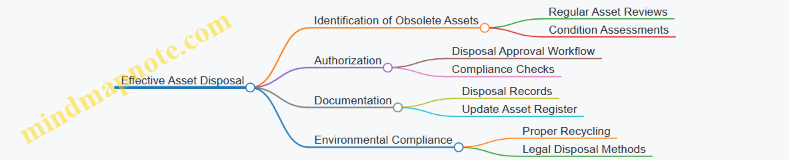
Summary
Failures in asset management often stem from gaps in communication, controls, documentation, and compliance. Accountants and portfolio managers can mitigate these risks by adopting best practices such as maintaining accurate asset registers, implementing strong internal controls, selecting appropriate valuation methods, and ensuring proper disposal processes.
By learning from these failures and integrating practical examples and structured processes, professionals can enhance asset management effectiveness and safeguard organizational value.
11.4 Example: Streamlining Asset Reporting to Improve Decision-Making
Effective asset reporting is crucial for accountants and portfolio managers to make informed decisions that optimize asset utilization, reduce costs, and enhance financial performance. This section illustrates how streamlining asset reporting can lead to better decision-making through practical examples and mind maps.
Understanding the Challenges in Traditional Asset Reporting
Traditional asset reporting often involves manual data entry, fragmented systems, and delayed updates, resulting in inaccurate or outdated information. This can lead to poor asset allocation, missed maintenance schedules, and suboptimal financial planning.
Common Challenges:
- Data silos and lack of integration
- Time-consuming manual reconciliation
- Inconsistent asset classification and valuation
- Delayed reporting impacting timely decisions
Mind Map: Challenges in Traditional Asset Reporting
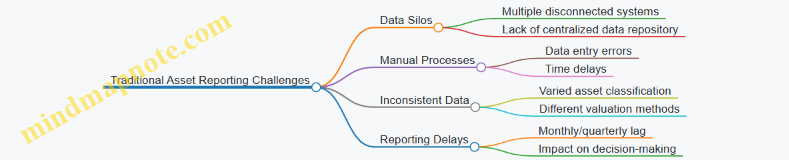
Streamlining Asset Reporting: Best Practices
-
Centralize Asset Data
- Use a unified asset management system integrating with accounting and ERP platforms.
- Example: A mid-sized firm implemented an integrated ERP system that consolidated asset data from procurement, maintenance, and finance departments, reducing data reconciliation time by 40%.
-
Automate Data Collection and Reporting
- Employ barcode/RFID scanning and automated depreciation calculations.
- Example: Automating asset tagging and depreciation schedules enabled real-time updates, cutting monthly report preparation from 5 days to 1 day.
-
Standardize Asset Classification and Valuation
- Define clear asset categories and consistent valuation methods across the organization.
- Example: A portfolio manager standardized asset classes into tangible and intangible with predefined depreciation methods, improving comparability across reports.
-
Implement Real-Time Dashboards and KPIs
- Use visualization tools to present key asset metrics such as utilization, maintenance costs, and book value.
- Example: A finance team used dashboards to monitor asset utilization rates, enabling proactive reallocation of underused assets.
-
Regular Training and Process Reviews
- Ensure accounting and asset management teams are trained on tools and best practices.
- Conduct periodic reviews to identify bottlenecks and update procedures.
Mind Map: Best Practices for Streamlined Asset Reporting
Practical Example: Implementing Streamlined Asset Reporting in a Finance Firm
Scenario: A finance firm with 500+ fixed assets struggled with monthly asset reports that were inaccurate and delayed, affecting budgeting and investment decisions.
Steps Taken:
- Step 1: Integrated their asset register with the accounting software and ERP system.
- Step 2: Introduced RFID tags for all physical assets to automate tracking.
- Step 3: Standardized asset categories and depreciation methods aligned with IFRS.
- Step 4: Developed a real-time dashboard displaying asset status, book value, and maintenance schedules.
- Step 5: Trained accounting and portfolio management teams on new processes and tools.
Outcomes:
- Report preparation time reduced from 7 days to 1 day.
- Accuracy of asset valuation improved by 25%, reducing audit adjustments.
- Enhanced decision-making enabled timely asset disposals and reinvestments.
Mind Map: Streamlined Asset Reporting Implementation Example
Key Takeaways for Accountants and Portfolio Managers
- Streamlining asset reporting enhances data accuracy and timeliness.
- Integration and automation reduce manual errors and free up resources.
- Standardization ensures consistency and comparability across reports.
- Real-time dashboards empower proactive asset management decisions.
- Continuous training and process evaluation sustain improvements over time.
By adopting these best practices and leveraging technology, accountants and portfolio managers can transform asset reporting from a cumbersome task into a strategic tool that drives better financial and operational outcomes.
11.5 Practical Tips for Accountants Managing Diverse Asset Portfolios
Managing a diverse asset portfolio can be complex, especially for accountants who must ensure accuracy, compliance, and strategic insight. Below are practical tips, supported by mind maps and examples, to help accountants effectively manage diverse assets.
Tip 1: Categorize Assets Clearly and Consistently
A clear categorization system helps streamline tracking, reporting, and valuation.
Example: A firm with machinery, patents, and investment securities should maintain separate registers for each category, applying appropriate depreciation or amortization methods.
Tip 2: Use Tailored Valuation Methods per Asset Type
Different assets require different valuation and depreciation approaches.
Example: For software licenses (intangible), apply amortization over the license period; for machinery (tangible), use straight-line depreciation.
Tip 3: Maintain Up-to-Date Asset Registers with Detailed Metadata
Include acquisition date, cost, location, custodian, and maintenance history.

Example: An accountant updates the register monthly to reflect asset relocations and maintenance performed, ensuring accurate valuation and audit readiness.
Tip 4: Implement Robust Internal Controls
Segregate duties and require approvals for asset acquisitions, disposals, and transfers.
Example: Before disposing of obsolete equipment, the accountant ensures management approval and documents the disposal in the asset register.
Tip 5: Leverage Technology for Automation and Accuracy
Use asset management software integrated with accounting systems.
Example: A portfolio manager uses software that automatically calculates depreciation monthly and generates alerts for assets due for maintenance.
Tip 6: Regularly Review and Reconcile Asset Data
Schedule periodic reconciliations between physical assets and accounting records.
Example: Quarterly, the accountant leads a physical count of office equipment and reconciles findings with the asset register, adjusting for missing or damaged items.
Tip 7: Understand Tax and Regulatory Implications
Stay informed on tax depreciation rules and compliance requirements for different asset classes.
Example: An accountant applies accelerated depreciation for tax purposes on qualifying equipment while maintaining straight-line depreciation for financial reporting.
Tip 8: Communicate Effectively with Portfolio Managers and Stakeholders
Provide clear, concise reports highlighting asset performance, risks, and opportunities.
Example: The accountant prepares a quarterly report showing asset utilization rates and maintenance costs, helping portfolio managers optimize asset allocation.
Summary
By categorizing assets clearly, applying appropriate valuation methods, maintaining detailed registers, enforcing internal controls, leveraging technology, performing regular reconciliations, understanding tax implications, and communicating effectively, accountants can confidently manage diverse asset portfolios.
These practical tips, supported by real-world examples and structured mind maps, provide a roadmap to enhance asset management efficiency and accuracy.
12. Conclusion and Next Steps for Accountants
12.1 Recap of Key Best Practices in Asset Management
Asset management is a critical function for accountants and portfolio managers, ensuring that assets are accurately tracked, valued, maintained, and reported. Below is a comprehensive recap of the key best practices discussed throughout this blog, reinforced with mind maps and practical examples to solidify understanding.
Mind Map: Core Pillars of Asset Management
Asset Identification and Classification
Best Practice: Maintain an up-to-date asset register with clear tagging and classification.
Example: A mid-sized accounting firm uses barcode tags on all office equipment and software licenses. The asset register includes asset type, purchase date, cost, and location, enabling quick retrieval and audit readiness.
Asset Valuation and Depreciation
Best Practice: Choose the depreciation method that best reflects asset usage and financial reporting needs.
Example: For a fleet of delivery vehicles, the firm applies the units of production method, depreciating based on mileage rather than time, providing a more accurate expense matching.
Asset Acquisition and Capitalization
Best Practice: Clearly define capitalization thresholds and ensure all acquisitions follow an approval workflow.
Example: Purchases under $1,000 are expensed immediately, while those above require manager approval and capitalization. This prevents unnecessary capitalization of low-value items.
Asset Maintenance and Optimization
Best Practice: Integrate maintenance schedules with accounting records to track costs and extend asset life.
Example: The firm schedules quarterly maintenance for IT servers and records maintenance expenses separately, allowing analysis of maintenance impact on asset longevity.
Asset Disposal and Write-Off
Best Practice: Document disposal approvals and accurately record gains or losses.
Example: When selling an obsolete printer, the accountant records the sale price, removes the asset from the register, and recognizes a loss if the sale price is below book value.
Asset Reporting and Financial Statement Integration
Best Practice: Generate regular asset reports with KPIs to inform portfolio managers and stakeholders.
Example: A monthly report highlights assets nearing end-of-life, accumulated depreciation, and maintenance costs, enabling proactive decision-making.
Risk Management and Internal Controls
Best Practice: Implement segregation of duties and regular audits to prevent misappropriation.
Example: The person responsible for asset tagging is different from the one approving disposals, reducing fraud risk.
Tax Considerations and Regulatory Compliance
Best Practice: Align accounting depreciation with tax requirements and maintain thorough documentation.
Example: The firm tracks capital improvements separately to apply appropriate tax credits, ensuring compliance and maximizing benefits.
Leveraging Technology
Best Practice: Use asset management software integrated with ERP systems to automate tracking and reporting.
Example: Implementing RFID tags for physical assets allows real-time inventory updates and reduces manual errors.
Mind Map: Practical Example Workflow - Asset Lifecycle
Final Thoughts
By adhering to these best practices, accountants and portfolio managers can ensure assets are managed efficiently, risks are mitigated, and financial reporting is accurate and compliant. Consistent application of these principles, supported by technology and clear workflows, drives better asset utilization and organizational value.
12.2 Building an Asset Management Strategy Tailored to Your Organization
Creating an effective asset management strategy that aligns with your organization’s unique needs is essential for maximizing asset value, ensuring compliance, and improving operational efficiency. This section will guide you through the key steps to build a tailored asset management strategy, supported by practical examples and mind maps to visualize the process.
Step 1: Assess Your Current Asset Management Landscape
Before designing a new strategy, understand your existing asset management processes, tools, and challenges.
- Inventory Assessment: Review your current asset register for completeness and accuracy.
- Process Review: Identify how assets are acquired, tracked, maintained, and disposed of.
- Stakeholder Analysis: Determine who is involved in asset management (accountants, portfolio managers, IT, operations).
Example: A mid-sized accounting firm discovered that their asset register was outdated, with many assets untagged and no clear depreciation tracking method.
Step 2: Define Clear Objectives and Goals
Set specific, measurable goals that your asset management strategy should achieve.
- Improve asset tracking accuracy to 99%
- Reduce asset downtime by 15%
- Ensure 100% compliance with accounting standards
- Optimize depreciation methods to reflect true asset value
Example: The same accounting firm aimed to reduce manual errors in asset reporting by automating depreciation calculations.
Step 3: Develop Policies and Procedures
Establish clear policies that govern asset lifecycle management.
- Acquisition and Capitalization Policies
- Asset Tagging and Identification Procedures
- Maintenance Scheduling and Cost Tracking
- Disposal and Write-Off Guidelines
Example: Implementing a capitalization threshold policy helped the firm avoid expensing minor purchases unnecessarily.
Step 4: Select and Implement Appropriate Tools and Technologies
Choose software and tools that fit your organization’s size and complexity.
- Asset Management Software (e.g., SAP, Oracle, or specialized tools)
- Integration with ERP and Accounting Systems
- Use of RFID or Barcode Scanning for Asset Tracking
Example: The firm integrated an asset management module into their existing ERP system, enabling real-time asset status updates.
Step 5: Assign Roles and Responsibilities
Define clear ownership for asset management activities.
- Accountants: Financial reporting, depreciation, compliance
- Portfolio Managers: Asset performance monitoring
- Operations: Maintenance and physical asset control
Example: Assigning a dedicated Asset Manager improved accountability and streamlined communication.
Step 6: Monitor, Review, and Improve Continuously
Establish KPIs and regular review cycles to assess strategy effectiveness.
- Asset Utilization Rate
- Maintenance Cost vs Budget
- Accuracy of Asset Register
- Compliance Audit Results
Example: Quarterly reviews helped the firm identify discrepancies early and adjust depreciation methods accordingly.
Mind Map: Building an Asset Management Strategy
Example Scenario: Tailoring Strategy for a Portfolio Management Firm
Context: A portfolio management firm manages diverse financial assets and physical infrastructure.
Tailored Strategy Highlights:
- Emphasis on integrating asset management software with portfolio analytics tools.
- Policies focused on rapid revaluation of assets to reflect market changes.
- Assigning portfolio managers to monitor asset performance metrics alongside accountants handling depreciation.
- Monthly reporting dashboards combining financial and operational asset data.
Outcome: Improved decision-making speed and accuracy, leading to optimized asset allocation and compliance.
Summary
Building an asset management strategy tailored to your organization involves a thorough assessment, clear goal-setting, policy development, technology adoption, role definition, and continuous monitoring. By following these steps and adapting them to your unique context, accountants and portfolio managers can ensure assets are managed efficiently, compliantly, and in alignment with organizational objectives.
12.3 Continuous Improvement and Professional Development
Continuous improvement and professional development are essential for accountants involved in asset management to stay current with evolving standards, technologies, and best practices. This section explores strategies and actionable steps to foster ongoing growth, supported by mind maps and practical examples.
Why Continuous Improvement Matters in Asset Management
- Ensures compliance with changing accounting standards (e.g., IFRS, GAAP)
- Enhances accuracy and efficiency in asset tracking and reporting
- Adapts to technological advancements such as AI and automation
- Improves risk management and internal controls
Mind Map: Continuous Improvement Framework for Accountants
Practical Example: Implementing a Continuous Learning Plan
Scenario: An accounting team managing fixed assets at a mid-sized firm noticed discrepancies in asset depreciation calculations after adopting new ERP software.
Steps Taken:
- Knowledge Update: Team members attended a webinar on ERP asset modules and depreciation standards.
- Skill Enhancement: Hands-on training sessions were organized to practice the new software features.
- Process Evaluation: Monthly reviews were scheduled to identify errors and improve workflows.
- Technology Adoption: Automation scripts were created to reduce manual data entry.
- Networking: Team joined an online accounting forum to share challenges and solutions.
Outcome: Accuracy improved by 30%, and the team reduced processing time by 20% within three months.
Mind Map: Professional Development Pathways for Accountants in Asset Management
Example: Leveraging Certifications to Enhance Asset Management Expertise
Case: Sarah, a portfolio manager with an accounting background, pursued the Certified Asset Management Accountant (CAMA) certification to deepen her understanding of asset lifecycle and valuation.
Benefits:
- Gained advanced knowledge of asset impairment and revaluation
- Improved ability to advise clients on tax-efficient asset strategies
- Enhanced credibility with stakeholders and clients
Tips for Sustaining Continuous Improvement
- Schedule regular learning goals and review progress quarterly
- Encourage knowledge sharing within teams through lunch-and-learn sessions
- Use feedback from audits and stakeholders to identify improvement areas
- Stay curious and open to experimenting with new tools and methods
By embedding continuous improvement and professional development into everyday practices, accountants can significantly elevate their asset management capabilities, ensuring accuracy, compliance, and strategic value creation.
12.4 Resources and Tools for Further Learning
As an accountant involved in asset management, continuous learning and leveraging the right tools are essential to stay updated and improve efficiency. Below is a curated list of resources, tools, and learning aids, including mind maps and practical examples, to help deepen your understanding and enhance your asset management skills.
Professional Organizations and Certifications
- CMA (Certified Management Accountant): Offers deep insights into management accounting including asset management.
- CFA (Chartered Financial Analyst): Valuable for portfolio managers focusing on asset valuation and management.
- IMA (Institute of Management Accountants): Provides resources and webinars on asset management best practices.
Example: Enrolling in the CMA program can help accountants master cost management and asset lifecycle analysis.
Online Courses and Learning Platforms
- Coursera & edX: Courses on financial accounting, asset management, and ERP systems.
- LinkedIn Learning: Tutorials on asset tracking software and depreciation methods.
- Udemy: Practical courses on fixed asset accounting and tax implications.
Example: A course on “Fixed Asset Accounting and Depreciation” on Udemy offers hands-on exercises with real-world scenarios.
Books and Publications
- “Fixed Asset Accounting: A Guide for Accountants” by John Smith
- “Asset Management Excellence” by Robert S. Kaplan and H. Thomas Johnson
- Journal of Accountancy: Regular articles on asset management trends and regulations.
Example: “Asset Management Excellence” provides case studies on optimizing asset utilization and accounting.
Software Tools for Asset Management
| Tool Name | Description | Example Use Case |
|---|---|---|
| SAP ERP | Comprehensive ERP with asset management module | Automating asset lifecycle and depreciation |
| Oracle NetSuite | Cloud-based asset tracking and financial reporting | Real-time asset valuation and reporting |
| Asset Panda | Mobile asset tracking with barcode/RFID support | Tracking IT equipment across multiple locations |
Example: Using Asset Panda, an accountant can scan asset barcodes during audits to instantly update asset registers.
Mind Maps for Asset Management Concepts
Mind Map 1: Asset Life Cycle Management

Mind Map 2: Depreciation Methods
Mind Map 3: Internal Controls in Asset Management
Practical Examples and Templates
- Asset Register Template: Excel spreadsheet with columns for asset ID, description, acquisition date, cost, depreciation method, accumulated depreciation, net book value.
- Depreciation Calculation Worksheet: Step-by-step template to calculate depreciation using different methods.
- Maintenance Log: Tracking maintenance activities, costs, and impact on asset value.
Example: Using the Asset Register Template, an accountant can quickly generate reports for monthly asset valuation and depreciation expense.
Communities and Forums
- AccountingCoach Forum: Discussions on asset accounting challenges.
- Reddit r/Accounting: Peer advice and shared experiences.
- LinkedIn Groups: Asset Management and Accounting Professionals.
Example: Posting a question about handling asset impairment on LinkedIn groups can yield expert advice and practical tips.
Summary Mind Map: Resources and Tools Overview
By leveraging these resources and tools, accountants and portfolio managers can build a solid foundation in asset management, improve accuracy, and contribute to better financial decision-making within their organizations.
12.5 Final Example: Creating an Action Plan for Asset Management Enhancement
Creating a structured action plan is essential for accountants aiming to enhance asset management within their organizations. This example will guide you through a step-by-step approach, integrating best practices, practical examples, and visual mind maps to help you visualize and implement improvements effectively.
Step 1: Assess Current Asset Management Practices
- Objective: Understand the existing processes, tools, and challenges.
- Example: Conduct an internal audit to review asset registers, depreciation methods, and reporting accuracy.
Mind Map: Assess Current Practices
Step 2: Define Clear Goals and Objectives
- Objective: Establish what improvements are needed.
- Example: Aim to reduce asset misclassification by 30% within 6 months and automate depreciation calculations.
Mind Map: Define Goals
Step 3: Identify Key Stakeholders and Responsibilities
- Objective: Assign roles to ensure accountability.
- Example: Assign portfolio managers to oversee asset tracking and accountants to handle valuation and reporting.
Mind Map: Stakeholders & Responsibilities
Step 4: Develop and Implement Process Improvements
- Objective: Introduce best practices and tools.
- Example: Implement an asset management software that integrates with ERP and automates depreciation.
Mind Map: Process Improvements
Step 5: Training and Change Management
- Objective: Ensure all stakeholders are trained and onboard.
- Example: Conduct workshops for accountants and portfolio managers on new software and procedures.
Mind Map: Training & Change Management
Step 6: Monitor, Review, and Adjust
- Objective: Track progress and refine the plan.
- Example: Monthly reviews of asset reports and quarterly audits to measure improvements.
Mind Map: Monitoring & Review
Practical Example: Action Plan Summary Table
| Step | Action Item | Responsible Party | Timeline | Success Metric |
|---|---|---|---|---|
| 1 | Conduct asset management audit | Accounting Team | Month 1 | Audit report with identified gaps |
| 2 | Set improvement goals | Management | Month 1 | Documented goals and targets |
| 3 | Assign roles and responsibilities | Project Lead | Month 1 | Role matrix completed |
| 4 | Implement asset management software | IT & Accounting | Months 2-3 | Software live and operational |
| 5 | Conduct training sessions | HR & Project Lead | Month 3 | Training attendance and feedback |
| 6 | Review progress and adjust plan | Management | Ongoing | KPI reports and audit results |
Final Thoughts
By following this structured action plan, accountants can systematically enhance asset management processes, reduce errors, improve reporting accuracy, and ultimately contribute to better financial decision-making. Visualizing each step with mind maps helps clarify responsibilities and workflows, ensuring a cohesive and collaborative approach.
Remember, asset management is an ongoing process that benefits greatly from continuous monitoring and adaptation to new technologies and regulatory changes.