Management Accounting Principles
1. Introduction to Management Accounting
1.1 Definition and Scope of Management Accounting
Definition: Management Accounting is the process of preparing management reports and accounts that provide accurate and timely financial and statistical information required by managers to make day-to-day and short-term decisions. Unlike financial accounting, which focuses on historical data and external reporting, management accounting is primarily concerned with internal decision-making and future planning.
Scope of Management Accounting: Management accounting covers a broad range of activities that support managerial functions such as planning, controlling, decision-making, and performance evaluation. The scope can be broadly categorized as follows:
- Cost Accounting: Recording, classification, and allocation of costs to products or services.
- Budgeting and Forecasting: Preparing detailed financial plans and predicting future financial outcomes.
- Performance Measurement: Using financial and non-financial metrics to evaluate business performance.
- Decision Support: Providing relevant data and analysis to aid managerial decisions.
- Financial Analysis: Analyzing financial statements and ratios to assess business health.
- Risk Management: Identifying and managing financial risks.
Mind Map: Definition and Scope of Management Accounting
Practical Example: Management Accounting in Action
Scenario: A medium-sized manufacturing company, “ABC Manufacturing,” wants to improve its profitability and operational efficiency.
-
Cost Accounting: ABC Manufacturing tracks direct material, direct labor, and overhead costs for each product line to understand profitability.
-
Budgeting: The management team prepares a detailed budget for the upcoming year, including sales forecasts, production costs, and capital expenditures.
-
Performance Measurement: Monthly variance reports compare actual costs and revenues against budgets to identify areas needing attention.
-
Decision Support: When considering launching a new product, management accounting provides cost-volume-profit analysis to determine the break-even point and expected profitability.
-
Financial Analysis: Ratio analysis helps management assess liquidity and solvency to ensure the company can meet its obligations.
This integrated approach helps ABC Manufacturing make informed decisions, control costs, and plan for sustainable growth.
Mind Map: Practical Example - ABC Manufacturing
Summary
Management Accounting is a vital internal function that equips managers with the financial and statistical insights needed to steer their organizations effectively. Its scope is comprehensive, covering cost management, budgeting, performance evaluation, decision support, financial analysis, and risk management. By leveraging management accounting principles, companies can enhance decision-making, optimize resource use, and achieve strategic objectives.
1.2 Differences Between Financial and Management Accounting
Management accounting and financial accounting are two essential branches of accounting that serve different purposes, audiences, and use distinct methodologies. Understanding their differences is crucial for accountants, especially management accountants who often bridge the gap between these two fields.
Key Differences at a Glance
Purpose
- Financial Accounting: Primarily focused on providing a clear and standardized view of the company’s financial health to external stakeholders such as investors, creditors, and regulatory bodies.
- Management Accounting: Focuses on providing detailed financial and non-financial information to internal management to aid in planning, controlling, and decision-making.
Example: A company’s financial accountant prepares an annual report showing overall profitability for shareholders, while the management accountant prepares a departmental cost report to help managers control expenses.
Audience
- Financial Accounting: External users including shareholders, banks, tax authorities, and regulatory agencies.
- Management Accounting: Internal users such as CEOs, department heads, and operational managers.
Example: The CFO uses financial accounting reports to communicate with investors, whereas the production manager uses management accounting reports to optimize manufacturing processes.
Time Orientation
- Financial Accounting: Historical focus, reporting on past financial performance.
- Management Accounting: Both historical and forward-looking, including forecasts and budgets.
Example: Financial accounting reports last quarter’s sales figures; management accounting prepares sales forecasts for the next quarter.
Regulatory Requirements and Standards
- Financial Accounting: Must comply with Generally Accepted Accounting Principles (GAAP), International Financial Reporting Standards (IFRS), or other regulatory frameworks.
- Management Accounting: No mandatory standards; reports are customized to meet internal needs.
Example: Financial statements must follow IFRS guidelines, while management accounting reports can vary widely in format and content.
Frequency and Reporting
- Financial Accounting: Reports are typically prepared on a fixed schedule (quarterly, annually).
- Management Accounting: Reports can be generated as frequently as needed (daily, weekly, monthly).
Example: A financial accountant prepares quarterly income statements; a management accountant may prepare weekly cost variance reports.
Level of Detail
- Financial Accounting: Provides aggregated data summarizing the entire organization.
- Management Accounting: Provides detailed, segmented data often broken down by product line, department, or project.
Example: Financial accounting shows total company revenue; management accounting breaks down revenue by product category.
Focus and Content
- Financial Accounting: Focuses on financial results and position, including balance sheets, income statements, and cash flow statements.
- Management Accounting: Includes financial data plus operational metrics such as production efficiency, customer satisfaction, and cost control.
Example: Financial accounting reports net income; management accounting analyzes cost per unit and customer acquisition costs.
Mind Map: Summary of Differences
Practical Example: Comparing Reports
| Aspect | Financial Accounting Report | Management Accounting Report |
|---|---|---|
| Report Type | Annual Financial Statements | Monthly Budget vs Actual Report |
| Audience | External Investors | Internal Department Managers |
| Content | Summary of revenues, expenses, assets, liabilities | Detailed breakdown of departmental costs and variances |
| Purpose | Compliance and external communication | Performance monitoring and decision support |
| Frequency | Annually, Quarterly | Monthly, Weekly, or as needed |
Conclusion
While both financial and management accounting deal with financial data, their objectives, audiences, and methodologies differ significantly. Management accountants must understand these differences to effectively translate financial data into actionable insights for internal decision-making, ensuring the organization’s strategic and operational goals are met.
1.3 Role of Management Accountants in Corporate Finance
Management accountants play a pivotal role in corporate finance by bridging the gap between financial data and strategic decision-making. Their expertise goes beyond traditional bookkeeping and financial reporting, focusing on providing insights that drive business growth, efficiency, and profitability.
Core Responsibilities of Management Accountants in Corporate Finance
Decision Support
Management accountants provide critical financial insights that help management make informed decisions. They prepare detailed budgets and forecasts, analyze financial trends, and assess risks associated with various business initiatives.
Example: A management accountant at a manufacturing company creates a rolling forecast that helps the company adjust production schedules based on fluctuating demand, ensuring optimal inventory levels and cost efficiency.
Cost Management
They analyze and classify costs to identify areas where the company can reduce expenses without compromising quality. Techniques like Activity-Based Costing (ABC) help allocate overheads more accurately.
Example: In a retail chain, the management accountant uses ABC to identify that certain store locations incur disproportionately high utility costs, prompting targeted energy-saving initiatives.
Performance Measurement
Management accountants develop and monitor Key Performance Indicators (KPIs) and conduct variance analysis to evaluate business performance against budgets and benchmarks.
Example: A management accountant at a service firm tracks customer acquisition cost and profit margins monthly, enabling the marketing team to optimize campaigns for better ROI.
Strategic Planning
They assist in evaluating capital investments, pricing strategies, and long-term financial plans to align with corporate objectives.
Example: Before launching a new product line, the management accountant conducts a Net Present Value (NPV) analysis to determine the project’s profitability and advises the executive team accordingly.
Compliance & Reporting
Management accountants ensure internal financial reports comply with corporate policies and regulatory requirements while upholding ethical standards.
Example: In a publicly traded company, the management accountant prepares internal reports that support external financial disclosures, ensuring accuracy and compliance with regulatory frameworks.
Summary Mind Map: Role of Management Accountants in Corporate Finance
In conclusion, management accountants are essential to corporate finance as they provide actionable financial insights, support strategic initiatives, and ensure sound financial management. Their role is integral to driving sustainable business success through informed decision-making and efficient resource management.
1.4 Overview of Key Management Accounting Principles
Management accounting is built on a set of core principles that guide accountants and finance professionals in providing relevant, timely, and accurate information to support managerial decision-making. Understanding these principles helps ensure that management accounting practices align with organizational goals and promote effective resource utilization.
Key Principles of Management Accounting
Below is a mind map that summarizes the foundational principles:
Principle 1: Relevance
Management accounting information should be directly applicable to the decisions at hand. For example, a management accountant preparing a cost analysis for a product line should focus on costs that will change with production volume, ignoring sunk costs.
Example: A company is deciding whether to discontinue a product. Relevant costs include variable manufacturing costs and avoidable fixed costs. Sunk costs like past research expenses are irrelevant.
Principle 2: Accuracy and Reliability
While perfect accuracy is often impossible, management accounting strives for reliable data to build trust.
Example: When calculating overhead allocation, using a consistent and well-documented method ensures reliability, such as applying machine hours consistently across production departments.
Principle 3: Timeliness
Information must be delivered promptly to influence decisions effectively.
Example: A monthly budget variance report delivered within the first week of the following month allows managers to take corrective actions swiftly.
Principle 4: Cost-Benefit Consideration
The cost of gathering and processing information should not exceed the expected benefits.
Example: Instead of tracking every minor expense, a company may group small costs into a single category to reduce administrative effort.
Principle 5: Consistency
Using consistent accounting methods over time enables meaningful comparisons.
Example: If a company uses absorption costing one year, switching to variable costing the next without reconciliation can confuse performance analysis.
Principle 6: Flexibility
Management accounting systems should adapt to different managerial needs and changing environments.
Example: During a market downturn, a company might shift focus from growth metrics to cost control metrics in its reports.
Principle 7: Objectivity
Information should be free from bias to maintain integrity.
Example: An accountant should report unfavorable budget variances honestly, even if it reflects poorly on their department.
Principle 8: Confidentiality
Sensitive financial data must be protected to prevent misuse.
Example: Salary cost reports should be restricted to HR and senior management only.
Principle 9: Future Orientation
Management accounting emphasizes forecasting and planning rather than just historical reporting.
Example: Preparing a rolling forecast that updates sales projections quarterly to guide production planning.
Principle 10: Integration
Management accounting should be integrated with other business functions like marketing, operations, and HR.
Example: Collaborating with the sales team to develop pricing strategies based on cost data and market demand.
Summary Mind Map
Summary: Management Accounting Principles Mind Map
By adhering to these principles, management accountants can provide actionable insights that help organizations optimize performance, control costs, and achieve strategic objectives.
1.5 Practical Example: How Management Accounting Supports Decision Making in a Manufacturing Firm
Management accounting plays a crucial role in helping manufacturing firms make informed decisions by providing relevant, timely, and accurate financial and non-financial information. This section illustrates how management accounting principles are applied in a manufacturing setting to support decision-making processes.
Scenario Overview
Imagine a mid-sized manufacturing firm, “ABC Manufacturing,” that produces electronic components. The management team needs to decide whether to launch a new product line, optimize production costs, and improve overall profitability.
Step 1: Cost Analysis and Classification
Management accountants begin by classifying costs related to the new product:
- Direct Materials: Raw materials specifically used for the new product.
- Direct Labor: Wages paid to workers assembling the product.
- Manufacturing Overhead: Indirect costs such as factory rent, utilities, and depreciation.
This classification helps in understanding the cost structure and estimating the product’s profitability.
Step 2: Budgeting and Forecasting
The management accountant prepares a budget forecast for the new product, including expected sales volume, production costs, and marketing expenses.
- Sales Forecast: 10,000 units at $50 each.
- Material Cost: $15 per unit.
- Labor Cost: $10 per unit.
- Overhead Allocation: $5 per unit.
- Marketing Expenses: $20,000 fixed.
This budget helps management anticipate cash flows and profitability.
Step 3: Cost-Volume-Profit (CVP) Analysis
Using CVP analysis, management accountants calculate the break-even point and profit potential.
- Contribution Margin per Unit: $50 - ($15 + $10 + $5) = $20
- Break-even Units: $20,000 / $20 = 1,000 units
This shows that the firm needs to sell at least 1,000 units to cover fixed marketing expenses.
Step 4: Decision Making
With this information, management can:
- Assess whether the sales forecast is realistic.
- Determine pricing strategies to maximize profit.
- Identify cost control opportunities in materials or labor.
- Decide to proceed with the product launch if projected profits meet company targets.
Step 5: Performance Measurement
After launch, management accountants track actual costs and revenues against the budget to analyze variances.
- Material Cost Variance: Actual vs Standard cost.
- Labor Efficiency Variance: Actual hours vs standard hours.
This continuous monitoring helps in taking corrective actions.
Summary
Through cost classification, budgeting, CVP analysis, and performance measurement, management accounting equips ABC Manufacturing with the necessary insights to make data-driven decisions. This integrated approach minimizes risks and maximizes profitability.
Additional Example: Optimizing Production Scheduling
Management accountants analyze machine hours and labor availability to schedule production efficiently, balancing demand and capacity.
By aligning production schedules with cost data, the firm reduces overtime costs and inventory holding expenses.
This practical example demonstrates how management accounting principles are embedded in everyday decision-making within a manufacturing firm, providing a clear roadmap for accountants and management alike.
2. Cost Concepts and Classifications
2.1 Understanding Fixed, Variable, and Mixed Costs
Management accounting hinges on a clear understanding of cost behavior. Knowing how costs behave relative to changes in production or sales volume is essential for budgeting, forecasting, and decision-making. This section explores three fundamental cost types: fixed, variable, and mixed costs, with practical examples and mind maps to clarify each concept.
Fixed Costs
Definition: Fixed costs are expenses that remain constant in total regardless of changes in the level of production or sales volume within a relevant range.
Characteristics:
- Do not fluctuate with production volume.
- Incurred even if production is zero.
- Examples include rent, salaries of permanent staff, insurance, and depreciation.
Example: A company rents a factory for $10,000 per month. Whether it produces 1,000 units or 10,000 units, the rent remains $10,000.
Mind Map:
Variable Costs
Definition: Variable costs change in direct proportion to changes in production or sales volume.
Characteristics:
- Total variable costs increase as production increases.
- Cost per unit remains constant.
Example: A bakery spends $2 on ingredients for each loaf of bread. If it bakes 100 loaves, the total ingredient cost is $200; if it bakes 500 loaves, the cost is $1,000.
Mind Map:
Mixed Costs (Semi-Variable Costs)
Definition: Mixed costs contain both fixed and variable components. Part of the cost remains constant regardless of activity level, while another part varies with production volume.
Characteristics:
- Fixed portion is incurred even if production is zero.
- Variable portion fluctuates with production.
Example: A utility bill includes a fixed monthly charge of $100 plus $0.05 per kWh of electricity used. If the company uses 1,000 kWh, the total cost is $100 + (1,000 x $0.05) = $150.
Mind Map:
Practical Example: Classifying Costs in a Retail Business
| Cost Item | Type | Explanation |
|---|---|---|
| Store Rent | Fixed | Monthly rent remains constant regardless of sales volume. |
| Sales Commissions | Variable | Paid as a percentage of sales; increases with sales volume. |
| Electricity Bill | Mixed | Fixed monthly charge plus variable charge based on usage. |
| Salaries (Managers) | Fixed | Salaries paid regardless of store performance. |
| Packaging Materials | Variable | Cost increases with the number of products sold. |
Summary Mind Map
Understanding these cost behaviors enables management accountants to prepare accurate budgets, forecast costs effectively, and make informed pricing and production decisions. By integrating these principles with real-world examples, accountants can better communicate cost implications to management and support strategic planning.
2.2 Direct vs Indirect Costs: Definitions and Examples
Definitions
Direct Costs: Direct costs are expenses that can be directly traced to a specific cost object, such as a product, department, or project. These costs are incurred specifically for the production of goods or services and can be easily identified and measured.
Indirect Costs: Indirect costs, on the other hand, are expenses that cannot be directly traced to a single cost object. They are incurred for multiple cost objects and are often allocated based on a reasonable basis. These costs support the overall operations but are not directly linked to production.
Mind Map: Understanding Direct and Indirect Costs
Characteristics Comparison
| Aspect | Direct Costs | Indirect Costs |
|---|---|---|
| Traceability | Directly traceable to cost object | Not directly traceable |
| Examples | Raw materials, direct labor | Rent, utilities, administrative costs |
| Variability | Usually variable with production | Usually fixed or semi-variable |
| Accounting Treatment | Charged directly to product cost | Allocated using cost drivers |
Examples of Direct Costs
-
Raw Materials in Manufacturing:
- Steel used in car manufacturing.
- Fabric used in garment production.
-
Direct Labor:
- Wages paid to assembly line workers.
- Salaries of machine operators.
-
Manufacturing Supplies:
- Nuts, bolts, and screws used in product assembly.
Examples of Indirect Costs
-
Factory Overhead:
- Electricity to run the factory lighting.
- Maintenance costs of machinery.
-
Administrative Expenses:
- Salaries of HR and accounting staff.
- Office rent and utilities.
-
Depreciation:
- Depreciation on factory building and equipment.
Practical Example: Direct vs Indirect Costs in a Bakery
| Cost Item | Type | Explanation |
|---|---|---|
| Flour | Direct Cost | Flour is directly used in baking bread and can be traced to each batch. |
| Baker’s Wages | Direct Cost | Wages paid to bakers who make the bread directly. |
| Oven Electricity | Indirect Cost | Electricity powers the oven but is shared across all products. |
| Rent for Bakery Premises | Indirect Cost | Rent supports the entire bakery operation, not just one product. |
Mind Map: Allocating Costs in a Bakery
Best Practices for Management Accountants
- Accurate Identification: Clearly distinguish between direct and indirect costs to improve cost control and pricing strategies.
- Appropriate Allocation Bases: Use logical and consistent bases (e.g., machine hours, labor hours) to allocate indirect costs fairly.
- Regular Review: Periodically review cost classifications to reflect changes in operations or production methods.
Summary
Understanding the distinction between direct and indirect costs is fundamental for accurate product costing, budgeting, and financial analysis. Direct costs are easily traceable and variable with production, while indirect costs support overall operations and require allocation. Proper classification ensures better decision-making and financial transparency.
2.3 Product Costs vs Period Costs
Understanding the distinction between product costs and period costs is fundamental in management accounting as it impacts inventory valuation, cost control, and profitability analysis.
Definition and Overview
- Product Costs: These are costs that are directly associated with the production of goods. They include all costs necessary to create a product and prepare it for sale.
- Period Costs: These costs are not tied directly to production and are expensed in the period in which they are incurred.
Mind Map: Product Costs vs Period Costs
Detailed Explanation
| Aspect | Product Costs | Period Costs |
|---|---|---|
| Definition | Costs incurred to create a product | Costs incurred outside production activities |
| Accounting Treatment | Capitalized as inventory, expensed when sold | Expensed immediately in the income statement |
| Examples | Raw materials, direct labor, factory overhead | Marketing expenses, administrative salaries |
| Impact on Financials | Affect cost of goods sold and inventory values | Affect operating expenses and net income |
Practical Examples
-
Manufacturing Company Example
- Product Costs:
- Steel used in car frames
- Wages of assembly line workers
- Depreciation of factory equipment
- Period Costs:
- Advertising expenses for new car model
- Salaries of corporate office staff
- Product Costs:
-
Retail Business Example
- Product Costs:
- Purchase price of inventory
- Shipping costs to warehouse
- Period Costs:
- Store rent
- Sales staff salaries
- Product Costs:
Mind Map: Accounting Treatment Flow
Best Practices
- Accurate Classification: Ensure costs are properly classified to avoid misstating inventory or expenses.
- Consistent Application: Apply the same classification method consistently for comparability.
- Use Examples for Training: Use real-life examples to train accounting teams on classification.
Summary
Product costs are integral to the manufacturing process and are capitalized as inventory until the product is sold. Period costs are associated with time periods and are expensed immediately. Correctly distinguishing between these costs ensures accurate financial reporting and better management decision-making.
2.4 Cost Behavior Analysis and Its Importance
What is Cost Behavior Analysis?
Cost behavior analysis is the study of how costs change in response to variations in a company’s level of activity. Understanding cost behavior helps management accountants predict how costs will change with changes in production volume, sales, or other business activities.
Types of Cost Behavior
Costs generally behave in three main ways:
- Fixed Costs: Costs that remain constant regardless of activity level.
- Variable Costs: Costs that vary directly with the level of activity.
- Mixed Costs: Costs that have both fixed and variable components.
Why is Cost Behavior Analysis Important?
- Budgeting and Forecasting: Helps create accurate budgets by predicting how costs will change.
- Cost Control: Identifies which costs can be controlled or influenced.
- Pricing Decisions: Assists in setting prices by understanding cost structures.
- Profit Planning: Helps forecast profits at different activity levels.
Mind Map: Overview of Cost Behavior Analysis
Fixed Costs Explained
Fixed costs remain unchanged within a relevant range of activity. For example, a company pays $5,000 monthly rent regardless of whether it produces 1,000 or 10,000 units.
Example:
- Rent expense of $5,000/month.
- Production increases from 1,000 to 2,000 units.
- Rent remains $5,000, so cost per unit decreases from $5 to $2.50.
Variable Costs Explained
Variable costs change in direct proportion to activity levels.
Example:
- Raw material cost is $3 per unit.
- Producing 1,000 units costs $3,000.
- Producing 2,000 units costs $6,000.
Mixed Costs Explained
Mixed costs have a fixed base plus a variable component.
Example:
- Utility bill = $200 fixed + $0.10 per unit produced.
- Producing 1,000 units: $200 + (1,000 x $0.10) = $300.
- Producing 2,000 units: $200 + (2,000 x $0.10) = $400.
Mind Map: Examples of Cost Behavior
Practical Example: Cost Behavior Analysis in a Bakery
A bakery produces cakes and wants to analyze its cost behavior.
| Cost Type | Description | Cost Behavior |
|---|---|---|
| Rent | Monthly bakery rent | Fixed |
| Flour | Cost per kg of flour | Variable |
| Electricity | Base charge + usage per hour | Mixed |
- Rent: $2,000/month (fixed)
- Flour: $1.50/kg (variable)
- Electricity: $100 base + $5 per hour used
If the bakery operates 100 hours and uses 500 kg of flour:
- Rent = $2,000
- Flour = 500 kg x $1.50 = $750
- Electricity = $100 + (100 x $5) = $600
Total Costs = $2,000 + $750 + $600 = $3,350
If the bakery increases operation to 150 hours and 700 kg of flour:
- Rent = $2,000 (fixed)
- Flour = 700 x $1.50 = $1,050
- Electricity = $100 + (150 x $5) = $850
Total Costs = $2,000 + $1,050 + $850 = $3,900
This analysis helps the bakery predict how costs will increase with production and operating hours.
Summary
Cost behavior analysis is a foundational principle in management accounting that enables accountants and managers to understand how costs react to changes in business activity. By classifying costs into fixed, variable, and mixed categories and analyzing their behavior, organizations can make informed decisions on budgeting, pricing, and cost control.
Additional Mind Map: Importance of Cost Behavior Analysis in Decision Making
2.5 Practical Example: Classifying Costs in a Retail Business
In a retail business, understanding and classifying costs accurately is crucial for effective management accounting. This helps in pricing, budgeting, and profitability analysis. Let’s explore how costs can be classified with clear examples and mind maps.
Step 1: Identify Cost Types
Retail businesses typically incur various costs. These can be broadly categorized as:
- Fixed Costs: Costs that remain constant regardless of sales volume.
- Variable Costs: Costs that fluctuate directly with sales volume.
- Mixed Costs: Costs that have both fixed and variable components.
Mind Map: Cost Types in Retail
Step 2: Direct vs Indirect Costs
- Direct Costs: Costs that can be directly traced to a product or service.
- Indirect Costs: Costs that cannot be directly traced to a single product.
In retail:
- Direct Costs: Purchase cost of inventory (COGS)
- Indirect Costs: Store rent, utilities, administrative salaries
Mind Map: Direct and Indirect Costs
Step 3: Product Costs vs Period Costs
- Product Costs: Costs related to acquiring or producing inventory.
- Period Costs: Costs that are expensed in the period incurred.
In retail:
- Product Costs: Purchase price of goods, shipping fees for inventory
- Period Costs: Advertising, rent, office salaries
Mind Map: Product vs Period Costs
Example Scenario: “FashionHub” Retail Store
FashionHub is a retail clothing store. Below is a breakdown of their monthly costs:
| Cost Item | Amount ($) | Classification |
|---|---|---|
| Store Rent | 5,000 | Fixed, Indirect, Period Cost |
| Salaries (Sales Staff) | 8,000 | Fixed, Indirect, Period Cost |
| Inventory Purchase | 20,000 | Variable, Direct, Product Cost |
| Sales Commissions | 2,000 | Variable, Direct, Period Cost |
| Utilities (Electricity) | 1,200 | Mixed, Indirect, Period Cost |
| Packaging Materials | 1,000 | Variable, Direct, Product Cost |
| Advertising | 3,000 | Fixed, Indirect, Period Cost |
Analysis:
-
Fixed Costs: Store Rent, Salaries, Advertising
-
Variable Costs: Inventory Purchase, Sales Commissions, Packaging
-
Mixed Costs: Utilities (part fixed, part variable)
-
Direct Costs: Inventory Purchase, Packaging, Sales Commissions (linked to sales)
-
Indirect Costs: Rent, Salaries, Utilities, Advertising
-
Product Costs: Inventory Purchase, Packaging
-
Period Costs: Rent, Salaries, Advertising, Utilities, Sales Commissions
Visualizing the Classification
Why This Classification Matters
- Pricing: Knowing direct costs helps set product prices that cover costs and generate profit.
- Budgeting: Fixed and variable cost separation aids in creating flexible budgets.
- Cost Control: Identifying indirect costs helps management focus on overhead reduction.
- Profitability Analysis: Product vs period cost distinction ensures accurate profit measurement.
Summary
Classifying costs in a retail business like FashionHub provides clarity on how expenses behave and relate to sales. This classification supports better decision-making, budgeting, and financial control.
By applying these principles and using mind maps, management accountants can communicate cost structures effectively to stakeholders and improve overall business performance.
3. Costing Methods and Techniques
3.1 Job Costing: Principles and Application
Job costing is a fundamental management accounting technique used to assign costs to specific jobs or projects. It is especially useful in industries where products or services are customized or produced in small batches, such as construction, consulting, or custom manufacturing.
Principles of Job Costing
- Cost Accumulation: Costs are accumulated separately for each job.
- Direct and Indirect Costs: Direct materials, direct labor, and a fair share of overhead are assigned to each job.
- Job Cost Sheet: A document that records all costs related to a particular job.
- Cost Control: Monitoring costs against budgets or estimates to control expenses.
Mind Map: Job Costing Principles
Application of Job Costing
- Identify the Job: Define the specific project or order.
- Estimate Costs: Predict direct materials, labor, and overhead.
- Track Actual Costs: Record all costs incurred during the job.
- Allocate Overhead: Apply overhead costs based on a predetermined rate.
- Analyze Results: Compare actual costs to estimates for performance evaluation.
Practical Example: Custom Furniture Manufacturing
Scenario: A custom furniture company receives an order for a bespoke dining table.
- Direct Materials: Wood, varnish, hardware.
- Direct Labor: Hours spent by carpenters and finishers.
- Overhead: Factory rent, utilities allocated based on labor hours.
Job Cost Sheet Snapshot:
| Cost Element | Estimated Cost | Actual Cost | Variance |
|---|---|---|---|
| Direct Materials | $1,200 | $1,250 | +$50 |
| Direct Labor | $800 | $750 | -$50 |
| Overhead | $400 | $420 | +$20 |
| Total | $2,400 | $2,420 | +$20 |
This detailed tracking helps management assess profitability and identify areas for cost control.
Mind Map: Job Costing Application Steps
Best Practices for Job Costing
- Maintain detailed and accurate job cost sheets.
- Use technology (e.g., ERP systems) to automate cost tracking.
- Regularly review cost variances to improve estimates.
- Train staff on the importance of accurate data entry.
Additional Example: Consulting Firm
A consulting firm uses job costing to track hours and expenses for each client project.
- Direct Labor: Consultant hours billed.
- Direct Expenses: Travel, materials.
- Overhead: Allocated based on billable hours.
This enables precise billing and profitability analysis per client.
Summary
Job costing is an essential principle in management accounting that enables organizations to assign costs accurately to individual jobs, facilitating better cost control, pricing decisions, and profitability analysis. By applying job costing principles with detailed tracking and analysis, management accountants can provide valuable insights that drive business success.
3.2 Process Costing: When and How to Use It
What is Process Costing?
Process costing is a management accounting technique used to allocate costs to mass-produced, homogeneous products that pass through a series of continuous processes or departments. Unlike job costing, which tracks costs for individual jobs or batches, process costing averages costs over all units produced during a period.
When to Use Process Costing
Process costing is ideal in industries where:
- Production is continuous or repetitive.
- Products are indistinguishable from each other.
- Costs are accumulated by process or department rather than by individual job.
Common industries using process costing:
- Chemicals
- Food and beverages
- Textiles
- Petroleum refining
- Paper manufacturing
How Process Costing Works
Costs are collected for each process or department for a specific period. These costs include:
- Direct materials
- Direct labor
- Manufacturing overhead
The total costs are then divided by the number of units produced to find the cost per unit.
Mind Map: Process Costing Overview
Step-by-Step Process Costing Example
Scenario: A company manufactures bottled fruit juice. The production involves two processes: Mixing and Bottling.
| Process | Costs Incurred (Monthly) | Units Produced |
|---|---|---|
| Mixing | $50,000 | 10,000 |
| Bottling | $30,000 | 10,000 |
Step 1: Calculate Cost per Unit for Each Process
- Mixing: $50,000 / 10,000 units = $5 per unit
- Bottling: $30,000 / 10,000 units = $3 per unit
Step 2: Total Cost per Unit
- $5 (Mixing) + $3 (Bottling) = $8 per bottled juice unit
Interpretation: Each bottle of juice costs $8 to produce through both processes.
Mind Map: Process Costing Calculation
Best Practices in Process Costing
- Accurate Tracking of Costs by Department: Ensure all direct materials, labor, and overhead are properly assigned to each process.
- Consistent Measurement of Output: Units produced must be measured consistently to avoid distortions in unit cost.
- Use of Equivalent Units: When production is partially complete, calculate equivalent units to fairly assign costs.
- Regular Reconciliation: Periodically reconcile costs to identify discrepancies early.
Example: Handling Equivalent Units
Suppose in the Bottling process, 10,000 units are started, but only 8,000 are fully completed by month-end. The remaining 2,000 units are 50% complete.
Calculating Equivalent Units:
- Completed units = 8,000
- Partially completed units = 2,000 x 50% = 1,000
- Total equivalent units = 8,000 + 1,000 = 9,000
If the bottling cost is $30,000:
- Cost per equivalent unit = $30,000 / 9,000 = $3.33
This method ensures costs are fairly allocated between completed and in-process units.
Mind Map: Equivalent Units in Process Costing
Summary
Process costing is a vital tool for management accountants in industries with continuous production. By understanding when and how to apply process costing, accountants can provide accurate cost information to support pricing, budgeting, and performance evaluation.
Additional Practical Example
Industry: Paper Manufacturing
- Multiple processes: Pulping, Pressing, Drying
- Monthly costs and units tracked per process
- Use of equivalent units for in-progress inventory
Outcome: Enables management to identify cost drivers and optimize each process for cost efficiency.
This comprehensive understanding of process costing, supported by clear examples and mind maps, equips management accountants to implement best practices effectively.
3.3 Activity-Based Costing (ABC): A Detailed Approach
Overview: Activity-Based Costing (ABC) is a costing methodology that assigns overhead and indirect costs to related products and services by identifying cost drivers. Unlike traditional costing methods that allocate overhead based on a single volume measure (like labor hours or machine hours), ABC recognizes the complexity of overhead costs and assigns them more accurately based on the activities that generate those costs.
Why Use ABC?
- Provides more accurate product costing
- Helps identify inefficient or non-value-adding activities
- Supports better pricing, budgeting, and cost control decisions
Core Principles of ABC
- Identify Activities: Break down the production or service process into distinct activities.
- Assign Costs to Activities: Collect overhead costs and assign them to activities based on resource consumption.
- Determine Cost Drivers: Identify measurable factors that cause the cost of each activity.
- Assign Costs to Products/Services: Use cost drivers to allocate activity costs to products or services.
Mind Map: Activity-Based Costing Process
Step-by-Step Example: ABC in a Furniture Manufacturing Company
Scenario: A furniture company produces two products: Chairs and Tables. Traditional costing allocates overhead based on direct labor hours, but management suspects this distorts product costs.
Step 1: Identify Activities and Costs
- Machine Setup: $30,000
- Quality Inspection: $20,000
- Material Handling: $10,000
- Order Processing: $15,000
Step 2: Determine Cost Drivers and Activity Volumes
| Activity | Cost Driver | Total Cost | Chairs (Volume) | Tables (Volume) |
|---|---|---|---|---|
| Machine Setup | Number of Setups | $30,000 | 100 | 50 |
| Quality Inspection | Inspection Hours | $20,000 | 200 | 300 |
| Material Handling | Material Moves | $10,000 | 400 | 100 |
| Order Processing | Number of Orders | $15,000 | 150 | 50 |
Step 3: Calculate Activity Rates
- Machine Setup Rate = $30,000 / (100 + 50) = $200 per setup
- Quality Inspection Rate = $20,000 / (200 + 300) = $40 per inspection hour
- Material Handling Rate = $10,000 / (400 + 100) = $20 per material move
- Order Processing Rate = $15,000 / (150 + 50) = $75 per order
Step 4: Assign Activity Costs to Products
| Activity | Chairs Cost (Volume × Rate) | Tables Cost (Volume × Rate) |
|---|---|---|
| Machine Setup | 100 × $200 = $20,000 | 50 × $200 = $10,000 |
| Quality Inspection | 200 × $40 = $8,000 | 300 × $40 = $12,000 |
| Material Handling | 400 × $20 = $8,000 | 100 × $20 = $2,000 |
| Order Processing | 150 × $75 = $11,250 | 50 × $75 = $3,750 |
| Total Overhead | $47,250 | $27,750 |
Step 5: Compare with Traditional Costing
- Traditional overhead allocation might have assigned costs based solely on labor hours, potentially overcosting Chairs or Tables.
Mind Map: Benefits of ABC
Best Practices for Implementing ABC
- Start with a pilot project focusing on a specific product line or department
- Engage cross-functional teams to accurately identify activities and drivers
- Use software tools to manage and analyze ABC data
- Regularly review and update cost drivers and activities
- Communicate findings clearly to management and operational teams
Additional Example: ABC in a Service Company
A consulting firm uses ABC to allocate overhead costs such as administrative support, IT services, and client onboarding.
- Activities: Client Meetings, Report Preparation, Research
- Cost Drivers: Number of Meetings, Hours Spent on Reports, Research Hours
By applying ABC, the firm discovers that certain clients consume disproportionately more resources, enabling better pricing and resource allocation.
Summary: Activity-Based Costing provides a granular and accurate approach to overhead allocation by focusing on activities and their drivers. This method helps management accountants deliver insights that improve cost control, pricing strategies, and overall organizational efficiency.
3.4 Standard Costing and Variance Analysis
Standard costing is a fundamental management accounting technique that involves assigning predetermined costs to products or services. These standard costs serve as benchmarks against which actual costs are compared to identify variances. Variance analysis then helps management understand the reasons behind cost deviations and take corrective actions.
What is Standard Costing?
Standard costing involves setting expected costs for materials, labor, and overhead based on historical data, industry standards, and efficiency targets. These standards are used for budgeting, cost control, and performance evaluation.
Benefits of Standard Costing:
- Simplifies cost control and budgeting
- Facilitates variance analysis
- Enhances decision-making
- Motivates employees by setting clear cost targets
Components of Standard Costing
Variance Analysis Overview
Variance analysis compares actual costs to standard costs to identify differences (variances). Variances are classified as favorable (costs less than standard) or unfavorable (costs more than standard).
Types of variances include:
- Material Variance (Price and Usage)
- Labor Variance (Rate and Efficiency)
- Overhead Variance (Spending and Efficiency)
Material Variance
- Material Price Variance (MPV): Difference between actual price paid and standard price, multiplied by actual quantity purchased.
- Material Usage Variance (MUV): Difference between actual quantity used and standard quantity allowed, multiplied by standard price.
Formula:
- MPV = (Actual Price - Standard Price) × Actual Quantity
- MUV = (Actual Quantity - Standard Quantity) × Standard Price
Example:
A company sets a standard price of $5 per kg for raw material and expects to use 1000 kg for production. Actual purchase was 1100 kg at $4.80 per kg.
- MPV = ($4.80 - $5.00) × 1100 = -$220 (Favorable)
- MUV = (1100 - 1000) × $5.00 = $500 (Unfavorable)
Interpretation: The company paid less per kg than expected (favorable), but used more material than the standard (unfavorable).
Labor Variance
- Labor Rate Variance (LRV): Difference between actual hourly wage and standard wage, multiplied by actual hours worked.
- Labor Efficiency Variance (LEV): Difference between actual hours worked and standard hours allowed, multiplied by standard wage rate.
Formula:
- LRV = (Actual Rate - Standard Rate) × Actual Hours
- LEV = (Actual Hours - Standard Hours) × Standard Rate
Example:
Standard labor rate is $20/hour, and standard hours for a job are 50 hours. Actual hours worked were 55 hours at $18/hour.
- LRV = ($18 - $20) × 55 = -$110 (Favorable)
- LEV = (55 - 50) × $20 = $100 (Unfavorable)
Interpretation: The company paid a lower wage rate than standard (favorable), but took more hours than planned (unfavorable).
Overhead Variance
- Variable Overhead Spending Variance: Difference between actual variable overhead and standard variable overhead based on actual hours.
- Variable Overhead Efficiency Variance: Difference between actual hours and standard hours allowed, multiplied by standard variable overhead rate.
Example:
Standard variable overhead rate is $3 per labor hour. For a job requiring 50 hours standard, actual hours were 55, and actual variable overhead cost was $170.
- Standard variable overhead = 50 × $3 = $150
- Spending Variance = $170 - (55 × $3) = $170 - $165 = $5 (Unfavorable)
- Efficiency Variance = (55 - 50) × $3 = 5 × $3 = $15 (Unfavorable)
Integrated Example: Putting It All Together
A furniture manufacturer sets the following standards for producing one table:
| Cost Element | Standard Quantity | Standard Price/Rate |
|---|---|---|
| Wood | 10 board feet | $4 per board foot |
| Labor | 5 hours | $15 per hour |
| Variable Overhead | 5 hours | $3 per hour |
Actual data for one table:
- Wood used: 12 board feet at $3.80 per board foot
- Labor hours: 6 hours at $14 per hour
- Variable overhead: $20
Calculate variances:
- Material Price Variance = (3.80 - 4.00) × 12 = -$2.40 (Favorable)
- Material Usage Variance = (12 - 10) × 4.00 = $8.00 (Unfavorable)
- Labor Rate Variance = (14 - 15) × 6 = -$6.00 (Favorable)
- Labor Efficiency Variance = (6 - 5) × 15 = $15.00 (Unfavorable)
- Variable Overhead Spending Variance = $20 - (6 × 3) = $20 - $18 = $2 (Unfavorable)
- Variable Overhead Efficiency Variance = (6 - 5) × 3 = $3 (Unfavorable)
Interpretation:
- The company saved on material price and labor rate but used more materials and labor hours than planned.
- Overhead costs were slightly higher than expected.
Best Practices for Standard Costing and Variance Analysis
- Regularly Update Standards: Reflect current market conditions and operational efficiencies.
- Investigate Significant Variances: Identify root causes to improve processes.
- Use Variance Analysis for Performance Management: Align incentives with cost control.
- Integrate with Budgeting and Forecasting: Ensure consistency across financial planning.
Summary Mind Map
By mastering standard costing and variance analysis, management accountants can provide valuable insights that drive cost efficiency, operational improvements, and strategic decision-making.
3.5 Practical Example: Implementing Activity-Based Costing (ABC) in a Service Company
Activity-Based Costing (ABC) is a costing methodology that assigns overhead and indirect costs to related products and services by identifying cost drivers. While traditionally used in manufacturing, ABC is highly effective in service companies where overheads are significant and diverse.
Scenario Overview
Imagine a mid-sized IT consulting firm, “TechSolutions,” providing three main services:
- Software Development
- IT Support
- Training and Workshops
The firm wants to better understand the true cost of each service to improve pricing strategies and profitability.
Step 1: Identify Activities and Cost Pools
In ABC, costs are assigned to activities first, then to services based on their consumption of these activities.
Key activities at TechSolutions:
- Project Management
- Software Development
- Customer Support
- Training Preparation
- Training Delivery
- Administrative Support
Mind Map: Activities and Cost Pools
Step 2: Assign Costs to Activity Cost Pools
The firm collects overhead costs (e.g., salaries of project managers, support staff, office rent, utilities) and assigns them to the above activities based on resource usage.
| Activity | Overhead Cost ($) |
|---|---|
| Project Management | 120,000 |
| Software Development | 200,000 |
| Customer Support | 80,000 |
| Training Preparation | 40,000 |
| Training Delivery | 60,000 |
| Administrative Support | 50,000 |
Total Overhead = $550,000
Step 3: Determine Cost Drivers for Each Activity
Cost drivers are factors that cause the cost of an activity to increase or decrease.
| Activity | Cost Driver | Quantity |
|---|---|---|
| Project Management | Number of Projects | 10 |
| Software Development | Development Hours | 20,000 |
| Customer Support | Number of Support Tickets | 5,000 |
| Training Preparation | Number of Training Sessions | 15 |
| Training Delivery | Number of Training Hours | 120 |
| Administrative Support | Number of Employees | 50 |
Mind Map: Cost Drivers
Step 4: Calculate Activity Rates
Activity Rate = Overhead Cost / Cost Driver Quantity
| Activity | Overhead Cost ($) | Cost Driver Quantity | Activity Rate ($ per unit) |
|---|---|---|---|
| Project Management | 120,000 | 10 | 12,000 |
| Software Development | 200,000 | 20,000 | 10 |
| Customer Support | 80,000 | 5,000 | 16 |
| Training Preparation | 40,000 | 15 | 2,666.67 |
| Training Delivery | 60,000 | 120 | 500 |
| Administrative Support | 50,000 | 50 | 1,000 |
Step 5: Assign Costs to Services Based on Activity Consumption
Assume the following consumption data for each service:
| Service | Projects | Dev Hours | Support Tickets | Training Sessions | Training Hours | Employees |
|---|---|---|---|---|---|---|
| Software Development | 6 | 15,000 | 500 | 0 | 0 | 30 |
| IT Support | 3 | 3,000 | 4,000 | 0 | 0 | 15 |
| Training & Workshops | 1 | 2,000 | 500 | 15 | 120 | 5 |
Calculations:
-
Software Development:
- Project Management: 6 projects * $12,000 = $72,000
- Software Development: 15,000 hours * $10 = $150,000
- Customer Support: 500 tickets * $16 = $8,000
- Training Preparation: 0 * $2,666.67 = $0
- Training Delivery: 0 * $500 = $0
- Administrative Support: 30 employees * $1,000 = $30,000
- Total Overhead Assigned = $260,000
-
IT Support:
- Project Management: 3 * $12,000 = $36,000
- Software Development: 3,000 * $10 = $30,000
- Customer Support: 4,000 * $16 = $64,000
- Training Preparation: 0 * $2,666.67 = $0
- Training Delivery: 0 * $500 = $0
- Administrative Support: 15 * $1,000 = $15,000
- Total Overhead Assigned = $145,000
-
Training & Workshops:
- Project Management: 1 * $12,000 = $12,000
- Software Development: 2,000 * $10 = $20,000
- Customer Support: 500 * $16 = $8,000
- Training Preparation: 15 * $2,666.67 = $40,000
- Training Delivery: 120 * $500 = $60,000
- Administrative Support: 5 * $1,000 = $5,000
- Total Overhead Assigned = $145,000
Step 6: Analyze Results and Take Action
- Insight: Software Development consumes the largest overhead, mainly due to development hours and project management.
- Pricing: The firm can now price each service more accurately, reflecting the true overhead costs.
- Cost Control: Identify high-cost activities (e.g., training preparation) and explore efficiency improvements.
Summary Mind Map: ABC Implementation Steps
Key Takeaways
- ABC provides detailed insight into overhead consumption.
- It helps service companies allocate indirect costs more accurately.
- Enables better pricing, budgeting, and cost management decisions.
This practical example demonstrates how management accountants in service industries can leverage ABC to enhance financial clarity and strategic decision-making.
4. Budgeting and Forecasting
4.1 Types of Budgets: Operating, Capital, and Cash Budgets
Budgeting is a cornerstone of management accounting, enabling organizations to plan, control, and evaluate their financial resources effectively. Understanding the different types of budgets is essential for management accountants to tailor financial plans according to organizational needs.
Operating Budget
The operating budget is a detailed projection of all expected income and expenses related to the day-to-day operations of a business over a specific period, usually a fiscal year. It focuses on revenues, cost of goods sold, and operating expenses.
Key Components:
- Sales Revenue
- Cost of Goods Sold (COGS)
- Selling, General & Administrative Expenses (SG&A)
- Depreciation
- Operating Income
Example: A retail company forecasts sales of $1,000,000 for the next year. The cost of goods sold is estimated at 60% of sales, and operating expenses are projected at $250,000. The operating budget helps the company anticipate a gross profit of $400,000 and operating income of $150,000.
Mind Map: Operating Budget
Capital Budget
The capital budget deals with long-term investments and expenditures on assets such as property, plant, and equipment. It helps organizations plan for significant expenditures that will impact the business over multiple years.
Key Components:
- Project Identification
- Cost Estimates
- Financing Methods
- Expected Returns (NPV, IRR)
- Payback Period
Example: A manufacturing firm plans to invest $500,000 in new machinery. The capital budget will include the cost of the machinery, installation, and projected benefits such as increased production capacity and cost savings.
Mind Map: Capital Budget
Cash Budget
The cash budget forecasts cash inflows and outflows over a specific period, helping ensure the company maintains adequate liquidity to meet its obligations.
Key Components:
- Cash Receipts (from sales, loans, investments)
- Cash Disbursements (expenses, loan repayments, capital expenditures)
- Opening and Closing Cash Balances
Example: A service company expects cash collections of $200,000 in January but has payments totaling $180,000. The cash budget helps the company plan for a closing cash balance of $20,000, ensuring it can cover all expenses without liquidity issues.
Mind Map: Cash Budget
Integrated Example: Seasonal Business Budgeting
Consider a company that sells winter apparel. Its operating budget will forecast higher sales and expenses during colder months. The capital budget may include plans to purchase additional inventory racks, while the cash budget ensures sufficient liquidity during off-peak months.
Operating Budget Snapshot:
- Peak season sales in Q4: $500,000
- Off-season sales in Q2: $150,000
Capital Budget Plan:
- Invest $50,000 in new inventory shelving before Q4
Cash Budget Insight:
- Cash inflows dip in Q2, requiring short-term financing to cover expenses
This integrated approach ensures the company aligns its operational activities, investment decisions, and cash management effectively.
Best Practices for Budget Preparation
- Align budgets with strategic goals: Ensure each budget supports overall business objectives.
- Use historical data and market trends: Base forecasts on reliable data.
- Involve cross-functional teams: Gain insights from different departments.
- Review and revise regularly: Adapt budgets to changing conditions.
- Leverage technology: Use budgeting software for accuracy and efficiency.
By mastering these types of budgets and their interplay, management accountants can provide invaluable insights that drive better financial planning and organizational success.
4.2 Zero-Based Budgeting vs Incremental Budgeting
Introduction
Budgeting is a critical function in management accounting, helping organizations plan their financial resources effectively. Two popular budgeting approaches are Zero-Based Budgeting (ZBB) and Incremental Budgeting. Understanding their differences, advantages, and practical applications can help management accountants choose the best method for their organization’s needs.
What is Zero-Based Budgeting (ZBB)?
Zero-Based Budgeting is a budgeting method where every expense must be justified for each new period, starting from a “zero base.” Unlike traditional budgeting, no previous budget figures are automatically carried forward.
- Key Characteristics:
- Starts from zero every period
- Requires detailed justification for all expenses
- Focuses on activities and cost drivers
Mind Map: Zero-Based Budgeting
Example of Zero-Based Budgeting
Imagine a marketing department preparing its annual budget. Instead of using last year’s budget as a baseline, the team must justify every expense, such as:
- Advertising campaigns
- Social media management
- Event sponsorships
Each activity is evaluated for its contribution to business goals. For example, if a particular event sponsorship did not generate leads last year, it might be cut or reduced.
What is Incremental Budgeting?
Incremental Budgeting is a traditional budgeting approach where the previous year’s budget is used as a base, and adjustments are made by adding or subtracting a percentage to account for expected changes.
- Key Characteristics:
- Uses prior budget as baseline
- Adjusts for inflation, growth, or cuts
- Simple and quick to prepare
Mind Map: Incremental Budgeting
Example of Incremental Budgeting
A manufacturing company’s maintenance department had a budget of $500,000 last year. For the new year, the company expects a 5% increase in costs due to inflation and decides to increase the budget to $525,000 without detailed review of each expense.
Comparative Analysis
| Aspect | Zero-Based Budgeting (ZBB) | Incremental Budgeting |
|---|---|---|
| Starting Point | Zero, no assumptions from previous budget | Previous year’s budget |
| Focus | Justification of all expenses | Adjustments to existing budget |
| Time and Effort | High, detailed analysis required | Low, simple adjustments |
| Cost Control | Strong emphasis on eliminating waste | Risk of perpetuating inefficiencies |
| Flexibility | High, adapts to current priorities | Low, may ignore changing business conditions |
| Suitability | Organizations needing cost optimization or restructuring | Stable organizations with predictable costs |
Best Practices for Using ZBB and Incremental Budgeting
-
When to Use Zero-Based Budgeting:
- During organizational restructuring
- When cost reduction is a priority
- For departments with variable or discretionary spending
-
When to Use Incremental Budgeting:
- For stable departments with predictable expenses
- When time and resources for budgeting are limited
- For organizations with minimal changes expected
Practical Example: Choosing the Right Approach
A software company’s R&D department is launching new projects and needs to allocate funds carefully. They opt for Zero-Based Budgeting to justify each project’s funding based on potential ROI.
Conversely, their IT support department has consistent, predictable costs and uses Incremental Budgeting, increasing last year’s budget by 3% to account for inflation.
Summary
Both Zero-Based Budgeting and Incremental Budgeting have their place in management accounting. ZBB promotes cost discipline and alignment with strategic goals but requires more effort. Incremental Budgeting is simpler and faster but may overlook inefficiencies. Management accountants should assess their organization’s context and objectives to select the most appropriate budgeting method.
4.3 Forecasting Techniques for Revenue and Expenses
Forecasting revenue and expenses is a critical component of management accounting that helps organizations plan for the future, allocate resources effectively, and make informed strategic decisions. Accurate forecasting enables management accountants to anticipate financial performance, identify potential risks, and seize opportunities.
Key Forecasting Techniques
Below are some of the most widely used forecasting techniques for revenue and expenses, along with practical examples and mind maps to help visualize the concepts.
Historical Data Analysis
This technique involves analyzing past financial data to predict future revenue and expenses. It assumes that historical trends will continue unless there are significant changes in the business environment.
- Example: A retail company reviews sales data from the last three years to forecast next quarter’s revenue, adjusting for seasonal trends.
Moving Averages
Moving averages smooth out short-term fluctuations and highlight longer-term trends by averaging data points over a specific period.
- Example: A manufacturing firm calculates a 3-month moving average of raw material costs to forecast expenses for the next quarter.
Regression Analysis
Regression analysis examines the relationship between dependent variables (e.g., revenue) and one or more independent variables (e.g., marketing spend, economic indicators).
- Example: A software company uses regression analysis to forecast revenue based on historical marketing expenditure and customer acquisition rates.
Exponential Smoothing
This technique assigns exponentially decreasing weights to older data, making recent observations more influential in the forecast.
- Example: A logistics company uses exponential smoothing to forecast fuel expenses, giving more weight to recent price changes.
Scenario Analysis
Scenario analysis involves creating multiple forecasts based on different assumptions about future conditions (e.g., optimistic, pessimistic, and most likely scenarios).
- Example: A construction firm prepares revenue forecasts under three scenarios: rapid market growth, stable conditions, and economic downturn.
Delphi Method
This is a qualitative forecasting technique that relies on expert opinions gathered through multiple rounds of questionnaires to reach a consensus.
- Example: A consulting firm uses the Delphi method to forecast expenses related to new regulatory compliance requirements.
Practical Example: Forecasting Revenue for a Seasonal Business
Context: A company selling winter sports equipment wants to forecast revenue for the upcoming year.
Approach:
- Use historical sales data from the past 5 years.
- Apply moving averages to smooth seasonal spikes.
- Incorporate regression analysis with weather forecasts as an independent variable.
- Develop three scenarios (normal winter, mild winter, severe winter) to understand potential revenue variations.
Outcome:
- The company prepares a flexible revenue forecast that helps in inventory planning and budgeting marketing expenses.
Summary
Effective forecasting combines quantitative methods like moving averages and regression with qualitative approaches such as scenario and Delphi methods. Management accountants should select techniques based on data availability, business complexity, and forecasting horizon to enhance accuracy and support strategic decision-making.
4.4 Best Practices for Effective Budget Preparation
Effective budget preparation is a cornerstone of successful management accounting. It ensures that resources are allocated efficiently, financial goals are realistic, and performance can be measured accurately. Below are key best practices, supported by mind maps and practical examples, to help management accountants craft robust budgets.
Involve Key Stakeholders
Engaging department heads, project managers, and other relevant personnel ensures the budget reflects operational realities and gains broader acceptance.
Example: In a corporate finance department, involving sales and marketing teams during budget preparation helped identify realistic revenue targets and marketing expenses, reducing the risk of over-optimistic forecasts.
Use Historical Data as a Baseline
Analyzing past budgets and actual results provides a foundation for forecasting future expenses and revenues.
Example: A retail company reviewed the last three years’ sales data to adjust their budget for seasonal fluctuations, ensuring inventory purchases aligned with expected demand peaks.
Adopt a Clear Budgeting Methodology
Choose between incremental, zero-based, or flexible budgeting based on organizational needs.
Example: A startup used zero-based budgeting to justify every expense from scratch, helping control costs tightly during rapid growth phases.
Set Realistic and Measurable Objectives
Budgets should align with strategic goals and be quantifiable to track performance.
Example: A manufacturing firm set a budget objective to reduce production costs by 5% within the next fiscal year, enabling clear performance evaluation.
Incorporate Contingency Planning
Include buffers for unexpected expenses or revenue shortfalls to maintain financial stability.
Example: A technology company allocated 10% of its budget as a contingency reserve to address potential supply chain disruptions.
Leverage Technology and Tools
Use budgeting software and spreadsheets to improve accuracy, collaboration, and version control.
Example: An accounting team implemented cloud-based budgeting software allowing real-time updates and collaboration across departments.
Regularly Review and Revise Budgets
Budgets should be dynamic documents, reviewed periodically to reflect changes in business conditions.
Example: A service company conducted quarterly budget reviews, adjusting forecasts based on client acquisition rates and project pipelines.
Summary Table of Best Practices with Examples
| Best Practice | Description | Example Scenario |
|---|---|---|
| Stakeholder Involvement | Engage relevant teams for input and buy-in | Sales team contributing to revenue forecasts |
| Historical Data Usage | Use past data to inform projections | Retailer analyzing seasonal sales trends |
| Clear Budgeting Methodology | Select appropriate budgeting approach | Startup using zero-based budgeting |
| Realistic Objectives | Set measurable, aligned goals | Manufacturer targeting 5% cost reduction |
| Contingency Planning | Include buffers for uncertainties | Tech company reserving 10% for supply risks |
| Leverage Technology | Utilize software for efficiency | Cloud budgeting tools enabling collaboration |
| Regular Review | Periodically update budgets | Quarterly reviews adjusting forecasts |
By integrating these best practices, management accountants can prepare budgets that are not only accurate and comprehensive but also flexible enough to adapt to changing business environments. This approach supports better decision-making and drives organizational success.
4.5 Practical Example: Creating a Flexible Budget for a Seasonal Business
Flexible budgeting is a powerful tool for businesses that experience fluctuations in activity levels, such as seasonal businesses. Unlike static budgets, which are fixed and prepared for a single level of activity, flexible budgets adjust according to actual output or sales volume, providing a more accurate and useful framework for performance evaluation and control.
Understanding the Need for a Flexible Budget in Seasonal Businesses
Seasonal businesses, such as ski resorts, ice cream shops, or holiday decoration retailers, face significant variations in sales and costs throughout the year. Preparing a static budget based on an average or expected activity level can lead to misleading variance analysis and poor decision-making.
Example: An ice cream shop expects high sales in summer months and low sales in winter. A static budget based on average annual sales would not reflect the true cost behavior or revenue potential during peak and off-peak seasons.
Step-by-Step Process to Create a Flexible Budget
-
Identify Cost Behavior Patterns
- Separate costs into fixed, variable, and mixed categories.
- Understand how each cost behaves relative to activity levels (e.g., sales volume, units produced).
-
Determine the Activity Levels
- Define relevant activity measures (e.g., number of customers, units sold).
- Identify the range of activity levels expected during different seasons.
-
Develop Cost Formulas
- For variable costs: Cost = Variable cost per unit × Activity level
- For fixed costs: Remain constant regardless of activity within relevant range
- For mixed costs: Separate into fixed and variable components using methods like high-low or regression analysis
-
Prepare Flexible Budget at Different Activity Levels
- Create budget scenarios for low, medium, and high activity periods.
-
Analyze Variances
- Compare actual results to the flexible budget corresponding to the actual activity level to identify true variances.
Mind Map: Creating a Flexible Budget for a Seasonal Business
Detailed Example: Ice Cream Shop Seasonal Flexible Budget
| Cost Item | Cost Behavior | Cost Driver | Cost Formula / Rate |
|---|---|---|---|
| Rent | Fixed | N/A | $2,000 per month |
| Ice Cream Ingredients | Variable | Units sold | $1.50 per unit |
| Utilities | Mixed | Units sold | $500 fixed + $0.10 per unit |
| Marketing | Fixed | N/A | $300 per month |
Activity Levels (Units Sold):
- Off-Peak (Winter): 1,000 units
- Shoulder (Spring/Fall): 3,000 units
- Peak (Summer): 6,000 units
Flexible Budget Calculations:
| Season | Units Sold | Rent | Ingredients (1.5 × Units) | Utilities (500 + 0.1 × Units) | Marketing | Total Cost |
|---|---|---|---|---|---|---|
| Off-Peak | 1,000 | 2000 | 1,500 | 500 + 100 = 600 | 300 | 4,400 |
| Shoulder | 3,000 | 2000 | 4,500 | 500 + 300 = 800 | 300 | 7,600 |
| Peak | 6,000 | 2000 | 9,000 | 500 + 600 = 1,100 | 300 | 12,400 |
Mind Map: Cost Breakdown for Ice Cream Shop
Using the Flexible Budget
Suppose actual sales in summer were 5,500 units instead of the budgeted 6,000 units. The flexible budget for 5,500 units would be:
- Rent: $2,000
- Ingredients: 5,500 × $1.50 = $8,250
- Utilities: $500 + (5,500 × $0.10) = $500 + $550 = $1,050
- Marketing: $300
- Total: $2,000 + $8,250 + $1,050 + $300 = $11,600
If the actual total cost was $12,000, the variance analysis would be:
- Total Variance = Actual Cost - Flexible Budget Cost = $12,000 - $11,600 = $400 (Unfavorable)
This variance is more meaningful than comparing actual costs to a static budget based on 6,000 units, as it accounts for the actual activity level.
Best Practices for Implementing Flexible Budgets in Seasonal Businesses
- Regularly update cost behavior assumptions based on recent data.
- Use multiple activity levels to prepare a range of budget scenarios.
- Train management accountants and operational managers on interpreting flexible budget variances.
- Integrate flexible budgeting with forecasting and performance measurement systems.
Summary
Flexible budgeting allows seasonal businesses to adapt their budgets to actual activity levels, providing more accurate cost control and performance evaluation. By understanding cost behaviors, developing cost formulas, and preparing budgets for different activity levels, management accountants can support better decision-making and resource allocation throughout the seasonal cycles.
5. Performance Measurement and Management
5.1 Key Performance Indicators (KPIs) in Management Accounting
Key Performance Indicators (KPIs) are quantifiable measures that help management accountants evaluate the success of an organization or a particular activity in meeting objectives. KPIs provide critical insights into financial and operational performance, enabling informed decision-making and strategic planning.
What Are KPIs?
KPIs are metrics tailored to reflect the goals and priorities of a business. In management accounting, KPIs focus on financial health, cost control, efficiency, and profitability.
Importance of KPIs in Management Accounting
- Performance Tracking: Monitor progress against budgets and forecasts.
- Decision Support: Provide data-driven insights for operational and strategic decisions.
- Accountability: Assign responsibility by linking KPIs to departments or individuals.
- Continuous Improvement: Identify areas for cost reduction and process optimization.
Categories of KPIs in Management Accounting
Examples of Common KPIs with Explanations and Practical Use
-
Profit Margin
- Definition: Percentage of revenue remaining after all expenses.
- Formula: (Net Profit / Revenue) × 100
- Example: A company with $500,000 revenue and $100,000 net profit has a profit margin of 20%.
- Use: Helps assess overall profitability and pricing strategies.
-
Cost Variance
- Definition: Difference between budgeted and actual costs.
- Formula: Budgeted Cost - Actual Cost
- Example: If the budgeted cost for raw materials is $50,000 but actual cost is $55,000, cost variance is -$5,000 (unfavorable).
- Use: Identifies areas where costs are exceeding expectations.
-
Return on Investment (ROI)
- Definition: Measures profitability relative to invested capital.
- Formula: (Net Profit / Investment Cost) × 100
- Example: Investing $200,000 in new equipment yields $50,000 net profit, ROI = 25%.
- Use: Evaluates effectiveness of capital expenditures.
-
Inventory Turnover
- Definition: Number of times inventory is sold and replaced over a period.
- Formula: Cost of Goods Sold / Average Inventory
- Example: COGS = $600,000, Average Inventory = $150,000, Inventory Turnover = 4 times.
- Use: Indicates inventory management efficiency.
-
Budget Variance
- Definition: Difference between budgeted and actual financial outcomes.
- Formula: Budgeted Amount - Actual Amount
- Example: Operating expenses budgeted at $120,000 but actual is $110,000, variance is +$10,000 (favorable).
- Use: Helps control spending and improve forecasting accuracy.
How to Select Relevant KPIs
- Align KPIs with organizational goals.
- Ensure KPIs are measurable and actionable.
- Limit the number of KPIs to focus on critical areas.
- Review and update KPIs regularly to reflect changing priorities.
Practical Example: Using KPIs to Improve Profitability in a Retail Chain
A retail chain tracks the following KPIs monthly:
- Gross Profit Margin: To monitor pricing and cost of goods sold.
- Inventory Turnover: To reduce holding costs and avoid stockouts.
- Sales per Square Foot: To assess store productivity.
- Operating Expense Ratio: To control overhead costs.
By analyzing these KPIs, management identified that some stores had low inventory turnover and high operating expenses. Targeted actions included renegotiating supplier contracts and optimizing staffing schedules, resulting in a 5% increase in overall profit margin within six months.
Summary Mind Map
KPIs are indispensable tools for management accountants, providing clarity and focus in complex financial environments. By selecting the right KPIs and interpreting them effectively, accountants can drive better business outcomes and support sustainable growth.
5.2 Balanced Scorecard Approach
The Balanced Scorecard (BSC) is a strategic management tool that helps organizations translate their vision and strategy into actionable objectives across four key perspectives: Financial, Customer, Internal Processes, and Learning & Growth. Developed by Robert Kaplan and David Norton in the early 1990s, the Balanced Scorecard provides a comprehensive framework that goes beyond traditional financial metrics to include non-financial performance indicators.
Why Use the Balanced Scorecard?
- Aligns day-to-day work with long-term strategy
- Provides a balanced view of organizational performance
- Facilitates communication and understanding of strategic goals
- Enables better decision-making through integrated metrics
The Four Perspectives of the Balanced Scorecard
Detailed Explanation of Each Perspective
-
Financial Perspective
- Focuses on financial objectives such as increasing revenue, reducing costs, and improving profitability.
- Example: A retail company sets a target to increase net profit margin by 5% over the next fiscal year.
-
Customer Perspective
- Measures customer satisfaction, retention, and market share.
- Example: A software firm aims to improve customer satisfaction scores by 10% through enhanced support services.
-
Internal Process Perspective
- Focuses on optimizing internal operational processes to deliver value.
- Example: A manufacturing plant targets reducing production cycle time by 15%.
-
Learning & Growth Perspective
- Emphasizes employee development, organizational culture, and innovation.
- Example: A consulting firm implements a training program to increase employee certification rates by 20%.
How to Develop a Balanced Scorecard
Practical Example: Balanced Scorecard for a Mid-Sized Manufacturing Company
| Perspective | Objective | Key Performance Indicator (KPI) | Target | Initiative |
|---|---|---|---|---|
| Financial | Increase profitability | Net Profit Margin (%) | 12% by year-end | Cost reduction program |
| Customer | Improve customer satisfaction | Customer Satisfaction Index | 90% satisfaction score | Customer feedback system |
| Internal Processes | Enhance production efficiency | Production Cycle Time (days) | Reduce by 10% | Lean manufacturing implementation |
| Learning & Growth | Develop employee skills | % of employees trained | 80% trained annually | Training and development workshops |
Best Practices for Implementing the Balanced Scorecard
- Link Scorecard to Strategy: Ensure every metric ties directly to strategic objectives.
- Communicate Clearly: Share the scorecard across all levels to foster understanding and buy-in.
- Use Realistic Targets: Set achievable yet challenging goals.
- Regularly Review: Monitor progress frequently and adjust as necessary.
- Integrate with Incentives: Align employee rewards with scorecard outcomes.
Additional Mind Map: Benefits of Balanced Scorecard
Summary
The Balanced Scorecard is a powerful framework that helps management accountants and corporate finance professionals measure and manage performance beyond traditional financial metrics. By integrating financial and non-financial indicators, it supports strategic alignment, operational efficiency, and continuous improvement.
Implementing the Balanced Scorecard with clear objectives, measurable KPIs, and regular reviews can significantly enhance an organization’s ability to achieve its strategic goals.
5.3 Financial and Non-Financial Performance Measures
Management accounting relies heavily on performance measures to evaluate how well an organization is achieving its objectives. These measures can be broadly categorized into financial and non-financial performance indicators. Both types are essential for a holistic understanding of business performance.
Financial Performance Measures
Financial measures focus on quantifiable monetary outcomes and are traditionally used to assess profitability, liquidity, efficiency, and solvency. They provide insights into the financial health and sustainability of the organization.
Common Financial Performance Measures:
- Profitability Ratios: Gross Profit Margin, Net Profit Margin, Return on Assets (ROA), Return on Equity (ROE)
- Liquidity Ratios: Current Ratio, Quick Ratio
- Efficiency Ratios: Inventory Turnover, Receivables Turnover
- Leverage Ratios: Debt to Equity Ratio, Interest Coverage Ratio
Example: A retail company tracks its Net Profit Margin to understand how much profit it retains from each dollar of sales after all expenses. If the margin decreases over time, management investigates cost control or pricing strategies.
Non-Financial Performance Measures
Non-financial measures capture qualitative or quantitative data that do not directly translate into monetary terms but significantly impact long-term success. These include customer satisfaction, employee engagement, process efficiency, and innovation.
Common Non-Financial Performance Measures:
- Customer Metrics: Customer Satisfaction Score (CSAT), Net Promoter Score (NPS), Customer Retention Rate
- Operational Metrics: Cycle Time, Defect Rates, On-Time Delivery
- Employee Metrics: Employee Turnover Rate, Training Hours per Employee
- Innovation Metrics: Number of New Products Launched, R&D Spending
Example: A software company uses Customer Satisfaction Scores to gauge user experience. High satisfaction correlates with repeat business and referrals, which eventually improve financial performance.
Mind Map: Financial Performance Measures
Mind Map: Non-Financial Performance Measures
Integrating Financial and Non-Financial Measures
Best practice in management accounting is to integrate both financial and non-financial measures to get a balanced view of performance. This integration helps avoid short-termism and encourages sustainable growth.
Balanced Scorecard Example:
A manufacturing firm implements a balanced scorecard with four perspectives:
- Financial: Increase net profit margin by 5% annually.
- Customer: Improve customer satisfaction score from 80% to 90%.
- Internal Processes: Reduce production cycle time by 10%.
- Learning & Growth: Increase employee training hours by 20%.
By tracking these measures together, management ensures that financial gains are supported by strong customer loyalty, efficient processes, and skilled employees.
Practical Example: Using Financial and Non-Financial Measures in a Retail Chain
Scenario: A retail chain wants to improve overall performance.
- Financial Measure: Monitor same-store sales growth and gross profit margin monthly.
- Non-Financial Measure: Track customer footfall, average transaction value, and customer satisfaction surveys.
Outcome:
- If sales growth is stagnant but customer satisfaction is declining, the company investigates service quality or product mix.
- If customer satisfaction is high but profit margins are shrinking, cost control or pricing strategies are reviewed.
This dual approach allows management accountants to provide actionable insights that align operational improvements with financial goals.
Summary
- Financial performance measures provide critical insights into profitability, liquidity, and efficiency.
- Non-financial measures capture operational, customer, employee, and innovation factors that drive long-term success.
- Combining both types of measures through frameworks like the balanced scorecard leads to more effective performance management.
- Real-world examples demonstrate how integrated measures support better decision-making and sustainable growth.
5.4 Benchmarking and Continuous Improvement
Benchmarking and continuous improvement are essential components of effective management accounting. They help organizations identify performance gaps, adopt best practices, and foster a culture of ongoing enhancement. This section explores the principles, methodologies, and practical examples of benchmarking and continuous improvement in the context of management accounting.
What is Benchmarking?
Benchmarking is the systematic process of comparing an organization’s processes, performance metrics, and practices against those of leading companies or industry standards. The goal is to identify areas for improvement and implement strategies to close performance gaps.
Types of Benchmarking:
- Internal Benchmarking: Comparing processes within different departments or units of the same organization.
- Competitive Benchmarking: Comparing performance against direct competitors.
- Functional Benchmarking: Comparing similar functions or processes across different industries.
- Generic Benchmarking: Comparing operations or processes regardless of industry.
Mind Map: Benchmarking Overview
Continuous Improvement (Kaizen)
Continuous improvement, often referred to as Kaizen, is a philosophy focused on incremental, ongoing enhancements to processes, products, or services. It encourages all employees to contribute ideas and solutions to improve efficiency and quality.
Key principles include:
- Small, incremental changes rather than large-scale transformations.
- Employee involvement at all levels.
- Data-driven decision making.
- Regular review and feedback loops.
Mind Map: Continuous Improvement Principles
Integrating Benchmarking and Continuous Improvement
Benchmarking identifies performance gaps and best practices, while continuous improvement provides the methodology to implement changes and sustain progress. Together, they form a powerful approach to optimizing management accounting functions.
Example: A retail company benchmarks its inventory turnover ratio against top competitors and finds it lags by 15%. Using continuous improvement tools like root cause analysis and PDCA cycles, the company refines its inventory management process, reduces stockouts, and improves turnover by 20% within six months.
Practical Example: Benchmarking and Continuous Improvement in Action
Scenario: A manufacturing firm wants to reduce its production costs and improve profitability.
- Identify Benchmarking Metrics: The firm selects cost per unit, production cycle time, and defect rates.
- Select Benchmarking Partners: They choose industry leaders and similar-sized companies.
- Data Collection & Analysis: The firm discovers its defect rate is 4%, while the best-in-class is 1.5%.
- Gap Analysis: High defect rates are linked to outdated machinery and lack of employee training.
- Continuous Improvement Plan: Implement lean manufacturing techniques, upgrade equipment, and conduct training sessions.
- Implementation & Monitoring: Using PDCA cycles, the firm tracks defect rates monthly.
- Results: After 9 months, defect rates drop to 1.7%, production costs decrease by 12%, and profitability improves.
Mind Map: Example Workflow
Best Practices for Benchmarking and Continuous Improvement
- Set Clear Objectives: Define what you want to achieve before benchmarking.
- Use Reliable Data: Ensure data accuracy and relevance.
- Engage Stakeholders: Involve employees and management to foster buy-in.
- Customize Practices: Adapt best practices to fit organizational context.
- Maintain Continuous Feedback: Use regular reviews to sustain improvements.
Summary
Benchmarking and continuous improvement are intertwined strategies that empower management accountants to drive operational excellence. By learning from industry leaders and fostering a culture of ongoing enhancement, organizations can optimize costs, improve performance, and maintain a competitive edge.
5.5 Practical Example: Using KPIs to Improve Profitability in a Retail Chain
Management accounting plays a crucial role in helping retail chains improve profitability by tracking and analyzing Key Performance Indicators (KPIs). This section will walk through a practical example of how a retail chain can use KPIs to identify areas for improvement, make informed decisions, and ultimately increase profitability.
Step 1: Identifying Relevant KPIs for a Retail Chain
Retail businesses have unique operational characteristics, so selecting the right KPIs is essential. Common KPIs for retail chains include:
- Sales per Square Foot
- Gross Profit Margin
- Inventory Turnover
- Customer Conversion Rate
- Average Transaction Value (ATV)
- Customer Retention Rate
- Operating Expense Ratio
Mind Map: Key KPIs for Retail Profitability
Step 2: Collecting and Analyzing Data
The retail chain collects monthly data for each KPI across its stores. For example:
| KPI | Store A | Store B | Store C |
|---|---|---|---|
| Sales per Square Foot | $350 | $280 | $400 |
| Gross Profit Margin | 45% | 38% | 50% |
| Inventory Turnover | 6 | 4 | 7 |
| Customer Conversion Rate | 20% | 15% | 25% |
| Average Transaction Value | $45 | $40 | $50 |
| Customer Retention Rate | 70% | 65% | 80% |
| Operating Expense Ratio | 30% | 35% | 28% |
Analysis reveals that Store B is underperforming in most KPIs compared to Stores A and C.
Step 3: Diagnosing Issues Using KPIs
- Low Sales per Square Foot & Customer Conversion Rate: Indicates fewer customers entering or purchasing.
- Lower Gross Profit Margin: Possible discounting or higher cost of goods sold.
- Lower Inventory Turnover: Overstocking or slow-moving products.
- Higher Operating Expense Ratio: Inefficient cost management.
Mind Map: Diagnosing Store B’s Issues
Step 4: Implementing Improvement Strategies
Based on the diagnosis, the retail chain decides to:
- Improve Customer Experience: Train staff to enhance service and upselling.
- Optimize Pricing and Discounts: Review pricing strategy to improve margins.
- Inventory Management: Use ABC analysis to focus on high-value products and reduce slow-moving stock.
- Control Operating Expenses: Audit expenses and reduce unnecessary costs.
Example: ABC Inventory Analysis
- A Items: Top 20% products contributing 70% of sales
- B Items: Next 30% products contributing 20% of sales
- C Items: Remaining 50% products contributing 10% of sales
Focus on optimizing A and B items inventory levels.
Step 5: Monitoring Progress and Adjusting
After three months, the retail chain tracks KPIs again:
| KPI | Store B (Before) | Store B (After) |
|---|---|---|
| Sales per Square Foot | $280 | $320 |
| Gross Profit Margin | 38% | 43% |
| Inventory Turnover | 4 | 6 |
| Customer Conversion Rate | 15% | 20% |
| Average Transaction Value | $40 | $44 |
| Customer Retention Rate | 65% | 70% |
| Operating Expense Ratio | 35% | 30% |
The improvements demonstrate how KPI-driven management accounting can enhance profitability.
Summary
Using KPIs effectively allows management accountants in retail chains to:
- Diagnose operational and financial issues
- Implement targeted improvement strategies
- Monitor results and refine approaches
This continuous cycle supports sustainable profitability growth.
Additional Mind Map: KPI-Driven Profitability Improvement Cycle
This practical example highlights the power of management accounting principles in driving data-informed decisions that improve retail profitability.
6. Decision-Making Tools and Techniques
6.1 Cost-Volume-Profit (CVP) Analysis
Introduction to CVP Analysis
Cost-Volume-Profit (CVP) Analysis is a fundamental management accounting tool that helps accountants and managers understand the relationship between costs, sales volume, and profit. It is essential for making informed decisions about pricing, production levels, and product mix.
CVP analysis answers key questions such as:
- How many units must be sold to break even?
- What sales volume is needed to achieve a target profit?
- How do changes in costs or prices affect profitability?
Key Components of CVP Analysis
- Fixed Costs: Costs that remain constant regardless of production volume (e.g., rent, salaries).
- Variable Costs: Costs that vary directly with production volume (e.g., raw materials).
- Sales Price per Unit: The selling price for each unit of product.
- Contribution Margin: Sales price per unit minus variable cost per unit.
- Break-Even Point: The sales volume at which total revenue equals total costs, resulting in zero profit.
Mind Map: Core Elements of CVP Analysis
The CVP Formula
The basic CVP equation is:
\[ \text{Profit} = (\text{Sales Price per Unit} \times \text{Quantity Sold}) - (\text{Variable Cost per Unit} \times \text{Quantity Sold}) - \text{Fixed Costs} \]
Or simplified as:
\[ \text{Profit} = (\text{Contribution Margin per Unit} \times \text{Quantity Sold}) - \text{Fixed Costs} \]
Break-Even Point Calculation
The break-even point in units is calculated as:
\[ \text{Break-Even Units} = \frac{\text{Fixed Costs}}{\text{Contribution Margin per Unit}} \]
Practical Example 1: Calculating Break-Even Point
A company produces and sells widgets. The details are:
- Sales price per widget: $50
- Variable cost per widget: $30
- Fixed costs: $40,000
Step 1: Calculate contribution margin per unit:
\[ 50 - 30 = 20 \]
Step 2: Calculate break-even units:
\[ \frac{40,000}{20} = 2,000 \text{ units} \]
The company must sell 2,000 widgets to break even.
Mind Map: Break-Even Analysis Process
Target Profit Analysis
To find the sales volume needed to achieve a specific target profit, the formula is:
\[ \text{Required Sales Volume} = \frac{\text{Fixed Costs} + \text{Target Profit}}{\text{Contribution Margin per Unit}} \]
Practical Example 2: Target Profit Sales Volume
Using the widget example, if the company wants to earn $20,000 profit:
\[ \frac{40,000 + 20,000}{20} = 3,000 \text{ units} \]
The company needs to sell 3,000 widgets to earn $20,000 profit.
CVP Analysis for Multiple Products
When multiple products are involved, the weighted average contribution margin is used:
\[ \text{Weighted Average Contribution Margin} = \sum \left(\text{Contribution Margin per Unit}_i \times \text{Sales Mix Percentage}_i\right) \]
Practical Example 3: Multiple Products
Product A:
- Sales price: $40
- Variable cost: $25
- Sales mix: 60%
Product B:
- Sales price: $60
- Variable cost: $40
- Sales mix: 40%
Contribution margins:
- Product A: $15
- Product B: $20
Weighted average contribution margin:
\[ (15 \times 0.6) + (20 \times 0.4) = 9 + 8 = 17 \]
If fixed costs are $85,000, break-even units (total) are:
\[ \frac{85,000}{17} = 5,000 \text{ units (total)} \]
Product A units: 60% of 5,000 = 3,000 units
Product B units: 40% of 5,000 = 2,000 units
Mind Map: Multi-Product CVP Analysis
Sensitivity Analysis in CVP
CVP analysis can be used to test how changes in variables affect profitability:
- What if sales price decreases?
- What if variable costs increase?
- What if fixed costs change?
Practical Example 4: Sensitivity Analysis
If the widget sales price drops from $50 to $45, contribution margin becomes:
\[ 45 - 30 = 15 \]
New break-even units:
\[ \frac{40,000}{15} = 2,667 \text{ units} \]
The company now needs to sell 667 more units to break even.
Best Practices for Using CVP Analysis
- Always separate fixed and variable costs accurately.
- Use realistic sales price and cost estimates.
- Consider the impact of multiple products and sales mix.
- Use CVP as a dynamic tool for scenario planning.
- Combine CVP with other decision-making tools for comprehensive analysis.
CVP analysis empowers management accountants to provide actionable insights that drive profitability and operational efficiency. By mastering CVP principles and applying them with real-world examples, accountants can significantly enhance strategic decision-making within their organizations.
6.2 Relevant Costing for Short-Term Decisions
Introduction to Relevant Costing
Relevant costing is a crucial management accounting principle used to make informed short-term decisions. It involves identifying and considering only those costs and revenues that will be affected by a specific decision. Costs that do not change regardless of the decision, known as sunk costs or irrelevant costs, are excluded.
Key Concepts of Relevant Costing
- Relevant Costs: Future costs that differ between alternatives.
- Irrelevant Costs: Costs that remain unchanged regardless of the decision.
- Opportunity Costs: The benefit foregone by choosing one alternative over another.
Why Relevant Costing Matters in Short-Term Decisions
Short-term decisions often involve choosing between alternatives such as accepting a special order, discontinuing a product line, or making vs. buying components. Using relevant costing ensures that decisions are based on accurate financial impacts, avoiding misleading conclusions from including irrelevant costs.
Mind Map: Relevant Costing Overview
Identifying Relevant Costs
To determine relevant costs, follow these steps:
- Focus on Future Costs: Only costs that will be incurred or avoided in the future.
- Exclude Sunk Costs: Past costs that cannot be changed.
- Consider Opportunity Costs: The value of the next best alternative.
Example 1: Special Order Decision
A company manufactures widgets with a normal selling price of $50 each. The variable cost per widget is $30, and fixed costs are $10,000 per month.
A potential customer offers to buy 1,000 widgets at $35 each for a one-time order. The company has enough capacity to fulfill this order without affecting regular sales.
Relevant Costs:
- Variable cost per widget: $30 x 1,000 = $30,000
- Fixed costs are not relevant because they will remain unchanged.
Relevant Revenue:
- Special order revenue: $35 x 1,000 = $35,000
Decision:
- Incremental profit = $35,000 - $30,000 = $5,000
- Accepting the order adds $5,000 profit, so it is financially beneficial.
Mind Map: Special Order Decision
Example 2: Make or Buy Decision
A company needs 500 units of a component. It can make the component in-house at a variable cost of $20 per unit plus $5,000 fixed overhead allocated to production. Alternatively, it can buy the component from a supplier at $25 per unit.
Step 1: Identify Relevant Costs
- Variable cost to make: $20 x 500 = $10,000
- Fixed overhead of $5,000 is allocated and will not change if production stops (irrelevant).
Step 2: Compare with Buy Cost
- Buy cost: $25 x 500 = $12,500
Step 3: Consider Opportunity Costs
- If making the components frees up space or labor for other profitable activities, include that benefit.
Decision:
- Making cost relevant = $10,000
- Buying cost = $12,500
- Making in-house is cheaper by $2,500, so the company should make the components unless there are other qualitative factors.
Mind Map: Make or Buy Decision
Common Short-Term Decisions Using Relevant Costing
- Discontinuing a Product Line: Analyze avoidable costs and lost contribution margin.
- Accepting or Rejecting Special Orders: Focus on incremental costs and revenues.
- Pricing Decisions: Consider variable costs and opportunity costs.
- Outsourcing Decisions: Compare relevant costs of internal production vs external purchase.
Best Practices for Applying Relevant Costing
- Always separate fixed and variable costs clearly.
- Identify which costs will change as a direct result of the decision.
- Include opportunity costs to capture the full economic impact.
- Avoid including sunk costs or allocated overheads that will not change.
- Use relevant costing alongside qualitative factors for holistic decision-making.
Summary
Relevant costing is a powerful tool for management accountants to support short-term decision-making. By focusing on costs and revenues that truly impact the decision, organizations can make financially sound choices that enhance profitability and operational efficiency.
Additional Mind Map: Relevant Costing Decision Framework
6.3 Make or Buy Decisions: Criteria and Examples
Make or buy decisions are critical choices management accountants face when determining whether to produce goods or services internally (make) or purchase them from external suppliers (buy). This decision impacts cost efficiency, quality control, capacity utilization, and strategic positioning.
Key Criteria for Make or Buy Decisions
- Cost Considerations
- Direct costs (materials, labor)
- Indirect costs (overheads, administrative expenses)
- Opportunity costs
- Capacity and Resource Availability
- Current production capacity
- Availability of skilled labor and technology
- Quality Control
- Ability to maintain desired quality standards
- Supplier reliability and quality consistency
- Time and Flexibility
- Lead times for production vs procurement
- Flexibility to respond to demand changes
- Strategic Importance
- Core competencies and competitive advantage
- Confidentiality and intellectual property concerns
- Risk Factors
- Supply chain risks
- Market volatility
Mind Map: Make or Buy Decision Criteria
Step-by-Step Approach to Make or Buy Decision
- Identify the product or service in question.
- Calculate the total cost of making internally:
- Include all direct and indirect costs.
- Obtain quotes and evaluate the cost of buying externally.
- Assess qualitative factors: quality, capacity, strategic fit.
- Analyze risks associated with both options.
- Make a decision based on quantitative and qualitative analysis.
Example 1: Manufacturing Component Decision
Scenario: A company manufactures electronic devices and must decide whether to produce a specific circuit board in-house or purchase it from a supplier.
-
Internal production costs:
- Direct materials: $50 per unit
- Direct labor: $30 per unit
- Overhead allocation: $20 per unit
- Total internal cost = $100 per unit
-
Supplier quote: $90 per unit
-
Additional considerations:
- Current factory capacity is fully utilized.
- Supplier has a strong reputation for quality.
- Lead time from supplier is 2 weeks, internal production lead time is 4 weeks.
Decision:
- Buying from the supplier saves $10 per unit.
- Frees up capacity for other products.
- Faster delivery time.
Conclusion: The company should buy the circuit boards externally.
Mind Map: Example 1 Decision Factors
Example 2: Service Function Decision (IT Support)
Scenario: A corporation is evaluating whether to maintain an in-house IT support team or outsource the service.
-
Internal costs:
- Salaries and benefits: $500,000 annually
- Equipment and software licenses: $100,000 annually
- Total internal cost: $600,000
-
Outsourcing quote: $550,000 annually
-
Qualitative factors:
- In-house team has deep company knowledge.
- Outsourcing offers 24/7 support.
- Concerns about data security with external providers.
Decision:
- Outsourcing is cheaper by $50,000.
- However, data security and company-specific knowledge are critical.
Conclusion: The company may choose to keep IT support in-house but explore hybrid models or negotiate better outsourcing terms.
Mind Map: Example 2 Decision Factors
Best Practices for Make or Buy Decisions
- Conduct a thorough cost-benefit analysis including hidden and opportunity costs.
- Incorporate both quantitative data and qualitative factors.
- Regularly review decisions as market conditions and internal capabilities change.
- Engage cross-functional teams (finance, operations, procurement) for holistic evaluation.
- Document the decision process for transparency and future reference.
Make or buy decisions are not one-time events but ongoing strategic evaluations that help organizations optimize costs, maintain quality, and align with long-term goals.
6.4 Pricing Decisions and Strategies
Pricing is a critical management accounting function that directly impacts a company’s profitability, market positioning, and competitive advantage. Effective pricing decisions require a deep understanding of costs, customer value perception, competitor pricing, and overall business objectives.
Key Considerations in Pricing Decisions
- Cost Structure: Understanding fixed and variable costs to ensure prices cover costs and generate profit.
- Market Demand: Analyzing customer willingness to pay and price elasticity.
- Competition: Evaluating competitor pricing and market positioning.
- Business Objectives: Aligning pricing with goals such as market penetration, profit maximization, or brand positioning.
- Legal and Ethical Constraints: Ensuring compliance with regulations and ethical standards.
Common Pricing Strategies
Cost-Based Pricing
This strategy sets prices primarily based on the cost of production plus a markup for profit.
Example: A company manufactures a gadget with a total cost of $50 per unit (including materials, labor, and overhead). The management decides on a 20% markup.
- Price = $50 + (20% of $50) = $60
This ensures all costs are covered and a profit margin is secured.
Best Practice: Always include both fixed and variable costs to avoid underpricing.
Value-Based Pricing
Pricing is based on the perceived value to the customer rather than just costs.
Example: A software company offers a productivity tool that saves users 10 hours a week. If the average hourly wage of users is $30, the perceived value is $300 per week. The company might price the subscription at $100 per week, offering clear value.
Best Practice: Conduct customer surveys and market research to understand perceived value.
Competition-Based Pricing
Prices are set based on competitors’ pricing strategies.
- Penetration Pricing: Setting a low price to enter a competitive market and gain market share.
- Price Skimming: Setting a high price initially and lowering it over time.
Example: A new smartphone brand enters the market with a penetration price of $400, while competitors price similar models at $600, aiming to attract price-sensitive customers.
Best Practice: Monitor competitor pricing regularly and adjust accordingly.
Dynamic Pricing
Prices fluctuate based on demand, time, or customer segment.
Example: Airlines use dynamic pricing to adjust ticket prices based on booking time, demand, and seasonality.
Best Practice: Use data analytics and forecasting tools to optimize pricing dynamically.
Psychological Pricing
Techniques that influence customer perception.
Example:
- Pricing a product at $9.99 instead of $10 to make it appear cheaper (Charm Pricing).
- Setting premium prices to create a perception of higher quality (Prestige Pricing).
Best Practice: Combine psychological pricing with clear value communication.
Integrated Example: Pricing Decision for a New Product Launch
Scenario: A company plans to launch a new fitness tracker.
- Cost Analysis: Total cost per unit = $80
- Market Research: Customers are willing to pay up to $150
- Competitor Pricing: Similar products priced between $120-$160
- Business Objective: Gain market share quickly
Pricing Strategy:
- Use penetration pricing at $120 to attract customers.
- Monitor sales and customer feedback.
- After 6 months, consider gradual price increase or bundle offers.
Summary of Best Practices
- Always start with a thorough cost analysis.
- Understand customer value and market demand.
- Keep an eye on competitor pricing but align with your unique value proposition.
- Use a mix of pricing strategies tailored to product lifecycle and business goals.
- Leverage data analytics for dynamic pricing adjustments.
- Consider psychological factors to enhance perceived value.
Pricing decisions are complex and multifaceted. By integrating cost data, market insights, and strategic objectives, management accountants can play a pivotal role in setting prices that drive profitability and competitive advantage.
6.5 Practical Example: Applying CVP Analysis to Launch a New Product
Cost-Volume-Profit (CVP) analysis is a powerful management accounting tool that helps accountants and managers understand the relationship between costs, sales volume, and profit. This section demonstrates how CVP analysis can be applied to make informed decisions when launching a new product.
Scenario Overview
Imagine a company, FreshBrew Coffee, planning to launch a new premium coffee blend. The management wants to determine the sales volume needed to break even and achieve target profits.
Given Data:
- Selling price per unit: $15
- Variable cost per unit: $9
- Fixed costs (marketing, production setup, etc.): $60,000
- Target profit: $30,000
Step 1: Calculate Contribution Margin (CM)
Contribution Margin per unit = Selling Price - Variable Cost
- Selling Price = $15
- Variable Cost = $9
- Contribution Margin = $15 - $9 = $6
This means each unit sold contributes $6 towards covering fixed costs and profit.
Step 2: Calculate Break-Even Sales Volume
Break-even volume (units) = Fixed Costs / Contribution Margin per unit
- Fixed Costs = $60,000
- Contribution Margin = $6
- Break-even Volume = 60,000 / 6 = 10,000 units
FreshBrew Coffee needs to sell 10,000 units to cover all costs.
Step 3: Calculate Sales Volume for Target Profit
Sales volume for target profit = (Fixed Costs + Target Profit) / Contribution Margin per unit
- Fixed Costs = $60,000
- Target Profit = $30,000
- Contribution Margin = $6
- Required Sales Volume = (60,000 + 30,000) / 6 = 90,000 / 6 = 15,000 units
To earn $30,000 profit, FreshBrew Coffee must sell 15,000 units.
Step 4: Visualizing CVP Analysis with Mind Maps
Step 5: Sensitivity Analysis - Impact of Price Change
What if FreshBrew Coffee considers increasing the selling price to $17?
- New Contribution Margin = $17 - $9 = $8
- Break-even volume = $60,000 / $8 = 7,500 units
- Target profit volume = ($60,000 + $30,000) / $8 = 11,250 units
Insight: Increasing the price reduces the break-even and target sales volume, but market demand elasticity must be considered.
Step 6: Practical Considerations and Best Practices
- Include all relevant fixed costs: Marketing campaigns, production setup, and overheads.
- Review variable costs carefully: Consider supplier negotiations or economies of scale.
- Use CVP as a dynamic tool: Regularly update assumptions based on market feedback.
- Combine with market research: Ensure sales volume targets are realistic.
Summary Mind Map
By following these steps, management accountants can provide valuable insights that guide strategic decisions around product launches, pricing, and profitability targets.
7. Capital Investment Appraisal
7.1 Importance of Capital Budgeting in Management Accounting
Capital budgeting is a fundamental process within management accounting that involves evaluating and selecting long-term investment projects. These projects often require significant capital outlays and have impacts that extend over multiple years. Effective capital budgeting ensures that a company allocates its scarce resources to investments that will generate the highest returns and align with strategic objectives.
Why Capital Budgeting Matters
- Long-Term Financial Impact: Capital investments such as purchasing new machinery, expanding facilities, or launching new products affect the company’s financial health for years.
- Resource Allocation: Ensures optimal use of limited financial resources by prioritizing projects with the best risk-return profile.
- Strategic Alignment: Helps management align investment decisions with the company’s strategic goals and market positioning.
- Risk Management: Identifies and evaluates risks associated with large investments, enabling informed decision-making.
- Performance Measurement: Provides a framework to assess the expected profitability and payback period of investments.
Mind Map: Importance of Capital Budgeting
Role of Management Accountants in Capital Budgeting
Management accountants play a critical role in the capital budgeting process by:
- Collecting and analyzing relevant financial data.
- Preparing detailed cash flow forecasts.
- Applying appraisal techniques such as Net Present Value (NPV), Internal Rate of Return (IRR), and Payback Period.
- Conducting risk assessments and sensitivity analyses.
- Communicating findings and recommendations to management.
Practical Example: Evaluating a New Plant Investment
Scenario: A manufacturing company is considering investing $5 million to build a new plant. The expected additional cash inflows from the plant are $1.5 million annually for 5 years.
Step 1: Estimate Cash Flows
- Initial Investment: $5,000,000 (Year 0)
- Annual Cash Inflows: $1,500,000 (Years 1-5)
Step 2: Apply Payback Period
- Payback Period = Initial Investment / Annual Cash Inflow = $5,000,000 / $1,500,000 ≈ 3.33 years
Step 3: Calculate Net Present Value (NPV)
- Assume discount rate = 10%
- NPV = Σ (Cash Inflow / (1 + r)^t) - Initial Investment
- NPV = ($1.5M / 1.1) + ($1.5M / 1.1^2) + … + ($1.5M / 1.1^5) - $5M
- NPV ≈ $5.68M - $5M = $680,000 (positive NPV indicates a good investment)
Step 4: Interpret Results
- Since the payback period is less than the project life and NPV is positive, the investment is financially viable.
Mind Map: Capital Budgeting Process
Summary
Capital budgeting is indispensable in management accounting as it guides organizations in making informed, strategic, and financially sound investment decisions. By systematically evaluating potential projects, management accountants help safeguard the company’s financial health and promote sustainable growth.
7.2 Techniques: Payback Period, Net Present Value (NPV), Internal Rate of Return (IRR)
Management accountants play a crucial role in evaluating capital investment projects to ensure that resources are allocated efficiently and generate optimal returns. Three fundamental techniques widely used for capital investment appraisal are the Payback Period, Net Present Value (NPV), and Internal Rate of Return (IRR). Each technique offers unique insights and helps decision-makers assess the viability and profitability of potential investments.
Payback Period
Definition: The Payback Period is the length of time required to recover the initial investment from the cash inflows generated by the project.
Key Characteristics:
- Simple and easy to calculate.
- Focuses on liquidity and risk by emphasizing how quickly the investment is recouped.
- Does not consider cash flows beyond the payback period or the time value of money.
Formula:
\[ \text{Payback Period} = \frac{\text{Initial Investment}}{\text{Annual Cash Inflow}} \]
Example: A company invests $100,000 in new equipment expected to generate $25,000 annually in cash inflows.
- Payback Period = $100,000 / $25,000 = 4 years
Interpretation: The company will recover its investment in 4 years. If the company’s acceptable payback period is 5 years, this project would be considered acceptable.
Mind Map (Payback Period):
Net Present Value (NPV)
Definition: NPV calculates the present value of all cash inflows and outflows associated with a project, discounted at the company’s required rate of return (cost of capital). It measures the net value added to the firm by undertaking the project.
Key Characteristics:
- Considers the time value of money.
- Provides a direct measure of the increase in firm value.
- A positive NPV indicates a profitable project.
Formula:
\[ \text{NPV} = \sum_{t=1}^{n} \frac{C_t}{(1 + r)^t} - C_0 \]
Where:
- \( C_t \) = Cash inflow at time t
- \( r \) = Discount rate (cost of capital)
- \( C_0 \) = Initial investment
- \( n \) = Project life in years
Example: A company invests $100,000 in a project that generates $30,000 annually for 5 years. The cost of capital is 8%.
Calculate the present value of cash inflows:
| Year | Cash Inflow | Present Value Factor (8%) | Present Value |
|---|---|---|---|
| 1 | $30,000 | 0.9259 | $27,777 |
| 2 | $30,000 | 0.8573 | $25,719 |
| 3 | $30,000 | 0.7938 | $23,814 |
| 4 | $30,000 | 0.7350 | $22,050 |
| 5 | $30,000 | 0.6806 | $20,418 |
Total Present Value of Inflows = $119,778
NPV = $119,778 - $100,000 = $19,778
Interpretation: Since NPV is positive, the project is expected to add value to the company and is financially viable.
Mind Map (Net Present Value):
Internal Rate of Return (IRR)
Definition: IRR is the discount rate that makes the NPV of a project equal to zero. It represents the expected annual rate of return from the project.
Key Characteristics:
- Considers time value of money.
- Useful for comparing projects of different sizes.
- A project is acceptable if IRR exceeds the company’s required rate of return.
Calculation: IRR is found by trial and error or using financial calculators/software by solving:
\[ 0 = \sum_{t=1}^{n} \frac{C_t}{(1 + IRR)^t} - C_0 \]
Example: Using the previous example, the IRR is the rate \( r \) that satisfies:
\[ 0 = \sum_{t=1}^{5} \frac{30,000}{(1 + r)^t} - 100,000 \]
By trial or using Excel’s IRR function, IRR ≈ 14.5%
Interpretation: Since IRR (14.5%) > cost of capital (8%), the project is acceptable.
Mind Map (Internal Rate of Return):
Summary Comparison Table
| Technique | Time Value of Money | Decision Rule | Advantages | Limitations |
|---|---|---|---|---|
| Payback Period | No | Accept if payback < cutoff | Simple, focuses on liquidity | Ignores TVM and cash flows after payback |
| NPV | Yes | Accept if NPV > 0 | Measures value addition, considers TVM | Requires discount rate, complex |
| IRR | Yes | Accept if IRR > cost of capital | Considers TVM, easy to compare | Multiple IRRs possible, reinvestment assumption |
Integrated Example: Choosing Between Two Projects
| Year | Project A Cash Flow | Project B Cash Flow |
|---|---|---|
| 0 | -$150,000 | -$150,000 |
| 1 | $50,000 | $70,000 |
| 2 | $60,000 | $40,000 |
| 3 | $70,000 | $30,000 |
- Cost of capital: 10%
Payback Period:
- Project A: $150,000 / average inflow ($60,000) ≈ 2.5 years
- Project B: $150,000 / average inflow ($46,667) ≈ 3.2 years
NPV Calculation:
| Year | PV Factor (10%) | Project A PV | Project B PV |
|---|---|---|---|
| 0 | 1.000 | -150,000 | -150,000 |
| 1 | 0.909 | 45,450 | 63,630 |
| 2 | 0.826 | 49,560 | 33,040 |
| 3 | 0.751 | 52,570 | 22,530 |
- NPV Project A = (-150,000) + 45,450 + 49,560 + 52,570 = $ -420
- NPV Project B = (-150,000) + 63,630 + 33,040 + 22,530 = -$30,800
IRR Calculation (approximate):
- Project A IRR ≈ 10.2%
- Project B IRR ≈ 8.5%
Decision:
- Payback favors Project A (faster recovery).
- NPV is negative for both but Project A is closer to breakeven.
- IRR favors Project A (above cost of capital).
Thus, Project A is preferable based on these techniques.
Best Practices for Applying These Techniques
- Use Payback Period for a quick liquidity assessment but not as the sole decision criterion.
- Always incorporate NPV for a comprehensive value-based decision.
- Use IRR to compare projects with different scales or durations.
- Consider the project’s risk and cash flow patterns when interpreting results.
- Combine these techniques with qualitative factors for robust decision-making.
7.3 Risk Analysis in Capital Investment Decisions
Capital investment decisions often involve significant financial commitments over long periods, making risk analysis a critical component in the evaluation process. Understanding and managing risks helps organizations make informed decisions, avoid costly mistakes, and maximize returns.
What is Risk Analysis in Capital Investment?
Risk analysis involves identifying, assessing, and prioritizing potential uncertainties that could impact the expected outcomes of a capital investment project. These risks may arise from market fluctuations, operational challenges, regulatory changes, or financial uncertainties.
Key Types of Risks in Capital Investment
Mind Map: Types of Risks in Capital Investment
Steps in Risk Analysis
- Risk Identification: List all possible risks related to the project.
- Risk Assessment: Evaluate the likelihood and potential impact of each risk.
- Risk Quantification: Use quantitative methods to estimate risk exposure.
- Risk Mitigation: Develop strategies to reduce or manage risks.
- Risk Monitoring: Continuously track risks throughout the project lifecycle.
Quantitative Techniques for Risk Analysis
- Sensitivity Analysis: Examines how changes in one variable affect project outcomes.
Mind Map: Sensitivity Analysis
- Scenario Analysis: Evaluates outcomes under different scenarios (best case, worst case, most likely).
Mind Map: Scenario Analysis
- Monte Carlo Simulation: Uses probability distributions to simulate a wide range of possible outcomes.
Mind Map: Monte Carlo Simulation
Practical Example: Risk Analysis for a New Manufacturing Plant
Scenario: A company plans to invest $10 million in a new manufacturing plant. The expected cash flows are based on assumptions about market demand, production costs, and regulatory environment.
-
Risk Identification:
- Demand may be lower than expected.
- Raw material prices could increase.
- Construction delays may occur.
- New environmental regulations may impose additional costs.
-
Sensitivity Analysis:
- Vary demand by ±20% and observe impact on NPV.
- Vary raw material costs by ±15%.
-
Scenario Analysis:
- Best Case: Demand increases by 15%, costs remain stable.
- Worst Case: Demand decreases by 20%, costs increase by 15%, and regulatory costs add 5% to expenses.
- Most Likely: Base assumptions hold.
-
Monte Carlo Simulation:
- Assign probability distributions to demand (normal distribution), costs (triangular distribution), and regulatory impact (discrete distribution).
- Run 10,000 simulations to generate a probability distribution of NPV.
Best Practices for Risk Analysis in Capital Investment
- Engage cross-functional teams to identify risks comprehensively.
- Use a combination of qualitative and quantitative methods.
- Regularly update risk assessments as new information emerges.
- Incorporate risk-adjusted discount rates if appropriate.
- Document assumptions and methodologies clearly.
Summary
Risk analysis is indispensable in capital investment decisions, providing a structured approach to understanding uncertainties and their potential impacts. By applying techniques like sensitivity analysis, scenario analysis, and Monte Carlo simulation, management accountants can better advise decision-makers and enhance the robustness of investment appraisals.
7.4 Best Practices for Capital Project Evaluation
Evaluating capital projects effectively is crucial for management accountants to ensure that investments generate optimal returns and align with the company’s strategic goals. This section outlines best practices for capital project evaluation, supported by clear examples and mind maps to visualize key concepts.
Align Projects with Strategic Objectives
- Ensure every capital project supports the long-term vision and goals of the organization.
- Prioritize projects that contribute to competitive advantage, market expansion, or operational efficiency.
Example: A manufacturing company prioritizes automation projects that reduce labor costs and improve production speed, aligning with its strategic goal of cost leadership.
Use Multiple Financial Metrics
- Rely on a combination of appraisal techniques such as Net Present Value (NPV), Internal Rate of Return (IRR), and Payback Period.
- This multi-metric approach provides a balanced view of profitability, risk, and liquidity.
Example: A retail chain evaluates a new store investment by calculating:
- NPV to estimate value addition,
- IRR to compare with the company’s hurdle rate,
- Payback period to assess liquidity impact.
Incorporate Risk and Sensitivity Analysis
- Identify key variables that affect project outcomes (e.g., sales volume, costs, discount rates).
- Perform sensitivity analysis to understand how changes impact project viability.
- Use scenario planning to prepare for best-case, worst-case, and most likely outcomes.
Example: An energy company evaluates a wind farm project by testing how fluctuations in energy prices and installation costs affect NPV.
Consider Non-Financial Factors
- Evaluate qualitative aspects such as environmental impact, regulatory compliance, brand reputation, and employee safety.
- These factors can influence long-term sustainability and stakeholder support.
Example: A chemical company rejects a project with a high NPV due to potential environmental hazards and community opposition.
Engage Cross-Functional Teams
- Include representatives from finance, operations, marketing, and legal departments.
- Diverse perspectives improve project evaluation accuracy and uncover hidden risks or opportunities.
Example: Before approving a new product line investment, the company forms a committee with members from R&D, finance, and sales to assess feasibility.
Maintain Transparent Documentation and Communication
- Document assumptions, methodologies, and decisions clearly.
- Communicate findings effectively to stakeholders for informed decision-making.
Example: A management accountant prepares a detailed report on a capital project evaluation, including all calculations, risk assessments, and recommendations, shared with the executive board.
Summary Mind Map
Integrated Example:
Scenario: A technology firm is evaluating the purchase of new manufacturing equipment costing $2 million.
- Alignment: The equipment supports the strategy to increase production capacity by 30%.
- Financial Metrics:
- NPV calculated at $500,000 (positive value)
- IRR at 15%, above the company’s 12% hurdle rate
- Payback period of 4 years, acceptable given the equipment lifespan of 10 years
- Risk Analysis: Sensitivity tests show that a 10% drop in sales volume reduces NPV to $100,000 but remains positive.
- Non-Financial: The equipment reduces energy consumption by 20%, supporting sustainability goals.
- Cross-Functional Input: Operations confirm feasibility; finance validates cost assumptions; marketing forecasts increased demand.
- Documentation: A comprehensive report is prepared and presented to the board for approval.
This integrated approach ensures a thorough evaluation that balances quantitative and qualitative factors, mitigating risks and maximizing value creation.
7.5 Practical Example: Evaluating a New Plant Investment Using NPV and IRR
When a company considers investing in a new plant, it must evaluate whether the investment will generate sufficient returns to justify the initial outlay. Two of the most widely used capital budgeting techniques are Net Present Value (NPV) and Internal Rate of Return (IRR).
Step 1: Understanding the Investment Scenario
Imagine a manufacturing company, ABC Corp, is considering building a new plant to increase production capacity. The initial investment cost is $5 million. The plant is expected to generate additional cash inflows for the next 5 years.
- Initial Investment: $5,000,000 (Year 0)
- Expected Cash Inflows:
- Year 1: $1,200,000
- Year 2: $1,300,000
- Year 3: $1,500,000
- Year 4: $1,700,000
- Year 5: $1,800,000
- Required Rate of Return (Discount Rate): 10%
Step 2: Calculating Net Present Value (NPV)
NPV is the sum of the present values of all cash inflows and outflows associated with the project, discounted at the required rate of return.
Formula:
\[ \text{NPV} = \sum_{t=1}^{n} \frac{C_t}{(1 + r)^t} - C_0 \]
Where:
- \(C_t\) = Cash inflow at time t
- \(r\) = Discount rate (10%)
- \(C_0\) = Initial investment
- \(n\) = Number of periods (5 years)
Calculation Table:
| Year | Cash Inflow ($) | Discount Factor (10%) | Present Value ($) |
|---|---|---|---|
| 0 | -5,000,000 | 1.000 | -5,000,000 |
| 1 | 1,200,000 | 0.909 | 1,090,909 |
| 2 | 1,300,000 | 0.826 | 1,073,636 |
| 3 | 1,500,000 | 0.751 | 1,126,500 |
| 4 | 1,700,000 | 0.683 | 1,161,100 |
| 5 | 1,800,000 | 0.621 | 1,117,800 |
Total Present Value of Inflows: $5,569,945
NPV: $5,569,945 - $5,000,000 = $569,945
Since NPV is positive, the investment is expected to add value to the company.
Step 3: Calculating Internal Rate of Return (IRR)
IRR is the discount rate that makes the NPV of the project zero. It represents the project’s expected rate of return.
To find IRR, we solve for \(r\) in the equation:
\[ 0 = \sum_{t=1}^{n} \frac{C_t}{(1 + r)^t} - C_0 \]
Using trial and error or financial calculator/software:
- At 12% discount rate, NPV ≈ $100,000 (positive)
- At 13% discount rate, NPV ≈ -$50,000 (negative)
Interpolating:
\[ \text{IRR} = 12\% + \left( \frac{100,000}{100,000 + 50,000} \right) \times (13\% - 12\%) = 12.67\% \]
Since IRR (12.67%) > required rate of return (10%), the project is acceptable.
Step 4: Mind Map - Evaluating Plant Investment Using NPV and IRR
Step 5: Best Practices When Using NPV and IRR
- Use realistic cash flow estimates: Overly optimistic projections can lead to poor decisions.
- Consider the project lifespan: Make sure to include all relevant cash flows.
- Use consistent discount rates: Reflect the company’s cost of capital or risk profile.
- Complement with other metrics: Payback period, profitability index, and scenario analysis add depth.
- Account for risk: Sensitivity analysis can help understand how changes affect NPV and IRR.
Step 6: Additional Example - Sensitivity Analysis
Suppose ABC Corp wants to see how a change in cash inflows affects NPV.
- If Year 5 cash inflow drops to $1,500,000:
| Year | Cash Inflow ($) | Discount Factor (10%) | Present Value ($) |
|---|---|---|---|
| 5 | 1,500,000 | 0.621 | 931,500 |
New total present value of inflows = $5,383,645
New NPV = $5,383,645 - $5,000,000 = $383,645 (still positive)
This shows the project remains viable even with lower cash inflows.
Summary
Evaluating a new plant investment using NPV and IRR provides a quantitative basis for decision-making. In this example, ABC Corp’s project shows a positive NPV and an IRR exceeding the required rate of return, indicating a financially sound investment. Incorporating best practices and sensitivity analysis ensures robust and informed capital budgeting decisions.
8. Cost Control and Reduction Strategies
8.1 Establishing Cost Control Systems
Cost control systems are essential frameworks within management accounting that help organizations monitor, manage, and reduce expenses to improve profitability and operational efficiency. Establishing an effective cost control system involves identifying cost drivers, setting cost standards, measuring actual costs, analyzing variances, and taking corrective actions.
Key Components of a Cost Control System
Best Practices for Establishing Cost Control Systems
-
Define Clear Objectives: Understand what costs need control and why—whether to reduce waste, improve budgeting accuracy, or enhance pricing strategies.
-
Engage Cross-Functional Teams: Involve departments like production, procurement, and finance to get comprehensive cost insights.
-
Use Technology: Implement ERP or specialized cost accounting software for real-time cost tracking and reporting.
-
Set Realistic Standards: Base cost standards on historical data, industry benchmarks, and expected operational conditions.
-
Train Employees: Ensure staff understand cost control importance and their role in maintaining standards.
-
Regular Monitoring and Review: Establish periodic reviews to detect variances early and respond promptly.
Practical Example: Establishing a Cost Control System in a Manufacturing Company
Scenario: A mid-sized furniture manufacturer wants to reduce production costs without compromising quality.
Step 1: Cost Identification
- Direct materials: wood, fabric, nails
- Direct labor: carpenters, upholsterers
- Overhead: electricity, machine maintenance, rent
Step 2: Setting Cost Standards
- Material cost per chair: $50
- Labor cost per chair: $30
- Overhead allocation per chair: $20
Step 3: Cost Measurement
- Actual costs collected weekly via production reports and purchase invoices.
Step 4: Variance Analysis
- Week 1 actual material cost: $55 (unfavorable variance of $5)
- Labor cost: $28 (favorable variance of $2)
Step 5: Corrective Actions
- Investigate material cost increase: supplier price hike or wastage?
- Found wastage due to poor cutting techniques.
- Implemented training to reduce scrap.
Step 6: Reporting and Feedback
- Weekly cost reports shared with production managers.
- Continuous feedback loop to improve processes.
Mind Map: Cost Control System Workflow
Cost Control System Workflow

Start
|
|---> Identify Costs
|       |
|       |---> Classify Costs
|
|---> Set Cost Standards
|
|---> Measure Actual Costs
|
|---> Perform Variance Analysis
|
|---> Take Corrective Actions
|
|---> Report and Feedback
|
\---> Continuous Improvement
Mind Map: Benefits of Cost Control Systems
Additional Example: Cost Control in a Service Company
A consulting firm establishes a cost control system focusing on labor hours and travel expenses.
- Cost Identification: Billable vs non-billable hours, travel costs, software subscriptions.
- Standards: Billable hours target per consultant: 35 hours/week; travel budget per project: $500.
- Measurement: Timesheets and expense reports.
- Variance Analysis: Identified consultants averaging 30 billable hours, leading to revenue shortfall.
- Corrective Action: Introduced time management training and improved project scheduling.
Establishing a robust cost control system is a foundational step for management accountants aiming to optimize organizational costs and support strategic financial goals. By combining clear processes, technology, and continuous monitoring, companies can achieve sustainable cost management.
8.2 Variance Analysis for Cost Control
Variance analysis is a fundamental tool in management accounting used to monitor and control costs by comparing actual performance against budgeted or standard costs. It helps management identify areas where the business is over-performing or under-performing, enabling timely corrective actions.
What is Variance Analysis?
Variance analysis involves calculating the difference between actual costs and standard or budgeted costs. These differences, called variances, are then analyzed to understand their causes and impacts.
Types of Variances
- Material Variance
- Material Price Variance
- Material Usage Variance
- Labor Variance
- Labor Rate Variance
- Labor Efficiency Variance
- Overhead Variance
- Variable Overhead Spending Variance
- Variable Overhead Efficiency Variance
- Fixed Overhead Spending Variance
- Fixed Overhead Volume Variance
Mind Map: Overview of Variance Analysis
Why is Variance Analysis Important for Cost Control?
- Identifies cost overruns early
- Highlights inefficiencies in production or operations
- Supports budgeting and forecasting accuracy
- Facilitates performance evaluation and accountability
Step-by-Step Process for Variance Analysis
- Set Standards: Establish standard costs for materials, labor, and overhead.
- Collect Actual Data: Gather actual cost data from accounting records.
- Calculate Variances: Compute the difference between actual and standard costs.
- Analyze Causes: Investigate reasons behind significant variances.
- Take Corrective Action: Implement measures to address unfavorable variances.
Practical Example: Material Variance Analysis in a Furniture Manufacturing Company
Scenario:
- Standard cost for wood per chair: 5 board feet at $3 per board foot = $15
- Actual usage: 6 board feet per chair
- Actual price paid: $2.80 per board foot
- Production: 1,000 chairs
Calculations:
-
Material Price Variance (MPV): \[(Standard Price - Actual Price) x Actual Quantity\] = ($3.00 - $2.80) x (6,000 board feet) = $0.20 x 6,000 = $1,200 Favorable
-
Material Usage Variance (MUV): \[(Standard Quantity - Actual Quantity) x Standard Price\] = (5,000 - 6,000) x $3.00 = (-1,000) x $3.00 = $3,000 Unfavorable
Interpretation:
- The company paid less per board foot than expected, saving $1,200.
- However, it used 1,000 board feet more than the standard, causing a $3,000 loss.
- Overall, the unfavorable usage variance outweighs the favorable price variance, indicating inefficiency in material usage.
Mind Map: Material Variance Example Breakdown
Best Practices for Effective Variance Analysis
- Use realistic and regularly updated standard costs
- Focus on significant variances that impact profitability
- Involve cross-functional teams to identify root causes
- Link variance analysis to performance incentives
- Use software tools to automate variance calculations and reporting
Additional Example: Labor Variance in a Software Development Firm
Scenario:
- Standard labor hours per project: 100 hours at $50/hour
- Actual labor hours: 120 hours
- Actual labor rate: $48/hour
Calculations:
-
Labor Rate Variance (LRV): \[(Standard Rate - Actual Rate) x Actual Hours\] = ($50 - $48) x 120 = $240 Favorable
-
Labor Efficiency Variance (LEV): \[(Standard Hours - Actual Hours) x Standard Rate\] = (100 - 120) x $50 = -20 x $50 = $1,000 Unfavorable
Interpretation:
- The firm paid a lower hourly rate than planned, saving $240.
- However, it took 20 extra hours, costing $1,000 more.
- The overall labor variance is unfavorable, highlighting inefficiency in project execution.
Mind Map: Labor Variance Example
Summary
Variance analysis is a powerful cost control mechanism that helps management pinpoint specific areas of cost deviation. By understanding and acting on variances, organizations can improve operational efficiency, reduce waste, and enhance profitability.
For accountants and management accountants, mastering variance analysis is essential to providing actionable insights and driving strategic financial decisions.
8.3 Lean Accounting and Waste Reduction
Lean accounting is an approach designed to support lean manufacturing and lean enterprise initiatives by providing simplified, relevant, and timely financial information. It focuses on eliminating waste in accounting processes and improving decision-making by aligning accounting practices with lean principles.
What is Lean Accounting?
Lean accounting adapts traditional accounting methods to better fit the lean environment. It emphasizes:
- Value stream costing instead of traditional cost centers
- Simplified reporting that is easy for all employees to understand
- Eliminating non-value-added activities in accounting
Why Lean Accounting Matters
Traditional accounting systems often create complexity and delay, which can obscure the true performance of lean initiatives. Lean accounting helps:
- Reduce waste in accounting processes
- Provide clearer, more actionable financial information
- Support continuous improvement efforts
Key Principles of Lean Accounting
- Value Stream Costing: Costs are assigned to value streams (end-to-end processes) rather than departments.
- Simplified Financial Reports: Reports focus on metrics that matter to lean teams, such as cycle time, quality, and cost per value stream.
- Elimination of Waste: Identify and remove non-value-added accounting activities.
- Decision-Making Support: Provide timely and relevant data to support lean decisions.
Mind Map: Core Components of Lean Accounting
Waste Reduction in Lean Accounting
Waste in accounting can take many forms, including:
- Excessive data collection and reporting
- Complex cost allocations that do not add value
- Delays in financial reporting
- Redundant approval processes
Lean accounting seeks to reduce these wastes by:
- Streamlining data collection to focus on key metrics
- Using value stream costing to simplify allocations
- Automating routine tasks where possible
- Empowering employees with clear financial information
Mind Map: Types of Waste in Accounting and Reduction Strategies
Practical Example: Implementing Lean Accounting in a Manufacturing Setup
Scenario: A mid-sized manufacturing company struggles with complex monthly reports that take weeks to prepare and are difficult for shop floor managers to interpret.
Lean Accounting Implementation:
- Value Stream Costing: The company shifts from departmental cost centers to value stream costing, grouping all costs related to a product family.
- Simplified Reporting: Monthly reports are replaced with weekly visual scorecards showing key metrics like cycle time, defect rates, and cost per value stream.
- Waste Reduction: Automated data collection tools reduce manual entry and errors.
- Employee Empowerment: Shop floor managers receive clear, actionable financial data to make daily decisions.
Result: Reporting time reduced by 50%, improved decision-making, and a clearer understanding of cost drivers.
Mind Map: Steps to Implement Lean Accounting
Additional Example: Waste Reduction in Accounting Processes
Example: A corporate finance team identified that their month-end closing process took 10 days, with many manual reconciliations causing delays.
Lean Approach:
- Standardized reconciliation templates were introduced.
- Automation tools were implemented to handle repetitive data matching.
- Non-value-added approval steps were eliminated.
Outcome: Month-end close time reduced to 5 days, freeing up time for analysis and strategic planning.
Best Practices for Lean Accounting and Waste Reduction
- Engage cross-functional teams to identify accounting wastes
- Focus on value streams rather than departments
- Use visual management tools to communicate financial data
- Continuously review and improve accounting processes
- Leverage technology to automate routine tasks
By integrating lean accounting principles and focusing on waste reduction, management accountants can provide more relevant, timely, and actionable financial information that supports lean initiatives and drives continuous improvement across the organization.
8.4 Continuous Cost Improvement Techniques
Continuous cost improvement is an ongoing effort to reduce costs and enhance efficiency without compromising quality or customer satisfaction. It is a vital principle in management accounting that helps organizations maintain competitiveness and improve profitability over time. This section explores key techniques for continuous cost improvement, supported by practical examples and mind maps to visualize the concepts.
Key Techniques for Continuous Cost Improvement
-
Kaizen (Continuous Improvement)
- A Japanese philosophy focusing on small, incremental changes that collectively lead to significant improvements.
- Encourages employee involvement at all levels to identify waste and inefficiencies.
-
Lean Accounting
- Aligns accounting practices with lean manufacturing principles.
- Focuses on value streams rather than traditional cost centers.
- Eliminates non-value-added activities and simplifies reporting.
-
Value Stream Mapping (VSM)
- Visual tool to analyze the flow of materials and information.
- Identifies bottlenecks, delays, and waste in processes.
-
Benchmarking
- Comparing costs and processes against industry best practices or competitors.
- Helps set realistic cost reduction targets.
-
Total Quality Management (TQM)
- Focuses on quality improvement to reduce defects and rework costs.
-
Six Sigma
- Uses data-driven methods to reduce process variation and defects.
-
Activity-Based Management (ABM)
- Uses activity-based costing data to identify and reduce non-value-added activities.
Mind Map: Continuous Cost Improvement Techniques
Practical Example 1: Implementing Kaizen in a Manufacturing Plant
A mid-sized manufacturing company noticed rising overhead costs due to inefficient material handling. They launched a Kaizen initiative involving floor workers, supervisors, and management. Over several months, small changes such as reorganizing storage areas, standardizing material transport routes, and introducing quick-change tooling reduced material handling time by 15%, cutting associated labor and equipment costs.
Practical Example 2: Using Value Stream Mapping in a Retail Supply Chain
A retail chain used Value Stream Mapping to analyze its supply chain from supplier to store shelves. The map revealed excessive waiting times at the distribution center and redundant quality checks. By streamlining these steps and improving communication, the company reduced lead times by 20% and lowered inventory holding costs.
Mind Map: Example - Kaizen Implementation Steps
Practical Example 3: Lean Accounting to Support Continuous Improvement
A service company adopted lean accounting to better reflect the cost of its value streams rather than departments. This shift helped identify non-value-added activities in the billing process. By eliminating redundant approval steps and automating invoice generation, the company reduced billing cycle time by 30%, decreasing administrative costs.
Mind Map: Lean Accounting Benefits
Best Practices for Continuous Cost Improvement
- Engage Employees: Foster a culture where all employees feel empowered to suggest improvements.
- Use Data: Base decisions on accurate and timely cost and process data.
- Set Measurable Goals: Define clear targets for cost reduction and efficiency gains.
- Standardize Improvements: Once improvements prove effective, standardize them to maintain gains.
- Review Regularly: Continuously monitor processes and costs to identify new opportunities.
By integrating these continuous cost improvement techniques into daily operations, management accountants can drive sustainable cost reductions and contribute significantly to organizational success.
8.5 Practical Example: Implementing Lean Accounting in a Manufacturing Setup
Lean accounting is a methodology designed to support lean manufacturing principles by simplifying accounting processes, improving decision-making, and eliminating waste in financial reporting. This practical example will walk through the implementation of lean accounting in a mid-sized manufacturing company producing automotive components.
Understanding Lean Accounting in Manufacturing
Lean accounting focuses on:
- Streamlining cost tracking
- Providing relevant, timely information
- Supporting lean management decisions
- Eliminating unnecessary accounting complexity
Step 1: Mapping Current Accounting Processes
Before implementing lean accounting, the company mapped its existing cost accounting and reporting processes to identify inefficiencies and waste.
Mind Map: Current Accounting Process Mapping
Step 2: Identifying Waste and Opportunities
The company identified:
- Overhead allocation based on arbitrary drivers
- Excessive variance analysis that confused lean teams
- Reporting delays that hindered timely decision-making
Step 3: Implementing Value Stream Costing
Lean accounting replaces traditional cost centers with value streams — end-to-end processes that deliver value to customers.
Mind Map: Value Stream Costing Implementation
Example:
Instead of allocating overhead to dozens of departments, the company grouped all costs related to “Assembly Line A” into one value stream. This simplified cost tracking and helped managers focus on the profitability of the entire process rather than individual cost centers.
Step 4: Simplifying Performance Metrics
Lean accounting emphasizes metrics that align with lean principles and are easy for teams to understand and act upon.
Mind Map: Simplified Performance Metrics
Example:
The finance team replaced complex variance reports with a simple monthly “Value Stream Profit and Loss” statement that showed revenue, direct costs, and contribution margin for each value stream.
Step 5: Visual Management and Reporting
To support lean teams, the company introduced visual management tools such as dashboards and scorecards.
Mind Map: Visual Reporting Tools
Example:
A digital dashboard displayed daily production costs, inventory levels, and quality metrics for each value stream, enabling quick adjustments and continuous improvement.
Step 6: Training and Cultural Change
Successful lean accounting requires training finance staff and lean teams to understand and use new metrics and reports.
Example:
- Conducted workshops explaining value stream costing
- Collaborated with lean teams to tailor reports
- Encouraged feedback and iterative improvements
Benefits Realized
- Reduced time spent on cost allocations by 40%
- Improved decision-making speed due to timely, relevant data
- Enhanced collaboration between finance and operations
- Increased focus on value creation rather than cost control alone
Summary Mind Map: Lean Accounting Implementation Workflow
This practical example demonstrates how lean accounting transforms traditional manufacturing accounting by focusing on value streams, simplifying cost tracking, and providing actionable insights that empower lean teams to improve performance continuously.
9. Management Accounting Information Systems
9.1 Role of Information Systems in Management Accounting
Management accounting relies heavily on accurate, timely, and relevant information to support decision-making, planning, and control within organizations. Information Systems (IS) play a pivotal role in collecting, processing, storing, and disseminating this financial and operational data. By integrating technology with accounting principles, management accountants can enhance efficiency, improve data accuracy, and provide insightful analysis.
Key Functions of Information Systems in Management Accounting
- Data Collection: Automated capture of financial transactions and operational data from various departments.
- Data Processing: Transforming raw data into meaningful information through calculations, classifications, and summarizations.
- Information Storage: Securely storing historical and current data for easy retrieval and analysis.
- Information Dissemination: Delivering reports, dashboards, and alerts to relevant stakeholders in real-time.
- Decision Support: Providing analytical tools and models to assist in budgeting, forecasting, and performance measurement.
Mind Map: Core Roles of Information Systems in Management Accounting
Example 1: Automated Data Collection Enhancing Accuracy
A mid-sized manufacturing company implemented an integrated information system that automatically captures production costs from the shop floor via barcode scanning and IoT sensors. This system eliminates manual data entry errors and provides real-time cost data to management accountants, enabling faster and more accurate cost analysis.
Mind Map: Benefits of Automated Data Collection
Example 2: Real-Time Reporting and Dashboards
A retail chain uses an information system that consolidates sales, inventory, and financial data into interactive dashboards. Management accountants access these dashboards to monitor KPIs such as gross margin, inventory turnover, and sales per square foot. This immediate insight allows for quick corrective actions, such as adjusting pricing or promotions.
Mind Map: Features of Management Accounting Dashboards
Example 3: Decision Support through Forecasting Models
A service company integrates its management accounting system with advanced forecasting software. By inputting historical financial data and market trends, management accountants generate multiple budget scenarios. This enables the company to prepare for different economic conditions and make informed investment decisions.
Mind Map: Decision Support Tools in Management Accounting
Summary
Information Systems are indispensable in modern management accounting. They streamline data management, enhance reporting capabilities, and empower management accountants with robust decision-making tools. By leveraging these systems, organizations can achieve greater accuracy, efficiency, and strategic insight.
Next Section Preview: 9.2 Integrating ERP Systems with Management Accounting
9.2 Integrating ERP Systems with Management Accounting
Enterprise Resource Planning (ERP) systems have revolutionized the way organizations manage their operations by integrating various business processes into a single unified system. For management accountants, ERP systems provide a powerful platform to streamline data collection, improve accuracy, and enhance decision-making capabilities.
What is ERP Integration in Management Accounting?
ERP integration refers to the seamless connection between the ERP software modules and management accounting functions. This integration ensures that financial data, operational metrics, and other relevant information flow effortlessly across departments, enabling management accountants to access real-time insights and generate comprehensive reports.
Benefits of Integrating ERP Systems with Management Accounting
- Real-time Data Access: Instant availability of financial and operational data.
- Improved Accuracy: Reduced manual data entry errors.
- Enhanced Reporting: Automated generation of detailed management reports.
- Cost Efficiency: Streamlined processes reduce administrative overhead.
- Better Decision Making: Access to consolidated data supports strategic planning.
Key ERP Modules Relevant to Management Accounting
- Financial Management
- Cost Management
- Inventory Management
- Procurement
- Sales and Distribution
- Human Resources
Mind Map: ERP Integration Components for Management Accounting
How ERP Supports Management Accounting Best Practices
-
Automated Cost Tracking: ERP systems automatically capture costs from various departments, enabling accurate cost allocation and variance analysis.
-
Budget Integration: Budgets can be created, monitored, and adjusted within the ERP, allowing for dynamic forecasting and variance reporting.
-
Real-Time Performance Monitoring: Dashboards and reports provide up-to-date KPIs and financial metrics.
-
Audit Trail and Compliance: ERP maintains detailed logs of transactions, supporting internal controls and regulatory compliance.
Practical Example: Integrating ERP in a Manufacturing Company
Scenario: A mid-sized manufacturing company implements an ERP system to integrate its production, procurement, and finance functions.
- Before ERP: Management accountants manually collected data from separate systems, leading to delays and errors.
- After ERP: The ERP system automatically records raw material purchases, labor hours, and overhead costs.
Outcome:
- Cost of goods manufactured is calculated in real-time.
- Variance reports highlight deviations between actual and standard costs immediately.
- Management can quickly adjust production schedules and budgets based on accurate data.
Mind Map: Workflow of ERP Integration in Management Accounting
Challenges and Considerations
- Data Migration: Ensuring historical data is accurately transferred.
- User Training: Management accountants must be trained to use ERP tools effectively.
- Customization: Tailoring ERP modules to fit specific accounting needs.
- Integration with Legacy Systems: Sometimes necessary for phased implementation.
Best Practices for Successful ERP Integration
- Engage management accountants early in the ERP selection and design process.
- Define clear data governance policies.
- Use phased rollouts to minimize disruption.
- Continuously monitor system performance and user feedback.
Summary
Integrating ERP systems with management accounting functions empowers accountants with timely, accurate, and comprehensive data. This integration supports better cost management, budgeting, and strategic decision-making, ultimately driving organizational efficiency and profitability.
9.3 Data Analytics and Visualization for Accountants
In the evolving landscape of management accounting, data analytics and visualization have become indispensable tools. They empower accountants to transform raw financial data into actionable insights, enabling better decision-making, improved forecasting, and enhanced performance monitoring.
What is Data Analytics in Accounting?
Data analytics involves the systematic computational analysis of data or statistics. For accountants, it means examining financial and operational data to identify patterns, trends, and anomalies that impact business performance.
Why Visualization Matters
Visualization is the graphical representation of data. It helps accountants and stakeholders quickly grasp complex information, spot trends, and communicate findings effectively.
Mind Map: Components of Data Analytics and Visualization for Accountants
Key Analytical Techniques Explained with Examples
Descriptive Analytics
Focuses on summarizing historical data to understand what has happened.
Example: An accountant uses descriptive analytics to analyze last quarter’s expenses by category, identifying that travel costs were 15% higher than the previous quarter.
Predictive Analytics
Uses statistical models and machine learning to forecast future outcomes.
Example: Using historical sales and expense data, an accountant predicts next quarter’s cash flow to ensure sufficient liquidity.
Prescriptive Analytics
Suggests actions based on data insights to optimize outcomes.
Example: Based on predictive cash flow analysis, the accountant recommends adjusting payment schedules to avoid short-term cash shortages.
Mind Map: Visualization Types and Their Uses
Practical Example: Creating a Dashboard for Financial Performance
Scenario: A management accountant at a mid-sized company wants to monitor key financial metrics in real-time to support strategic decisions.
Steps:
- Data Integration: Pull data from ERP and accounting software.
- Key Metrics: Define KPIs such as revenue, gross margin, operating expenses, and net profit.
- Visualization: Use a dashboard tool (e.g., Power BI, Tableau) to create:
- Line graphs showing monthly revenue trends.
- Bar charts comparing budgeted vs actual expenses.
- Pie charts illustrating cost center allocations.
- Interactivity: Enable filters to view data by department or time period.
Outcome: The accountant and management team can quickly identify areas where expenses exceed budgets and take corrective action.
Mind Map: Benefits of Data Analytics and Visualization in Accounting
Additional Example: Fraud Detection Using Data Analytics
Context: An accountant notices unusual expense claims.
Approach:
- Use data analytics to identify outliers in expense reports.
- Visualize suspicious transactions on a heat map highlighting frequency and amounts.
Result: The accountant uncovers patterns indicating potential fraudulent activities and escalates for further investigation.
Summary
Data analytics and visualization equip management accountants with powerful capabilities to analyze vast datasets, uncover insights, and communicate findings effectively. By integrating these tools into daily workflows, accountants can drive better financial performance and strategic decision-making.
9.4 Ensuring Data Accuracy and Security
In management accounting, data accuracy and security are paramount to ensure reliable decision-making, compliance, and safeguarding sensitive financial information. This section explores best practices, tools, and examples to maintain data integrity and protect information assets.
Importance of Data Accuracy and Security
- Accurate data ensures trustworthy reports and analysis.
- Security protects against data breaches, fraud, and unauthorized access.
- Poor data quality can lead to costly errors and misinformed decisions.
Key Components of Data Accuracy
- Data Validation: Ensuring inputs meet required formats and constraints.
- Reconciliation: Regularly comparing data across systems to identify discrepancies.
- Audit Trails: Maintaining logs of data changes for accountability.
- Data Cleansing: Removing duplicates, correcting errors, and updating outdated information.
Key Components of Data Security
- Access Controls: Role-based permissions to limit data access.
- Encryption: Protecting data in transit and at rest.
- Backup and Recovery: Regular backups and tested recovery plans.
- Security Policies: Clear guidelines on data handling and incident response.
Mind Map: Ensuring Data Accuracy
Mind Map: Ensuring Data Security
Best Practices for Data Accuracy and Security
-
Implement Automated Validation Rules:
- Example: In an ERP system, set rules that prevent entry of negative sales figures or invalid account codes.
-
Regular Data Reconciliation:
- Example: Monthly reconciliation of inventory data between warehouse management and accounting systems to detect discrepancies.
-
Maintain Comprehensive Audit Trails:
- Example: Logging every change to budget figures with user ID and timestamp to track modifications.
-
Apply Role-Based Access Controls (RBAC):
- Example: Only senior accountants can approve budget adjustments, while junior staff have read-only access.
-
Use Encryption for Sensitive Data:
- Example: Encrypt payroll data both when stored and during transmission to payroll providers.
-
Conduct Regular Backups and Test Recovery:
- Example: Weekly backups of financial databases with quarterly disaster recovery drills.
-
Develop and Enforce Security Policies:
- Example: Policies requiring password changes every 90 days and mandatory security training for accounting staff.
Practical Example: Ensuring Data Accuracy and Security in a Corporate Finance Department
Scenario: A multinational corporation uses an integrated financial system to manage budgets, costs, and forecasts across multiple regions.
- Data Validation: The system automatically flags entries where forecasted expenses exceed historical averages by more than 20%, prompting review.
- Reconciliation: Monthly, the finance team reconciles regional expense reports with consolidated financial statements to identify anomalies.
- Audit Trails: Every budget modification is logged with details of the user and time, enabling traceability.
- Access Controls: Regional accountants have access only to their respective data, while global managers have broader permissions.
- Encryption: All sensitive financial data is encrypted during transmission between regional offices and headquarters.
- Backup: Nightly backups are performed, and quarterly recovery tests ensure data can be restored promptly.
This integrated approach minimizes errors, protects sensitive data, and supports confident decision-making.
Summary
Ensuring data accuracy and security in management accounting requires a combination of technical controls, process discipline, and organizational policies. By implementing validation, reconciliation, audit trails, access controls, encryption, and robust backup procedures, management accountants can safeguard the integrity and confidentiality of financial data, thereby enhancing the reliability of their insights and recommendations.
9.5 Practical Example: Using Dashboard Reporting to Monitor Financial Performance
Dashboard reporting is a powerful tool in management accounting that consolidates key financial metrics into a single, visual interface. This enables management accountants and decision-makers to monitor financial performance in real-time, identify trends, and make informed decisions quickly.
What is a Financial Dashboard?
A financial dashboard is an interactive display of financial data, often presented through charts, graphs, and tables, that provides a snapshot of an organization’s financial health. It typically includes KPIs such as revenue, expenses, profit margins, cash flow, and budget variances.
Benefits of Using Dashboard Reporting
- Real-time Monitoring: Immediate access to updated financial data.
- Improved Decision-Making: Visual insights help identify issues and opportunities faster.
- Enhanced Communication: Simplifies complex data for stakeholders.
- Trend Analysis: Easily track performance over time.
Step-by-Step Example: Creating a Financial Dashboard for a Mid-Sized Retail Company
Scenario: The management accountant at a retail company wants to monitor monthly financial performance, focusing on sales revenue, cost of goods sold (COGS), operating expenses, net profit, and budget variance.
Step 1: Identify Key Metrics
- Sales Revenue
- Cost of Goods Sold (COGS)
- Gross Profit
- Operating Expenses
- Net Profit
- Budget vs Actual Variance
Step 2: Collect Data Gather monthly financial data from the accounting system and budget forecasts.
Step 3: Design the Dashboard Layout Organize the dashboard into sections:
- Top Section: Summary KPIs (Revenue, Net Profit, Variance)
- Middle Section: Trend charts (Revenue & Expenses over 12 months)
- Bottom Section: Variance analysis and detailed breakdowns
Step 4: Choose Visualization Types
- Bar charts for monthly revenue and expenses
- Line charts for trend analysis
- Gauge charts for budget variance
- Tables for detailed expense categories
Step 5: Build and Automate Use dashboard tools like Microsoft Power BI, Tableau, or Excel to create and automate data refresh.
Mind Map: Components of a Financial Dashboard
Example Visualization Descriptions
-
Monthly Sales Revenue Bar Chart: Displays monthly sales figures for the current year, highlighting peak and low sales months.
-
Gross Profit Trend Line: Shows the gross profit margin trend over the last 12 months to assess profitability stability.
-
Operating Expenses Breakdown Table: Lists major expense categories (rent, salaries, utilities) with actual vs budgeted amounts.
-
Budget Variance Gauge: Visual gauge indicating whether the company is over or under budget for the current month.
Practical Insights from Dashboard Reporting
- If the Budget Variance Gauge shows a negative variance (over budget), the accountant can drill down into the Operating Expenses Breakdown to identify which categories caused the overspend.
- The Gross Profit Trend can reveal seasonal fluctuations, helping management plan inventory and staffing.
- Monitoring Sales Revenue trends can inform marketing and promotional strategies.
Additional Mind Map: Workflow for Dashboard Reporting
Final Thoughts
Dashboard reporting transforms raw financial data into actionable insights. For management accountants, mastering dashboard design and interpretation is essential to support strategic financial management and drive business performance.
By integrating best practices such as selecting relevant KPIs, using clear visualizations, and ensuring data accuracy, accountants can leverage dashboards to become trusted advisors within their organizations.
10. Ethical Considerations in Management Accounting
10.1 Importance of Ethics and Integrity
Ethics and integrity form the cornerstone of management accounting, ensuring that financial information is accurate, reliable, and trustworthy. Management accountants play a critical role in providing decision-makers with truthful insights, and any compromise in ethical standards can lead to disastrous consequences for the organization, stakeholders, and the wider economy.
Why Ethics and Integrity Matter in Management Accounting
- Trust Building: Ethical behavior fosters trust between management accountants, executives, investors, and other stakeholders.
- Accurate Decision-Making: Integrity ensures that data and reports reflect the true financial position, enabling sound decisions.
- Legal Compliance: Ethical conduct helps organizations comply with laws and regulations, avoiding penalties.
- Reputation Management: Upholding ethics protects the company’s reputation and long-term sustainability.
- Preventing Fraud and Misconduct: Ethical vigilance reduces the risk of fraud, embezzlement, and financial misstatements.
Mind Map: Core Reasons for Ethics and Integrity in Management Accounting
Practical Example 1: Ethical Dilemma in Budget Reporting
A management accountant at a manufacturing company is pressured by senior management to understate the budgeted costs for a new product launch to make the project appear more profitable. The accountant faces a choice:
- Option 1: Comply with management’s request, risking inaccurate reporting and future financial losses.
- Option 2: Uphold ethical standards by reporting realistic costs, even if it delays approval.
By choosing Option 2, the accountant maintains integrity, enabling the company to make informed decisions and avoid potential financial setbacks.
Mind Map: Ethical Decision-Making Process
Practical Example 2: Integrity in Cost Allocation
In a service company, a management accountant discovers that some overhead costs are being allocated disproportionately to certain departments to manipulate performance results. The accountant raises the issue with management and recommends a fairer, more transparent allocation method based on actual resource usage.
This action preserves the integrity of performance reports and ensures departments are evaluated fairly, promoting trust and accountability.
Summary
Ethics and integrity are not just abstract ideals but practical necessities in management accounting. They ensure that financial information serves its true purpose: to guide sound business decisions, protect stakeholders, and uphold the organization’s reputation. Management accountants must continually cultivate ethical awareness and be prepared to address dilemmas with courage and professionalism.
10.2 Common Ethical Dilemmas Faced by Management Accountants
Management accountants often find themselves navigating complex ethical landscapes. Their role requires balancing the interests of the company, stakeholders, and regulatory requirements, which can lead to challenging situations. Below is a detailed exploration of common ethical dilemmas, illustrated with mind maps and practical examples.
Ethical Dilemma 1: Pressure to Manipulate Financial Data
Management accountants may face pressure from senior management to alter or manipulate financial reports to present a more favorable picture of the company’s performance.
- Mind Map:
- Example: A management accountant is asked to delay recognizing certain expenses to meet quarterly profit targets. The accountant must decide whether to comply, risking ethical breach, or refuse and face potential backlash.
Ethical Dilemma 2: Conflict of Interest
Situations where personal interests conflict with professional duties can compromise objectivity.
- Mind Map:
- Example: A management accountant is responsible for selecting a vendor and realizes a family member owns one of the bidding companies. Ethical practice requires disclosure and possibly stepping back from the decision.
Ethical Dilemma 3: Confidentiality Breaches
Handling sensitive financial information demands strict confidentiality. Sharing or leaking information can harm the company and stakeholders.
- Mind Map:
- Example: An accountant accidentally sends a financial report containing sensitive data to an external party. The situation requires immediate reporting and mitigation.
Ethical Dilemma 4: Reporting Unethical Behavior
Deciding whether to report unethical or illegal actions within the company can be difficult, especially if it involves colleagues or superiors.
- Mind Map:
- Example: A management accountant discovers that a manager is inflating expense reports. The accountant must weigh the risks and benefits of reporting this misconduct.
Ethical Dilemma 5: Budgetary Slack and Manipulation
Creating budgets that intentionally overstate expenses or understate revenues to create a cushion can mislead management.
- Mind Map:
- Example: An accountant inflates the budget for a project to ensure targets are easily met, which could lead to misallocation of company resources.
Summary
Management accountants must consistently apply ethical principles such as integrity, objectivity, confidentiality, and professional competence. Recognizing these common dilemmas and applying best practices helps maintain trust and supports sustainable business success.
10.3 Frameworks and Standards for Ethical Conduct
Management accountants play a critical role in ensuring ethical conduct within organizations. Adhering to established frameworks and standards helps maintain integrity, transparency, and trustworthiness in financial reporting and decision-making. This section explores key ethical frameworks and standards relevant to management accounting, supported by practical examples and mind maps to clarify concepts.
Key Ethical Frameworks and Standards
-
IMA Statement of Ethical Professional Practice
- Issued by the Institute of Management Accountants (IMA), this is the primary ethical guideline for management accountants worldwide.
- It emphasizes four overarching principles: Honesty, Fairness, Objectivity, and Responsibility.
-
IFAC Code of Ethics for Professional Accountants
- Developed by the International Federation of Accountants (IFAC), this code applies to all professional accountants, including management accountants.
- It covers fundamental principles such as Integrity, Objectivity, Professional Competence, Confidentiality, and Professional Behavior.
-
COSO Framework (Ethical Culture Component)
- The Committee of Sponsoring Organizations of the Treadway Commission (COSO) includes ethical culture as a key component of internal control.
- Encourages organizations to embed ethical values into their control environment.
-
Corporate Governance Codes
- Many countries have corporate governance codes that include ethical guidelines for financial reporting and management accountability.
- These codes promote transparency, accountability, and ethical leadership.
Mind Map: Ethical Principles in Management Accounting
Detailed Explanation of IMA Statement of Ethical Professional Practice
- Competence: Maintain professional knowledge and skill to provide competent services.
- Confidentiality: Keep information confidential except when disclosure is authorized or legally required.
- Integrity: Avoid conflicts of interest and refrain from engaging in activities that could discredit the profession.
- Credibility: Communicate information fairly and objectively.
Practical Example: Applying Ethical Standards in Budget Reporting
Scenario: A management accountant discovers that the sales forecast has been deliberately inflated by the sales department to secure a larger budget.
Ethical Response:
- Refer to the IMA Code’s principles of Integrity and Credibility.
- Objectively assess the forecast data and raise concerns with management.
- Maintain confidentiality while addressing the issue through proper channels.
- Document findings and recommendations transparently.
This approach ensures that the accountant upholds ethical standards while contributing to accurate and reliable budgeting.
Mind Map: Steps to Handle Ethical Dilemmas
Other Relevant Standards and Guidelines
- Sarbanes-Oxley Act (SOX): U.S. legislation that enforces strict ethical standards and accountability for corporate financial reporting.
- IFRS and GAAP Ethical Considerations: While primarily accounting standards, they incorporate ethical expectations for transparency and fair presentation.
Summary
Adhering to ethical frameworks and standards is essential for management accountants to maintain professional integrity and support sound corporate governance. By following established codes such as the IMA Statement of Ethical Professional Practice and the IFAC Code of Ethics, accountants can navigate complex ethical dilemmas effectively, ensuring trust and credibility within their organizations.
10.4 Whistleblowing and Corporate Governance
Whistleblowing is a critical mechanism within corporate governance that enables employees and stakeholders to report unethical, illegal, or unsafe practices within an organization without fear of retaliation. For management accountants, understanding whistleblowing is essential because they often have access to sensitive financial information and may be in a position to detect and report irregularities.
What is Whistleblowing?
Whistleblowing involves the disclosure by an employee or insider of information about wrongdoing, such as fraud, corruption, or violations of laws and regulations. It serves as an early warning system to protect the organization, its stakeholders, and the public.
Importance in Corporate Governance
- Promotes transparency and accountability.
- Helps prevent financial misstatements and fraud.
- Protects the organization’s reputation.
- Ensures compliance with laws and ethical standards.
Mind Map: Whistleblowing in Corporate Governance
Best Practices for Whistleblowing in Corporate Governance
-
Establish Clear Policies: Organizations should have well-defined whistleblowing policies that outline what constitutes wrongdoing, how to report it, and protections for whistleblowers.
-
Provide Multiple Reporting Channels: Employees should have access to confidential and anonymous channels such as hotlines, email, or third-party services.
-
Ensure Protection Against Retaliation: Anti-retaliation policies must be enforced to protect whistleblowers from dismissal, harassment, or discrimination.
-
Encourage a Speak-Up Culture: Leadership should promote openness and encourage employees to report concerns without fear.
-
Train Management Accountants: Equip accountants with knowledge about ethical standards and reporting procedures.
Practical Example: Whistleblowing in Action
Scenario:
Jessica is a management accountant at a mid-sized manufacturing firm. During a routine review of expense reports, she notices repeated unauthorized payments to a vendor that seem inflated and suspicious. Concerned, Jessica refers to the company’s whistleblowing policy and reports the issue anonymously through the internal ethics hotline.
Outcome:
The compliance team investigates and uncovers a kickback scheme involving the procurement manager and the vendor. Thanks to Jessica’s timely whistleblowing, the company takes corrective action, terminates the involved parties, and strengthens its vendor approval process.
This example highlights the importance of whistleblowing channels and the role of management accountants in safeguarding organizational integrity.
Mind Map: Whistleblowing Process Example
Challenges and Considerations
- Fear of Retaliation: Despite policies, employees may hesitate to report due to fear of negative consequences.
- False Reporting: Organizations must balance protecting whistleblowers with preventing malicious or false claims.
- Cultural Barriers: In some corporate cultures, speaking up may be discouraged.
- Legal Frameworks: Different jurisdictions have varying laws protecting whistleblowers.
Summary
Whistleblowing is a cornerstone of effective corporate governance, empowering management accountants and other employees to act as guardians of ethical conduct. By fostering transparent reporting mechanisms and protecting whistleblowers, organizations can detect and prevent misconduct early, thereby enhancing trust, compliance, and long-term success.
10.5 Practical Example: Handling Conflicts of Interest in Budget Reporting
Introduction
Conflicts of interest in budget reporting can undermine the integrity of financial data, leading to poor decision-making and loss of stakeholder trust. Management accountants must recognize, manage, and resolve these conflicts ethically to maintain transparency and accuracy.
What is a Conflict of Interest in Budget Reporting?
A conflict of interest occurs when an individual’s personal interests, relationships, or external pressures influence their professional judgment or actions in preparing or presenting budgets.
Common scenarios include:
- Inflating budget estimates to secure more resources for a department.
- Underreporting expenses to meet performance targets.
- Favoring certain projects due to personal relationships.
Mind Map: Identifying Conflicts of Interest in Budget Reporting
Example Scenario
Company: ABC Manufacturing
Situation: The head of the production department is preparing the annual budget. They are under pressure to show improved profitability to secure a year-end bonus. To achieve this, they understate maintenance costs and overstate expected sales.
Potential Conflict: Personal financial gain influencing budget accuracy.
Steps to Handle the Conflict
-
Recognition:
- The management accountant notices inconsistencies in maintenance cost estimates compared to historical data.
-
Verification:
- Cross-check budget figures with previous years and operational data.
-
Communication:
- Discuss concerns with the production head and clarify the importance of accurate reporting.
-
Escalation:
- If unresolved, escalate to senior management or the audit committee.
-
Documentation:
- Record all findings, communications, and actions taken.
-
Ethical Guidance:
- Refer to the company’s code of ethics and professional standards.
Mind Map: Steps to Manage Conflicts of Interest
Best Practices to Prevent Conflicts
- Segregation of Duties: Separate budget preparation and approval roles.
- Regular Audits: Conduct periodic internal audits of budgets.
- Training: Educate employees on ethical standards and conflict of interest policies.
- Transparent Reporting: Use clear, standardized templates and require supporting documentation.
- Whistleblower Policies: Encourage reporting of unethical behavior without fear of retaliation.
Additional Example: Favoritism in Project Budgeting
Scenario: A management accountant is pressured by a senior manager to allocate a larger budget to a project managed by a close friend, despite limited justification.
Handling:
- The accountant requests detailed project justifications.
- Compares proposed budget with similar projects.
- Raises concerns with the finance director if pressure continues.
Summary
Handling conflicts of interest in budget reporting requires vigilance, ethical commitment, and clear communication. By following structured steps and best practices, management accountants can uphold the integrity of financial information and support sound corporate governance.
11. Emerging Trends and Future Directions
11.1 Impact of Artificial Intelligence and Automation
Artificial Intelligence (AI) and automation are transforming management accounting by enhancing efficiency, accuracy, and decision-making capabilities. These technologies are enabling management accountants to move beyond traditional number crunching to become strategic advisors who provide real-time insights and predictive analytics.
Key Areas Where AI and Automation Impact Management Accounting
Example 1: Automated Data Entry and Reconciliation
A multinational corporation implemented an AI-powered automation tool that extracts invoice data from emails and automatically inputs it into the accounting system. This reduced manual data entry errors by 90% and cut processing time from days to hours.
Example 2: Predictive Budgeting with Machine Learning
A retail chain uses machine learning algorithms to analyze past sales, seasonal trends, and external factors like economic indicators to generate highly accurate monthly sales forecasts. This predictive budgeting helps management allocate resources more effectively and optimize inventory levels.
Mind Map: AI-Driven Forecasting Process
Example 3: Intelligent Variance Analysis
An automotive manufacturer integrated AI tools that automatically analyze budget variances by comparing actual costs to budgeted amounts. The system highlights significant deviations and suggests possible causes, such as supplier price changes or production inefficiencies, enabling faster corrective actions.
Mind Map: AI in Variance Analysis
Benefits of AI and Automation in Management Accounting
- Increased accuracy and reduced human error
- Faster processing and real-time insights
- Enhanced predictive capabilities for better planning
- Improved compliance and risk management
- Greater focus on strategic analysis rather than routine tasks
Challenges and Considerations
- Initial investment and integration complexity
- Data privacy and security concerns
- Need for upskilling accountants to work alongside AI
- Ensuring transparency and explainability of AI decisions
Conclusion
AI and automation are revolutionizing management accounting by automating routine tasks and empowering accountants with advanced analytical tools. Embracing these technologies allows management accountants to deliver deeper insights and drive strategic business decisions, positioning them as invaluable partners in corporate finance.
11.2 Sustainability Accounting and Environmental Costing
Sustainability accounting and environmental costing have become essential components of modern management accounting. As companies face increasing pressure from regulators, consumers, and investors to operate responsibly, integrating sustainability into accounting practices is no longer optional but a strategic necessity.
What is Sustainability Accounting?
Sustainability accounting involves measuring, analyzing, and reporting an organization’s environmental, social, and economic impacts. It extends traditional accounting by incorporating non-financial metrics related to sustainability.
Environmental Costing Explained
Environmental costing focuses specifically on identifying and managing costs associated with environmental activities, such as waste management, pollution control, resource consumption, and compliance with environmental regulations.
Mind Map: Key Components of Sustainability Accounting
Why is Sustainability Accounting Important?
- Regulatory Compliance: Helps organizations meet legal requirements related to environmental protection.
- Cost Management: Identifies hidden environmental costs that can be reduced.
- Risk Management: Assesses environmental risks that could impact financial performance.
- Stakeholder Communication: Provides transparent reporting to investors, customers, and the public.
Types of Environmental Costs
| Cost Type | Description | Example |
|---|---|---|
| Prevention Costs | Costs to avoid environmental damage | Investment in energy-efficient machinery |
| Detection Costs | Costs to monitor and measure environmental impact | Environmental audits and inspections |
| Internal Failure Costs | Costs from environmental failures before reaching customers | Waste treatment and reprocessing |
| External Failure Costs | Costs from environmental damage after release | Fines, cleanup costs, legal liabilities |
Practical Example: Environmental Costing in a Beverage Company
Scenario: A beverage company wants to evaluate the environmental costs associated with its plastic bottle packaging.
- Direct Costs: Purchase of biodegradable plastic, recycling program expenses.
- Indirect Costs: Staff training on waste segregation, environmental management software.
- Hidden Costs: Potential brand damage from plastic waste criticism.
By identifying these costs, the company decides to invest in reusable glass bottles, reducing long-term environmental costs and enhancing brand reputation.
Mind Map: Steps to Implement Sustainability Accounting
Best Practices in Sustainability Accounting
- Comprehensive Data Collection: Use technology to gather accurate environmental data.
- Cross-Functional Collaboration: Involve departments like operations, finance, and sustainability teams.
- Regular Reporting: Publish sustainability reports aligned with frameworks like GRI or SASB.
- Continuous Improvement: Use environmental costing insights to drive greener processes.
Example: Using Environmental Costing for Decision Making
A manufacturing firm discovers through environmental costing that energy consumption accounts for a significant portion of its indirect environmental costs. By investing in solar panels, the company reduces electricity costs and carbon footprint, achieving both financial savings and sustainability goals.
Summary
Sustainability accounting and environmental costing empower management accountants to provide a holistic view of organizational performance. By integrating these principles, companies can not only comply with regulations but also unlock value through improved resource efficiency, risk management, and stakeholder trust.
11.3 The Growing Role of Data Science in Management Accounting
Data science is revolutionizing management accounting by enabling accountants to extract deeper insights from vast amounts of data, improve forecasting accuracy, and support strategic decision-making. The integration of data science techniques such as machine learning, predictive analytics, and data visualization is transforming traditional accounting roles into more analytical and forward-looking functions.
Key Areas Where Data Science Impacts Management Accounting
Automated Data Collection and Integration
Data science enables automated extraction and consolidation of financial and operational data from multiple sources such as ERP, CRM, and external databases. This reduces manual errors and frees up accountants to focus on analysis rather than data gathering.
Example: A multinational corporation integrates its sales, inventory, and finance systems using data pipelines. This integration allows management accountants to generate real-time cost reports without manual data reconciliation.
Predictive Analytics for Forecasting
Predictive models use historical data to forecast future trends such as sales, expenses, and cash flows. This enhances budgeting accuracy and helps management accountants anticipate financial outcomes.
Example: A retail chain uses time series forecasting models to predict seasonal demand fluctuations, enabling more precise inventory budgeting and reducing stockouts or overstock situations.
Machine Learning for Anomaly Detection and Pattern Recognition
Machine learning algorithms can identify unusual transactions or cost patterns that may indicate errors, fraud, or inefficiencies. They also help uncover hidden relationships within financial data.
Example: A manufacturing company applies clustering algorithms to categorize cost centers based on spending patterns, identifying departments with abnormal cost spikes for further investigation.
Data Visualization and Interactive Dashboards
Data science tools enable management accountants to create interactive dashboards that visualize KPIs, variances, and trends in an intuitive manner. This facilitates quicker decision-making and better communication with stakeholders.
Example: An accounting team develops a dashboard showing real-time budget vs actual expenditure across departments, allowing managers to immediately spot deviations and take corrective actions.
Enhanced Decision Support through Scenario Analysis and Risk Assessment
Data science models can simulate multiple business scenarios to evaluate potential financial impacts and risks, supporting strategic planning and capital investment decisions.
Example: Before launching a new product line, a company uses Monte Carlo simulations to assess various market conditions and their effects on profitability, helping management choose the most viable strategy.
Summary
The growing role of data science in management accounting empowers accountants to move beyond traditional number crunching towards becoming strategic advisors. By leveraging data integration, predictive analytics, machine learning, and visualization, management accountants can deliver more accurate insights, improve operational efficiency, and support data-driven decision-making.
Practical Takeaway
Start Small: Begin by integrating data visualization tools into your existing reporting processes.
Upskill: Invest in learning basic data science concepts and tools relevant to accounting.
Collaborate: Work closely with data scientists and IT teams to build tailored analytics solutions.
Example: A mid-sized company trained its management accounting team on Python basics and implemented automated variance analysis scripts, reducing report preparation time by 40% and improving insight quality.
11.4 Remote and Cloud-Based Accounting Solutions
Introduction
The rise of remote work and digital transformation has accelerated the adoption of cloud-based accounting solutions. These platforms enable management accountants to access financial data anytime, anywhere, fostering collaboration, improving efficiency, and enhancing decision-making.
Key Benefits of Remote and Cloud-Based Accounting Solutions
- Accessibility: Access financial data and accounting tools from any device with internet connectivity.
- Real-Time Collaboration: Multiple users can work simultaneously, ensuring up-to-date information.
- Cost Efficiency: Reduces the need for expensive on-premises infrastructure and IT maintenance.
- Scalability: Easily scale up or down based on business needs.
- Security: Advanced encryption and backup systems protect sensitive data.
Mind Map: Advantages of Cloud-Based Accounting
Popular Cloud-Based Accounting Platforms
| Platform | Key Features | Best For |
|---|---|---|
| QuickBooks Online | User-friendly interface, invoicing, payroll integration | Small to medium businesses |
| Xero | Multi-currency support, bank reconciliation | Growing businesses |
| Sage Intacct | Advanced financial management, automation | Mid-sized to large enterprises |
| FreshBooks | Time tracking, expense management | Freelancers and service providers |
Best Practices for Implementing Remote and Cloud-Based Solutions
- Assess Business Needs: Identify which accounting functions benefit most from cloud migration.
- Choose the Right Platform: Consider scalability, integrations, user-friendliness, and security.
- Train Staff: Ensure all users are comfortable with the new system to maximize adoption.
- Establish Data Governance: Define roles, access levels, and data backup procedures.
- Monitor and Optimize: Regularly review system performance and user feedback for continuous improvement.
Practical Example: Transitioning to Cloud Accounting in a Mid-Sized Firm
Scenario: A mid-sized manufacturing company with 50 employees previously used desktop accounting software. The management accountant faced challenges with remote access, delayed data updates, and collaboration bottlenecks.
Solution: The company transitioned to Xero, a cloud-based accounting platform.
Implementation Steps:
- Migrated historical financial data to the cloud.
- Trained the finance team on Xero’s features.
- Integrated Xero with the company’s CRM and inventory management systems.
- Established user roles and permissions to protect sensitive data.
Results:
- Real-time financial reporting accessible to management anywhere.
- Improved collaboration between accounting, sales, and operations teams.
- Reduced month-end closing time by 30%.
Mind Map: Steps to Implement Cloud Accounting
Challenges and Mitigation Strategies
| Challenge | Mitigation Strategy |
|---|---|
| Data Security Concerns | Use platforms with strong encryption and compliance certifications (e.g., GDPR, SOC 2) |
| Internet Dependency | Ensure reliable internet connections and offline capabilities where possible |
| Change Resistance | Conduct change management sessions and highlight benefits |
| Integration with Legacy Systems | Use middleware or APIs to connect disparate systems |
Future Outlook
Remote and cloud-based accounting solutions will continue evolving with AI integration, enhanced automation, and deeper analytics capabilities. Management accountants who embrace these technologies will gain strategic advantages in agility, accuracy, and insight generation.
Summary
Remote and cloud-based accounting solutions represent a transformative shift in management accounting. By enabling real-time access, fostering collaboration, and reducing costs, they empower accountants to deliver timely, accurate insights that drive better business decisions.
11.5 Practical Example: Using AI Tools to Enhance Forecast Accuracy
In today’s rapidly evolving corporate finance environment, management accountants are increasingly leveraging Artificial Intelligence (AI) tools to improve the accuracy and reliability of financial forecasts. AI-driven forecasting models can analyze vast datasets, identify patterns, and adapt to changing conditions much faster than traditional methods.
Understanding AI in Forecasting
AI tools utilize machine learning algorithms, natural language processing, and data analytics to generate predictive insights. These tools can process historical financial data, market trends, and external factors such as economic indicators or consumer behavior to produce more precise forecasts.
Benefits of Using AI for Forecasting
- Improved Accuracy: AI models reduce human bias and errors by analyzing complex datasets.
- Real-Time Updates: AI systems can continuously learn and update forecasts as new data becomes available.
- Scenario Analysis: AI can simulate multiple scenarios quickly, helping management prepare for uncertainties.
- Resource Efficiency: Automates repetitive data processing, freeing accountants for higher-value tasks.
Step-by-Step Example: Implementing AI Forecasting in a Retail Company
Scenario: A retail company wants to forecast monthly sales for the next year to optimize inventory and staffing.
- Data Collection: Gather historical sales data, marketing spend, seasonality factors, competitor pricing, and economic indicators.
- Data Preparation: Clean data to handle missing values and outliers.
- Model Selection: Choose AI tools like time series forecasting with Long Short-Term Memory (LSTM) neural networks or Facebook’s Prophet.
- Training the Model: Feed historical data into the AI model to learn patterns.
- Validation: Test the model on recent data to check accuracy.
- Forecast Generation: Produce monthly sales forecasts.
- Integration: Use forecasts to plan inventory levels and workforce scheduling.
Mind Map: AI-Driven Forecasting Workflow
Example Output: AI Forecast vs Traditional Forecast
| Month | Traditional Forecast (Units) | AI Forecast (Units) | Actual Sales (Units) |
|---|---|---|---|
| January | 10,000 | 10,500 | 10,600 |
| February | 9,800 | 10,200 | 10,100 |
| March | 11,000 | 11,300 | 11,250 |
Observation: The AI forecast is closer to actual sales, demonstrating improved accuracy.
Best Practices When Using AI Tools for Forecasting
- Data Quality: Ensure high-quality, relevant data for training AI models.
- Continuous Monitoring: Regularly review AI forecasts against actual outcomes.
- Human Oversight: Combine AI insights with expert judgment for final decisions.
- Scenario Planning: Use AI to test multiple ‘what-if’ scenarios.
- Training and Skill Development: Equip management accountants with AI literacy.
Summary
Integrating AI tools into management accounting forecasting processes empowers accountants to deliver more accurate, timely, and actionable insights. This enhances strategic planning, risk management, and operational efficiency across corporate finance functions.
12. Case Studies and Real-World Applications
12.1 Case Study 1: Cost Reduction in a Global Manufacturing Company
Background
A global manufacturing company producing automotive components faced escalating production costs that were eroding profit margins. The management accounting team was tasked with identifying cost reduction opportunities without compromising product quality or delivery timelines.
Step 1: Understanding Cost Structure
The first step involved a detailed analysis of the company’s cost structure. The team classified costs into fixed, variable, and semi-variable categories and identified major cost drivers.
Mind Map: Cost Structure Analysis
Example:
- Fixed costs accounted for 30% of total costs.
- Variable costs, especially raw materials, made up 50%.
- Utilities and maintenance were semi-variable, fluctuating with production volume.
Step 2: Activity-Based Costing (ABC) Implementation
To gain more precise insights, the team implemented Activity-Based Costing (ABC) to allocate overheads based on actual activities.
Mind Map: Activity-Based Costing
Example:
- Machine setup was identified as a costly activity due to frequent changeovers.
- Quality inspection costs were high because of manual checks.
Step 3: Identifying Cost Reduction Opportunities
Using ABC data, the team pinpointed areas with disproportionate overhead costs.
Mind Map: Cost Reduction Opportunities
Example:
- Changeover time was reduced by 20% through lean manufacturing techniques.
- Automated quality inspection reduced labor costs by 15% and improved defect detection.
Step 4: Implementing Lean Accounting Principles
The company adopted lean accounting to support the cost reduction initiatives and improve reporting transparency.
Mind Map: Lean Accounting Implementation
Example:
- Value stream costing helped focus on end-to-end process costs rather than departmental costs.
- Real-time dashboards enabled quicker decision-making.
Step 5: Monitoring and Continuous Improvement
Post-implementation, the management accounting team established KPIs to monitor cost savings and ensure sustainability.
Mind Map: Monitoring & Continuous Improvement
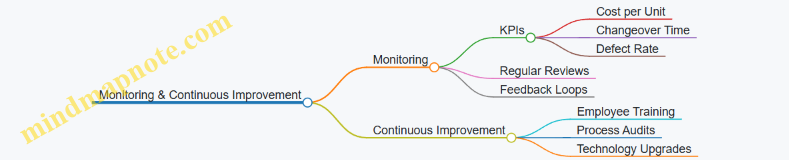
Example:
- Cost per unit decreased by 12% within six months.
- Defect rates dropped by 8%, contributing to lower rework costs.
Summary
This case study demonstrates how management accounting principles such as cost classification, Activity-Based Costing, and lean accounting can be integrated to identify and implement effective cost reduction strategies. By combining detailed cost analysis with practical process improvements and continuous monitoring, the global manufacturing company successfully enhanced profitability while maintaining quality and operational efficiency.
12.2 Case Study 2: Budgeting and Forecasting in a Fast-Growing Startup
Overview
In this case study, we explore how a fast-growing technology startup implemented effective budgeting and forecasting practices to manage rapid expansion, control costs, and align financial goals with strategic objectives. The startup, “TechNova,” specializes in SaaS solutions and experienced a 150% revenue growth in its second year.
Challenges Faced by TechNova
- Unpredictable cash flows due to rapid customer acquisition
- Difficulty in forecasting expenses related to scaling operations
- Need for flexible budgeting to accommodate market changes
- Aligning departmental budgets with overall company goals
Step 1: Establishing a Budgeting Framework
TechNova adopted a flexible budgeting approach to adapt to fluctuating business conditions.
Mind Map: Budgeting Framework for TechNova
Example: The marketing team initially budgeted $50,000 for Q1 campaigns. However, as customer acquisition exceeded expectations, the flexible budget allowed increasing the marketing spend to $70,000 without disrupting overall financial planning.
Step 2: Implementing Rolling Forecasts
Instead of annual static budgets, TechNova used rolling forecasts to continuously update financial projections every quarter.
Mind Map: Rolling Forecast Process

Example: In Q2, the forecast was adjusted to reflect a new partnership that was expected to increase sales by 20%. This led to revising revenue projections from $1.2M to $1.44M and adjusting production costs accordingly.
Step 3: Departmental Budgeting and Accountability
Each department was assigned a budget aligned with company goals and held accountable for variances.
Mind Map: Departmental Budgeting Structure

Example: The product development team was allocated $200,000 for new feature development. Mid-year variance analysis showed they were under budget by 10%, allowing reallocation of funds to accelerate a critical feature.
Step 4: Variance Analysis and Continuous Improvement
Regular variance analysis helped TechNova identify deviations and take corrective actions promptly.
Mind Map: Variance Analysis Cycle
Example: In Q3, customer support costs exceeded the budget by 15% due to higher-than-expected onboarding needs. The finance team worked with support to optimize staffing schedules, reducing overtime costs in Q4.
Step 5: Tools and Best Practices
TechNova leveraged cloud-based budgeting software integrated with their ERP system to automate data collection and reporting.
Best Practices Implemented:
- Collaborative budgeting involving cross-functional teams
- Scenario planning to prepare for different growth trajectories
- Clear communication of budget assumptions and changes
Example: Using scenario planning, TechNova prepared for a conservative, moderate, and aggressive growth scenario. This enabled quick pivoting when market conditions changed unexpectedly.
Summary
Through flexible budgeting, rolling forecasts, departmental accountability, and continuous variance analysis, TechNova successfully managed its rapid growth while maintaining financial discipline. This case illustrates how startups can adopt dynamic management accounting principles to navigate uncertainty and scale sustainably.
Key Takeaways
- Flexible budgets allow startups to adapt to changing business volumes.
- Rolling forecasts provide up-to-date financial insights for decision-making.
- Departmental budgeting promotes ownership and alignment with company goals.
- Regular variance analysis drives continuous financial improvement.
- Leveraging technology enhances accuracy and efficiency in budgeting.
This case study exemplifies best practices in budgeting and forecasting tailored for fast-growing startups, providing actionable insights for management accountants in similar environments.
12.3 Case Study 3: Performance Measurement in a Non-Profit Organization
Overview
Performance measurement in non-profit organizations (NPOs) is crucial to ensure that resources are used efficiently to achieve the mission and create social impact. Unlike for-profit entities, non-profits focus on social value rather than financial profit, so their performance metrics must reflect both financial stewardship and mission effectiveness.
This case study explores how a mid-sized non-profit organization implemented a comprehensive performance measurement system to improve transparency, accountability, and impact.
Background
The non-profit, “Helping Hands Foundation,” provides educational support and vocational training to underprivileged youth. They faced challenges in measuring their effectiveness beyond basic financial reports and wanted to adopt a more balanced approach to performance measurement.
Step 1: Identifying Key Performance Indicators (KPIs)
The management accounting team collaborated with program managers and stakeholders to define KPIs aligned with the organization’s mission and operational goals.
Mind Map: KPIs for Helping Hands Foundation
Example:
- Cost per Beneficiary: Total program costs divided by the number of youth trained.
- Job Placement Rate: Percentage of graduates who secured employment within 6 months.
Step 2: Designing the Balanced Scorecard
To integrate financial and non-financial KPIs, Helping Hands adopted the Balanced Scorecard framework, customized for non-profits.
Mind Map: Balanced Scorecard Perspectives for Non-Profit

Example:
- Tracking Fund Utilization ensured that at least 85% of funds were directed to program activities rather than administrative costs.
- Measuring Volunteer Development helped increase volunteer retention by 15% year-over-year.
Step 3: Data Collection and Reporting
The organization implemented a centralized management accounting information system to collect data from various departments.
- Financial data was extracted monthly from the accounting software.
- Program managers submitted quarterly reports on training outcomes.
- Surveys were conducted bi-annually to gather beneficiary and community feedback.
Example:
- A dashboard was created to visualize KPIs in real-time, enabling quick identification of areas needing attention.
Step 4: Analysis and Continuous Improvement
Variance analysis was performed regularly to compare actual results against targets.
Example:
- The Job Placement Rate was below target by 10%. Root cause analysis revealed a lack of employer partnerships. The organization responded by initiating new collaborations, resulting in a 20% increase in placements the following year.
Lessons Learned and Best Practices
- Align KPIs with Mission: Metrics must reflect both financial health and social impact.
- Engage Stakeholders: Involving program staff and beneficiaries ensures relevant and actionable KPIs.
- Use Balanced Scorecard: Provides a holistic view beyond financials.
- Leverage Technology: Dashboards and integrated systems improve data accuracy and accessibility.
- Focus on Continuous Improvement: Regular review and adaptation drive better outcomes.
Summary
This case study demonstrates how management accounting principles and tools, such as KPI development, balanced scorecards, and variance analysis, can be effectively applied in a non-profit context. By focusing on both financial stewardship and mission impact, Helping Hands Foundation enhanced its performance measurement, leading to improved decision-making and greater social value.
12.4 Case Study 4: Capital Investment Decision in the Energy Sector
Overview
Capital investment decisions are critical in the energy sector due to the high costs, long project lifecycles, and significant environmental and regulatory considerations. This case study explores how a large energy company evaluated a proposed investment in a new solar power plant using management accounting principles and capital budgeting techniques.
Project Background
The company is considering investing $150 million to build a solar power plant with an expected operational life of 25 years. The project aims to increase renewable energy capacity, reduce carbon emissions, and benefit from government subsidies.
Key assumptions:
- Initial investment: $150 million
- Annual operating costs: $5 million
- Expected annual revenue: $25 million
- Project life: 25 years
- Discount rate: 8%
- Salvage value at end of project: $10 million
Step 1: Identifying Relevant Cash Flows
- Initial Outlay: $150 million (Year 0)
- Annual Net Cash Inflows: Revenue minus operating costs = $25M - $5M = $20 million per year (Years 1-25)
- Terminal Cash Flow: Salvage value of $10 million at Year 25
Mind Map: Relevant Cash Flows
Step 2: Applying Capital Budgeting Techniques
Payback Period
- Payback Period = Initial Investment / Annual Net Cash Inflow = $150M / $20M = 7.5 years
- Interpretation: The company recovers its initial investment in 7.5 years.
Net Present Value (NPV)
- NPV calculation considers the time value of money by discounting future cash flows at 8%.
Formula:
\[ NPV = \sum_{t=1}^{25} \frac{20M}{(1+0.08)^t} + \frac{10M}{(1+0.08)^{25}} - 150M \]
Using a financial calculator or Excel, the NPV is approximately $92 million.
Internal Rate of Return (IRR)
- IRR is the discount rate that makes NPV = 0.
- For this project, IRR is approximately 18%.
Mind Map: Capital Budgeting Techniques
Step 3: Risk and Sensitivity Analysis
The company conducted sensitivity analysis to understand how changes in key variables affect the project’s viability.
-
Scenario 1: Revenue Decrease by 10%
- New annual revenue: $22.5 million
- New net cash inflow: $17.5 million
- NPV decreases but remains positive at approximately $65 million.
-
Scenario 2: Operating Costs Increase by 20%
- New operating costs: $6 million
- New net cash inflow: $19 million
- NPV decreases to approximately $80 million.
-
Scenario 3: Discount Rate Increases to 10%
- NPV decreases to approximately $70 million.
Mind Map: Sensitivity Analysis
Step 4: Qualitative Considerations
- Environmental Impact: Positive contribution to sustainability goals.
- Regulatory Environment: Favorable subsidies and tax incentives.
- Technological Risks: Potential advances in solar technology could impact future costs.
- Market Risks: Fluctuations in energy prices and demand.
Best Practices Demonstrated
- Comprehensive identification of relevant cash flows.
- Use of multiple capital budgeting techniques for robust decision-making.
- Incorporation of sensitivity analysis to assess risks.
- Consideration of qualitative factors beyond pure financial metrics.
Conclusion
The investment in the solar power plant shows strong financial viability with a positive NPV and IRR well above the discount rate. Sensitivity analysis confirms the project’s resilience to moderate changes in assumptions. Coupled with strategic alignment to sustainability goals, the company decides to proceed with the investment.
Summary Table
| Metric | Value |
|---|---|
| Initial Investment | $150 million |
| Annual Net Cash Flow | $20 million |
| Project Life | 25 years |
| Discount Rate | 8% |
| Payback Period | 7.5 years |
| NPV | $92 million |
| IRR | 18% |
This case study exemplifies how management accountants in the energy sector apply core principles and best practices to guide capital investment decisions that balance financial returns with strategic and environmental considerations.
12.5 Lessons Learned and Best Practices from Each Case
In this section, we consolidate the key takeaways and best practices derived from the previous case studies, providing actionable insights for management accountants. These lessons are supported by mind maps to visualize concepts and practical examples to illustrate their application.
Case Study 1: Cost Reduction in a Global Manufacturing Company
Lessons Learned:
- Importance of detailed cost classification to identify reduction opportunities.
- Utilizing variance analysis to pinpoint inefficiencies.
- Engaging cross-functional teams to implement lean accounting principles.
Best Practices:
- Regularly update cost drivers and review cost behavior.
- Implement continuous monitoring systems for cost control.
- Foster a culture of cost awareness across departments.
Mind Map:
Example: A manufacturing firm identified excessive material waste by analyzing material variance reports. By introducing stricter quality checks and supplier negotiations, they reduced material costs by 12% within six months.
Case Study 2: Budgeting and Forecasting in a Fast-Growing Startup
Lessons Learned:
- Flexibility in budgeting is crucial for startups facing rapid changes.
- Zero-based budgeting helps in prioritizing essential expenditures.
- Incorporating scenario analysis improves forecasting accuracy.
Best Practices:
- Use rolling forecasts to adapt to market changes.
- Engage all departments in the budgeting process for realistic inputs.
- Leverage technology for real-time budget tracking.
Mind Map:
Example: A tech startup used zero-based budgeting to reassess all expenses quarterly, reallocating funds from low-impact marketing campaigns to product development, resulting in a 20% increase in customer acquisition.
Case Study 3: Performance Measurement in a Non-Profit Organization
Lessons Learned:
- Balanced scorecard helps align financial and mission-driven goals.
- Non-financial KPIs are as important as financial metrics.
- Transparent reporting builds stakeholder trust.
Best Practices:
- Define clear, measurable objectives linked to organizational mission.
- Regularly review and adjust KPIs.
- Use dashboards for effective communication.
Mind Map:
Example: A non-profit implemented a dashboard tracking volunteer hours and beneficiary satisfaction alongside financials, which improved program effectiveness and donor confidence.
Case Study 4: Capital Investment Decision in the Energy Sector
Lessons Learned:
- Comprehensive risk analysis is critical in capital budgeting.
- Combining multiple appraisal techniques provides a balanced view.
- Stakeholder involvement ensures alignment with strategic goals.
Best Practices:
- Use sensitivity analysis to understand impact of variable changes.
- Incorporate environmental and regulatory considerations.
- Document assumptions and revisit them periodically.
Mind Map:
Example: An energy company evaluated a new solar plant investment using NPV and IRR, incorporating sensitivity analysis on energy prices and regulatory changes, leading to a well-informed go/no-go decision.
Summary Mind Map of Lessons Learned and Best Practices
Final Thoughts
Integrating these lessons and best practices into daily management accounting activities empowers accountants to drive strategic decision-making, optimize resource allocation, and enhance organizational performance. Real-world examples demonstrate that a tailored approach, continuous learning, and embracing technology are key to success.