Financial Planning for SMEs
1. Introduction to Financial Planning for SMEs
1.1 Understanding the Importance of Financial Planning
Financial planning is a critical foundation for the success and sustainability of Small and Medium Enterprises (SMEs). It involves forecasting future financial results, setting goals, and creating strategies to manage income, expenses, investments, and risks effectively. Without a solid financial plan, SMEs risk cash flow problems, poor decision-making, and missed growth opportunities.
Why Financial Planning Matters for SMEs
- Ensures Cash Flow Stability: Proper planning helps SMEs anticipate cash inflows and outflows, preventing liquidity crises.
- Supports Informed Decision-Making: Financial data and forecasts enable owners and advisors to make strategic choices.
- Facilitates Goal Setting: Clear financial goals align business activities and measure progress.
- Attracts Investors and Lenders: A well-structured financial plan demonstrates credibility and viability.
- Manages Risks: Identifies potential financial risks and prepares contingency plans.
Mind Map: Core Benefits of Financial Planning for SMEs
Example 1: Retail Boutique Avoids Cash Crunch
A small retail boutique struggled with inconsistent cash flow due to seasonal sales. By implementing a financial plan that forecasted monthly cash inflows and outflows, the owner was able to:
- Identify low cash periods ahead of time
- Arrange short-term financing during off-peak months
- Negotiate better payment terms with suppliers
This proactive approach prevented stock shortages and late payments, stabilizing the business.
Mind Map: Components of Financial Planning
Example 2: Small Consultancy Aligns Goals with Financial Plan
A small consultancy firm set a goal to increase revenue by 20% within a year. Through financial planning, they:
- Broke down the revenue target into quarterly milestones
- Allocated budget for marketing and training
- Monitored monthly financial reports to adjust strategies
This structured approach helped the consultancy meet its growth target while maintaining profitability.
Summary
Understanding the importance of financial planning empowers SMEs to navigate uncertainties, optimize resources, and achieve sustainable growth. For accountants and small business advisors, guiding clients through this process with clear examples and practical tools is essential to building resilient businesses.
1.2 Key Financial Challenges Faced by SMEs
Small and Medium-sized Enterprises (SMEs) often face a unique set of financial challenges that can impact their growth, sustainability, and overall success. Understanding these challenges is the first step towards effective financial planning.
Common Financial Challenges for SMEs
Cash Flow Management
Cash flow is the lifeblood of any SME. Many SMEs struggle with maintaining a steady cash flow due to irregular income streams and delayed payments from customers.
Example:
A small graphic design agency completes a project for a client but receives payment 60 days later. Meanwhile, the agency has to pay salaries, rent, and software subscriptions monthly. This gap creates cash flow pressure.
Best Practice: Implementing a cash flow forecast and negotiating payment terms can help manage this challenge.
Access to Finance
SMEs often find it difficult to secure financing due to limited credit history or collateral. Banks may impose high interest rates or strict lending criteria.
Example:
A local bakery wants to expand but is denied a loan because it lacks sufficient financial documentation and collateral.
Best Practice: Preparing detailed financial statements and exploring alternative financing options like crowdfunding or government grants can improve access.
Budgeting and Forecasting
Many SMEs lack the expertise to create realistic budgets and forecasts, leading to overestimations or underestimations that affect decision-making.
Example:
A small IT consultancy overestimates client acquisition, leading to overspending on hiring and infrastructure.
Best Practice: Using historical data and conservative assumptions can improve forecasting accuracy.
Cost Control
Unexpected expenses or inefficient use of resources can erode profits.
Example:
A boutique hotel faces rising utility costs and unplanned maintenance expenses, squeezing margins.
Best Practice: Regular expense audits and negotiating with suppliers help control costs.
Taxation and Compliance
Complex tax regulations can overwhelm SMEs, leading to errors or penalties.
Example:
A freelance consultant misses a tax filing deadline and incurs fines.
Best Practice: Working with accountants and using tax software ensures compliance.
Risk Management
SMEs often lack formal risk management strategies, leaving them vulnerable to market changes or emergencies.
Example:
A small construction firm is hit by sudden material price hikes and lacks a contingency fund.
Best Practice: Conducting risk assessments and setting aside contingency funds mitigates risks.
Summary Mind Map
By recognizing these key financial challenges and applying best practices, SMEs can build stronger financial foundations and improve their chances of sustainable growth.
1.3 Overview of Financial Planning Best Practices
Financial planning is a critical process that helps SMEs manage their resources efficiently, anticipate challenges, and seize growth opportunities. Below is an overview of essential best practices that form the foundation of effective financial planning for SMEs.
Best Practice 1: Establish Clear Financial Goals
- Define specific, measurable, achievable, relevant, and time-bound (SMART) goals.
- Align financial goals with overall business strategy.
Example: A small bakery sets a goal to increase monthly revenue by 15% within six months by introducing new product lines.
Best Practice 2: Develop a Realistic Budget
- Create budgets based on historical data and market research.
- Include all fixed and variable costs.
- Update budgets regularly to reflect changes.
Example: A local landscaping business prepares a quarterly budget accounting for seasonal fluctuations in demand and labor costs.
Best Practice 3: Maintain Robust Cash Flow Management
- Monitor cash inflows and outflows daily.
- Use cash flow forecasts to anticipate shortages.
- Implement strategies to accelerate receivables and manage payables.
Example: A small manufacturing firm uses weekly cash flow forecasts to ensure they have enough liquidity to cover supplier payments.
Best Practice 4: Control Costs and Optimize Expenses
- Differentiate between essential and non-essential expenses.
- Negotiate with suppliers for better rates.
- Leverage technology to automate expense tracking.
Example: A boutique hotel reduces energy costs by investing in smart thermostats and negotiating bulk purchasing agreements for supplies.
Best Practice 5: Choose Appropriate Financing
- Understand the pros and cons of debt versus equity financing.
- Prepare thorough loan applications with clear financial projections.
- Maintain a balanced capital structure.
Example: A tech startup opts for a mix of angel investment and a small business loan to fund product development and marketing.
Best Practice 6: Regularly Review and Adjust Financial Plans
- Set KPIs to monitor progress.
- Conduct monthly or quarterly financial reviews.
- Adjust plans based on market conditions and business performance.
Example: A consulting firm revises its financial plan quarterly to adapt to client demand and economic changes.
Mind Map: Core Financial Planning Best Practices for SMEs
Mind Map: Example Application of Best Practices in a Small Business
By integrating these best practices into their financial planning process, SMEs can build a solid foundation for sustainable growth and resilience against financial uncertainties.
1.4 Case Study: How a Small Retailer Improved Cash Flow with Basic Planning
Background
Sarah owns a small retail store specializing in home décor items. Despite steady sales, she frequently faced cash flow shortages, making it difficult to pay suppliers on time and invest in new inventory. Sarah realized that without proper financial planning, her business growth was at risk.
Step 1: Identifying the Problem
Sarah began by tracking her cash inflows and outflows over a month. She discovered that while sales were consistent, the timing of payments and purchases created cash crunches.
Key Issues Identified:
- Customers mostly paid at the point of sale, but some wholesale clients delayed payments.
- Inventory purchases were made in bulk without considering cash availability.
- No formal cash flow forecast existed.
Step 2: Implementing Basic Cash Flow Planning
Sarah adopted a simple cash flow forecasting method to anticipate cash shortages and surpluses.
Mind Map: Basic Cash Flow Planning Process
Example:
- Sarah created a weekly cash flow spreadsheet listing expected cash inflows and outflows.
- She noted that supplier payments were due every 15th and 30th, while some client payments came late.
Step 3: Adjusting Payment Terms
Sarah negotiated with her suppliers to extend payment terms from 15 days to 30 days, giving her more breathing room.
Example:
- Supplier A agreed to net 30 terms instead of net 15.
- Sarah also offered a 2% early payment discount to her wholesale clients to encourage faster payments.
Step 4: Managing Inventory Purchases
Instead of bulk buying, Sarah shifted to smaller, more frequent inventory orders aligned with cash availability.
Mind Map: Inventory Purchase Strategy
Example:
- Sarah tracked monthly sales trends and ordered inventory accordingly, reducing excess stock and freeing up cash.
Step 5: Monitoring and Reviewing
Sarah reviewed her cash flow weekly, adjusting plans as needed.
Example:
- When a large wholesale order was delayed, she postponed a planned inventory purchase.
- This flexibility prevented cash shortages.
Results
- Improved cash flow visibility and control.
- Reduced late payments to suppliers.
- Increased ability to invest in new product lines.
- Enhanced relationships with suppliers and clients.
Summary Table
| Challenge | Action Taken | Outcome |
|---|---|---|
| Irregular cash flow | Implemented weekly cash flow forecasts | Anticipated shortages and planned accordingly |
| Short supplier payment terms | Negotiated extended payment terms | Improved cash availability |
| Bulk inventory purchases | Shifted to smaller, frequent orders | Reduced cash tied up in stock |
| Late client payments | Offered early payment discounts | Accelerated receivables |
This case study illustrates how even basic financial planning techniques, like cash flow forecasting and payment term negotiations, can significantly improve an SME’s financial health. For accountants and small business advisors, guiding clients through these simple steps can build a foundation for sustainable growth.
2. Setting Financial Goals and Objectives
2.1 Defining Short-term and Long-term Financial Goals
Financial goals are the foundation of any effective financial plan for SMEs. They provide direction, motivation, and a clear framework for decision-making. Understanding the difference between short-term and long-term financial goals is crucial for small business advisors and accountants guiding SMEs.
What Are Financial Goals?
Financial goals are specific objectives related to the financial performance and health of a business. They can range from managing daily cash flow to expanding the business over several years.
Short-term Financial Goals
Short-term financial goals are targets set to be achieved within a period of up to one year. These goals often focus on immediate operational needs and cash flow management.
Examples of Short-term Financial Goals:
- Maintaining a positive cash flow month-to-month
- Reducing outstanding accounts receivable by 10% within 6 months
- Cutting operational expenses by 5% in the next quarter
- Saving a contingency fund equivalent to 3 months of operating expenses
Mind Map: Short-term Financial Goals
Example:
A small bakery sets a short-term goal to reduce overdue invoices by 15% within 3 months. They implement a new invoicing system with automated reminders and offer a 2% discount for payments made within 10 days. This improves cash flow and reduces the need for short-term borrowing.
Long-term Financial Goals
Long-term financial goals are objectives set with a horizon of more than one year, often spanning 3 to 5 years or more. These goals focus on growth, sustainability, and strategic positioning.
Examples of Long-term Financial Goals:
- Expanding to a new location within 3 years
- Increasing annual revenue by 50% over 5 years
- Paying off all business debt within 4 years
- Building a capital reserve for equipment upgrades
Mind Map: Long-term Financial Goals
Example:
A small IT consultancy sets a long-term goal to increase annual revenue by 40% in 5 years by expanding their service offerings and entering two new regional markets. They create a phased investment plan, allocating profits towards marketing and hiring skilled staff.
How to Define Effective Financial Goals
- Be Specific: Clearly define what you want to achieve.
- Measurable: Include metrics to track progress.
- Achievable: Set realistic targets based on current resources.
- Relevant: Align goals with overall business strategy.
- Time-bound: Assign deadlines for accountability.
This is the SMART goal framework, widely used in SME financial planning.
Integrated Example: Combining Short-term and Long-term Goals
| Goal Type | Goal Description | Timeframe | Example Action Steps |
|---|---|---|---|
| Short-term | Improve cash flow by reducing overdue invoices | 6 months | Implement invoicing software; offer payment discounts |
| Long-term | Expand to two new cities | 3 years | Conduct market research; secure financing; hire local staff |
By balancing short-term operational goals with long-term strategic goals, SMEs can maintain financial stability while pursuing growth.
Summary
- Short-term goals focus on immediate financial health and operational efficiency.
- Long-term goals drive growth, sustainability, and strategic success.
- Using mind maps helps visualize and organize financial objectives.
- Real-world examples demonstrate practical application of goal-setting.
- Applying the SMART framework ensures goals are clear and actionable.
This foundational understanding enables accountants and small business advisors to guide SMEs effectively in their financial planning journey.
2.2 Aligning Financial Goals with Business Strategy
Aligning financial goals with your overall business strategy is crucial for ensuring that every dollar spent and every financial decision supports the broader objectives of your SME. This alignment helps maintain focus, optimize resource allocation, and measure progress effectively.
Why Alignment Matters
- Ensures financial resources are directed towards strategic priorities.
- Helps avoid conflicting objectives that can drain resources.
- Provides clarity for decision-making and performance measurement.
Steps to Align Financial Goals with Business Strategy
-
Understand the Business Strategy
- Identify the core mission, vision, and strategic objectives.
- Understand growth plans, market positioning, and competitive advantages.
-
Translate Strategic Objectives into Financial Terms
- Convert qualitative goals (e.g., market expansion) into quantitative financial targets (e.g., revenue growth, capital investment).
-
Set Financial Goals that Support Strategy
- Define specific financial goals such as profitability, cash flow targets, cost management, or investment in innovation.
-
Communicate and Integrate Across Teams
- Ensure all departments understand how their budgets and financial targets contribute to the strategy.
-
Monitor and Adjust
- Regularly review financial performance against strategic milestones and adjust goals as needed.
Mind Map: Aligning Financial Goals with Business Strategy
Example 1: A Small E-commerce Business Expanding Market Reach
Business Strategy: Expand into new regional markets over the next 12 months.
Financial Goals Aligned:
- Increase marketing budget by 20% to support regional campaigns.
- Allocate $50,000 for inventory buildup in new markets.
- Achieve a 15% increase in monthly revenue within 9 months.
- Maintain operating costs below 30% of revenue to ensure profitability.
Outcome: By aligning financial goals with the expansion strategy, the business was able to track marketing ROI, manage inventory costs effectively, and measure revenue growth in new regions.
Example 2: A Small Manufacturing Firm Focusing on Cost Leadership
Business Strategy: Become the lowest-cost producer in the local market to gain competitive advantage.
Financial Goals Aligned:
- Reduce production costs by 10% within 6 months.
- Invest in automation technology with a budget of $100,000.
- Improve cash flow by shortening receivables cycle by 15 days.
- Limit overhead expenses growth to under 5% annually.
Outcome: The financial goals directly supported the cost leadership strategy by focusing on cost reduction and operational efficiency, enabling the firm to offer competitive pricing.
Mind Map: Example 1 - E-commerce Business Financial Alignment
Mind Map: Example 2 - Manufacturing Cost Leadership
Best Practices
- Link KPIs to Both Financial and Strategic Goals: For example, track customer acquisition cost alongside revenue growth when expanding markets.
- Use Scenario Planning: Prepare financial goals for different strategic outcomes to stay agile.
- Engage Stakeholders: Involve finance teams and business unit leaders in goal-setting to ensure buy-in and realistic targets.
By embedding financial goals within the framework of your business strategy, SMEs can create a cohesive plan that drives sustainable growth and operational success.
2.3 SMART Goals Framework for SMEs
Setting clear and actionable financial goals is crucial for the success of any SME. The SMART framework is a widely recognized method that helps businesses create goals that are Specific, Measurable, Achievable, Relevant, and Time-bound. This structured approach ensures that financial objectives are clear and attainable, improving focus and accountability.
What is the SMART Framework?
- Specific: Goals should be clear and unambiguous.
- Measurable: You must be able to track progress and measure the outcome.
- Achievable: Goals should be realistic and attainable given your resources.
- Relevant: Goals must align with your overall business strategy.
- Time-bound: There should be a clear deadline or timeframe.
Mind Map: SMART Goals Framework for SMEs
Detailed Breakdown with Examples
-
Specific
- Instead of “Increase revenue,” specify “Increase monthly sales revenue by $10,000 through new product lines.”
- Example: A local bakery sets a goal to “Increase catering orders by 20% in the next quarter.”
-
Measurable
- Use numbers or percentages to track progress.
- Example: A graphic design agency aims to “Reduce outstanding client invoices by 30% within 60 days.”
-
Achievable
- Goals should stretch the business but remain realistic.
- Example: A small IT consultancy targets “Onboard 3 new clients per month,” based on current capacity.
-
Relevant
- Ensure the goal supports broader business objectives.
- Example: A fitness studio focuses on “Increasing membership retention rate by 15%” to support sustainable growth.
-
Time-bound
- Deadlines create urgency and help prioritize.
- Example: An online retailer plans to “Launch a new product line within 6 months.”
Mind Map: Example of a SMART Financial Goal for an SME
Practical Example: Applying SMART to a Small Business
Scenario: A small landscaping company wants to improve its financial performance.
- Specific: Increase monthly contract revenue by $5,000 by targeting commercial clients.
- Measurable: Track signed contracts and monthly revenue reports.
- Achievable: Hire one additional sales representative and allocate budget for targeted advertising.
- Relevant: Aligns with the company’s goal to diversify client base beyond residential customers.
- Time-bound: Achieve this within the next 4 months.
This goal helps the company focus efforts on a clear target, measure progress, and adjust strategies if needed.
Tips for SMEs When Using SMART Goals
- Involve your team in goal-setting to increase buy-in.
- Regularly review and update goals based on performance and market changes.
- Use financial software or dashboards to track measurable outcomes easily.
- Break larger goals into smaller milestones for better management.
By integrating the SMART framework into your financial planning, SMEs can enhance clarity, motivation, and success rates in achieving their financial objectives.
2.4 Example: A Service Business Setting Realistic Revenue Targets
Setting realistic revenue targets is crucial for any SME, especially service businesses where income can be variable and dependent on client acquisition and retention. Let’s explore a detailed example of a small digital marketing consultancy aiming to set achievable revenue goals for the next fiscal year.
Step 1: Understand Current Revenue and Market Conditions
- Current Annual Revenue: $250,000
- Number of Clients: 20
- Average Revenue per Client: $12,500
- Market Growth Rate: 5% annually
Step 2: Define Business Capacity and Constraints
- Number of Consultants: 3
- Billable Hours per Consultant per Year: 1,600 hours
- Average Hourly Rate: $100
- Maximum Capacity Revenue: 3 consultants * 1,600 hours * $100 = $480,000
Step 3: Set Realistic Growth Expectations
- Considering market growth and business capacity, a 15% revenue growth target is reasonable.
- Target Revenue: $250,000 * 1.15 = $287,500
Step 4: Break Down Revenue Targets
-
New Clients Needed:
- Current average revenue per client = $12,500
- Revenue increase needed = $37,500
- New clients needed = $37,500 / $12,500 = 3 clients
-
Upselling to Existing Clients:
- Upsell target = $10,000
- Average upsell per client = $500
- Number of clients to upsell = $10,000 / $500 = 20 clients (all existing clients)
Step 5: Final Revenue Target Plan
- Acquire 3 new clients
- Upsell existing 20 clients by $500 each
- Maintain service quality and consultant capacity
Mind Map: Setting Realistic Revenue Targets for a Service Business
Additional Example: Freelance Graphic Designer
- Current Revenue: $60,000/year
- Average Project Fee: $1,500
- Projects per Year: 40
- Goal: Increase revenue by 20%
Steps:
- Target revenue: $60,000 * 1.20 = $72,000
- Additional revenue needed: $12,000
- Options:
- Increase projects by 8 (to 48 projects/year)
- Increase average project fee by $300 (to $1,800/project)
- Combination: 4 extra projects + $150 increase per project
This example shows how breaking down revenue targets into actionable steps helps freelancers and service SMEs create achievable plans.
Key Takeaways
- Base revenue targets on current performance and realistic market conditions.
- Consider business capacity to avoid overcommitment.
- Break down targets into new client acquisition and upselling existing clients.
- Use clear, actionable numbers to guide sales and marketing efforts.
- Regularly review and adjust targets based on performance and market feedback.
3. Budgeting and Forecasting
3.1 Creating an Effective Budget: Step-by-Step
Creating a budget is a foundational step in financial planning for SMEs. An effective budget helps you allocate resources wisely, anticipate cash flow needs, and set realistic financial goals. Below is a detailed, step-by-step guide to creating a budget that works for your small or medium-sized enterprise.
Step 1: Define the Budget Period
- Decide the time frame for your budget (monthly, quarterly, annually).
- Most SMEs start with a monthly budget and then aggregate it into quarterly or annual views.
Step 2: Gather Historical Financial Data
- Collect past financial statements, including income statements, cash flow reports, and expense records.
- This data provides a baseline for forecasting future revenues and expenses.
Step 3: Estimate Revenue
- Project sales or service income based on historical trends, market analysis, and sales forecasts.
- Consider seasonality, market conditions, and planned marketing efforts.
Step 4: List Fixed and Variable Expenses
- Fixed expenses: rent, salaries, insurance, loan repayments.
- Variable expenses: utilities, raw materials, commissions, marketing costs.
Step 5: Plan for One-Time or Irregular Expenses
- Include costs such as equipment purchases, maintenance, or tax payments.
Step 6: Set Aside Contingency Funds
- Allocate a percentage (e.g., 5-10%) of the budget for unexpected expenses.
Step 7: Review and Adjust
- Compare projected income and expenses.
- Adjust spending plans to avoid deficits.
Step 8: Monitor and Update Regularly
- Track actual performance against the budget monthly.
- Revise forecasts as necessary to reflect changes.
Mind Map: Steps to Create an Effective Budget
Example: Budgeting for a Small Café
Step 1: The café owner chooses a monthly budget to closely monitor cash flow.
Step 2: They gather sales data and expense reports from the past year.
Step 3: Revenue is projected based on an average of last year’s monthly sales, adjusted for a planned 10% increase due to a new marketing campaign.
Step 4: Fixed expenses include rent ($2,000), salaries ($5,000), and insurance ($300). Variable expenses include coffee beans, milk, and other supplies, estimated at 30% of sales.
Step 5: One-time expenses include new coffee machine purchase ($1,200) planned for the third month.
Step 6: A contingency fund of 7% of total expenses is set aside.
Step 7: The owner reviews the budget and ensures expenses do not exceed projected revenue.
Step 8: Monthly actuals are compared to the budget, and adjustments are made if sales fall short or costs rise.
Mind Map: Small Café Budget Example
Tips for SMEs When Creating Budgets
- Be Realistic: Avoid overestimating revenue or underestimating expenses.
- Use Simple Tools: Spreadsheets or budgeting software can simplify the process.
- Involve Your Team: Input from sales, operations, and finance teams improves accuracy.
- Plan for Growth: Include budgets for new initiatives or expansion.
- Keep it Flexible: Budgets should be living documents that adapt to business changes.
By following these steps and using practical examples, SMEs can create effective budgets that provide clarity and control over their financial future.
3.2 Types of Budgets Suitable for SMEs
Effective budgeting is a cornerstone of sound financial planning for SMEs. Different types of budgets serve various purposes, helping businesses allocate resources, forecast performance, and control costs. Below, we explore the most common types of budgets suitable for SMEs, accompanied by mind maps and practical examples.
Operating Budget
An operating budget outlines the expected income and expenses related to the day-to-day operations of the business. It typically includes sales revenue, cost of goods sold (COGS), and operating expenses such as salaries, rent, utilities, and marketing.
Mind Map:
Example:
A small bakery estimates monthly sales of $20,000. Their expenses include $8,000 for ingredients (COGS), $5,000 for staff wages, $1,200 for rent, and $800 for utilities and marketing. The operating budget helps them forecast a monthly profit and identify areas to optimize costs.
Cash Flow Budget
This budget focuses on the timing of cash inflows and outflows, ensuring the business maintains enough liquidity to meet its obligations. It helps SMEs avoid cash shortages and plan for periods of low cash availability.
Mind Map:
Example:
A small landscaping company experiences seasonal fluctuations. By preparing a cash flow budget, they anticipate lower cash inflows during winter and plan to build a cash reserve during peak seasons to cover expenses in slower months.
Capital Expenditure (CapEx) Budget
This budget plans for investments in long-term assets such as equipment, property, or technology. CapEx budgets help SMEs prioritize and manage large expenditures without disrupting operational cash flow.
Mind Map:
Example:
A small manufacturing SME plans to purchase a new machine costing $50,000. They create a CapEx budget to evaluate financing options and schedule the purchase to align with cash availability and production needs.
Project Budget
Used for specific projects, this budget tracks all costs and revenues associated with a particular initiative, such as launching a new product or marketing campaign.
Mind Map:
Example:
A small IT consultancy budgets for a client software development project. They estimate labor costs, software licenses, and marketing expenses to ensure the project remains profitable.
Static vs. Flexible Budgets
- Static Budget: Fixed budget based on expected activity levels. Useful for SMEs with predictable operations.
- Flexible Budget: Adjusts according to actual activity levels, providing a more dynamic approach.
Mind Map:
Example:
A small retail store uses a static budget for rent and salaries but employs a flexible budget for inventory purchases that vary with sales volume.
Summary Table of Budgets for SMEs
| Budget Type | Purpose | Best For | Example Use Case |
|---|---|---|---|
| Operating Budget | Day-to-day income and expenses | All SMEs | Bakery forecasting monthly profits |
| Cash Flow Budget | Managing liquidity and cash timing | Seasonal businesses | Landscaping company managing seasonal cash flow |
| Capital Expenditure | Planning long-term asset purchases | Growing SMEs with investment needs | Manufacturing SME planning machinery purchase |
| Project Budget | Tracking costs/revenues of projects | Project-based SMEs | IT consultancy budgeting a software project |
| Static Budget | Fixed budget for predictable costs | SMEs with stable operations | Retail store budgeting fixed expenses |
| Flexible Budget | Adjustable budget based on activity | SMEs with variable sales | Retail store adjusting inventory budget |
By understanding and implementing these budget types, SMEs can better control their finances, anticipate challenges, and make informed decisions that support sustainable growth.
3.3 Forecasting Revenue and Expenses with Practical Tools
Forecasting revenue and expenses is a critical component of financial planning for SMEs. Accurate forecasts help business owners anticipate cash flow needs, allocate resources efficiently, and make informed strategic decisions. This section explores practical tools and techniques for forecasting, along with easy-to-understand examples and mind maps to visualize the process.
Why Forecasting Matters
- Helps anticipate future financial performance
- Enables proactive management of cash flow
- Supports budgeting and investment decisions
- Identifies potential financial risks early
Key Components of Forecasting
- Revenue Forecasting: Estimating future sales based on historical data, market trends, and sales pipeline
- Expense Forecasting: Predicting costs including fixed, variable, and one-time expenses
Practical Tools for Forecasting
Spreadsheet Models (Excel, Google Sheets)
- Widely accessible and customizable
- Can incorporate formulas, scenarios, and charts
- Example: Using a monthly sales growth rate to project revenue
Accounting Software with Forecasting Features
- Tools like QuickBooks, Xero, and FreshBooks offer built-in forecasting
- Automatically pull historical data to generate projections
Dedicated Financial Planning Software
- Examples: LivePlan, Fathom, Float
- Provide advanced forecasting capabilities with scenario analysis
Simple Manual Methods
- Moving averages
- Trend analysis
- Percentage of sales method
Step-by-Step Revenue Forecasting Example
Scenario: A small bakery wants to forecast revenue for the next 6 months.
- Gather Historical Sales Data: Last 6 months sales figures
- Identify Trends: Sales have increased by 5% monthly on average
- Apply Growth Rate: Project next 6 months by increasing last month’s sales by 5% each month
| Month | Sales (Units) | Sales Price (per unit) | Revenue Forecast |
|---|---|---|---|
| Jan | 1,000 | $5 | $5,000 |
| Feb | 1,050 | $5 | $5,250 |
| Mar | 1,102 | $5 | $5,510 |
| Apr | 1,157 | $5 | $5,785 |
| May | 1,215 | $5 | $6,075 |
| Jun | 1,276 | $5 | $6,380 |
Expense Forecasting Example
Scenario: The bakery’s expenses include fixed rent ($1,000/month), variable ingredient costs (40% of sales), and utilities ($200/month).
| Month | Rent | Ingredient Cost (40% of Revenue) | Utilities | Total Expense |
|---|---|---|---|---|
| Jan | 1000 | $2,000 | 200 | $3,200 |
| Feb | 1000 | $2,100 | 200 | $3,300 |
| Mar | 1000 | $2,204 | 200 | $3,404 |
| Apr | 1000 | $2,314 | 200 | $3,514 |
| May | 1000 | $2,430 | 200 | $3,630 |
| Jun | 1000 | $2,552 | 200 | $3,752 |
Mind Maps for Forecasting Revenue and Expenses
Mind Map 1: Revenue Forecasting Process
Mind Map 2: Expense Forecasting Process
Mind Map 3: Tools for Forecasting
Best Practices for Effective Forecasting
- Use multiple data sources for accuracy
- Regularly update forecasts with actual results
- Incorporate seasonality and market conditions
- Use scenario planning to prepare for uncertainties
- Keep forecasts simple and understandable for stakeholders
Summary
Forecasting revenue and expenses using practical tools empowers SMEs to plan effectively and make data-driven decisions. By combining historical data, market insights, and appropriate software or manual methods, small businesses can create reliable financial projections that support growth and sustainability.
3.4 Best Practice: Rolling Budgets for Dynamic Market Conditions
In the fast-paced and often unpredictable environment that SMEs operate in, traditional static budgets can quickly become outdated. Rolling budgets offer a flexible and proactive approach to financial planning, allowing businesses to continuously update their budgets based on the latest market information and business performance.
What is a Rolling Budget?
A rolling budget is a continuous budgeting process where the budget period is extended by adding a new budget period (usually a month or a quarter) as the current period ends. This keeps the budget horizon constant and ensures the business is always planning ahead.
Key Characteristics:
- Continuous update of budget figures
- Typically covers 12 months or 4 quarters ahead
- Reflects current market conditions and business realities
Why Rolling Budgets Are Ideal for SMEs
- Adaptability: SMEs often face rapid changes in demand, supply chain disruptions, or regulatory shifts. Rolling budgets allow quick adjustments.
- Improved Forecast Accuracy: Regular updates mean forecasts are based on the latest data.
- Better Cash Flow Management: Helps anticipate cash needs and avoid surprises.
- Enhanced Decision Making: Provides timely financial insights for strategic choices.
Mind Map: Rolling Budget Components and Benefits
How to Implement Rolling Budgets: Step-by-Step
- Establish a Baseline Budget: Start with a detailed budget for the next 12 months or 4 quarters.
- Set a Regular Update Schedule: Decide on monthly or quarterly reviews.
- Collect Real-Time Data: Gather actual sales, expenses, and market intelligence.
- Adjust Projections: Update the budget by adding a new period and revising forecasts.
- Communicate Changes: Share updates with key stakeholders to align expectations.
Example: Rolling Budget in Action for a Seasonal SME
Business Context: A small outdoor gear retailer experiences seasonal fluctuations, with peak sales in spring and summer.
- Initial Budget: Prepared in January, projecting sales and expenses for the entire year.
- March Update: Sales in early spring are 15% higher than expected due to an early warm season.
- Action: The rolling budget is updated to reflect increased sales forecasts for April to June, adjusting inventory purchases and marketing spend accordingly.
- July Update: Unexpected supply chain delays increase costs.
- Action: Budget is revised to accommodate higher expenses and adjust cash flow projections.
This continuous updating helps the retailer avoid stockouts, manage cash flow, and capitalize on market opportunities.
Mind Map: Rolling Budget Update Cycle
Tips for Successful Rolling Budgeting
- Use budgeting software that supports rolling forecasts.
- Train your finance team and business advisors on the process.
- Keep communication transparent across departments.
- Combine rolling budgets with scenario planning for risk management.
Rolling budgets empower SMEs to remain financially agile and responsive, turning budgeting from a static annual exercise into a dynamic management tool that supports growth and resilience.
3.5 Example: Budgeting for a Seasonal Small Business
Seasonal small businesses face unique budgeting challenges due to fluctuating revenue and expenses throughout the year. Proper budgeting helps these businesses manage cash flow, prepare for off-peak periods, and capitalize on peak seasons.
Understanding Seasonality in Budgeting
Seasonality means that certain months or quarters generate significantly more revenue than others. For example, a small ice cream shop may see most of its sales during summer months, while a holiday decoration store peaks in November and December.
Step-by-Step Budgeting Approach for Seasonal SMEs
- Analyze Historical Data: Review past sales and expense records to identify peak and off-peak periods.
- Segment the Year: Divide the fiscal year into seasons or months based on revenue patterns.
- Estimate Revenue Per Period: Forecast sales for each segment, considering market trends and growth.
- Plan Variable and Fixed Costs: Allocate costs that fluctuate with sales (e.g., inventory) and fixed costs (e.g., rent).
- Build a Cash Flow Buffer: Set aside reserves during peak months to cover expenses during slow periods.
- Review and Adjust Regularly: Update the budget monthly or quarterly to reflect actual performance.
Mind Map: Budgeting Process for Seasonal Small Business
Practical Example: Budgeting for “Sunny Scoops” Ice Cream Shop
- Business Profile: Small ice cream shop operating year-round with peak sales from June to August.
- Historical Sales: 70% of annual sales occur in summer months.
| Month | Estimated Revenue | Fixed Costs | Variable Costs | Notes |
|---|---|---|---|---|
| January | $2,000 | $3,000 | $500 | Low sales, heating costs high |
| February | $2,500 | $3,000 | $600 | Low sales |
| March | $3,000 | $3,000 | $700 | Start of increase |
| April | $5,000 | $3,000 | $1,200 | Pre-season inventory buildup |
| May | $10,000 | $3,000 | $3,000 | Preparing for peak season |
| June | $25,000 | $3,000 | $8,000 | Peak sales |
| July | $30,000 | $3,000 | $9,000 | Peak sales |
| August | $20,000 | $3,000 | $6,000 | Peak sales |
| September | $7,000 | $3,000 | $2,000 | Post-peak drop |
| October | $4,000 | $3,000 | $1,000 | Off-season |
| November | $3,000 | $3,000 | $700 | Off-season |
| December | $3,000 | $3,000 | $700 | Holiday season, slight uptick |
Mind Map: Cash Flow Management for Sunny Scoops
Best Practices Demonstrated
- Building Cash Reserves: Sunny Scoops saves a portion of peak season profits to cover fixed costs during slow months.
- Adjusting Variable Costs: Inventory and staffing levels are increased during peak months and scaled back off-season.
- Regular Budget Reviews: Monthly comparison of actual vs budgeted figures allows timely adjustments.
Additional Example: Holiday Decorations Store
- Peaks in November-December.
- Budget includes ramping up inventory in September-October.
- Off-season focuses on marketing and product development with minimal inventory investment.
Summary
Budgeting for seasonal SMEs requires a dynamic approach that anticipates fluctuations and plans accordingly. By segmenting the year, forecasting realistically, and managing cash flow prudently, seasonal businesses can maintain stability and capitalize on their peak periods effectively.
4. Cash Flow Management
4.1 Importance of Cash Flow for SME Survival
Cash flow is the lifeblood of any business, especially for Small and Medium-sized Enterprises (SMEs). Unlike large corporations that may have access to extensive credit lines or reserves, SMEs often operate on tighter margins and with limited financial buffers. Understanding and managing cash flow effectively can be the difference between thriving and closing down.
What is Cash Flow?
Cash flow refers to the movement of money into and out of a business over a specific period. Positive cash flow means more money is coming in than going out, enabling the business to pay bills, invest in growth, and handle unexpected expenses. Negative cash flow indicates the opposite and can lead to financial distress.
Why is Cash Flow Critical for SME Survival?
- Operational Continuity: Ensures the business can meet day-to-day expenses such as payroll, rent, and supplier payments.
- Debt Management: Helps in timely repayment of loans and avoiding penalties or damage to credit ratings.
- Investment and Growth: Enables the SME to invest in new opportunities, equipment, or marketing.
- Crisis Buffer: Acts as a cushion during slow sales periods or unexpected costs.
Mind Map: Key Reasons Cash Flow is Vital for SMEs
Common Cash Flow Challenges for SMEs
- Late payments from customers
- Over-investment in inventory
- Unexpected expenses
- Poor financial forecasting
Example: Retail Boutique Struggling with Cash Flow
A small retail boutique experienced rapid growth but failed to manage its cash flow effectively. They invested heavily in new inventory anticipating high sales, but many customers delayed payments, and some products didn’t sell as expected. As a result, the boutique struggled to pay suppliers on time, risking stock shortages.
By implementing a cash flow forecast and negotiating better payment terms with customers and suppliers, the boutique improved its cash flow visibility and stabilized operations.
Mind Map: Cash Flow Challenges and Solutions
Practical Tips for SMEs to Maintain Healthy Cash Flow
- Regular Cash Flow Forecasting: Project cash inflows and outflows weekly or monthly.
- Invoice Promptly and Follow Up: Issue invoices immediately and have a system to chase overdue payments.
- Manage Inventory Wisely: Avoid tying up too much cash in unsold stock.
- Negotiate Payment Terms: Work with suppliers and customers to create favorable payment schedules.
- Maintain a Cash Reserve: Set aside funds to cover at least 3 months of operating expenses.
Example: Service-Based SME Improving Cash Flow
A small digital marketing agency started offering discounts for clients who paid upfront and introduced milestone payments for larger projects. This approach improved their cash inflows, allowing them to better manage payroll and invest in new software tools.
Mind Map: Best Practices for Healthy Cash Flow
Summary
Cash flow management is essential for SME survival because it ensures the business can meet its financial obligations, invest in growth, and withstand unforeseen challenges. By understanding the importance of cash flow and implementing practical strategies, SMEs can build financial resilience and position themselves for long-term success.
4.2 Techniques to Monitor and Improve Cash Flow
Effective cash flow management is critical for the survival and growth of SMEs. Monitoring cash flow regularly and implementing improvement techniques can help businesses avoid liquidity crises and maintain smooth operations. Below are several practical techniques, illustrated with mind maps and real-world examples.
Techniques to Monitor Cash Flow
Regular Cash Flow Forecasting
Creating a cash flow forecast helps anticipate cash shortages or surpluses by projecting inflows and outflows over a specific period.
Example: A small graphic design agency prepares a weekly cash flow forecast to ensure they have enough funds to cover payroll and supplier payments, adjusting their spending if a client payment is delayed.
Monitoring Accounts Receivable and Payable
Tracking outstanding invoices and bills helps maintain a healthy cash flow by ensuring timely collections and managing payment schedules.
Example: A small wholesale business implements automated reminders for customers with overdue invoices, reducing average collection time from 45 to 30 days.
Maintaining a Cash Reserve
Setting aside a cash buffer helps SMEs manage unexpected expenses or temporary cash flow gaps.
Example: A local café maintains a cash reserve equivalent to two months of rent and salaries, enabling them to cover costs during slow seasons without borrowing.
Techniques to Improve Cash Flow
Accelerating Receivables
Encouraging faster payments improves cash inflow.
Example: A consulting firm offers a 2% discount for clients who pay invoices within 10 days, increasing early payments by 20%.
Extending Payables Without Penalties
Negotiating longer payment terms with suppliers can improve cash availability.
Example: A small manufacturing company renegotiates supplier contracts to extend payment terms from 30 to 45 days, improving their cash flow timing.
Managing Inventory Efficiently
Reducing excess inventory frees up cash tied in stock.
Example: A boutique retailer implements monthly inventory audits and discounts unsold items, reducing inventory holding costs by 15%.
Controlling Operating Expenses
Reviewing and cutting unnecessary expenses helps preserve cash.
Example: A small IT firm switches to cloud-based software subscriptions, saving 25% on software costs annually.
Summary Mind Map
By integrating these techniques into their financial routines, SMEs can maintain healthier cash flows, reduce financial stress, and position themselves for sustainable growth.
4.3 Managing Receivables and Payables Efficiently
Efficient management of receivables and payables is critical for maintaining healthy cash flow in SMEs. It ensures that your business has enough liquidity to meet its obligations while minimizing the risk of bad debts and late payments.
Understanding Receivables and Payables
- Receivables: Money owed to your business by customers for goods or services delivered.
- Payables: Money your business owes to suppliers or creditors for goods or services received.
Best Practices for Managing Receivables
-
Invoice Promptly and Accurately
- Send invoices immediately after delivery or service completion.
- Ensure invoices are clear, detailed, and error-free to avoid disputes.
-
Set Clear Payment Terms
- Define payment deadlines (e.g., Net 30 days).
- Communicate terms upfront to customers.
-
Offer Multiple Payment Options
- Include bank transfers, credit cards, online payments.
- Make it easy for customers to pay on time.
-
Implement a Follow-Up System
- Send reminders before and after due dates.
- Use automated tools where possible.
-
Evaluate Customer Creditworthiness
- Assess risk before extending credit.
- Set credit limits accordingly.
-
Incentivize Early Payments
- Offer small discounts for early settlement.
-
Manage Disputes Quickly
- Address invoice disputes promptly to avoid payment delays.
Best Practices for Managing Payables
-
Track Payment Due Dates
- Use accounting software or calendars to avoid late payments.
-
Negotiate Payment Terms
- Seek extended payment terms to improve cash flow.
-
Prioritize Payments
- Pay critical suppliers first to maintain good relationships.
-
Take Advantage of Early Payment Discounts
- If cash flow allows, pay early to save money.
-
Avoid Late Fees and Penalties
- Ensure timely payments to maintain creditworthiness.
-
Consolidate Suppliers
- Reduce the number of payables to simplify management.
Mind Map: Managing Receivables Efficiently
Mind Map: Managing Payables Efficiently
Example 1: Managing Receivables in a Small Marketing Agency
Scenario: A marketing agency often faced delayed payments from clients, causing cash flow issues.
Solution:
- They implemented an automated invoicing system that sent invoices immediately after project completion.
- Payment terms were clearly stated as Net 30 days.
- Clients received automated reminders 5 days before and after the due date.
- Early payment discounts of 2% were offered if payment was made within 10 days.
Outcome:
- The agency reduced average collection time from 45 days to 28 days.
- Cash flow stabilized, enabling timely payment of salaries and expenses.
Example 2: Managing Payables in a Small Manufacturing Business
Scenario: A small manufacturer struggled with late payments to suppliers, resulting in strained relationships and halted deliveries.
Solution:
- They used accounting software to track all due dates.
- Negotiated extended payment terms from 30 to 45 days with key suppliers.
- Prioritized payments to critical suppliers to maintain supply chain continuity.
- Took advantage of early payment discounts when cash flow permitted.
Outcome:
- Improved supplier relationships and uninterrupted supply of materials.
- Saved 1.5% annually by utilizing early payment discounts strategically.
Summary
Efficient management of receivables and payables involves clear communication, timely invoicing and payments, use of technology, and strategic negotiation. By applying these best practices, SMEs can maintain healthy cash flow, reduce financial stress, and build stronger relationships with customers and suppliers.
4.4 Example: Implementing a Cash Flow Forecast for a Manufacturing SME
Cash flow forecasting is essential for manufacturing SMEs to anticipate cash shortages, plan for expenses, and ensure smooth operations. Let’s explore a detailed example of how a small manufacturing company, “ABC Components,” implements a cash flow forecast.
Step 1: Understand Cash Flow Components
A manufacturing SME’s cash flow typically includes:
- Cash Inflows: Sales revenue, loans, investment injections, asset sales
- Cash Outflows: Raw material purchases, payroll, rent, utilities, loan repayments, equipment maintenance
Step 2: Gather Historical Data
ABC Components collects data from the past 6 months:
- Monthly sales figures
- Payment terms with customers (e.g., 30 days)
- Supplier payment schedules
- Recurring expenses
Step 3: Build the Cash Flow Forecast Template
The forecast is usually prepared on a weekly or monthly basis. ABC Components chooses a weekly forecast for better granularity.
Cash Flow Forecast Mind Map
Step 4: Populate the Forecast
Example Table (Weekly Forecast for 4 Weeks)
| Week | Opening Balance | Cash Inflows | Cash Outflows | Net Cash Flow | Closing Balance |
|---|---|---|---|---|---|
| Week 1 | $10,000 | $15,000 | $18,000 | -$3,000 | $7,000 |
| Week 2 | $7,000 | $20,000 | $16,000 | $4,000 | $11,000 |
| Week 3 | $11,000 | $10,000 | $12,000 | -$2,000 | $9,000 |
| Week 4 | $9,000 | $25,000 | $20,000 | $5,000 | $14,000 |
Notes:
- Customer payments are forecasted based on sales made 30 days prior.
- Raw material purchases are scheduled weekly based on production plans.
- Payroll is a fixed weekly cost.
Step 5: Analyze and Adjust
- Identify cash shortfalls: Week 1 shows a $3,000 deficit.
- Plan corrective actions: Delay non-essential purchases or arrange short-term credit.
- Monitor regularly: Update forecast weekly with actual figures.
Additional Mind Map: Cash Flow Improvement Strategies
Real-Life Example: ABC Components’ Outcome
By implementing the cash flow forecast, ABC Components was able to:
- Predict cash shortages a week in advance.
- Negotiate with suppliers to delay payments during tight weeks.
- Offer early payment discounts to customers, improving inflows.
- Avoid overdraft fees and maintain smooth production schedules.
Summary
Implementing a cash flow forecast enables manufacturing SMEs like ABC Components to maintain financial stability, plan proactively, and make informed decisions. Regular updates and analysis of the forecast are crucial for adapting to changing business conditions.
4.5 Best Practice: Using Cash Flow Statements to Avoid Shortfalls
Cash flow statements are essential financial tools that provide a clear picture of how cash moves in and out of an SME. Proper use of cash flow statements helps businesses anticipate cash shortages, plan for expenses, and maintain financial stability.
Why Use Cash Flow Statements?
- Visibility: Understand timing of cash inflows and outflows.
- Planning: Identify periods of potential cash shortfalls.
- Decision Making: Make informed decisions on spending, investments, and financing.
- Avoiding Crisis: Prevent unexpected liquidity problems that could disrupt operations.
Components of a Cash Flow Statement
How to Use Cash Flow Statements to Avoid Shortfalls
- Regular Monitoring: Update cash flow statements weekly or monthly to track actual vs. projected cash.
- Forecasting: Use historical data to forecast future cash inflows and outflows.
- Identify Gaps: Spot periods where cash outflows exceed inflows.
- Plan Actions: Arrange short-term financing, delay non-essential expenses, or accelerate receivables.
- Scenario Analysis: Prepare for best, worst, and most likely cash flow scenarios.
Example: Manufacturing SME Managing Cash Flow
Background: A small manufacturing company experiences fluctuating sales due to seasonal demand.
Challenge: During low season, cash outflows for raw materials and payroll remain high, causing cash shortages.
Solution: By maintaining a detailed cash flow statement, the company:
- Forecasted cash needs 3 months ahead.
- Identified a shortfall in the upcoming quarter.
- Negotiated extended payment terms with suppliers.
- Applied for a short-term line of credit to cover the gap.
- Accelerated invoicing to customers by offering early payment discounts.
Result: The company avoided operational disruptions and maintained supplier relationships.
Mind Map: Steps to Avoid Cash Shortfalls Using Cash Flow Statements
Tips for SMEs:
- Use simple spreadsheet templates or accounting software with cash flow modules.
- Communicate regularly with your accountant or financial advisor to interpret cash flow data.
- Keep a buffer cash reserve for unexpected expenses.
- Educate your team on the importance of timely invoicing and expense approvals.
By integrating cash flow statements into regular financial management, SMEs can proactively manage liquidity, avoid costly shortfalls, and position themselves for sustainable growth.
5. Cost Control and Expense Management
5.1 Identifying Fixed vs Variable Costs
Understanding the distinction between fixed and variable costs is fundamental for effective cost control and expense management in SMEs. This knowledge helps business owners and advisors make informed decisions about budgeting, pricing, and profitability.
What Are Fixed Costs?
Fixed costs are expenses that remain constant regardless of the level of production or sales volume. These costs must be paid regularly and do not fluctuate with business activity in the short term.
Examples of Fixed Costs:
- Rent or lease payments for office or retail space
- Salaries of permanent staff
- Insurance premiums
- Depreciation of equipment
- Loan repayments
What Are Variable Costs?
Variable costs change directly in proportion to the volume of goods or services produced. When production increases, variable costs rise; when production decreases, these costs fall.
Examples of Variable Costs:
- Raw materials
- Direct labor (hourly wages)
- Packaging costs
- Utility costs tied to production (e.g., electricity for machinery)
- Sales commissions
Mind Map: Fixed Costs
Mind Map: Variable Costs
Why Is This Important?
Knowing which costs are fixed and which are variable allows SMEs to:
- Forecast expenses accurately: Anticipate how costs will change with production levels.
- Set pricing strategies: Ensure prices cover both fixed and variable costs to maintain profitability.
- Manage cash flow: Plan for fixed costs that must be paid regardless of sales.
- Identify cost-saving opportunities: Focus on controlling variable costs to improve margins.
Practical Example: A Small Bakery
Scenario: A bakery produces bread and pastries.
- Fixed Costs: Rent for the bakery space ($1,500/month), salaries of full-time bakers ($3,000/month), insurance ($200/month).
- Variable Costs: Flour, sugar, eggs, and other ingredients (cost varies with production), hourly wages for part-time staff, packaging materials.
If the bakery decides to increase production from 1,000 to 1,500 loaves per month, the fixed costs remain the same, but variable costs will increase proportionally with the additional ingredients and labor hours.
Mind Map: Bakery Cost Breakdown Example
Tips for SMEs to Identify Costs
- Review financial statements: Analyze past expense reports to categorize costs.
- Consult with your accountant: They can help classify costs accurately.
- Track costs over time: Observe which expenses fluctuate with sales or production.
- Use accounting software: Many tools allow tagging and categorizing expenses.
By clearly identifying fixed and variable costs, SMEs can better control their spending, optimize pricing, and improve overall financial health.
5.2 Strategies to Reduce Operational Costs Without Compromising Quality
Reducing operational costs is a critical goal for SMEs aiming to improve profitability and sustainability. However, cutting costs should never come at the expense of product or service quality, as this can damage reputation and customer loyalty. The key lies in identifying inefficiencies and optimizing processes while maintaining or even enhancing quality standards.
Key Strategies to Reduce Operational Costs
Streamline Processes and Eliminate Waste
- Identify bottlenecks and redundancies: Map out workflows to find steps that add little value or cause delays.
- Adopt Lean principles: Focus on reducing waste (time, materials, effort) without affecting output.
- Automate repetitive tasks: Use technology to handle routine activities like invoicing or inventory tracking.
Example:
A small manufacturing SME implemented a lean approach by reorganizing their assembly line, reducing unnecessary movements and wait times. This led to a 15% reduction in labor hours without affecting product quality.
Negotiate with Suppliers and Consolidate Purchases
- Bulk buying discounts: Combine orders to get better pricing.
- Long-term contracts: Secure stable prices and favorable terms.
- Evaluate alternative suppliers: Regularly review supplier performance and costs.
Example:
A local café negotiated a yearly contract with their coffee bean supplier, securing a 10% discount and priority delivery, reducing costs while ensuring consistent product quality.
Optimize Energy and Resource Usage
- Implement energy-efficient equipment: Switch to LED lighting, energy-saving appliances.
- Monitor utility consumption: Use smart meters to identify high-usage periods.
- Encourage responsible resource use: Train staff to minimize waste.
Example:
A small office replaced old air conditioning units with energy-efficient models and introduced a policy to switch off equipment when not in use, cutting energy bills by 20%.
Outsource Non-Core Activities
- Focus on core competencies: Delegate tasks like payroll, IT support, or cleaning.
- Use freelancers or agencies: Pay for services as needed rather than full-time staff.
Example:
A boutique marketing agency outsourced its accounting functions to a specialized firm, reducing overhead costs and improving financial accuracy.
Implement Inventory Management Best Practices
- Just-in-time inventory: Reduce holding costs by ordering only what’s needed.
- Regular stock audits: Prevent overstocking and obsolescence.
Example:
A small electronics retailer adopted a just-in-time system, reducing storage costs and minimizing unsold inventory without impacting customer availability.
Mind Map: Strategies to Reduce Operational Costs Without Compromising Quality
Mind Map: Example Applications
Summary
By carefully analyzing operational workflows, negotiating better supplier terms, optimizing resource use, outsourcing non-core functions, and managing inventory efficiently, SMEs can significantly reduce costs without sacrificing quality. These strategies, supported by practical examples, demonstrate that cost reduction and quality maintenance can go hand-in-hand when approached strategically.
5.3 Leveraging Technology for Expense Tracking
Effective expense tracking is a cornerstone of sound financial planning for SMEs. Leveraging technology not only simplifies this process but also enhances accuracy, provides real-time insights, and helps identify cost-saving opportunities. In this section, we explore how SMEs can harness technology to streamline expense tracking with practical examples and mind maps to visualize the approach.
Why Use Technology for Expense Tracking?
- Accuracy: Automated data entry reduces human errors.
- Time-saving: Speeds up the process of recording and categorizing expenses.
- Real-time Monitoring: Instant access to expense data helps in timely decision-making.
- Integration: Connects with accounting, payroll, and budgeting systems.
- Reporting: Generates detailed reports and analytics effortlessly.
Key Features to Look for in Expense Tracking Tools
Popular Expense Tracking Technologies for SMEs
-
Cloud-based Accounting Software (e.g., QuickBooks, Xero)
- Automatically imports bank transactions.
- Allows attaching receipts via mobile apps.
- Provides customizable expense categories.
-
Dedicated Expense Management Apps (e.g., Expensify, Zoho Expense)
- Enables employees to capture expenses on the go.
- Automates approval workflows.
- Integrates with accounting platforms.
-
Spreadsheet Automation Tools (e.g., Microsoft Excel with Power Query, Google Sheets with Add-ons)
- Automates data import and categorization.
- Useful for SMEs with simple expense tracking needs.
Example: Implementing Technology for Expense Tracking in a Small Hospitality Business
Business Context: A small café with multiple daily suppliers and frequent small purchases struggled to keep track of expenses manually.
Solution: They adopted a cloud-based accounting software with mobile receipt scanning.
Process:
- Staff scan receipts immediately after purchase using the mobile app.
- Expenses are automatically categorized based on vendor and type.
- The owner reviews weekly expense reports generated by the system.
Outcome:
- Reduced lost receipts by 90%.
- Saved 5 hours per week previously spent on manual entry.
- Improved budget adherence by identifying overspending categories early.
Mind Map: Workflow of Technology-Enabled Expense Tracking
Best Practices for SMEs When Leveraging Technology
- Choose Scalable Solutions: Start with tools that can grow with your business.
- Train Your Team: Ensure all employees understand how to use the technology effectively.
- Regularly Review Data: Use insights from reports to control costs.
- Integrate Systems: Connect expense tracking with payroll and accounting for seamless workflows.
- Maintain Data Security: Use tools with strong encryption and access controls.
Additional Example: Freelance Consultant Using Spreadsheet Automation
A freelance consultant with limited expenses used Google Sheets combined with add-ons to automate expense tracking. Bank statements were imported monthly, and expenses were categorized using custom formulas. This low-cost solution provided clear visibility into spending without investing in expensive software.
By leveraging technology for expense tracking, SMEs can transform a traditionally tedious task into a strategic advantage, enabling better financial control and informed decision-making.
5.4 Example: Cost Reduction in a Small Hospitality Business
Cost control is crucial for small hospitality businesses, where margins can be tight and operational expenses often fluctuate. Let’s explore a practical example of how a small boutique hotel successfully implemented cost reduction strategies without compromising guest experience.
Background:
The “Seaside Haven” is a 25-room boutique hotel located in a coastal town. Facing rising utility bills and supply costs, the management aimed to reduce operational expenses by 15% over six months.
Step 1: Identifying Cost Categories
The first step was to map out all major cost centers:
Step 2: Analyzing and Prioritizing Costs
Using monthly expense reports, the hotel identified that utilities and food & beverage costs were the largest and most variable expenses.
Step 3: Implementing Cost Reduction Strategies
-
Utilities:
- Installed energy-efficient LED lighting in all rooms and common areas.
- Introduced motion sensors in less-frequented areas like storage rooms and corridors.
- Scheduled regular maintenance of HVAC systems to improve efficiency.
-
Food & Beverage:
- Negotiated bulk purchasing agreements with local suppliers to reduce costs.
- Revised the menu to focus on seasonal and locally sourced ingredients, reducing waste.
- Implemented portion control training for kitchen staff.
-
Labor Costs:
- Optimized staff schedules based on occupancy forecasts to avoid overstaffing.
- Cross-trained employees to handle multiple roles during slow periods.
-
Housekeeping Supplies:
- Switched to eco-friendly, concentrated cleaning products that require less volume per use.
- Introduced a linen reuse program encouraging guests to opt out of daily towel changes.
Step 4: Monitoring Results
After six months, the hotel tracked the following outcomes:
Key Takeaways and Best Practices
- Data-Driven Decisions: Regularly analyze expense reports to identify high-impact areas.
- Engage Staff: Involve employees in cost-saving initiatives, such as training on portion control and energy conservation.
- Sustainable Practices: Eco-friendly measures often reduce costs and appeal to environmentally conscious guests.
- Supplier Relationships: Building strong partnerships can lead to better pricing and flexible terms.
Summary Mind Map
This example demonstrates that with systematic analysis and targeted actions, small hospitality businesses can significantly reduce costs while maintaining service quality and guest satisfaction.
5.5 Best Practice: Regular Expense Audits and Vendor Negotiations
Effective expense management is crucial for SMEs to maintain profitability and optimize cash flow. Two powerful strategies that work hand-in-hand are conducting regular expense audits and engaging in vendor negotiations. This section explores these practices in detail, supported by mind maps and practical examples.
What is an Expense Audit?
An expense audit is a systematic review of all business expenditures to identify unnecessary costs, errors, or opportunities for savings. Regular audits help SMEs stay on top of their spending, ensuring resources are allocated efficiently.
Why Regular Expense Audits Matter
- Detect duplicate or erroneous payments
- Identify non-essential or underperforming expenses
- Improve budgeting accuracy
- Strengthen internal controls
Mind Map: Expense Audit Process
Example: Expense Audit in a Small Hospitality Business
A small café noticed their monthly utility bills were steadily increasing. During an expense audit, they discovered an outdated HVAC system consuming excessive energy. The audit report recommended upgrading to an energy-efficient system, which reduced utility costs by 20% within six months.
Vendor Negotiations: Unlocking Cost Savings
Vendor negotiations involve discussions with suppliers or service providers to secure better pricing, payment terms, or added value. SMEs often overlook this, but it can significantly reduce costs and improve cash flow.
Key Areas to Negotiate
- Pricing discounts for volume or loyalty
- Extended payment terms to ease cash flow
- Bundled services or products for better rates
- Early payment discounts
Mind Map: Vendor Negotiation Strategy
Example: Negotiating with a Supplier in a Small Retail Business
A boutique clothing store regularly purchased inventory from a supplier without reviewing terms. After analyzing expenses, the owner approached the supplier and negotiated a 10% discount for ordering larger quantities quarterly instead of monthly. This improved inventory turnover and reduced ordering costs.
Integrating Expense Audits and Vendor Negotiations
Regular expense audits provide the data and insights needed to approach vendors confidently. By identifying high-cost areas or irregular spending, SMEs can target negotiations where they will have the most impact.
Mind Map: Integrated Approach
Practical Tips for SMEs
- Schedule expense audits quarterly or bi-annually.
- Use accounting software to track and categorize expenses automatically.
- Prepare a negotiation checklist before vendor meetings.
- Build strong relationships with vendors to foster goodwill.
- Document all agreed changes to avoid misunderstandings.
Summary
Regular expense audits combined with proactive vendor negotiations empower SMEs to control costs effectively. These best practices not only improve profitability but also strengthen supplier relationships and enhance financial resilience.
By embedding these strategies into routine financial planning, SMEs can unlock sustainable savings and position themselves for long-term success.
6. Financing Options and Capital Structure
6.1 Understanding Different Types of SME Financing
Financing is a critical component for the growth and sustainability of Small and Medium Enterprises (SMEs). Understanding the various types of financing available helps SMEs make informed decisions that align with their business goals and cash flow needs. This section explores the main financing options, their characteristics, advantages, and practical examples.
Types of SME Financing
Below is a mind map illustrating the primary categories of SME financing:
Debt Financing
Debt financing involves borrowing money that must be repaid over time, usually with interest. It does not dilute ownership but requires regular repayments.
-
Bank Loans: Traditional loans with fixed or variable interest rates. Suitable for capital expenditures or expansion.
- Example: A small manufacturing SME secures a 5-year bank loan to purchase new machinery.
-
Overdrafts: Short-term borrowing facility allowing businesses to withdraw more than their account balance up to an agreed limit.
- Example: A retail SME uses an overdraft to manage seasonal inventory purchases.
-
Trade Credit: Suppliers allow the business to buy now and pay later, improving cash flow.
- Example: A café receives 30-day payment terms from its coffee bean supplier.
-
Invoice Financing: SMEs borrow money against their outstanding invoices.
- Example: A graphic design firm uses invoice factoring to get immediate cash instead of waiting 60 days for client payments.
-
Microloans: Small loans typically offered by non-profits or community lenders, ideal for startups or micro-businesses.
- Example: A local artisan secures a microloan to buy raw materials.
Equity Financing
Equity financing involves raising capital by selling shares of the company. It does not require repayment but dilutes ownership.
-
Angel Investors: Wealthy individuals who invest in early-stage businesses in exchange for equity.
- Example: A tech startup receives seed funding from an angel investor to develop its app.
-
Venture Capital: Professional investment firms that provide funding to high-growth potential SMEs.
- Example: A biotech SME secures venture capital to fund clinical trials.
-
Crowdfunding: Raising small amounts of money from a large number of people, typically via online platforms.
- Example: A craft brewery launches a crowdfunding campaign to expand its production.
-
Family & Friends: Informal equity or debt financing from personal networks.
- Example: A small consultancy raises initial capital from family members.
Alternative Financing
Alternative financing options provide flexible or niche solutions outside traditional bank loans and equity.
-
Leasing: Renting equipment or property instead of purchasing outright.
- Example: A landscaping SME leases trucks to reduce upfront costs.
-
Grants & Subsidies: Non-repayable funds provided by governments or organizations to support SMEs.
- Example: A renewable energy SME receives a government grant to develop solar technology.
-
Peer-to-Peer Lending: Borrowing money directly from individuals through online platforms.
- Example: An online retailer secures a peer-to-peer loan to increase inventory.
-
Factoring: Selling accounts receivable to a third party at a discount for immediate cash.
- Example: A wholesale distributor factors invoices to improve liquidity.
Practical Example: Choosing the Right Financing
Scenario: A small bakery wants to expand by opening a second location but lacks sufficient capital.
- Option 1: Take a bank loan to cover renovation and equipment costs, ensuring fixed repayment terms.
- Option 2: Use crowdfunding to raise community support and funds, building customer loyalty.
- Option 3: Lease baking equipment to reduce upfront costs and preserve cash flow.
By evaluating these options, the bakery can select a financing mix that balances cost, risk, and growth objectives.
Summary
Understanding the diverse financing options available enables SMEs to tailor their financial strategies effectively. Combining different types of financing can also optimize capital structure and support sustainable growth.
6.2 Evaluating Debt vs Equity Financing
When SMEs consider raising capital, one of the fundamental decisions is choosing between debt financing and equity financing. Each option has distinct implications on control, cost, risk, and long-term business growth. Understanding these differences helps small business advisors and accountants guide their clients effectively.
What is Debt Financing?
Debt financing involves borrowing money that must be repaid over time, usually with interest. Common sources include bank loans, credit lines, and bonds.
Key Characteristics:
- Fixed repayment schedule
- Interest expense is tax-deductible
- No ownership dilution
- Creditworthiness impacts terms
What is Equity Financing?
Equity financing means raising capital by selling shares or ownership stakes in the business. This can come from angel investors, venture capitalists, or private equity.
Key Characteristics:
- No mandatory repayments
- Investors share profits and losses
- Dilution of ownership and control
- Potential for strategic partnerships
Mind Map: Debt vs Equity Financing Overview
Factors to Consider When Choosing Between Debt and Equity
Example 1: Debt Financing for a Growing Retail SME
Scenario: A local retail store wants to expand its inventory and renovate its space. It has steady monthly revenue and a good credit score.
- The business takes a bank loan of $100,000 at 6% interest, repayable over 5 years.
- Interest payments reduce taxable income.
- The owner retains full control.
- Monthly repayments are manageable due to steady cash flow.
Outcome: The retail SME successfully expands without diluting ownership, but must ensure consistent cash flow to meet repayments.
Example 2: Equity Financing for a Tech Startup
Scenario: A tech startup needs $500,000 to develop a new software product but has limited revenue and high initial expenses.
- The startup raises capital by selling 20% equity to angel investors.
- No immediate repayment obligations, easing cash flow pressure.
- Investors provide strategic advice and industry connections.
- Ownership dilution occurs, but the startup gains valuable resources.
Outcome: The startup accelerates product development and market entry but shares future profits and decision-making.
Mind Map: Decision Factors for SMEs
Best Practices for SMEs When Evaluating Financing Options
- Conduct a thorough cash flow analysis to ensure debt repayments are sustainable.
- Assess the impact of ownership dilution on decision-making and future fundraising.
- Consider hybrid financing options like convertible debt or mezzanine financing.
- Engage financial advisors to model scenarios and tax implications.
- Maintain transparent communication with potential investors or lenders.
Summary
Choosing between debt and equity financing is a strategic decision that depends on the SME’s financial health, growth stage, cash flow, and owner preferences. Debt financing offers control retention and tax benefits but requires disciplined repayment. Equity financing reduces immediate financial pressure and can bring strategic partners but dilutes ownership.
By carefully evaluating these factors and using practical examples, accountants and small business advisors can help SMEs make informed financing decisions that align with their long-term goals.
6.3 Best Practices for Preparing Loan Applications
Securing financing is a critical step for many SMEs aiming to grow or stabilize their operations. Preparing a strong loan application can significantly improve your chances of approval and favorable terms. Below are best practices, supported by clear examples and mind maps, to guide SMEs through this process.
Understand Your Financing Needs
Before applying, clearly define why you need the loan and how much funding is required.
- Example: A small bakery wants to purchase new ovens and renovate its kitchen. They calculate the total cost as $50,000 and decide to apply for a loan of that amount.
Prepare a Detailed Business Plan
A comprehensive business plan demonstrates your business’s viability and repayment ability.
-
Include:
- Executive summary
- Market analysis
- Marketing and sales strategy
- Operational plan
- Financial projections
-
Example: The bakery includes projected sales growth from the new ovens, estimating a 20% increase in monthly revenue.
Organize Financial Documents
Lenders require financial transparency. Prepare the following:
-
Recent tax returns
-
Profit and loss statements
-
Balance sheets
-
Cash flow statements
-
Bank statements
-
Example: The bakery compiles its last two years of tax returns and monthly cash flow statements to show consistent revenue.
Demonstrate Creditworthiness
Your personal and business credit scores influence loan approval.
-
Check credit reports for errors and resolve outstanding debts.
-
Provide explanations for any negative marks.
-
Example: The bakery owner reviews their credit report, clears a small overdue account, and attaches a letter explaining a past late payment due to unforeseen circumstances.
Collateral and Guarantees
Some loans require collateral or personal guarantees.
-
Identify assets that can be pledged.
-
Understand the risks involved.
-
Example: The bakery offers kitchen equipment as collateral to secure a lower interest rate.
Write a Clear Loan Proposal
Summarize your loan request clearly:
-
Amount requested
-
Purpose
-
Repayment plan
-
Benefits to the business
-
Example: The bakery’s loan proposal states: “Requesting $50,000 to purchase ovens and renovate kitchen, expecting to increase monthly revenue by 20%, with repayment over 5 years.”
Choose the Right Lender
Research lenders that specialize in SME loans and compare terms.
-
Banks
-
Credit unions
-
Online lenders
-
Government programs
-
Example: The bakery compares interest rates and repayment terms from a local bank and a government-backed loan program, choosing the latter for lower rates.
Prepare for the Interview
Be ready to discuss your business, financials, and loan purpose confidently.
-
Practice answers to common lender questions.
-
Bring all documentation organized.
-
Example: The bakery owner rehearses explaining how the new ovens will improve efficiency and profitability.
Summary Mind Map
By following these best practices, SMEs can present a compelling loan application that highlights their preparedness and reduces lender risk, improving the likelihood of approval and favorable terms.
6.4 Example: Choosing the Right Financing for a Growing Tech Startup
Growing a tech startup requires careful consideration of financing options to ensure sustainable growth without compromising control or financial health. Let’s explore how a hypothetical tech startup, “InnovateX,” approached this challenge.
Background:
InnovateX has developed an innovative SaaS platform and has gained initial traction with 500 paying customers. The founders want to scale operations, hire more developers, and invest in marketing. They estimate needing $500,000 in funding over the next 12 months.
Financing Options Considered:
- Bootstrapping
- Angel Investment
- Venture Capital (VC)
- Bank Loan
- Government Grants and Subsidies
- Crowdfunding
Mind Map: Financing Options for InnovateX
Step 1: Assessing Needs and Priorities
InnovateX prioritized the following:
- Maintain majority control of the company
- Access to moderate capital ($500k)
- Flexible repayment or equity terms
- Potential strategic support
Step 2: Evaluating Each Option with Examples
-
Bootstrapping
- Example: Using founders’ savings and early revenues.
- Pros: No equity loss.
- Cons: Limited to $50k available; insufficient for scaling.
-
Angel Investment
- Example: Local angel investor offers $200k for 10% equity.
- Pros: Investor brings industry contacts.
- Cons: Dilution but manageable.
-
Venture Capital
- Example: VC offers $1M for 30% equity.
- Pros: Large capital, but too much dilution for current stage.
- Cons: Pressure to scale quickly.
-
Bank Loan
- Example: Bank offers $300k loan at 8% interest with collateral.
- Pros: No equity loss.
- Cons: Monthly repayments could strain cash flow.
-
Government Grants
- Example: Innovation grant of $100k available but competitive.
- Pros: Non-dilutive.
- Cons: Application process takes months.
-
Crowdfunding
- Example: Campaign could raise $150k but requires marketing effort.
- Pros: Validates product.
- Cons: Uncertain and time-consuming.
Step 3: Combining Financing Sources
InnovateX decides on a hybrid approach:
- $200k from angel investment (10% equity)
- $200k bank loan with manageable repayments
- $100k government grant application underway
This combination balances equity dilution, cash flow, and capital needs.
Mind Map: InnovateX Financing Strategy
Key Takeaways for SMEs and Advisors:
- Assess capital needs realistically. Avoid over- or under-funding.
- Understand trade-offs: Equity dilution vs. debt obligations.
- Consider hybrid financing: Combining sources can optimize benefits.
- Leverage strategic investors: Beyond money, expertise and networks matter.
- Plan for cash flow: Debt repayments should be manageable.
- Explore non-dilutive options: Grants and subsidies can reduce financing costs.
By following a structured evaluation and combining financing options, InnovateX positioned itself for sustainable growth while maintaining control and financial stability. This approach serves as a practical example for other growing tech startups navigating financing decisions.
6.5 Managing Capital Structure for Long-Term Stability
Managing the capital structure effectively is crucial for SMEs aiming for sustainable growth and financial stability. Capital structure refers to the mix of debt and equity that a business uses to finance its operations and growth. Striking the right balance helps minimize the cost of capital, reduce financial risk, and maintain flexibility for future opportunities.
Why Capital Structure Matters for SMEs
- Cost Efficiency: Debt often has a lower cost than equity due to tax deductibility of interest, but excessive debt increases financial risk.
- Financial Flexibility: A balanced structure allows SMEs to access funds when needed without jeopardizing solvency.
- Investor Confidence: A well-managed capital structure signals stability and prudent management to investors and lenders.
Key Principles for Managing Capital Structure
- Maintain a healthy debt-to-equity ratio tailored to the industry and business lifecycle.
- Avoid over-leveraging to reduce the risk of insolvency during downturns.
- Use equity financing strategically to fund long-term growth projects.
- Regularly review and adjust the capital mix as the business evolves.
Mind Map: Components of Capital Structure Management
Example 1: Balancing Debt and Equity in a Growing SME
ABC Tech Solutions, a software development SME, initially funded through owner’s equity, decided to take on a bank loan to expand its product line. They maintained a debt-to-equity ratio of 0.5, ensuring manageable interest payments while preserving ownership control. This balance allowed them to invest in R&D without overburdening cash flow.
Mind Map: Decision Factors for Capital Structure
Example 2: Adjusting Capital Structure During Economic Downturn
GreenLeaf Manufacturing, a small business in the eco-friendly products sector, faced reduced sales during an economic slowdown. To maintain stability, they prioritized paying down high-interest debt and avoided taking on new loans. They also sought additional equity investment from existing shareholders to strengthen their balance sheet.
Best Practices for SMEs
- Regularly Monitor Financial Ratios: Track debt-to-equity and interest coverage ratios monthly or quarterly.
- Maintain a Contingency Fund: To cover debt obligations during unexpected downturns.
- Engage Financial Advisors: To tailor capital structure strategies to your specific business needs.
- Transparent Communication: Keep investors and lenders informed about financial strategies and performance.
Summary
Managing capital structure is a dynamic process that requires continuous assessment and adjustment. By understanding the components, evaluating decision factors, and learning from practical examples, SMEs can build a capital structure that supports long-term stability and growth.
7. Risk Management and Contingency Planning
7.1 Identifying Financial Risks Unique to SMEs
Small and Medium-sized Enterprises (SMEs) face a variety of financial risks that can significantly impact their stability and growth. Unlike larger corporations, SMEs often have limited resources, less diversified income streams, and tighter cash flow, making risk identification and management critical.
Key Financial Risks Unique to SMEs
Below is a mind map illustrating the primary financial risks SMEs commonly encounter:
Detailed Explanation and Examples
-
Cash Flow Risks
- Late Payments from Customers: SMEs often rely heavily on timely payments to meet their own obligations. For example, a small graphic design firm might experience delays in client payments, causing difficulties in paying freelancers or rent.
- Seasonal Revenue Fluctuations: Businesses like local ice cream shops or holiday decoration retailers face predictable but challenging seasonal dips. Without proper planning, these fluctuations can strain finances during off-peak periods.
- Unexpected Expenses: Sudden equipment repairs or legal fees can disrupt budgets. For instance, a small manufacturing SME might face costly machine breakdowns that halt production.
-
Credit Risks
- Customer Default: SMEs extending credit to customers risk non-payment. A small wholesaler providing goods on credit terms may lose revenue if a key client defaults.
- Supplier Credit Terms: If suppliers tighten credit terms, SMEs might struggle to maintain inventory. For example, a boutique retailer may face stock shortages if suppliers demand upfront payments.
-
Market Risks
- Changes in Demand: Shifts in consumer preferences can reduce sales. A small bookstore might see declining sales due to the rise of e-books.
- Price Volatility: Fluctuating costs of raw materials impact profitability. A small bakery may face higher flour prices, squeezing margins.
- Competitive Pressure: New entrants or larger competitors can erode market share. A local café might lose customers to a new coffee chain.
-
Operational Risks
- Supply Chain Disruptions: Delays or shortages affect production schedules. For example, a small electronics assembler may face component shortages.
- Technology Failures: System outages can halt operations. A small accounting firm relying on cloud software may be unable to serve clients during downtime.
- Staff Turnover: Losing key employees can disrupt business continuity. A small consultancy losing its lead advisor may struggle to maintain client relationships.
-
Regulatory and Compliance Risks
- Tax Changes: New tax laws can increase liabilities unexpectedly. For instance, a small restaurant may face higher payroll taxes.
- Licensing Requirements: Failure to comply can result in fines or closure. A small food producer must maintain health certifications.
-
Financing Risks
- Loan Repayment Challenges: SMEs with loans may struggle to meet repayments during downturns. A small construction company might face cash shortages delaying loan payments.
- Interest Rate Fluctuations: Variable rates can increase financing costs unexpectedly.
-
External Risks
- Economic Downturns: Recessions reduce consumer spending, impacting sales.
- Natural Disasters: Floods or fires can damage assets and halt operations.
Example Mind Map: Cash Flow Risks in an SME
Practical Example
Consider “GreenLeaf Landscaping,” a small SME specializing in garden maintenance:
- They experience late payments from several clients, causing cash shortages.
- Their business is seasonal, with peak demand in spring and summer.
- An unexpected storm damages equipment, leading to unexpected expenses.
By identifying these risks early, GreenLeaf can implement strategies such as stricter payment terms, building a cash reserve during peak months, and investing in insurance to cover equipment damage.
Summary:
Identifying financial risks unique to SMEs is the first step toward effective financial planning. By understanding the specific challenges such as cash flow volatility, credit exposure, market fluctuations, and operational vulnerabilities, SMEs can develop targeted strategies to mitigate these risks and enhance their financial resilience.
7.2 Creating a Contingency Fund and Emergency Plans
Introduction
For SMEs, financial stability can be fragile due to market fluctuations, unexpected expenses, or sudden drops in revenue. Creating a contingency fund and developing emergency plans are critical best practices to safeguard the business against unforeseen financial shocks.
What is a Contingency Fund?
A contingency fund is a reserved amount of money set aside specifically to cover unexpected costs or financial emergencies. It acts as a financial safety net, allowing SMEs to continue operations without disruption during tough times.
Why SMEs Need a Contingency Fund
- Business continuity: Ensures the business can cover urgent expenses like repairs, legal fees, or sudden supplier price hikes.
- Cash flow stability: Helps manage periods of low revenue without resorting to high-interest loans.
- Confidence for stakeholders: Demonstrates financial prudence to investors, lenders, and employees.
Steps to Create a Contingency Fund
-
Define the Amount: Typically, SMEs should aim to save 3 to 6 months’ worth of operating expenses. For example, if monthly expenses are $10,000, the fund should be between $30,000 and $60,000.
-
Source Funds: Gradually allocate a percentage of monthly profits or reduce discretionary spending to build the fund without hurting daily operations.
-
Storage: Keep the fund in a separate, easily accessible bank account to avoid accidental spending but still allow quick access when needed.
-
Review & Adjust: Regularly review the fund size and adjust based on changes in business scale or risk exposure.
Emergency Plans: Preparing for the Unexpected
An emergency plan outlines the steps an SME will take in the event of a financial crisis. It complements the contingency fund by providing a clear roadmap for action.
Example: Contingency Fund and Emergency Plan in Action
Scenario: A small construction SME faces an unexpected equipment breakdown costing $15,000.
- The company has a contingency fund of $50,000.
- Using the fund, they quickly repair the equipment without halting projects.
- The emergency plan triggers a review of supplier contracts to include backup options.
- Communication with clients reassures them of continued project timelines.
This proactive approach prevents project delays and preserves client trust.
Best Practices for SMEs
- Start small but start early: Even saving $500 a month builds a meaningful fund over time.
- Integrate with overall financial planning: Align contingency fund goals with budgeting and cash flow forecasts.
- Train key staff: Ensure team members understand the emergency plan and their roles.
- Simulate scenarios: Conduct tabletop exercises to test the effectiveness of emergency responses.
Summary
Creating a contingency fund and emergency plans are essential pillars of SME financial resilience. They provide a structured way to prepare for and respond to financial uncertainties, ensuring business continuity and long-term success.
7.3 Insurance Options and Their Role in Financial Planning
Insurance is a critical component of financial planning for SMEs, acting as a safety net that protects the business from unforeseen risks and financial losses. Proper insurance coverage ensures business continuity, safeguards assets, and provides peace of mind to business owners and stakeholders.
Why Insurance Matters in SME Financial Planning
- Mitigates financial risks from unexpected events
- Protects physical and intellectual assets
- Ensures compliance with legal and contractual obligations
- Enhances credibility with lenders, investors, and clients
Common Insurance Types for SMEs
Integrating Insurance into Financial Planning
- Risk Assessment: Identify potential risks specific to your SME’s industry and operations.
- Coverage Needs: Determine the types and levels of insurance required.
- Budgeting for Premiums: Allocate funds within the financial plan for insurance costs.
- Review and Update: Regularly reassess insurance coverage as the business evolves.
Example: Insurance Planning for a Small Construction Firm
- Risk Profile: High risk of workplace injuries, equipment damage, and project delays.
- Insurance Portfolio: Workers’ Compensation, Liability Insurance, Equipment Insurance, Business Interruption.
- Financial Planning Impact: Budget includes insurance premiums as fixed costs; contingency fund established for deductibles.
- Outcome: After a site accident, workers’ compensation covers medical costs, preventing cash flow disruption.
Best Practices for SME Insurance Planning
Additional Example: Cyber Insurance for an Online Retail SME
- Scenario: An online boutique experiences a data breach exposing customer payment information.
- Insurance Role: Cyber insurance covers notification costs, legal fees, and customer compensation.
- Financial Planning Insight: Including cyber insurance in the budget mitigates potentially devastating financial losses.
Summary
Insurance is not just a cost but a strategic investment in the financial resilience of SMEs. By understanding the types of insurance available and integrating them thoughtfully into financial plans, SMEs can protect their assets, employees, and future growth prospects effectively.
7.4 Example: Risk Mitigation Strategies for a Small Construction Firm
Managing risks is critical for small construction firms due to the high stakes involved in project delivery, safety, and financial stability. Below, we explore practical risk mitigation strategies with clear examples and mind maps to visualize the approach.
Understanding Key Risks in Construction SMEs
Before mitigating risks, it’s important to identify the common risks faced:
- Project Delays: Due to weather, supply chain issues, or labor shortages.
- Cost Overruns: Unexpected expenses or poor budgeting.
- Safety Incidents: Accidents leading to injuries or legal liabilities.
- Regulatory Compliance: Failing to meet building codes or permits.
- Cash Flow Problems: Delayed payments from clients.
Mind Map: Risk Categories for a Small Construction Firm
Strategy 1: Comprehensive Project Planning
Best Practice: Develop detailed project plans including timelines, resource allocation, and contingency buffers.
Example: A small construction firm uses project management software to map out each phase of a residential build. They allocate extra time for weather delays and pre-order materials to avoid supply chain disruptions.
Mind Map: Project Planning Components
Strategy 2: Robust Safety Protocols
Best Practice: Implement strict safety training, regular site inspections, and enforce use of personal protective equipment (PPE).
Example: The firm holds weekly safety briefings and uses checklists to ensure compliance. After adopting these protocols, they reduced on-site accidents by 40% within a year.
Mind Map: Safety Risk Mitigation
Strategy 3: Financial Controls and Cash Flow Management
Best Practice: Maintain detailed budgets, monitor expenses closely, and establish clear payment terms with clients.
Example: The firm requires 30% upfront payment before starting work and invoices monthly. They use accounting software to track expenses in real-time, preventing cost overruns.
Mind Map: Financial Risk Controls
Strategy 4: Legal and Regulatory Compliance
Best Practice: Stay updated on local building codes, obtain all necessary permits, and use clear contracts.
Example: The firm assigns a compliance officer to review regulations before each project. They also use standardized contracts vetted by legal advisors to minimize disputes.
Mind Map: Legal Risk Management
Strategy 5: Insurance and Contingency Planning
Best Practice: Secure appropriate insurance policies (e.g., liability, workers’ compensation) and set aside contingency funds.
Example: After a minor equipment theft, the firm’s insurance covered the replacement costs, preventing financial strain. They maintain a contingency fund equal to 10% of project costs.
Mind Map: Insurance & Contingency
Summary
By integrating these risk mitigation strategies, a small construction firm can significantly reduce vulnerabilities and improve project success rates. The use of mind maps helps visualize complex risk areas and ensures a structured approach to managing them.
These practical examples demonstrate how financial planning and risk management go hand-in-hand to protect SMEs in the construction sector.
7.5 Best Practice: Regular Risk Assessments and Scenario Planning
Effective financial planning for SMEs must include regular risk assessments and scenario planning to anticipate potential challenges and prepare appropriate responses. This proactive approach helps businesses minimize losses, capitalize on opportunities, and maintain stability even in uncertain environments.
What is Risk Assessment?
Risk assessment is the systematic process of identifying, analyzing, and evaluating risks that could negatively impact the business’s financial health. For SMEs, these risks can range from cash flow shortages, supplier disruptions, regulatory changes, to market volatility.
Why Regular Risk Assessments?
- Early Detection: Identifies emerging risks before they escalate.
- Informed Decision Making: Provides data-driven insights for strategic choices.
- Resource Allocation: Helps prioritize risk mitigation efforts efficiently.
- Compliance: Ensures adherence to legal and regulatory requirements.
What is Scenario Planning?
Scenario planning involves creating detailed, plausible future scenarios to explore how different risks and opportunities might affect the business. It enables SMEs to develop flexible strategies and contingency plans.
Mind Map: Components of Regular Risk Assessment
Mind Map: Scenario Planning Process
Practical Example: Risk Assessment and Scenario Planning for a Small Construction Firm
Context: A small construction company faces risks such as project delays, cost overruns, and regulatory compliance issues.
Step 1: Risk Identification
- Project delays due to weather
- Increased material costs
- Labor shortages
- New safety regulations
Step 2: Risk Analysis
- Likelihood: High for weather delays during rainy season
- Impact: High for cost overruns
Step 3: Risk Evaluation & Prioritization
- Prioritize weather delays and material cost increases
Step 4: Scenario Planning
- Best Case: Mild weather, stable material prices
- Worst Case: Severe weather causing 3-month delay, 20% material cost increase
- Most Likely: Moderate weather delays, 10% material cost increase
Step 5: Response Plans
- Build buffer time into project schedules
- Negotiate fixed-price contracts with suppliers
- Cross-train workers to cover labor shortages
- Stay updated on regulations and conduct regular safety training
Step 6: Monitoring
- Monthly review of weather forecasts and material prices
- Quarterly risk assessment updates
Additional Example: Scenario Planning for a Small Retail Business
A small retail store uses scenario planning to prepare for changes in consumer behavior:
- Scenario 1 (Best Case): Increased foot traffic due to local events
- Scenario 2 (Worst Case): Economic downturn reduces consumer spending
- Scenario 3 (Most Likely): Stable sales with slight seasonal fluctuations
Response plans include adjusting inventory levels, launching targeted promotions, and exploring e-commerce options.
Tips for Implementing Regular Risk Assessments and Scenario Planning
- Schedule risk assessments quarterly or bi-annually.
- Involve cross-functional teams to capture diverse perspectives.
- Use simple risk matrices to evaluate likelihood and impact.
- Document scenarios clearly and update them as market conditions change.
- Integrate findings into the overall financial plan and budgeting process.
By embedding regular risk assessments and scenario planning into your SME’s financial planning routine, you build resilience and agility, enabling your business to navigate uncertainties with confidence and strategic foresight.
8. Tax Planning and Compliance
8.1 Understanding SME Tax Obligations
Small and Medium-sized Enterprises (SMEs) operate under specific tax frameworks that vary by country but generally share common obligations. Understanding these tax obligations is crucial for compliance, avoiding penalties, and optimizing tax liabilities.
Key Tax Obligations for SMEs
- Income Tax: Tax on business profits.
- Value Added Tax (VAT) / Sales Tax: Tax on goods and services sold.
- Payroll Taxes: Taxes related to employee wages (e.g., social security, withholding tax).
- Corporate Tax: For incorporated SMEs, tax on corporate earnings.
- Self-Employment Tax: For sole proprietors or partnerships.
- Other Local Taxes: Depending on jurisdiction, e.g., property tax, business licenses.
Mind Map: SME Tax Obligations Overview
Income Tax for SMEs
Income tax is typically levied on the net profit of the business after allowable expenses. SMEs must maintain accurate records of income and expenses to calculate taxable income correctly.
Example:
A small graphic design studio earns $120,000 in revenue and incurs $70,000 in deductible expenses (software subscriptions, rent, utilities). Their taxable income is $50,000, which will be subject to income tax based on the prevailing rates.
VAT / Sales Tax
Many jurisdictions require SMEs to register for VAT or sales tax once their revenue exceeds a certain threshold. VAT is charged on sales and can be reclaimed on business purchases.
Example:
A boutique clothing store crosses the $85,000 annual revenue threshold and must register for VAT. They charge 15% VAT on sales and can claim back VAT paid on inventory purchases.
Payroll Taxes
If an SME employs staff, it must withhold income tax and social security contributions from employee wages and remit these to tax authorities. Employers also usually contribute additional amounts.
Example:
A small café employs 5 staff members. Each month, it deducts income tax and social security from wages and pays employer contributions, ensuring compliance with payroll tax laws.
Corporate Tax
Incorporated SMEs pay corporate tax on profits. Tax rates and filing requirements differ from personal income tax.
Example:
A tech startup incorporated as a private limited company reports $200,000 profit and pays corporate tax at 25%. It files annual corporate tax returns accordingly.
Self-Employment Tax
Sole proprietors and partners pay self-employment tax, which covers social security and Medicare contributions.
Example:
A freelance consultant reports $80,000 income and pays self-employment tax quarterly based on estimated earnings.
Mind Map: Tax Filing and Compliance Steps
Best Practices for SMEs
- Register for all applicable taxes early.
- Maintain organized and up-to-date financial records.
- Use accounting software to track tax obligations.
- Consult with tax professionals to optimize tax planning.
- Stay informed about changes in tax laws.
Example Scenario: A Small Bakery’s Tax Obligations
- Income Tax: Reports annual profit of $60,000.
- VAT: Registered after surpassing $100,000 revenue, charges 10% VAT.
- Payroll Taxes: Employs 3 bakers, withhold and remit payroll taxes monthly.
- Local Taxes: Pays business license fees yearly.
By understanding and managing these obligations, the bakery avoids penalties and maintains healthy financial operations.
Understanding SME tax obligations is foundational for financial planning and compliance. Accountants and small business advisors play a key role in guiding SMEs through these requirements with practical examples and clear processes.
8.2 Strategies to Optimize Tax Liabilities Legally
Optimizing tax liabilities legally is a critical aspect of financial planning for SMEs. By understanding and applying effective tax strategies, small and medium enterprises can reduce their tax burden, improve cash flow, and reinvest savings into business growth. Below, we explore key strategies, supported by mind maps and practical examples.
Key Strategies to Optimize Tax Liabilities
Claim All Eligible Deductions
SMEs should meticulously track all business-related expenses to claim deductions that reduce taxable income.
Example:
A small graphic design firm claims deductions for software subscriptions, office supplies, and travel expenses related to client meetings. By doing so, they reduce their taxable income by $15,000 annually.
Claiming Deductions Mind Map
Utilize Tax Credits
Tax credits directly reduce the amount of tax owed and can be more valuable than deductions.
Example:
A small manufacturing SME invests in energy-efficient machinery and claims an energy efficiency tax credit, saving $5,000 on their tax bill.
Tax Credits Mind Map
Choose the Right Business Structure
The legal structure impacts tax rates and liabilities. For example, an S-Corp may allow profits to pass through to owners’ personal tax returns, avoiding double taxation.
Example:
A consulting SME switches from a sole proprietorship to an S-Corp, enabling owners to reduce self-employment taxes and save approximately 15% in taxes annually.
Income Splitting and Family Employment
Hiring family members or splitting income through dividends can reduce overall family tax burden.
Example:
A family-owned bakery employs the owner’s spouse and adult child, paying them reasonable salaries. This shifts income to family members in lower tax brackets, reducing total family tax liability.
Timing Income and Expenses
Deferring income to the next tax year or accelerating expenses into the current year can lower taxable income.
Example:
A small IT service provider purchases new equipment in December instead of January, accelerating depreciation deductions and reducing current year taxes.
Timing Strategies Mind Map
Retirement Plans and Benefits
Contributions to retirement plans reduce taxable income and provide future security.
Example:
A small accounting firm establishes a SEP IRA plan, allowing owner and employees to contribute pre-tax income, reducing taxable income by $20,000 annually.
Keep Accurate and Organized Records
Maintaining detailed records ensures all deductions and credits are claimed and supports compliance during audits.
Example:
A boutique consultancy uses cloud accounting software to track all expenses and receipts, simplifying tax filing and maximizing deductions.
Work with Tax Professionals
Engaging accountants or tax advisors helps SMEs stay compliant and uncover additional tax-saving opportunities.
Example:
An SME partners with a tax advisor who identifies overlooked R&D credits, resulting in a $7,000 tax refund.
Summary
Legal tax optimization involves a combination of claiming all eligible deductions and credits, choosing the right business structure, managing income timing, and maintaining organized records. SMEs that adopt these strategies, supported by professional advice, can significantly reduce their tax liabilities and improve financial health.
8.3 Keeping Accurate Records for Tax Efficiency
Accurate record-keeping is a cornerstone of effective tax planning and compliance for SMEs. Maintaining organized and detailed financial records not only simplifies tax filing but also helps identify potential deductions, avoid penalties, and improve overall financial management.
Why Accurate Records Matter for Tax Efficiency
- Ensure Compliance: Proper records support the figures reported on tax returns, reducing the risk of audits and penalties.
- Maximize Deductions: Detailed records help identify all allowable expenses, reducing taxable income.
- Cash Flow Management: Understanding tax obligations in advance aids in managing cash reserves.
- Simplify Reporting: Well-maintained records streamline the preparation of financial statements and tax returns.
Key Types of Records to Keep
- Income Records: Sales invoices, receipts, bank deposits.
- Expense Records: Purchase receipts, bills, payroll records.
- Asset Records: Purchase and sale documents, depreciation schedules.
- Tax Documents: Previous tax returns, correspondence with tax authorities.
- Bank Statements: Monthly statements, reconciliations.
Best Practices for Record-Keeping
- Organize by Category: Separate income, expenses, assets, and liabilities.
- Use Digital Tools: Accounting software or cloud storage for easy access and backup.
- Regular Updates: Record transactions promptly to avoid backlog.
- Retain Documents: Follow local regulations for document retention periods (usually 5-7 years).
- Reconcile Accounts Monthly: Match bank statements with recorded transactions.
Mind Map: Components of Accurate Record-Keeping
Example 1: Freelance Graphic Designer’s Record-Keeping
Scenario: Sarah, a freelance graphic designer, uses a spreadsheet and cloud storage to track her income and expenses.
- She records every invoice sent and payment received.
- She scans and uploads receipts for software subscriptions, office supplies, and travel.
- Monthly, she reconciles her bank statements with her records.
- At tax time, Sarah easily compiles her deductible expenses, reducing her taxable income.
Outcome: Sarah avoids last-minute scrambling for documents and maximizes her tax deductions.
Mind Map: Sarah’s Record-Keeping Workflow
Example 2: Small Retail Store Using Accounting Software
Scenario: A small retail store implements cloud-based accounting software.
- All sales are recorded through a POS system integrated with the software.
- Expenses such as inventory purchases and utilities are entered regularly.
- The software automatically categorizes expenses and generates reports.
- The accountant accesses the system remotely to prepare tax filings.
Outcome: The store benefits from real-time financial insights and streamlined tax compliance.
Mind Map: Retail Store’s Digital Record-Keeping
Tips for Accountants and Small Business Advisors
- Encourage clients to adopt digital record-keeping solutions tailored to their business size.
- Provide templates or checklists for essential documents.
- Schedule regular reviews to ensure records are up-to-date.
- Educate clients on the importance of document retention policies.
By embedding these record-keeping best practices into daily operations, SMEs can enhance tax efficiency, reduce stress during tax season, and build a solid foundation for sustainable financial health.
8.4 Example: Tax Planning for a Freelance Consultancy
Tax planning is a crucial aspect for any SME, and freelance consultancies are no exception. Effective tax planning helps freelancers minimize tax liabilities, stay compliant, and optimize cash flow. Below is a detailed example illustrating practical tax planning strategies for a freelance consultant.
Scenario:
Jane is a freelance marketing consultant who earns an annual income of $80,000. She works from home, uses a laptop and phone for business, and occasionally hires subcontractors. Jane wants to optimize her tax situation legally and ensure she keeps accurate records.
Step 1: Understand Tax Obligations
- Income Tax: Jane must report all income earned from her consultancy.
- Self-Employment Tax: Covers social security and Medicare contributions.
- Sales Tax: May apply if Jane sells tangible products or taxable services.
- Estimated Taxes: Quarterly payments to avoid penalties.
Step 2: Identify Deductible Expenses
Jane can reduce taxable income by deducting legitimate business expenses. Examples include:
- Home office deduction
- Equipment and software
- Internet and phone bills
- Professional development and subscriptions
- Subcontractor fees
- Travel expenses related to consulting
Step 3: Implement Record-Keeping System
Jane uses accounting software to track income and expenses, categorizing each transaction for easy tax reporting.
Mind Map: Tax Planning Components for Jane’s Freelance Consultancy
Step 4: Utilize Tax-Advantaged Accounts
Jane contributes to a SEP IRA, reducing taxable income while saving for retirement.
Step 5: Plan for Quarterly Estimated Taxes
To avoid a large tax bill and penalties, Jane calculates and pays estimated taxes every quarter based on projected income.
Step 6: Example Calculations
Income: $80,000
Expenses:
- Home office (10% of $12,000 rent): $1,200
- Equipment & software: $2,000
- Internet & phone (50% business use): $600
- Subcontractors: $5,000
- Travel: $1,000
Total deductible expenses: $9,800
Taxable income: $80,000 - $9,800 = $70,200
If Jane contributes $5,000 to her SEP IRA, taxable income further reduces to $65,200.
Mind Map: Quarterly Estimated Tax Planning
Step 7: Best Practices Summary
- Keep detailed records of all income and expenses.
- Separate personal and business finances.
- Use accounting software for accuracy and efficiency.
- Consult a tax professional for complex issues.
- Review tax laws annually for changes affecting freelancers.
Final Thoughts
By following these tax planning steps, Jane can legally minimize her tax burden, maintain compliance, and focus on growing her freelance consultancy. This example highlights the importance of proactive tax planning tailored to the unique needs of freelance SMEs.
8.5 Best Practice: Working with Accountants for Proactive Tax Management
Effective tax management is a cornerstone of financial health for SMEs. Partnering with a skilled accountant not only ensures compliance but also helps in strategic tax planning to minimize liabilities and optimize cash flow. This section explores best practices for collaborating with accountants proactively, supported by mind maps and real-world examples.
Why Work Proactively with Accountants?
- Stay Ahead of Deadlines: Avoid penalties by timely filings.
- Optimize Tax Deductions: Identify all eligible deductions and credits.
- Plan for Cash Flow: Anticipate tax payments and manage liquidity.
- Navigate Complex Regulations: Keep up with changing tax laws.
Mind Map: Benefits of Proactive Accountant Collaboration
Best Practices for Working with Accountants
-
Establish Regular Communication:
- Schedule monthly or quarterly check-ins.
- Use these meetings to review financials, discuss upcoming tax obligations, and adjust plans.
-
Maintain Organized Financial Records:
- Provide accurate and timely data.
- Use cloud-based accounting software for real-time updates.
-
Engage Accountants Early in the Fiscal Year:
- Avoid last-minute rushes.
- Plan tax strategies aligned with business goals.
-
Leverage Accountant Expertise for Tax Planning:
- Explore tax credits, incentives, and deductions.
- Discuss implications of business decisions on tax liabilities.
-
Use Technology to Enhance Collaboration:
- Share documents securely.
- Utilize dashboards and alerts for deadlines.
Mind Map: Steps for Effective Accountant Collaboration
Example 1: Small Marketing Agency Streamlines Tax Management
Scenario: A small marketing agency struggled with quarterly tax payments and missed out on available R&D tax credits.
Action: They engaged an accountant early in the year, implemented cloud accounting software, and scheduled monthly reviews.
Outcome: The agency optimized tax credits worth $15,000, avoided late penalties, and improved cash flow forecasting.
Example 2: Family-Owned Restaurant Uses Accountant to Navigate Tax Changes
Scenario: New local tax regulations impacted the restaurant’s profitability.
Action: The accountant provided timely advice on compliance and helped restructure expenses to maximize deductions.
Outcome: The restaurant remained compliant, saved $8,000 in taxes, and adjusted pricing strategies accordingly.
Summary
Working proactively with accountants transforms tax management from a reactive chore into a strategic advantage. SMEs benefit from timely compliance, tax savings, and improved financial planning by fostering transparent communication, leveraging technology, and engaging accountants throughout the fiscal year.
9. Financial Reporting and Analysis
9.1 Key Financial Statements Every SME Should Know
Financial statements are essential tools that provide a snapshot of a business’s financial health. For SMEs, understanding and utilizing these statements effectively can guide better decision-making, improve financial management, and attract potential investors or lenders.
The Three Core Financial Statements
-
Income Statement (Profit & Loss Statement)
- Shows the company’s revenues, expenses, and profits over a specific period.
- Helps SMEs understand profitability and operational efficiency.
-
Balance Sheet
- Provides a snapshot of the company’s assets, liabilities, and equity at a specific point in time.
- Useful for assessing financial stability and capital structure.
-
Cash Flow Statement
- Tracks the inflows and outflows of cash during a period.
- Crucial for managing liquidity and ensuring the business can meet its obligations.
Mind Map: Overview of Key Financial Statements
Income Statement (Profit & Loss Statement)
Purpose: To measure profitability over a period (monthly, quarterly, or annually).
Key Components:
- Revenue: Total sales or income generated.
- Cost of Goods Sold (COGS): Direct costs related to producing goods or services.
- Gross Profit: Revenue minus COGS.
- Operating Expenses: Indirect costs such as rent, salaries, utilities.
- Net Profit: What remains after all expenses are deducted.
Example:
A small bakery reports:
- Revenue: $50,000
- COGS: $20,000
- Operating Expenses: $15,000
Net Profit = $50,000 - $20,000 - $15,000 = $15,000
This shows the bakery made $15,000 profit in the period.
Balance Sheet
Purpose: To provide a snapshot of what the business owns (assets) and owes (liabilities), plus owner’s equity.
Key Components:
- Assets: Resources owned by the business (cash, inventory, equipment).
- Liabilities: Obligations owed to others (loans, accounts payable).
- Equity: Owner’s residual interest (capital invested plus retained earnings).
Example:
A small consultancy’s balance sheet might look like:
- Assets:
- Cash: $10,000
- Equipment: $5,000
- Liabilities:
- Loan: $8,000
- Equity:
- Owner’s Capital: $7,000
Assets ($15,000) = Liabilities ($8,000) + Equity ($7,000)
Mind Map: Balance Sheet Breakdown
Cash Flow Statement
Purpose: To track actual cash movements, highlighting liquidity.
Key Sections:
- Operating Activities: Cash from core business operations.
- Investing Activities: Cash used for or generated from investments (buying/selling assets).
- Financing Activities: Cash from borrowing or repaying loans, issuing shares.
Example:
A small retail shop’s cash flow for a month:
- Operating Activities: +$8,000 (cash received from sales)
- Investing Activities: -$2,000 (purchase of new equipment)
- Financing Activities: +$5,000 (loan received)
Net Cash Flow = $8,000 - $2,000 + $5,000 = $11,000 increase in cash
Mind Map: Cash Flow Statement Components
Why SMEs Should Master These Statements
- Improved Decision Making: Understand profitability, liquidity, and financial position.
- Better Financial Control: Identify areas to cut costs or invest.
- Attracting Funding: Lenders and investors require clear financial statements.
- Compliance: Meet regulatory and tax reporting requirements.
Practical Example: Using Financial Statements Together
Consider a small graphic design firm that notices declining cash despite positive net profit.
- Income Statement: Shows a profit of $10,000.
- Balance Sheet: Reveals high accounts receivable (clients haven’t paid yet).
- Cash Flow Statement: Shows negative cash flow from operating activities.
Insight: The firm is profitable but struggling with cash collection. They decide to tighten credit terms and improve invoicing processes.
Summary
| Financial Statement | Purpose | Key Benefit for SMEs |
|---|---|---|
| Income Statement | Measures profitability | Understand if business is making money |
| Balance Sheet | Snapshot of financial position | Assess assets, liabilities, and equity |
| Cash Flow Statement | Tracks cash inflows and outflows | Manage liquidity and avoid cash shortages |
Mastering these statements empowers SMEs to build sustainable, financially sound businesses.
9.2 Using Financial Ratios to Assess Business Health
Financial ratios are essential tools that help SMEs and their advisors quickly assess the overall financial health of a business. By analyzing these ratios, accountants and small business advisors can identify strengths, weaknesses, and areas needing improvement. Below, we explore key financial ratios, their significance, and practical examples to illustrate their use.
Key Financial Ratios for SMEs
Financial Ratios Mind Map
Liquidity Ratios
These ratios measure a company’s ability to meet short-term obligations.
a) Current Ratio
- Formula: Current Assets / Current Liabilities
- Interpretation: A ratio above 1 indicates the business can cover its short-term debts.
Example: A small bakery has current assets of $50,000 and current liabilities of $30,000.
Current Ratio = 50,000 / 30,000 = 1.67
This suggests the bakery is in a good position to pay off its short-term obligations.
b) Quick Ratio (Acid-Test Ratio)
- Formula: (Current Assets - Inventory) / Current Liabilities
- Interpretation: More stringent than current ratio; excludes inventory as it may not be quickly convertible to cash.
Example: Using the bakery example, if inventory is $20,000:
Quick Ratio = (50,000 - 20,000) / 30,000 = 30,000 / 30,000 = 1.0
This indicates the bakery can just cover its immediate liabilities without relying on inventory sales.
Profitability Ratios
These ratios assess the SME’s ability to generate profit relative to sales, assets, or equity.
a) Gross Profit Margin
- Formula: (Revenue - Cost of Goods Sold) / Revenue × 100
- Interpretation: Shows how efficiently a company produces and sells its products.
Example: A small apparel store has revenue of $200,000 and COGS of $120,000.
Gross Profit Margin = (200,000 - 120,000) / 200,000 × 100 = 40%
This means 40% of sales revenue is retained after covering production costs.
b) Net Profit Margin
- Formula: Net Profit / Revenue × 100
- Interpretation: Indicates overall profitability after all expenses.
Example: If the apparel store’s net profit is $20,000:
Net Profit Margin = 20,000 / 200,000 × 100 = 10%
c) Return on Assets (ROA)
- Formula: Net Income / Total Assets × 100
- Interpretation: Measures how efficiently assets generate profit.
Example: If total assets are $150,000:
ROA = 20,000 / 150,000 × 100 = 13.33%
Efficiency Ratios
Efficiency ratios show how well the SME uses its assets.
a) Inventory Turnover
- Formula: Cost of Goods Sold / Average Inventory
- Interpretation: Higher turnover indicates efficient inventory management.
Example: If average inventory is $30,000:
Inventory Turnover = 120,000 / 30,000 = 4 times per year
This means the inventory is sold and replaced 4 times annually.
b) Accounts Receivable Turnover
- Formula: Net Credit Sales / Average Accounts Receivable
- Interpretation: Measures how quickly receivables are collected.
Example: If net credit sales are $180,000 and average receivables are $15,000:
Receivable Turnover = 180,000 / 15,000 = 12 times per year
Solvency Ratios
These ratios evaluate long-term financial stability.
a) Debt to Equity Ratio
- Formula: Total Liabilities / Shareholders’ Equity
- Interpretation: Indicates the proportion of debt financing relative to equity.
Example: If total liabilities are $80,000 and equity is $120,000:
Debt to Equity = 80,000 / 120,000 = 0.67
A ratio below 1 generally suggests a balanced capital structure.
b) Interest Coverage Ratio
- Formula: EBIT (Earnings Before Interest and Taxes) / Interest Expense
- Interpretation: Ability to cover interest payments.
Example: If EBIT is $25,000 and interest expense is $5,000:
Interest Coverage = 25,000 / 5,000 = 5 times
This means the SME earns 5 times its interest obligations, indicating good solvency.
Practical Example: Using Ratios to Diagnose a Small Café’s Financial Health
| Ratio | Value | Interpretation |
|---|---|---|
| Current Ratio | 1.2 | Adequate liquidity |
| Quick Ratio | 0.8 | Slight liquidity concern without inventory |
| Gross Profit Margin | 55% | Strong product margin |
| Net Profit Margin | 8% | Moderate overall profitability |
| Inventory Turnover | 6 | Efficient inventory management |
| Debt to Equity Ratio | 1.5 | Higher reliance on debt financing |
| Interest Coverage | 2 | Adequate but watch interest payments |
This analysis suggests the café is profitable with good inventory management but should monitor liquidity and debt levels closely.
Best Practices for SMEs and Advisors
- Regular Monitoring: Calculate and review key ratios monthly or quarterly.
- Benchmarking: Compare ratios against industry averages or competitors.
- Integrated Analysis: Use a combination of ratios rather than relying on one.
- Actionable Insights: Use ratio trends to inform budgeting, financing, and operational decisions.
By embedding these financial ratios into regular financial reviews, accountants and small business advisors can provide SMEs with clear, actionable insights to maintain and improve business health.
9.3 Best Practices for Regular Financial Reviews
Regular financial reviews are essential for SMEs to maintain financial health, identify issues early, and make informed decisions. These reviews help business owners and advisors stay aligned with financial goals, adapt to changes, and optimize performance.
Key Best Practices for Regular Financial Reviews
Establish a Consistent Review Schedule
- Monthly Reviews: Focus on cash flow, sales, and expense tracking to catch short-term issues.
- Quarterly Reviews: More comprehensive, including profit & loss, balance sheet, and budget variance analysis.
- Annual Reviews: Strategic review aligned with business goals, tax planning, and long-term forecasting.
Example: A small marketing agency schedules monthly financial reviews to monitor project profitability and quarterly reviews to adjust their budget based on client acquisition trends.
Prepare Comprehensive Financial Data
Before each review, gather all relevant financial documents:
- Profit & Loss Statement
- Cash Flow Statement
- Balance Sheet
- Budget vs Actual Reports
- Key Performance Indicators (e.g., gross margin, receivables turnover)
Example: A boutique retailer uses accounting software to generate real-time reports, ensuring all data is up-to-date before their monthly financial review meetings.
Analyze Financial Statements Thoroughly
- Profit & Loss: Identify revenue trends, cost spikes, and profitability changes.
- Cash Flow: Check for timing mismatches between inflows and outflows.
- Balance Sheet: Review asset utilization, liabilities, and equity changes.
- Budget Variance: Understand deviations and their causes.
Example: A small manufacturing firm notices a consistent negative variance in raw material costs during their quarterly review and investigates supplier pricing changes.
Engage Relevant Stakeholders
Include accountants, financial advisors, and key management personnel in the review process to gain diverse insights and ensure accountability.
Example: A family-owned restaurant involves their accountant and operations manager in monthly financial reviews to align financial data with operational realities.
Develop and Document an Action Plan
Based on the review findings, create a clear action plan:
- Address financial risks or cash flow gaps
- Adjust budgets or forecasts
- Explore growth opportunities
- Set deadlines and assign responsibilities
Example: After identifying a cash flow shortfall, a small IT consultancy decides to tighten credit terms and accelerate invoicing, documented in their review meeting minutes.
Use Technology to Streamline Reviews
Leverage accounting and financial planning software to automate report generation, track KPIs, and facilitate collaborative reviews.
Example: A small e-commerce business uses cloud-based dashboards to monitor financial metrics in real-time, enabling quicker and more effective monthly reviews.
Summary Mindmap
Regular financial reviews empower SMEs to stay financially agile, make data-driven decisions, and foster sustainable growth.
9.4 Example: Interpreting Profit & Loss Statements for Decision Making
Understanding and interpreting Profit & Loss (P&L) statements is crucial for SMEs to make informed financial decisions. The P&L statement, also known as the income statement, summarizes revenues, costs, and expenses over a specific period, revealing the company’s profitability.
What is a Profit & Loss Statement?
- Revenue (Sales): Total income generated from goods or services.
- Cost of Goods Sold (COGS): Direct costs attributable to production.
- Gross Profit: Revenue minus COGS.
- Operating Expenses: Indirect costs such as rent, salaries, marketing.
- Operating Profit (EBIT): Gross profit minus operating expenses.
- Net Profit: Final profit after all expenses, taxes, and interest.
Mind Map: Components of a P&L Statement
Example: Interpreting a Small Retailer’s P&L Statement
| Item | Amount (USD) |
|---|---|
| Revenue | 150,000 |
| Cost of Goods Sold | 90,000 |
| Gross Profit | 60,000 |
| Operating Expenses | 35,000 |
| Operating Profit | 25,000 |
| Interest Expense | 2,000 |
| Taxes | 5,000 |
| Net Profit | 18,000 |
Interpretation:
- Gross Profit Margin: (60,000 / 150,000) * 100 = 40%
- Indicates the retailer retains 40 cents from each dollar of sales after covering direct costs.
- Operating Profit Margin: (25,000 / 150,000) * 100 = 16.7%
- Shows profitability after operating expenses.
- Net Profit Margin: (18,000 / 150,000) * 100 = 12%
- Final profitability after all costs.
Decision Making Insights:
- The gross profit margin suggests the pricing strategy and cost control on goods are reasonable.
- Operating expenses consume a significant portion (23.3%) of revenue; reviewing these could improve profitability.
- Interest expense is relatively low but should be monitored.
Mind Map: Decision Points from P&L Analysis
Practical Example: Adjusting Strategy Based on P&L
- Scenario: The retailer notices operating expenses are high due to marketing costs.
- Action: Analyze marketing ROI; reduce ineffective campaigns.
- Result: Operating expenses drop by $5,000.
- Updated Net Profit: 18,000 + 5,000 = $23,000.
- Impact: Net profit margin improves to (23,000 / 150,000) * 100 = 15.3%.
Summary
Interpreting P&L statements helps SMEs:
- Understand profitability at different levels.
- Identify areas for cost reduction.
- Make informed pricing and investment decisions.
- Monitor financial health regularly.
By combining numerical analysis with strategic thinking, SMEs can leverage P&L insights to drive sustainable growth.
9.5 Leveraging Technology for Automated Reporting
Automated financial reporting is a game-changer for SMEs, enabling faster, more accurate, and insightful financial analysis without the heavy manual workload. By integrating technology into financial reporting processes, SMEs can save time, reduce errors, and make data-driven decisions more confidently.
Benefits of Automated Reporting for SMEs
- Time Efficiency: Automated tools generate reports instantly, freeing up valuable time for strategic tasks.
- Accuracy: Reduces human error in data entry and calculations.
- Real-Time Insights: Access up-to-date financial data anytime.
- Customization: Tailor reports to specific business needs.
- Compliance: Easier adherence to accounting standards and tax regulations.
Key Features to Look for in Automated Reporting Tools
- Integration with accounting software (e.g., QuickBooks, Xero)
- Customizable report templates
- Real-time dashboards
- Alerts and notifications for anomalies
- Multi-user access with role-based permissions
Mind Map: Components of Automated Financial Reporting
Practical Example: Using Xero for Automated Reporting
Scenario: A small marketing agency wants to streamline its monthly financial reporting to reduce manual effort and improve accuracy.
Solution: They integrate Xero accounting software with their bank accounts and CRM. Xero automatically imports transactions, categorizes expenses, and generates real-time financial reports.
Outcome:
- Monthly Profit & Loss and Cash Flow reports are generated automatically.
- The finance team receives alerts when expenses exceed budget.
- The agency owner accesses dashboards anytime to monitor financial health.
Mind Map: Workflow of Automated Reporting in an SME
Best Practices for Implementing Automated Reporting
- Choose the Right Tool: Select software that fits your SME’s size, industry, and complexity.
- Train Your Team: Ensure staff understand how to use the tools effectively.
- Maintain Data Quality: Regularly review and clean data inputs to avoid garbage in, garbage out.
- Customize Reports: Tailor reports to highlight KPIs relevant to your business goals.
- Integrate Systems: Connect accounting, sales, and banking platforms for seamless data flow.
Additional Example: Leveraging Power BI for Financial Visualization
A small manufacturing SME uses Microsoft Power BI to pull data from their accounting software and Excel spreadsheets. They create interactive dashboards that visualize monthly sales trends, expenses by category, and cash flow forecasts. This empowers the management team to quickly identify cost overruns and adjust procurement strategies accordingly.
Summary
Leveraging technology for automated reporting transforms financial management for SMEs by providing timely, accurate, and actionable insights. By adopting the right tools and best practices, SMEs can improve financial transparency, enhance decision-making, and ultimately drive business growth.
10. Leveraging Technology in Financial Planning
10.1 Overview of Financial Planning Software for SMEs
Financial planning software has become an essential tool for SMEs aiming to streamline their financial management, improve accuracy, and enable better decision-making. These tools range from simple budgeting apps to comprehensive platforms that integrate accounting, forecasting, and reporting.
Why SMEs Need Financial Planning Software
- Efficiency: Automates repetitive tasks like invoicing, expense tracking, and report generation.
- Accuracy: Reduces human error in calculations and data entry.
- Real-time Insights: Provides up-to-date financial data to support timely decisions.
- Scalability: Grows with the business, accommodating more complex financial needs.
Key Features to Look For
Popular Financial Planning Software for SMEs
| Software | Key Strengths | Example Use Case |
|---|---|---|
| QuickBooks | User-friendly, comprehensive accounting | A local bakery managing invoices and payroll |
| Xero | Cloud-based, strong integration | A small marketing agency tracking project expenses |
| FreshBooks | Simple invoicing and time tracking | Freelancers and consultants managing client billing |
| PlanGuru | Advanced budgeting and forecasting | SMEs needing detailed financial projections |
| Wave | Free, basic accounting and invoicing | Startups with limited budgets |
Example: Using QuickBooks for a Small Retailer
- Scenario: A small retail store wants to manage sales, track inventory costs, and generate monthly profit reports.
- How QuickBooks Helps:
- Automates sales recording and links it to inventory.
- Tracks expenses such as rent, utilities, and payroll.
- Generates customizable financial reports for management review.
Example: Forecasting with PlanGuru for a Growing Tech Startup
- Scenario: A tech startup needs to create detailed financial forecasts to attract investors and plan for scaling.
- How PlanGuru Helps:
- Builds multi-year budgets and cash flow forecasts.
- Allows scenario analysis to test different growth assumptions.
- Integrates with existing accounting data for accuracy.
Best Practices for Selecting Financial Planning Software
- Assess Your Business Needs: Identify which features are critical (e.g., invoicing, forecasting).
- Consider Ease of Use: Choose software that your team can adopt quickly.
- Integration Capability: Ensure it works well with your existing tools.
- Budget: Balance cost against functionality; some free tools may suffice initially.
- Support and Training: Opt for vendors offering good customer support and resources.
Summary
Financial planning software empowers SMEs to manage their finances more effectively, providing clarity and control over cash flow, budgeting, and forecasting. By choosing the right tool tailored to their unique needs, SMEs can save time, reduce errors, and make informed financial decisions that support sustainable growth.
10.2 Benefits of Cloud-Based Accounting and Planning Tools
Cloud-based accounting and planning tools have revolutionized how SMEs manage their finances. By leveraging the power of the cloud, these tools offer numerous advantages that help small and medium-sized enterprises streamline their financial operations, improve accuracy, and enhance decision-making.
Key Benefits
-
Accessibility & Convenience
- Access financial data anytime, anywhere with an internet connection.
- Enables remote work and collaboration among team members and advisors.
-
Real-Time Data & Updates
- Instant updates ensure all users see the most current financial information.
- Facilitates timely decision-making based on accurate data.
-
Cost Efficiency
- Reduces the need for expensive on-premises software and hardware.
- Subscription-based pricing models help manage cash flow.
-
Automation & Integration
- Automates repetitive tasks such as invoicing, bank reconciliations, and payroll.
- Integrates with other business tools like CRM, inventory management, and payment gateways.
-
Enhanced Security
- Cloud providers invest heavily in security protocols, backups, and disaster recovery.
- Reduces risk of data loss compared to manual or local storage.
-
Scalability
- Easily scales with business growth without the need for major IT investments.
- Flexible plans accommodate changing business needs.
-
Collaboration & Transparency
- Multiple users can work simultaneously with controlled access levels.
- Facilitates better communication between accountants, advisors, and business owners.
Mind Map: Benefits of Cloud-Based Accounting and Planning Tools
Practical Examples
Example 1: Remote Collaboration for a Consulting Firm
A small consulting firm with employees working from different locations adopted a cloud-based accounting tool. This allowed their accountant and business advisor to access financial reports in real-time, regardless of location. They could collaboratively review budgets and forecasts, speeding up financial planning cycles and improving accuracy.
Example 2: Automation Saves Time for a Retail SME
A boutique retail store integrated their point-of-sale system with a cloud accounting platform. Sales data automatically synced daily, eliminating manual entry errors. Automated invoicing and payment reminders improved cash flow, while the owner could review financial health anytime via a mobile app.
Example 3: Cost Savings for a Start-Up
A tech start-up chose a cloud-based financial planning tool with a monthly subscription. This avoided the upfront costs of traditional software licenses and hardware. As the company grew, they easily upgraded their plan to include advanced forecasting features without disruption.
Summary
Cloud-based accounting and planning tools empower SMEs by providing flexible, cost-effective, and secure solutions that enhance financial management. Their ability to offer real-time data, automate processes, and support collaboration makes them essential for modern small business financial planning.
10.3 Integrating Financial Tools with Business Operations
Integrating financial tools seamlessly with business operations is crucial for SMEs to achieve real-time financial visibility, improve decision-making, and enhance overall efficiency. This integration allows businesses to automate routine tasks, reduce errors, and ensure that financial data flows smoothly across departments.
Why Integration Matters
- Streamlined Processes: Automate invoicing, payroll, and expense tracking.
- Accurate Data: Minimize manual entry errors by syncing data across platforms.
- Real-Time Insights: Access up-to-date financial reports to make informed decisions.
- Improved Collaboration: Facilitate communication between finance, sales, and operations teams.
Key Areas for Integration
Practical Examples of Integration
-
Example: Retail SME Using Accounting Software and POS System
- A small retail business integrates its Point of Sale (POS) system with accounting software like QuickBooks or Xero.
- Every sale recorded at the POS automatically updates the accounting records, reflecting revenue and inventory changes.
- This reduces manual data entry and ensures accurate financial statements.
-
Example: Service-Based SME Integrating CRM with Invoicing
- A consultancy firm uses a CRM system (e.g., HubSpot) integrated with invoicing tools.
- When a project milestone is completed in the CRM, an invoice is automatically generated and sent to the client.
- This integration speeds up billing cycles and improves cash flow.
-
Example: Manufacturing SME Linking Inventory and Financial Systems
- A small manufacturer connects its inventory management software with its financial planning tool.
- Raw material purchases, production costs, and finished goods inventory are tracked in real-time.
- Financial reports reflect accurate cost of goods sold and profit margins.
Steps to Successfully Integrate Financial Tools
Best Practices
- Start Small: Begin with integrating critical systems like accounting and sales before expanding.
- Use Cloud-Based Solutions: Cloud tools often offer easier integration and scalability.
- Ensure Data Security: Protect sensitive financial data during integration.
- Regularly Update Systems: Keep software versions current to maintain compatibility.
- Train Employees: Ensure staff understand how integrated tools affect their workflows.
Summary
Integrating financial tools with business operations empowers SMEs to automate financial processes, improve accuracy, and gain timely insights. By carefully selecting compatible software and following structured integration steps, SMEs can create a cohesive financial ecosystem that supports growth and operational efficiency.
10.4 Example: Using Budgeting Apps to Streamline SME Finances
In today’s fast-paced business environment, SMEs need efficient tools to manage their finances accurately and in real-time. Budgeting apps have become essential for streamlining financial planning, tracking expenses, and forecasting budgets. This example explores how a small marketing agency leveraged budgeting apps to improve financial control and decision-making.
Case Study: BrightWave Marketing Agency
BrightWave is a small marketing agency with 15 employees. Before adopting a budgeting app, they managed their finances using spreadsheets and manual tracking, which was time-consuming and prone to errors. They decided to implement a budgeting app to streamline their financial processes.
Step 1: Choosing the Right Budgeting App
BrightWave evaluated several budgeting apps based on features such as:
- Real-time expense tracking
- Integration with bank accounts and accounting software
- User-friendly interface
- Customizable budget categories
- Reporting and forecasting capabilities
They selected YouNeedABudget (YNAB) for its intuitive design and strong budgeting philosophy.
Step 2: Setting Up the Budget
Using YNAB, BrightWave created budget categories aligned with their business needs:
- Fixed Costs: Rent, salaries, software subscriptions
- Variable Costs: Advertising, client entertainment, office supplies
- Savings: Emergency fund, equipment upgrades
They allocated monthly budget limits for each category based on historical data and growth projections.
Step 3: Real-Time Expense Tracking
Employees were encouraged to log expenses immediately via the mobile app. This helped the finance team monitor spending against the budget in real-time, allowing for quick adjustments.
Step 4: Reporting and Forecasting
The app’s reporting features enabled BrightWave to generate monthly financial summaries, identify overspending areas, and forecast cash flow for the next quarter.
Mind Map: Benefits of Using Budgeting Apps for SMEs
Mind Map: Steps to Implement a Budgeting App in an SME
Additional Examples
-
QuickBooks Online: A small bakery used QuickBooks to automate expense tracking and payroll, reducing manual errors and saving 10 hours per month.
-
Mint: A freelance graphic designer used Mint to consolidate personal and business finances, helping to separate expenses and optimize tax deductions.
-
FreshBooks: A consulting firm leveraged FreshBooks for invoicing and budgeting, improving cash flow visibility and client payment tracking.
Key Takeaways
- Budgeting apps simplify financial management by automating tracking and reporting.
- Real-time data helps SMEs make proactive financial decisions.
- Customizable budgets align spending with business goals.
- Training and staff engagement are critical for successful adoption.
By integrating budgeting apps like YNAB, BrightWave Marketing Agency transformed their financial planning process, gaining clarity, control, and confidence in managing their SME finances.
10.5 Best Practice: Training Staff on Financial Technology Adoption
Adopting financial technology (fintech) tools can significantly enhance the efficiency and accuracy of financial planning within SMEs. However, the success of these tools largely depends on how well the staff understands and utilizes them. Training staff on financial technology adoption is therefore a critical best practice.
Why Training Staff on Financial Technology is Essential
- Maximizes ROI on Technology Investments: Proper training ensures that the tools are used to their full potential.
- Reduces Errors: Educated users make fewer mistakes, improving data accuracy.
- Increases Efficiency: Staff can complete financial tasks faster and with greater confidence.
- Encourages Adoption: Training reduces resistance and fear of new technology.
Key Components of an Effective Training Program
Step-by-Step Guide to Training Staff
-
Assess Current Skills and Needs
- Conduct surveys or interviews to understand staff familiarity with financial tools.
- Example: A small accounting firm surveyed their team and found only 40% were comfortable with cloud accounting software.
-
Select the Right Training Methods
- Combine hands-on workshops with online tutorials for flexibility.
- Example: A retail SME used Zoom sessions for live demonstrations and recorded videos for later reference.
-
Develop Clear, Role-Specific Training Content
- Tailor training to different roles (e.g., bookkeepers vs. financial advisors).
- Example: In a small consultancy, the finance team received deeper training on forecasting tools, while sales staff learned invoicing basics.
-
Provide Continuous Support and Resources
- Establish a helpdesk or designate a ‘tech champion’ within the team.
- Example: A manufacturing SME appointed a finance lead as the go-to person for software questions.
-
Encourage Feedback and Iterate
- Use surveys and usage data to refine training.
- Example: After initial training, a startup collected feedback and added more advanced sessions on budgeting features.
Example: Training Implementation in a Small Business
Company: GreenLeaf Landscaping (15 employees)
Challenge: Transitioning from manual spreadsheets to cloud-based financial software.
Training Approach:
- Initial survey revealed low tech confidence.
- Conducted a 3-day hands-on workshop covering invoicing, expense tracking, and reporting.
- Created simple step-by-step guides with screenshots.
- Set up a weekly Q&A session for the first two months.
Outcome:
- Within 3 months, invoicing errors dropped by 70%.
- Staff reported increased confidence and faster processing times.
Additional Mind Map: Overcoming Common Training Challenges
Tips for Sustained Success
- Celebrate Milestones: Recognize staff achievements in mastering new tools.
- Integrate Training into Onboarding: Ensure new hires receive fintech training early.
- Stay Updated: Regularly update training materials as software evolves.
By investing in comprehensive and ongoing training for financial technology adoption, SMEs empower their teams to leverage digital tools effectively, driving better financial management and business growth.
11. Building Financial Literacy within the SME Team
11.1 Importance of Financial Literacy for SME Growth
Financial literacy is the ability to understand and effectively use various financial skills, including personal financial management, budgeting, and investing. For SMEs (Small and Medium Enterprises), financial literacy is not just a nice-to-have skill but a critical factor that can determine business survival and growth.
Why Financial Literacy Matters for SMEs
- Improved Decision Making: Financially literate SME owners and advisors can make informed decisions about investments, expenses, and growth strategies.
- Better Cash Flow Management: Understanding cash inflows and outflows helps prevent liquidity crises.
- Access to Financing: Knowledge of financial statements and creditworthiness improves chances of securing loans or investments.
- Risk Mitigation: Awareness of financial risks and how to manage them reduces vulnerability.
- Compliance and Tax Efficiency: Helps in timely tax payments and leveraging tax benefits.
Mind Map: Core Benefits of Financial Literacy for SMEs
Example 1: How Financial Literacy Helped a Small Café Avoid Bankruptcy
A small café owner, initially struggling with inconsistent cash flow, attended a financial literacy workshop organized by their local small business association. They learned how to track daily sales, control expenses, and forecast cash flow. By applying these skills, the owner identified that high inventory costs were draining cash and renegotiated supplier terms. Within six months, the café stabilized its finances and even expanded to a second location.
Mind Map: Financial Literacy Skills Applied in the Café Example
Example 2: Financial Literacy Empowering a Freelance Consultant
A freelance consultant struggled to price services competitively while ensuring profitability. After learning basic financial concepts like break-even analysis and profit margins, they adjusted their pricing model. This change led to a 20% increase in net income without losing clients.
Mind Map: Pricing Strategy Improvement Through Financial Literacy
How to Foster Financial Literacy in SMEs
- Workshops and Training: Regular sessions tailored to SME needs.
- Mentorship Programs: Pairing less experienced owners with financially savvy advisors.
- Accessible Resources: Guides, online courses, and tools designed for SMEs.
- Encouraging a Culture of Learning: Promoting open discussions about finances within the team.
Final Thoughts
Financial literacy equips SME owners and advisors with the tools to navigate complex financial landscapes confidently. It enables sustainable growth, reduces risks, and opens doors to new opportunities. Investing in financial education is investing in the future success of the business.
11.2 Training Programs and Resources for SME Employees
Effective financial planning within SMEs depends heavily on the financial literacy and capability of the entire team, not just the finance department. Implementing structured training programs and providing accessible resources empowers employees to make informed decisions that benefit the business’s financial health.
Why Training Programs Matter for SMEs
- Enhances understanding of financial concepts relevant to daily operations.
- Promotes a culture of accountability and financial responsibility.
- Improves communication between finance teams and other departments.
- Helps identify cost-saving opportunities and efficiency improvements.
Types of Training Programs Suitable for SME Employees
Mind Map: Training Programs for SME Employees
Examples of Training Programs in Action
Example 1: Financial Literacy Workshop for a Small Marketing Agency
- Duration: 3 sessions, 2 hours each
- Content: Introduction to Profit & Loss, Cash Flow Basics, Budgeting Fundamentals
- Outcome: Marketing and sales teams better understood how their campaigns impact profitability, leading to more cost-effective campaign planning.
Example 2: Role-Specific Training in a Family-Owned Manufacturing SME
- Sales team trained on pricing strategies and margin calculations.
- Operations team educated on cost control and inventory management.
- Result: Improved pricing accuracy and reduced waste, boosting overall margins by 8% within 6 months.
Example 3: Online Learning for Remote SME Employees
- Employees enrolled in a LinkedIn Learning course on “Small Business Financial Management.”
- Weekly group discussions to share learnings and apply concepts.
- Resulted in better cross-departmental understanding of financial goals.
Recommended Resources for SME Financial Training
Mind Map: Financial Training Resources
Best Practices for Implementing Training Programs
- Tailor content to employee roles and business context.
- Use interactive and practical exercises to reinforce learning.
- Encourage open dialogue and questions to clarify concepts.
- Schedule regular refresher sessions to keep knowledge current.
- Measure impact through feedback and financial performance indicators.
By investing in comprehensive training programs and leveraging diverse resources, SMEs can build a financially savvy workforce that contributes actively to the company’s financial planning and overall success.
11.3 Encouraging a Culture of Financial Responsibility
Creating a culture of financial responsibility within an SME is essential for sustainable growth and long-term success. When every team member understands the impact of their financial decisions and feels accountable for the business’s financial health, the company is better positioned to manage costs, optimize resources, and seize growth opportunities.
Why Cultivating Financial Responsibility Matters
- Improves decision-making: Employees make choices aligned with financial goals.
- Enhances transparency: Open communication about finances builds trust.
- Reduces waste: Awareness leads to cost-saving behaviors.
- Boosts morale: Employees feel empowered contributing to business success.
Mind Map: Components of a Financially Responsible Culture
Best Practices to Encourage Financial Responsibility
-
Provide Financial Education
- Organize monthly workshops explaining key financial concepts like budgeting, cash flow, and profit margins.
- Share easy-to-understand newsletters highlighting financial tips and company performance.
-
Promote Transparent Communication
- Hold quarterly meetings where financial results and challenges are openly discussed.
- Encourage questions and suggestions related to financial management.
-
Define Clear Roles and Accountability
- Assign financial responsibilities to relevant team members (e.g., expense approvals, budget monitoring).
- Set measurable financial KPIs tied to individual or team performance.
-
Leverage Technology
- Implement user-friendly financial tools that allow employees to track budgets and expenses.
- Use dashboards to visualize financial data accessible to all relevant staff.
-
Lead by Example
- Leadership should demonstrate financial discipline and transparency.
- Recognize and reward employees who contribute to cost-saving or revenue-generating initiatives.
Example: Encouraging Financial Responsibility in a Small Marketing Agency
Scenario: A small marketing agency with 15 employees struggled with overspending on client projects and lacked budget awareness across teams.
Actions Taken:
- Conducted monthly financial literacy workshops tailored to project managers and creative teams.
- Introduced a shared dashboard displaying project budgets, expenses, and profitability in real-time.
- Set clear expense approval limits and required justification for overruns.
- Leadership openly shared quarterly financial results and discussed how each team’s performance impacted overall profitability.
- Implemented a reward system recognizing teams that consistently stayed within budget and delivered profitable projects.
Outcome:
- Project overspending reduced by 30% within six months.
- Employees reported feeling more engaged and responsible for financial outcomes.
- The agency improved profit margins and reinvested savings into growth initiatives.
Mind Map: Steps to Build Financial Responsibility in SMEs
By embedding financial responsibility into the company culture, SMEs empower their teams to contribute actively to the business’s financial health. This collective ownership not only improves operational efficiency but also builds resilience against financial uncertainties.
11.4 Example: A Small Business Implementing Monthly Financial Workshops
Background
GreenLeaf Marketing, a small digital marketing agency with 15 employees, noticed that while their team was skilled in creative and client-facing roles, many lacked confidence in understanding the company’s financial health. This gap occasionally led to misaligned priorities and inefficient budget use.
To address this, the owner, Sarah, decided to implement monthly financial workshops aimed at improving financial literacy across the team, fostering a culture of financial responsibility and empowering employees to contribute more effectively to the company’s financial goals.
Workshop Structure and Content
Each workshop was designed to be interactive, practical, and relevant to the employees’ roles. The sessions lasted 60 minutes and covered key financial concepts, using real company data and relatable examples.
Workshop Topics Included:
- Understanding Basic Financial Statements (P&L, Balance Sheet, Cash Flow)
- Budgeting and Expense Tracking
- The Importance of Cash Flow
- Cost Control and Profitability
- Financial Goal Setting and KPIs
Mind Map: Monthly Financial Workshop Framework
Example: Workshop on Understanding Profit & Loss Statement
Objective: Help employees understand how revenue and expenses affect profitability.
Approach:
- Sarah presented a simplified P&L statement from the previous quarter.
- She explained revenue streams, fixed and variable costs, and net profit.
- The team participated in a group exercise to identify areas where costs could be optimized.
Outcome:
- Marketing staff realized how campaign budgets impacted overall profitability.
- The sales team understood the importance of closing deals that contributed positively to margins.
Mind Map: Understanding Profit & Loss Statement Workshop
Benefits Observed Over 6 Months
- Increased employee engagement in financial discussions.
- More informed decisions regarding project budgets and resource allocation.
- Improved communication between finance and other departments.
- Early identification of potential cash flow issues.
Tips for Small Businesses Implementing Similar Workshops
- Tailor Content: Customize workshops to the knowledge level and roles of your employees.
- Use Real Data: Make sessions relevant by using actual company financials.
- Encourage Participation: Use interactive activities to keep engagement high.
- Regular Follow-Up: Reinforce learning with monthly summaries and feedback.
- Leverage Technology: Use simple tools like spreadsheets or financial dashboards.
Final Mind Map: Key Success Factors for Financial Workshops
By integrating monthly financial workshops, GreenLeaf Marketing successfully built a financially literate team that contributed to stronger financial planning and business growth. This example illustrates how small businesses can empower their workforce with financial knowledge, leading to better decision-making and sustainable success.
11.5 Best Practice: Continuous Learning and Development in Finance
Continuous learning and development in finance is essential for SMEs to maintain financial health, adapt to changing market conditions, and make informed decisions. For accountants and small business advisors, fostering a culture of ongoing education within the SME team ensures that financial knowledge stays current and actionable.
Why Continuous Learning Matters
- Keeps up with regulatory changes: Tax laws, accounting standards, and compliance requirements evolve frequently.
- Improves decision-making: Updated financial knowledge leads to better budgeting, forecasting, and risk management.
- Enhances efficiency: Learning new tools and techniques can streamline financial processes.
- Builds confidence: A financially literate team can confidently engage in strategic discussions.
Key Components of Continuous Financial Learning
Practical Strategies to Implement Continuous Learning
-
Monthly Financial Workshops:
- Short sessions focusing on specific topics like cash flow forecasting or tax updates.
- Example: A small marketing agency holds 1-hour workshops every first Monday, led by their accountant, covering recent changes in VAT regulations.
-
E-Learning Platforms & Webinars:
- Subscriptions to platforms like Coursera, LinkedIn Learning, or industry-specific webinars.
- Example: A boutique consultancy encourages staff to complete a “Financial Modelling for SMEs” course quarterly.
-
Peer Learning Groups:
- Small groups within the business discuss financial challenges and share insights.
- Example: A family-owned restaurant forms a monthly finance roundtable where managers analyze monthly P&L statements together.
-
Access to Financial News & Updates:
- Curate newsletters or alerts on financial regulations and market trends.
- Example: An SME advisor sends weekly summaries of relevant financial news to clients.
-
Hands-On Use of Financial Tools:
- Encourage staff to experiment with budgeting software and reporting tools.
- Example: A small retail business rotates responsibility for updating the budget in their cloud-based software, promoting hands-on learning.
Example: Continuous Learning in Action
Scenario: A small IT services company noticed recurring cash flow issues and delayed invoicing. Their accountant initiated a continuous learning program:
- Step 1: Conducted a workshop on cash flow management and invoice tracking.
- Step 2: Introduced a cloud-based invoicing tool and trained the team.
- Step 3: Set up monthly review meetings to discuss financial KPIs.
- Outcome: Within 3 months, invoice turnaround improved by 30%, and cash flow became more predictable.
Mind Map: Benefits of Continuous Learning in SME Finance
Tips for Accountants and Advisors
- Encourage curiosity and reward initiative in learning.
- Tailor learning content to the SME’s industry and size.
- Use real business data for training to increase relevance.
- Schedule regular check-ins to assess learning progress.
- Collaborate with external experts for specialized topics.
By embedding continuous learning and development into the financial culture of SMEs, accountants and small business advisors can help businesses stay resilient, compliant, and positioned for sustainable growth.
12. Monitoring and Revising Financial Plans
12.1 Setting Up KPIs to Track Financial Performance
Key Performance Indicators (KPIs) are essential metrics that help SMEs monitor their financial health and make informed decisions. Setting up the right KPIs enables small businesses to track progress toward their financial goals, identify issues early, and optimize performance.
Why KPIs Matter for SMEs
- Provide clear, measurable targets
- Enable proactive financial management
- Help communicate financial status to stakeholders
- Support strategic decision-making
Common Financial KPIs for SMEs
| KPI Name | Description | Example Use Case |
|---|---|---|
| Gross Profit Margin | Percentage of revenue remaining after COGS | A retailer tracking product profitability |
| Net Profit Margin | Percentage of revenue remaining after all expenses | A consultancy measuring overall profitability |
| Current Ratio | Current assets divided by current liabilities | A manufacturer assessing short-term liquidity |
| Accounts Receivable Days | Average days to collect payment | A service provider improving cash flow |
| Debt-to-Equity Ratio | Measure of financial leverage | A startup balancing investor funding and loans |
| Operating Cash Flow | Cash generated from core business operations | A restaurant monitoring daily cash inflows |
Mind Map: Setting Up Financial KPIs for SMEs
Example 1: Retail SME Tracking Gross Profit Margin
Scenario: A small clothing store wants to improve profitability.
KPI Setup:
- Calculate Gross Profit Margin monthly: (Revenue - Cost of Goods Sold) / Revenue * 100
- Target: Maintain a margin above 50%
Outcome: By tracking this KPI, the store identifies which product lines have low margins and adjusts pricing or suppliers accordingly.
Mind Map: Example 1 - Retail SME Gross Profit Margin
Example 2: Service SME Monitoring Accounts Receivable Days
Scenario: A freelance consultancy experiences delayed payments affecting cash flow.
KPI Setup:
- Calculate average Accounts Receivable Days monthly: (Accounts Receivable / Total Credit Sales) * Number of Days
- Target: Reduce from 60 days to 30 days
Outcome: The consultancy implements stricter payment terms and sends reminders, successfully reducing the average collection period.
Mind Map: Example 2 - Service SME Accounts Receivable Days
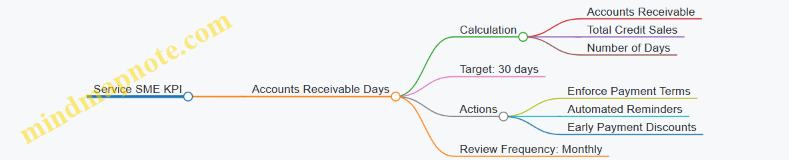
Best Practices for Setting KPIs
- Align KPIs with strategic business goals
- Keep KPIs simple and focused
- Use a mix of leading and lagging indicators
- Regularly review and update KPIs
- Communicate KPI results clearly to the team
Tools to Track Financial KPIs
- Accounting software (e.g., QuickBooks, Xero)
- Spreadsheet templates with KPI dashboards
- Business intelligence tools (e.g., Power BI, Tableau)
By thoughtfully setting up KPIs tailored to their unique business needs, SMEs can gain actionable insights that drive financial performance and long-term success.
12.2 When and How to Revise Financial Plans
Financial plans are not static documents; they must evolve as your business and the external environment change. Knowing when and how to revise your financial plan is crucial for maintaining relevance and effectiveness.
When to Revise Financial Plans
-
Significant Business Changes
- Launching new products or services
- Entering new markets
- Major changes in operations or staffing
-
Financial Performance Deviations
- Actual revenue or expenses significantly differ from forecasts
- Cash flow issues arise unexpectedly
-
Market or Economic Shifts
- Changes in regulations or tax laws
- Economic downturns or booms
- Competitor actions impacting your market share
-
Funding Events
- Securing new financing or investment
- Paying off significant debt
-
Periodic Reviews
- Scheduled quarterly or annual reviews to ensure alignment with goals
How to Revise Financial Plans
-
Assess Current Plan Performance
- Compare actual financial results against the plan
- Identify gaps and root causes
-
Gather Updated Information
- Market data, customer feedback, operational changes
- Updated financial statements and forecasts
-
Engage Stakeholders
- Include management, finance team, advisors, and key employees
-
Adjust Assumptions and Projections
- Revise revenue forecasts, cost estimates, and cash flow projections
-
Update Budgets and Financial Goals
- Reflect new priorities and constraints
-
Document Changes Clearly
- Maintain version control and rationale for revisions
-
Communicate the Revised Plan
- Share with relevant teams to ensure alignment and accountability
Mind Maps
When to Revise Financial Plans
How to Revise Financial Plans
Examples
Example 1: Revising After Unexpected Revenue Drop
A small manufacturing SME noticed a 20% drop in sales due to a competitor launching a similar product at a lower price. During their quarterly review, they:
- Assessed the revenue shortfall and identified the competitor’s pricing as the main cause.
- Gathered updated market data showing customer preferences shifting.
- Engaged the sales and marketing teams to brainstorm adjustments.
- Revised revenue projections downward and adjusted marketing budgets to focus on differentiation.
- Documented the changes and communicated the revised plan to all departments.
This proactive revision helped the SME avoid cash flow problems and refocus their strategy.
Example 2: Revising Due to Economic Downturn
A small hospitality business faced a sudden economic downturn reducing customer visits. They:
- Compared actual expenses and revenue to their original plan.
- Identified that fixed costs were too high relative to reduced income.
- Engaged their accountant and business advisor to explore cost-cutting measures.
- Revised the financial plan to reduce discretionary spending and delay expansion plans.
- Created a contingency cash reserve in the updated plan.
This revision enabled the business to survive the downturn and prepare for recovery.
Summary
Regularly revising your financial plan ensures your SME remains agile and responsive to internal and external changes. By knowing when to revise and following a structured approach, you can maintain financial health and support sustainable growth.
12.3 Incorporating Market Changes and Business Growth into Planning
Financial planning for SMEs is not a one-time task but a dynamic process that must evolve with market conditions and business growth. Incorporating these changes effectively ensures that your financial plan remains relevant, realistic, and actionable.
Understanding Market Changes
Market changes can include shifts in customer demand, new competitors entering the market, regulatory updates, technological advancements, or broader economic factors such as inflation or recession.
Mind Map: Market Changes Impacting Financial Planning
Example: A small apparel retailer notices a growing trend towards sustainable clothing. This market change suggests a potential shift in customer preferences that could impact inventory purchasing and marketing budgets. The retailer revises their financial plan to allocate funds for sourcing eco-friendly materials and marketing campaigns targeting eco-conscious consumers.
Adapting to Business Growth
As SMEs grow, their financial needs and structures become more complex. Growth can mean increased sales volume, expanded product lines, new locations, or larger teams.
Mind Map: Business Growth Factors to Consider in Financial Planning
Example: A small software development firm secures a major client, increasing revenue projections by 40%. To meet demand, they plan to hire three additional developers and invest in upgraded hardware. Their financial plan is updated to reflect increased payroll expenses and capital expenditure, ensuring cash flow remains positive during expansion.
Integrating Market Changes and Growth into Financial Planning
To keep your financial plan aligned with reality, it is essential to regularly review and adjust it based on market signals and internal growth metrics.
Mind Map: Steps to Incorporate Changes into Financial Planning
Example: A local café experiences a sudden rise in ingredient costs due to supply chain disruptions. Simultaneously, they plan to open a second location next year. By monitoring supplier price changes and updating their cost forecasts, they adjust menu prices slightly and revise their budget to include renovation costs for the new site. Regular monthly financial reviews help them stay on track and adjust quickly if further market shifts occur.
Practical Tips for SMEs
- Set regular review intervals: Schedule monthly or quarterly financial plan reviews to capture changes promptly.
- Use scenario planning: Develop best-case, worst-case, and most-likely financial scenarios to prepare for uncertainties.
- Leverage technology: Utilize financial software that allows easy updating and real-time tracking.
- Engage your team: Keep key staff informed and involved in financial adjustments to ensure alignment.
- Maintain flexibility: Build contingency funds and avoid overly rigid budgets that cannot adapt to change.
Summary
Incorporating market changes and business growth into your financial planning is critical for SME resilience and success. By continuously monitoring external and internal factors, updating forecasts, and adjusting budgets, SMEs can navigate uncertainties and capitalize on growth opportunities effectively.
12.4 Example: Pivoting Financial Strategy During Economic Downturn
During an economic downturn, SMEs often face reduced demand, tighter credit conditions, and increased uncertainty. Pivoting financial strategy is crucial to survive and position the business for recovery. This section explores a detailed example of how a small manufacturing SME successfully adjusted its financial planning to navigate a recession.
Case Study: “ABC Manufacturing Co.” – Navigating the 2023 Economic Slowdown
Background: ABC Manufacturing Co. produces custom metal parts for the automotive industry. With the 2023 downturn, automotive demand dropped sharply, impacting ABC’s revenue.
Initial Challenges:
- 30% drop in sales within 3 months
- Inventory buildup due to reduced orders
- Cash flow constraints from delayed customer payments
- Fixed overhead costs remained high
Step 1: Conducting a Rapid Financial Assessment
ABC’s finance team quickly reviewed key financial metrics:
- Cash Flow Forecast: Projected cash shortages within 2 months
- Cost Structure Analysis: Fixed costs were 70% of total expenses
- Receivables Aging: 40% of invoices overdue beyond 60 days
Step 2: Pivoting the Financial Strategy
Mind Map: Pivoting Financial Strategy
Step 3: Implementing Cash Flow Improvements
- Tighten Credit Terms: Reduced payment terms from 60 to 30 days for new customers.
- Accelerate Receivables: Introduced early payment discounts, resulting in 20% faster collections.
- Negotiate Payables: Extended supplier payment terms from 30 to 45 days without penalties.
Example: ABC negotiated with a key supplier to delay payments by 15 days, easing immediate cash outflows.
Step 4: Cost Control Measures
- Discretionary Spending: Paused non-essential travel and marketing campaigns.
- Salary Adjustments: Implemented a temporary 10% salary reduction for senior management.
- Inventory Optimization: Reduced raw material orders to match lower production needs, avoiding excess stock.
Example: By cutting discretionary expenses, ABC saved $15,000 monthly, helping maintain liquidity.
Step 5: Revenue Diversification
- New Customer Segments: Targeted small electric vehicle startups requiring custom parts.
- Alternative Products: Developed metal components for medical devices, a growing sector.
Example: Within 2 months, ABC secured a contract with a local medical device manufacturer, generating 10% of previous monthly revenue.
Step 6: Financing and Support
- Working Capital Loan: Obtained a low-interest loan of $100,000 to cover short-term cash gaps.
- Government Relief: Applied for and received grants aimed at SMEs affected by the downturn.
Example: The loan provided a cash buffer, allowing ABC to meet payroll and supplier obligations without disruption.
Summary Mind Map: Financial Strategy Pivot Outcomes
Key Takeaways for SMEs
- Agility is critical: Quickly assess financial health and act decisively.
- Cash flow focus: Prioritize managing inflows and outflows to maintain operations.
- Cost discipline: Identify and reduce non-essential expenses without harming core capabilities.
- Explore new revenue streams: Diversify to reduce dependence on vulnerable markets.
- Leverage financing options: Use loans and relief programs strategically to bridge gaps.
By following these steps, ABC Manufacturing Co. not only survived the downturn but positioned itself for growth as the economy recovered.
This example demonstrates how SMEs can pivot their financial strategies effectively during economic challenges by integrating best practices with practical, actionable steps.
12.5 Best Practice: Regular Financial Plan Audits and Feedback Loops
Regular financial plan audits and establishing feedback loops are essential best practices for SMEs to ensure their financial strategies remain relevant, effective, and aligned with business goals. This practice involves systematically reviewing financial plans, analyzing performance against targets, identifying gaps or risks, and making informed adjustments based on real-time data and stakeholder input.
Why Regular Financial Plan Audits Matter
- Early Detection of Issues: Identifies discrepancies or deviations from the plan before they escalate.
- Improved Decision-Making: Provides data-driven insights to refine budgeting, forecasting, and cash flow management.
- Adaptability: Helps SMEs respond proactively to market changes, economic shifts, or internal business developments.
- Accountability: Encourages transparency and responsibility among team members managing finances.
Components of a Financial Plan Audit
Establishing Effective Feedback Loops
Feedback loops allow continuous improvement by integrating insights from audits back into the financial planning process.
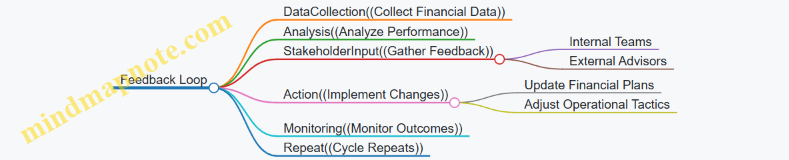
Practical Example: Pivoting Financial Strategy in a Small Retail Business
Scenario: A small retail business noticed a consistent cash flow shortfall during quarterly audits.
Audit Findings:
- Sales were 15% below forecast due to seasonal demand shifts.
- Inventory costs were higher than budgeted.
- Payment terms with suppliers were too short, causing cash crunches.
Feedback Loop Actions:
- Management adjusted sales forecasts to reflect seasonal trends.
- Negotiated extended payment terms with suppliers to improve cash flow.
- Revised inventory purchasing strategy to reduce holding costs.
- Implemented monthly mini-audits to track improvements.
Outcome: Within two quarters, cash flow stabilized, and profitability improved by 10%.
Tips for SMEs to Implement Regular Financial Plan Audits and Feedback Loops
- Schedule Audits Quarterly or Bi-Annually: Consistency is key to catching issues early.
- Use Financial Software: Automate data collection and reporting to save time.
- Involve Cross-Functional Teams: Include finance, operations, and sales for holistic insights.
- Document Findings and Actions: Maintain clear records to track progress over time.
- Encourage Open Communication: Foster a culture where feedback is welcomed and acted upon.
By embedding regular financial plan audits and feedback loops into their financial management routines, SMEs can enhance agility, reduce risks, and drive sustainable growth.
13. Conclusion and Future Trends in SME Financial Planning
13.1 Recap of Key Financial Planning Best Practices
Financial planning is the backbone of any successful SME. To ensure your business thrives, it’s essential to revisit and internalize the core best practices covered throughout this guide. Below is a comprehensive recap, supported by mind maps and practical examples to solidify your understanding.
Mind Map: Core Areas of SME Financial Planning
Summary of Best Practices with Examples
-
Setting Clear Financial Goals
- Use the SMART framework (Specific, Measurable, Achievable, Relevant, Time-bound).
- Example: A small bakery sets a goal to increase monthly revenue by 15% within six months by introducing new product lines.
-
Budgeting and Forecasting
- Develop realistic budgets and update them regularly using rolling forecasts.
- Example: A seasonal landscaping business creates a rolling budget to adjust for peak and off-peak months, ensuring resource allocation matches demand.
-
Effective Cash Flow Management
- Monitor cash inflows and outflows daily; implement cash flow forecasts.
- Example: A manufacturing SME uses weekly cash flow forecasts to avoid shortages and schedule payments strategically.
-
Cost Control and Expense Management
- Differentiate between fixed and variable costs; regularly audit expenses.
- Example: A small café negotiates better rates with suppliers and switches to energy-efficient appliances to reduce utility bills.
-
Choosing the Right Financing
- Evaluate debt vs equity options and prepare thorough loan applications.
- Example: A tech startup opts for equity financing to fuel growth without immediate repayment pressure.
-
Risk Management and Contingency Planning
- Identify risks, maintain contingency funds, and secure appropriate insurance.
- Example: A construction firm creates a risk register and sets aside emergency funds to cover project delays.
-
Tax Planning and Compliance
- Stay updated on tax obligations; keep accurate records and seek professional advice.
- Example: A freelance consultant uses accounting software to track deductible expenses, reducing taxable income.
-
Regular Financial Reporting and Analysis
- Review financial statements monthly; use ratios to gauge performance.
- Example: A retail store analyzes gross margin ratios to identify underperforming product lines.
-
Leveraging Technology
- Adopt cloud-based accounting tools and train staff accordingly.
- Example: A small agency implements an integrated financial platform that syncs invoicing and payroll.
-
Building Financial Literacy
- Conduct regular training sessions to empower employees.
- Example: A family-owned business holds monthly workshops to explain financial reports to all team members.
-
Monitoring and Revising Financial Plans
- Set KPIs, conduct periodic reviews, and adapt plans based on market changes.
- Example: During an economic downturn, a boutique adjusts its financial plan by cutting discretionary spending and focusing on core products.
Mind Map: Example of Monitoring & Revising Financial Plans

By consistently applying these best practices, SMEs can build a resilient financial foundation that supports sustainable growth and adaptability in an ever-changing business environment.
13.2 Emerging Trends Impacting SME Financial Strategies
As the financial landscape continues to evolve rapidly, SMEs must stay ahead by adapting their financial strategies to emerging trends. These trends not only influence how SMEs manage their finances but also open new opportunities for growth and resilience. Below, we explore key emerging trends, supported by mind maps and practical examples to illustrate their impact.
Digital Transformation and FinTech Integration
The rise of financial technology (FinTech) is revolutionizing SME financial management. From automated bookkeeping to AI-driven forecasting, SMEs can leverage technology to enhance accuracy, efficiency, and decision-making.
Mind Map: Digital Transformation in SME Finance
Example: A small e-commerce business implemented AI-powered accounting software that automatically categorizes expenses and predicts cash flow shortages. This allowed the owner to proactively manage working capital and avoid late payments.
Increased Focus on Sustainability and ESG (Environmental, Social, Governance) Finance
Sustainability is becoming a critical factor in financial planning. SMEs are increasingly expected to incorporate ESG principles, which can also unlock new funding sources and customer segments.
Mind Map: ESG Integration in SME Financial Strategies

Example: A local manufacturing SME adopted energy-efficient machinery and documented its ESG efforts, qualifying for a green loan with lower interest rates and attracting eco-conscious clients.
Remote Work and Distributed Teams Impact on Financial Planning
The shift to remote work affects cost structures, payroll management, and investment in digital infrastructure.
Mind Map: Financial Implications of Remote Work for SMEs
Example: A consulting SME reduced office space costs by 40% and redirected savings to upgrade cybersecurity and cloud collaboration tools, improving productivity and financial stability.
Data-Driven Decision Making and Real-Time Financial Monitoring
Access to real-time data enables SMEs to make informed decisions quickly, improving agility.
Mind Map: Data-Driven Financial Strategies
Example: A small restaurant chain used real-time sales and expense dashboards to adjust inventory orders dynamically, reducing waste and improving profit margins.
Alternative Financing and Crowdfunding
Traditional bank loans are no longer the only option. SMEs are exploring crowdfunding, peer-to-peer lending, and invoice financing.
Mind Map: Alternative Financing Options for SMEs
Example: A small tech startup raised initial capital through a crowdfunding campaign, validating their product while securing funds without diluting equity.
Cybersecurity and Financial Data Protection
With increased digitalization, protecting financial data is paramount to avoid costly breaches.
Mind Map: Cybersecurity in SME Financial Management
Example: A boutique accounting firm invested in cybersecurity training and tools, preventing a ransomware attack that could have disrupted client services and caused financial loss.
Summary
Emerging trends such as digital transformation, ESG integration, remote work, data-driven decision-making, alternative financing, and cybersecurity are reshaping SME financial strategies. By understanding and embracing these trends, SMEs can enhance their financial resilience, unlock new opportunities, and position themselves for sustainable growth.
These insights provide a roadmap for accountants and small business advisors to guide their SME clients effectively in the evolving financial landscape.
13.3 Preparing SMEs for Financial Resilience and Growth
Financial resilience and sustainable growth are critical for SMEs to navigate uncertainties and capitalize on opportunities. Preparing your SME for these requires a strategic blend of proactive planning, flexibility, and continuous improvement.
Key Pillars of Financial Resilience and Growth
Example: Preparing a Small Manufacturing SME for Resilience and Growth
Background: A small manufacturing company faced fluctuating demand and rising material costs. To build resilience and enable growth, they implemented the following:
- Cash Flow Management: Established a rolling 6-month cash flow forecast updated monthly to anticipate shortfalls.
- Diversified Revenue: Introduced a maintenance service contract alongside product sales to create recurring income.
- Cost Control: Conducted quarterly expense reviews, renegotiated supplier contracts, and optimized inventory levels.
- Flexible Financing: Secured a line of credit with a local bank to cover unexpected expenses.
- Risk Management: Created an emergency fund equivalent to three months of fixed costs.
- Technology Investment: Adopted cloud-based accounting software to improve financial visibility.
- Financial Education: Conducted quarterly workshops for management on interpreting financial reports.
Outcome: The SME improved its cash flow stability, reduced costs by 12%, and grew revenue by 18% within a year, demonstrating increased resilience and capacity for growth.
Mind Map: Steps to Build Financial Resilience and Growth
Practical Tips for SMEs
- Maintain a Cash Buffer: Aim for at least 3-6 months of operating expenses saved.
- Regular Financial Reviews: Schedule monthly or quarterly financial health check-ins.
- Scenario Planning: Prepare for best-case, expected, and worst-case financial scenarios.
- Build Relationships: Engage with banks, advisors, and peers for support and insights.
- Leverage Technology: Use affordable tools like QuickBooks, Xero, or Wave for real-time financial data.
By embedding these practices into your SME’s financial planning, you create a robust foundation that not only withstands economic shocks but also fosters sustainable growth and long-term success.
13.4 Final Example: A Success Story of Financial Planning Transforming an SME
Background
GreenLeaf Organics is a small, family-owned organic food producer that struggled with inconsistent cash flow, unclear financial goals, and inefficient budgeting. Despite having a loyal customer base, the business faced challenges scaling operations and managing expenses.
Initial Challenges
- Unpredictable cash flow leading to delayed supplier payments
- Lack of formal budgeting causing overspending in marketing and underinvestment in production
- No clear financial goals, making it difficult to measure progress
- Limited understanding of financing options to support growth
Step 1: Setting Clear Financial Goals
GreenLeaf worked with their small business advisor to establish SMART financial goals:
- Increase monthly revenue by 20% within 12 months
- Reduce operational costs by 10% in 6 months
- Build a cash reserve equivalent to 3 months of operating expenses
Step 2: Implementing Budgeting and Forecasting
They introduced a monthly budgeting process, categorizing expenses into fixed and variable costs. Forecasting was done quarterly to adjust for seasonal demand.
- Used simple spreadsheet templates for budgeting
- Created rolling forecasts to anticipate cash flow gaps
Example: In July, the forecast predicted a cash shortfall due to lower sales. The team delayed non-essential purchases and negotiated extended payment terms with suppliers, avoiding a cash crunch.
Step 3: Cash Flow Management
GreenLeaf adopted a cash flow statement review every two weeks, tracking receivables and payables closely.
- Introduced early payment discounts for customers
- Automated invoice reminders
- Prioritized payments based on due dates and supplier relationships
Example: Offering a 2% discount for payments within 10 days increased early payments by 30%, improving liquidity.
Step 4: Cost Control and Expense Management
The business conducted a thorough expense audit and identified areas to optimize:
- Switched to a more cost-effective packaging supplier
- Reduced energy consumption by upgrading to LED lighting
- Outsourced non-core activities like payroll processing
Example: Switching packaging suppliers saved 8% on materials, contributing directly to improved profit margins.
Step 5: Financing and Growth
With improved financial clarity, GreenLeaf successfully applied for a small business loan to invest in new equipment.
- Prepared detailed financial statements and forecasts
- Demonstrated clear repayment plan aligned with cash flow projections
Example: The loan enabled a 25% increase in production capacity, meeting growing demand and increasing revenue.
Results After 12 Months
- Revenue increased by 22%, surpassing the target
- Operational costs reduced by 12%
- Cash reserves built up to cover 4 months of expenses
- Improved supplier and customer relationships
- Enhanced confidence in financial decision-making
Key Takeaways
- Setting clear, measurable financial goals provides direction
- Regular budgeting and forecasting enable proactive management
- Cash flow monitoring is critical for SME survival
- Cost control can unlock hidden profitability
- Proper financial planning facilitates access to growth capital
This success story illustrates how disciplined financial planning, combined with practical tools and best practices, can transform an SME’s financial health and position it for sustainable growth.