Cost Accounting for Manufacturing
1. Introduction to Cost Accounting in Manufacturing
1.1 Understanding Cost Accounting: Definition and Importance
Cost accounting is a specialized branch of accounting that focuses on capturing, analyzing, and controlling the costs associated with manufacturing goods. It provides detailed cost information that helps management make informed decisions to enhance operational efficiency and profitability.
Definition of Cost Accounting
Cost accounting involves the recording, classification, allocation, and reporting of costs to determine the cost of products or services. Unlike financial accounting, which focuses on external reporting, cost accounting is primarily used internally to aid management in planning, controlling, and decision-making.
Importance of Cost Accounting in Manufacturing
- Cost Control: Helps identify areas where costs can be reduced without compromising quality.
- Pricing Decisions: Provides accurate cost data to set competitive and profitable prices.
- Profitability Analysis: Determines which products or processes are most profitable.
- Inventory Valuation: Assists in valuing raw materials, work-in-progress, and finished goods.
- Budgeting and Forecasting: Enables preparation of realistic budgets and forecasts.
- Performance Measurement: Facilitates variance analysis to monitor efficiency.
Mind Map: Core Elements of Cost Accounting
Example: Why Cost Accounting Matters in a Manufacturing Setup
Imagine a mid-sized furniture manufacturer producing chairs and tables. Without cost accounting, the company might price both products based on guesswork or market trends alone. However, by implementing cost accounting:
- They discover that producing tables requires more expensive wood and labor hours than chairs.
- Overhead costs such as electricity and machine depreciation are higher for table production.
- Using this data, they adjust prices to reflect true costs, ensuring profitability.
- They identify that certain processes in chair production are inefficient, leading to higher labor costs.
- By addressing these inefficiencies, they reduce costs and improve margins.
This example illustrates how cost accounting provides actionable insights that directly impact pricing, cost control, and profitability.
Mind Map: Benefits of Cost Accounting for Management
Summary
Cost accounting is a vital tool in manufacturing that goes beyond simple bookkeeping. It equips accountants and cost analysts with the insights needed to manage costs effectively, optimize production processes, and support strategic business decisions. By understanding and applying cost accounting principles, manufacturing firms can achieve greater financial discipline and competitive advantage.
1.2 Key Objectives of Cost Accounting in Manufacturing
Cost accounting plays a pivotal role in manufacturing by providing detailed insights into the costs associated with production processes. Understanding its key objectives helps accountants and cost analysts drive efficiency, control expenses, and improve profitability.
Primary Objectives of Cost Accounting in Manufacturing
- Cost Determination: Accurately ascertain the cost of products, processes, or services.
- Cost Control: Monitor and regulate costs to avoid wastage and inefficiencies.
- Cost Reduction: Identify opportunities to reduce costs without compromising quality.
- Profitability Analysis: Analyze product-wise or department-wise profitability.
- Inventory Valuation: Provide accurate valuation of raw materials, work-in-progress, and finished goods.
- Budgeting and Forecasting: Assist in preparing budgets and forecasting future costs.
- Decision Support: Provide relevant cost data to support managerial decisions.
Mind Map: Key Objectives of Cost Accounting
Detailed Explanation with Examples
-
Cost Determination
- Objective: To calculate the exact cost incurred in manufacturing a product.
- Example: A bicycle manufacturer calculates the cost of each bicycle by summing direct materials (steel, tires), direct labor (assembly time), and allocated overhead (factory rent, utilities).
-
Cost Control
- Objective: To keep costs within the planned limits.
- Example: A textile company monitors fabric wastage and labor hours monthly. If wastage exceeds the standard, corrective actions like staff training are implemented.
-
Cost Reduction
- Objective: To identify and eliminate unnecessary costs.
- Example: An electronics manufacturer switches to a more cost-effective supplier for microchips without compromising quality, reducing material costs by 8%.
-
Profitability Analysis
- Objective: To understand which products or departments contribute most to profit.
- Example: A furniture manufacturer analyzes product lines and discovers that custom-made tables have higher profit margins than mass-produced chairs, guiding marketing focus.
-
Inventory Valuation
- Objective: To assign accurate costs to inventory for financial reporting.
- Example: A chemical plant uses weighted average cost to value raw materials, ensuring consistent inventory valuation despite price fluctuations.
-
Budgeting and Forecasting
- Objective: To plan future costs and allocate resources effectively.
- Example: A food processing company prepares annual budgets based on historical cost data and projected sales, enabling better cash flow management.
-
Decision Support
- Objective: To provide cost data that aids managerial decisions.
- Example: A machinery manufacturer uses cost data to decide whether to outsource a component or produce it in-house, considering cost and capacity.
Mind Map: Example Scenario - Bicycle Manufacturing Cost Objectives
By focusing on these objectives, cost accounting becomes an indispensable tool for manufacturing firms to enhance operational efficiency, maintain competitive pricing, and maximize profitability.
1.3 Overview of Manufacturing Cost Components
Manufacturing costs are the expenses directly associated with the production of goods. Understanding these cost components is essential for accountants and cost analysts to accurately allocate costs, control expenses, and improve profitability.
Manufacturing costs are generally classified into three main categories:
- Direct Materials
- Direct Labor
- Manufacturing Overhead
Mind Map: Manufacturing Cost Components
Direct Materials
Direct materials are raw materials and components that become an integral part of the finished product and can be directly traced to it.
Example:
A furniture manufacturer uses wood, nails, and varnish as direct materials. The cost of the wood planks used to make a table is a direct material cost.
Best Practice: Maintain detailed records of material usage per product to avoid wastage and improve cost accuracy.
Direct Labor
Direct labor refers to the wages paid to workers who are directly involved in the manufacturing process and whose efforts can be traced to specific products.
Example:
In an electronics assembly plant, the wages paid to workers assembling circuit boards are direct labor costs.
Best Practice: Track labor hours by job or product to identify inefficiencies and optimize workforce allocation.
Manufacturing Overhead
Manufacturing overhead includes all indirect costs related to production that cannot be directly traced to a specific product. These costs support the production process but are not part of the final product.
Common Overhead Costs:
- Indirect materials (e.g., lubricants, cleaning supplies)
- Indirect labor (e.g., supervisors, maintenance staff)
- Utilities (electricity, water for the factory)
- Depreciation on manufacturing equipment
- Factory rent and property taxes
Example:
A car manufacturer’s factory electricity bill and the salary of the maintenance crew are manufacturing overhead costs.
Best Practice: Use a consistent and logical basis for allocating overhead costs to products, such as machine hours or labor hours, to ensure fair cost distribution.
Mind Map: Examples of Manufacturing Overhead
Integrated Example: Cost Components in a Toy Manufacturing Company
- Direct Materials: Plastic pellets, paint, packaging materials
- Direct Labor: Assembly line workers who put toys together
- Manufacturing Overhead: Factory lighting, salaries of quality control inspectors, maintenance of molding machines
By accurately tracking these components, the company can calculate the total manufacturing cost per toy, identify cost-saving opportunities, and price their products competitively.
Summary
Understanding and correctly classifying manufacturing cost components is fundamental for effective cost accounting. Direct materials and direct labor are easily traceable to products, while manufacturing overhead requires careful allocation. Employing best practices such as detailed tracking and logical overhead allocation helps manufacturing firms maintain accurate cost data, control expenses, and improve profitability.
1.4 Best Practice: Aligning Cost Accounting with Business Strategy
Aligning cost accounting practices with the overall business strategy is essential for manufacturing companies to ensure that financial insights directly support strategic goals. This integration helps organizations make informed decisions, optimize resource allocation, and improve competitive positioning.
Why Align Cost Accounting with Business Strategy?
- Strategic Decision Support: Cost data tailored to strategic priorities enables better investment and operational decisions.
- Resource Optimization: Focuses cost management on areas that drive competitive advantage.
- Performance Measurement: Links cost control efforts with strategic KPIs.
- Agility: Allows rapid response to market changes by understanding cost implications.
Key Steps to Achieve Alignment
Example: Mid-Sized Electronics Manufacturer
Context: The company aims to become the market leader in energy-efficient consumer devices within 3 years.
Alignment Actions:
- Identify Strategic Cost Drivers: Focus on R&D and sustainable materials costs.
- Customize Cost Accounting: Implement activity-based costing (ABC) to accurately track costs related to energy-efficient components.
- Performance Metrics: Develop KPIs such as cost per energy-efficient unit and R&D cost variance.
- Reporting: Monthly reports highlight cost trends in strategic areas for management review.
Outcome: Enabled targeted cost reduction in non-strategic areas and increased investment in innovation, supporting the business goal.
Mind Map: Aligning Cost Drivers with Strategic Objectives
Practical Tips for Accountants and Cost Analysts
- Engage with Strategy Teams: Regularly participate in strategic planning meetings to understand priorities.
- Customize Cost Reports: Tailor reports to highlight costs impacting strategic goals.
- Use Scenario Analysis: Model cost impacts of strategic initiatives before implementation.
- Educate Stakeholders: Help non-financial managers understand cost implications of strategy.
Example: Automotive Parts Manufacturer
The company’s strategy focuses on lean manufacturing to reduce waste and improve quality.
- Cost accounting was aligned by:
- Tracking waste-related costs separately.
- Implementing standard costing to identify variances quickly.
- Linking cost variances to lean initiatives for continuous improvement.
This alignment helped reduce overhead by 12% over two years and improved product quality.
Summary
Aligning cost accounting with business strategy transforms cost data from mere numbers into strategic insights. By focusing on strategic cost drivers, customizing cost measurement, and fostering communication between finance and operations, manufacturing firms can enhance decision-making and drive sustainable growth.
1.5 Example: How a Mid-Sized Manufacturer Uses Cost Accounting to Improve Profitability
In this section, we explore a practical example of a mid-sized manufacturing company, “ABC Components Ltd.”, and how it leverages cost accounting to enhance profitability. This example will illustrate the step-by-step application of cost accounting principles, supported by mind maps and easy-to-understand examples.
Company Background
- ABC Components Ltd. manufactures precision metal parts for the automotive industry.
- Annual revenue: $25 million
- Workforce: 150 employees
- Product lines: 3 main product categories
Step 1: Identifying Cost Components
ABC Components begins by categorizing its manufacturing costs into three main buckets:
Example:
- Direct Materials: Steel, aluminum, and other raw materials.
- Direct Labor: Wages of machine operators.
- Manufacturing Overhead: Factory rent, electricity, supervisor salaries.
Step 2: Cost Classification and Allocation
The company classifies costs as fixed or variable:
Example:
- Rent is fixed regardless of production volume.
- Raw materials cost varies with units produced.
ABC uses a labor-hour basis to allocate overhead costs:
If total labor hours are 60,000, overhead rate = $20 per labor hour.
Step 3: Implementing Job Order Costing
Since ABC Components produces custom orders, it applies job order costing:
Example:
- Job #101 requires 50 labor hours and $10,000 in materials.
- Overhead applied = 50 hours * $20 = $1,000.
- Total job cost = $10,000 + (50 * $25 labor rate) + $1,000 overhead.
Step 4: Analyzing Cost Data to Improve Profitability
ABC Components uses cost data to identify high-cost areas and inefficiencies.
Example:
- Material waste was 8% higher than industry standard.
- Labor efficiency variance showed 10% more hours than planned.
- Overhead costs were stable but could be optimized by energy-saving initiatives.
Step 5: Applying Best Practices
- Material Control: Implement tighter inventory management to reduce waste.
- Labor Monitoring: Introduce performance incentives to improve efficiency.
- Overhead Reduction: Invest in energy-efficient machinery.
- Pricing Adjustments: Use accurate job costing to set competitive yet profitable prices.
Summary Mind Map
Conclusion
By systematically applying cost accounting techniques, ABC Components Ltd. was able to:
- Reduce material waste by 5% within 6 months.
- Improve labor efficiency by 8% through targeted training and incentives.
- Lower overhead costs by 7% via energy-saving measures.
- Adjust pricing to reflect true costs, increasing profit margins by 4%.
This example demonstrates how mid-sized manufacturers can leverage cost accounting not just for record-keeping but as a strategic tool to drive profitability and operational excellence.
2. Classification of Manufacturing Costs
2.1 Direct vs Indirect Costs: Definitions and Differences
Understanding the distinction between direct and indirect costs is fundamental in manufacturing cost accounting. This section will define both cost types, highlight their differences, and provide practical examples and mind maps to clarify these concepts.
Definitions
Direct Costs: Direct costs are expenses that can be directly traced to the production of a specific product or service. These costs are incurred exclusively for a particular cost object (e.g., a product, batch, or job).
Indirect Costs: Indirect costs, also known as overhead costs, are expenses that cannot be directly traced to a single product or service. Instead, they support multiple cost objects and are allocated across them.
Key Differences
| Aspect | Direct Costs | Indirect Costs |
|---|---|---|
| Traceability | Directly traceable to a product/job | Not directly traceable; allocated |
| Examples | Raw materials, direct labor | Factory rent, utilities, maintenance |
| Variability | Usually variable | Usually fixed or semi-variable |
| Cost Object Specificity | Specific to one product/job | Shared among multiple products/jobs |
Mind Map: Direct Costs
Mind Map: Indirect Costs
Examples
Example 1: Direct Costs in a Furniture Manufacturing Company
- Wood used to build tables and chairs (raw material)
- Wages paid to carpenters assembling the furniture (direct labor)
- Special varnish applied only to a particular batch of tables (direct expense)
Example 2: Indirect Costs in the Same Company
- Factory electricity bill powering all machinery
- Salary of the factory supervisor overseeing multiple production lines
- Depreciation on the forklifts used to move materials
Practical Implications
- Cost Tracking: Direct costs are easier to track and assign to products, enabling precise product costing.
- Cost Allocation: Indirect costs require allocation methods (e.g., predetermined overhead rates) to assign costs fairly across products.
- Pricing and Profitability: Understanding these costs helps in setting accurate product prices and identifying areas for cost control.
Summary
| Aspect | Direct Costs | Indirect Costs |
|---|---|---|
| Traceability | Directly assigned to products | Allocated using cost drivers |
| Examples | Raw materials, direct labor | Rent, utilities, maintenance |
| Impact on Costing | Precise product cost calculation | Requires estimation and allocation |
By mastering the distinction between direct and indirect costs, accountants and cost analysts can improve cost accuracy, enhance budgeting, and support strategic decision-making in manufacturing environments.
2.2 Fixed, Variable, and Semi-Variable Costs Explained
In manufacturing cost accounting, understanding the behavior of costs relative to production volume is crucial. Costs are generally classified into three main types based on how they change with production levels: fixed costs, variable costs, and semi-variable (or mixed) costs.
Fixed Costs
Fixed costs remain constant in total regardless of the level of production or sales volume within a relevant range. These costs do not fluctuate with changes in output.
Examples of Fixed Costs:
- Factory rent
- Salaries of permanent staff
- Depreciation of manufacturing equipment
- Property taxes
Example Scenario: A manufacturing plant pays $10,000 monthly for rent. Whether the plant produces 1,000 units or 10,000 units, the rent remains $10,000.
Mind Map: Fixed Costs
Variable Costs
Variable costs change directly and proportionally with the level of production. The total variable cost increases as production increases, but the cost per unit remains constant.
Examples of Variable Costs:
- Raw materials
- Direct labor (if paid per unit produced)
- Packaging costs
- Utilities directly tied to production (e.g., electricity for machinery)
Example Scenario: If a furniture manufacturer uses $50 worth of wood per chair, producing 100 chairs costs $5,000 in wood, while producing 200 chairs costs $10,000.
Mind Map: Variable Costs
Semi-Variable (Mixed) Costs
Semi-variable costs contain both fixed and variable components. Part of the cost remains fixed regardless of production, while the other part varies with production volume.
Examples of Semi-Variable Costs:
- Utility bills with a fixed base charge plus usage fees
- Maintenance costs that have a fixed contract fee plus variable repair costs
- Salaries with a fixed base plus overtime pay
Example Scenario: A factory pays a monthly electricity bill consisting of a $500 fixed charge plus $0.10 per kWh consumed. If the factory uses 5,000 kWh, the bill is $500 + (5,000 x $0.10) = $1,000.
Mind Map: Semi-Variable Costs
Summary Table
| Cost Type | Behavior with Production Volume | Cost per Unit Behavior | Examples |
|---|---|---|---|
| Fixed Costs | Constant in total | Decreases as production rises | Rent, Salaries, Depreciation |
| Variable Costs | Changes proportionally with production | Constant | Raw materials, Direct labor |
| Semi-Variable Costs | Part fixed, part variable | Varies | Utilities, Maintenance, Overtime |
Practical Example: Cost Classification in a Manufacturing Setup
Scenario: A bicycle manufacturing company incurs the following monthly costs:
- Factory rent: $8,000
- Direct materials: $120 per bicycle
- Direct labor: $80 per bicycle
- Electricity bill: $300 fixed charge + $0.05 per bicycle
Classification:
- Factory rent: Fixed cost
- Direct materials: Variable cost
- Direct labor: Variable cost
- Electricity bill: Semi-variable cost
Calculation for 1,000 bicycles:
- Fixed costs: $8,000 (rent) + $300 (electricity fixed) = $8,300
- Variable costs: (120 + 80) x 1,000 = $200,000
- Variable part of electricity: 1,000 x $0.05 = $50
- Total cost = $8,300 + $200,000 + $50 = $208,350
This example shows how understanding cost behavior helps in budgeting and forecasting.
Best Practices
- Accurately identify cost behavior: Misclassifying costs can lead to poor budgeting and pricing decisions.
- Use relevant range: Fixed costs remain fixed only within a certain production range.
- Analyze semi-variable costs carefully: Break down into fixed and variable components using methods like the high-low method.
- Leverage cost behavior for decision-making: Helps in break-even analysis, pricing, and cost control.
By mastering the distinctions between fixed, variable, and semi-variable costs, accountants and cost analysts in manufacturing can provide valuable insights that drive profitability and operational efficiency.
2.3 Prime Cost and Conversion Cost: What They Mean
In manufacturing cost accounting, understanding the concepts of Prime Cost and Conversion Cost is fundamental for accurate cost control and pricing decisions. These two cost categories help managers and accountants analyze production expenses and identify areas for efficiency improvement.
What is Prime Cost?
Prime Cost refers to the direct costs that are directly attributable to the production of goods. It includes:
- Direct Materials: Raw materials that become an integral part of the finished product.
- Direct Labor: Wages paid to workers who are directly involved in manufacturing.
Prime Cost does not include manufacturing overhead or indirect costs.
Mind Map: Prime Cost Components
Example:
A furniture manufacturer produces wooden chairs. For one chair:
- Wood and nails cost: $25 (Direct Materials)
- Labor cost for assembly: $15 (Direct Labor)
Prime Cost = $25 + $15 = $40
This means the direct cost to produce one chair is $40.
What is Conversion Cost?
Conversion Cost represents the costs incurred to convert raw materials into finished goods. It includes:
- Direct Labor: Same as in Prime Cost.
- Manufacturing Overhead: Indirect costs such as factory rent, utilities, depreciation of equipment, and indirect labor.
Conversion Cost excludes direct materials.
Mind Map: Conversion Cost Components
Example:
Using the same furniture manufacturer:
- Direct Labor: $15
- Factory rent allocated per chair: $5
- Utilities and depreciation per chair: $3
Conversion Cost = $15 + $5 + $3 = $23
This means it costs $23 to convert raw materials into a finished chair, excluding the cost of the wood and nails.
Why Are These Costs Important?
- Prime Cost helps in pricing decisions by showing the direct cost base.
- Conversion Cost helps evaluate efficiency in labor and overhead management.
- Comparing these costs can highlight areas for cost control.
Mind Map: Importance of Prime and Conversion Costs
Integrated Example: Calculating Prime and Conversion Costs
Consider a company manufacturing custom metal parts:
| Cost Element | Amount per Unit |
|---|---|
| Direct Materials | $40 |
| Direct Labor | $20 |
| Factory Rent | $10 |
| Utilities | $5 |
| Indirect Labor | $3 |
- Prime Cost = Direct Materials + Direct Labor = $40 + $20 = $60
- Conversion Cost = Direct Labor + Manufacturing Overhead = $20 + ($10 + $5 + $3) = $38
This breakdown helps the cost analyst understand that while $60 is spent directly on materials and labor, $38 is spent on converting those materials into finished goods.
Best Practice Tips:
- Always separate direct materials from conversion costs for clear cost analysis.
- Use prime cost to set minimum pricing thresholds.
- Monitor conversion costs regularly to control overhead and labor efficiency.
- Employ software tools or ERP systems to track these costs accurately.
By mastering the concepts of Prime Cost and Conversion Cost, accountants and cost analysts in manufacturing can better manage production costs, improve pricing strategies, and enhance overall profitability.
2.4 Best Practice: Accurate Cost Classification for Better Decision-Making
Accurate cost classification is fundamental in manufacturing cost accounting because it directly impacts budgeting, pricing, profitability analysis, and strategic decision-making. Misclassification can lead to incorrect cost allocation, distorted profit margins, and poor operational decisions.
Why Accurate Cost Classification Matters
- Improved Cost Control: Knowing exactly what costs are fixed, variable, direct, or indirect helps managers control expenses effectively.
- Better Pricing Strategies: Accurate cost data ensures product pricing covers costs and desired profit margins.
- Enhanced Profitability Analysis: Identifies which products or processes are truly profitable.
- Informed Budgeting: Helps create realistic budgets and forecasts.
Key Cost Classifications in Manufacturing
Best Practices for Accurate Cost Classification
-
Understand the Nature of Each Cost
- Analyze whether the cost can be directly traced to a product or process.
- Example: Steel used in car frames is a direct material cost; factory security salaries are indirect.
-
Use Clear Definitions and Consistent Terminology
- Maintain a cost dictionary or chart of accounts with clear descriptions.
- Example: Define “machine maintenance” as indirect overhead, not direct labor.
-
Implement Detailed Cost Tracking Systems
- Use job or process costing systems to capture costs at granular levels.
- Example: Assign labor hours to specific jobs rather than pooling all labor costs.
-
Regularly Review and Update Classifications
- Costs may change nature over time; review classifications quarterly or annually.
- Example: A new automated process may shift labor from direct to indirect.
-
Train Staff on Cost Concepts
- Ensure accounting and production teams understand cost classifications.
- Example: Workshops explaining difference between fixed and variable costs.
Example: Accurate Cost Classification in a Furniture Manufacturing Company
| Cost Item | Classification | Explanation |
|---|---|---|
| Wood and Fabric | Direct Material | Directly traceable to each furniture piece |
| Assembly Line Labor | Direct Labor | Labor hours spent assembling each product |
| Factory Rent | Fixed Overhead | Monthly rent does not vary with production |
| Machine Electricity | Variable Overhead | Electricity cost varies with machine usage |
| Quality Control Salaries | Indirect Labor | Salaries not directly linked to a single product |
This classification allows the company to calculate product costs accurately, set competitive prices, and identify areas for cost reduction.
Mind Map: Steps to Ensure Accurate Cost Classification
Summary
Accurate cost classification is not just an accounting exercise; it is a strategic tool that empowers manufacturing firms to make informed decisions. By following best practices such as clear definitions, detailed tracking, regular reviews, and staff training, companies can enhance cost visibility, optimize pricing, and improve overall financial performance.
2.5 Example: Classifying Costs in an Automotive Parts Manufacturer
In this section, we’ll explore how an automotive parts manufacturer classifies its various costs into direct, indirect, fixed, variable, and semi-variable categories. Understanding these classifications helps accountants and cost analysts accurately allocate expenses, control costs, and improve pricing strategies.
Company Background
AutoParts Co. produces brake pads and other essential automotive components. The manufacturing process involves raw materials, labor, machinery, and overhead costs.
Step 1: Identify Cost Components
| Cost Item | Description |
|---|---|
| Raw Materials | Steel, rubber, and other materials for brake pads |
| Direct Labor | Wages paid to assembly line workers |
| Factory Rent | Monthly rent for manufacturing facility |
| Machine Maintenance | Regular servicing of production machines |
| Utilities | Electricity and water used in production |
| Quality Control Staff | Salaries of employees inspecting finished goods |
| Packaging Materials | Boxes and wrapping for finished products |
| Production Supervisor | Salary of supervisor overseeing production line |
| Depreciation of Equipment | Allocation of machinery cost over useful life |
Step 2: Classify Costs
Direct Costs
- Raw Materials: Steel and rubber directly used in brake pads.
- Direct Labor: Assembly line workers who physically manufacture the parts.
Indirect Costs (Manufacturing Overhead)
- Factory Rent: Cannot be traced to a single product.
- Machine Maintenance: Supports all production but not tied to specific units.
- Utilities: Power consumed by the plant.
- Quality Control Staff: Salaries for inspection.
- Production Supervisor: Oversees entire production.
- Depreciation of Equipment: Spreads equipment cost over time.
- Packaging Materials: Used after production, considered indirect.
Fixed Costs
- Factory Rent
- Production Supervisor Salary
- Depreciation of Equipment
Variable Costs
- Raw Materials
- Direct Labor
- Packaging Materials
- Utilities (partially variable)
Semi-Variable Costs
- Utilities (fixed base charge + variable usage charge)
- Machine Maintenance (routine fixed maintenance + variable repairs)
Mind Map: Cost Classification Overview
Practical Example: Calculating Monthly Cost Breakdown
| Cost Item | Monthly Cost ($) | Classification | Notes |
|---|---|---|---|
| Raw Materials | 150,000 | Direct, Variable | Steel and rubber usage varies with output |
| Direct Labor | 80,000 | Direct, Variable | Paid hourly to assembly workers |
| Factory Rent | 20,000 | Indirect, Fixed | Fixed monthly lease |
| Machine Maintenance | 5,000 | Indirect, Semi-Variable | Routine maintenance fixed; repairs vary |
| Utilities | 12,000 | Indirect, Semi-Variable | Base charge + consumption-based |
| Quality Control Staff | 10,000 | Indirect, Fixed | Salaries of inspectors |
| Packaging Materials | 8,000 | Indirect, Variable | Packaging depends on production volume |
| Production Supervisor | 9,000 | Indirect, Fixed | Monthly salary |
| Depreciation | 7,000 | Indirect, Fixed | Equipment amortization |
Mind Map: Monthly Cost Breakdown
Insights and Best Practices
- Accurate Classification: Helps in precise product costing and pricing.
- Monitor Semi-Variable Costs: Break down utilities and maintenance to fixed and variable components for better budgeting.
- Use Cost Drivers: For indirect costs, identify appropriate allocation bases (e.g., machine hours for maintenance).
- Regular Review: Costs can shift categories over time; periodic reassessment is essential.
Summary
By classifying costs clearly, AutoParts Co. can:
- Determine the true cost of producing each brake pad.
- Identify areas for cost control and reduction.
- Improve budgeting accuracy.
- Support strategic decisions such as pricing and product mix.
This example illustrates how cost accountants and cost analysts in manufacturing can apply classification principles to real-world scenarios, ensuring financial clarity and operational efficiency.
3. Cost Accounting Methods in Manufacturing
3.1 Job Order Costing: Concepts and Application
Job Order Costing is a cost accounting method used to assign manufacturing costs to specific jobs or batches. It is particularly useful when products are customized or produced in distinct batches, allowing for precise tracking of costs associated with each individual job.
Key Concepts of Job Order Costing
- Job: A specific order or batch for which costs are accumulated.
- Direct Materials: Raw materials that can be directly traced to the job.
- Direct Labor: Labor costs directly attributable to the job.
- Manufacturing Overhead: Indirect costs allocated to jobs using a predetermined overhead rate.
- Job Cost Sheet: A document used to record all costs related to a specific job.
Mind Map: Job Order Costing Components
How Job Order Costing Works
- Job Identification: Each job is assigned a unique job number.
- Accumulating Direct Materials: Materials requisitioned specifically for the job are recorded.
- Recording Direct Labor: Labor hours spent on the job are tracked and multiplied by wage rates.
- Applying Overhead: Overhead is allocated based on a predetermined rate (e.g., machine hours, labor hours).
- Job Completion: Total costs are summed to determine the cost of the job.
Mind Map: Job Order Costing Process
Example: Job Order Costing in a Custom Furniture Manufacturer
Scenario: A custom furniture manufacturer receives an order for 10 bespoke dining tables. Each table requires specific wood types and finishes.
- Direct Materials: Wood, varnish, screws, and other materials are requisitioned specifically for this job.
- Direct Labor: Carpenters and finishers log hours spent exclusively on these tables.
- Overhead: Factory utilities, depreciation on equipment, and indirect labor are allocated based on direct labor hours.
Step-by-step:
- Job #101 is created for this order.
- Materials requisitioned total $5,000.
- Labor hours logged are 200 hours at $20/hour = $4,000.
- Predetermined overhead rate is $10 per labor hour, so overhead applied = 200 x $10 = $2,000.
Total Job Cost: $5,000 (Materials) + $4,000 (Labor) + $2,000 (Overhead) = $11,000
This detailed tracking allows the company to price the job accurately and analyze profitability.
Best Practice: Maintaining Detailed Job Cost Sheets
- Use standardized job cost sheets to capture all costs.
- Update costs in real-time to avoid errors.
- Regularly review overhead allocation bases to ensure accuracy.
Mind Map: Best Practices in Job Order Costing
Additional Example: Job Order Costing in an Aerospace Component Manufacturer
An aerospace company produces custom engine parts per client specifications. Each job involves unique materials and precision labor.
- Job #305 involves manufacturing 50 turbine blades.
- Direct materials cost: $120,000
- Direct labor: 1,000 hours at $50/hour = $50,000
- Overhead applied at $30 per labor hour = 1,000 x $30 = $30,000
Total Job Cost: $200,000
This method ensures the company can track costs accurately for each contract and identify cost-saving opportunities.
Summary
Job Order Costing is essential for manufacturers producing customized or batch-specific products. By tracking direct materials, labor, and overhead per job, companies gain detailed insight into product costs, enabling better pricing, cost control, and profitability analysis.
3.2 Process Costing: When and How to Use It
Process costing is a cost accounting method used primarily in manufacturing environments where production is continuous, and the products are indistinguishable from one another. It accumulates costs for each process or department over a period and then averages these costs over all units produced.
When to Use Process Costing
Process costing is ideal when:
- Production involves a continuous flow of identical or similar products.
- Costs are accumulated by process or department rather than by individual jobs.
- Products are mass-produced in large quantities.
Examples of industries using process costing:
- Chemicals manufacturing
- Food and beverage production
- Textile manufacturing
- Petroleum refining
How Process Costing Works
- Accumulate costs by process or department: Direct materials, direct labor, and manufacturing overhead are collected for each process.
- Calculate equivalent units: Since some units may be partially completed, equivalent units measure the work done on these units.
- Determine cost per equivalent unit: Total costs divided by equivalent units.
- Assign costs to completed and ending inventory: Costs are allocated between finished goods and work-in-process inventory.
Mind Map: Overview of Process Costing
Mind Map: Steps in Process Costing Calculation
Example: Process Costing in a Beverage Manufacturing Plant
Scenario: A beverage company produces bottled juice through three processes: Mixing, Bottling, and Packaging. During April, the Mixing department incurred $120,000 in direct materials, $30,000 in direct labor, and $20,000 in overhead. The department started with 10,000 units in beginning inventory (40% complete) and completed 90,000 units during the month. Ending inventory was 5,000 units (60% complete).
Step 1: Accumulate Costs
- Direct materials: $120,000
- Direct labor: $30,000
- Overhead: $20,000
- Total costs: $170,000
Step 2: Calculate Equivalent Units
- Units completed: 90,000
- Ending inventory equivalent units: 5,000 * 60% = 3,000
- Total equivalent units: 90,000 + 3,000 = 93,000
Step 3: Compute Cost per Equivalent Unit
- Cost per equivalent unit = $170,000 / 93,000 = $1.83
Step 4: Assign Costs
- Cost of completed units = 90,000 * $1.83 = $164,700
- Cost of ending inventory = 3,000 * $1.83 = $5,490
This method helps the company accurately assign costs to products in progress and finished goods, facilitating better pricing and inventory valuation.
Best Practice: Accurate Tracking of Equivalent Units
To improve accuracy in process costing:
- Regularly update the percentage completion of work-in-process inventory.
- Use detailed production reports from each department.
- Train staff on recognizing stages of completion.
Additional Example: Textile Manufacturing
A textile company produces fabric in a continuous process. During May, the dyeing department had 15,000 units in beginning inventory (50% complete), started 100,000 units, and ended with 10,000 units (30% complete). Total costs for the department were $200,000.
-
Calculate equivalent units:
- Completed units = (15,000 + 100,000) - 10,000 = 105,000
- Ending inventory equivalent units = 10,000 * 30% = 3,000
- Total equivalent units = 105,000 + 3,000 = 108,000
-
Cost per equivalent unit = $200,000 / 108,000 = $1.85
This example demonstrates how process costing handles partially completed inventory and continuous production.
Summary
Process costing is essential for industries with continuous, homogeneous production. By accumulating costs by process and calculating equivalent units, manufacturers can accurately assign costs to products and manage inventory valuation effectively. Implementing best practices such as detailed tracking and regular updates ensures the reliability of cost data.
3.3 Activity-Based Costing (ABC): A Detailed Approach
Activity-Based Costing (ABC) is a refined costing methodology that assigns manufacturing overhead and indirect costs to products and services based on the activities they require. Unlike traditional costing methods that allocate overhead broadly, ABC provides a more accurate reflection of the true cost drivers, enabling better decision-making and cost control.
What is Activity-Based Costing?
ABC identifies key activities in the manufacturing process and assigns costs to products based on their consumption of these activities. This approach helps uncover hidden costs and inefficiencies that traditional costing might overlook.
Key Concepts of ABC
- Activities: Tasks or operations that consume resources (e.g., machine setups, inspections).
- Cost Pools: Groupings of individual costs related to a single activity.
- Cost Drivers: Factors that cause the cost of an activity to increase or decrease (e.g., number of setups, hours of inspection).
Mind Map: Core Components of ABC
Step-by-Step Implementation of ABC in Manufacturing
- Identify Activities: List all significant activities involved in the manufacturing process.
- Assign Costs to Activities: Collect overhead costs and assign them to the identified activities to form cost pools.
- Determine Cost Drivers: Select measurable factors that influence the cost of each activity.
- Calculate Activity Rates: Divide the total cost in each cost pool by the total quantity of its cost driver.
- Assign Costs to Products: Multiply the activity rate by the amount of cost driver consumed by each product.
Mind Map: ABC Implementation Process
Example: Applying ABC in an Electronics Assembly Plant
Scenario: An electronics manufacturer produces two products: Product A (high volume, simple assembly) and Product B (low volume, complex assembly). Traditional costing allocates overhead based on direct labor hours, which results in Product B being undercosted.
Step 1: Identify Activities and Cost Pools
- Machine Setup
- Quality Inspection
- Packaging
Step 2: Assign Overhead Costs to Activities
- Machine Setup: $50,000
- Quality Inspection: $30,000
- Packaging: $20,000
Step 3: Determine Cost Drivers and Total Driver Quantity
- Machine Setup: Number of setups (100 setups)
- Quality Inspection: Inspection hours (600 hours)
- Packaging: Number of packages (10,000 packages)
Step 4: Calculate Activity Rates
- Machine Setup Rate = $50,000 / 100 setups = $500 per setup
- Quality Inspection Rate = $30,000 / 600 hours = $50 per inspection hour
- Packaging Rate = $20,000 / 10,000 packages = $2 per package
Step 5: Assign Costs to Products
| Activity | Product A Usage | Product B Usage | Cost Assigned to A | Cost Assigned to B |
|---|---|---|---|---|
| Machine Setup | 60 setups | 40 setups | 60 x $500 = $30,000 | 40 x $500 = $20,000 |
| Quality Inspection | 400 hours | 200 hours | 400 x $50 = $20,000 | 200 x $50 = $10,000 |
| Packaging | 7,000 packages | 3,000 packages | 7,000 x $2 = $14,000 | 3,000 x $2 = $6,000 |
Total Overhead Assigned:
- Product A: $64,000
- Product B: $36,000
This allocation shows Product B consumes a larger share of costly setups and inspections relative to its volume, which traditional costing might have missed.
Benefits of ABC in Manufacturing
- Improved Cost Accuracy: Reflects the actual consumption of resources.
- Enhanced Pricing Strategies: Helps set prices based on true product costs.
- Waste Identification: Reveals inefficient activities that can be optimized.
- Better Product Mix Decisions: Supports decisions on product profitability.
Mind Map: Benefits of ABC
Practical Tips for Accountants and Cost Analysts
- Engage cross-functional teams to identify all relevant activities.
- Use software tools to track activity usage and costs efficiently.
- Regularly review and update cost drivers to reflect process changes.
- Combine ABC insights with traditional costing for comprehensive analysis.
By adopting Activity-Based Costing, manufacturing firms can gain granular insights into their cost structure, enabling smarter financial management and operational improvements.
3.4 Best Practice: Selecting the Right Costing Method for Your Manufacturing Process
Selecting the appropriate costing method is critical for accurate cost measurement, pricing decisions, and profitability analysis in manufacturing. The choice depends on the nature of the production process, product diversity, volume, and management objectives. Below, we explore best practices for selecting the right costing method, supported by mind maps and practical examples.
Key Factors to Consider When Choosing a Costing Method
Overview of Costing Methods
| Costing Method | Best Suited For | Key Characteristics |
|---|---|---|
| Job Order Costing | Custom, low volume, diverse products | Costs accumulated per job/order; detailed tracking |
| Process Costing | Continuous, high volume, homogeneous products | Costs averaged over units produced; cost flows by process |
| Activity-Based Costing (ABC) | Complex products, multiple overheads, diverse activities | Allocates overhead based on activities and cost drivers |
Mind Map: Matching Manufacturing Characteristics to Costing Methods
Practical Examples
Example 1: Job Order Costing in a Custom Furniture Manufacturer
- The company produces bespoke furniture pieces based on individual customer orders.
- Each job has unique material and labor requirements.
- Job order costing allows precise tracking of costs per piece, enabling accurate pricing and profitability analysis.
Example 2: Process Costing in a Bottled Beverage Plant
- The plant produces thousands of identical bottles daily.
- Costs are accumulated by process stages (mixing, bottling, labeling).
- Process costing averages costs across units, simplifying cost control.
Example 3: Activity-Based Costing in an Electronics Manufacturer
- The company produces multiple product lines with varying complexity.
- Overhead costs are significant and driven by activities like testing, assembly, and quality control.
- ABC allocates overhead more accurately, highlighting cost-saving opportunities.
Best Practice Steps for Selecting the Right Costing Method
- Analyze Your Production Process: Determine if production is job-based, continuous, or complex with multiple activities.
- Assess Product Variety and Volume: High variety and low volume favor job order costing; high volume and homogeneity favor process costing.
- Identify Cost Drivers: Understand what drives overhead costs to decide if ABC is needed.
- Align with Management Goals: Choose a method that supports your cost control, pricing, and profitability objectives.
- Pilot and Evaluate: Test the chosen method on a small scale to verify accuracy and usefulness.
Summary Mind Map: Decision Framework for Costing Method
By following these best practices and leveraging the decision frameworks above, manufacturing accountants and cost analysts can select the most effective costing method tailored to their specific operational environment, leading to improved cost accuracy, better decision-making, and enhanced profitability.
3.5 Example: Implementing Activity-Based Costing (ABC) in an Electronics Assembly Plant
Activity-Based Costing (ABC) provides a more accurate method of assigning overhead costs by linking them to the actual activities that drive costs. In an electronics assembly plant, where multiple products share complex processes, ABC helps identify the true cost of each product line.
Step 1: Identify Activities and Cost Pools
In the electronics assembly plant, key activities might include:
- Component Testing
- Circuit Board Assembly
- Quality Inspection
- Packaging
- Machine Setup
Each activity forms a cost pool where overhead costs are accumulated.
Step 2: Assign Overhead Costs to Activities
Suppose the plant’s total overhead is $500,000. Through analysis, the overhead is distributed as follows:
- Component Testing: $100,000
- Circuit Board Assembly: $200,000
- Quality Inspection: $80,000
- Packaging: $70,000
- Machine Setup: $50,000
Step 3: Determine Cost Drivers and Measure Activity Levels
Each activity has a cost driver that best reflects its consumption of resources:
| Activity | Cost Driver | Total Activity Level |
|---|---|---|
| Component Testing | Number of Tests | 20,000 tests |
| Circuit Board Assembly | Assembly Hours | 10,000 hours |
| Quality Inspection | Inspection Hours | 5,000 hours |
| Packaging | Number of Packages | 25,000 packages |
| Machine Setup | Setup Hours | 1,000 hours |
Step 4: Calculate Activity Rates
Activity Rate = Overhead Cost / Total Activity Level
| Activity | Overhead Cost | Total Activity Level | Activity Rate (per unit) |
|---|---|---|---|
| Component Testing | $100,000 | 20,000 tests | $5.00 per test |
| Circuit Board Assembly | $200,000 | 10,000 hours | $20.00 per hour |
| Quality Inspection | $80,000 | 5,000 hours | $16.00 per hour |
| Packaging | $70,000 | 25,000 packages | $2.80 per package |
| Machine Setup | $50,000 | 1,000 hours | $50.00 per hour |
Step 5: Assign Costs to Products Based on Usage
The plant produces two products: Product A and Product B.
| Activity | Product A Usage | Product B Usage |
|---|---|---|
| Number of Tests | 8,000 | 12,000 |
| Assembly Hours | 6,000 | 4,000 |
| Inspection Hours | 2,000 | 3,000 |
| Number of Packages | 10,000 | 15,000 |
| Setup Hours | 600 | 400 |
Calculate overhead assigned:
-
Product A:
- Component Testing: 8,000 tests * $5.00 = $40,000
- Assembly: 6,000 hrs * $20.00 = $120,000
- Inspection: 2,000 hrs * $16.00 = $32,000
- Packaging: 10,000 pkgs * $2.80 = $28,000
- Setup: 600 hrs * $50.00 = $30,000
- Total Overhead = $250,000
-
Product B:
- Component Testing: 12,000 tests * $5.00 = $60,000
- Assembly: 4,000 hrs * $20.00 = $80,000
- Inspection: 3,000 hrs * $16.00 = $48,000
- Packaging: 15,000 pkgs * $2.80 = $42,000
- Setup: 400 hrs * $50.00 = $20,000
- Total Overhead = $250,000
Step 6: Analyze Results and Make Informed Decisions
The ABC method reveals that although Product A uses more assembly hours, Product B consumes more testing and inspection resources. This insight helps the plant:
- Price products more accurately based on true costs
- Identify opportunities to reduce costs in high-overhead activities
- Optimize production scheduling to minimize costly setups
Summary of Best Practices Demonstrated
- Identify relevant activities that consume overhead resources.
- Select appropriate cost drivers that reflect the cause-effect relationship.
- Collect accurate data on activity levels for each product.
- Calculate precise activity rates to assign overhead costs fairly.
- Use insights from ABC to improve pricing, cost control, and process efficiency.
This example illustrates how ABC can transform cost accounting in a manufacturing environment by providing clarity and actionable information beyond traditional costing methods.
4. Cost Accumulation and Cost Flow in Manufacturing
4.1 Understanding Cost Accumulation Techniques
Cost accumulation is a fundamental process in manufacturing cost accounting that involves gathering and recording all costs related to the production of goods. It serves as the foundation for cost measurement, control, and decision-making. Understanding different cost accumulation techniques enables accountants and cost analysts to accurately track expenses, allocate costs properly, and provide meaningful insights for management.
What is Cost Accumulation?
Cost accumulation refers to the systematic collection of cost data from various sources such as raw materials, labor, and overhead. This data is then organized to reflect the total cost incurred during a manufacturing process or for a specific job or batch.
Why is Cost Accumulation Important?
- Provides accurate cost information for pricing and profitability analysis.
- Helps in budgeting and forecasting.
- Supports variance analysis and cost control.
- Ensures compliance with accounting standards.
Main Cost Accumulation Techniques
There are primarily two cost accumulation techniques used in manufacturing:
- Job Order Costing
- Process Costing
Additionally, some companies use a hybrid or activity-based approach depending on their production environment.
Job Order Costing
This technique accumulates costs for each individual job or order. It is suitable for customized or unique products where costs can be traced directly to a specific job.
Mind Map: Job Order Costing
Example: A custom furniture manufacturer receives an order for a bespoke dining table. The accountant accumulates costs by recording the wood, finishes, and labor hours specifically used for this table on a job cost sheet. Overhead is allocated based on labor hours for this job.
Process Costing
Process costing accumulates costs by department or process over a period of time. It is ideal for continuous, homogeneous production such as chemicals, textiles, or food processing.
Mind Map: Process Costing
Example: A textile company produces fabric through multiple processes: spinning, weaving, and dyeing. Costs are accumulated separately for each department monthly. The total costs are then divided by the equivalent units produced to find the cost per unit.
Activity-Based Costing (ABC) as an Advanced Technique
While not a traditional cost accumulation method, ABC refines cost allocation by tracing overhead and indirect costs to activities and then to products.
Mind Map: Activity-Based Costing
Example: An electronics assembly plant uses ABC to accumulate costs related to testing, packaging, and machine setup. Instead of allocating overhead broadly, costs are assigned based on the number of tests performed or setups required, providing more precise product costing.
Summary Table: Cost Accumulation Techniques
| Technique | Suitable For | Cost Accumulation Basis | Example Industry |
|---|---|---|---|
| Job Order Costing | Custom, unique products | Per job/order | Custom furniture, aerospace |
| Process Costing | Continuous, homogeneous goods | By department/process | Chemicals, textiles |
| Activity-Based Costing | Complex overhead allocation | Activities and cost drivers | Electronics, automotive |
Best Practice Tips for Cost Accumulation
- Maintain detailed records: Use job cost sheets or departmental reports to capture costs accurately.
- Use technology: Implement ERP or cost accounting software to automate data collection.
- Regularly review cost drivers: Ensure overhead allocation bases remain relevant.
- Train staff: Ensure production and accounting teams understand the importance of accurate cost data.
Final Example: Cost Accumulation in a Metal Fabrication Company
A metal fabrication company produces both custom orders and standard parts. They use job order costing for custom jobs, tracking materials and labor per order. For standard parts produced continuously, they apply process costing by accumulating costs in cutting, welding, and finishing departments. Overhead is allocated using machine hours as the base. This hybrid approach ensures precise cost accumulation tailored to their diverse production.
Understanding and applying the right cost accumulation technique is essential for accurate cost measurement, effective cost control, and informed decision-making in manufacturing environments.
4.2 Flow of Costs Through Inventory Accounts
In manufacturing cost accounting, understanding the flow of costs through inventory accounts is crucial for accurate financial reporting and cost control. The flow of costs represents how the costs of raw materials, labor, and overhead move through different inventory accounts before becoming part of the Cost of Goods Sold (COGS).
Key Inventory Accounts in Manufacturing
- Raw Materials Inventory: This account holds the cost of materials purchased but not yet used in production.
- Work-in-Process (WIP) Inventory: This account accumulates costs for products that are partially completed.
- Finished Goods Inventory: This account contains the cost of completed products that are ready for sale.
Mind Map: Flow of Costs Through Inventory Accounts
Step-by-Step Flow Explanation
-
Raw Materials Purchased
- When raw materials are purchased, their cost is recorded in the Raw Materials Inventory account.
-
Materials Requisitioned for Production
- As production begins, raw materials are requisitioned and moved from Raw Materials Inventory to Work-in-Process Inventory.
- Example: A furniture manufacturer purchases wood worth $10,000. When production starts, $6,000 worth of wood is moved to WIP.
-
Direct Labor and Overhead Applied
- Direct labor costs and manufacturing overhead are added to WIP as work progresses.
- Example: Labor costs of $4,000 and overhead of $2,000 are applied to the WIP account for the furniture being produced.
-
Completion of Goods
- Once production is complete, the total cost accumulated in WIP (materials + labor + overhead) is transferred to Finished Goods Inventory.
- Example: The furniture pieces completed have a total cost of $12,000 (materials $6,000 + labor $4,000 + overhead $2,000).
-
Sale of Finished Goods
- When finished goods are sold, their cost is transferred from Finished Goods Inventory to Cost of Goods Sold (COGS).
- Example: Furniture worth $8,000 is sold; this amount is moved from Finished Goods Inventory to COGS.
Mind Map: Cost Movement Example in a Furniture Manufacturer
Practical Example
Scenario:
A manufacturing company produces custom machinery. During the month:
- Raw materials purchased: $50,000
- Materials requisitioned for production: $35,000
- Direct labor incurred: $20,000
- Manufacturing overhead applied: $15,000
- Completed goods transferred to Finished Goods Inventory: $60,000
- Goods sold during the month: $40,000
Cost Flow Entries:
| Inventory Account | Debit ($) | Credit ($) |
|---|---|---|
| Raw Materials Inventory | 50,000 | |
| Raw Materials Inventory | 35,000 | |
| Work-in-Process Inventory | 35,000 | |
| Work-in-Process Inventory | 20,000 | |
| Work-in-Process Inventory | 15,000 | |
| Work-in-Process Inventory | 70,000 | |
| Finished Goods Inventory | 70,000 | |
| Finished Goods Inventory | 40,000 | |
| Cost of Goods Sold (COGS) | 40,000 |
Best Practice Tips
- Regularly reconcile inventory accounts to ensure accurate cost flow tracking.
- Use job costing or process costing systems to capture costs precisely at each stage.
- Implement software solutions that automate cost tracking through inventory accounts.
- Train accounting and production staff on the importance of timely and accurate cost data entry.
Understanding the flow of costs through inventory accounts enables accountants and cost analysts to maintain accurate financial records, identify inefficiencies, and support strategic decision-making in manufacturing operations.
4.3 Work-in-Process Inventory: Tracking and Valuation
Work-in-Process (WIP) inventory represents the goods that are in various stages of production but are not yet completed. Managing and valuing WIP accurately is critical for manufacturing companies because it directly affects cost reporting, inventory valuation, and profitability analysis.
Understanding Work-in-Process Inventory
WIP inventory includes raw materials that have entered the production process but have not yet become finished goods. It encompasses:
- Raw materials issued to production
- Direct labor applied
- Manufacturing overhead allocated
Accurate tracking ensures that costs are assigned properly to products and financial statements reflect true production costs.
Mind Map: Components of Work-in-Process Inventory
Tracking Work-in-Process Inventory
Tracking WIP involves monitoring the flow of materials, labor, and overhead through the production cycle. Common methods include:
- Job Cost Sheets: Used in job order costing to track costs for individual jobs.
- Production Reports: Daily or periodic reports detailing quantities and costs added.
- Inventory Ledger Cards: Recording quantities and values of WIP at different stages.
Best Practice: Implement real-time tracking systems integrated with ERP software to reduce errors and improve visibility.
Example: Tracking WIP in a Furniture Manufacturing Plant
A furniture manufacturer produces custom tables. For Job #101, the following costs are recorded:
- Raw materials issued: $500
- Direct labor: 10 hours at $20/hour = $200
- Overhead applied at 150% of direct labor = $300
The WIP value for Job #101 at the end of the period is:
$500 (materials) + $200 (labor) + $300 (overhead) = $1,000
This amount is recorded as WIP inventory until the job is completed.
Valuation of Work-in-Process Inventory
Valuing WIP inventory accurately requires assigning costs to the partially completed goods. The valuation includes:
- Direct Materials: Cost of raw materials used so far.
- Direct Labor: Labor cost incurred to date.
- Manufacturing Overhead: Allocated overhead based on a predetermined rate.
Two common approaches for valuation:
- Physical Units Method: Counts units in process and estimates percentage completion.
- Equivalent Units Method: Converts partially completed units into equivalent fully completed units for cost assignment.
Mind Map: Valuation Process of WIP Inventory
Example: Valuing WIP Using Equivalent Units Method
Consider a batch of 1000 units in production:
- 600 units are 100% complete for materials and labor
- 400 units are 50% complete for materials and labor
Costs incurred:
- Materials: $12,000
- Labor: $8,000
Calculate equivalent units:
- Materials: (600 * 100%) + (400 * 50%) = 600 + 200 = 800 units
- Labor: Same as materials = 800 units
Cost per equivalent unit:
- Materials: $12,000 / 800 = $15
- Labor: $8,000 / 800 = $10
Value of WIP:
- Completed units (600): (15 + 10) * 600 = $15,000
- Partially completed units (400): (15 + 10) * 50% * 400 = $5,000
- Total WIP = $20,000
Best Practices for WIP Tracking and Valuation
- Regular Physical Counts: To verify quantities and detect discrepancies early.
- Use of Standard Costs: Helps in simplifying valuation and variance analysis.
- Integration with Production Scheduling: Ensures timely updates and accurate cost flow.
- Automation: Employ barcode/RFID scanning and ERP systems for real-time data capture.
Summary
Effective tracking and valuation of Work-in-Process inventory are vital for accurate cost accounting in manufacturing. By understanding the components, employing appropriate tracking methods, and applying correct valuation techniques, accountants and cost analysts can provide reliable financial data to support decision-making and operational efficiency.
4.4 Best Practice: Maintaining Accurate Cost Records to Avoid Inventory Misstatements
Maintaining accurate cost records is critical in manufacturing to ensure that inventory is correctly valued and financial statements reflect the true cost of production. Misstatements in inventory can lead to incorrect profit reporting, tax issues, and poor management decisions.
Why Accurate Cost Records Matter
- Financial Accuracy: Inventory is a major asset on the balance sheet; errors distort financial health.
- Cost Control: Helps identify inefficiencies and cost overruns.
- Regulatory Compliance: Ensures adherence to accounting standards and tax laws.
- Decision Making: Reliable data supports pricing, budgeting, and forecasting.
Key Components of Accurate Cost Records
Best Practices to Maintain Accurate Cost Records
-
Implement Robust Data Collection Systems
- Use barcode/RFID scanning for material movements.
- Automate labor tracking with time clocks linked to production jobs.
-
Standardize Cost Classification
- Clearly define what constitutes direct vs indirect costs.
- Use consistent overhead allocation bases.
-
Regular Physical Inventory Counts and Reconciliations
- Conduct cycle counts frequently to catch discrepancies early.
- Reconcile physical inventory with system records monthly.
-
Use Integrated ERP Systems
- Centralize cost data to reduce manual errors.
- Enable real-time inventory and cost tracking.
-
Maintain Clear Documentation and Audit Trails
- Document all cost recording procedures.
- Keep detailed records of adjustments and corrections.
-
Train Staff and Promote Accountability
- Educate employees on the importance of accurate data.
- Assign responsibility for cost record accuracy.
Example: Avoiding Inventory Misstatements in a Textile Manufacturing Company
Scenario: A textile manufacturer was experiencing discrepancies between physical inventory and accounting records, leading to misstated cost of goods sold and profit margins.
Actions Taken:
- Implemented barcode scanning for raw material receipt and usage.
- Established monthly cycle counts for work-in-process and finished goods.
- Automated labor tracking with job-specific timecards.
- Standardized overhead allocation based on machine hours.
- Trained warehouse and production staff on proper recording procedures.
Outcome:
- Inventory discrepancies reduced by 90% within 3 months.
- More accurate cost of goods sold reporting.
- Improved management confidence in financial data.
Mind Map: Steps to Maintain Accurate Cost Records
By integrating these best practices, accountants and cost analysts in manufacturing can significantly reduce the risk of inventory misstatements, leading to more reliable financial reporting and better operational decision-making.
4.5 Example: Cost Flow in a Textile Manufacturing Company
Understanding the flow of costs in a textile manufacturing company is crucial for accurate cost accounting and inventory valuation. This example will walk through the journey of costs from raw materials to finished goods, illustrating how cost accumulation and cost flow principles apply in a real-world setting.
Overview of Cost Flow in Textile Manufacturing
Textile manufacturing typically involves multiple stages: purchasing raw materials (fibers, yarns), processing (spinning, weaving, dyeing), and finishing (cutting, sewing, packaging). Each stage accumulates costs that flow through inventory accounts before becoming part of the Cost of Goods Sold (COGS).
Mind Map: Cost Flow Stages in Textile Manufacturing
Step 1: Raw Materials Inventory
The company purchases raw fibers and yarns, recording their cost in Raw Materials Inventory.
Example:
- Purchased 10,000 kg of cotton fibers at $2.50/kg = $25,000
- Purchased dyes and chemicals costing $3,000
Best Practice: Maintain detailed purchase records and verify quantities received to ensure accurate raw material cost accumulation.
Step 2: Work-in-Process (WIP) Inventory
Raw materials are issued to production for spinning, weaving, dyeing, and finishing. At each stage, direct labor and manufacturing overhead costs are added.
Example:
- Spinning department uses 8,000 kg of cotton fibers (from raw materials) with labor cost $4,000 and overhead $2,000.
- Weaving department processes spun yarn with labor $5,000 and overhead $3,000.
- Dyeing department applies dyes costing $1,500 plus labor $2,000 and overhead $1,000.
Mind Map: Cost Components in WIP
Best Practice: Use job cards or production reports to track material usage and labor hours per department for precise cost allocation.
Step 3: Finished Goods Inventory
After finishing, the fabric rolls or garments are transferred to Finished Goods Inventory at total accumulated cost.
Example:
- Total accumulated cost for 5,000 fabric rolls:
- Raw materials used: $20,000
- Direct labor: $11,000
- Overhead: $6,000
- Total Finished Goods Inventory value = $37,000
Best Practice: Regularly reconcile WIP and Finished Goods accounts to avoid cost leakage and inventory misstatements.
Step 4: Cost of Goods Sold (COGS)
When finished goods are sold, their cost is transferred from Finished Goods Inventory to COGS.
Example:
- Sold 2,000 fabric rolls at $10 each
- Cost per roll = $37,000 / 5,000 rolls = $7.40
- COGS = 2,000 rolls × $7.40 = $14,800
Best Practice: Use perpetual inventory systems to update COGS in real-time, improving financial reporting accuracy.
Mind Map: Summary of Cost Flow and Accounting Entries
Key Takeaways
- Cost flow in textile manufacturing involves multiple inventory accounts reflecting the production stages.
- Accurate tracking of direct materials, labor, and overhead at each stage is essential.
- Using detailed production records and inventory reconciliation helps maintain cost accuracy.
- Understanding cost flow supports better pricing, budgeting, and profitability analysis.
This example demonstrates how cost accounting principles are applied in a textile manufacturing context, providing a clear framework for accountants and cost analysts to manage and control manufacturing costs effectively.
5. Overhead Cost Allocation and Control
5.1 Identifying Manufacturing Overhead Costs
Manufacturing overhead costs, often referred to as factory overhead or indirect manufacturing costs, are all the costs incurred in the manufacturing process that cannot be directly traced to a specific product. Unlike direct materials or direct labor, these costs support the production process as a whole and are essential for maintaining operations.
What Constitutes Manufacturing Overhead?
Manufacturing overhead includes expenses related to:
- Indirect materials (e.g., lubricants, cleaning supplies)
- Indirect labor (e.g., maintenance staff, supervisors)
- Utilities for the factory (electricity, water, gas)
- Depreciation on factory equipment and buildings
- Factory rent and property taxes
- Equipment repairs and maintenance
- Quality control and inspection costs
- Factory insurance
Understanding and accurately identifying these costs is critical for proper cost allocation and pricing decisions.
Mind Map: Components of Manufacturing Overhead
Best Practice: Comprehensive Identification of Overhead Costs
To ensure no overhead costs are overlooked, companies should:
- Conduct regular reviews of all factory-related expenses.
- Collaborate with departments such as maintenance, HR, and facilities management to capture indirect labor and materials.
- Use detailed accounting codes to track overhead expenses separately from direct costs.
- Update overhead cost lists periodically to reflect changes in operations or new cost drivers.
Example: Identifying Overhead Costs in a Furniture Manufacturing Plant
Scenario: A furniture manufacturer produces wooden chairs and tables. Direct materials include wood and nails, and direct labor includes carpenters assembling the furniture.
Overhead Identification:
- The factory uses varnish and glue, which are indirect materials because they are used in small quantities and not easily traced to a single product.
- Supervisors oversee multiple production lines, so their salaries are indirect labor.
- Electricity powers the factory lighting and machinery.
- The factory building is rented, and rent is an overhead cost.
- Maintenance staff repair machines and perform routine upkeep.
By identifying these overhead costs, the company can allocate them properly to products, ensuring accurate product costing.
Mind Map: Example Overhead Costs in Furniture Manufacturing
Summary
Identifying manufacturing overhead costs requires a thorough understanding of all indirect expenses that support production. Proper identification ensures accurate cost allocation, which is vital for pricing, budgeting, and profitability analysis. Using structured approaches like detailed mind maps and regular expense reviews helps manufacturing accountants and cost analysts maintain clarity and precision in overhead cost management.
5.2 Overhead Allocation Bases: Labor Hours, Machine Hours, and More
In manufacturing cost accounting, overhead costs are indirect costs that cannot be directly traced to a specific product but are necessary for production. Allocating these overhead costs accurately is crucial for determining the true cost of products and making informed pricing and operational decisions.
What is an Overhead Allocation Base?
An overhead allocation base is a measurable activity or factor used to assign overhead costs to products or cost centers. The choice of base directly impacts the accuracy of cost allocation.
Common Overhead Allocation Bases
- Labor Hours: Total hours worked by employees directly involved in production.
- Machine Hours: Total hours machines are used in production.
- Direct Labor Cost: Total wages paid to direct labor.
- Units Produced: Number of units manufactured.
- Material Cost: Cost of raw materials used.
Mind Map: Common Overhead Allocation Bases
Labor Hours
Labor hours are one of the most traditional and widely used bases for overhead allocation, especially in labor-intensive manufacturing environments.
Best Practice: Use labor hours when labor is a significant driver of overhead costs.
Example: A furniture manufacturer incurs $50,000 in overhead costs monthly. The total labor hours worked are 2,500 hours.
- Overhead Rate = $50,000 / 2,500 hours = $20 per labor hour
- If a product requires 5 labor hours, overhead allocated = 5 x $20 = $100
Mind Map: Labor Hours Allocation
Machine Hours
Machine hours are ideal for automated or machine-intensive manufacturing processes where machines drive overhead costs such as maintenance, depreciation, and utilities.
Best Practice: Use machine hours when overhead costs are closely related to machine usage.
Example: An electronics assembly plant has $80,000 monthly overhead and 4,000 machine hours.
- Overhead Rate = $80,000 / 4,000 hours = $20 per machine hour
- A product that uses 3 machine hours will be allocated overhead = 3 x $20 = $60
Mind Map: Machine Hours Allocation
Direct Labor Cost
This base uses the total wages paid to direct labor as a proportion to allocate overhead. It is useful when labor cost fluctuates significantly and impacts overhead consumption.
Example: A metal fabrication shop has $120,000 overhead and $400,000 direct labor cost.
- Overhead Rate = $120,000 / $400,000 = 0.3 (or 30%)
- For a product with $2,000 direct labor cost, overhead allocated = $2,000 x 0.3 = $600
Units Produced
Allocating overhead based on units produced is simple but can be less accurate if products consume overhead differently.
Example: A toy manufacturer has $30,000 overhead and produces 10,000 units.
- Overhead Rate = $30,000 / 10,000 units = $3 per unit
- Overhead allocated to a batch of 100 units = 100 x $3 = $300
Material Cost
When overhead is driven by material handling or storage, material cost can be an effective allocation base.
Example: A chemical manufacturer has $60,000 overhead and $200,000 material cost.
- Overhead Rate = $60,000 / $200,000 = 0.3 (or 30%)
- For a product with $5,000 material cost, overhead allocated = $5,000 x 0.3 = $1,500
Mind Map: Choosing the Right Overhead Allocation Base
Summary of Best Practices
- Match the base to the primary cost driver: Identify what causes overhead costs and select the base accordingly.
- Use multiple bases if needed: Complex manufacturing may require multiple allocation bases for accuracy.
- Regularly review allocation bases: As production processes evolve, the relevance of bases may change.
- Keep it understandable: Ensure the chosen base can be easily tracked and explained to stakeholders.
Integrated Example: Overhead Allocation in a Mixed Manufacturing Environment
A company manufactures two products: Product A (labor-intensive) and Product B (machine-intensive).
- Total Overhead: $100,000
- Total Labor Hours: 3,000
- Total Machine Hours: 2,000
Step 1: Allocate 60% of overhead ($60,000) based on labor hours (for labor-related overhead).
- Overhead Rate (Labor) = $60,000 / 3,000 = $20 per labor hour
Step 2: Allocate 40% of overhead ($40,000) based on machine hours (for machine-related overhead).
- Overhead Rate (Machine) = $40,000 / 2,000 = $20 per machine hour
Product A: 100 labor hours, 50 machine hours
- Overhead = (100 x $20) + (50 x $20) = $2,000 + $1,000 = $3,000
Product B: 50 labor hours, 150 machine hours
- Overhead = (50 x $20) + (150 x $20) = $1,000 + $3,000 = $4,000
This blended approach improves allocation accuracy by reflecting the different overhead consumption patterns.
By carefully selecting and applying overhead allocation bases, manufacturing accountants and cost analysts can ensure more precise product costing, leading to better pricing, budgeting, and strategic decisions.
5.3 Overhead Absorption Rates: Calculation and Application
What is Overhead Absorption Rate?
Overhead Absorption Rate (OAR) is a predetermined rate used to allocate manufacturing overhead costs to products or job orders based on a consistent and rational basis. It helps in assigning indirect costs (like utilities, rent, maintenance) to cost units, ensuring that product costing reflects the true cost of production.
Why Use Overhead Absorption Rates?
- To allocate overhead costs systematically and fairly
- To enable accurate product costing and pricing
- To facilitate budgeting and cost control
- To support variance analysis and performance evaluation
Components of Overhead Absorption Rate
- Estimated Overhead Costs: Total overhead expected for the period
- Estimated Activity Base: The cost driver used for absorption (e.g., machine hours, labor hours)
Formula for Overhead Absorption Rate
Overhead Absorption Rate (OAR) = Estimated Overhead Costs / Estimated Activity Base
Common Bases for Overhead Absorption
The choice depends on the nature of the manufacturing process. For labor-intensive processes, labor hours or cost may be appropriate; for automated processes, machine hours may be better.
Mind Map: Understanding Overhead Absorption Rate
Step-by-Step Calculation Example
Scenario: A manufacturing company estimates its total overhead costs for the next year to be $600,000. It expects to use 30,000 machine hours during the year. The company decides to use machine hours as the absorption base.
Step 1: Identify estimated overhead costs
- $600,000
Step 2: Identify estimated activity base
- 30,000 machine hours
Step 3: Calculate Overhead Absorption Rate
OAR = $600,000 / 30,000 machine hours = $20 per machine hour
Interpretation: For every machine hour used, $20 of overhead will be applied to the product cost.
Applying Overhead Absorption Rate
If a product job consumes 150 machine hours, the overhead absorbed will be:
Overhead Applied = 150 machine hours * $20 = $3,000
This $3,000 is added to the direct costs to determine the total cost of the job.
Mind Map: Application of Overhead Absorption Rate
Example: Overhead Absorption Using Direct Labor Hours
Scenario: A furniture manufacturer estimates overhead costs of $450,000 and expects 15,000 direct labor hours.
Calculate OAR:
OAR = $450,000 / 15,000 direct labor hours = $30 per labor hour
Job consumes 200 direct labor hours:
Overhead Applied = 200 hours * $30 = $6,000
This method is suitable when labor is a significant cost driver.
Handling Overapplied and Underapplied Overhead
- Overapplied Overhead: When applied overhead > actual overhead
- Underapplied Overhead: When applied overhead < actual overhead
Best Practice: Regularly compare applied overhead with actual overhead and adjust financial statements accordingly to maintain accuracy.
Summary of Best Practices for Overhead Absorption Rate
- Choose an absorption base that closely correlates with overhead consumption
- Use estimated costs and activity levels based on historical data and realistic forecasts
- Review and update the absorption rate periodically (e.g., annually)
- Monitor variances between applied and actual overhead to identify inefficiencies
- Integrate overhead absorption into overall cost control and budgeting processes
Final Mind Map: Best Practices and Application Overview
5.4 Best Practice: Using Activity-Based Costing to Improve Overhead Allocation Accuracy
Activity-Based Costing (ABC) is a refined approach to overhead allocation that assigns costs to products and services based on the actual activities and resources they consume. Unlike traditional costing methods that allocate overhead using a single volume-based cost driver (like labor hours or machine hours), ABC recognizes the complexity and diversity of manufacturing processes, leading to more accurate and insightful cost information.
Why Use Activity-Based Costing?
- Improved Accuracy: Allocates overhead costs based on multiple cost drivers reflecting real resource consumption.
- Enhanced Decision-Making: Provides detailed cost insights to identify high-cost activities and opportunities for cost reduction.
- Supports Complex Manufacturing: Ideal for multi-product environments with diverse processes.
Mind Map: Key Components of Activity-Based Costing
Step-by-Step Implementation of ABC in Manufacturing
- Identify and Define Activities: Break down the manufacturing process into key activities that consume overhead resources.
- Assign Costs to Activity Pools: Collect overhead costs and assign them to the identified activities based on resource usage.
- Select Cost Drivers: Choose measurable factors that cause the costs of each activity (e.g., number of setups, inspection hours).
- Calculate Activity Rates: Divide total activity cost by total cost driver units.
- Assign Costs to Products: Multiply activity rates by the amount of cost driver consumed by each product.
Example: Implementing ABC in a Food Processing Plant
Scenario: A food processing company produces two products: Product A (simple packaging) and Product B (complex packaging requiring more setups and inspections). Traditional costing allocates overhead based on machine hours, which results in Product B being undercosted.
| Activity | Total Cost | Cost Driver | Total Driver Units | Activity Rate (Cost/Unit) |
|---|---|---|---|---|
| Machine Setup | $50,000 | Number of Setups | 100 setups | $500 per setup |
| Quality Inspection | $30,000 | Inspection Hours | 600 hours | $50 per inspection hour |
| Material Handling | $20,000 | Material Moves | 400 moves | $50 per move |
Product Usage:
- Product A: 20 setups, 200 inspection hours, 150 material moves
- Product B: 80 setups, 400 inspection hours, 250 material moves
Overhead Allocation:
- Product A: (20 x $500) + (200 x $50) + (150 x $50) = $10,000 + $10,000 + $7,500 = $27,500
- Product B: (80 x $500) + (400 x $50) + (250 x $50) = $40,000 + $20,000 + $12,500 = $72,500
Insight: ABC reveals that Product B consumes significantly more overhead resources than Product A, which traditional machine-hour allocation would have masked.
Mind Map: Benefits of ABC for Overhead Allocation
Practical Tips for Accountants and Cost Analysts
- Engage Cross-Functional Teams: Collaborate with production, quality, and logistics teams to accurately identify activities and cost drivers.
- Start Small: Pilot ABC on a specific product line or department before full-scale implementation.
- Use Software Tools: Leverage cost accounting or ERP systems that support ABC data collection and analysis.
- Regularly Review and Update: Manufacturing processes evolve; update activities and cost drivers periodically to maintain accuracy.
By adopting Activity-Based Costing, manufacturing firms can significantly improve the accuracy of overhead allocation, leading to better cost control, pricing strategies, and overall financial performance.
5.5 Example: Reducing Overhead Waste in a Food Processing Plant
In this section, we explore a practical example of how a mid-sized food processing plant successfully reduced overhead waste by implementing targeted cost accounting best practices. This example illustrates the identification, allocation, and control of overhead costs to improve overall manufacturing efficiency and profitability.
Background
The food processing plant produces packaged snacks and employs a traditional overhead allocation method based on direct labor hours. Management noticed that overhead costs were steadily increasing, but profitability was not improving proportionally. They suspected inefficiencies and waste in overhead but lacked detailed insight.
Step 1: Identifying Overhead Waste
The plant’s cost accounting team began by categorizing overhead costs into major buckets:
- Utilities (electricity, water, gas)
- Maintenance and Repairs
- Indirect Labor (supervisors, quality control)
- Depreciation of equipment
- Supplies and Consumables
Using historical data and walk-through observations, they identified several sources of overhead waste:
- Excessive machine idle time leading to unnecessary utility consumption
- Over-maintenance on some equipment and under-maintenance on others
- Inefficient scheduling causing overtime for supervisory staff
- High scrap rates increasing indirect labor and rework costs
Step 2: Allocating Overhead More Accurately
The plant shifted from a simplistic labor-hour based overhead allocation to Activity-Based Costing (ABC) to better trace overhead costs to specific activities.
Mind Map: Overhead Allocation Using ABC
By assigning costs based on actual activities (e.g., machine hours, maintenance hours, inspection hours), the plant could identify which products or processes were consuming disproportionate overhead resources.
Step 3: Implementing Cost Control Measures
Based on the ABC insights, the plant implemented several best practices:
- Reducing Machine Idle Time: Introduced real-time monitoring to track machine usage and schedule production runs more efficiently.
- Optimizing Maintenance: Adopted a predictive maintenance program using sensor data to reduce unnecessary maintenance and prevent breakdowns.
- Streamlining Supervisory Roles: Adjusted shift schedules to align with peak production times, reducing overtime costs.
- Improving Quality Control: Enhanced training and process controls to reduce scrap and rework, lowering indirect labor overhead.
Step 4: Measuring Results
Within six months, the plant observed:
- 12% reduction in utility costs due to decreased machine idle time.
- 15% decrease in maintenance expenses by avoiding unnecessary repairs.
- 10% reduction in indirect labor costs through better scheduling.
- Overall overhead cost reduction of approximately 13%, improving product cost accuracy and profitability.
Summary Mind Map: Overhead Waste Reduction Process
Key Takeaways
- Traditional overhead allocation methods can mask inefficiencies; ABC provides clearer insights.
- Real-time data and monitoring are critical to identifying and reducing overhead waste.
- Cross-functional collaboration between accounting, operations, and maintenance teams drives successful cost control.
- Continuous improvement in overhead management directly impacts the bottom line in manufacturing.
This example demonstrates how food processing plants can leverage cost accounting best practices to identify overhead waste and implement effective controls, ultimately enhancing financial performance and operational efficiency.
6. Standard Costing and Variance Analysis
6.1 Introduction to Standard Costing in Manufacturing
Standard costing is a fundamental technique used in manufacturing cost accounting that involves assigning predetermined costs to products or services. These costs, known as standard costs, serve as benchmarks against which actual costs are compared to identify variances and drive cost control and efficiency improvements.
What is Standard Costing?
Standard costing sets expected costs for materials, labor, and overhead based on historical data, engineering studies, and management expectations. It simplifies cost control by providing a clear target for cost management and performance evaluation.
Key Objectives of Standard Costing:
- Establish cost benchmarks for production
- Facilitate budgeting and cost control
- Identify variances between actual and standard costs
- Support decision-making and performance evaluation
Mind Map: Components of Standard Costing
Why Use Standard Costing in Manufacturing?
Manufacturing environments often involve repetitive processes and large volumes, making it impractical to track actual costs for every unit produced. Standard costing provides a practical and efficient way to estimate costs, monitor performance, and quickly identify areas needing attention.
Example: Setting Standard Costs for a Widget Manufacturer
Imagine a company producing widgets. Based on past data and engineering input, the company sets the following standards per widget:
- Direct Materials: 2 pounds of raw material at $5 per pound = $10
- Direct Labor: 1 hour at $20 per hour = $20
- Manufacturing Overhead: $15 per widget (applied based on labor hours)
Standard Cost per Widget = $10 + $20 + $15 = $45
When actual production occurs, the company compares actual costs to these standards to analyze variances.
Mind Map: Standard Costing Process Flow
Benefits of Standard Costing
- Simplifies Costing: Reduces complexity by using predetermined costs.
- Enables Variance Analysis: Helps identify where costs deviate from expectations.
- Supports Budgeting: Provides a foundation for preparing budgets.
- Improves Cost Control: Facilitates timely corrective actions.
- Enhances Performance Measurement: Allows evaluation of efficiency and effectiveness.
Practical Example: Variance Identification
Suppose the widget manufacturer produced 1,000 widgets in a month. The actual costs were:
- Direct Materials: 2,100 pounds at $5.10 per pound = $10,710
- Direct Labor: 1,050 hours at $19.50 per hour = $20,475
- Overhead: $15,500
Calculate Material Variances:
-
Standard Material Cost = 2 pounds/widget * 1,000 widgets * $5 = $10,000
-
Actual Material Cost = $10,710
-
Material Price Variance = (Standard Price - Actual Price) x Actual Quantity
= ($5.00 - $5.10) x 2,100 = -$210 (Unfavorable) -
Material Usage Variance = (Standard Quantity - Actual Quantity) x Standard Price
= (2,000 - 2,100) x $5.00 = -$500 (Unfavorable)
This analysis shows the company paid more per pound and used more material than expected, signaling areas for investigation.
Summary
Standard costing is a powerful tool in manufacturing that sets cost expectations and enables detailed variance analysis. By understanding and applying standard costing principles, accountants and cost analysts can drive cost efficiency, support budgeting, and improve overall manufacturing performance.
6.2 Setting Standards for Materials, Labor, and Overhead
Setting standards is a foundational step in standard costing systems, enabling manufacturing companies to plan, control, and evaluate performance effectively. Standards represent the expected costs or quantities for materials, labor, and overhead under normal operating conditions.
Setting Material Standards
Material standards define the expected quantity and cost of raw materials required to produce one unit of product.
- Material Quantity Standard: The amount of raw material needed per unit of output.
- Material Price Standard: The expected cost per unit of raw material.
Example: A furniture manufacturer determines that each chair requires 5 board feet of wood. The standard price for wood is $3 per board foot.
Calculation:
- Material Quantity Standard = 5 board feet
- Material Price Standard = $3/board foot
- Standard Material Cost per Chair = 5 x $3 = $15
Best Practice: Involve procurement and production teams to ensure realistic quantity and price standards. Regularly update price standards to reflect market changes.
Setting Labor Standards
Labor standards specify the expected labor time and labor rate required to manufacture one unit.
- Labor Time Standard: The time needed by a qualified worker to complete one unit.
- Labor Rate Standard: The wage rate per hour, including benefits and payroll taxes.
Example: An electronics manufacturer estimates that assembling one circuit board takes 2 hours. The standard labor rate is $20 per hour.
Calculation:
- Labor Time Standard = 2 hours
- Labor Rate Standard = $20/hour
- Standard Labor Cost per Circuit Board = 2 x $20 = $40
Best Practice: Use time studies or historical data to set realistic labor time standards. Factor in skill levels and efficiency.
Setting Overhead Standards
Overhead standards allocate indirect manufacturing costs to each unit based on a predetermined overhead rate.
- Overhead Rate: Calculated by dividing estimated overhead costs by an allocation base (e.g., labor hours, machine hours).
- Overhead Application: Overhead is applied to products by multiplying the overhead rate by the actual quantity of the allocation base used.
Example: A metal fabrication plant estimates $500,000 in overhead costs for the year and expects 25,000 machine hours.
Calculation:
- Overhead Rate = $500,000 / 25,000 hours = $20 per machine hour
- If a product uses 3 machine hours, overhead applied = 3 x $20 = $60
Best Practice: Choose an allocation base that closely correlates with overhead consumption. Regularly review overhead estimates to maintain accuracy.
Mind Maps
Mind Map 1: Components of Setting Standards
Mind Map 2: Steps to Set Material Standards
Mind Map 3: Labor Standard Setting Process
Mind Map 4: Overhead Standard Calculation
Integrated Example: Setting Standards for a Toy Manufacturer
Scenario: A toy manufacturer produces a plastic toy car.
-
Material Standard:
- Plastic required: 2 pounds per toy
- Plastic cost: $1.50 per pound
- Standard Material Cost = 2 x $1.50 = $3.00
-
Labor Standard:
- Assembly time: 1.5 hours per toy
- Labor rate: $18 per hour
- Standard Labor Cost = 1.5 x $18 = $27.00
-
Overhead Standard:
- Estimated overhead: $300,000 per year
- Estimated labor hours: 15,000
- Overhead rate = $300,000 / 15,000 = $20 per labor hour
- Overhead cost per toy = 1.5 x $20 = $30.00
Total Standard Cost per Toy:
- Materials: $3.00
- Labor: $27.00
- Overhead: $30.00
- Total = $60.00
Best Practice: Regularly compare actual costs to these standards to identify variances and opportunities for improvement.
Summary
- Setting accurate standards for materials, labor, and overhead is crucial for effective cost control.
- Collaborate with cross-functional teams and use reliable data sources.
- Update standards periodically to reflect changes in processes, prices, and efficiencies.
- Use standards as benchmarks for variance analysis and performance evaluation.
6.3 Analyzing Material, Labor, and Overhead Variances
Cost variance analysis is a critical tool in manufacturing cost accounting that helps identify differences between standard costs and actual costs incurred. These variances provide insights into operational efficiency, cost control, and areas requiring management attention. This section breaks down the analysis of material, labor, and overhead variances with clear examples and mind maps to facilitate understanding.
Material Variances
Material variances measure the difference between the standard cost of materials and the actual cost incurred. They are primarily divided into:
- Material Price Variance (MPV): Difference due to paying a different price than standard.
- Material Usage Variance (MUV): Difference due to using more or less material than the standard quantity.
Mind Map: Material Variances
Example: Material Variance in a Furniture Manufacturer
A furniture company sets a standard cost of $5 per board foot of wood and expects to use 100 board feet for a batch (standard cost = $500). Actual purchase was 110 board feet at $4.80 each (actual cost = $528).
- Material Price Variance: (5 - 4.80) x 110 = $22 Favorable (paid less per unit)
- Material Usage Variance: (100 - 110) x 5 = -$50 Unfavorable (used more material)
Interpretation: The company saved on price but used more wood than planned, indicating possible waste or inefficiency.
Labor Variances
Labor variances analyze differences between standard labor costs and actual labor costs. They include:
- Labor Rate Variance (LRV): Difference due to paying a different wage rate.
- Labor Efficiency Variance (LEV): Difference due to working more or fewer hours than standard.
Mind Map: Labor Variances
Example: Labor Variance in a Machinery Manufacturer
Standard labor cost per unit is 2 hours at $20/hour. For 50 units, standard hours = 100 hours, standard cost = $2,000.
Actual labor: 110 hours at $22/hour, actual cost = $2,420.
- Labor Rate Variance: (20 - 22) x 110 = -$220 Unfavorable (paid higher wage rate)
- Labor Efficiency Variance: (100 - 110) x 20 = -$200 Unfavorable (used more hours)
Interpretation: Both higher wage rates and lower efficiency increased labor costs.
Overhead Variances
Overhead variances compare the applied overhead to actual overhead costs. They are categorized as:
- Variable Overhead Spending Variance: Difference between actual and standard variable overhead costs.
- Variable Overhead Efficiency Variance: Difference due to actual hours differing from standard hours.
- Fixed Overhead Spending (Budget) Variance: Difference between actual fixed overhead and budgeted fixed overhead.
- Fixed Overhead Volume Variance: Difference due to production volume differing from expected.
Mind Map: Overhead Variances
Example: Overhead Variance in a Food Processing Plant
- Budgeted fixed overhead = $50,000
- Standard variable overhead rate = $5/hour
- Actual production used 9,000 labor hours
- Standard labor hours allowed for actual output = 8,500 hours
- Actual variable overhead = $48,000
- Actual fixed overhead = $52,000
Calculations:
- Variable Overhead Spending Variance = $48,000 - ($5 x 9,000) = $48,000 - $45,000 = $3,000 Unfavorable
- Variable Overhead Efficiency Variance = (8,500 - 9,000) x $5 = -500 x $5 = -$2,500 Unfavorable
- Fixed Overhead Spending Variance = $52,000 - $50,000 = $2,000 Unfavorable
- Fixed Overhead Volume Variance = (8,500 - 10,000) x Fixed Overhead Rate (assume $5) = -1,500 x $5 = -$7,500 Unfavorable
Interpretation: The plant spent more than budgeted on fixed overhead and variable overhead, and production volume was below expectations, leading to unfavorable variances.
Summary Mind Map: Variance Analysis Overview
Best Practices for Variance Analysis
- Regularly compare actual costs against standards to detect issues early.
- Investigate significant variances to identify root causes.
- Use variance reports to inform budgeting and forecasting.
- Integrate variance analysis with operational metrics for comprehensive insights.
- Train accounting and production teams on the importance of accurate data collection.
By mastering variance analysis, accountants and cost analysts in manufacturing can drive cost efficiency, support strategic decisions, and enhance overall financial performance.
6.4 Best Practice: Using Variance Analysis for Continuous Improvement
Variance analysis is a powerful tool in manufacturing cost accounting that helps identify the differences between standard costs and actual costs. By systematically analyzing these variances, accountants and cost analysts can pinpoint inefficiencies, uncover cost-saving opportunities, and drive continuous improvement in manufacturing processes.
What is Variance Analysis?
Variance analysis involves breaking down the differences between expected (standard) costs and actual costs into specific categories such as material, labor, and overhead variances. This detailed insight enables targeted corrective actions.
Why Use Variance Analysis for Continuous Improvement?
- Identifies root causes of cost deviations
- Supports proactive decision-making
- Enhances budgeting and forecasting accuracy
- Drives accountability across departments
- Encourages ongoing process optimization
Mind Map: Components of Variance Analysis
Step-by-Step Approach to Using Variance Analysis for Continuous Improvement
-
Set Clear Standards: Establish realistic and measurable standard costs for materials, labor, and overhead.
-
Collect Accurate Data: Ensure precise recording of actual costs during production.
-
Calculate Variances: Determine the differences between standard and actual costs.
-
Analyze Variances: Break down variances into price, usage, efficiency, and spending categories.
-
Investigate Root Causes: Collaborate with production teams to understand why variances occurred.
-
Implement Corrective Actions: Adjust processes, negotiate supplier prices, or provide training.
-
Monitor Results: Track the impact of changes on future variances.
-
Repeat Cycle: Use variance analysis as a continuous feedback loop.
Mind Map: Continuous Improvement Cycle Using Variance Analysis
Example 1: Investigating Labor Efficiency Variance in a Machinery Manufacturer
Scenario: A machinery manufacturer notices a significant unfavorable labor efficiency variance for a particular product line.
- Standard labor time: 5 hours per unit
- Actual labor time: 6 hours per unit
- Units produced: 1,000
Variance Calculation:
Labor Efficiency Variance = (Standard Hours - Actual Hours) × Standard Labor Rate
= (5,000 hours - 6,000 hours) × $20/hour = -1,000 hours × $20 = -$20,000 (Unfavorable)
Investigation:
- Production team reports frequent machine breakdowns causing delays.
- New operators are less experienced, leading to slower assembly.
Corrective Actions:
- Schedule preventive maintenance to reduce breakdowns.
- Provide additional training to operators.
Outcome:
- Subsequent months show improved labor efficiency and reduced variance.
Example 2: Material Price Variance in an Electronics Assembly Plant
Scenario: The plant experiences a favorable material price variance due to a supplier discount.
- Standard material cost: $50 per unit
- Actual material cost: $45 per unit
- Units produced: 2,000
Variance Calculation:
Material Price Variance = (Standard Price - Actual Price) × Actual Quantity
= ($50 - $45) × (2,000 units × 1 unit material) = $5 × 2,000 = $10,000 (Favorable)
Action:
- Negotiate long-term contracts to maintain lower prices.
Continuous Improvement Insight:
- Use variance data to identify and replicate supplier negotiation successes.
Tips for Effective Variance Analysis
- Regularly update standards to reflect current market and operational conditions.
- Involve cross-functional teams to gain comprehensive insights.
- Use variance reports as a communication tool for transparency.
- Integrate variance analysis with other performance metrics.
By embedding variance analysis into the continuous improvement framework, manufacturing finance professionals can transform raw cost data into actionable insights that enhance operational efficiency, reduce waste, and ultimately improve profitability.
6.5 Example: Investigating Labor Efficiency Variance in a Machinery Manufacturer
Labor efficiency variance is a key metric in cost accounting that measures the difference between the actual labor hours used and the standard labor hours allowed for the actual production, multiplied by the standard labor rate. Understanding and investigating this variance helps manufacturing companies identify inefficiencies and improve labor productivity.
Scenario Overview
A machinery manufacturer produces heavy-duty industrial pumps. The standard labor time to produce one pump is set at 10 hours, with a standard labor rate of $25 per hour. In the last month, the company produced 500 pumps.
- Standard labor hours allowed: 500 pumps × 10 hours = 5,000 hours
- Actual labor hours used: 5,500 hours
- Standard labor rate: $25/hour
Step 1: Calculate Labor Efficiency Variance
\[ \text{Labor Efficiency Variance} = (\text{Standard Hours} - \text{Actual Hours}) \times \text{Standard Rate} \]
\[ = (5,000 - 5,500) \times 25 = (-500) \times 25 = -12,500 \]
The negative variance of $12,500 indicates an unfavorable labor efficiency variance, meaning more labor hours were used than expected.
Step 2: Mind Map - Investigating Causes of Labor Efficiency Variance
Step 3: Example Analysis of Causes
-
Worker Skill Levels:
- The company recently hired 20% new operators who are still in training.
- Training sessions were limited due to production pressure.
-
Machine Downtime:
- Two critical machines experienced unplanned downtime totaling 100 hours.
- Maintenance team was understaffed, causing delays in repairs.
-
Production Scheduling:
- Frequent product changeovers increased setup time.
- Inefficient scheduling led to idle labor during machine setups.
-
Material Issues:
- Some batches of raw materials were below quality standards, causing rework.
- Delays in material delivery caused labor to wait.
-
Work Environment:
- Recent safety incidents slowed down production.
- Workspace layout caused unnecessary movement, reducing efficiency.
Step 4: Mind Map - Action Plan to Address Labor Efficiency Variance
Step 5: Example of Impact After Improvements
After implementing the action plan over the next quarter:
- Actual labor hours reduced to 5,100 hours for 500 pumps.
- Labor efficiency variance recalculated:
\[ (5,000 - 5,100) \times 25 = (-100) \times 25 = -2,500 \]
The unfavorable variance dropped from $12,500 to $2,500, indicating significant improvement.
Summary
Investigating labor efficiency variance involves:
- Calculating the variance accurately.
- Identifying root causes through detailed analysis.
- Creating targeted action plans.
- Monitoring improvements over time.
This example illustrates how a machinery manufacturer can use cost accounting insights to enhance labor productivity and reduce costs effectively.
7. Cost Control Techniques and Budgeting
7.1 Cost Control Fundamentals in Manufacturing
Cost control is a critical aspect of manufacturing that ensures the business remains profitable and competitive. It involves monitoring, analyzing, and managing expenses to keep production costs within budget while maintaining product quality and operational efficiency.
Key Objectives of Cost Control in Manufacturing
- Minimize waste and inefficiencies
- Optimize resource utilization
- Maintain product quality without unnecessary expenses
- Improve profitability through cost reduction
- Enable accurate budgeting and forecasting
Mind Map: Cost Control Fundamentals
Components of Cost Control
-
Monitoring Costs:
- Track actual costs against budgets.
- Use real-time data collection where possible.
-
Analyzing Variances:
- Identify differences between standard and actual costs.
- Investigate causes such as inefficiencies, price changes, or errors.
-
Implementing Cost Reduction:
- Streamline production processes.
- Reduce scrap and rework.
- Negotiate better terms with suppliers.
-
Budgeting and Forecasting:
- Develop realistic cost standards.
- Adjust budgets based on production volume changes.
-
Reporting and Feedback:
- Provide timely reports to management.
- Use feedback loops to drive continuous improvement.
Example: Cost Control in a Metal Fabrication Plant
Scenario: A metal fabrication company noticed rising costs in raw materials and labor overtime.
- Monitoring: The cost accountant implemented weekly tracking of material usage and labor hours.
- Variance Analysis: They discovered material wastage was 8% higher than the standard.
- Action Taken: Introduced employee training on material handling and improved inventory management.
- Result: Material waste dropped to 3%, labor overtime reduced by better scheduling.
- Outcome: Overall manufacturing costs decreased by 6% over the next quarter.
Best Practices for Effective Cost Control
- Establish clear cost standards and communicate them across departments.
- Use technology such as ERP systems to automate cost tracking.
- Encourage employee involvement in identifying cost-saving opportunities.
- Regularly review and update cost control procedures.
- Integrate cost control with quality management to avoid compromising product standards.
Mind Map: Best Practices in Cost Control
By mastering these fundamentals, accountants and cost analysts in manufacturing can significantly contribute to operational efficiency and profitability through disciplined cost control.
7.2 Preparing Manufacturing Budgets: Types and Processes
Manufacturing budgets are essential tools that help organizations plan, control, and optimize their production costs and resources. Preparing an effective manufacturing budget involves understanding the different types of budgets and following a structured process to ensure accuracy and alignment with business goals.
Types of Manufacturing Budgets
-
Direct Materials Budget
- Estimates the quantity and cost of raw materials required for production.
- Helps ensure materials are available without overstocking.
-
Direct Labor Budget
- Projects the labor hours needed and associated costs to meet production targets.
-
Manufacturing Overhead Budget
- Includes all indirect production costs such as utilities, depreciation, and maintenance.
-
Production Budget
- Specifies the number of units to be produced in a period.
- Derived from sales forecasts and inventory policies.
-
Ending Finished Goods Inventory Budget
- Estimates the value of finished goods inventory at the end of the period.
-
Cost of Goods Manufactured (COGM) Budget
- Summarizes total production costs incurred during the period.
-
Cash Budget (related but important)
- Projects cash inflows and outflows related to manufacturing activities.
Manufacturing Budget Preparation Process
-
Sales Forecasting
- Begin with an accurate sales forecast as it drives production needs.
-
Determine Production Requirements
- Calculate units to produce considering sales forecast and desired inventory levels.
-
Prepare Direct Materials Budget
- Estimate raw materials needed based on production units.
- Calculate costs using current or projected prices.
-
Prepare Direct Labor Budget
- Estimate labor hours per unit and multiply by production units.
- Apply labor rates to calculate total labor cost.
-
Prepare Manufacturing Overhead Budget
- Identify fixed and variable overhead costs.
- Allocate overhead based on cost drivers (e.g., machine hours).
-
Compile Cost of Goods Manufactured Budget
- Aggregate direct materials, direct labor, and overhead costs.
-
Review and Adjust
- Analyze budget for feasibility and alignment with financial goals.
-
Approval and Communication
- Obtain management approval and communicate budgets to relevant departments.
Mind Map: Types of Manufacturing Budgets
Mind Map: Manufacturing Budget Preparation Process
Example: Preparing a Manufacturing Budget for ABC Electronics
Scenario: ABC Electronics plans to produce 10,000 units of a new gadget next quarter. The company wants to maintain an ending inventory of 1,000 units and expects beginning inventory of 1,200 units.
Step 1: Production Budget
- Units to produce = Sales forecast + Ending inventory - Beginning inventory
- Assume sales forecast = 10,800 units
- Units to produce = 10,800 + 1,000 - 1,200 = 10,600 units
Step 2: Direct Materials Budget
- Each unit requires 3 pounds of raw material.
- Raw material needed = 10,600 units * 3 pounds = 31,800 pounds
- Raw material cost per pound = $5
- Total direct materials cost = 31,800 * $5 = $159,000
Step 3: Direct Labor Budget
- Labor hours per unit = 2 hours
- Labor rate per hour = $20
- Total labor hours = 10,600 * 2 = 21,200 hours
- Total direct labor cost = 21,200 * $20 = $424,000
Step 4: Manufacturing Overhead Budget
- Fixed overhead = $150,000
- Variable overhead rate = $3 per labor hour
- Variable overhead = 21,200 * $3 = $63,600
- Total overhead = $150,000 + $63,600 = $213,600
Step 5: Cost of Goods Manufactured Budget
- Direct materials: $159,000
- Direct labor: $424,000
- Manufacturing overhead: $213,600
- Total COGM = $159,000 + $424,000 + $213,600 = $796,600
Best Practices for Preparing Manufacturing Budgets
- Use Historical Data: Leverage past production and cost data to improve forecast accuracy.
- Collaborate Across Departments: Engage production, procurement, and finance teams for comprehensive budgeting.
- Regularly Update Budgets: Adjust budgets periodically to reflect changes in market conditions or production plans.
- Incorporate Contingencies: Include buffer amounts to handle unexpected cost fluctuations.
- Leverage Technology: Use budgeting software to automate calculations and improve accuracy.
By following these structured steps and best practices, accountants and cost analysts can prepare manufacturing budgets that not only guide production efficiently but also support strategic financial planning and cost control.
7.3 Implementing Flexible Budgets for Variable Production Levels
Flexible budgeting is a dynamic budgeting approach that adjusts budgeted costs and revenues based on actual production levels or other activity measures. Unlike static budgets, which are fixed for a single level of activity, flexible budgets provide a more accurate and realistic framework for cost control and performance evaluation in manufacturing environments where production volumes fluctuate.
What is a Flexible Budget?
A flexible budget is a budget that adjusts or flexes with changes in volume or activity. It is particularly useful in manufacturing because production levels often vary due to demand, supply chain issues, or operational constraints.
Key Characteristics:
- Adjusts costs based on actual production output
- Separates fixed and variable costs clearly
- Provides a basis for meaningful variance analysis
Why Use Flexible Budgets in Manufacturing?
- Improved Cost Control: Helps identify whether cost variances are due to volume changes or inefficiencies.
- Better Performance Evaluation: Enables comparison of actual costs against budgeted costs at the actual level of activity.
- Enhanced Decision Making: Supports managers in adjusting operations and resources dynamically.
Steps to Implement a Flexible Budget
- Classify Costs: Separate fixed costs (do not change with production volume) and variable costs (change proportionally with production).
- Determine Cost Behavior: Establish cost formulas for variable costs, e.g., variable cost per unit.
- Set Activity Levels: Identify relevant activity bases such as units produced, machine hours, or labor hours.
- Create Budget Formulas: Develop equations that calculate budgeted costs based on actual activity.
- Prepare Flexible Budget: Use actual production data to compute adjusted budget figures.
- Analyze Variances: Compare actual costs to flexible budget costs to identify efficiency or spending issues.
Mind Map: Flexible Budget Implementation Process
Example 1: Flexible Budget for a Widget Manufacturer
Scenario: A widget manufacturing company produces between 1,000 and 5,000 units monthly. Fixed manufacturing overhead is $20,000 per month. Variable costs include $5 per unit for materials and $3 per unit for labor.
Step 1: Cost Classification
- Fixed Costs: $20,000 (overhead)
- Variable Costs: $8 per unit ($5 materials + $3 labor)
Step 2: Budget Formula
- Total Cost = Fixed Costs + (Variable Cost per Unit × Actual Units Produced)
Step 3: Actual Production
- Suppose actual production is 3,500 units in a month.
Step 4: Flexible Budget Calculation
- Total Cost = $20,000 + ($8 × 3,500) = $20,000 + $28,000 = $48,000
Step 5: Variance Analysis
- If actual costs were $50,000, the variance is $2,000 unfavorable.
- This variance can be investigated to determine if it is due to inefficiencies or other factors.
Mind Map: Example 1 Breakdown
Example 2: Flexible Budget Using Machine Hours
Scenario: A metal fabrication plant incurs fixed overhead costs of $15,000 per month and variable overhead costs of $10 per machine hour. The plant uses machine hours as the activity base.
Step 1: Cost Classification
- Fixed Overhead: $15,000
- Variable Overhead: $10 per machine hour
Step 2: Actual Activity
- Actual machine hours used: 1,200 hours
Step 3: Flexible Budget Calculation
- Total Overhead = $15,000 + ($10 × 1,200) = $15,000 + $12,000 = $27,000
Step 4: Variance Analysis
- Actual overhead costs were $29,000.
- Overhead variance = $2,000 unfavorable.
This variance may be due to inefficiencies, higher utility costs, or maintenance expenses.
Mind Map: Example 2 Breakdown
Best Practices for Implementing Flexible Budgets
- Accurate Cost Behavior Analysis: Regularly review and update cost behavior assumptions to reflect current operations.
- Use Relevant Activity Bases: Choose activity measures that truly drive costs (e.g., labor hours, machine hours, units produced).
- Integrate with Performance Management: Use flexible budgets as a tool for continuous monitoring and improvement.
- Communicate Clearly: Ensure all stakeholders understand how flexible budgets work and their role in cost control.
- Leverage Technology: Use budgeting software that supports flexible budgeting and real-time data integration.
Summary
Implementing flexible budgets allows manufacturing accountants and cost analysts to adapt budgeting processes to real-world production variability. This leads to more accurate cost control, insightful variance analysis, and better-informed managerial decisions. By combining clear cost classification, appropriate activity bases, and dynamic budget formulas, manufacturing firms can enhance financial performance and operational efficiency.
7.4 Best Practice: Integrating Cost Control with Operational KPIs
Effective cost control in manufacturing is not just about tracking expenses but also about aligning cost management efforts with operational performance indicators. Integrating cost control with operational Key Performance Indicators (KPIs) enables accountants and cost analysts to identify inefficiencies, optimize resource utilization, and drive continuous improvement.
Why Integrate Cost Control with Operational KPIs?
- Holistic Performance View: Combines financial and operational data for comprehensive insights.
- Proactive Management: Early identification of cost overruns linked to operational issues.
- Improved Decision-Making: Enables data-driven strategies to reduce costs without sacrificing quality or productivity.
Key Steps to Integration
Selecting Operational KPIs Relevant to Cost Control
| KPI | Description | Cost Control Linkage |
|---|---|---|
| Production Efficiency | Ratio of actual output to standard output | Impacts labor and overhead costs |
| Machine Downtime | Time machines are non-operational | Increases overhead and delays production |
| Scrap Rate | Percentage of defective products | Drives up material costs |
| Labor Utilization | Percentage of productive labor hours | Affects direct labor cost efficiency |
Example: Integrating KPIs in a Food Processing Plant
Scenario: A food processing company noticed rising production costs despite steady sales. By integrating cost control with operational KPIs, they identified that increased machine downtime was causing overtime labor costs and higher overhead absorption.
Actions Taken:
- Tracked machine downtime daily and linked it to labor cost variances.
- Implemented preventive maintenance to reduce downtime.
- Monitored scrap rates alongside material cost variances.
Results:
- 15% reduction in overtime labor costs within 3 months.
- 10% decrease in scrap rate, lowering material waste.
- Improved overhead cost allocation accuracy.
Tools and Techniques for Integration
- Automated Dashboards: Use ERP or BI tools to visualize cost and operational KPIs in real-time.
- Cross-Functional Teams: Encourage collaboration between finance, production, and maintenance departments.
- Variance Analysis: Regularly analyze variances between actual and standard costs alongside KPI trends.
Practical Tips
- Start with a limited set of KPIs closely linked to major cost drivers.
- Ensure data accuracy by integrating systems and automating data capture.
- Use visual management tools like dashboards and scorecards.
- Review KPIs and cost data frequently to enable timely interventions.
By integrating cost control with operational KPIs, manufacturing accountants and cost analysts can move beyond traditional cost tracking to become strategic partners driving operational excellence and profitability.
7.5 Example: Budgeting and Cost Control in a Chemical Manufacturing Facility
In this section, we explore a practical example of budgeting and cost control within a chemical manufacturing facility. Chemical manufacturing involves complex processes, multiple raw materials, and stringent quality standards, making effective budgeting and cost control essential for profitability and compliance.
Scenario Overview:
A mid-sized chemical manufacturing company produces specialty solvents used in various industries. The management aims to implement a robust budgeting and cost control system to optimize production costs, reduce waste, and improve financial forecasting.
Step 1: Establishing the Budget Framework
The budgeting process begins by identifying key cost centers and categorizing costs into direct materials, direct labor, manufacturing overhead, and administrative expenses.
Example:
- Direct Materials: Solvents, catalysts, packaging materials
- Direct Labor: Operators, quality control staff
- Manufacturing Overhead: Utilities, maintenance, depreciation
- Administrative Expenses: Salaries, office supplies
Step 2: Preparing the Sales and Production Budget
The sales budget forecasts the expected demand for solvents, which drives the production budget.
Example:
- Forecasted sales for Q3: 50,000 liters
- Opening inventory: 5,000 liters
- Desired ending inventory: 7,000 liters
- Production required = Sales + Desired Ending Inventory - Opening Inventory = 50,000 + 7,000 - 5,000 = 52,000 liters
Step 3: Material Requirements Planning (MRP) and Cost Estimation
Based on production quantity, the company estimates raw material needs and costs.
Example:
- For 1 liter of solvent, 0.8 liters of raw solvent and 0.1 liters of catalyst are required.
- Unit costs: Raw solvent $2.50/liter, catalyst $10.00/liter
- Total raw solvent needed = 52,000 liters * 0.8 = 41,600 liters
- Total catalyst needed = 52,000 liters * 0.1 = 5,200 liters
- Raw solvent cost = 41,600 * $2.50 = $104,000
- Catalyst cost = 5,200 * $10.00 = $52,000
- Total direct material cost = $156,000
Step 4: Labor and Overhead Budgeting
Labor hours and overhead costs are budgeted based on production volume.
Example:
- Labor hours per liter: 0.05 hours
- Labor rate: $20/hour
- Total labor hours = 52,000 * 0.05 = 2,600 hours
- Labor cost = 2,600 * $20 = $52,000
- Variable overhead rate: $3 per labor hour = 2,600 * $3 = $7,800
- Fixed overhead (monthly): $30,000
- Total overhead = $7,800 + $30,000 = $37,800
Step 5: Preparing the Flexible Budget
A flexible budget adjusts costs based on actual production volume, allowing better cost control.
Example:
- If actual production is 48,000 liters instead of 52,000 liters:
- Direct materials cost adjusts proportionally: $156,000 * (48,000/52,000) = $144,000
- Direct labor cost: $52,000 * (48,000/52,000) = $48,000
- Variable overhead: $7,800 * (48,000/52,000) = $7,200
- Fixed overhead remains $30,000
Step 6: Cost Control and Variance Analysis
Management compares actual costs against the flexible budget to identify variances.
Example:
- Actual material cost: $150,000
- Flexible budget material cost: $144,000
- Material cost variance = $150,000 - $144,000 = $6,000 (Unfavorable)
Management investigates causes such as price increases or wastage.
Step 7: Continuous Monitoring and Reporting
Regular reporting ensures timely detection of cost deviations.
Example KPIs:
- Cost per liter target: $4.50
- Actual cost per liter: $4.60
- Variance: 2.2% over budget
Summary
This example demonstrates how a chemical manufacturing facility can implement budgeting and cost control by:
- Establishing a detailed budget framework
- Preparing sales and production budgets
- Estimating material, labor, and overhead costs
- Using flexible budgets for dynamic cost control
- Conducting variance analysis to identify and address cost deviations
- Continuously monitoring performance with KPIs
By following these best practices, accountants and cost analysts can help manufacturing firms optimize costs, improve profitability, and maintain competitive advantage.
8. Inventory Valuation Methods and Their Impact
8.1 Overview of Inventory Valuation Methods: FIFO, LIFO, Weighted Average
Inventory valuation is a critical aspect of cost accounting in manufacturing, as it directly affects the cost of goods sold (COGS), gross profit, and ultimately the financial health of the company. Understanding the different inventory valuation methods helps accountants and cost analysts make informed decisions that align with business goals and regulatory requirements.
Common Inventory Valuation Methods
- FIFO (First-In, First-Out)
- LIFO (Last-In, First-Out)
- Weighted Average Cost
Mind Map: Inventory Valuation Methods Overview
FIFO (First-In, First-Out)
Concept: FIFO assumes that the first items purchased (or produced) are the first ones sold. Therefore, the cost of goods sold is based on the oldest inventory costs, while the ending inventory is valued at the most recent costs.
Example: A manufacturer buys raw materials in three batches:
- 100 units @ $10 each
- 100 units @ $12 each
- 100 units @ $15 each
If 150 units are sold, under FIFO:
- COGS = (100 units x $10) + (50 units x $12) = $1000 + $600 = $1600
- Ending Inventory = (50 units x $12) + (100 units x $15) = $600 + $1500 = $2100
Best Practice: FIFO is often preferred when inventory items are perishable or subject to obsolescence, as it aligns with the physical flow of goods.
LIFO (Last-In, First-Out)
Concept: LIFO assumes the most recently purchased items are sold first. The cost of goods sold reflects the latest costs, while ending inventory is valued at older costs.
Example: Using the same purchase data:
- 100 units @ $10 each
- 100 units @ $12 each
- 100 units @ $15 each
If 150 units are sold, under LIFO:
- COGS = (100 units x $15) + (50 units x $12) = $1500 + $600 = $2100
- Ending Inventory = (50 units x $10) + (100 units x $12) = $500 + $1200 = $1700
Best Practice: LIFO can be advantageous in times of rising prices as it matches current costs against current revenues, reducing taxable income. However, it is not permitted under IFRS and may not reflect actual physical flow.
Weighted Average Cost
Concept: This method calculates an average cost per unit of inventory by dividing the total cost of goods available for sale by the total units available. Both COGS and ending inventory are valued at this average cost.
Example: Using the same purchase data:
- Total units = 300
- Total cost = (100 x $10) + (100 x $12) + (100 x $15) = $1000 + $1200 + $1500 = $3700
- Average cost per unit = $3700 / 300 = $12.33
If 150 units are sold:
- COGS = 150 x $12.33 = $1849.50
- Ending Inventory = 150 x $12.33 = $1849.50
Best Practice: Weighted average smooths out price fluctuations and is useful when inventory items are indistinguishable or interchangeable.
Mind Map: Impact of Inventory Valuation Methods on Financials
Summary Table: Comparison of Inventory Valuation Methods
| Method | Cost Flow Assumption | Ending Inventory Value | COGS Value | Tax Impact | IFRS Allowed? |
|---|---|---|---|---|---|
| FIFO | Oldest costs first | Higher (recent costs) | Lower (older costs) | Higher taxes | Yes |
| LIFO | Newest costs first | Lower (older costs) | Higher (recent costs) | Lower taxes | No |
| Weighted Average | Average cost | Moderate | Moderate | Moderate | Yes |
Practical Example: Choosing the Right Method
A food manufacturing company with perishable goods opts for FIFO to ensure inventory reflects fresh stock and to comply with physical flow. Conversely, a metal parts manufacturer facing rising raw material costs may choose LIFO to reduce taxable income. A chemical manufacturer with homogeneous inventory might prefer weighted average for simplicity and consistency.
By understanding these inventory valuation methods and their implications, accountants and cost analysts can better manage manufacturing costs, improve financial reporting accuracy, and support strategic decision-making.
8.2 Impact of Inventory Valuation on Cost of Goods Sold and Profitability
Inventory valuation methods directly influence the Cost of Goods Sold (COGS) and, consequently, the profitability reported by manufacturing companies. Understanding these impacts is crucial for accountants and cost analysts to make informed decisions and provide accurate financial insights.
How Inventory Valuation Affects COGS and Profitability
Inventory valuation determines the cost assigned to ending inventory and COGS during an accounting period. Since COGS is deducted from sales revenue to calculate gross profit, changes in inventory valuation can significantly alter reported profits.
- Higher inventory valuation → Lower COGS → Higher Gross Profit
- Lower inventory valuation → Higher COGS → Lower Gross Profit
Common Inventory Valuation Methods and Their Impact
| Method | Description | Impact on COGS in Rising Prices | Impact on Profitability in Rising Prices |
|---|---|---|---|
| FIFO (First-In, First-Out) | Assumes oldest inventory sold first | Lower COGS | Higher Profit |
| LIFO (Last-In, First-Out) | Assumes newest inventory sold first | Higher COGS | Lower Profit |
| Weighted Average | Averages cost of all inventory units | Moderate COGS | Moderate Profit |
Mind Map: Inventory Valuation Impact on Financials
Example 1: Impact of FIFO vs LIFO in a Rising Price Environment
A manufacturer purchases 100 units of raw material in January at $10 each and another 100 units in February at $12 each. They sell 150 units in March.
-
FIFO Calculation:
- COGS = (100 units × $10) + (50 units × $12) = $1000 + $600 = $1600
- Ending Inventory = 50 units × $12 = $600
-
LIFO Calculation:
- COGS = (100 units × $12) + (50 units × $10) = $1200 + $500 = $1700
- Ending Inventory = 50 units × $10 = $500
Impact:
- LIFO results in $100 higher COGS, reducing gross profit by $100 compared to FIFO.
- Ending inventory value is $100 lower under LIFO.
Mind Map: Example 1 Breakdown
Example 2: Weighted Average Method Impact
Using the same data:
-
Total cost = (100 × $10) + (100 × $12) = $2200
-
Total units = 200
-
Weighted average cost per unit = $2200 / 200 = $11
-
COGS for 150 units = 150 × $11 = $1650
-
Ending Inventory for 50 units = 50 × $11 = $550
Impact:
- COGS and inventory value fall between FIFO and LIFO values.
- Profitability is moderate compared to FIFO and LIFO.
Mind Map: Weighted Average Method
Additional Considerations
-
Inflation and Deflation:
- In inflationary periods, FIFO reports higher profits; LIFO reports lower profits.
- In deflationary periods, effects reverse.
-
Tax Strategy:
- Companies may prefer LIFO to reduce taxable income when prices rise.
-
Financial Reporting:
- FIFO often provides a better approximation of current market value for inventory.
-
Regulatory Constraints:
- Some countries do not allow LIFO for financial reporting.
Summary
Inventory valuation methods significantly affect COGS and profitability. Accountants and cost analysts must understand these impacts to interpret financial results accurately and advise on strategic decisions such as pricing, budgeting, and tax planning.
8.3 Best Practice: Choosing the Appropriate Inventory Valuation Method
Choosing the right inventory valuation method is crucial for manufacturing companies as it directly impacts financial statements, tax liabilities, and business decision-making. The three primary methods—FIFO (First-In, First-Out), LIFO (Last-In, First-Out), and Weighted Average Cost—each have unique advantages and implications.
Key Considerations When Selecting an Inventory Valuation Method
- Nature of Inventory and Production Cycle
- Price Fluctuations and Inflation Impact
- Tax Implications and Regulatory Compliance
- Financial Reporting Objectives
- Operational Complexity and System Capabilities
Mind Map: Factors Influencing Inventory Valuation Method Choice
Overview of Inventory Valuation Methods
| Method | Description | Best Suited For | Financial Impact |
|---|---|---|---|
| FIFO | Assumes oldest inventory sold first | Stable or rising prices; perishable goods | Higher ending inventory value; higher profits in inflationary periods |
| LIFO | Assumes newest inventory sold first | Inflationary environments; tax deferral strategies | Lower taxable income; lower ending inventory value |
| Weighted Average | Averages cost of all inventory available | Homogeneous products; fluctuating prices | Smoothens cost fluctuations; moderate profit impact |
Best Practice Steps for Choosing the Appropriate Method
-
Analyze Inventory Characteristics
- Perishable items favor FIFO to reflect physical flow.
- Non-perishable, bulk items may suit Weighted Average.
-
Evaluate Price Trends and Inflation Effects
- In rising price environments, FIFO inflates profits; LIFO reduces taxable income.
-
Consider Tax and Regulatory Requirements
- Some jurisdictions restrict LIFO (e.g., IFRS does not permit LIFO).
-
Assess Financial Reporting Goals
- If showing higher profits is a priority, FIFO may be preferred.
-
Review Operational and System Constraints
- Ensure accounting software supports chosen method.
-
Perform Scenario Analysis
- Model financial outcomes under each method to understand impact.
Example 1: Choosing FIFO for a Food Manufacturing Company
A bakery producing fresh bread and pastries uses FIFO because:
- Products are highly perishable.
- Physical flow matches FIFO assumptions.
- Ensures inventory valuation reflects current costs.
This method helps avoid overstating profits and inventory value with outdated costs.
Example 2: Selecting LIFO in a Metal Parts Manufacturer
A metal parts manufacturer faces rising raw material costs due to inflation. They choose LIFO because:
- It matches recent higher costs against current revenues.
- Reduces taxable income, improving cash flow.
- Their accounting system supports LIFO.
However, they must comply with local regulations allowing LIFO.
Example 3: Weighted Average Cost in a Chemical Manufacturing Plant
A chemical manufacturer with homogeneous products and fluctuating raw material prices opts for Weighted Average because:
- It smooths out price volatility.
- Simplifies inventory valuation.
- Provides consistent cost flow assumptions.
Mind Map: Decision Flow for Inventory Valuation Method
Summary
Choosing the appropriate inventory valuation method requires balancing operational realities, financial objectives, and compliance requirements. Regularly reviewing the chosen method against changing business conditions and regulations ensures optimal cost accounting and reporting accuracy.
8.4 Example: Effects of FIFO vs LIFO in a Metal Fabrication Company
In this section, we explore how different inventory valuation methods—FIFO (First-In, First-Out) and LIFO (Last-In, First-Out)—impact the cost accounting and financial outcomes of a metal fabrication company. Understanding these effects helps accountants and cost analysts make informed decisions about inventory management and financial reporting.
Company Background
SteelFab Inc. is a mid-sized metal fabrication company specializing in custom steel components. The company purchases raw steel at varying prices throughout the year due to fluctuating market conditions.
- Beginning Inventory: 1,000 units @ $50/unit
- Purchases during the year:
- 2,000 units @ $55/unit
- 1,500 units @ $60/unit
Total units available for sale: 4,500 units
Units sold during the year: 3,000 units
Objective
Evaluate the impact of using FIFO vs LIFO on:
- Cost of Goods Sold (COGS)
- Ending Inventory Valuation
- Gross Profit
Step 1: Calculate COGS and Ending Inventory Using FIFO
FIFO Assumption: The oldest inventory is sold first.
-
Units sold (3,000) come first from:
- 1,000 units @ $50 = $50,000
- 2,000 units @ $55 = $110,000
-
Total COGS = $50,000 + $110,000 = $160,000
-
Ending Inventory (units remaining = 1,500) all from the last purchase:
- 1,500 units @ $60 = $90,000
Step 2: Calculate COGS and Ending Inventory Using LIFO
LIFO Assumption: The newest inventory is sold first.
-
Units sold (3,000) come first from:
- 1,500 units @ $60 = $90,000
- 1,500 units @ $55 = $82,500
-
Total COGS = $90,000 + $82,500 = $172,500
-
Ending Inventory (units remaining = 1,500) come from oldest purchases:
- 500 units @ $55 = $27,500
- 1,000 units @ $50 = $50,000
-
Total Ending Inventory = $27,500 + $50,000 = $77,500
Step 3: Compare Financial Impact
| Metric | FIFO | LIFO |
|---|---|---|
| COGS | $160,000 | $172,500 |
| Ending Inventory | $90,000 | $77,500 |
Gross Profit Impact: Assuming sales revenue of $240,000
- FIFO Gross Profit = $240,000 - $160,000 = $80,000
- LIFO Gross Profit = $240,000 - $172,500 = $67,500
Mind Map: Inventory Valuation Impact
Best Practice Insights
-
Choose FIFO when:
- You want to reflect current inventory at recent purchase costs.
- Financial statements need to show higher profits.
- Inventory turnover is high and items are perishable or obsolete quickly.
-
Choose LIFO when:
- You want to match current costs with current revenues.
- You aim to reduce taxable income during inflationary periods.
- The company operates in an environment where inventory costs are rising steadily.
Additional Example: Impact on Decision Making
Suppose SteelFab Inc. is considering investing in new machinery based on profitability.
- Using FIFO, the higher gross profit ($80,000) might encourage investment.
- Using LIFO, the lower gross profit ($67,500) might delay or reduce investment.
This demonstrates how inventory valuation affects not only accounting but strategic decisions.
Summary
| Aspect | FIFO | LIFO |
|---|---|---|
| COGS | Lower during rising prices | Higher during rising prices |
| Ending Inventory Value | Higher | Lower |
| Gross Profit | Higher | Lower |
| Tax Impact | Higher taxable income | Lower taxable income |
| Financial Reporting | More favorable profit figures | More conservative profit figures |
This example highlights the importance of selecting an inventory valuation method aligned with the company’s financial goals and market conditions.
8.5 Practical Tips for Accurate Inventory Tracking and Valuation
Accurate inventory tracking and valuation are critical for manufacturing companies to ensure correct financial reporting, optimize working capital, and improve operational efficiency. Below are practical tips, supported by examples and mind maps, to help accountants and cost analysts maintain precise inventory records.
Implement Robust Inventory Management Systems
- Use barcode or RFID technology to automate inventory tracking.
- Integrate inventory management software with ERP systems for real-time updates.
Example: A mid-sized electronics manufacturer implemented RFID tagging on all components, reducing inventory discrepancies by 30% within six months.
Conduct Regular Physical Inventory Counts
- Schedule periodic cycle counts rather than relying solely on annual counts.
- Use ABC classification to prioritize counting high-value or fast-moving items more frequently.
Example: A chemical manufacturer adopted monthly cycle counts for Class A items, which led to a 15% reduction in stockouts.
Maintain Clear Documentation and Standard Operating Procedures (SOPs)
- Document all inventory handling processes, including receiving, storage, and issuing.
- Train staff regularly on SOPs to minimize errors.
Example: A furniture manufacturer developed SOPs for inventory handling, which decreased misplaced inventory incidents by 25%.
Use Appropriate Inventory Valuation Methods Consistently
- Choose FIFO, LIFO, or Weighted Average based on the nature of inventory and regulatory requirements.
- Apply the chosen method consistently to avoid financial statement distortions.
Example: A metal fabrication company switched from LIFO to FIFO to better reflect current market prices, improving transparency for investors.
Reconcile Inventory Records with Financial Statements Regularly
- Perform monthly reconciliations between physical inventory, inventory ledger, and financial reports.
- Investigate and resolve discrepancies promptly.
Example: A textile manufacturer identified a recurring discrepancy due to data entry errors during reconciliation and implemented double-check procedures, eliminating the issue.
Leverage Technology for Data Accuracy and Analytics
- Use data analytics tools to identify unusual inventory movements or trends.
- Implement alerts for inventory thresholds to prevent overstocking or stockouts.
Example: A food processing plant used analytics dashboards to monitor inventory turnover rates, enabling timely procurement decisions.
Establish Strong Internal Controls
- Separate duties among staff to reduce risk of theft or fraud.
- Conduct surprise audits and review inventory adjustments carefully.
Example: A pharmaceutical manufacturer implemented segregation of duties between inventory custodians and record keepers, significantly reducing inventory shrinkage.
Summary Table of Practical Tips
| Tip Number | Practical Tip | Key Benefit | Example Industry |
|---|---|---|---|
| 1 | Implement Robust Inventory Systems | Automation & Accuracy | Electronics Manufacturing |
| 2 | Conduct Regular Physical Counts | Inventory Accuracy & Stockouts | Chemical Manufacturing |
| 3 | Maintain Clear Documentation & SOPs | Consistency & Error Reduction | Furniture Manufacturing |
| 4 | Use Appropriate Valuation Methods | Financial Transparency & Compliance | Metal Fabrication |
| 5 | Reconcile Inventory & Financial Records | Discrepancy Resolution | Textile Manufacturing |
| 6 | Leverage Technology & Analytics | Optimized Inventory Management | Food Processing |
| 7 | Establish Strong Internal Controls | Fraud Prevention | Pharmaceutical |
By following these practical tips, manufacturing finance professionals can significantly improve the accuracy of inventory tracking and valuation, leading to better cost control, financial reporting, and operational efficiency.
9. Cost-Volume-Profit (CVP) Analysis in Manufacturing
9.1 Fundamentals of CVP Analysis
Cost-Volume-Profit (CVP) Analysis is a vital financial tool used by accountants and cost analysts in manufacturing to understand how changes in costs and volume affect a company’s operating profit. It helps in decision-making related to pricing, production levels, and product mix.
What is CVP Analysis?
CVP Analysis examines the relationship between:
- Costs (fixed and variable)
- Sales Volume
- Selling Price
- Profit or Loss
It answers key questions such as:
- How many units must be sold to break even?
- What sales volume is needed to achieve a target profit?
- How will changes in costs or prices impact profitability?
Key Components of CVP Analysis
- Fixed Costs: Costs that remain constant regardless of production volume (e.g., rent, salaries).
- Variable Costs: Costs that vary directly with production volume (e.g., raw materials).
- Contribution Margin (CM): The amount remaining from sales revenue after variable costs are deducted. It contributes to covering fixed costs and generating profit.
Contribution Margin Formula:
\[ \text{Contribution Margin per Unit} = \text{Selling Price per Unit} - \text{Variable Cost per Unit} \]
Break-Even Point (BEP)
The break-even point is the sales volume at which total revenues equal total costs, resulting in zero profit.
- Break-Even Units Formula:
\[ \text{BEP (units)} = \frac{\text{Total Fixed Costs}}{\text{Contribution Margin per Unit}} \]
- Break-Even Sales Revenue:
\[ \text{BEP (sales)} = \text{BEP (units)} \times \text{Selling Price per Unit} \]
Example 1: Calculating Break-Even Point
A manufacturer produces widgets with the following data:
- Selling Price per Unit = $50
- Variable Cost per Unit = $30
- Fixed Costs = $40,000
Step 1: Calculate Contribution Margin per Unit
\[ CM = 50 - 30 = 20 \]
Step 2: Calculate Break-Even Units
\[ BEP = \frac{40,000}{20} = 2,000 \text{ units} \]
Interpretation: The manufacturer must sell 2,000 widgets to cover all costs.
CVP Relationships Mind Map
- Increasing sales volume increases profit after fixed costs are covered.
- Increasing variable costs reduces contribution margin, increasing break-even sales.
- Raising selling price increases contribution margin, lowering break-even sales.
Target Profit Analysis
To find the sales volume needed to achieve a specific profit:
\[ \text{Required Sales (units)} = \frac{\text{Fixed Costs} + \text{Target Profit}}{\text{Contribution Margin per Unit}} \]
Example 2: Target Profit
Using the widget example, if the manufacturer wants a profit of $10,000:
\[ \text{Required Sales} = \frac{40,000 + 10,000}{20} = 2,500 \text{ units} \]
Margin of Safety (MOS)
Margin of Safety indicates how much sales can drop before the company reaches break-even.
\[ \text{MOS} = \text{Actual Sales} - \text{Break-Even Sales} \]
Expressed as a percentage:
\[ \text{MOS \%} = \frac{\text{MOS}}{\text{Actual Sales}} \times 100 \]
Example 3: Margin of Safety
If actual sales are 3,000 units:
\[ MOS = 3,000 - 2,000 = 1,000 \text{ units} \]
\[ MOS \% = \frac{1,000}{3,000} \times 100 = 33.3\% \]
Practical Tips for Accountants and Cost Analysts
- Regularly update fixed and variable cost estimates to reflect operational changes.
- Use CVP analysis to evaluate the impact of pricing decisions and cost control measures.
- Integrate CVP analysis with budgeting and forecasting for better financial planning.
Summary Mind Map
CVP analysis is a powerful, straightforward tool that empowers manufacturing finance professionals to make informed decisions by understanding cost behavior and profit dynamics.
9.2 Calculating Break-Even Point and Margin of Safety
Understanding the break-even point and margin of safety is crucial for manufacturing accountants and cost analysts to make informed decisions about production levels, pricing, and risk management. This section will explain these concepts in detail, provide step-by-step calculation methods, and illustrate them with practical examples.
What is Break-Even Point (BEP)?
The break-even point is the level of sales at which total revenues equal total costs, resulting in zero profit but also zero loss. It helps manufacturers understand the minimum production or sales volume needed to cover all costs.
- Fixed Costs (FC): Costs that remain constant regardless of production volume (e.g., rent, salaries).
- Variable Costs (VC): Costs that vary directly with production volume (e.g., raw materials).
- Sales Price per Unit (SP): The selling price of one unit of product.
Formula:
\[ \text{Break-Even Point (units)} = \frac{\text{Fixed Costs}}{\text{Sales Price per Unit} - \text{Variable Cost per Unit}} \]
This denominator is also called the Contribution Margin per Unit.
What is Margin of Safety (MOS)?
Margin of Safety represents the difference between actual or projected sales and the break-even sales. It indicates how much sales can drop before the company incurs a loss.
Formula:
\[ \text{Margin of Safety (units)} = \text{Actual Sales (units)} - \text{Break-Even Sales (units)} \]
Margin of Safety %:
\[ \text{MOS \%} = \frac{\text{Margin of Safety (units)}}{\text{Actual Sales (units)}} \times 100 \]
Mind Map: Break-Even Analysis Overview
Step-by-Step Example: Calculating Break-Even Point and Margin of Safety
Scenario:
A manufacturer produces widgets with the following cost structure:
- Fixed Costs = $120,000 per year
- Variable Cost per Widget = $8
- Sales Price per Widget = $20
- Actual Sales = 15,000 widgets
Step 1: Calculate Contribution Margin per Unit
\[ 20 - 8 = 12 \]
Step 2: Calculate Break-Even Point (units)
\[ \frac{120,000}{12} = 10,000 \text{ widgets} \]
Step 3: Calculate Margin of Safety (units)
\[ 15,000 - 10,000 = 5,000 \text{ widgets} \]
Step 4: Calculate Margin of Safety (%)
\[ \frac{5,000}{15,000} \times 100 = 33.33\% \]
Interpretation:
The company must sell at least 10,000 widgets to avoid losses. Currently, it sells 15,000 widgets, so sales could drop by 5,000 units (33.33%) before the company starts losing money.
Mind Map: Practical Application of BEP and MOS
Additional Example: Multi-Product Manufacturing
Scenario:
A factory produces two products: A and B.
| Product | Sales Price | Variable Cost | Sales Mix (%) |
|---|---|---|---|
| A | $30 | $18 | 60% |
| B | $50 | $35 | 40% |
Fixed Costs = $200,000
Step 1: Calculate Contribution Margin per Unit for each product
- Product A: 30 - 18 = $12
- Product B: 50 - 35 = $15
Step 2: Calculate Weighted Average Contribution Margin (WACM)
\[ WACM = (12 \times 0.6) + (15 \times 0.4) = 7.2 + 6 = 13.2 \]
Step 3: Calculate Break-Even Point (in total units)
\[ \frac{200,000}{13.2} \approx 15,152 \text{ units (combined)} \]
Step 4: Calculate Break-Even Sales by Product
- Product A: 15,152 \times 0.6 = 9,091 units
- Product B: 15,152 \times 0.4 = 6,061 units
This approach helps cost analysts understand how sales mix affects break-even and guides production priorities.
Tips for Accountants and Cost Analysts
- Always verify fixed and variable cost classifications before calculations.
- Use break-even analysis to test the impact of price changes or cost fluctuations.
- Regularly update break-even and margin of safety figures as costs and sales change.
- Combine break-even analysis with other financial metrics for comprehensive decision-making.
By mastering break-even point and margin of safety calculations, manufacturing finance professionals can better support strategic planning, cost control, and risk management initiatives.
9.3 Using CVP for Pricing and Production Decisions
Cost-Volume-Profit (CVP) analysis is a powerful tool that helps manufacturing accountants and cost analysts understand how changes in costs and volume affect a company’s operating profit. Leveraging CVP for pricing and production decisions enables manufacturers to optimize profitability, manage risks, and make informed strategic choices.
Understanding CVP in Pricing and Production
At its core, CVP analysis examines the relationship between:
- Sales Price per Unit
- Variable Cost per Unit
- Fixed Costs
- Sales Volume
By analyzing these variables, manufacturers can determine the break-even point, target profit levels, and the impact of different pricing or production scenarios.
Mind Map: Key Elements of CVP in Pricing and Production Decisions
Using CVP for Pricing Decisions
Pricing decisions in manufacturing must balance competitiveness, cost recovery, and profit objectives. CVP helps by:
- Calculating the minimum price to cover costs: Ensuring the price covers variable costs and contributes to fixed costs.
- Estimating the effect of price changes on sales volume: Understanding how demand may shift with price adjustments.
- Determining target profit pricing: Setting prices to achieve specific profit goals.
Example:
A manufacturer produces custom metal parts with the following cost structure:
- Variable cost per unit: $15
- Fixed costs: $50,000 per month
- Current selling price: $30 per unit
If management wants to increase the selling price to $35, CVP analysis can estimate the required sales volume to maintain the current profit level.
Calculation:
-
Current contribution margin per unit = $30 - $15 = $15
-
New contribution margin per unit = $35 - $15 = $20
-
Suppose current sales volume is 5,000 units.
-
Current profit = (Contribution margin × Sales volume) - Fixed costs = (15 × 5,000) - 50,000 = $25,000
-
Required sales volume at new price to maintain profit:
\[ \text{Required Sales Volume} = \frac{\text{Fixed Costs} + \text{Target Profit}}{\text{New Contribution Margin}} = \frac{50,000 + 25,000}{20} = 3,750 \text{ units} \]
Insight: The manufacturer can sell fewer units at a higher price to maintain the same profit, but must assess if the market will accept the price increase.
Mind Map: Pricing Decision Process Using CVP
Using CVP for Production Decisions
CVP analysis assists production planning by:
- Determining the optimal production volume: Balancing fixed costs and variable costs to maximize profit.
- Evaluating the impact of capacity constraints: Understanding how production limits affect profitability.
- Assessing the profitability of product mix: Prioritizing products with higher contribution margins.
Example:
A factory produces two products, A and B:
| Product | Contribution Margin per Unit | Production Time (hours) | Demand (units) |
|---|---|---|---|
| A | $25 | 2 | 1,000 |
| B | $15 | 1 | 1,500 |
The factory has 2,500 production hours available.
Goal: Maximize profit by deciding production quantities.
Calculation:
- Calculate contribution margin per hour:
- Product A: $25 / 2 hours = $12.50 per hour
- Product B: $15 / 1 hour = $15 per hour
- Prioritize production of Product B since it yields higher contribution margin per hour.
- Produce 1,500 units of B (1,500 hours).
- Remaining hours = 2,500 - 1,500 = 1,000 hours.
- Produce Product A with remaining hours: 1,000 hours / 2 hours per unit = 500 units.
Total Contribution Margin:
- Product B: 1,500 × $15 = $22,500
- Product A: 500 × $25 = $12,500
- Total = $35,000
Insight: CVP analysis guides production decisions to maximize profitability given capacity constraints.
Mind Map: Production Decision Process Using CVP
Practical Tips for Accountants and Cost Analysts
- Regularly update cost data to ensure CVP analysis reflects current conditions.
- Incorporate market research to understand demand sensitivity to price changes.
- Use scenario analysis to evaluate multiple pricing and production options.
- Collaborate with sales and operations teams for realistic assumptions.
Summary
Using CVP analysis for pricing and production decisions empowers manufacturing finance professionals to:
- Set prices that cover costs and meet profit goals.
- Optimize production schedules within capacity limits.
- Make data-driven decisions that improve profitability.
By integrating CVP insights into daily decision-making, manufacturers can better navigate market dynamics and operational challenges.
9.4 Best Practice: Incorporating CVP Analysis into Monthly Reporting
Cost-Volume-Profit (CVP) analysis is a powerful tool that helps manufacturing accountants and cost analysts understand how changes in costs and volume affect a company’s operating profit. Incorporating CVP analysis into monthly reporting enables timely decision-making, better forecasting, and enhanced cost control.
Why Incorporate CVP Analysis into Monthly Reporting?
- Real-time insight: Monthly CVP reports provide up-to-date information on profitability drivers.
- Improved decision-making: Helps management adjust pricing, production levels, and cost structures quickly.
- Performance tracking: Identifies variances from expected break-even points and margins of safety.
- Risk management: Highlights potential risks from volume fluctuations or cost changes.
Step-by-Step Approach to Integrate CVP Analysis in Monthly Reporting
-
Collect Accurate Data
- Gather monthly data on sales volume, sales price, variable costs, and fixed costs.
- Ensure cost classifications are current and precise.
-
Calculate Key CVP Metrics
- Contribution Margin (CM) = Sales Price per Unit - Variable Cost per Unit
- Contribution Margin Ratio = CM / Sales Price
- Break-Even Sales Volume = Fixed Costs / CM
- Margin of Safety = Actual Sales - Break-Even Sales
-
Develop Monthly CVP Summary Report
- Include actual vs. budgeted sales volume and revenue.
- Show contribution margin and fixed cost comparisons.
- Highlight break-even points and margin of safety.
-
Analyze Variances
- Identify causes for deviations in sales volume, costs, or prices.
- Use variance insights to recommend operational adjustments.
-
Visualize Data for Clarity
- Incorporate charts and mind maps to illustrate relationships and trends.
Mind Map: Monthly CVP Reporting Framework
Example: CVP Analysis in Monthly Report for a Furniture Manufacturer
Scenario:
- Sales Price per Chair: $150
- Variable Cost per Chair: $90
- Fixed Costs per Month: $30,000
- Actual Sales Volume: 500 chairs
- Budgeted Sales Volume: 600 chairs
Calculations:
- Contribution Margin per Chair = $150 - $90 = $60
- Break-Even Sales Volume = $30,000 / $60 = 500 chairs
- Margin of Safety = 500 (actual) - 500 (break-even) = 0 chairs
Insights:
- The company just broke even this month.
- Sales volume was below budget by 100 chairs.
- No margin of safety means no buffer for unexpected costs or sales drops.
Recommendations:
- Increase marketing efforts to boost sales above break-even.
- Review variable costs to find potential savings.
Mind Map: CVP Analysis Example Breakdown
Tips for Effective CVP Integration in Monthly Reporting
- Automate data collection: Use ERP or accounting software to pull accurate monthly data.
- Standardize report formats: Ensure consistency for easy comparison across months.
- Train teams: Educate finance and operations teams on interpreting CVP reports.
- Combine with other metrics: Integrate CVP with cash flow and inventory reports for holistic insight.
- Use scenario analysis: Include “what-if” scenarios to anticipate impacts of changes in costs or volume.
In summary, embedding CVP analysis into monthly reporting equips manufacturing finance professionals with actionable insights to steer the company toward profitability and operational efficiency. The use of clear visualizations like mind maps and practical examples ensures that complex cost-volume-profit relationships are communicated effectively to stakeholders.
9.5 Example: CVP Analysis for a Furniture Manufacturer Launching a New Product Line
Cost-Volume-Profit (CVP) analysis is a vital tool for manufacturing companies when launching new products. It helps in understanding how changes in costs and volume affect a company’s operating profit. Let’s explore a detailed example of a furniture manufacturer planning to launch a new line of ergonomic office chairs.
Scenario Overview:
- Company: ComfortCraft Furniture
- New Product: Ergonomic Office Chair
- Selling Price per Unit: $150
- Variable Cost per Unit: $90 (materials, labor, variable overhead)
- Fixed Costs: $120,000 (marketing, rent, salaries)
Step 1: Calculate Contribution Margin per Unit
Contribution Margin (CM) = Selling Price per Unit - Variable Cost per Unit
CM = $150 - $90 = $60
This means each chair sold contributes $60 towards covering fixed costs and profit.
Step 2: Calculate Break-Even Point (BEP)
Break-Even Point in Units = Fixed Costs / Contribution Margin per Unit
BEP = $120,000 / $60 = 2,000 units
ComfortCraft must sell 2,000 chairs to cover all costs.
Step 3: Calculate Target Profit Sales Volume
Suppose ComfortCraft wants to earn a target profit of $30,000.
Required Sales Volume = (Fixed Costs + Target Profit) / Contribution Margin per Unit
Required Sales Volume = ($120,000 + $30,000) / $60 = 2,500 units
Step 4: Margin of Safety (MOS)
Assuming the company forecasts sales of 3,000 units in the first year.
MOS (units) = Forecasted Sales - Break-Even Sales
MOS = 3,000 - 2,000 = 1,000 units
Margin of Safety (%) = (MOS / Forecasted Sales) * 100 = (1,000 / 3,000) * 100 = 33.33%
ComfortCraft has a 33.33% margin of safety, indicating a comfortable buffer before losses occur.
Mind Map: CVP Analysis Components for ComfortCraft
Step 5: Sensitivity Analysis
What if variable costs increase due to material price hikes?
- New Variable Cost per Unit = $100
- New Contribution Margin = $150 - $100 = $50
- New BEP = $120,000 / $50 = 2,400 units
This means ComfortCraft must sell 400 more chairs to break even.
Step 6: Using CVP Analysis for Pricing Decisions
If ComfortCraft considers lowering the price to $140 to increase volume:
- New CM = $140 - $90 = $50
- BEP = $120,000 / $50 = 2,400 units
They need to assess if the expected increase in sales volume compensates for the lower margin.
Mind Map: Impact of Changes on CVP
Practical Tips for Accountants and Cost Analysts:
- Regularly update cost data to reflect current prices.
- Use CVP analysis to evaluate the financial viability of new product lines before launch.
- Consider multiple scenarios (price changes, cost fluctuations) to prepare risk mitigation strategies.
- Integrate CVP insights into budgeting and forecasting processes.
Summary:
Through this CVP analysis example, ComfortCraft Furniture can make informed decisions about pricing, production volume, and profitability targets for their new ergonomic chair line. By understanding the break-even point and margin of safety, they can strategically plan marketing efforts and cost management to ensure a successful product launch.
10. Lean Manufacturing and Cost Accounting Integration
10.1 Principles of Lean Manufacturing and Cost Reduction
Lean Manufacturing is a systematic approach focused on minimizing waste within manufacturing systems while simultaneously maximizing productivity. The core idea is to create more value for customers with fewer resources by optimizing the flow of products and services through entire value streams.
Core Principles of Lean Manufacturing
-
Value Identification
- Define value from the customer’s perspective.
- Focus on what the customer is willing to pay for.
-
Value Stream Mapping
- Analyze the entire production process to identify all steps.
- Distinguish between value-added and non-value-added activities.
-
Flow Creation
- Ensure that value-creating steps flow smoothly without interruptions or delays.
-
Establish Pull
- Produce only what is needed when it is needed, reducing inventory and overproduction.
-
Pursuit of Perfection
- Continuously improve processes to eliminate waste and improve quality.
Mind Map: Principles of Lean Manufacturing
Types of Waste (Muda) Targeted by Lean
- Overproduction
- Waiting
- Transport
- Overprocessing
- Inventory
- Motion
- Defects
Each type of waste represents a cost burden that does not add value to the product or service.
Mind Map: Types of Waste in Lean Manufacturing
How Lean Manufacturing Drives Cost Reduction
- Reducing Inventory Costs: By producing only what is needed (pull system), companies reduce holding costs and risks of obsolescence.
- Lowering Defect Rates: Continuous improvement and quality focus reduce rework and scrap costs.
- Minimizing Waiting Times: Streamlined workflows reduce idle time for workers and machines, improving labor and equipment utilization.
- Cutting Excess Motion and Transport: Optimized plant layouts and processes reduce unnecessary movement, saving time and energy.
- Avoiding Overproduction and Overprocessing: Producing exactly what is required prevents wasted materials and labor.
Example: Lean Implementation in a Small Electronics Manufacturer
Scenario: A small electronics manufacturer struggled with high inventory costs and frequent production delays.
Lean Actions Taken:
- Conducted value stream mapping to identify bottlenecks and excess inventory points.
- Implemented a pull-based Kanban system to regulate production based on actual demand.
- Reorganized the production floor to minimize transport and motion waste.
- Introduced daily Kaizen meetings to encourage continuous improvement.
Results:
- Inventory levels dropped by 30%, freeing up working capital.
- Production lead time reduced by 25%, improving customer satisfaction.
- Defect rates decreased by 15%, lowering rework costs.
Mind Map: Lean Manufacturing Cost Reduction Example
Summary
Lean Manufacturing principles provide a robust framework for cost reduction by focusing on eliminating waste and improving process flow. For cost accountants and cost analysts in manufacturing, understanding these principles helps in identifying cost-saving opportunities and supporting lean initiatives with accurate cost data and analysis.
By integrating lean thinking into cost accounting practices, organizations can better track the financial impact of waste elimination and continuous improvement efforts, ultimately driving profitability and operational excellence.
10.2 Identifying Waste and Its Cost Implications
In lean manufacturing, identifying and eliminating waste is crucial to reducing costs and improving efficiency. Waste refers to any activity or resource consumption that does not add value to the final product from the customer’s perspective. Understanding the types of waste and their cost implications helps accountants and cost analysts pinpoint areas for cost reduction and process improvement.
Types of Waste in Manufacturing (The 8 Wastes)
The most widely recognized framework for identifying waste is the “8 Wastes” model, which includes:
- Defects: Products or components that do not meet quality standards, leading to rework or scrap.
- Overproduction: Producing more than what is needed, causing excess inventory and increased holding costs.
- Waiting: Idle time when materials, information, or people are waiting for the next step.
- Non-Utilized Talent: Underusing employees’ skills and creativity.
- Transportation: Unnecessary movement of materials or products between processes.
- Inventory: Excess raw materials, work-in-progress, or finished goods.
- Motion: Unnecessary movements by people (e.g., walking, reaching).
- Excess Processing: Performing more work or higher quality than required by the customer.
Mind Map: The 8 Wastes of Lean Manufacturing
Cost Implications of Waste
Each type of waste directly or indirectly increases manufacturing costs. Here’s how:
-
Defects: Lead to increased material costs, labor for rework, and potential warranty claims. For example, a factory producing electronic components may face high costs if a batch of circuit boards fails quality tests, requiring rework or scrapping.
-
Overproduction: Ties up capital in unsold inventory and increases storage and insurance costs. For instance, a furniture manufacturer producing more chairs than demand results in warehouse space rental and potential s.
-
Waiting: Causes labor inefficiencies and delays in delivery schedules. For example, if an assembly line operator waits for parts due to supply delays, labor costs accumulate without value creation.
-
Non-Utilized Talent: Results in missed opportunities for process improvements and innovation, indirectly increasing costs through inefficiencies.
-
Transportation: Increases handling costs and risks damage to products. A metal fabrication plant moving parts multiple times between departments incurs additional forklift operation costs.
-
Inventory: Excess inventory leads to higher holding costs, risk of obsolescence, and cash flow constraints.
-
Motion: Unnecessary worker movement reduces productivity and may increase injury risk, leading to higher healthcare and compensation costs.
-
Excess Processing: Performing unnecessary steps or using higher-grade materials than needed inflates production costs. For example, polishing parts beyond customer requirements wastes labor and materials.
Mind Map: Cost Implications of Waste
Example: Identifying Waste in a Food Processing Plant
A medium-sized food processing plant noticed rising production costs and delayed order fulfillment. A cost analyst conducted a waste identification exercise:
- Defects: 3% of packaged goods were rejected due to labeling errors, causing rework and scrap.
- Overproduction: The plant produced 10% more units than orders, increasing inventory holding costs.
- Waiting: Operators frequently waited 15 minutes per hour for ingredient deliveries.
- Transportation: Raw materials were moved multiple times between storage and processing areas.
Cost Impact:
- Rework and scrap added $20,000 monthly in material and labor costs.
- Excess inventory increased storage costs by $5,000 monthly.
- Waiting time resulted in $8,000 lost labor productivity.
- Extra transportation added $3,000 in handling costs.
Action Taken:
- Implemented barcode scanning to reduce labeling defects.
- Adjusted production scheduling to align with actual orders.
- Streamlined ingredient delivery to reduce waiting.
- Reorganized plant layout to minimize transportation.
This example illustrates how identifying waste types and quantifying their cost implications can guide targeted improvements.
Summary
Identifying waste in manufacturing is a foundational step in lean cost accounting. By understanding the 8 wastes and their cost implications, accountants and cost analysts can:
- Pinpoint non-value-adding activities inflating costs.
- Collaborate with operations to implement waste reduction strategies.
- Improve cost accuracy and support continuous improvement initiatives.
Using mind maps helps visualize the complex relationships between waste types and costs, making it easier to communicate findings and recommendations across finance and manufacturing teams.
10.3 Best Practice: Aligning Cost Accounting Systems with Lean Initiatives
Lean manufacturing focuses on eliminating waste, improving process efficiency, and delivering value to customers. To fully leverage lean initiatives, cost accounting systems must evolve from traditional, volume-based costing to more dynamic, value-focused approaches. Aligning cost accounting with lean principles helps organizations accurately measure the financial impact of lean improvements and supports continuous cost reduction.
Key Elements of Alignment
Mind Map: Aligning Cost Accounting with Lean Initiatives
Waste Identification and Costing
Lean manufacturing identifies seven types of waste (muda). Cost accounting systems should be adapted to capture the cost impact of these wastes explicitly.
Example:
A manufacturing plant notices excessive waiting times on the assembly line. By assigning labor and overhead costs to waiting periods, the cost accounting system reveals that waiting accounts for 8% of total production costs. This insight drives targeted lean projects to reduce bottlenecks.
Value Stream Costing
Traditional costing often allocates overhead broadly, which can obscure true cost drivers. Lean initiatives encourage mapping value streams — the sequence of activities that deliver value to the customer — and assigning costs directly to these streams.
Example:
An electronics manufacturer maps its value streams: PCB assembly, final assembly, and testing. By assigning costs to each stream, management identifies that the testing stream has disproportionately high costs due to rework. This leads to lean efforts focused on quality improvements upstream.
Mind Map: Value Stream Costing
Real-Time Cost Tracking
Lean manufacturing thrives on immediate feedback. Cost accounting systems should integrate with production data systems to provide near real-time cost information.
Example:
A food processing plant uses automated data capture from machines and labor time clocks to update cost reports daily. This allows cost analysts to quickly spot deviations from standards and collaborate with production to address issues before month-end.
Cross-Functional Collaboration
Aligning cost accounting with lean initiatives requires accountants to work closely with production and lean teams to understand process changes and their cost implications.
Example:
In a metal fabrication shop, cost analysts participate in daily lean huddles, gaining insights into process improvements and providing immediate cost impact analysis. This collaboration accelerates decision-making and reinforces lean culture.
Continuous Improvement Support
Lean is a continuous journey. Cost accounting systems should support ongoing improvement through tools like variance analysis and kaizen costing.
- Variance Analysis: Helps identify deviations from standard costs caused by lean improvements or inefficiencies.
- Kaizen Costing: Tracks cost reductions from incremental improvements over time.
Example:
A machinery manufacturer implements kaizen costing to monitor cost savings from small process changes. Monthly reports show a steady decline in direct labor costs, validating lean efforts.
Mind Map: Continuous Improvement Support
Summary
Aligning cost accounting systems with lean initiatives transforms cost data into a powerful tool for waste elimination and value creation. By focusing on waste costing, value stream costing, real-time tracking, collaboration, and continuous improvement, manufacturing organizations can better measure, manage, and sustain lean benefits.
Additional Practical Example
Scenario: A textile manufacturer traditionally allocates overhead based on machine hours. After adopting lean, they shift to activity-based costing aligned with value streams. This reveals that the dyeing process consumes 40% of overhead but contributes only 25% of revenue. Lean teams focus on improving dyeing efficiency, and cost accounting tracks the resulting cost reductions, enabling management to make informed investment decisions.
10.4 Example: Cost Savings from Lean Implementation in an Electronics Manufacturer
Background
An electronics manufacturer producing consumer devices faced rising production costs and inefficiencies in its assembly line. The company decided to implement Lean Manufacturing principles to reduce waste, improve process flow, and ultimately lower costs.
Lean Implementation Steps and Cost Savings
1. Identifying Waste (Muda) in the Process
- Overproduction
- Excess inventory
- Waiting times
- Unnecessary transportation
- Overprocessing
- Defects
- Unused employee creativity
Mind Map: Types of Waste Identified
Example: The company found that inventory buffers between assembly stations were excessive, leading to high holding costs and space usage.
2. Value Stream Mapping (VSM)
- Mapped the entire production process from raw materials to finished goods
- Identified bottlenecks and non-value-added activities
Mind Map: Value Stream Mapping Focus Areas
Example: The testing phase had a long wait time due to limited testing equipment, causing delays and overtime labor costs.
3. Implementing 5S Methodology
- Sort: Removed unnecessary tools and materials
- Set in order: Organized tools for easy access
- Shine: Cleaned workstations regularly
- Standardize: Created standard operating procedures
- Sustain: Trained employees to maintain discipline
Mind Map: 5S Implementation
Example: After 5S, the assembly line reduced time spent searching for components by 15%, improving labor efficiency.
4. Continuous Flow and Pull System
- Reorganized workstations to enable smooth flow of materials
- Implemented Kanban cards to signal production needs, reducing overproduction
Mind Map: Flow and Pull System
Example: Inventory levels dropped by 20%, freeing up $150,000 in working capital.
5. Employee Involvement and Kaizen Events
- Held regular Kaizen workshops to identify improvement opportunities
- Empowered employees to suggest and implement changes
Mind Map: Kaizen Process
Example: A Kaizen event reduced defect rates in soldering by 30%, saving $50,000 annually in rework costs.
Quantified Cost Savings Summary
| Improvement Area | Cost Savings / Impact |
|---|---|
| Inventory Reduction | $150,000 (reduced holding costs) |
| Labor Efficiency (5S) | 15% time saved on component search |
| Defect Reduction (Kaizen) | $50,000 (less rework) |
| Reduced Overtime (Flow/Pull) | $40,000 (less waiting and delays) |
| Space Utilization Improvement | $30,000 (freed floor space) |
Total Estimated Annual Savings: $270,000
Key Takeaways
- Lean manufacturing principles can significantly reduce manufacturing costs by eliminating waste.
- Engaging employees through Kaizen fosters continuous improvement and cost control.
- Visual tools like Value Stream Mapping and Kanban help identify bottlenecks and optimize flow.
- Small improvements in efficiency and defect reduction accumulate to substantial cost savings.
This example illustrates how integrating Lean Manufacturing with cost accounting enables the electronics manufacturer to track and quantify cost savings, supporting data-driven decisions and continuous operational excellence.
10.5 Using Kaizen Costing for Continuous Cost Improvement
Kaizen Costing is a cost reduction system focused on continuous, incremental improvements during the manufacturing process. Unlike traditional costing methods that focus on setting standards before production, Kaizen Costing emphasizes ongoing cost improvements after the product design and production processes are established.
What is Kaizen Costing?
- Definition: A Japanese term where “Kaizen” means “change for better” or continuous improvement.
- Goal: Reduce costs continuously by eliminating waste and improving efficiency without compromising quality.
- Scope: Applied during the manufacturing phase, focusing on cost control and reduction.
Key Principles of Kaizen Costing
How Kaizen Costing Works in Manufacturing
- Set Cost Reduction Targets: Based on previous cost data and competitive benchmarks.
- Identify Improvement Opportunities: Through employee suggestions, process analysis, and waste identification.
- Implement Incremental Changes: Small, manageable improvements rather than large-scale changes.
- Measure and Monitor Results: Track cost savings and process efficiency.
- Standardize Successful Improvements: Update standards and procedures to reflect improvements.
Example: Kaizen Costing in an Electronics Manufacturing Plant
Scenario: An electronics manufacturer producing circuit boards aims to reduce production costs by 5% over the next year.
- Step 1: Set a 5% cost reduction target focusing on materials and labor.
- Step 2: Form cross-functional teams including operators, engineers, and cost analysts to identify waste.
- Step 3: Identify excessive material scrap due to inefficient cutting processes.
- Step 4: Implement a new cutting jig to reduce scrap by 10%.
- Step 5: Track cost savings monthly and standardize the new cutting process.
Result: Achieved a 3% cost reduction in material costs within 6 months, contributing significantly toward the overall 5% goal.
Mind Map: Kaizen Costing Process Flow
Best Practices for Implementing Kaizen Costing
- Engage All Employees: Encourage suggestions from shop floor workers who understand the processes best.
- Focus on Small, Continuous Improvements: Avoid large disruptive changes; incremental steps are more sustainable.
- Use Data-Driven Decisions: Collect and analyze cost data regularly to identify improvement areas.
- Integrate with Other Lean Tools: Combine Kaizen Costing with 5S, Value Stream Mapping, and Just-In-Time (JIT) for maximum impact.
- Maintain Transparent Communication: Keep all stakeholders informed about goals, progress, and successes.
Example: Continuous Cost Improvement in an Automotive Parts Manufacturer
- Problem: High machine downtime causing increased overhead costs.
- Kaizen Approach: Operators suggested a preventive maintenance schedule.
- Action: Implemented daily machine checks and weekly maintenance routines.
- Outcome: Reduced downtime by 15%, lowering overhead absorption costs and improving overall cost efficiency.
Summary
Kaizen Costing is a powerful approach for manufacturing companies aiming for sustainable cost reduction through continuous, small improvements. By fostering a culture of ongoing enhancement and involving employees at all levels, companies can achieve significant cost savings while maintaining or improving product quality.
Additional Mind Map: Benefits of Kaizen Costing
By integrating Kaizen Costing into your manufacturing cost accounting practices, accountants and cost analysts can play a pivotal role in driving continuous cost improvements and supporting strategic business objectives.
11. Technology and Software in Manufacturing Cost Accounting
11.1 Role of ERP Systems in Cost Accounting
Enterprise Resource Planning (ERP) systems have revolutionized the way manufacturing companies manage their cost accounting processes. By integrating various business functions into a single unified system, ERP facilitates real-time data flow, accuracy, and comprehensive cost tracking.
What is an ERP System?
ERP systems are integrated software platforms that manage core business processes such as finance, manufacturing, supply chain, procurement, and human resources. In manufacturing, ERP systems provide a centralized database that supports cost accounting by capturing detailed cost data from multiple departments.
Mind Map: Key Functions of ERP in Cost Accounting
Benefits of ERP Systems in Cost Accounting
-
Real-Time Data Accuracy: ERP systems automatically capture cost data from production, procurement, and labor, reducing manual errors and ensuring up-to-date information.
-
Improved Cost Visibility: Managers can view detailed cost breakdowns by product, department, or process, enabling better decision-making.
-
Streamlined Overhead Allocation: ERP facilitates automated overhead allocation based on predefined drivers such as machine hours or labor hours.
-
Enhanced Reporting: Built-in reporting tools allow for quick generation of cost reports, variance analyses, and budget comparisons.
-
Audit Readiness: ERP maintains comprehensive audit trails, simplifying compliance with financial regulations.
Example: How an ERP System Supports Cost Accounting in a Manufacturing Firm
Company: Precision Components Inc., a manufacturer of automotive parts.
Scenario:
- Before ERP implementation, cost accountants manually collected data from production logs, purchase orders, and payroll systems, leading to delays and occasional inaccuracies.
- After ERP implementation, all cost data flows automatically into the system:
- Raw material usage is recorded as materials are issued to production.
- Labor hours are captured via time clocks linked to the ERP.
- Overhead costs are allocated based on machine runtime data.
Outcome:
- Cost accountants generate accurate product cost reports daily.
- Variance analysis is automated, highlighting discrepancies immediately.
- Inventory valuation is updated in real-time, improving financial reporting.
Mind Map: ERP Data Flow for Cost Accounting
Best Practices for Leveraging ERP in Cost Accounting
- Customize Cost Drivers: Tailor overhead allocation drivers within the ERP to reflect actual manufacturing processes.
- Regular Data Validation: Periodically verify data inputs to maintain accuracy.
- Train Staff: Ensure accountants and cost analysts are proficient in ERP functionalities related to cost accounting.
- Integrate with Other Systems: Connect ERP with shop floor control and payroll systems for seamless data capture.
Additional Example: Using ERP to Manage Standard Costing
A mid-sized electronics manufacturer uses ERP to set and maintain standard costs for materials and labor. When actual costs deviate, the ERP automatically calculates variances and generates alerts for review. This enables the cost accounting team to quickly identify inefficiencies and implement corrective actions.
In summary, ERP systems play a pivotal role in modern manufacturing cost accounting by providing integrated, accurate, and timely cost information that supports strategic financial management and operational efficiency.
11.2 Automating Cost Data Collection and Reporting
Automation in cost data collection and reporting is transforming how manufacturing companies manage their financial information. By reducing manual input, minimizing errors, and accelerating data availability, automation empowers accountants and cost analysts to make timely and accurate decisions.
Why Automate Cost Data Collection?
- Accuracy: Automated systems reduce human errors in data entry.
- Efficiency: Speeds up data gathering from multiple sources.
- Real-Time Reporting: Enables up-to-date cost insights.
- Integration: Seamlessly connects with other enterprise systems like ERP and MES.
Key Components of Automated Cost Data Collection
- Sensors & IoT Devices: Capture machine usage, material consumption, and labor hours.
- Barcode/RFID Scanning: Tracks inventory movement and raw material usage.
- ERP Integration: Automatically imports transactional data.
- Cloud-Based Platforms: Centralize data storage and access.
Mind Map: Automating Cost Data Collection
Automating Cost Reporting
Automation in reporting involves generating cost reports with minimal manual intervention. This includes:
- Predefined Report Templates: Standardized formats for cost summaries, variance analysis, and budget comparisons.
- Scheduled Reporting: Automatic generation and distribution of reports at set intervals.
- Dashboards: Interactive visualizations for quick insights.
- Alerts & Notifications: Automated warnings for cost overruns or anomalies.
Mind Map: Automating Cost Reporting
Example 1: Automated Data Collection in a Metal Fabrication Plant
A metal fabrication company installed IoT sensors on their cutting machines to monitor machine hours and material usage. This data automatically feeds into their ERP system, updating work-in-process inventory and labor costs in real-time. As a result, the cost accounting team reduced data entry errors by 90% and shortened monthly closing from 10 days to 4 days.
Example 2: Automated Cost Reporting in an Electronics Manufacturer
An electronics manufacturer implemented a cloud-based BI tool integrated with their ERP. Cost reports, including material variances and overhead absorption, are generated automatically every week and emailed to department heads. The dashboard provides drill-down capabilities, enabling managers to quickly identify cost drivers and take corrective actions.
Best Practices for Implementing Automation
- Start Small: Pilot automation on a single process before scaling.
- Ensure Data Quality: Validate data sources to avoid garbage-in, garbage-out.
- Train Staff: Equip accountants and analysts with skills to use new tools.
- Maintain Security: Protect sensitive cost data with appropriate controls.
- Continuously Improve: Use feedback to refine automation workflows.
Summary
Automating cost data collection and reporting in manufacturing not only improves accuracy and efficiency but also provides timely insights that drive better financial and operational decisions. Leveraging IoT, ERP integration, and BI tools can transform traditional cost accounting into a dynamic, real-time function that supports strategic growth.
11.3 Best Practice: Leveraging Data Analytics for Cost Optimization
In today’s manufacturing environment, data analytics has become a critical tool for cost accountants and cost analysts aiming to optimize manufacturing costs effectively. Leveraging data analytics enables organizations to gain deeper insights into cost drivers, identify inefficiencies, and support strategic decision-making.
Why Data Analytics Matters in Cost Optimization
- Enhanced Visibility: Real-time access to cost data across departments.
- Improved Accuracy: Automated data collection reduces human error.
- Predictive Insights: Forecasting cost trends and identifying potential overruns.
- Informed Decision-Making: Data-driven strategies for cost control and reduction.
Key Components of Data Analytics for Cost Optimization
Practical Steps to Leverage Data Analytics
- Integrate Data Sources: Combine data from ERP, production machines, procurement, and finance.
- Clean and Validate Data: Ensure accuracy and consistency for reliable analysis.
- Apply Analytical Techniques: Use statistical analysis, machine learning, and trend analysis.
- Visualize Insights: Create interactive dashboards to monitor key cost metrics.
- Act on Findings: Implement cost-saving initiatives based on data insights.
Example: Using Data Analytics to Reduce Scrap Costs in a Manufacturing Plant
A mid-sized electronics manufacturer noticed rising scrap costs impacting profitability. By leveraging data analytics, the cost analyst:
- Collected data from production lines and quality control systems.
- Analyzed scrap rates by machine, shift, and operator.
- Identified that a specific machine during the night shift had a 25% higher scrap rate.
- Investigated root causes and found maintenance issues and operator training gaps.
- Recommended targeted maintenance schedules and additional training.
- Resulted in a 15% reduction in scrap costs within three months.
Analytical Techniques Commonly Used
Example: Forecasting Raw Material Costs to Optimize Purchasing
A chemical manufacturer used predictive analytics to forecast raw material price fluctuations. By analyzing historical price data, supplier lead times, and market trends, the cost analyst:
- Predicted a price increase in a key raw material three months in advance.
- Adjusted purchasing schedules to buy in advance at lower prices.
- Negotiated better contracts with suppliers based on forecast data.
- Achieved a 10% reduction in raw material costs over the fiscal year.
Tips for Successful Implementation
- Ensure cross-functional collaboration between finance, production, and IT.
- Invest in training cost analysts on data analytics tools and techniques.
- Start with pilot projects to demonstrate value before scaling.
- Continuously monitor and refine analytics models based on feedback.
By embedding data analytics into cost accounting processes, manufacturing companies can unlock significant cost optimization opportunities, improve operational efficiency, and maintain a competitive edge.
11.4 Example: Using Cloud-Based Cost Accounting Software in a Small Manufacturing Firm
In today’s fast-paced manufacturing environment, small firms often face challenges in managing cost accounting efficiently due to limited resources and expertise. Cloud-based cost accounting software offers a scalable, affordable, and user-friendly solution that can transform how these firms track, analyze, and control their manufacturing costs.
Scenario Overview
Firm: BrightTech Components
Industry: Small-scale electronics manufacturing
Challenge: Manual cost tracking led to errors, delayed reporting, and difficulty in overhead allocation.
Solution: Implementation of a cloud-based cost accounting software tailored for manufacturing.
Benefits Experienced by BrightTech Components
- Real-time Cost Tracking: Instant updates on material, labor, and overhead costs.
- Automated Overhead Allocation: Using predefined drivers such as machine hours and labor hours.
- Improved Accuracy: Reduced human errors in data entry and calculations.
- Scalability: Ability to add new product lines without overhauling the system.
- Remote Access: Management and accountants can access data anytime, anywhere.
Mind Map: Key Features of Cloud-Based Cost Accounting Software
Step-by-Step Example: Tracking Costs for a New Product
-
Material Cost Entry:
- Raw materials are scanned into inventory.
- Software automatically updates material costs as items are consumed.
-
Labor Cost Recording:
- Workers log hours via a mobile app.
- Labor costs are calculated based on hourly rates.
-
Overhead Allocation:
- Machine hours recorded through IoT sensors.
- Overhead allocated using machine hours as the cost driver.
-
Cost Compilation:
- Software aggregates direct materials, direct labor, and allocated overhead.
- Generates product cost reports in real-time.
-
Variance Analysis:
- Compares actual costs to standard costs.
- Highlights variances for management review.
Mind Map: Workflow of Cost Tracking in Cloud Software
Practical Example: Overhead Allocation Calculation
- Data: Machine hours for Product A = 150 hours
- Total Machine Hours: 1,000 hours
- Total Overhead Costs: $50,000
Overhead Rate per Machine Hour:
$50,000 / 1,000 hours = $50 per machine hour
Allocated Overhead for Product A:
150 hours * $50 = $7,500
This automated calculation ensures accurate overhead assignment without manual intervention.
Key Takeaways
- Cloud-based software reduces manual workload and errors.
- Real-time data enables proactive cost management.
- Automated overhead allocation improves accuracy.
- Scalable solutions support growth and complexity.
- Integration with other systems enhances overall operational efficiency.
By adopting cloud-based cost accounting software, small manufacturing firms like BrightTech Components can significantly enhance their cost visibility, control, and decision-making capabilities, ultimately driving profitability and competitive advantage.
11.5 Future Trends: AI and Machine Learning in Cost Accounting
The integration of Artificial Intelligence (AI) and Machine Learning (ML) into cost accounting is transforming how manufacturing companies analyze, predict, and control costs. These advanced technologies enable accountants and cost analysts to move beyond traditional methods, offering deeper insights, automation, and enhanced decision-making capabilities.
Key Areas Where AI and ML Impact Cost Accounting:
Example 1: Predictive Cost Modeling in a Precision Engineering Firm
A precision engineering manufacturer implemented an AI-powered cost forecasting tool that analyzes historical raw material prices, supplier lead times, and market trends. The system predicts price spikes three months in advance, allowing the procurement team to negotiate better contracts or adjust production schedules accordingly. This proactive approach reduced raw material cost overruns by 12% in the first year.
Example 2: Anomaly Detection in Overhead Costs at a Food Processing Plant
Using machine learning algorithms, the cost accounting team at a food processing company set up an anomaly detection system that monitors overhead expenses such as utilities and maintenance. The system flagged an unusual spike in energy consumption during a specific period, which led to the discovery of a malfunctioning machine consuming excess power. Fixing the issue saved the company $50,000 annually.
Example 3: AI-Driven Cost Allocation in an Electronics Manufacturer
An electronics manufacturer integrated AI tools with their ERP system to dynamically allocate overhead costs based on real-time production activities rather than static rates. This resulted in more accurate product costing, revealing that some product lines were under-costed and others over-costed. The company adjusted pricing strategies accordingly, improving overall profitability.
Mind Map: AI and ML Applications in Manufacturing Cost Accounting
Best Practices for Implementing AI and ML in Cost Accounting:
- Start Small: Begin with pilot projects such as automating invoice processing or simple predictive models.
- Data Quality: Ensure high-quality, clean data from manufacturing and accounting systems.
- Cross-Functional Collaboration: Engage IT, production, and finance teams for successful integration.
- Continuous Learning: Use feedback loops to refine AI models for better accuracy.
- Ethical Considerations: Maintain transparency and compliance with data privacy regulations.
Final Thoughts
AI and Machine Learning are no longer futuristic concepts but practical tools reshaping cost accounting in manufacturing. By embracing these technologies, accountants and cost analysts can enhance accuracy, efficiency, and strategic insight, ultimately driving better financial performance and competitive advantage.
12. Regulatory and Compliance Considerations
12.1 Understanding Financial Reporting Standards Affecting Cost Accounting
Cost accounting in manufacturing is not only about tracking and controlling costs but also about ensuring compliance with financial reporting standards. These standards ensure that cost data is reported consistently, transparently, and accurately, which is critical for internal decision-making and external financial reporting.
Key Financial Reporting Standards Impacting Cost Accounting
-
Generally Accepted Accounting Principles (GAAP)
- Sets the framework for financial reporting in the United States.
- Requires consistent cost measurement and inventory valuation.
-
International Financial Reporting Standards (IFRS)
- Used globally, with some differences from GAAP.
- Emphasizes fair value and component-based costing.
-
Cost Accounting Standards (CAS)
- Applicable mainly to government contractors.
- Focuses on consistency and uniformity in cost measurement.
-
Tax Regulations
- Influence how costs are capitalized or expensed.
- Affect inventory valuation methods and depreciation.
Mind Map: Financial Reporting Standards and Cost Accounting
Best Practice: Aligning Cost Accounting with Reporting Standards
- Maintain Consistency: Use the same cost accounting methods across periods to ensure comparability.
- Documentation: Keep detailed records of cost allocation methods and assumptions.
- Regular Review: Periodically review cost accounting policies to ensure compliance with updated standards.
- Training: Educate accounting and cost analysis teams on relevant standards.
Example 1: Inventory Valuation under GAAP vs IFRS
A manufacturing company produces electronic components and maintains a large inventory.
- Under GAAP, the company uses the LIFO method to value inventory, which can reduce taxable income during inflationary periods.
- Under IFRS, LIFO is not permitted; the company must use FIFO or weighted average.
Impact: When preparing consolidated financial statements for international investors, the company must adjust inventory values to comply with IFRS, affecting reported profits and cost of goods sold.
Example 2: Cost Capitalization and Expense Recognition
A machinery manufacturer incurs costs related to the development of a new production line.
- According to GAAP, certain development costs can be capitalized as part of property, plant, and equipment if they meet specific criteria.
- Tax regulations may require immediate expensing of some costs.
Impact: The timing of cost recognition affects both reported earnings and tax liabilities.
Mind Map: Cost Recognition and Compliance
Summary
Understanding and applying financial reporting standards is essential for manufacturing cost accountants and cost analysts. It ensures that cost data is reliable, comparable, and compliant with regulatory requirements. By integrating these standards into cost accounting practices, organizations can improve financial transparency and support strategic decision-making.
12.2 Compliance with Tax Regulations Related to Manufacturing Costs
Manufacturing companies must carefully navigate tax regulations to ensure compliance and optimize their tax liabilities. Tax authorities scrutinize how manufacturing costs are reported, allocated, and deducted, making it essential for accountants and cost analysts to understand relevant tax rules and apply them accurately.
Key Areas of Tax Compliance in Manufacturing Costs
- Capitalization vs. Expense: Determining which costs should be capitalized as part of inventory or fixed assets versus those that can be expensed immediately.
- Inventory Valuation Methods: Adhering to tax-approved methods such as FIFO, LIFO, or weighted average, which impact taxable income.
- Deductibility of Overhead and Indirect Costs: Understanding which overhead costs are deductible and how to allocate them properly.
- Research and Development (R&D) Credits: Identifying eligible manufacturing-related R&D expenses for tax credits.
- Depreciation and Amortization: Applying correct depreciation methods and schedules for manufacturing equipment.
Mind Map: Tax Compliance Components for Manufacturing Costs
Capitalization vs. Expense
Best Practice: Follow IRS guidelines and accounting standards (e.g., ASC 330) to correctly classify costs.
Example: A manufacturing firm purchases a new machine costing $100,000. The cost, including installation, must be capitalized and depreciated over its useful life rather than expensed immediately. Conversely, routine maintenance costs on the machine are expensed as incurred.
Inventory Valuation Methods and Tax Impact
Tax authorities often require consistent use of inventory valuation methods. Changing methods requires approval and can affect taxable income.
Example: A metal fabrication company uses FIFO for tax reporting. During periods of rising prices, FIFO results in lower cost of goods sold and higher taxable income compared to LIFO. The company must maintain documentation supporting their chosen method.
Deductibility of Overhead and Indirect Costs
Manufacturing overhead includes costs like factory rent, utilities, and indirect labor. Proper allocation is critical for tax deductions.
Mind Map: Overhead Deductibility
Example: A food processing plant allocates factory utilities as part of manufacturing overhead, which is capitalized into inventory and deductible when inventory is sold. However, fines paid for regulatory violations are not deductible.
Research and Development (R&D) Tax Credits
Manufacturers investing in process improvements or new product development may qualify for R&D tax credits.
Example: An electronics manufacturer develops a new circuit board design. Costs related to prototype development, testing, and engineering salaries may qualify for R&D credits, reducing tax liability.
Depreciation and Amortization
Manufacturing equipment depreciation must comply with tax regulations such as the Modified Accelerated Cost Recovery System (MACRS).
Example: A machinery manufacturer purchases equipment and elects Section 179 expensing to immediately deduct the cost up to limits set by the IRS, accelerating tax benefits.
Summary Checklist for Tax Compliance in Manufacturing Costs
- Correctly classify costs as capitalized or expensed
- Consistently apply inventory valuation methods
- Accurately allocate overhead costs
- Identify and document R&D expenses for credits
- Apply appropriate depreciation methods
- Maintain detailed records and supporting documentation
Final Example: Compliance in Action
A chemical manufacturing company implemented a new cost accounting system to track manufacturing costs. By integrating tax rules into the system, they ensured:
- Capitalization of raw materials, direct labor, and overhead into inventory
- Use of FIFO inventory valuation for tax reporting
- Proper allocation of overhead costs with clear documentation
- Identification of qualifying R&D expenses, resulting in $150,000 in tax credits
- Application of MACRS depreciation schedules for equipment
This proactive approach minimized audit risks and optimized tax savings.
By understanding and applying these tax compliance principles, accountants and cost analysts in manufacturing can ensure accurate financial reporting and maximize tax efficiency.
12.3 Best Practice: Maintaining Audit-Ready Cost Accounting Records
Maintaining audit-ready cost accounting records is essential for manufacturing companies to ensure transparency, accuracy, and compliance with regulatory requirements. Audit-ready records facilitate smooth internal and external audits, minimize risks of financial misstatements, and enhance decision-making reliability.
Key Principles for Audit-Ready Cost Accounting Records
- Accuracy: Ensure all cost data entries are precise and reflect actual transactions.
- Completeness: Capture all relevant cost components including direct materials, labor, and overhead.
- Traceability: Maintain clear documentation linking costs to source documents and production activities.
- Consistency: Apply consistent cost accounting methods and policies over time.
- Timeliness: Record costs promptly to avoid backlog and errors.
- Security: Protect records from unauthorized access or alterations.
Mind Map: Components of Audit-Ready Cost Accounting Records
Best Practices to Maintain Audit-Ready Records
-
Implement Robust Documentation Procedures
- Keep purchase orders, invoices, labor timesheets, and production reports organized.
- Use standardized forms and digital records to reduce errors.
-
Use Integrated Accounting and Manufacturing Systems
- Employ ERP or cost accounting software that links production data with financial records.
- Automate data capture to reduce manual entry errors.
-
Regular Reconciliation and Review
- Periodically reconcile inventory counts with cost records.
- Review overhead allocations and variances monthly.
-
Establish Clear Cost Allocation Policies
- Define bases for overhead allocation (e.g., machine hours, labor hours) and apply consistently.
- Document any changes in policies with proper approvals.
-
Train Staff on Compliance and Record-Keeping
- Educate accounting and production teams on the importance of accurate record-keeping.
- Provide guidelines on handling and storing cost documents.
-
Maintain Audit Trails
- Ensure all adjustments and journal entries have supporting documentation.
- Track changes in costing methods or standards.
-
Secure Data Storage and Backup
- Use secure servers with restricted access.
- Regularly back up data to prevent loss.
Example: Maintaining Audit-Ready Records in a Manufacturing Plant
Scenario: A mid-sized electronics manufacturer wants to prepare for an upcoming external audit.
- The accounting team implements a checklist to verify that all purchase orders and invoices for raw materials are matched and recorded.
- Labor hours are tracked using biometric time clocks integrated with the payroll system, ensuring accurate labor cost capture.
- Overhead costs are allocated monthly based on machine hours recorded by automated sensors.
- Monthly variance reports are generated and reviewed by management to identify discrepancies early.
- All cost records are stored in a centralized ERP system with role-based access controls.
- Backup procedures are scheduled nightly, and audit trails are maintained for all cost adjustments.
This approach ensures that when auditors request documentation, the company can quickly provide complete, accurate, and traceable cost records.
Mind Map: Audit-Ready Record Workflow Example
By following these best practices, manufacturing companies can maintain cost accounting records that are not only accurate and reliable but also fully prepared for audit scrutiny, thereby supporting sound financial management and regulatory compliance.
12.4 Example: Navigating Cost Accounting Compliance in a Pharmaceutical Manufacturer
Pharmaceutical manufacturing is a highly regulated industry where cost accounting compliance is critical not only for financial accuracy but also for regulatory adherence and audit readiness. This example explores how a pharmaceutical manufacturer successfully navigates cost accounting compliance challenges by implementing best practices and robust internal controls.
Understanding the Compliance Landscape
Pharmaceutical companies must comply with various regulations such as:
- Generally Accepted Accounting Principles (GAAP)
- International Financial Reporting Standards (IFRS)
- FDA regulations related to manufacturing costs
- Tax laws specific to research and development (R&D) expenses
- Sarbanes-Oxley Act (SOX) for internal controls
Mind Map: Regulatory Framework for Pharmaceutical Cost Accounting
Key Compliance Challenges
- Capitalization vs Expense of R&D Costs
- Allocation of Overhead to Multiple Product Lines
- Valuation of Work-in-Process (WIP) Inventory with Complex Batch Processes
- Documentation and Audit Trail Maintenance
Mind Map: Compliance Challenges
Best Practices Implemented
-
Clear Policy on R&D Cost Treatment
- Segregate costs into capitalizable development and expensable research
- Example: Costs related to clinical trials are capitalized only after regulatory approval milestones
-
Activity-Based Costing (ABC) for Overhead Allocation
- Assign overhead based on activities such as quality control, packaging, and batch testing
- Example: Quality control overhead allocated based on number of tests per product batch
-
Automated WIP Tracking System
- Use ERP modules tailored for batch manufacturing to track raw materials, labor, and overhead in real time
- Example: Batch #1234 shows raw material cost $50,000, labor $15,000, overhead $10,000, total WIP $75,000
-
Robust Documentation and Internal Controls
- Maintain detailed cost records and approval workflows
- Example: Electronic signatures for cost adjustments and variance approvals
Mind Map: Best Practices for Compliance
Practical Example: Overhead Allocation Using ABC
Scenario: The pharmaceutical manufacturer produces three products: A, B, and C. Overhead costs include quality control, packaging, and equipment maintenance totaling $300,000.
| Activity | Cost ($) | Driver | Product A | Product B | Product C |
|---|---|---|---|---|---|
| Quality Control | 120,000 | Number of tests (total 600) | 200 | 250 | 150 |
| Packaging | 100,000 | Number of packages (total 10,000) | 4,000 | 3,000 | 3,000 |
| Equipment Maintenance | 80,000 | Machine hours (total 4,000) | 1,500 | 1,000 | 1,500 |
Step 1: Calculate overhead rate per driver unit
- Quality Control rate = $120,000 / 600 tests = $200 per test
- Packaging rate = $100,000 / 10,000 packages = $10 per package
- Maintenance rate = $80,000 / 4,000 hours = $20 per machine hour
Step 2: Allocate overhead to each product
| Product | QC Overhead ($) | Packaging Overhead ($) | Maintenance Overhead ($) | Total Overhead ($) |
|---|---|---|---|---|
| A | 200 tests * $200 = 40,000 | 4,000 packages * $10 = 40,000 | 1,500 hours * $20 = 30,000 | 110,000 |
| B | 250 tests * $200 = 50,000 | 3,000 packages * $10 = 30,000 | 1,000 hours * $20 = 20,000 | 100,000 |
| C | 150 tests * $200 = 30,000 | 3,000 packages * $10 = 30,000 | 1,500 hours * $20 = 30,000 | 90,000 |
This detailed allocation ensures compliance with cost accounting standards by accurately reflecting overhead consumption.
Documentation and Audit Trail Example
- All cost entries are timestamped and linked to batch numbers.
- Variance analysis reports are generated monthly and reviewed by the finance team.
- Electronic approval workflows ensure segregation of duties.
Mind Map: Documentation Workflow
Summary
By implementing clear policies, leveraging ABC for overhead allocation, automating WIP tracking, and maintaining rigorous documentation, the pharmaceutical manufacturer effectively navigates cost accounting compliance. These practices not only ensure regulatory adherence but also enhance cost visibility and support strategic decision-making.
For accountants and cost analysts in pharmaceutical manufacturing, adopting these approaches can significantly reduce compliance risks and improve financial accuracy.
12.5 Internal Controls to Prevent Cost Misstatements and Fraud
Manufacturing companies face significant risks related to cost misstatements and fraud due to the complexity of cost accumulation, allocation, and reporting processes. Implementing robust internal controls is essential to safeguard assets, ensure accurate financial reporting, and maintain stakeholder trust.
Key Internal Controls in Manufacturing Cost Accounting
Internal controls are policies and procedures designed to provide reasonable assurance that financial information is reliable and that operations are efficient and compliant with regulations. Below is a mind map summarizing the major internal control areas relevant to preventing cost misstatements and fraud:
Example 1: Segregation of Duties in a Manufacturing Plant
In a mid-sized electronics manufacturer, the finance department implemented segregation of duties by assigning separate teams for raw material purchasing, inventory management, and cost accounting. This ensured that no single employee could both order materials and record inventory, reducing the risk of unauthorized transactions or inventory manipulation.
Example 2: Authorization Controls Preventing Overhead Misallocation
A food processing company noticed unusual fluctuations in overhead costs. Upon investigation, it was found that an unapproved change to the overhead absorption rate was made by a junior accountant. To prevent recurrence, the company introduced a policy requiring managerial approval for any changes to cost allocation methods, enforced through system controls in their ERP.
Example 3: Physical Controls to Safeguard Inventory
A metal fabrication firm experienced inventory shrinkage due to theft. They responded by installing secure locks and surveillance cameras in raw material storage areas and limiting access only to authorized personnel. This physical control reduced inventory losses and improved cost accuracy.
Mind Map: Steps to Implement Effective Internal Controls
Best Practices Summary
- Document Everything: Maintain clear, complete documentation for all cost transactions.
- Enforce Segregation of Duties: Prevent conflicts of interest by dividing responsibilities.
- Use Technology Wisely: Leverage ERP systems with built-in controls and audit trails.
- Regular Audits: Conduct both scheduled and surprise audits to detect anomalies early.
- Employee Training: Foster a culture of integrity and awareness about fraud risks.
By embedding these internal controls into the manufacturing cost accounting process, companies can significantly reduce the risk of cost misstatements and fraud, ensuring more reliable financial reporting and better decision-making.
13. Case Studies and Practical Applications
13.1 Case Study 1: Cost Reduction through Process Improvement in a Plastic Manufacturing Company
Background
A mid-sized plastic manufacturing company specializing in injection molding faced rising production costs that were squeezing profit margins. The company produced a variety of plastic components used in automotive and consumer goods sectors. Management decided to undertake a cost reduction initiative focused on process improvement, leveraging cost accounting data to identify inefficiencies.
Initial Cost Challenges
- High material waste during the molding process
- Excessive machine downtime impacting labor efficiency
- Overhead costs increasing due to energy consumption
Step 1: Data Collection and Analysis
Using detailed cost accounting records, the company mapped out the cost drivers:
Mind Map: Initial Cost Drivers
Example: The cost accounting team identified that scrap rates were at 12%, significantly above the industry benchmark of 5%. This directly increased material costs and indirectly increased labor and overhead due to rework.
Step 2: Process Improvement Initiatives
The company implemented several best practices:
Mind Map: Process Improvement Initiatives
Example: By introducing a preventive maintenance program, machine downtime was reduced by 20%, improving labor utilization and lowering overhead costs related to energy inefficiency.
Step 3: Cost Accounting Adjustments
The cost accounting system was updated to reflect new cost flows and variances:
Mind Map: Cost Accounting Adjustments
Example: After improvements, the material usage variance shifted from unfavorable $15,000 per month to a favorable $5,000 per month, indicating better control over raw material consumption.
Step 4: Results and Impact
- Scrap rate reduced from 12% to 6%, saving approximately $50,000 annually in material costs.
- Machine downtime decreased by 20%, improving labor efficiency and reducing overtime costs.
- Energy consumption dropped by 10%, lowering overhead costs.
- Overall manufacturing cost per unit decreased by 8%, enhancing competitive pricing ability.
Mind Map: Outcomes
Key Takeaways
- Integrating cost accounting data with process improvement initiatives provides actionable insights.
- Regular variance analysis helps track the effectiveness of cost control measures.
- Cross-functional collaboration between accounting, production, and maintenance teams is critical.
Final Example Summary
A plastic manufacturing company successfully reduced costs by systematically analyzing cost drivers, implementing targeted process improvements, and updating cost accounting practices to monitor progress. This case demonstrates how cost analysts and accountants can play a pivotal role in driving manufacturing efficiency and profitability through data-driven decision-making.
13.2 Case Study 2: Implementing Activity-Based Costing in a Heavy Equipment Manufacturer
Introduction
Activity-Based Costing (ABC) is a powerful costing methodology that assigns overhead and indirect costs to specific activities, providing a more accurate reflection of product costs. This case study explores how a heavy equipment manufacturer successfully implemented ABC to improve cost accuracy, enhance pricing strategies, and optimize resource allocation.
Background
The manufacturer produces a range of heavy machinery including excavators, bulldozers, and cranes. Traditional costing methods allocated overhead based on direct labor hours, which led to distorted product costs due to the complexity and diversity of production processes.
Challenges faced:
- Overhead costs were not accurately traced to products
- Pricing decisions were based on inaccurate cost data
- Difficulty identifying cost drivers and inefficiencies
Step 1: Identifying Activities and Cost Pools
The company began by mapping out all major activities involved in production and support. Examples of activities included:
- Machine setup
- Quality inspections
- Material handling
- Equipment maintenance
- Engineering design
- Order processing
Mind Map: Activities and Cost Pools
Each activity was assigned a cost pool representing the total overhead costs incurred for that activity.
Step 2: Determining Cost Drivers
Next, the company identified cost drivers that best explain the consumption of resources for each activity. Examples included:
- Number of setups for Machine Setup
- Number of inspections for Quality Inspections
- Weight or volume of materials moved for Material Handling
- Hours of equipment downtime for Equipment Maintenance
- Number of engineering change orders for Engineering Design
- Number of purchase orders for Order Processing
Mind Map: Cost Drivers Linked to Activities
Step 3: Collecting Data and Calculating Activity Rates
The company collected data over a fiscal period on the total costs and the total quantity of each cost driver. For example:
| Activity | Total Cost ($) | Cost Driver Quantity | Activity Rate ($ per unit) |
|---|---|---|---|
| Machine Setup | 500,000 | 250 setups | 2,000 |
| Quality Inspections | 300,000 | 1,500 inspections | 200 |
| Material Handling | 400,000 | 20,000 tons moved | 20 |
The activity rate is calculated as:
\[ \text{Activity Rate} = \frac{\text{Total Cost}}{\text{Cost Driver Quantity}} \]
Step 4: Assigning Costs to Products
Using the activity rates, overhead costs were assigned to each product based on its consumption of activities. For example, if an excavator required 10 setups and 100 inspections, the overhead cost assigned would be:
- Machine Setup: 10 setups × $2,000 = $20,000
- Quality Inspections: 100 inspections × $200 = $20,000
Mind Map: Cost Assignment to Products
This approach provided a more nuanced and accurate cost profile for each product.
Step 5: Results and Benefits
- Improved Cost Accuracy: The company discovered that some products were previously undercosted while others were overcosted.
- Better Pricing Decisions: Pricing was adjusted to reflect true costs, improving profitability.
- Resource Optimization: Identified high-cost activities enabled targeted process improvements.
- Enhanced Cost Transparency: Management gained clearer insights into cost drivers.
Example: The bulldozer line was found to consume disproportionately high machine setup resources due to frequent model changes. By consolidating production runs, setup frequency was reduced by 30%, saving $150,000 annually.
Best Practices Highlighted
- Engage cross-functional teams to accurately identify activities and drivers.
- Use reliable data collection methods for cost driver quantities.
- Regularly review and update activity rates to reflect operational changes.
- Integrate ABC data with financial reporting systems for seamless analysis.
Summary Mind Map: ABC Implementation Process
Conclusion
Implementing Activity-Based Costing enabled the heavy equipment manufacturer to gain precise insights into overhead consumption, leading to smarter pricing, cost control, and operational efficiency. This case exemplifies how ABC can transform manufacturing cost accounting by aligning costs with actual activities and resource usage.
13.3 Case Study 3: Overcoming Cost Allocation Challenges in a Multi-Product Factory
Introduction
In a multi-product manufacturing environment, accurately allocating costs to each product can be complex and challenging. This case study explores how a mid-sized factory producing three distinct product lines overcame cost allocation issues by implementing refined cost accounting practices and leveraging activity-based costing (ABC).
Background
The factory manufactures:
- Product A: High-volume, low-complexity item
- Product B: Medium-volume, medium-complexity item
- Product C: Low-volume, high-complexity item
Initially, the factory used a traditional overhead allocation method based on direct labor hours. This approach led to distorted product costs, particularly overcosting Product A and undercosting Product C, which impacted pricing and profitability decisions.
Challenges Faced
- Inaccurate Overhead Allocation: Using direct labor hours as the sole base did not reflect the actual consumption of overhead resources.
- Product Cost Distortion: High-complexity products were undercosted, leading to underpricing and margin erosion.
- Decision-Making Impact: Management struggled to identify true product profitability.
Solution Approach
The company decided to adopt Activity-Based Costing (ABC) to better trace overhead costs to products based on activities driving those costs.
Steps Taken:
-
Identify Key Activities:
- Machine setups
- Quality inspections
- Material handling
- Production scheduling
-
Assign Costs to Activities: Overhead costs were traced to these activities using cost drivers.
-
Determine Cost Drivers:
- Number of setups
- Inspection hours
- Material moves
- Scheduling complexity
-
Calculate Activity Rates: Total cost per activity divided by total cost driver units.
-
Allocate Costs to Products: Based on each product’s consumption of activities.
Mind Map: Cost Allocation Challenges and ABC Implementation
Example: Overhead Allocation Before and After ABC
| Product | Direct Labor Hours | Traditional Overhead Allocation ($) | ABC Overhead Allocation ($) |
|---|---|---|---|
| Product A | 1,000 | 50,000 | 30,000 |
| Product B | 800 | 40,000 | 45,000 |
| Product C | 200 | 10,000 | 25,000 |
- Traditional Method: Overhead allocated purely on labor hours, heavily favoring Product A.
- ABC Method: Overhead allocated based on actual activity consumption, reflecting higher complexity and resource use for Product C.
Benefits Realized
- Improved Cost Accuracy: Product costs better reflect true resource consumption.
- Enhanced Pricing Decisions: Pricing adjusted to reflect actual costs, improving margins.
- Better Resource Management: Identification of high-cost activities enabled targeted process improvements.
- Informed Strategic Decisions: Management could prioritize products with better profitability.
Mind Map: Benefits of ABC in Multi-Product Factory
Practical Tips for Accountants and Cost Analysts
- Engage cross-functional teams to identify relevant activities.
- Use data collection tools to accurately measure activity drivers.
- Regularly review and update activity cost pools to reflect process changes.
- Communicate findings clearly to production and management teams.
Conclusion
This case study demonstrates how adopting Activity-Based Costing can resolve cost allocation challenges in a multi-product manufacturing setting. By aligning overhead costs with actual activities, companies can achieve more accurate product costing, better pricing strategies, and improved profitability analysis.
For accountants and cost analysts, this approach provides a practical framework to tackle complex cost allocation issues and drive strategic decision-making in manufacturing environments.
13.4 Best Practice: Lessons Learned from Real-World Manufacturing Cost Accounting
Manufacturing cost accounting is a dynamic discipline that requires continuous learning and adaptation. Drawing from real-world experiences, several best practices have emerged that help accountants and cost analysts optimize cost management, improve accuracy, and support strategic decision-making. Below are key lessons learned, illustrated with examples and mind maps to facilitate understanding.
Importance of Accurate Cost Classification
Misclassification of costs can lead to distorted product costing and poor decision-making.
- Lesson: Always distinguish clearly between direct and indirect costs, and between fixed and variable costs.
- Example: A furniture manufacturer initially classified some indirect labor as direct labor, inflating product costs. After reclassification, they identified cost-saving opportunities in overhead control.
Selecting the Appropriate Costing Method
Choosing the right costing method (Job Order, Process, or Activity-Based Costing) is crucial.
- Lesson: Match the costing method to the production process complexity and product diversity.
- Example: An electronics assembly plant switched from process costing to ABC to better allocate overheads based on activities, which revealed previously hidden high-cost activities.
Regular Variance Analysis to Drive Continuous Improvement
Variance analysis helps identify inefficiencies and areas for cost control.
- Lesson: Conduct monthly variance analysis for materials, labor, and overhead to catch deviations early.
- Example: A machinery manufacturer noticed a consistent unfavorable labor efficiency variance, prompting a review that uncovered outdated equipment causing delays.
Integrating Cost Accounting with Lean Manufacturing
Lean principles reduce waste and improve cost efficiency.
- Lesson: Align cost accounting systems to capture cost savings from lean initiatives.
- Example: A food processing plant integrated lean metrics with cost accounting, tracking cost reductions from waste elimination and process improvements.
Leveraging Technology for Real-Time Cost Data
Automation and ERP systems improve accuracy and timeliness.
- Lesson: Implement technology solutions to automate cost data collection and reporting.
- Example: A small metal fabrication firm adopted cloud-based cost accounting software, enabling real-time cost tracking and faster month-end closing.
Maintaining Compliance and Audit Readiness
Accurate and transparent cost records are essential for compliance.
- Lesson: Establish strong internal controls and maintain detailed documentation.
- Example: A pharmaceutical manufacturer developed standardized cost accounting procedures and audit trails, facilitating smooth regulatory reviews.
Summary Table of Lessons and Examples
| Lesson | Real-World Example | Key Benefit |
|---|---|---|
| Accurate Cost Classification | Furniture manufacturer reclassified labor costs | Improved cost accuracy |
| Appropriate Costing Method Selection | Electronics plant implemented ABC | Better overhead allocation |
| Regular Variance Analysis | Machinery manufacturer identified equipment issues | Early detection of inefficiencies |
| Integrating Lean Manufacturing | Food processor tracked lean cost savings | Waste reduction and cost savings |
| Leveraging Technology | Metal fabricator used cloud software | Real-time data and faster closing |
| Maintaining Compliance and Audit Readiness | Pharma company standardized procedures | Regulatory compliance and transparency |
By applying these lessons, manufacturing finance professionals can enhance the reliability of cost information, support strategic initiatives, and contribute to overall operational excellence.
13.5 Summary of Key Takeaways and Actionable Insights
In this final section of the case studies chapter, we consolidate the essential lessons learned from practical manufacturing cost accounting applications and provide actionable insights to help accountants and cost analysts drive efficiency and profitability.
Key Takeaways Mind Map
Actionable Insights Mind Map
Practical Example: Applying Key Insights
Scenario: A mid-sized furniture manufacturer faced rising overhead costs and inconsistent product costing.
- Step 1: Implemented Activity-Based Costing to better allocate overhead based on machine hours and setups.
- Step 2: Conducted variance analysis monthly to identify labor inefficiencies.
- Step 3: Adopted flexible budgeting aligned with seasonal demand fluctuations.
- Step 4: Integrated lean manufacturing principles to reduce waste in material handling.
- Step 5: Invested in cloud-based cost accounting software to automate data collection and reporting.
Outcome: Overhead costs reduced by 12%, improved pricing accuracy, and enhanced decision-making agility.
By internalizing these key takeaways and applying the actionable insights, accountants and cost analysts in manufacturing can significantly enhance cost visibility, control, and strategic impact within their organizations.
14. Conclusion and Future Directions in Manufacturing Cost Accounting
14.1 Recap of Best Practices and Core Concepts
In this section, we revisit the essential best practices and core concepts covered throughout the blog to reinforce your understanding of cost accounting in manufacturing. This recap is designed to help accountants and cost analysts consolidate their knowledge and apply it effectively in real-world manufacturing environments.
Core Concepts Mind Map
Best Practices Mind Map
Example 1: Aligning Cost Accounting with Business Strategy
A mid-sized electronics manufacturer aligned its cost accounting system to focus on high-margin product lines. By classifying costs accurately and using ABC, the company identified that certain low-volume products were disproportionately consuming overhead resources. This insight led to strategic decisions to discontinue or reprice these products, improving overall profitability.
Example 2: Using Variance Analysis for Continuous Improvement
A machinery manufacturer implemented standard costing and regularly analyzed labor efficiency variances. When a significant unfavorable variance was detected, investigation revealed outdated machinery causing delays. The company invested in upgrades, which improved labor productivity and reduced costs.
Example 3: Integrating Lean Manufacturing with Cost Accounting
A food processing plant adopted lean principles to eliminate waste. By integrating lean metrics into their cost accounting system, they tracked cost savings from reduced inventory and improved process flow. This integration helped justify lean initiatives with clear financial benefits.
Summary
The core of effective manufacturing cost accounting lies in:
- Understanding and classifying costs properly
- Choosing and applying the right costing methods
- Maintaining accurate and timely cost data
- Using variance analysis and budgeting to control costs
- Leveraging technology to enhance accuracy and efficiency
- Aligning cost accounting with operational and strategic goals
By consistently applying these best practices, accountants and cost analysts can provide valuable insights that drive manufacturing efficiency and profitability.
14.2 Emerging Trends Impacting Cost Accounting in Manufacturing
As manufacturing evolves rapidly with technological advancements and shifting market demands, cost accounting must adapt to stay relevant and provide actionable insights. This section explores key emerging trends shaping cost accounting in manufacturing, supported by mind maps and practical examples.
Digital Transformation and Industry 4.0
The integration of digital technologies such as IoT (Internet of Things), automation, and smart sensors is revolutionizing manufacturing processes. These technologies generate vast amounts of real-time data, enabling more precise cost tracking and analysis.
Mind Map: Digital Transformation Impact on Cost Accounting
Example: A smart factory implementing IoT sensors tracks machine run-time and energy consumption in real-time, allowing cost accountants to allocate overhead costs more accurately based on actual machine usage rather than estimates.
Advanced Analytics and Artificial Intelligence (AI)
AI and machine learning algorithms analyze complex cost data sets to identify patterns, predict cost overruns, and optimize resource allocation.
Mind Map: AI and Analytics in Cost Accounting
Example: An electronics manufacturer uses AI-driven software to analyze historical labor and material costs, predicting future cost trends and suggesting optimal production schedules to minimize expenses.
Sustainability and Green Cost Accounting
With increasing environmental regulations and consumer demand for sustainable products, manufacturers are incorporating environmental costs into their cost accounting systems.
Mind Map: Sustainability in Cost Accounting
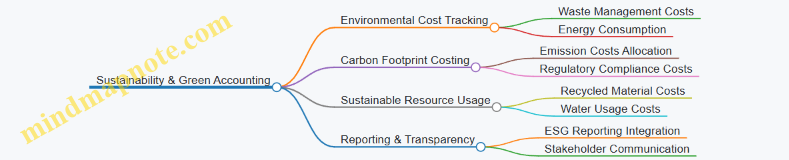
Example: A chemical manufacturer integrates carbon emission costs into product costing, enabling pricing strategies that reflect environmental impact and qualify for green certifications.
Cloud Computing and Collaborative Platforms
Cloud-based cost accounting solutions facilitate real-time collaboration across departments and locations, improving data accuracy and decision-making speed.
Mind Map: Cloud Computing Benefits for Cost Accounting

Example: A multinational manufacturing company uses a cloud ERP system to consolidate cost data from plants worldwide, enabling cost analysts to generate unified reports and identify global cost-saving opportunities.
Customization and Agile Cost Accounting
Manufacturers increasingly require flexible cost accounting systems that can quickly adapt to changing production methods, product lines, and market conditions.
Mind Map: Agile Cost Accounting Features
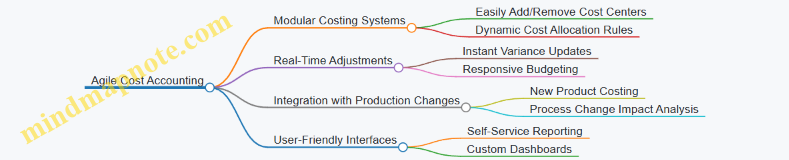
Example: A manufacturer launching multiple new product variants uses an agile costing system that allows cost analysts to quickly configure cost structures and simulate profitability scenarios without IT intervention.
Summary
Emerging trends such as digital transformation, AI, sustainability, cloud computing, and agile methodologies are reshaping cost accounting in manufacturing. By embracing these trends, accountants and cost analysts can enhance accuracy, responsiveness, and strategic value in their cost management practices.
Actionable Tip: Start by evaluating your current cost accounting system’s readiness for these trends. Consider pilot projects with IoT integration or AI analytics to gradually build capabilities and demonstrate value.
14.3 Preparing for the Future: Skills and Tools for Accountants and Cost Analysts
As manufacturing continues to evolve with technological advancements and shifting market demands, accountants and cost analysts must proactively develop new skills and adopt modern tools to stay relevant and effective. This section explores the essential skills and tools that will empower finance professionals in manufacturing to excel in the future.
Key Skills for Future-Ready Accountants and Cost Analysts
-
Data Analytics and Interpretation
- Ability to analyze large datasets to uncover cost drivers, inefficiencies, and opportunities.
- Understanding of statistical tools and software (e.g., Excel advanced functions, Power BI, Tableau).
-
Technological Proficiency
- Familiarity with ERP systems (SAP, Oracle, Microsoft Dynamics).
- Knowledge of automation tools (RPA - Robotic Process Automation).
- Awareness of emerging technologies like AI and Machine Learning.
-
Strategic Thinking and Business Acumen
- Linking cost data to strategic business decisions.
- Understanding manufacturing processes and supply chain dynamics.
-
Communication and Collaboration
- Presenting complex cost information in an understandable way to non-finance stakeholders.
- Working cross-functionally with production, engineering, and procurement teams.
-
Continuous Learning and Adaptability
- Staying updated with regulatory changes and industry trends.
- Adapting to new cost accounting standards and methodologies.
Essential Tools for Modern Cost Accounting
- ERP Systems: Centralize data and streamline cost tracking.
- Business Intelligence (BI) Tools: Visualize cost data and trends.
- Cloud-Based Accounting Software: Enables real-time collaboration and access.
- Automation and AI Solutions: Automate repetitive tasks and enhance forecasting.
- Cost Modeling Software: Build detailed cost models for scenario analysis.
Mind Map: Future Skills for Manufacturing Accountants and Cost Analysts
Mind Map: Tools Empowering Future Cost Accounting
Practical Example: Upskilling in Data Analytics
Scenario: A cost analyst at a mid-sized electronics manufacturer noticed recurring discrepancies in overhead allocation. To address this, she enrolled in an online data analytics course focused on Excel Power Query and Power BI.
Outcome: Using her new skills, she developed interactive dashboards that tracked overhead costs by department and machine usage in real-time. This visibility helped identify inefficient machines causing cost overruns, enabling targeted maintenance and cost savings of 8% in overhead within six months.
Practical Example: Leveraging Automation Tools
Scenario: An accounting team in a food processing plant was spending excessive time manually entering production cost data into their ERP system.
Solution: They implemented Robotic Process Automation (RPA) to automatically extract data from production reports and input it into the ERP.
Result: This reduced data entry errors by 90% and freed up 20 hours per week for the team to focus on variance analysis and strategic cost control initiatives.
Actionable Steps for Accountants and Cost Analysts
- Assess Current Skill Gaps: Identify areas such as data analytics or ERP proficiency needing improvement.
- Invest in Training: Utilize online courses, workshops, and certifications relevant to manufacturing finance.
- Adopt New Tools Gradually: Pilot BI or automation tools on small projects before full-scale implementation.
- Engage Cross-Functionally: Collaborate with IT and operations to understand technology integration.
- Stay Informed: Subscribe to industry publications and participate in professional networks.
By embracing these skills and tools, accountants and cost analysts will not only enhance their efficiency and accuracy but also become strategic partners in driving manufacturing profitability and innovation.
14.4 Final Example: Strategic Cost Management in a Smart Factory Environment
In today’s rapidly evolving manufacturing landscape, the concept of a “Smart Factory” integrates advanced technologies such as IoT (Internet of Things), AI (Artificial Intelligence), robotics, and data analytics to optimize production processes. Strategic cost management in such an environment requires a blend of traditional cost accounting principles and innovative approaches to leverage real-time data for decision-making.
Understanding Strategic Cost Management in a Smart Factory
Strategic cost management focuses on managing costs with a long-term perspective, aligning cost control with business strategy and competitive advantage. In a smart factory, this involves:
- Continuous monitoring of cost drivers using sensor data
- Dynamic overhead allocation based on real-time machine usage
- Predictive maintenance to reduce downtime and costs
- Integration of lean principles supported by data analytics
Mind Map: Components of Strategic Cost Management in a Smart Factory
Example: Implementing Strategic Cost Management at “TechFab Inc.” — A Smart Factory Case Study
Background: TechFab Inc. is a mid-sized manufacturer of precision electronic components. They recently upgraded their facility to a smart factory, installing IoT sensors on machines, implementing an ERP system with cost accounting modules, and adopting AI-driven analytics.
Step 1: Real-Time Cost Identification and Measurement
- IoT sensors track machine hours, energy consumption, and material usage.
- Data feeds into the ERP system, automatically updating cost records.
Step 2: Activity-Based Costing (ABC) with Real-Time Data
- Overhead costs are allocated based on actual machine usage and energy consumption rather than estimated labor hours.
- For example, machine A consumes 30% of total energy but was previously allocated only 15% of overhead.
Step 3: Predictive Maintenance to Control Costs
- AI algorithms analyze sensor data to predict when machines require maintenance.
- This reduces unexpected downtime and costly repairs.
Step 4: Lean Manufacturing Supported by Data Analytics
- Waste areas identified through data (e.g., excess inventory, inefficient workflows).
- Process improvements implemented, reducing scrap rates by 12%.
Step 5: Dynamic Decision Making
- Pricing adjusted based on real-time cost data and market demand.
- Capacity planning optimized to balance workload and minimize overtime costs.
Mind Map: TechFab Inc.’s Strategic Cost Management Workflow
Practical Tips for Accountants and Cost Analysts in Smart Factories
- Leverage Technology: Embrace ERP and IoT data streams to automate cost tracking and reduce manual errors.
- Focus on Data Quality: Ensure sensor data is accurate and integrated properly to maintain reliable cost records.
- Adopt Flexible Costing Models: Use activity-based and predictive costing methods to reflect real-time changes.
- Collaborate Cross-Functionally: Work closely with operations, IT, and engineering teams to understand cost drivers.
- Continuously Monitor and Improve: Use dashboards and alerts to track variances and initiate corrective actions promptly.
Summary
Strategic cost management in a smart factory environment transforms traditional cost accounting by integrating technology and data analytics. This approach enables manufacturers to gain deeper insights into cost behavior, improve cost control, and make agile decisions that enhance competitiveness and profitability.
By following the example of TechFab Inc., accountants and cost analysts can see how best practices and innovative tools come together to create a dynamic, data-driven cost management system tailored for the future of manufacturing.
14.5 Resources for Continued Learning and Professional Development
To stay ahead in the dynamic field of manufacturing cost accounting, continuous learning and professional development are essential. This section provides a curated list of resources, including books, online courses, professional certifications, communities, and tools, along with mind maps to help you organize your learning journey.
Books
- Cost Accounting: A Managerial Emphasis by Charles T. Horngren – A foundational text that covers core principles and practical applications.
- Managerial Accounting by Ray H. Garrison – Offers insights into cost behavior, budgeting, and performance evaluation.
- Activity-Based Costing: Making It Work for Small and Mid-Sized Companies by Douglas T. Hicks – Focuses on ABC implementation in manufacturing.
Online Courses & Platforms
- Coursera: Managerial Accounting Fundamentals (offered by University of Illinois) – Covers cost concepts and decision-making.
- LinkedIn Learning: Cost Accounting Foundations – Practical tutorials on cost allocation and variance analysis.
- edX: Manufacturing Process Control – Understand how manufacturing processes impact costs.
Professional Certifications
- Certified Management Accountant (CMA) – Recognized globally, focusing on financial planning, analysis, control, and decision support.
- Certified Cost Accountant (CCA) – Specializes in cost accounting principles and manufacturing applications.
- Lean Six Sigma Green Belt – Enhances skills in process improvement and waste reduction, directly impacting cost efficiency.
Communities & Forums
- Institute of Management Accountants (IMA) – Offers resources, webinars, and networking opportunities.
- Cost Accounting Group on LinkedIn – A platform for discussion, knowledge sharing, and problem-solving.
- Manufacturing Accounting Forums – Industry-specific forums where professionals discuss challenges and solutions.
Tools & Software Learning
- ERP Systems Tutorials (SAP, Oracle, Microsoft Dynamics) – Learn how integrated systems support cost accounting.
- Excel for Cost Accounting – Master pivot tables, formulas, and macros for cost analysis.
- Power BI and Tableau – Visualize cost data for better insights.
Mind Maps
Mind Map 1: Learning Path for Manufacturing Cost Accounting
Mind Map 2: Professional Certifications Roadmap
Mind Map 3: Tools and Technologies for Cost Accountants

Examples
Example 1: Using Online Courses to Bridge Knowledge Gaps Jane, a cost analyst at a mid-sized manufacturing firm, enrolled in the Coursera “Managerial Accounting Fundamentals” course to deepen her understanding of cost behavior and budgeting. She applied the concepts learned to improve her company’s monthly variance analysis reports, leading to more accurate forecasting and cost control.
Example 2: Leveraging Professional Certifications for Career Growth Mark pursued the CMA certification to enhance his expertise in strategic cost management. After certification, he led a project implementing activity-based costing in his manufacturing plant, resulting in a 12% reduction in overhead costs by identifying inefficient cost drivers.
Example 3: Engaging with Communities for Problem Solving Samantha joined the IMA community and participated in webinars focused on lean manufacturing and cost accounting integration. Through discussions, she discovered best practices for aligning cost accounting with lean initiatives, which she successfully implemented at her company.
Final Tips
- Set a structured learning schedule using the mind maps above.
- Combine theoretical knowledge with practical application.
- Network regularly with peers and industry experts.
- Stay updated with emerging technologies and regulatory changes.
By leveraging these resources and approaches, accountants and cost analysts in manufacturing can continuously enhance their skills, drive cost efficiencies, and contribute strategically to their organizations.