Accounting for Government Grants
1. Introduction to Government Grants
1.1 Definition and Types of Government Grants
Government grants are financial awards provided by government bodies to organizations, institutions, or individuals to support specific projects, activities, or general operations without the expectation of repayment. These grants are designed to promote public welfare, stimulate economic growth, support research and innovation, and assist in community development.
Definition of Government Grants
A government grant is a non-repayable fund or product disbursed by one party (government) to a recipient, often to carry out a public purpose or stimulate activities aligned with government policies. Unlike loans, grants do not require repayment, but they often come with conditions or performance requirements.
Mind Map: Definition of Government Grants
Types of Government Grants
Government grants can be broadly categorized based on their purpose, conditions, and the nature of the recipient. Understanding these types helps accountants and financial managers apply the correct accounting treatment.
-
Capital Grants
- Purpose: To finance the acquisition, construction, or improvement of fixed assets.
- Example: A grant to build a new public library or upgrade government office buildings.
-
Revenue Grants
- Purpose: To support operating expenses or specific programs.
- Example: Funding for community health programs or educational initiatives.
-
Project Grants
- Purpose: To fund specific projects with defined objectives and timelines.
- Example: A grant for a renewable energy pilot project.
-
General Support Grants
- Purpose: To provide broad financial support without strict usage restrictions.
- Example: Block grants to local governments for general use.
-
Conditional Grants
- Purpose: Provided with specific conditions or performance targets.
- Example: Grants that require job creation or environmental compliance.
-
Unconditional Grants
- Purpose: Provided without any specific conditions attached.
- Example: A grant given to support general administrative costs.
Mind Map: Types of Government Grants
Examples Illustrating Types of Government Grants
-
Capital Grant Example: The Department of Transportation awards a $5 million grant to a city government to construct a new bridge. This grant is capital in nature because it finances a long-term asset.
-
Revenue Grant Example: A health department receives a $500,000 grant to fund vaccination programs during a public health campaign. This grant supports ongoing operational expenses.
-
Project Grant Example: An environmental agency is granted $1 million to conduct a two-year study on water quality in local rivers.
-
General Support Grant Example: A local municipality receives a block grant of $2 million to allocate across various departments as needed.
-
Conditional Grant Example: A government provides a grant to a manufacturing company contingent upon the creation of 100 new jobs within two years.
-
Unconditional Grant Example: A cultural institution receives funding to cover administrative costs without any specific usage restrictions.
Best Practice Tip:
When accounting for government grants, clearly identify the type of grant at the outset. This classification influences recognition, measurement, and disclosure. Maintaining detailed documentation on the grant’s purpose and conditions ensures compliance and accurate financial reporting.
This foundational understanding of government grants sets the stage for deeper exploration into recognition criteria, measurement, and accounting treatments in subsequent sections.
1.2 Importance of Accurate Accounting for Government Grants
Accurate accounting for government grants is crucial for government financial managers and accountants to ensure transparency, compliance, and effective resource management. Government grants often come with specific conditions and reporting requirements, making precise accounting essential to avoid financial misstatements, penalties, or loss of future funding.
Why Accurate Accounting Matters
- Compliance with Regulations: Government grants are subject to strict regulatory frameworks such as IFRS, GASB, or local government accounting standards. Accurate accounting ensures adherence to these rules.
- Transparency and Accountability: Proper recording and reporting of grant funds build trust with stakeholders, including taxpayers, grantors, and oversight bodies.
- Financial Management: Accurate accounting helps in budgeting, forecasting, and monitoring the use of grant funds to achieve intended outcomes.
- Audit Readiness: Detailed and accurate records simplify audits and reduce the risk of findings or sanctions.
- Sustainability of Funding: Demonstrating proper use of funds increases the likelihood of securing future grants.
Mind Map: Importance of Accurate Accounting for Government Grants
Practical Example 1: Compliance and Reporting
A city government receives a $2 million grant to improve public transportation infrastructure. The grant requires quarterly reports detailing expenditures and progress. Accurate accounting ensures that all expenses are properly categorized and documented, enabling the city to submit timely and accurate reports. Failure to do so could result in penalties or grant clawbacks.
Practical Example 2: Transparency and Stakeholder Trust
A state health department receives multiple grants for pandemic response. By maintaining clear and accurate accounting records, the department can transparently show how funds were allocated to testing, vaccination, and public education. This transparency fosters public trust and supports the department’s reputation.
Mind Map: Consequences of Inaccurate Accounting
Practical Example 3: Audit Readiness
A government agency managing environmental grants undergoes an external audit. Because the agency maintained meticulous records of grant receipts, expenditures, and compliance with grant conditions, the audit is completed smoothly with no adverse findings. This success enhances the agency’s credibility and supports future grant applications.
Summary
Accurate accounting for government grants is not just a regulatory requirement but a foundational practice that supports effective governance, financial integrity, and sustainable funding. By understanding its importance and implementing best practices, accountants and financial managers can safeguard public resources and contribute to successful government programs.
1.3 Overview of Regulatory Frameworks and Standards
Government grants accounting is governed by a variety of regulatory frameworks and standards designed to ensure transparency, consistency, and accountability in financial reporting. Understanding these frameworks is essential for accountants and government financial managers to correctly recognize, measure, present, and disclose government grants.
Key Regulatory Frameworks and Standards
-
International Financial Reporting Standards (IFRS)
- IFRS specifically addresses government grants under IAS 20 - Accounting for Government Grants and Disclosure of Government Assistance.
- IAS 20 provides guidance on recognition, measurement, and disclosure of grants.
-
Governmental Accounting Standards Board (GASB)
- GASB Statement No. 33 covers accounting and financial reporting for nonexchange transactions, including government grants.
- GASB standards are primarily used by U.S. state and local governments.
-
Federal Accounting Standards Advisory Board (FASAB)
- FASAB issues standards for federal entities in the United States.
- It provides guidance on grants and cooperative agreements.
-
National and Local Government Accounting Standards
- Many countries have their own public sector accounting standards (e.g., IPSAS - International Public Sector Accounting Standards).
- Local governments may have additional regulations or policies.
-
Grantor-Specific Regulations
- Some grants come with specific accounting and reporting requirements dictated by the grantor agency.
Mind Map: Regulatory Frameworks for Government Grants
IFRS - IAS 20 Highlights
- Recognition: Grants recognized when there is reasonable assurance that the entity will comply with conditions and the grant will be received.
- Measurement: Grants measured at fair value.
- Presentation: Grants related to assets can be presented as deferred income or deducted from the asset’s carrying amount.
- Disclosure: Nature, extent, and conditions of grants must be disclosed.
Example:
A government agency receives a $500,000 grant to purchase new IT equipment. Under IAS 20, the agency recognizes the grant when it is reasonably assured and measures it at fair value. The grant is presented as deferred income and amortized over the useful life of the equipment.
GASB Statement No. 33 Highlights
- Nonexchange Transactions: Grants are nonexchange transactions where the government gives or receives value without directly receiving equal value in return.
- Recognition: Revenue recognized when eligibility requirements are met.
- Types of Eligibility Requirements: Time requirements, reimbursement, and contingencies.
- Presentation: Revenues reported in the period when eligibility is met.
Example:
A city receives a grant to fund a public transportation project. The grant requires the city to spend funds within a fiscal year. The city recognizes revenue as expenses are incurred, matching grant revenue with related costs.
Mind Map: Key Accounting Concepts in Government Grants
Practical Example: Navigating Multiple Standards
A government financial manager at a regional authority must account for a $1 million grant received from a federal agency. The grant is subject to both national public sector accounting standards and specific federal grantor requirements.
Steps Taken:
- Review national accounting standards to identify recognition and measurement principles.
- Consult federal grant guidelines for reporting and compliance requirements.
- Apply IAS 20 principles for recognition and measurement if applicable.
- Ensure disclosures meet both national standards and grantor requirements.
- Document all decisions and maintain audit trails.
This integrated approach ensures compliance, transparency, and accuracy.
Summary
Understanding the regulatory frameworks and standards applicable to government grants is foundational for proper accounting. Familiarity with IFRS (IAS 20), GASB, FASAB, and local standards helps ensure grants are accounted for consistently and transparently. Additionally, recognizing grantor-specific requirements and integrating them into accounting practices is a best practice for government financial managers.
1.4 Common Challenges in Accounting for Government Grants
Accounting for government grants presents unique challenges that can impact the accuracy and transparency of financial reporting. Understanding these challenges is essential for accountants and government financial managers to ensure compliance and effective management.
Mind Map: Common Challenges in Accounting for Government Grants
Recognition Issues
One of the most frequent challenges is determining the appropriate timing and conditions for recognizing a government grant. Grants may be conditional, requiring certain performance milestones or compliance with specific terms before recognition is allowed.
Example: A government agency receives a grant to build a public park, but the grant is only payable upon completion of certain construction milestones. Recognizing the grant income before these milestones are met would be premature and could misstate financial results.
Best Practice: Maintain detailed documentation of grant conditions and monitor progress regularly to ensure recognition aligns with fulfillment of conditions.
Measurement Difficulties
Measuring the value of government grants can be complex, especially when grants are provided in non-monetary forms such as land, equipment, or services.
Example: A municipality receives donated land from the government as a grant. Determining the fair value of the land at the time of receipt requires professional appraisal and may vary significantly depending on market conditions.
Best Practice: Engage qualified valuation experts and apply consistent valuation methodologies to ensure accurate measurement.
Compliance and Documentation
Ensuring compliance with grant conditions and maintaining comprehensive documentation is critical for audit readiness and avoiding penalties.
Example: A government department receives a grant for educational programs with strict reporting requirements. Failure to document expenditures properly can lead to grant clawbacks or reputational damage.
Best Practice: Implement robust record-keeping systems and conduct periodic internal audits to verify compliance.
Presentation and Disclosure
Properly classifying and disclosing government grants in financial statements is essential for transparency and stakeholder trust.
Example: A grant intended for capital asset acquisition is mistakenly presented as revenue in the income statement, distorting the financial position.
Best Practice: Follow applicable accounting standards (e.g., IPSAS, IFRS) carefully and provide clear disclosures about the nature, amount, and conditions of grants.
Internal Controls
Weak internal controls can lead to mismanagement or misstatement of government grants.
Example: Lack of segregation of duties results in unauthorized use of grant funds for unrelated expenses.
Best Practice: Establish clear internal control procedures including segregation of duties, approval workflows, and regular reconciliations.
Coordination Across Departments
Government grants often involve multiple departments, which can create communication gaps and inconsistent accounting treatments.
Example: The finance department records a grant differently than the project management office, leading to discrepancies in reports.
Best Practice: Develop standardized accounting policies and facilitate regular inter-departmental meetings to align practices.
Summary
Accounting for government grants requires careful attention to recognition timing, accurate measurement, strict compliance, transparent presentation, strong internal controls, and effective coordination. By anticipating and addressing these common challenges, accountants and financial managers can ensure that government grants are accounted for accurately and responsibly.
1.5 Practical Example: Identifying a Government Grant in a Municipal Budget
Understanding how to identify government grants within a municipal budget is a foundational skill for accountants and financial managers in the public sector. This example will guide you through the process, using a typical municipal budget scenario.
Step 1: Understand the Source and Nature of Funds
Government grants are funds provided by higher levels of government (federal, state, or provincial) to municipalities for specific or general purposes. These funds are typically non-repayable but may come with conditions.
Mind Map: Sources of Government Grants
Step 2: Review the Municipal Budget Document
Municipal budgets often categorize revenues by source. Look for line items labeled as “Grants,” “Intergovernmental Revenues,” or similar.
Example:
| Revenue Source | Amount (USD) |
|---|---|
| Property Taxes | 5,000,000 |
| Sales Taxes | 2,000,000 |
| Federal Grants | 1,200,000 |
| State Grants | 800,000 |
| Service Charges | 1,500,000 |
Here, the “Federal Grants” and “State Grants” lines indicate government grants.
Step 3: Identify the Purpose and Conditions
Each grant should have an associated purpose and possibly conditions attached.
Mind Map: Grant Characteristics
Example:
- Federal Grant of $1,200,000 for road infrastructure improvements, requiring quarterly progress reports.
- State Grant of $800,000 for environmental cleanup, with a spending deadline within 12 months.
Step 4: Confirm the Grant Classification
Determine if the grant is capital (for asset acquisition or improvement) or revenue (for operational expenses).
Example:
- The federal grant for road infrastructure is a capital grant.
- The state grant for environmental cleanup is a revenue grant.
Step 5: Document and Record the Grant
Proper documentation includes grant agreements, correspondence, and budget notes.
Best Practice: Maintain a centralized grant register with details such as:
- Grantor
- Amount
- Purpose
- Conditions
- Recognition criteria
Mind Map: Grant Documentation
Summary Example: Identifying a Government Grant
| Step | Action Taken | Example Outcome |
|---|---|---|
| 1. Source Identification | Found “Federal Grants” and “State Grants” in budget | $1,200,000 and $800,000 identified as grants |
| 2. Purpose Review | Reviewed grant agreements | Infrastructure and environmental cleanup purposes |
| 3. Condition Check | Noted reporting and spending conditions | Quarterly reports and 12-month spending deadline |
| 4. Classification | Classified grants as capital or revenue | Federal = capital; State = revenue |
| 5. Documentation | Created entries in grant register | Centralized record for tracking |
This practical example illustrates how accountants and government financial managers can systematically identify and classify government grants within a municipal budget, ensuring compliance and accurate financial reporting.
2. Recognition Criteria for Government Grants
2.1 When to Recognize a Government Grant
Recognizing a government grant at the appropriate time is crucial for accurate financial reporting and compliance. The recognition point determines when the grant is recorded in the financial statements, impacting income, assets, and liabilities.
Key Principles for Recognition
- Probable Receipt: The entity must have reasonable assurance that it will receive the grant.
- Compliance with Conditions: The entity must comply with any attached conditions or be reasonably certain it will comply.
- Reliable Measurement: The amount of the grant can be measured reliably.
Mind Map: Criteria for Recognizing a Government Grant
Timing Considerations
- At Grant Approval: Some grants are recognized when the government formally approves the grant and communicates it to the entity.
- Upon Fulfillment of Conditions: If the grant is conditional, recognition occurs only when conditions are met.
- Over Time: For grants related to income, recognition may be spread over periods matching the related expenses.
Practical Example 1: Recognizing a Capital Grant for Building Renovation
A city government receives a $500,000 grant to renovate a public library. The grant is approved and communicated in January, but the renovation will take six months.
- Recognition Approach: The grant is recognized as income over the six-month renovation period, matching the expense recognition.
- Reasoning: The grant is conditional on renovation progress; recognizing it upfront would misstate income.
Mind Map: Timing of Recognition Based on Grant Type
Practical Example 2: Recognizing an Unconditional Operating Grant
A government agency receives an unconditional grant of $200,000 to support general operations for the fiscal year.
- Recognition Approach: The entire amount is recognized as income when the grant is received or receivable since there are no conditions.
- Reasoning: No restrictions or performance obligations exist, so recognition is immediate.
Best Practice Tips
- Maintain clear documentation of grant agreements, approvals, and conditions.
- Establish internal controls to track compliance with grant conditions.
- Collaborate with legal and compliance teams to interpret grant terms.
- Use consistent policies for recognition to ensure comparability.
Mind Map: Best Practices for Grant Recognition
By understanding when to recognize government grants, accountants and financial managers can ensure compliance with accounting standards such as IAS 20 or relevant government accounting frameworks, leading to transparent and reliable financial statements.
2.2 Conditions and Contingencies Affecting Recognition
When accounting for government grants, understanding the conditions and contingencies attached to the grant is critical for accurate recognition. These factors determine whether and when a grant can be recognized as income or as an asset, ensuring compliance with accounting standards such as IFRS and GASB.
What Are Conditions and Contingencies?
- Conditions: Specific requirements or obligations that the recipient must fulfill to qualify for the grant or to retain the grant funds.
- Contingencies: Events or circumstances that may affect the entitlement to the grant, often dependent on future outcomes.
Why Are They Important?
- They affect the timing of recognition.
- Failure to meet conditions may require repayment or reversal of recognized income.
- They influence disclosure requirements.
Mind Map: Conditions and Contingencies Affecting Recognition
Common Types of Conditions
- Use Restrictions: Funds must be used for a specified purpose.
- Performance Milestones: Completion of certain activities or phases.
- Reporting Requirements: Submission of financial or progress reports.
- Matching Contributions: Recipient must provide a certain amount of funding.
- Compliance with Laws: Adherence to legal or environmental standards.
Mind Map: Examples of Conditions
Recognition Implications
- Grant recognized only when conditions are met:
- If conditions are not yet met, the grant is recognized as a liability or deferred income.
- Partial fulfillment:
- Proportionate recognition may be appropriate.
- Failure to meet conditions:
- May require reversal of recognized amounts.
Practical Example 1: Infrastructure Grant with Milestone Conditions
A government agency receives a $5 million grant to build a community center. The grant agreement specifies:
- $2 million payable upon completion of the foundation.
- $3 million payable upon final completion.
- Quarterly progress reports must be submitted.
Accounting Treatment:
- Recognize $2 million as income when the foundation is completed and verified.
- Recognize the remaining $3 million upon final completion.
- Until milestones are met, amounts are recorded as deferred income.
Practical Example 2: Grant with Use Restriction and Reporting Condition
A city receives a $500,000 grant to fund environmental cleanup, with the condition that funds are used exclusively for hazardous waste removal and that annual reports are submitted.
Accounting Treatment:
- Recognize the grant as income only when expenditures for hazardous waste removal occur.
- Maintain records to demonstrate compliance with use restrictions.
- If reporting is delayed or incomplete, recognition may be deferred.
Mind Map: Recognition Process Considering Conditions
Best Practices
- Thoroughly review grant agreements to identify all conditions and contingencies.
- Maintain detailed documentation of how and when conditions are met.
- Implement monitoring systems to track compliance and milestones.
- Coordinate with legal and compliance teams to understand implications of non-fulfillment.
- Use clear accounting policies to handle partial fulfillment and contingencies.
Summary
Conditions and contingencies are pivotal in determining the timing and amount of government grant recognition. Proper identification, documentation, and monitoring ensure compliance and accurate financial reporting, ultimately supporting transparency and accountability in government financial management.
2.3 Distinguishing Between Capital and Revenue Grants
Understanding the distinction between capital and revenue grants is crucial for accurate accounting and financial reporting in government entities. This section explores the characteristics, accounting treatments, and practical examples to help accountants and government financial managers correctly classify and handle these grants.
What Are Capital Grants?
Capital grants are funds provided by the government to finance the acquisition, construction, or improvement of long-term assets. These grants are typically used for infrastructure projects, buildings, equipment, or other capital expenditures.
Key Characteristics:
- Intended for purchasing or improving fixed assets
- Often non-recurring and substantial in amount
- Benefits extend over multiple accounting periods
What Are Revenue Grants?
Revenue grants are funds given to support the day-to-day operational expenses or specific programs. These grants help cover costs such as salaries, supplies, or service delivery.
Key Characteristics:
- Intended for operational or revenue expenses
- Usually recurring and smaller in amount
- Benefits realized within the current accounting period
Mind Map: Distinguishing Capital vs Revenue Grants
Accounting Treatment Differences
| Aspect | Capital Grants | Revenue Grants |
|---|---|---|
| Purpose | Acquisition or improvement of fixed assets | Support operational expenses |
| Recognition | Deferred income or deducted from asset cost | Recognized immediately as income |
| Impact on Financials | Affects balance sheet and amortized over time | Affects income statement in current period |
| Examples | Grant for new school building | Grant for community health program |
Practical Examples
Example 1: Capital Grant
A government agency receives a $2 million grant to build a new public library. The grant is used exclusively for construction costs.
- Classification: Capital grant
- Accounting treatment: The grant is recorded as deferred income and recognized in the income statement over the useful life of the library building (e.g., 20 years) through amortization.
Example 2: Revenue Grant
A city council receives a $500,000 grant to fund a local arts program for the current fiscal year.
- Classification: Revenue grant
- Accounting treatment: The grant is recognized as income in the current fiscal year to match the expenses of running the arts program.
Mind Map: Accounting Workflow for Capital vs Revenue Grants
Best Practices
- Document the grant purpose clearly: Ensure grant agreements specify whether funds are for capital or revenue purposes.
- Align accounting treatment with grant conditions: Follow regulatory standards such as IPSAS 23 or IFRS requirements.
- Use consistent classification: Avoid misclassification to maintain transparency and compliance.
- Provide clear disclosures: In financial statements, disclose the nature and accounting treatment of grants.
Summary
Distinguishing between capital and revenue grants hinges on the purpose and timing of benefits. Capital grants relate to long-term assets and are recognized over the asset’s life, while revenue grants support operational costs and are recognized immediately. Proper classification ensures accurate financial reporting and compliance with accounting standards.
2.4 Best Practice: Documentation and Evidence for Recognition
Accurate documentation and robust evidence are fundamental to the proper recognition of government grants. This ensures compliance with accounting standards, facilitates audit processes, and supports transparency and accountability within government financial management.
Why Documentation and Evidence Matter
- Verification: Confirms the existence and terms of the grant.
- Compliance: Ensures adherence to regulatory and accounting standards.
- Audit Trail: Provides clear records for internal and external audits.
- Transparency: Builds trust with stakeholders and grantors.
Key Documentation Components
Mind Map: Documentation and Evidence for Grant Recognition
Best Practices for Documentation
-
Maintain a Centralized Grant File:
- Store all relevant documents in a dedicated digital or physical folder.
- Include grant agreements, correspondence, financial records, and reports.
-
Record Grant Terms Clearly:
- Highlight recognition criteria stipulated in the agreement.
- Note any conditions or contingencies affecting recognition.
-
Track Receipt of Funds:
- Use bank statements and accounting entries to confirm amounts received.
- Reconcile received funds against grant schedules.
-
Document Internal Approvals:
- Obtain formal sign-offs from authorized personnel before recognizing grants.
-
Regularly Update Performance Evidence:
- Keep records of progress reports and compliance with grant conditions.
-
Use Standardized Templates:
- Develop templates for grant documentation to ensure consistency.
Practical Example: Recognizing a Grant for Infrastructure Development
Scenario: A city government receives a $2 million grant to build a new community center. The grant agreement states that funds will be disbursed in three installments upon meeting specific construction milestones.
Documentation Steps:
- Grant Agreement: Signed contract detailing milestones and payment schedule.
- Correspondence: Emails confirming milestone approvals.
- Financial Records: Bank statements showing receipt of each installment.
- Internal Approvals: City council resolution authorizing acceptance and recognition of the grant.
- Performance Reports: Engineering reports confirming milestone completion.
Recognition:
- Upon receipt of the first installment and verification of milestone completion, the grant is recognized as deferred income.
- As construction progresses and milestones are met, portions of the grant are recognized as income in the financial statements.
Mind Map: Example - Infrastructure Grant Recognition Process
By following these documentation best practices, government accountants and financial managers can ensure that grant recognition is accurate, defensible, and aligned with both internal policies and external standards.
2.5 Practical Example: Recognizing a Grant for Infrastructure Development
Scenario Overview
A local government receives a government grant of $5 million to develop a new public transportation infrastructure project. The grant is intended to cover construction costs and is subject to specific conditions, including project milestones and reporting requirements.
Step 1: Identify the Grant and Its Nature
- Type of Grant: Capital grant for infrastructure development
- Grantor: State government
- Purpose: Construction of new bus terminals and related facilities
- Conditions: Completion of milestones, submission of progress reports, and use of funds exclusively for construction
Step 2: Assess Recognition Criteria
According to accounting standards (e.g., IPSAS 23 or IAS 20), recognition of a government grant requires:
- Reasonable assurance that the entity will comply with conditions attached to the grant
- Reasonable assurance that the grant will be received
Since the local government has signed a formal agreement and has a history of compliance, recognition is appropriate.
Step 3: Determine Measurement
- The grant amount is $5 million.
- The grant is measured at fair value, which is the nominal amount since it is a non-repayable grant.
Step 4: Accounting Treatment
- The grant is related to an asset (infrastructure).
- It will be recognized as deferred income and amortized over the useful life of the asset.
Mind Map: Recognizing a Government Grant for Infrastructure Development
Step 5: Journal Entries Example
| Date | Account | Debit ($) | Credit ($) |
|---|---|---|---|
| Upon grant receipt | Bank (Cash) | 5,000,000 | |
| Upon grant receipt | Deferred Grant Income | 5,000,000 |
As construction progresses and assets are capitalized:
| Date | Account | Debit ($) | Credit ($) |
|---|---|---|---|
| Capitalization | Infrastructure Asset | X | |
| Capitalization | Bank (Cash) or Payables | X |
Amortization of grant income over asset life (e.g., 20 years):
| Date | Account | Debit ($) | Credit ($) |
|---|---|---|---|
| Annual | Deferred Grant Income | 250,000 | |
| Annual | Grant Income (P&L) | 250,000 |
Step 6: Best Practices
- Maintain clear documentation of grant agreements and conditions.
- Monitor compliance with milestones and reporting requirements.
- Coordinate with project managers to align accounting recognition with project progress.
- Regularly review deferred income balances and amortization schedules.
Additional Mind Map: Best Practices in Grant Recognition
Summary
Recognizing a government grant for infrastructure development involves verifying eligibility, measuring the grant, and applying the appropriate accounting treatment. By following these steps and best practices, government financial managers ensure transparency, compliance, and accurate financial reporting.
This example demonstrates how to integrate accounting standards with practical project management considerations, providing a clear framework for recognizing and accounting for government grants in infrastructure projects.
3. Measurement of Government Grants
3.1 Initial Measurement: Fair Value and Present Value Concepts
When accounting for government grants, the initial measurement is a critical step that determines how the grant is recognized in the financial statements. Two fundamental concepts underpin this measurement: Fair Value and Present Value.
Understanding Fair Value
Fair value is defined as the price that would be received to sell an asset or paid to transfer a liability in an orderly transaction between market participants at the measurement date.
- Key Characteristics:
- Market-based measurement
- Reflects current market conditions
- Assumes an orderly transaction
Mind Map: Fair Value Concept
Example: Measuring a Non-Cash Grant
A government grants a municipality equipment valued at $100,000. The municipality should recognize the equipment and the grant at the fair value of the equipment received, which is $100,000, assuming no restrictions or conditions affect the measurement.
Understanding Present Value
Present value (PV) is the current worth of a future sum of money or stream of cash flows given a specified rate of return (discount rate).
- Key Characteristics:
- Time value of money concept
- Discounts future cash flows to current value
- Requires selection of an appropriate discount rate
Mind Map: Present Value Concept
Example: Measuring a Grant with Repayment Condition
A government grant of $50,000 is receivable in two years, but the recipient must repay it if certain conditions are not met. To measure the grant initially, the recipient discounts the $50,000 to its present value using an appropriate discount rate (e.g., 5%).
Calculation:
PV = $50,000 / (1 + 0.05)^2 = $45,351
The grant is initially recognized at $45,351.
Integrating Fair Value and Present Value in Grant Accounting
Mind Map: Initial Measurement Process
Best Practice Tips
- Always document the basis for fair value or present value measurement.
- Use market data and expert valuations where possible.
- Select discount rates that reflect the entity’s credit risk and market conditions.
- Review and update assumptions if conditions change before recognition.
Practical Example: Municipality Grant for Building Renovation
A municipality receives a grant of $200,000 to be paid in two installments: $100,000 immediately and $100,000 in one year. There is no repayment condition.
- Immediate $100,000 is recognized at fair value: $100,000.
- The $100,000 receivable in one year is discounted at 4%:
PV = $100,000 / (1 + 0.04)^1 = $96,154
- Total grant recognized initially: $100,000 + $96,154 = $196,154.
This ensures the grant is accurately reflected in the financial statements considering the time value of money.
By understanding and correctly applying fair value and present value concepts, accountants and government financial managers can ensure transparent, accurate, and compliant reporting of government grants.
3.2 Subsequent Measurement and Adjustments
Subsequent measurement of government grants involves the ongoing accounting treatment after the initial recognition and measurement. This step is crucial to ensure that the financial statements accurately reflect the impact of the grant over time, particularly when conditions change or when the grant is linked to specific assets or income.
Key Concepts in Subsequent Measurement
- Amortization of Grants Related to Assets: When a grant is related to an asset, it is typically recognized as deferred income and amortized over the useful life of the asset.
- Recognition of Income: Grants related to income are recognized in profit or loss over the periods necessary to match them with the related costs.
- Adjustments for Changes in Conditions: If conditions attached to the grant change or are not met, adjustments may be required, including potential repayments.
Mind Map: Subsequent Measurement Overview
Amortization of Grants Related to Assets
When a government grant is received for the purchase or construction of a fixed asset, the grant is initially recognized as deferred income (liability) and then systematically recognized as income over the asset’s useful life.
Example: A government grant of $500,000 is received to build a new public library. The library is expected to have a useful life of 25 years.
- Initial recognition: $500,000 deferred income.
- Annual amortization: $500,000 / 25 = $20,000 recognized as income each year.
Mind Map: Amortization Process
Recognition of Grants Related to Income
Grants that compensate for expenses or losses should be recognized in the same period as the related costs to ensure proper matching.
Example: A government grant of $100,000 is awarded to cover training expenses for government employees in the current fiscal year.
- The grant is recognized as income in the same period when the training expenses are incurred.
- If training expenses are $80,000, the grant income recognized is $80,000 to match the expense.
- The remaining $20,000 is recognized when additional eligible expenses occur or deferred if conditions apply.
Mind Map: Income-Related Grants
Adjustments Due to Changes in Conditions or Repayment
Sometimes, grants come with conditions that, if unmet, require repayment or adjustment of the recognized amounts.
Example: A grant of $200,000 is provided to a government agency to create 50 new jobs within two years. After one year, only 30 jobs have been created.
- The agency must reassess the grant recognition.
- If conditions are unlikely to be met, a portion of the grant may need to be reversed or disclosed as a liability.
- This adjustment ensures the financial statements reflect the true economic benefit.
Mind Map: Adjustments and Repayments
Practical Example: Subsequent Measurement in Action
Scenario: A local government receives a $1 million grant to purchase firefighting equipment with a useful life of 10 years. The grant requires the equipment to be used exclusively for firefighting services.
- Year 1:
- Recognize $1 million as deferred income.
- Amortize $100,000 as grant income.
- Year 3:
- Equipment is repurposed partially for non-firefighting activities.
- The government reassesses the grant conditions.
- Adjust deferred income and recognize a liability for the portion related to non-compliance.
This example highlights the importance of continuous monitoring and adjustment to ensure compliance and accurate financial reporting.
Best Practices for Subsequent Measurement and Adjustments
- Maintain detailed schedules linking grants to assets and expenses.
- Regularly review grant conditions and compliance status.
- Document all adjustments with clear rationale.
- Coordinate with legal and compliance teams for condition interpretation.
- Use consistent amortization methods aligned with asset depreciation.
By following these principles and practices, accountants and government financial managers can ensure that government grants are measured and reported accurately throughout their lifecycle, providing transparency and accountability to stakeholders.
3.3 Handling Grants with Repayment Conditions
Government grants with repayment conditions present unique accounting challenges. These grants require the recipient to repay the grant amount, either partially or fully, if certain conditions are not met. Proper accounting treatment ensures compliance with standards and accurate financial reporting.
Understanding Repayment Conditions
Repayment conditions typically arise when grants are contingent on:
- Failure to meet performance targets
- Non-compliance with grant terms
- Early termination of the grant project
- Change in use of the grant funds
These conditions create a potential liability for the recipient.
Accounting Treatment Overview
The key accounting considerations include:
- Initial recognition of the grant
- Recognition of a liability for the repayment obligation
- Measurement of the liability
- Subsequent adjustments based on fulfillment or breach of conditions
Mind Map: Accounting for Grants with Repayment Conditions
Example 1: Infrastructure Grant with Clawback Clause
Scenario: A local government receives a $1 million grant to build a community center. The grant includes a clause requiring repayment if the center is sold within 5 years.
Accounting Treatment:
- Initially, recognize the $1 million as deferred income.
- Recognize a contingent liability for the repayment obligation.
- If the government decides to sell the center in year 3, recognize the repayment liability and reduce income accordingly.
Mind Map:
Example 2: Research Grant with Performance Milestones
Scenario: A government agency awards a $500,000 research grant payable in installments, with repayment required if milestones are not met.
Accounting Treatment:
- Recognize grant income as milestones are achieved.
- If a milestone is missed, recognize a liability for the repayment amount.
- Adjust financial statements to reflect the likelihood of repayment.
Mind Map:
Best Practices
- Thorough Documentation: Maintain clear records of all grant terms and repayment conditions.
- Regular Monitoring: Continuously assess compliance with grant conditions.
- Conservative Recognition: Recognize liabilities promptly when repayment becomes probable.
- Transparent Disclosure: Clearly disclose repayment conditions and potential liabilities in financial statements.
Summary
Handling grants with repayment conditions requires a careful balance between recognizing income and potential liabilities. By following a structured approach and using clear documentation, government entities can ensure compliance and maintain transparent financial reporting.
3.4 Best Practice: Using Valuation Experts and Consistent Methods
Accurately measuring government grants is critical to ensure compliance with accounting standards and to present a true and fair view of financial statements. One of the best practices in this area is to engage valuation experts and adopt consistent valuation methods. This approach helps mitigate risks related to misvaluation, enhances transparency, and supports audit readiness.
Why Use Valuation Experts?
- Specialized Knowledge: Valuation experts possess deep understanding of market conditions, asset-specific factors, and regulatory requirements.
- Objective Assessment: They provide an independent and unbiased valuation, reducing the risk of internal bias.
- Complex Grants: Some grants involve assets or conditions that require sophisticated valuation techniques beyond routine accounting.
- Compliance Assurance: Experts ensure that valuations comply with relevant accounting standards such as IFRS, GASB, or IPSAS.
Consistent Valuation Methods
Consistency in applying valuation methods is essential for comparability across reporting periods and entities. Common valuation methods include:
- Market Approach: Uses prices and other relevant information generated by market transactions.
- Income Approach: Converts future amounts (cash flows or income) to a single current amount using a discount rate.
- Cost Approach: Based on the current replacement cost of an asset, less depreciation.
Mind Map: Valuation Experts and Consistent Methods
Practical Example 1: Valuing a Grant for Renewable Energy Equipment
A government agency receives a grant to purchase solar panels. The grant amount is based on the fair value of the equipment. To ensure accurate measurement:
- The agency hires a valuation expert specializing in renewable energy assets.
- The expert uses the market approach, comparing prices of similar solar panels recently sold.
- The valuation is documented and reviewed by the finance team.
- Consistent application of this method is maintained for all future equipment grants.
This approach ensures the grant is recorded at a fair value reflecting current market conditions.
Practical Example 2: Measuring a Grant with Repayment Conditions
A local government receives a grant for community development, repayable if certain milestones are not met. The valuation expert:
- Applies the income approach, discounting expected cash flows considering the probability of repayment.
- Works closely with legal and project teams to understand conditions.
- Provides a valuation report that guides the accounting treatment.
The finance team applies this consistent method for similar conditional grants, ensuring comparability.
Tips for Implementing Best Practices
- Engage Experts Early: Involve valuation professionals during grant negotiation or acceptance.
- Develop Valuation Policies: Establish clear policies outlining preferred methods and documentation requirements.
- Train Staff: Ensure accountants understand valuation principles and when to seek expert advice.
- Maintain Documentation: Keep detailed records of valuation reports, assumptions, and methodologies.
- Review Regularly: Periodically reassess valuation methods to reflect changes in market conditions or regulations.
By integrating valuation experts and consistent methods into the accounting process for government grants, organizations can enhance accuracy, compliance, and stakeholder trust.
3.5 Practical Example: Measuring a Grant for Technology Upgrade
When a government entity receives a grant specifically aimed at upgrading technology infrastructure, accurately measuring the grant is crucial for proper accounting and reporting. This example will guide you through the steps and considerations involved in measuring such a grant.
Step 1: Identify the Nature and Terms of the Grant
- Is the grant a lump sum or disbursed in installments?
- Are there any conditions or performance obligations attached?
- Does the grant cover full or partial costs?
Example: A government agency receives a $500,000 grant to upgrade its IT systems. The grant is disbursed in two installments: $300,000 upfront and $200,000 upon completion of the upgrade.
Step 2: Determine Initial Measurement
- The grant should be measured at fair value at the date of receipt or when the grant becomes receivable.
- If payment is deferred, consider the present value of future payments.
Example: Since the grant is paid in installments, the agency calculates the present value of the second installment ($200,000) discounted at an appropriate rate (e.g., 3%).
Mind Map: Initial Measurement of Technology Upgrade Grant
Step 3: Recognize the Grant in Financial Statements
- Recognize the grant as income over the periods necessary to match it with the related costs.
- If the grant relates to an asset, it may be recognized as deferred income and amortized over the asset’s useful life.
Example: The agency decides to recognize the grant as deferred income and amortize it over 5 years, matching the expected useful life of the upgraded technology.
Step 4: Adjust for Any Conditions or Repayments
- If the grant has conditions that may not be met, recognize a liability or adjust the measurement accordingly.
- Monitor for any repayments or clawbacks.
Example: The grant requires the agency to maintain the upgraded system for at least 3 years. Failure to do so could result in repayment. The agency sets up controls to monitor compliance.
Mind Map: Adjustments and Conditions
Step 5: Disclosure and Reporting
- Disclose the grant amount, measurement basis, and any conditions in the financial statements.
- Provide narrative on how the grant impacts financial position and performance.
Example: In the notes to financial statements, the agency discloses the $500,000 grant, its recognition as deferred income, amortization policy, and conditions attached.
Summary Table: Measuring a Technology Upgrade Grant
| Step | Action | Example Detail |
|---|---|---|
| Identify Grant Terms | Review agreement and payment schedule | $500,000 in two installments |
| Initial Measurement | Calculate fair value and present value | Discount second installment at 3% |
| Recognition | Recognize as deferred income | Amortize over 5 years |
| Adjust for Conditions | Monitor compliance and potential repayments | Maintain system for 3 years |
| Disclosure | Report measurement and conditions | Notes in financial statements |
This practical example highlights the importance of understanding the terms of the grant, applying appropriate measurement techniques, and ensuring transparent reporting. By following these steps, government accountants and financial managers can ensure compliance and provide stakeholders with clear, reliable information about technology upgrade grants.
4. Presentation and Disclosure Requirements
4.1 Presentation in Financial Statements: Income vs. Capital
When accounting for government grants, one of the critical considerations is how to present these grants in the financial statements. The presentation typically falls into two broad categories: income-related grants and capital-related grants. Understanding the distinction and appropriate presentation ensures transparency, compliance with accounting standards, and provides stakeholders with clear insights into the financial health and funding sources of the government entity.
Mind Map: Presentation of Government Grants in Financial Statements
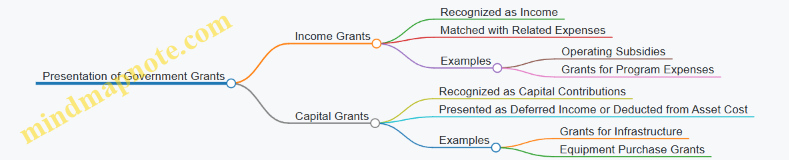
Income Grants
Definition: Grants provided to support operational costs or specific program expenses.
Presentation:
- Recognized as income in the statement of financial performance (income statement).
- Matched with the expenses they are intended to offset, following the matching principle.
Example: A government agency receives a $500,000 grant to fund a community outreach program. The grant is recognized as income over the period the program expenses are incurred.
Best Practice: Maintain detailed schedules linking grant income to related expenses to ensure proper matching and avoid misstatements.
Mind Map: Income Grants Presentation
Capital Grants
Definition: Grants provided to acquire or construct long-term assets such as buildings, infrastructure, or equipment.
Presentation Options:
-
Deferred Income Approach:
- Recognize the grant as deferred income (liability) on the balance sheet.
- Amortize the income to the statement of financial performance over the useful life of the related asset.
-
Deduction from Asset Cost:
- Reduce the carrying amount of the asset by the grant amount.
- Depreciation is charged on the net amount.
Example: A city government receives a $2 million grant to build a new public library. The grant is recorded as deferred income and amortized over the 40-year useful life of the library building.
Best Practice: Choose a consistent presentation policy and disclose it clearly in the notes to the financial statements.
Mind Map: Capital Grants Presentation

Integrated Example: Income vs. Capital Grant Presentation
Scenario: A government financial manager oversees two grants:
- A $300,000 grant to fund staff salaries for a social welfare program (income grant).
- A $1 million grant to purchase new firefighting equipment (capital grant).
Accounting Treatment:
- The $300,000 is recognized as income in the period when salaries are paid, matching the expense.
- The $1 million grant is recorded as deferred income and amortized over the equipment’s 10-year useful life.
Financial Statement Impact:
- Income Statement shows $300,000 grant income matching salary expenses.
- Balance Sheet shows deferred income liability of $1 million initially, reducing over 10 years.
Summary
| Aspect | Income Grants | Capital Grants |
|---|---|---|
| Purpose | Support operational/program expenses | Fund acquisition/construction of assets |
| Financial Statement | Recognized as income | Deferred income or deduction from asset cost |
| Matching Principle | Yes, matched with related expenses | Amortized over asset’s useful life |
| Examples | Program subsidies, operational costs | Infrastructure, equipment grants |
| Best Practices | Detailed tracking, periodic recognition | Consistent policy, clear disclosures |
By carefully distinguishing between income and capital grants and presenting them appropriately, government accountants and financial managers can ensure compliance, enhance transparency, and provide meaningful financial information to stakeholders.
4.2 Disclosure Requirements Under IFRS and Government Accounting Standards
Accounting for government grants requires transparent and comprehensive disclosure to ensure stakeholders understand the nature, extent, and impact of grants on financial statements. Both IFRS and various government accounting standards provide specific requirements to guide these disclosures.
Key Disclosure Requirements Under IFRS (IAS 20)
- Nature and Extent of Grants Recognized: Entities must disclose the types of government grants received and their significance to the financial statements.
- Accounting Policy: Clear explanation of the accounting policies adopted for government grants, including the methods of recognition and measurement.
- Unfulfilled Conditions: Details of any unfulfilled conditions or contingencies attached to government grants that have not been recognized.
- Grant Income Presentation: How grant income is presented in the financial statements (e.g., deducted from related expenses or shown separately).
Government Accounting Standards Disclosure Requirements
Government accounting standards, such as GASB (Governmental Accounting Standards Board) in the U.S. or IPSAS (International Public Sector Accounting Standards), emphasize:
- Grant Source and Purpose: Disclosure of the source of grants and the intended purpose or program supported.
- Restrictions and Conditions: Information on any restrictions or conditions attached to the grants.
- Grant Revenue Recognition: Timing and basis of recognizing grant revenue.
- Use of Grants: How grants have been utilized during the reporting period.
Mind Map: Disclosure Requirements Overview
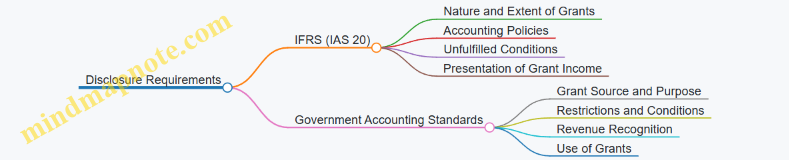
Best Practice: Integrating Disclosures into Financial Statements
- Use clear, concise language avoiding technical jargon.
- Provide quantitative data alongside qualitative explanations.
- Include tables summarizing grants received, recognized income, and unfulfilled conditions.
- Cross-reference disclosures with notes on related assets or expenses.
Practical Example 1: IFRS-Compliant Disclosure in a Government Agency Annual Report
Note X: Government Grants
During the year, the agency received government grants totaling $5 million, primarily to support infrastructure development and community programs. Grants are recognized when there is reasonable assurance that the agency will comply with the conditions attached and the grants will be received.
| Grant Type | Amount Received | Amount Recognized | Unfulfilled Conditions |
|---|---|---|---|
| Infrastructure Grant | $3,000,000 | $2,500,000 | $500,000 |
| Community Program | $2,000,000 | $2,000,000 | $0 |
The agency presents grant income as a separate line item in the statement of comprehensive income.
Mind Map: Example Disclosure Structure
Practical Example 2: GASB Disclosure for a City Government
Note 8: Government Grants and Contributions
The City received several grants from federal and state governments during the fiscal year 2023, amounting to $12 million. These grants are restricted for specific purposes including public safety, transportation, and environmental projects.
The City recognizes grant revenue when eligibility requirements are met. As of year-end, $1.2 million of grant funds remain unspent and are reported as deferred inflows of resources.
| Grant Program | Amount Received | Recognized Revenue | Deferred Inflows |
|---|---|---|---|
| Public Safety | $4,000,000 | $3,800,000 | $200,000 |
| Transportation | $5,000,000 | $4,700,000 | $300,000 |
| Environmental | $3,000,000 | $3,000,000 | $0 |
Mind Map: GASB Disclosure Elements
Summary
Proper disclosure under IFRS and government accounting standards enhances transparency and accountability in the use of government grants. By clearly communicating the nature, extent, conditions, and financial impact of grants, accountants and financial managers help stakeholders make informed decisions and maintain trust.
Additional Tips
- Regularly review updates to IFRS and local government accounting standards.
- Collaborate with auditors to ensure disclosures meet compliance requirements.
- Use visual aids like tables and mind maps in reports to improve clarity.
4.3 Best Practice: Transparent Reporting to Stakeholders
Transparent reporting is essential in government grant accounting to build trust, ensure accountability, and facilitate informed decision-making among stakeholders such as government officials, auditors, taxpayers, and grantors. This section explores best practices for transparent reporting, supported by clear examples and mind maps to visualize key concepts.
Why Transparent Reporting Matters
- Enhances credibility and public trust.
- Ensures compliance with regulatory requirements.
- Facilitates effective monitoring and evaluation of grant usage.
- Helps prevent misuse or misallocation of funds.
Key Elements of Transparent Reporting
-
Clear Disclosure
- Clearly state the nature, amount, and purpose of each government grant.
- Disclose any conditions or restrictions attached to the grant.
-
Timely Reporting
- Provide reports aligned with financial periods (quarterly, annually).
- Ensure stakeholders receive information promptly to support decision-making.
-
Consistent Presentation
- Use standardized formats and terminology.
- Maintain consistency across reports to enable comparability.
-
Detailed Notes
- Include explanatory notes on accounting policies, measurement methods, and any changes.
- Highlight significant judgments or estimates related to grants.
-
Stakeholder Communication
- Tailor reports to the needs of different stakeholders.
- Use accessible language and visual aids where appropriate.
Mind Map: Components of Transparent Reporting
Practical Example 1: Disclosing a Multi-Year Grant in Annual Reports
Scenario: A government agency receives a $5 million multi-year grant for environmental conservation.
Best Practice Reporting:
- Income Statement: Recognize grant income proportionally over the grant period.
- Balance Sheet: Present any unspent grant funds as deferred income or liabilities.
- Notes to Financial Statements: Describe the grant’s purpose, duration, conditions, and recognition policy.
- Supplementary Report: Include performance indicators such as hectares conserved or projects completed.
Outcome: Stakeholders can clearly see how the grant funds are being utilized over time and the agency’s progress toward objectives.
Mind Map: Example Reporting Structure for Multi-Year Grant
Practical Example 2: Transparent Reporting in a Local Government Grant
Scenario: A city government receives a grant to upgrade public transportation infrastructure.
Best Practice Reporting:
- Clear Disclosure: Report the grant amount and specify that funds are restricted to transportation projects.
- Timely Updates: Provide quarterly progress reports to the city council and public.
- Consistent Presentation: Use the same reporting format each quarter to track spending and progress.
- Detailed Notes: Explain any delays or changes in project scope affecting grant usage.
Outcome: The public and oversight bodies remain informed, reducing the risk of mismanagement and increasing support for the project.
Mind Map: Stakeholder-Focused Reporting Approach
Tips for Implementing Transparent Reporting
- Develop standardized templates for grant reporting.
- Train accounting and finance teams on disclosure requirements.
- Use visual aids like charts and graphs to enhance understanding.
- Establish regular communication channels with stakeholders.
- Incorporate feedback mechanisms to improve reporting quality.
Transparent reporting is not just a regulatory obligation but a strategic tool that strengthens governance and public confidence. By following these best practices, government accountants and financial managers can ensure that grant information is presented clearly, accurately, and comprehensively to all stakeholders.
4.4 Practical Example: Disclosing a Multi-Year Grant in Annual Reports
Disclosing a multi-year government grant in annual financial reports requires clarity, transparency, and adherence to accounting standards such as IFRS or GASB. This section provides a detailed example of how a government entity should present and disclose such grants, supported by mind maps to visualize the process.
Understanding Multi-Year Grants
Multi-year grants are funds provided by the government that span multiple fiscal years. Proper disclosure involves:
- Recognizing the grant income over the period it relates to
- Presenting the grant in financial statements appropriately
- Providing detailed notes explaining the nature, conditions, and timing of the grant
Mind Map: Key Disclosure Elements for Multi-Year Grants
Example Scenario
Entity: City Public Health Department
Grant: Multi-Year Public Health Improvement Grant
Grant Details:
- Total Amount: $5,000,000
- Duration: 5 years (2022-2026)
- Purpose: Enhance community health services and infrastructure
- Conditions: Annual performance targets and expenditure restrictions
Step 1: Recognition of Grant Income
The department recognizes grant income on a systematic basis over the grant period, matching the expenses incurred. For example:
| Year | Grant Income Recognized | Expenses Incurred |
|---|---|---|
| 2022 | $1,000,000 | $950,000 |
| 2023 | $1,000,000 | $1,050,000 |
| 2024 | $1,000,000 | $1,000,000 |
| 2025 | $1,000,000 | $1,000,000 |
| 2026 | $1,000,000 | $1,000,000 |
Step 2: Presentation in Financial Statements
- Statement of Financial Position: Any unspent grant funds at year-end are reported as deferred income (liability) or grant receivable (asset).
- Statement of Activities: Grant income is presented separately or disclosed in notes to show the contribution from government grants.
Mind Map: Financial Statement Presentation
Step 3: Notes to Financial Statements Example
Note X: Government Grants
The City Public Health Department has been awarded a multi-year grant totaling $5,000,000 from the State Health Agency to support community health services from 2022 through 2026. The grant is recognized on a systematic basis over the grant period to match related expenses.
As of December 31, 2023, the department has recognized $2,000,000 in grant income and incurred $2,000,000 in related expenses. Unspent grant funds amounting to $500,000 are recorded as deferred income.
The grant is subject to annual performance targets and expenditure restrictions. Management monitors compliance through internal controls and regular reporting to the grantor.
Step 4: Best Practices Summary
- Clearly identify the grant and its terms in disclosures.
- Recognize income systematically over the grant period.
- Present unspent funds appropriately as liabilities or assets.
- Provide detailed notes explaining conditions, restrictions, and compliance.
- Use visuals such as tables and mind maps to enhance clarity.
This practical example demonstrates how government financial managers and accountants can effectively disclose multi-year grants, ensuring transparency and compliance with accounting standards while providing stakeholders with a clear understanding of the grant’s financial impact.
4.5 Case Study: Presentation Differences in Various Government Entities
Government entities vary widely in their structure, reporting requirements, and stakeholder expectations. These differences significantly impact how government grants are presented in their financial statements. This case study explores presentation variations across three common types of government entities: Central Government, Local Government, and Government Agencies.
Mind Map: Factors Influencing Presentation of Government Grants
Central Government Presentation
Context: Central governments typically follow IPSAS or similar international standards and often have complex, multi-source grants.
Presentation Approach:
- Grants are often presented separately in the Statement of Financial Performance (Income Statement) as either “Government Grants” or under a specific line item such as “Grants and Subsidies Received.”
- Capital grants related to assets are recognized as deferred income and amortized over the useful life of the asset.
- Detailed disclosures include grant conditions, unfulfilled obligations, and multi-year commitments.
Example: The Ministry of Infrastructure receives a $100 million capital grant for highway construction.
- The grant is initially recorded as deferred income on the balance sheet.
- Each year, amortization of the grant income is recognized corresponding to the depreciation expense of the constructed highway.
- Notes disclose the grant’s purpose, conditions, and expected completion timeline.
Local Government Presentation
Context: Local governments often follow GASB or national public sector accounting standards, with a focus on transparency to local taxpayers.
Presentation Approach:
- Grants are usually reported in the governmental funds financial statements as “Intergovernmental Revenues.”
- Capital grants may be reported as revenue when the related capital asset is acquired or constructed.
- Emphasis on fund accounting means grants are often segregated by fund to show restricted vs. unrestricted usage.
Example: A city government receives a $5 million grant for park renovation.
- The grant is recorded as revenue in the Capital Projects Fund when the funds are available and spent.
- The financial statements include a schedule of grant revenues and expenditures by fund.
- Notes highlight restrictions on grant use and any unspent balances.
Government Agencies Presentation
Context: Agencies may have hybrid reporting requirements, sometimes following accrual accounting but with specific donor or grantor-imposed presentation rules.
Presentation Approach:
- Grants are often presented as “Grant Income” or “Contributions” in the Statement of Activities.
- Conditional grants are disclosed separately, with recognition deferred until conditions are met.
- Agencies may provide segmented reporting to satisfy multiple stakeholders.
Example: A public health agency receives a $2 million grant conditioned on achieving vaccination targets.
- The grant is recognized as income only when vaccination milestones are met.
- The agency discloses the unfulfilled conditions and potential repayment obligations.
- A segmented report shows grant income by program area.
Mind Map: Presentation Elements by Entity Type
Key Takeaways
- Entity type drives presentation: Central governments emphasize accrual and amortization, local governments focus on fund accounting and transparency, agencies prioritize conditional recognition and segmented reporting.
- Disclosure requirements vary: More complex entities provide detailed notes on conditions and multi-year commitments.
- Examples help illustrate: Real-world grants show how accounting policies translate into financial statement presentation.
Practical Exercise
Consider a $10 million grant received by each entity type for similar infrastructure projects. Draft a brief presentation outline for each entity’s financial statements, highlighting differences in recognition, presentation, and disclosure.
This case study demonstrates the importance of tailoring grant presentation to the entity’s accounting framework, stakeholder needs, and grant conditions to ensure clarity, compliance, and transparency.
5. Accounting Treatment for Different Types of Grants
5.1 Grants Related to Assets: Recognition and Amortization
Government grants related to assets are funds provided to acquire, construct, or improve long-term assets such as buildings, infrastructure, equipment, or land. Proper accounting treatment ensures that these grants are recognized accurately and amortized systematically over the useful life of the related asset.
Key Concepts
- Recognition: The grant should be recognized when there is reasonable assurance that the entity will comply with the conditions attached and the grant will be received.
- Presentation: Grants related to assets can be presented either by deducting the grant from the carrying amount of the asset or by recognizing it as deferred income.
- Amortization: If recognized as deferred income, the grant is amortized to profit or loss over the asset’s useful life, matching the depreciation expense.
Mind Map: Grants Related to Assets
Recognition Approaches
-
Deducting from Asset Carrying Amount
- The grant reduces the asset’s book value.
- Depreciation is charged on the net amount.
-
Deferred Income Approach
- Grant recognized as a liability (deferred income).
- Amortized to income statement over asset’s life.
Practical Example 1: Deducting Grant from Asset
A government agency receives a $500,000 grant to purchase new IT equipment costing $2,000,000. The equipment has a useful life of 5 years.
-
Accounting treatment:
- Asset recorded at $1,500,000 ($2,000,000 - $500,000).
- Annual depreciation = $1,500,000 / 5 = $300,000.
-
Journal entries:
- On purchase:
- Dr Equipment $2,000,000
- Cr Cash/Payables $1,500,000
- Cr Government Grant (deferred income) $500,000 (if using deferred income approach)
- If deducting grant from asset, credit Government Grant is not recorded separately.
- On purchase:
Practical Example 2: Deferred Income Approach
Using the same example, if the grant is recognized as deferred income:
-
Initial recognition:
- Dr Equipment $2,000,000
- Cr Cash/Payables $1,500,000
- Cr Deferred Government Grant $500,000
-
Annual amortization:
- Dr Deferred Government Grant $100,000 ($500,000 / 5 years)
- Cr Other Income $100,000
-
Depreciation expense:
- Dr Depreciation Expense $400,000 ($2,000,000 / 5 years)
- Cr Accumulated Depreciation $400,000
This method keeps the asset at full cost but recognizes the grant income over the asset’s life.
Mind Map: Amortization Process
Best Practices
- Consistent Policy: Choose one presentation method and apply consistently across similar grants.
- Documentation: Maintain detailed records of grant agreements, conditions, and asset details.
- Review Useful Life: Periodically reassess asset useful life and adjust amortization accordingly.
- Internal Controls: Ensure controls are in place to track grant receipts and related asset accounting.
Summary
Accounting for government grants related to assets requires careful recognition, presentation, and amortization to reflect the economic reality. Whether reducing the asset’s carrying amount or recognizing deferred income, the key is to match the grant income with the asset’s depreciation to provide transparent and accurate financial reporting.
5.2 Grants Related to Income: Matching Income with Expenses
Government grants related to income are financial awards provided to support the operational expenses of an entity, rather than the acquisition or construction of fixed assets. The key accounting principle here is to match the grant income with the related expenses to reflect a true and fair view of the financial performance during the reporting period.
Understanding Income-Related Grants
Income-related grants are typically intended to subsidize costs such as salaries, research expenses, or program delivery costs. These grants are recognized as income over the periods necessary to match them with the related costs that they are intended to compensate.
Best Practice: Matching Principle
The matching principle requires that grant income should be recognized in the same period as the expenses it is meant to offset. This ensures that financial statements accurately reflect the net cost of operations.
Mind Map: Matching Income-Related Grants with Expenses
Accounting Approaches
-
Deferred Income Approach: The grant is initially recorded as deferred income (liability) and recognized as income systematically over the periods in which the related expenses are incurred.
-
Direct Offset Approach: The grant income is directly offset against the related expenses in the income statement, reducing the expense amount.
The choice between these approaches depends on the accounting framework and organizational policy.
Practical Example 1: Research Grant Matching
Scenario: A government agency awards a $100,000 grant to a university to fund a two-year research project. The university incurs research expenses evenly over the two years.
Accounting Treatment:
- The university records the $100,000 grant as deferred income initially.
- Each year, $50,000 is recognized as income to match the $50,000 research expenses incurred.
Journal Entries:
| Period | Debit | Credit | Description |
|---|---|---|---|
| Year 1 | Cash/Bank | Deferred Income | Receipt of grant |
| Year 1 | Deferred Income | Grant Income | Recognize income matching expenses |
| Year 1 | Research Expense | Cash/Bank | Research costs incurred |
| Year 2 | Deferred Income | Grant Income | Recognize income matching expenses |
| Year 2 | Research Expense | Cash/Bank | Research costs incurred |
Mind Map: Research Grant Accounting Flow
Practical Example 2: Training Program Subsidy
Scenario: A local government receives a $30,000 grant to subsidize employee training costs during the fiscal year.
Accounting Treatment:
- The government directly offsets the grant income against the training expenses.
Journal Entries:
| Debit | Credit | Description |
|---|---|---|
| Training Expense | Cash/Bank | Payment for training services |
| Cash/Bank | Grant Income | Recognition of grant income |
This approach simplifies accounting by reducing the net expense reported.
Mind Map: Direct Offset Approach
Key Considerations and Best Practices
- Detailed Expense Tracking: Maintain granular records of expenses related to the grant to ensure accurate matching.
- Regular Reconciliation: Periodically reconcile deferred income balances with incurred expenses.
- Clear Policies: Establish and document accounting policies for grant income recognition.
- Transparent Disclosure: Disclose the nature, amount, and accounting treatment of grants in financial statements.
Summary
Matching income-related government grants with the corresponding expenses ensures transparency and accuracy in financial reporting. Whether using the deferred income approach or direct offset method, the core principle remains to align income recognition with the period in which expenses are incurred, providing stakeholders with a clear picture of financial performance.
5.3 Grants for Specific Projects vs. General Support Grants
Government grants can broadly be categorized into two types based on their intended use: Grants for Specific Projects and General Support Grants. Understanding the differences between these two types is crucial for accurate accounting, compliance, and financial reporting.
What Are Grants for Specific Projects?
These grants are awarded with explicit conditions that funds must be used for a particular project or purpose. The grantor expects detailed reporting on how the funds are spent and the outcomes achieved.
-
Characteristics:
- Restricted use
- Often tied to deliverables or milestones
- Requires detailed tracking and reporting
- May have performance conditions
-
Example: A government grant awarded to a city council specifically to build a new public library.
What Are General Support Grants?
General support grants provide funding without restrictions on specific projects. They are intended to support the overall operations or mission of the recipient organization.
-
Characteristics:
- Unrestricted use
- Supports general operations or multiple projects
- Less stringent reporting requirements
-
Example: A grant given to a government health department to support ongoing public health programs without specifying particular initiatives.
Mind Map: Comparing Grants for Specific Projects vs. General Support Grants
Accounting Implications
| Aspect | Grants for Specific Projects | General Support Grants |
|---|---|---|
| Recognition | Recognized as income when conditions are met and costs incurred on the project | Recognized as income when received or receivable if unconditional |
| Tracking | Requires separate tracking of funds and expenses | Can be pooled with general funds |
| Reporting | Detailed reporting on project progress and fund usage | Periodic financial reports on overall use |
| Restrictions | Funds must be used only for the specified project | Funds can be used for any organizational purpose |
Best Practices for Accounting
-
For Specific Project Grants:
- Maintain a dedicated ledger or cost center for the project.
- Track all expenses against the grant to ensure compliance.
- Regularly reconcile grant income with project expenditures.
- Prepare detailed reports for grantors highlighting milestones and fund usage.
-
For General Support Grants:
- Record as unrestricted income.
- Use funds flexibly but maintain transparency in financial statements.
- Include grant income in overall operational budgets.
Practical Example 1: Accounting for a Specific Project Grant
Scenario: The Department of Transportation receives a $2 million grant to upgrade traffic signals in a city.
- The grant is restricted to this project.
- Costs are tracked in a dedicated project account.
- Grant income is recognized proportionally as eligible expenses are incurred.
- Monthly reports are submitted to the grantor detailing progress and expenditures.
Accounting Entries:
| Transaction | Debit | Credit |
|---|---|---|
| Receipt of grant funds | Cash $2,000,000 | Deferred Grant Income $2,000,000 |
| Incur expenses on project | Project Expense $500,000 | Cash $500,000 |
| Recognize grant income (matching expenses) | Deferred Grant Income $500,000 | Grant Income $500,000 |
Practical Example 2: Accounting for a General Support Grant
Scenario: The Public Health Department receives a $500,000 grant to support ongoing health initiatives without restrictions.
- The grant is recorded as unrestricted income upon receipt.
- Funds are used across multiple programs.
- Financial statements reflect the grant as part of general operational income.
Accounting Entry:
| Transaction | Debit | Credit |
|---|---|---|
| Receipt of grant funds | Cash $500,000 | Grant Income $500,000 |
Mind Map: Accounting Workflow for Specific vs. General Grants
Summary
Understanding the distinction between grants for specific projects and general support grants is essential for government accountants and financial managers. Proper classification affects recognition, tracking, reporting, and compliance. By applying best practices and using clear examples, organizations can ensure transparency, accountability, and alignment with regulatory requirements.
5.4 Best Practice: Consistent Policy Application Across Departments
In government organizations, multiple departments often receive and manage various government grants simultaneously. Ensuring a consistent application of accounting policies across these departments is critical to maintaining accuracy, transparency, and compliance in financial reporting. This section explores best practices to achieve consistency, supported by practical examples and mind maps to visualize the approach.
Why Consistency Matters
- Uniform Financial Reporting: Consistency ensures that all departments report grant-related transactions uniformly, facilitating consolidated financial statements.
- Compliance Assurance: Adhering to the same policies helps meet regulatory requirements and audit standards.
- Simplified Training and Communication: A single, clear policy framework reduces confusion and errors among accounting staff.
- Improved Internal Controls: Consistent application aids in monitoring and controlling grant usage effectively.
Key Elements of Consistent Policy Application
Steps to Implement Consistent Policies Across Departments
-
Develop a Centralized Grant Accounting Policy Manual
- Compile all relevant accounting standards, regulatory requirements, and organizational rules.
- Include definitions, recognition criteria, measurement methods, and disclosure requirements.
-
Standardize Procedures and Templates
- Create uniform templates for grant recognition, reporting, and reconciliation.
- Ensure all departments use these templates to reduce discrepancies.
-
Conduct Regular Training and Workshops
- Train accounting and financial management staff on the policy manual.
- Use real-life examples to illustrate correct application.
-
Establish Communication Channels
- Set up forums or committees for departments to discuss challenges and share best practices.
-
Implement Monitoring and Review Mechanisms
- Schedule periodic internal audits focusing on grant accounting.
- Perform cross-departmental reviews to identify inconsistencies.
-
Update Policies Based on Feedback and Regulatory Changes
- Maintain a dynamic policy manual that evolves with new standards or organizational needs.
Practical Example: Consistent Policy Application in a State Government
Scenario: The Department of Health and the Department of Education both receive grants for community outreach programs. Previously, each department recognized and reported these grants differently, causing confusion during consolidated financial reporting.
Solution:
- The State Finance Office developed a centralized policy manual outlining:
- Recognition criteria (e.g., when grant conditions are met)
- Measurement approaches (e.g., fair value at initial recognition)
- Presentation formats (e.g., separate line items for capital vs. revenue grants)
- Both departments adopted standardized reporting templates.
- Joint training sessions were held to ensure understanding.
- Quarterly cross-departmental reviews were instituted.
Outcome:
- Financial reports became more consistent and reliable.
- Audit findings related to grant accounting decreased significantly.
- Enhanced transparency improved stakeholder confidence.
Mind Map: Implementation Workflow
Additional Example: Handling Multi-Department Grants
Context: A federal grant aimed at environmental conservation is allocated to both the Department of Natural Resources and the Department of Public Works.
Challenge: Different interpretations of grant conditions led to inconsistent expense recognition.
Best Practice Application:
- The finance office issued a joint memo clarifying the accounting treatment.
- Both departments used a shared ledger system with predefined coding for grant transactions.
- Monthly reconciliation meetings ensured alignment.
Result:
- Harmonized accounting entries across departments.
- Simplified audit process with clear trail of transactions.
Summary
Consistent policy application across departments is foundational for effective government grant accounting. By developing centralized policies, standardizing procedures, fostering communication, and implementing robust monitoring, government financial managers can ensure accuracy, compliance, and transparency.
This approach not only simplifies internal processes but also strengthens external stakeholder trust through reliable financial reporting.
5.5 Practical Example: Accounting for a Grant Supporting Public Health Initiatives
Scenario Overview
A government health department receives a grant of $2 million to support a public health initiative aimed at improving vaccination rates across several regions. The grant is intended to cover both capital expenditures (such as purchasing medical equipment) and operational expenses (such as community outreach programs and staff salaries).
Step 1: Identify Grant Components
- Capital Grant Component: $1.2 million for purchasing vaccination equipment and setting up mobile clinics.
- Revenue Grant Component: $800,000 for operational costs including salaries, training, and outreach activities.
Mind Map: Grant Components Breakdown
Step 2: Recognition and Measurement
- Capital Grant: Recognized as deferred income and amortized over the useful life of the related assets (e.g., 5 years).
- Revenue Grant: Recognized in the income statement on a systematic basis matching the related expenses.
Mind Map: Recognition and Measurement
Step 3: Accounting Entries
| Transaction Description | Debit Account | Credit Account | Amount |
|---|---|---|---|
| Receipt of Grant Funds | Cash | Deferred Income (Capital) | $1,200,000 |
| Receipt of Grant Funds | Cash | Grant Income (Revenue) | $800,000 |
| Purchase of Medical Equipment | Medical Equipment Asset | Cash | $1,200,000 |
| Amortization of Capital Grant (Year 1) | Deferred Income | Grant Income | $240,000 |
| Operational Expenses (Salaries, Outreach) | Operational Expenses | Cash | $800,000 |
Step 4: Presentation and Disclosure
- Balance Sheet: Medical equipment recorded as an asset; deferred income shown as a liability.
- Income Statement: Grant income recognized systematically; operational expenses matched accordingly.
- Notes: Disclose grant terms, amortization policy, and any conditions attached.
Mind Map: Presentation and Disclosure
Step 5: Best Practices Illustrated
- Segregate Grant Components: Clearly separate capital and revenue portions to ensure accurate accounting.
- Match Income and Expenses: Recognize revenue grants in the same period as the related expenses.
- Maintain Documentation: Keep detailed records of grant agreements, asset purchases, and amortization schedules.
- Regular Monitoring: Track grant conditions and compliance requirements to avoid repayment risks.
Mind Map: Best Practices
Summary
This example demonstrates how a government grant supporting public health initiatives should be accounted for by separating capital and revenue components, recognizing income systematically, and ensuring transparent presentation and disclosure. Following these steps helps government financial managers maintain compliance and provide clear financial reporting.
Additional Example: Handling Conditional Grants
If the grant had a condition requiring vaccination targets to be met before full recognition, the revenue portion would be recognized only when those conditions are satisfied, with unfulfilled amounts recorded as liabilities.
Mind Map: Conditional Grant Handling
This approach ensures compliance with accounting standards and provides stakeholders with an accurate financial picture.
6. Handling Conditional Grants and Performance Obligations
6.1 Identifying Conditions and Performance Requirements
Government grants often come with specific conditions and performance requirements that recipients must meet to retain the funding. Proper identification and understanding of these conditions are critical for accurate accounting and compliance.
What Are Conditions and Performance Requirements?
- Conditions: These are stipulations set by the grantor that the recipient must fulfill. Failure to meet them may result in repayment or penalties.
- Performance Requirements: These are measurable outcomes or milestones that the recipient must achieve as part of the grant agreement.
Why Identifying Conditions Matters
- Ensures compliance with grant terms.
- Determines the timing and recognition of grant income.
- Helps avoid financial penalties or clawbacks.
Mind Map: Key Elements of Conditions and Performance Requirements
Types of Conditions Explained
- Legal Conditions: Compliance with laws and regulations (e.g., environmental laws).
- Financial Conditions: Restrictions on how funds are used (e.g., funds must be spent on specific projects).
- Operational Conditions: Requirements related to project execution (e.g., hiring a minimum number of staff).
Mind Map: Examples of Performance Requirements
Practical Examples
Example 1: Employment Creation Grant
- Condition: Recipient must create 50 new jobs within 12 months.
- Performance Requirement: Submit quarterly reports showing progress.
- Accounting Implication: Grant income recognized only as jobs are verified.
Example 2: Infrastructure Development Grant
- Condition: Funds must be used exclusively for road construction.
- Performance Requirement: Completion of phases within specified timelines.
- Accounting Implication: Capitalize grant as asset; recognize income proportionally as construction progresses.
Example 3: Research Grant
- Condition: Research findings must be published.
- Performance Requirement: Submit final report and publications.
- Accounting Implication: Defer recognition until deliverables are submitted.
Best Practices for Identifying Conditions and Performance Requirements
- Thoroughly Review Grant Agreements: Highlight all conditions and performance clauses.
- Engage Legal and Compliance Teams: To interpret complex conditions.
- Maintain Detailed Documentation: Keep records of all communications and compliance evidence.
- Implement Monitoring Systems: Track progress against performance metrics.
- Train Staff: Ensure understanding of grant obligations across departments.
Mind Map: Steps to Identify Conditions and Performance Requirements
By systematically identifying and understanding the conditions and performance requirements attached to government grants, accountants and financial managers can ensure accurate recognition, maintain compliance, and support successful grant management.
6.2 Accounting for Fulfillment and Non-fulfillment of Conditions
Government grants often come with specific conditions or performance obligations that recipients must fulfill to retain the grant benefits. Proper accounting treatment depends on whether these conditions are met or not. This section explores how to account for both fulfillment and non-fulfillment of such conditions, supported by practical examples and mind maps to clarify the concepts.
Understanding Conditions and Performance Obligations
Conditions attached to government grants typically require the recipient to:
- Achieve specific milestones or outcomes
- Use funds for designated purposes
- Report progress periodically
- Maintain compliance with legal or regulatory requirements
Failure to meet these conditions may result in partial or full repayment of the grant or other penalties.
Mind Map: Key Concepts in Accounting for Grant Conditions
Accounting Treatment When Conditions Are Fulfilled
When the recipient meets the grant conditions, the grant can be recognized as income or offset against related expenses or asset costs, depending on the nature of the grant.
Best Practices:
- Maintain detailed documentation proving fulfillment.
- Recognize income systematically as conditions are met.
- Ensure disclosures clearly describe the nature of conditions and fulfillment status.
Example: A government agency receives a $500,000 grant to improve public parks, with the condition that all funds must be spent within two years on park renovations.
- As the agency incurs eligible expenses, it recognizes grant income proportionally.
- Upon completing renovations and submitting required reports, the agency confirms fulfillment.
- The grant income is fully recognized in the financial statements.
Accounting Treatment When Conditions Are Not Fulfilled
If conditions are not met, the recipient may need to:
- Reverse previously recognized grant income.
- Recognize a liability for amounts repayable.
- Disclose the nature and potential impact of non-fulfillment.
Best Practices:
- Regularly review compliance status.
- Establish provisions or contingent liabilities where repayment is probable.
- Communicate promptly with grantors to negotiate terms if possible.
Example: A government department receives a $200,000 grant to create 50 new jobs within 12 months. After the period, only 30 jobs were created.
- The department assesses the shortfall.
- It recognizes a liability for the portion of the grant related to unmet job creation (e.g., 40% of the grant).
- The previously recognized income is adjusted accordingly.
- Disclosures explain the non-fulfillment and potential repayment.
Mind Map: Accounting Workflow for Grant Conditions
Practical Tips for Accountants and Financial Managers
- Establish clear tracking systems: Use project management tools to monitor condition fulfillment.
- Maintain open communication: Regularly update grantors on progress and challenges.
- Document everything: Keep detailed records to support accounting decisions.
- Review grant agreements carefully: Understand all conditions and implications.
- Consult auditors early: Engage with auditors to ensure compliance with accounting standards.
Summary
Accounting for the fulfillment and non-fulfillment of government grant conditions requires careful assessment, documentation, and transparent reporting. Recognizing income only when conditions are met and appropriately accounting for potential repayments ensures compliance and financial statement accuracy.
6.3 Best Practice: Monitoring and Reporting on Grant Conditions
Effective monitoring and reporting on grant conditions are critical to ensure compliance, maintain transparency, and secure future funding. Government grants often come with specific conditions and performance obligations that must be tracked meticulously. Failure to comply can lead to penalties, repayment demands, or loss of funding.
Key Components of Monitoring and Reporting on Grant Conditions
- Understanding Grant Conditions: Clearly identify all terms, conditions, and performance metrics stipulated in the grant agreement.
- Establishing Monitoring Systems: Implement systems to track progress against conditions in real time.
- Regular Reporting: Prepare timely and accurate reports for internal stakeholders and grantors.
- Documentation and Audit Trails: Maintain comprehensive records to support compliance and facilitate audits.
- Corrective Actions: Develop processes to address any deviations or non-compliance promptly.
Mind Map: Monitoring and Reporting on Grant Conditions
Practical Example 1: Monitoring Employment Creation Condition
A government grant awarded to a local agency requires the creation of 50 new jobs within 12 months. To monitor this:
- The agency sets up a monthly tracking system within their HR software to record new hires.
- A designated grant manager reviews monthly reports to ensure targets are on track.
- Quarterly reports are prepared and submitted to the grantor detailing the number of jobs created.
- If the target is not met by month 9, the agency develops a corrective action plan, such as increasing recruitment efforts, and communicates this to the grantor.
Mind Map: Employment Creation Condition Monitoring
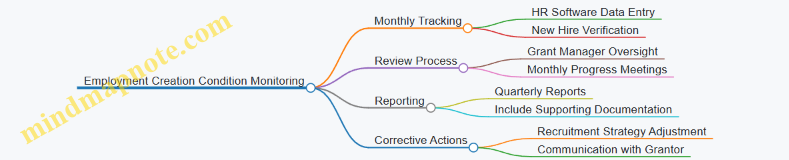
Practical Example 2: Reporting on Infrastructure Grant Usage
A municipality receives a grant to build a community center with strict budget and timeline conditions.
- Project managers use project management software to track expenditures and milestones.
- Financial accountants reconcile grant funds monthly to ensure spending aligns with budget conditions.
- Monthly progress reports include narrative updates, financial summaries, and photos of construction progress.
- Any delays or budget overruns are flagged immediately, and mitigation plans are submitted to the grantor.
Mind Map: Infrastructure Grant Reporting
Additional Best Practices
- Centralize Grant Information: Use a centralized database or software platform to consolidate all grant-related data.
- Assign Clear Roles: Designate specific staff members responsible for monitoring, reporting, and compliance.
- Train Staff Regularly: Provide ongoing training on grant conditions and reporting requirements.
- Automate Where Possible: Utilize automated alerts for upcoming deadlines and condition milestones.
- Engage with Grantors: Maintain open communication channels to clarify expectations and report challenges promptly.
By integrating these best practices, accountants and government financial managers can ensure robust monitoring and reporting on grant conditions, safeguarding compliance and fostering trust with grant providers.
6.4 Practical Example: Managing a Grant with Employment Creation Conditions
Managing government grants that include employment creation conditions requires careful tracking, documentation, and accounting to ensure compliance and proper recognition of the grant. This section provides a detailed example, supported by mind maps, to illustrate best practices.
Scenario Overview
A government agency receives a $500,000 grant aimed at stimulating local employment. The grant conditions require the creation of at least 50 new full-time jobs within 12 months. The grant is conditional upon meeting this employment target, and failure to meet it could result in partial or full repayment.
Step 1: Understanding the Grant Conditions
- Grant Amount: $500,000
- Condition: Create 50 new full-time jobs within 12 months
- Consequences: Repayment if conditions are not met
Mind Map: Understanding Grant Conditions
Step 2: Setting Up Internal Controls and Monitoring
To manage this grant effectively, the agency establishes internal controls:
- Monthly tracking of new hires
- Verification of employment status (full-time, duration)
- Documentation of payroll records
- Regular reporting to finance and grant management teams
Mind Map: Internal Controls for Employment Condition
Step 3: Accounting Treatment
Initial Recognition:
- The grant is recognized as a conditional grant and initially not recognized as income until the employment condition is met.
Progress Recognition:
- As jobs are created and verified, a proportionate amount of the grant can be recognized as income.
Example Calculation:
- After 6 months, 30 jobs have been created (60% of target).
- Recognize 60% of $500,000 = $300,000 as grant income.
Journal Entries:
| Date | Account | Debit | Credit |
|---|---|---|---|
| Month 6 | Grant Receivable | $300,000 | |
| Month 6 | Grant Income | $300,000 |
Mind Map: Accounting Treatment
Step 4: Handling Non-Compliance
If the agency fails to meet the target (e.g., only 40 jobs created), it must:
- Calculate the proportionate grant amount to be recognized (40/50 = 80%)
- Return or repay the unearned portion ($500,000 - $400,000 = $100,000)
- Adjust financial statements accordingly
Example Journal Entry for Repayment:
| Date | Account | Debit | Credit |
|---|---|---|---|
| Month 12 | Grant Income | $100,000 | |
| Month 12 | Cash/Bank | $100,000 |
Mind Map: Handling Non-Compliance
Step 5: Reporting and Disclosure
- Clearly disclose the nature of the grant and conditions in financial statements.
- Report progress and any contingencies related to employment conditions.
- Maintain transparency with stakeholders.
Mind Map: Reporting and Disclosure
Summary
Managing a government grant with employment creation conditions involves:
- Careful understanding of grant terms
- Establishing robust internal controls
- Recognizing income proportionate to condition fulfillment
- Handling repayments if conditions are unmet
- Transparent reporting and disclosure
This example demonstrates how accountants and government financial managers can apply best practices to ensure compliance and accurate financial reporting.
7. Internal Controls and Compliance for Government Grants
7.1 Designing Internal Controls for Grant Accounting
Effective internal controls are essential to ensure the accuracy, compliance, and integrity of government grant accounting. Designing robust internal controls helps prevent errors, fraud, and mismanagement of funds, while ensuring that grant conditions and reporting requirements are met.
Key Objectives of Internal Controls in Grant Accounting
- Ensure proper authorization and approval of grant-related transactions
- Maintain accurate and complete records of grant funds
- Safeguard grant assets from misuse or theft
- Ensure compliance with grant terms, conditions, and regulatory requirements
- Facilitate timely and accurate financial reporting
Mind Map: Components of Internal Controls for Grant Accounting
Best Practices for Designing Internal Controls
-
Establish Clear Policies and Procedures
- Develop a comprehensive grant management policy manual.
- Define roles and responsibilities clearly.
-
Segregate Duties to Reduce Risk
- Ensure no single individual controls all aspects of grant transactions.
- Example: One person authorizes expenses, another processes payments, and a third performs reconciliations.
-
Implement Authorization Controls
- Require multi-level approvals for grant expenditures above certain thresholds.
- Example: Expenses over $5,000 require both department head and finance manager approval.
-
Maintain Detailed Documentation
- Retain copies of grant agreements, invoices, receipts, and correspondence.
- Example: Use a centralized digital repository with indexed grant documents.
-
Regular Monitoring and Auditing
- Schedule periodic internal audits focusing on grant compliance.
- Use checklists to verify adherence to grant conditions.
-
Use Technology to Enhance Controls
- Integrate grant accounting modules into ERP systems.
- Employ automated alerts for budget overruns or approaching deadlines.
-
Train Staff Continuously
- Conduct workshops on grant compliance and accounting standards.
- Update teams on changes in regulations or internal policies.
Practical Example: Designing Internal Controls for a Public Health Grant
Scenario: A government health department receives a $2 million grant to fund vaccination programs.
- Authorization: Only the grant manager and finance director can approve expenditures.
- Segregation of Duties:
- Grant manager requests purchases.
- Procurement team processes orders.
- Finance team processes payments.
- Internal audit reviews monthly transactions.
- Documentation: All purchase orders, delivery receipts, and payment vouchers are scanned and stored in a shared drive.
- Monitoring: Monthly reconciliation of grant expenditures against budget.
- Reporting: Quarterly financial reports submitted to the grantor with supporting schedules.
- Training: Staff attend quarterly sessions on grant compliance and fraud prevention.
This control design ensures transparency, accountability, and compliance with grant requirements.
Mind Map: Example Control Flow for Grant Expenditure Approval
By embedding these internal controls into the grant accounting process, government financial managers and accountants can significantly reduce risks and improve the reliability of financial information related to government grants.
7.2 Compliance Monitoring and Audit Trails
Effective compliance monitoring and maintaining robust audit trails are critical components in the accounting for government grants. These practices ensure transparency, accountability, and adherence to grant conditions, helping government financial managers and accountants mitigate risks of non-compliance and potential financial penalties.
What is Compliance Monitoring?
Compliance monitoring involves ongoing activities to ensure that all grant-related transactions and activities comply with applicable laws, regulations, and grant agreements.
What are Audit Trails?
Audit trails are detailed records that chronologically document the sequence of activities and transactions related to the grant. They provide evidence for internal and external audits.
Key Components of Compliance Monitoring and Audit Trails
Best Practices for Compliance Monitoring
-
Establish Clear Policies and Procedures
- Define roles and responsibilities for monitoring compliance.
- Develop checklists aligned with grant terms.
-
Regular Transaction Reviews
- Periodically verify that expenditures align with approved budgets.
- Cross-check invoices and receipts against grant conditions.
-
Use Automated Monitoring Tools
- Implement ERP modules that flag non-compliant transactions.
- Set up alerts for approaching deadlines or unusual spending patterns.
-
Training and Awareness
- Conduct regular training sessions for staff on compliance requirements.
-
Document Everything
- Maintain detailed records of all grant-related decisions and transactions.
Best Practices for Audit Trails
-
Comprehensive Record-Keeping
- Capture all relevant data: dates, amounts, authorizations, and supporting documents.
-
Secure and Controlled Access
- Restrict access to financial systems to authorized personnel only.
- Use role-based permissions.
-
Change Management Logs
- Record any changes made to grant-related data, including who made the change and why.
-
Regular Audit Reviews
- Conduct internal audits to verify the integrity of audit trails.
-
Retention Policies
- Define how long records should be kept in compliance with legal and grant requirements.
Example: Compliance Monitoring in a Government Health Grant
Scenario: A government agency receives a grant to improve community health services. The grant requires quarterly financial reporting and restricts spending to specific categories.
- The finance team sets up automated alerts in their ERP system to flag any expenses outside approved categories.
- Monthly reviews are conducted to verify that all expenditures have corresponding invoices and approvals.
- A compliance checklist is used to ensure all grant conditions are met before submitting quarterly reports.
- All transactions are logged with timestamps, user IDs, and supporting documents stored digitally.
Example: Audit Trail in a Municipal Infrastructure Grant
Scenario: A city receives a grant for road repairs. The grant requires detailed documentation of all purchases and contractor payments.
- Each payment is recorded in the accounting system with scanned copies of contracts, invoices, and payment authorizations.
- Access to the payment module is restricted to the finance manager and grant coordinator.
- Any changes to payment records trigger an automatic audit log entry.
- During an external audit, the city easily provides a chronological trail of all grant-related transactions, demonstrating compliance.
Mind Map: Steps to Implement Effective Compliance Monitoring and Audit Trails
Summary
Compliance monitoring and audit trails form the backbone of trustworthy government grant accounting. By implementing structured processes, leveraging technology, and fostering a culture of accountability, government financial managers and accountants can ensure grants are managed effectively and transparently.
For further reading, consider exploring sections 7.1 (Designing Internal Controls) and 10.4 (Best Practice: Continuous Training and Knowledge Sharing) to complement your understanding of compliance and audit processes.
7.3 Best Practice: Integrating Grant Accounting into Enterprise Resource Planning (ERP) Systems
Integrating grant accounting into an Enterprise Resource Planning (ERP) system is a best practice that enhances accuracy, efficiency, and compliance in managing government grants. ERP systems provide a centralized platform to track, monitor, and report grant-related financial activities, ensuring transparency and accountability.
Why Integrate Grant Accounting into ERP?
- Centralized Data Management: Consolidates all grant-related financial data in one system.
- Improved Accuracy: Reduces manual errors through automation.
- Real-Time Reporting: Enables timely insights into grant utilization and compliance.
- Compliance and Audit Readiness: Facilitates adherence to regulatory requirements and simplifies audits.
- Resource Optimization: Streamlines workflows and reduces administrative burden.
Key Components of Grant Accounting Integration in ERP
Step-by-Step Integration Process
- Requirement Analysis: Identify grant accounting needs, including types of grants, reporting requirements, and compliance standards.
- ERP Module Selection: Choose or customize ERP modules that support grant management (e.g., fund accounting, project accounting).
- Data Mapping: Define how grant data maps to ERP fields (e.g., grant ID, funding source, budget lines).
- Workflow Configuration: Set up approval processes, notifications, and compliance checks.
- User Training: Train accountants and financial managers on ERP grant accounting functionalities.
- Testing: Conduct thorough testing to ensure accuracy and compliance.
- Go-Live and Monitoring: Implement the system and continuously monitor for improvements.
Practical Example: Integrating a Grant for Public Infrastructure Development
Scenario: A government finance department receives a multi-year grant to develop public infrastructure. The grant requires quarterly reporting and strict budget adherence.
- ERP Setup: The finance team configures the ERP system to create a dedicated project code for the grant.
- Budget Tracking: The grant budget is entered into the system, segmented by fiscal year and expense category.
- Transaction Recording: All expenditures related to the project are tagged with the grant project code.
- Compliance Checks: Automated alerts notify managers if spending exceeds budget or if reporting deadlines approach.
- Reporting: Real-time dashboards provide visibility into grant utilization, enabling timely submission of reports to the grantor.
Mind Map: Workflow Automation in ERP for Grant Accounting
Additional Example: Automating Grant Closeout
At the end of the grant period, the ERP system automatically generates a closeout report by compiling all financial transactions, unspent funds, and compliance documentation. This reduces manual effort and ensures timely submission to the grantor.
Tips for Successful Integration
- Customize ERP to Fit Grant Requirements: Avoid one-size-fits-all; tailor modules to specific grant types.
- Maintain Data Integrity: Regularly audit data inputs and reconciliations.
- Leverage User Roles: Assign clear responsibilities within the ERP to control access and approvals.
- Continuous Training: Keep staff updated on system upgrades and best practices.
- Engage Stakeholders: Collaborate with IT, finance, and grant management teams for smooth integration.
Integrating grant accounting into ERP systems transforms how government financial managers and accountants handle grants, fostering transparency, efficiency, and compliance throughout the grant lifecycle.
7.4 Practical Example: Internal Control Checklist for Grant Management
Effective internal controls are essential for ensuring compliance, accuracy, and transparency in government grant management. Below is a detailed internal control checklist designed specifically for accountants and government financial managers to manage grants efficiently.
Internal Control Checklist for Grant Management
Mind Map: Internal Control Areas for Grant Management
Example Scenario: Implementing Internal Controls in a Public Health Grant
Background: A government financial manager is overseeing a $2 million grant aimed at improving community health infrastructure.
-
Grant Application and Approval: The manager verifies that the application includes all required documents, such as project plans and budget estimates, and obtains sign-off from the department head before submission.
-
Grant Agreement Review: Upon award, the manager reviews the grant agreement, noting a condition that 30% of funds must be spent on rural clinics. The manager assigns a compliance officer to monitor this.
-
Fund Receipt and Recording: Funds are received into a dedicated bank account. The finance team records the receipt immediately and reconciles monthly.
-
Budgeting and Fund Allocation: The budget is segmented to reflect the rural clinic requirement. Any budget changes require approval from the grant oversight committee.
-
Expenditure Authorization and Documentation: All purchases require pre-approval. The procurement team maintains invoices and contracts, ensuring segregation of duties between those approving and those making payments.
-
Monitoring and Reporting: Monthly reports track spending against the rural clinic target and overall budget. Reports are reviewed by senior management before submission to the grantor.
-
Compliance and Audit: An internal audit is scheduled quarterly to verify adherence to grant conditions, with findings reported to the audit committee.
-
Grant Closeout: Before closing, the manager verifies all funds are spent according to conditions, reconciles accounts, and submits final reports with supporting documentation.
This checklist and example demonstrate how structured internal controls can mitigate risks, ensure compliance, and promote transparency in government grant accounting.
8. Tax Implications and Government Grants
8.1 Tax Treatment of Government Grants in Different Jurisdictions
Government grants can have varying tax implications depending on the jurisdiction, the nature of the grant, and the recipient entity. Understanding these differences is crucial for accountants and government financial managers to ensure compliance and optimize tax positions.
Overview of Tax Treatment
- Taxable Grants: Some jurisdictions treat government grants as taxable income, requiring recipients to include them in their taxable profit.
- Non-Taxable Grants: Other jurisdictions exempt certain grants from taxation, especially those aimed at public welfare or non-profit activities.
- Partial Taxation: Certain grants may be partially taxable, for example, the portion used for capital expenditures might be exempt while operational support is taxable.
Mind Map: Tax Treatment Categories
Jurisdictional Examples
United States
- Tax Treatment: Generally, government grants are considered taxable income unless specifically excluded.
- Example: A state grant received by a government contractor for operational expenses must be reported as income.
- Best Practice: Maintain detailed records to distinguish between grant types and consult IRS guidelines (e.g., IRS Publication 525).
European Union
- Tax Treatment: Varies by member state; many provide exemptions for grants supporting public interest projects.
- Example: A grant to a municipality for building a public park is typically non-taxable.
- Best Practice: Review local tax laws and EU directives; document the purpose and use of funds clearly.
Canada
- Tax Treatment: Grants are generally taxable unless they are capital in nature or specifically exempted.
- Example: A grant for purchasing equipment is treated differently than a grant for operational costs.
- Best Practice: Separate capital grants from operational grants in accounting records to ensure correct tax treatment.
Australia
- Tax Treatment: Government grants are typically assessable income but may be offset by related expenses.
- Example: A research grant received by a university is taxable but can be offset by research expenses.
- Best Practice: Track expenses meticulously to maximize allowable deductions.
Mind Map: Steps to Determine Tax Treatment
Practical Example 1: Tax Treatment in the United States
Scenario: A government contractor receives a $500,000 grant to develop a new public transportation system.
- The grant is considered taxable income.
- The contractor must report the grant as income in the year received.
- Expenses related to the project can be deducted.
Accounting Tip: Record the grant as income and separately track project expenses to ensure accurate tax reporting.
Practical Example 2: Tax Treatment in Canada
Scenario: A non-profit organization receives a $200,000 grant to purchase medical equipment.
- The grant for capital assets is generally not taxable.
- However, any operational grants received would be taxable.
Accounting Tip: Maintain separate accounts for capital and operational grants to comply with tax regulations.
Summary
Understanding the tax treatment of government grants requires careful consideration of the grant type, recipient entity, and jurisdictional tax laws. Best practices include maintaining clear documentation, consulting tax authorities, and segregating grants by purpose to ensure compliance and optimize tax outcomes.
8.2 Accounting for Grants with Taxable and Non-Taxable Components
Government grants can sometimes include both taxable and non-taxable components, which complicates the accounting process. Understanding how to properly identify, separate, and account for these components is essential for compliance and accurate financial reporting.
Understanding Taxable vs. Non-Taxable Components
- Taxable Components: Portions of the grant that are considered taxable income by tax authorities. These may include grants that fund activities generating taxable revenue or grants that do not meet specific exemptions.
- Non-Taxable Components: Portions exempt from taxation, often because they are intended for public benefit, capital investments, or specific government-approved projects.
Mind Map: Identifying Taxable and Non-Taxable Components
Step-by-Step Accounting Process
- Review the Grant Agreement: Carefully analyze the terms to identify any clauses specifying tax treatment.
- Consult Tax Regulations: Determine which parts of the grant are taxable under local tax laws.
- Separate the Grant Amount: Allocate the total grant into taxable and non-taxable portions based on the above.
- Record the Taxable Portion: Recognize this portion as taxable income and ensure tax provisions are made accordingly.
- Record the Non-Taxable Portion: Recognize separately, often as deferred income or capital grant, depending on the nature.
- Disclose in Financial Statements: Clearly disclose the split and tax implications in notes to the financial statements.
Practical Example 1: Research and Development Grant
A government agency awards a $500,000 grant to a public university for R&D activities. The grant agreement specifies:
- $300,000 is for equipment purchase (non-taxable capital grant).
- $200,000 is for operational expenses (taxable income).
Accounting Treatment:
- Record $300,000 as a capital grant, credited to deferred income and amortized over the useful life of the equipment.
- Record $200,000 as taxable income in the profit and loss statement.
- Calculate tax provisions on the $200,000 portion.
Mind Map: Example Breakdown of R&D Grant
Practical Example 2: Community Development Grant
A local government receives a $1,000,000 grant:
- $700,000 for building community centers (non-taxable capital grant).
- $300,000 for administrative costs (taxable income).
Accounting Treatment:
- Capitalize the $700,000 as an asset and recognize grant income over the asset’s depreciation period.
- Recognize $300,000 as taxable income in the current period.
- Ensure tax compliance by setting aside tax provisions for the taxable portion.
Best Practices
- Maintain Clear Documentation: Keep detailed records separating taxable and non-taxable components.
- Regularly Consult Tax Experts: Tax laws can change; ongoing consultation ensures compliance.
- Use Separate Ledger Accounts: Helps in transparent tracking and reporting.
- Disclose Clearly: Transparency in financial statements builds trust with stakeholders.
Summary
Accounting for grants with taxable and non-taxable components requires careful analysis, clear segregation, and consistent application of accounting and tax principles. By following structured processes and leveraging best practices, accountants and government financial managers can ensure accurate reporting and compliance.
8.3 Best Practice: Coordinating with Tax Advisors for Compliance
Coordinating with tax advisors is a critical best practice for government financial managers and accountants handling government grants. Given the complex tax implications that can arise from different types of grants, jurisdictions, and conditions, collaboration with tax experts ensures compliance, optimizes tax positions, and mitigates risks.
Why Coordinate with Tax Advisors?
- Complex Tax Regulations: Tax laws related to government grants vary widely by jurisdiction and grant type.
- Avoiding Penalties: Misinterpretation or misapplication of tax rules can lead to costly penalties or interest.
- Optimizing Tax Benefits: Tax advisors can identify opportunities for exemptions, credits, or deferrals.
- Ensuring Accurate Reporting: Proper classification and reporting of grants on tax returns.
Key Areas for Collaboration
Practical Steps for Effective Coordination
- Early Engagement: Involve tax advisors during the grant application or acceptance phase to anticipate tax implications.
- Comprehensive Documentation Sharing: Provide full access to grant agreements, correspondence, and financial records.
- Joint Review Sessions: Schedule periodic meetings to review grant accounting treatment and tax reporting.
- Stay Updated: Work with tax advisors to monitor changes in tax laws affecting grants.
- Training and Knowledge Sharing: Facilitate sessions where tax advisors educate finance teams on relevant tax issues.
Example 1: Coordinating on a Research and Development Grant
A government agency receives a grant to fund R&D activities. The grant includes a component that is taxable income and another that qualifies for a tax credit.
- The accountant shares the grant agreement with the tax advisor.
- The tax advisor identifies the taxable portion and advises on the correct reporting.
- They collaborate to claim the R&D tax credit, ensuring all documentation supports the claim.
- Regular updates are exchanged to comply with annual tax filing deadlines.
Example 2: Handling a Grant with Cross-Border Tax Implications
A government entity receives a grant from an international organization. The grant involves withholding tax obligations in the donor country.
- The accountant consults the tax advisor to understand withholding tax treaties.
- Together, they determine if exemptions apply and how to document them.
- The tax advisor guides on reclaiming withheld taxes where possible.
- The finance team adjusts accounting entries based on tax advisor recommendations.
Mind Map: Tax Advisor Coordination Workflow
Summary
Coordinating with tax advisors is indispensable for ensuring compliance and maximizing the benefits of government grants. By establishing clear communication channels, sharing comprehensive documentation, and engaging tax professionals early and continuously, accountants and government financial managers can navigate the complex tax landscape confidently and efficiently.
8.4 Practical Example: Tax Reporting for a Research and Development Grant
When a government grant is awarded specifically for Research and Development (R&D), it is crucial for accountants and government financial managers to understand the tax implications and correctly report the grant in compliance with tax regulations.
Overview of Tax Reporting for R&D Grants
- R&D grants may be taxable or non-taxable depending on jurisdiction and grant conditions.
- Proper classification affects taxable income and potential tax credits.
- Documentation and clear accounting records are essential for audit and compliance.
Step-by-Step Tax Reporting Process
Example Scenario
Entity: Government-funded research institute
Grant: $500,000 awarded for developing a new clean energy technology
Grant Conditions: Must be used exclusively for R&D expenses; unspent funds must be returned.
Tax Jurisdiction: Country X where R&D grants are partially taxable.
Step 1: Identify Taxable and Non-Taxable Portions
- $300,000 is considered non-taxable as it directly reimburses R&D expenses.
- $200,000 is taxable as it is treated as income supporting operational costs.
Step 2: Accounting Entries
| Date | Account | Debit ($) | Credit ($) |
|---|---|---|---|
| Grant Receipt | Cash | 500,000 | |
| Deferred Income (Non-Taxable) | 300,000 | ||
| Grant Income (Taxable) | 200,000 |
- Deferred Income is recognized for the non-taxable portion and amortized as R&D expenses are incurred.
Step 3: Expense Recognition and Deferred Income Amortization
| Date | Account | Debit ($) | Credit ($) |
|---|---|---|---|
| As expenses incurred | R&D Expense | 100,000 | |
| Deferred Income | 100,000 |
- This process continues until the full $300,000 is amortized.
Step 4: Tax Return Reporting
- Taxable Grant Income: Report $200,000 as taxable income in the current period.
- Non-Taxable Portion: The amortized deferred income reduces R&D expenses but is not included as taxable income.
- Supporting Documentation: Attach schedules detailing grant receipt, expense matching, and amortization.
Best Practices
- Maintain detailed records separating taxable and non-taxable grant components.
- Regularly reconcile deferred income with actual R&D expenses.
- Consult tax advisors to confirm jurisdiction-specific treatments.
- Use accounting software modules designed for grant tracking.
Summary
This example illustrates the importance of:
- Correctly identifying taxable vs. non-taxable portions of R&D grants.
- Applying appropriate accounting entries to reflect the grant’s impact on financial statements.
- Ensuring transparent and compliant tax reporting to avoid penalties.
By following these steps, government financial managers and accountants can ensure accurate tax reporting and maximize compliance for R&D grants.
9. Grant Closeout and Post-Award Accounting
9.1 Procedures for Grant Closeout and Final Reporting
Successfully closing out a government grant and preparing the final report is a critical step in the grant management lifecycle. It ensures compliance with grant terms, proper accounting of funds, and transparency to stakeholders. This section outlines detailed procedures, best practices, and practical examples to guide accountants and government financial managers through the closeout process.
Key Steps in Grant Closeout
Detailed Procedures
Documentation Collection
- Gather all financial documentation: invoices, receipts, payroll records, procurement documents.
- Collect progress reports: evidence of project milestones, deliverables, and outcomes.
- Maintain a checklist: ensure all required documents are complete and organized.
Financial Reconciliation
- Compare actual expenditures against the approved budget: identify variances and explain them.
- Identify unspent funds: determine if funds need to be returned or reallocated.
- Adjust accounting entries: ensure all transactions related to the grant are accurately recorded.
Compliance Review
- Review grant agreement terms: confirm all conditions and restrictions have been met.
- Check deliverables: verify that all project objectives were achieved as per the grant.
- Address audit findings: resolve any issues raised during interim audits.
Final Reporting
- Prepare financial statements: include income and expenditure statements specific to the grant.
- Compile performance reports: describe project outcomes, challenges, and lessons learned.
- Submit reports on time: adhere to deadlines specified by the grantor.
Fund Management
- Return unspent funds if required: process repayments promptly.
- Close grant accounts: ensure no further transactions are recorded against the grant.
- Document closeout: keep records for future reference and audits.
Best Practice Example: Closeout of a Community Development Grant
Scenario: A local government received a $500,000 grant to improve community parks over two years.
- Year 2, Month 11: The finance team begins collecting all invoices related to landscaping, equipment purchases, and labor.
- Month 12: They reconcile expenses and find $20,000 unspent due to cost savings.
- Compliance check: All park improvements were completed, and community engagement reports are compiled.
- Final report: Financial statements and a narrative report detailing project impact are prepared.
- Fund return: The $20,000 unspent funds are returned to the grantor.
- Account closure: The grant account is closed in the financial system.
This example demonstrates the importance of early preparation, thorough documentation, and transparent reporting.
Mind Map: Final Reporting Components
Practical Tips
- Start closeout activities early: Begin collecting documents and reconciling accounts at least 2-3 months before the grant end date.
- Maintain clear communication: Coordinate with project managers, auditors, and grantors to ensure all requirements are met.
- Use checklists and templates: Standardize closeout procedures to reduce errors and omissions.
- Leverage technology: Utilize grant management software to track expenses and deadlines.
Summary
Grant closeout and final reporting require meticulous attention to detail, comprehensive documentation, and adherence to grant conditions. By following structured procedures and best practices, government financial managers can ensure successful grant completion, maintain compliance, and foster trust with grantors.
9.2 Accounting for Unspent Funds and Grant Reconciliation
Government grants often come with specific timelines and conditions for expenditure. Proper accounting for unspent funds and thorough grant reconciliation are critical to ensure compliance, transparency, and accurate financial reporting.
Understanding Unspent Funds
Unspent funds refer to the portion of the grant money that remains unused at the end of a reporting period or grant term. These funds may need to be returned to the grantor, carried forward, or reallocated depending on the grant agreement.
Key considerations:
- Timing of expenditures vs. grant period
- Restrictions on use of funds
- Reporting requirements for unspent amounts
Mind Map: Components of Unspent Funds Accounting
Steps for Accounting for Unspent Funds
- Track expenditures continuously: Maintain detailed records of all grant-related expenses to identify unspent balances accurately.
- Compare actual spending to budget: Regularly compare expenditures against the approved grant budget and timelines.
- Determine the status of unspent funds: Identify if unspent funds are refundable, carry-forward eligible, or subject to other conditions.
- Adjust accounting records accordingly: Record unspent funds as liabilities if they must be returned or as deferred income if they will be used in future periods.
- Prepare reconciliation reports: Reconcile grant funds received, expenditures made, and unspent balances to ensure accuracy.
Mind Map: Grant Reconciliation Process
Example 1: Accounting for Unspent Funds in a Community Development Grant
Scenario: A government agency received a $500,000 grant for community park renovations, with a grant period ending December 31. By year-end, only $420,000 was spent.
Accounting treatment:
- The $80,000 unspent balance is identified.
- The grant agreement states unspent funds must be returned if not used within the grant period.
- The agency records a liability for $80,000 as “Grant funds refundable” on the balance sheet.
- Financial statements disclose the unspent funds and the related liability.
Mind Map for this example:
Example 2: Reconciliation of Multi-Year Education Grant
Scenario: A government department receives a $1 million grant to be spent over three years for educational programs. After year two, $350,000 remains unspent.
Accounting treatment:
- Since the grant is multi-year, unspent funds are deferred income, not a liability.
- The department records the $350,000 as deferred income on the balance sheet.
- Expenses in year two are matched against the grant income recognized.
- Reconciliation report prepared to track cumulative spending and remaining funds.
Mind Map for this example:
Best Practices for Accounting Unspent Funds and Reconciliation
- Maintain detailed, real-time tracking: Use accounting software or ERP systems to monitor grant expenditures continuously.
- Understand grant conditions thoroughly: Review agreements for restrictions on unspent funds.
- Regular reconciliation cycles: Conduct monthly or quarterly reconciliations to identify discrepancies early.
- Clear documentation: Keep audit trails of all transactions and communications with grantors.
- Transparent reporting: Disclose unspent funds and related accounting treatments in financial statements and grant reports.
Summary
Accounting for unspent funds and grant reconciliation are essential to ensure compliance with grant conditions and accurate financial reporting. By systematically tracking expenditures, understanding grant terms, and performing regular reconciliations, government financial managers and accountants can effectively manage grant funds and maintain stakeholder trust.
9.3 Best Practice: Timely Documentation and Communication with Grantors
Effective management of government grants hinges on maintaining timely and accurate documentation as well as proactive communication with grantors. This ensures compliance, fosters trust, and minimizes risks related to audit findings or funding delays.
Why Timely Documentation and Communication Matter
- Compliance: Meeting grant conditions and deadlines avoids penalties or repayment demands.
- Transparency: Clear records demonstrate proper use of funds.
- Relationship Management: Open communication builds trust and facilitates future funding.
- Audit Readiness: Well-maintained documentation simplifies audits and reviews.
Key Components of Timely Documentation
Best Practices for Documentation
- Establish a Centralized Repository: Use digital document management systems to store all grant-related files.
- Set Clear Deadlines: Align documentation timelines with grantor requirements.
- Standardize Formats: Use templates for reports and correspondence to ensure consistency.
- Regular Updates: Schedule periodic reviews and updates of documentation.
- Version Control: Track changes and maintain historical records.
Effective Communication Strategies
Best Practices for Communication
- Proactive Engagement: Don’t wait for grantors to ask; provide updates ahead of deadlines.
- Clear and Concise Messaging: Use straightforward language and avoid jargon.
- Document All Interactions: Keep records of phone calls, emails, and meetings.
- Use Multiple Channels: Combine emails, calls, and formal reports for effective communication.
- Assign a Dedicated Liaison: Designate a point person responsible for all grantor communications.
Practical Example: Timely Documentation and Communication in Action
Scenario: A government financial manager overseeing a grant for a community health program.
- Step 1: Upon grant award, the manager uploads the signed agreement and all related documents into a centralized cloud repository.
- Step 2: Monthly financial reports and progress updates are prepared using standardized templates and submitted to the grantor before the 10th of each month.
- Step 3: When a delay occurs in project milestones due to unforeseen circumstances, the manager immediately informs the grantor via email, outlining the issue and corrective actions.
- Step 4: All correspondence is logged and stored, enabling easy retrieval during audits.
- Step 5: At grant closeout, a comprehensive report combining financial data, project outcomes, and compliance certificates is submitted on time, ensuring smooth closure.
Summary
Timely documentation and communication are critical pillars in government grant accounting. By implementing structured processes, leveraging technology, and fostering transparent relationships with grantors, financial managers can ensure compliance, reduce risks, and enhance the overall success of grant-funded projects.
9.4 Practical Example: Closing Out a Community Development Grant
Closing out a community development grant is a critical phase in the grant lifecycle. It involves finalizing all financial and programmatic reporting, ensuring compliance with grant terms, and reconciling any unspent funds. This example will walk through the key steps, best practices, and provide mind maps to visualize the process.
Step 1: Review Grant Agreement and Closeout Requirements
- Understand all conditions related to the grant closeout.
- Identify deadlines for final reports and financial reconciliation.
- Confirm documentation requirements.
Mind Map: Grant Closeout Requirements
Step 2: Compile Financial Data
- Gather all expense reports related to the grant.
- Verify that all expenditures comply with the grant terms.
- Identify any unspent funds or over-expenditures.
Example:
- Total grant awarded: $500,000
- Total expenses incurred: $480,000
- Unspent funds: $20,000
Mind Map: Financial Data Compilation
Step 3: Prepare Final Financial Report
- Summarize all expenditures and categorize them according to the grant budget.
- Include explanations for any variances.
- Calculate any funds to be returned or reallocated.
Example Table:
| Budget Category | Budgeted Amount | Actual Expenses | Variance |
|---|---|---|---|
| Infrastructure | $300,000 | $290,000 | $10,000 |
| Community Programs | $150,000 | $140,000 | $10,000 |
| Administrative Costs | $50,000 | $50,000 | $0 |
| Total | $500,000 | $480,000 | $20,000 |
Mind Map: Final Financial Report
Step 4: Complete Programmatic Reporting
- Document outcomes achieved with the grant funds.
- Include qualitative and quantitative data.
- Highlight success stories and challenges.
Example:
- Number of community centers renovated: 3
- Number of residents benefiting: 1,200
- Community feedback summary: Positive impact on local engagement
Mind Map: Programmatic Reporting
Step 5: Conduct Internal Review and Approval
- Submit reports to internal finance and program managers.
- Review for accuracy and completeness.
- Obtain necessary approvals before submission to the grantor.
Mind Map: Internal Review Process
Step 6: Submit Closeout Package to Grantor
- Include all required documents: financial report, program report, certifications.
- Confirm submission method and deadlines.
- Maintain copies for internal records.
Example:
- Submission via online portal by June 30
- Attach signed certification of accuracy
Mind Map: Closeout Submission
Step 7: Address Post-Closeout Follow-Up
- Respond promptly to any questions or audit requests from the grantor.
- Implement any corrective actions if required.
- Archive all grant-related documents securely.
Mind Map: Post-Closeout Activities
Summary Checklist for Closing Out a Community Development Grant
- Review grant agreement and closeout requirements
- Compile and verify financial data
- Prepare and analyze final financial report
- Complete programmatic reporting
- Conduct internal review and obtain approvals
- Submit closeout package to grantor
- Manage post-closeout follow-up and archiving
By following these structured steps and leveraging clear documentation, government financial managers and accountants can ensure a smooth and compliant closeout process for community development grants, minimizing risks and enhancing transparency.
10. Case Studies and Real-World Examples
10.1 Case Study: Accounting for a Large-Scale Infrastructure Grant
Overview
This case study explores the accounting process for a large-scale government grant awarded to a municipal government for the construction of a new public transportation system. The grant amount is $50 million, intended to cover both capital expenditures and related operational costs over a 5-year period.
Step 1: Understanding the Grant
- Grant Type: Capital and revenue grant
- Purpose: Construction of infrastructure and initial operational support
- Conditions: Completion milestones, periodic reporting, and employment targets
Step 2: Recognition Criteria
- Recognize the grant when there is reasonable assurance that:
- The municipality will comply with the conditions attached
- The grant will be received
Step 3: Measurement
- Initial measurement at fair value: $50 million
- Capital portion: $40 million (for infrastructure assets)
- Revenue portion: $10 million (for operational expenses)
Step 4: Accounting Treatment
Capital Grants
- Recognized as deferred income and amortized over the useful life of the asset
- Asset recorded at cost less accumulated depreciation
Revenue Grants
- Recognized in the income statement over the periods in which the related expenses are incurred
Step 5: Monitoring Conditions
- Track project milestones
- Monitor employment targets
- Maintain documentation for audit purposes
Mind Map: Accounting Workflow for Large-Scale Infrastructure Grant
Practical Examples
Example 1: Recognizing the Capital Grant Portion
- On receipt of the grant agreement, the municipality recognizes $40 million as deferred income.
- The infrastructure asset is recorded at $40 million.
- Annual amortization is calculated based on the asset’s useful life (e.g., 20 years).
Journal Entries:
| Date | Account | Debit ($) | Credit ($) |
|---|---|---|---|
| YYYY-MM-DD | Cash | 40,000,000 | |
| YYYY-MM-DD | Deferred Income (Liability) | 40,000,000 |
- Upon asset capitalization:
| Date | Account | Debit ($) | Credit ($) |
|---|---|---|---|
| YYYY-MM-DD | Infrastructure Asset | 40,000,000 | |
| YYYY-MM-DD | Cash | 40,000,000 |
- Annual amortization:
| Date | Account | Debit ($) | Credit ($) |
|---|---|---|---|
| YYYY-MM-DD | Deferred Income | 2,000,000 | |
| YYYY-MM-DD | Grant Income | 2,000,000 |
Example 2: Recognizing the Revenue Grant Portion
- Operational costs of $2 million incurred in year 1.
- Recognize grant income matching the expenses.
| Date | Account | Debit ($) | Credit ($) |
|---|---|---|---|
| YYYY-MM-DD | Cash | 2,000,000 | |
| YYYY-MM-DD | Grant Income | 2,000,000 |
| Date | Account | Debit ($) | Credit ($) |
|---|---|---|---|
| YYYY-MM-DD | Operational Expense | 2,000,000 | |
| YYYY-MM-DD | Cash | 2,000,000 |
Mind Map: Monitoring and Compliance
Lessons Learned
- Early identification of grant components (capital vs revenue) is critical.
- Maintaining detailed documentation ensures compliance and audit readiness.
- Regular monitoring of conditions prevents potential repayment or penalties.
- Integration of grant accounting with project management enhances transparency.
This case study demonstrates how best practices in accounting for government grants can be applied in a real-world large-scale infrastructure project, ensuring compliance, transparency, and accurate financial reporting.
10.2 Case Study: Managing Multi-Source Grants in a Government Agency
Managing multiple grants from different sources within a single government agency presents unique challenges and opportunities. This case study explores best practices, common pitfalls, and practical examples to help accountants and financial managers effectively handle multi-source grants.
Background
The Department of Community Development (DCD) receives funding from various government bodies, including federal, state, and local agencies, as well as international donors. Each grant has distinct compliance requirements, reporting timelines, and accounting treatments.
Key Challenges
- Diverse Compliance Requirements: Different grantors require different documentation and reporting formats.
- Allocation of Shared Costs: Some expenses benefit multiple grants, requiring careful cost allocation.
- Tracking and Monitoring: Maintaining visibility over multiple grant budgets and expenditures.
- Timely Reporting: Meeting varied deadlines to avoid penalties or funding delays.
Mind Map: Challenges in Managing Multi-Source Grants
Best Practices
-
Centralized Grant Management System: Implement an integrated software solution that consolidates grant data, automates tracking, and facilitates reporting.
-
Clear Cost Allocation Policies: Define and document methodologies for allocating shared costs among grants, ensuring compliance with each grantor’s guidelines.
-
Regular Training and Communication: Keep finance teams updated on grant-specific requirements and changes.
-
Robust Internal Controls: Establish approval workflows, audit trails, and segregation of duties to minimize errors and fraud.
-
Consistent Documentation: Maintain detailed records for each grant, including agreements, correspondence, and expenditure justifications.
Mind Map: Best Practices for Multi-Source Grant Management
Practical Example: Cost Allocation for Shared Office Space
Scenario: The DCD occupies office space funded partially by a federal grant (60%) and a state grant (40%). Monthly rent is $10,000.
Approach:
- Calculate allocation based on agreed percentages.
- Record $6,000 as rent expense under the federal grant and $4,000 under the state grant.
- Maintain supporting documentation such as lease agreements and allocation policies.
Accounting Entry:
| Account | Debit | Credit |
|---|---|---|
| Rent Expense - Federal Grant | $6,000 | |
| Rent Expense - State Grant | $4,000 | |
| Cash/Accounts Payable | $10,000 |
Mind Map: Cost Allocation Process
Reporting and Compliance
The DCD prepares separate financial reports for each grant, consolidating data from the centralized system. Monthly reconciliations ensure expenditures align with grant budgets.
Example: For a federal grant requiring quarterly expenditure reports, the finance team extracts grant-specific expenses from the system, verifies allocations, and compiles the report.
Lessons Learned
- Early implementation of a centralized system reduces manual errors.
- Clear communication with grantors prevents misunderstandings about allowable costs.
- Regular internal audits help identify and correct discrepancies promptly.
Summary
Managing multi-source grants requires meticulous planning, transparent processes, and effective use of technology. By adopting best practices and learning from real-world examples like the DCD, government agencies can enhance compliance, improve financial accuracy, and build trust with grantors.
10.3 Lessons Learned from Grant Accounting Failures
Government grant accounting is a complex area that requires meticulous attention to detail, compliance with regulations, and robust internal controls. Failures in this domain can lead to financial misstatements, loss of funding, reputational damage, and legal consequences. This section explores key lessons learned from real-world grant accounting failures, supported by mind maps and practical examples.
Common Causes of Grant Accounting Failures
Lesson 1: Importance of Complete and Accurate Documentation
Failure Example: A government agency lost a significant grant due to missing documentation proving compliance with spending conditions. The absence of signed agreements and expenditure reports led auditors to question the legitimacy of fund usage.
Best Practice: Maintain a centralized and secure repository for all grant-related documents, including contracts, amendments, correspondence, and financial reports. Use document management systems with version control and access logs.
Lesson 2: Strict Adherence to Grant Conditions and Reporting Deadlines
Failure Example: A city government failed to meet the quarterly reporting deadlines for a public health grant. This delay triggered penalties and risked the continuation of funding.
Best Practice: Implement a grant calendar with automated reminders for all reporting deadlines. Assign clear responsibilities to team members for compliance monitoring.
Lesson 3: Robust Internal Controls and Segregation of Duties
Failure Example: In a government department, a single individual was responsible for grant approval, fund disbursement, and accounting entries, which led to misappropriation of funds and inaccurate financial reporting.
Best Practice: Establish segregation of duties to ensure no single person controls all aspects of grant management. Regular internal audits should verify compliance and detect anomalies early.
Lesson 4: Accurate Classification and Recognition of Grant Income and Expenses
Failure Example: An agency incorrectly classified a capital grant as revenue income, leading to misstated financial statements and confusion during audits.
Best Practice: Develop clear accounting policies aligned with applicable standards (e.g., IPSAS, IFRS). Train accounting staff on distinguishing capital vs. revenue grants and the appropriate recognition methods.
Lesson 5: Effective Communication Across Departments and With Grantors
Failure Example: A lack of communication between the finance and project management teams resulted in unreported grant expenditures and missed compliance requirements.
Best Practice: Foster regular interdepartmental meetings and establish clear communication protocols. Maintain transparent dialogue with grantors to clarify expectations and report issues proactively.
Summary Table of Lessons Learned
| Failure Cause | Consequence | Best Practice | Example Scenario |
|---|---|---|---|
| Missing Documentation | Loss of funding, audit issues | Centralized document management | Lost grant due to missing expenditure reports |
| Non-compliance with deadlines | Penalties, funding suspension | Automated grant calendar | Late quarterly report on health grant |
| Weak internal controls | Fraud, inaccurate reporting | Segregation of duties, internal audits | Single-person control leading to misappropriation |
| Misclassification of grants | Financial misstatements | Clear accounting policies and training | Capital grant recorded as revenue |
| Poor communication | Unreported expenses, compliance gaps | Regular meetings, transparent reporting | Finance and project teams not aligned |
By learning from these failures, accountants and government financial managers can strengthen their grant accounting processes, ensuring compliance, transparency, and optimal use of public funds.
10.4 Best Practice: Continuous Training and Knowledge Sharing
Continuous training and knowledge sharing are critical components for maintaining high standards in accounting for government grants. Given the evolving regulatory landscape, complex grant conditions, and the need for transparency, government financial managers and accountants must stay updated and collaborate effectively.
Why Continuous Training Matters
- Regulatory Updates: Government grant accounting standards and regulations frequently change. Staying current ensures compliance and reduces risk.
- Complexity of Grants: Different grants come with unique conditions, reporting requirements, and accounting treatments.
- Technology Integration: New software and tools require ongoing learning to optimize grant management.
- Risk Mitigation: Well-trained staff can identify and prevent errors, fraud, and misstatements.
Key Components of an Effective Training Program
- Regular Workshops and Seminars: Focused on latest standards (e.g., IFRS, GASB), case studies, and practical applications.
- E-Learning Modules: Flexible, self-paced courses covering foundational and advanced topics.
- Cross-Department Knowledge Sharing: Sessions where finance teams share experiences and challenges.
- Mentorship Programs: Pairing experienced accountants with newer staff for hands-on learning.
- Access to Updated Resources: Subscriptions to professional journals, newsletters, and regulatory updates.
Mind Map: Continuous Training Framework
Mind Map: Knowledge Sharing Channels
Practical Examples
Example 1: Monthly Grant Accounting Workshops
A government finance department organizes monthly workshops where team members present recent grant accounting challenges and solutions. For instance, one session focused on the accounting treatment of conditional grants with performance obligations, using a recent infrastructure grant as a case study. This encourages peer learning and keeps the team aligned.
Example 2: Mentorship Program for New Accountants
New hires are paired with senior accountants who guide them through the nuances of government grant accounting. This includes hands-on training with grant management software and walkthroughs of actual grant files, helping new staff gain confidence and practical knowledge quickly.
Example 3: Knowledge Sharing via Digital Platforms
The finance team uses an internal intranet forum dedicated to government grants. Team members post questions, share regulatory updates, and upload templates or checklists. This repository becomes a living knowledge base accessible anytime, fostering continuous learning.
Tips for Implementing Continuous Training and Knowledge Sharing
- Schedule training sessions well in advance and make attendance a priority.
- Encourage open communication and create a safe environment for asking questions.
- Use real-life examples and case studies to make training relatable.
- Regularly update training materials to reflect current standards and practices.
- Recognize and reward knowledge sharing efforts to motivate participation.
By embedding continuous training and knowledge sharing into the culture of government finance teams, organizations can enhance accuracy, compliance, and efficiency in accounting for government grants, ultimately supporting better stewardship of public funds.
10.5 Practical Example: Implementing a Grant Accounting Software Solution
Implementing a grant accounting software solution can significantly enhance the accuracy, efficiency, and transparency of managing government grants. This section walks through a detailed example of how a government financial manager or accountant might approach the selection, implementation, and utilization of such a system.
Step 1: Identifying Needs and Requirements
Before selecting software, it’s crucial to map out the specific needs related to government grant accounting.
Mind Map: Identifying Software Needs
Example: A government agency managing multiple grants with varying conditions needs software that can track each grant’s milestones and generate compliance reports automatically.
Step 2: Evaluating and Selecting Software
Evaluate software options based on:
- Compliance with government accounting standards (e.g., GASB, IPSAS)
- Ease of integration with existing financial systems
- User-friendliness and training support
- Scalability for future grant volumes
Example: After evaluation, the agency selects a cloud-based grant accounting solution that offers automated compliance checks and integrates seamlessly with their ERP.
Step 3: Planning the Implementation
Create an implementation roadmap:
Mind Map: Implementation Roadmap
Example: The agency schedules a 3-month implementation with phased data migration and parallel runs to ensure accuracy.
Step 4: Data Migration and Configuration
- Import historical grant data ensuring accuracy and completeness.
- Configure the system to reflect the agency’s grant categories, recognition policies, and reporting needs.
Example: The finance team imports data for 50 active grants, categorizing them by capital and revenue grants, and sets up automated alerts for conditional grant deadlines.
Step 5: Training and Change Management
- Conduct hands-on training sessions tailored to different user roles.
- Provide clear documentation and support channels.
Example: Grant managers learn to update milestone achievements, while accountants focus on financial reconciliations and report generation.
Step 6: Testing and Validation
- Perform User Acceptance Testing (UAT) with real grant scenarios.
- Validate compliance with accounting standards and grant conditions.
Example: Testing reveals that the system correctly amortizes capital grants over asset useful lives and flags overdue performance conditions.
Step 7: Go-Live and Continuous Improvement
- Launch the system with ongoing support.
- Collect user feedback for iterative improvements.
Example: After go-live, the agency reduces manual reconciliation time by 40% and improves reporting turnaround.
Additional Mind Map: Benefits of Grant Accounting Software
Mind Map: Benefits
Summary Example: End-to-End Scenario
Scenario: A government financial manager implements a grant accounting software to manage a $10 million multi-year infrastructure grant.
- Before Implementation: Manual spreadsheets, delayed reporting, and risk of non-compliance.
- After Implementation: Automated recognition of grant income, real-time tracking of milestones, and instant generation of compliance reports.
This practical example demonstrates how integrating a specialized software solution can transform government grant accounting from a complex, error-prone process into a streamlined, transparent, and compliant function.
11. Future Trends and Innovations in Government Grant Accounting
11.1 Impact of Digital Transformation on Grant Accounting
Digital transformation is revolutionizing how government grants are accounted for, managed, and reported. The integration of advanced technologies enhances accuracy, transparency, and efficiency in grant accounting processes. This section explores the key impacts of digital transformation on grant accounting, supported by mind maps and practical examples.
Key Areas of Impact
Automation in Grant Accounting
Automation reduces manual workload and errors by enabling automatic data capture and processing. For example, a government financial manager can use software that automatically imports grant award data and matches it with expenditure reports, flagging discrepancies instantly.
Example: A city government implements an automated grant tracking system that sends alerts when grant conditions are near deadlines, ensuring timely compliance and reporting.
Data Analytics for Better Decision-Making
Advanced analytics help identify spending patterns, forecast budget needs, and detect anomalies that may indicate misuse of funds.
Example: Using data analytics, a state agency identifies that a particular grant recipient consistently underutilizes funds, prompting a review and reallocation of resources.
Cloud Computing Enables Collaboration and Accessibility
Cloud platforms allow multiple departments to access and update grant information securely from different locations, improving coordination.
Example: A federal agency uses a cloud-based grant management system that enables accountants, program managers, and auditors to collaborate in real-time, reducing delays in reporting.
Blockchain for Transparency and Security
Blockchain technology creates tamper-proof records of grant transactions and automates compliance through smart contracts.
Example: A government health department pilots a blockchain solution to track grant disbursements for pandemic relief, ensuring funds are used as intended and providing transparent audit trails.
Artificial Intelligence Enhances Compliance and Efficiency
AI tools can automatically review grant agreements, identify compliance risks, and answer common queries through chatbots.
Example: An AI-powered system scans grant contracts to highlight clauses related to reporting deadlines and conditions, helping accountants stay compliant.
Integration with ERP Systems
Integrating grant accounting modules with existing ERP systems ensures consistency in financial data and simplifies consolidated reporting.
Example: A municipal government integrates its grant accounting software with its ERP, enabling seamless posting of grant-related transactions into the general ledger.
Enhanced Reporting and Visualization
Digital tools provide interactive dashboards that display grant status, financial metrics, and compliance indicators in real-time.
Example: A government financial manager uses a dashboard to monitor multiple grants simultaneously, quickly identifying those at risk of non-compliance or overspending.
Summary Mind Map
Digital transformation empowers government accountants and financial managers to handle grants more effectively, ensuring compliance, transparency, and optimal use of public funds. Embracing these technologies is a best practice that leads to improved governance and stakeholder confidence.
11.2 Emerging Standards and Regulatory Changes
As government grant accounting continues to evolve, staying abreast of emerging standards and regulatory changes is critical for accountants and government financial managers. These changes aim to enhance transparency, improve consistency, and ensure accountability in the use of public funds.
Overview of Emerging Standards
- IFRS Updates: The International Accounting Standards Board (IASB) periodically updates IFRS standards affecting grant recognition, measurement, and disclosure.
- GASB Pronouncements: The Governmental Accounting Standards Board (GASB) issues new guidance specifically tailored for U.S. governmental entities.
- IPSAS Developments: The International Public Sector Accounting Standards (IPSAS) Board introduces standards to harmonize public sector accounting globally.
- Local Regulatory Changes: Many countries update their national accounting frameworks to align with international best practices or local policy changes.
Key Areas of Change
Detailed Examples of Emerging Changes
IFRS 20 Updates
IFRS 20, which specifically addresses accounting for government grants and disclosure of government assistance, is under review to clarify treatment of grants related to assets and income recognition patterns.
Example: A government agency receives a grant to purchase equipment. The updated IFRS 20 guidance emphasizes recognizing the grant as deferred income and amortizing it systematically over the useful life of the equipment. This prevents premature income recognition and aligns expense matching.
GASB Statement No. 96: Subscription-Based IT Arrangements
GASB 96 introduces accounting guidance for subscription-based IT arrangements, which often involve government grants to fund software or cloud services.
Example: A city government receives a grant to subscribe to a cloud-based financial management system. Under GASB 96, the subscription is recognized as an intangible asset, and the grant is accounted for accordingly, improving clarity on asset capitalization.
IPSAS 23: Revenue from Non-Exchange Transactions
IPSAS 23 provides guidance on recognizing revenue from non-exchange transactions such as government grants, focusing on conditions and restrictions.
Example: A public hospital receives a grant conditioned on achieving specific health outcomes. IPSAS 23 requires recognition of the grant revenue only when the conditions are substantially met, ensuring accurate financial reporting.
Best Practices for Adapting to Emerging Standards
- Continuous Education: Regular training sessions and workshops for accounting teams on new standards.
- Policy Updates: Revising internal accounting policies to reflect the latest regulatory requirements.
- System Enhancements: Upgrading accounting software to incorporate new recognition and disclosure rules.
- Stakeholder Communication: Proactively informing auditors, grantors, and management about changes and their impact.
Practical Mind Map: Adapting to Regulatory Changes
Real-World Example: Transitioning to New Standards
Scenario: A state government agency managing multiple grants must implement GASB Statement No. 96 and updated IFRS 20 guidance simultaneously.
Approach:
- Conducted a gap analysis comparing current accounting practices with new standards.
- Developed a phased implementation plan prioritizing high-impact grants.
- Trained staff on new recognition and disclosure requirements.
- Upgraded ERP systems to automate new accounting treatments.
- Prepared enhanced disclosures for the annual financial statements.
Outcome: The agency achieved compliance ahead of the deadline, improved financial statement transparency, and reduced audit findings related to grant accounting.
By proactively understanding and integrating emerging standards and regulatory changes, government accountants and financial managers can ensure accurate, transparent, and compliant accounting for government grants, thereby strengthening public trust and operational efficiency.
11.3 Best Practice: Leveraging Data Analytics for Grant Management
Data analytics has become an essential tool for government financial managers and accountants to enhance the efficiency, transparency, and accuracy of grant management. By leveraging data analytics, organizations can gain deeper insights into grant performance, compliance, risk management, and financial reporting.
Why Use Data Analytics in Grant Management?
- Improved Decision-Making: Data-driven insights help identify trends, forecast outcomes, and optimize resource allocation.
- Enhanced Compliance Monitoring: Automated analytics can flag potential compliance issues before they escalate.
- Risk Identification: Early detection of anomalies or irregularities reduces the risk of fraud or mismanagement.
- Streamlined Reporting: Analytics tools can automate and simplify complex reporting requirements.
Mind Map: Key Areas Where Data Analytics Supports Grant Management
Practical Example 1: Using Data Analytics to Monitor Grant Compliance
A government financial manager uses a data analytics platform to monitor compliance conditions attached to a workforce development grant. The system integrates data from payroll, project progress reports, and financial transactions to automatically flag when employment targets are not being met or when expenditures fall outside approved categories.
Outcome: Early alerts allow the team to take corrective actions, ensuring compliance and avoiding penalties.
Mind Map: Compliance Monitoring Workflow with Data Analytics
Practical Example 2: Financial Performance Analysis Using Analytics
An accountant for a government agency leverages data analytics to compare budgeted versus actual expenditures across multiple grants. By visualizing this data in dashboards, they identify projects that are consistently overspending or underspending, enabling reallocation of funds or budget adjustments.
Outcome: Optimized use of grant funds and improved financial stewardship.
Mind Map: Financial Performance Analytics
Best Practices for Implementing Data Analytics in Grant Management
- Integrate Data Sources: Ensure all relevant data (financial, operational, compliance) is consolidated for comprehensive analysis.
- Automate Data Collection: Use technology to reduce manual entry errors and improve timeliness.
- Customize Dashboards: Tailor visualizations to the needs of different stakeholders (accountants, managers, auditors).
- Train Staff: Provide training to ensure users understand how to interpret analytics outputs.
- Maintain Data Quality: Regularly audit data inputs to ensure accuracy and completeness.
- Leverage Predictive Analytics: Use historical data to forecast risks and opportunities.
Final Thought
Leveraging data analytics transforms government grant management from a reactive process into a proactive, strategic function. By embedding analytics into everyday workflows, accountants and financial managers can ensure grants are managed effectively, transparently, and in full compliance with regulatory requirements.
11.4 Practical Example: Using Blockchain for Grant Transparency
In recent years, blockchain technology has emerged as a powerful tool to enhance transparency, security, and traceability in accounting processes, including government grant management. This section explores how blockchain can be applied to improve the transparency of government grants, supported by detailed mind maps and practical examples.
What is Blockchain?
Blockchain is a decentralized, distributed ledger technology that records transactions across multiple computers in a way that the recorded entries cannot be altered retroactively. This immutability and transparency make it ideal for tracking financial transactions such as government grants.
Benefits of Using Blockchain in Grant Accounting
- Enhanced Transparency: Every transaction related to the grant is recorded and visible to authorized stakeholders.
- Improved Security: Cryptographic techniques ensure data integrity and prevent unauthorized alterations.
- Real-time Tracking: Grants can be monitored in real-time from allocation to disbursement and utilization.
- Auditability: Immutable records simplify audits and compliance checks.
Mind Map: Blockchain Application in Government Grant Transparency
Practical Example: Implementing Blockchain in a Government Grant Program
Scenario: A government agency provides grants to small businesses for green energy projects. The agency wants to ensure transparent tracking of funds from allocation to project completion.
Step 1: Grant Application and Approval on Blockchain
- Applicants submit their proposals via a blockchain-enabled portal.
- Smart contracts automatically verify eligibility criteria.
- Approval decisions are recorded on the blockchain, timestamped and immutable.
Step 2: Fund Disbursement
- Once approved, funds are disbursed through blockchain transactions.
- Each disbursement is recorded, showing amount, date, and recipient.
Step 3: Utilization and Reporting
- Recipients upload expense reports and proof of project milestones.
- These documents are hashed and stored on the blockchain to ensure authenticity.
Step 4: Audit and Compliance
- Auditors access the blockchain ledger to verify all transactions and reports.
- Any discrepancies trigger alerts via smart contracts.
Mind Map: Blockchain Grant Process Flow
Example Transaction Record on Blockchain
| Field | Description |
|---|---|
| Transaction ID | 0xA1B2C3D4E5F6 |
| Grant ID | GRNT-2024-001 |
| Recipient | GreenTech Solutions Ltd. |
| Amount | $150,000 |
| Date | 2024-05-15 |
| Purpose | Solar Panel Installation Project |
| Status | Disbursed |
This record is cryptographically secured and visible to all authorized parties.
Addressing Challenges
- Integration: Use APIs to connect blockchain with existing ERP and accounting systems.
- Data Privacy: Store sensitive data off-chain with hashed references on-chain.
- Regulatory Compliance: Work closely with legal teams to ensure blockchain records meet government standards.
Summary
Using blockchain for government grant transparency offers a revolutionary approach to managing public funds with enhanced trust and efficiency. By implementing smart contracts, immutable ledgers, and real-time tracking, government financial managers and accountants can significantly reduce fraud, improve audit readiness, and foster public confidence.
For accountants and government financial managers, exploring pilot projects with blockchain technology can be a valuable step toward modernizing grant accounting practices.
12. Summary and Key Takeaways
12.1 Recap of Best Practices in Government Grant Accounting
Accounting for government grants requires a structured approach to ensure compliance, transparency, and accuracy. Below is a comprehensive recap of the best practices, supported by mind maps and practical examples to reinforce understanding.
Mind Map: Key Best Practices Overview
Recognition Best Practices
- Identify the grant type early: Distinguish between capital grants (for assets) and revenue grants (for operational expenses).
- Confirm eligibility and conditions: Ensure all conditions are met or clearly documented.
- Example: A city government receives a $500,000 grant to build a community center. The grant is recognized only after the contract is signed and eligibility criteria (such as project scope and timelines) are verified.
Mind Map: Recognition Process
Measurement Best Practices
- Use fair value or present value: Measure grants at fair value on initial recognition; if payment is deferred, calculate present value.
- Adjust for contingencies: If repayment is required upon failure to meet conditions, factor this into measurement.
- Example: A government agency receives a $1 million grant payable over 3 years. Present value calculations are applied to reflect the time value of money.
Mind Map: Measurement Considerations
Presentation and Disclosure Best Practices
- Separate grants by nature: Present capital grants as deferred income or reduce asset cost; revenue grants recognized in income.
- Disclose clearly: Include grant terms, conditions, and any contingencies in notes.
- Example: An annual report discloses a $2 million multi-year grant for public health, detailing how funds were used and any outstanding conditions.
Mind Map: Presentation & Disclosure
Internal Controls Best Practices
- Implement segregation of duties: Different staff should handle grant approval, accounting, and reconciliation.
- Maintain audit trails: Record all transactions and communications related to grants.
- Example: A government financial manager sets up a control system where grant requests are approved by a committee, accounting entries are made by finance staff, and reconciliations are reviewed by internal audit.
Mind Map: Internal Controls
Handling Conditional Grants
- Track performance obligations: Monitor milestones and conditions continuously.
- Document fulfillment or breaches: Keep detailed records to support accounting treatment.
- Example: A grant requires creation of 100 new jobs within 2 years. The government agency tracks employment data quarterly and reports progress to the grantor.
Mind Map: Conditional Grants Management
Tax Implications Best Practices
- Coordinate with tax advisors: Understand local tax laws affecting grants.
- Separate taxable and non-taxable components: Reflect appropriately in accounting.
- Example: A research grant includes a taxable stipend and a non-taxable equipment subsidy. The accountant separates these in the financial records and tax filings.
Grant Closeout Best Practices
- Reconcile unspent funds: Return or reallocate as per grant terms.
- Prepare final reports promptly: Ensure compliance and transparency.
- Example: After completing a community development project, the finance team reconciles remaining grant funds and submits a final financial and performance report to the grantor.
Leveraging Technology and Innovation
- Use ERP systems: Integrate grant accounting for real-time tracking.
- Apply data analytics: Identify trends and compliance risks.
- Explore blockchain: Enhance transparency and auditability.
- Example: A government agency implements an ERP module dedicated to grant management, reducing errors and improving reporting efficiency.
Summary Table of Best Practices with Examples
| Best Practice Area | Key Actions | Example Scenario |
|---|---|---|
| Recognition | Verify eligibility, document conditions | City recognizes grant after contract signing |
| Measurement | Use fair/present value, adjust for contingencies | Present value calculation for multi-year grant |
| Presentation & Disclosure | Separate capital/revenue, disclose terms | Annual report details multi-year health grant |
| Internal Controls | Segregation of duties, audit trails | Committee approves grants, internal audit reviews |
| Conditional Grants | Monitor obligations, document compliance | Track job creation milestones |
| Tax Implications | Coordinate with tax advisors, separate components | Separate taxable stipend and non-taxable subsidy |
| Closeout | Reconcile funds, timely reporting | Final report after community project completion |
| Technology & Innovation | Use ERP, data analytics, blockchain | ERP module for grant management implemented |
By following these best practices, accountants and government financial managers can ensure that government grants are accounted for accurately, transparently, and in compliance with applicable standards and regulations.
12.2 Common Pitfalls and How to Avoid Them
Accounting for government grants is a complex process that requires careful attention to detail, compliance with regulations, and clear documentation. Below, we explore the most common pitfalls encountered by accountants and government financial managers, along with practical strategies and examples to avoid them.
Common Pitfalls Mind Map
Premature Recognition of Grants
Pitfall: Recognizing a government grant before the entity has met the necessary conditions or before it is virtually certain that the grant will be received.
How to Avoid:
- Ensure all eligibility criteria and conditions are met before recognition.
- Maintain clear communication with grantors to confirm grant status.
- Use conservative judgment when uncertainty exists.
Example: A city government receives notification of a grant for park renovation but has not yet signed the agreement or met the performance conditions. Recognizing the grant income immediately would be premature. Instead, recognition should occur only after the agreement is signed and conditions are satisfied.
Failure to Recognize Conditions Attached to Grants
Pitfall: Overlooking specific conditions or performance obligations attached to grants, leading to incorrect accounting treatment.
How to Avoid:
- Thoroughly review grant agreements for conditions.
- Implement monitoring systems to track compliance.
- Recognize grants as income only when conditions are fulfilled.
Example: A government agency receives a grant contingent on creating 100 new jobs. If the agency recognizes the entire grant upfront without verifying job creation, it risks misstating income. Instead, income should be recognized as jobs are created and verified.
Incorrect Measurement of Grants
Pitfall: Measuring grants at incorrect amounts, such as ignoring fair value principles or failing to discount future payments.
How to Avoid:
- Apply fair value measurement techniques.
- Discount grants payable over multiple years to present value.
- Consult valuation experts when necessary.
Example: A grant payable in installments over five years is recorded at the total nominal amount rather than discounted present value, overstating assets and income. Proper discounting aligns accounting with economic reality.
Misclassification Between Capital and Revenue Grants
Pitfall: Confusing capital grants (for asset acquisition) with revenue grants (for operational expenses), resulting in improper presentation.
How to Avoid:
- Classify grants based on their intended use as specified in agreements.
- Follow accounting standards for presentation.
- Train accounting staff on classification criteria.
Example: A grant intended for purchasing new fire trucks (capital grant) is recorded as revenue income, inflating operating results. Correct treatment involves recognizing the grant as deferred income and amortizing it over the asset’s useful life.
Incomplete or Inaccurate Disclosure
Pitfall: Failing to disclose material information about grants in financial statements, such as terms, conditions, and accounting policies.
How to Avoid:
- Follow disclosure requirements under IFRS and government standards.
- Maintain detailed notes on each grant.
- Review disclosures during financial statement preparation.
Example: A government entity receives multiple grants but only discloses aggregate amounts without explaining conditions or restrictions, reducing transparency for stakeholders.
Weak Internal Controls Over Grant Accounting
Pitfall: Lack of robust controls can lead to errors, misstatements, or even fraud.
How to Avoid:
- Establish segregation of duties in grant management.
- Implement approval workflows for grant recognition and expenditure.
- Conduct regular internal audits.
Example: Without proper controls, an employee might recognize grant income prematurely or misallocate funds, leading to compliance issues and audit findings.
Poor Documentation and Record Keeping
Pitfall: Missing or incomplete documentation can hinder audit processes and compliance verification.
How to Avoid:
- Keep comprehensive records of grant agreements, correspondence, and performance reports.
- Use digital document management systems.
- Regularly update and review documentation.
Example: During an audit, a government department cannot provide evidence of meeting grant conditions due to lost documentation, resulting in questioned costs and potential repayment demands.
Summary Table of Pitfalls and Avoidance Strategies
| Pitfall | How to Avoid | Example Scenario |
|---|---|---|
| Premature Recognition | Confirm conditions before recognition | Recognizing park renovation grant before agreement |
| Ignoring Grant Conditions | Monitor and verify performance obligations | Recognizing job creation grant income upfront |
| Incorrect Measurement | Use fair value and discounting methods | Recording installment grant at nominal value |
| Misclassification of Grants | Classify based on grant purpose | Treating capital grant as revenue |
| Incomplete Disclosure | Follow disclosure standards | Omitting grant conditions in financial notes |
| Weak Internal Controls | Segregate duties, audit regularly | Unauthorized grant income recognition |
| Poor Documentation | Maintain thorough records | Lost evidence of grant compliance |
By understanding these common pitfalls and implementing the recommended best practices, accountants and government financial managers can ensure accurate, transparent, and compliant accounting for government grants.
12.3 Practical Checklist for Accountants and Financial Managers
To ensure effective and compliant accounting for government grants, accountants and financial managers should follow a comprehensive checklist that covers all critical stages from grant recognition to reporting and closeout. Below is a detailed checklist supported by mind maps and practical examples to guide you through the process.
Practical Checklist for Government Grant Accounting
Mind Map: Government Grant Accounting Process
Example 1: Applying the Checklist for a Capital Grant
Scenario: A government agency receives a $500,000 grant to purchase and install new IT infrastructure.
- Identification: Grant agreement specifies it is a capital grant with no repayment conditions.
- Recognition: Recognize grant when the agency has entitlement after signing the agreement.
- Measurement: Grant measured at $500,000 (fair value).
- Accounting Treatment: Record grant as deferred income and amortize over the useful life of the IT assets (e.g., 5 years).
- Controls: Segregate duties between procurement, accounting, and grant compliance teams.
- Reporting: Disclose grant income amortization in notes.
- Closeout: Reconcile grant funds with asset acquisition costs and submit final report.
Mind Map: Capital Grant Accounting Example
Example 2: Checklist Application for a Conditional Revenue Grant
Scenario: A local government receives a $200,000 grant to support community health programs, conditional on achieving specific performance targets.
- Identification: Grant agreement includes performance conditions.
- Recognition: Recognize income only when conditions are met.
- Measurement: Initially record as deferred income.
- Accounting Treatment: Release income proportionally as performance targets are achieved.
- Controls: Implement monitoring system to track performance metrics.
- Reporting: Disclose unfulfilled conditions and related deferred income.
- Closeout: Finalize income recognition upon grant period completion and submit performance reports.
Mind Map: Conditional Revenue Grant Accounting Example
Summary
This practical checklist, supported by mind maps and examples, equips accountants and financial managers with a structured approach to government grant accounting. By following these steps, you can ensure compliance, transparency, and effective financial management of government grants.
12.4 Final Example: End-to-End Accounting Process for a Government Grant
To consolidate the knowledge shared throughout this blog, let’s walk through a comprehensive, end-to-end example of accounting for a government grant. This example integrates best practices, internal controls, recognition, measurement, presentation, and closeout steps.
Scenario Overview
The City of Greenfield receives a $2 million government grant to develop a new public park. The grant is conditional on completing the project within 3 years and requires periodic progress reporting. The grant is intended to cover both capital expenditures (landscaping, playground equipment) and operational costs (project management salaries).
Step 1: Initial Recognition and Documentation
- Grant Identification: Confirm the grant qualifies as a government grant under applicable accounting standards (e.g., IPSAS 23 or IAS 20).
- Documentation: Collect grant agreement, conditions, and reporting requirements.
Mind Map: Initial Recognition
Example: The finance team files the signed grant agreement and logs the $2 million grant in the accounting system as a conditional grant.
Step 2: Measurement of the Grant
- Fair Value: The grant amount is fixed at $2 million.
- Present Value: Since the grant is disbursed upfront, present value adjustments are not necessary.
- Conditionality: Recognize the grant only when conditions are met or when there is reasonable assurance of compliance.
Mind Map: Measurement
Example: The City recognizes $500,000 initially after confirming project commencement and compliance with initial conditions.
Step 3: Accounting Treatment
- Capital Component: Recognize as deferred income and amortize over the useful life of the park assets.
- Revenue Component: Recognize income in the period when related expenses (e.g., salaries) are incurred.
Mind Map: Accounting Treatment
Example:
- Capital grant portion ($1.5 million) recorded as deferred income.
- Revenue grant portion ($500,000) recognized as income matching project management salary expenses.
Step 4: Internal Controls and Monitoring
- Controls: Establish segregation of duties for grant management and accounting.
- Monitoring: Track expenditures against grant conditions.
- Reporting: Prepare quarterly progress reports for the grantor.
Mind Map: Internal Controls
Example: The finance team uses an ERP module to tag all park-related expenses and generate compliance reports.
Step 5: Presentation and Disclosure
- Financial Statements: Present deferred income separately under liabilities.
- Disclosure: Include grant nature, conditions, and unfulfilled obligations in notes.
Mind Map: Presentation & Disclosure
Example: The City’s annual report discloses the $2 million grant, the conditions, and the amortization schedule.
Step 6: Grant Closeout
- Final Reporting: Submit final project completion report.
- Reconciliation: Verify all funds spent and conditions met.
- Accounting: Recognize any remaining deferred income or return unspent funds if required.
Mind Map: Grant Closeout
Example: Upon project completion, the City recognizes the remaining deferred income as revenue and submits the final report to the grantor.
Summary Table: End-to-End Process
| Step | Action | Example Outcome |
|---|---|---|
| Initial Recognition | Review agreement and document grant | $2 million logged as conditional grant |
| Measurement | Confirm amount and conditions | $500,000 recognized initially |
| Accounting Treatment | Split capital and revenue components | $1.5M deferred income, $500K income |
| Internal Controls | Track expenses, segregation of duties | ERP tagging and quarterly reports |
| Presentation | Report deferred income and disclose details | Notes in financial statements |
| Grant Closeout | Final report, reconcile funds, adjust income | Remaining deferred income recognized |
This example illustrates the integrated approach to government grant accounting, emphasizing documentation, compliance, and transparent financial reporting. By following these steps and leveraging best practices, accountants and government financial managers can ensure accurate and compliant grant accounting from start to finish.