Financial Statement Interpretation
1. Introduction to Financial Statement Interpretation
1.1 Understanding the Purpose of Financial Statements
Financial statements are formal records of the financial activities and position of a business, person, or other entity. They provide a structured way to communicate financial information to various stakeholders, enabling informed decision-making.
Why Are Financial Statements Important?
- Decision-Making: They help accountants, financial planners, investors, creditors, and management make informed decisions.
- Performance Evaluation: Track profitability, liquidity, and solvency over time.
- Compliance: Ensure adherence to regulatory and tax requirements.
- Transparency: Build trust with stakeholders by providing clear financial data.
Core Purposes of Financial Statements
The Four Primary Financial Statements and Their Roles
| Financial Statement | Purpose | Example Use Case |
|---|---|---|
| Balance Sheet | Shows the financial position at a specific point in time (assets, liabilities, equity). | Assessing a company’s net worth before lending money. |
| Income Statement | Reports revenues, expenses, and profits over a period. | Evaluating profitability trends for investment decisions. |
| Cash Flow Statement | Tracks cash inflows and outflows to assess liquidity. | Ensuring a business can meet its short-term obligations. |
| Statement of Changes in Equity | Shows changes in owners’ equity during the period. | Understanding how retained earnings and other equity components evolve. |
Example: Understanding the Purpose through a Small Business Scenario
Imagine a financial planner advising a small retail business owner who wants to expand. The planner reviews the financial statements to:
- Balance Sheet: Check if the business has enough assets or equity to secure a loan.
- Income Statement: Analyze if the business is generating consistent profits.
- Cash Flow Statement: Confirm the business has sufficient cash flow to cover new expenses.
This holistic review helps the planner recommend whether expansion is financially viable.
Best Practice Tips
- Always consider the context behind the numbers — industry norms, economic conditions, and company strategy.
- Use financial statements together rather than in isolation for a comprehensive view.
- Regularly update and review statements to track changes and trends.
By understanding the fundamental purpose of financial statements, accountants and financial planners can better interpret data and provide actionable insights that drive sound financial decisions.
1.2 Key Users of Financial Statements: Accountants and Financial Planners
Financial statements are vital tools that serve multiple stakeholders, but two of the most critical users are Accountants and Financial Planners. Understanding their unique perspectives and how they utilize financial statements helps in tailoring interpretation and analysis effectively.
Accountants: Guardians of Financial Accuracy and Compliance
Accountants are primarily responsible for preparing, verifying, and ensuring the accuracy of financial statements. Their focus is on compliance with accounting standards, internal controls, and presenting a true and fair view of the company’s financial position.
Key Roles of Accountants in Using Financial Statements:
- Preparation & Reporting: Ensuring financial statements comply with GAAP, IFRS, or other relevant standards.
- Audit & Assurance: Verifying the accuracy and completeness of financial data.
- Internal Controls: Monitoring processes to prevent errors and fraud.
- Tax Compliance: Using financial data to prepare tax returns and plan tax strategies.
Mind Map: Accountants’ Use of Financial Statements
Example:
An accountant reviewing the financial statements of a manufacturing firm notices a sudden increase in inventory levels on the balance sheet. They investigate further to ensure this increase is properly recorded and not due to errors or misstatements, which could affect tax calculations and financial reporting.
Financial Planners: Strategists for Client Financial Success
Financial planners use financial statements to assess the financial health of individuals or businesses and to develop strategies for wealth management, investment, retirement, and risk management.
Key Roles of Financial Planners in Using Financial Statements:
- Financial Health Assessment: Evaluating liquidity, solvency, and profitability.
- Goal Setting: Aligning financial strategies with client objectives.
- Investment Planning: Identifying opportunities and risks based on financial data.
- Risk Management: Using financial insights to mitigate financial risks.
Mind Map: Financial Planners’ Use of Financial Statements
Example:
A financial planner analyzing a client’s business financial statements identifies that the company has strong cash flows but high short-term liabilities. They recommend restructuring debt and adjusting investment strategies to improve liquidity and reduce financial risk.
Comparative Summary Table
| Aspect | Accountants | Financial Planners |
|---|---|---|
| Primary Focus | Accuracy, Compliance, Reporting | Financial health, Strategy, Client Goals |
| Key Activities | Preparing statements, auditing, tax compliance | Assessing statements, planning, advising |
| Use of Financial Data | Verify and record financial information | Analyze for decision-making and planning |
| Example Focus | Investigate anomalies in inventory levels | Recommend debt restructuring for liquidity |
Integrated Example: Collaborative Use
Consider a mid-sized educational institution preparing for expansion:
- The accountant ensures the financial statements accurately reflect current assets, liabilities, and funding sources.
- The financial planner uses these statements to evaluate the institution’s capacity to finance expansion, forecast cash flows, and develop a funding strategy.
This collaboration ensures both accuracy and strategic foresight.
Summary
Understanding the distinct yet complementary roles of accountants and financial planners in interpreting financial statements enables more effective communication and better decision-making. Accountants focus on the integrity and compliance of financial data, while financial planners leverage this data to guide strategic financial decisions.
1.3 Overview of the Main Financial Statements: Balance Sheet, Income Statement, Cash Flow Statement
Financial statements are the backbone of financial analysis, providing a structured summary of a company’s financial performance and position. The three primary financial statements every accountant and financial planner must master are the Balance Sheet, Income Statement, and Cash Flow Statement. Understanding these statements holistically allows professionals to make informed decisions and provide valuable insights.
Mind Map: Main Financial Statements Overview
Balance Sheet
The Balance Sheet provides a snapshot of a company’s financial position at a specific point in time. It follows the fundamental accounting equation:
Assets = Liabilities + Equity
This equation must always balance, reflecting that all assets are financed either by borrowing (liabilities) or by owners’ investments (equity).
Example:
Consider ABC Corp’s balance sheet as of December 31, 2023:
| Category | Amount (USD) |
|---|---|
| Current Assets | 150,000 |
| Non-Current Assets | 350,000 |
| Total Assets | 500,000 |
| Current Liabilities | 100,000 |
| Long-Term Liabilities | 200,000 |
| Equity | 200,000 |
Check the equation:
150,000 + 350,000 = 100,000 + 200,000 + 200,000
500,000 = 500,000 ✅
This confirms the balance sheet is balanced.
Income Statement
The Income Statement (or Profit & Loss Statement) summarizes the company’s revenues and expenses over a period, showing how the net income or loss was derived.
Key components include:
- Revenue: Total sales or income generated.
- Cost of Goods Sold (COGS): Direct costs attributable to production.
- Gross Profit: Revenue minus COGS.
- Operating Expenses: Selling, general, and administrative expenses.
- Operating Income: Gross profit minus operating expenses.
- Net Income: Final profit after all expenses, taxes, and interest.
Example:
XYZ Ltd’s income statement for the year ended 2023:
| Description | Amount (USD) |
|---|---|
| Revenue | 1,000,000 |
| Cost of Goods Sold | 600,000 |
| Gross Profit | 400,000 |
| Operating Expenses | 200,000 |
| Operating Income | 200,000 |
| Interest Expense | 20,000 |
| Tax Expense | 54,000 |
| Net Income | 126,000 |
This statement helps financial planners understand profitability and cost management.
Cash Flow Statement
The Cash Flow Statement tracks the inflows and outflows of cash over a period, categorized into three activities:
- Operating Activities: Cash flows from core business operations.
- Investing Activities: Cash flows from buying or selling assets.
- Financing Activities: Cash flows from borrowing, repaying debt, or equity transactions.
This statement is crucial because profitability does not always equate to cash availability.
Example:
DEF Inc.’s cash flow statement for 2023:
| Activity | Cash Inflows (USD) | Cash Outflows (USD) |
|---|---|---|
| Operating Activities | 180,000 | 120,000 |
| Investing Activities | 50,000 | 100,000 |
| Financing Activities | 200,000 | 150,000 |
Net cash flow = (180,000 - 120,000) + (50,000 - 100,000) + (200,000 - 150,000) = 60,000 - 50,000 + 50,000 = 60,000 USD increase in cash.
Integrated Example: Understanding the Three Statements Together
Imagine a startup, Tech Solutions, which reports the following for 2023:
- Balance Sheet shows total assets of $300,000, liabilities of $150,000, and equity of $150,000.
- Income Statement shows revenue of $500,000, net income of $50,000.
- Cash Flow Statement shows positive cash flow from operations of $70,000.
Interpretation:
- The balance sheet indicates a balanced financial position.
- The income statement shows profitability, but net income is modest compared to revenue, suggesting significant expenses.
- The cash flow statement’s positive operating cash flow indicates healthy cash generation, which is a good sign for liquidity.
Summary
Understanding the balance sheet, income statement, and cash flow statement is foundational for accountants and financial planners. Each statement provides unique insights, and when analyzed together, they offer a comprehensive view of a company’s financial health.
This section sets the stage for deeper dives into each statement in subsequent chapters, where best practices and detailed examples will further enhance interpretation skills.
1.4 Best Practices for Initial Review: Setting Objectives and Context
When beginning the interpretation of financial statements, it is crucial to establish clear objectives and understand the context in which the statements are prepared. This initial review sets the foundation for accurate analysis and meaningful insights.
Best Practices for Initial Review
-
Define the Purpose of Analysis
- Understand why you are reviewing the financial statements: investment decision, credit evaluation, internal control, or regulatory compliance.
- Tailor your focus areas based on the objective.
-
Understand the Business and Industry Context
- Familiarize yourself with the company’s business model, industry trends, and economic environment.
- Identify key drivers of financial performance relevant to the sector.
-
Review the Reporting Period and Accounting Policies
- Check the period covered by the statements and ensure consistency with previous reports.
- Examine accounting policies and any changes that might affect comparability.
-
Identify Significant Events or Transactions
- Look for notes on mergers, acquisitions, restructuring, or one-time events.
- Consider how these events impact financial results.
-
Assess the Quality and Reliability of Data
- Verify if the statements are audited or reviewed.
- Note any qualifications or emphasis of matter in audit reports.
-
Set Benchmarks and Comparison Points
- Decide on relevant benchmarks such as industry averages, historical performance, or competitor data.
Mind Map: Initial Review Process
Example: Initial Review of a Retail Company’s Financial Statements
Scenario: You are an accountant tasked with reviewing the financial statements of “BrightMart,” a mid-sized retail chain, ahead of advising on potential expansion.
- Objective: Assess financial health to determine capacity for expansion financing.
- Business Context: Retail sector experiencing shifts due to e-commerce growth.
- Reporting Period: Fiscal year ending December 31, 2023; compare with 2022.
- Accounting Policies: Note that BrightMart recently adopted new revenue recognition standards.
- Significant Events: Acquisition of a smaller competitor in Q3 2023.
- Data Quality: Statements audited with an unqualified opinion.
- Benchmarks: Industry average liquidity ratios and profit margins.
Interpretation:
- Focus on liquidity and cash flow to evaluate financing ability.
- Adjust analysis to account for acquisition impact on assets and liabilities.
- Compare margins with industry to assess operational efficiency.
Mind Map: Example Review for BrightMart
By following these best practices during the initial review, accountants and financial planners can ensure that their subsequent analysis is grounded in a clear understanding of the financial statements’ context and aligned with their specific objectives. This approach minimizes misinterpretation and enhances the value of financial insights.
1.5 Example: Interpreting a Sample Company’s Financial Overview
To illustrate the process of financial statement interpretation, let’s consider a fictional company, “GreenTech Solutions,” a mid-sized company specializing in renewable energy products. We will review its key financial statements and extract meaningful insights.
Step 1: Overview of the Financial Statements
-
Balance Sheet Highlights:
- Total Assets: $5 million
- Total Liabilities: $2 million
- Shareholders’ Equity: $3 million
-
Income Statement Highlights:
- Revenue: $8 million
- Cost of Goods Sold (COGS): $4.5 million
- Operating Expenses: $2 million
- Net Profit: $1 million
-
Cash Flow Statement Highlights:
- Net Cash from Operating Activities: $1.2 million
- Net Cash used in Investing Activities: -$0.8 million
- Net Cash from Financing Activities: $0.3 million
Step 2: Mind Map of Key Financial Areas
Financial Overview Mind Map - GreenTech Solutions
Step 3: Interpreting the Balance Sheet
- Assets: $5 million total, with $2 million in current assets and $3 million in fixed assets.
- Liabilities: $2 million total, with $1.2 million current liabilities and $0.8 million long-term debt.
- Equity: $3 million, indicating the company is financed more by equity than debt.
Best Practice: Calculate the Debt-to-Equity Ratio to assess leverage.
Example:
Debt-to-Equity Ratio = Total Liabilities / Shareholders’ Equity = 2,000,000 / 3,000,000 = 0.67
Interpretation: A ratio of 0.67 suggests moderate leverage, which is generally healthy for a growing company.
Step 4: Interpreting the Income Statement
- Revenue of $8 million with COGS of $4.5 million results in a Gross Profit of $3.5 million.
- Operating Expenses are $2 million, leaving an Operating Profit of $1.5 million.
- After taxes and interest, Net Profit is $1 million.
Best Practice: Calculate Gross Profit Margin and Net Profit Margin.
Example:
Gross Profit Margin = (Gross Profit / Revenue) * 100 = (3,500,000 / 8,000,000) * 100 = 43.75%
Net Profit Margin = (Net Profit / Revenue) * 100 = (1,000,000 / 8,000,000) * 100 = 12.5%
Interpretation: A gross margin of 43.75% indicates efficient production, while a net margin of 12.5% shows good overall profitability.
Step 5: Interpreting the Cash Flow Statement
- Positive cash flow from operating activities ($1.2 million) indicates the company generates sufficient cash from its core business.
- Negative cash flow from investing activities (-$0.8 million) suggests investment in assets or expansion.
- Positive cash flow from financing activities ($0.3 million) may indicate new borrowing or equity infusion.
Best Practice: Assess if operating cash flow covers investing and financing needs.
Example:
Net Cash Flow = 1.2M (Operating) - 0.8M (Investing) + 0.3M (Financing) = 0.7M
Interpretation: The company has a net positive cash flow of $0.7 million, indicating good liquidity.
Step 6: Integrated Mind Map of Interpretation Insights
Final Thoughts
This example demonstrates how accountants and financial planners can use best practices such as ratio analysis, margin calculations, and cash flow assessment to interpret a company’s financial health. By integrating data from all three financial statements and visualizing insights with mind maps, professionals can make informed decisions and provide valuable advice.
2. Analyzing the Balance Sheet
2.1 Structure and Components of the Balance Sheet
The balance sheet is a fundamental financial statement that provides a snapshot of a company’s financial position at a specific point in time. It follows the basic accounting equation:
Assets = Liabilities + Equity
Understanding the structure and components of the balance sheet is essential for accountants and financial planners to assess the financial health and stability of an organization.
Key Components of the Balance Sheet
- Assets: Resources owned by the company that are expected to bring future economic benefits.
- Liabilities: Obligations or debts the company owes to external parties.
- Equity: The residual interest in the assets of the company after deducting liabilities; represents owners’ claims.
Mind Map: Balance Sheet Structure
Detailed Explanation of Each Component
Assets
-
Current Assets: Assets expected to be converted into cash or used up within one year or operating cycle.
- Example: Cash on hand, accounts receivable from customers, inventory ready for sale.
-
Non-Current Assets: Assets held for long-term use, not expected to be converted into cash within a year.
- Example: Buildings, machinery, patents, long-term investments.
Liabilities
-
Current Liabilities: Obligations due within one year.
- Example: Accounts payable to suppliers, short-term loans, accrued wages.
-
Non-Current Liabilities: Obligations due beyond one year.
- Example: Bonds payable, long-term bank loans.
Equity
- Represents the owners’ stake in the company.
- Includes common stock (capital invested by shareholders), retained earnings (accumulated profits), and other equity components.
Example: Simplified Balance Sheet of ABC Manufacturing Co. (as of Dec 31, 2023)
| Assets | Amount (USD) | Liabilities & Equity | Amount (USD) |
|---|---|---|---|
| Current Assets: | Current Liabilities: | ||
| - Cash and Equivalents | 50,000 | - Accounts Payable | 30,000 |
| - Accounts Receivable | 70,000 | - Short-term Debt | 20,000 |
| - Inventory | 80,000 | Non-Current Liabilities: | |
| - Prepaid Expenses | 10,000 | - Long-term Debt | 100,000 |
| Total Current Assets | 210,000 | Total Liabilities | 150,000 |
| Non-Current Assets: | Equity: | ||
| - Property, Plant & Equip. | 300,000 | - Common Stock | 100,000 |
| - Intangible Assets | 40,000 | - Retained Earnings | 300,000 |
| Total Non-Current Assets | 340,000 | Total Equity | 400,000 |
| Total Assets | 550,000 | Total Liabilities & Equity | 550,000 |
Best Practice: Review the Balance Sheet in Sections
- Start by examining current assets and liabilities to assess short-term liquidity.
- Analyze non-current assets and liabilities to understand long-term financial commitments and asset base.
- Evaluate equity to gauge the company’s retained earnings and capital structure.
Example Interpretation:
For ABC Manufacturing Co., the balance sheet shows:
- A strong asset base of $550,000.
- Current assets ($210,000) exceed current liabilities ($50,000), indicating good short-term liquidity.
- A significant portion of assets is invested in long-term assets ($340,000), reflecting capital-intensive operations.
- Equity ($400,000) is higher than total liabilities ($150,000), suggesting a solid financial foundation.
Summary
Understanding the structure and components of the balance sheet is the first step in effective financial statement interpretation. By breaking down assets, liabilities, and equity into their current and non-current components, accountants and financial planners can better analyze liquidity, solvency, and overall financial stability.
This foundational knowledge sets the stage for deeper analysis in subsequent sections.
2.2 Assessing Asset Quality and Composition with Examples
Understanding the quality and composition of assets on a balance sheet is crucial for accountants and financial planners. It helps determine the liquidity, risk, and potential returns of a company’s resources. This section breaks down how to assess asset quality and composition, supported by practical examples and mind maps to visualize key concepts.
What is Asset Quality?
Asset quality refers to the likelihood that assets will retain their value and generate expected returns without significant impairment or loss. High-quality assets are liquid, reliable, and less risky.
Key Components of Assets
Assets are generally classified into:
- Current Assets: Cash and other assets expected to be converted into cash within one year.
- Non-Current Assets: Long-term investments, property, plant, equipment, intangible assets.
Mind Map: Asset Composition Overview
Step 1: Analyze Current Assets
Why? Current assets impact liquidity and short-term financial health.
Key considerations:
- Cash and Cash Equivalents: Assess if cash levels are adequate for operational needs.
- Accounts Receivable: Evaluate collectability and aging schedules to identify potential bad debts.
- Inventory: Check turnover rates and obsolescence risks.
Example 1: Evaluating Accounts Receivable Quality
Company A has $500,000 in accounts receivable. The aging report shows:
- 70% collected within 30 days
- 20% between 31-60 days
- 10% over 60 days
Interpretation: The 10% over 60 days may indicate collection issues, suggesting a need for allowance for doubtful accounts.
Step 2: Evaluate Non-Current Assets
Why? These assets represent long-term investments and capital expenditures.
Key considerations:
- Property, Plant & Equipment (PP&E): Check for impairment, depreciation methods, and useful life.
- Intangible Assets: Assess amortization and potential impairment.
- Goodwill: Monitor for impairment indicators.
Example 2: Assessing PP&E Quality
Company B owns machinery valued at $2 million with accumulated depreciation of $1.2 million. Recent market changes suggest machinery may be obsolete.
Interpretation: The company should test for impairment and adjust asset values accordingly to avoid overstating asset quality.
Step 3: Use Ratios to Assess Asset Quality
- Receivables Turnover Ratio: Measures how efficiently a company collects receivables.
- Formula: Net Credit Sales / Average Accounts Receivable
- Inventory Turnover Ratio: Indicates how quickly inventory is sold.
- Formula: Cost of Goods Sold / Average Inventory
- Fixed Asset Turnover Ratio: Shows how well fixed assets generate sales.
- Formula: Net Sales / Average Net Fixed Assets
Mind Map: Asset Quality Ratios
Example 3: Calculating Receivables Turnover
Company C has net credit sales of $1,200,000 and average accounts receivable of $300,000.
Receivables Turnover = $1,200,000 / $300,000 = 4 times
Interpretation: The company collects its receivables 4 times per year, or roughly every 90 days, which may be slower than industry average, indicating potential collection issues.
Step 4: Common-Size Analysis of Assets
Expressing asset components as a percentage of total assets helps compare asset composition across periods or companies.
Example 4: Common-Size Asset Breakdown
| Asset Type | Amount ($) | % of Total Assets |
|---|---|---|
| Cash and Cash Equivalents | 150,000 | 15% |
| Accounts Receivable | 300,000 | 30% |
| Inventory | 200,000 | 20% |
| PP&E | 350,000 | 35% |
| Total Assets | 1,000,000 | 100% |
Interpretation: A high percentage in inventory might indicate potential liquidity risk if inventory is slow-moving.
Summary
- Assess asset quality by reviewing liquidity, collectability, and impairment risks.
- Use aging reports, turnover ratios, and common-size analysis to gain insights.
- Always consider industry benchmarks and company-specific context.
By following these best practices, accountants and financial planners can better understand the asset base, identify risks, and make informed decisions.
2.3 Understanding Liabilities: Short-term vs Long-term with Practical Scenarios
Liabilities represent the financial obligations a company owes to outside parties. Understanding the distinction between short-term (current) and long-term liabilities is crucial for accountants and financial planners to assess a company’s liquidity, financial health, and risk profile.
What are Liabilities?
Liabilities are debts or obligations arising from past transactions, which the company is required to settle in the future through the transfer of assets, provision of services, or other economic benefits.
Short-term (Current) Liabilities
Definition: Obligations that are expected to be settled within one year or within the company’s operating cycle, whichever is longer.
Common Examples:
- Accounts Payable
- Short-term Loans
- Accrued Expenses
- Current Portion of Long-term Debt
- Taxes Payable
Importance: Short-term liabilities indicate the immediate cash outflows a company must manage. High current liabilities relative to current assets may signal liquidity problems.
Long-term Liabilities
Definition: Obligations that are due beyond one year or the operating cycle.
Common Examples:
- Long-term Loans and Bonds Payable
- Lease Obligations
- Deferred Tax Liabilities
- Pension Liabilities
Importance: Long-term liabilities reflect the company’s long-term financing strategy and capital structure. They impact solvency and financial stability.
Mind Map: Liabilities Overview
Practical Scenario 1: Evaluating Liquidity with Short-term Liabilities
Company A has the following liabilities:
- Accounts Payable: $50,000
- Short-term Loan: $30,000
- Accrued Expenses: $20,000
- Current Portion of Long-term Debt: $10,000
Total Current Liabilities: $110,000
Current Assets: $150,000
Analysis:
- Current Ratio = Current Assets / Current Liabilities = 150,000 / 110,000 = 1.36
- Interpretation: Company A has $1.36 in current assets for every $1 of current liabilities, indicating reasonable short-term liquidity.
Practical Scenario 2: Assessing Long-term Financial Commitments
Company B has the following long-term liabilities:
- Long-term Bank Loan: $500,000
- Bonds Payable: $300,000
- Lease Obligations: $100,000
Total Long-term Liabilities: $900,000
Equity: $1,200,000
Analysis:
- Debt to Equity Ratio = (Long-term Liabilities + Short-term Debt) / Equity
- Assuming short-term debt is $100,000, Debt to Equity = (900,000 + 100,000) / 1,200,000 = 1.0
- Interpretation: Company B has $1 of debt for every $1 of equity, indicating a balanced but leveraged capital structure.
Mind Map: Practical Analysis Steps
Best Practice Tips
- Always separate liabilities into short-term and long-term categories for clarity.
- Use ratios like current ratio and debt to equity ratio to interpret the impact of liabilities.
- Consider the timing of liabilities to understand cash flow pressures.
- Review notes to financial statements for details on liabilities, such as interest rates and maturity dates.
Summary
Understanding the distinction between short-term and long-term liabilities helps financial professionals evaluate a company’s immediate obligations and long-term financial strategy. Practical scenarios and ratio analysis provide actionable insights to guide decision-making.
2.4 Equity Analysis: Shareholders’ Equity and Retained Earnings Explained
Understanding Shareholders’ Equity
Shareholders’ equity represents the owners’ residual interest in the assets of a company after deducting liabilities. It is a critical component of the balance sheet and provides insight into the financial health and net worth of a business.
Key Components of Shareholders’ Equity:
- Common Stock: The par value of issued shares.
- Additional Paid-In Capital: Amount paid by investors above the par value.
- Retained Earnings: Accumulated net income not distributed as dividends.
- Treasury Stock: Shares repurchased by the company (deducted from equity).
- Other Comprehensive Income: Gains/losses not included in net income.
Mind Map: Components of Shareholders’ Equity
Retained Earnings Explained
Retained earnings are the cumulative profits that a company has reinvested in the business rather than distributed as dividends. They reflect the company’s ability to generate and retain wealth over time.
Formula:
Retained Earnings (End) = Retained Earnings (Beginning) + Net Income - Dividends Paid
Importance:
- Indicates reinvestment capacity.
- Helps fund growth without external financing.
- Reflects profitability trends.
Mind Map: Retained Earnings Flow
Best Practice: Analyzing Equity Changes
When interpreting shareholders’ equity, consider the following best practices:
- Track Changes Over Time: Analyze equity trends across periods to identify growth or erosion.
- Understand Dividend Policy: High retained earnings with low dividends may indicate reinvestment strategy.
- Evaluate Treasury Stock Transactions: Repurchases reduce equity but may signal management confidence.
- Assess Impact of Stock Issuances: New stock issuance increases equity and affects ownership dilution.
Example 1: Interpreting Shareholders’ Equity from a Sample Balance Sheet
| Item | Amount (USD) |
|---|---|
| Common Stock | 500,000 |
| Additional Paid-In Capital | 1,200,000 |
| Retained Earnings | 800,000 |
| Treasury Stock | (100,000) |
| Other Comprehensive Income | 50,000 |
| Total Shareholders’ Equity | 2,450,000 |
Interpretation:
- The company has issued common stock worth $500,000.
- Investors have paid $1.2 million above par value.
- Retained earnings of $800,000 indicate accumulated profits reinvested.
- Treasury stock of $100,000 shows shares repurchased, reducing equity.
- Other comprehensive income adds $50,000, reflecting gains outside net income.
Example 2: Retained Earnings Calculation
Given:
- Beginning Retained Earnings: $600,000
- Net Income for the Year: $250,000
- Dividends Paid: $50,000
Calculation:
Ending Retained Earnings = 600,000 + 250,000 - 50,000 = 800,000
This increase in retained earnings shows the company retained most of its profits to fuel growth.
Mind Map: Equity Analysis Workflow
Summary
Shareholders’ equity and retained earnings provide a window into the company’s financial foundation and growth strategy. By carefully analyzing these components, accountants and financial planners can better understand the company’s capital structure, profitability retention, and potential for future expansion.
Remember: Always integrate equity analysis with other financial statement components for a holistic view.
2.5 Best Practice: Using Common-Size Balance Sheets for Comparative Analysis
What is a Common-Size Balance Sheet?
A common-size balance sheet expresses each line item as a percentage of total assets. This standardization allows for easy comparison between companies of different sizes or the same company over different periods.
Why Use Common-Size Balance Sheets?
- Normalize Data: Removes the effect of size differences.
- Identify Trends: Spot changes in asset, liability, and equity structure over time.
- Benchmarking: Compare financial structures against industry peers.
How to Prepare a Common-Size Balance Sheet
- Take each item on the balance sheet.
- Divide it by the total assets.
- Multiply by 100 to get a percentage.
Formula:
Common-Size % = (Line Item / Total Assets) × 100
Mind Map: Common-Size Balance Sheet Analysis
Example: Preparing a Common-Size Balance Sheet
| Item | Amount (USD) | Total Assets (USD) | Common-Size % |
|---|---|---|---|
| Cash | 50,000 | 500,000 | (50,000/500,000)*100 = 10% |
| Accounts Receivable | 100,000 | 500,000 | 20% |
| Inventory | 150,000 | 500,000 | 30% |
| Property, Plant & Equipment | 200,000 | 500,000 | 40% |
Similarly, liabilities and equity are expressed as a percentage of total assets.
Mind Map: Step-by-Step Example
Using Common-Size Balance Sheets for Comparative Analysis
Comparing Two Companies
| Item | Company A % | Company B % |
|---|---|---|
| Cash | 10% | 5% |
| Inventory | 30% | 45% |
| Long-Term Debt | 26% | 40% |
| Shareholders’ Equity | 50% | 30% |
Interpretation:
- Company B holds more inventory relative to assets, which may indicate higher working capital needs or slower inventory turnover.
- Company B relies more on long-term debt, suggesting higher financial leverage.
- Company A has a stronger equity base, potentially indicating lower financial risk.
Comparing Across Time Periods
| Item | Year 1 % | Year 2 % |
|---|---|---|
| Cash | 8% | 12% |
| Accounts Receivable | 25% | 20% |
| Inventory | 35% | 30% |
| Long-Term Debt | 30% | 25% |
Interpretation:
- Increase in cash percentage suggests improved liquidity.
- Decrease in accounts receivable and inventory percentages may indicate better asset management.
- Reduction in long-term debt percentage points to deleveraging.
Mind Map: Comparative Analysis Benefits
Practical Tips
- Always compare companies within the same industry for meaningful insights.
- Use multiple years of data to identify consistent trends rather than one-off changes.
- Combine common-size analysis with ratio analysis for a comprehensive view.
Summary
Using common-size balance sheets is a best practice that empowers accountants and financial planners to perform meaningful comparative analyses. By converting absolute values into percentages of total assets, professionals can easily benchmark companies, detect trends, and make informed decisions supported by clear, visualized data.
Additional Example: Retail Sector
| Item | Company X % | Company Y % |
|---|---|---|
| Inventory | 50% | 35% |
| Cash | 5% | 10% |
| Current Liabilities | 20% | 25% |
| Shareholders’ Equity | 25% | 30% |
Interpretation:
- Company X holds a larger inventory percentage, possibly indicating higher stock levels or slower turnover.
- Company Y maintains higher cash reserves, which could reflect stronger liquidity.
- Differences in liabilities and equity percentages highlight varying capital structures.
This approach helps financial professionals to quickly grasp the financial positioning and operational efficiency of companies, facilitating better advisory and planning outcomes.
2.6 Example: Interpreting a Balance Sheet from a Manufacturing Company
In this section, we will walk through a detailed example of interpreting a balance sheet from a hypothetical manufacturing company, “ABC Manufacturing Ltd.” This example will demonstrate best practices and provide clear explanations to help accountants and financial planners understand the financial position of a manufacturing business.
Sample Balance Sheet (Simplified)
| ABC Manufacturing Ltd. | As of December 31, 2023 |
|---|---|
| Assets | |
| Current Assets | |
| - Cash and Cash Equivalents | $150,000 |
| - Accounts Receivable | $300,000 |
| - Inventory | $500,000 |
| - Prepaid Expenses | $50,000 |
| Total Current Assets | $1,000,000 |
| Property, Plant & Equipment (PPE) | $2,500,000 |
| Less: Accumulated Depreciation | ($700,000) |
| Net PPE | $1,800,000 |
| Intangible Assets | $200,000 |
| Total Assets | $3,000,000 |
| Liabilities and Equity | |
| Current Liabilities | |
| - Accounts Payable | $400,000 |
| - Short-term Debt | $150,000 |
| - Accrued Expenses | $100,000 |
| Total Current Liabilities | $650,000 |
| Long-term Debt | $1,000,000 |
| Total Liabilities | $1,650,000 |
| Shareholders’ Equity | |
| - Common Stock | $500,000 |
| - Retained Earnings | $850,000 |
| Total Equity | $1,350,000 |
| Total Liabilities & Equity | $3,000,000 |
Step 1: Understand the Asset Composition
-
Current Assets ($1,000,000): These are assets expected to be converted into cash or used within one year.
- Cash and Cash Equivalents ($150,000): Indicates liquidity available for immediate use.
- Accounts Receivable ($300,000): Money owed by customers; important to assess collectability.
- Inventory ($500,000): Raw materials, work-in-progress, and finished goods; high inventory may indicate production buildup or slow sales.
- Prepaid Expenses ($50,000): Payments made in advance for services or goods.
-
Non-Current Assets ($2,000,000 net):
- Net PPE ($1,800,000): Reflects the company’s investment in manufacturing facilities and equipment after depreciation.
- Intangible Assets ($200,000): Could include patents or trademarks relevant to manufacturing.
Step 2: Analyze Liabilities
-
Current Liabilities ($650,000):
- Accounts Payable ($400,000): Amounts owed to suppliers; high payables may indicate strong supplier credit or cash flow issues.
- Short-term Debt ($150,000): Loans or borrowings due within one year.
- Accrued Expenses ($100,000): Expenses incurred but not yet paid.
-
Long-term Debt ($1,000,000): Debt obligations due beyond one year; important to assess debt servicing capability.
Step 3: Evaluate Equity
- Shareholders’ Equity ($1,350,000):
- Common Stock ($500,000): Capital invested by shareholders.
- Retained Earnings ($850,000): Profits reinvested in the company.
Step 4: Calculate Key Metrics
Current Ratio (Liquidity)
\[ \text{Current Ratio} = \frac{\text{Current Assets}}{\text{Current Liabilities}} = \frac{1,000,000}{650,000} = 1.54 \]
- Interpretation: A ratio above 1 indicates the company can cover its short-term obligations. 1.54 suggests reasonable liquidity.
Debt to Equity Ratio (Leverage)
\[ \text{Debt to Equity} = \frac{\text{Total Liabilities}}{\text{Shareholders’ Equity}} = \frac{1,650,000}{1,350,000} \approx 1.22 \]
- Interpretation: For every dollar of equity, the company has $1.22 in liabilities. Moderate leverage; typical for capital-intensive manufacturing.
Inventory to Current Assets Ratio
\[ \frac{Inventory}{Current Assets} = \frac{500,000}{1,000,000} = 0.5 \]
- Interpretation: 50% of current assets are tied up in inventory, which may indicate potential liquidity risk if inventory is not easily converted to cash.
Step 5: Best Practices Applied
- Common-Size Analysis: Express each balance sheet item as a percentage of total assets to facilitate comparison.
| Item | Amount | % of Total Assets |
|---|---|---|
| Cash and Cash Equivalents | $150,000 | 5.0% |
| Accounts Receivable | $300,000 | 10.0% |
| Inventory | $500,000 | 16.7% |
| Prepaid Expenses | $50,000 | 1.7% |
| Net PPE | $1,800,000 | 60.0% |
| Intangible Assets | $200,000 | 6.7% |
| Total Assets | $3,000,000 | 100% |
-
This highlights that PPE is the largest asset, typical for manufacturing.
-
Trend Analysis: Compare these figures with previous periods to identify growth or deterioration.
Step 6: Interpretation Summary
- ABC Manufacturing Ltd. has a solid asset base with significant investment in PPE, reflecting its manufacturing nature.
- The liquidity position is adequate but should be monitored due to high inventory levels.
- The company carries moderate debt, which is common in capital-intensive industries, but debt servicing ability should be reviewed alongside income statements and cash flows.
- Retained earnings indicate profitable operations and reinvestment.
Additional Mind Map: Holistic Balance Sheet Interpretation Approach
This example demonstrates how accountants and financial planners can systematically interpret a manufacturing company’s balance sheet by breaking down components, calculating relevant ratios, and applying best practices such as common-size and trend analysis to gain meaningful insights.
3. Interpreting the Income Statement
3.1 Breakdown of Revenue Streams and Cost of Goods Sold
Understanding the components of revenue streams and Cost of Goods Sold (COGS) is fundamental for interpreting an income statement effectively. This section will guide accountants and financial planners through the breakdown of these elements, illustrating best practices with clear examples and mind maps.
What Are Revenue Streams?
Revenue streams represent the various sources from which a company earns money from its business activities. These can be diverse depending on the nature of the business.
Common Revenue Streams Include:
- Product Sales
- Service Income
- Subscription Fees
- Licensing Revenue
- Interest and Investment Income
Mind Map: Revenue Streams Breakdown
What is Cost of Goods Sold (COGS)?
COGS refers to the direct costs attributable to the production of the goods sold by a company. This includes the cost of materials and labor directly used to create the product.
Key Components of COGS:
- Raw Materials
- Direct Labor
- Manufacturing Overhead (variable portion)
Mind Map: Cost of Goods Sold Components
Best Practice: Categorizing Revenue and COGS for Clear Analysis
- Break down revenue into distinct streams to identify which areas drive growth.
- Separate COGS components to analyze cost drivers and identify efficiency opportunities.
- Use consistent categorization across periods for trend analysis.
Example 1: Retail Company Revenue and COGS Breakdown
Revenue Streams:
- Product Sales: $1,000,000
- Service Income (Extended Warranties): $50,000
COGS:
- Raw Materials (Purchased Inventory): $600,000
- Direct Labor (Warehouse Staff): $80,000
- Manufacturing Overhead (Packaging): $20,000
Interpretation: The retail company primarily earns from product sales, with a small portion from service income. The COGS is heavily weighted towards raw materials, indicating inventory cost is the main expense driver.
Example 2: Software-as-a-Service (SaaS) Company Revenue and COGS Breakdown
Revenue Streams:
- Subscription Fees: $800,000
- Licensing Revenue: $100,000
COGS:
- Direct Labor (Support Staff): $150,000
- Hosting and Cloud Services: $50,000
Interpretation: The SaaS company’s revenue is largely recurring from subscriptions. COGS includes labor and cloud hosting costs, which are variable with customer usage.
Mind Map: Example SaaS Company Income Components
Summary
Breaking down revenue streams and COGS provides clarity on where money is earned and spent. This insight helps financial planners and accountants identify profitability drivers, cost control opportunities, and areas for strategic focus.
By consistently applying these best practices and using detailed breakdowns, professionals can enhance the accuracy and depth of financial statement interpretation.
3.2 Operating Expenses and Their Impact on Profitability
Operating expenses (OPEX) are the costs a company incurs through its normal business operations. These expenses are crucial because they directly impact a company’s profitability by reducing the operating income.
What Are Operating Expenses?
Operating expenses include all costs that are not directly tied to the production of goods or services (which are classified under Cost of Goods Sold - COGS). Examples include:
- Salaries and wages of administrative staff
- Rent and utilities
- Marketing and advertising expenses
- Depreciation and amortization
- Office supplies
- Insurance
Mind Map: Components of Operating Expenses
Impact on Profitability
Operating expenses reduce the operating profit (also called EBIT - Earnings Before Interest and Taxes). Managing these expenses efficiently is key to maintaining or improving profitability.
Example:
Company XYZ has the following simplified income statement (in $ thousands):
| Description | Amount |
|---|---|
| Revenue | 1,000 |
| Cost of Goods Sold | 600 |
| Gross Profit | 400 |
| Operating Expenses | 250 |
| Operating Income | 150 |
If operating expenses increase by $50k due to higher marketing costs without a corresponding increase in revenue, operating income drops to $100k, reducing profitability.
Mind Map: Operating Expenses Impact on Profitability
Best Practices for Analyzing Operating Expenses
- Categorize Expenses Clearly: Break down OPEX into meaningful categories to identify cost drivers.
- Trend Analysis: Compare operating expenses over multiple periods to spot unusual increases or decreases.
- Benchmarking: Compare against industry peers to evaluate efficiency.
- Ratio Analysis: Use operating expense ratio (Operating Expenses / Revenue) to assess cost control.
Example: Operating Expense Ratio Calculation
Company ABC reports:
- Revenue: $2,000,000
- Operating Expenses: $600,000
Operating Expense Ratio = 600,000 / 2,000,000 = 0.30 or 30%
This means 30% of revenue is consumed by operating expenses. If the industry average is 25%, ABC may need to investigate cost control measures.
Practical Example: Retail Business
A retail company spends heavily on advertising during holiday seasons. While this increases operating expenses temporarily, it often leads to higher sales.
| Period | Revenue ($) | Operating Expenses ($) | Operating Income ($) |
|---|---|---|---|
| Q3 (Off-peak) | 500,000 | 100,000 | 80,000 |
| Q4 (Holiday) | 800,000 | 180,000 | 150,000 |
Though operating expenses increased by 80%, the revenue growth led to a higher operating income, showing a positive impact on profitability.
Summary
Operating expenses are a vital component of financial statement interpretation. Understanding their composition and impact helps accountants and financial planners make informed decisions about cost management and profitability optimization.
3.3 Understanding Gross Profit, Operating Profit, and Net Profit
Financial statements provide critical insights into a company’s profitability through various profit metrics. Understanding Gross Profit, Operating Profit, and Net Profit is essential for accountants and financial planners to evaluate business performance effectively.
Gross Profit
Definition: Gross Profit is the difference between Revenue and Cost of Goods Sold (COGS). It reflects the efficiency of production or purchasing processes.
Formula:
Gross Profit = Revenue - Cost of Goods Sold
Example: A retail company generated $500,000 in sales revenue. The cost of goods sold (inventory purchase cost) was $300,000.
- Gross Profit = $500,000 - $300,000 = $200,000
This means the company earned $200,000 to cover operating expenses and generate profit.
Mind Map:
Operating Profit (Operating Income)
Definition: Operating Profit is the profit earned from core business operations, excluding interest and taxes. It accounts for operating expenses such as salaries, rent, utilities, and depreciation.
Formula:
Operating Profit = Gross Profit - Operating Expenses
Example: Using the previous example, the company has operating expenses totaling $100,000.
- Operating Profit = $200,000 - $100,000 = $100,000
This shows the profit generated from regular business activities before financing and tax considerations.
Mind Map:
Net Profit (Net Income)
Definition: Net Profit is the final profit after all expenses, including operating expenses, interest, taxes, and other non-operating items, have been deducted from total revenue.
Formula:
Net Profit = Operating Profit - Interest Expense - Taxes + Other Income/Expenses
Example: Continuing with the example, suppose the company pays $10,000 in interest and $15,000 in taxes, with no other income or expenses.
- Net Profit = $100,000 - $10,000 - $15,000 = $75,000
This represents the company’s bottom-line profitability.
Mind Map:
Integrated Example: Profit Metrics for ABC Manufacturing
| Description | Amount ($) |
|---|---|
| Revenue | 1,000,000 |
| Cost of Goods Sold | 600,000 |
| Gross Profit | 400,000 |
| Operating Expenses | 150,000 |
| Operating Profit | 250,000 |
| Interest Expense | 20,000 |
| Taxes | 50,000 |
| Net Profit | 180,000 |
Interpretation:
- ABC Manufacturing earns $400,000 gross profit, indicating a 40% gross margin.
- After operating expenses, operating profit is $250,000, showing strong operational control.
- Net profit of $180,000 reflects the final earnings after financing and tax costs.
Mind Map:
Best Practices for Interpretation
- Compare margins over time: Track gross, operating, and net profit margins across periods to identify trends.
- Benchmark against industry peers: Understand if margins align with industry standards.
- Analyze cost drivers: Investigate increases in COGS or operating expenses that impact profits.
- Consider non-operating items: Be aware of one-time gains or losses affecting net profit.
Summary
| Profit Type | Formula | Purpose | Example Value | Key Insight |
|---|---|---|---|---|
| Gross Profit | Revenue - COGS | Measure production efficiency | $200,000 | Indicates direct cost control |
| Operating Profit | Gross Profit - Operating Expenses | Profit from core operations | $100,000 | Shows operational efficiency |
| Net Profit | Operating Profit - Interest - Taxes + Others | Final profitability after all costs | $75,000 | Reflects overall business success |
Understanding these profit metrics empowers accountants and financial planners to make informed decisions, advise clients accurately, and identify areas for financial improvement.
3.4 Best Practice: Trend Analysis of Income Statement Items
Trend analysis is a powerful technique used to evaluate the financial performance of a company over multiple periods. By examining income statement items across several years or quarters, accountants and financial planners can identify patterns, growth rates, and potential red flags that might not be apparent from a single period’s data.
Why Trend Analysis Matters
- Detects growth or decline: Helps identify whether revenues, expenses, and profits are increasing, stable, or decreasing.
- Supports forecasting: Historical trends provide a basis for predicting future performance.
- Highlights anomalies: Sudden spikes or drops can indicate unusual events or errors.
- Improves decision-making: Enables more informed financial planning and advisory.
Key Income Statement Items to Analyze in Trends
- Revenue (Sales)
- Cost of Goods Sold (COGS)
- Gross Profit
- Operating Expenses (SG&A, R&D, etc.)
- Operating Income
- Net Income
Mind Map: Components of Trend Analysis for Income Statement
Step-by-Step Approach to Trend Analysis
- Collect Data: Gather income statements for at least 3-5 consecutive periods.
- Normalize Data: Adjust for any changes in accounting policies or one-time events.
- Calculate Percentage Changes: Compute the year-over-year or quarter-over-quarter percentage changes for each item.
- Indexing: Set a base year (e.g., 100) and express other years as an index relative to the base.
- Visualize Trends: Use line graphs or bar charts to illustrate changes over time.
- Interpret Results: Identify consistent growth, volatility, or decline.
Example 1: Trend Analysis of Revenue and Net Income (3-Year Data)
| Year | Revenue ($) | % Change Revenue | Net Income ($) | % Change Net Income |
|---|---|---|---|---|
| 2021 | 1,000,000 | - | 100,000 | - |
| 2022 | 1,200,000 | 20% | 150,000 | 50% |
| 2023 | 1,320,000 | 10% | 165,000 | 10% |
Interpretation:
- Revenue grew steadily, with a strong 20% increase in 2022 followed by 10% in 2023.
- Net income growth outpaced revenue growth in 2022, indicating improved profitability or cost control.
- The slower net income growth in 2023 suggests either rising expenses or margin pressure.
Mind Map: Example 1 Interpretation
Example 2: Using Indexing for Expense Trend Analysis
| Year | Operating Expenses ($) | Index (Base Year 2021=100) |
|---|---|---|
| 2021 | 400,000 | 100 |
| 2022 | 460,000 | 115 |
| 2023 | 506,000 | 126.5 |
Interpretation:
- Operating expenses increased by 15% in 2022 and 10% in 2023.
- If revenue growth is slower than expense growth, profitability may be at risk.
Mind Map: Expense Trend Analysis Using Indexing
Practical Tips for Effective Trend Analysis
- Use consistent periods: Compare the same quarters or fiscal years to avoid seasonality distortions.
- Adjust for inflation: Consider inflation impact on revenue and expenses over long periods.
- Identify one-time items: Exclude or separately analyze extraordinary gains/losses.
- Combine with ratio analysis: Use margins and ratios alongside raw trends for deeper insight.
- Leverage visualization tools: Graphs make trends easier to spot and communicate.
Summary
Trend analysis of income statement items is an essential best practice for accountants and financial planners. It helps uncover underlying performance patterns, supports forecasting, and enhances financial decision-making. By systematically analyzing revenue, expenses, and profitability over time with clear visualization and interpretation, professionals can provide more accurate and actionable insights to their clients or organizations.
3.5 Example: Income Statement Interpretation for a Retail Business
Interpreting the income statement of a retail business involves understanding the flow of revenues and expenses to assess profitability, operational efficiency, and cost management. Below is a detailed example with explanations and mind maps to help visualize key concepts.
Sample Income Statement (Retail Business) - Year Ending 2023
| Description | Amount (USD) |
|---|---|
| Revenue (Sales) | 1,200,000 |
| Cost of Goods Sold | 720,000 |
| Gross Profit | 480,000 |
| Operating Expenses | 300,000 |
| - Selling Expenses | 180,000 |
| - General & Admin | 120,000 |
| Operating Income | 180,000 |
| Interest Expense | 20,000 |
| Earnings Before Tax (EBT) | 160,000 |
| Income Tax Expense | 48,000 |
| Net Income | 112,000 |
Step 1: Understand Revenue and Cost of Goods Sold (COGS)
- Revenue (Sales): Total income from selling goods.
- COGS: Direct costs related to the products sold (inventory, purchase cost).
Gross Profit = Revenue - COGS = $1,200,000 - $720,000 = $480,000
Gross Profit Margin = (Gross Profit / Revenue) × 100 = (480,000 / 1,200,000) × 100 = 40%
This means the retail business retains 40 cents for every dollar of sales after covering the cost of goods sold.
Mind Map: Revenue and Gross Profit
Step 2: Analyze Operating Expenses
Operating expenses include costs necessary to run the business but not directly tied to product costs.
- Selling Expenses: $180,000 (e.g., marketing, sales staff salaries)
- General & Administrative Expenses: $120,000 (e.g., office rent, admin salaries)
Total Operating Expenses = $300,000
Operating Income = Gross Profit - Operating Expenses = $480,000 - $300,000 = $180,000
Operating Margin = (Operating Income / Revenue) × 100 = (180,000 / 1,200,000) × 100 = 15%
This indicates the business earns 15 cents per dollar of sales after covering both product costs and operating expenses.
Mind Map: Operating Expenses and Income
Step 3: Consider Non-Operating Items and Taxes
- Interest Expense: $20,000 (cost of debt financing)
- Earnings Before Tax (EBT): $160,000
- Income Tax Expense: $48,000 (assumed 30% tax rate)
Net Income = EBT - Income Tax = $160,000 - $48,000 = $112,000
Net Profit Margin = (Net Income / Revenue) × 100 = (112,000 / 1,200,000) × 100 = 9.33%
This is the bottom-line profitability after all expenses and taxes.
Mind Map: Non-Operating Items and Net Income
Step 4: Interpretation and Insights
- Healthy Gross Margin (40%) suggests good control over product costs or pricing power.
- Operating Margin (15%) indicates efficient management of operating expenses.
- Net Profit Margin (9.33%) is reasonable for retail, reflecting profitability after financing and taxes.
- Interest expense is moderate; consider if refinancing could reduce costs.
- Selling expenses are a significant portion of operating expenses; evaluate marketing ROI.
Additional Example: Impact of Increased COGS
If COGS rises to $840,000 (due to supplier price increases), new calculations:
- Gross Profit = $1,200,000 - $840,000 = $360,000
- Gross Margin = 30%
- Operating Income = $360,000 - $300,000 = $60,000
- Operating Margin = 5%
- EBT = $60,000 - $20,000 = $40,000
- Net Income = $40,000 - $12,000 (tax) = $28,000
- Net Margin = 2.33%
This shows a significant profit squeeze, highlighting the importance of cost control.
Mind Map: Effect of Increased COGS
Summary
This example illustrates how to dissect a retail business income statement, calculate key margins, and interpret the financial health and operational efficiency. Mind maps help visualize relationships between components, making it easier for accountants and financial planners to communicate insights and advise clients effectively.
3.6 Case Study: Identifying Profitability Drivers and Risks
In this case study, we will analyze the income statement of a fictional retail company, “BrightMart,” to identify key profitability drivers and potential risks. This practical example will help accountants and financial planners understand how to interpret income statement data to make informed decisions.
Company Overview:
- BrightMart operates a chain of retail stores specializing in consumer electronics.
- The company has experienced fluctuating profits over the last three years.
Step 1: Review the Income Statement Summary (in $ millions)
| Year | Revenue | Cost of Goods Sold (COGS) | Gross Profit | Operating Expenses | Operating Income | Net Income |
|---|---|---|---|---|---|---|
| Year 1 | 500 | 300 | 200 | 120 | 80 | 50 |
| Year 2 | 550 | 330 | 220 | 140 | 80 | 55 |
| Year 3 | 600 | 390 | 210 | 160 | 50 | 30 |
Step 2: Identify Profitability Drivers
Mind Map: Profitability Drivers
Example:
- From Year 1 to Year 2, BrightMart’s revenue increased by 10% ($500M to $550M), driven by new product launches and expanded store locations.
- Gross profit improved from $200M to $220M, indicating effective cost of goods sold management.
Step 3: Identify Risks to Profitability
Mind Map: Profitability Risks
Example:
- In Year 3, COGS rose sharply to $390M (a 18.2% increase from Year 2), reducing gross profit despite higher revenue.
- Operating expenses also increased to $160M, squeezing operating income from $80M to $50M.
- This suggests risks related to supplier cost increases and rising operational costs.
Step 4: Analyze Profitability Trends
Mind Map: Trend Analysis
Interpretation:
- Despite revenue growth, margins are declining, signaling margin pressure.
- The drop in gross profit margin from 40% to 35% indicates rising costs or pricing pressure.
- Operating and net profit margins halved in Year 3, highlighting profitability risks.
Step 5: Recommendations Based on Analysis
- Cost Control: Negotiate better supplier contracts or find alternative suppliers to reduce COGS.
- Expense Management: Review and optimize operating expenses, especially marketing and administrative costs.
- Pricing Strategy: Evaluate pricing to maintain margins without losing competitive edge.
- Risk Monitoring: Keep track of market competition and economic indicators to anticipate further risks.
Summary
This case study demonstrates how to dissect an income statement to identify what drives profitability and what threatens it. By combining numerical analysis with qualitative insights, accountants and financial planners can provide actionable recommendations to improve a company’s financial health.
Additional Example: Quick Calculation of Gross Profit Margin
Gross Profit Margin = (Gross Profit / Revenue) * 100
Year 3 Gross Profit Margin = (210 / 600) * 100 = 35%
This simple calculation highlights the margin erosion despite revenue growth.
By applying these best practices and examples, professionals can enhance their financial statement interpretation skills and better support strategic decision-making.
4. Decoding the Cash Flow Statement
4.1 Components of Cash Flow: Operating, Investing, and Financing Activities
Understanding the cash flow statement is crucial for accountants and financial planners because it reveals how a company generates and uses cash during a specific period. The cash flow statement is divided into three main components:
- Operating Activities
- Investing Activities
- Financing Activities
Each component provides insight into different aspects of the company’s financial health and cash management.
Operating Activities
Operating activities reflect the core business operations generating cash inflows and outflows. This section adjusts net income for non-cash items and changes in working capital.
Key elements include:
- Cash received from customers
- Cash paid to suppliers and employees
- Interest and taxes paid
- Adjustments for depreciation, amortization, and changes in receivables/payables
Example: A retail company reports a net income of $100,000. Depreciation expense is $10,000 (non-cash), accounts receivable increased by $5,000, and accounts payable increased by $3,000.
Operating Cash Flow Calculation:
Operating Cash Flow = Net Income + Depreciation - Increase in Accounts Receivable + Increase in Accounts Payable
Operating Cash Flow = $100,000 + $10,000 - $5,000 + $3,000 = $108,000
Mind Map:
Investing Activities
Investing activities reflect cash used for or generated from the purchase and sale of long-term assets and investments.
Key elements include:
- Purchase or sale of property, plant, and equipment (PPE)
- Purchase or sale of investments (stocks, bonds)
- Loans made to or collected from other entities
Example: A manufacturing firm buys new machinery for $50,000 and sells old equipment for $10,000.
Investing Cash Flow Calculation:
Investing Cash Flow = Cash inflows from sale of equipment - Cash outflows for purchase of machinery
Investing Cash Flow = $10,000 - $50,000 = -$40,000
Mind Map:
Financing Activities
Financing activities show how a company raises capital and repays investors or creditors.
Key elements include:
- Issuance or repurchase of equity shares
- Borrowing or repayment of debt
- Dividend payments
Example: A company issues new shares worth $30,000, repays a loan of $20,000, and pays dividends of $5,000.
Financing Cash Flow Calculation:
Financing Cash Flow = Proceeds from share issuance - Loan repayment - Dividends paid
Financing Cash Flow = $30,000 - $20,000 - $5,000 = $5,000
Mind Map:
Summary Mind Map of Cash Flow Components
Integrated Example
Company ABC’s Cash Flow Summary for the Year:
| Activity | Cash Inflows | Cash Outflows | Net Cash Flow |
|---|---|---|---|
| Operating Activities | $500,000 | $400,000 | $100,000 |
| Investing Activities | $20,000 | $70,000 | -$50,000 |
| Financing Activities | $150,000 | $120,000 | $30,000 |
Interpretation:
- Positive operating cash flow ($100,000) indicates healthy core business operations.
- Negative investing cash flow (-$50,000) suggests investment in long-term assets, which could support future growth.
- Positive financing cash flow ($30,000) shows the company raised more capital than it repaid, possibly to fund investments.
This holistic view helps accountants and financial planners assess liquidity, sustainability, and strategic financial decisions.
Best Practice Tips
- Always reconcile net income to operating cash flow to understand cash quality.
- Analyze investing activities to gauge asset growth or divestment.
- Review financing activities to assess capital structure changes.
- Use cash flow trends over multiple periods for better insights.
By mastering the components of cash flow, accountants and financial planners can provide more accurate financial advice and better anticipate a company’s cash needs and risks.
4.2 Importance of Cash Flow Analysis vs. Profitability
Understanding the distinction between cash flow and profitability is crucial for accountants and financial planners when interpreting financial statements. While profitability indicates whether a company is earning more than it spends, cash flow reveals the actual liquidity position — the ability to meet short-term obligations and invest in growth.
Why Cash Flow Analysis Matters More Than Profitability Alone
- Profitability shows the company’s success over a period, typically reflected in the Income Statement.
- Cash Flow shows the real-time movement of cash in and out of the business, detailed in the Cash Flow Statement.
Key Differences:
Common Scenarios Illustrating the Importance of Cash Flow
Example 1: Profitable but Cash-Strapped Business
A company reports a net profit of $500,000 for the year but has a negative operating cash flow of $100,000 due to high accounts receivable and inventory buildup.
- Interpretation: Despite profitability, the company may struggle to pay suppliers or employees without additional financing.
Example 2: Positive Cash Flow but Accounting Loss
A startup has a net loss of $50,000 but positive cash flow of $200,000 because it received a large upfront payment from a client.
- Interpretation: The business has liquidity to operate but needs to address profitability for long-term sustainability.
Mind Map: Components Influencing Cash Flow vs Profitability
Best Practices for Financial Planners and Accountants
- Always analyze both profitability and cash flow to get a comprehensive view.
- Use cash flow statements to assess liquidity risks and operational efficiency.
- Monitor working capital management as it directly impacts cash flow.
- Be cautious of companies showing profits but consistently negative cash flows.
Practical Example: Cash Flow vs Profitability Analysis
Consider the following simplified data for Company ABC:
| Metric | Year 1 | Year 2 |
|---|---|---|
| Net Profit | $300,000 | $350,000 |
| Operating Cash Flow | $250,000 | $150,000 |
| Increase in Accounts Receivable | $50,000 | $120,000 |
| Increase in Inventory | $20,000 | $30,000 |
Interpretation:
- Year 2 shows higher net profit but a significant drop in operating cash flow.
- The increase in accounts receivable indicates slower collections, tying up cash.
- This could signal potential liquidity issues despite improved profitability.
Summary
| Aspect | Profitability | Cash Flow |
|---|---|---|
| Definition | Net income after expenses | Actual cash generated or used |
| Focus | Earnings and performance | Liquidity and operational health |
| Key Statement | Income Statement | Cash Flow Statement |
| Importance | Long-term viability | Short-term survival and flexibility |
In conclusion, while profitability is important to measure business success, cash flow analysis provides the real-time financial health picture necessary for effective decision-making and planning.
4.3 Best Practice: Using Cash Flow Ratios to Assess Liquidity
Understanding liquidity is crucial for accountants and financial planners because it reflects a company’s ability to meet its short-term obligations. While traditional liquidity ratios like the current ratio and quick ratio rely on balance sheet figures, cash flow ratios provide a more dynamic and realistic view by focusing on actual cash movements.
Key Cash Flow Ratios to Assess Liquidity
Cash Flow Ratios Mind Map
Operating Cash Flow Ratio
This ratio compares the cash generated from core business operations to the current liabilities due within one year.
Formula:
\[ \text{Operating Cash Flow Ratio} = \frac{\text{Operating Cash Flow}}{\text{Current Liabilities}} \]
Interpretation:
- A ratio greater than 1 indicates the company generates enough cash from operations to cover its short-term liabilities.
- A ratio less than 1 may signal liquidity issues.
Example:
A company has an operating cash flow of $500,000 and current liabilities of $400,000.
\[ \frac{500,000}{400,000} = 1.25 \]
This means the company can cover its current liabilities 1.25 times with cash generated from operations, indicating good liquidity.
Free Cash Flow to Debt Ratio
Free cash flow (FCF) is the cash remaining after capital expenditures needed to maintain or expand asset base.
Formula:
\[ \text{Free Cash Flow to Debt Ratio} = \frac{\text{Free Cash Flow}}{\text{Total Debt}} \]
Interpretation:
- Higher ratios indicate better ability to pay down debt using free cash.
Example:
If a company has free cash flow of $200,000 and total debt of $1,000,000:
\[ \frac{200,000}{1,000,000} = 0.2 \]
This means the company can cover 20% of its debt with free cash flow in the current period.
Cash Flow Coverage Ratio
This ratio measures the company’s ability to cover its total debt obligations using operating cash flow.
Formula:
\[ \text{Cash Flow Coverage Ratio} = \frac{\text{Operating Cash Flow}}{\text{Total Debt}} \]
Example:
Operating cash flow is $600,000 and total debt is $800,000:
\[ \frac{600,000}{800,000} = 0.75 \]
This suggests the company generates 75% of its debt amount in operating cash flow, which may require further analysis on debt servicing capability.
Cash Conversion Cycle (CCC)
While not a ratio, CCC is a critical liquidity metric that measures how quickly a company converts its investments in inventory and other resources into cash flows from sales.
Formula:
\[ \text{CCC} = \text{Days Inventory Outstanding} + \text{Days Sales Outstanding} - \text{Days Payable Outstanding} \]
Interpretation:
- Shorter CCC indicates faster liquidity turnaround.
Example:
- Days Inventory Outstanding = 40 days
- Days Sales Outstanding = 30 days
- Days Payable Outstanding = 25 days
\[ 40 + 30 - 25 = 45 \] days
The company takes 45 days on average to convert resource investments into cash.
Practical Tips for Accountants and Financial Planners
- Always compare cash flow ratios against industry benchmarks to contextualize liquidity.
- Use multiple cash flow ratios together to get a comprehensive liquidity picture.
- Monitor trends over multiple periods to detect improving or deteriorating liquidity.
- Combine cash flow ratios with traditional liquidity ratios for balanced analysis.
Summary Mind Map
By incorporating these cash flow ratios into your financial statement interpretation toolkit, you can provide more nuanced and actionable insights into a company’s liquidity position, helping clients and stakeholders make better-informed decisions.
4.4 Example: Analyzing Cash Flow Patterns in a Service Company
Understanding cash flow patterns is crucial for service companies, where revenue recognition and cash collection cycles can differ significantly from product-based businesses. Let’s explore how to analyze the cash flow statement of a hypothetical service company, “ServicePro Inc.”, to identify its liquidity health and operational efficiency.
Step 1: Overview of ServicePro Inc.’s Cash Flow Statement (in $ thousands)
| Activity | Year 1 | Year 2 | Year 3 |
|---|---|---|---|
| Operating Activities | 500 | 650 | 700 |
| Investing Activities | (200) | (150) | (100) |
| Financing Activities | (100) | (200) | (300) |
| Net Increase in Cash | 200 | 300 | 300 |
Step 2: Mind Map - Components of Cash Flow in a Service Company
Step 3: Analyzing Operating Cash Flow
Operating cash flow (OCF) is the lifeblood of any service company. For ServicePro Inc., OCF has increased steadily from $500K to $700K over three years, indicating improved cash generation from core operations.
Best Practice: Compare OCF to net income to check quality of earnings.
- Suppose net income for Year 3 is $650K.
- OCF ($700K) > Net Income ($650K) suggests strong cash collection and low accruals.
Step 4: Mind Map - Operating Cash Flow Analysis
Step 5: Investing Activities Insight
ServicePro’s investing cash outflows are decreasing: from $(200K)$ to $(100K)$, which may indicate reduced capital expenditure or completion of major investments.
Example: Year 1 investment in new software platform ($150K) and office equipment ($50K).
Step 6: Financing Activities Interpretation
Financing cash outflows are increasing, from $(100K)$ to $(300K)$, possibly due to debt repayments or dividend distributions.
Example: Year 3 includes repayment of a $250K loan.
Step 7: Mind Map - Cash Flow Pattern Interpretation
Step 8: Practical Example - Detecting Potential Issues
If ServicePro’s operating cash flow had been declining despite rising net income, this could signal:
- Delayed client payments (increased accounts receivable)
- Overstated revenue recognition
- Poor expense control
Example: If Year 3 OCF was $400K but net income $650K, further investigation into working capital changes would be warranted.
Step 9: Summary Table - Key Ratios from Cash Flow
| Ratio | Formula | Year 3 Value | Interpretation |
|---|---|---|---|
| Operating Cash Flow Ratio | OCF / Current Liabilities | 1.5 | Healthy liquidity if >1 |
| Free Cash Flow | OCF - Capital Expenditures | $600K | Positive free cash flow indicates flexibility |
| Cash Flow to Net Income Ratio | OCF / Net Income | 1.08 | OCF slightly exceeds net income, good quality earnings |
Step 10: Final Thoughts
For accountants and financial planners, analyzing cash flow patterns in service companies like ServicePro Inc. involves:
- Focusing on operating cash flow trends to assess ongoing business viability
- Understanding the timing and nature of investing and financing activities
- Using cash flow ratios to complement profitability analysis
This holistic approach helps ensure accurate financial interpretation and better-informed planning decisions.
References:
- IFRS Foundation, “Cash Flow Statements: A Guide for Analysts”
- Financial Accounting Standards Board (FASB) Codification on Cash Flows
4.5 Practical Tips for Detecting Cash Flow Red Flags
Understanding cash flow is critical for accountants and financial planners to assess the true liquidity and financial health of an organization. Detecting red flags early can prevent potential financial distress. Below are practical tips, mind maps, and examples to help identify warning signs in cash flow statements.
Key Practical Tips to Detect Cash Flow Red Flags
-
Tip 1: Monitor Operating Cash Flow Consistency
- Positive and consistent operating cash flow is a good indicator of financial health.
- Sudden drops or negative operating cash flow over multiple periods may signal underlying problems.
-
Tip 2: Compare Net Income with Operating Cash Flow
- Large discrepancies between net income and operating cash flow can indicate aggressive revenue recognition or non-cash earnings.
-
Tip 3: Watch for Increasing Cash Flow from Financing Activities
- Reliance on financing (debt or equity) to fund operations instead of operating cash flow can be a red flag.
-
Tip 4: Analyze Investing Activities for Unusual Patterns
- Frequent asset sales to generate cash may indicate liquidity issues.
-
Tip 5: Evaluate Changes in Working Capital
- Significant increases in accounts receivable or inventory without corresponding cash inflows can strain cash flow.
-
Tip 6: Look for One-Time Cash Flow Events
- Non-recurring cash inflows or outflows can distort the true cash flow picture.
-
Tip 7: Assess Cash Flow Ratios
- Ratios like Operating Cash Flow to Current Liabilities help gauge liquidity.
Mind Map: Detecting Cash Flow Red Flags
Example 1: Discrepancy Between Net Income and Operating Cash Flow
Scenario: A retail company reports a net income of $500,000 but has an operating cash flow of only $100,000.
Interpretation: This large gap suggests that much of the income is tied up in non-cash items or receivables. The company might be recognizing revenue prematurely or facing collection issues.
Action: Investigate accounts receivable aging and revenue recognition policies.
Example 2: Increasing Cash Flow from Financing Activities
Scenario: A manufacturing firm shows negative operating cash flow for three consecutive quarters but positive cash flow overall due to large inflows from issuing new debt.
Interpretation: The company is relying on borrowing to sustain operations, which may not be sustainable long-term.
Action: Assess debt repayment capacity and consider refinancing risks.
Example 3: Frequent Asset Sales in Investing Activities
Scenario: An education sector organization frequently sells fixed assets to boost cash flow.
Interpretation: This could indicate liquidity problems or poor capital management.
Action: Review capital expenditure plans and cash reserves.
Mind Map: Cash Flow Red Flags Example Analysis
Summary
Detecting cash flow red flags requires a holistic approach combining quantitative analysis with contextual understanding. Regularly comparing cash flow components, scrutinizing unusual patterns, and applying cash flow ratios will empower accountants and financial planners to identify risks early and advise accordingly.
5. Financial Ratios and Their Interpretation
5.1 Liquidity Ratios: Current Ratio, Quick Ratio with Examples
Liquidity ratios are essential tools for accountants and financial planners to assess a company’s ability to meet its short-term obligations. These ratios provide insights into the financial health and operational efficiency of a business by measuring how well current assets cover current liabilities.
Current Ratio
Definition: The current ratio measures a company’s ability to pay off its short-term liabilities with its short-term assets.
Formula:
Current Ratio = Current Assets / Current Liabilities
Interpretation:
- A ratio above 1 indicates that the company has more current assets than current liabilities, suggesting good short-term financial health.
- A ratio below 1 may signal liquidity problems.
Mind Map: Current Ratio
Example:
Company ABC has:
- Current Assets = $150,000
- Current Liabilities = $100,000
Current Ratio = $150,000 / $100,000 = 1.5
This means Company ABC has $1.50 in current assets for every $1.00 of current liabilities, indicating a comfortable liquidity position.
Quick Ratio (Acid-Test Ratio)
Definition: The quick ratio refines the current ratio by excluding inventory and other less liquid current assets, focusing on the most liquid assets.
Formula:
Quick Ratio = (Current Assets - Inventory - Prepaid Expenses) / Current Liabilities
Interpretation:
- A quick ratio above 1 suggests the company can cover its short-term liabilities without relying on inventory sales.
- A ratio below 1 could indicate potential liquidity problems, especially if inventory is not easily converted to cash.
Mind Map: Quick Ratio
Example:
Using the same Company ABC data:
- Current Assets = $150,000
- Inventory = $40,000
- Prepaid Expenses = $10,000
- Current Liabilities = $100,000
Quick Ratio = ($150,000 - $40,000 - $10,000) / $100,000 = $100,000 / $100,000 = 1.0
This indicates that without relying on inventory or prepaid expenses, Company ABC can exactly cover its current liabilities with its most liquid assets.
Practical Considerations and Best Practices
- Industry Norms: Liquidity ratios vary widely across industries; for example, retail companies often have higher inventory levels, affecting quick ratios.
- Trend Analysis: Monitor liquidity ratios over multiple periods to identify improving or deteriorating liquidity.
- Complementary Analysis: Use liquidity ratios alongside cash flow analysis for a comprehensive view.
Mind Map: Best Practices for Liquidity Ratios
Summary Table of Example
| Metric | Value | Interpretation |
|---|---|---|
| Current Assets | $150,000 | Total short-term assets |
| Inventory | $40,000 | Part of current assets, less liquid |
| Prepaid Exp. | $10,000 | Less liquid current asset |
| Current Liab. | $100,000 | Short-term obligations |
| Current Ratio | 1.5 | Good liquidity |
| Quick Ratio | 1.0 | Adequate liquidity without inventory |
By mastering liquidity ratios like the current and quick ratios, accountants and financial planners can make informed decisions about a company’s short-term financial stability and operational efficiency.
5.2 Solvency Ratios: Debt to Equity, Interest Coverage Ratio Explained
Solvency ratios are critical indicators that help accountants and financial planners assess a company’s long-term financial stability and its ability to meet long-term obligations. Two of the most important solvency ratios are the Debt to Equity Ratio and the Interest Coverage Ratio.
Debt to Equity Ratio (D/E)
The Debt to Equity ratio measures the relative proportion of shareholders’ equity and debt used to finance a company’s assets. It indicates the degree to which a company is financing its operations through debt versus wholly owned funds.
Formula:
Debt to Equity Ratio = Total Liabilities / Shareholders' Equity
Interpretation:
- A low D/E ratio suggests the company is less reliant on borrowing, which may indicate lower financial risk.
- A high D/E ratio implies higher leverage, which can increase risk but also potentially increase returns.
Best Practice:
- Compare the D/E ratio with industry averages to understand if the company’s leverage is typical.
- Analyze trends over multiple periods to identify increasing or decreasing reliance on debt.
Example:
Consider a company with:
- Total Liabilities = $500,000
- Shareholders’ Equity = $1,000,000
Calculation:
D/E = 500,000 / 1,000,000 = 0.5
This means the company uses 50 cents of debt for every dollar of equity, indicating moderate leverage.
Interest Coverage Ratio (ICR)
The Interest Coverage Ratio measures a company’s ability to pay interest on its outstanding debt with its operating income. It reflects how comfortably a company can meet interest obligations from its earnings.
Formula:
Interest Coverage Ratio = EBIT (Earnings Before Interest and Taxes) / Interest Expense
Interpretation:
- A higher ICR indicates better ability to cover interest payments, suggesting lower risk.
- An ICR below 1 means the company is not generating enough earnings to cover interest expenses, signaling potential solvency issues.
Best Practice:
- Use EBIT rather than net income to exclude tax and financing effects.
- Monitor ICR trends to detect early signs of financial distress.
Example:
A company reports:
- EBIT = $200,000
- Interest Expense = $50,000
Calculation:
ICR = 200,000 / 50,000 = 4
This means the company earns 4 times its interest obligations, indicating a comfortable coverage.
Mind Maps
Debt to Equity Ratio Mind Map
Interest Coverage Ratio Mind Map
Integrated Example: Solvency Analysis for ABC Corp
| Metric | Value |
|---|---|
| Total Liabilities | $750,000 |
| Shareholders’ Equity | $500,000 |
| EBIT | $120,000 |
| Interest Expense | $30,000 |
- Debt to Equity Ratio:
750,000 / 500,000 = 1.5
This indicates ABC Corp uses $1.50 of debt for every $1 of equity, showing relatively high leverage.
- Interest Coverage Ratio:
120,000 / 30,000 = 4
ABC Corp earns 4 times its interest expense, suggesting it can comfortably meet interest payments despite high leverage.
Interpretation: While ABC Corp has a higher debt load, its strong earnings relative to interest expense reduce immediate solvency risk. However, financial planners should monitor if EBIT declines or interest expenses increase.
Summary
- Debt to Equity Ratio helps evaluate the balance between debt and equity financing.
- Interest Coverage Ratio assesses the company’s ability to meet interest payments.
- Both ratios should be analyzed together and compared against industry benchmarks.
- Trend analysis and contextual understanding are essential for accurate interpretation.
These solvency ratios provide accountants and financial planners with vital insights into a company’s financial health and risk profile, enabling informed decision-making and strategic planning.
5.3 Profitability Ratios: Return on Assets, Return on Equity with Practical Calculations
Profitability ratios are essential tools for accountants and financial planners to evaluate how efficiently a company is generating profit relative to its assets and shareholders’ equity. Two of the most widely used profitability ratios are Return on Assets (ROA) and Return on Equity (ROE).
Return on Assets (ROA)
Definition: ROA measures how effectively a company uses its assets to generate net income. It indicates the profitability relative to total assets.
Formula:
\[ \text{ROA} = \frac{\text{Net Income}}{\text{Average Total Assets}} \times 100 \]
- Net Income is the profit after tax for the period.
- Average Total Assets is usually calculated as \( \frac{\text{Beginning Assets} + \text{Ending Assets}}{2} \).
Interpretation:
- A higher ROA indicates more efficient use of assets.
- Useful for comparing companies within the same industry.
Mind Map: Return on Assets (ROA)
Example Calculation:
Company A has:
- Net Income: $500,000
- Beginning Total Assets: $2,000,000
- Ending Total Assets: $2,200,000
Calculate Average Total Assets:
\[ \frac{2,000,000 + 2,200,000}{2} = 2,100,000 \]
Calculate ROA:
\[ \frac{500,000}{2,100,000} \times 100 = 23.81\% \]
This means Company A generates approximately 23.81 cents of profit for every dollar of assets.
Return on Equity (ROE)
Definition: ROE measures the profitability relative to shareholders’ equity, indicating how well the company uses investments from its shareholders to generate earnings.
Formula:
\[ \text{ROE} = \frac{\text{Net Income}}{\text{Average Shareholders’ Equity}} \times 100 \]
- Net Income is the profit after tax.
- Average Shareholders’ Equity is typically the average of equity at the beginning and end of the period.
Interpretation:
- Higher ROE suggests effective management and profitable use of equity.
- Important for investors assessing return on their investment.
Mind Map: Return on Equity (ROE)
Example Calculation:
Company B has:
- Net Income: $300,000
- Beginning Shareholders’ Equity: $1,000,000
- Ending Shareholders’ Equity: $1,200,000
Calculate Average Shareholders’ Equity:
\[ \frac{1,000,000 + 1,200,000}{2} = 1,100,000 \]
Calculate ROE:
\[ \frac{300,000}{1,100,000} \times 100 = 27.27\% \]
This means Company B generates a 27.27% return on the equity invested by its shareholders.
Practical Comparison and Insights
Mind Map: Profitability Ratios Comparison
Example Scenario:
- Company A has ROA of 23.81% and ROE of 35%.
- Company B has ROA of 20% and ROE of 27.27%.
Interpretation:
- Company A uses assets more efficiently and provides higher returns to shareholders, possibly due to higher financial leverage.
- Company B is also profitable but with lower returns.
Best Practice: Always analyze ROA and ROE together to understand profitability and the impact of financial leverage.
Summary
- ROA and ROE are key profitability ratios that help assess how well a company generates profit from its assets and equity.
- Practical calculations involve net income and average balances.
- Mind maps help visualize components and interpretation.
- Examples clarify the application in real-world scenarios.
By mastering these ratios, accountants and financial planners can provide deeper insights into company performance and support better financial decision-making.
5.4 Efficiency Ratios: Inventory Turnover, Receivables Turnover Illustrated
Efficiency ratios are critical tools for accountants and financial planners to evaluate how effectively a company utilizes its assets to generate sales and manage operations. Two key efficiency ratios are Inventory Turnover and Receivables Turnover. This section will explain these ratios, demonstrate best practices for their interpretation, and provide easy-to-understand examples supported by mind maps.
Inventory Turnover Ratio
Definition: Inventory Turnover measures how many times a company’s inventory is sold and replaced over a period, typically a year. It indicates inventory management efficiency.
Formula: \[ \text{Inventory Turnover} = \frac{\text{Cost of Goods Sold (COGS)}}{\text{Average Inventory}} \]
Best Practice:
- Use average inventory (beginning + ending inventory divided by 2) for accuracy.
- Compare the ratio against industry benchmarks.
- A very high ratio may indicate insufficient inventory, risking stockouts.
- A very low ratio may suggest overstocking or obsolete inventory.
Example: A retail company has a COGS of $500,000 for the year. Beginning inventory was $80,000, and ending inventory was $120,000.
Calculate average inventory: \[ \frac{80,000 + 120,000}{2} = 100,000 \]
Inventory Turnover: \[ \frac{500,000}{100,000} = 5 \]
Interpretation: The company turns over its inventory 5 times a year.
Mind Map: Inventory Turnover Ratio
Receivables Turnover Ratio
Definition: Receivables Turnover measures how efficiently a company collects its accounts receivable or credit sales.
Formula: \[ \text{Receivables Turnover} = \frac{\text{Net Credit Sales}}{\text{Average Accounts Receivable}} \]
Best Practice:
- Use net credit sales, excluding cash sales.
- Use average accounts receivable for accuracy.
- Higher turnover indicates faster collection.
- Compare with industry norms to assess credit policies.
Example: A service company reports net credit sales of $750,000. Beginning accounts receivable was $60,000, and ending accounts receivable was $90,000.
Calculate average accounts receivable: \[ \frac{60,000 + 90,000}{2} = 75,000 \]
Receivables Turnover: \[ \frac{750,000}{75,000} = 10 \]
Interpretation: The company collects its receivables 10 times a year.
Mind Map: Receivables Turnover Ratio
Integrating Both Ratios for Holistic Efficiency Analysis
Combined Mind Map:
Practical Example: Combined Interpretation
Consider a mid-sized electronics retailer with the following data:
| Metric | Value |
|---|---|
| COGS | $1,200,000 |
| Beginning Inventory | $250,000 |
| Ending Inventory | $350,000 |
| Net Credit Sales | $1,800,000 |
| Beginning Accounts Receivable | $150,000 |
| Ending Accounts Receivable | $210,000 |
Calculate Inventory Turnover: \[ \text{Avg Inventory} = \frac{250,000 + 350,000}{2} = 300,000 \] \[ \text{Inventory Turnover} = \frac{1,200,000}{300,000} = 4 \]
Calculate Receivables Turnover: \[ \text{Avg Accounts Receivable} = \frac{150,000 + 210,000}{2} = 180,000 \] \[ \text{Receivables Turnover} = \frac{1,800,000}{180,000} = 10 \]
Interpretation:
- Inventory turns over 4 times per year, which may be average or slightly low depending on industry standards, suggesting inventory could be optimized.
- Receivables turnover of 10 indicates efficient collection practices.
Actionable Insight: The company might focus on improving inventory management to reduce holding costs while maintaining strong receivables collection.
Summary
- Efficiency ratios like Inventory Turnover and Receivables Turnover provide insight into operational effectiveness.
- Always use average balances for accuracy.
- Benchmark ratios against industry peers.
- Use these ratios together to get a comprehensive view of asset utilization.
- Regular monitoring helps identify trends and potential issues early.
By mastering these ratios, accountants and financial planners can better advise clients on optimizing working capital and improving cash flow management.
5.5 Best Practice: Combining Ratios for Holistic Financial Analysis
Financial ratios individually provide valuable insights into specific aspects of a company’s financial health. However, combining multiple ratios offers a more comprehensive and nuanced understanding, enabling accountants and financial planners to make well-rounded assessments. This section explores how to integrate liquidity, solvency, profitability, and efficiency ratios to form a holistic financial analysis.
Why Combine Ratios?
- Broader Perspective: Single ratios can be misleading if viewed in isolation.
- Cross-Verification: Confirms findings by comparing related metrics.
- Identify Strengths and Weaknesses: Highlights areas of financial strength and potential risk.
- Better Decision-Making: Supports more informed recommendations for clients or stakeholders.
Mind Map: Combining Financial Ratios for Holistic Analysis
Step-by-Step Approach to Combining Ratios
- Start with Liquidity Ratios: Evaluate if the company can meet short-term obligations.
- Assess Solvency Ratios: Understand the long-term financial stability and debt burden.
- Analyze Profitability Ratios: Determine how effectively the company generates profits.
- Examine Efficiency Ratios: Check how well the company utilizes its assets.
- Cross-Reference Findings: For example, a high ROE with poor liquidity may indicate risk.
- Compare Against Industry Benchmarks: Contextualize ratios to sector norms.
- Perform Trend Analysis: Look at ratios over multiple periods to identify patterns.
Example: Holistic Ratio Analysis for “TechNova Inc.” (Hypothetical)
| Ratio | Value | Interpretation |
|---|---|---|
| Current Ratio | 1.8 | Good liquidity; can cover short-term liabilities |
| Quick Ratio | 1.2 | Adequate immediate liquidity |
| Debt to Equity Ratio | 0.6 | Moderate leverage; manageable debt levels |
| Interest Coverage Ratio | 8.0 | Strong ability to cover interest expenses |
| Return on Assets (ROA) | 10% | Efficient asset use to generate profits |
| Return on Equity (ROE) | 18% | High return for shareholders |
| Net Profit Margin | 12% | Healthy profitability |
| Inventory Turnover | 6 | Efficient inventory management |
| Receivables Turnover | 8 | Effective collection of receivables |
Integrated Interpretation:
- TechNova Inc. demonstrates strong liquidity (Current and Quick Ratios) ensuring short-term obligations are met.
- Moderate debt levels (Debt to Equity) combined with a high Interest Coverage Ratio indicate solid solvency and low financial risk.
- High profitability ratios (ROA, ROE, Net Profit Margin) suggest effective management and strong earnings.
- Efficiency ratios (Inventory and Receivables Turnover) confirm operational effectiveness.
- Overall, the combined ratios paint a picture of a financially healthy company with balanced risk and strong performance.
Mind Map: Interpretation Flow for TechNova Inc.
Tips for Accountants and Financial Planners
- Always contextualize ratios within the industry and economic environment.
- Use ratio combinations to detect early warning signs, such as high leverage with declining profitability.
- Integrate ratio analysis with qualitative factors like management quality and market conditions.
- Present combined ratio insights in client reports with clear visual aids (charts, mind maps).
By combining financial ratios thoughtfully, accountants and financial planners can deliver deeper insights that drive smarter financial decisions and strategic planning.
5.6 Example: Ratio Analysis for a Technology Startup
In this section, we will walk through a detailed ratio analysis for a hypothetical technology startup, “TechNova Inc.”, to illustrate how financial ratios can provide insights into the company’s financial health and operational efficiency.
Company Background
- Industry: Software Development
- Age: 3 years
- Business Model: SaaS (Software as a Service)
- Recent Financial Highlights: Rapid revenue growth, moderate investment in R&D, and increasing operational expenses.
Step 1: Collect Key Financial Data (Simplified)
| Metric | Amount (USD) |
|---|---|
| Current Assets | 1,200,000 |
| Current Liabilities | 800,000 |
| Total Assets | 5,000,000 |
| Total Liabilities | 3,000,000 |
| Shareholders’ Equity | 2,000,000 |
| Revenue | 4,500,000 |
| Cost of Goods Sold (COGS) | 1,350,000 |
| Operating Expenses | 2,250,000 |
| Net Income | 450,000 |
| Interest Expense | 100,000 |
| Inventory | 200,000 |
| Accounts Receivable | 600,000 |
| Accounts Payable | 400,000 |
Step 2: Calculate and Interpret Key Ratios
Liquidity Ratios
-
Current Ratio = Current Assets / Current Liabilities = 1,200,000 / 800,000 = 1.5
- Interpretation: The company has $1.50 in current assets for every $1 of current liabilities, indicating a reasonable short-term liquidity position.
-
Quick Ratio = (Current Assets - Inventory) / Current Liabilities = (1,200,000 - 200,000) / 800,000 = 1,000,000 / 800,000 = 1.25
- Interpretation: Excluding inventory, TechNova still maintains a strong liquidity buffer.
Solvency Ratios
-
Debt to Equity Ratio = Total Liabilities / Shareholders’ Equity = 3,000,000 / 2,000,000 = 1.5
- Interpretation: For every dollar of equity, the company has $1.50 of debt, which is moderate leverage for a startup investing in growth.
-
Interest Coverage Ratio = EBIT / Interest Expense
- EBIT (Earnings Before Interest and Taxes) = Net Income + Interest Expense = 450,000 + 100,000 = 550,000
- Interest Coverage = 550,000 / 100,000 = 5.5
- Interpretation: TechNova can cover its interest expense 5.5 times, indicating comfortable debt servicing ability.
Profitability Ratios
-
Gross Profit Margin = (Revenue - COGS) / Revenue = (4,500,000 - 1,350,000) / 4,500,000 = 3,150,000 / 4,500,000 = 70%
- Interpretation: High gross margin typical for SaaS companies, reflecting strong pricing power and low direct costs.
-
Operating Profit Margin = (EBIT) / Revenue = 550,000 / 4,500,000 = 12.2%
- Interpretation: Indicates operational efficiency after accounting for operating expenses.
-
Net Profit Margin = Net Income / Revenue = 450,000 / 4,500,000 = 10%
- Interpretation: Healthy bottom-line profitability for a young tech startup.
Efficiency Ratios
-
Inventory Turnover = COGS / Inventory = 1,350,000 / 200,000 = 6.75 times
- Interpretation: Inventory is turning over nearly 7 times a year, which is good for a tech company with some hardware components.
-
Receivables Turnover = Revenue / Accounts Receivable = 4,500,000 / 600,000 = 7.5 times
- Interpretation: The company collects its receivables approximately every 48 days (365 / 7.5), which is reasonable.
-
Payables Turnover = COGS / Accounts Payable = 1,350,000 / 400,000 = 3.38 times
- Interpretation: The company pays its suppliers roughly every 108 days (365 / 3.38), which could indicate extended payment terms.
Mind Maps for Ratio Analysis
Mind Map 1: Liquidity Ratios
Mind Map 2: Solvency Ratios
Mind Map 3: Profitability Ratios
Mind Map 4: Efficiency Ratios
Summary and Practical Insights
- Liquidity: TechNova maintains a solid liquidity position, ensuring it can meet short-term obligations without stress.
- Leverage: Moderate debt levels are typical for startups investing in growth, but the company comfortably covers interest expenses.
- Profitability: High gross margins reflect the SaaS business model, while net margins indicate effective cost control.
- Efficiency: Receivables and inventory turnover ratios suggest efficient operations, though payables turnover hints at longer payment cycles which might be a negotiation strategy or cash flow management tool.
By consistently applying these ratio analyses, accountants and financial planners can better understand the financial dynamics of technology startups like TechNova and provide tailored advice to support sustainable growth and financial stability.
6. Vertical and Horizontal Analysis Techniques
6.1 Understanding Vertical Analysis: Common-Size Financial Statements
Vertical analysis is a financial analysis technique that expresses each item in a financial statement as a percentage of a base figure within the same statement. This method allows accountants and financial planners to easily compare financial statements of different-sized companies or analyze trends within a single company over time by standardizing the data.
What is Vertical Analysis?
- Vertical analysis converts absolute numbers into relative percentages.
- It helps in understanding the proportion of each line item relative to a key total.
- Commonly applied to the Income Statement and Balance Sheet.
Why Use Vertical Analysis?
- Facilitates comparison across companies regardless of size.
- Highlights structural changes within the financial statements.
- Identifies cost and expense patterns.
- Useful for benchmarking against industry standards.
How Vertical Analysis Works
- Income Statement: Each item is expressed as a percentage of total sales/revenue.
- Balance Sheet: Each item is expressed as a percentage of total assets.
Mind Map: Vertical Analysis Overview
Step-by-Step Example: Vertical Analysis on Income Statement
Sample Income Statement (in $ thousands):
| Item | Amount |
|---|---|
| Total Revenue | 1,000 |
| Cost of Goods Sold | 600 |
| Gross Profit | 400 |
| Operating Expenses | 200 |
| Operating Income | 200 |
| Interest Expense | 50 |
| Net Income | 150 |
Vertical Analysis Calculation:
| Item | Amount | % of Revenue |
|---|---|---|
| Total Revenue | 1,000 | 100% |
| Cost of Goods Sold | 600 | 60% |
| Gross Profit | 400 | 40% |
| Operating Expenses | 200 | 20% |
| Operating Income | 200 | 20% |
| Interest Expense | 50 | 5% |
| Net Income | 150 | 15% |
Interpretation:
- COGS consumes 60% of revenue, indicating the cost structure.
- Operating expenses are 20%, showing operational efficiency.
- Net income margin is 15%, reflecting profitability.
Mind Map: Vertical Analysis on Income Statement
Step-by-Step Example: Vertical Analysis on Balance Sheet
Sample Balance Sheet (in $ thousands):
| Item | Amount |
|---|---|
| Total Assets | 2,000 |
| Current Assets | 800 |
| Property, Plant & Equip | 1,200 |
| Total Liabilities | 1,200 |
| Current Liabilities | 500 |
| Long-term Debt | 700 |
| Shareholders’ Equity | 800 |
Vertical Analysis Calculation:
| Item | Amount | % of Total Assets |
|---|---|---|
| Total Assets | 2,000 | 100% |
| Current Assets | 800 | 40% |
| Property, Plant & Equip | 1,200 | 60% |
| Total Liabilities | 1,200 | 60% |
| Current Liabilities | 500 | 25% |
| Long-term Debt | 700 | 35% |
| Shareholders’ Equity | 800 | 40% |
Interpretation:
- Current assets represent 40% of total assets, indicating liquidity.
- Liabilities are 60%, showing leverage.
- Equity is 40%, reflecting the company’s net worth.
Mind Map: Vertical Analysis on Balance Sheet
Best Practices for Vertical Analysis
- Always select the correct base figure (total revenue for income statement, total assets for balance sheet).
- Use vertical analysis alongside horizontal analysis for trend identification.
- Compare common-size statements with industry averages for benchmarking.
- Be cautious of one-time items that may distort percentages.
Practical Example: Comparing Two Companies Using Vertical Analysis
| Item | Company A ($) | % of Revenue | Company B ($) | % of Revenue |
|---|---|---|---|---|
| Total Revenue | 2,000,000 | 100% | 5,000,000 | 100% |
| Cost of Goods Sold | 1,200,000 | 60% | 3,250,000 | 65% |
| Operating Expenses | 400,000 | 20% | 800,000 | 16% |
| Net Income | 300,000 | 15% | 500,000 | 10% |
Insights:
- Company A has lower COGS percentage, indicating better cost control.
- Company B has lower operating expenses percentage, possibly due to economies of scale.
- Company A has a higher net income margin, suggesting higher profitability.
Vertical analysis is a powerful tool for accountants and financial planners to quickly assess financial statement structure, compare companies, and identify areas for deeper investigation.
6.2 Horizontal Analysis: Year-over-Year and Period Comparisons
Horizontal analysis, also known as trend analysis, is a technique used to evaluate financial statement data over a series of periods. It helps accountants and financial planners identify trends, growth patterns, and potential red flags by comparing financial figures year-over-year (YoY) or across multiple reporting periods.
What is Horizontal Analysis?
- It involves calculating the dollar and percentage change in financial statement line items between two or more periods.
- Enables the detection of consistent growth, decline, or volatility in revenues, expenses, assets, liabilities, and equity.
Why Use Horizontal Analysis?
- To understand business performance trends over time.
- To identify unusual fluctuations that may require further investigation.
- To support forecasting and budgeting decisions.
Steps to Perform Horizontal Analysis
- Select the base period (usually the earliest period).
- Calculate the absolute change for each line item: Current Period Amount - Base Period Amount.
- Calculate the percentage change: (Absolute Change / Base Period Amount) × 100.
- Analyze the results to identify significant increases or decreases.
Mind Map: Horizontal Analysis Overview
Example: Horizontal Analysis on a Retail Company’s Income Statement
| Item | 2022 Amount ($) | 2023 Amount ($) | Dollar Change ($) | % Change |
|---|---|---|---|---|
| Revenue | 1,000,000 | 1,200,000 | 200,000 | 20% |
| Cost of Goods Sold | 600,000 | 720,000 | 120,000 | 20% |
| Operating Expenses | 250,000 | 275,000 | 25,000 | 10% |
| Net Income | 100,000 | 150,000 | 50,000 | 50% |
Interpretation:
- Revenue increased by 20%, indicating growth in sales.
- Cost of Goods Sold rose proportionally, maintaining gross margin.
- Operating expenses grew slower (10%), suggesting improved expense control.
- Net income increased by 50%, reflecting operational leverage and profitability improvement.
Mind Map: Example Analysis Breakdown
Horizontal Analysis Over Multiple Periods
When analyzing more than two periods, you can track trends over several years or quarters.
| Year | Revenue ($) | Dollar Change ($) | % Change |
|---|---|---|---|
| 2020 | 800,000 | - | - |
| 2021 | 900,000 | 100,000 | 12.5% |
| 2022 | 1,000,000 | 100,000 | 11.1% |
| 2023 | 1,200,000 | 200,000 | 20% |
Interpretation:
- Revenue shows steady growth from 2020 to 2023.
- The highest growth rate occurred in 2023 (20%), signaling a possible expansion or market opportunity.
Mind Map: Multi-Period Horizontal Analysis
Practical Tips for Effective Horizontal Analysis
- Always use consistent accounting policies across periods to ensure comparability.
- Consider inflation or currency fluctuations when comparing periods.
- Combine horizontal analysis with vertical analysis and ratio analysis for a comprehensive view.
- Investigate significant changes to understand underlying causes.
Example: Detecting a Red Flag
| Item | 2022 Amount ($) | 2023 Amount ($) | Dollar Change ($) | % Change |
|---|---|---|---|---|
| Accounts Receivable | 150,000 | 300,000 | 150,000 | 100% |
Interpretation:
- A 100% increase in accounts receivable may indicate collection issues or aggressive sales on credit.
- This warrants further investigation to assess cash flow impact.
Mind Map: Red Flag Detection
Summary
Horizontal analysis is a powerful tool for accountants and financial planners to track financial performance over time. By calculating and interpreting dollar and percentage changes, professionals can uncover growth trends, identify risks, and make informed decisions. Integrating mind maps and practical examples enhances understanding and application of this essential analytical technique.
6.3 Best Practice: Identifying Trends and Anomalies Using Both Methods
Financial statement analysis becomes significantly more insightful when vertical and horizontal analysis techniques are combined. This integrated approach helps accountants and financial planners not only spot trends over time but also detect anomalies that might indicate underlying issues or opportunities.
Understanding the Two Methods
- Vertical Analysis: Converts each line item in a financial statement to a percentage of a base figure within the same period, enabling comparison across companies or time periods regardless of size.
- Horizontal Analysis: Examines changes in financial statement items over multiple periods, highlighting growth rates, declines, or unusual fluctuations.
Why Combine Vertical and Horizontal Analysis?
- Vertical analysis provides a snapshot of the financial structure in a single period.
- Horizontal analysis reveals the direction and magnitude of changes over time.
- Together, they offer a comprehensive view that helps identify both consistent trends and sudden anomalies.
Mind Map: Combining Vertical and Horizontal Analysis
Step-by-Step Best Practice Approach
-
Prepare Financial Statements for Multiple Periods:
- Collect at least 3-5 years of financial data.
-
Perform Vertical Analysis for Each Period:
- Convert line items to percentages (e.g., each expense as % of sales).
-
Conduct Horizontal Analysis:
- Calculate year-over-year percentage changes for each line item.
-
Compare Vertical Analysis Across Periods:
- Observe shifts in cost structure or asset composition.
-
Identify Trends:
- Look for consistent increases or decreases in key ratios or line items.
-
Spot Anomalies:
- Detect sudden spikes or drops that deviate from established trends.
-
Investigate Causes:
- Use notes, management discussion, or external factors to understand anomalies.
Example: Retail Chain Financial Analysis
| Year | Sales ($) | Cost of Goods Sold ($) | COGS % of Sales (Vertical) | Sales Growth % (Horizontal) | COGS Growth % (Horizontal) |
|---|---|---|---|---|---|
| 2020 | 1,000,000 | 600,000 | 60% | - | - |
| 2021 | 1,200,000 | 720,000 | 60% | 20% | 20% |
| 2022 | 1,500,000 | 1,050,000 | 70% | 25% | 46% |
- Observation: Vertical analysis shows COGS increased from 60% to 70% of sales in 2022.
- Horizontal analysis reveals a 46% increase in COGS compared to 25% sales growth.
- Interpretation: The disproportionate rise in COGS suggests margin compression or cost inefficiencies.
Mind Map: Detecting Anomalies in Financial Trends
Additional Example: Educational Institution Expense Analysis
| Year | Total Expenses ($) | Instruction Expenses ($) | Instruction % of Total Expenses (Vertical) | Expense Growth % (Horizontal) | Instruction Growth % (Horizontal) |
|---|---|---|---|---|---|
| 2019 | 5,000,000 | 3,000,000 | 60% | - | - |
| 2020 | 5,500,000 | 3,300,000 | 60% | 10% | 10% |
| 2021 | 6,000,000 | 4,200,000 | 70% | 9% | 27% |
- Insight: Instruction expenses grew faster than total expenses in 2021, increasing their share from 60% to 70%.
- Action: This may indicate a strategic shift or rising costs in instruction; further review recommended.
Practical Tips
- Always contextualize anomalies with external information (industry trends, economic conditions).
- Use graphical tools (line charts, bar graphs) to visualize vertical and horizontal changes.
- Document findings and hypotheses for transparent communication with clients or stakeholders.
By systematically combining vertical and horizontal analysis, accountants and financial planners can uncover nuanced insights, enabling more informed financial decision-making and strategic planning.
6.4 Example: Applying Vertical and Horizontal Analysis to a Retail Chain
Understanding the financial health and performance trends of a retail chain requires a systematic approach. Vertical and horizontal analyses are two powerful techniques that help accountants and financial planners interpret financial statements effectively.
What is Vertical Analysis?
Vertical analysis expresses each item in a financial statement as a percentage of a base figure within the same period. For the income statement, this base is usually total sales or revenue. For the balance sheet, it is total assets.
What is Horizontal Analysis?
Horizontal analysis compares financial data over multiple periods to identify trends, growth patterns, or declines. It is typically expressed as a percentage change from one period to the next.
Step 1: Vertical Analysis of the Retail Chain’s Income Statement
| Income Statement Item | Amount (Year 1) | % of Sales (Year 1) | Amount (Year 2) | % of Sales (Year 2) |
|---|---|---|---|---|
| Sales Revenue | $1,000,000 | 100% | $1,200,000 | 100% |
| Cost of Goods Sold (COGS) | $600,000 | 60% | $720,000 | 60% |
| Gross Profit | $400,000 | 40% | $480,000 | 40% |
| Operating Expenses | $250,000 | 25% | $300,000 | 25% |
| Operating Income | $150,000 | 15% | $180,000 | 15% |
| Interest Expense | $20,000 | 2% | $18,000 | 1.5% |
| Net Income | $100,000 | 10% | $130,000 | 10.8% |
Interpretation:
- The retail chain maintains stable gross profit margins (40%) across both years, indicating consistent pricing and cost control.
- Operating expenses remain steady at 25% of sales, showing controlled overhead.
- Interest expense decreased as a percentage of sales, possibly due to debt reduction.
- Net income margin improved slightly, suggesting better overall profitability.
Step 2: Horizontal Analysis of the Retail Chain’s Income Statement
| Income Statement Item | Year 1 Amount | Year 2 Amount | Change ($) | Change (%) |
|---|---|---|---|---|
| Sales Revenue | $1,000,000 | $1,200,000 | $200,000 | 20% |
| Cost of Goods Sold (COGS) | $600,000 | $720,000 | $120,000 | 20% |
| Gross Profit | $400,000 | $480,000 | $80,000 | 20% |
| Operating Expenses | $250,000 | $300,000 | $50,000 | 20% |
| Operating Income | $150,000 | $180,000 | $30,000 | 20% |
| Interest Expense | $20,000 | $18,000 | -$2,000 | -10% |
| Net Income | $100,000 | $130,000 | $30,000 | 30% |
Interpretation:
- Sales revenue increased by 20%, reflecting growth in the retail chain’s operations.
- COGS and operating expenses grew proportionally with sales, indicating stable cost management.
- Interest expense decreased by 10%, improving net income.
- Net income grew by 30%, outpacing sales growth, which is a positive sign.
Mind Map: Vertical Analysis Breakdown
Mind Map: Horizontal Analysis Process
Additional Example: Balance Sheet Vertical and Horizontal Analysis
| Balance Sheet Item | Year 1 Amount | % of Total Assets (Year 1) | Year 2 Amount | % of Total Assets (Year 2) |
|---|---|---|---|---|
| Total Assets | $2,000,000 | 100% | $2,400,000 | 100% |
| Current Assets | $800,000 | 40% | $960,000 | 40% |
| Fixed Assets | $1,200,000 | 60% | $1,440,000 | 60% |
| Current Liabilities | $400,000 | 20% | $480,000 | 20% |
| Long-term Debt | $600,000 | 30% | $660,000 | 27.5% |
| Shareholders’ Equity | $1,000,000 | 50% | $1,260,000 | 52.5% |
Horizontal Analysis:
- Total assets increased by 20%, consistent with business growth.
- Long-term debt increased by 10%, but its proportion to total assets decreased, indicating stronger equity financing.
- Shareholders’ equity increased by 26%, improving the company’s financial stability.
Summary
By applying vertical analysis, we understand the structure and proportional relationships within a single period’s financial statements. Horizontal analysis reveals trends and growth patterns over time. Together, these analyses provide a comprehensive view of the retail chain’s financial performance and position, enabling accountants and financial planners to make informed decisions and recommendations.
Practical Tips
- Always use vertical analysis to benchmark against industry standards.
- Use horizontal analysis to detect early warning signs or opportunities.
- Combine both analyses for a holistic understanding.
- Visual tools like mind maps help organize and communicate findings clearly.
6.5 Case Study: Detecting Financial Health Changes Over Time
Introduction
In this case study, we will analyze a fictional retail chain, “GreenLeaf Retailers,” over a five-year period to detect changes in its financial health using horizontal and vertical analysis techniques. This will help accountants and financial planners understand how to identify trends, spot potential issues early, and make informed decisions.
Company Background
GreenLeaf Retailers operates 50 stores across multiple states, specializing in eco-friendly products. The company has been growing steadily but faced some market challenges recently.
Step 1: Collect Financial Statements
We have the summarized Income Statements and Balance Sheets for GreenLeaf Retailers for the years 2019 through 2023.
Step 2: Horizontal Analysis (Year-over-Year Changes)
Horizontal analysis involves comparing financial data over multiple periods to identify trends and growth patterns.
Income Statement Horizontal Analysis (Selected Items)
| Year | Revenue ($M) | Cost of Goods Sold ($M) | Operating Expenses ($M) | Net Income ($M) | Revenue Growth % | Net Income Growth % |
|---|---|---|---|---|---|---|
| 2019 | 120 | 72 | 30 | 10 | - | - |
| 2020 | 130 | 78 | 32 | 12 | 8.3% | 20% |
| 2021 | 140 | 84 | 35 | 14 | 7.7% | 16.7% |
| 2022 | 135 | 82 | 38 | 9 | -3.6% | -35.7% |
| 2023 | 125 | 75 | 40 | 5 | -7.4% | -44.4% |
Observation: Revenue grew steadily from 2019 to 2021 but declined in 2022 and 2023. Net income followed a similar pattern but dropped sharply in the last two years, indicating profitability issues.
Mind Map: Horizontal Analysis Focus Areas
Step 3: Vertical Analysis (Common-Size Statements)
Vertical analysis expresses each item as a percentage of a base figure (e.g., total revenue for income statement items) to assess structural changes.
Income Statement Vertical Analysis (% of Revenue)
| Year | COGS % | Operating Expenses % | Net Income % |
|---|---|---|---|
| 2019 | 60% | 25% | 8.3% |
| 2020 | 60% | 24.6% | 9.2% |
| 2021 | 60% | 25% | 10% |
| 2022 | 60.7% | 28.1% | 6.7% |
| 2023 | 60% | 32% | 4% |
Observation: Cost of goods sold remained relatively stable as a percentage of revenue, but operating expenses increased notably in 2022 and 2023, squeezing net income margins.
Mind Map: Vertical Analysis Focus Areas
Step 4: Balance Sheet Horizontal Analysis (Selected Items)
| Year | Total Assets ($M) | Total Liabilities ($M) | Equity ($M) | Asset Growth % | Liability Growth % |
|---|---|---|---|---|---|
| 2019 | 80 | 40 | 40 | - | - |
| 2020 | 85 | 42 | 43 | 6.25% | 5% |
| 2021 | 90 | 45 | 45 | 5.88% | 7.14% |
| 2022 | 92 | 50 | 42 | 2.22% | 11.11% |
| 2023 | 88 | 53 | 35 | -4.35% | 6% |
Observation: Assets grew steadily until 2022 but declined in 2023. Liabilities increased faster than assets in 2022 and 2023, reducing equity and indicating rising financial risk.
Mind Map: Balance Sheet Horizontal Analysis
Step 5: Interpretation and Insights
- The decline in revenue and net income in 2022 and 2023 signals operational challenges.
- Operating expenses rising as a percentage of revenue suggest cost control issues.
- Increasing liabilities and decreasing equity indicate growing financial risk and potential liquidity concerns.
- Stable COGS percentage implies that supply chain or production costs are controlled, but overheads are problematic.
Step 6: Recommendations for Accountants and Financial Planners
- Investigate causes of increased operating expenses (e.g., staffing, marketing, rent).
- Review debt structure and consider refinancing or reducing liabilities to improve equity.
- Monitor cash flow closely to ensure liquidity.
- Advise management on cost optimization strategies.
- Use trend analysis regularly to detect early warning signs.
Summary Mind Map: Detecting Financial Health Changes Over Time
Final Example: Applying This to Your Clients
Imagine you are reviewing a client’s financials and notice a similar pattern: revenues plateauing or declining, expenses rising, and equity shrinking. Using the techniques demonstrated, you can pinpoint problem areas and provide actionable advice, helping clients maintain or restore financial health over time.
7. Segment and Industry-Specific Financial Interpretation
7.1 Importance of Industry Context in Financial Analysis
Understanding the industry context is crucial when interpreting financial statements. Financial metrics and ratios can vary significantly across industries due to differences in business models, capital intensity, regulatory environments, and market dynamics. Without considering the industry context, an analyst risks drawing misleading conclusions.
Why Industry Context Matters
- Benchmarking Accuracy: Comparing a company’s financials to industry peers provides a realistic performance gauge.
- Risk Assessment: Different industries face unique risks (e.g., regulatory risk in finance, commodity price risk in manufacturing).
- Capital Structure Norms: Some industries rely heavily on debt (utilities), while others prefer equity financing (tech startups).
- Profit Margin Expectations: Retail businesses often have thin margins, whereas software companies may enjoy high gross margins.
Mind Map: Key Reasons to Consider Industry Context
Industry-Specific Financial Characteristics
| Industry | Typical Capital Intensity | Common Profit Margins | Key Financial Ratios to Watch |
|---|---|---|---|
| Manufacturing | High | Moderate | Inventory Turnover, Fixed Asset Turnover |
| Financial Services | Moderate | Variable | Loan-to-Deposit Ratio, Capital Adequacy |
| Education | Low to Moderate | Low | Tuition Revenue Growth, Operating Margin |
| Technology | Low | High | R&D Expense Ratio, Gross Margin |
Example 1: Comparing Debt Levels in Utilities vs. Technology
- Utilities often have high debt-to-equity ratios due to stable cash flows and capital-intensive infrastructure.
- Technology companies typically have lower debt levels, relying more on equity and internal funding.
If an analyst sees a debt-to-equity ratio of 2.5, it might be normal for a utility company but a red flag for a tech startup.
Mind Map: Industry Context Impact on Financial Ratios
Example 2: Profit Margin Expectations in Retail vs. Software
- A retail company with a 5% net profit margin may be performing well given the competitive pricing and high operating costs.
- A software company with the same margin might be underperforming, as software firms often have margins exceeding 20% due to low variable costs.
Practical Tips for Incorporating Industry Context
- Use Industry Benchmarks: Always compare financial ratios against industry averages or medians.
- Understand Business Models: Know how companies generate revenue and incur costs in the sector.
- Consider Economic Cycles: Some industries are cyclical (automotive), others are defensive (healthcare).
- Review Regulatory Environment: Compliance costs and restrictions can impact financials.
- Adjust Expectations: Customize your interpretation based on sector-specific norms.
Summary
Incorporating industry context transforms raw financial data into meaningful insights. For accountants and financial planners, this ensures recommendations and analyses are relevant, accurate, and actionable.
7.2 Best Practice: Benchmarking Against Industry Peers
Benchmarking against industry peers is a critical best practice in financial statement interpretation. It allows accountants and financial planners to contextualize a company’s financial performance, identify strengths and weaknesses, and make informed recommendations. By comparing key financial metrics and ratios with those of similar companies operating in the same industry, professionals can gain insights that raw numbers alone cannot provide.
Why Benchmarking Matters
- Contextual Analysis: Financial figures are more meaningful when compared to industry standards.
- Performance Evaluation: Helps identify whether a company is outperforming or underperforming its peers.
- Risk Identification: Highlights potential financial risks or operational inefficiencies.
- Strategic Planning: Informs decision-making and goal setting based on competitive positioning.
Key Steps in Benchmarking Against Industry Peers
- Identify Relevant Peers: Select companies of similar size, market segment, and geographic location.
- Gather Financial Data: Obtain financial statements and key metrics from reliable sources (e.g., annual reports, financial databases).
- Select Benchmark Metrics: Choose ratios and indicators relevant to the industry and business model.
- Perform Comparative Analysis: Calculate and compare metrics side-by-side.
- Interpret Results: Analyze differences and investigate underlying causes.
- Apply Insights: Use findings to guide financial planning, risk management, and client advisory.
Mind Map: Benchmarking Process
Common Benchmark Metrics by Industry
| Industry | Key Metrics to Benchmark |
|---|---|
| Financial Services | Return on Equity (ROE), Net Interest Margin |
| Manufacturing | Inventory Turnover, Gross Margin |
| Education | Operating Margin, Student-to-Staff Ratio |
| Retail | Same-Store Sales Growth, Inventory Turnover |
Example: Benchmarking a Mid-Sized Manufacturing Company
Scenario: A mid-sized manufacturing company wants to evaluate its financial health relative to its industry peers.
Step 1: Identify Peers
- Selected 5 companies of similar size and product focus within the manufacturing sector.
Step 2: Gather Data
- Collected latest annual reports and financial data.
Step 3: Select Metrics
- Gross Margin
- Inventory Turnover
- Current Ratio
- Debt to Equity Ratio
Step 4: Comparative Analysis Table
| Metric | Company A (Subject) | Peer Average | Interpretation |
|---|---|---|---|
| Gross Margin | 35% | 40% | Slightly below industry average; potential cost inefficiencies. |
| Inventory Turnover | 4.5 times | 6 times | Lower turnover suggests slower inventory movement. |
| Current Ratio | 1.8 | 1.5 | Stronger liquidity position. |
| Debt to Equity | 0.6 | 0.8 | More conservative leverage strategy. |
Step 5: Interpretation
- The company has a solid liquidity position and conservative debt levels, which is positive.
- However, gross margin and inventory turnover lag behind peers, indicating areas for operational improvement.
Step 6: Application
- Financial planners can advise management to review cost controls and inventory management practices.
- Accountants can monitor these metrics regularly to track improvements.
Mind Map: Example Analysis Insights
Practical Tips for Effective Benchmarking
- Use up-to-date and consistent data sources.
- Adjust for differences in accounting policies where possible.
- Consider qualitative factors such as market conditions and company strategies.
- Use benchmarking as a continuous process, not a one-time exercise.
- Communicate findings clearly to clients or stakeholders with actionable insights.
By integrating benchmarking into financial statement interpretation, accountants and financial planners can elevate their analysis, providing deeper insights and more strategic recommendations tailored to the specific industry context.
7.3 Sector-Specific Metrics: Financial Services, Manufacturing, Education
Interpreting financial statements effectively requires understanding the unique metrics and key performance indicators (KPIs) that are most relevant to each sector. This section explores critical sector-specific metrics for Financial Services, Manufacturing, and Education sectors, providing examples and mind maps to clarify their application.
Financial Services Sector Metrics
Financial services companies such as banks, insurance firms, and asset managers operate with distinct financial characteristics. Key metrics focus on liquidity, asset quality, and risk management.
Key Metrics:
- Net Interest Margin (NIM): Measures the difference between interest income generated and interest paid out, relative to interest-earning assets.
- Loan-to-Deposit Ratio (LDR): Indicates liquidity by comparing loans issued to deposits held.
- Non-Performing Loans (NPL) Ratio: Percentage of loans in default or close to being in default.
- Capital Adequacy Ratio (CAR): Measures a bank’s capital relative to its risk-weighted assets.
- Combined Ratio (Insurance): Sum of loss ratio and expense ratio; indicates underwriting profitability.
Mind Map: Financial Services Sector Metrics
Example:
A bank reports a NIM of 3.5%, an LDR of 85%, and an NPL ratio of 2%. This suggests the bank is generating reasonable interest income relative to its assets, maintaining good liquidity, and managing credit risk effectively. However, if the NPL ratio rises above 5%, it signals deteriorating asset quality requiring closer scrutiny.
Manufacturing Sector Metrics
Manufacturing companies focus heavily on operational efficiency, inventory management, and cost control. Their financial interpretation often revolves around production cycles and capital investment.
Key Metrics:
- Inventory Turnover Ratio: Measures how many times inventory is sold and replaced over a period.
- Days Sales Outstanding (DSO): Average number of days to collect receivables.
- Operating Cycle: Time taken from purchasing raw materials to collecting cash from sales.
- Capacity Utilization Rate: Percentage of potential output actually produced.
- Gross Margin Percentage: Indicates production efficiency and pricing power.
Mind Map: Manufacturing Sector Metrics
Example:
A manufacturing firm shows an inventory turnover of 6 times per year and a DSO of 45 days. This means inventory is replenished every two months and receivables are collected in about one and a half months, indicating efficient working capital management. If capacity utilization is below 70%, it may suggest underused resources or demand issues.
Education Sector Metrics
Educational institutions, including private schools, colleges, and universities, have unique financial characteristics focusing on enrollment, funding sources, and operational sustainability.
Key Metrics:
- Student Enrollment Growth Rate: Measures changes in student population over time.
- Tuition Dependency Ratio: Percentage of total revenue derived from tuition fees.
- Operating Margin: Indicates financial sustainability by comparing operating income to revenue.
- Endowment per Student: Reflects financial strength and resource availability.
- Cost per Student: Average expense incurred per enrolled student.
Mind Map: Education Sector Metrics
Example:
A university reports a tuition dependency ratio of 70%, an operating margin of 8%, and steady enrollment growth of 3% annually. This indicates reliance on tuition fees but also operational profitability and growing demand. A low endowment per student might signal limited financial cushioning during downturns.
Summary
Understanding these sector-specific metrics allows accountants and financial planners to tailor their financial statement interpretation to the nuances of each industry. By combining these metrics with standard financial analysis techniques, professionals can deliver more insightful and actionable advice.
7.4 Example: Interpreting Financial Statements of an Educational Institution
Interpreting the financial statements of an educational institution requires understanding the unique revenue streams, cost structures, and financial goals that differ significantly from typical commercial enterprises. This example will walk through key components of an educational institution’s financial statements, highlighting best practices and providing mind maps to visualize the interpretation process.
Key Financial Statement Components for Educational Institutions
- Revenue Sources: Tuition fees, government grants, donations, endowment income, auxiliary services (e.g., campus housing, food services).
- Expenses: Salaries and benefits, academic program costs, administrative expenses, facility maintenance, scholarships and financial aid.
- Assets: Cash reserves, property and equipment (campus buildings, technology), investments.
- Liabilities: Long-term debt (bonds for campus expansion), accounts payable, deferred revenue (prepaid tuition).
Mind Map: Revenue Streams in Educational Institutions
Mind Map: Expense Categories
Step 1: Analyze the Income Statement
Example:
| Item | Amount (USD) |
|---|---|
| Tuition and Fees | 50,000,000 |
| Government Grants | 15,000,000 |
| Donations and Endowments | 5,000,000 |
| Auxiliary Services | 10,000,000 |
| Total Revenue | 80,000,000 |
| Salaries and Benefits | 40,000,000 |
| Academic Programs | 15,000,000 |
| Facilities | 8,000,000 |
| Financial Aid | 7,000,000 |
| Administrative Costs | 5,000,000 |
| Total Expenses | 75,000,000 |
| Net Surplus | 5,000,000 |
Interpretation:
- Tuition and fees are the largest revenue source, accounting for 62.5% of total revenue.
- Government grants provide critical funding but are less than tuition revenue.
- Auxiliary services contribute a significant portion, indicating a diversified income base.
- Salaries and benefits represent the largest expense, typical for labor-intensive institutions.
- The net surplus indicates financial health but should be evaluated in context of reinvestment needs.
Step 2: Review the Balance Sheet
Example:
| Item | Amount (USD) |
|---|---|
| Assets | |
| Cash and Equivalents | 8,000,000 |
| Accounts Receivable | 3,000,000 |
| Property & Equipment | 120,000,000 |
| Investments | 25,000,000 |
| Total Assets | 156,000,000 |
| Liabilities | |
| Long-term Debt | 60,000,000 |
| Accounts Payable | 5,000,000 |
| Deferred Revenue | 10,000,000 |
| Total Liabilities | 75,000,000 |
| Net Assets (Equity) | 81,000,000 |
Interpretation:
- The institution holds significant fixed assets, reflecting campus infrastructure.
- Long-term debt is substantial but balanced by net assets, indicating capacity for debt servicing.
- Deferred revenue reflects prepaid tuition, a common liability in education.
Step 3: Examine the Cash Flow Statement
Example:
| Activity Type | Amount (USD) |
|---|---|
| Operating Activities | 6,000,000 |
| Investing Activities | (4,000,000) |
| Financing Activities | (1,000,000) |
| Net Increase in Cash | 1,000,000 |
Interpretation:
- Positive cash flow from operations indicates strong core activities.
- Negative investing cash flow suggests ongoing capital investments (e.g., new buildings).
- Financing cash outflow may represent debt repayments.
Best Practices for Interpretation
- Contextualize Revenue: Understand the mix of restricted vs unrestricted funds, as restrictions impact spending flexibility.
- Evaluate Expense Allocation: High proportion of expenses in academic programs and financial aid is typical and often desirable.
- Assess Asset Utilization: Large property holdings should be evaluated for maintenance costs and depreciation.
- Analyze Debt Levels: Consider debt in relation to net assets and revenue to assess sustainability.
- Look for Trends: Compare multiple years to identify growth or financial stress.
Additional Mind Map: Interpretation Framework for Educational Institutions
Summary
Interpreting financial statements of educational institutions requires a nuanced approach that recognizes their unique funding sources, expense structures, and mission-driven financial goals. By applying best practices and leveraging visualization tools like mind maps, accountants and financial planners can provide insightful analysis that supports strategic decision-making and sustainable financial management.
7.5 Practical Tips for Adjusting Analysis Based on Business Model
When interpreting financial statements, understanding the underlying business model is crucial. Different business models have unique financial characteristics, risks, and performance drivers. Adjusting your analysis accordingly ensures more accurate insights and better decision-making.
Key Considerations When Adjusting Analysis
- Revenue Recognition Patterns: Subscription vs. one-time sales
- Cost Structure: Fixed vs. variable costs
- Capital Intensity: Asset-heavy vs. asset-light businesses
- Growth Stage: Startup, growth, maturity, or decline
- Industry-Specific Metrics: Tailored KPIs relevant to the sector
Mind Map: Adjusting Financial Analysis Based on Business Model
Practical Tips with Examples
-
Understand Revenue Streams and Timing
- Tip: For subscription-based businesses (e.g., SaaS companies), focus on recurring revenue and deferred revenue balances.
- Example: A financial planner analyzing a software company should adjust cash flow expectations to account for monthly subscription renewals rather than lump-sum sales.
-
Analyze Cost Structures Carefully
- Tip: Asset-heavy businesses (e.g., manufacturing) have high depreciation expenses; adjust profitability analysis to consider non-cash charges.
- Example: An accountant reviewing a factory’s financials should separate fixed overhead from variable costs to understand operating leverage.
-
Consider Capital Intensity and Asset Utilization
- Tip: Asset-light businesses (e.g., consulting firms) rely more on human capital; focus on payroll and operating expenses rather than fixed assets.
- Example: When interpreting an educational institution’s financials, emphasize personnel costs and program expenses over physical assets.
-
Adjust for Growth Stage
- Tip: Startups may show negative earnings but strong cash burn rates; mature companies may focus on dividend sustainability.
- Example: A financial planner advising a startup should prioritize cash flow management and runway analysis over traditional profitability ratios.
-
Use Industry-Specific KPIs
- Tip: Incorporate metrics like student enrollment rates for education or loan default rates for financial services.
- Example: An accountant analyzing a private school’s financials should include enrollment trends and tuition fee collection rates in their interpretation.
Mind Map: Industry-Specific Adjustments
Example Scenario: Adjusting Analysis for an Educational Institution
- Revenue: Primarily tuition fees, often recognized over semesters.
- Costs: High personnel expenses (teachers, admin staff), facility maintenance.
- Capital: Moderate fixed assets (buildings, equipment).
Adjustment Approach:
- Focus on deferred revenue to understand cash flow timing.
- Analyze staff costs as a percentage of total expenses to assess operational efficiency.
- Consider enrollment trends as a leading indicator of future revenue.
Example Interpretation: “The institution’s balance sheet shows a significant deferred revenue balance, reflecting prepaid tuition fees. Income statement analysis reveals personnel costs constitute 70% of expenses, highlighting the labor-intensive nature of the business. Enrollment has increased by 5% year-over-year, suggesting potential revenue growth in the upcoming period.”
Summary
Adjusting financial statement interpretation based on the business model enhances accuracy and relevance. By considering revenue recognition, cost structure, capital intensity, growth stage, and industry-specific metrics, accountants and financial planners can tailor their analysis to better reflect the unique financial realities of each business.
8. Integrating Qualitative Factors into Financial Interpretation
8.1 Assessing Management Discussion and Analysis (MD&A)
The Management Discussion and Analysis (MD&A) section of a financial report is a critical qualitative component that complements the quantitative data found in financial statements. It provides insights into the company’s performance, financial condition, and future outlook from the perspective of management. For accountants and financial planners, effectively assessing the MD&A helps in understanding the narrative behind the numbers, identifying risks, opportunities, and management’s strategic priorities.
What is MD&A?
- Narrative explanation by management
- Contextualizes financial results
- Discusses trends, risks, and uncertainties
- Provides forward-looking information
Why is MD&A Important?
- Offers qualitative insights beyond raw numbers
- Helps identify management’s confidence and strategy
- Reveals potential red flags or growth opportunities
- Assists in risk assessment and financial planning
Mind Map: Key Components of MD&A
Best Practices for Assessing MD&A
- Read Holistically: Consider all sections together to understand the full narrative.
- Compare with Financial Statements: Cross-check claims with actual financial data.
- Identify Consistency: Look for alignment between management’s discussion and financial trends.
- Spot Red Flags: Watch for vague language, excessive optimism, or unexplained changes.
- Evaluate Risk Disclosures: Understand how management perceives and plans to mitigate risks.
- Note Forward-Looking Information: Use these insights for forecasting and planning.
Example: Assessing MD&A for a Technology Company
Excerpt from MD&A:
“During the fiscal year, our revenue increased by 15%, driven primarily by growth in our cloud services segment. Operating expenses rose by 10% due to strategic investments in R&D and sales expansion. We anticipate continued growth in cloud adoption, though we remain cautious about potential regulatory changes impacting data privacy. Our liquidity position remains strong with $50 million in cash reserves, supporting planned capital expenditures.”
Assessment:
- Revenue Growth: The 15% increase aligns with the income statement showing higher sales.
- Expense Increase: The 10% rise in operating expenses is justified by investments, which may lead to future growth.
- Risk Awareness: Management acknowledges regulatory risks, indicating transparency.
- Liquidity: Strong cash reserves support operational flexibility.
This narrative helps financial planners understand the growth drivers and potential risks, allowing them to tailor financial strategies accordingly.
Mind Map: Linking MD&A Insights to Financial Planning
Additional Example: Red Flag Detection in MD&A
Excerpt:
“We expect significant growth next year due to new product launches and market expansion. While current economic conditions are challenging, our diversified portfolio will shield us from adverse impacts.”
Potential Red Flags:
- Overly optimistic language without supporting data.
- Lack of detail on how economic challenges will be managed.
- No mention of specific risks or mitigation strategies.
Interpretation:
Financial planners should approach such statements cautiously, seek further clarification, and rely on quantitative data to validate these claims.
Summary
Assessing the MD&A is essential for a comprehensive understanding of a company’s financial health and strategic direction. By combining qualitative insights with quantitative analysis, accountants and financial planners can make more informed decisions, anticipate risks, and identify growth opportunities.
Remember: Always integrate MD&A assessment as part of a holistic financial statement interpretation process.
8.2 Evaluating Corporate Governance and Risk Disclosures
Corporate governance and risk disclosures are critical components of financial statement interpretation, especially for accountants and financial planners who need to assess the sustainability and reliability of a company’s financial health. This section explores how to evaluate these disclosures effectively, with practical examples and mind maps to aid understanding.
What is Corporate Governance?
Corporate governance refers to the system of rules, practices, and processes by which a company is directed and controlled. It balances the interests of a company’s many stakeholders, such as shareholders, management, customers, suppliers, financiers, government, and the community.
Why is Corporate Governance Important in Financial Interpretation?
- Ensures transparency and accountability
- Reduces risk of fraud and mismanagement
- Enhances investor confidence
- Impacts company valuation and risk profile
Key Components of Corporate Governance to Evaluate
- Board Composition and Independence
- Executive Compensation Policies
- Shareholder Rights
- Audit Committee Effectiveness
- Ethical Policies and Compliance
Mind Map: Corporate Governance Evaluation
Understanding Risk Disclosures
Risk disclosures provide insight into the potential risks a company faces and how it manages them. These disclosures are typically found in the Management Discussion and Analysis (MD&A) section or in notes to the financial statements.
Types of Risks to Look For
- Financial Risks (credit risk, liquidity risk, market risk)
- Operational Risks
- Regulatory and Compliance Risks
- Strategic Risks
- Environmental, Social, and Governance (ESG) Risks
Best Practices for Evaluating Risk Disclosures
- Assess completeness and clarity of disclosed risks
- Evaluate management’s risk mitigation strategies
- Compare risk disclosures with industry peers
- Look for changes or emerging risks year-over-year
Mind Map: Risk Disclosure Evaluation
Example 1: Evaluating Corporate Governance in a Public Company
Company: ABC Manufacturing Ltd.
- Board Composition: 70% independent directors with diverse industry experience.
- Executive Compensation: Linked 60% to long-term performance metrics.
- Audit Committee: Chaired by an independent director with financial expertise.
- Ethics: Robust whistleblower policy with anonymous reporting channels.
Interpretation: ABC Manufacturing demonstrates strong governance practices, suggesting lower risk of financial misstatement and higher investor confidence.
Example 2: Analyzing Risk Disclosures in a Financial Services Firm
Company: XYZ Financial Corp.
- Credit Risk: Discloses exposure to subprime loans and mitigation through diversified portfolio.
- Liquidity Risk: Maintains liquidity reserves exceeding regulatory minimums.
- Regulatory Risk: Notes ongoing investigations but outlines proactive compliance measures.
- ESG Risk: Recently added disclosures on climate change impact.
Interpretation: XYZ Financial provides comprehensive risk disclosures, allowing financial planners to assess potential vulnerabilities and plan accordingly.
Practical Tips for Accountants and Financial Planners
- Cross-reference governance disclosures with financial ratios (e.g., audit fees vs. total expenses).
- Use risk disclosures to adjust financial forecasts and contingency plans.
- Engage with clients or management to clarify ambiguous disclosures.
- Monitor changes in governance and risk disclosures over multiple reporting periods to detect trends.
Summary
Evaluating corporate governance and risk disclosures is essential for a holistic understanding of a company’s financial statements. Strong governance often correlates with reliable financial reporting, while transparent risk disclosures help identify potential threats to financial stability. By using structured evaluation frameworks and real-world examples, accountants and financial planners can enhance their interpretative skills and provide more informed advice.
8.3 Best Practice: Combining Quantitative and Qualitative Insights
Financial statement interpretation is most effective when quantitative data is enriched with qualitative insights. This integrated approach enables accountants and financial planners to develop a comprehensive understanding of a company’s financial health, risks, and future prospects.
Why Combine Quantitative and Qualitative Insights?
- Quantitative Data provides objective, numerical evidence such as revenue figures, profit margins, and ratios.
- Qualitative Data offers context, including management quality, industry trends, regulatory environment, and corporate governance.
Together, they create a fuller picture that neither can provide alone.
Mind Map: Integrating Quantitative and Qualitative Analysis
Step-by-Step Approach to Combining Insights
-
Start with Quantitative Analysis:
- Calculate key financial ratios (liquidity, solvency, profitability).
- Perform trend and horizontal/vertical analysis.
-
Review Qualitative Information:
- Read MD&A sections for management’s perspective.
- Analyze industry reports and news for external factors.
- Assess governance disclosures and risk factors.
-
Synthesize Findings:
- Cross-check if quantitative trends align with qualitative narratives.
- Identify discrepancies or red flags.
- Adjust interpretations accordingly.
-
Document Integrated Insights:
- Prepare reports that highlight both numerical data and contextual factors.
Example 1: Interpreting Profit Margin Decline
Quantitative Insight:
- A company’s gross profit margin declined from 40% to 32% over two years.
Qualitative Insight:
- MD&A reveals increased raw material costs due to supply chain disruptions.
- Industry reports confirm a global shortage affecting prices.
Integrated Interpretation:
- The margin decline is primarily driven by external cost pressures rather than operational inefficiency.
- Management’s plan to negotiate long-term contracts is a positive sign.
Example 2: Evaluating Liquidity Ratios with Market Sentiment
Quantitative Insight:
- Current ratio dropped below 1.0, indicating potential liquidity issues.
Qualitative Insight:
- Recent news articles highlight a pending lawsuit that could impact cash reserves.
- Governance disclosures mention contingency plans.
Integrated Interpretation:
- The low current ratio combined with legal risk suggests caution.
- However, contingency plans may mitigate short-term liquidity concerns.
Mind Map: Practical Tips for Combining Insights
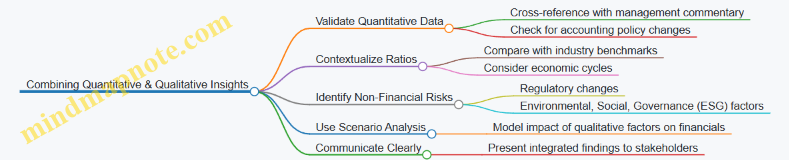
Summary
Combining quantitative and qualitative insights is a best practice that enhances the accuracy and relevance of financial statement interpretation. By systematically integrating numerical data with contextual information, accountants and financial planners can deliver deeper, actionable insights that support better decision-making.
8.4 Example: Impact of Regulatory Changes on Financial Interpretation
Regulatory changes can significantly affect how financial statements are prepared, presented, and interpreted. For accountants and financial planners, understanding these impacts is crucial to provide accurate analysis and advice.
Mind Map: Regulatory Changes and Financial Interpretation
Example 1: New Revenue Recognition Standard (IFRS 15 / ASC 606)
Scenario: A software company previously recognized revenue upon delivery of software licenses. Under the new standard, revenue must be recognized as performance obligations are satisfied over time.
Impact on Financial Statements:
- Revenue may be deferred and recognized over the contract period rather than upfront.
- Accounts receivable and contract liabilities may increase.
Interpretation Adjustments:
- Revenue Trends: A sudden drop in reported revenue in the initial periods may not indicate poor performance but a timing shift.
- Profitability Ratios: Gross margin may appear lower initially due to deferred revenue.
- Cash Flow: Operating cash flow may remain strong despite lower reported revenue.
Example Mind Map:
Example 2: Lease Accounting Changes (IFRS 16 / ASC 842)
Scenario: A retail chain leases multiple stores. Previously, operating leases were off-balance sheet. New standards require recognition of right-of-use assets and lease liabilities on the balance sheet.
Impact on Financial Statements:
- Increase in total assets and liabilities.
- Higher depreciation and interest expenses replacing operating lease expenses.
Interpretation Adjustments:
- Leverage Ratios: Debt-to-equity ratio may increase, affecting solvency analysis.
- Profitability Metrics: Operating profit may decrease initially due to interest and depreciation.
- Cash Flow Statement: Operating cash flows increase as lease payments shift to financing activities.
Example Mind Map:
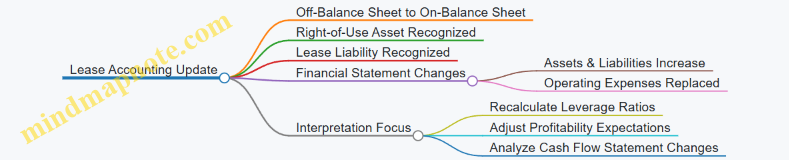
Example 3: Corporate Tax Rate Change
Scenario: A government reduces the corporate tax rate from 30% to 25% mid-year.
Impact on Financial Statements:
- Deferred tax assets and liabilities must be remeasured.
- Income tax expense may decrease in future periods.
Interpretation Adjustments:
- Effective Tax Rate: Analysts should adjust expectations for tax expense.
- Net Income: May increase due to lower tax burden.
- Deferred Tax Balances: Changes in deferred tax can cause volatility in equity.
Example Mind Map:
Practical Tips for Accountants and Financial Planners
- Stay Updated: Regularly monitor regulatory announcements and accounting standard updates.
- Communicate Clearly: Explain the nature and impact of regulatory changes to clients and stakeholders.
- Adjust Analysis Models: Incorporate changes into financial models, ratio calculations, and trend analyses.
- Use Pro Forma Statements: Where possible, prepare adjusted financial statements to compare pre- and post-regulation periods.
- Consider Qualitative Factors: Understand the strategic implications of regulatory changes beyond just numerical impacts.
By integrating these examples and mind maps, accountants and financial planners can better interpret financial statements in the context of evolving regulatory landscapes, ensuring more accurate and insightful financial analysis.
8.5 Case Study: How Market Sentiment Affects Financial Planning
Market sentiment refers to the overall attitude of investors toward a particular security or financial market. It is the tone or feeling that investors collectively exhibit, often influenced by news, economic data, geopolitical events, and psychological factors. Understanding market sentiment is crucial for financial planners and accountants as it directly impacts investment decisions, risk assessment, and client advisory.
Mind Map: Components of Market Sentiment Impacting Financial Planning
Example 1: Market Sentiment During a Bull Market
Scenario: During a prolonged bull market, investor optimism is high. Financial planners notice clients eager to invest aggressively in equities.
Impact on Financial Planning:
- Increased allocation to growth stocks.
- Higher risk tolerance advised.
- Emphasis on capital appreciation.
Best Practice: Balance enthusiasm with caution by diversifying portfolios and setting realistic return expectations.
Example 2: Market Sentiment During a Market Correction
Scenario: A sudden market correction triggers fear and uncertainty among investors.
Impact on Financial Planning:
- Clients may want to liquidate holdings to avoid losses.
- Risk aversion spikes.
- Potential for missed recovery opportunities.
Best Practice: Financial planners should educate clients on market cycles, encourage long-term perspective, and avoid panic selling.
Mind Map: Financial Planner’s Response to Changing Market Sentiment
Detailed Case Study: The 2020 COVID-19 Market Crash and Recovery
Background: In early 2020, the COVID-19 pandemic caused a rapid shift in market sentiment from optimism to fear, leading to one of the fastest market crashes in history.
Market Sentiment Shift:
- Panic selling dominated.
- Volatility spiked dramatically.
- Uncertainty about economic recovery.
Financial Planning Challenges:
- Clients requested portfolio withdrawals.
- Difficulty in predicting market bottom.
- Need to reassess risk tolerance amid uncertainty.
Planner’s Approach:
- Maintained open communication with clients, providing data-driven insights.
- Recommended maintaining diversified portfolios with defensive assets.
- Used scenario analysis to prepare clients for multiple recovery paths.
- Gradually reintroduced equity exposure as sentiment improved.
Outcome:
- Clients who stayed invested benefited from the rapid market recovery.
- Those who panicked and exited early faced opportunity costs.
Example Mind Map: Client Emotional Responses and Planner Actions
Summary
Market sentiment plays a pivotal role in shaping financial planning strategies. By understanding the psychological and external factors driving sentiment, financial planners and accountants can better guide clients through volatile markets. Incorporating sentiment analysis into financial statement interpretation allows for a more holistic approach to risk management and investment advisory.
Key Takeaways:
- Always consider market sentiment alongside quantitative financial data.
- Use mind maps and scenario planning to visualize and prepare for sentiment-driven market changes.
- Maintain clear, empathetic communication with clients to manage expectations and emotions.
- Balance short-term market reactions with long-term financial goals.
This case study highlights the integration of qualitative market sentiment analysis with traditional financial statement interpretation to enhance decision-making and client outcomes.
9. Common Pitfalls and How to Avoid Them
9.1 Overreliance on Single Metrics
In financial statement interpretation, relying heavily on a single metric can lead to misleading conclusions and poor decision-making. Financial health and performance are multi-dimensional, and no single ratio or figure can provide a complete picture.
Why Overreliance on Single Metrics is Risky
- Incomplete Analysis: One metric may highlight a strength but ignore underlying weaknesses.
- Context Ignorance: Metrics can vary widely by industry, company size, or economic conditions.
- Manipulation Risk: Some metrics can be influenced by accounting policies or one-time events.
- False Confidence: Overconfidence in one number can lead to ignoring warning signs elsewhere.
Common Metrics Often Overrelied Upon
- Earnings Per Share (EPS)
- Current Ratio
- Return on Equity (ROE)
- Debt-to-Equity Ratio
- Gross Profit Margin
Mind Map: Risks of Overreliance on Single Metrics
Example 1: Overreliance on EPS
A technology startup shows a rising EPS over three years. At first glance, this suggests growing profitability. However, deeper analysis reveals:
- The company has increasing debt to finance growth.
- Cash flow from operations is negative.
- Significant one-time tax benefits inflated net income.
Conclusion: Solely relying on EPS masked liquidity risks and sustainability concerns.
Mind Map: EPS Overreliance Pitfalls
Example 2: Current Ratio Misinterpretation
A retail company reports a current ratio of 2.5, which is generally considered healthy. However:
- Large portion of current assets is slow-moving inventory.
- Accounts receivable aging indicates collection issues.
- The company has upcoming short-term debt maturities.
Conclusion: The high current ratio alone does not guarantee liquidity; quality of assets matters.
Mind Map: Current Ratio Overreliance
Best Practice: Use a Balanced Set of Metrics
- Combine liquidity, profitability, solvency, and efficiency ratios.
- Perform trend analysis over multiple periods.
- Compare against industry benchmarks.
- Review qualitative factors alongside quantitative data.
Summary
Overreliance on a single financial metric can obscure the true financial condition of a business. Accountants and financial planners should adopt a holistic approach, integrating multiple metrics and contextual insights to make informed decisions.
9.2 Ignoring Non-Recurring Items and One-Time Events
When interpreting financial statements, one of the most common pitfalls is ignoring non-recurring items and one-time events. These items can significantly distort the true financial performance and position of a company if not properly identified and adjusted for.
What Are Non-Recurring Items and One-Time Events?
- Non-Recurring Items: Transactions or events that are unusual or infrequent and not expected to happen regularly in the normal course of business.
- One-Time Events: Specific occurrences that impact financials only once, such as asset sales, restructuring costs, legal settlements, or natural disaster losses.
Why Are They Important?
- They can inflate or deflate profits, mislead stakeholders about ongoing operational performance.
- Distorting key ratios and trend analysis.
- Affect decision-making for accountants and financial planners.
Mind Map: Understanding Non-Recurring Items and One-Time Events
Common Examples of Non-Recurring Items
| Item | Description | Example Scenario |
|---|---|---|
| Gain/Loss on Asset Sale | Profit or loss from selling fixed assets | Selling old machinery for $500,000 |
| Restructuring Costs | Expenses related to reorganizing business operations | Severance payments during downsizing |
| Legal Settlements | Costs or gains from lawsuit settlements | $2 million settlement paid to resolve a lawsuit |
| Impairment Charges | Write-down of asset value due to reduced worth | Impairment of goodwill after acquisition |
| Natural Disaster Losses | Losses due to events like floods or fires | Factory damaged by hurricane |
Best Practices for Handling Non-Recurring Items
- Identify and Separate: Always check notes to financial statements for disclosures on non-recurring items.
- Adjust Profitability Measures: Calculate adjusted EBITDA or adjusted net income excluding these items to understand ongoing performance.
- Use Consistent Treatment: Apply the same approach across periods for meaningful trend analysis.
- Communicate Clearly: When presenting financials to clients or stakeholders, highlight the impact of these items.
Mind Map: Best Practices for Non-Recurring Items
Example: Misinterpretation Due to Ignoring One-Time Gain
Scenario: A retail company reports a net income of $10 million for the year, which includes a $3 million gain from selling a piece of land.
Without Adjustment:
- Net income appears strong, suggesting improved profitability.
With Adjustment:
- Adjusted net income = $10 million - $3 million = $7 million.
- Reveals that core operations generated less profit than initially perceived.
Impact:
- Financial planners might overestimate the company’s earning power.
- Accountants may incorrectly advise on tax planning or investment.
Example: One-Time Restructuring Costs Affecting Profitability
Scenario: A manufacturing firm incurs $5 million in restructuring costs due to plant closures.
Financial Statement Impact:
- Operating expenses spike, causing a net loss.
Interpretation:
- Excluding the $5 million restructuring cost, the company is actually profitable.
Best Practice:
- Present adjusted income statement excluding restructuring costs to show normalized earnings.
Summary
Ignoring non-recurring items and one-time events can lead to flawed financial interpretations. By identifying, adjusting, and clearly communicating these items, accountants and financial planners can provide a more accurate picture of a company’s financial health and make better-informed decisions.
9.3 Best Practice: Cross-Verification and Multiple Data Sources
Cross-verification and the use of multiple data sources are critical best practices in financial statement interpretation. They ensure accuracy, reduce bias, and provide a more comprehensive understanding of a company’s financial health. Relying on a single data point or source can lead to misinterpretations and flawed decision-making.
Why Cross-Verification Matters
- Accuracy: Confirms the reliability of financial figures.
- Consistency: Detects discrepancies or anomalies across reports.
- Risk Mitigation: Identifies potential errors or fraud.
- Holistic View: Combines quantitative and qualitative data for deeper insights.
Key Steps in Cross-Verification
Multiple Data Sources to Consider
- Internal Financial Statements: Balance sheet, income statement, cash flow statement.
- Management Reports: Budgets, forecasts, variance analyses.
- External Audits: Auditor’s reports, notes on accounting policies.
- Market Data: Stock prices, competitor financials, economic indicators.
- Industry Benchmarks: Sector averages, key performance indicators (KPIs).
- Regulatory Filings: SEC filings, tax returns.
Example 1: Detecting Revenue Overstatement
A financial planner reviews a company’s income statement showing a 25% revenue increase year-over-year. To cross-verify:
- Compare with Cash Flow Statement: The operating cash flow shows only a 5% increase, indicating possible revenue recognition issues.
- Review Management Reports: Forecasts and sales reports show conservative growth expectations.
- Check External Audits: Auditor’s notes mention revenue recognition policy changes.
- Market Data: Competitors report flat sales growth.
Conclusion: The revenue increase may be overstated or influenced by accounting policy changes. Further investigation is warranted.
Example 2: Validating Inventory Valuation
An accountant notices a sudden spike in inventory on the balance sheet.
- Cross-check with Purchase Orders: Confirm if there were large recent purchases.
- Review Inventory Turnover Ratios: A declining turnover ratio may indicate overstocking or obsolete inventory.
- Consult Industry Benchmarks: Compare inventory levels relative to sales.
- Physical Inventory Counts: Verify actual stock levels.
Outcome: Cross-verification reveals inventory buildup due to slow-moving products, signaling potential write-downs.
Mind Map: Cross-Verification Workflow
Practical Tips
- Always question unusually high or low figures.
- Use software tools to automate reconciliation and data comparison.
- Collaborate with other departments (e.g., sales, procurement) for qualitative insights.
- Keep abreast of industry trends to contextualize data.
By integrating cross-verification and multiple data sources into your financial statement interpretation process, accountants and financial planners can significantly enhance the reliability of their analyses and provide more informed, strategic advice to stakeholders.
9.4 Example: Misinterpretation of Earnings Due to Accounting Adjustments
Financial statements often include various accounting adjustments that can significantly impact the reported earnings. Misinterpreting these adjustments can lead to incorrect conclusions about a company’s financial health. This section explores common types of accounting adjustments, how they affect earnings, and provides illustrative examples to help accountants and financial planners avoid pitfalls.
Understanding Accounting Adjustments
Accounting adjustments are entries made to the financial records to allocate income and expenses to the correct accounting periods or to reflect non-cash transactions. They include items such as depreciation, amortization, provisions, write-offs, and one-time gains or losses.
Mind Map: Types of Accounting Adjustments Affecting Earnings
Example Scenario 1: Depreciation Impact on Earnings
Company A reports a net income of $1,000,000. However, it includes a depreciation expense of $300,000, which is a non-cash charge reflecting the wear and tear of fixed assets.
- Misinterpretation: Assuming the entire $1,000,000 is cash profit.
- Correct Interpretation: Adjust net income by adding back depreciation to understand cash earnings.
Adjusted Earnings (Cash Basis):
Net Income: $1,000,000
+ Depreciation: $300,000
= Cash Earnings: $1,300,000
Example Scenario 2: One-Time Gain Inflating Earnings
Company B reports net income of $2,500,000, which includes a one-time gain of $700,000 from selling a subsidiary.
- Misinterpretation: Viewing the $2,500,000 as recurring profit.
- Correct Interpretation: Exclude one-time gain to assess sustainable earnings.
Adjusted Earnings (Recurring):
Net Income: $2,500,000
- One-time Gain: $700,000
= Recurring Earnings: $1,800,000
Mind Map: Steps to Avoid Misinterpretation of Earnings
Practical Tips for Accountants and Financial Planners
- Scrutinize Notes to Financial Statements: These often reveal the nature and impact of accounting adjustments.
- Calculate Adjusted Earnings Metrics: Such as EBITDA or adjusted net income to get a clearer picture.
- Compare Across Periods: Look for unusual spikes or drops caused by adjustments.
- Discuss with Management: Gain insights into the reasons behind significant adjustments.
Summary
Misinterpretation of earnings due to accounting adjustments can lead to flawed financial analysis and poor decision-making. By understanding the types of adjustments, carefully analyzing their impact, and using adjusted metrics, accountants and financial planners can provide more accurate assessments of a company’s financial performance.
Additional Example: Warranty Provision Impact
Company C sets aside a warranty provision expense of $150,000 in the current year, reducing net income. However, actual warranty claims were only $50,000.
- Misinterpretation: Assuming the full $150,000 is a recurring expense.
- Correct Interpretation: Recognize that provisions are estimates and may reverse in future periods.
Mind Map: Warranty Provision Effects
By factoring in such provisions and their reversals, financial planners can better forecast future earnings and cash flows.
9.5 Tips for Maintaining Objectivity and Accuracy
Maintaining objectivity and accuracy when interpreting financial statements is crucial for accountants and financial planners. Biases, assumptions, or incomplete data can lead to incorrect conclusions, potentially harming decision-making and client trust. Below are practical tips, supported by mind maps and examples, to help ensure your financial analysis remains objective and precise.
Tip 1: Use Multiple Data Sources
Relying on a single source of information can skew your interpretation. Cross-verify financial data with:
- Audited financial statements
- Management reports
- Industry benchmarks
- Market data
Example: If a company reports unusually high profits, check for notes on one-time gains or accounting changes in the footnotes or MD&A section.
Mind Map: Multiple Data Sources
Tip 2: Identify and Adjust for Non-Recurring Items
Non-recurring events like asset sales, restructuring costs, or legal settlements can distort profitability and cash flow.
Example: A company shows a spike in net income due to selling a major asset. Adjust your profitability analysis by excluding this gain to understand core business performance.
Mind Map: Adjusting for Non-Recurring Items
Tip 3: Apply Consistent Analytical Methods
Use standardized methods such as ratio analysis, vertical/horizontal analysis, and trend analysis consistently across periods and companies to avoid subjective bias.
Example: When comparing liquidity ratios over three years, apply the same calculation method and definitions to ensure comparability.
Mind Map: Consistent Analytical Methods
Tip 4: Document Assumptions and Limitations
Clearly record any assumptions made during interpretation and acknowledge limitations of the data or methods.
Example: If forecasting future earnings based on historical trends, note assumptions about market conditions and potential risks.
Mind Map: Documentation of Assumptions
Tip 5: Use Peer and Industry Comparisons
Benchmarking against industry peers helps contextualize financial results and highlights anomalies.
Example: A company’s debt-to-equity ratio appears high until compared with industry norms, revealing it is typical for its sector.
Mind Map: Peer and Industry Comparisons
Tip 6: Maintain Professional Skepticism
Question unusual trends or figures and seek explanations rather than accepting data at face value.
Example: If receivables turnover suddenly slows, investigate potential issues with credit policies or customer payment delays.
Mind Map: Professional Skepticism
Tip 7: Regularly Update Knowledge and Skills
Stay current with accounting standards, financial regulations, and analytical tools to improve accuracy.
Example: Understanding changes in revenue recognition standards can prevent misinterpretation of income statements.
Mind Map: Continuous Learning
Summary Example: Applying Objectivity and Accuracy
Consider a financial planner analyzing a client’s company showing a sudden increase in net income. By applying the tips above:
- They cross-check the income statement with footnotes and discover a one-time asset sale.
- They adjust profitability metrics to exclude this gain.
- They compare adjusted ratios with industry peers.
- They document assumptions and communicate findings clearly to the client.
This approach ensures the client receives an accurate picture of ongoing business performance, supporting better financial decisions.
Maintaining objectivity and accuracy is a continuous process that enhances the credibility and usefulness of financial statement interpretation. Leveraging these tips will empower accountants and financial planners to deliver insightful, reliable analyses.
10. Practical Applications for Accountants and Financial Planners
10.1 Using Financial Statement Interpretation in Client Advisory
Financial statement interpretation is a critical skill for accountants and financial planners when advising clients. It enables professionals to provide tailored, insightful guidance based on a client’s financial health, goals, and risk tolerance. This section explores how to effectively leverage financial statements in client advisory, supported by practical examples and mind maps to visualize the process.
Why Financial Statement Interpretation Matters in Client Advisory
- Understand Client’s Financial Position: Helps identify strengths, weaknesses, and opportunities.
- Customized Recommendations: Align financial advice with the client’s actual financial situation.
- Risk Management: Detect potential financial risks early.
- Goal Setting & Monitoring: Establish realistic financial goals and track progress.
Mind Map: Key Steps in Using Financial Statement Interpretation for Client Advisory
Practical Example: Advising a Small Business Owner
Client Profile: Jane owns a small retail business. She wants to expand but is unsure if her finances support it.
Step 1: Analyze Financial Statements
- Balance Sheet: Shows moderate assets but relatively high short-term liabilities.
- Income Statement: Profitable but with thin margins.
- Cash Flow Statement: Positive operating cash flow but limited free cash.
Step 2: Interpretation
- Liquidity risk due to high short-term liabilities.
- Profitability is stable but expansion may strain cash reserves.
Step 3: Advisory Recommendations
- Consider negotiating longer payment terms with suppliers to improve liquidity.
- Explore financing options to fund expansion without compromising cash flow.
- Implement cost control measures to improve margins.
Step 4: Communication
- Present findings with charts showing cash flow trends and liquidity ratios.
- Outline clear steps Jane can take before proceeding with expansion.
Mind Map: Example Client Advisory Workflow
Additional Example: Financial Planning for an Individual Client
Client Profile: Mark, a young professional, wants to save for a home and retirement.
Step 1: Review Personal Financial Statements
- Assets: Savings, investments
- Liabilities: Student loan, credit card debt
- Income and expenses detailed in income statement format
Step 2: Interpretation
- Debt-to-income ratio is high, limiting saving capacity.
- Positive cash flow but heavily allocated to debt repayment.
Step 3: Advisory Recommendations
- Prioritize high-interest debt repayment.
- Set up an emergency fund.
- Begin small, consistent investments aligned with retirement goals.
Step 4: Communication
- Use simple charts to show debt impact and savings growth projections.
- Provide a step-by-step plan with timelines.
Best Practices for Client Advisory Using Financial Statements
- Always contextualize numbers within client goals and industry norms.
- Use visuals (charts, graphs, mind maps) to enhance understanding.
- Simplify complex financial jargon into clear, actionable advice.
- Regularly update clients with new financial data and adjust recommendations.
- Encourage client questions to ensure clarity and engagement.
By integrating financial statement interpretation into client advisory, accountants and financial planners can deliver more precise, actionable, and client-focused advice, ultimately fostering stronger client relationships and better financial outcomes.
10.2 Best Practice: Tailoring Analysis to Client Goals and Risk Profiles
When interpreting financial statements for clients, it is essential to customize the analysis based on their unique financial goals and risk tolerance. This tailored approach ensures that the insights provided are relevant, actionable, and aligned with the client’s overall financial strategy.
Understanding Client Goals
Clients may have diverse objectives such as wealth accumulation, capital preservation, income generation, or preparing for retirement. Each goal influences how financial data should be interpreted and prioritized.
- Wealth Accumulation: Focus on growth metrics, profitability, and reinvestment potential.
- Capital Preservation: Emphasize liquidity, solvency, and low-risk investments.
- Income Generation: Highlight dividend stability, cash flow reliability, and payout ratios.
- Retirement Planning: Assess long-term sustainability, risk exposure, and asset diversification.
Assessing Risk Profiles
Risk tolerance varies widely among clients and can be categorized as conservative, moderate, or aggressive. Understanding this helps in interpreting financial statements with the right lens.
- Conservative: Prioritize stability, low debt levels, and consistent cash flows.
- Moderate: Balance growth and safety, with attention to profitability and manageable leverage.
- Aggressive: Focus on high growth potential, even if accompanied by higher volatility or debt.
Mind Map: Tailoring Financial Statement Interpretation
Example 1: Tailoring Analysis for a Conservative Client
Client Profile: Jane, a 55-year-old nearing retirement, prioritizes capital preservation and steady income.
Interpretation Focus:
- Emphasize liquidity ratios such as current and quick ratios to ensure the company can meet short-term obligations.
- Analyze cash flow statements to confirm consistent operating cash flows.
- Review dividend payout ratios to assess income reliability.
- Examine debt-to-equity ratios to ensure low leverage.
Outcome: Jane’s financial planner highlights a company with strong liquidity, stable dividends, and low debt, aligning with her conservative risk profile and income needs.
Example 2: Tailoring Analysis for an Aggressive Client
Client Profile: Mark, a 35-year-old entrepreneur focused on wealth accumulation and willing to accept higher risk.
Interpretation Focus:
- Concentrate on growth indicators such as revenue growth rate and return on equity.
- Evaluate reinvestment potential by analyzing retained earnings and capital expenditures.
- Accept higher debt levels but monitor interest coverage ratios to avoid excessive risk.
- Use trend analysis to identify emerging opportunities and risks.
Outcome: Mark’s financial planner recommends companies with strong growth trajectories and reinvestment strategies, even if accompanied by moderate leverage, matching his aggressive profile.
Practical Tips for Accountants and Financial Planners
- Engage in Detailed Client Discussions: Understand their financial goals, timelines, and risk appetite before analysis.
- Use Customized Reporting: Highlight metrics and ratios most relevant to the client’s profile.
- Scenario Analysis: Present multiple scenarios showing how financial changes impact client goals.
- Regular Review: Update interpretations as client goals or market conditions evolve.
By integrating client-specific goals and risk profiles into financial statement interpretation, accountants and financial planners can deliver more personalized, meaningful advice that drives better financial outcomes.
10.3 Example: Creating Financial Health Reports for Small Businesses
Creating financial health reports for small businesses is a critical task for accountants and financial planners. These reports provide a clear snapshot of a company’s financial status, helping owners make informed decisions, secure financing, and plan for growth.
Step 1: Gather Financial Statements
- Balance Sheet
- Income Statement
- Cash Flow Statement
Step 2: Perform Key Ratio Analysis
- Liquidity Ratios (Current Ratio, Quick Ratio)
- Profitability Ratios (Net Profit Margin, Return on Assets)
- Solvency Ratios (Debt to Equity)
- Efficiency Ratios (Inventory Turnover, Receivables Turnover)
Step 3: Conduct Vertical and Horizontal Analysis
- Vertical Analysis: Express each line item as a percentage of total assets or sales
- Horizontal Analysis: Compare financial data over multiple periods to identify trends
Step 4: Summarize Qualitative Insights
- Management commentary
- Industry conditions
- Market risks
Step 5: Compile the Financial Health Report
- Executive Summary
- Financial Statement Overview
- Ratio Analysis with Interpretation
- Trend Analysis
- Recommendations and Action Plan
Mind Map: Components of a Financial Health Report
Example: Financial Health Report for “GreenLeaf Landscaping” (Small Business)
Background: GreenLeaf Landscaping is a small landscaping company with $1.2M in annual revenue. The owner seeks a financial health report to understand current performance and plan for expansion.
Financial Statement Highlights
- Balance Sheet: Total Assets: $600,000; Total Liabilities: $250,000; Equity: $350,000
- Income Statement: Revenue: $1,200,000; Net Profit: $120,000 (10% net margin)
- Cash Flow Statement: Positive operating cash flow of $100,000
Ratio Analysis
| Ratio | Calculation | Value | Interpretation |
|---|---|---|---|
| Current Ratio | Current Assets / Current Liabilities | 1.8 | Healthy liquidity, can cover short-term obligations |
| Quick Ratio | (Current Assets - Inventory) / Current Liabilities | 1.2 | Adequate quick liquidity |
| Debt to Equity Ratio | Total Liabilities / Equity | 0.71 | Moderate leverage, manageable debt |
| Net Profit Margin | Net Profit / Revenue | 10% | Good profitability for industry |
| Inventory Turnover | COGS / Average Inventory | 6 times | Efficient inventory management |
Trend Analysis
- Vertical Analysis: Cost of Goods Sold is 60% of sales, consistent with industry norms.
- Horizontal Analysis: Revenue grew 8% from prior year; net profit margin improved by 1.5%.
Qualitative Insights
- Owner plans to invest in new equipment to improve efficiency.
- Local market demand for landscaping is growing.
Recommendations
- Maintain current liquidity levels while monitoring debt levels.
- Consider financing options for equipment purchase, ensuring debt-to-equity remains below 1.
- Continue monitoring profit margins and control operating expenses.
Mind Map: Example Financial Health Report Structure for GreenLeaf Landscaping
Practical Tips for Accountants and Financial Planners
- Use simple language and clear visuals when presenting reports to small business owners.
- Tailor ratio benchmarks to the specific industry and business size.
- Highlight actionable insights rather than just numbers.
- Incorporate graphical elements like charts and trend lines for easier comprehension.
By following these steps and integrating best practices, accountants and financial planners can create comprehensive financial health reports that empower small business owners with clarity and confidence in their financial decisions.
10.4 Leveraging Interpretation for Tax Planning and Compliance
Financial statement interpretation is a critical tool for accountants and financial planners aiming to optimize tax planning and ensure compliance. By carefully analyzing financial statements, professionals can identify tax-saving opportunities, anticipate tax liabilities, and maintain adherence to regulatory requirements.
Key Areas Where Financial Statement Interpretation Supports Tax Planning and Compliance
Tax Planning & Compliance Mind Map
Income Statement Interpretation for Tax Planning
-
Identify Taxable Income Components:
- Distinguish between operating and non-operating income.
- Example: Interest income may be taxable differently than core business revenue.
-
Detect Non-Deductible Expenses:
- Some expenses (e.g., fines, penalties) are not deductible.
- Example: A company’s financial statement shows a $50,000 penalty expense; this should be excluded from deductible expenses in tax calculations.
-
Recognize Timing Differences:
- Understand accrual vs. cash recognition to optimize tax timing.
- Example: Revenue recognized in financials but not yet received in cash may defer tax liability.
Balance Sheet Review for Tax Compliance
-
Asset Valuation and Depreciation:
- Analyze fixed asset values to determine depreciation schedules.
- Example: A company’s balance sheet shows machinery valued at $500,000; selecting an accelerated depreciation method could reduce taxable income early.
-
Deferred Tax Assets and Liabilities:
- Identify timing differences creating deferred tax items.
- Example: Warranty expenses accrued in financials but deductible for tax when paid create deferred tax assets.
-
Inventory Valuation Methods:
- FIFO, LIFO, or weighted average impact taxable income.
- Example: Switching from FIFO to LIFO during inflationary periods can reduce taxable income.
Cash Flow Statement Insights
-
Cash vs. Accrual Basis:
- Understanding cash flow helps reconcile tax payments with reported income.
- Example: A company with strong accrual income but weak cash flow may face tax payment challenges.
-
Tax Impact on Operating Cash Flows:
- Tax refunds or payments appear in financing or operating activities.
- Example: Large tax refunds improve operating cash flow, indicating potential overpayment.
Ratio Analysis for Tax Planning
-
Effective Tax Rate Calculation:
- Compare tax expense to pre-tax income.
- Example: An effective tax rate significantly lower than statutory rate may indicate tax credits or incentives.
-
Debt-to-Equity Ratio:
- High debt levels may increase interest expense deductions.
- Example: A company with a debt-to-equity ratio of 3:1 may benefit from interest deductibility but must watch thin capitalization rules.
Compliance Monitoring
-
Matching Financial Data with Tax Filings:
- Ensure consistency between reported financials and tax returns.
- Example: Discrepancies in reported revenue or expenses can trigger audits.
-
Identifying Discrepancies or Red Flags:
- Unusual fluctuations or inconsistencies may indicate compliance risks.
- Example: Sudden drop in taxable income without clear reason warrants further investigation.
Practical Example: Leveraging Financial Statement Interpretation for Tax Planning
Scenario: A mid-sized manufacturing company wants to optimize its tax position for the upcoming fiscal year.
-
Income Statement Review: The accountant identifies a $200,000 non-deductible expense related to entertainment costs. By excluding this from deductible expenses, taxable income is adjusted accordingly.
-
Balance Sheet Analysis: The company has recently acquired new machinery worth $1 million. The accountant recommends using an accelerated depreciation method allowed by tax law to reduce taxable income in the short term.
-
Cash Flow Statement: The analysis reveals timing differences where revenue is recognized but cash not yet received. The company opts to defer some income recognition where permissible, delaying tax liability.
-
Ratio Analysis: The effective tax rate is calculated at 28%, slightly below the statutory rate of 30%, due to available tax credits. The accountant advises documenting these credits thoroughly for compliance.
-
Compliance Check: The accountant cross-verifies financial statement figures with prior tax filings to ensure consistency and avoid audit triggers.
Summary
By integrating financial statement interpretation into tax planning and compliance processes, accountants and financial planners can:
- Identify tax-saving opportunities through detailed income and expense analysis.
- Optimize asset depreciation and inventory valuation for tax benefits.
- Manage timing differences to defer or accelerate tax liabilities.
- Ensure compliance by reconciling financial data with tax filings.
- Detect potential risks and prepare for audits proactively.
This holistic approach enhances both the accuracy of tax reporting and the effectiveness of tax planning strategies.
10.5 Case Study: Financial Planning Based on Statement Insights
Overview
This case study demonstrates how accountants and financial planners can leverage financial statement interpretation to develop a comprehensive financial plan tailored to a client’s unique circumstances. We will analyze the financial statements of a hypothetical small business, “GreenTech Solutions,” and use the insights to guide strategic financial planning decisions.
Step 1: Understanding the Client’s Financial Position
Client Profile: GreenTech Solutions is a mid-sized company specializing in eco-friendly technology products. The client seeks financial planning advice to optimize cash flow, reduce debt, and plan for future expansion.
Key Financial Statements Reviewed:
- Balance Sheet
- Income Statement
- Cash Flow Statement
Step 2: Interpreting Financial Statements
Balance Sheet Insights
- Assets: Total assets of $2 million, with $500,000 in current assets and $1.5 million in fixed assets.
- Liabilities: Total liabilities of $1.2 million, including $700,000 in long-term debt and $500,000 in current liabilities.
- Equity: Shareholders’ equity stands at $800,000.
Income Statement Insights
- Revenue: $3 million annual revenue with a gross profit margin of 40%.
- Expenses: Operating expenses are $900,000, resulting in an operating profit of $300,000.
- Net Profit: After interest and taxes, net profit is $180,000.
Cash Flow Statement Insights
- Operating Cash Flow: Positive $250,000, indicating healthy core business operations.
- Investing Cash Flow: Negative $200,000 due to recent purchase of new manufacturing equipment.
- Financing Cash Flow: Positive $100,000 from a recent loan.
Step 3: Mind Map – Key Financial Insights
Financial Planning Mind Map for GreenTech Solutions
Step 4: Developing the Financial Plan
1. Improve Cash Flow Management
- Best Practice: Analyze working capital components (accounts receivable, inventory, accounts payable).
- Example: GreenTech has $300,000 in accounts receivable with an average collection period of 60 days, which is longer than the industry average of 45 days.
- Action: Implement stricter credit policies and incentivize early payments to reduce the collection period.
2. Debt Reduction Strategy
- Best Practice: Prioritize paying down high-interest short-term liabilities.
- Example: Current liabilities include a $200,000 short-term loan at 8% interest.
- Action: Use part of the operating cash flow surplus to pay down this loan faster, reducing interest expenses.
3. Expansion Planning and Capital Budgeting
- Best Practice: Use cash flow forecasts and ROI analysis before committing to new investments.
- Example: The recent $200,000 investment in manufacturing equipment is expected to increase production capacity by 20%, potentially increasing revenue by $600,000 annually.
- Action: Prepare a detailed cash flow projection to ensure the company can sustain operations during the expansion phase.
Step 5: Mind Map – Financial Planning Actions
Step 6: Example – Cash Flow Forecast Table
| Month | Opening Cash Balance | Operating Cash Flow | Investing Cash Flow | Financing Cash Flow | Closing Cash Balance |
|---|---|---|---|---|---|
| January | $100,000 | $20,000 | -$15,000 | $0 | $105,000 |
| February | $105,000 | $22,000 | -$10,000 | $0 | $117,000 |
| March | $117,000 | $25,000 | -$5,000 | $0 | $137,000 |
| April | $137,000 | $28,000 | $0 | -$20,000 (debt repayment) | $145,000 |
This forecast helps GreenTech plan cash availability and debt repayments effectively.
Conclusion
By carefully interpreting GreenTech Solutions’ financial statements, accountants and financial planners can craft a targeted financial plan that addresses cash flow optimization, debt reduction, and strategic expansion. The integration of best practices with real-world examples and visual mind maps ensures the plan is actionable and easy to communicate to clients.
End of Case Study
11. Advanced Tools and Techniques
11.1 Utilizing Financial Modeling for Deeper Analysis
Financial modeling is a powerful technique that accountants and financial planners use to create a quantitative representation of a company’s financial performance. It enables deeper analysis by forecasting future financial outcomes based on historical data, assumptions, and various scenarios.
What is Financial Modeling?
Financial modeling involves building an abstract model (usually in Excel or specialized software) that represents the financial operations of a business. This model helps in decision making, valuation, budgeting, and strategic planning.
Benefits of Financial Modeling
- Enables scenario analysis and forecasting
- Helps identify key financial drivers
- Supports investment and financing decisions
- Facilitates budgeting and resource allocation
Key Components of a Financial Model
Step-by-Step Example: Building a Simple Financial Model for a Retail Company
Step 1: Gather Historical Data
- Revenue for past 3 years
- Cost of Goods Sold (COGS)
- Operating Expenses
- Capital Expenditures
Step 2: Define Assumptions
- Revenue growth rate: 8% annually
- COGS as 60% of revenue
- Operating expenses grow at 5% annually
- Capital expenditures fixed at $50,000 per year
Step 3: Project Income Statement for Next 3 Years
| Year | Revenue | COGS (60%) | Operating Expenses | Operating Income |
|---|---|---|---|---|
| 2023 | $1,000,000 | $600,000 | $200,000 | $200,000 |
| 2024 | $1,080,000 | $648,000 | $210,000 | $222,000 |
| 2025 | $1,166,400 | $699,840 | $220,500 | $246,060 |
Step 4: Analyze Results and Adjust Assumptions
- Check if projected operating income aligns with strategic goals
- Adjust growth rates or expense assumptions as needed
Mind Map: Financial Modeling Process for Accountants and Financial Planners
Example: Using Financial Modeling to Evaluate a New Product Launch
- Objective: Assess financial impact of launching a new product line
- Inputs: Estimated sales volume, pricing, production costs, marketing expenses
- Process: Incorporate these inputs into the existing financial model to forecast incremental revenue and costs
- Output: Determine net profit contribution and payback period
This enables financial planners to advise clients on whether the product launch is financially viable.
Best Practices for Financial Modeling
- Use clear and consistent assumptions
- Build flexible models that allow easy scenario changes
- Document all inputs and assumptions for transparency
- Validate model outputs against historical data
- Incorporate sensitivity analysis to understand risks
By mastering financial modeling, accountants and financial planners can provide deeper insights, improve forecasting accuracy, and support strategic decision-making with confidence.
11.2 Best Practice: Scenario and Sensitivity Analysis
Scenario and sensitivity analysis are powerful techniques used by accountants and financial planners to assess how different variables impact financial outcomes. These analyses help in understanding risks, preparing for uncertainties, and making informed decisions.
What is Scenario Analysis?
Scenario analysis involves creating multiple plausible future states (scenarios) based on varying assumptions about key drivers such as sales growth, costs, interest rates, or market conditions. It helps in evaluating how financial statements and key metrics change under different conditions.
What is Sensitivity Analysis?
Sensitivity analysis examines how sensitive a financial outcome (e.g., net income, cash flow) is to changes in one or more input variables, holding other factors constant. It identifies which variables have the greatest impact on financial performance.
Why Use Scenario and Sensitivity Analysis?
- Risk Management: Understand potential risks and prepare mitigation strategies.
- Decision Support: Evaluate the impact of strategic choices.
- Forecasting: Improve accuracy by considering multiple outcomes.
- Communication: Provide stakeholders with a range of possible results.
Mind Map: Overview of Scenario and Sensitivity Analysis
Step-by-Step Guide to Scenario Analysis
- Identify Key Variables: Revenue growth, cost of goods sold, interest rates, etc.
- Define Scenarios: Typically, best case, base case, and worst case.
- Build Financial Models: Adjust assumptions for each scenario.
- Analyze Results: Compare financial metrics like net income, cash flow, ratios.
- Interpret and Communicate: Highlight risks and opportunities.
Example: Scenario Analysis for a Retail Business
| Scenario | Sales Growth | Cost Increase | Net Income (USD) |
|---|---|---|---|
| Best Case | 10% | 5% | 1,200,000 |
| Base Case | 5% | 7% | 900,000 |
| Worst Case | 0% | 10% | 600,000 |
Interpretation: The retail business’s net income varies significantly depending on sales growth and cost changes. This helps planners prepare for cash flow needs and investment decisions.
Mind Map: Scenario Analysis Process
Step-by-Step Guide to Sensitivity Analysis
- Select Key Variable(s): For example, sales price or interest rate.
- Determine Range of Variation: E.g., ±10%, ±20%.
- Calculate Impact: Measure changes on target financial metric.
- Visualize Results: Use tables or tornado charts.
- Focus on High-Impact Variables: Prioritize management attention.
Example: Sensitivity Analysis on Sales Price
| Sales Price Change | Net Income (USD) | % Change in Net Income |
|---|---|---|
| -20% | 500,000 | -44% |
| -10% | 700,000 | -22% |
| Base (0%) | 900,000 | 0% |
| +10% | 1,100,000 | +22% |
| +20% | 1,300,000 | +44% |
Interpretation: Net income is highly sensitive to changes in sales price, indicating pricing strategy is critical.
Mind Map: Sensitivity Analysis Workflow
Combining Scenario and Sensitivity Analysis
- Use scenario analysis to explore broad future states.
- Within each scenario, apply sensitivity analysis to key variables.
- This layered approach provides a detailed risk profile.
Example: Combined Analysis for a Manufacturing Firm
- Scenario: Base case assumes 5% sales growth.
- Sensitivity: Within base case, analyze impact of ±15% raw material cost changes on net income.
| Raw Material Cost Change | Net Income (USD) |
|---|---|
| -15% | 1,050,000 |
| Base (0%) | 900,000 |
| +15% | 750,000 |
Interpretation: Even in a stable sales environment, raw material costs significantly affect profitability.
Practical Tips for Accountants and Financial Planners
- Use spreadsheet software with scenario manager and data tables features.
- Document assumptions clearly for transparency.
- Regularly update models with actual data.
- Communicate findings with visual aids for clients or stakeholders.
- Integrate scenario and sensitivity analysis into regular financial reviews.
Summary
Scenario and sensitivity analysis are essential best practices for robust financial statement interpretation. They enable professionals to anticipate changes, quantify risks, and make data-driven decisions with confidence.
11.3 Example: Forecasting Financial Outcomes Using Historical Data
Forecasting financial outcomes is a critical skill for accountants and financial planners. By leveraging historical financial data, professionals can predict future performance, identify potential risks, and make informed strategic decisions. This section will guide you through the process of forecasting using historical data, supported by mind maps and practical examples.
Step 1: Collect and Organize Historical Data
Start by gathering several years of financial statements, including the income statement, balance sheet, and cash flow statement. Organize the data chronologically to identify trends and patterns.
Example:
| Year | Revenue ($) | Cost of Goods Sold ($) | Operating Expenses ($) | Net Income ($) |
|---|---|---|---|---|
| 2019 | 1,000,000 | 600,000 | 250,000 | 100,000 |
| 2020 | 1,100,000 | 660,000 | 270,000 | 110,000 |
| 2021 | 1,210,000 | 726,000 | 297,000 | 121,000 |
Step 2: Identify Key Variables and Trends
Use the historical data to calculate growth rates and ratios that will inform your forecast.
-
Revenue Growth Rate:
- 2020: (1,100,000 - 1,000,000) / 1,000,000 = 10%
- 2021: (1,210,000 - 1,100,000) / 1,100,000 = 10%
-
Cost of Goods Sold (COGS) as % of Revenue:
- 2019: 600,000 / 1,000,000 = 60%
- 2020: 660,000 / 1,100,000 = 60%
- 2021: 726,000 / 1,210,000 = 60%
-
Operating Expenses as % of Revenue:
- 2019: 250,000 / 1,000,000 = 25%
- 2020: 270,000 / 1,100,000 = 24.5%
- 2021: 297,000 / 1,210,000 = 24.5%
Step 3: Choose a Forecasting Method
Common methods include:
- Straight-line projection: Assumes constant growth rate.
- Moving average: Smooths out fluctuations.
- Regression analysis: Models relationships between variables.
For simplicity, we’ll use straight-line projection based on historical growth rates.
Step 4: Build the Forecast
Using the 10% revenue growth rate and stable expense ratios, forecast the financials for 2022 and 2023.
| Year | Revenue ($) | COGS ($) | Operating Expenses ($) | Net Income ($) (Estimated) |
|---|---|---|---|---|
| 2022 | 1,331,000 | 798,600 | 325,750 | 132,650 |
| 2023 | 1,464,100 | 878,460 | 358,723 | 146,917 |
Calculations:
- Revenue 2022 = 1,210,000 * 1.10 = 1,331,000
- COGS 2022 = 1,331,000 * 60% = 798,600
- Operating Expenses 2022 = 1,331,000 * 24.5% = 325,750
- Net Income 2022 = Revenue - COGS - Operating Expenses = 1,331,000 - 798,600 - 325,750 = 132,650
Repeat similarly for 2023.
Step 5: Visualize the Forecast Using Mind Maps
Forecasting Financial Outcomes Mind Map
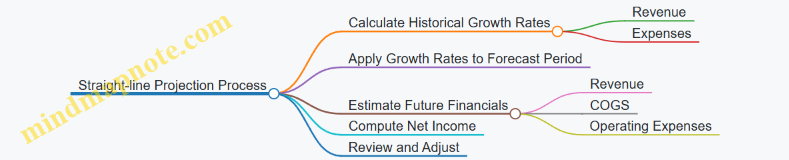
Step 6: Incorporate Scenario Analysis
To enhance forecasting, consider best-case, base-case, and worst-case scenarios.
| Scenario | Revenue Growth | COGS % of Revenue | Operating Expenses % | Net Income Impact |
|---|---|---|---|---|
| Best-case | 12% | 58% | 23% | Higher profits |
| Base-case | 10% | 60% | 24.5% | Moderate profits |
| Worst-case | 7% | 62% | 26% | Lower profits |
Example:
- Best-case Revenue 2022 = 1,210,000 * 1.12 = 1,355,200
- Worst-case Revenue 2022 = 1,210,000 * 1.07 = 1,294,700
Step 7: Practical Tips for Accountants and Financial Planners
- Always validate historical data accuracy before forecasting.
- Use multiple forecasting methods to cross-check results.
- Adjust forecasts for known upcoming events (e.g., market expansion, regulatory changes).
- Communicate assumptions clearly when presenting forecasts to clients.
Summary
Forecasting financial outcomes using historical data involves collecting accurate past financials, identifying trends, selecting an appropriate forecasting method, and building projections. Incorporating visual tools like mind maps helps organize the process, while scenario analysis provides a range of possible outcomes to aid decision-making. This approach equips accountants and financial planners with actionable insights to guide clients effectively.
11.4 Introduction to Software Tools for Financial Statement Interpretation
In today’s fast-paced financial environment, leveraging software tools for financial statement interpretation is essential for accountants and financial planners. These tools not only enhance accuracy and efficiency but also provide deeper insights through advanced analytics and visualization.
Why Use Software Tools?
- Automate data extraction and processing
- Perform complex calculations and ratio analysis instantly
- Visualize financial data through charts, graphs, and dashboards
- Facilitate scenario planning and forecasting
- Improve collaboration and reporting
Categories of Software Tools
Popular Software Tools and Their Features
-
Microsoft Excel / Google Sheets
- Widely used for custom financial models
- Supports formulas, pivot tables, and macros
- Example: Using Excel to calculate liquidity ratios and create trend graphs
-
QuickBooks / Xero
- Accounting software with built-in financial reports
- Automates data entry and reconciliations
- Example: Generating cash flow statements directly from bookkeeping data
-
Tableau / Power BI
- Business Intelligence tools for advanced visualization
- Connects to multiple data sources
- Example: Creating interactive dashboards to track profitability ratios over time
-
Fathom / Spotlight Reporting
- Specialized financial analysis and reporting tools
- Provides KPI tracking and benchmarking
- Example: Comparing a client’s financial ratios against industry standards
-
Adaptive Insights / Anaplan
- Cloud-based planning and forecasting platforms
- Supports scenario modeling and collaborative budgeting
- Example: Forecasting future earnings based on historical income statements
Example: Using Power BI to Interpret Financial Statements
- Data Import: Import balance sheet, income statement, and cash flow data from Excel or accounting software.
- Data Transformation: Clean and organize data using Power Query.
- Visualization: Create charts such as trend lines for revenue, bar graphs for expense categories, and waterfall charts for cash flow.
- Ratio Calculation: Build custom measures to calculate financial ratios like current ratio, ROE, and debt-to-equity.
- Dashboard: Combine visuals into an interactive dashboard for easy interpretation and presentation.
Best Practices When Using Software Tools
- Validate Data: Always cross-check imported data with original financial statements.
- Understand the Tool’s Capabilities: Invest time in learning features to maximize insights.
- Customize Reports: Tailor dashboards and reports to the specific needs of clients or stakeholders.
- Maintain Security: Use secure platforms and manage access controls carefully.
- Combine Tools: Use multiple tools in tandem (e.g., Excel for modeling, Power BI for visualization) for comprehensive analysis.
Incorporating software tools into financial statement interpretation empowers accountants and financial planners to deliver more insightful, timely, and accurate financial advice, ultimately enhancing decision-making and client satisfaction.
11.5 Case Study: Enhancing Decision-Making with Advanced Analytics
In this case study, we explore how a mid-sized manufacturing company, “Precision Components Inc.”, leveraged advanced analytics to improve its financial decision-making process. By integrating financial statement interpretation with predictive modeling and scenario analysis, the company was able to identify risks early, optimize resource allocation, and enhance strategic planning.
Background
Precision Components Inc. faced challenges in forecasting cash flow and profitability due to fluctuating raw material costs and changing customer demand. Traditional financial analysis provided historical insights but lacked predictive power.
Step 1: Data Collection and Preparation
- Gathered 5 years of historical financial statements (Balance Sheet, Income Statement, Cash Flow Statement).
- Collected operational data such as production volumes, supplier prices, and sales forecasts.
- Cleaned and normalized data for consistency.
Step 2: Financial Modeling and Advanced Analytics
- Developed a financial forecasting model using regression analysis to predict revenue based on sales trends and market conditions.
- Incorporated scenario analysis to simulate impacts of raw material price increases and demand fluctuations.
- Applied sensitivity analysis to identify which variables most significantly affected profitability.
Mind Map: Advanced Analytics Workflow
Step 3: Interpretation of Results
-
Scenario 1: Raw material costs increase by 15%.
- Predicted net profit margin drops by 4%.
- Cash flow tightens, requiring better working capital management.
-
Scenario 2: Sales volume increases by 10%.
- Revenue growth improves net profit by 6%.
- Additional production capacity needed, impacting capital expenditure.
-
Sensitivity analysis revealed that raw material costs had a higher impact on profitability than sales volume.
Mind Map: Scenario Analysis Insights
Step 4: Decision-Making Enhancements
- Prioritized negotiating long-term contracts with suppliers to stabilize raw material costs.
- Planned capital investments aligned with sales growth forecasts.
- Implemented rolling forecasts updated quarterly to reflect market changes.
- Enhanced communication between finance, procurement, and sales teams to ensure data-driven decisions.
Example: Predictive Cash Flow Dashboard Snapshot
| Month | Predicted Cash Inflows | Predicted Cash Outflows | Net Cash Flow |
|---|---|---|---|
| January | $1,200,000 | $1,100,000 | $100,000 |
| February | $1,250,000 | $1,180,000 | $70,000 |
| March | $1,300,000 | $1,350,000 | -$50,000 |
This dashboard helped the finance team anticipate potential cash shortages and plan financing accordingly.
Key Takeaways
- Advanced analytics transforms raw financial data into actionable insights.
- Scenario and sensitivity analyses enable proactive risk management.
- Integration of financial and operational data improves forecasting accuracy.
- Continuous updating of models supports agile decision-making.
By adopting advanced analytics, Precision Components Inc. enhanced its financial statement interpretation capabilities, leading to smarter, data-driven decisions that improved overall business resilience and growth prospects.
12. Summary and Future Trends in Financial Statement Interpretation
12.1 Recap of Key Best Practices and Lessons Learned
Financial statement interpretation is a critical skill for accountants and financial planners, enabling them to make informed decisions and provide valuable insights to clients and stakeholders. This section summarizes the essential best practices covered throughout the blog, reinforced with mind maps and practical examples to solidify understanding.
Mind Map: Core Areas of Financial Statement Interpretation
Best Practice 1: Holistic Approach to Financial Statements
Lesson: Always analyze the balance sheet, income statement, and cash flow statement together rather than in isolation.
Example: A company may show strong net income on the income statement but have negative cash flow from operations, signaling potential liquidity issues.
Mind Map: Holistic Financial Analysis
Best Practice 2: Use of Ratio Analysis for Deeper Insights
Lesson: Ratios provide standardized measures to compare performance over time and against industry peers.
Example: A current ratio below 1 may indicate liquidity problems. For instance, a retail business with a current ratio of 0.8 should investigate short-term obligations carefully.
Mind Map: Financial Ratios Overview

Best Practice 3: Trend and Comparative Analysis
Lesson: Vertical and horizontal analyses help identify trends, anomalies, and growth patterns.
Example: A horizontal analysis of a manufacturing company’s revenue over five years reveals a steady 10% annual growth, while vertical analysis shows increasing cost of goods sold as a percentage of sales, indicating margin pressure.
Mind Map: Analytical Techniques
Best Practice 4: Incorporate Qualitative Factors
Lesson: Financial numbers alone do not tell the full story; consider management commentary, risk disclosures, and market conditions.
Example: A company reporting stable earnings but disclosing regulatory risks in the MD&A section may face future challenges impacting financial performance.
Mind Map: Qualitative Considerations
Best Practice 5: Avoid Common Pitfalls
Lesson: Be cautious of one-time items, accounting adjustments, and overreliance on single metrics.
Example: A spike in net income due to a one-time asset sale should not be mistaken for sustainable profitability.
Summary Table of Key Lessons and Examples
| Best Practice | Key Takeaway | Example Scenario |
|---|---|---|
| Holistic Approach | Analyze all financial statements together | Strong income but negative cash flow signals liquidity issues |
| Ratio Analysis | Use ratios for standardized comparisons | Current ratio < 1 indicates potential liquidity problems |
| Trend & Comparative Analysis | Identify trends and anomalies via vertical/horizontal analysis | Rising costs reducing margins despite revenue growth |
| Incorporate Qualitative Factors | Combine quantitative data with qualitative insights | Regulatory risks disclosed despite stable earnings |
| Avoid Common Pitfalls | Watch for one-time events and accounting adjustments | One-time asset sale inflates net income temporarily |
By consistently applying these best practices, accountants and financial planners can deepen their understanding of financial statements, enhance accuracy in interpretation, and provide more strategic advice to clients and organizations.
12.2 Emerging Trends: AI and Automation in Financial Analysis
The landscape of financial statement interpretation is rapidly evolving with the integration of Artificial Intelligence (AI) and automation technologies. These advancements are transforming how accountants and financial planners analyze data, identify trends, and make informed decisions. This section explores the key emerging trends, practical applications, and examples that illustrate the power of AI and automation in financial analysis.
The Role of AI and Automation in Financial Analysis
AI and automation tools help process vast amounts of financial data quickly and accurately, reducing human error and freeing professionals to focus on strategic insights. They enable predictive analytics, anomaly detection, natural language processing (NLP) for qualitative data, and real-time reporting.
Mind Map: AI and Automation in Financial Analysis
Practical Applications and Examples
Automated Data Extraction and Processing
AI-powered Optical Character Recognition (OCR) tools can extract financial data from scanned documents, PDFs, and invoices, automatically populating financial models and statements.
Example: A financial planner uses an AI tool to scan hundreds of client invoices and receipts. The tool extracts relevant financial figures and categorizes expenses, drastically reducing manual data entry time and errors.
Predictive Analytics for Forecasting
Machine learning algorithms analyze historical financial data to forecast future revenue, expenses, and cash flows, helping planners anticipate financial performance.
Example: An accountant leverages AI-driven forecasting software to predict a company’s quarterly revenue based on past trends and external economic indicators, enabling proactive budget adjustments.
Anomaly and Fraud Detection
AI systems can flag unusual transactions or inconsistencies in financial statements that may indicate errors or fraudulent activity.
Example: A financial institution employs AI to monitor transaction patterns. The system detects an unexpected spike in liabilities, prompting further investigation that uncovers a bookkeeping error.
Natural Language Processing (NLP) for Qualitative Analysis
NLP tools analyze textual data such as Management Discussion & Analysis (MD&A), earnings call transcripts, and news articles to extract sentiment and key risk factors.
Example: A financial planner uses NLP software to analyze the sentiment of quarterly earnings calls, identifying management’s cautious tone about future market conditions, which influences investment strategy.
Automated Reporting and Visualization
Automation platforms generate real-time financial dashboards and customized reports, allowing for quicker insights and client communication.
Example: An accountant sets up an automated reporting system that delivers monthly financial health dashboards to clients, highlighting key ratios and trends without manual compilation.
Mind Map: Benefits and Challenges of AI in Financial Analysis
Future Outlook
As AI and automation continue to mature, their integration with financial statement interpretation will deepen. Emerging technologies like explainable AI (XAI) will improve transparency, while cloud-based platforms will enhance accessibility. Financial professionals who embrace these tools will gain a competitive edge by delivering faster, more accurate, and insightful analyses.
Summary
AI and automation are reshaping financial analysis by streamlining data processing, enhancing predictive accuracy, and enabling deeper qualitative insights. Through practical applications such as automated data extraction, anomaly detection, and NLP-driven sentiment analysis, accountants and financial planners can improve decision-making and client outcomes. Understanding both the benefits and challenges of these technologies is essential for leveraging their full potential in financial statement interpretation.
12.3 Preparing for Changes in Financial Reporting Standards
Financial reporting standards are continuously evolving to improve transparency, comparability, and relevance of financial information. For accountants and financial planners, staying ahead of these changes is crucial to ensure compliance and maintain the accuracy of financial statement interpretation.
Understanding the Importance of Staying Updated
- Regulatory bodies such as the IASB (International Accounting Standards Board) and FASB (Financial Accounting Standards Board) regularly update standards.
- Changes can affect recognition, measurement, presentation, and disclosure requirements.
- Early preparation helps avoid restatements, penalties, and misinterpretation.
Key Steps to Prepare for Changes
Example: Transition to IFRS 17 - Insurance Contracts
IFRS 17, effective from January 2023, replaces IFRS 4 and introduces a consistent accounting model for insurance contracts.
- Impact: Changes in revenue recognition timing, measurement of insurance liabilities, and disclosure requirements.
- Best Practice: Early identification of insurance contracts in client portfolios and simulation of financial statement impacts.
Example Scenario: A financial planner working with an insurance company client notices that under IFRS 17, reported profits will be more volatile due to changes in contract measurement. By preparing early, the planner advises the client on managing earnings expectations and adjusting investment strategies accordingly.
Example: Lease Accounting Changes under IFRS 16
IFRS 16 requires lessees to recognize most leases on the balance sheet, impacting asset and liability figures.
- Impact: Increase in reported assets and liabilities, affecting solvency and leverage ratios.
- Best Practice: Conduct lease inventory and reassess lease contracts before implementation.
Example Scenario: An accountant helps a retail client identify all lease contracts and quantify the impact of IFRS 16. This allows the client to understand changes in financial ratios and prepare stakeholders for the new reporting format.
Practical Tips for Smooth Transition
- Create a Change Management Team: Assign roles for monitoring, training, and implementation.
- Leverage Technology: Use accounting software updates and automation tools to ease adoption.
- Engage with Auditors Early: Collaborate to ensure interpretations align with regulatory expectations.
- Document Everything: Maintain detailed records of changes and decisions for audit trails.
Summary Mind Map
By proactively preparing for changes in financial reporting standards, accountants and financial planners can ensure accurate financial statement interpretation, maintain compliance, and provide valuable insights to clients and stakeholders.
12.4 Example: Adapting Interpretation Techniques for ESG Reporting
Environmental, Social, and Governance (ESG) reporting has become a critical component of financial statement interpretation, especially for accountants and financial planners aiming to provide comprehensive insights. ESG factors influence not only a company’s sustainability but also its long-term financial performance and risk profile.
Understanding ESG Reporting in Financial Interpretation
ESG reporting supplements traditional financial statements by providing qualitative and quantitative data on a company’s environmental impact, social responsibility, and governance practices. Integrating ESG data requires adapting traditional interpretation techniques to include non-financial metrics alongside financial ones.
Mind Map: Key Components of ESG Reporting Interpretation
Best Practice: Integrating ESG Metrics with Financial Ratios
- Link ESG data to financial outcomes: For example, reduced carbon emissions can lead to lower regulatory costs and operational savings.
- Use ESG scores alongside traditional ratios: Compare ESG ratings with profitability or solvency ratios to assess sustainability.
- Trend analysis: Monitor ESG performance trends over multiple periods to identify improvements or risks.
Example: Interpreting ESG Reporting for a Manufacturing Company
Scenario: A manufacturing company releases its annual financial statements along with an ESG report highlighting a 15% reduction in carbon emissions and a 10% increase in employee diversity.
- Environmental Impact: The 15% carbon emissions reduction suggests improved energy efficiency, potentially lowering future operating costs and regulatory risks.
- Social Impact: Increased diversity may enhance innovation and employee satisfaction, reducing turnover costs.
- Governance: The company also reports enhanced board independence, which can improve decision-making and risk oversight.
Interpretation:
- Adjust financial forecasts to reflect potential cost savings from environmental initiatives.
- Consider social improvements as factors that may stabilize or increase productivity.
- Evaluate governance changes as positive signals for long-term risk management.
Mind Map: ESG Impact on Financial Planning
Practical Tips for Accountants and Financial Planners
- Incorporate ESG data into client reports: Use clear visuals and comparisons to traditional metrics.
- Educate clients on ESG relevance: Explain how ESG factors affect risk and return.
- Stay updated on ESG standards: Familiarize with frameworks like GRI, SASB, and TCFD.
- Use software tools: Leverage platforms that integrate ESG data with financial analysis.
Summary
Adapting financial statement interpretation techniques to include ESG reporting enables accountants and financial planners to deliver a more holistic view of a company’s health and prospects. By combining traditional financial analysis with ESG insights, professionals can better assess risks, identify opportunities, and support sustainable decision-making.
12.5 Final Tips for Continuous Improvement and Professional Development
In the fast-evolving world of finance and education, continuous improvement and professional development are crucial for accountants and financial planners to maintain their expertise in financial statement interpretation. This section provides actionable tips, mind maps, and examples to help you stay ahead.
Commit to Lifelong Learning
- Regularly attend workshops, webinars, and industry conferences.
- Subscribe to financial journals and newsletters.
- Enroll in advanced courses on financial analysis, accounting standards, and data analytics.
Example: An accountant attends quarterly IFRS update webinars to stay current with new reporting standards, enabling more accurate interpretation of client financials.
Develop Analytical Thinking Skills
- Practice critical analysis by reviewing diverse financial statements.
- Engage in case studies and scenario-based learning.
- Collaborate with peers to discuss interpretations and challenge assumptions.
Example: A financial planner reviews a struggling company’s financials and identifies hidden liquidity issues by analyzing cash flow trends and off-balance-sheet liabilities.
Leverage Technology and Tools
- Familiarize yourself with financial modeling software (e.g., Excel, Tableau, Power BI).
- Use AI-powered tools for data extraction and anomaly detection.
- Automate routine tasks to focus on higher-level analysis.
Example: Using Power BI dashboards, an accountant quickly visualizes key financial ratios across multiple clients, improving efficiency and insight.
Build a Strong Professional Network
- Join professional organizations such as AICPA, CFA Institute, or local finance groups.
- Participate in online forums and discussion groups.
- Seek mentorship and offer mentorship to others.
Example: A financial planner joins a LinkedIn group focused on financial statement analysis, gaining new perspectives and sharing best practices.
Stay Updated on Regulatory Changes
- Monitor updates from regulatory bodies like SEC, FASB, IASB.
- Understand implications of new accounting standards on financial statements.
- Adjust interpretation frameworks accordingly.
Example: After the introduction of new lease accounting standards (ASC 842), an accountant revises their approach to analyzing lease liabilities on client balance sheets.
Practice Ethical Standards and Objectivity
- Maintain integrity by avoiding bias in interpretation.
- Disclose assumptions and limitations transparently.
- Uphold confidentiality and professional responsibility.
Example: A financial planner clearly communicates the assumptions behind cash flow forecasts to clients, ensuring realistic expectations.
Mind Maps
Mind Map 1: Continuous Learning Pathways
Mind Map 2: Analytical Skill Development
Mind Map 3: Technology Integration
Mind Map 4: Professional Networking
Mind Map 5: Regulatory Awareness
Mind Map 6: Ethics and Objectivity
Summary Example: Applying Continuous Improvement
Scenario: Jane, a financial planner, noticed discrepancies in client cash flow statements after new lease accounting standards were introduced. She attended a specialized webinar, updated her financial models, and joined a professional forum to discuss challenges. By integrating new knowledge and tools, Jane improved her interpretations and provided more accurate financial advice, enhancing client trust and satisfaction.
By embracing these final tips, accountants and financial planners can ensure their skills remain sharp, relevant, and aligned with industry best practices, ultimately delivering greater value to their clients and organizations.