Financial Governance and Control
1. Introduction to Financial Governance and Control
1.1 Understanding Financial Governance: Definition and Importance
Financial governance refers to the system of rules, practices, and processes by which an organization directs and controls its financial activities. It ensures accountability, transparency, and integrity in managing financial resources, aligning financial operations with organizational goals and regulatory requirements.
Why is Financial Governance Important?
- Ensures Accountability: Clear roles and responsibilities prevent misuse of funds.
- Promotes Transparency: Open financial reporting builds trust among stakeholders.
- Mitigates Risks: Identifies and controls financial risks proactively.
- Supports Compliance: Helps organizations adhere to laws and regulations.
- Enhances Decision-Making: Reliable financial data supports strategic planning.
Mind Map: Core Components of Financial Governance
Example 1: Financial Governance in a Municipal Government
A city government implemented a financial governance framework that included strict budgeting policies and monthly financial reporting. Accountants prepared detailed budget forecasts while governance officers ensured compliance with state regulations. This framework helped the city avoid overspending and improved public trust through transparent reporting.
Mind Map: Benefits of Strong Financial Governance
Example 2: Accountability Through Segregation of Duties
In a government finance department, segregation of duties was enforced so that the person who approves payments is different from the one who processes invoices. This control reduced the risk of fraudulent payments and ensured that errors were caught early, demonstrating a key aspect of financial governance.
Summary
Financial governance is the backbone of sound financial management in any organization, especially within finance and government sectors. By establishing clear policies, controls, and accountability mechanisms, organizations can safeguard assets, ensure compliance, and foster trust among stakeholders.
For accountants and governance officers, understanding these fundamentals is critical to implementing effective financial governance frameworks that support organizational integrity and performance.
1.2 Key Principles of Financial Control in Organizations
Financial control is essential for ensuring that an organization’s financial resources are used efficiently, effectively, and in compliance with laws and policies. The key principles of financial control provide a foundation for establishing strong governance and safeguarding assets. Below, we explore these principles with clear explanations, practical examples, and mind maps to visualize their interconnections.
Principle 1: Segregation of Duties
Definition: Dividing responsibilities among different individuals to reduce the risk of error or fraud.
Example: In a government finance department, the person who approves purchase orders should not be the same person who processes payments.
Mind Map:
Principle 2: Authorization and Approval
Definition: All financial transactions must be authorized by designated personnel before execution.
Example: A governance officer must approve any budget reallocations above a certain threshold to ensure proper oversight.
Mind Map:
Principle 3: Documentation and Record Keeping
Definition: Maintaining accurate and complete records of all financial transactions.
Example: Every invoice paid by a government agency should have supporting documents such as purchase orders and delivery receipts.
Mind Map:
Principle 4: Physical and Logical Controls
Definition: Safeguarding assets through physical measures (locks, safes) and logical controls (passwords, access rights).
Example: Cash held in a government office is stored in a locked safe accessible only to authorized personnel.
Mind Map:
Principle 5: Independent Checks and Reconciliations
Definition: Regular review and verification of financial data by independent personnel.
Example: A finance officer reconciles bank statements monthly to detect discrepancies.
Mind Map:
Principle 6: Compliance with Policies and Regulations
Definition: Ensuring all financial activities adhere to internal policies and external regulatory requirements.
Example: A government department follows procurement laws strictly to avoid conflicts of interest.
Mind Map:
Principle 7: Timely Reporting and Transparency
Definition: Providing accurate financial information promptly to stakeholders.
Example: Monthly financial reports are submitted to senior management and oversight committees.
Mind Map:
Integrated Mind Map: Key Principles of Financial Control
Summary Example: Applying Principles in a Government Finance Process
Consider a government agency processing vendor payments:
- Segregation of Duties: Different staff members handle invoice receipt, approval, and payment processing.
- Authorization: Payments above $10,000 require manager approval.
- Documentation: All payments must have attached purchase orders and delivery confirmations.
- Physical Controls: Checks are stored securely until dispatched.
- Independent Checks: Monthly bank reconciliations are performed by an internal auditor.
- Compliance: Procurement policies are reviewed quarterly to ensure alignment with regulations.
- Reporting: Payment summaries are reported monthly to the finance committee.
This integrated approach minimizes risks and promotes accountability.
By understanding and applying these key principles, accountants and governance officers can build strong financial control environments that protect organizational assets and enhance trust.
1.3 Roles and Responsibilities of Accountants and Governance Officers
Financial governance and control rely heavily on the clear definition and execution of roles by key personnel, particularly accountants and governance officers. Understanding their distinct yet complementary responsibilities is crucial for maintaining organizational integrity, compliance, and financial accuracy.
Roles of Accountants
Accountants are the backbone of financial operations, responsible for recording, analyzing, and reporting financial transactions. Their roles include:
- Financial Record Keeping: Maintaining accurate and up-to-date ledgers and journals.
- Preparation of Financial Statements: Creating balance sheets, income statements, and cash flow reports.
- Budgeting and Forecasting: Assisting in the preparation and monitoring of budgets.
- Compliance: Ensuring adherence to accounting standards and regulatory requirements.
- Internal Controls Support: Implementing and monitoring controls related to financial processes.
- Audit Facilitation: Preparing documentation and responding to audit inquiries.
Example: A government accountant ensures that all procurement expenses are properly documented and coded according to the budget, preventing unauthorized spending and facilitating smooth audits.
Roles of Governance Officers
Governance officers oversee the broader framework of policies, risk management, and compliance within the organization. Their responsibilities include:
- Policy Development and Implementation: Crafting governance policies and ensuring they are followed.
- Risk Management: Identifying financial risks and coordinating mitigation strategies.
- Compliance Monitoring: Tracking adherence to laws, regulations, and internal policies.
- Training and Awareness: Educating staff on governance standards and ethical practices.
- Reporting: Providing governance reports to senior management and boards.
- Coordination with Auditors: Liaising with internal and external auditors to facilitate governance reviews.
Example: A governance officer in a municipal government develops a policy requiring dual authorization for all payments above a certain threshold, reducing the risk of fraud.
Mind Map: Roles of Accountants
Mind Map: Roles of Governance Officers
Collaborative Responsibilities
While their roles are distinct, accountants and governance officers must collaborate closely to ensure effective financial governance:
- Control Design and Monitoring: Accountants implement controls; governance officers oversee their effectiveness.
- Risk Assessment: Governance officers identify risks; accountants provide data and insights.
- Compliance Reporting: Accountants prepare financial data; governance officers contextualize compliance status.
Example: In a state department, the governance officer identifies the risk of unauthorized vendor payments. The accountant then implements a control requiring invoice verification before payment, and both monitor the control’s effectiveness over time.
Summary Table: Roles and Responsibilities
| Role | Key Responsibilities | Example Scenario |
|---|---|---|
| Accountant | Record transactions, prepare financial statements, support internal controls, facilitate audits | Ensures procurement expenses are accurately recorded and coded |
| Governance Officer | Develop policies, manage risks, monitor compliance, train staff, report to management | Implements dual authorization policy for large payments |
By clearly defining and understanding these roles, organizations in finance and government sectors can build a strong foundation for financial governance and control, minimizing risks and enhancing transparency.
1.4 Overview of Regulatory Frameworks and Compliance Requirements
Financial governance in both the finance and government sectors is deeply influenced by a complex web of regulatory frameworks and compliance requirements. Understanding these frameworks is essential for accountants and governance officers to ensure that their organizations operate within legal boundaries, maintain transparency, and uphold public trust.
Key Regulatory Frameworks
-
International Financial Reporting Standards (IFRS)
- Provides a global framework for financial reporting
- Ensures consistency and comparability of financial statements
-
Generally Accepted Accounting Principles (GAAP)
- Commonly used in the United States
- Sets standards for financial accounting and reporting
-
Sarbanes-Oxley Act (SOX)
- U.S. federal law aimed at enhancing corporate governance and accountability
- Requires strict internal controls and accurate financial disclosures
-
Government Finance Statistics Manual (GFSM)
- Developed by the International Monetary Fund (IMF)
- Provides guidelines for government accounting and reporting
-
Public Financial Management (PFM) Frameworks
- Focus on budgeting, expenditure, and financial control in the public sector
-
Anti-Money Laundering (AML) Regulations
- Designed to prevent financial crimes and illicit fund flows
Compliance Requirements: Core Areas
-
Financial Reporting Compliance
- Timely and accurate submission of financial statements
- Adherence to prescribed accounting standards
-
Internal Control Compliance
- Implementation of controls to safeguard assets and ensure data integrity
-
Audit and Assurance Compliance
- Regular internal and external audits
- Addressing audit findings promptly
-
Risk Management Compliance
- Identification, assessment, and mitigation of financial risks
-
Ethics and Anti-Fraud Compliance
- Policies to prevent fraud, corruption, and unethical behavior
Mind Map: Regulatory Frameworks and Compliance Requirements
Example 1: Compliance with Sarbanes-Oxley Act (SOX) in a Government-Owned Corporation
A government-owned energy company implemented SOX compliance by establishing a dedicated internal control team. They introduced strict authorization protocols for financial transactions and enhanced their financial reporting systems to ensure accuracy. Regular training sessions were conducted for finance staff to keep them updated on compliance requirements. This proactive approach helped the company avoid penalties and improved stakeholder confidence.
Example 2: Adhering to IFRS in a Municipal Government
A municipal government transitioning from local accounting standards to IFRS faced challenges in asset valuation and revenue recognition. By engaging external consultants and conducting workshops for their accounting team, they successfully aligned their financial statements with IFRS. This improved transparency and facilitated better decision-making by elected officials.
Practical Tips for Accountants and Governance Officers
- Stay updated with changes in relevant regulations through continuous education and professional networks.
- Develop a compliance calendar to track reporting deadlines and audit schedules.
- Use compliance management software to automate monitoring and reporting.
- Foster a culture of transparency and ethical behavior within the finance team.
Summary
Understanding and navigating regulatory frameworks and compliance requirements is foundational to effective financial governance. By integrating these frameworks into daily operations and controls, accountants and governance officers can safeguard organizational integrity, ensure legal compliance, and promote financial transparency.
1.5 Case Study: How Strong Financial Governance Prevented a Major Fraud
Overview
This case study explores how a government agency successfully prevented a major fraud incident through the implementation of strong financial governance and control mechanisms. It highlights the key governance practices, control activities, and monitoring techniques that played a pivotal role in early detection and prevention.
Background
The Department of Public Infrastructure (DPI) manages large-scale infrastructure projects with budgets exceeding $500 million annually. Due to the complexity and scale of its operations, DPI is vulnerable to financial risks including fraud, misappropriation, and unauthorized expenditures.
Fraud Scenario
An internal audit flagged unusual payment patterns related to a vendor contract. The payments were significantly higher than contract terms, and some invoices appeared duplicated. Without proper governance, this could have led to a multi-million dollar loss.
Governance Practices That Prevented Fraud
- Segregation of Duties: Payment approval, invoice processing, and vendor management were handled by separate teams, reducing the risk of collusion.
- Robust Authorization Controls: All payments above $50,000 required dual authorization from senior finance officers.
- Regular Reconciliation: Monthly reconciliation of vendor statements against payments ensured discrepancies were quickly identified.
- Continuous Monitoring: Automated alerts were set up for duplicate invoices and unusual payment amounts.
- Whistleblower Policy: Employees were encouraged to report suspicious activities anonymously.
Mind Map: Key Financial Governance Controls in DPI
Step-by-Step Fraud Prevention Example
- Invoice Submission: Vendor submits invoices electronically.
- Invoice Processing: Finance team enters invoices into the system.
- Automated Checks: System flags duplicate invoice numbers and unusually high amounts.
- Approval Workflow: Payment requests over $50,000 require two senior officer approvals.
- Reconciliation: Monthly reconciliation identifies discrepancies between vendor statements and payments.
- Investigation Triggered: Discrepancies trigger an internal audit.
- Whistleblower Report: An employee reports suspicious behavior related to the vendor.
- Fraud Prevention: Payment is held, and further investigation confirms attempted fraud.
Lessons Learned
- Proactive Controls Are Essential: Early detection through automated monitoring prevented financial loss.
- Clear Roles and Responsibilities: Segregation of duties minimized risk of internal collusion.
- Employee Engagement: Whistleblower policies empower employees to act as a governance safeguard.
- Regular Audits and Reconciliations: These processes are critical to maintaining financial integrity.
Additional Mind Map: Roles and Responsibilities in Fraud Prevention
Conclusion
This case study demonstrates that strong financial governance is not just a compliance requirement but a critical defense mechanism against fraud. By embedding best practices such as segregation of duties, multi-level approvals, continuous monitoring, and fostering a culture of transparency, government agencies can safeguard public funds effectively.
Call to Action
Governance officers and accountants should regularly review and update their control frameworks, invest in technology for monitoring, and encourage open communication channels to maintain a fraud-resistant environment.
2. Establishing a Robust Financial Governance Framework
2.1 Designing Governance Structures: Committees, Policies, and Reporting Lines
Effective financial governance begins with a well-designed governance structure that clearly defines committees, policies, and reporting lines. This structure ensures accountability, transparency, and efficient decision-making within finance and government organizations.
Key Components of Governance Structures
- Committees: Groups responsible for oversight, decision-making, and policy approval.
- Policies: Formal rules and guidelines that govern financial activities.
- Reporting Lines: Defined channels through which financial information and decisions flow.
Committees in Financial Governance
Committees play a pivotal role by providing oversight and ensuring that financial controls are properly implemented. Common committees include:
- Audit Committee: Oversees internal and external audits, reviews financial statements, and monitors compliance.
- Risk Management Committee: Identifies and manages financial risks.
- Finance Committee: Responsible for budgeting, financial planning, and resource allocation.
- Compliance Committee: Ensures adherence to laws, regulations, and internal policies.
Example:
A government agency established an Audit Committee composed of senior accountants, governance officers, and external experts. This committee meets quarterly to review audit findings and recommend corrective actions, significantly reducing financial discrepancies over two years.
Policies: The Backbone of Governance
Financial policies provide the framework for consistent and compliant financial operations. Key policies include:
- Procurement Policy: Defines how purchases are authorized and documented.
- Expense Reimbursement Policy: Sets rules for employee expense claims.
- Budgeting Policy: Guides the preparation, approval, and monitoring of budgets.
- Conflict of Interest Policy: Ensures transparency and fairness.
Example:
A municipal government implemented a Procurement Policy that requires dual authorization for purchases above $5,000. This policy prevented unauthorized spending and improved vendor accountability.
Reporting Lines: Clear Channels for Accountability
Clear reporting lines ensure that financial information flows efficiently and that responsibilities are well understood.
- Vertical Reporting: From operational accountants up to CFOs and governance officers.
- Horizontal Reporting: Between departments such as finance, compliance, and risk management.
Example:
In a state finance department, accountants report monthly financial summaries to the Finance Committee, which then reports consolidated results to the governing board. This clear hierarchy improved decision-making speed and accuracy.
Mind Maps
Mind Map 1: Governance Structure Overview
Mind Map 2: Audit Committee Responsibilities
Mind Map 3: Designing Reporting Lines
Best Practices for Designing Governance Structures
- Define Clear Roles and Responsibilities: Avoid overlaps and gaps by documenting each committee’s and individual’s duties.
- Ensure Independence: Committees like the Audit Committee should include independent members to enhance objectivity.
- Regular Review and Updates: Governance structures should evolve with organizational changes and regulatory updates.
- Promote Transparency: Open communication channels and clear reporting lines foster trust.
- Leverage Technology: Use governance software to track committee activities, policy compliance, and reporting.
Practical Example: Implementing Governance Structures in a Government Agency
A regional government agency faced challenges with inconsistent financial reporting and delayed decision-making. They redesigned their governance structure by:
- Establishing a Finance Committee and an Audit Committee with defined charters.
- Creating a comprehensive Budgeting Policy and Procurement Policy.
- Mapping out reporting lines where accountants report to the Finance Manager, who reports to the CFO, and the CFO reports to the Governance Officer.
Within one year, the agency observed improved financial accuracy, faster approvals, and enhanced compliance with regulations.
Summary
Designing an effective governance structure involves establishing well-defined committees, crafting clear and enforceable policies, and setting transparent reporting lines. These elements work together to create a strong foundation for financial governance and control, enabling organizations to manage risks, ensure compliance, and promote accountability.
2.2 Developing Financial Policies and Procedures: Best Practices
Developing clear, comprehensive, and practical financial policies and procedures is a cornerstone of effective financial governance and control. These documents serve as the blueprint for consistent financial management, ensuring compliance, reducing risks, and promoting transparency.
Why Financial Policies and Procedures Matter
- Consistency: Standardizes financial activities across departments.
- Compliance: Ensures adherence to laws, regulations, and internal standards.
- Risk Mitigation: Identifies and controls financial risks.
- Accountability: Clarifies roles and responsibilities.
- Transparency: Facilitates clear reporting and audit trails.
Best Practices for Developing Financial Policies and Procedures
Understand Organizational Context and Regulatory Requirements
- Analyze the organization’s size, complexity, and sector-specific regulations.
- Align policies with national laws, accounting standards, and government mandates.
Involve Key Stakeholders Early
- Engage accountants, governance officers, department heads, and legal advisors.
- Collect inputs to ensure policies are practical and comprehensive.
Define Clear Objectives and Scope
- Specify what each policy/procedure covers.
- Clarify the purpose to guide users effectively.
Use Simple, Clear, and Concise Language
- Avoid jargon.
- Use bullet points and numbered lists for readability.
Structure Policies and Procedures Logically
- Policies: Principles and rules.
- Procedures: Step-by-step instructions.
Include Roles and Responsibilities
- Specify who is responsible for each task.
- Define escalation paths.
Incorporate Control Activities
- Authorization requirements.
- Verification and reconciliation steps.
Provide Examples and Templates
- Include sample forms, checklists, and approval workflows.
Establish Review and Update Mechanisms
- Schedule periodic reviews.
- Assign responsibility for updates.
Train Staff and Communicate Effectively
- Conduct workshops and refresher sessions.
- Make policies easily accessible.
Mind Map: Developing Financial Policies and Procedures
Example 1: Expense Reimbursement Policy
Objective: To ensure all employee expense claims are valid, authorized, and reimbursed timely.
Key Elements:
- Scope: Applies to all employees submitting expense claims.
- Procedure:
- Employee submits expense form with receipts.
- Supervisor reviews and approves within 5 business days.
- Finance verifies receipts and policy compliance.
- Payment processed within 10 business days.
- Controls:
- Receipts mandatory for all claims.
- Expenses above $500 require additional managerial approval.
- Example:
- An employee submits a taxi receipt for a client meeting. The supervisor verifies the trip was business-related before approval.
Example 2: Procurement Policy
Objective: To ensure transparent, fair, and cost-effective procurement.
Key Elements:
- Scope: Applies to all purchases above $1,000.
- Procedure:
- Request for quotation (RFQ) sent to at least three vendors.
- Evaluation committee reviews bids.
- Purchase order issued after approval.
- Goods/services received and inspected.
- Invoice matched and payment processed.
- Controls:
- Segregation of duties between requestor, approver, and payment processor.
- Documentation retention for audit.
- Example:
- A government department needs office supplies. They send RFQs to three suppliers, select the best offer based on price and delivery time, and document the decision.
Mind Map: Example - Expense Reimbursement Policy
Mind Map: Example - Procurement Policy
Tips for Successful Implementation
- Pilot new policies in a single department before organization-wide rollout.
- Use real-life scenarios during training to illustrate application.
- Encourage feedback and continuous improvement.
By following these best practices and integrating clear examples, financial policies and procedures become living documents that empower accountants and governance officers to maintain strong financial governance and control.
2.3 Integrating Risk Management into Financial Governance
Effective financial governance cannot be achieved without a robust integration of risk management practices. Risk management ensures that potential financial threats are identified, assessed, and mitigated proactively, thereby safeguarding an organization’s assets, reputation, and compliance status.
What is Risk Management in Financial Governance?
Risk management in financial governance refers to the systematic process of identifying, evaluating, and addressing risks that could impact an organization’s financial health and governance objectives. It aligns risk appetite with strategic goals and ensures controls are in place to manage uncertainties.
Why Integrate Risk Management?
- Proactive Identification: Detect risks before they materialize into financial losses.
- Enhanced Decision-Making: Inform budgeting, investments, and compliance decisions.
- Regulatory Compliance: Meet legal and regulatory requirements related to risk oversight.
- Stakeholder Confidence: Build trust among investors, regulators, and the public.
Key Steps to Integrate Risk Management into Financial Governance
-
Risk Identification
- Catalog financial risks such as credit risk, liquidity risk, fraud risk, and compliance risk.
- Example: A government finance department identifies risks related to delayed tax revenue collection impacting cash flow.
-
Risk Assessment
- Evaluate the likelihood and potential impact of each risk.
- Use qualitative and quantitative methods.
- Example: Using a risk matrix to assess the probability and impact of procurement fraud.
-
Risk Mitigation and Control Design
- Develop controls and policies to reduce risk exposure.
- Example: Implementing dual authorization for large payments to prevent unauthorized disbursements.
-
Risk Monitoring and Reporting
- Continuously monitor risk indicators and control effectiveness.
- Report findings to governance committees.
- Example: Monthly risk dashboards highlighting budget variances and compliance issues.
-
Risk Culture and Training
- Promote awareness and accountability across all levels.
- Example: Regular workshops for accountants on emerging financial risks.
Mind Map: Integrating Risk Management into Financial Governance
Practical Example: Risk Management Integration in a Government Finance Office
Scenario: A municipal government faces risks related to fluctuating grant revenues and potential procurement fraud.
- Identification: The finance team lists revenue volatility and procurement irregularities as top risks.
- Assessment: They use a risk matrix rating revenue volatility as medium likelihood/high impact and procurement fraud as low likelihood/high impact.
- Mitigation: Controls include establishing reserve funds to buffer revenue fluctuations and implementing mandatory procurement audits.
- Monitoring: Monthly reports track grant income against forecasts and audit findings.
- Culture: Staff receive quarterly training on ethical procurement and financial risk awareness.
This integrated approach helps the municipality maintain financial stability and governance integrity.
Additional Mind Map: Risk Management Tools and Techniques
Summary
Integrating risk management into financial governance is essential for anticipating challenges and ensuring sound financial stewardship. By embedding risk processes into governance frameworks, organizations can enhance resilience, improve compliance, and foster a culture of accountability.
Accountants and governance officers should champion this integration by applying practical tools, conducting regular assessments, and promoting continuous learning across their organizations.
2.4 Example: Implementing a Financial Governance Framework in a Government Agency
Implementing a financial governance framework in a government agency is a critical step toward ensuring transparency, accountability, and effective management of public funds. This section walks through a practical example, illustrating the process, challenges, and best practices involved.
Step 1: Assess Current Financial Governance Status
Before designing a new framework, the agency conducted a comprehensive assessment of its existing financial governance structures, policies, and controls.
Mind Map: Assessing Current Status
Example: The agency discovered that while budgeting processes were in place, there was a lack of formalized risk management and inconsistent reporting standards across departments.
Step 2: Define Governance Structure and Roles
The agency established a clear governance structure, defining roles and responsibilities to ensure accountability.
Mind Map: Governance Structure
Example: The agency appointed a Financial Governance Committee responsible for oversight, with subcommittees for risk and compliance management.
Step 3: Develop and Document Financial Policies and Procedures
Comprehensive policies were drafted covering budgeting, procurement, expenditure authorization, risk management, and reporting.
Mind Map: Financial Policies and Procedures
Example: The procurement policy included mandatory competitive bidding for contracts above a certain threshold, reducing risks of favoritism and fraud.
Step 4: Implement Internal Controls
Internal controls were embedded into daily operations to safeguard assets and ensure accuracy.
Mind Map: Internal Controls Implementation
Example: The agency introduced segregation of duties where the person who approves expenditures cannot process payments, minimizing fraud risk.
Step 5: Integrate Risk Management
Risk identification and mitigation became a core part of financial governance.
Mind Map: Risk Management Integration
Example: The agency identified risks related to delayed fund disbursement and implemented automated alerts to flag delays.
Step 6: Training and Capacity Building
Staff across departments received training on new policies, controls, and governance responsibilities.
Example: Workshops were held to familiarize finance officers with the updated procurement policy and internal control procedures.
Step 7: Monitoring, Reporting, and Continuous Improvement
Regular monitoring and reporting mechanisms were established to ensure compliance and identify areas for improvement.
Mind Map: Monitoring and Reporting
Example: Monthly financial reports were standardized and submitted to the Financial Governance Committee, which reviewed and provided feedback.
Summary Table of Key Practices and Examples
| Practice | Example |
|---|---|
| Comprehensive Assessment | Identified gaps in risk management and reporting |
| Clear Governance Structure | Formed Financial Governance Committee with defined roles |
| Documented Policies | Procurement policy with competitive bidding |
| Internal Controls | Segregation of duties for expenditure approval and payment processing |
| Risk Management Integration | Automated alerts for delayed fund disbursement |
| Training and Capacity Building | Workshops for finance officers on new policies |
| Monitoring and Reporting | Standardized monthly reports reviewed by governance committee |
Final Thoughts
This example demonstrates that implementing a financial governance framework in a government agency requires a structured approach, clear roles, documented policies, effective controls, and continuous engagement with staff. By following these steps, agencies can enhance financial integrity, reduce risks, and improve public trust.
2.5 Tools and Technologies Supporting Governance Frameworks
In today’s fast-evolving financial landscape, leveraging the right tools and technologies is essential for establishing, maintaining, and enhancing financial governance frameworks. These tools not only streamline processes but also improve accuracy, transparency, and compliance, enabling accountants and governance officers to focus on strategic oversight rather than manual tasks.
Key Categories of Tools Supporting Financial Governance
Enterprise Resource Planning (ERP) Systems
ERP systems integrate core financial processes such as budgeting, accounting, procurement, and reporting into a single platform. This integration helps enforce standardized controls and improves data accuracy.
Example: A government finance department implemented SAP ERP to unify its budgeting and expenditure tracking. The system’s built-in approval workflows ensured that no payment was processed without proper authorization, reducing errors and fraud risk.
Compliance Management Software
These tools help organizations monitor regulatory requirements, manage compliance tasks, and maintain audit trails.
Example: A municipal government used MetricStream to manage compliance with local financial regulations. The software automated reminders for policy reviews and tracked compliance status, ensuring timely adherence to changing laws.
Risk Management Platforms
Risk management tools assist in identifying, assessing, and mitigating financial risks by providing dashboards, risk scoring, and scenario analysis.
Example: A state treasury adopted LogicManager to map financial risks across departments. The platform’s risk heat maps helped prioritize controls and allocate resources effectively.
Audit Management Tools
Audit software facilitates planning, execution, and reporting of internal and external audits, ensuring thorough control evaluations.
Example: An accounting team in a government agency used AuditBoard to streamline audit workflows, track findings, and manage remediation efforts, significantly reducing audit cycle time.
Robotic Process Automation (RPA) and Workflow Automation
Automation tools reduce manual intervention in repetitive financial tasks such as data entry, invoice processing, and reconciliations, minimizing errors and freeing up staff for higher-value activities.
Example: A finance department deployed UiPath RPA bots to automatically extract data from invoices and enter it into the accounting system, accelerating processing time and improving accuracy.
Data Analytics and Predictive Analytics Tools
Analytics platforms enable deep insights into financial data, helping detect anomalies, forecast trends, and support decision-making.
Example: Using Power BI, a government finance office created dashboards that visualized budget utilization and flagged unusual spending patterns for further investigation.
Cybersecurity and Access Control Tools
Protecting financial data integrity and confidentiality is critical. Tools such as multi-factor authentication, encryption, and role-based access controls safeguard sensitive information.
Example: A public sector finance department implemented Okta for identity management, ensuring only authorized personnel could access financial systems.
Collaboration and Document Management Platforms
Effective governance requires seamless communication and document sharing among stakeholders.
Example: A governance team used Microsoft Teams and SharePoint to collaborate on financial policy documents, track version history, and hold virtual meetings, improving transparency and accountability.
Summary
Integrating these tools into your financial governance framework can significantly enhance control effectiveness, reduce risks, and improve compliance. Selecting the right combination depends on organizational size, complexity, and specific governance needs. Starting with core ERP and compliance tools, then layering automation and analytics, provides a scalable approach to modern financial governance.
By embracing technology thoughtfully, accountants and governance officers can transform financial governance from a manual, error-prone process into a streamlined, transparent, and proactive function.
3. Internal Controls: Foundations and Implementation
3.1 Defining Internal Controls: Types and Objectives
Internal controls are the processes, policies, and procedures implemented by an organization to ensure the integrity of financial and accounting information, promote accountability, and prevent fraud. They are essential for maintaining effective financial governance and control, especially within finance and government sectors.
What Are Internal Controls?
Internal controls are mechanisms designed to provide reasonable assurance that an organization’s objectives related to financial reporting, compliance, and operations are achieved. They help safeguard assets, ensure accuracy of records, and promote operational efficiency.
Objectives of Internal Controls
- Reliability of Financial Reporting: Ensuring that financial statements and reports are accurate, complete, and timely.
- Compliance with Laws and Regulations: Adhering to applicable laws, regulations, and internal policies.
- Operational Effectiveness and Efficiency: Optimizing resource use and preventing waste or errors.
- Safeguarding Assets: Protecting physical and intangible assets from loss, theft, or misuse.
Types of Internal Controls
Internal controls can be broadly categorized into three types:
- Preventive Controls: Designed to prevent errors or irregularities from occurring.
- Detective Controls: Designed to identify and detect errors or irregularities that have already occurred.
- Corrective Controls: Designed to correct errors or irregularities once detected.
Mind Map: Types and Objectives of Internal Controls
Examples of Internal Controls in Practice
Example 1: Segregation of Duties (Preventive Control)
- In a government finance department, the person who approves purchase orders is different from the person who processes payments. This separation helps prevent unauthorized or fraudulent payments.
Example 2: Bank Reconciliation (Detective Control)
- Monthly bank reconciliations are performed by the accounting team to detect any discrepancies between the organization’s records and the bank statements, helping identify errors or unauthorized transactions early.
Example 3: Corrective Action on Budget Overruns (Corrective Control)
- When a department exceeds its budget, a review is conducted to identify causes, and corrective measures such as revising spending policies or additional training are implemented to prevent recurrence.
Mind Map: Example Controls in a Government Finance Context
Why Are Internal Controls Critical?
- They reduce the risk of errors and fraud, protecting public funds.
- They improve the accuracy and reliability of financial information used for decision-making.
- They ensure compliance with statutory and regulatory requirements, avoiding penalties.
- They promote transparency and accountability within government agencies and financial institutions.
In summary, internal controls form the backbone of financial governance by establishing a structured approach to managing risks and ensuring organizational objectives are met. Understanding their types and objectives helps accountants and governance officers design and implement effective control systems tailored to their specific operational environments.
3.2 Segregation of Duties: Practical Examples and Pitfalls
Segregation of Duties (SoD) is a fundamental internal control designed to prevent errors and fraud by dividing responsibilities among different individuals. By ensuring that no single person has control over all aspects of a financial transaction, organizations reduce the risk of unauthorized actions and increase transparency.
What is Segregation of Duties?
Segregation of Duties involves splitting critical tasks and responsibilities so that the work of one individual is checked or complemented by another. This control is vital in financial governance to maintain integrity and accountability.
Key Areas Where SoD Applies:
- Authorization
- Custody
- Record Keeping
- Reconciliation
Mind Map: Core Components of Segregation of Duties
Practical Example 1: Accounts Payable Process
| Task | Role A | Role B | Role C |
|---|---|---|---|
| Invoice Receipt | Receive and log invoice | ||
| Invoice Approval | Approve payment | ||
| Payment Processing | Execute payment | ||
| Record Maintenance | Update accounting records |
In this example, no single individual can both approve and execute payments, reducing the risk of fraudulent disbursements.
Mind Map: Accounts Payable Segregation of Duties
Practical Example 2: Payroll Processing
- Role A: HR prepares employee data and salary details.
- Role B: Payroll department processes payroll based on HR data.
- Role C: Finance reviews and approves payroll before payment.
- Role D: Treasury executes payroll payments.
This separation ensures that no single person can manipulate payroll data and authorize payments simultaneously.
Common Pitfalls in Segregation of Duties
- Insufficient Staffing: Small teams may struggle to separate duties effectively, leading to overlapping responsibilities.
- Lack of Awareness: Employees unaware of SoD principles may inadvertently violate controls.
- Over-reliance on Manual Controls: Without automation, errors or fraud can go undetected.
- Inadequate Monitoring: Failure to regularly review and update SoD assignments can create control gaps.
Mind Map: Pitfalls in Segregation of Duties
Mitigating Pitfalls: Best Practices
- Conduct regular SoD reviews and audits.
- Use role-based access controls in financial systems.
- Provide training on the importance of SoD.
- Implement automated alerts for SoD conflicts.
Example: SoD Conflict Detection Using Software
A government finance department implemented an ERP system with built-in SoD conflict detection. When a user was assigned both payment approval and payment execution roles, the system flagged the conflict, prompting management to reassign duties. This proactive approach prevented potential fraud and ensured compliance.
Summary
Segregation of Duties is a cornerstone of effective financial governance. By clearly defining and separating roles, organizations can minimize risks, improve accuracy, and foster accountability. Practical implementation requires understanding the tasks involved, designing appropriate role assignments, and continuously monitoring for conflicts or lapses.
For accountants and governance officers, mastering SoD principles and recognizing common pitfalls is essential to maintaining robust financial controls.
3.3 Control Activities: Authorization, Verification, and Reconciliation
Control activities are the specific policies and procedures that help ensure management directives are carried out effectively. They are fundamental components of an organization’s internal control system and are essential for mitigating risks related to financial misstatements, fraud, and operational inefficiencies. This section explores three critical control activities: Authorization, Verification, and Reconciliation — each supported by practical examples and mind maps to aid understanding.
Authorization
Authorization is the process of granting formal approval to transactions or activities before they are executed. It ensures that only approved and legitimate transactions occur, reducing the risk of unauthorized spending or fraudulent activities.
Key aspects of Authorization:
- Defined approval limits based on roles or hierarchy
- Clear delegation of authority
- Documentation of approvals for audit trails
Example: In a government finance department, purchase orders above $10,000 require the signature of the department head. Lower-value purchases can be approved by the procurement officer. This tiered authorization prevents unauthorized large expenditures.
Mind Map: Authorization
Verification
Verification involves checking the accuracy, completeness, and validity of transactions and data before processing. It acts as a checkpoint to catch errors or irregularities early.
Common verification activities include:
- Matching invoices to purchase orders and delivery receipts
- Confirming budget availability before commitment
- Validating vendor details and contract terms
Example: Before processing a payment, the accounts payable team verifies that the invoice matches the purchase order and the goods receipt note. If discrepancies are found, the payment is held until resolved.
Mind Map: Verification
Reconciliation
Reconciliation is the process of comparing two sets of records to ensure they agree and identifying any differences that require investigation. It is a critical control to maintain data integrity and detect anomalies.
Types of reconciliations:
- Bank reconciliations comparing bank statements to cash records
- Interdepartmental reconciliations to confirm balances
- Asset reconciliations verifying physical assets against records
Example: A government finance team performs monthly bank reconciliations to ensure that the cash balances in the accounting system match the bank statements. Any discrepancies, such as outstanding checks or deposits in transit, are documented and resolved promptly.
Mind Map: Reconciliation
Integrated Example: Applying Authorization, Verification, and Reconciliation in a Government Procurement Process
- Authorization: The procurement officer submits a purchase request which must be approved by the department head if the amount exceeds $15,000.
- Verification: Upon receipt of goods, the accounts payable team verifies the invoice against the purchase order and delivery note to confirm accuracy.
- Reconciliation: At month-end, the finance team reconciles the payments made with bank statements to ensure all transactions are recorded correctly.
This integrated approach ensures financial transactions are properly controlled, reducing risks and enhancing accountability.
Summary
| Control Activity | Purpose | Example | Key Benefit |
|---|---|---|---|
| Authorization | Approve transactions before execution | Department head approval for purchases > $10,000 | Prevents unauthorized spending |
| Verification | Check accuracy and validity of transactions | Matching invoices with purchase orders | Detects errors and prevents duplicates |
| Reconciliation | Compare records to ensure agreement | Monthly bank reconciliations | Identifies discrepancies and fraud |
By embedding these control activities into daily financial operations, accountants and governance officers can strengthen the organization’s financial governance and control environment.
3.4 Monitoring Controls: Continuous vs. Periodic Approaches
Effective monitoring of internal controls is essential to ensure that financial governance remains robust and responsive to emerging risks. Monitoring controls can be broadly categorized into two approaches: continuous monitoring and periodic monitoring. Both approaches serve complementary roles in maintaining the integrity of financial processes.
Continuous Monitoring
Continuous monitoring refers to the ongoing, real-time or near-real-time assessment of control activities. It allows organizations to detect and address issues as they arise, reducing the risk of material errors or fraud.
Key Features:
- Automated data collection and analysis
- Real-time alerts and notifications
- Integration with financial systems (e.g., ERP, accounting software)
- Enables proactive risk management
Example: A government finance department implements continuous monitoring by using software that automatically flags transactions exceeding predefined thresholds (e.g., payments above $10,000 without prior approval). When such a transaction occurs, the system immediately notifies the governance officer for review.
Mind Map: Continuous Monitoring
Periodic Monitoring
Periodic monitoring involves scheduled reviews and assessments of controls at defined intervals (e.g., monthly, quarterly, annually). This approach helps validate the effectiveness of controls over time and identify trends or recurring issues.
Key Features:
- Scheduled audits and control self-assessments
- Manual or automated data sampling
- Comprehensive review of control design and operation
- Useful for compliance reporting and governance oversight
Example: An accountant in a municipal government conducts quarterly reconciliations of bank statements against ledger entries. This periodic review helps identify discrepancies that may have been missed during daily operations.
Mind Map: Periodic Monitoring
Comparing Continuous and Periodic Monitoring
| Aspect | Continuous Monitoring | Periodic Monitoring |
|---|---|---|
| Frequency | Ongoing, real-time | Scheduled intervals (monthly, quarterly) |
| Approach | Automated, system-driven | Manual or automated sampling and review |
| Focus | Immediate detection and response | Validation and trend analysis |
| Benefits | Proactive risk management, faster issue resolution | Comprehensive oversight, compliance assurance |
| Challenges | Requires technology investment and integration | May delay issue detection, resource intensive |
Integrated Monitoring Strategy
Best practices recommend combining continuous and periodic monitoring to maximize control effectiveness. Continuous monitoring provides immediate oversight, while periodic reviews offer deeper insights and validation.
Example: A government finance office uses continuous monitoring tools to flag unusual transactions daily, while also conducting a comprehensive quarterly internal audit to assess control design and operational effectiveness.
Mind Map: Integrated Monitoring Strategy
Practical Tips for Accountants and Governance Officers
- Leverage Technology: Use ERP systems and data analytics tools to automate continuous monitoring.
- Define Clear Thresholds: Establish meaningful thresholds for alerts to avoid false positives.
- Schedule Regular Reviews: Plan periodic audits and self-assessments to validate control effectiveness.
- Document Findings: Maintain detailed records of monitoring activities and corrective actions.
- Train Staff: Ensure all relevant personnel understand monitoring processes and their roles.
Summary
Monitoring controls through continuous and periodic approaches is vital for maintaining strong financial governance. Continuous monitoring enables timely detection and response, while periodic monitoring provides thorough validation and compliance assurance. Together, they form a comprehensive control environment that supports transparency, accountability, and risk mitigation.
3.5 Case Example: Detecting Errors through Effective Internal Controls
Effective internal controls are critical in identifying and correcting errors before they escalate into significant financial discrepancies or fraud. This section explores a practical case example demonstrating how a government finance department leveraged internal controls to detect errors early and maintain financial integrity.
Background
A mid-sized municipal government finance office was experiencing frequent discrepancies in its monthly expense reports. These discrepancies led to delayed financial reporting and concerns about potential misappropriation of funds. To address this, the finance team decided to review and strengthen their internal control system.
Step 1: Identifying Key Control Points
The team mapped out the entire expense reporting process, identifying critical control points where errors were most likely to occur:
- Invoice Receipt and Verification
- Expense Authorization
- Data Entry into Financial Systems
- Reconciliation of Expense Reports with Bank Statements
Step 2: Implementing Segregation of Duties
To reduce the risk of errors and fraud, the finance office separated responsibilities:
- One team member received and verified invoices.
- Another authorized expenses.
- A different person entered data into the accounting system.
- A separate team conducted monthly reconciliations.
This segregation ensured that no single individual had control over the entire process, reducing the chance of undetected errors.
Step 3: Introducing Automated Controls
The department implemented automated validation rules in their accounting software:
- Flagging duplicate invoice numbers.
- Checking for invoice amounts exceeding predefined thresholds.
- Alerting when expenses were recorded outside approved budget categories.
Step 4: Continuous Monitoring and Exception Reporting
Monthly exception reports were generated to highlight:
- Unusual expense patterns.
- Missing approvals.
- Reconciliation mismatches.
These reports were reviewed by governance officers to promptly investigate anomalies.
Mind Map: Internal Controls for Error Detection
Example: Detecting a Duplicate Invoice
During a monthly review, the automated system flagged two invoices with the same invoice number but different amounts. Investigation revealed that a vendor had mistakenly submitted the same invoice twice with a slight variation in amount due to a clerical error. Thanks to the control, the duplicate payment was prevented, saving the municipality from financial loss.
Example: Identifying Unauthorized Expenses
An exception report highlighted an expense categorized under “Office Supplies” that exceeded the approved budget by 150%. Upon review, it was discovered that the expense was actually for equipment repair, which required a different approval process. This error was corrected, and the approval workflow was updated to include clearer category definitions.
Key Takeaways
- Segregation of duties is essential to prevent errors and fraud.
- Automated controls enhance error detection capabilities and reduce manual workload.
- Regular monitoring and exception reporting enable timely identification and correction of discrepancies.
- Clear documentation and process mapping help in understanding where errors may occur.
- Continuous feedback and training ensure controls remain effective and relevant.
By applying these internal control practices, the municipal finance office significantly reduced errors, improved reporting accuracy, and strengthened overall financial governance.
4. Financial Risk Management and Control
4.1 Identifying Financial Risks: Credit, Market, Operational, and Compliance
Financial risk identification is a critical step in establishing effective financial governance and control. Understanding the different types of financial risks enables accountants and governance officers to design appropriate controls and mitigation strategies. This section explores the four primary categories of financial risks: Credit Risk, Market Risk, Operational Risk, and Compliance Risk, with clear examples and mind maps to facilitate comprehension.
Credit Risk
Definition: Credit risk is the possibility that a borrower or counterparty will fail to meet their financial obligations, leading to a loss.
Examples:
- A government agency providing loans to small businesses may face credit risk if borrowers default.
- A finance department managing receivables may encounter delayed payments or bad debts.
Mind Map:
Practical Example: A municipal government extends credit to local contractors for infrastructure projects. To mitigate credit risk, the finance team performs creditworthiness assessments and requires performance bonds. This reduces the risk of financial loss if contractors fail to deliver or pay.
Market Risk
Definition: Market risk arises from fluctuations in market variables such as interest rates, exchange rates, equity prices, and commodity prices that can impact the value of financial assets or liabilities.
Examples:
- A government pension fund exposed to stock market volatility.
- Currency fluctuations affecting international grant payments.
Mind Map:
Practical Example: A state treasury manages a portfolio of government bonds and equities. To control market risk, they diversify investments across asset classes and use interest rate swaps to hedge against rising rates, protecting the portfolio’s value.
Operational Risk
Definition: Operational risk involves losses resulting from inadequate or failed internal processes, people, systems, or external events.
Examples:
- Errors in financial data entry.
- System outages affecting transaction processing.
- Fraud or employee misconduct.
Mind Map:
Practical Example: A government finance department experienced repeated errors in payroll processing due to manual data entry. Implementing automated payroll software with validation controls reduced errors and improved operational reliability.
Compliance Risk
Definition: Compliance risk is the risk of legal or regulatory sanctions, financial loss, or reputational damage due to failure to comply with laws, regulations, or internal policies.
Examples:
- Non-compliance with tax reporting requirements.
- Violations of anti-money laundering (AML) regulations.
Mind Map:
Practical Example: A government agency failed to submit timely financial disclosures, resulting in regulatory fines. By establishing a compliance calendar and automated reminders, the agency improved adherence to reporting deadlines.
Summary Mind Map: Financial Risk Categories
By systematically identifying these financial risks, accountants and governance officers can prioritize controls, allocate resources effectively, and strengthen the organization’s financial resilience.
4.2 Risk Assessment Techniques and Tools
Effective risk assessment is a cornerstone of sound financial governance and control. It enables organizations to identify, evaluate, and prioritize financial risks, allowing governance officers and accountants to implement appropriate controls and mitigation strategies. This section explores various risk assessment techniques and tools, supported by practical examples and mind maps to facilitate understanding.
Key Risk Assessment Techniques
Qualitative Risk Assessment
- Description: Uses subjective judgment to evaluate risks based on their likelihood and impact.
- Process: Risks are categorized (e.g., low, medium, high) through workshops, interviews, or surveys.
- Example: A government finance team conducts a workshop to assess the risk of budget misallocation, rating it as “medium likelihood” and “high impact” due to potential public service disruption.
Quantitative Risk Assessment
- Description: Uses numerical data and statistical models to estimate risk probabilities and financial impact.
- Process: Techniques include Monte Carlo simulations, sensitivity analysis, and value-at-risk (VaR) models.
- Example: A municipal finance office uses Monte Carlo simulation to predict the probability of cash flow shortages under different economic scenarios.
Risk Matrix
- Description: A visual tool that plots risks on a grid based on their likelihood and impact.
- Process: Helps prioritize risks by categorizing them into zones such as low, moderate, and high risk.
- Example: A government department uses a risk matrix to prioritize compliance risks, focusing on those with high impact and high likelihood.
Failure Mode and Effects Analysis (FMEA)
- Description: Identifies potential failure points in financial processes and assesses their effects.
- Process: Assigns risk priority numbers (RPN) based on severity, occurrence, and detection.
- Example: An accounting team applies FMEA to the invoice approval process to identify where errors could lead to fraudulent payments.
Scenario Analysis
- Description: Evaluates the impact of different hypothetical scenarios on financial outcomes.
- Process: Develops best-case, worst-case, and most-likely scenarios.
- Example: A government treasury models the impact of sudden changes in tax revenue due to economic downturns.
Mind Maps for Risk Assessment Techniques
Mind Map 1: Overview of Risk Assessment Techniques
Mind Map 2: Steps in Qualitative Risk Assessment
Mind Map 3: Components of FMEA
Practical Examples
Example 1: Using a Risk Matrix in a Government Finance Department
A finance team identifies the risk of delayed vendor payments. They assess the likelihood as “possible” and the impact as “medium” because delays could disrupt public services but are unlikely to cause severe financial loss. Plotted on the risk matrix, this risk falls into the moderate risk zone, prompting the team to implement automated payment reminders and approval workflows.
Example 2: Applying Monte Carlo Simulation for Budget Forecasting
A city government uses Monte Carlo simulation to forecast annual tax revenues. By inputting variables such as economic growth rates, unemployment levels, and tax compliance rates, the simulation runs thousands of iterations to produce a probability distribution of possible revenue outcomes. This quantitative insight helps the finance team prepare contingency plans for lower-than-expected revenues.
Example 3: FMEA on Procurement Process
The procurement division conducts an FMEA to identify failure modes such as “incorrect vendor selection” and “unauthorized purchase orders.” Severity, occurrence, and detection scores are assigned, revealing that unauthorized purchase orders have the highest RPN. As a result, controls like multi-level approvals and audit trails are strengthened.
Tools Supporting Risk Assessment
- Risk Registers: Centralized logs to document identified risks, their assessments, and mitigation actions.
- Spreadsheet Models: Widely used for quantitative analysis and scenario planning.
- Specialized Software: Tools like RiskWatch, LogicManager, and Palisade’s @RISK offer advanced analytics and visualization.
- Collaboration Platforms: Facilitate qualitative assessments through shared documents and real-time discussions.
Summary
Risk assessment techniques and tools empower accountants and governance officers to proactively manage financial risks. Combining qualitative insights with quantitative data, supported by visual tools like risk matrices and FMEA, ensures a comprehensive understanding of potential threats. Practical application of these techniques, illustrated through real-world examples, enhances the effectiveness of financial governance and control frameworks.
4.3 Implementing Controls to Mitigate Financial Risks
Financial risk mitigation is a critical component of effective financial governance. Implementing robust controls helps organizations proactively manage risks such as credit risk, market risk, operational risk, and compliance risk. This section explores practical controls, supported by clear examples and mind maps to visualize the approach.
Key Controls to Mitigate Financial Risks
-
Credit Risk Controls
- Creditworthiness assessments
- Credit limits and approval hierarchies
- Regular monitoring of receivables
-
Market Risk Controls
- Hedging strategies
- Diversification of investments
- Setting risk appetite and limits
-
Operational Risk Controls
- Segregation of duties
- Automated transaction controls
- Incident reporting and root cause analysis
-
Compliance Risk Controls
- Regulatory checklists
- Training and awareness programs
- Periodic compliance audits
Mind Map: Financial Risk Control Framework
Practical Examples
Example 1: Credit Risk Control in a Government Grant Program
A government agency managing grants implements a credit risk control by assessing the financial health of grant applicants before approval. They establish credit limits based on applicant history and require co-signers for higher risk applicants. Monthly reviews of outstanding grants ensure timely follow-up on delayed payments.
Example 2: Market Risk Mitigation in a Public Pension Fund
A public pension fund diversifies its investment portfolio across asset classes and geographies to reduce exposure to market volatility. The fund uses forward contracts to hedge currency risk and sets clear risk appetite limits approved by the governance board.
Example 3: Operational Risk Control in a Municipal Finance Department
To prevent errors and fraud, the municipal finance department enforces segregation of duties where the person authorizing payments is different from the one processing them. Automated controls flag transactions above a certain threshold for additional approval. Incident reports are logged and analyzed monthly to improve processes.
Example 4: Compliance Risk Control in a Tax Authority
The tax authority maintains an updated regulatory checklist aligned with national laws. Regular training sessions ensure staff understand compliance requirements. Quarterly internal audits identify gaps, and corrective actions are tracked until closure.
Mind Map: Example - Operational Risk Controls
Steps to Implement Controls Effectively
- Risk Identification: Map out all financial risks relevant to your organization.
- Control Design: Develop controls tailored to each risk type.
- Documentation: Clearly document control procedures and responsibilities.
- Training: Educate staff on the importance and execution of controls.
- Monitoring: Use dashboards and reports to track control effectiveness.
- Review and Update: Regularly revisit controls to adapt to changing risk landscapes.
By integrating these controls into daily financial operations, accountants and governance officers can significantly reduce the likelihood and impact of financial risks, ensuring stronger governance and organizational resilience.
4.4 Example: Risk Management in Public Sector Budgeting
Effective risk management in public sector budgeting is critical to ensure that government funds are allocated efficiently, transparently, and in a way that mitigates financial risks that could impact public services. This section explores practical examples and mind maps to illustrate how risk management can be integrated into the budgeting process.
Understanding Risks in Public Sector Budgeting
Public sector budgets face unique risks such as revenue shortfalls, unexpected expenditures, policy changes, and economic fluctuations. Identifying these risks early helps governance officers and accountants implement controls to mitigate their impact.
Mind Map: Key Financial Risks in Public Sector Budgeting
Example: Risk Identification and Assessment
A municipal government preparing its annual budget identified the following risks:
- Revenue Risk: Potential reduction in property tax revenue due to an economic slowdown.
- Expenditure Risk: Increased costs in infrastructure projects due to rising material prices.
- Policy Risk: New environmental regulations requiring additional compliance costs.
Each risk was assessed for likelihood and impact, using a simple risk matrix:
| Risk | Likelihood | Impact | Priority |
|---|---|---|---|
| Property tax shortfall | Medium | High | High |
| Infrastructure cost rise | High | Medium | High |
| Environmental compliance | Low | Medium | Medium |
Mind Map: Risk Assessment and Prioritization Process
Mitigation Strategies and Controls
For the identified risks, the municipal government implemented the following controls:
- Revenue Risk Mitigation: Conservative revenue forecasting and establishing a contingency reserve fund.
- Expenditure Risk Mitigation: Fixed-price contracts for infrastructure projects and regular cost monitoring.
- Policy Risk Mitigation: Early engagement with regulatory bodies and budgeting for compliance training.
Example: Implementing Controls in Budget Monitoring
To ensure controls were effective, the government set up monthly budget review meetings involving finance, project managers, and governance officers. They used dashboards to track actual vs. budgeted figures and flagged deviations exceeding 5% for immediate review.
Mind Map: Continuous Monitoring and Reporting
Real-World Impact
By integrating risk management into budgeting, the municipal government avoided a potential budget crisis when an economic downturn reduced tax revenues by 7%. The contingency reserve covered the shortfall without cutting essential services, demonstrating the value of proactive risk controls.
Summary
Risk management in public sector budgeting involves identifying potential financial risks, assessing their likelihood and impact, prioritizing them, and implementing controls to mitigate adverse effects. Using structured approaches like risk matrices, regular monitoring, and cross-department collaboration ensures budgets remain resilient and aligned with public service goals.
This example highlights how accountants and governance officers can apply best practices to safeguard public funds and maintain financial stability.
4.5 Reporting and Escalation Procedures for Risk Events
Effective reporting and escalation procedures are critical components of financial risk management. They ensure that risk events are communicated promptly and appropriately within an organization, enabling timely decision-making and mitigation actions. This section explores best practices, practical examples, and mind maps to help accountants and governance officers implement robust reporting and escalation frameworks.
Importance of Reporting and Escalation
- Timely Awareness: Early detection and communication of risk events prevent escalation into larger issues.
- Accountability: Clear reporting lines assign responsibility for managing and resolving risks.
- Transparency: Facilitates an open culture where risks are openly discussed and addressed.
- Compliance: Meets regulatory requirements for risk management and internal controls.
Key Components of Reporting and Escalation Procedures
Mind Map: Components of Reporting and Escalation Procedures
Step 1: Risk Identification and Initial Reporting
- Detection Methods: Automated alerts, internal audits, employee reports, financial monitoring.
- Risk Categorization: Classify risks by severity (low, medium, high), type (operational, financial, compliance).
- Example: A government finance department detects unusual payment transactions flagged by automated software.
Step 2: Reporting Process
- Reporting Channels: Email, risk management software, dedicated hotlines, governance meetings.
- Reporting Frequency: Immediate for critical risks; periodic for low-level risks.
- Report Content: Description of risk event, impact assessment, evidence, initial recommendations.
Mind Map: Reporting Process
- Example: An accountant reports a detected budget variance exceeding thresholds via the risk management platform immediately.
Step 3: Escalation Process
- Escalation Triggers: Risk severity thresholds, repeated occurrences, regulatory breaches.
- Escalation Levels: From frontline staff to supervisors, risk committees, senior management, and external regulators if needed.
- Roles and Responsibilities: Clear definition of who escalates, who receives, and who acts.
Mind Map: Escalation Process
- Example: A compliance officer escalates a suspected fraud case to the audit committee after initial investigation.
Step 4: Documentation and Communication
-
Maintain detailed logs of all reported risk events and escalations.
-
Use standardized templates for consistency.
-
Communicate updates regularly to all stakeholders.
-
Example: A governance officer maintains a risk register updated with status, actions taken, and closure dates.
Step 5: Feedback, Follow-up, and Closure
-
Develop action plans to mitigate identified risks.
-
Monitor effectiveness of controls post-escalation.
-
Close risk events formally once resolved.
-
Example: After resolving a budget control issue, the finance team documents lessons learned and updates procedures.
Practical Example: Reporting and Escalation in Action
Scenario: During a quarterly review, an accountant identifies a significant discrepancy in grant disbursement amounts.
- Initial Reporting: Accountant immediately reports the discrepancy via the risk management system, attaching supporting documents.
- Risk Categorization: The risk is classified as high due to potential financial loss and compliance impact.
- Escalation: The issue is escalated to the finance manager, who reviews and forwards it to the risk committee.
- Investigation: The risk committee assigns an internal audit team to investigate.
- Resolution: Findings reveal a procedural error; corrective actions are implemented.
- Documentation: All steps are logged, and a report is submitted to senior management.
- Closure: After verification of corrective actions, the risk event is formally closed.
Summary
Robust reporting and escalation procedures enable organizations to manage financial risks proactively. By defining clear processes, roles, and communication channels, accountants and governance officers can ensure risks are addressed efficiently, minimizing impact and supporting organizational resilience.
5. Budgeting and Financial Planning Controls
5.1 Best Practices in Budget Preparation and Approval Processes
Effective budget preparation and approval are critical components of financial governance and control, especially within finance and government sectors. A well-structured budgeting process ensures resource allocation aligns with strategic goals, enhances transparency, and mitigates financial risks.
Key Best Practices in Budget Preparation
-
Clear Objective Setting
- Define strategic priorities and organizational goals.
- Align budget items with these objectives to ensure relevance.
-
Inclusive Stakeholder Engagement
- Involve department heads, finance teams, and governance officers early.
- Gather input to create realistic and comprehensive budgets.
-
Historical Data Analysis
- Review past budgets and actual expenditures.
- Identify trends, variances, and areas for improvement.
-
Realistic Assumptions and Forecasting
- Use conservative estimates for revenues and expenditures.
- Incorporate economic indicators and policy changes.
-
Detailed Line-Item Budgeting
- Break down budgets into specific categories for clarity.
- Facilitate easier monitoring and control.
-
Contingency Planning
- Allocate funds for unforeseen expenses.
- Enhances flexibility and risk management.
-
Use of Technology
- Employ budgeting software for accuracy and efficiency.
- Enables scenario analysis and real-time collaboration.
Best Practices in Budget Approval Processes
-
Defined Approval Hierarchy
- Establish clear roles and responsibilities for approvals.
- Ensure segregation of duties to prevent conflicts of interest.
-
Transparent Review Procedures
- Conduct thorough reviews by finance committees or governance boards.
- Use checklists and evaluation criteria.
-
Timely Communication
- Keep all stakeholders informed of approval status and feedback.
- Enables prompt revisions and consensus.
-
Documentation and Record-Keeping
- Maintain records of all budget versions, approvals, and changes.
- Supports audit trails and accountability.
-
Compliance Checks
- Verify alignment with regulatory and policy requirements.
- Prevents legal and financial risks.
Mind Map: Budget Preparation Process
Mind Map: Budget Approval Process
Practical Examples
Example 1: Inclusive Stakeholder Engagement in a Municipal Government
In a mid-sized city government, the finance department initiated budget preparation by organizing workshops with department heads and governance officers. This collaborative approach uncovered overlooked operational needs and allowed departments to justify their funding requests with data. The result was a more accurate and accepted budget, reducing revision cycles during approval.
Example 2: Using Technology for Scenario Analysis in a State Finance Office
A state finance office implemented budgeting software that allowed scenario modeling based on different revenue forecasts. For instance, they simulated the impact of a 5% reduction in tax revenue due to economic downturn. This proactive approach helped the governance board approve a budget with built-in contingencies, ensuring fiscal stability.
Example 3: Clear Approval Hierarchy in a Government Agency
A federal agency established a multi-tiered approval process where initial budget drafts were reviewed by department heads, followed by the finance committee, and finally the governance board. Each level had defined criteria and checklists to ensure compliance and alignment with strategic goals. This structured process improved accountability and reduced approval delays.
Summary
Adhering to best practices in budget preparation and approval fosters transparency, accountability, and strategic alignment in financial governance. Incorporating inclusive engagement, data-driven forecasting, clear approval hierarchies, and leveraging technology are essential steps for accountants and governance officers to enhance control and decision-making.
5.2 Variance Analysis: Techniques and Practical Examples
Variance analysis is a critical financial control tool used to compare actual financial performance against budgeted or planned figures. It helps organizations identify deviations, understand their causes, and take corrective actions to maintain financial discipline.
What is Variance Analysis?
Variance analysis involves calculating the difference between actual and budgeted amounts and analyzing the reasons for these differences. It is widely used in budgeting, forecasting, and financial reporting processes.
Types of Variances
- Favorable Variance: When actual revenues are higher or actual expenses are lower than the budget.
- Unfavorable Variance: When actual revenues are lower or actual expenses are higher than the budget.
Common Techniques in Variance Analysis
-
Static Budget Variance
- Compares actual results to the original budget.
-
Flexible Budget Variance
- Adjusts the budget based on actual activity levels and compares it to actual results.
-
Sales Volume Variance
- Measures the impact of changes in sales volume on revenue or profit.
-
Price Variance
- Analyzes differences caused by changes in price per unit.
-
Cost Variance
- Examines deviations in costs, such as materials, labor, and overhead.
Mind Map: Overview of Variance Analysis Techniques
Step-by-Step Approach to Conducting Variance Analysis
- Collect Data: Gather actual financial results and budgeted figures.
- Calculate Variances: Subtract budgeted amounts from actual amounts.
- Classify Variances: Determine if variances are favorable or unfavorable.
- Analyze Causes: Investigate reasons behind significant variances.
- Report Findings: Communicate insights to management for decision-making.
- Take Corrective Actions: Adjust operations or budgets as needed.
Practical Example 1: Sales Revenue Variance Analysis
Scenario: A government department budgeted $1,000,000 in revenue for a public service but recorded actual revenue of $900,000.
- Variance: $900,000 - $1,000,000 = -$100,000 (Unfavorable)
Analysis:
- Lower-than-expected service uptake due to reduced demand.
- Delays in billing processes.
Action:
- Increase outreach programs to boost service usage.
- Improve billing cycle efficiency.
Mind Map: Sales Revenue Variance Analysis
Practical Example 2: Expense Variance Analysis - Office Supplies
Scenario: The finance department budgeted $50,000 for office supplies but spent $65,000.
- Variance: $65,000 - $50,000 = $15,000 (Unfavorable)
Analysis:
- Unexpected increase in prices from suppliers.
- Poor inventory management leading to over-ordering.
Action:
- Negotiate better supplier contracts.
- Implement tighter inventory controls.
Mind Map: Expense Variance Analysis - Office Supplies
Practical Example 3: Flexible Budget Variance
Scenario: A government project budgeted $200,000 for labor costs based on 1,000 hours at $200/hour. Actual hours worked were 1,200 hours, and actual labor cost was $250,000.
- Flexible Budget Labor Cost: 1,200 hours x $200/hour = $240,000
- Flexible Budget Variance: $250,000 - $240,000 = $10,000 (Unfavorable)
Analysis:
- Labor rate increased due to overtime.
Action:
- Review overtime policies and staffing plans.
Mind Map: Flexible Budget Variance
Best Practices for Effective Variance Analysis
- Set Materiality Thresholds: Focus on variances that significantly impact financial performance.
- Use Visual Tools: Charts and dashboards help communicate variances clearly.
- Involve Cross-Functional Teams: Collaborate with operations, procurement, and other departments to understand causes.
- Regular Review Cycles: Conduct variance analysis monthly or quarterly for timely insights.
- Link to Performance Management: Use variance findings to inform performance evaluations and incentives.
Summary
Variance analysis is an indispensable tool for accountants and governance officers to maintain control over financial performance. By understanding the types of variances, applying appropriate techniques, and analyzing practical examples, organizations can enhance budgeting accuracy, improve financial decision-making, and strengthen overall financial governance.
5.3 Controls to Prevent Budget Overruns and Misallocations
Effective budget control is critical in both government and finance sectors to ensure resources are used efficiently and objectives are met without overspending. Preventing budget overruns and misallocations requires a combination of proactive planning, continuous monitoring, and clear accountability.
Key Controls to Prevent Budget Overruns and Misallocations
Budget Overruns and Misallocations Controls Mind Map
Detailed Explanation and Examples
1. Budget Approval Process
Before any budget is finalized, it should undergo a rigorous approval process involving multiple levels of review. This ensures that budgets are realistic and aligned with organizational goals.
Example: In a municipal government, the finance department prepares the initial budget draft which is then reviewed by department heads and finally approved by the city council. This multi-tiered review helps catch unrealistic allocations early.
2. Budget Monitoring and Real-Time Tracking
Continuous monitoring of expenditures against the budget allows early detection of potential overruns.
Example: A government agency uses an ERP system that provides real-time dashboards showing budget consumption by project. When spending approaches 80% of the allocated budget, automated alerts notify managers to review expenditures.
3. Spending Limits and Authorization Controls
Setting clear spending limits at departmental and project levels prevents unauthorized or excessive spending.
Example: In a finance department, any purchase above $10,000 requires dual authorization from both the department head and the finance controller, reducing the risk of impulsive or unapproved expenses.
4. Change Management Procedures
Budgets should not be static. However, any changes must be formally requested, justified, and approved to prevent misallocations.
Example: A government infrastructure project encounters unexpected costs. The project manager submits a formal change request detailing the reasons and additional funding needed. This request is reviewed by the finance committee before approval.
5. Segregation of Duties
Separating responsibilities between those who prepare budgets and those who authorize spending reduces the risk of errors or fraud.
Example: The accountant prepares the budget, but only the governance officer can authorize expenditures, ensuring checks and balances.
6. Automated Alerts and Exception Reporting
Technology can help by automatically flagging unusual spending patterns or budget breaches.
Example: A finance system sends an alert when a department exceeds 90% of its quarterly budget, prompting immediate review.
7. Regular Reporting and Transparency
Frequent budget vs actual reports and transparent communication with stakeholders foster accountability.
Example: Monthly budget reports are presented in governance meetings, where deviations are discussed and corrective actions decided.
8. Contingency Planning and Risk Management
Allocating contingency funds and conducting scenario analyses prepare organizations for unexpected expenses.
Example: A government agency sets aside 5% of its total budget as a contingency reserve to cover unforeseen costs.
9. Audit and Review
Periodic internal and external audits help identify control weaknesses and ensure compliance.
Example: An annual audit reveals that some departments consistently overspend due to poor forecasting, leading to targeted training programs.
Summary
Implementing these controls creates a structured environment where budgets are respected, and resources are allocated effectively. The combination of clear policies, technological support, and continuous oversight is essential to prevent budget overruns and misallocations.
Additional Mind Map: Example Workflow for Budget Control
This workflow ensures that budget control is an ongoing, dynamic process rather than a one-time event.
5.4 Case Study: Successful Budget Control in a Municipal Government
Introduction
Effective budget control is critical for municipal governments to ensure public funds are allocated efficiently, prevent overspending, and maintain transparency. This case study explores how the City of Greenfield implemented a robust budget control system that led to improved financial discipline, accountability, and service delivery.
Background
Greenfield is a mid-sized municipality with a population of 150,000. Prior to reforms, the city faced challenges such as frequent budget overruns, delayed project completions, and lack of real-time budget monitoring.
The Finance Department, led by the Chief Accountant and Governance Officer, initiated a comprehensive budget control overhaul aimed at:
- Enhancing budget preparation accuracy
- Strengthening monitoring and reporting
- Increasing stakeholder engagement
Steps Taken for Successful Budget Control
-
Comprehensive Budget Planning and Approval Process
- Involved department heads early to prepare realistic budgets.
- Used historical data and trend analysis to forecast revenues and expenditures.
- Established clear approval workflows with defined authorities.
-
Implementation of Variance Analysis
- Monthly variance reports comparing actual vs. budgeted figures.
- Root cause analysis for significant variances.
- Adjustments and corrective actions communicated promptly.
-
Real-Time Budget Monitoring System
- Adopted an integrated financial management software.
- Enabled live tracking of expenditures against budget.
- Alerts triggered when spending approached thresholds.
-
Training and Capacity Building
- Conducted workshops for department managers on budget responsibilities.
- Developed easy-to-understand budget control manuals.
-
Stakeholder Communication and Transparency
- Regular budget performance reports shared with city council and public.
- Public forums held to discuss budget priorities and outcomes.
Mind Map: Budget Control Framework in Greenfield Municipality
Example: Variance Analysis in Practice
| Department | Budgeted Amount | Actual Spending | Variance | Explanation | Action Taken |
|---|---|---|---|---|---|
| Public Works | $2,000,000 | $2,300,000 | +$300,000 | Unexpected road repair projects | Reallocated funds from other areas |
| Parks & Recreation | $500,000 | $450,000 | -$50,000 | Delayed equipment purchase | Adjusted next quarter budget |
This example shows how variance analysis helped identify overspending early and enabled timely corrective measures.
Key Outcomes
- Reduced Budget Overruns: Over 3 years, budget overruns dropped from 15% to under 3%.
- Improved Accountability: Department managers became more responsible for their budgets.
- Enhanced Transparency: Public trust increased due to open communication.
- Better Resource Allocation: Funds were reallocated efficiently based on real-time data.
Lessons Learned
- Early involvement of all stakeholders is crucial.
- Technology adoption significantly improves monitoring.
- Continuous training empowers staff to manage budgets effectively.
- Transparent communication fosters trust and support.
Summary Mind Map: Success Factors
This case study illustrates that with structured processes, technology, and stakeholder collaboration, municipal governments can achieve effective budget control, ensuring fiscal responsibility and better public service delivery.
5.5 Leveraging Technology for Budget Monitoring and Forecasting
In today’s fast-paced financial environment, technology plays a pivotal role in enhancing the accuracy, efficiency, and transparency of budget monitoring and forecasting. For accountants and governance officers in the finance and government sectors, leveraging the right technological tools can transform traditional budgeting processes into dynamic, data-driven decision-making frameworks.
Why Technology Matters in Budget Monitoring and Forecasting
- Real-time Data Access: Enables timely tracking of budget performance against actual expenditures.
- Improved Accuracy: Reduces human error through automation and standardized processes.
- Scenario Analysis: Facilitates ‘what-if’ simulations to anticipate financial outcomes.
- Enhanced Collaboration: Allows multiple stakeholders to access and update budget data simultaneously.
- Regulatory Compliance: Ensures adherence to financial policies and audit trails.
Key Technologies Used
- Enterprise Resource Planning (ERP) Systems: Integrate budgeting with accounting and procurement modules.
- Budgeting, Forecasting, and Planning (BFP) Software: Specialized tools like Adaptive Insights, Anaplan, or IBM Planning Analytics.
- Data Visualization Tools: Power BI, Tableau for intuitive dashboards.
- Cloud Computing: Enables remote access and scalability.
- Artificial Intelligence (AI) and Machine Learning (ML): For predictive analytics and anomaly detection.
Mind Map: Technology Components for Budget Monitoring and Forecasting
Practical Example 1: Implementing Cloud-Based Budgeting Software in a Municipal Government
Context: A mid-sized municipal government faced challenges with manual budget tracking, leading to delays and inaccuracies.
Solution: They adopted a cloud-based budgeting platform that integrated with their existing ERP system.
Outcome:
- Real-time budget vs. actual expenditure reports.
- Automated alerts when departments approached budget limits.
- Collaborative budget adjustments with audit trails.
Best Practice Highlight: Training sessions were held to ensure all finance officers could effectively use the new system, emphasizing the importance of change management.
Mind Map: Workflow of Cloud-Based Budget Monitoring
Practical Example 2: Using AI for Predictive Budget Forecasting in a Government Finance Department
Context: A national finance department wanted to improve the accuracy of its annual budget forecasts.
Solution: They implemented an AI-powered forecasting tool that analyzed historical spending patterns, economic indicators, and policy changes.
Outcome:
- More accurate revenue and expenditure forecasts.
- Early identification of potential budget shortfalls.
- Data-driven recommendations for budget reallocations.
Best Practice Highlight: The department combined AI insights with expert judgment, ensuring forecasts were both data-informed and contextually relevant.
Mind Map: AI-Driven Budget Forecasting Process
Tips for Successful Technology Adoption in Budget Monitoring and Forecasting
- Assess Needs Thoroughly: Understand organizational requirements before selecting tools.
- Ensure Integration: Choose technologies that seamlessly integrate with existing financial systems.
- Prioritize User Training: Equip staff with necessary skills to maximize tool benefits.
- Maintain Data Quality: Implement strong data governance to ensure accurate inputs.
- Promote Transparency: Use dashboards and reports that are accessible to relevant stakeholders.
- Regularly Review and Update: Continuously refine forecasting models and monitoring processes.
Summary
Leveraging technology for budget monitoring and forecasting empowers finance professionals to make informed decisions, respond proactively to financial challenges, and uphold strong governance standards. By combining automation, analytics, and collaboration tools, organizations can transform budgeting from a static exercise into a dynamic, strategic function.
6. Financial Reporting and Transparency
6.1 Ensuring Accuracy and Completeness in Financial Reporting
Accurate and complete financial reporting is the cornerstone of sound financial governance. It ensures stakeholders—including government officials, auditors, and the public—can trust the financial information presented, enabling informed decision-making and accountability.
Key Elements to Ensure Accuracy and Completeness
- Data Integrity: Ensuring that financial data is recorded correctly without errors or omissions.
- Reconciliation Processes: Regularly comparing financial records with source documents to identify discrepancies.
- Standardized Reporting Formats: Using consistent templates and accounting standards to maintain uniformity.
- Timely Reporting: Delivering financial reports within established deadlines to maintain relevance.
- Internal Reviews and Approvals: Multiple layers of review to catch errors before finalization.
Mind Map: Components of Accurate and Complete Financial Reporting
Best Practices with Examples
Data Integrity through Source Document Verification
Practice: Cross-check all journal entries against original invoices, contracts, or receipts.
Example: A government finance department requires accountants to attach scanned copies of purchase orders and invoices to every payment voucher. This prevents unauthorized or duplicate payments.
Reconciliation Processes
Practice: Conduct monthly bank reconciliations to ensure cash balances in the ledger match bank statements.
Example: The municipal finance office performs bank reconciliations by the 5th of each month. Any discrepancies trigger immediate investigation, preventing misstatements.
Use of Standardized Reporting Templates
Practice: Adopt government-mandated financial reporting templates aligned with International Public Sector Accounting Standards (IPSAS).
Example: A state agency uses a standardized Excel template with built-in formulas and validation rules, reducing manual errors and ensuring consistency across departments.
Timely Reporting and Period Closing
Practice: Establish clear deadlines for month-end and year-end closing activities.
Example: The finance team in a government ministry follows a strict calendar where all entries must be posted within 10 days after month-end, enabling timely report generation.
Internal Reviews and Approvals
Practice: Implement a multi-tiered review process involving supervisors and governance officers before reports are finalized.
Example: Before submitting quarterly financial statements, the accountant prepares the report, the finance manager reviews it, and the governance officer performs a final compliance check.
Mind Map: Internal Controls Supporting Financial Reporting Accuracy
Practical Example: Detecting and Correcting Reporting Errors
In a government department, an accountant noticed that the reported expenditure for a project was significantly lower than expected. Upon investigation, it was found that several invoices had been recorded under a different project code due to a data entry error. Thanks to routine reconciliation and review processes, the error was detected early, corrected, and the financial report was updated before submission.
Summary
Ensuring accuracy and completeness in financial reporting requires a combination of strong internal controls, standardized processes, and vigilant review mechanisms. By embedding these best practices into daily operations, accountants and governance officers can maintain the integrity of financial information, thereby supporting transparency and accountability in the finance and government sectors.
6.2 Internal and External Reporting Requirements
Financial reporting is a cornerstone of effective financial governance and control. It ensures transparency, accountability, and informed decision-making within government and finance sectors. This section explores the internal and external reporting requirements, highlighting best practices and providing clear examples to guide accountants and governance officers.
Internal Reporting Requirements
Internal reporting focuses on providing timely, accurate, and relevant financial information to management and other internal stakeholders to support operational and strategic decisions.
Key Components:
- Management Accounts: Regular reports (monthly, quarterly) showing financial performance against budgets.
- Variance Analysis: Identifying and explaining deviations from planned budgets.
- Cash Flow Reports: Monitoring liquidity and ensuring funds availability.
- Internal Audit Reports: Findings and recommendations from internal control reviews.
- Compliance Reports: Status updates on adherence to internal policies and regulatory requirements.
Mind Map: Internal Reporting Requirements
Example:
A municipal finance department prepares monthly management accounts that include a detailed variance analysis comparing actual expenditures to the approved budget. When a significant overspend is detected in the infrastructure maintenance budget, the report triggers a review meeting where corrective measures are discussed and implemented.
External Reporting Requirements
External reporting involves disclosing financial information to outside parties such as regulators, funding agencies, taxpayers, and the public. These reports must comply with legal standards and promote transparency.
Key Components:
- Annual Financial Statements: Comprehensive reports including balance sheet, income statement, cash flow statement, and notes.
- Regulatory Filings: Submissions to government bodies such as tax authorities, securities commissions, or grant providers.
- Budget Reports: Public disclosure of budget plans and performance.
- Audit Reports: Independent auditor opinions on financial statements.
- Sustainability and Social Responsibility Reports: Increasingly required to demonstrate ethical governance.
Mind Map: External Reporting Requirements
Example:
A state government agency publishes its annual financial statements on its website, accompanied by an independent auditor’s report. This transparency builds public trust and fulfills statutory requirements. Additionally, it submits quarterly compliance reports to the national treasury to maintain eligibility for federal funding.
Best Practices for Reporting
- Timeliness: Ensure reports are delivered promptly to support decision-making.
- Accuracy: Implement strong internal controls to guarantee data integrity.
- Clarity: Use clear language and visual aids (charts, graphs) to enhance understanding.
- Consistency: Follow standardized formats and accounting principles (e.g., IPSAS, GAAP).
- Accessibility: Make external reports easily accessible to stakeholders, including online publication.
Example:
A governance officer introduces a dashboard for internal reporting that visually tracks key financial metrics in real-time. This tool improves communication between finance and operational teams and accelerates response to financial variances.
Summary
Understanding and effectively managing internal and external reporting requirements is vital for financial governance. Internal reports enable proactive management and control, while external reports ensure accountability and compliance with regulatory frameworks. By adopting best practices and leveraging clear examples, accountants and governance officers can strengthen their organization’s financial transparency and integrity.
6.3 Controls to Prevent Financial Statement Fraud
Financial statement fraud involves intentional misrepresentation or omission of financial information to deceive stakeholders. Preventing such fraud is critical for maintaining trust, compliance, and the integrity of financial reporting.
Key Controls to Prevent Financial Statement Fraud
Detailed Explanation and Examples
1. Strong Internal Controls
- Segregation of Duties: Ensure no single individual controls all aspects of a financial transaction. For example, the person who authorizes payments should not be the same person who records them.
- Authorization and Approval: Require multiple levels of approval for significant transactions, such as capital expenditures or write-offs.
- Regular Reconciliations: Monthly bank reconciliations and interdepartmental account reconciliations help detect discrepancies early.
Example: A government finance department implemented a policy where all journal entries above $10,000 require dual sign-off. This simple control reduced unauthorized adjustments by 40% within the first year.
2. Robust Governance and Oversight
- Establish an independent audit committee that reviews financial statements and internal control effectiveness.
- Conduct regular internal audits focusing on high-risk areas.
- Engage external auditors to provide an unbiased review.
Example: A municipal government’s audit committee meets quarterly to review financial reports and audit findings, ensuring transparency and timely corrective actions.
3. Transparent Financial Reporting
- Maintain consistent accounting policies and disclose any changes.
- Provide detailed notes and explanations for unusual transactions.
- Ensure timely submission of financial reports to stakeholders.
Example: A state agency publishes quarterly financial summaries with clear explanations of variances, increasing stakeholder confidence.
4. Whistleblower Programs
- Provide secure and anonymous channels for employees to report suspicious activities.
- Protect whistleblowers from retaliation to encourage reporting.
- Investigate all reports promptly and thoroughly.
Example: After launching an anonymous hotline, a government department uncovered a scheme where an employee was inflating expense reimbursements.
5. Employee Training and Ethical Culture
- Conduct regular training sessions on fraud risks and ethical standards.
- Promote a culture where integrity is valued and unethical behavior is not tolerated.
Example: An annual mandatory training on fraud awareness helped reduce incidents of misreporting in a finance office by reinforcing ethical responsibilities.
6. Use of Technology and Data Analytics
- Implement automated controls that flag unusual transactions.
- Use data analytics to identify patterns inconsistent with normal operations.
Example: A finance team used data analytics software to detect duplicate vendor payments, preventing potential fraud losses.
7. Management Review and Monitoring
- Managers should review journal entries, especially those made at period-end.
- Perform analytical reviews comparing current financial data with historical trends.
- Monitor related party transactions for conflicts of interest.
Example: A governance officer reviews all adjusting entries monthly and investigates any that deviate significantly from prior periods.
Mind Map: Example of Internal Controls to Prevent Financial Statement Fraud
Internal Controls Mind Map
Mind Map: Fraud Prevention Framework
Summary
Preventing financial statement fraud requires a multi-layered approach combining strong internal controls, governance oversight, transparency, ethical culture, and the use of technology. Practical examples demonstrate how these controls can be effectively implemented in government and finance sectors to safeguard financial integrity.
6.4 Example: Transparent Reporting Practices in a Public Institution
Transparent financial reporting is a cornerstone of good governance in public institutions. It ensures accountability, builds public trust, and supports informed decision-making by stakeholders. This section explores how a public institution can implement transparent reporting practices effectively, illustrated with practical examples and mind maps.
Key Elements of Transparent Reporting
- Accuracy: Financial data must be precise and free from material misstatements.
- Completeness: All relevant financial information should be disclosed.
- Timeliness: Reports should be prepared and published promptly.
- Clarity: Information must be presented in a clear, understandable format.
- Accessibility: Reports should be easily accessible to stakeholders.
Mind Map: Components of Transparent Reporting
Practical Example: City Government Financial Reporting
Context: A mid-sized city government aims to enhance transparency in its annual financial reports to improve citizen trust and meet regulatory requirements.
Steps Taken:
-
Standardized Reporting Templates: Adopted government accounting standards and created templates that include all mandatory disclosures.
-
Interactive Online Portal: Developed a user-friendly website where financial reports, budgets, and audit findings are published and updated regularly.
-
Visual Summaries: Incorporated infographics and charts summarizing key financial data such as revenue sources, expenditure categories, and debt levels.
-
Public Engagement Sessions: Held quarterly town hall meetings to explain financial results and answer citizen questions.
-
Third-Party Audits: Engaged independent auditors to review financial statements and publish their opinions alongside the reports.
Mind Map: Transparent Reporting Workflow in the City Government
Example: Financial Statement Disclosure
| Section | Description | Example Detail |
|---|---|---|
| Revenue Recognition | Clear explanation of revenue sources and timing | “Property tax revenue recognized when levied” |
| Expense Reporting | Detailed breakdown by department and type | “Public safety expenses increased by 5% due to new equipment purchases” |
| Debt and Liabilities | Full disclosure of outstanding debts | “Long-term bonds totaling $50 million, maturing in 2030” |
| Contingencies | Potential liabilities and risks | “Pending litigation related to contract disputes” |
Benefits Observed
- Increased public confidence in the city’s financial management.
- Improved compliance with national financial reporting standards.
- Enhanced ability for policymakers to make data-driven decisions.
- Reduction in audit findings due to improved internal controls.
Summary
Transparent reporting in public institutions requires a structured approach combining accuracy, completeness, timeliness, clarity, and accessibility. By adopting standardized templates, leveraging technology, engaging stakeholders, and ensuring rigorous audits, institutions can foster trust and accountability.
For accountants and governance officers, embedding these practices into daily workflows is essential for sustaining transparency and meeting both regulatory and public expectations.
6.5 Role of Auditors and Governance Officers in Reporting Oversight
Financial reporting oversight is a critical function that ensures the integrity, accuracy, and transparency of financial statements. Both auditors and governance officers play complementary roles in this process, safeguarding stakeholders’ trust and supporting sound decision-making.
The Role of Auditors in Reporting Oversight
Auditors, whether internal or external, provide an independent assessment of an organization’s financial reporting. Their primary responsibilities include:
- Verification of Financial Statements: Auditors examine financial records, transactions, and controls to confirm that reports accurately reflect the organization’s financial position.
- Assessment of Internal Controls: They evaluate the effectiveness of internal controls related to financial reporting to identify weaknesses or risks.
- Compliance Checks: Auditors ensure that financial reports comply with applicable accounting standards, laws, and regulations.
- Reporting Findings: They communicate audit results, including any discrepancies, risks, or recommendations, to management and governance bodies.
Example: A government agency undergoes an external audit where auditors detect inconsistencies in revenue recognition. Their report prompts the agency to revise accounting policies and strengthen controls, resulting in more reliable financial reports.
The Role of Governance Officers in Reporting Oversight
Governance officers act as custodians of the organization’s governance framework, ensuring that financial reporting processes align with governance policies and ethical standards. Their responsibilities include:
- Oversight of Reporting Processes: Ensuring that financial reporting timelines, accuracy, and disclosures meet governance standards.
- Facilitating Communication: Acting as a bridge between auditors, management, and the board to ensure transparent reporting.
- Monitoring Compliance: Tracking adherence to governance policies and regulatory requirements related to financial reporting.
- Risk Management: Identifying and escalating reporting risks or irregularities.
- Training and Awareness: Promoting understanding of governance responsibilities among finance teams.
Example: A governance officer in a municipal finance department coordinates quarterly reporting reviews, ensuring that all departments submit accurate data on time and that any issues raised by internal auditors are addressed promptly.
Mind Map: Roles and Responsibilities in Reporting Oversight
Collaboration Between Auditors and Governance Officers
Effective financial reporting oversight requires close collaboration between auditors and governance officers. This partnership helps to:
- Ensure timely identification and resolution of reporting issues.
- Enhance the quality and reliability of financial information.
- Strengthen the organization’s control environment.
Example: During an annual audit, governance officers organize preparatory meetings with auditors to review reporting schedules and documentation requirements. This proactive approach minimizes disruptions and accelerates the audit process.
Mind Map: Collaboration Workflow
Best Practices for Auditors and Governance Officers in Reporting Oversight
- Maintain Independence and Objectivity: Auditors must remain impartial; governance officers should support unbiased reporting.
- Establish Clear Communication Channels: Regular updates and transparent dialogue reduce misunderstandings.
- Document Processes Thoroughly: Clear documentation aids accountability and future audits.
- Continuous Training: Keeping abreast of regulatory changes and best practices enhances oversight quality.
- Use Technology Effectively: Tools like audit management software and reporting dashboards improve efficiency.
Example: A finance department implements an integrated reporting system accessible to both auditors and governance officers, enabling real-time monitoring and faster issue resolution.
Summary
The roles of auditors and governance officers in financial reporting oversight are distinct yet interdependent. Auditors provide independent verification and assurance, while governance officers ensure that reporting aligns with governance frameworks and regulatory requirements. Together, they form a robust defense against errors, fraud, and non-compliance, fostering transparency and trust in financial reporting.
7. Compliance Management and Regulatory Controls
7.1 Understanding Key Financial Regulations Affecting Government and Finance Sectors
Financial regulations form the backbone of governance and control in both government and finance sectors. These regulations ensure transparency, accountability, and integrity in financial operations, protecting public funds and maintaining trust.
Overview of Key Financial Regulations
-
Government Financial Regulations
- Public Financial Management Acts
- Budgetary Control Laws
- Procurement and Contracting Regulations
- Anti-Corruption and Transparency Laws
-
Finance Sector Regulations
- Banking and Financial Services Acts
- Anti-Money Laundering (AML) and Counter-Terrorism Financing (CTF) Regulations
- Securities and Exchange Commission (SEC) Rules
- Data Protection and Privacy Laws
Mind Map: Key Financial Regulations in Government Sector
Mind Map: Key Financial Regulations in Finance Sector
Examples of Key Regulations and Their Impact
Public Financial Management Act (PFMA) Example
Scenario: A government department implements the PFMA to enhance budget control.
Practice: The department establishes clear procedures for budget approval, expenditure authorization, and monthly financial reporting.
Outcome: This reduces unauthorized spending and improves transparency, enabling timely corrective actions.
Anti-Money Laundering (AML) Regulations Example
Scenario: A financial institution adopts AML regulations to prevent illicit fund flows.
Practice: The institution enforces customer identification programs and monitors transactions for suspicious activities.
Outcome: Early detection of potential money laundering activities helps avoid regulatory penalties and reputational damage.
Procurement Regulations Example
Scenario: A municipal government follows procurement laws requiring competitive bidding.
Practice: All contracts above a certain threshold undergo a transparent bidding process with public notices.
Outcome: This ensures fair competition, reduces corruption risk, and achieves better value for public funds.
Best Practices for Compliance
- Regular Training: Ensure accountants and governance officers stay updated on regulatory changes.
- Documentation: Maintain comprehensive records of compliance activities.
- Internal Audits: Conduct periodic reviews to verify adherence to regulations.
- Stakeholder Communication: Promote transparency by sharing compliance status with relevant parties.
Summary
Understanding and adhering to key financial regulations is essential for effective governance and control in government and finance sectors. By integrating these regulations into daily operations, organizations can safeguard assets, enhance accountability, and build public trust.
7.2 Developing Compliance Programs and Training
Developing effective compliance programs and training is a cornerstone of maintaining strong financial governance and control, especially within the finance and government sectors. Compliance programs ensure that organizations adhere to laws, regulations, policies, and ethical standards, reducing risks of violations and penalties.
Key Components of a Compliance Program
A well-structured compliance program typically includes the following elements:
- Risk Assessment: Identifying and prioritizing compliance risks relevant to the organization.
- Policies and Procedures: Clear documentation of rules and guidelines.
- Training and Communication: Educating employees and stakeholders.
- Monitoring and Auditing: Regular checks to ensure adherence.
- Reporting Mechanisms: Channels for raising concerns or violations.
- Enforcement and Discipline: Consequences for non-compliance.
Mind Map: Components of a Compliance Program
Step-by-Step Guide to Developing a Compliance Program
-
Conduct a Compliance Risk Assessment:
- Evaluate the regulatory environment impacting your organization.
- Identify areas with the highest risk of non-compliance.
- Example: A government finance department identifies procurement and grant disbursement as high-risk areas.
-
Develop Clear Policies and Procedures:
- Draft policies that address identified risks.
- Ensure policies are clear, concise, and accessible.
- Example: Implementing a policy on conflict of interest disclosures for all finance officers.
-
Design and Deliver Training Programs:
- Tailor training content to different roles and risk areas.
- Use interactive methods such as workshops, e-learning, and scenario-based exercises.
- Example: Conducting quarterly workshops on anti-corruption practices for procurement teams.
-
Establish Monitoring and Reporting Systems:
- Set up regular audits and compliance checks.
- Create confidential reporting channels.
- Example: Introducing an anonymous hotline for reporting suspected financial misconduct.
-
Enforce Compliance and Take Corrective Actions:
- Investigate reported issues promptly.
- Apply disciplinary measures consistently.
- Example: Suspension and retraining of an employee found violating expense policies.
-
Review and Update the Program Regularly:
- Adapt to changes in regulations and organizational structure.
- Incorporate feedback from audits and training.
- Example: Updating the compliance manual after new government financial regulations are enacted.
Mind Map: Developing a Compliance Training Program
Examples of Compliance Training in Practice
Example 1: Anti-Money Laundering (AML) Training in a Government Financial Agency
- Context: The agency must comply with AML regulations to prevent illicit financial flows.
- Training Focus: Identifying suspicious transactions, reporting requirements, and legal consequences.
- Method: Interactive e-learning with real-world scenarios and quizzes.
- Outcome: Improved detection rates of suspicious activities and timely reporting.
Example 2: Ethics and Conflict of Interest Training for Accountants
- Context: Accountants often face situations where personal interests may conflict with professional duties.
- Training Focus: Recognizing conflicts, disclosure procedures, and ethical decision-making.
- Method: In-person workshops with role-playing exercises.
- Outcome: Enhanced awareness and reduction in undisclosed conflicts.
Best Practices for Effective Compliance Training
- Customize Content: Align training with specific roles and compliance risks.
- Engage Learners: Use interactive and scenario-based learning.
- Regular Refreshers: Conduct periodic training updates to reinforce knowledge.
- Measure Effectiveness: Use assessments and feedback to improve programs.
- Leadership Support: Ensure management visibly supports compliance initiatives.
Summary
Developing compliance programs and training is an ongoing process that requires commitment, clarity, and adaptability. By integrating risk assessments, clear policies, targeted training, and robust monitoring, organizations in the finance and government sectors can foster a culture of compliance that safeguards their integrity and operational effectiveness.
7.3 Monitoring Compliance and Handling Non-Compliance
Effective monitoring of compliance and timely handling of non-compliance are critical components of a strong financial governance framework. This section explores best practices, practical examples, and mind maps to help accountants and governance officers implement robust compliance monitoring systems.
Monitoring Compliance: Key Concepts
Monitoring compliance involves continuous or periodic activities to ensure that organizational processes, transactions, and behaviors align with applicable laws, regulations, policies, and internal controls.
Best Practices:
- Establish clear compliance indicators and metrics.
- Use automated tools for real-time monitoring.
- Conduct regular audits and spot checks.
- Foster a culture of transparency and accountability.
Example: A government finance department uses compliance dashboards integrated with their ERP system to track adherence to procurement regulations in real-time, flagging any deviations immediately.
Mind Map: Monitoring Compliance
Handling Non-Compliance: Steps and Strategies
When non-compliance is identified, it must be addressed promptly and effectively to mitigate risks and prevent recurrence.
Key Steps:
- Identification: Detect the non-compliance through monitoring or whistleblower reports.
- Assessment: Evaluate the severity, impact, and root cause.
- Investigation: Conduct a thorough, impartial investigation.
- Remediation: Implement corrective actions such as policy updates, disciplinary measures, or process redesign.
- Reporting: Document findings and actions taken; report to senior management or regulators as required.
- Follow-up: Monitor to ensure the effectiveness of remediation.
Example: A governance officer discovers unauthorized expenditure in a municipal budget. After investigation, the officer initiates process changes, retrains staff, and reports the incident to the oversight committee.
Mind Map: Handling Non-Compliance
Practical Example: Monitoring and Handling Non-Compliance in a Government Finance Office
Scenario: During a quarterly internal audit, a governance officer identifies repeated late submission of financial reports by several departments, violating internal policies and risking regulatory penalties.
Actions Taken:
- Monitoring: The officer implements an automated alert system that notifies department heads three days before report deadlines.
- Handling Non-Compliance: For departments with repeated delays, the officer conducts meetings to understand challenges, offers targeted training, and escalates persistent issues to senior management.
- Outcome: Timeliness improves significantly, reducing risk of non-compliance penalties.
Tips for Effective Compliance Monitoring and Handling
- Leverage technology to automate monitoring and reporting.
- Encourage open communication channels for reporting concerns.
- Maintain clear documentation of all compliance activities.
- Train staff regularly on compliance requirements and consequences of non-compliance.
- Foster a culture where compliance is seen as integral to organizational success.
By integrating these practices and tools, accountants and governance officers can ensure that compliance is continuously monitored and non-compliance is addressed swiftly and effectively, safeguarding the organization’s financial integrity and reputation.
7.4 Example: Managing Compliance with Anti-Money Laundering (AML) Regulations
Anti-Money Laundering (AML) regulations are critical for financial governance, especially within government and finance sectors. Effective AML compliance helps prevent illicit funds from entering the financial system, protects the organization’s reputation, and ensures adherence to legal requirements.
Understanding AML Compliance
AML compliance involves a set of procedures, laws, and regulations designed to stop the practice of generating income through illegal actions. Organizations must implement controls to detect, prevent, and report suspicious activities.
Mind Map: Key Components of AML Compliance
Practical Example: Implementing AML Compliance in a Government Finance Department
Scenario: A government finance department handles large volumes of transactions daily, including grants, procurement payments, and international transfers. To comply with AML regulations, the department must establish a robust AML program.
Step 1: Customer Due Diligence (CDD)
- Before onboarding any vendor or partner, the department performs KYC checks, verifying identities and assessing risk levels.
- Example: A new vendor from a high-risk country undergoes enhanced due diligence, including background checks and source of funds verification.
Step 2: Transaction Monitoring
- The department uses AML software to monitor transactions for unusual patterns such as large cash payments or rapid movement of funds.
- Example: An alert is triggered when a vendor requests multiple payments just below the reporting threshold, prompting further investigation.
Step 3: Record Keeping and Reporting
- All transaction data and due diligence documents are securely stored for at least five years.
- Suspicious activities are reported promptly to the national Financial Intelligence Unit (FIU).
Step 4: Training and Awareness
- Regular training sessions are conducted for all finance staff to recognize red flags and understand reporting procedures.
Step 5: Internal Controls and Audits
- The compliance officer reviews AML policies annually and conducts internal audits to ensure adherence.
Mind Map: AML Compliance Workflow Example
Additional Example: Detecting Structuring (Smurfing) in Transactions
Context: A governance officer notices multiple small payments from a single source that cumulatively exceed reporting thresholds.
Action:
- The officer flags the activity as potential structuring, a common money laundering technique.
- An investigation is launched, involving transaction tracing and customer interviews.
- Suspicious Activity Report (SAR) is filed with detailed findings.
Outcome: The early detection prevents illicit funds from being integrated into the financial system and demonstrates the effectiveness of the AML controls.
Best Practices for Managing AML Compliance
- Automate Monitoring: Use technology to continuously scan transactions and flag anomalies.
- Maintain Clear Policies: Document AML procedures and ensure they are accessible to all staff.
- Regular Training: Keep employees informed about emerging threats and regulatory updates.
- Strong Governance: Assign a dedicated AML compliance officer with clear authority.
- Collaborate with Regulators: Maintain open communication channels with regulatory bodies.
By integrating these AML compliance practices within financial governance frameworks, accountants and governance officers can effectively manage risks, uphold regulatory standards, and safeguard organizational integrity.
7.5 Using Compliance Software to Enhance Control Effectiveness
In today’s complex regulatory environment, compliance software has become an indispensable tool for organizations in the finance and government sectors. These software solutions streamline compliance management, automate control activities, and provide real-time monitoring, thereby significantly enhancing control effectiveness.
What is Compliance Software?
Compliance software refers to specialized applications designed to help organizations manage regulatory requirements, monitor compliance status, and automate control processes. It reduces manual effort, minimizes human error, and ensures timely adherence to laws and policies.
Key Benefits of Compliance Software
- Automation of Compliance Tasks: Automatically track deadlines, submissions, and regulatory changes.
- Centralized Documentation: Store policies, procedures, and audit trails in one secure location.
- Real-Time Monitoring and Alerts: Immediate notifications for compliance breaches or control failures.
- Reporting and Analytics: Generate compliance reports and dashboards for governance officers and auditors.
- Risk Assessment Integration: Identify and prioritize compliance risks based on data.
Mind Map: Benefits of Compliance Software
How Compliance Software Enhances Control Effectiveness
-
Improved Accuracy and Consistency: Automated workflows reduce manual errors and ensure consistent application of controls.
-
Enhanced Visibility: Dashboards and real-time data provide governance officers with a clear picture of compliance status across departments.
-
Faster Response to Issues: Instant alerts enable quick remediation of control failures or compliance breaches.
-
Audit Readiness: Comprehensive logs and documentation simplify internal and external audits.
-
Resource Optimization: Frees up staff time from routine compliance tasks to focus on strategic governance activities.
Mind Map: Enhancing Control Effectiveness with Compliance Software
Practical Examples
Example 1: Automating Regulatory Reporting in a Government Finance Department
- A government finance department implemented compliance software to automate monthly regulatory reporting.
- The software tracked all submission deadlines, automatically compiled data from various financial systems, and generated reports.
- Result: 100% on-time submissions with zero errors, reducing manual workload by 40%.
Example 2: Real-Time Compliance Monitoring in a Public Sector Agency
- A public sector agency used compliance software to monitor adherence to procurement policies.
- The system flagged any purchases exceeding authorized limits and alerted governance officers immediately.
- Result: Significant reduction in unauthorized expenditures and improved policy enforcement.
Example 3: Centralized Policy Management in a Municipal Government
- The municipal government deployed a compliance platform to centralize all financial policies and procedures.
- Employees could easily access up-to-date policies, and the system tracked acknowledgments.
- Result: Increased employee awareness and adherence to financial controls.
Selecting the Right Compliance Software
When choosing compliance software, consider:
- Scalability: Can it grow with your organization’s needs?
- Integration: Does it integrate with existing financial and ERP systems?
- User-Friendliness: Is the interface intuitive for accountants and governance officers?
- Customization: Can workflows and controls be tailored to specific regulatory requirements?
- Support and Training: Are vendor support and training resources available?
Mind Map: Selecting Compliance Software
Conclusion
Compliance software is a powerful enabler for enhancing financial governance and control effectiveness. By automating routine tasks, providing real-time insights, and ensuring consistent application of controls, these tools empower accountants and governance officers to maintain strong compliance postures and focus on strategic risk management.
For organizations in finance and government sectors, investing in the right compliance software is not just a technology upgrade—it’s a critical step toward resilient and transparent financial governance.
8. Fraud Prevention and Detection Controls
8.1 Common Types of Financial Fraud in Government and Finance
Financial fraud poses a significant risk to both government entities and financial institutions, undermining trust, wasting public resources, and causing reputational damage. Understanding the common types of financial fraud is essential for accountants and governance officers to design effective prevention and detection controls.
Mind Map: Common Types of Financial Fraud
Asset Misappropriation
This is the most common type of financial fraud, involving the theft or misuse of an organization’s assets.
Examples:
- Embezzlement: A government employee diverts public funds into a personal account by manipulating accounting records.
- Payroll Fraud: Adding ghost employees to the payroll and collecting their salaries.
Corruption
Corruption involves the abuse of power for personal gain and often overlaps with bribery and kickbacks.
Examples:
- A procurement officer accepts bribes from a contractor in exchange for awarding a government contract.
- Kickbacks where a vendor returns part of the contract value to an official as a reward.
Financial Statement Fraud
Manipulating financial reports to present a more favorable picture of an organization’s financial health.
Examples:
- Overstating revenue by recording fictitious sales in a government agency’s financial statements.
- Underreporting expenses to inflate net income.
Procurement Fraud
Fraudulent activities related to the purchasing process.
Examples:
- Bid Rigging: Collusion between vendors to fix prices or outcomes of bidding processes.
- Invoice Fraud: Submitting false or inflated invoices for payment.
Expense Reimbursement Fraud
Employees submit false or inflated expense claims.
Examples:
- Claiming travel expenses for trips never taken.
- Inflating meal or accommodation costs.
Grant Fraud
Misuse or misreporting of government grants.
Examples:
- Using grant funds for unauthorized purposes.
- Falsifying reports to show compliance with grant conditions.
Cyber Fraud
Increasingly prevalent, involving digital methods to commit fraud.
Examples:
- Phishing attacks targeting finance officers to gain access to bank accounts.
- Unauthorized data manipulation to alter financial records.
Mind Map: Fraud Examples and Indicators
Summary
By recognizing these common types of financial fraud and their typical manifestations, accountants and governance officers can better tailor internal controls and monitoring activities to safeguard public funds and maintain organizational integrity.
8.2 Designing Fraud Prevention Controls: Segregation, Authorization, and Monitoring
Fraud prevention is a critical component of financial governance, especially within the finance and government sectors where public trust and accountability are paramount. Designing effective fraud prevention controls involves implementing a combination of segregation of duties, authorization protocols, and continuous monitoring mechanisms. These controls work synergistically to reduce the risk of fraudulent activities and detect anomalies early.
Segregation of Duties (SoD)
Segregation of Duties is a fundamental fraud prevention control that ensures no single individual has control over all aspects of a financial transaction. This division reduces the risk of errors and fraud by distributing responsibilities across multiple people.
Key Principles of SoD:
- Authorization: Approving transactions or activities.
- Custody: Handling or managing assets.
- Record Keeping: Maintaining accounting records.
- Reconciliation: Verifying records and transactions.
Mind Map: Segregation of Duties
Example:
In a government finance department, the person who requests a purchase order should not be the same person who approves the payment or records the transaction. For instance, an accountant prepares the payment voucher, but the finance manager authorizes the payment, and a separate internal auditor reviews the transaction records periodically.
Authorization Controls
Authorization controls ensure that all financial transactions are reviewed and approved by designated personnel before execution. This control prevents unauthorized or fraudulent transactions from occurring.
Best Practices for Authorization:
- Define clear approval hierarchies based on transaction size and type.
- Use documented approval workflows.
- Require multiple levels of approval for high-value transactions.
- Maintain audit trails of all approvals.
Mind Map: Authorization Controls
Example:
A municipal government requires that any expenditure above $10,000 must be approved by the department head and the finance director. All approvals are documented electronically with timestamps and stored in a centralized system to ensure transparency and traceability.
Monitoring Controls
Monitoring controls involve ongoing oversight activities to detect and prevent fraudulent activities. These controls can be manual or automated and are essential for identifying unusual patterns or suspicious transactions.
Types of Monitoring Controls:
- Continuous Monitoring: Automated systems that flag anomalies in real-time.
- Periodic Reviews: Scheduled audits and reconciliations.
- Exception Reporting: Highlight transactions that deviate from norms.
- Whistleblower Mechanisms: Channels for employees to report suspicious activities anonymously.
Mind Map: Monitoring Controls
Example:
A government finance office uses software that continuously analyzes payment transactions to detect duplicates or payments to vendors not on the approved list. Additionally, quarterly internal audits are conducted to reconcile bank statements and verify compliance with policies. Employees are encouraged to report suspicious behavior through a confidential hotline.
Integrating Controls for Maximum Effectiveness
The most effective fraud prevention strategy combines segregation of duties, authorization, and monitoring controls into a cohesive system.
Integrated Mind Map
Integrated Example:
In a government agency, a purchase request is initiated by a program officer (record keeping), approved by the department head (authorization), and the payment is processed by the finance team (custody). Automated software monitors transactions for irregularities, while internal auditors conduct periodic reviews. Employees have access to a whistleblower hotline to report any concerns confidentially.
Summary
- Segregation of Duties prevents concentration of power and reduces fraud risk.
- Authorization Controls ensure transactions are approved by appropriate personnel.
- Monitoring Controls provide ongoing oversight to detect and respond to suspicious activities.
- Combining these controls creates a robust fraud prevention framework essential for maintaining integrity in financial governance.
By embedding these controls thoughtfully and consistently, accountants and governance officers can safeguard public resources and uphold trust in financial operations.
8.3 Techniques for Fraud Detection: Data Analytics and Whistleblower Programs
Fraud detection is a critical component of financial governance and control, especially within the finance and government sectors where the stakes are high and transparency is paramount. Two of the most effective techniques for detecting fraud are data analytics and whistleblower programs. This section explores these techniques in detail, providing practical examples and mind maps to illustrate their application.
Data Analytics for Fraud Detection
Data analytics involves examining large volumes of financial and operational data to identify unusual patterns, anomalies, or trends that may indicate fraudulent activity. It leverages statistical methods, machine learning, and visualization tools to enhance fraud detection capabilities.
Key Techniques in Data Analytics:
- Anomaly Detection: Identifying transactions or activities that deviate significantly from established norms.
- Pattern Recognition: Detecting recurring suspicious behaviors or transaction sequences.
- Predictive Modeling: Using historical fraud data to predict potential future fraud risks.
- Link Analysis: Mapping relationships between entities to uncover hidden connections or collusion.
Example: A government finance department implemented a data analytics system that flagged vendor payments exceeding typical amounts or frequency. By analyzing payment data over time, the system identified a vendor receiving unusually high payments shortly after contract renewals. Further investigation revealed a conflict of interest and fraudulent invoicing.
Mind Map: Data Analytics Techniques for Fraud Detection
Whistleblower Programs
Whistleblower programs encourage employees, contractors, and external parties to report suspected fraud or unethical behavior confidentially and without fear of retaliation. These programs are essential for uncovering fraud that may not be detected through data analytics alone.
Best Practices for Whistleblower Programs:
- Confidential Reporting Channels: Hotlines, online portals, or third-party services to ensure anonymity.
- Clear Policies and Communication: Informing all stakeholders about the program and protections.
- Timely Investigation: Prompt and thorough follow-up on all reports.
- Protection Against Retaliation: Ensuring whistleblowers are safeguarded from adverse actions.
Example: A municipal government established a whistleblower hotline managed by an independent third party. An anonymous tip reported irregularities in procurement processes. The subsequent investigation uncovered bid-rigging schemes, leading to corrective actions and policy reforms.
Mind Map: Whistleblower Program Components
Integrating Data Analytics and Whistleblower Programs
Combining data analytics with whistleblower programs creates a powerful fraud detection ecosystem. While analytics can proactively identify suspicious activities, whistleblower programs provide human insights and context that might otherwise be missed.
Example: In a government agency, data analytics flagged a series of unusual expense reimbursements. Simultaneously, a whistleblower reported concerns about a manager’s spending habits. Together, these inputs accelerated the investigation and led to uncovering a larger fraud scheme.
Mind Map: Integrated Fraud Detection Approach
Summary
- Data analytics enables organizations to detect fraud patterns and anomalies efficiently by analyzing large datasets.
- Whistleblower programs empower individuals to report unethical behavior confidentially, often uncovering fraud that data alone cannot detect.
- Integrating both techniques enhances the overall effectiveness of fraud detection and strengthens financial governance.
By adopting these techniques, accountants and governance officers can proactively safeguard their organizations against fraud risks, ensuring integrity and accountability in financial operations.
8.4 Case Study: How Early Detection Saved a Government Department from Loss
Background
A mid-sized government department responsible for public infrastructure maintenance faced a significant risk of financial loss due to fraudulent activities within its procurement process. Early detection mechanisms played a crucial role in identifying irregularities before substantial damage occurred.
Scenario Overview
- Department: Public Infrastructure Maintenance
- Issue: Suspicious procurement transactions involving inflated invoices
- Potential Loss: Estimated $500,000 over 6 months
- Detection Method: Automated anomaly detection combined with manual review
Early Detection Process
Explanation:
- Automated Monitoring: The department implemented software that flagged transactions deviating from historical patterns, such as sudden spikes in invoice amounts or repeated payments to the same vendor within short periods.
- Manual Review: Governance officers conducted targeted reviews of flagged transactions, verifying supporting documents and vendor legitimacy.
- Whistleblower Reports: An anonymous reporting system encouraged employees to report suspicious behavior without fear of retaliation.
Example of Detected Irregularity
| Transaction ID | Vendor Name | Invoice Amount | Flag Reason |
|---|---|---|---|
| TXN-2023-0456 | ABC Supplies Ltd | $75,000 | Invoice amount unusually high compared to previous $10,000 average |
| TXN-2023-0478 | ABC Supplies Ltd | $72,500 | Duplicate payment within 2 weeks |
The system flagged these transactions for further investigation.
Investigation Findings
- Vendor ABC Supplies Ltd submitted inflated invoices for routine materials.
- Collusion between a procurement staff member and the vendor was uncovered.
- The procurement staff member manipulated purchase orders to approve higher amounts.
Actions Taken
Outcome
- Losses were limited to approximately $50,000 due to early detection.
- Strengthened controls reduced risk of future fraud.
- Increased staff vigilance and ethical culture within the department.
Key Takeaways
- Proactive Monitoring: Automated systems can identify anomalies before losses escalate.
- Integrated Approach: Combining technology with human oversight maximizes detection effectiveness.
- Encouraging Reporting: Whistleblower programs are vital for uncovering hidden fraud.
- Continuous Improvement: Lessons learned should feed into control enhancements and staff training.
Summary Mindmap
This case study illustrates how early detection mechanisms, when effectively implemented and supported by governance officers and accountants, can protect government departments from significant financial losses and foster a culture of integrity.
8.5 Responding to Fraud Incidents: Investigation and Remediation
When a fraud incident is detected, a swift, structured, and thorough response is critical to minimize damage, restore trust, and prevent recurrence. This section outlines the key steps involved in investigating and remediating fraud incidents, supported by practical examples and mind maps to clarify the process.
Step 1: Initial Response and Containment
- Secure Evidence: Immediately preserve all relevant documents, electronic records, and physical evidence to prevent tampering.
- Limit Access: Restrict access to affected systems and personnel involved to contain the incident.
- Notify Key Stakeholders: Inform senior management, legal counsel, and compliance officers.
Example: A government finance department detected irregularities in vendor payments. The finance team immediately froze the suspicious accounts and secured transaction logs to prevent further unauthorized payments.
Step 2: Planning the Investigation
- Form an Investigation Team: Include internal auditors, forensic accountants, legal experts, and IT specialists.
- Define Scope and Objectives: Clarify what needs to be investigated and desired outcomes.
- Develop an Investigation Plan: Outline steps, timelines, and resource allocation.
Example: In a municipal government fraud case, the governance officer assembled a cross-functional team to investigate suspected procurement fraud, defining clear objectives to identify perpetrators and quantify losses.
Step 3: Conducting the Investigation
- Data Collection: Gather financial records, emails, contracts, and system logs.
- Interviews: Conduct confidential interviews with relevant staff and witnesses.
- Forensic Analysis: Use data analytics and forensic accounting techniques to trace fraudulent transactions.
- Documentation: Maintain detailed records of findings and evidence.
Example: During an investigation into payroll fraud, auditors used data analytics to identify duplicate payments and interviewed payroll staff to understand control weaknesses.
Step 4: Reporting Findings
- Prepare a Detailed Report: Summarize findings, evidence, impact, and implicated parties.
- Recommendations: Provide actionable remediation steps and control improvements.
- Presentation: Share the report with senior management, audit committees, and, if necessary, law enforcement.
Example: A government agency’s fraud investigation report highlighted gaps in approval workflows and recommended automation of payment authorizations to reduce risks.
Step 5: Remediation and Follow-Up
- Disciplinary Actions: Take appropriate action against involved employees, including termination or legal proceedings.
- Control Enhancements: Implement stronger internal controls, such as segregation of duties and automated alerts.
- Training: Conduct fraud awareness and ethics training for employees.
- Monitoring: Establish ongoing monitoring to detect future anomalies.
Example: After uncovering expense reimbursement fraud, a finance department introduced a digital expense management system with built-in approval workflows and audit trails.
Mind Map: Fraud Incident Response Process
Mind Map: Key Roles in Fraud Investigation
Practical Example: Responding to a Procurement Fraud Incident
Scenario: A governance officer in a state government noticed irregularities in contract awards.
Response:
- Containment: Suspended the procurement process and secured all related documents.
- Investigation: Formed a team including auditors and legal experts.
- Data Analysis: Reviewed bidding documents and payment records.
- Interviews: Questioned procurement staff and vendors.
- Findings: Identified collusion between a vendor and a procurement officer.
- Reporting: Submitted a comprehensive report to senior management.
- Remediation: Terminated involved employees, revised procurement policies, and introduced mandatory ethics training.
- Monitoring: Established periodic audits of procurement activities.
Summary
Responding effectively to fraud incidents requires a well-coordinated approach encompassing immediate containment, thorough investigation, transparent reporting, and robust remediation. Embedding these practices within financial governance frameworks strengthens organizational resilience and upholds public trust.
9. Technology and Automation in Financial Governance
9.1 Role of ERP Systems in Strengthening Financial Controls
Enterprise Resource Planning (ERP) systems are comprehensive software platforms that integrate various business processes, including finance, procurement, human resources, and more, into a single unified system. In the context of financial governance and control, ERP systems play a pivotal role by automating, standardizing, and securing financial transactions and reporting.
Why ERP Systems Matter for Financial Controls
- Centralized Data Management: ERP systems consolidate financial data from multiple departments, reducing errors caused by data duplication or inconsistency.
- Automated Controls: Built-in workflows enforce approval hierarchies and segregation of duties, minimizing manual intervention and fraud risks.
- Real-Time Monitoring: Financial data is updated in real time, enabling timely detection of anomalies and better decision-making.
- Audit Trails: ERP systems maintain detailed logs of all transactions and changes, facilitating audits and compliance.
Key Financial Control Features Enabled by ERP Systems
Example 1: Automated Approval Workflows
A government finance department implemented an ERP system that requires purchase requisitions over a certain threshold to be automatically routed to multiple approvers based on their roles. This automation enforces segregation of duties and prevents unauthorized spending.
- Before ERP: Manual paper-based approvals led to delays and occasional bypassing of controls.
- After ERP: The system enforces approval rules, sends reminders, and blocks unauthorized transactions.
Example 2: Real-Time Budget Monitoring
A municipal government uses an ERP system to track budget consumption in real time. The system generates alerts when spending approaches budget limits, allowing proactive adjustments.
- Benefit: Prevents budget overruns and improves fiscal discipline.
Example 3: Comprehensive Audit Trails
An accounting team in a public sector organization relies on the ERP’s audit trail feature to trace every change made to financial records. This capability was crucial during an external audit, providing transparency and building trust.
Mind Map: ERP Benefits for Financial Controls
Best Practices for Leveraging ERP Systems in Financial Controls
- Customize Workflows to Reflect Organizational Policies: Tailor ERP approval processes to match your governance framework.
- Regularly Update User Roles and Permissions: Ensure segregation of duties is maintained as staff roles evolve.
- Train Staff Thoroughly: Provide comprehensive training to maximize ERP system benefits and reduce errors.
- Integrate ERP with Other Systems: Connect ERP with budgeting, procurement, and compliance tools for seamless data flow.
- Conduct Periodic Reviews: Regularly audit ERP controls and configurations to adapt to changing regulatory requirements.
Summary
ERP systems are indispensable tools for strengthening financial controls in both government and finance sectors. By automating processes, ensuring data integrity, and providing real-time insights, they help accountants and governance officers uphold transparency, compliance, and efficiency.
For further reading, explore how Robotic Process Automation (RPA) complements ERP systems in automating financial controls (see section 9.4).
9.2 Automating Routine Controls: Benefits and Risks
Automation of routine financial controls is increasingly becoming a cornerstone of effective financial governance and control, especially within finance and government sectors. By leveraging technology to automate repetitive and rule-based tasks, organizations can enhance accuracy, efficiency, and compliance while freeing up valuable human resources for more strategic activities.
Benefits of Automating Routine Controls
-
Increased Accuracy and Consistency
- Automation reduces human errors in data entry, calculations, and reconciliations.
- Controls are applied uniformly without variation, ensuring consistency.
-
Time and Cost Efficiency
- Routine tasks such as invoice matching, approval workflows, and transaction monitoring are completed faster.
- Reduces manual labor costs and accelerates financial closing cycles.
-
Improved Compliance and Auditability
- Automated logs and audit trails provide transparent documentation.
- Easier to demonstrate compliance with regulatory requirements.
-
Real-time Monitoring and Alerts
- Automated systems can flag exceptions or anomalies immediately.
- Enables proactive risk management and quicker response times.
-
Scalability
- Automation can handle increased transaction volumes without proportional increases in staff.
Risks of Automating Routine Controls
-
Over-Reliance on Technology
- Blind trust in automation may cause oversight of exceptions or system errors.
-
Implementation Complexity and Costs
- Initial setup, integration with existing systems, and training can be resource-intensive.
-
System Vulnerabilities and Cybersecurity Risks
- Automated controls depend on IT infrastructure that may be exposed to cyber threats.
-
Loss of Human Judgment
- Some controls require contextual understanding that automation cannot replicate.
-
Change Management Challenges
- Resistance from staff and potential disruption during transition periods.
Mind Map: Benefits of Automating Routine Controls
Mind Map: Risks of Automating Routine Controls
Practical Examples
Example 1: Automated Invoice Processing in a Government Department
A government finance office implemented an automated invoice processing system that matches purchase orders, invoices, and receipts. The system automatically flags mismatches for review and routes approved invoices for payment.
- Benefits realized: Reduced payment delays by 40%, minimized duplicate payments, and improved audit readiness with detailed logs.
- Risk mitigated: Staff were trained to review flagged exceptions to avoid blind reliance on automation.
Example 2: Automated Expense Report Controls in a Finance Firm
An accounting firm deployed software that automatically checks employee expense reports against policy limits and flags unusual transactions.
- Benefits realized: Faster expense approvals and reduced policy violations.
- Risk mitigated: Periodic manual audits were maintained to ensure the system’s accuracy and catch any false negatives.
Example 3: Automated Bank Reconciliation in a Municipal Treasury
The treasury automated its bank reconciliation process by integrating bank feeds directly into the accounting system, automatically matching transactions daily.
- Benefits realized: Significant reduction in manual reconciliation time and early detection of discrepancies.
- Risk mitigated: IT security protocols were strengthened to protect sensitive financial data.
Best Practices for Successful Automation of Routine Controls
-
Start Small and Scale Gradually
- Pilot automation on high-volume, low-complexity controls first.
-
Maintain Human Oversight
- Ensure exceptions and anomalies are reviewed by qualified personnel.
-
Invest in Training and Change Management
- Prepare staff for new processes and tools to reduce resistance.
-
Regularly Review and Update Automated Controls
- Adapt automation rules to evolving regulations and organizational changes.
-
Ensure Robust IT Security Measures
- Protect automated control systems from cyber threats.
By thoughtfully automating routine financial controls, accountants and governance officers can significantly enhance the governance framework’s effectiveness, balancing efficiency gains with prudent risk management.
9.3 Cybersecurity Controls for Financial Data Protection
In today’s digital era, protecting financial data from cyber threats is paramount for organizations in the finance and government sectors. Cybersecurity controls are essential to safeguard sensitive financial information, maintain trust, and ensure compliance with regulatory requirements.
Key Cybersecurity Controls for Financial Data Protection
- Access Controls: Restricting access to financial data only to authorized personnel.
- Data Encryption: Encrypting data both at rest and in transit to prevent unauthorized interception.
- Multi-Factor Authentication (MFA): Adding layers of authentication to verify user identities.
- Network Security: Implementing firewalls, intrusion detection/prevention systems (IDS/IPS), and secure VPNs.
- Regular Security Audits and Vulnerability Assessments: Identifying and mitigating security weaknesses.
- Data Backup and Recovery Plans: Ensuring data integrity and availability in case of cyber incidents.
- Employee Training and Awareness: Educating staff on cybersecurity best practices and phishing prevention.
- Incident Response Plans: Preparing for quick and effective responses to cybersecurity breaches.
Mind Map: Cybersecurity Controls Overview
Example 1: Implementing Multi-Factor Authentication (MFA) in a Government Finance Department
A government finance department implemented MFA across all systems handling financial data. Employees were required to use a combination of passwords and a time-based one-time password (TOTP) generated by an authenticator app. This significantly reduced unauthorized access incidents, especially phishing-related breaches.
Mind Map: Multi-Factor Authentication Implementation
Example 2: Encryption of Financial Data in Transit and at Rest
A municipal government agency adopted end-to-end encryption for all financial transactions and stored financial records. Data in transit was protected using TLS (Transport Layer Security), while data at rest was encrypted using AES-256 standards. This ensured that even if data was intercepted or accessed without authorization, it remained unreadable.
Mind Map: Data Encryption Strategies
Example 3: Employee Cybersecurity Awareness Training
A finance department in a government agency conducted quarterly cybersecurity awareness sessions focusing on phishing attacks, password hygiene, and safe internet practices. They also ran simulated phishing campaigns to test employee readiness. Over a year, phishing click rates dropped by 60%, demonstrating the effectiveness of continuous training.
Mind Map: Cybersecurity Awareness Training Program
Summary
Effective cybersecurity controls for financial data protection combine technical measures, process improvements, and human factors. By implementing layered defenses such as access controls, encryption, MFA, and continuous employee training, organizations in finance and government sectors can significantly reduce their cyber risk exposure and protect sensitive financial information from evolving threats.
9.4 Example: Implementing Robotic Process Automation (RPA) in Financial Processes
Robotic Process Automation (RPA) is transforming financial governance by automating repetitive, rule-based tasks, reducing errors, and improving efficiency. This section explores how RPA can be implemented in financial processes within government and finance sectors, with practical examples and mind maps to illustrate key concepts.
What is RPA?
RPA uses software robots (bots) to mimic human actions in interacting with digital systems. In financial processes, RPA can automate data entry, reconciliation, report generation, compliance checks, and more.
Benefits of RPA in Financial Governance
- Increased Accuracy: Reduces manual errors in data processing.
- Enhanced Efficiency: Speeds up routine tasks, freeing staff for higher-value activities.
- Improved Compliance: Ensures consistent application of rules and audit trails.
- Cost Savings: Reduces operational costs by automating labor-intensive tasks.
Mind Map: Key Areas for RPA Implementation in Financial Processes
Practical Example: Automating Invoice Processing in a Government Agency
Scenario: A government finance department processes thousands of invoices monthly. Manual entry leads to delays and errors, impacting payment cycles and vendor relationships.
RPA Implementation Steps:
- Data Extraction: Bots extract invoice data (invoice number, amount, vendor details) from emails and scanned documents using Optical Character Recognition (OCR).
- Validation: Bots cross-check invoice data against purchase orders and contracts.
- Entry: Validated data is automatically entered into the financial management system.
- Exception Handling: Invoices failing validation are flagged for manual review.
- Notification: Automated alerts sent to relevant staff for approvals or exceptions.
Outcome:
- Processing time reduced by 60%
- Error rates dropped significantly
- Improved vendor satisfaction due to timely payments
Mind Map: Invoice Processing Automation Workflow
Additional Examples of RPA in Financial Processes
-
Bank Reconciliation: Bots automatically match bank statements with ledger entries, identify discrepancies, and prepare reconciliation reports.
-
Compliance Monitoring: RPA bots scan transactions for compliance with anti-money laundering (AML) rules and flag suspicious activities.
-
Payroll Processing: Automating data aggregation from timesheets and ensuring accurate salary calculations and disbursements.
-
Financial Reporting: Bots gather data from multiple systems, consolidate it, and generate standardized reports for stakeholders.
Best Practices for RPA Implementation in Financial Governance
- Start Small: Begin with high-volume, rule-based tasks to demonstrate quick wins.
- Engage Stakeholders: Collaborate with finance, IT, and compliance teams.
- Ensure Data Quality: Clean and standardize data before automation.
- Design for Exception Handling: Plan for manual intervention where bots cannot resolve issues.
- Monitor and Optimize: Continuously track bot performance and refine processes.
Mind Map: Best Practices for RPA Implementation
Conclusion
Implementing RPA in financial processes offers significant advantages in governance and control by automating routine tasks, enhancing accuracy, and ensuring compliance. By carefully selecting processes, engaging stakeholders, and following best practices, accountants and governance officers can leverage RPA to strengthen financial governance frameworks effectively.
9.5 Future Trends: AI and Blockchain in Financial Governance
As financial governance evolves, emerging technologies like Artificial Intelligence (AI) and Blockchain are revolutionizing how organizations manage controls, compliance, and transparency. This section explores these future trends, highlighting practical examples and illustrating their impact through mind maps.
Artificial Intelligence (AI) in Financial Governance
AI leverages machine learning, natural language processing, and predictive analytics to enhance decision-making, automate routine tasks, and detect anomalies in financial data.
Key Applications:
- Automated Risk Assessment: AI models analyze historical data to predict financial risks and flag potential issues before they materialize.
- Fraud Detection: Machine learning algorithms identify unusual transaction patterns that may indicate fraud.
- Regulatory Compliance: AI-powered tools monitor regulatory changes and ensure organizational policies remain up-to-date.
- Process Automation: Robotic Process Automation (RPA) combined with AI automates repetitive tasks such as invoice processing and reconciliations.
Example: A government finance department implemented an AI-driven fraud detection system that reduced false positives by 40%, enabling auditors to focus on high-risk transactions more effectively.
Mind Map: AI Applications in Financial Governance
Blockchain in Financial Governance
Blockchain technology offers a decentralized, immutable ledger that enhances transparency, traceability, and security in financial transactions.
Key Applications:
- Transparent Financial Reporting: Blockchain enables real-time, tamper-proof recording of financial data accessible to authorized stakeholders.
- Smart Contracts: Automated contracts execute predefined financial agreements when conditions are met, reducing manual oversight.
- Audit Trail Enhancement: Every transaction is time-stamped and recorded, simplifying audits and compliance verification.
- Interagency Collaboration: Blockchain facilitates secure data sharing between government departments, improving coordination.
Example: A municipal government adopted blockchain for procurement processes, resulting in a 30% reduction in processing time and increased vendor trust due to enhanced transparency.
Mind Map: Blockchain Applications in Financial Governance
Integrating AI and Blockchain: Synergistic Benefits
Combining AI and blockchain can create powerful governance solutions:
- AI analyzes blockchain data for deeper insights and predictive analytics.
- Smart contracts powered by AI can adapt dynamically based on real-time data.
- Enhanced fraud detection by cross-verifying blockchain transactions with AI anomaly detection.
Example: A national treasury uses AI to monitor blockchain-based transactions for compliance breaches, automatically triggering smart contract clauses to halt suspicious payments.
Mind Map: AI and Blockchain Integration in Financial Governance
Challenges and Considerations
- Data Privacy: Ensuring sensitive financial data is protected while leveraging transparency.
- Regulatory Acceptance: Aligning new technologies with existing legal frameworks.
- Implementation Costs: Balancing investment with expected governance improvements.
- Skill Gaps: Training accountants and governance officers to work with AI and blockchain tools.
Conclusion
AI and blockchain represent transformative trends in financial governance, offering enhanced control, transparency, and efficiency. By understanding and adopting these technologies thoughtfully, accountants and governance officers can future-proof their organizations and drive stronger financial integrity.
10. Continuous Improvement and Governance Maturity
10.1 Assessing Financial Governance Maturity Levels
Assessing the maturity level of financial governance within an organization is a critical step toward strengthening control mechanisms, ensuring compliance, and driving continuous improvement. A maturity assessment helps organizations understand their current capabilities, identify gaps, and prioritize initiatives for enhancing governance practices.
What is Financial Governance Maturity?
Financial governance maturity refers to the extent to which an organization has developed, implemented, and optimized its financial governance framework, controls, and processes. It reflects how well the organization manages financial risks, ensures compliance, and maintains transparency.
Why Assess Maturity Levels?
- Identify Strengths and Weaknesses: Understand which areas of governance are robust and which require improvement.
- Prioritize Resources: Allocate budget and personnel effectively to areas with the greatest need.
- Benchmark Progress: Track improvements over time and compare against industry standards.
- Support Strategic Planning: Align governance initiatives with organizational goals.
Common Financial Governance Maturity Models
Most maturity models use a staged approach, typically ranging from ad hoc or initial levels to optimized, fully integrated governance. Below is a commonly used five-level maturity model:
Financial Governance Maturity Levels Mind Map
How to Conduct a Financial Governance Maturity Assessment
- Define Assessment Scope: Determine which areas of financial governance to evaluate (e.g., budgeting, reporting, compliance).
- Select or Develop a Maturity Model: Use an existing framework or customize one to fit organizational needs.
- Gather Data: Collect information through interviews, document reviews, and process observations.
- Evaluate Current Practices: Map existing controls and processes against maturity criteria.
- Identify Gaps and Risks: Highlight areas lacking controls or with ineffective governance.
- Develop Improvement Plan: Prioritize actions based on risk and impact.
Example: Maturity Assessment for a Government Finance Department
- Level 1 (Initial): The department had inconsistent budgeting processes, with no formal documentation or control checks.
- Level 2 (Repeatable): Basic policies for expense approvals were introduced, but compliance was uneven.
- Level 3 (Defined): A formal financial governance framework was implemented, including defined roles for budget owners and internal auditors.
- Level 4 (Managed): The department started tracking key performance indicators (KPIs) such as budget variance and control exceptions.
- Level 5 (Optimized): Automated dashboards provide real-time governance insights, and continuous training fosters a culture of accountability.
Mind Map: Steps to Assess Financial Governance Maturity
Practical Tips for Accountants and Governance Officers
- Use simple scoring methods (e.g., 1-5 scale) for each governance area to quantify maturity.
- Engage cross-functional teams to get a holistic view.
- Document evidence carefully to support maturity ratings.
- Reassess maturity periodically (e.g., annually) to measure progress.
- Leverage technology tools that can automate data collection and reporting.
Summary
Assessing financial governance maturity is a foundational activity that empowers organizations to strengthen controls, manage risks, and improve transparency. By understanding where they stand today, accountants and governance officers can chart a clear path toward optimized financial governance that supports organizational success.
10.2 Conducting Internal Audits and Control Self-Assessments
Internal audits and control self-assessments (CSAs) are critical tools for ensuring the effectiveness of financial governance frameworks. They help organizations identify weaknesses, improve controls, and maintain compliance with regulations. This section provides a detailed guide on how to conduct these assessments effectively, supported by practical examples and mind maps for clarity.
What is an Internal Audit?
An internal audit is an independent, objective assurance and consulting activity designed to add value and improve an organization’s operations. It evaluates the effectiveness of risk management, control, and governance processes.
What is a Control Self-Assessment (CSA)?
A CSA is a process where management and staff collectively evaluate the effectiveness of controls in their area of responsibility. It encourages ownership and proactive identification of control gaps.
Benefits of Internal Audits and CSAs
- Identify control weaknesses before they lead to issues
- Enhance compliance with laws and regulations
- Improve operational efficiency
- Foster a culture of accountability
- Provide assurance to senior management and stakeholders
Step-by-Step Process for Conducting Internal Audits
Mind Map: Internal Audit Process
Example: A government finance department planned an internal audit focusing on procurement controls. The audit team reviewed purchase orders, vendor approvals, and payment processes. They identified gaps in vendor verification controls and recommended implementing a mandatory vendor background check process.
Step-by-Step Process for Conducting Control Self-Assessments
Mind Map: Control Self-Assessment Process
Example: In a municipal finance office, the team conducted a CSA on cash handling procedures. During facilitated workshops, staff identified inconsistent cash reconciliation practices. They agreed on standardized reconciliation templates and regular supervisory reviews to strengthen controls.
Key Considerations for Effective Audits and CSAs
- Ensure independence and objectivity in internal audits
- Engage relevant stakeholders early and often
- Use clear, simple language in questionnaires and reports
- Leverage technology for data analysis and tracking
- Follow up diligently on agreed actions
Tools and Techniques
- Audit Management Software: Streamlines planning, execution, and reporting
- Data Analytics: Identifies anomalies and patterns in financial transactions
- Checklists and Questionnaires: Standardize assessment criteria
- Workshops and Interviews: Facilitate open discussion and buy-in
Summary Mind Map
Mind Map: Internal Audits & Control Self-Assessments Overview
By integrating both internal audits and control self-assessments into your financial governance strategy, organizations can proactively manage risks, strengthen controls, and foster a culture of continuous improvement.
10.3 Benchmarking and Best Practice Adoption
Benchmarking and adopting best practices are critical steps in advancing the maturity and effectiveness of financial governance within any organization, especially in the finance and government sectors. This process involves comparing your organization’s financial governance processes, controls, and outcomes against industry standards or leading organizations to identify gaps and opportunities for improvement.
What is Benchmarking?
Benchmarking is a systematic process of measuring and comparing an organization’s practices, processes, and performance metrics against those of peers or industry leaders. The goal is to understand where your organization stands and how to elevate its financial governance framework.
Why Benchmarking Matters in Financial Governance
- Identify Gaps: Recognize weaknesses in current governance and control mechanisms.
- Drive Improvement: Learn from others’ successes to enhance your own processes.
- Enhance Compliance: Ensure alignment with evolving regulatory and industry standards.
- Promote Accountability: Establish clear performance targets and accountability.
Types of Benchmarking Relevant to Financial Governance
Steps to Effective Benchmarking in Financial Governance
Best Practice Adoption: How to Integrate Benchmarking Insights
- Customize Best Practices: Adapt best practices to fit your organization’s unique context and regulatory environment.
- Engage Stakeholders: Involve accountants, governance officers, and leadership to ensure buy-in.
- Pilot Programs: Test new controls or processes on a small scale before full implementation.
- Continuous Training: Provide ongoing education to staff on updated governance practices.
- Leverage Technology: Use financial governance software to embed best practices into workflows.
Example: Benchmarking Financial Reporting Controls in a Government Department
A municipal finance department noticed recurring discrepancies in monthly financial reports. They benchmarked their reporting controls against a neighboring city known for exemplary transparency and accuracy.
- Benchmarking Findings: The neighboring city used automated reconciliation tools and had a dedicated internal review committee.
- Adopted Best Practices: The department implemented automated reconciliation software and established a monthly review committee including governance officers.
- Outcome: Within six months, reporting errors decreased by 40%, and audit findings related to reporting were significantly reduced.
Mind Map: Best Practice Adoption Framework
Tips for Successful Benchmarking and Adoption
- Start Small: Focus on critical areas such as internal controls or risk management.
- Use Quantitative and Qualitative Data: Combine metrics with staff feedback.
- Document Lessons Learned: Maintain a repository of insights for future reference.
- Foster a Culture of Continuous Improvement: Encourage openness to change and innovation.
By systematically benchmarking and thoughtfully adopting best practices, accountants and governance officers can significantly enhance the robustness, transparency, and compliance of their financial governance frameworks, ultimately contributing to stronger organizational integrity and public trust.
10.4 Example: Roadmap for Enhancing Financial Governance in a Government Entity
Enhancing financial governance within a government entity requires a structured, phased approach that aligns with organizational goals, regulatory requirements, and stakeholder expectations. Below is a detailed roadmap example that outlines key steps, milestones, and best practices to improve financial governance effectively.
Phase 1: Assessment and Planning
-
Objective: Understand current governance maturity, identify gaps, and define improvement goals.
-
Key Activities:
- Conduct a comprehensive financial governance maturity assessment.
- Map existing policies, controls, and reporting structures.
- Engage stakeholders (accountants, governance officers, management) for input.
- Identify regulatory and compliance requirements specific to the entity.
- Define clear objectives and success criteria for governance enhancement.
-
Example: A municipal government conducts workshops with finance teams and auditors to assess weaknesses in budget controls and reporting accuracy.
Phase 2: Framework Development and Policy Enhancement
-
Objective: Design or update the financial governance framework and policies to address identified gaps.
-
Key Activities:
- Develop or revise financial governance policies (e.g., budgeting, procurement, reporting).
- Establish clear roles and responsibilities for governance officers and accountants.
- Integrate risk management and compliance controls into the framework.
- Define escalation and reporting protocols.
-
Example: Updating procurement policies to include mandatory segregation of duties and approval thresholds to prevent fraud.
Phase 3: Implementation of Controls and Technology
-
Objective: Deploy internal controls and leverage technology to automate and monitor governance processes.
-
Key Activities:
- Implement key internal controls such as authorization workflows, reconciliations, and audit trails.
- Deploy financial management software or ERP modules tailored to government needs.
- Train staff on new systems and control procedures.
- Establish continuous monitoring mechanisms.
-
Example: Introducing an automated budget approval system that routes requests through predefined approval hierarchies.
Phase 4: Monitoring, Reporting, and Continuous Improvement
-
Objective: Ensure governance effectiveness through ongoing monitoring, transparent reporting, and iterative improvements.
-
Key Activities:
- Conduct regular internal audits and control self-assessments.
- Generate periodic governance and financial reports for management and oversight bodies.
- Collect feedback and identify areas for refinement.
- Update policies and controls based on audit findings and regulatory changes.
-
Example: Quarterly governance dashboards highlighting compliance status, risk exposures, and control effectiveness.
Phase 5: Culture Building and Capacity Development
-
Objective: Foster a culture of accountability and continuous learning around financial governance.
-
Key Activities:
- Conduct regular training and workshops for accountants and governance officers.
- Promote ethical standards and transparency through leadership communication.
- Recognize and reward compliance and governance excellence.
- Encourage cross-departmental collaboration to sustain governance practices.
-
Example: Annual governance excellence awards and interactive training sessions on emerging compliance topics.
Summary Roadmap Mind Map
Practical Example: Applying the Roadmap in a Government Entity
Context: A regional government entity faced challenges with budget overruns, delayed financial reporting, and compliance lapses.
Application:
- Phase 1: Conducted a governance maturity assessment revealing weak internal controls and unclear roles.
- Phase 2: Revised financial policies to clarify responsibilities and introduced risk management protocols.
- Phase 3: Implemented an ERP system with automated approval workflows and real-time budget tracking.
- Phase 4: Established quarterly audit cycles and governance reporting dashboards.
- Phase 5: Rolled out training programs and launched a governance champions network.
Outcome: Within 18 months, the entity improved budget adherence by 25%, reduced reporting delays by 40%, and strengthened compliance with regulatory standards.
This roadmap example illustrates how a government entity can systematically enhance its financial governance by combining best practices, technology, and culture-building efforts. Accountants and governance officers play a pivotal role at every stage, ensuring controls are practical, effective, and aligned with organizational goals.
10.5 Training and Development for Accountants and Governance Officers
Effective training and development programs are essential to ensure that accountants and governance officers remain proficient in financial governance and control practices. Continuous learning helps professionals adapt to evolving regulations, emerging risks, and new technologies, thereby strengthening organizational financial integrity.
Importance of Training and Development
- Keeps knowledge current with regulatory changes
- Enhances skills in risk management and internal controls
- Promotes ethical standards and fraud awareness
- Improves use of financial technologies and automation tools
- Fosters a culture of accountability and transparency
Key Areas of Training
Training Methods and Formats
- Workshops and Seminars: Interactive sessions focusing on practical applications, such as case studies on budget control or fraud detection.
- Certifications: Professional qualifications like Certified Internal Auditor (CIA), Certified Government Financial Manager (CGFM), or Certified Fraud Examiner (CFE) enhance credibility and expertise.
- E-Learning Modules: Flexible online courses covering topics like compliance management or ERP system usage.
- On-the-Job Training: Mentoring and shadowing experienced governance officers to understand real-world challenges.
- Simulations and Role-Playing: Exercises to practice decision-making in financial governance scenarios.
Example: Designing a Training Program for a Government Finance Department
Objective: Enhance skills in internal controls and fraud prevention.
Program Components:
- Introductory workshop on financial governance principles
- Hands-on sessions on segregation of duties and authorization controls
- Case study analysis of a fraud incident and lessons learned
- E-learning module on emerging financial regulations
- Quarterly refresher webinars
Outcome: Improved detection of control weaknesses and faster response to compliance issues.
Mind Map: Example Training Curriculum
Practical Tips for Effective Training
- Assess Training Needs: Conduct surveys or interviews to identify knowledge gaps.
- Customize Content: Tailor training to the specific context of the organization and roles.
- Encourage Interaction: Use group discussions and problem-solving exercises.
- Measure Effectiveness: Use quizzes, feedback forms, and performance metrics.
- Promote Continuous Learning: Provide access to resources and encourage participation in professional networks.
Example: Impact of Training on Governance Officers
After implementing a structured training program, a municipal government observed:
- 30% reduction in control exceptions during audits
- Faster identification and escalation of compliance issues
- Increased confidence among governance officers in using financial software
- Enhanced collaboration between finance and other departments
Summary
Training and development are critical pillars in maintaining robust financial governance and control. By investing in comprehensive, practical, and ongoing learning opportunities, organizations empower their accountants and governance officers to uphold high standards of financial integrity and adapt to the dynamic environment of public finance.
11. Collaboration and Communication in Financial Governance
11.1 Building Effective Communication Channels Between Finance and Other Departments
Effective communication between the finance department and other organizational units is critical for ensuring transparency, accuracy, and timely decision-making in financial governance. This section explores best practices, practical examples, and mind maps to help accountants and governance officers establish and maintain strong communication channels.
Why Effective Communication Matters
- Enhances Accuracy: Clear communication reduces errors in financial data shared across departments.
- Improves Collaboration: Facilitates joint problem-solving and alignment on financial goals.
- Supports Compliance: Ensures all departments understand regulatory requirements and financial policies.
- Enables Timely Reporting: Speeds up the flow of information needed for budgeting, forecasting, and audits.
Best Practices for Building Communication Channels
-
Establish Regular Meetings and Check-ins
- Schedule cross-departmental meetings (weekly, monthly) to discuss financial updates.
- Use these forums to clarify financial policies, deadlines, and expectations.
-
Define Clear Roles and Points of Contact
- Assign finance liaisons for each department to streamline communication.
- Ensure departments know whom to approach for financial queries.
-
Leverage Collaborative Technology Platforms
- Use shared tools such as Microsoft Teams, Slack, or dedicated financial management software.
- Create shared document repositories for policies, reports, and templates.
-
Develop Standardized Reporting Formats
- Implement templates for budget requests, expense reports, and variance analyses.
- Standardization reduces confusion and facilitates quicker review.
-
Provide Training and Awareness Sessions
- Conduct workshops to educate non-finance staff on basic financial principles and governance.
- Encourage open dialogue to address questions and feedback.
-
Encourage Open Feedback Loops
- Create channels for departments to provide feedback on financial processes.
- Use feedback to continuously improve communication and controls.
Mind Map: Building Effective Communication Channels
Example 1: Monthly Financial Sync between Finance and Procurement
Scenario: The finance department at a government agency established a monthly sync meeting with the procurement team to review budget status, upcoming purchases, and compliance with financial policies.
Outcome:
- Improved visibility into procurement spending.
- Early identification of potential budget overruns.
- Streamlined approval processes due to better understanding of financial controls.
Example 2: Use of Collaborative Platforms in a Municipal Government
Scenario: A municipal government implemented Microsoft Teams channels dedicated to financial governance topics, accessible by finance, project managers, and department heads.
Features:
- Shared calendars for financial deadlines.
- Document libraries with up-to-date policies and templates.
- Chat groups for quick clarifications.
Benefits:
- Reduced email overload.
- Faster resolution of financial queries.
- Enhanced transparency across departments.
Mind Map: Communication Flow Example in a Government Entity
Tips for Accountants and Governance Officers
- Be proactive in reaching out to other departments, not just reactive.
- Use clear, jargon-free language when communicating financial information.
- Document key decisions and share meeting minutes promptly.
- Foster a culture of openness where departments feel comfortable raising concerns.
By building and nurturing effective communication channels, finance professionals and governance officers can significantly enhance financial governance, reduce risks, and promote organizational success.
11.2 Role of Governance Officers in Facilitating Cross-Functional Collaboration
Financial governance in government and finance sectors demands seamless collaboration across multiple departments and functions. Governance Officers play a pivotal role in bridging gaps, aligning objectives, and fostering a culture of cooperation to ensure effective financial control and compliance.
Key Responsibilities of Governance Officers in Cross-Functional Collaboration
- Facilitating Communication: Ensuring clear, consistent, and timely information flow between finance, legal, operations, IT, and other departments.
- Aligning Objectives: Helping different teams understand how their roles impact overall financial governance and organizational goals.
- Coordinating Policies and Procedures: Harmonizing financial policies across departments to avoid conflicts and redundancies.
- Conflict Resolution: Mediating disputes or misunderstandings related to financial controls or governance requirements.
- Training and Awareness: Organizing cross-departmental training sessions to build governance knowledge and compliance culture.
- Monitoring and Reporting: Collecting feedback from various functions to improve governance frameworks continuously.
Mind Map: Governance Officer’s Role in Cross-Functional Collaboration
Practical Example 1: Facilitating a Cross-Departmental Budget Review
Scenario: A government agency is preparing its annual budget. Departments such as Finance, Operations, IT, and Legal must collaborate to ensure the budget aligns with regulatory requirements and operational needs.
Governance Officer Actions:
- Organizes joint budget review meetings with representatives from each department.
- Develops a shared communication platform for budget documents and comments.
- Clarifies financial governance policies related to budget approval and expenditure limits.
- Identifies conflicting priorities early and facilitates negotiation to reach consensus.
- Ensures all departments understand compliance implications of budget decisions.
Outcome: The agency achieves a well-coordinated budget that meets governance standards and operational objectives, reducing the risk of overspending or regulatory breaches.
Mind Map: Cross-Departmental Budget Review Facilitation
Practical Example 2: Coordinating Compliance Training Across Departments
Scenario: New financial regulations require updated compliance training for all staff involved in financial processes.
Governance Officer Actions:
- Collaborates with HR, Legal, and IT to design and deliver training modules.
- Schedules sessions to accommodate different department workflows.
- Communicates the importance of compliance and governance to all stakeholders.
- Collects feedback post-training to identify knowledge gaps.
- Reports training completion rates and compliance status to senior management.
Outcome: Enhanced awareness and adherence to financial regulations across the organization, minimizing compliance risks.
Mind Map: Compliance Training Coordination
Best Practices for Governance Officers to Enhance Cross-Functional Collaboration
- Establish Clear Communication Channels: Use collaborative tools (e.g., Microsoft Teams, Slack) and regular meetings to maintain open dialogue.
- Promote Shared Goals: Emphasize how each department’s contribution supports the organization’s financial governance objectives.
- Document Agreements and Processes: Maintain clear records of decisions, policies, and workflows to avoid misunderstandings.
- Encourage Mutual Respect and Understanding: Recognize the expertise and constraints of different departments.
- Leverage Technology: Utilize project management and compliance software to track tasks and deadlines collaboratively.
- Provide Continuous Support: Act as a resource for questions and guidance related to governance and controls.
Summary
Governance Officers are the linchpins in fostering effective cross-functional collaboration within financial governance frameworks. By facilitating communication, aligning objectives, coordinating policies, and promoting a culture of compliance, they ensure that diverse departments work cohesively toward shared financial control and governance goals. Practical examples demonstrate how their involvement leads to better budget management, compliance adherence, and overall organizational resilience.
11.3 Reporting Governance Outcomes to Stakeholders
Effective reporting of financial governance outcomes to stakeholders is a critical component of transparency, accountability, and trust-building within any organization, especially in the finance and government sectors. Governance officers and accountants must ensure that reports are clear, comprehensive, and tailored to the needs of diverse stakeholder groups.
Key Objectives of Governance Outcome Reporting
- Communicate the effectiveness of financial controls and governance frameworks
- Highlight compliance with regulatory requirements
- Demonstrate risk management and mitigation efforts
- Provide insight into financial performance and integrity
- Foster stakeholder confidence and support
Stakeholder Categories and Their Reporting Needs
Each stakeholder group requires different levels of detail and focus in governance outcome reports. For example, regulators prioritize compliance and risk management, while citizens and the public seek transparency and accountability.
Components of an Effective Governance Outcome Report
Best Practices for Reporting Governance Outcomes
-
Clarity and Simplicity: Use plain language avoiding jargon to ensure accessibility for non-financial stakeholders.
-
Visual Aids: Incorporate charts, graphs, and mind maps to illustrate complex data and trends.
-
Regular Reporting Cadence: Establish consistent reporting intervals (monthly, quarterly, annually) to maintain transparency.
-
Tailored Content: Customize reports based on stakeholder needs and interests.
-
Action-Oriented: Highlight not only issues but also corrective actions and progress.
-
Verification: Ensure data accuracy through internal reviews and audits before dissemination.
Example: Reporting Governance Outcomes in a Municipal Government
Scenario: A municipal finance department prepares a quarterly governance outcome report for the city council and public.
- Executive Summary: Summarizes that all financial controls operated effectively with no significant compliance issues.
- Compliance Status: Confirms adherence to local government financial regulations and successful completion of external audits.
- Risk Management: Identifies emerging risks related to delayed grant funding and outlines mitigation strategies.
- Financial Controls: Details segregation of duties maintained, with one minor control lapse promptly corrected.
- Performance Metrics: Shows budget variance within acceptable limits and timely financial reporting.
- Recommendations: Suggests enhanced training for staff on new financial software.
Visual elements include pie charts of budget allocation, bar graphs of expenditure vs. budget, and a mind map summarizing risk areas.
Example: Dashboard for Real-Time Governance Reporting
To enhance stakeholder engagement, some organizations implement dashboards that provide real-time updates on governance metrics.
Features:
- Interactive charts showing control effectiveness trends
- Compliance status indicators (green/yellow/red)
- Risk heat maps
- Alerts for control breaches or compliance deadlines
This approach allows governance officers to communicate outcomes dynamically and respond quickly to stakeholder queries.
Summary
Reporting governance outcomes to stakeholders is more than a compliance exercise; it is a strategic communication tool that builds trust and drives continuous improvement. By understanding stakeholder needs, structuring reports effectively, and using clear visuals like mind maps, governance officers and accountants can ensure their messages resonate and lead to meaningful action.
11.4 Example: Collaborative Approach to Financial Control in a Multi-Agency Project
In complex government projects involving multiple agencies, financial governance and control become significantly more challenging due to diverse stakeholders, varying policies, and differing financial systems. A collaborative approach is essential to ensure transparency, accountability, and efficient use of public funds.
Overview of the Multi-Agency Project
Consider a national infrastructure development project involving the Ministry of Transport, Ministry of Finance, and a regional development authority. Each agency has its own budgeting, procurement, and reporting processes, but the project requires joint financial oversight to avoid duplication, misallocation, and delays.
Key Elements of the Collaborative Financial Control Approach
- Unified Governance Structure: Establish a joint financial governance committee with representatives from each agency.
- Standardized Policies and Procedures: Harmonize financial policies across agencies to create a common control framework.
- Shared Financial Systems: Use integrated financial management software accessible to all stakeholders.
- Regular Communication and Reporting: Schedule periodic meetings and shared dashboards for real-time financial updates.
- Risk and Issue Management: Jointly identify, assess, and mitigate financial risks.
Mind Map: Collaborative Financial Control Framework
Practical Example: Harmonizing Budget Approval
- Challenge: Each agency had different budget approval thresholds causing delays.
- Solution: The governance committee agreed on a unified approval matrix where all expenditures above $50,000 require joint sign-off.
- Result: Streamlined approvals reduced project delays by 30%.
Mind Map: Budget Approval Process
Example: Shared Risk Register and Issue Tracking
- Implementation: A cloud-based risk register accessible by all agencies.
- Features: Risks categorized by likelihood and impact, assigned owners, and tracked to resolution.
- Benefit: Early identification of financial risks such as funding shortfalls or procurement delays, enabling proactive mitigation.
Mind Map: Risk Management Process
Lessons Learned and Best Practices
- Early establishment of a joint governance committee fosters trust and accountability.
- Standardizing policies reduces confusion and administrative overhead.
- Shared technology platforms enable transparency and real-time control.
- Regular communication ensures alignment and timely issue resolution.
- Joint risk management improves overall project resilience.
Summary
A collaborative approach to financial control in multi-agency projects enhances governance by uniting diverse stakeholders under a common framework. Through unified governance structures, standardized policies, shared systems, and continuous communication, agencies can effectively manage financial risks and ensure project success.
This example underscores the importance of cooperation and integration in public sector financial governance, providing a replicable model for similar multi-agency initiatives.
11.5 Leveraging Workshops and Training to Foster a Governance Culture
Creating a strong financial governance culture within an organization, especially in finance and government sectors, requires more than just policies and controls—it demands continuous education, engagement, and empowerment of all stakeholders. Workshops and training sessions are powerful tools to embed governance principles into daily operations and mindset.
Why Workshops and Training Matter
- Build Awareness: Educate employees about governance frameworks, controls, and their roles.
- Enhance Skills: Provide practical skills for implementing controls and managing risks.
- Encourage Accountability: Foster a sense of ownership and responsibility.
- Promote Collaboration: Break silos by encouraging cross-departmental communication.
- Drive Continuous Improvement: Use feedback to refine governance practices.
Designing Effective Governance Workshops
Mind Map: Designing Governance Workshops
Example: A government finance department organized a half-day workshop focusing on “Understanding Internal Controls and Fraud Prevention.” The session included role-playing exercises where participants acted as auditors detecting control weaknesses, which helped solidify learning through practical experience.
Training Modules to Foster Governance Culture
Mind Map: Training Modules for Financial Governance
Example: A series of monthly training sessions was implemented in a municipal finance office, each focusing on one module. After the “Ethics and Integrity” session, employees reported higher confidence in identifying suspicious activities and felt more comfortable using whistleblower channels.
Interactive Techniques to Engage Participants
-
Case Study Analysis: Present real or simulated governance failures and successes. Ask participants to identify what went wrong or right and how controls could be improved.
-
Role-Playing: Simulate scenarios such as budget approval, audit meetings, or fraud detection to practice decision-making and communication.
-
Group Discussions: Facilitate conversations on challenges faced in governance implementation and brainstorm solutions.
-
Quizzes and Polls: Use live quizzes to reinforce learning and gauge understanding.
-
Scenario-Based Exercises: Provide hypothetical situations requiring participants to apply governance principles.
Example: During a workshop, participants were divided into groups to analyze a case where a government agency faced budget overruns due to weak controls. Each group proposed control improvements, which were then discussed collectively.
Measuring Workshop and Training Effectiveness
Mind Map: Measuring Training Effectiveness
Example: After a governance training series, a government finance office tracked audit findings and noted a 30% reduction in control deficiencies over six months, indicating improved control adherence.
Best Practices for Sustaining a Governance Culture Through Training
- Leadership Involvement: Senior management should actively participate and endorse training initiatives.
- Tailored Content: Customize training to reflect the organization’s specific governance challenges and regulatory environment.
- Regular Refreshers: Conduct periodic refresher courses to reinforce concepts.
- Encourage Open Dialogue: Create safe spaces for employees to ask questions and share concerns.
- Leverage Technology: Use e-learning platforms for accessibility and tracking.
Example: A national treasury department launched an e-learning portal with governance modules accessible anytime, complemented by quarterly live workshops, ensuring continuous engagement.
Summary
Workshops and training are essential to embed financial governance into the organizational culture. By designing interactive, relevant, and continuous learning experiences, organizations empower accountants and governance officers to uphold strong controls, manage risks effectively, and foster transparency and accountability.
12. Case Studies and Real-World Applications
12.1 Case Study: Financial Governance Transformation in a National Treasury
Background
The National Treasury of Country X faced significant challenges related to financial governance, including outdated control frameworks, fragmented reporting systems, and limited risk management capabilities. These issues led to inefficiencies, compliance risks, and reduced stakeholder confidence.
Objectives of the Transformation
- Strengthen financial governance structures
- Enhance transparency and accountability
- Improve risk management and internal controls
- Streamline financial reporting and compliance
- Foster a culture of continuous improvement
Transformation Approach
The Treasury adopted a phased approach to overhaul its financial governance, integrating best practices and leveraging technology.
Mind Map: Financial Governance Transformation Framework
Key Practices and Examples
-
Governance Structure Enhancement
- Example: Formation of a Financial Oversight Committee including senior accountants, governance officers, and external advisors to oversee policy implementation and compliance.
-
Policy and Procedure Standardization
- Example: Developed a comprehensive Financial Management Manual detailing approval workflows, expense policies, and reporting timelines, reducing ambiguity and errors.
-
Risk Management Integration
- Example: Conducted a risk workshop identifying key financial risks such as budget overruns and procurement fraud, followed by implementation of targeted controls like dual approvals for large expenditures.
-
Internal Controls Strengthening
- Example: Introduced segregation of duties by separating payment authorization from cash disbursement functions, minimizing fraud risks.
-
Technology Adoption
- Example: Deployed an Enterprise Resource Planning (ERP) system that automated invoice processing, budget tracking, and generated real-time financial reports, improving accuracy and timeliness.
-
Training and Culture Building
- Example: Launched quarterly training sessions for accountants and governance officers focusing on updated policies, fraud awareness, and ethical conduct.
-
Monitoring and Continuous Improvement
- Example: Established quarterly internal audits and control self-assessments, with findings reported to the Oversight Committee for corrective action.
Mind Map: Example of Risk Management Controls Implemented
Outcomes and Benefits
- Improved Transparency: Real-time dashboards and standardized reports increased visibility for stakeholders.
- Reduced Errors and Fraud: Stronger internal controls and segregation of duties led to a 40% reduction in financial discrepancies within the first year.
- Enhanced Compliance: Regular training and updated policies ensured adherence to national and international regulations.
- Increased Efficiency: Automation reduced manual processing time by 50%, allowing staff to focus on strategic tasks.
- Stronger Risk Management: Proactive identification and mitigation of risks minimized financial losses.
Lessons Learned
- Early stakeholder engagement is critical for buy-in.
- Continuous training sustains governance improvements.
- Technology must be aligned with process redesign.
- Regular monitoring and feedback loops drive sustained control effectiveness.
This case study demonstrates how a comprehensive, integrated approach to financial governance transformation can significantly strengthen control environments in a national treasury setting, providing a replicable model for other government finance entities.
12.2 Lessons Learned from Governance Failures in Public Sector Finance
Financial governance failures in the public sector often lead to significant financial losses, reputational damage, and erosion of public trust. Understanding these failures and extracting lessons from them is critical for accountants and governance officers aiming to strengthen financial controls and governance frameworks.
Common Causes of Governance Failures
- Weak Internal Controls: Lack of segregation of duties, inadequate authorization processes.
- Poor Risk Management: Failure to identify, assess, and mitigate financial risks.
- Lack of Transparency: Incomplete or inaccurate financial reporting.
- Non-compliance with Regulations: Ignoring or misunderstanding regulatory requirements.
- Inadequate Oversight: Governance bodies failing to monitor financial activities effectively.
- Fraud and Corruption: Deliberate manipulation or misappropriation of funds.
Mind Map: Causes of Governance Failures
Real-World Example: The City of Bell Scandal (California, USA)
Background: In 2010, the City of Bell faced a major financial governance scandal where city officials were found to have received exorbitant salaries, far above norms for similar municipalities.
Failures Identified:
- Lack of transparency in salary disclosures.
- Weak oversight by city council and auditors.
- Poor internal controls allowing unchecked approvals.
Lessons Learned:
- Importance of transparent reporting and public disclosure.
- Need for independent oversight bodies.
- Regular audits and whistleblower protections are essential.
Mind Map: Lessons from City of Bell
Example: Weak Internal Controls Leading to Procurement Fraud
In a government department, a lack of segregation of duties allowed a single employee to both approve and process vendor payments. This led to fraudulent payments to fictitious vendors.
Key Takeaways:
- Segregation of duties is a fundamental control.
- Regular reconciliation and vendor validation can detect anomalies early.
- Automated workflows with approval hierarchies reduce risk.
Mind Map: Procurement Fraud Due to Control Weakness
Lessons on Compliance Failures: The NHS IT Project Overspend (UK)
Scenario: The National Health Service (NHS) faced massive cost overruns and delays in an IT modernization project due to poor compliance with procurement and financial management regulations.
Failures:
- Ignoring procurement guidelines.
- Lack of risk assessment and contingency planning.
- Insufficient monitoring of project budgets.
Lessons:
- Strict adherence to procurement and financial regulations is non-negotiable.
- Early risk identification and mitigation plans are critical.
- Continuous budget monitoring and reporting prevent overruns.
Mind Map: Compliance Failure in NHS IT Project
Summary of Key Lessons Learned
| Lesson | Description | Example |
|---|---|---|
| Transparency | Ensure clear, accessible financial reporting | City of Bell salary disclosures |
| Strong Internal Controls | Segregate duties, enforce approvals | Procurement fraud case |
| Regulatory Compliance | Follow laws and guidelines strictly | NHS IT project overspend |
| Effective Oversight | Independent audits and monitoring | City council oversight failures |
| Risk Management | Identify and mitigate risks early | NHS project risk failures |
| Fraud Prevention | Implement detection and whistleblower programs | City of Bell fraud detection |
Final Thoughts
Failures in financial governance provide invaluable insights. By studying these examples and mind maps, accountants and governance officers can proactively design frameworks that minimize risks, enhance transparency, and uphold public trust in government financial management.
12.3 Best Practices from Leading Government Financial Institutions
Leading government financial institutions set benchmarks in financial governance and control by adopting comprehensive, transparent, and innovative practices. Below, we explore some of the best practices they employ, supported by clear examples and mind maps to illustrate the concepts.
Strong Governance Structures
Leading institutions establish clear governance frameworks with defined roles, responsibilities, and accountability mechanisms.
Example: The U.S. Government Accountability Office (GAO) has an independent audit committee that oversees financial reporting and internal controls, ensuring transparency and accountability.
Comprehensive Risk Management Integration
Risk management is embedded into all financial processes, not treated as a separate function.
Example: The UK’s National Audit Office integrates risk management into budgeting and procurement, allowing early identification and mitigation of financial risks.
Robust Internal Controls and Segregation of Duties
Institutions enforce segregation of duties to prevent fraud and errors, supported by automated control systems.
Example: The Canadian government employs automated workflows in its financial management system to ensure that no single individual can both initiate and approve payments.
Transparent and Timely Financial Reporting
Leading institutions prioritize accuracy, completeness, and timeliness in financial reporting to stakeholders.
Example: Singapore’s Ministry of Finance publishes detailed quarterly financial reports online, including explanations of variances and future outlooks, enhancing public trust.
Continuous Training and Capacity Building
Regular training programs ensure that accountants and governance officers stay updated on regulations, technologies, and best practices.
Example: The Australian National Audit Office runs an annual governance summit that brings together finance professionals for knowledge sharing and skills enhancement.
Leveraging Technology and Automation
Adoption of ERP systems, data analytics, and automation tools to improve control effectiveness and reduce manual errors.
Example: The German Federal Ministry of Finance uses advanced data analytics to detect unusual spending patterns, enabling proactive fraud detection.
Summary Table of Best Practices with Examples
| Best Practice | Description | Example Institution |
|---|---|---|
| Strong Governance Structures | Clear roles, committees, and accountability | U.S. GAO |
| Integrated Risk Management | Embedding risk in all financial processes | UK National Audit Office |
| Robust Internal Controls | Segregation of duties and automated controls | Canadian Government |
| Transparent Financial Reporting | Accurate, timely, and public financial disclosures | Singapore Ministry of Finance |
| Continuous Training | Regular upskilling on regulations and technology | Australian National Audit Office |
| Technology & Automation | Use of ERP, analytics, and cybersecurity | German Federal Ministry of Finance |
By adopting these best practices, government financial institutions enhance their governance frameworks, improve financial control effectiveness, and build public trust through transparency and accountability.
12.4 Practical Examples of Control Implementation Across Different Departments
Effective financial governance requires tailored control implementations that address the unique risks and operational realities of each department within an organization. Below, we explore practical examples of how financial controls are applied across various government and finance departments, accompanied by mind maps to visualize the control frameworks.
Procurement Department
Key Controls Implemented:
- Segregation of duties between requisition, approval, and payment
- Vendor verification and approval process
- Purchase order matching with invoices
- Competitive bidding and contract management
Example: In a government procurement office, the control framework ensures that no single individual can initiate, approve, and pay for a purchase. The procurement officer raises a purchase request, which must be approved by a supervisor. The finance team then verifies that invoices match purchase orders before payment is processed.
Mind Map:
Payroll Department
Key Controls Implemented:
- Employee data verification and authorization
- Time and attendance monitoring
- Payroll reconciliation and approval
- Access controls to payroll systems
Example: In a municipal government payroll department, employee timesheets are reviewed by supervisors before payroll processing. Payroll runs are reconciled against approved timesheets and budget allocations. Access to payroll software is restricted to authorized personnel only.
Mind Map:
Grants Management Department
Key Controls Implemented:
- Eligibility verification of grant applicants
- Budget controls on grant disbursements
- Monitoring and reporting on fund usage
- Audit trails for grant approvals and payments
Example: A government grants office implements controls requiring all grant applications to undergo eligibility checks by a dedicated team. Disbursements are made only after verifying compliance with budget limits and documented approvals. Regular monitoring reports are generated to track fund utilization.
Mind Map:
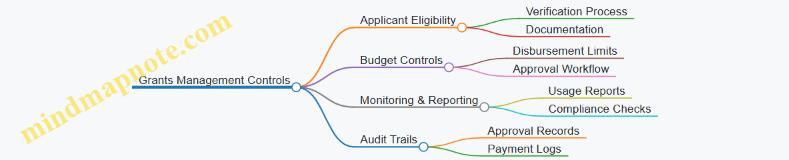
Accounts Payable Department
Key Controls Implemented:
- Invoice verification against purchase orders and delivery receipts
- Dual authorization for payments above threshold
- Timely payment processing to avoid penalties
- Fraud detection through anomaly monitoring
Example: In a finance department, invoices are matched with purchase orders and delivery confirmations before payment. Payments exceeding a set threshold require two levels of approval. The system flags unusual payment patterns for further investigation.
Mind Map:

Budgeting and Financial Planning Department
Key Controls Implemented:
- Budget preparation with stakeholder input
- Approval workflows for budget changes
- Variance analysis and reporting
- Forecasting accuracy reviews
Example: A government finance planning team collaborates with department heads to prepare budgets. Any changes to approved budgets require formal approval. Monthly variance reports highlight deviations, prompting corrective actions.
Mind Map:

Treasury Department
Key Controls Implemented:
- Cash flow monitoring and forecasting
- Investment authorization and limits
- Bank reconciliations
- Access controls to treasury systems
Example: The treasury department maintains daily cash flow reports and forecasts to ensure liquidity. Investments are made only within authorized limits and require multi-level approvals. Bank reconciliations are performed monthly to detect discrepancies.
Mind Map:

Summary
These examples demonstrate how financial controls must be customized to the operational context of each department. By implementing clear segregation of duties, authorization workflows, verification processes, and monitoring mechanisms, organizations can significantly reduce risks and enhance financial governance.
Embedding these controls into daily operations, supported by technology and continuous training, ensures sustainable financial integrity across all departments.
12.5 Summary of Key Takeaways and Actionable Insights
In this final section, we consolidate the essential lessons from the comprehensive exploration of financial governance and control, providing actionable insights to empower accountants and governance officers in the finance and government sectors.
Key Takeaways
-
Strong Governance Frameworks Are Foundational: Establishing clear policies, roles, and reporting lines creates the backbone for effective financial control.
-
Internal Controls Must Be Practical and Enforced: Segregation of duties, authorization protocols, and regular reconciliations prevent errors and fraud.
-
Risk Management is Integral: Proactively identifying and mitigating financial risks safeguards organizational assets.
-
Transparency and Accurate Reporting Build Trust: Adhering to regulatory standards and ensuring completeness in reports enhances stakeholder confidence.
-
Compliance is Continuous: Ongoing training, monitoring, and use of compliance tools reduce regulatory breaches.
-
Technology Enhances Control but Requires Oversight: Automation and advanced tools improve efficiency but must be carefully managed to avoid new risks.
-
Culture and Communication Matter: Collaboration across departments and fostering a governance mindset are critical for sustained success.
-
Continuous Improvement Drives Maturity: Regular assessments, audits, and benchmarking enable organizations to evolve and strengthen their governance.
Actionable Insights
Build and Document Your Governance Framework
- Develop clear financial policies tailored to your organization’s needs.
- Define roles and responsibilities explicitly to avoid overlaps.
Implement and Monitor Internal Controls
- Use simple segregation of duties examples, e.g., different people handle invoice approval and payment processing.
- Schedule periodic reconciliations and surprise audits.
Integrate Risk Management in Daily Operations
- Maintain a risk register updated with emerging financial risks.
- Conduct scenario analyses to prepare for potential budget shortfalls.
Enhance Financial Reporting Practices
- Use checklists to ensure completeness before report submission.
- Train staff on common reporting errors and how to avoid them.
Strengthen Compliance Programs
- Organize regular training sessions on relevant regulations.
- Deploy compliance management software to track adherence.
Leverage Technology Wisely
- Automate repetitive tasks like data entry but retain manual review for exceptions.
- Implement cybersecurity protocols to protect financial data.
Foster a Governance Culture
- Encourage open communication channels for reporting concerns.
- Recognize and reward adherence to governance practices.
Pursue Continuous Improvement
- Conduct annual governance maturity assessments.
- Benchmark against peer organizations and adopt best practices.
Mind Maps
Mind Map 1: Financial Governance Core Components
Mind Map 2: Internal Controls Example - Invoice Processing
Mind Map 3: Risk Management Cycle
Practical Example: Applying Key Takeaways
Scenario: A government department noticed recurring budget overruns.
Action Steps:
- Established a cross-functional governance committee to oversee budgeting.
- Implemented segregation of duties by separating budget preparation and approval.
- Introduced monthly variance analysis reports reviewed by senior management.
- Adopted budgeting software with automated alerts for overspending.
- Conducted training sessions on financial policies and compliance.
Result: Within one fiscal year, budget overruns reduced by 40%, and reporting accuracy improved significantly.
By internalizing these key takeaways and applying the actionable insights, accountants and governance officers can significantly enhance financial governance and control within their organizations, ensuring accountability, transparency, and sustainable financial health.