Accounting for Stock Options
1. Introduction to Stock Options
1.1 Definition and Types of Stock Options
What Are Stock Options?
Stock options are financial instruments that give an employee or investor the right, but not the obligation, to buy or sell shares of a company’s stock at a predetermined price (known as the exercise or strike price) within a specified time period.
They are widely used as a form of equity compensation to align the interests of employees and shareholders, incentivizing employees to contribute to the company’s growth and success.
Mind Map: Stock Options Overview
Types of Stock Options
-
Non-Qualified Stock Options (NSOs)
- Can be granted to employees, directors, contractors, and others.
- Taxed as ordinary income upon exercise.
- Simpler regulatory requirements.
-
Incentive Stock Options (ISOs)
- Only granted to employees.
- Potential for favorable tax treatment (capital gains) if holding period requirements are met.
- Subject to specific IRS rules and limitations.
-
Employee Stock Purchase Plans (ESPPs)
- Allow employees to purchase stock at a discount, often through payroll deductions.
- May have qualified and non-qualified versions.
Mind Map: Types of Stock Options
Example 1: Non-Qualified Stock Option
Sarah, a software engineer at a tech company, receives 1,000 NSOs with an exercise price of $10 per share. After 3 years, the stock price rises to $30. When Sarah exercises her options, she pays $10,000 (1,000 shares x $10) and can immediately sell the shares at $30,000, realizing a gain of $20,000. The $20,000 is taxed as ordinary income.
Example 2: Incentive Stock Option
John, an employee at the same company, is granted 1,000 ISOs at $10 per share. He exercises the options when the stock price is $30 but holds the shares for more than one year after exercise and two years after the grant date. When he sells at $50, the $40,000 gain ($50 - $10 x 1,000) is taxed at the lower capital gains rate.
Summary
Stock options are versatile equity instruments that come in various types, each with distinct tax and regulatory implications. Understanding these differences is crucial for accurate accounting and effective financial analysis.
This foundational knowledge sets the stage for deeper exploration of accounting practices and valuation methods in subsequent sections.
1.2 Importance of Stock Options in Corporate Finance
Stock options play a pivotal role in corporate finance, serving as a strategic tool for aligning the interests of employees, management, and shareholders. Their importance extends beyond mere compensation, influencing company performance, capital structure, and investor relations.
Why Stock Options Matter
- Incentivizing Performance: Stock options motivate employees and executives to work towards increasing the company’s stock price, directly linking compensation to company success.
- Attracting and Retaining Talent: Especially in competitive industries like tech and finance, stock options are a key part of compensation packages that attract top talent and reduce turnover.
- Cash Flow Management: Unlike direct salary increases, stock options allow companies to conserve cash while still offering valuable rewards.
- Aligning Interests: By giving employees a stake in the company, stock options align their interests with those of shareholders.
Mind Map: Importance of Stock Options in Corporate Finance
Example 1: Tech Startup Using Stock Options to Attract Talent
A tech startup with limited cash resources offers stock options to its early employees. Instead of paying high salaries, the company grants options that vest over four years. This approach helps the startup attract skilled developers who are motivated to contribute to the company’s growth, knowing their equity stake could be valuable if the company goes public or is acquired.
Example 2: Executive Compensation and Performance Alignment
A publicly traded company grants stock options to its CEO as part of the compensation package. The options vest only if the company meets specific performance targets, such as revenue growth and stock price appreciation. This structure ensures the CEO’s incentives are closely tied to shareholder value creation.
Mind Map: Benefits of Stock Options for Companies
Real-World Impact
Stock options have been instrumental in the success stories of many tech giants like Google and Facebook, where early employees benefited significantly from equity compensation. This not only rewarded employees but also fostered a culture of ownership and accountability.
Summary
Stock options are more than just a compensation mechanism; they are a strategic financial tool that impacts corporate governance, talent management, and financial planning. Understanding their importance helps accountants and equity analysts evaluate company strategies and financial health more effectively.
1.3 Overview of Accounting Challenges with Stock Options
Accounting for stock options presents unique challenges due to the complexity of valuation, timing, and regulatory requirements. Understanding these challenges is crucial for accountants and equity analysts to ensure accurate financial reporting and compliance.
Key Accounting Challenges
Valuation Challenges
- Fair Value Estimation: Determining the fair value of stock options at grant date is complex because options are derivative instruments whose value depends on multiple variables.
- Model Selection: Common models include Black-Scholes and the Binomial model. Choosing the appropriate model affects the accuracy of valuation.
- Assumptions & Inputs: Volatility, risk-free rate, expected life, and dividend yield must be estimated, often based on historical data or market conditions.
Example: A tech startup grants options to employees. The accountant uses the Black-Scholes model but struggles to estimate volatility due to limited trading history. They decide to use industry benchmarks to approximate volatility, documenting assumptions carefully.
Timing Challenges
- Grant Date Identification: The grant date is when the company and employee have a mutual understanding of the option terms. Delays or ambiguities can complicate this.
- Vesting Period: Stock options typically vest over time or upon performance milestones, requiring expense recognition to be spread accordingly.
- Expense Recognition: Determining the correct period over which to recognize compensation expense requires careful tracking of vesting schedules.
Example: An employee receives options with a 4-year vesting schedule. The company must recognize the expense evenly over those 4 years, adjusting for any forfeitures if the employee leaves early.
Regulatory Compliance Challenges
- IFRS 2 vs ASC Topic 718: Different accounting standards have nuanced differences in treatment, especially around measurement and disclosure.
- Disclosure Requirements: Companies must provide detailed notes on stock option plans, assumptions used, and expense recognized.
Example: A multinational company must reconcile differences between IFRS and US GAAP when consolidating financial statements, ensuring disclosures meet both standards.
Complexity in Modifications and Tax Implications
- Modifications & Cancellations: Changes to option terms after grant date require remeasurement and additional accounting entries.
- Tax Implications: Timing and amount of tax deductions may differ from expense recognition, requiring deferred tax accounting.
- Multiple Vesting Conditions: Performance and market conditions complicate the estimation of expense and require ongoing reassessment.
Example: A company reprices underwater options to motivate employees. This triggers additional expense recognition and requires careful documentation and compliance with accounting standards.
Summary Mind Map
By understanding these challenges and applying best practices with clear documentation and appropriate models, accountants and equity analysts can improve the accuracy and transparency of stock option accounting.
1.4 Real-World Example: Stock Options in a Tech Startup
To better understand how stock options work in practice, let’s explore a detailed example involving a fictional tech startup, “Innovatech,” which uses stock options as a key part of its employee compensation strategy.
Company Background
- Innovatech is a 3-year-old startup specializing in AI-driven software solutions.
- It has 50 employees, including engineers, sales, and management.
- To attract and retain talent, Innovatech grants stock options to employees as part of their compensation package.
Stock Option Grant Details
- Grant Date: January 1, 2024
- Number of Options Granted: 10,000 options to a senior engineer
- Exercise Price: $5 per share (equal to the fair market value at grant date)
- Vesting Schedule: 4 years with a 1-year cliff (25% after 1 year, then monthly vesting)
- Expiration: 10 years from grant date
Mind Map: Stock Option Components
Step 1: Determining Fair Value at Grant Date
Innovatech uses the Black-Scholes model to estimate the fair value of each option at the grant date. Key inputs include:
- Current stock price: $5
- Exercise price: $5
- Expected life: 6 years (based on expected employee behavior)
- Volatility: 40% (derived from comparable companies)
- Risk-free rate: 3%
- Dividend yield: 0%
Calculated fair value per option: $3.00
Total fair value of options granted: 10,000 x $3.00 = $30,000
Step 2: Expense Recognition Over Vesting Period
Since the options vest over 4 years, Innovatech recognizes the compensation expense evenly over this period, assuming no forfeitures.
- Annual expense = $30,000 / 4 = $7,500
Example Journal Entry (Year 1):
| Date | Account | Debit | Credit |
|---|---|---|---|
| 31-Dec-24 | Compensation Expense | $7,500 | |
| 31-Dec-24 | Additional Paid-in Capital | $7,500 |
Step 3: Vesting and Forfeitures
If the employee leaves after 18 months, only 37.5% of the options have vested (25% after 1 year + 12.5% over 6 months). The company will recognize expense only for the vested portion.
- Vested portion fair value = 10,000 x 37.5% x $3.00 = $11,250
- Expense recognized until termination date = $11,250
Mind Map: Expense Recognition Timeline
Step 4: Exercise of Options
If the employee exercises 3,000 vested options at $5 per share when the market price is $12:
- Cash received: 3,000 x $5 = $15,000
- Market value of shares issued: 3,000 x $12 = $36,000
Journal Entry:
| Date | Account | Debit | Credit |
|---|---|---|---|
| Exercise Date | Cash | $15,000 | |
| Exercise Date | Additional Paid-in Capital | $21,000 | |
| Exercise Date | Common Stock (par value) | $3,000 | |
| Exercise Date | Equity (APIC - Options) | $33,000 |
Note: Par value assumed $1 per share for illustration.
Summary Table: Key Figures
| Item | Value |
|---|---|
| Options Granted | 10,000 |
| Exercise Price | $5 |
| Fair Value per Option (BSM) | $3 |
| Total Fair Value | $30,000 |
| Vesting Period | 4 years |
| Annual Expense | $7,500 |
| Vested at 18 months | 37.5% (3,750) |
| Expense Recognized at 18 mo | $11,250 |
| Options Exercised | 3,000 |
| Cash Received on Exercise | $15,000 |
Conclusion
This example illustrates the practical steps accountants and equity analysts take to measure, recognize, and report stock options in a startup environment. By understanding the grant terms, applying valuation models, and carefully tracking vesting and exercises, professionals can ensure accurate financial reporting and compliance with accounting standards.
2. Regulatory Framework and Standards
2.1 Overview of IFRS 2 and ASC Topic 718
Accounting for stock options is governed primarily by two major standards depending on the jurisdiction: IFRS 2 (International Financial Reporting Standard 2) and ASC Topic 718 (Accounting Standards Codification Topic 718) under US GAAP. Both standards aim to ensure transparent and consistent reporting of share-based payments, but they have nuanced differences in scope, measurement, and disclosure requirements.
Mind Map: Key Components of IFRS 2 and ASC Topic 718
IFRS 2: Key Highlights
- Scope: Applies to all share-based payment transactions, including equity-settled, cash-settled, and transactions with cash alternatives.
- Measurement: For equity-settled awards, fair value is measured at the grant date and is not remeasured subsequently. For cash-settled awards, fair value is remeasured at each reporting date.
- Expense Recognition: The total fair value of the award is recognized as an expense over the vesting period, reflecting the service received.
- Disclosure: Requires detailed disclosures about the nature and extent of share-based payment arrangements, how fair value was determined, and the effect on profit or loss.
Example: IFRS 2 Equity-Settled Stock Option
A company grants 1,000 stock options to an employee on January 1, 2024. The fair value per option at grant date is $10, and the options vest over 4 years.
- Total fair value: 1,000 x $10 = $10,000
- Annual expense recognized: $10,000 / 4 = $2,500
Journal entry each year:
Dr. Employee Compensation Expense $2,500
    Cr. Equity - Stock Options $2,500
ASC Topic 718: Key Highlights
- Scope: Covers all share-based payments to employees, including stock options, restricted stock units, and other equity instruments.
- Measurement: Fair value is measured at grant date using an option pricing model (e.g., Black-Scholes). Unlike IFRS, equity awards are not remeasured after grant.
- Expense Recognition: Expense is recognized over the requisite service period, using either straight-line or graded vesting methods.
- Disclosure: Requires disclosures about the nature and terms of awards, assumptions used in valuation, and the effect on earnings per share (EPS).
Example: ASC 718 Graded Vesting Expense
A company grants 1,000 options vesting 25% each year over 4 years. Fair value per option is $12.
- Total fair value: 1,000 x $12 = $12,000
- Expense recognized each year (graded vesting):
- Year 1: 25% x $12,000 = $3,000
- Year 2: 25% x $12,000 = $3,000
- Year 3: 25% x $12,000 = $3,000
- Year 4: 25% x $12,000 = $3,000
Journal entry each year:
Dr. Compensation Expense $3,000
    Cr. Additional Paid-in Capital $3,000
Mind Map: Differences Between IFRS 2 and ASC Topic 718
Best Practices for Compliance
- Understand the jurisdictional requirements: Apply IFRS 2 for international entities and ASC 718 for US-based or SEC registrants.
- Use appropriate valuation models: Black-Scholes or binomial models are common; ensure assumptions are documented.
- Maintain detailed records: Track grant dates, vesting conditions, modifications, and exercises.
- Regularly review disclosures: Ensure transparency and completeness to satisfy auditors and regulators.
This foundational understanding of IFRS 2 and ASC Topic 718 sets the stage for deeper exploration of grant date accounting, vesting conditions, and expense recognition in subsequent sections.
2.2 Key Differences Between IFRS and US GAAP in Stock Option Accounting
Stock option accounting under IFRS and US GAAP shares many similarities but also exhibits important differences that accountants and equity analysts must understand to ensure accurate financial reporting. This section explores these key differences with clear examples and mind maps to facilitate comprehension.
Overview Mind Map
Measurement of Fair Value at Grant Date
IFRS:
- Requires measurement of the fair value of the equity instruments granted at the grant date.
- Uses the “fair value” approach, often employing option pricing models like Black-Scholes or Monte Carlo simulations.
- If the fair value cannot be reliably estimated, the intrinsic value method can be used, but this is rare.
US GAAP:
- Also requires fair value measurement at grant date.
- Primarily uses the Black-Scholes or lattice models.
- Intrinsic value method was eliminated for most awards after the adoption of ASC 718.
Example: A company grants 1,000 stock options with a grant date fair value of $10 per option.
- Under both IFRS and US GAAP, the total compensation cost is $10,000.
Treatment of Vesting Conditions
| Aspect | IFRS (IFRS 2) | US GAAP (ASC 718) | |
|---|---|---|---|
| Service Conditions | Required to be met for vesting | Required to be met for vesting | |
| Performance Conditions | Separated into market and non-market conditions - Market conditions: included in fair value at grant date - Non-market conditions: accounted for by adjusting expense based on probability | Similar treatment - Market conditions: included in fair value - Non-market conditions: accounted for by adjusting expense based on probability | |
| Cancellations | Treated as forfeitures when they occur | Treated as forfeitures when they occur |
Mind Map:
Example: A company grants options with a performance condition tied to revenue growth (non-market). Initially, management estimates a 70% chance of meeting the target.
- IFRS and US GAAP: Expense recognized is adjusted as the probability estimate changes.
Modifications and Repricing
IFRS:
- If the modification increases the fair value or changes the vesting conditions, incremental expense is recognized.
- The incremental fair value is the difference between the modified and original fair value at the modification date.
US GAAP:
- Similar approach; incremental fair value is recognized as additional compensation cost.
- Requires reassessment of vesting conditions and fair value.
Example: Original option fair value: $8 Modified option fair value: $12
- Incremental expense: $4 per option recognized over the remaining vesting period.
Expense Recognition and Forfeitures
IFRS:
- Expense recognized over the vesting period based on grant date fair value.
- Forfeitures are accounted for as they occur; no upfront estimation.
US GAAP:
- Expense recognized over the vesting period.
- Forfeitures can be estimated upfront and adjusted, or accounted for as they occur (policy choice).
Mind Map:
Example: A company grants options vesting over 4 years with a total fair value of $40,000.
- IFRS: Recognize $10,000 expense each year, adjusting for actual forfeitures.
- US GAAP: If estimating 10% forfeitures upfront, recognize $9,000 expense per year, adjusting if actual forfeitures differ.
Tax Effects
IFRS:
- Deferred tax recognized for temporary differences.
- No specific guidance on tax benefits from stock options; local tax laws apply.
US GAAP:
- Requires recognition of deferred tax assets and valuation allowances.
- Excess tax benefits from stock option exercises are recognized in equity.
Summary Table of Key Differences
| Topic | IFRS (IFRS 2) | US GAAP (ASC 718) |
|---|---|---|
| Fair Value Measurement | Fair value at grant date, intrinsic value rarely used | Fair value at grant date, intrinsic value method eliminated |
| Vesting Conditions | Market conditions included in fair value; non-market adjusted | Same as IFRS |
| Forfeitures | Accounted as they occur | Estimate upfront or as they occur |
| Modifications | Incremental fair value recognized | Incremental fair value recognized |
| Tax Effects | Deferred tax assets/liabilities recognized; local tax laws apply | Deferred tax assets/liabilities recognized; excess tax benefits recorded in equity |
Understanding these differences is crucial for accountants and equity analysts working across jurisdictions or with multinational companies. Accurate application ensures compliance, transparent reporting, and informed decision-making.
Additional Resources
- IFRS Foundation: IFRS 2 Share-based Payment
- FASB Accounting Standards Codification Topic 718
End of Section 2.2
2.3 Disclosure Requirements and Compliance Best Practices
Accounting for stock options involves rigorous disclosure requirements designed to ensure transparency and provide stakeholders with a clear understanding of the company’s equity compensation plans. Compliance with these requirements not only fulfills regulatory obligations but also enhances investor confidence.
Key Disclosure Requirements
-
Description of the Stock Option Plan:
- Terms and conditions
- Eligibility criteria
- Vesting schedules
-
Number and Weighted Average Exercise Price:
- Outstanding options at the beginning and end of the period
- Options granted, exercised, forfeited, or expired during the period
-
Fair Value Measurement:
- Methodology used (e.g., Black-Scholes, Monte Carlo)
- Assumptions such as volatility, risk-free rate, expected life
-
Expense Recognition:
- Total compensation cost recognized during the period
- Unrecognized compensation cost and expected amortization period
-
Impact on Financial Statements:
- Effect on net income and earnings per share (EPS)
-
Tax Effects:
- Deferred tax assets or liabilities related to stock options
Compliance Best Practices Mind Map
Example: Disclosure Note for a Public Company
Note X: Stock-Based Compensation
The Company grants stock options to employees under its 2020 Equity Incentive Plan. Options generally vest over four years and expire ten years from the grant date.
| Description | Number of Options | Weighted Average Exercise Price ($) |
|---|---|---|
| Outstanding at January 1, 2023 | 1,000,000 | 15.00 |
| Granted during 2023 | 200,000 | 20.00 |
| Exercised during 2023 | (150,000) | 14.50 |
| Forfeited during 2023 | (50,000) | 16.00 |
| Outstanding at December 31, 2023 | 1,000,000 | 16.50 |
The fair value of options granted during 2023 was estimated using the Black-Scholes model with the following assumptions:
- Expected volatility: 30%
- Risk-free interest rate: 2.5%
- Expected life: 6 years
- Dividend yield: 0%
Stock-based compensation expense recognized in 2023 amounted to $3.2 million, with $1.8 million remaining to be recognized over the next three years.
The Company has recognized deferred tax assets of $0.9 million related to stock options.
Mind Map: Disclosure Components Breakdown
Summary
Effective disclosure of stock options requires a comprehensive approach combining detailed documentation, consistent valuation methodologies, and transparent communication. By adhering to best practices and regulatory requirements, accountants and equity analysts can ensure accurate reporting that supports informed decision-making by investors and other stakeholders.
2.4 Example: Preparing Disclosures for a Public Company
When preparing disclosures related to stock options for a public company, transparency and compliance with regulatory requirements are paramount. Disclosures provide stakeholders with insights into the nature, terms, and financial impact of stock option plans.
Key Disclosure Areas for Stock Options
Mind Map: Stock Option Disclosure Components
Example Disclosure Extract for a Public Company
Stock Option Plan
The Company maintains a stock option plan to attract, retain, and motivate employees and directors. Under the plan, options are granted with an exercise price equal to the market price on the grant date. Options generally vest over four years and expire ten years after the grant date.
Accounting Policies
Stock options are measured at fair value on the grant date using the Black-Scholes option pricing model. Compensation expense is recognized on a straight-line basis over the vesting period, adjusted for estimated forfeitures.
Stock Option Activity
| Description | Number of Options | Weighted Average Exercise Price |
|---|---|---|
| Outstanding at Jan 1 | 1,200,000 | $15.00 |
| Granted | 300,000 | $20.00 |
| Exercised | (150,000) | $14.00 |
| Forfeited | (50,000) | $18.00 |
| Outstanding at Dec 31 | 1,300,000 | $16.50 |
Fair Value Assumptions
- Expected volatility: 35%
- Risk-free interest rate: 2.5%
- Expected term: 6 years
- Dividend yield: 1.2%
Compensation Expense
Total stock-based compensation expense recognized for the year was $3.5 million. As of December 31, $2.1 million of unrecognized compensation cost related to non-vested options is expected to be recognized over a weighted-average period of 2.8 years.
Tax Effects
The Company recorded a deferred tax asset of $0.9 million related to stock option deductions expected upon exercise. Tax benefits realized from option exercises during the year totaled $1.2 million.
Best Practices for Preparing Disclosures
- Be Clear and Concise: Use straightforward language to explain complex terms.
- Use Tables and Charts: Summarize option activity and assumptions visually.
- Update Regularly: Reflect changes in plans, assumptions, and regulations.
- Coordinate with Legal and Tax Teams: Ensure accuracy and compliance.
- Provide Context: Explain how stock options impact financial performance.
By following these guidelines and using the example above as a template, accountants and equity analysts can prepare comprehensive, compliant, and insightful stock option disclosures for public companies.
3. Grant Date Accounting
3.1 Identifying the Grant Date and Its Significance
The grant date is a critical concept in accounting for stock options. It is the date on which the company and the employee have a mutual understanding of the terms and conditions of the stock option award. This date marks the point at which the fair value of the stock options is measured and from which the expense recognition period begins.
Why is the Grant Date Important?
- Establishes the fair value measurement point
- Determines the start of the vesting period for expense recognition
- Sets the contractual terms and conditions of the award
- Impacts financial reporting and tax treatment
Mind Map: Key Aspects of the Grant Date
Determining the Grant Date
The grant date is typically identified as the date when all of the following conditions are met:
- Approval by the Board of Directors or Compensation Committee: The stock option plan or award must be formally approved.
- Communication to the Employee: The employee must be informed of the award and its terms.
- No Further Negotiations: The terms are fixed and not subject to change.
If these conditions occur on different dates, the grant date is the earliest date when all are satisfied.
Mind Map: Steps to Identify Grant Date
Example 1: Simple Grant Date Identification
Scenario:
- March 1: Board approves stock option plan.
- March 5: Employee receives grant letter.
- March 10: Employee accepts terms.
Grant Date: March 10, because this is when all conditions are met — approval, communication, and acceptance.
Example 2: Complex Scenario with Delayed Acceptance
Scenario:
- April 1: Board approves award.
- April 3: Employee notified.
- April 15: Employee negotiates minor changes.
- April 20: Final terms agreed.
Grant Date: April 20, as the terms were not finalized until this date.
Significance in Accounting
- Fair Value Measurement: The stock option’s fair value is measured at the grant date using valuation models such as Black-Scholes or Monte Carlo simulations.
- Expense Recognition: The total compensation cost is recognized over the vesting period starting from the grant date.
- Financial Reporting: Accurate identification ensures compliance with IFRS 2 and ASC 718 standards.
Mind Map: Grant Date and Accounting Impact
Best Practices
- Maintain clear documentation of board approvals and employee communications.
- Confirm mutual agreement on terms before finalizing the grant date.
- Use consistent internal controls to identify and record the grant date.
- Train accounting and HR teams on the importance of the grant date.
By properly identifying the grant date, accountants and equity analysts ensure accurate valuation and reporting of stock options, which is essential for transparent financial statements and regulatory compliance.
3.2 Measuring Fair Value at Grant Date
Measuring the fair value of stock options at the grant date is a critical step in the accounting process. It determines the total compensation cost that will be recognized over the vesting period. The fair value reflects the estimated value of the option based on various assumptions and valuation models.
Key Concepts in Fair Value Measurement
- Grant Date: The date on which the company and the employee agree to the stock option terms.
- Fair Value: The estimated price at which the option would be exchanged in an arm’s length transaction.
- Valuation Models: Mathematical models used to estimate the fair value, such as Black-Scholes or Binomial models.
Mind Map: Factors Influencing Fair Value Measurement
Valuation Models Overview
-
Black-Scholes Model
- Most commonly used for plain vanilla options.
- Assumes European-style exercise (only at expiration).
- Inputs: stock price, exercise price, time to expiration, volatility, risk-free rate, dividends.
-
Binomial Model
- Suitable for American-style options (exercisable anytime).
- Can incorporate complex features like early exercise and varying vesting conditions.
Example: Calculating Fair Value Using Black-Scholes Model
Scenario:
- Grant Date: Jan 1, 2024
- Current Stock Price: $50
- Exercise Price: $50
- Expected Life: 5 years
- Volatility: 30% (annualized)
- Risk-Free Rate: 3%
- Expected Dividends: 1% yield
Step-by-Step Calculation:
- Calculate d1 and d2:
\[ d1 = \frac{\ln(\frac{S}{K}) + (r - q + \frac{\sigma^2}{2})T}{\sigma \sqrt{T}} \]
\[ d2 = d1 - \sigma \sqrt{T} \]
Where:
- \(S\) = Current stock price = 50
- \(K\) = Exercise price = 50
- \(r\) = Risk-free rate = 0.03
- \(q\) = Dividend yield = 0.01
- \(\sigma\) = Volatility = 0.30
- \(T\) = Time to expiration = 5
- Calculate the option price:
\[ C = S e^{-qT} N(d1) - K e^{-rT} N(d2) \]
Where \(N(d)\) is the cumulative distribution function of the standard normal distribution.
- Result:
Using a calculator or spreadsheet, the fair value \(C\) is approximately $11.23 per option.
Mind Map: Steps to Measure Fair Value at Grant Date
Best Practices for Measuring Fair Value
- Use Market Data: Whenever possible, use observable market inputs such as stock price and volatility.
- Document Assumptions: Clearly document all assumptions used in the valuation model.
- Update Inputs for Modifications: If terms change, re-measure fair value accordingly.
- Leverage Technology: Use specialized software to reduce errors and improve efficiency.
Additional Example: Impact of Volatility on Fair Value
| Volatility | Fair Value (per option) |
|---|---|
| 20% | $7.85 |
| 30% | $11.23 |
| 40% | $15.60 |
Insight: Higher volatility increases the fair value of the stock option because it raises the probability of favorable stock price movements.
Summary
Measuring fair value at the grant date is foundational to stock option accounting. By understanding the inputs and applying appropriate valuation models, accountants and equity analysts can ensure accurate and compliant financial reporting.
3.3 Best Practices for Documenting Grant Date Assumptions
Documenting grant date assumptions is a critical step in the accounting for stock options. Accurate and comprehensive documentation ensures transparency, facilitates audit processes, and supports consistent application of valuation models. Below are best practices, supported by mind maps and examples, to help accountants and equity analysts effectively document these assumptions.
Key Elements to Document at Grant Date
- Grant Date Identification: Clearly specify the exact date when the stock options are granted.
- Option Terms: Include exercise price, vesting schedule, expiration date, and any special terms.
- Fair Value Assumptions: Document all inputs used in valuation models such as volatility, risk-free rate, expected life, and dividend yield.
- Employee Data: Number of options granted, employee classifications, and expected forfeiture rates.
- Market Conditions: Any market-based vesting conditions or performance criteria.
Mind Map: Components of Grant Date Assumptions
Best Practice #1: Use Standardized Templates
Create and use standardized documentation templates for all stock option grants. This ensures consistency and completeness across different grants and reporting periods.
Example:
| Field | Description | Example Value |
|---|---|---|
| Grant Date | Date options are granted | 2024-05-01 |
| Exercise Price | Price at which options can be exercised | $25.00 |
| Vesting Schedule | Timeline for vesting | 25% per year over 4 years |
| Expected Volatility | Estimated stock price volatility | 35% |
| Risk-Free Rate | Treasury yield for expected life | 2.5% |
| Expected Life | Expected option life in years | 6 years |
| Dividend Yield | Expected dividend rate | 1.2% |
| Forfeiture Rate | Estimated employee forfeiture | 5% |
Best Practice #2: Include Rationale for Assumptions
For each assumption, provide a brief rationale or source to justify the chosen value. This is especially important for subjective inputs like volatility and expected life.
Example:
- Volatility: Based on historical stock price data over the past 3 years.
- Expected Life: Derived from historical exercise behavior of employees in similar roles.
- Forfeiture Rate: Estimated from prior year’s employee turnover statistics.
Mind Map: Documenting Rationale for Assumptions
Best Practice #3: Maintain Version Control and Audit Trail
Keep track of all versions of grant date assumption documents, including updates and approvals. This helps in audits and when assumptions need to be revisited.
Example:
- Document version: v1.0
- Prepared by: Jane Doe
- Date: 2024-05-01
- Reviewed by: John Smith
- Date of review: 2024-05-03
Any changes to assumptions after initial documentation should be logged with reasons and dates.
Best Practice #4: Use Visual Aids to Summarize Assumptions
Incorporate charts or mind maps in documentation to provide a quick overview of key assumptions and their interrelations.
Example Mind Map: Summary of Grant Date Assumptions
Best Practice #5: Align Assumptions with Company Policies and Market Conditions
Ensure that assumptions reflect current company policies, market conditions, and any recent changes in employee behavior or economic environment.
Example: If the company has recently changed its dividend policy to increase payouts, update the dividend yield assumption accordingly.
Summary
Documenting grant date assumptions thoroughly and clearly is essential for accurate stock option accounting. Using standardized templates, providing rationale, maintaining version control, employing visual aids, and aligning assumptions with real-world conditions are best practices that enhance reliability and audit readiness.
By following these best practices, accountants and equity analysts can ensure that the valuation of stock options is well-supported, transparent, and compliant with accounting standards.
3.4 Example: Calculating Grant Date Fair Value Using Black-Scholes Model
Understanding the fair value of stock options at the grant date is critical for accurate accounting and financial reporting. The Black-Scholes model is one of the most widely used methods for estimating this fair value. Below, we will walk through a detailed example, supported by mind maps to clarify the process.
What is the Black-Scholes Model?
The Black-Scholes model is a mathematical formula used to estimate the theoretical price of European-style options. It takes into account several variables to calculate the option’s fair value.
Key Inputs for Black-Scholes Model
Mind Map: Black-Scholes Model Inputs
Step-by-Step Calculation Example
Scenario:
- Current Stock Price (S): $50
- Exercise Price (K): $55
- Time to Expiration (T): 3 years
- Risk-Free Interest Rate (r): 4% (0.04)
- Volatility (σ): 30% (0.30)
- Dividend Yield (q): 2% (0.02)
Step 1: Calculate d1 and d2
Formulas:
\[ d_1 = \frac{\ln(\frac{S}{K}) + (r - q + \frac{\sigma^2}{2})T}{\sigma \sqrt{T}} \]
\[ d_2 = d_1 - \sigma \sqrt{T} \]
Calculations:
- \( \ln(\frac{50}{55}) = \ln(0.9091) = -0.0953 \)
- \( (0.04 - 0.02 + \frac{0.30^2}{2}) \times 3 = (0.02 + 0.045) \times 3 = 0.195 \)
- Numerator for d1: \( -0.0953 + 0.195 = 0.0997 \)
- Denominator for d1: \( 0.30 \times \sqrt{3} = 0.30 \times 1.732 = 0.5196 \)
Thus,
\[ d_1 = \frac{0.0997}{0.5196} = 0.192 \]
\[ d_2 = 0.192 - 0.5196 = -0.3276 \]
Step 2: Calculate N(d1) and N(d2)
N(d) is the cumulative distribution function of the standard normal distribution.
Using standard normal tables or a calculator:
- N(d1) = N(0.192) ≈ 0.576
- N(d2) = N(-0.328) ≈ 0.372
Step 3: Calculate the Option Price (C)
Formula:
\[ C = S e^{-qT} N(d_1) - K e^{-rT} N(d_2) \]
Calculations:
- \( S e^{-qT} = 50 \times e^{-0.02 \times 3} = 50 \times e^{-0.06} = 50 \times 0.9418 = 47.09 \)
- \( K e^{-rT} = 55 \times e^{-0.04 \times 3} = 55 \times e^{-0.12} = 55 \times 0.8869 = 48.78 \)
Therefore,
\[ C = 47.09 \times 0.576 - 48.78 \times 0.372 = 27.13 - 18.15 = 8.98 \]
Fair Value of the Stock Option at Grant Date = $8.98
Mind Map: Black-Scholes Calculation Flow
Practical Best Practices
- Use Reliable Market Data: Ensure volatility and risk-free rates are sourced from credible market data providers.
- Document Assumptions: Maintain clear documentation of all assumptions used in the model.
- Review and Update Regularly: Volatility and other inputs may change; update calculations if there is a significant delay between grant and reporting.
- Leverage Software Tools: Many accounting and financial software packages automate Black-Scholes calculations, reducing manual errors.
Additional Example: Impact of Volatility on Option Value
| Volatility | Option Fair Value ($) |
|---|---|
| 20% | 5.45 |
| 30% | 8.98 |
| 40% | 13.50 |
Higher volatility increases the option’s fair value, reflecting greater uncertainty and potential upside.
This example demonstrates how accountants and equity analysts can apply the Black-Scholes model to estimate the grant date fair value of stock options, ensuring compliance with accounting standards and supporting accurate financial reporting.
4. Vesting Conditions and Their Impact
4.1 Types of Vesting Conditions: Service and Performance
Vesting conditions are critical components in stock option agreements that determine when an employee earns the right to exercise their stock options. Understanding the types of vesting conditions is essential for accurate accounting and financial reporting.
Overview of Vesting Conditions
Vesting conditions generally fall into two broad categories:
- Service Vesting Conditions: Require the employee to remain employed for a specified period.
- Performance Vesting Conditions: Depend on achieving specific performance targets or milestones.
These conditions affect the timing and amount of expense recognition in the financial statements.
Mind Map: Types of Vesting Conditions
Service Vesting Conditions
Service vesting requires employees to stay with the company for a certain period before their options vest.
- Cliff Vesting: All options vest at once after a specified period (e.g., 4 years).
- Graded Vesting: Options vest gradually over time (e.g., 25% per year over 4 years).
Example:
An employee is granted 1,000 stock options with a 4-year graded vesting schedule (25% each year). After 2 years, 500 options have vested.
Accounting Implication: Expense is recognized proportionally over the vesting period based on the fair value at grant date.
Performance Vesting Conditions
Performance vesting depends on meeting specific targets, which can be classified as market or non-market conditions.
Market Conditions
Market conditions relate to the company’s stock price or market indices and affect the option’s fair value.
- Examples: Stock price reaching $50, or outperforming a benchmark index.
Accounting Treatment: Market conditions are factored into the fair value at grant date and do not affect the expense recognition pattern.
Example:
Options vest only if the company’s stock price exceeds $50 within 3 years. The fair value at grant date incorporates this condition using option pricing models.
Non-Market Conditions
Non-market conditions depend on operational or financial targets unrelated to stock price.
- Examples: Achieving $100M revenue, launching a new product, or hitting EPS targets.
Accounting Treatment: Expense recognition is adjusted based on the probability of achieving these targets, and the expense is revised if expectations change.
Example:
An employee’s options vest only if the company achieves $100M revenue in the fiscal year. Initially, the probability is estimated at 70%, so 70% of the expense is recognized. If the probability changes, the expense is adjusted accordingly.
Mind Map: Accounting Impact of Vesting Conditions
Integrated Example: Combining Service and Performance Vesting
Company XYZ grants 2,000 stock options to an employee with the following conditions:
- Vesting over 4 years (service condition)
- Options vest only if the company achieves a 10% revenue growth target each year (non-market performance condition)
Step 1: Determine fair value at grant date (assuming $10 per option).
Step 2: Estimate probability of meeting revenue targets (initially 80%).
Step 3: Expense recognition over 4 years:
- Annual expense = 2,000 options × $10 × 80% ÷ 4 = $4,000
Step 4: Adjust expense if probability changes:
- If probability drops to 50% in year 3, reduce remaining expense accordingly.
Best Practices
- Clearly document vesting conditions in grant agreements.
- Regularly reassess probabilities for non-market conditions.
- Use appropriate valuation models that incorporate market conditions.
- Maintain detailed tracking of employee service periods and performance milestones.
Understanding the nuances of service and performance vesting conditions ensures accurate stock option accounting and compliance with regulatory standards.
4.2 Accounting for Market vs. Non-Market Conditions
When accounting for stock options, understanding the distinction between market and non-market vesting conditions is crucial because they affect how and when compensation expense is recognized.
Definitions
- Market Conditions: Conditions related to the market price of the company’s stock, such as achieving a target share price or relative total shareholder return (TSR).
- Non-Market Conditions: Conditions unrelated to market performance, typically service conditions (e.g., continued employment) or performance conditions based on operational targets (e.g., revenue growth, EBITDA).
Key Accounting Principles
| Condition Type | Measurement Basis | Expense Recognition | Adjustments Over Time |
|---|---|---|---|
| Market | Fair value at grant date, including market condition | Recognized regardless of whether market condition is met | No adjustment for failure to meet market condition; expense remains unchanged |
| Non-Market | Fair value at grant date, excluding non-market condition | Recognized based on probability of satisfying condition | Adjusted for changes in probability of meeting condition |
Mind Map: Market vs. Non-Market Conditions
Detailed Explanation
Market Conditions
Market conditions are factored into the grant date fair value of the stock options using valuation models such as Black-Scholes or Monte Carlo simulations. Because these conditions are inherently uncertain and tied to stock price movements, accounting standards require that the entire compensation cost be recognized over the vesting period regardless of whether the market condition is ultimately met.
Example:
A company grants options with a market condition that the stock price must reach $100 within 3 years. The grant date fair value, which includes this market condition, is $15 per option.
- The company will recognize the full compensation expense based on the $15 fair value over the vesting period.
- If the stock price never reaches $100, the expense is not reversed.
Non-Market Conditions
Non-market conditions are not included in the grant date fair value calculation. Instead, the fair value is measured assuming these conditions will be met. The expense recognized is adjusted over the vesting period based on the probability of satisfying these conditions.
Example:
A company grants options with a service condition requiring 3 years of employment and a performance condition requiring $10 million in revenue growth.
- The grant date fair value is calculated without considering the revenue target.
- Initially, the company estimates a 70% chance of meeting the revenue target.
- Compensation expense is recognized based on this probability.
- If the probability changes to 90% in year 2, the expense is adjusted upward accordingly.
Mind Map: Example Walkthrough
Best Practices
- Clearly identify and classify vesting conditions at grant date.
- Use appropriate valuation models that incorporate market conditions accurately.
- Regularly update estimates of non-market condition probabilities and adjust expense accordingly.
- Document assumptions and changes thoroughly for audit and disclosure purposes.
Summary Table
| Aspect | Market Conditions | Non-Market Conditions |
|---|---|---|
| Included in Fair Value? | Yes | No |
| Expense Recognition Basis | Full grant date fair value over vesting | Adjusted for probability of achievement |
| Subsequent Adjustments | No | Yes |
| Examples | Stock price targets, TSR | Service period, revenue targets |
By understanding and applying these distinctions, accountants and equity analysts can ensure accurate and compliant accounting for stock options, reflecting the true economic impact of equity compensation.
4.3 Best Practices for Tracking and Updating Vesting Conditions
Tracking and updating vesting conditions accurately is crucial for ensuring the correct accounting treatment of stock options. Vesting conditions determine when employees earn the right to exercise their options, impacting expense recognition and financial reporting.
Key Best Practices for Tracking and Updating Vesting Conditions
- Establish Clear Documentation: Maintain detailed records of all vesting schedules, including service and performance conditions.
- Use Automated Tracking Systems: Implement software solutions to monitor vesting milestones and trigger updates.
- Regularly Review Performance Conditions: Since performance-based vesting can change, periodic reassessment is essential.
- Communicate Changes Promptly: Any modifications to vesting terms should be documented and communicated to accounting and HR teams.
- Integrate Cross-Functional Collaboration: Ensure coordination between finance, HR, and legal departments for consistent updates.
- Maintain Audit Trails: Keep logs of all changes to vesting conditions for compliance and audit purposes.
Mind Map: Tracking Vesting Conditions
Mind Map: Updating Vesting Conditions
Example 1: Tracking Service-Based Vesting
Scenario: An employee is granted stock options with a 4-year vesting schedule, vesting 25% each year.
Best Practice Application:
- Use an automated equity management system to track each anniversary date.
- The system sends alerts one month before each vesting date.
- HR confirms employee status (active, terminated) before vesting is recognized.
- Accounting records expense monthly based on the vesting schedule.
Outcome: Accurate, timely expense recognition and reduced risk of errors.
Example 2: Updating Performance-Based Vesting Conditions
Scenario: A company grants stock options with vesting contingent on achieving a revenue target within 2 years.
Best Practice Application:
- Finance team monitors quarterly revenue against targets.
- At the end of year 1, revenue is below target; the company revises the vesting probability to 50%.
- Accounting adjusts the cumulative expense recognized to date accordingly.
- All changes are documented and communicated to stakeholders.
Outcome: Reflects realistic expense recognition aligned with performance outcomes.
Summary
Tracking and updating vesting conditions requires a structured approach combining clear documentation, automation, frequent reviews, and cross-functional collaboration. By implementing these best practices, accountants and equity analysts can ensure accurate financial reporting and compliance.
4.4 Example: Adjusting Expense for Performance-Based Vesting
Performance-based vesting conditions require that certain performance targets be met before stock options vest. These conditions affect the expense recognition because the probability of meeting these targets can change over time, requiring adjustments to the recognized compensation expense.
Understanding Performance-Based Vesting Adjustments
When accounting for performance-based stock options, companies must estimate the likelihood that the performance conditions will be met at each reporting date. This probability estimate directly impacts the amount of expense recognized.
If the probability changes, the cumulative expense recognized to date must be adjusted accordingly.
Mind Map: Key Concepts in Adjusting Expense for Performance-Based Vesting
Example Scenario
Company ABC grants 10,000 stock options to an employee with a 3-year vesting period, contingent on achieving a revenue growth target.
- Grant date fair value per option: $15
- Vesting period: 3 years
- Performance condition: Revenue growth of 10% per year
At the grant date, management estimates a 60% probability that the target will be met.
Step 1: Initial Expense Recognition
- Total fair value = 10,000 options × $15 = $150,000
- Probability-adjusted fair value = $150,000 × 60% = $90,000
- Annual expense over 3 years = $90,000 / 3 = $30,000 per year
Journal entry each year:
Dr. Compensation Expense $30,000
  Cr. Additional Paid-in Capital - Stock Options $30,000
Step 2: Reassessment at Year 2
At the end of year 2, management revises the probability to 80% based on updated revenue forecasts.
- Revised total fair value = $150,000 × 80% = $120,000
- Cumulative expense to recognize by year 2 = $120,000 × (2/3) = $80,000
- Expense recognized to date = $30,000 (Year 1) + $30,000 (Year 2) = $60,000
- Additional expense to recognize in Year 2 = $80,000 - $60,000 = $20,000
Journal entry for Year 2 adjustment:
Dr. Compensation Expense $20,000
  Cr. Additional Paid-in Capital - Stock Options $20,000
Total expense recognized at the end of Year 2 is $80,000.
Step 3: Final Year Expense
At the end of Year 3, the performance target is met, confirming the 80% probability estimate.
- Total expense to recognize = $120,000
- Expense recognized to date = $80,000
- Expense for Year 3 = $120,000 - $80,000 = $40,000
Journal entry:
Dr. Compensation Expense $40,000
  Cr. Additional Paid-in Capital - Stock Options $40,000
Mind Map: Journal Entries Over Vesting Period
Key Takeaways
- Performance-based vesting requires continuous probability assessment.
- Expense adjustments reflect changes in estimated likelihood of achieving targets.
- Proper documentation of assumptions and changes is critical for audit and disclosure.
- Transparent communication in financial statements enhances stakeholder understanding.
This example illustrates how accountants and equity analysts should approach the dynamic nature of performance-based vesting conditions, ensuring expenses are accurately reflected in financial reporting.
5. Expense Recognition and Amortization
5.1 Calculating Total Compensation Cost
Calculating the total compensation cost of stock options is a fundamental step in accounting for equity-based compensation. This cost represents the fair value of the stock options granted to employees and must be recognized as an expense over the vesting period.
Key Concepts in Calculating Total Compensation Cost
- Grant Date Fair Value: The estimated value of stock options at the grant date, typically calculated using option pricing models such as Black-Scholes or a binomial model.
- Number of Awards Granted: The total number of stock options granted to employees.
- Vesting Period: The time over which employees earn the right to exercise their stock options.
- Forfeiture Rate: The estimated percentage of options expected to be forfeited before vesting.
Mind Map: Components of Total Compensation Cost
Step-by-Step Calculation Process
-
Determine the Grant Date Fair Value per Option
- Use an appropriate option pricing model.
- Input relevant assumptions (e.g., stock price, volatility).
-
Calculate the Total Fair Value of the Award
- Multiply the fair value per option by the number of options granted.
-
Adjust for Expected Forfeitures
- Multiply the total fair value by (1 - forfeiture rate).
-
Allocate Expense Over the Vesting Period
- Recognize the adjusted total compensation cost as an expense on a straight-line basis over the vesting period.
Mind Map: Calculation Workflow
Example: Calculating Total Compensation Cost
Scenario:
- Company ABC grants 10,000 stock options to employees.
- Grant date fair value per option (calculated via Black-Scholes): $15.
- Vesting period: 4 years.
- Estimated forfeiture rate: 10%.
Calculation:
-
Total fair value before forfeiture adjustment:
- 10,000 options × $15 = $150,000
-
Adjust for forfeitures:
- $150,000 × (1 - 0.10) = $135,000
-
Annual expense recognition:
- $135,000 ÷ 4 years = $33,750 per year
Interpretation: Company ABC will recognize $33,750 as stock option compensation expense each year over the 4-year vesting period.
Mind Map: Example Breakdown
Best Practices
- Use Reliable Valuation Models: Ensure assumptions like volatility and risk-free rate are based on current and relevant market data.
- Regularly Update Forfeiture Estimates: Adjust expense recognition if actual forfeitures differ significantly from estimates.
- Document Assumptions Clearly: Maintain transparency for auditors and stakeholders.
- Coordinate with HR: To track actual grants, forfeitures, and exercises accurately.
By following these steps and best practices, accountants and equity analysts can accurately calculate and recognize the total compensation cost associated with stock option grants, ensuring compliance and clear financial reporting.
5.2 Expense Recognition Over the Vesting Period
Expense recognition for stock options is a critical accounting process that ensures the compensation cost is matched with the period in which employees earn their awards. This section breaks down how to recognize expense over the vesting period with clear explanations, mind maps, and practical examples.
Understanding the Vesting Period
The vesting period is the timeframe during which employees must provide service to earn the right to exercise their stock options. Expense recognition aligns with this period to reflect the cost of compensation accurately.
Key Principles of Expense Recognition
- Total Compensation Cost: Determined at the grant date as the fair value of the stock options.
- Expense Allocation: This total cost is recognized as an expense over the vesting period.
- Straight-Line Method: Most common approach, spreading expense evenly unless service is non-linear.
- Adjustments: For forfeitures or changes in vesting conditions, expense recognition is adjusted accordingly.
Mind Map: Expense Recognition Process
Step-by-Step Example
Scenario:
- Grant Date: Jan 1, 2024
- Number of Options Granted: 1,000
- Fair Value per Option at Grant Date: $10
- Vesting Period: 4 years (service-based, straight-line)
- Estimated Forfeiture Rate: 5%
Step 1: Calculate Total Compensation Cost
Total fair value = 1,000 options × $10 = $10,000
Adjusting for forfeitures:
Expected options to vest = 1,000 × (1 - 0.05) = 950
Adjusted total compensation cost = 950 × $10 = $9,500
Step 2: Allocate Expense Over Vesting Period
Annual expense = $9,500 ÷ 4 years = $2,375 per year
Step 3: Record Expense Each Year
| Year | Expense Recognized | Cumulative Expense |
|---|---|---|
| 2024 | $2,375 | $2,375 |
| 2025 | $2,375 | $4,750 |
| 2026 | $2,375 | $7,125 |
| 2027 | $2,375 | $9,500 |
Mind Map: Adjusting for Forfeitures
Handling Changes in Vesting Conditions
If vesting conditions change (e.g., acceleration or extension), the expense recognition schedule must be updated to reflect the new vesting period or conditions.
Example: If the vesting period shortens from 4 years to 2 years after 1 year, the remaining expense must be recognized over the next year instead of the remaining 3 years.
Practical Tips and Best Practices
- Use robust tracking systems to monitor vesting and forfeitures.
- Regularly review forfeiture estimates and update expense accordingly.
- Document assumptions and changes in vesting conditions clearly.
- Coordinate with HR and legal teams to understand performance conditions.
Summary
Expense recognition over the vesting period ensures that stock option compensation costs are matched with the employee service period. Using clear estimates, adjusting for forfeitures, and updating for changes in vesting conditions are essential for accurate financial reporting.
5.3 Handling Modifications and Cancellations
Stock option modifications and cancellations are common events that can significantly impact the accounting treatment of stock-based compensation. Proper handling ensures accurate expense recognition and compliance with accounting standards such as ASC 718 and IFRS 2.
What Constitutes a Modification?
A modification occurs when the terms or conditions of an existing stock option award are changed. This can include:
- Changing the exercise price
- Extending the exercise period
- Altering vesting conditions
- Increasing the number of options granted
What Constitutes a Cancellation?
A cancellation happens when an option is terminated before it is exercised or vested, either voluntarily by the employee or by the company.
Mind Map: Handling Modifications and Cancellations
Accounting Treatment for Modifications
When a stock option is modified, the company must:
- Determine the fair value of the modified award at the modification date.
- Compare this fair value to the fair value of the original award immediately before the modification.
- Recognize any incremental compensation cost resulting from the modification over the remaining vesting period.
Key Point: The incremental cost is the difference between the fair value of the modified award and the original award.
Example: Modification of Exercise Price
Scenario:
- Original grant: 1,000 options with an exercise price of $50.
- Fair value at grant: $15 per option.
- After 1 year, the exercise price is reduced to $40 due to market conditions.
- Fair value of modified options at modification date: $20 per option.
- Remaining vesting period: 2 years.
Calculation:
- Incremental fair value = $20 - $15 = $5 per option
- Total incremental cost = 1,000 options * $5 = $5,000
- Recognize $5,000 over the remaining 2 years ($2,500 per year).
Accounting Treatment for Cancellations
When options are cancelled, the company must:
- Immediately recognize any unrecognized compensation cost related to the cancelled options.
- Reverse any previously recognized expense if applicable.
If the cancellation is accompanied by a replacement award, the accounting treatment depends on whether the replacement award is considered a modification or a new grant.
Example: Cancellation of Unvested Options
Scenario:
- 500 options granted with a fair value of $10 each.
- Vesting period: 4 years.
- After 2 years, 200 unvested options are cancelled.
- Previously recognized expense for cancelled options: 200 options * $10 * (2/4) = $1,000.
Accounting:
- Recognize the remaining unrecognized expense immediately: 200 options * $10 * (2/4) = $1,000.
- Total expense recognized for cancelled options: $2,000.
Best Practices for Handling Modifications and Cancellations
- Documentation: Maintain detailed records of all modifications and cancellations, including rationale and approval.
- Internal Controls: Implement controls to track changes and ensure timely and accurate accounting.
- Communication: Inform stakeholders, including auditors and equity analysts, about significant modifications or cancellations.
- Regular Review: Periodically review stock option plans to identify potential modifications or cancellations early.
Summary
Handling modifications and cancellations requires careful re-measurement and immediate recognition of incremental costs or remaining expenses. Using clear documentation, robust controls, and transparent communication helps ensure compliance and accurate financial reporting.
5.4 Example: Amortizing Stock Option Expense in Financial Statements
Amortizing stock option expense involves recognizing the total compensation cost related to stock options over the vesting period. This ensures that the expense is matched with the period in which employees earn the options.
Key Concepts Mind Map
Step-by-Step Example
Scenario:
A tech company grants 10,000 stock options to an employee on January 1, 2024. The options vest over 4 years with a straight-line vesting schedule (25% each year). The fair value of each option at the grant date is $15.
Step 1: Calculate Total Compensation Cost
- Total Compensation Cost = Number of Options × Fair Value per Option
- = 10,000 × $15 = $150,000
Step 2: Determine Annual Expense
- Vesting Period = 4 years
- Annual Expense = Total Compensation Cost ÷ Vesting Period
- = $150,000 ÷ 4 = $37,500 per year
Step 3: Record Expense Each Year
| Year | Expense Recognized | Cumulative Expense |
|---|---|---|
| 2024 | $37,500 | $37,500 |
| 2025 | $37,500 | $75,000 |
| 2026 | $37,500 | $112,500 |
| 2027 | $37,500 | $150,000 |
Step 4: Journal Entry Example (Year 1)
| Account | Debit | Credit |
|---|---|---|
| Stock-based Compensation Expense | $37,500 | |
| Additional Paid-in Capital (APIC) - Stock Options | $37,500 |
Mind Map: Journal Entry Flow
Adjusting for Forfeitures
If the employee leaves after 2 years and forfeits unvested options, the company needs to adjust the expense accordingly.
- Vested options after 2 years = 10,000 × 50% = 5,000
- Total compensation cost to recognize = 5,000 × $15 = $75,000
- Expense recognized over 2 years = $75,000 ÷ 2 = $37,500 per year
Revised Cumulative Expense Table:
| Year | Expense Recognized | Cumulative Expense |
|---|---|---|
| 2024 | $37,500 | $37,500 |
| 2025 | $37,500 | $75,000 |
No expense is recognized in years 3 and 4 due to forfeiture.
Practical Tips and Best Practices
- Consistent Methodology: Use a consistent amortization method (usually straight-line) unless a different method better reflects the pattern of employee service.
- Forfeiture Estimates: Regularly update forfeiture estimates and adjust expense accordingly.
- Documentation: Maintain clear documentation of grant dates, vesting schedules, and assumptions.
- System Integration: Utilize accounting software to automate amortization schedules and journal entries.
By following this approach, accountants and equity analysts can accurately amortize stock option expenses, ensuring compliance with accounting standards and providing transparent financial reporting.
6. Tax Implications and Accounting
6.1 Tax Deductibility of Stock Options
Understanding the tax deductibility of stock options is crucial for accountants and equity analysts to accurately assess the financial impact of equity-based compensation on a company’s tax position. This section explores the principles, rules, and practical examples related to the tax treatment of stock options.
Overview
Stock options provide employees the right to purchase company shares at a predetermined price. From a tax perspective, the timing and amount of deductible expenses for the company depend on the type of stock option granted and the jurisdiction’s tax laws.
Types of Stock Options and Their Tax Treatment
-
Non-Qualified Stock Options (NQSOs)
- Taxable to the employee at exercise
- Employer receives a tax deduction equal to the amount included in the employee’s income
-
Incentive Stock Options (ISOs)
- Generally no tax deduction for the employer unless a disqualifying disposition occurs
Mind Map: Tax Deductibility of Stock Options
Timing of Tax Deduction
For NQSOs, the employer’s tax deduction typically arises at the time the employee exercises the option. The deductible amount is the difference between the fair market value (FMV) of the stock at exercise and the exercise price paid by the employee.
For ISOs, the employer generally does not get a tax deduction unless the employee sells the stock before meeting specific holding period requirements (a disqualifying disposition).
Example 1: Tax Deductibility for NQSOs
Scenario:
- Employee granted NQSOs with an exercise price of $20 per share.
- At exercise, FMV is $50 per share.
- Employee exercises 1,000 options.
Calculation:
- Tax Deductible Amount = (FMV - Exercise Price) × Number of Options
- = ($50 - $20) × 1,000 = $30,000
Implication:
- Employer can claim a tax deduction of $30,000 in the year of exercise.
Example 2: Tax Treatment for ISOs
Scenario:
- Employee granted ISOs with an exercise price of $15.
- FMV at exercise is $40.
- Employee exercises 500 options but holds the shares.
Tax Implication:
- Employer does not get a tax deduction at exercise.
- If the employee sells the shares before the required holding period, the employer may claim a deduction equal to the amount included in the employee’s income.
Mind Map: Example Walkthrough for NQSOs
Jurisdictional Considerations
Tax rules vary by country. For example:
- In the United States, the Internal Revenue Code governs stock option taxation with clear distinctions between NQSOs and ISOs.
- In Canada, stock options may have different tax treatments, often with deductions available at exercise or sale.
- European countries have diverse rules, often requiring careful local tax consultation.
Best Practices for Accountants and Equity Analysts
- Maintain detailed records of grant dates, exercise dates, FMV, and exercise prices.
- Coordinate with tax advisors to understand jurisdiction-specific rules.
- Monitor employee dispositions to identify disqualifying events affecting deductibility.
- Ensure accurate timing of tax deductions in financial reporting.
Summary
Tax deductibility of stock options hinges on the option type, timing of exercise, and jurisdictional tax laws. NQSOs generally provide a clear tax deduction at exercise, while ISOs offer potential tax benefits to employees but limited deductions to employers unless certain conditions are met. Proper documentation and understanding of local tax rules are essential for accurate accounting and compliance.
6.2 Accounting for Deferred Tax Assets and Liabilities
When accounting for stock options, understanding the tax implications is crucial, especially the recognition of deferred tax assets (DTAs) and deferred tax liabilities (DTLs). These arise due to differences in the timing of expense recognition between financial accounting and tax reporting.
What Are Deferred Tax Assets and Liabilities?
- Deferred Tax Asset (DTA): Occurs when the tax deduction exceeds the book expense, leading to future tax benefits.
- Deferred Tax Liability (DTL): Occurs when the book expense exceeds the tax deduction, leading to future tax payments.
Why Do DTAs and DTLs Arise in Stock Option Accounting?
Stock options create differences because:
- For financial reporting, compensation expense is recognized over the vesting period based on the grant-date fair value.
- For tax purposes, the deduction is generally recognized when the option is exercised, and the amount is based on the intrinsic value (market price minus exercise price).
This timing and measurement difference creates temporary differences leading to DTAs or DTLs.
Mind Map: Deferred Tax Accounting for Stock Options
Step-by-Step Accounting Process
- Calculate cumulative stock-based compensation expense for financial reporting.
- Determine tax deduction amount at exercise (intrinsic value).
- Calculate the temporary difference:
- Temporary Difference = Cumulative Book Expense - Cumulative Tax Deduction
- Apply the enacted tax rate to temporary difference to find deferred tax asset or liability.
- Assess whether a valuation allowance is necessary for DTAs.
- Record journal entries to recognize deferred tax assets/liabilities.
Example 1: Recognizing Deferred Tax Asset
Scenario:
- Grant-date fair value per option: $10
- Number of options granted: 1,000
- Vesting period: 4 years
- Tax deduction per option at exercise (intrinsic value): $15
- Enacted tax rate: 30%
Year 2:
- Cumulative book expense recognized: $5,000 (500 options vested × $10 × 1 year)
- Tax deduction so far: $0 (no exercises yet)
Temporary difference:
- $5,000 (book) - $0 (tax) = $5,000
Deferred tax asset:
- $5,000 × 30% = $1,500
Journal entry:
Dr. Deferred Tax Asset 1,500
   Cr. Income Tax Benefit 1,500
This DTA reflects future tax savings when options are exercised.
Example 2: Deferred Tax Liability Scenario
In rare cases where the tax deduction is less than the book expense (e.g., due to forfeitures or changes in assumptions), a deferred tax liability may arise.
Scenario:
- Cumulative book expense: $8,000
- Tax deduction so far: $10,000
Temporary difference:
- $8,000 - $10,000 = -$2,000 (negative temporary difference)
Deferred tax liability:
- $2,000 × 30% = $600
Journal entry:
Dr. Income Tax Expense 600
   Cr. Deferred Tax Liability 600
Valuation Allowance Considerations
- If it is more likely than not that some or all of the deferred tax asset will not be realized (e.g., insufficient future taxable income), a valuation allowance must be recorded.
Example:
- Deferred tax asset: $1,500
- Management estimates only 70% realizability
Valuation allowance:
- $1,500 × 30% = $450
Journal entry:
Dr. Income Tax Expense 450
   Cr. Valuation Allowance 450
Summary Best Practices
- Maintain detailed tracking of cumulative book expense and tax deductions.
- Regularly update assumptions and tax rates to reflect current conditions.
- Assess valuation allowance each reporting period.
- Coordinate with tax teams to ensure alignment on exercise data and tax deductions.
- Disclose deferred tax assets and liabilities clearly in financial statements.
By carefully accounting for deferred tax assets and liabilities related to stock options, accountants and equity analysts can ensure accurate financial reporting and provide stakeholders with transparent insights into the company’s tax position.
6.3 Best Practices for Coordinating Tax and Financial Reporting
Coordinating tax and financial reporting for stock options is critical to ensure compliance, optimize tax benefits, and maintain accurate financial statements. Misalignment between tax and accounting treatments can lead to errors, restatements, or missed tax deductions.
Key Best Practices
-
Early Collaboration Between Tax and Accounting Teams
- Foster communication to align assumptions, timelines, and data.
- Jointly review stock option plans and changes.
-
Consistent Documentation and Tracking
- Maintain detailed records of grant dates, vesting schedules, exercises, cancellations, and modifications.
- Track tax basis and book basis separately but reconcile regularly.
-
Understand Differences in Tax and Accounting Treatments
- Tax deductions often occur at exercise or sale, while accounting expense is recognized over the vesting period.
- Deferred tax assets/liabilities must be recorded for timing differences.
-
Use Integrated Systems and Automation
- Implement software that supports both tax and financial reporting needs.
- Automate data flow to reduce manual errors.
-
Regular Reconciliation and Review
- Periodically reconcile book expense, tax deductions, and deferred tax balances.
- Adjust deferred tax assets/liabilities for changes in tax laws or valuation allowances.
-
Stay Updated on Regulatory Changes
- Monitor updates in tax codes and accounting standards affecting stock options.
- Train teams on implications and required adjustments.
Mind Map: Coordinating Tax and Financial Reporting for Stock Options
Example 1: Reconciling Tax Deduction and Book Expense
Scenario: A company grants stock options with a fair value of $100,000 recognized as expense over 4 years. The employees exercise options in year 3, generating a tax deduction of $120,000 due to an increase in stock price.
Accounting Treatment:
- Recognize $25,000 expense per year for 4 years.
- Record deferred tax asset/liability for timing differences.
Tax Treatment:
- Deduct $120,000 in year 3 when exercised.
Best Practice:
- Maintain a deferred tax asset for the difference between book expense recognized ($75,000 by year 3) and tax deduction ($120,000).
- Reconcile deferred tax balances quarterly.
Example 2: Using Integrated Software for Coordination
Scenario: A multinational tech company uses a cloud-based equity management platform that integrates with their ERP and tax software.
Benefits:
- Real-time updates on option grants, exercises, and cancellations.
- Automated calculation of book expense and tax deductions.
- Generates reports for both accounting and tax teams.
Best Practice:
- Regularly validate data inputs.
- Schedule monthly cross-functional meetings to review reports.
Summary
Coordinating tax and financial reporting for stock options requires proactive communication, robust documentation, understanding of differing treatments, and leveraging technology. By following these best practices, organizations can ensure accurate reporting, optimize tax benefits, and reduce compliance risks.
6.4 Example: Recording Tax Effects of Stock Option Exercises
When employees exercise stock options, companies must account not only for the equity transactions but also for the related tax effects. This section provides a detailed example of how to record the tax effects arising from stock option exercises, including journal entries and a mind map to visualize the process.
Understanding the Tax Effects
When stock options are exercised, the company may receive a tax deduction equal to the intrinsic value of the options at exercise (i.e., the difference between the market price and the exercise price). This creates a deferred tax asset or reduces deferred tax liabilities, impacting the company’s tax expense.
Mind Map: Tax Effects of Stock Option Exercises
Example Scenario
- Company: Tech Solutions Inc.
- Employee stock options exercised: 10,000 options
- Exercise price per option: $15
- Market price at exercise: $25
- Tax rate: 30%
- Previously recognized compensation expense: $50,000
Step 1: Calculate Intrinsic Value and Tax Deduction
- Intrinsic value per option = Market Price - Exercise Price = $25 - $15 = $10
- Total intrinsic value = 10,000 options * $10 = $100,000
- Tax deduction = $100,000 * 30% = $30,000
Step 2: Journal Entries for Exercise
- Record cash received from exercise:
Dr. Cash $150,000 (10,000 options * $15 exercise price)
  Cr. Common Stock (par value) $X
  Cr. Additional Paid-in Capital $Y
Note: The exact split between Common Stock and Additional Paid-in Capital depends on par value.
- Remove previously recognized compensation expense from Equity:
Dr. Additional Paid-in Capital - Stock Options $50,000
  Cr. Compensation Expense (or Retained Earnings if reversing) $50,000
- Record tax benefit from exercise:
Dr. Deferred Tax Asset $30,000
  Cr. Income Tax Expense $30,000
Step 3: Explanation
- The company receives $150,000 cash from the employee exercising the options.
- The intrinsic value of $100,000 creates a tax deduction, resulting in a $30,000 tax benefit.
- The deferred tax asset reflects the expected future tax benefit.
- Income tax expense is reduced by the tax benefit amount.
Additional Mind Map: Journal Entry Flow
Summary
Recording the tax effects of stock option exercises requires careful calculation of the intrinsic value, understanding the tax deduction, and reflecting these in the financial statements through appropriate journal entries. This example demonstrates best practices for accountants and equity analysts to ensure accurate and compliant accounting treatment.
For further reading, refer to ASC 718 and IAS 12 for detailed guidance on tax accounting related to stock-based compensation.
7. Stock Option Exercises and Settlements
7.1 Accounting for Cash vs. Equity Settled Options
Stock options can be settled in two primary ways: cash-settled or equity-settled. Understanding the accounting treatment for each is crucial for accurate financial reporting and compliance.
Overview
- Equity-Settled Stock Options: The company issues its own shares to employees upon exercise.
- Cash-Settled Stock Options: The company pays the employee the cash equivalent of the stock option’s value instead of issuing shares.
Mind Map: Settlement Types and Accounting Implications
Equity-Settled Stock Options
Accounting Treatment:
- Measure the fair value of the options at the grant date.
- Recognize compensation expense over the vesting period.
- Credit equity (usually Additional Paid-in Capital) for the same amount.
- No subsequent remeasurement after grant date.
Example:
ABC Tech grants 1,000 stock options to an employee on January 1, 2024. The fair value per option at grant date is $10. The options vest over 4 years.
- Total compensation cost = 1,000 × $10 = $10,000
- Annual expense recognized = $10,000 / 4 = $2,500
Journal Entry (each year):
| Date | Account | Debit | Credit |
|---|---|---|---|
| Year-end | Compensation Expense | $2,500 | |
| Year-end | Additional Paid-in Capital | $2,500 |
Cash-Settled Stock Options
Accounting Treatment:
- Recognize a liability for the fair value of the options.
- Measure the fair value at grant date and remeasure at each reporting date until settlement.
- Recognize compensation expense over the vesting period based on changes in liability.
Example:
XYZ Corp grants 500 cash-settled stock options on January 1, 2024. The fair value per option at grant date is $8. At the end of year 1, the fair value changes to $9.
- Initial total liability = 500 × $8 = $4,000
- After year 1, liability remeasured to 500 × $9 = $4,500
Year 1 Compensation Expense:
Assuming straight-line vesting over 4 years, recognize 25% of the grant date fair value plus adjustment for remeasurement:
- Base expense = $4,000 × 25% = $1,000
- Increase in liability = $4,500 - $4,000 = $500
- Total expense = $1,000 + $500 = $1,500
Journal Entry (end of Year 1):
| Date | Account | Debit | Credit |
|---|---|---|---|
| Year-end | Compensation Expense | $1,500 | |
| Year-end | Liability for Stock Options | $1,500 |
Mind Map: Key Differences Between Equity and Cash Settled Options
Best Practices
- Documentation: Clearly identify the settlement type at grant date.
- Valuation: Use appropriate valuation models (e.g., Black-Scholes) to determine fair value.
- Regular Remeasurement: For cash-settled options, update fair value at each reporting date.
- Internal Controls: Ensure robust tracking of vesting conditions and exercise activity.
- Disclosure: Transparently disclose the nature of stock options and related accounting policies.
Summary Table
| Aspect | Equity-Settled Options | Cash-Settled Options |
|---|---|---|
| Recognition | Compensation expense over vesting | Compensation expense + liability remeasurement |
| Measurement Date | Grant date fair value only | Grant date and each reporting date |
| Balance Sheet Impact | Equity (Additional Paid-in Capital) | Liability |
| Cash Flow Impact | No immediate cash outflow | Cash outflow on settlement |
| Remeasurement Requirement | No | Yes |
Understanding these distinctions helps accountants and equity analysts accurately reflect stock option costs and obligations, ensuring compliance and providing stakeholders with clear financial insights.
7.2 Impact of Early Exercises and Forfeitures
Stock options are a common form of equity compensation, but their accounting can become complex when employees exercise options earlier than the scheduled vesting or when options are forfeited. Understanding the impact of early exercises and forfeitures is crucial for accurate financial reporting and compliance.
Early Exercises: Definition and Accounting Implications
Early exercise occurs when an employee exercises stock options before they are fully vested or before the expected exercise date. This can happen for various reasons, including tax planning or personal financial strategy.
Accounting Considerations:
- When options are exercised early but unvested, companies often implement a repurchase right to buy back unvested shares if the employee leaves.
- The company must continue to recognize compensation expense over the original vesting period for unvested shares.
- The fair value of the options at grant date remains the basis for expense recognition.
Mind Map: Early Exercises Accounting Flow
Example 1: Early Exercise with Repurchase Rights
An employee is granted 1,000 stock options vesting over 4 years. After 1 year, the employee exercises all options early. The company issues shares but retains the right to repurchase unvested shares if the employee leaves.
- The company continues to recognize compensation expense for the remaining 3 years on the unvested portion.
- Shares issued are classified as issued but subject to repurchase, affecting equity presentation.
Forfeitures: Definition and Accounting Treatment
Forfeiture occurs when an employee leaves the company or fails to meet vesting conditions, resulting in the loss of unvested stock options.
Accounting Considerations:
- Companies must estimate forfeiture rates at grant date and adjust compensation expense accordingly.
- Actual forfeitures reduce the total expense recognized going forward.
- Adjustments are made prospectively; prior expense recognized is not reversed.
Mind Map: Forfeitures Accounting Process
Example 2: Forfeiture Impact on Expense Recognition
A company grants 5,000 options with an estimated forfeiture rate of 10%. After 2 years, actual forfeitures are 15%.
- The company revises the forfeiture estimate to 15% and reduces future compensation expense accordingly.
- The expense recognized in prior periods remains unchanged.
Combined Impact on Financial Statements
Both early exercises and forfeitures affect:
- Expense Timing: Early exercises may accelerate recognition; forfeitures reduce future expense.
- Equity Accounts: Early exercised shares may be subject to repurchase rights, impacting equity classification.
- Disclosure: Companies must disclose policies on early exercises and forfeiture estimates.
Mind Map: Financial Statement Impact
Best Practices for Handling Early Exercises and Forfeitures
- Maintain detailed tracking of option exercises and vesting status.
- Regularly update forfeiture rate estimates based on historical data.
- Clearly document repurchase rights and communicate with employees.
- Ensure transparent disclosures in financial statements.
Summary Table: Early Exercises vs. Forfeitures
| Aspect | Early Exercises | Forfeitures |
|---|---|---|
| Definition | Exercising options before full vesting | Loss of unvested options due to employee exit |
| Expense Recognition | Continue over original vesting period | Adjust future expense estimates downward |
| Equity Impact | Shares issued but may be subject to repurchase | No direct equity impact |
| Disclosure | Repurchase rights and accounting policy | Forfeiture rate estimates and adjustments |
By understanding and properly accounting for early exercises and forfeitures, accountants and equity analysts can ensure accurate financial reporting and provide valuable insights into a company’s equity compensation programs.
7.3 Best Practices for Tracking Exercises and Reporting
Effectively tracking stock option exercises and accurately reporting them are critical to maintaining compliance, ensuring transparency, and providing stakeholders with reliable financial information. Below are best practices, supported by mind maps and practical examples, to help accountants and equity analysts manage this process efficiently.
Best Practices Mind Map
Detailed Explanation and Examples
1. Real-Time Tracking
Implementing real-time tracking systems helps prevent errors and delays. Equity management platforms such as Carta, Shareworks, or internal ERP modules allow automatic capture of exercise events.
Example: A tech company integrates its stock option plan with payroll software. When an employee exercises options, the system automatically records the transaction, calculates withholding taxes, and updates the general ledger.
2. Accurate Record-Keeping
Maintain comprehensive logs including:
- Employee ID
- Number of options exercised
- Exercise price
- Fair market value at exercise
- Date of exercise
- Tax withholdings
Example: An equity analyst maintains an Excel tracker with columns for each data point. When an employee exercises 1,000 options at $10 with a market price of $15, the analyst records all details and flags the tax withholding amount.
3. Timely Reporting
Exercises impact both the income statement (due to compensation expense adjustments) and equity accounts. Reporting must be aligned with financial close schedules.
Example: After quarter-end, the accounting team reviews all exercises, adjusts stock-based compensation expense, and updates the earnings release notes accordingly.
4. Internal Controls
Segregate duties to reduce risk. For instance, the HR department approves exercises, while finance records them.
Example: A company requires dual sign-off for exercises over a certain threshold. This ensures accuracy and prevents unauthorized transactions.
5. Communication
Clear communication with employees regarding exercise confirmations, tax obligations, and reporting timelines enhances transparency.
Example: Upon exercise, employees receive an automated email detailing the number of shares acquired, taxes withheld, and next steps.
6. Compliance
Stay current with accounting standards and regulatory requirements. Document all procedures for audit readiness.
Example: The finance team holds quarterly training sessions on ASC 718 updates and maintains a compliance manual outlining stock option exercise processes.
Example Scenario: Tracking and Reporting a Stock Option Exercise
| Step | Action | Details |
|---|---|---|
| 1 | Employee submits exercise request | Exercises 500 options at $12 each |
| 2 | HR approves exercise | Confirms eligibility and vesting |
| 3 | Equity management system records exercise | Captures date, price, and participant info |
| 4 | Payroll calculates tax withholding | Applies appropriate rates and reports to tax authorities |
| 5 | Finance updates general ledger | Debits cash, credits equity, adjusts compensation expense |
| 6 | Reporting team includes exercise in quarterly disclosures | Notes impact on diluted shares and expense |
This structured approach ensures accuracy, compliance, and transparency throughout the exercise and reporting process.
7.4 Example: Journal Entries for Stock Option Exercises
When employees exercise stock options, companies must record the appropriate journal entries to reflect the issuance of shares, receipt of cash (if any), and the transfer of amounts from equity accounts. This section provides detailed examples and mind maps to help accountants and equity analysts understand and apply these entries correctly.
Mind Map: Key Components of Stock Option Exercise Accounting
Step-by-Step Example
Scenario:
- Employee exercises 1,000 stock options.
- Exercise price per option: $10
- Par value per share: $1
- Fair value of stock options previously recognized as compensation expense: $8,000
Step 1: Record Cash Received
The company receives cash equal to the exercise price times the number of options exercised.
| Calculation | Amount |
|---|---|
| 1,000 options x $10 exercise price | $10,000 |
Journal Entry:
| Account | Debit | Credit |
|---|---|---|
| Cash | $10,000 | |
| Common Stock | $1,000 | |
| Additional Paid-In Capital (APIC) | $9,000 |
Note: Common Stock is credited at par value (1,000 shares x $1), and APIC is credited for the excess.
Step 2: Remove Stock Options Outstanding (Equity Account)
The previously recognized compensation expense related to these options is reclassified from Stock Options Outstanding (or a similar equity account) to APIC.
| Account | Debit | Credit |
|---|---|---|
| Stock Options Outstanding (Equity) | $8,000 | |
| Additional Paid-In Capital (APIC) | $8,000 |
Combined Journal Entries
| Account | Debit | Credit |
|---|---|---|
| Cash | $10,000 | |
| Stock Options Outstanding (Equity) | $8,000 | |
| Common Stock | $1,000 | |
| Additional Paid-In Capital (APIC) | $17,000 |
Mind Map: Journal Entry Flow for Stock Option Exercise
Example with Partial Exercise and Forfeiture
Scenario:
- Employee granted 2,000 options, fair value $16,000.
- Employee exercises 1,200 options.
- Exercise price: $12
- Par value: $1
Step 1: Cash Received
1,200 x $12 = $14,400
Step 2: Remove Stock Options Outstanding
Proportionate fair value: (1,200 / 2,000) x $16,000 = $9,600
Journal Entry:
| Account | Debit | Credit |
|---|---|---|
| Cash | $14,400 | |
| Stock Options Outstanding (Equity) | $9,600 | |
| Common Stock | $1,200 | |
| Additional Paid-In Capital (APIC) | $22,800 |
Note: APIC = Cash + Stock Options Outstanding - Common Stock = $14,400 + $9,600 - $1,200 = $22,800
Tax Effect Considerations (Optional)
If tax deductions arise from the exercise, deferred tax assets or liabilities may be recorded. For simplicity, this example focuses on the equity and cash components.
Summary
- When stock options are exercised, cash is debited for the exercise price.
- Common stock is credited at par value.
- Additional paid-in capital is credited for the residual amount.
- The equity account representing stock options outstanding is debited to remove the previously recognized compensation cost.
- Proper documentation and reconciliation ensure accuracy in financial reporting.
This approach ensures transparent and compliant accounting for stock option exercises, aligning with both IFRS and US GAAP standards.
8. Modifications, Cancellations, and Repricing
8.1 Identifying Modifications and Their Accounting Treatment
Understanding Stock Option Modifications
Stock option modifications occur when the terms or conditions of an existing stock option award are changed after the grant date. These changes can affect the valuation, expense recognition, and disclosures related to the award.
Common types of modifications include:
- Changing the exercise price
- Extending the exercise period
- Altering vesting conditions
- Changing the number of options granted
Why Identifying Modifications is Critical
Modifications can increase or decrease the fair value of stock options and thus impact the compensation expense recognized. Proper identification ensures compliance with accounting standards such as IFRS 2 and ASC Topic 718.
Mind Map: Types of Stock Option Modifications
Accounting Treatment Overview
When a modification occurs, the accounting treatment depends on whether the modification increases the fair value or the number of options granted.
-
If the modification increases fair value or number of options:
- Recognize incremental compensation cost equal to the increase in fair value at the modification date.
- Expense this incremental cost over the remaining vesting period.
-
If the modification decreases fair value:
- No adjustment to compensation cost; continue with original grant date fair value.
-
If the modification changes vesting conditions:
- Reassess the probability of vesting and adjust expense accordingly.
-
If the modification changes settlement method:
- Reclassify the award and account for any incremental cost.
Mind Map: Accounting Treatment Steps for Modifications
Example 1: Repricing Stock Options
Scenario: A company granted 10,000 stock options with an exercise price of $50 when the market price was $60. Due to market decline, the company reprices the options to $40.
Accounting Treatment:
- The repricing decreases the exercise price and increases the fair value of the options.
- Calculate the fair value before and after repricing using a valuation model (e.g., Black-Scholes).
- The incremental fair value is recognized as additional compensation expense over the remaining vesting period.
Illustration:
- Original fair value per option: $12
- New fair value per option after repricing: $18
- Incremental fair value per option: $6
- Total incremental cost: 10,000 options x $6 = $60,000
- Recognize $60,000 expense over remaining vesting period.
Example 2: Extending the Exercise Period
Scenario: An employee’s stock options were initially exercisable for 5 years post-vesting. The company extends this period by 2 years.
Accounting Treatment:
- Extension increases the option’s fair value.
- Calculate incremental fair value due to extension.
- Recognize incremental expense over the remaining vesting period.
Example 3: Changing Vesting Conditions
Scenario: Vesting was originally based on 3 years of service. The company adds a performance target as a vesting condition.
Accounting Treatment:
- Assess whether the performance condition is a market or non-market condition.
- For non-market conditions, adjust expense based on revised probability of achievement.
- For market conditions, fair value at grant date already reflects condition; no adjustment needed.
Best Practices for Identifying and Accounting for Modifications
- Maintain detailed documentation of all modifications, including rationale and approval.
- Recalculate fair value at modification date using consistent valuation models.
- Collaborate with valuation experts to ensure accuracy.
- Update vesting schedules and probabilities promptly.
- Communicate changes clearly to stakeholders and auditors.
- Ensure disclosures reflect the nature and financial impact of modifications.
Summary
Identifying stock option modifications accurately and applying the correct accounting treatment is essential for transparent financial reporting. Incremental costs arising from modifications must be recognized appropriately, ensuring compliance with accounting standards and providing stakeholders with a true picture of compensation expenses.
8.2 Handling Cancellations and Replacement Awards
When stock options are canceled before they vest or are exercised, or when replacement awards are granted, accountants must carefully evaluate the accounting treatment to ensure compliance with applicable standards such as IFRS 2 or ASC Topic 718. This section explores best practices for handling cancellations and replacement awards, supported by detailed mind maps and practical examples.
Understanding Cancellations and Replacement Awards
- Cancellations: Occur when an employer terminates a stock option award before it vests or before exercise.
- Replacement Awards: New stock options or equity instruments granted to replace canceled or forfeited awards, often with modified terms.
Key Accounting Considerations
- Whether the cancellation is voluntary or involuntary.
- Impact on previously recognized compensation expense.
- Treatment of any incremental fair value from replacement awards.
- Disclosure requirements.
Mind Map: Overview of Cancellations and Replacement Awards Accounting
Best Practices for Handling Cancellations
- Assess the reason for cancellation: Determine if cancellation is voluntary or involuntary, as this affects expense recognition.
- Review the original grant terms: Identify if any unrecognized compensation cost remains.
- Adjust compensation expense accordingly:
- If cancellation is involuntary or company-initiated, recognize any remaining unrecognized expense immediately.
- If voluntary (e.g., employee resignation), typically no reversal of expense is required.
- Document all cancellations thoroughly: Maintain clear records for audit and compliance.
Mind Map: Cancellation Accounting Flow
Handling Replacement Awards
Replacement awards often arise when companies want to modify terms or reprice options. The accounting treatment depends on whether the replacement award is considered a modification or a new grant.
- Modification: If the replacement award changes the terms of the original award but is not a cancellation and regrant, incremental fair value must be measured and expensed.
- Cancellation and New Grant: Treated as cancellation of the original award and a new grant of options, with separate accounting for each.
Mind Map: Replacement Award Accounting
Example 1: Cancellation of Unvested Options
Scenario: An employee has 1,000 stock options granted with a 4-year vesting period. After 2 years, the employee resigns and the unvested options are canceled.
Accounting Treatment:
- Since the cancellation is voluntary (employee resignation), no reversal of previously recognized compensation expense is required.
- No additional expense is recognized for the canceled unvested options.
Example 2: Company-Initiated Cancellation and Replacement Award
Scenario: A company cancels 2,000 stock options previously granted to an employee and issues 2,000 new options with a lower exercise price.
Steps:
- Recognize any remaining unrecognized compensation expense on the original options immediately.
- Measure the fair value of the new options at the new grant date.
- Calculate incremental fair value (difference between new grant fair value and canceled options’ fair value).
- Recognize incremental expense over the new vesting period.
Journal Entry Example:
- Debit: Compensation Expense (for remaining original expense + incremental expense)
- Credit: Additional Paid-In Capital - Stock Options
Summary Checklist for Handling Cancellations and Replacement Awards
- Identify cancellation type (voluntary vs. involuntary).
- Calculate unrecognized compensation cost.
- Determine if replacement award is modification or new grant.
- Measure incremental fair value for modifications.
- Recognize expenses according to vesting and cancellation rules.
- Maintain detailed documentation.
- Ensure transparent disclosures in financial statements.
By following these best practices and leveraging clear documentation and valuation methods, accountants and equity analysts can accurately reflect the financial impact of cancellations and replacement awards, thereby enhancing financial statement reliability and stakeholder trust.
8.3 Best Practices for Documentation and Internal Controls
Proper documentation and robust internal controls are critical when accounting for stock option modifications, cancellations, and repricing. These practices ensure accuracy, compliance, and transparency, reducing the risk of errors and financial misstatements.
Key Elements of Effective Documentation
- Comprehensive Record-Keeping: Maintain detailed records of all stock option plans, including grant agreements, modification terms, cancellation notices, and repricing approvals.
- Clear Authorization Processes: Document approvals from appropriate governance bodies such as the Board of Directors or Compensation Committee.
- Consistent Tracking: Use standardized templates and systems to track changes and their accounting impacts.
- Audit Trail: Ensure all changes have a clear audit trail linking decisions to supporting documentation.
Internal Controls Framework
- Segregation of Duties: Separate responsibilities between those who authorize changes, those who execute them, and those who record transactions.
- Periodic Reviews: Conduct regular reviews of stock option modifications and cancellations to verify compliance with accounting standards.
- Access Controls: Restrict access to stock option records and systems to authorized personnel only.
- Reconciliation Procedures: Regularly reconcile stock option records with general ledger entries and equity accounts.
Mind Map: Documentation Best Practices
Mind Map: Internal Controls for Stock Option Changes
Example: Documenting a Stock Option Repricing
Scenario: A company decides to reprice stock options due to a significant drop in its share price.
Documentation Steps:
- Board Resolution: Record the formal approval from the Board of Directors outlining the repricing rationale and terms.
- Modification Agreement: Update the original stock option agreements to reflect new exercise prices.
- Accounting Memo: Prepare a memo detailing the accounting treatment, referencing ASC 718 or IFRS 2 guidance.
- Change Log Entry: Log the repricing event in the stock option tracking system with date, authorized personnel, and impact on fair value.
- Audit Trail: Ensure all documents are linked and stored securely for future audits.
Internal Controls Applied:
- Authorization by Board ensures segregation of duties.
- Accounting team reviews and approves the valuation impact.
- Finance reconciles the updated stock option balances with the general ledger.
Example: Internal Control Checklist for Stock Option Modifications
| Control Area | Control Activity | Responsible Party | Frequency |
|---|---|---|---|
| Authorization | Obtain formal Board or Committee approval | Corporate Secretary | Per event |
| Documentation | Maintain updated agreements and memos | Legal & Accounting | Ongoing |
| Segregation of Duties | Separate roles for approval, execution, and recording | Finance & HR | Continuous |
| Access Controls | Restrict system access to authorized personnel | IT Security | Periodic review |
| Reconciliation | Reconcile stock option records with GL and equity | Accounting | Monthly/Quarterly |
| Periodic Review | Conduct compliance audits and accounting reviews | Internal Audit | Annually |
By embedding these best practices into your stock option accounting process, accountants and equity analysts can ensure accurate financial reporting, maintain regulatory compliance, and provide transparent disclosures to stakeholders.
8.4 Example: Accounting for a Stock Option Repricing Event
Overview
Stock option repricing occurs when a company lowers the exercise price of outstanding stock options to reflect a decline in the market price of its shares. This is often done to maintain the incentive value of options for employees. Accounting for repricing events requires careful consideration under IFRS 2 and ASC 718, as repricing is treated as a modification that may increase the fair value of the options.
Mind Map: Key Steps in Accounting for Stock Option Repricing
Step-by-Step Example
Scenario:
- Employee A was granted 1,000 stock options on Jan 1, 2023.
- Original exercise price: $50
- Grant date fair value: $15 per option
- Vesting period: 4 years
- After 1 year (Jan 1, 2024), the company reprices the options to $30 due to a drop in stock price.
- New fair value after repricing: $22 per option
- Remaining vesting period: 3 years
Step 1: Calculate original total compensation cost
- 1,000 options x $15 = $15,000
Step 2: Recognize expense for 1 year before repricing
- Expense recognized = $15,000 x (1/4) = $3,750
Step 3: Calculate incremental fair value due to repricing
- New fair value = $22
- Old fair value = $15
- Incremental fair value = $22 - $15 = $7 per option
- Total incremental fair value = 1,000 x $7 = $7,000
Step 4: Recognize additional expense over remaining vesting period
- Remaining vesting period = 3 years
- Additional annual expense = $7,000 / 3 = $2,333.33
Step 5: Total expense recognition schedule
| Period | Expense Recognized | Notes |
|---|---|---|
| Year 1 (pre-repricing) | $3,750 | Original grant expense |
| Year 2 | $3,750 (original) + $2,333.33 (incremental) = $6,083.33 | Combined expense |
| Year 3 | $3,750 + $2,333.33 = $6,083.33 | Combined expense |
| Year 4 | $3,750 + $2,333.33 = $6,083.33 | Combined expense |
Step 6: Journal Entries
-
At repricing date (Jan 1, 2024), no immediate entry is required; the incremental fair value is recognized over the remaining vesting period.
-
Expense recognition entries for Year 2 onwards:
Dr. Compensation Expense $6,083.33
    Cr. Additional Paid-in Capital - Stock Options $6,083.33
Mind Map: Journal Entries for Repricing
Best Practices
- Documentation: Ensure board approval and clear documentation of repricing rationale.
- Valuation: Use a consistent and appropriate valuation model (e.g., Black-Scholes) to calculate incremental fair value.
- Communication: Inform employees about changes and impact on their compensation.
- Disclosure: Clearly disclose the nature of the repricing, incremental expense recognized, and impact on financial statements.
Summary
Repricing stock options is treated as a modification that increases the fair value of the awards. The incremental fair value must be recognized as additional compensation expense over the remaining vesting period. Proper documentation, valuation, and disclosure are critical to ensure compliance and transparency.
9. Financial Statement Presentation and Disclosure
9.1 Presentation of Stock Option Expenses in Income Statements
Stock option expenses represent the cost recognized by a company for granting stock options to employees and other stakeholders. Proper presentation of these expenses in the income statement is crucial for transparency, comparability, and compliance with accounting standards such as IFRS 2 and ASC Topic 718.
Key Concepts in Presenting Stock Option Expenses
- Expense Recognition: Stock option expenses are recognized over the vesting period, reflecting the service period employees must fulfill.
- Classification: Typically classified as part of employee compensation expenses within operating expenses.
- Impact on Profitability: These expenses reduce reported net income but do not affect cash flow directly.
Mind Map: Presentation of Stock Option Expenses in Income Statements
Best Practices for Presentation
- Consistent Classification: Align stock option expenses with the function of the employee’s role (e.g., R&D for engineers, SG&A for sales staff).
- Clear Disclosure: Include notes explaining the nature of stock option expenses, valuation methods, and assumptions.
- Separate Line Item (If Material): When stock option expenses are significant, presenting them as a separate line item enhances clarity.
- EPS Impact: Disclose the effect of stock options on diluted earnings per share.
Example 1: Income Statement Presentation
A technology company grants stock options to its employees. The total stock option expense for the year is $2 million, allocated as follows:
| Expense Category | Amount (USD) |
|---|---|
| Research & Development | 1,200,000 |
| Selling, General & Admin | 800,000 |
Income Statement Extract:
Operating Expenses:
  Research & Development           $12,000,000
    - Stock Option Expense          1,200,000
  Selling, General & Administrative $20,000,000
    - Stock Option Expense            800,000
Notes:
- Stock option expenses are included within the respective functional expense categories.
- The company discloses the valuation model used (Black-Scholes) and key assumptions in the notes.
Example 2: Separate Line Item Presentation
If the stock option expense is material and management wants to highlight it, the income statement might show:
Operating Expenses:
  Research & Development           $10,800,000
  Selling, General & Administrative $19,200,000
  Stock Option Expense               $ 2,000,000
This approach improves transparency but requires clear disclosure to explain the nature of the expense.
Mind Map: Disclosure Elements Related to Stock Option Expenses
Summary
Presenting stock option expenses clearly in the income statement helps users understand the cost of equity compensation and its impact on profitability. Whether included within operating expenses or as a separate line item, consistent classification and thorough disclosure are essential for transparency and compliance.
Additional Example: Journal Entry for Expense Recognition
To recognize stock option expense over the vesting period:
| Account | Debit (USD) | Credit (USD) |
|---|---|---|
| Stock-based Compensation Expense | 500,000 | |
| Additional Paid-in Capital (Equity) | 500,000 |
This entry reflects the non-cash expense recognized in the income statement and the corresponding increase in equity.
For accountants and equity analysts, understanding the nuances of stock option expense presentation ensures accurate financial analysis and reporting.
9.2 Balance Sheet Impacts and Equity Classification
Overview
Stock options impact the balance sheet primarily through equity accounts and, in some cases, liabilities. Understanding how to classify and present these impacts is essential for accurate financial reporting and compliance.
Key Concepts
- Equity Classification: Stock options granted as equity-settled awards are recorded in shareholders’ equity.
- Liability Classification: Cash-settled stock options or certain modifications may require liability classification.
- Additional Paid-in Capital (APIC): Compensation expense related to stock options is accumulated in APIC.
- Deferred Tax Effects: Tax impacts related to stock options affect deferred tax assets or liabilities on the balance sheet.
Mind Map: Balance Sheet Impact of Stock Options
Equity Classification Details
-
Share Capital: When stock options are exercised, the par value of the shares issued is credited to the common stock account.
-
Additional Paid-in Capital (APIC): The excess of the exercise price over par value and the cumulative stock option compensation expense are recorded here.
-
Stock Option Expense: Recognized over the vesting period, this expense increases APIC, reflecting the cost of employee services.
-
Forfeitures: When options are forfeited, previously recognized APIC related to those options is reversed or adjusted.
Liability Classification Details
- For cash-settled stock options, the company records a liability at fair value, which is remeasured at each reporting date.
- Changes in fair value are recognized in profit or loss.
Example 1: Equity-Settled Stock Option Impact on Balance Sheet
Scenario: A company grants 10,000 stock options with a grant-date fair value of $5 per option. The options vest over 4 years.
Accounting Treatment:
- Annual stock option expense = (10,000 options × $5) / 4 = $12,500
- Each year, $12,500 is recognized as compensation expense and credited to APIC – Stock Options.
- Upon exercise, assume 5,000 options are exercised at an exercise price of $10, with a par value of $1.
Journal Entry at Exercise:
| Account | Debit | Credit |
|---|---|---|
| Cash (5,000 × $10) | $50,000 | |
| Common Stock (5,000 × $1) | $5,000 | |
| APIC – Stock Options | $12,500 | |
| APIC – Excess over Par Value | $32,500 |
Balance Sheet Impact:
- Increase in cash by $50,000
- Increase in common stock by $5,000
- Increase in APIC by $45,000 (including reversal of stock option expense related to exercised options)
Mind Map: Equity Classification Flow
Example 2: Liability Classification for Cash-Settled Options
Scenario: A company grants 1,000 cash-settled stock appreciation rights (SARs) with a grant-date fair value of $8 each.
Accounting Treatment:
- Initial recognition: Debit compensation expense $8,000; Credit liability $8,000.
- At reporting date, fair value changes to $10, liability is adjusted.
Journal Entry at Reporting Date:
| Account | Debit | Credit |
|---|---|---|
| Compensation Expense | $2,000 | |
| Liability | $2,000 |
Balance Sheet Impact:
- Liability increases by $2,000
- Expense recognized in income statement
Deferred Tax Effects
- Stock option expenses create temporary differences.
- Deferred tax assets/liabilities are recorded based on the tax deductibility of the stock option expense.
Example: If the tax deduction occurs upon exercise, deferred tax assets are recognized during the vesting period.
Summary Best Practices
- Maintain clear segregation between equity-settled and cash-settled awards.
- Regularly update fair value estimates for liability-classified awards.
- Track vesting and forfeitures meticulously to adjust APIC and expenses accordingly.
- Coordinate with tax teams to properly reflect deferred tax impacts.
- Disclose equity classification and balance sheet impacts transparently in financial statements.
By integrating these principles, accountants and equity analysts can ensure accurate balance sheet presentation and compliance with accounting standards.
9.3 Comprehensive Disclosure Examples and Templates
Effective disclosure of stock options in financial statements is critical for transparency and compliance with accounting standards such as IFRS 2 and ASC Topic 718. This section provides detailed examples and templates to help accountants and equity analysts prepare comprehensive disclosures.
Key Disclosure Components
- Description of the Stock Option Plan
- Number and Weighted Average Exercise Price of Options
- Fair Value Measurement Methods and Assumptions
- Expense Recognition and Impact on Profit or Loss
- Outstanding Options and Vesting Schedules
- Modifications, Cancellations, and Forfeitures
- Tax Effects Related to Stock Options
Mind Map: Stock Option Disclosure Components
Example 1: Narrative Disclosure Template
Stock Option Plan Description:
The Company operates a stock option plan to attract and retain key employees. Options granted under the plan vest over a period of four years and expire ten years from the grant date.
Option Activity:
During the year ended December 31, 20XX, the Company granted 500,000 stock options with a weighted average exercise price of $15.00. Options exercised totaled 200,000, and 50,000 options were forfeited.
Fair Value Measurement:
The fair value of stock options granted was estimated using the Black-Scholes option pricing model with the following assumptions:
- Expected volatility: 30%
- Risk-free interest rate: 2.5%
- Expected life: 6 years
Expense Recognition:
Total stock-based compensation expense recognized for the year was $1.2 million, with $300,000 recognized in the current quarter.
Outstanding Options:
As of December 31, 20XX, 1,200,000 options were outstanding with a weighted average exercise price of $14.50. The weighted average remaining contractual life is 7 years.
Modifications and Cancellations:
No modifications or cancellations occurred during the reporting period.
Tax Effects:
Deferred tax assets related to stock options amounted to $350,000 as of the reporting date.
Example 2: Tabular Disclosure Template
| Description | Number of Options | Weighted Average Exercise Price | Weighted Average Remaining Contractual Life (Years) |
|---|---|---|---|
| Outstanding at beginning of year | 1,000,000 | $13.75 | 8 |
| Granted | 500,000 | $15.00 | - |
| Exercised | (200,000) | $12.50 | - |
| Forfeited | (50,000) | $14.00 | - |
| Outstanding at end of year | 1,250,000 | $14.50 | 7 |
| Valuation Assumptions | Value |
|---|---|
| Expected Volatility | 30% |
| Risk-Free Interest Rate | 2.5% |
| Expected Life (Years) | 6 |
| Stock-Based Compensation Expense | Amount |
|---|---|
| Total Expense Recognized | $1,200,000 |
| Expense Recognized in Current Period | $300,000 |
Mind Map: Example Disclosure Flow
Best Practices for Disclosure
- Use clear, concise language avoiding jargon.
- Include both narrative and tabular formats for clarity.
- Reconcile option activity from beginning to end of the period.
- Disclose valuation models and key assumptions explicitly.
- Highlight any significant modifications or cancellations.
- Coordinate disclosures with tax reporting to ensure consistency.
- Update disclosures each reporting period to reflect changes.
By integrating these examples, mind maps, and best practices, accountants and equity analysts can create comprehensive, transparent, and compliant stock option disclosures that enhance stakeholder understanding and meet regulatory requirements.
9.4 Best Practices for Transparent Reporting to Stakeholders
Transparent reporting of stock options is critical for maintaining investor confidence, meeting regulatory requirements, and providing clear insights into a company’s compensation strategies. Below are best practices designed to enhance transparency and clarity in financial reporting related to stock options.
Comprehensive Disclosure
- Clearly disclose the number and nature of stock options granted, exercised, forfeited, and outstanding.
- Include detailed information on the valuation methods used (e.g., Black-Scholes, Monte Carlo).
- Explain key assumptions such as volatility, expected life, risk-free rate, and dividend yield.
Example:
“During the fiscal year, 1,000,000 stock options were granted with a weighted-average exercise price of $25. The fair value of each option was estimated using the Black-Scholes model with the following assumptions: volatility of 30%, expected life of 5 years, risk-free rate of 2%, and no dividends.”
Clear Presentation of Expense Recognition
- Present stock option expense separately or clearly within compensation expenses.
- Show cumulative expense recognized to date and expense expected in future periods.
- Reconcile expense recognized with changes in assumptions or modifications.
Example:
“Stock-based compensation expense recognized during the year amounted to $5 million, with $3 million recognized in the first half and $2 million in the second half, reflecting accelerated vesting due to performance milestones.”
Transparent Impact on Equity and Dilution
- Report the impact of stock options on diluted earnings per share (EPS).
- Disclose the potential dilution effect of outstanding options.
- Provide a reconciliation of weighted-average shares outstanding, including options.
Example:
“The diluted EPS calculation includes 500,000 options outstanding, which could potentially dilute earnings by 3%.”
Use of Visual Aids and Mind Maps for Clarity
Visual representations can help stakeholders understand complex stock option data and accounting treatments.
Mind Map: Key Elements of Transparent Stock Option Reporting
Mind Map: Expense Recognition Process
Regular Updates and Reconciliations
- Provide periodic updates on stock option activity and expense.
- Reconcile opening and closing balances of stock options.
- Disclose any changes in assumptions or estimates.
Example:
"The following table reconciles stock option activity during the year:
Activity Number of Options Beginning Balance 2,000,000 Granted 500,000 Exercised (300,000) Forfeited (100,000)
Consistency and Comparability
- Use consistent accounting policies and presentation formats year over year.
- Benchmark disclosures against industry peers.
- Highlight any changes in accounting policies and their effects.
Stakeholder Education
- Provide explanatory notes or appendices to clarify complex terms.
- Use examples and scenarios to illustrate accounting impacts.
- Offer Q&A sessions or investor presentations focused on equity compensation.
Example:
“To help stakeholders understand the impact of stock options, we include a simplified example illustrating how vesting schedules affect expense recognition over time.”
Summary Table: Best Practices for Transparent Reporting
| Best Practice | Description | Example/Tool |
|---|---|---|
| Comprehensive Disclosure | Detailed info on grants, assumptions, methods | Grant details, valuation assumptions |
| Clear Expense Presentation | Separate or clear expense reporting | Expense reconciliation tables |
| Equity and Dilution Impact | Report dilution effects and EPS impact | Diluted EPS calculations |
| Visual Aids | Use charts, mind maps, tables for clarity | Mind maps (see above) |
| Regular Updates | Periodic reconciliations and assumption updates | Stock option activity tables |
| Consistency and Comparability | Maintain uniform policies and benchmark | Year-over-year disclosure comparison |
| Stakeholder Education | Explanatory notes and presentations | Simplified examples, Q&A sessions |
By integrating these best practices, accountants and equity analysts can ensure that stock option reporting is not only compliant but also accessible and informative, fostering trust and informed decision-making among stakeholders.
10. Advanced Topics and Emerging Trends
10.1 Accounting for Stock Options in Mergers and Acquisitions
When companies undergo mergers and acquisitions (M&A), accounting for stock options becomes particularly complex. This section explores the key considerations, best practices, and examples to help accountants and equity analysts navigate this challenging area.
Key Considerations in M&A Stock Option Accounting
- Identification of Award Types: Determine whether stock options are replaced, assumed, or cancelled.
- Measurement Date: Establish the appropriate measurement date for fair value calculations.
- Modification Accounting: Assess if any changes to stock options constitute modifications requiring remeasurement.
- Vesting and Service Periods: Analyze how vesting schedules and service periods are affected by the transaction.
- Expense Recognition: Decide on how to recognize compensation expense post-transaction.
- Disclosure Requirements: Ensure transparent reporting of stock option impacts in financial statements.
Mind Map: Stock Option Accounting in M&A
Treatment Scenarios
-
Assumption of Stock Options by Acquirer
- The acquirer continues the original stock option plan.
- Options are remeasured at the acquisition date fair value.
- Remaining compensation expense is recognized over the original vesting period.
-
Cancellation and Replacement
- Target company’s stock options are cancelled.
- Replacement awards are granted by the acquirer.
- The difference in fair value between old and new awards is recognized as a modification expense.
-
Cash-Out of Stock Options
- Options are settled in cash at the acquisition date.
- Any intrinsic value is recognized immediately.
Example 1: Assumption of Stock Options
Scenario:
- Company A acquires Company B.
- Company B has 10,000 unvested stock options granted at $20 strike price.
- Acquisition date fair value of options is $30.
- Remaining vesting period is 2 years.
Accounting Treatment:
- Remeasure options at $30 fair value.
- Recognize compensation expense over 2 years based on $30 value.
Journal Entry (simplified):
| Date | Account | Debit | Credit |
|---|---|---|---|
| Acquisition Date | Stock Compensation Expense | $150,000 | |
| Additional Paid-in Capital | $150,000 |
(Assuming 10,000 options × $30 fair value = $300,000 total; half recognized immediately if 1 year elapsed)
Example 2: Cancellation and Replacement
Scenario:
- Company X acquires Company Y.
- Company Y’s 5,000 options are cancelled.
- Company X issues 4,000 new options with a fair value of $40.
- Old options had a fair value of $35.
Accounting Treatment:
- Recognize the intrinsic value difference as modification expense.
- Calculate the incremental expense: (4,000 × $40) - (5,000 × $35) = $160,000 - $175,000 = -$15,000 (a negative modification, so no additional expense).
Note: Negative modification means no incremental expense, but prior expense remains.
Best Practices
- Early Identification: Assess stock option plans early in the M&A process to plan accounting treatment.
- Consistent Valuation: Use consistent valuation models pre- and post-transaction.
- Documentation: Maintain detailed records of assumptions, modifications, and measurement dates.
- Collaboration: Work closely with tax and legal teams to understand implications.
- Clear Disclosures: Provide transparent disclosures about the impact of stock options on the transaction.
Mind Map: Best Practices for M&A Stock Option Accounting
Accounting for stock options in mergers and acquisitions requires a nuanced understanding of both the technical accounting standards and the strategic implications of the transaction. By applying these best practices and carefully analyzing each scenario, accountants and equity analysts can ensure accurate financial reporting and provide valuable insights to stakeholders.
10.2 Impact of Market Volatility on Valuation Models
Market volatility plays a crucial role in the valuation of stock options, directly influencing the fair value estimates used in accounting. Understanding how volatility affects valuation models is essential for accountants and equity analysts to ensure accurate financial reporting and compliance with accounting standards.
Understanding Market Volatility
Market volatility refers to the degree of variation in the price of a financial instrument over time. Higher volatility indicates larger price swings, which increase the uncertainty and potential value of stock options.
- Implied Volatility (IV): Derived from market prices of traded options, reflecting the market’s expectation of future volatility.
- Historical Volatility: Calculated from past stock price movements.
How Volatility Affects Stock Option Valuation Models
Stock option valuation models, such as the Black-Scholes model or the Binomial model, incorporate volatility as a key input. The higher the volatility, the greater the option’s fair value because the probability of the option finishing in-the-money increases.
Mind Map: Factors Influencing Stock Option Valuation
Volatility in the Black-Scholes Model
The Black-Scholes formula calculates the theoretical price of European-style options. Volatility is a critical input:
\[ C = S_0 N(d_1) - K e^{-rt} N(d_2) \]
Where:
\[ d_1 = \frac{\ln(\frac{S_0}{K}) + (r + \frac{\sigma^2}{2})t}{\sigma \sqrt{t}}, \quad d_2 = d_1 - \sigma \sqrt{t} \]
- \(\sigma\) = volatility
An increase in \(\sigma\) raises \(d_1\) and \(d_2\), increasing the option price.
Example 1: Effect of Volatility on Option Fair Value
| Volatility (%) | Option Fair Value ($) |
|---|---|
| 15 | 4.50 |
| 30 | 7.80 |
| 50 | 12.30 |
Scenario: A company grants stock options with the following parameters:
- Current stock price: $50
- Exercise price: $50
- Time to expiration: 1 year
- Risk-free rate: 2%
As volatility increases from 15% to 50%, the option’s fair value nearly triples, demonstrating the sensitivity of valuation to volatility assumptions.
Managing Volatility Assumptions: Best Practices
- Use Market Data: Prefer implied volatility from traded options when available for more accurate and current estimates.
- Update Regularly: Volatility can change rapidly; update assumptions at each reporting period.
- Document Assumptions: Maintain clear records of volatility sources and rationale.
- Stress Testing: Perform sensitivity analyses to understand how changes in volatility impact expense recognition.
Mind Map: Best Practices for Volatility Management
Example 2: Sensitivity Analysis on Volatility
A company performs sensitivity testing on a stock option grant with a base volatility of 25%. The results show:
| Volatility (%) | Expense Recognized ($) |
|---|---|
| 20 | 1,000,000 |
| 25 | 1,250,000 |
| 30 | 1,500,000 |
This analysis helps the finance team anticipate the impact of volatility fluctuations on compensation expense and earnings.
Challenges and Considerations
- Volatility Smile: Real market data often shows volatility varies with strike price and maturity, complicating model inputs.
- Thinly Traded Stocks: For private or thinly traded companies, estimating volatility is challenging and may require proxy data.
- Market Events: Sudden market shocks can cause volatility spikes, impacting valuation and expense recognition.
Summary
Market volatility is a pivotal factor in stock option valuation models. Accurate estimation and regular updating of volatility assumptions ensure fair value measurements reflect current market conditions, leading to more reliable financial statements.
Accountants and equity analysts should integrate best practices such as using implied volatility, conducting sensitivity analyses, and maintaining thorough documentation to manage the impact of volatility effectively.
10.3 Use of Technology and Software in Stock Option Accounting
In the evolving landscape of finance and technology, leveraging advanced software and technology solutions has become indispensable for accurate, efficient, and compliant stock option accounting. This section explores how technology streamlines complex calculations, automates compliance, and enhances reporting accuracy.
Benefits of Using Technology in Stock Option Accounting
- Accuracy: Automated valuation models reduce human error in fair value calculations.
- Efficiency: Speeds up data processing and expense recognition across multiple grants.
- Compliance: Ensures adherence to IFRS 2, ASC 718, and other regulatory requirements.
- Audit Trail: Maintains detailed logs for internal and external audits.
- Integration: Connects with payroll, HR, and financial reporting systems.
Key Features of Stock Option Accounting Software
- Grant Management: Tracks grant date, vesting schedules, and modifications.
- Valuation Tools: Implements models like Black-Scholes, Binomial, or Monte Carlo simulations.
- Expense Recognition Automation: Calculates and amortizes compensation expense over vesting periods.
- Tax Reporting: Handles deferred tax assets/liabilities and tax deductions.
- Scenario Analysis: Simulates impact of repricing, cancellations, and exercises.
Mind Map: Core Components of Stock Option Accounting Software
Example: Automating Black-Scholes Valuation
Consider a company granting 10,000 stock options with the following parameters:
- Stock Price: $50
- Exercise Price: $45
- Time to Maturity: 4 years
- Volatility: 30%
- Risk-Free Rate: 2%
Using a software platform with built-in Black-Scholes model, the system automatically calculates the fair value per option (e.g., $8.50) and multiplies by the total options to determine total compensation cost ($85,000). The software then schedules expense recognition over the vesting period, updating dynamically if vesting conditions change.
Mind Map: Workflow of Stock Option Accounting Using Software
Practical Example: Integration with Payroll and HR Systems
A multinational tech company uses an integrated platform that connects stock option accounting software with its HR and payroll systems. When an employee exercises options:
- The HR system updates employee status and stock ownership.
- The payroll system calculates tax withholding based on exercise gains.
- The accounting software automatically records the journal entries for exercise and tax effects.
- Real-time dashboards provide equity analysts with up-to-date expense and liability figures.
This integration minimizes manual data entry, reduces errors, and accelerates month-end closing.
Emerging Technologies Enhancing Stock Option Accounting
- Artificial Intelligence (AI): Predicts employee exercise behavior to improve expense forecasting.
- Blockchain: Enhances transparency and security in stock option issuance and tracking.
- Cloud Computing: Enables scalable, remote access to accounting platforms.
- Robotic Process Automation (RPA): Automates repetitive tasks such as data reconciliation and report generation.
Summary
Technology and software solutions are transforming stock option accounting by automating complex calculations, ensuring compliance, and integrating seamlessly with broader financial systems. Accountants and equity analysts should embrace these tools to enhance accuracy, efficiency, and strategic insight.
Recommended Tools:
- Equity Edge Online (E*TRADE)
- Certent Equity Management
- Solium Shareworks
- Workday Equity Management
Each offers robust features tailored to different company sizes and complexities, with extensive support for regulatory compliance and reporting.
10.4 Example: Leveraging Automation for Accurate Stock Option Reporting
In today’s fast-paced financial environment, automation plays a pivotal role in ensuring accuracy, efficiency, and compliance in stock option accounting. This section explores how leveraging automation tools can streamline stock option reporting, reduce errors, and provide real-time insights.
Why Automate Stock Option Reporting?
- Complex Calculations: Stock option valuation models like Black-Scholes or Monte Carlo simulations require precise inputs and iterative calculations.
- Volume of Transactions: High-growth companies often deal with thousands of option grants, exercises, cancellations, and modifications.
- Regulatory Compliance: Automated systems help maintain audit trails and ensure adherence to IFRS 2 and ASC 718.
- Real-Time Reporting: Automation enables timely financial reporting and scenario analysis.
Key Features of Automated Stock Option Accounting Systems
Example Workflow: Automating Stock Option Expense Calculation
- Data Input: Import grant details, vesting schedules, and market data.
- Valuation: System calculates fair value at grant date using Black-Scholes.
- Vesting Tracking: Automatically tracks service and performance conditions.
- Expense Recognition: Allocates expense over vesting period.
- Modification Handling: Adjusts expense for repricing or cancellations.
- Reporting: Generates journal entries and disclosure reports.
Practical Example: Using Automation to Calculate and Report Stock Option Expense
| Step | Manual Process | Automated Process | Benefits |
|---|---|---|---|
| Data Collection | Manual data entry from spreadsheets | Direct integration with HR and equity systems | Reduces errors and saves time |
| Valuation | Use of external valuation tools and manual input | Built-in Black-Scholes calculator with auto-updates | Ensures consistency and accuracy |
| Vesting Tracking | Manual tracking and updates | Automated alerts and updates based on conditions | Improves compliance and reduces oversight |
| Expense Recognition | Manual amortization calculations | Automated amortization with real-time updates | Enhances timeliness and accuracy |
| Reporting | Preparing reports manually | Auto-generated financial statements and disclosures | Streamlines audit process and transparency |
Mind Map: Benefits of Automation in Stock Option Reporting
Real-World Example: TechCorp’s Automation Journey
TechCorp, a mid-sized technology firm, faced challenges managing stock options manually due to rapid growth and increasing complexity. By implementing an automated equity management platform integrated with their ERP and HR systems, TechCorp achieved:
- 50% reduction in time spent on stock option accounting.
- Elimination of manual calculation errors.
- Real-time visibility into stock option expense and outstanding awards.
- Simplified audit process with comprehensive documentation.
This transformation allowed TechCorp’s finance team to focus on strategic analysis rather than routine data processing.
Best Practices for Implementing Automation
- Choose Scalable Solutions: Ensure the platform can handle growing transaction volumes.
- Integrate Systems: Connect HR, payroll, and accounting software for seamless data flow.
- Regularly Update Valuation Models: Keep models aligned with market conditions and regulatory changes.
- Train Staff: Equip accountants and analysts with skills to use automation tools effectively.
- Maintain Controls: Implement checks to validate automated outputs.
By embracing automation, accountants and equity analysts can enhance the accuracy, efficiency, and transparency of stock option reporting, ultimately supporting better financial decision-making and compliance.
11. Case Studies and Practical Applications
11.1 Case Study: Accounting for Stock Options in a High-Growth Tech Firm
Background
TechInnovate Inc., a rapidly expanding technology company, uses stock options extensively to attract and retain top talent. The company grants stock options to employees with varying vesting schedules and performance conditions. As the company prepares its financial statements, the accounting team faces the challenge of accurately recognizing and reporting stock option expenses.
Mind Map: Key Considerations in Stock Option Accounting for TechInnovate Inc.
Step 1: Identifying the Grant Date and Measuring Fair Value
TechInnovate granted 10,000 stock options to a senior engineer on January 1, 2023. The options vest over 4 years with a cliff after 1 year. The fair value per option at grant date, calculated using the Black-Scholes model, is $15.
Example Calculation:
- Number of options: 10,000
- Fair value per option: $15
- Total compensation cost: 10,000 x $15 = $150,000
Step 2: Accounting for Vesting Conditions
The options vest only if the employee remains with the company for 4 years (service condition). There is also a performance condition: the company must achieve a revenue target by the end of year 2.
Best Practice: Separate service and performance conditions. Recognize expense only if it is probable the performance condition will be met.
Example:
- At the end of year 1, revenue target is on track.
- Recognize expense over the 4-year vesting period.
Step 3: Expense Recognition Over the Vesting Period
The total compensation cost of $150,000 is recognized on a straight-line basis over 4 years, assuming no forfeitures.
Annual Expense:
$150,000 / 4 = $37,500 per year
Journal Entry Example:
| Date | Account | Debit | Credit |
|---|---|---|---|
| Dec 31, 2023 | Stock-based Compensation Expense | $37,500 | |
| Dec 31, 2023 | Additional Paid-in Capital (Equity) | $37,500 |
Step 4: Adjusting for Forfeitures
If the employee leaves after 2 years, only 50% of the options vest. The company must adjust expense accordingly.
Revised Expense:
- Total vested options: 5,000
- Total compensation cost: 5,000 x $15 = $75,000
- Expense recognized over 2 years = $37,500 per year
Step 5: Handling Modifications
Suppose TechInnovate reprices the options to $18 due to market changes.
Best Practice: Recognize incremental compensation cost for the increase in fair value.
Example:
- Original fair value: $15
- New fair value: $18
- Incremental cost per option: $3
- Remaining unrecognized options: 5,000
- Incremental compensation cost: 5,000 x $3 = $15,000
Recognize this over the remaining vesting period.
Step 6: Tax Implications
When options are exercised, TechInnovate receives a tax deduction equal to the intrinsic value.
Example:
- Exercise price: $20
- Market price at exercise: $30
- Intrinsic value per option: $10
- Number of options exercised: 5,000
- Tax deduction: 5,000 x $10 = $50,000
Record deferred tax assets/liabilities accordingly.
Summary Table: Stock Option Accounting Timeline for TechInnovate
| Year | Event | Expense Recognized | Notes |
|---|---|---|---|
| 2023 | Grant Date | $37,500 | Initial expense recognition |
| 2024 | Performance target met | $37,500 | Continue expense recognition |
| 2025 | Employee leaves early | Adjust expense | Forfeiture adjustment |
| 2026 | Option repricing | Incremental $15,000 | Recognize incremental cost |
| 2027 | Option exercise | N/A | Tax deduction recorded |
Conclusion
This case study illustrates the complexity of accounting for stock options in a high-growth tech firm. By following best practices such as careful grant date valuation, monitoring vesting conditions, adjusting for forfeitures, and accounting for modifications, accountants and equity analysts can ensure accurate financial reporting and compliance.
Additional Mind Map: Best Practices Checklist
- Grant Date Valuation
- Use appropriate valuation models
- Document assumptions
- Vesting Conditions
- Separate service and performance
- Update estimates regularly
- Expense Recognition
- Recognize over vesting period
- Adjust for forfeitures
- Modifications
- Calculate incremental cost
- Document changes
- Tax Accounting
- Track tax deductions
- Record deferred tax assets/liabilities
- Disclosure
- Provide transparent notes
- Use illustrative examples
11.2 Case Study: Handling Stock Option Expensing in a Publicly Traded Company
Overview
This case study explores how a publicly traded technology company, TechNova Inc., manages the accounting and expensing of its employee stock options. It highlights the practical application of accounting standards, challenges faced, and best practices implemented to ensure accurate financial reporting.
Company Background
- Company: TechNova Inc.
- Industry: Technology (Software Development)
- Employee Stock Option Plan (ESOP): Grants stock options to employees as part of compensation and retention strategy.
- Stock Option Details:
- Vesting period: 4 years (25% per year)
- Exercise price: Fair market value at grant date
- Option type: Equity-settled stock options
Step 1: Grant Date Fair Value Measurement
TechNova uses the Black-Scholes model to estimate the fair value of stock options at the grant date.
Key Inputs:
- Stock price at grant date: $50
- Exercise price: $50
- Expected volatility: 30%
- Risk-free interest rate: 2%
- Expected life: 5 years
- Dividend yield: 1%
Example Calculation: Using these inputs, the Black-Scholes model calculates a fair value of $12 per option.
Mind Map: Grant Date Fair Value Measurement
Step 2: Vesting Conditions and Expense Recognition
TechNova’s options vest over four years with a service condition.
Expense Recognition:
- Total compensation cost = Fair value per option × Number of options granted
- Expense recognized on a straight-line basis over the vesting period
Example:
- Options granted: 10,000
- Fair value per option: $12
- Total compensation cost: $120,000
- Annual expense: $30,000
Mind Map: Expense Recognition
Step 3: Adjusting for Forfeitures
Employees may leave before vesting, causing forfeitures.
Best Practice: Estimate expected forfeitures upfront and adjust expense accordingly.
Example:
- Expected forfeiture rate: 10%
- Adjusted total cost: $120,000 × 90% = $108,000
- Annual expense: $27,000
Mind Map: Forfeiture Adjustment
Step 4: Modifications and Cancellations
TechNova occasionally modifies option terms (e.g., repricing).
Accounting Treatment:
- Recognize incremental fair value from modification as additional expense
Example:
- Original option value: $12
- Repriced option value: $15
- Incremental value: $3 × number of options modified
Mind Map: Modifications
Step 5: Stock Option Exercises
When employees exercise options, TechNova records the following:
- Debit cash for exercise price
- Credit common stock and additional paid-in capital
Example:
- Employee exercises 1,000 options at $50
- Cash received: $50,000
Journal Entry:
Dr. Cash $50,000
Dr. Additional Paid-in Capital - Stock Options (removal of related equity) $12,000
  Cr. Common Stock $1,000 (par value)
  Cr. Additional Paid-in Capital $61,000
Mind Map: Exercise Accounting
Step 6: Disclosure and Reporting
TechNova ensures transparent disclosures in its financial statements:
- Description of ESOP
- Number of options granted, exercised, forfeited
- Weighted average exercise price
- Total stock-based compensation expense
Example Disclosure Extract:
“During the fiscal year, TechNova granted 10,000 stock options with a weighted average grant-date fair value of $12. The total stock-based compensation expense recognized was $27,000, net of estimated forfeitures.”
Mind Map: Disclosure
Summary of Best Practices Demonstrated
- Use of robust valuation models (Black-Scholes) with well-documented assumptions
- Straight-line expense recognition aligned with vesting
- Proactive forfeiture estimation and adjustment
- Careful accounting for modifications and repricing
- Accurate journal entries for exercises
- Comprehensive and transparent disclosures
This case study illustrates the practical application of stock option accounting principles in a publicly traded company, providing a clear roadmap for accountants and equity analysts to follow best practices while maintaining compliance and transparency.
11.3 Lessons Learned and Common Pitfalls
Accounting for stock options is complex and nuanced, requiring careful attention to detail and adherence to regulatory standards. In this section, we explore key lessons learned from practical experience and highlight common pitfalls to avoid. These insights are essential for accountants and equity analysts aiming to ensure accuracy, compliance, and transparency.
Mind Map: Key Lessons Learned
Mind Map: Common Pitfalls to Avoid
Detailed Examples
Example 1: Misidentifying the Grant Date
A technology company issued stock options to employees but recorded the grant date as the date when the board approved the plan, rather than the date when the employees were notified and the options became enforceable. This led to premature recognition of compensation expense, distorting quarterly financial results.
Lesson: Always confirm the grant date as the date when both the company and the employee have a mutual understanding of the terms and the employee’s rights become non-forfeitable.
Example 2: Ignoring Vesting Conditions
An equity analyst reviewed a company’s financials and noticed that the stock option expense was recognized evenly over the vesting period without considering performance-based vesting conditions. When the company failed to meet targets, many options were forfeited, but the expense was not adjusted accordingly.
Lesson: Track and update vesting conditions continuously. Adjust expense recognition to reflect actual vesting outcomes.
Example 3: Inaccurate Fair Value Estimation
A startup used a simplified valuation model that did not incorporate expected volatility or dividend yield, resulting in an undervaluation of stock options. This understated the compensation expense and misled investors.
Lesson: Use appropriate and accepted valuation models, and update assumptions regularly to reflect market conditions.
Example 4: Failure to Adjust for Forfeitures
A company initially estimated a 5% forfeiture rate but did not revise this rate despite actual forfeitures being closer to 15%. This caused overstatement of stock-based compensation expense.
Lesson: Regularly review and update forfeiture estimates based on actual experience.
Example 5: Poor Documentation of Modifications
During a repricing event, a company failed to document the terms and accounting rationale properly. This led to inconsistent application of accounting standards and confusion during audits.
Lesson: Maintain thorough documentation for all modifications, including board approvals, rationale, and accounting treatment.
Example 6: Neglecting Tax Implications
An accountant overlooked the deferred tax asset arising from stock option exercises, resulting in incomplete tax reporting and potential cash flow issues.
Lesson: Coordinate financial accounting with tax reporting to capture deferred tax effects accurately.
Example 7: Inadequate Disclosure
A public company provided minimal disclosure about its stock option plans, valuation methods, and assumptions, leading to questions from investors and regulators.
Lesson: Ensure disclosures are comprehensive, clear, and aligned with regulatory requirements to maintain stakeholder trust.
Summary Checklist: Avoiding Pitfalls
- Confirm and document the correct grant date
- Monitor and update vesting conditions regularly
- Use appropriate valuation models and update assumptions
- Adjust expense for actual forfeitures
- Document all modifications and repricing events thoroughly
- Coordinate tax and financial reporting
- Provide transparent and detailed disclosures
By learning from these lessons and avoiding common pitfalls, accountants and equity analysts can improve the accuracy and reliability of stock option accounting, ultimately supporting better decision-making and compliance.
11.4 Best Practices Summary Checklist
To ensure accurate, compliant, and efficient accounting for stock options, accountants and equity analysts should adhere to the following best practices. This checklist integrates key principles covered throughout the blog, supported by practical examples and mind maps for clarity.
Best Practices Checklist
-
Understand the Regulatory Framework
- Stay updated on IFRS 2 and ASC Topic 718 requirements.
- Example: Regularly review updates from FASB and IASB websites.
-
Accurately Determine the Grant Date and Fair Value
- Identify the precise grant date.
- Use appropriate valuation models (e.g., Black-Scholes, Monte Carlo).
- Example: Calculate grant date fair value for a 5-year option using Black-Scholes with inputs: stock price $50, strike price $55, volatility 30%, risk-free rate 2%, dividend yield 1%.
-
Properly Identify and Document Vesting Conditions
- Distinguish between service and performance conditions.
- Track market vs. non-market conditions separately.
- Example: For performance-based vesting tied to revenue targets, update expense estimates quarterly.
-
Recognize Expense Over the Vesting Period
- Amortize compensation cost systematically.
- Adjust for modifications, cancellations, and forfeitures promptly.
- Example: If an employee forfeits options halfway through vesting, reverse unrecognized expense accordingly.
-
Coordinate Tax and Financial Reporting
- Account for deferred tax assets/liabilities.
- Recognize tax benefits upon exercise.
- Example: Record deferred tax asset when stock options are expected to generate deductible expenses.
-
Maintain Detailed Documentation and Internal Controls
- Document assumptions, valuation methods, and changes.
- Implement controls for tracking exercises and cancellations.
- Example: Use a centralized system to log all stock option grants and exercises.
-
Disclose Transparently in Financial Statements
- Present expenses clearly in income statements.
- Provide detailed notes on valuation methods, assumptions, and outstanding options.
- Example: Include a table showing option activity (grants, exercises, forfeitures) during the period.
-
Leverage Technology and Automation
- Use specialized software for valuation and tracking.
- Automate journal entries and disclosures where possible.
- Example: Implement an equity management platform integrated with ERP systems.
Mind Maps
Mind Map 1: Stock Option Accounting Workflow
Mind Map 2: Key Considerations for Expense Recognition
Mind Map 3: Tax Accounting for Stock Options
Practical Example: Applying the Checklist
Scenario: A tech company grants 1,000 stock options to an employee with a 4-year vesting period and a strike price of $40. The current stock price is $45. The options are equity-settled with service-based vesting.
Step-by-step application:
-
Grant Date & Valuation:
- Identify grant date.
- Use Black-Scholes to calculate fair value (e.g., $8 per option).
-
Vesting Conditions:
- Confirm service-based vesting over 4 years.
-
Expense Recognition:
- Total compensation cost = 1,000 × $8 = $8,000.
- Recognize $2,000 expense annually over 4 years.
-
Tax Accounting:
- Estimate deferred tax asset based on expected tax deduction.
-
Documentation & Controls:
- Record all assumptions and valuation details.
- Track vesting progress and forfeitures.
-
Disclosure:
- Include expense and option details in financial statement notes.
-
Technology:
- Use equity management software to automate tracking and reporting.
By following this comprehensive checklist, finance professionals can ensure robust accounting practices for stock options that meet regulatory requirements and provide clear, transparent information to stakeholders.
12. Conclusion and Future Outlook
12.1 Recap of Key Accounting Principles for Stock Options
Understanding the accounting for stock options is crucial for accountants and equity analysts to ensure accurate financial reporting and compliance. This section summarizes the essential principles, supported by mind maps and practical examples to reinforce learning.
Mind Map: Overview of Stock Option Accounting Principles
Grant Date and Fair Value Measurement
The grant date is the date when the company and the employee agree to the stock option terms. At this point, the fair value of the options must be measured, typically using models like Black-Scholes or a binomial model.
Example:
A tech company grants 1,000 stock options to an employee on January 1. Using the Black-Scholes model, the fair value per option is calculated as $10. The total grant date fair value is $10,000.
Mind Map: Grant Date Accounting
Vesting Conditions
Stock options often have vesting conditions that must be met before the employee can exercise them. These can be service-based (time) or performance-based.
Example:
An employee’s 1,000 options vest over 4 years (25% per year). If the employee leaves after 2 years, only 500 options vest, and expense recognition adjusts accordingly.
Mind Map: Vesting Conditions
Expense Recognition
The total compensation cost (grant date fair value × number of options expected to vest) is recognized over the vesting period.
Example:
Using the $10,000 fair value and 4-year vesting, the company recognizes $2,500 expense annually. If performance conditions reduce expected vesting to 800 options, total expense adjusts to $8,000.
Mind Map: Expense Recognition
Tax Implications
Tax deductions usually occur when options are exercised. Deferred tax assets or liabilities arise from timing differences between accounting expense and tax deductions.
Example:
If the employee exercises options when the market price is $15, the company records a tax deduction based on the intrinsic value ($15 - $10 = $5 per option).
Mind Map: Tax Implications
Exercises and Settlements
Accounting differs for cash-settled vs. equity-settled options. Early exercises and forfeitures affect expense recognition and equity accounts.
Example:
An employee exercises 500 options early. The company records the exercise by increasing equity and reducing stock options outstanding accordingly.
Mind Map: Exercises and Settlements
Financial Reporting and Disclosures
Stock option expenses appear in the income statement, while equity accounts reflect the issued shares. Transparent disclosures include assumptions, valuation methods, and outstanding options.
Example:
A public company discloses the weighted average grant date fair value, total expense recognized, and number of options outstanding in its annual report.
Mind Map: Financial Reporting
Summary
By mastering these key principles—grant date measurement, vesting conditions, expense recognition, tax impacts, exercises, and reporting—finance professionals can ensure accurate and compliant accounting for stock options. Practical examples and structured approaches help demystify complex areas and support effective decision-making.
12.2 Emerging Regulatory Changes and Their Impacts
As the landscape of equity compensation continues to evolve, regulatory bodies worldwide are updating and refining standards to enhance transparency, accuracy, and comparability in accounting for stock options. Staying abreast of these emerging regulatory changes is critical for accountants and equity analysts to ensure compliance and provide insightful financial analysis.
Key Emerging Regulatory Changes
- Increased Focus on Fair Value Measurement Accuracy
- Enhanced Disclosure Requirements
- Integration of Environmental, Social, and Governance (ESG) Factors
- Technology-Driven Reporting Standards
Mind Map: Overview of Emerging Regulatory Changes
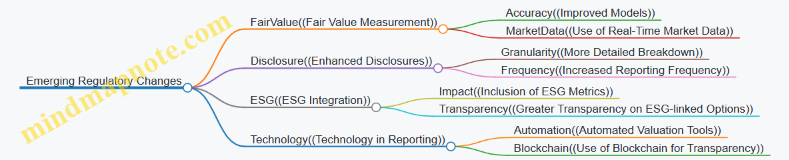
Increased Focus on Fair Value Measurement Accuracy
Regulators are emphasizing the need for more precise and dynamic valuation models that reflect current market conditions. This includes:
- Adoption of advanced option pricing models beyond Black-Scholes, such as Monte Carlo simulations.
- Incorporation of real-time market data and volatility metrics.
Example:
A tech company previously used the Black-Scholes model with historical volatility for valuation. New regulatory guidance encourages incorporating implied volatility from market options, resulting in a more accurate fair value estimate and adjusted expense recognition.
Mind Map: Fair Value Measurement Enhancements
Enhanced Disclosure Requirements
New regulations require companies to provide more granular disclosures about stock option plans, including:
- Detailed assumptions used in valuation.
- Sensitivity analyses showing how changes in assumptions affect expense.
- Breakdown of stock options by type, vesting conditions, and performance metrics.
Example:
A publicly traded company now discloses a sensitivity table illustrating how a 5% change in volatility or expected life impacts the total stock option expense, providing investors with clearer insight into risk factors.
Mind Map: Enhanced Disclosure Components
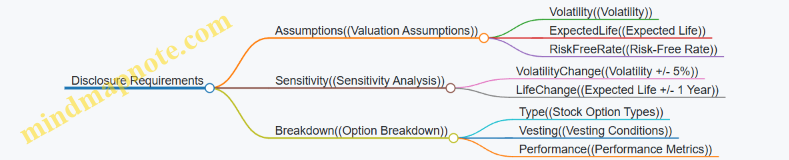
Integration of Environmental, Social, and Governance (ESG) Factors
Emerging regulations encourage or require companies to consider ESG factors in their equity compensation plans and disclosures. This includes:
- Linking stock option vesting to ESG performance targets.
- Reporting on how ESG goals impact stock option expense and valuation.
Example:
A company implements a new stock option plan where 20% of the options vest only if specific carbon reduction targets are met. Accounting must now incorporate these non-market performance conditions into expense recognition and disclosures.
Mind Map: ESG Integration in Stock Options
Technology-Driven Reporting Standards
Regulators are promoting the use of technology to improve accuracy and transparency in stock option accounting:
- Automated valuation tools using AI and machine learning.
- Blockchain technology for immutable records of stock option grants and exercises.
Example:
A financial services firm adopts an AI-powered platform that continuously updates stock option valuations based on live market data, reducing manual errors and improving reporting timeliness.
Mind Map: Technology in Stock Option Accounting
Summary
Emerging regulatory changes are driving a shift towards more precise valuation methods, richer disclosures, ESG integration, and technology adoption in stock option accounting. Accountants and equity analysts should proactively adapt to these changes to maintain compliance and provide stakeholders with transparent, accurate financial information.
Practical Takeaway Example
Scenario: A mid-sized tech company is preparing for its first public offering. New regulations require it to:
- Use implied volatility from market data for option valuation.
- Disclose detailed sensitivity analyses.
- Incorporate ESG-linked vesting conditions.
- Utilize automated tools for continuous valuation updates.
Action Plan:
- Upgrade valuation models and data sources.
- Enhance disclosure templates to include sensitivity tables.
- Collaborate with HR to document ESG-linked vesting terms.
- Implement a technology platform for stock option accounting.
This proactive approach ensures regulatory compliance and builds investor confidence through transparent reporting.
12.3 Preparing for Future Trends in Equity Compensation
As the landscape of equity compensation evolves, accountants and equity analysts must stay ahead of emerging trends to ensure accurate accounting, compliance, and strategic advisory. This section explores key future trends, their implications, and practical steps to prepare.
Key Future Trends in Equity Compensation
Mind Map: Preparing for Future Trends
Example 1: Implementing ESG-Linked Stock Options
A mid-sized tech company decides to introduce ESG-linked stock options where vesting depends on achieving carbon reduction targets.
- Accounting Implication: Performance conditions must be carefully assessed to determine if they are market or non-market conditions.
- Best Practice: Use detailed performance metrics and document assumptions clearly at grant date.
- Example Calculation: If the target is met halfway through the vesting period, expense recognition should be adjusted accordingly, reflecting the probability of achievement.
Example 2: Using Blockchain for Equity Record-Keeping
A multinational corporation pilots blockchain technology to track stock option grants and exercises.
- Benefits: Enhanced transparency, reduced fraud risk, and streamlined audit processes.
- Accounting Impact: Real-time data availability improves accuracy of expense recognition and disclosures.
- Best Practice: Collaborate with IT and legal teams to ensure compliance with data privacy and securities regulations.
Example 3: Automating Fair Value Calculations with AI
An equity analyst uses AI-powered software to calculate fair value of complex stock options under ASC 718.
- Advantages: Faster processing, reduced human error, and ability to model multiple scenarios.
- Implementation: Validate AI outputs with traditional models during transition.
- Best Practice: Maintain documentation of AI model assumptions and updates for audit purposes.
Actionable Steps for Accountants and Equity Analysts
- Stay Informed: Regularly review updates from FASB, IASB, and regulatory bodies.
- Invest in Technology: Evaluate and adopt tools that enhance accuracy and efficiency.
- Enhance Collaboration: Work closely with HR, Legal, and Tax to align equity compensation strategies.
- Focus on Training: Provide ongoing education on emerging trends and technologies.
- Review Policies: Update internal policies to reflect new award types and accounting treatments.
By proactively preparing for these future trends, finance professionals can ensure robust accounting practices, compliance, and strategic value creation through equity compensation programs.
12.4 Final Recommendations for Accountants and Equity Analysts
Accounting for stock options is a nuanced and evolving area that requires precision, up-to-date knowledge, and strategic foresight. Below are comprehensive recommendations tailored specifically for accountants and equity analysts to excel in this domain.
Stay Current with Regulatory Updates
- Regularly monitor updates from standard-setters like IASB (IFRS 2) and FASB (ASC 718).
- Understand jurisdictional differences and implications for multinational companies.
Example: When the FASB updates guidance on modification accounting, immediately assess the impact on your company’s outstanding awards and update internal policies accordingly.
Master Valuation Techniques and Assumptions
- Develop expertise in valuation models such as Black-Scholes, Binomial, and Monte Carlo simulations.
- Critically evaluate assumptions: volatility, risk-free rate, expected life, dividend yield.
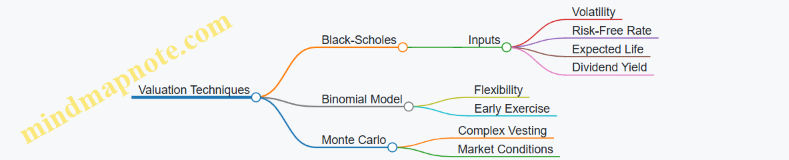
Example: For a tech company with high volatility, use Monte Carlo simulations to better capture the impact of performance-based vesting conditions.
Implement Robust Documentation and Controls
- Maintain detailed records of grant dates, vesting schedules, modifications, and exercises.
- Establish internal controls to ensure accuracy and compliance.

Example: Use a centralized equity management system that logs every stock option transaction and automatically updates expense schedules.
Coordinate Tax and Financial Reporting
- Collaborate with tax professionals to align deferred tax accounting with stock option expenses.
- Understand the timing differences and their impact on deferred tax assets/liabilities.
Example: When an employee exercises options, ensure the tax benefit is accurately recorded and reconciled with the financial statement impact.
Leverage Technology and Automation
- Utilize specialized accounting software to automate fair value calculations, expense recognition, and reporting.
- Implement dashboards for real-time monitoring of stock option plans.
Example: Automate monthly amortization of stock option expense and generate audit-ready reports to improve efficiency and reduce errors.
Communicate Clearly with Stakeholders
- Prepare transparent disclosures that explain assumptions, methodologies, and impacts.
- Educate management and investors on stock option accounting nuances.
Example: Include a simple infographic in the annual report illustrating how stock option expenses affect net income and shareholder equity.
Continuously Review and Improve Processes
- Conduct periodic reviews of stock option accounting policies and practices.
- Benchmark against industry peers and incorporate best practices.
Example: After a year-end close, hold a review session to identify bottlenecks in stock option accounting and implement process improvements.
Summary Table of Final Recommendations
| Recommendation | Key Actions | Example Use Case |
|---|---|---|
| Stay Current with Regulations | Monitor updates, assess impacts | Adjust policies after FASB guidance changes |
| Master Valuation Techniques | Use appropriate models, validate assumptions | Apply Monte Carlo for complex vesting |
| Robust Documentation & Controls | Maintain records, implement controls | Centralized equity management system |
| Coordinate Tax & Financial | Align tax and financial reporting | Record tax effects on option exercises |
| Leverage Technology | Automate calculations and reporting | Automated monthly expense amortization |
| Communicate with Stakeholders | Transparent disclosures, stakeholder education | Infographics in annual reports |
| Continuous Review & Improvement | Regular policy reviews, benchmarking | Post-close process improvement sessions |
By integrating these recommendations into your daily practice, accountants and equity analysts can ensure accurate, compliant, and insightful accounting for stock options that supports strategic decision-making and stakeholder confidence.