Accounting for Foreign Currency Transactions
1. Introduction to Foreign Currency Transactions
1.1 Definition and Importance of Foreign Currency Transactions
Foreign currency transactions refer to business dealings where the payment or receipt is denominated in a currency different from the entity’s functional currency. These transactions commonly occur in international trade, cross-border investments, or when companies operate subsidiaries in different countries.
Definition:
-
Foreign Currency Transaction: Any transaction that requires settlement in a currency other than the entity’s functional currency.
-
Functional Currency: The currency of the primary economic environment in which the entity operates.
Why Are Foreign Currency Transactions Important?
- Globalization of Business: As companies expand internationally, foreign currency transactions become inevitable.
- Exchange Rate Risk: Fluctuations in currency values can impact reported profits and financial position.
- Regulatory Compliance: Accurate accounting ensures compliance with IFRS, US GAAP, and local regulations.
- Financial Reporting Accuracy: Proper recording affects financial statements and decision-making.
Mind Map: Overview of Foreign Currency Transactions
Examples to Illustrate Foreign Currency Transactions
Example 1: Export Sale
- A US-based company sells goods to a customer in Germany for €100,000.
- The functional currency of the company is USD.
- At the transaction date, the exchange rate is 1 EUR = 1.10 USD.
Accounting Entry at Transaction Date:
| Account | Debit (USD) | Credit (USD) |
|---|---|---|
| Accounts Receivable | 110,000 | |
| Sales Revenue | 110,000 |
This records the sale in USD, converting the foreign currency amount at the spot rate.
Example 2: Foreign Currency Loan
- A UK subsidiary borrows JPY 10,000,000 from a Japanese bank.
- The subsidiary’s functional currency is GBP.
- Exchange rate at borrowing: 1 JPY = 0.0065 GBP.
Accounting Entry:
| Account | Debit (GBP) | Credit (GBP) |
|---|---|---|
| Cash | 65,000 | |
| Loan Payable | 65,000 |
Mind Map: Key Concepts in Foreign Currency Transactions
Summary
Understanding foreign currency transactions is foundational for accountants and international finance managers. It ensures accurate financial reporting, effective risk management, and compliance with accounting standards. Real-world examples, like export sales and foreign currency loans, demonstrate how these transactions are recorded and the importance of using correct exchange rates.
1.2 Overview of Exchange Rates and Currency Markets
Understanding exchange rates and currency markets is fundamental for accountants and international finance managers dealing with foreign currency transactions. This section provides a comprehensive overview, supported by mind maps and practical examples to clarify key concepts.
What Are Exchange Rates?
Exchange rates represent the value of one currency expressed in terms of another currency. They determine how much of one currency you can get in exchange for another.
- Spot Rate: The current exchange rate at which currencies can be exchanged immediately.
- Forward Rate: The agreed exchange rate for a currency transaction that will occur at a future date.
Mind Map: Types of Exchange Rates
Currency Markets (Forex Market)
The foreign exchange market (Forex) is a global decentralized market for trading currencies. It operates 24 hours a day, five days a week, and is the largest financial market in the world.
Key participants include:
- Central Banks
- Commercial Banks
- Corporations
- Hedge Funds
- Retail Investors
Mind Map: Participants in Currency Markets
Factors Influencing Exchange Rates
Exchange rates fluctuate due to various factors:
- Interest Rates: Higher interest rates offer lenders a better return, attracting foreign capital.
- Inflation Rates: Lower inflation rates generally increase currency value.
- Political Stability: Stable governments attract foreign investment.
- Economic Performance: Strong economic indicators boost currency demand.
- Market Speculation: Traders’ perceptions can drive currency movements.
Mind Map: Factors Affecting Exchange Rates
Types of Exchange Rate Regimes
- Fixed Exchange Rate: Currency value is pegged to another currency or basket of currencies.
- Floating Exchange Rate: Currency value is determined by market forces.
- Managed Float: Central banks intervene occasionally to stabilize or increase competitiveness.
Mind Map: Exchange Rate Regimes
Example 1: Spot Exchange Rate Transaction
A US company purchases goods from a German supplier for €100,000. The spot exchange rate is 1 EUR = 1.10 USD.
- The company records the transaction at $110,000 (100,000 x 1.10).
Example 2: Forward Exchange Contract
The same company expects to pay €100,000 in 3 months. To hedge against currency risk, it enters a forward contract at 1 EUR = 1.12 USD.
- Regardless of spot rate fluctuations, the company will pay $112,000 in 3 months.
Example 3: Impact of Exchange Rate Fluctuations
If after 3 months the spot rate changes to 1 EUR = 1.15 USD:
- Without hedging, the company would pay $115,000 (more expensive).
- With the forward contract, it pays $112,000, saving $3,000.
Summary
Understanding exchange rates and currency markets equips finance professionals to accurately record foreign currency transactions, manage risks, and comply with accounting standards. The mind maps and examples above provide a clear framework to grasp these essential concepts.
1.3 Common Types of Foreign Currency Transactions in Business
Foreign currency transactions occur when a business engages in activities involving currencies other than its functional currency. Understanding the common types of these transactions is essential for accurate accounting and risk management.
Mind Map: Types of Foreign Currency Transactions
Sales and Purchases
These are the most frequent foreign currency transactions. When a company sells goods or services to a foreign customer or purchases from a foreign supplier, the transaction is often denominated in a foreign currency.
Example:
A US-based company sells machinery to a German customer for €100,000. The transaction date exchange rate is 1 EUR = 1.10 USD. The company records revenue of $110,000 at the transaction date.
Best Practice: Always record the transaction at the spot rate on the transaction date and document the exchange rate source.
Borrowings and Loans
Companies may take loans or borrow funds in foreign currencies to finance operations or investments.
Example:
A UK company borrows ¥50,000,000 from a Japanese bank. The borrowing is recorded at the spot rate on the loan date. Interest payments made in yen must also be translated at the exchange rate on the payment date.
Best Practice: Track the loan principal and interest separately, revaluing monetary balances at each reporting date.
Investments
Foreign currency transactions also include investments in foreign subsidiaries or equity instruments.
Example:
A Canadian company invests CAD 1,000,000 in a subsidiary in Brazil. Dividends received in Brazilian Real (BRL) are translated at the exchange rate on the dividend payment date.
Best Practice: Determine the functional currency of the investment and apply appropriate translation or remeasurement methods.
Operating Expenses
Expenses such as salaries, rent, or utilities paid in foreign currency are also foreign currency transactions.
Example:
An Australian company pays monthly rent of USD 5,000 for its US office. Each payment is recorded at the exchange rate on the payment date.
Best Practice: Maintain detailed records of payment dates and exchange rates to ensure accurate expense recognition.
Other Transactions
These include advances, settlements, or miscellaneous transactions in foreign currency.
Example:
A French company receives a foreign currency advance from a customer in USD 20,000. The advance is recorded at the spot rate on receipt and adjusted upon settlement.
Best Practice: Monitor advances carefully to avoid misstatements in revenue recognition.
Summary
Foreign currency transactions span a wide range of business activities. Proper identification and classification are critical for accurate accounting and financial reporting.
By integrating best practices such as using spot rates at transaction dates, maintaining detailed documentation, and understanding the nature of each transaction, accountants and finance managers can ensure compliance and reduce currency risk exposure.
1.4 Best Practices: Establishing a Foreign Currency Accounting Policy with Examples
Establishing a robust foreign currency accounting policy is essential for organizations dealing with international transactions. This policy ensures consistency, accuracy, and compliance with accounting standards while managing currency risks effectively.
Key Components of a Foreign Currency Accounting Policy
- Scope and Applicability: Define which transactions and entities the policy covers.
- Functional Currency Determination: Establish criteria for identifying the functional currency of each entity.
- Exchange Rate Sources: Specify reliable sources for exchange rates (e.g., central bank rates, market rates).
- Initial Recognition Procedures: Outline how to record foreign currency transactions at the spot rate.
- Subsequent Measurement Rules: Define how to revalue monetary items and recognize exchange differences.
- Hedging and Risk Management: Describe approaches for managing currency risk, including hedge accounting.
- Documentation and Controls: Set requirements for documentation, approvals, and audit trails.
- Reporting and Disclosure: Clarify reporting requirements for foreign currency transactions and balances.
Mind Map: Components of a Foreign Currency Accounting Policy
Example 1: Defining Functional Currency
Scenario: A European subsidiary of a US-based company conducts most of its sales and expenses in Euros but reports to the US parent.
Policy Approach:
- The subsidiary’s functional currency is the Euro because it is the primary currency of the economic environment in which it operates.
- All transactions are initially recorded in Euros and then translated to USD for consolidation.
Mind Map: Functional Currency Determination
Example 2: Selecting Exchange Rate Sources
Scenario: A multinational company decides to standardize exchange rates for accounting purposes.
Policy Approach:
- Use the daily spot rates published by the central bank of the functional currency country.
- For month-end reporting, use the closing spot rate on the last business day.
Mind Map: Exchange Rate Sources
Example 3: Initial Recognition and Subsequent Measurement
Scenario: A company purchases inventory from a supplier in Japan for JPY 1,000,000 when the exchange rate is 110 JPY/USD.
Initial Recognition:
- Record the purchase at $9,090.91 (1,000,000 ÷ 110).
Subsequent Measurement:
- At reporting date, exchange rate changes to 105 JPY/USD.
- Revalue the payable to $9,523.81 (1,000,000 ÷ 105).
- Recognize an exchange loss of $432.90 ($9,523.81 - $9,090.91) in profit or loss.
Mind Map: Initial Recognition & Subsequent Measurement
Example 4: Hedging Foreign Currency Exposure
Scenario: A company expects to receive EUR 500,000 in 3 months and wants to hedge against EUR/USD fluctuations.
Policy Approach:
- Enter into a forward contract to sell EUR 500,000 at a fixed rate.
- Apply hedge accounting if criteria are met.
Mind Map: Hedging and Risk Management
Summary
By establishing a clear foreign currency accounting policy incorporating these components and examples, organizations can ensure consistent treatment of foreign currency transactions, reduce risk, and maintain compliance. Regular training and updates to the policy are recommended to adapt to evolving standards and business environments.
2. Accounting Standards and Regulatory Framework
2.1 IFRS and US GAAP Guidelines on Foreign Currency Transactions
Foreign currency transactions are an integral part of international business, and understanding the accounting guidelines under IFRS (International Financial Reporting Standards) and US GAAP (Generally Accepted Accounting Principles) is crucial for accurate financial reporting.
Overview
Both IFRS and US GAAP provide comprehensive frameworks for recognizing, measuring, and reporting foreign currency transactions, but there are nuanced differences in their approaches. Below is a detailed comparison and explanation of these guidelines.
Mind Map: Key Concepts in Foreign Currency Accounting under IFRS and US GAAP
IFRS Guidelines (IAS 21 - The Effects of Changes in Foreign Exchange Rates)
- Initial Recognition: Transactions are recorded at the spot exchange rate on the date of the transaction.
- Monetary Items: Assets and liabilities denominated in foreign currency are retranslated at the closing rate at each reporting date.
- Non-Monetary Items: Measured at historical cost and not retranslated unless carried at fair value.
- Exchange Differences: Recognized in profit or loss in the period they arise, except for qualifying hedges.
- Functional Currency: The currency of the primary economic environment in which the entity operates.
Example 1: Initial Recognition under IFRS
A company based in Germany purchases inventory from a US supplier for USD 10,000 on March 1 when the exchange rate is 1 EUR = 1.1 USD.
- Initial recognition in EUR: 10,000 USD / 1.1 = EUR 9,090.91
The inventory is recorded at EUR 9,090.91.
Example 2: Subsequent Measurement under IFRS
At the reporting date (March 31), the exchange rate changes to 1 EUR = 1.2 USD.
- The USD payable of 10,000 is remeasured: 10,000 USD / 1.2 = EUR 8,333.33
- Exchange difference: EUR 9,090.91 - EUR 8,333.33 = EUR 757.58 gain recognized in profit or loss.
US GAAP Guidelines (ASC 830 - Foreign Currency Matters)
- Initial Recognition: Similar to IFRS, transactions are recorded at the spot exchange rate on the transaction date.
- Monetary Items: Remeasured at the current exchange rate at the balance sheet date.
- Non-Monetary Items: Generally reported at historical exchange rates.
- Exchange Differences: Recognized in earnings, with some exceptions for certain hedging activities.
- Functional Currency: Determined based on the currency of the primary economic environment.
Example 3: Initial Recognition under US GAAP
A US company buys equipment from a Japanese supplier for JPY 1,000,000 on April 1 when the exchange rate is 1 USD = 110 JPY.
- Initial recognition in USD: 1,000,000 JPY / 110 = USD 9,090.91
The equipment is recorded at USD 9,090.91.
Example 4: Subsequent Measurement under US GAAP
At the reporting date (April 30), the exchange rate changes to 1 USD = 100 JPY.
- The JPY payable of 1,000,000 is remeasured: 1,000,000 JPY / 100 = USD 10,000
- Exchange difference: USD 10,000 - USD 9,090.91 = USD 909.09 loss recognized in earnings.
Mind Map: Differences Between IFRS and US GAAP on Foreign Currency Transactions
Best Practice Tips
- Consistent Policy: Establish and document a clear policy for determining functional currency and exchange rates used.
- Accurate Timing: Use the exact transaction date’s spot rate for initial recognition to avoid discrepancies.
- Regular Updates: Reassess exchange rates at each reporting date and apply consistently.
- Hedge Documentation: Maintain detailed documentation for any hedging instruments to comply with exceptions.
Summary
Understanding the similarities and differences between IFRS and US GAAP in accounting for foreign currency transactions helps international finance managers and accountants ensure compliance and accurate financial reporting. Both frameworks emphasize initial recognition at spot rates and subsequent remeasurement of monetary items, with exchange differences typically recognized in profit or loss. However, nuances in hedge accounting and functional currency determination require careful attention.
2.2 Key Differences Between IFRS and US GAAP Approaches
Understanding the differences between IFRS (International Financial Reporting Standards) and US GAAP (Generally Accepted Accounting Principles) is crucial for accountants and international finance managers dealing with foreign currency transactions. Both frameworks aim to provide transparent and consistent financial reporting but differ in their treatment of certain aspects.
Overview Mind Map
Functional Currency Determination
IFRS:
- Emphasizes the primary economic environment in which the entity operates.
- Considers factors such as sales prices, labor, material costs, and financing.
US GAAP:
- Similar approach but with more detailed guidance on indicators.
- Uses a hierarchical approach focusing on the currency that mainly influences sales prices.
Example: A subsidiary in Brazil sells primarily in USD but incurs most costs in BRL. Both IFRS and US GAAP would analyze which currency influences the subsidiary’s cash flows more significantly to determine the functional currency. However, US GAAP may require more granular analysis of sales contracts and financing arrangements.
Initial Recognition of Transactions
Both IFRS and US GAAP require:
- Recording foreign currency transactions at the spot exchange rate on the transaction date.
Example: A US company purchases inventory from a European supplier for €100,000 when the spot rate is 1 EUR = 1.10 USD.
- Under both standards, the inventory is recorded at $110,000.
Remeasurement of Monetary Items
IFRS:
- Monetary items are remeasured at the closing rate at each reporting date.
- Exchange differences are recognized in profit or loss.
US GAAP:
- Similar treatment; monetary assets and liabilities are remeasured at the current exchange rate.
- Exchange gains or losses are recognized in earnings.
Example: An accounts receivable of €50,000 recorded at 1 EUR = 1.10 USD (i.e., $55,000) is outstanding at year-end when the rate changes to 1 EUR = 1.15 USD.
- Both IFRS and US GAAP require remeasurement to $57,500, recognizing a $2,500 exchange gain.
Non-Monetary Items
IFRS:
- Non-monetary items measured at historical cost are not remeasured.
- Non-monetary items measured at fair value are remeasured using the exchange rate at the date of fair value measurement.
US GAAP:
- Similar approach.
Example: Property purchased for €200,000 at 1 EUR = 1.10 USD is recorded at $220,000. If the property is carried at historical cost, no remeasurement occurs despite exchange rate changes.
Foreign Operations Translation
IFRS:
- Functional currency approach.
- Assets and liabilities translated at closing rate.
- Income and expenses translated at exchange rates at transaction dates or average rates.
- Exchange differences recognized in Other Comprehensive Income (OCI) and accumulated in equity under ‘Foreign Currency Translation Reserve’.
US GAAP:
- Similar functional currency approach.
- Exchange differences also recorded in OCI.
- However, US GAAP has more detailed guidance on cumulative translation adjustments and reclassification.
Example: A subsidiary with functional currency EUR reports net assets of €1,000,000. At year-end, exchange rate is 1 EUR = 1.20 USD.
- Under both standards, net assets translate to $1,200,000.
- The translation difference from prior year is recorded in OCI.
Hedge Accounting
IFRS:
- More principles-based.
- Allows hedge accounting for foreign currency risk with specific documentation and effectiveness requirements.
US GAAP:
- More rules-based and prescriptive.
- Detailed criteria for hedge designation and effectiveness testing.
Example: A company enters a forward contract to hedge a forecasted foreign currency sale. Under IFRS, the company applies hedge accounting if criteria are met with reasonable effectiveness. Under US GAAP, stricter quantitative effectiveness tests are required.
Summary Mind Map
Practical Example: Comparative Treatment
| Transaction Aspect | IFRS Treatment | US GAAP Treatment |
|---|---|---|
| Functional Currency | Determined by primary economic environment | Hierarchical indicators approach |
| Initial Recognition | Spot rate on transaction date | Spot rate on transaction date |
| Monetary Items Remeasurement | Closing rate, differences in P&L | Closing rate, differences in earnings |
| Non-Monetary Items | Historical cost not remeasured | Historical cost not remeasured |
| Foreign Operations | Translation differences in OCI | Translation differences in OCI |
| Hedge Accounting | Principles-based, flexible criteria | Rules-based, strict criteria |
Best Practice Tips
- Maintain clear documentation on functional currency determination to satisfy both IFRS and US GAAP requirements.
- Use consistent exchange rates for initial recognition and remeasurement to avoid discrepancies.
- Monitor hedge effectiveness regularly and document thoroughly to comply with respective standards.
- Train accounting teams on subtle differences to ensure accurate reporting and compliance.
By understanding these key differences and applying best practices, accountants and international finance managers can ensure accurate and compliant accounting for foreign currency transactions under both IFRS and US GAAP frameworks.
2.3 Compliance Requirements for Multinational Corporations
Multinational corporations (MNCs) operate across various jurisdictions, each with its own accounting standards, tax regulations, and foreign currency reporting requirements. Compliance in foreign currency transactions is critical to ensure accurate financial reporting, avoid penalties, and maintain investor confidence.
Key Compliance Areas for MNCs in Foreign Currency Transactions
- Accounting Standards Adherence
- IFRS (IAS 21) or US GAAP guidance on foreign currency transactions and translations
- Regulatory Reporting Requirements
- Local country-specific disclosures
- Currency translation disclosures in consolidated financial statements
- Tax Compliance
- Treatment of foreign exchange gains and losses
- Transfer pricing rules related to currency fluctuations
- Internal Controls and Audit
- Policies for exchange rate selection and timing
- Documentation and approval processes
Mind Map: Compliance Requirements Overview
Example 1: IFRS Compliance in Foreign Currency Transactions
A European-based MNC with subsidiaries in Japan and Brazil must prepare consolidated financial statements in Euros. According to IFRS IAS 21:
- Each subsidiary determines its functional currency (JPY for Japan, BRL for Brazil).
- Transactions in foreign currencies are initially recorded at the spot rate on the transaction date.
- Monetary items are retranslated at the closing rate at each reporting date.
- Exchange differences are recognized in profit or loss unless they relate to a qualifying cash flow hedge.
Best Practice: The MNC implements a centralized policy requiring all subsidiaries to use the official closing rate published by the European Central Bank for month-end revaluation, ensuring consistency.
Mind Map: IFRS IAS 21 Compliance Steps
Example 2: US GAAP Compliance and Local Reporting
A US-based MNC with operations in Canada and Mexico must comply with US GAAP for consolidated reporting but also adhere to local Canadian and Mexican tax authority requirements.
- Under US GAAP, the functional currency is determined for each entity.
- Foreign currency transactions are recorded at the exchange rate on the transaction date.
- Exchange gains and losses are recognized in earnings.
- For local tax filings, the MNC must translate financials using the local tax authority prescribed rates, which may differ from US GAAP rates.
Best Practice: The MNC maintains dual reporting systems to reconcile differences between US GAAP consolidated financials and local statutory reports, ensuring compliance with both.
Mind Map: US GAAP and Local Reporting Compliance
Internal Controls and Audit Considerations
- Establish clear policies on:
- Which exchange rates to use (spot, average, closing)
- Timing of currency revaluation
- Documentation requirements for transactions and revaluations
- Regular internal audits to verify compliance with policies and standards
- Training programs for accounting teams on foreign currency accounting nuances
Example 3: Internal Control Implementation
An MNC implements an automated ERP system that pulls official exchange rates daily from a trusted financial data provider. The system flags any manual entries of exchange rates for review. Monthly, the internal audit team reviews foreign currency transaction logs and reconciliations to ensure adherence to policies.
Best Practice: This reduces human error and strengthens compliance with accounting standards and regulatory requirements.
Summary
Compliance for MNCs in foreign currency transactions requires a multi-faceted approach involving adherence to international accounting standards, local regulatory requirements, tax laws, and robust internal controls. Integrating best practices such as centralized policies, dual reporting systems, and technology-enabled controls helps ensure accurate and compliant financial reporting across borders.
2.4 Best Practices: Aligning Internal Controls with Regulatory Standards – Case Study
In the complex world of foreign currency transactions, aligning internal controls with regulatory standards is crucial to ensure compliance, accuracy, and risk mitigation. This section explores best practices through a detailed case study, supported by mind maps and practical examples.
Understanding the Need for Alignment
Foreign currency transactions expose companies to risks such as exchange rate fluctuations, misstatements, and regulatory non-compliance. Internal controls must be designed to address these risks while adhering to IFRS, US GAAP, and local regulations.
Mind Map: Key Components of Internal Controls for Foreign Currency Transactions
Case Study: GlobalTech Inc.
Background: GlobalTech Inc., a multinational technology company, faced challenges in managing foreign currency transactions across its subsidiaries in Europe, Asia, and the Americas. The company struggled with inconsistent application of exchange rates, delayed recognition of exchange differences, and incomplete documentation, leading to audit findings and compliance risks.
Objective: To realign internal controls with regulatory standards and improve accuracy and compliance in foreign currency accounting.
Step 1: Assessing Current Controls
- Conducted a comprehensive review of existing policies and procedures.
- Identified gaps in authorization, transaction recording, and reconciliation processes.
- Noted inconsistent use of spot rates and lack of standardized documentation.
Step 2: Designing Enhanced Controls
- Authorization: Implemented a tiered approval system for foreign currency contracts, requiring CFO sign-off for exposures above $500,000.
- Transaction Recording: Mandated use of daily published spot rates from a centralized financial system.
- Reconciliation: Established monthly reconciliation of foreign currency monetary items with variance analysis.
- Compliance: Developed a checklist aligned with IFRS IAS 21 and ASC 830 requirements for transaction recognition and measurement.
- Risk Management: Introduced quarterly reviews of hedging effectiveness and currency exposure reports.
Mind Map: Enhanced Internal Control Framework at GlobalTech Inc.
Step 3: Implementation and Training
- Rolled out updated policies across all subsidiaries.
- Conducted training sessions for accounting and finance teams focusing on:
- Correct exchange rate application.
- Documentation standards.
- Use of new reconciliation tools.
Step 4: Monitoring and Continuous Improvement
- Established a monthly internal audit process to test controls.
- Created feedback loops for continuous refinement.
Example: Applying the Enhanced Controls
Scenario: On March 15, GlobalTech Europe sells equipment to a customer in the US for €100,000. The spot rate on the transaction date is 1 EUR = 1.10 USD.
- Recording Transaction: Using the centralized system, the accounting team records the sale at $110,000.
- Authorization: The transaction is below the $500,000 threshold, so local finance manager approval suffices.
- Reconciliation: At month-end, the accounts receivable balance is revalued using the March 31 spot rate of 1 EUR = 1.12 USD, resulting in a foreign exchange gain.
- Compliance: All documentation, including exchange rate sources and approvals, are attached to the transaction record.
Benefits Realized
- Improved accuracy in foreign currency transaction recording.
- Enhanced compliance with IFRS and US GAAP standards.
- Reduction in audit findings related to foreign currency accounting.
- Better visibility and management of currency risk.
Summary
Aligning internal controls with regulatory standards requires a structured approach involving assessment, design, implementation, and monitoring. The GlobalTech Inc. case study illustrates how best practices can be integrated effectively, supported by clear authorization protocols, standardized transaction recording, rigorous reconciliation, and compliance checklists.
Additional Resources
- IFRS IAS 21 – The Effects of Changes in Foreign Exchange Rates
- FASB ASC 830 – Foreign Currency Matters
- COSO Framework for Internal Controls
- Sample Foreign Currency Transaction Checklist (Appendix A)
This approach ensures accountants and international finance managers can confidently manage foreign currency transactions while meeting regulatory expectations.
3. Initial Recognition of Foreign Currency Transactions
3.1 Recording Transactions at the Spot Exchange Rate
When a company engages in foreign currency transactions, the initial recognition of these transactions must be recorded using the spot exchange rate at the date of the transaction. The spot exchange rate is the current exchange rate at which one currency can be exchanged for another for immediate delivery.
Why Use the Spot Exchange Rate?
- Reflects the most accurate and fair value at the transaction date.
- Ensures consistency and comparability in financial reporting.
- Complies with accounting standards such as IFRS (IAS 21) and US GAAP.
Mind Map: Recording Foreign Currency Transactions at Spot Exchange Rate
Step-by-Step Example 1: Sale in Foreign Currency
Scenario: A US-based company sells goods to a customer in Europe for €10,000 on March 1st. The spot exchange rate on March 1st is 1 EUR = 1.10 USD.
Accounting Entry:
- Accounts Receivable (USD) = €10,000 × 1.10 = $11,000 (Debit)
- Sales Revenue (USD) = $11,000 (Credit)
Journal Entry:
| Date | Account | Debit | Credit |
|---|---|---|---|
| 2024-03-01 | Accounts Receivable | 11,000 | |
| 2024-03-01 | Sales Revenue | 11,000 |
Step-by-Step Example 2: Purchase in Foreign Currency
Scenario: A UK company purchases equipment from a US supplier for $5,000 on April 15th. The spot exchange rate on April 15th is 1 USD = 0.75 GBP.
Accounting Entry:
- Equipment (GBP) = $5,000 × 0.75 = £3,750 (Debit)
- Accounts Payable (GBP) = £3,750 (Credit)
Journal Entry:
| Date | Account | Debit | Credit |
|---|---|---|---|
| 2024-04-15 | Equipment | 3,750 | |
| 2024-04-15 | Accounts Payable | 3,750 |
Important Considerations
- Transaction Date: The date the transaction is recognized for accounting purposes, often the invoice date or delivery date.
- Source of Exchange Rate: Use reliable and consistent sources such as central banks, official financial data providers, or company policy-defined sources.
- Non-Monetary Items: Items like inventory or fixed assets purchased in foreign currency are recorded at the spot rate on the transaction date and are not revalued for exchange rate changes.
Mind Map: Key Points for Spot Rate Application
Best Practice Tips
- Always document the exchange rate source and date used for transparency and audit purposes.
- Establish company policy on which exchange rate source to use and how to handle timing differences.
- Train accounting staff to distinguish between monetary and non-monetary items for correct application of exchange rates.
- Use accounting software that supports multi-currency transactions and automatic spot rate retrieval to reduce errors.
By consistently applying the spot exchange rate at the transaction date, companies ensure accurate and compliant financial reporting of foreign currency transactions.
3.2 Examples: Recording a Sale and Purchase in Foreign Currency
When recording foreign currency transactions, it is essential to initially recognize the transaction at the spot exchange rate on the date of the transaction. This ensures that financial statements reflect the accurate value of the transaction in the functional currency.
Example 1: Recording a Sale in Foreign Currency
Scenario:
A US-based company sells goods worth €10,000 to a customer in Germany on March 1st. The spot exchange rate on March 1st is 1 EUR = 1.10 USD.
Accounting Entry:
| Date | Account | Debit (USD) | Credit (USD) |
|---|---|---|---|
| March 1st | Accounts Receivable | 11,000 | |
| March 1st | Sales Revenue | 11,000 |
Explanation:
- The sale is recorded by converting €10,000 at the spot rate of 1.10, resulting in $11,000.
Example 2: Recording a Purchase in Foreign Currency
Scenario:
The same US company purchases inventory from a supplier in Japan for ¥1,200,000 on March 1st. The spot exchange rate on March 1st is 1 JPY = 0.009 USD.
Accounting Entry:
| Date | Account | Debit (USD) | Credit (USD) |
|---|---|---|---|
| March 1st | Inventory | 10,800 | |
| March 1st | Accounts Payable | 10,800 |
Explanation:
- The purchase is recorded by converting ¥1,200,000 at the spot rate of 0.009, resulting in $10,800.
Mind Map: Recording Foreign Currency Transactions
Additional Example: Impact of Exchange Rate Fluctuation on Recorded Sale
Scenario:
The US company from Example 1 receives payment on March 15th when the exchange rate has changed to 1 EUR = 1.15 USD.
Initial Recorded Amount: $11,000
Payment Received: €10,000 * 1.15 = $11,500
Accounting Entry on Receipt:
| Date | Account | Debit (USD) | Credit (USD) |
|---|---|---|---|
| March 15th | Cash | 11,500 | |
| March 15th | Accounts Receivable | 11,000 | |
| March 15th | Foreign Exchange Gain | 500 |
Explanation:
- The company recognizes a foreign exchange gain of $500 due to the favorable change in exchange rate.
Mind Map: Handling Exchange Rate Fluctuations
Summary
- Always record foreign currency transactions at the spot exchange rate on the transaction date.
- Sales and purchases must be converted into the functional currency for accurate financial reporting.
- Subsequent exchange rate changes affect monetary items and must be recognized as gains or losses.
- Proper documentation and consistent application of exchange rates are critical for compliance and audit trails.
3.3 Handling Non-Monetary vs. Monetary Items
When accounting for foreign currency transactions, it is crucial to distinguish between monetary and non-monetary items because they are treated differently under accounting standards such as IFRS and US GAAP. Understanding this distinction ensures accurate measurement and reporting of foreign currency effects.
What Are Monetary Items?
Monetary items represent assets or liabilities that are fixed or determinable in terms of units of currency. They include:
- Cash and cash equivalents
- Receivables and payables
- Loans and borrowings
- Amounts to be received or paid in foreign currency
Key characteristic: Monetary items are settled in a fixed or determinable amount of money.
What Are Non-Monetary Items?
Non-monetary items are assets or liabilities that do not have a fixed or determinable amount of money. Examples include:
- Inventory
- Property, plant, and equipment (PPE)
- Intangible assets
- Prepaid expenses
Key characteristic: Their value is not directly linked to a fixed amount of currency and often recorded at historical cost or fair value.
Mind Map: Distinguishing Monetary and Non-Monetary Items
Accounting Treatment Differences
| Aspect | Monetary Items | Non-Monetary Items |
|---|---|---|
| Measurement at initial recognition | Recorded at spot exchange rate | Recorded at spot exchange rate |
| Subsequent measurement | Revalued at closing rate at reporting date | Measured at historical cost or fair value (exchange rate at transaction date) |
| Exchange differences | Recognized in profit or loss | No exchange differences recognized unless measured at fair value (then use rate at revaluation date) |
Mind Map: Accounting Treatment Flow
Practical Examples
Example 1: Monetary Item - Accounts Receivable
Scenario: A company sells goods to a foreign customer for €10,000 when the exchange rate is 1 EUR = 1.2 USD.
-
Initial recognition:
- Accounts receivable recorded at $12,000 (10,000 × 1.2).
-
At reporting date, exchange rate changes to 1 EUR = 1.3 USD.
-
Revaluation:
- Accounts receivable revalued to $13,000 (10,000 × 1.3).
- Exchange difference of $1,000 recognized in profit or loss.
Example 2: Non-Monetary Item - Inventory
Scenario: The same company purchases inventory costing €5,000 when the exchange rate is 1 EUR = 1.2 USD.
-
Initial recognition:
- Inventory recorded at $6,000 (5,000 × 1.2).
-
At reporting date, exchange rate changes to 1 EUR = 1.3 USD.
-
Subsequent measurement:
- Inventory remains at $6,000 (historical cost).
- No exchange difference recognized.
Example 3: Non-Monetary Item Measured at Fair Value - PPE
Scenario: The company owns a machine purchased for €50,000 at 1 EUR = 1.2 USD.
-
Initial recognition:
- Machine recorded at $60,000.
-
At reporting date, fair value appraisal values machine at €52,000, exchange rate 1 EUR = 1.3 USD.
-
Revaluation:
- Machine revalued at $67,600 (52,000 × 1.3).
- The increase of $7,600 is recognized in other comprehensive income (OCI) or revaluation surplus, not profit or loss.
Best Practices for Handling Monetary vs. Non-Monetary Items
- Clearly classify assets and liabilities as monetary or non-monetary at the outset.
- Use consistent exchange rates: spot rate at transaction date for initial recognition; closing rate for monetary items at reporting date.
- Maintain detailed documentation for exchange rates used and revaluation calculations.
- Regularly review accounting policies to ensure compliance with IFRS/US GAAP.
- Train accounting staff on distinctions and treatments to avoid misstatements.
Summary Mind Map
By mastering the distinction and accounting treatments of monetary and non-monetary items, accountants and international finance managers can ensure accurate financial reporting and better manage foreign currency risks.
3.4 Best Practices: Documentation and Timing for Accurate Initial Recognition
Accurate initial recognition of foreign currency transactions is critical for ensuring the integrity of financial statements and compliance with accounting standards. Proper documentation and precise timing help prevent errors, reduce audit risks, and provide transparency for stakeholders.
Key Best Practices for Documentation and Timing
Comprehensive Documentation
-
Transaction Details: Always maintain copies of invoices, contracts, and payment instructions. These documents provide evidence of the transaction amount, currency, and agreed terms.
-
Exchange Rate Source: Clearly document the source of the exchange rate used for initial recognition. Common sources include the central bank’s published rates or reputable market rates at the transaction date.
-
Authorization Records: Ensure that all foreign currency transactions are properly authorized. Maintain records of approvals and delegation to establish accountability.
Example:
A company imports goods from Germany and receives an invoice dated March 10 for €50,000. The accounting team should keep the invoice, note the exchange rate published by the European Central Bank on March 10, and record who approved the transaction entry.
Precise Timing for Exchange Rate Application
-
Spot Rate on Transaction Date: The transaction must be recorded using the spot exchange rate on the date the transaction occurs (usually the invoice date or delivery date).
-
Cut-off Procedures: At the end of each reporting period, ensure transactions are recorded in the correct period. For example, if payment occurs after the reporting date, the transaction should still be recognized at the spot rate on the transaction date, not the payment date.
-
Adjustments and Corrections: If errors are discovered or exchange rates fluctuate significantly before payment, adjustments should be made at the reporting date, not at initial recognition.
Example:
An exporter sells services to a client in Japan on April 15, invoiced at ¥10,000,000. The spot rate on April 15 is 0.0091 USD/JPY. The transaction should be recorded at $91,000 on April 15, even if payment is received later at a different rate.
Mind Map: Timing Considerations
Integration of Documentation and Timing
Combining thorough documentation with precise timing ensures:
- Transparency and audit trail for every foreign currency transaction.
- Consistency in applying exchange rates.
- Compliance with IFRS (IAS 21) and US GAAP rules.
Example:
A multinational company records a foreign currency purchase on June 1 using the spot rate from that day. The invoice, approval emails, and exchange rate printout are stored in the accounting system. At the end of June, the accounts payable balance is revalued at the June 30 spot rate, with the difference recorded as an exchange gain or loss.
Summary Checklist for Accountants and Finance Managers
- Obtain and archive all relevant transaction documents.
- Use reliable and consistent exchange rate sources.
- Record transactions at the spot rate on the transaction date.
- Apply strict cut-off procedures to ensure period accuracy.
- Document all approvals and authorizations.
- Review and adjust balances at reporting dates as required.
By following these best practices, accountants and international finance managers can ensure accurate initial recognition of foreign currency transactions, minimizing risks and enhancing financial statement reliability.
4. Subsequent Measurement and Exchange Rate Fluctuations
4.1 Revaluation of Foreign Currency Monetary Items at Reporting Date
When a company holds monetary items denominated in a foreign currency, these items must be revalued at each reporting date to reflect the current exchange rate. This process ensures that the financial statements present an accurate and up-to-date value of foreign currency assets and liabilities.
What Are Monetary Items?
Monetary items are assets and liabilities that are fixed or determinable in terms of units of currency. Examples include:
- Cash
- Accounts receivable/payable
- Loans and borrowings
- Bonds payable
Non-monetary items (e.g., inventory, property, plant, and equipment) are not revalued at reporting date for exchange differences.
Why Revalue Foreign Currency Monetary Items?
- To reflect the current exchange rate at the reporting date.
- To recognize any exchange gains or losses resulting from currency fluctuations.
- To comply with accounting standards such as IAS 21 (IFRS) or ASC 830 (US GAAP).
Revaluation Process Mind Map
Step-by-Step Example
Scenario: A company has an accounts receivable balance of €100,000 recorded at an exchange rate of 1 EUR = 1.10 USD on the transaction date. At the reporting date, the exchange rate is 1 EUR = 1.15 USD.
Step 1: Initial Recognition
- Accounts receivable recorded at €100,000 × 1.10 = $110,000
Step 2: Revaluation at Reporting Date
- Revalued amount = €100,000 × 1.15 = $115,000
Step 3: Calculate Exchange Difference
- Exchange gain = $115,000 - $110,000 = $5,000
Step 4: Accounting Entry
- Debit Accounts Receivable $5,000
- Credit Foreign Exchange Gain (P&L) $5,000
Additional Example: Foreign Currency Payable
Scenario: A company owes ¥1,000,000 to a supplier, initially recorded at 1 USD = 110 JPY (i.e., $9,090.91). At the reporting date, the exchange rate is 1 USD = 105 JPY.
Step 1: Initial Recognition
- Accounts payable recorded at ¥1,000,000 / 110 = $9,090.91
Step 2: Revaluation at Reporting Date
- Revalued amount = ¥1,000,000 / 105 = $9,523.81
Step 3: Calculate Exchange Difference
- Exchange loss = $9,523.81 - $9,090.91 = $432.90
Step 4: Accounting Entry
- Debit Foreign Exchange Loss (P&L) $432.90
- Credit Accounts Payable $432.90
Best Practices for Revaluation
- Use the spot exchange rate at the reporting date for accuracy.
- Maintain detailed documentation of exchange rates used and calculation methods.
- Regularly reconcile foreign currency balances to avoid errors.
- Implement automated systems to update exchange rates and calculate revaluations.
- Train accounting staff on the impact of currency fluctuations and revaluation procedures.
Summary Mind Map
Revaluation of foreign currency monetary items is a critical step in ensuring that financial statements accurately reflect the economic reality of currency fluctuations. By following the outlined process and best practices, accountants and international finance managers can effectively manage foreign currency risks and maintain compliance with accounting standards.
4.2 Recognizing Exchange Differences in Profit or Loss
When dealing with foreign currency transactions, exchange differences arise due to fluctuations in exchange rates between the transaction date and the settlement or reporting date. Recognizing these differences accurately in profit or loss is crucial for transparent financial reporting.
What Are Exchange Differences?
Exchange differences represent the gains or losses resulting from changes in exchange rates affecting monetary items denominated in foreign currencies.
- Monetary items: Assets or liabilities to be received or paid in a fixed or determinable amount of foreign currency (e.g., cash, receivables, payables).
- Non-monetary items: Assets or liabilities not held for conversion into cash (e.g., inventory, fixed assets) – generally not remeasured.
When to Recognize Exchange Differences?
- At each reporting date, monetary items are retranslated using the closing exchange rate.
- Exchange differences arising from retranslation are recognized in profit or loss immediately.
- On settlement of foreign currency monetary items, any exchange difference between the initial recognition and settlement date is also recognized in profit or loss.
Mind Map: Recognizing Exchange Differences in Profit or Loss
Example 1: Sale on Credit in Foreign Currency
Scenario:
- On January 1, Company A sells goods to a customer in Europe for €10,000.
- The exchange rate at the transaction date is 1 EUR = 1.10 USD.
- At the reporting date (January 31), the exchange rate is 1 EUR = 1.15 USD.
- The customer pays on February 15 when the exchange rate is 1 EUR = 1.12 USD.
Accounting Treatment:
| Date | Transaction | Exchange Rate | Amount (USD) | Entry Description |
|---|---|---|---|---|
| Jan 1 | Sale recorded | 1.10 | $11,000 | Debit Accounts Receivable $11,000; Credit Revenue $11,000 |
| Jan 31 | Revalue receivable | 1.15 | $11,500 | Debit Accounts Receivable $500; Credit Exchange Gain $500 |
| Feb 15 | Payment received and settle | 1.12 | $11,200 | Debit Cash $11,200; Debit Exchange Loss $300; Credit Accounts Receivable $11,500 |
Explanation:
- At reporting date, the receivable is revalued to $11,500, recognizing a $500 exchange gain.
- On settlement, cash received is $11,200, resulting in a $300 exchange loss recognized in profit or loss.
Example 2: Purchase Payable in Foreign Currency
Scenario:
- On March 1, Company B purchases equipment from a supplier in Japan for ¥1,000,000.
- The exchange rate at the transaction date is 1 JPY = 0.009 USD.
- At the reporting date (March 31), the exchange rate is 1 JPY = 0.0085 USD.
- Payment is made on April 15 when the exchange rate is 1 JPY = 0.0088 USD.
Accounting Treatment:
| Date | Transaction | Exchange Rate | Amount (USD) | Entry Description |
|---|---|---|---|---|
| Mar 1 | Purchase recorded | 0.009 | $9,000 | Debit Equipment $9,000; Credit Accounts Payable $9,000 |
| Mar 31 | Revalue payable | 0.0085 | $8,500 | Debit Exchange Loss $500; Credit Accounts Payable $500 |
| Apr 15 | Payment made and settle | 0.0088 | $8,800 | Debit Accounts Payable $8,500; Debit Exchange Loss $300; Credit Cash $8,800 |
Explanation:
- At reporting date, the payable is revalued downward to $8,500, recognizing a $500 exchange loss.
- On settlement, payment is $8,800, resulting in an additional $300 exchange loss.
Best Practices for Recognizing Exchange Differences
- Timely Revaluation: Ensure monetary items are revalued at each reporting date using the closing rate.
- Consistent Policy: Apply a consistent approach for recognizing exchange differences in profit or loss.
- Clear Documentation: Maintain detailed records of exchange rates used and calculations.
- Use of Hedging: Consider hedging strategies to mitigate exchange rate risk and reduce volatility in profit or loss.
Summary
Recognizing exchange differences in profit or loss ensures that financial statements reflect the true economic impact of currency fluctuations on monetary items. By following standardized accounting treatments and best practices, accountants and finance managers can provide accurate and transparent reporting of foreign currency transactions.
4.3 Examples: Impact of Exchange Rate Changes on Accounts Receivable and Payable
Foreign currency fluctuations directly affect the value of accounts receivable and accounts payable denominated in foreign currencies. Understanding these impacts is crucial for accurate financial reporting and risk management.
Mind Map: Impact of Exchange Rate Changes on Foreign Currency Receivables and Payables
Example 1: Accounts Receivable in Foreign Currency
Scenario: A US-based company sells goods to a European customer for €100,000 on January 1st. The spot exchange rate on January 1st is 1 EUR = 1.10 USD.
- Initial Recognition:
- Accounts Receivable = €100,000 * 1.10 = $110,000
At Reporting Date (December 31st):
- Spot rate changes to 1 EUR = 1.15 USD.
Revaluation:
- New value of Accounts Receivable = €100,000 * 1.15 = $115,000
- Exchange Gain = $115,000 - $110,000 = $5,000
Accounting Treatment:
- Debit Accounts Receivable $5,000
- Credit Exchange Gain $5,000
If the Euro had depreciated to 1 EUR = 1.05 USD:
- New value = €100,000 * 1.05 = $105,000
- Exchange Loss = $110,000 - $105,000 = $5,000
Accounting Treatment:
- Debit Exchange Loss $5,000
- Credit Accounts Receivable $5,000
Example 2: Accounts Payable in Foreign Currency
Scenario: A Canadian company purchases equipment from a Japanese supplier for ¥10,000,000 on March 1st. The spot exchange rate on March 1st is 1 JPY = 0.009 USD.
- Initial Recognition:
- Accounts Payable = ¥10,000,000 * 0.009 = $90,000
At Reporting Date (June 30th):
- Spot rate changes to 1 JPY = 0.0085 USD.
Revaluation:
- New value of Accounts Payable = ¥10,000,000 * 0.0085 = $85,000
- Exchange Gain = $90,000 - $85,000 = $5,000 (because payable decreased in USD terms)
Accounting Treatment:
- Debit Accounts Payable $5,000
- Credit Exchange Gain $5,000
If the Yen had appreciated to 1 JPY = 0.0095 USD:
- New value = ¥10,000,000 * 0.0095 = $95,000
- Exchange Loss = $95,000 - $90,000 = $5,000
Accounting Treatment:
- Debit Exchange Loss $5,000
- Credit Accounts Payable $5,000
Mind Map: Accounting Entries for Exchange Rate Fluctuations
Key Takeaways:
- Foreign currency receivables and payables must be revalued at each reporting date using the closing spot rate.
- Exchange differences arising from revaluation are recognized in profit or loss.
- Appreciations and depreciations of foreign currencies have opposite effects on receivables and payables.
- Maintaining detailed documentation of exchange rates and transaction dates is essential for audit trails.
By integrating these examples and mind maps into your accounting processes, finance professionals can better manage the complexities of foreign currency transactions and ensure compliance with relevant accounting standards.
4.4 Best Practices: Using Forward Contracts and Hedging to Manage Exposure
Managing foreign currency exposure is crucial for international finance managers and accountants to mitigate risks associated with exchange rate fluctuations. Forward contracts and hedging strategies are effective tools to lock in exchange rates and stabilize cash flows.
What is a Forward Contract?
A forward contract is a customized agreement between two parties to buy or sell a specific amount of foreign currency at a predetermined exchange rate on a future date.
Key Benefits:
- Locks in exchange rate, reducing uncertainty
- Helps in budgeting and forecasting
- Protects profit margins
Mind Map: Forward Contracts Overview
Hedging: An Overview
Hedging involves using financial instruments or strategies to offset potential losses/gains from currency fluctuations.
Common Hedging Instruments:
- Forward Contracts
- Futures
- Options
- Swaps
Mind Map: Hedging Strategies
Best Practices for Using Forward Contracts and Hedging
-
Assess Exposure Accurately
- Identify all foreign currency transactions and balances.
- Quantify the exposure in terms of amount and timing.
-
Match Hedging Instrument with Exposure
- Use forward contracts for known future transactions.
- Consider options for uncertain or optional exposures.
-
Document Hedging Policies and Objectives
- Maintain formal documentation outlining hedging strategy.
- Define risk tolerance levels and accounting treatment.
-
Regularly Monitor and Adjust Hedges
- Track market movements and hedge effectiveness.
- Adjust or close hedges if exposure changes.
-
Comply with Accounting Standards
- Follow IFRS 9 or ASC 815 for hedge accounting.
- Ensure proper recognition of gains/losses.
-
Use Technology for Tracking
- Implement ERP or treasury management systems.
- Automate hedge tracking and reporting.
Example 1: Using a Forward Contract to Hedge a Payable
Scenario: A US-based company expects to pay €100,000 to a supplier in 3 months. The current spot rate is 1 EUR = 1.10 USD, but the company fears the euro will strengthen.
Action: The company enters into a forward contract to buy €100,000 in 3 months at a forward rate of 1 EUR = 1.12 USD.
Outcome:
- Regardless of spot rate changes, the company will pay $112,000 (100,000 x 1.12).
- This locks in the cost and protects against adverse currency movements.
Accounting Treatment:
- At inception, no entry for the forward contract.
- At each reporting date, revalue the forward contract at fair value.
- Recognize any gain or loss in profit or loss unless hedge accounting applies.
Example 2: Hedging a Forecasted Sale with a Forward Contract
Scenario: A UK company expects to receive $200,000 from a US customer in 6 months. The current spot rate is 1 USD = 0.75 GBP.
Action: The company enters into a forward contract to sell $200,000 in 6 months at a rate of 0.74 GBP/USD.
Outcome:
- The company locks in GBP 148,000 (200,000 x 0.74) regardless of exchange rate fluctuations.
Accounting Treatment:
- Similar to Example 1, with revaluation at reporting dates.
- If hedge accounting is applied, gains/losses on the forward contract may be deferred in other comprehensive income.
Mind Map: Step-by-Step Hedging Process
Additional Tips
- Consider Partial Hedging: Hedge only a portion of exposure to balance risk and cost.
- Understand Counterparty Risk: Choose reliable financial institutions for forward contracts.
- Stay Updated on Market Conditions: Regularly review currency forecasts and adjust strategies.
By integrating forward contracts and other hedging techniques into your foreign currency accounting practices, you can effectively manage currency risk, stabilize financial results, and enhance decision-making confidence.
5. Foreign Currency Transactions in Consolidated Financial Statements
5.1 Translation vs. Remeasurement: Understanding the Concepts
Foreign currency accounting involves two critical processes when preparing financial statements for entities operating in multiple currencies: translation and remeasurement. Understanding the distinction between these two concepts is essential for accountants and international finance managers to ensure accurate and compliant reporting.
What is Translation?
Translation is the process of converting the financial statements of a foreign operation from its functional currency into the presentation currency of the parent company. This is typically done when consolidating financial statements of subsidiaries that operate in different currencies.
- Purpose: To present the subsidiary’s financials in the parent company’s reporting currency.
- When applied: When the subsidiary’s functional currency differs from the parent’s presentation currency.
Key points:
- Assets and liabilities are translated at the closing exchange rate at the reporting date.
- Income statement items are translated at the exchange rates at the dates of the transactions or an average rate for the period.
- Translation adjustments are recorded in Other Comprehensive Income (OCI) and accumulated in equity as a separate component called the Cumulative Translation Adjustment (CTA).
Mind Map: Translation Process
Example of Translation
A US parent company has a subsidiary in the UK, whose functional currency is GBP. The parent reports in USD.
- At year-end, the GBP/USD exchange rate is 1.30.
- The subsidiary’s net assets are £1,000,000.
- The income statement shows revenue of £500,000 for the year, with an average exchange rate of 1.25.
Translation:
- Net assets translated at 1.30 → $1,300,000
- Revenue translated at 1.25 → $625,000
- The difference arising from translating net assets at closing rate vs. historical rates is recorded in OCI as CTA.
What is Remeasurement?
Remeasurement is the process of converting foreign currency financial statements into the entity’s functional currency when the financial statements are initially prepared in a currency other than the functional currency.
- Purpose: To restate financial statements into the functional currency before any translation to the presentation currency.
- When applied: When the books of a foreign operation are maintained in a currency different from the functional currency.
Key points:
- Monetary items (cash, receivables, payables) are remeasured at the closing exchange rate.
- Non-monetary items (inventory, fixed assets) are remeasured at historical exchange rates.
- Income statement items are remeasured at the exchange rates at the dates of the transactions or an average rate.
- Exchange differences arising from remeasurement are recognized in profit or loss.
Mind Map: Remeasurement Process
Example of Remeasurement
A German subsidiary maintains its books in EUR, but its functional currency is USD.
- At year-end, EUR/USD exchange rate is 1.10.
- Cash balance is €100,000.
- Equipment was purchased for €200,000 when the exchange rate was 1.20.
- Revenue earned during the year is €300,000, average exchange rate 1.15.
Remeasurement:
- Cash (monetary) remeasured at closing rate 1.10 → $110,000
- Equipment (non-monetary) remeasured at historical rate 1.20 → $240,000
- Revenue remeasured at average rate 1.15 → $345,000
- Exchange differences from remeasurement are recorded in profit or loss.
Summary Table: Translation vs. Remeasurement
| Aspect | Translation | Remeasurement |
|---|---|---|
| Purpose | Convert financials to presentation currency | Convert financials to functional currency |
| When Applied | Functional currency ≠ Presentation currency | Books maintained in non-functional currency |
| Balance Sheet Items | Assets & liabilities at closing rate | Monetary items at closing rate; non-monetary at historical rate |
| Income Statement Items | At transaction date or average rate | At transaction date or average rate |
| Exchange Differences | Recorded in OCI as CTA | Recognized in profit or loss |
Practical Best Practices
- Determine the functional currency accurately: This is the first step to decide whether to translate or remeasure.
- Maintain clear documentation of exchange rates used and the rationale for the chosen rates.
- Use consistent exchange rates for income statement items (average rates) and balance sheet items (closing or historical rates).
- Monitor exchange differences carefully and ensure proper classification between OCI and profit or loss.
By mastering the concepts of translation and remeasurement, accountants and international finance managers can ensure the integrity of multinational financial reporting, comply with IFRS and US GAAP, and provide meaningful financial information to stakeholders.
5.2 Functional Currency Determination for Subsidiaries
Determining the functional currency of a subsidiary is a critical step in the consolidation process of multinational companies. The functional currency is the currency of the primary economic environment in which the subsidiary operates. It affects how financial statements are prepared and translated into the parent company’s presentation currency.
Key Factors in Determining Functional Currency
According to IAS 21 and ASC 830, the following factors should be considered:
-
Primary Indicators:
- The currency that mainly influences sales prices for goods and services.
- The currency of the country whose competitive forces and regulations mainly determine sales prices.
- The currency that mainly influences labor, material, and other costs.
-
Secondary Indicators:
- The currency in which funds from financing activities are generated.
- The currency in which receipts from operating activities are usually retained.
Mind Map: Functional Currency Determination Factors
Step-by-Step Approach
-
Assess the Currency Influencing Sales Prices
- Example: A subsidiary in Germany sells products primarily priced in Euros (EUR).
-
Evaluate the Currency Influencing Costs
- Example: The subsidiary pays most suppliers and employees in EUR.
-
Consider Financing and Operating Cash Flows
- Example: Loans and capital injections are in EUR.
-
Determine if the Functional Currency is Different from Local Currency
- Example: If the subsidiary operates in a country with a highly unstable local currency but transacts primarily in USD, USD might be the functional currency.
Mind Map: Step-by-Step Functional Currency Determination
Examples
Example 1: Subsidiary in Japan
- Sales are primarily in Japanese Yen (JPY).
- Costs are paid in JPY.
- Financing is obtained in JPY.
- Local currency (JPY) is stable.
Conclusion: Functional currency is JPY.
Example 2: Subsidiary in Venezuela
- Sales are invoiced in US Dollars (USD) due to hyperinflation and local currency instability.
- Costs are paid in Venezuelan Bolivar (VES), but contracts are often linked to USD.
- Financing is in USD.
Conclusion: Functional currency is USD.
Example 3: Subsidiary in Switzerland
- Sales are in Swiss Francs (CHF).
- Costs are paid in Euros (EUR) due to supplier locations.
- Financing is in CHF.
Conclusion: Functional currency is CHF because sales and financing are primarily in CHF, despite some costs in EUR.
Best Practices
-
Document the Assessment: Keep detailed records of the factors considered and rationale for the chosen functional currency.
-
Review Periodically: Functional currency may change due to shifts in economic environment or business model.
-
Use Consistent Criteria: Apply the same methodology across subsidiaries for comparability.
-
Involve Cross-Functional Teams: Collaborate with treasury, operations, and tax departments to gather comprehensive information.
Mind Map: Best Practices for Functional Currency Determination
Determining the correct functional currency ensures accurate financial reporting and compliance with accounting standards, ultimately supporting better decision-making for international finance managers and accountants.
5.3 Examples: Consolidation Process with Currency Translation Adjustments
When consolidating financial statements of multinational entities, currency translation adjustments play a critical role in presenting accurate and compliant financial information. This section provides detailed examples and mind maps to illustrate the consolidation process involving currency translation adjustments.
Understanding the Consolidation Process with Currency Translation
The consolidation process involves combining the financial statements of a parent company and its foreign subsidiaries. Since subsidiaries may operate in different functional currencies, their financial statements must be translated into the parent company’s presentation currency.
Key Steps:
- Determine the functional currency of each subsidiary.
- Translate subsidiary financial statements into the parent’s presentation currency.
- Recognize translation adjustments in other comprehensive income (OCI).
- Eliminate intercompany transactions and balances.
Mind Map: Consolidation Process with Currency Translation Adjustments
Example 1: Translating a Subsidiary’s Financial Statements
Scenario:
- Parent company’s presentation currency: USD
- Subsidiary’s functional currency: EUR
- Reporting date exchange rate: 1 EUR = 1.10 USD
- Average exchange rate for the period: 1 EUR = 1.08 USD
| Account | Amount (EUR) | Translation Rate | Amount (USD) |
|---|---|---|---|
| Assets | 1,000,000 | 1.10 (closing) | 1,100,000 |
| Liabilities | 400,000 | 1.10 (closing) | 440,000 |
| Revenue | 600,000 | 1.08 (average) | 648,000 |
| Expenses | 350,000 | 1.08 (average) | 378,000 |
| Equity (beginning) | 200,000 | Historical | 220,000 |
Translation Adjustment Calculation:
- Net assets (Assets - Liabilities) in EUR: 1,000,000 - 400,000 = 600,000 EUR
- Translated net assets at closing rate: 600,000 * 1.10 = 660,000 USD
- Equity translated at historical rate: 220,000 USD
- Translation adjustment = Net assets translated - Equity translated = 660,000 - 220,000 = 440,000 USD
This 440,000 USD is recorded as a currency translation adjustment in OCI.
Mind Map: Translation Adjustment Calculation
Example 2: Consolidation Entry for Currency Translation Adjustment
Scenario:
- Parent company consolidates subsidiary financials
- Translation adjustment calculated as 440,000 USD (from Example 1)
Journal Entry in Consolidation:
| Account | Debit (USD) | Credit (USD) |
|---|---|---|
| Foreign Currency Translation Reserve (Equity) | 440,000 | |
| Currency Translation Adjustment (OCI) | 440,000 |
This entry reflects the recognition of the translation adjustment in equity through OCI.
Example 3: Impact on Consolidated Financial Statements
| Consolidated Statement Item | Amount (USD) |
|---|---|
| Total Assets (including translated) | 1,100,000 |
| Total Liabilities | 440,000 |
| Equity (including translation reserve) | 660,000 |
The translation reserve component of equity reflects the cumulative currency translation adjustments, ensuring the consolidated financial statements present a true and fair view.
Summary
The consolidation process with currency translation adjustments requires careful application of exchange rates and recognition of translation differences in OCI. Using the examples and mind maps above, accountants and finance managers can better understand how to accurately consolidate foreign subsidiaries while complying with accounting standards.
For further reading:
- IAS 21 – The Effects of Changes in Foreign Exchange Rates
- IFRS Foundation: Illustrative Examples on Foreign Currency Translation
5.4 Best Practices: Consistent Application of Translation Methods Across Entities
In multinational organizations, subsidiaries often operate in different functional currencies. Consistent application of translation methods across these entities is critical to ensure accuracy, comparability, and compliance in consolidated financial statements. This section explores best practices for maintaining consistency, supported by practical examples and mind maps.
Why Consistency Matters
- Ensures comparability of financial data across reporting periods and entities.
- Reduces risk of errors and misstatements in consolidated financial statements.
- Facilitates compliance with accounting standards such as IFRS IAS 21 and ASC 830.
- Enhances transparency for stakeholders and auditors.
Key Best Practices
-
Establish a Clear Translation Policy
- Define which translation methods apply to which types of entities (e.g., functional currency vs. presentation currency).
- Document procedures for determining functional currency.
- Specify treatment of monetary and non-monetary items.
-
Consistent Functional Currency Determination
- Apply the same criteria across all subsidiaries.
- Review functional currency annually or when significant changes occur.
-
Standardize Translation Methods
- Use the temporal method or current rate method consistently based on the functional currency.
- Ensure all entities use the same exchange rates for similar transactions and reporting dates.
-
Centralized Monitoring and Review
- Implement centralized oversight by the corporate finance team.
- Conduct periodic reviews and reconciliations.
-
Training and Communication
- Provide regular training to local finance teams.
- Maintain clear communication channels for queries and updates.
Mind Map: Consistent Translation Methods Across Entities
Example 1: Applying Consistent Functional Currency Determination
Scenario: A multinational company has subsidiaries in Brazil and Germany. The Brazil subsidiary primarily transacts in Brazilian Real (BRL), while the Germany subsidiary transacts mainly in Euros (EUR). Both report to the parent company whose presentation currency is USD.
Best Practice Application:
- Both subsidiaries perform an annual review of their functional currency based on the primary economic environment.
- Brazil subsidiary confirms BRL as functional currency; Germany confirms EUR.
- Both apply the current rate method for translation of assets and liabilities and temporal method for monetary items, consistently across reporting periods.
Result: The consolidated financial statements accurately reflect currency impacts, and exchange differences are properly recorded in other comprehensive income.
Mind Map: Functional Currency Determination Process
Example 2: Standardizing Exchange Rate Usage
Scenario: A parent company consolidates financials from subsidiaries in Japan and Canada. The subsidiaries use different local systems to record exchange rates.
Best Practice Application:
- Corporate finance mandates use of the spot rate at the balance sheet date for monetary items.
- Exchange rates are sourced from a centralized, reliable provider (e.g., central bank rates).
- Local teams adjust their systems to align with the centralized rates.
Result: Uniform exchange rates reduce discrepancies and simplify consolidation.
Mind Map: Exchange Rate Standardization
Summary
Consistent application of translation methods across entities requires clear policies, standardized procedures, centralized oversight, and ongoing training. By following these best practices, international finance managers and accountants can ensure reliable, compliant, and transparent financial reporting.
Further Reading:
- IFRS IAS 21 – The Effects of Changes in Foreign Exchange Rates
- ASC 830 – Foreign Currency Matters
- Deloitte’s Practical Guide to Foreign Currency Translation
6. Accounting for Foreign Currency Derivatives and Hedging
6.1 Types of Foreign Currency Derivatives: Forwards, Futures, Options, and Swaps
Foreign currency derivatives are financial instruments used by companies to manage and hedge against the risks associated with fluctuations in exchange rates. Understanding the types of derivatives available is essential for international finance managers and accountants to effectively mitigate currency risk.
Overview Mind Map
Forwards
Definition: A forward contract is a customized agreement between two parties to buy or sell a specific amount of foreign currency at a predetermined exchange rate on a specified future date.
Key Characteristics:
- Over-the-counter (OTC) contract
- Tailored terms (amount, date, rate)
- No upfront payment
Example: A US-based company expects to receive €1,000,000 in 3 months. To hedge against the risk of the euro depreciating against the dollar, it enters into a forward contract to sell €1,000,000 at a fixed rate of 1.10 USD/EUR in 3 months. Regardless of the spot rate at maturity, the company will exchange euros at 1.10, locking in its USD revenue.
Mind Map:
Futures
Definition: A futures contract is a standardized agreement traded on an exchange to buy or sell a specific amount of foreign currency at a set price on a future date.
Key Characteristics:
- Standardized contract size and maturity
- Traded on regulated exchanges
- Requires margin deposits
- Marked to market daily
Example: An international finance manager anticipates paying GBP 500,000 in 6 months. To hedge, the manager buys GBP futures contracts on the exchange at a rate of 1.30 USD/GBP. The contracts are marked to market daily, and gains or losses are settled until the contract matures.
Mind Map:
Options
Definition: A foreign currency option gives the buyer the right, but not the obligation, to buy (call option) or sell (put option) a specific amount of foreign currency at a predetermined strike price before or on a specified expiration date.
Key Characteristics:
- Right without obligation
- Premium paid upfront
- Can be used for hedging or speculation
Example: A company expects to receive JPY 100 million in 2 months but wants protection against depreciation while retaining upside potential. It buys a put option with a strike price of 110 JPY/USD, paying a premium. If JPY weakens below 110, the company exercises the option; if JPY strengthens, it lets the option expire and benefits from the favorable rate.
Mind Map:
Swaps
Definition: A currency swap is an agreement between two parties to exchange principal and interest payments in different currencies over a specified period.
Key Characteristics:
- Exchange of principal and interest
- Used for long-term hedging or financing
- Customized OTC contracts
Example: A US company needs EUR financing, while a European company needs USD. They enter a currency swap where the US company borrows USD and swaps principal and interest payments with the European company, which borrows EUR. This arrangement helps both companies hedge currency risk and access foreign currency funding at better rates.
Mind Map:
Summary Mind Map
Practical Considerations for Accountants and Finance Managers
- Valuation: Derivatives must be measured at fair value at each reporting date.
- Hedge Accounting: Proper documentation and effectiveness testing are required to apply hedge accounting.
- Disclosure: Transparent disclosure of derivative instruments and their impact on financial statements is essential.
By understanding these derivative types and their applications, international finance professionals can design effective currency risk management strategies tailored to their organization’s needs.
6.2 Hedge Accounting Principles and Criteria
Hedge accounting is a specialized accounting treatment that aligns the timing of gain or loss recognition on a hedging instrument with the recognition of the related hedged item. This approach helps to reduce volatility in profit or loss caused by fluctuations in foreign currency exchange rates.
Key Principles of Hedge Accounting
- Hedging Relationship Identification: A formal designation and documentation of the hedging relationship and the entity’s risk management objective and strategy at inception.
- Hedge Effectiveness: The hedge must be expected to be highly effective in achieving offsetting changes in fair value or cash flows attributable to the hedged risk.
- Ongoing Assessment: The effectiveness of the hedge must be assessed on an ongoing basis and must remain highly effective throughout the reporting periods.
- Documentation: Detailed documentation is required at the inception of the hedge and throughout its life.
Types of Hedges Relevant to Foreign Currency Transactions
- Fair Value Hedge: Hedging exposure to changes in the fair value of a recognized asset or liability.
- Cash Flow Hedge: Hedging exposure to variability in cash flows that is attributable to a particular risk associated with a recognized asset or liability or a forecasted transaction.
- Net Investment Hedge: Hedging the foreign currency exposure of a net investment in a foreign operation.
Criteria for Hedge Accounting (IFRS 9 / ASC 815)
-
Formal Documentation at Inception:
- Identify the hedging instrument and hedged item.
- Specify the risk being hedged.
- Define how hedge effectiveness will be assessed.
-
Hedge Effectiveness:
- The hedge must be expected to be highly effective (typically 80-125% offset).
- Effectiveness is assessed prospectively and retrospectively.
-
Reliably Measurable:
- The fair value or cash flows of both the hedging instrument and hedged item must be reliably measurable.
-
Hedge Relationship Consistency:
- The hedge must be consistent with the entity’s risk management objectives.
Mind Map: Hedge Accounting Principles and Criteria
Example 1: Cash Flow Hedge of a Forecasted Foreign Currency Purchase
Scenario: A US-based company expects to purchase inventory from a European supplier in 6 months for €1,000,000. To hedge the foreign currency risk, the company enters into a forward contract to buy €1,000,000 at a fixed USD/EUR rate.
Hedge Accounting Application:
- Documentation: The company documents the hedging relationship, the risk being hedged (foreign currency risk), and the method of assessing effectiveness.
- Effectiveness Testing: The company expects the forward contract to offset changes in the USD cost of the inventory purchase.
- Accounting Treatment: Gains or losses on the forward contract are initially recorded in other comprehensive income (OCI) and reclassified to profit or loss when the inventory is purchased and recognized.
Mind Map:
Example 2: Fair Value Hedge of a Foreign Currency Payable
Scenario: A Canadian company has a €500,000 payable due in 3 months. To hedge the fair value risk from currency fluctuations, it enters into a forward contract to sell €500,000 at a fixed rate.
Hedge Accounting Application:
- Documentation: The hedging relationship is documented, specifying the hedged item (foreign currency payable) and the risk (fair value changes).
- Effectiveness Testing: The forward contract is expected to offset changes in the payable’s fair value.
- Accounting Treatment: Both the payable and the forward contract are remeasured at the reporting date, with gains or losses recognized immediately in profit or loss.
Mind Map:
Practical Tips for Applying Hedge Accounting
- Maintain thorough and clear documentation at hedge inception.
- Regularly perform and document hedge effectiveness tests.
- Use consistent methods for measuring fair value and cash flows.
- Coordinate with treasury and risk management teams to align hedge strategies with accounting.
By adhering to these principles and criteria, accountants and international finance managers can effectively apply hedge accounting to mitigate foreign currency risks while ensuring compliance with accounting standards.
6.3 Examples: Applying Hedge Accounting to a Forward Contract
Hedge accounting is a critical technique used by companies to manage the risks associated with foreign currency fluctuations. When a company enters into a forward contract to hedge a foreign currency exposure, it can apply hedge accounting to align the timing of gains and losses on the hedging instrument with the underlying exposure.
What is Hedge Accounting?
Hedge accounting allows an entity to match the changes in the fair value or cash flows of a hedging instrument (like a forward contract) with the hedged item (such as a forecasted foreign currency purchase or sale). This reduces volatility in profit or loss.
Example Scenario
Company: ABC Ltd. Exposure: ABC Ltd. expects to pay €1,000,000 for imported goods in 3 months. Functional Currency: USD Forward Contract: ABC Ltd. enters into a forward contract to buy €1,000,000 in 3 months at a fixed rate of 1.10 USD/EUR.
Step 1: Identify the Hedged Item and Hedging Instrument
- Hedged Item: Forecasted purchase of €1,000,000
- Hedging Instrument: Forward contract to buy €1,000,000 at 1.10 USD/EUR
Step 2: Documentation and Hedge Effectiveness
ABC Ltd. documents the hedge relationship, risk management objective, and strategy. The hedge is expected to be highly effective because the forward contract perfectly offsets the foreign currency risk.
Step 3: Accounting Entries Over Time
| Date | Spot Rate (USD/EUR) | Forward Rate (USD/EUR) | Notes |
|---|---|---|---|
| Day 0 | 1.12 | 1.10 | Enter forward contract at 1.10 |
| Month 1 | 1.15 | 1.10 | Spot rate increases, forward contract locked |
| Month 3 | 1.08 | Contract matures | Purchase of €1,000,000 at 1.10 USD/EUR |
Step 4: Journal Entries
At inception (Day 0):
- No entry for forward contract as it is at fair value zero.
At Month 1 (mark-to-market):
- The forward contract has a gain because the spot rate (1.15) is higher than the forward rate (1.10).
Journal Entry:
Dr. Forward Contract Asset (Derivative) 50,000
    Cr. Other Comprehensive Income (OCI) - Effective Portion 50,000
Calculation: (1.15 - 1.10) × €1,000,000 = $50,000 gain
At Month 3 (settlement):
- Purchase recorded at the forward rate:
Dr. Inventory (or Expense) 1,100,000
    Cr. Accounts Payable 1,100,000
- Reverse the forward contract asset and recognize any remaining gain or loss:
Dr. Other Comprehensive Income (OCI) 50,000
    Cr. Forward Contract Asset (Derivative) 50,000
- Recognize the realized exchange difference in profit or loss if any.
Mind Map: Hedge Accounting Process for Forward Contract
Additional Example: Hedge Accounting for a Forecasted Foreign Currency Sale
Scenario: XYZ Corp expects to receive £500,000 in 6 months. To hedge, it enters a forward contract to sell £500,000 at 1.30 USD/GBP.
Key Points:
- At each reporting date, the forward contract is marked to market.
- Gains or losses on the forward contract are recorded in OCI.
- When the sale occurs, the receivable is recorded at the forward rate.
- OCI amounts are reclassified to profit or loss to offset the foreign exchange difference on the sale.
Summary
Applying hedge accounting to forward contracts involves:
- Proper documentation and designation of the hedge relationship.
- Regular effectiveness testing.
- Recognizing changes in the fair value of the forward contract in OCI (for cash flow hedges).
- Reclassifying amounts from OCI to profit or loss when the hedged item affects profit or loss.
This approach smooths earnings volatility and reflects the economic reality of the hedge.
For accountants and international finance managers, mastering these steps and understanding the journal entries ensures accurate financial reporting and effective risk management.
6.4 Best Practices: Documentation and Effectiveness Testing of Hedges
Proper documentation and effectiveness testing are critical components of hedge accounting. They ensure compliance with accounting standards such as IFRS 9 and ASC 815, and help maintain transparency and accuracy in financial reporting.
Key Elements of Hedge Documentation
- Hedging Relationship Description: Clearly define the hedging instrument, the hedged item, and the nature of the risk being hedged.
- Hedge Objective and Strategy: Document the purpose of the hedge and how it aligns with the entity’s risk management strategy.
- Hedge Effectiveness Assessment Method: Specify the method used to assess hedge effectiveness (e.g., dollar-offset method, regression analysis).
- Hedge Period: Define the period over which the hedge is expected to be effective.
- Risk Management Authorization: Evidence of management’s formal approval of the hedge strategy.
Mind Map: Hedge Documentation Components
Example: Documentation for a Forward Contract Hedge
Scenario: A company enters into a forward contract to hedge the foreign currency risk of a forecasted purchase of €1,000,000 payable in 6 months.
- Hedging Instrument: Forward contract to buy €1,000,000 at a fixed rate.
- Hedged Item: Forecasted purchase payable in euros.
- Risk Being Hedged: Foreign currency risk related to the euro.
- Hedge Objective: To lock in the euro purchase price and mitigate exchange rate fluctuations.
- Effectiveness Assessment: Dollar-offset method comparing changes in the forward contract fair value to changes in the hedged item’s value.
- Hedge Period: 6 months.
- Authorization: Approved by CFO and Treasury Manager.
Hedge Effectiveness Testing
Effectiveness testing ensures that the hedge is expected to and actually does offset changes in the fair value or cash flows of the hedged item.
Types of Effectiveness Testing:
- Prospective Testing: Conducted before or at the inception of the hedge to predict effectiveness.
- Retrospective Testing: Conducted periodically to confirm the hedge has been effective.
Common Methods:
- Dollar-Offset Method: Measures the ratio of changes in the hedging instrument’s value to changes in the hedged item’s value.
- Regression Analysis: Statistical method to assess the correlation between the hedging instrument and hedged item.
- Critical Terms Match: Qualitative assessment where key terms of the hedge and hedged item are identical.
Mind Map: Hedge Effectiveness Testing
Example: Dollar-Offset Method Calculation
Scenario: Continuing from the forward contract example, assume the following changes over a reporting period:
| Date | Change in Forward Contract Value (€) | Change in Hedged Item Value (€) |
|---|---|---|
| Start | 0 | 0 |
| Month 3 | +€20,000 | +€19,500 |
Dollar-Offset Ratio:
= |Change in Forward Contract Value| / |Change in Hedged Item Value|
= 20,000 / 19,500 = 1.03
Since the ratio is close to 1 (typically between 0.8 and 1.25 is acceptable), the hedge is considered effective.
Best Practices Summary
- Maintain Detailed Documentation: Ensure all hedge relationships are documented at inception and updated as necessary.
- Use Appropriate Effectiveness Testing Methods: Choose methods that suit the hedge type and complexity.
- Perform Regular Testing: Conduct both prospective and retrospective tests at required intervals.
- Involve Cross-Functional Teams: Collaboration between accounting, treasury, and risk management enhances accuracy.
- Leverage Technology: Use specialized software to automate documentation and testing processes.
Final Mind Map: Best Practices for Hedge Documentation and Testing
By adhering to these best practices, accountants and international finance managers can ensure hedge accounting is robust, compliant, and reflective of the company’s risk management objectives.
7. Tax Implications of Foreign Currency Transactions
7.1 Tax Treatment of Exchange Gains and Losses
Foreign currency transactions often result in exchange gains or losses due to fluctuations in exchange rates between the transaction date and the settlement or reporting date. Understanding the tax treatment of these gains and losses is crucial for accurate tax reporting and compliance.
Overview of Exchange Gains and Losses
- Exchange Gain: Occurs when the foreign currency strengthens against the functional currency, resulting in a favorable difference.
- Exchange Loss: Occurs when the foreign currency weakens against the functional currency, resulting in an unfavorable difference.
Tax Treatment Principles
- Exchange gains and losses are generally recognized as taxable income or deductible expenses.
- Treatment may differ based on whether the transaction is:
- Monetary items (e.g., receivables, payables)
- Non-monetary items (e.g., inventory, fixed assets)
- Tax authorities may have specific rules on timing and recognition.
Mind Map: Tax Treatment of Exchange Gains and Losses
Example 1: Exchange Gain on Accounts Receivable
Scenario: A US company sells goods to a European customer for €100,000 when the exchange rate is 1 EUR = 1.10 USD. The invoice is recorded at $110,000. At the settlement date, the exchange rate is 1 EUR = 1.15 USD.
Accounting:
- Initial recognition: $110,000
- Settlement amount: €100,000 x 1.15 = $115,000
- Exchange gain: $115,000 - $110,000 = $5,000
Tax Treatment:
- The $5,000 exchange gain is taxable income in the period it is realized.
Example 2: Exchange Loss on Accounts Payable
Scenario: A Canadian company purchases equipment from a Japanese supplier for ¥10,000,000 when the exchange rate is 1 JPY = 0.009 USD. The invoice is recorded at $90,000. At payment date, the exchange rate is 1 JPY = 0.0085 USD.
Accounting:
- Initial recognition: ¥10,000,000 x 0.009 = $90,000
- Payment amount: ¥10,000,000 x 0.0085 = $85,000
- Exchange loss: $90,000 - $85,000 = $5,000
Tax Treatment:
- The $5,000 exchange loss is deductible in the tax period when realized.
Mind Map: Example 1 Breakdown
Additional Considerations
- Unrealized Exchange Gains/Losses: Some tax jurisdictions only tax realized gains and allow deductions only for realized losses.
- Functional Currency Impact: Gains and losses must be calculated using the entity’s functional currency.
- Hedging Effects: Gains or losses on hedging instruments may affect taxable income differently.
Summary
Understanding the tax treatment of exchange gains and losses helps ensure compliance and optimize tax outcomes. Always consider the nature of the transaction, timing of recognition, and jurisdiction-specific tax rules.
Recommended Best Practices
- Maintain detailed documentation of exchange rates and transaction dates.
- Coordinate with tax advisors to understand local tax treatments.
- Use accounting software that supports foreign currency tax reporting.
- Regularly review foreign currency exposure and tax implications.
7.2 Examples: Calculating Taxable Income with Foreign Currency Adjustments
When dealing with foreign currency transactions, calculating taxable income requires careful adjustments to reflect exchange gains or losses accurately. These adjustments ensure compliance with tax regulations and provide a true representation of income.
Mind Map: Key Components in Calculating Taxable Income with Foreign Currency Adjustments
Example 1: Sale in Foreign Currency with Exchange Gain
Scenario:
- A US-based company sells goods to a European customer for €100,000 on January 1.
- Spot exchange rate on January 1: 1 EUR = 1.10 USD
- Payment received on March 31 when the exchange rate is 1 EUR = 1.15 USD
Accounting:
- Initial revenue recognized: €100,000 × 1.10 = $110,000
- On receipt, cash recorded: €100,000 × 1.15 = $115,000
- Exchange gain: $115,000 - $110,000 = $5,000
Tax Implication:
- The $5,000 exchange gain is taxable income in the period when realized.
Calculation of Taxable Income:
- Revenue: $110,000
- Exchange gain: $5,000
- Total taxable income from transaction: $115,000
Example 2: Purchase in Foreign Currency with Exchange Loss
Scenario:
- A Canadian company purchases equipment from a Japanese supplier for ¥10,000,000 on February 1.
- Spot rate on February 1: 1 JPY = 0.0090 CAD
- Payment made on April 30 when the exchange rate is 1 JPY = 0.0085 CAD
Accounting:
- Initial recognition of equipment cost: ¥10,000,000 × 0.0090 = $90,000 CAD
- Payment amount in CAD: ¥10,000,000 × 0.0085 = $85,000 CAD
- Exchange loss: $90,000 - $85,000 = $5,000 CAD
Tax Implication:
- The $5,000 exchange loss reduces taxable income.
Calculation of Taxable Income Impact:
- Equipment cost: $90,000 (capitalized)
- Exchange loss: $5,000 (deductible expense)
Example 3: Loan in Foreign Currency with Unrealized Exchange Loss
Scenario:
- An Australian company borrows €500,000 on January 1.
- Spot rate on January 1: 1 EUR = 1.60 AUD
- Reporting date on December 31: 1 EUR = 1.50 AUD
Accounting:
- Initial loan recorded: €500,000 × 1.60 = $800,000 AUD
- At year-end, loan revalued: €500,000 × 1.50 = $750,000 AUD
- Unrealized exchange loss: $800,000 - $750,000 = $50,000 AUD
Tax Implication:
- Depending on jurisdiction, unrealized exchange losses may or may not be deductible.
- For taxable income calculation, only realized losses are generally deductible.
Calculation:
- No adjustment to taxable income for unrealized loss unless local tax rules allow.
Mind Map: Tax Treatment of Exchange Differences
Best Practice Tips:
- Maintain clear documentation of exchange rates used at transaction and reporting dates.
- Separate realized and unrealized exchange differences for tax reporting.
- Consult local tax regulations to determine the deductibility of exchange losses.
- Use consistent exchange rates for taxable income calculations to avoid discrepancies.
By integrating these examples and mind maps, accountants and international finance managers can better understand how to adjust taxable income for foreign currency transactions, ensuring compliance and accuracy in tax reporting.
7.3 Transfer Pricing Considerations in Foreign Currency Transactions
Transfer pricing refers to the rules and methods for pricing transactions within and between enterprises under common ownership or control. When these transactions involve foreign currency, additional complexities arise that require careful consideration to ensure compliance with tax regulations and to avoid disputes with tax authorities.
Key Concepts in Transfer Pricing and Foreign Currency
- Arm’s Length Principle: Transactions between related parties should be priced as if they were between independent parties.
- Currency Fluctuations: Exchange rate volatility can affect the comparability of prices and profits.
- Functional Currency: The currency of the primary economic environment in which the entity operates.
- Adjustment Mechanisms: Methods to adjust transfer prices or profits to account for currency risks.
Mind Map: Transfer Pricing and Foreign Currency Considerations
Exchange Rate Impact on Transfer Pricing
When related parties transact in different currencies, the exchange rate at the time of the transaction and at the time of reporting can differ, impacting the reported transfer price and taxable income. This can lead to:
- Unintended Profit Shifts: Currency movements may artificially inflate or deflate profits in different jurisdictions.
- Disputes with Tax Authorities: Authorities may challenge transfer prices if currency effects are not properly documented or justified.
Example 1: Pricing a Sale Between Related Entities in Different Currencies
Scenario:
- Parent company in the US sells goods to its subsidiary in Germany.
- Transfer price agreed: USD 1,000,000.
- At transaction date, exchange rate: 1 USD = 0.85 EUR.
- Subsidiary records purchase at EUR 850,000.
- At reporting date, exchange rate changes to 1 USD = 0.90 EUR.
Considerations:
- Should the transfer price be adjusted to reflect the new exchange rate?
- How to ensure the price remains at arm’s length despite currency fluctuations?
Best Practice:
- Use a consistent exchange rate source and date for pricing.
- Document the agreed currency and exchange rate policy.
- Consider including currency adjustment clauses in intercompany agreements.
Mind Map: Managing Currency Risk in Transfer Pricing
Example 2: Cost Plus Method with Currency Conversion
Scenario:
- A manufacturing subsidiary incurs costs in EUR.
- Parent company applies a 20% markup in USD.
- Costs: EUR 500,000.
- Exchange rate at cost recognition: 1 USD = 0.80 EUR.
Calculation:
- Convert costs to USD: 500,000 EUR / 0.80 = USD 625,000.
- Add 20% markup: USD 625,000 * 1.20 = USD 750,000.
Considerations:
- Which exchange rate to use for cost conversion?
- How to handle exchange rate differences if costs are recognized over multiple periods?
Best Practice:
- Define and consistently apply exchange rate policies.
- Use average rates for costs incurred over a period.
- Document all assumptions and calculations in transfer pricing documentation.
Documentation and Compliance
Tax authorities expect detailed documentation explaining how foreign currency transactions are priced and how exchange rate fluctuations are managed. This includes:
- Policies on currency selection and exchange rate sources.
- Methods used to convert currencies for transfer pricing purposes.
- Evidence supporting the arm’s length nature of prices after currency adjustments.
Summary
Transfer pricing in foreign currency transactions demands a thorough understanding of both tax regulations and currency risk management. By implementing consistent policies, documenting methodologies, and proactively managing currency exposure, companies can minimize tax risks and ensure compliance.
Additional Resources
- OECD Transfer Pricing Guidelines
- IFRS IAS 21 – The Effects of Changes in Foreign Exchange Rates
- Local tax authority guidance on transfer pricing and currency
This section equips accountants and international finance managers with practical insights and examples to navigate the complexities of transfer pricing in the context of foreign currency transactions.
7.4 Best Practices: Coordinating Tax and Accounting Policies for Currency Transactions
Foreign currency transactions present unique challenges that require seamless coordination between tax and accounting policies to ensure compliance, accuracy, and optimal financial outcomes. This section explores best practices to align these policies effectively, supported by detailed mind maps and practical examples.
Key Objectives for Coordination
- Ensure consistent recognition of foreign exchange gains and losses for both accounting and tax purposes.
- Minimize tax risks arising from currency fluctuations.
- Optimize cash flow and tax liabilities through strategic policy alignment.
- Maintain compliance with local and international tax regulations.
Mind Map: Coordination Framework for Tax and Accounting Policies
Best Practice 1: Align Recognition Timing of Exchange Differences
Explanation: Accounting standards (e.g., IFRS, US GAAP) require recognizing exchange differences at specific points (e.g., reporting date revaluation). Tax authorities may have different rules on when gains or losses are taxable.
Example: A company records a foreign currency receivable at the spot rate on the transaction date and revalues it at the reporting date. For tax purposes, the gain from revaluation might only be taxable upon realization (e.g., receipt of cash).
Practice:
- Establish clear policies that reconcile accounting recognition with tax reporting.
- Maintain detailed schedules tracking unrealized vs. realized gains/losses.
- Communicate timing differences in financial disclosures.
Best Practice 2: Consistent Use of Functional Currency and Reporting Currency
Explanation: Differences in functional currency determination can lead to discrepancies between accounting and tax records.
Example: A subsidiary operates primarily in EUR but reports in USD. Tax filings may require reporting in local currency, causing translation differences.
Practice:
- Define and document the functional currency consistently across accounting and tax teams.
- Use standardized exchange rates for tax reporting aligned with accounting policies.
- Coordinate with tax advisors to understand local currency requirements.
Mind Map: Managing Exchange Differences and Tax Implications
Best Practice 3: Integrate Transfer Pricing and Currency Policies
Explanation: Transfer pricing rules require transactions between related parties to be at arm’s length, including currency considerations.
Example: Intercompany loans denominated in foreign currency must reflect market rates and appropriate exchange adjustments for tax compliance.
Practice:
- Collaborate between accounting, tax, and transfer pricing teams to set currency policies.
- Document currency risk management strategies in transfer pricing documentation.
- Regularly review intercompany agreements to ensure compliance.
Best Practice 4: Leverage Hedging Strategies with Tax Considerations
Explanation: Hedging instruments can mitigate currency risk but have specific accounting and tax treatments.
Example: A forward contract used to hedge a foreign currency payable may generate realized gains or losses with tax consequences.
Practice:
- Ensure hedge accounting documentation aligns with tax reporting requirements.
- Analyze tax impact of hedge gains/losses and incorporate into tax planning.
- Maintain transparent records to support tax audits.
Example Scenario: Coordinated Policy in Action
Scenario: An international manufacturing firm has foreign currency payables in JPY. The accounting team revalues payables monthly, recognizing exchange differences in profit or loss. The tax department follows local tax rules that tax exchange gains/losses only upon settlement.
Coordinated Approach:
- The firm maintains separate tracking of unrealized and realized exchange differences.
- Monthly accounting reports include revaluation effects; tax reports exclude unrealized amounts.
- Hedging contracts are documented and their tax effects analyzed.
- Regular cross-functional meetings ensure alignment and update policies as regulations evolve.
Summary Mind Map: Best Practices Overview
By implementing these best practices, accountants and international finance managers can effectively coordinate tax and accounting policies for foreign currency transactions, reducing risk and enhancing financial accuracy.
8. Practical Challenges and Solutions in Accounting for Foreign Currency
8.1 Common Pitfalls in Foreign Currency Accounting
Foreign currency accounting is complex and prone to errors if not carefully managed. Understanding common pitfalls helps accountants and international finance managers avoid costly mistakes and maintain compliance. Below, we explore key pitfalls with explanations, examples, and mind maps to visualize the issues.
Pitfall 1: Incorrect Exchange Rate Application
One of the most frequent errors is using the wrong exchange rate for transaction recognition or remeasurement. For example, applying the spot rate at the wrong date or mixing spot and average rates improperly.
Example: A company purchases inventory on March 1st for €10,000. The spot rate on March 1st is 1 EUR = 1.10 USD, but the accountant mistakenly uses the rate from March 5th (1 EUR = 1.15 USD) to record the initial transaction.
Impact: This leads to an incorrect initial cost basis and distorted financial statements.
Mind Map:
Pitfall 2: Failure to Distinguish Monetary vs Non-Monetary Items
Foreign currency accounting standards require different treatments for monetary and non-monetary items. Monetary items (cash, receivables, payables) must be remeasured at the closing rate, while non-monetary items (inventory, fixed assets) are measured at historical rates.
Example: An accounts payable of ¥1,000,000 is outstanding at year-end. The accountant incorrectly revalues inventory purchased in yen at the closing rate instead of the historical rate.
Impact: This results in inappropriate exchange differences affecting profit or loss.
Mind Map:
Pitfall 3: Ignoring Timing Differences in Recognition
Foreign currency transactions often span multiple reporting periods. Ignoring the timing of exchange rate changes between transaction date, settlement date, and reporting date can cause errors.
Example: A sale is made on December 28th in GBP, but payment is received on January 15th. The accountant records revenue at the payment date exchange rate instead of the transaction date rate.
Impact: Revenue and exchange gains/losses are misstated, affecting period results.
Mind Map:
Pitfall 4: Inadequate Documentation and Policy Enforcement
Without clear policies and proper documentation, inconsistent application of foreign currency accounting rules occurs.
Example: A multinational firm lacks a documented policy on which exchange rates to use, resulting in different subsidiaries applying different rates for similar transactions.
Impact: Consolidation difficulties and audit issues arise.
Mind Map:
Pitfall 5: Overlooking Hedge Accounting Requirements
Companies often use hedging instruments to manage currency risk. Failing to meet hedge accounting criteria or improper documentation can lead to volatility in profit or loss.
Example: A forward contract is entered to hedge a forecasted sale, but the hedge is not formally documented or effectiveness tested.
Impact: The company must recognize all gains and losses immediately, losing the benefit of hedge accounting.
Mind Map:
Summary Mind Map: Common Pitfalls Overview
By recognizing these pitfalls and applying best practices such as clear policies, proper documentation, and training, finance professionals can significantly reduce errors in foreign currency accounting and improve financial reporting accuracy.
8.2 Examples: Errors in Exchange Rate Application and Their Corrections
Foreign currency transactions are prone to errors, especially when exchange rates are applied incorrectly. These errors can lead to misstated financial statements and incorrect profit or loss recognition. This section explores common errors in exchange rate application with detailed examples and corrections, supported by mind maps to visualize the concepts.
Common Errors in Exchange Rate Application
- Using incorrect exchange rates (e.g., wrong date or rate type)
- Applying exchange rates inconsistently across transactions
- Failing to revalue monetary items at reporting date
- Mixing spot and forward rates improperly
- Omitting exchange differences in accounting entries
Mind Map: Common Exchange Rate Errors
Example 1: Using Wrong Exchange Rate Date
Scenario: A company purchased inventory on 10th March for €10,000. The spot rate on 10th March was 1 EUR = 1.10 USD, but the accountant mistakenly used the rate from 15th March (1 EUR = 1.15 USD) to record the transaction.
Incorrect Entry:
- Inventory = €10,000 × 1.15 = $11,500
Correct Entry:
- Inventory = €10,000 × 1.10 = $11,000
Correction:
- Adjust inventory and accounts payable by $500 downward.
Mind Map: Error Correction Process
Example 2: Failing to Revalue Monetary Items at Reporting Date
Scenario: A company has an accounts receivable of €5,000 recorded at 1 EUR = 1.12 USD. At the reporting date, the spot rate changed to 1 EUR = 1.08 USD, but no revaluation was performed.
Impact:
- Accounts receivable overstated by €5,000 × (1.12 - 1.08) = $200
Correction:
- Recognize an exchange loss of $200 in profit or loss.
- Adjust accounts receivable to $5,000 × 1.08 = $5,400.
Mind Map: Revaluation Steps
Example 3: Mixing Spot and Forward Rates Improperly
Scenario: A company enters a forward contract to buy €20,000 at 1 EUR = 1.14 USD but mistakenly records the purchase at the spot rate of 1.10 USD on the transaction date.
Incorrect Entry:
- Purchase = €20,000 × 1.10 = $22,000
Correct Entry:
- Purchase = €20,000 × 1.14 = $22,800
Correction:
- Adjust inventory and accounts payable by $800 upward.
Mind Map: Spot vs Forward Rate Application
Example 4: Omitting Exchange Differences
Scenario: A company has an accounts payable of €8,000 recorded at 1.10 USD/EUR. At payment date, the rate is 1.12 USD/EUR. The accountant pays $8,960 but does not record the $160 exchange loss.
Impact:
- Profit or loss understated by $160
Correction:
- Record exchange loss:
- Debit Exchange Loss $160
- Credit Accounts Payable $160
Mind Map: Recognizing Exchange Differences
Summary Table of Errors and Corrections
| Error Type | Description | Correction Action | Example Reference |
|---|---|---|---|
| Wrong Exchange Rate Date | Using rate from incorrect date | Adjust entries using correct rate | Example 1 |
| No Revaluation at Reporting Date | Not adjusting monetary items at period end | Revalue and recognize exchange difference | Example 2 |
| Mixing Spot and Forward Rates | Applying spot rate to forward contract | Use forward rate for initial recognition | Example 3 |
| Omitting Exchange Differences | Not recording gains/losses on settlement | Recognize exchange gain/loss in P&L | Example 4 |
Best Practice Tips to Avoid Errors
- Always verify the correct exchange rate date and type before recording.
- Implement automated systems that pull accurate exchange rates.
- Revalue all monetary items at each reporting date consistently.
- Maintain clear documentation for forward contracts and hedge instruments.
- Train accounting staff regularly on foreign currency accounting standards.
By understanding these common errors and their corrections, accountants and international finance managers can ensure accurate financial reporting and compliance with accounting standards.
8.3 Technology Solutions: ERP Systems and Automation for Currency Accounting
In today’s fast-paced international business environment, managing foreign currency transactions manually can be both error-prone and time-consuming. Leveraging technology solutions such as Enterprise Resource Planning (ERP) systems and automation tools can significantly enhance accuracy, efficiency, and compliance in currency accounting.
Benefits of ERP Systems in Foreign Currency Accounting
- Centralized Data Management: ERP systems consolidate financial data across multiple subsidiaries and currencies into a single platform.
- Real-Time Exchange Rate Updates: Integration with currency data providers ensures exchange rates are updated automatically.
- Automated Revaluation: ERP systems can automatically revalue foreign currency monetary items at reporting dates.
- Audit Trails and Compliance: Systems maintain detailed logs of currency transactions and adjustments, supporting regulatory compliance.
- Integration with Treasury and Risk Management: Facilitates hedging and derivative accounting.
Mind Map: Key Features of ERP Systems for Currency Accounting
Automation Tools Beyond ERP
- Robotic Process Automation (RPA): Automates repetitive tasks such as data entry, exchange rate retrieval, and reconciliation.
- Artificial Intelligence (AI): Predicts currency trends and flags anomalies in transaction data.
- Cloud-Based Currency Management Platforms: Provide scalable solutions with real-time analytics and collaboration features.
Mind Map: Automation Technologies Supporting Currency Accounting
Practical Example 1: Automated Revaluation in ERP
Scenario: A multinational company records accounts receivable in EUR. At the end of the reporting period, the ERP system automatically revalues these receivables using the latest EUR/USD exchange rate.
- Initial transaction: €100,000 at 1.10 USD/EUR = $110,000
- Reporting date rate: 1.15 USD/EUR
- Revalued amount: €100,000 x 1.15 = $115,000
- ERP posts a foreign exchange gain of $5,000 automatically.
This automation reduces manual errors and speeds up financial close.
Practical Example 2: RPA for Exchange Rate Data Collection
Scenario: An accounting team uses RPA bots to extract daily exchange rates from a trusted financial website and upload them into the ERP system.
- Bot logs into the website at a scheduled time.
- Extracts exchange rates for all relevant currencies.
- Validates data for completeness.
- Uploads rates into ERP.
This process eliminates manual data entry, ensuring timely and accurate exchange rate updates.
Best Practices for Implementing Technology Solutions
- Assess Business Needs: Identify which currency processes are most time-consuming or error-prone.
- Choose Scalable Solutions: Select ERP and automation tools that can grow with your business.
- Ensure Integration: Verify seamless data flow between ERP, treasury, and tax systems.
- Train Staff: Provide comprehensive training to maximize technology adoption.
- Monitor and Optimize: Regularly review system performance and update configurations as needed.
Summary
Technology solutions like ERP systems and automation tools are indispensable for efficient and accurate accounting of foreign currency transactions. By automating exchange rate updates, revaluations, and reconciliations, finance teams can focus on analysis and strategic decision-making rather than manual processing.
For international finance managers and accountants, embracing these technologies is a best practice that supports compliance, reduces risk, and enhances operational efficiency.
8.4 Best Practices: Training and Continuous Improvement for Accounting Teams
Effective accounting for foreign currency transactions requires not only a solid understanding of standards and regulations but also continuous skill development and knowledge updates for accounting teams. This section explores best practices to ensure your team remains proficient, adaptable, and aligned with evolving international finance requirements.
Why Training and Continuous Improvement Matter
- Complexity of Foreign Currency Accounting: Frequent changes in exchange rates, diverse regulatory frameworks (IFRS, US GAAP), and the use of derivatives demand up-to-date expertise.
- Risk Mitigation: Proper training reduces errors in currency translation, remeasurement, and hedge accounting, minimizing financial misstatements.
- Technology Adoption: New ERP systems and automation tools require ongoing learning to maximize efficiency.
Best Practices for Training and Continuous Improvement
-
Structured Onboarding and Regular Training Sessions
- Develop a comprehensive onboarding program focused on foreign currency accounting principles.
- Schedule quarterly refresher courses covering recent regulatory updates and practical case studies.
-
Use of Interactive Learning Tools
- Incorporate simulations and real-life transaction scenarios.
- Use mind maps to visualize complex concepts and workflows.
-
Cross-Functional Workshops
- Engage teams from tax, treasury, and finance to foster holistic understanding.
- Promote knowledge sharing on how foreign currency impacts different departments.
-
Leverage Technology and E-Learning Platforms
- Utilize online courses, webinars, and certification programs.
- Encourage use of ERP sandbox environments for hands-on practice.
-
Continuous Feedback and Assessment
- Implement regular quizzes and practical assessments.
- Use feedback to tailor future training content.
-
Encourage Professional Development
- Support attendance at industry conferences and seminars.
- Promote certifications such as CPA with international accounting focus or IFRS diplomas.
Example: Quarterly Training Module Outline
| Session | Topic | Activity |
|---|---|---|
| 1 | IFRS vs US GAAP in Foreign Currency | Case study analysis |
| 2 | Hedge Accounting Basics | Simulation of forward contracts |
| 3 | ERP System Foreign Currency Features | Hands-on sandbox exercises |
| 4 | Recent Regulatory Updates | Group discussion and Q&A |
Mind Map: Continuous Improvement Framework for Accounting Teams
Example: Practical Scenario for Training
Scenario: An accounting team is tasked with recording a foreign currency transaction involving a purchase payable in euros, with fluctuating exchange rates over the month.
Training Exercise:
- Step 1: Record initial transaction at spot rate.
- Step 2: Revalue payable at month-end using closing rate.
- Step 3: Calculate and record exchange differences.
- Step 4: Discuss impact on financial statements.
This exercise helps team members understand timing, documentation, and the impact of exchange rate fluctuations.
Mind Map: Foreign Currency Transaction Training Topics
Summary
Investing in ongoing training and continuous improvement equips accounting teams to handle the complexities of foreign currency transactions confidently and accurately. Combining structured programs, interactive tools, real-world examples, and technology adoption creates a resilient and knowledgeable team ready to meet international finance challenges.
9. Case Studies and Real-World Examples
9.1 Case Study 1: Multinational Retailer Managing Currency Risk
Background
A multinational retailer, GlobalMart Inc., operates stores across North America, Europe, and Asia. It sources products primarily from Asia, sells in local currencies, and reports financials in USD. Given the diverse currency exposure, GlobalMart faces significant foreign currency risk impacting its profitability and financial reporting.
Currency Risk Challenges Faced by GlobalMart
- Transaction Risk: Payments to Asian suppliers are in JPY and CNY, while sales are in EUR, USD, and GBP.
- Translation Risk: Consolidating subsidiaries’ financial statements from EUR and GBP to USD.
- Economic Risk: Fluctuations in exchange rates affecting competitive pricing and market share.
Mind Map: Currency Risk Components for GlobalMart
Strategy Implemented by GlobalMart
- Functional Currency Determination: Each subsidiary uses its local currency as functional currency to reflect economic environment.
- Hedging Transaction Exposure: Use of forward contracts to lock exchange rates for payables in JPY and CNY.
- Natural Hedging: Matching receivables and payables in the same currency where possible.
- Translation Method: Applying the current rate method for consolidation, translating assets and liabilities at closing rates.
- Monitoring and Reporting: Monthly currency exposure reports to senior management.
Mind Map: GlobalMart’s Currency Risk Management Strategy
Example 1: Forward Contract to Hedge Payables
- Scenario: GlobalMart’s European subsidiary owes ¥100 million to a Japanese supplier payable in 3 months.
- Spot Rate (Today): 1 USD = 110 JPY
- Forward Rate (3 months): 1 USD = 108 JPY
Without Hedge:
- If JPY strengthens to 105 JPY/USD, payable in USD = ¥100,000,000 / 105 = $952,381 (higher cost)
With Hedge:
- Locked at forward rate: ¥100,000,000 / 108 = $925,926
Accounting Treatment:
- Record payable at spot rate on transaction date.
- Recognize forward contract as derivative at fair value.
- At settlement, adjust payable and derivative to reflect realized exchange rate.
Example 2: Translation of Subsidiary Financial Statements
- Subsidiary: UK entity reporting GBP financials.
- Balance Sheet Item: Cash GBP 1,000,000
- Closing Rate: 1 USD = 0.75 GBP
Translation to USD:
- Cash = GBP 1,000,000 / 0.75 = $1,333,333
Impact:
- Exchange differences from translation recorded in Other Comprehensive Income (OCI).
Best Practices Highlighted
- Consistent Functional Currency Assessment: Ensures accurate reflection of economic environment.
- Use of Forward Contracts: Mitigates transaction risk with clear accounting documentation.
- Natural Hedging: Reduces reliance on derivatives and associated costs.
- Clear Translation Policy: Aligns with IFRS/US GAAP standards and provides transparency.
- Regular Monitoring: Enables proactive management of currency exposures.
Summary Mind Map: Lessons from GlobalMart
This case study illustrates how a multinational retailer can effectively manage foreign currency risk through a combination of strategic hedging, natural hedging, and consistent accounting policies, supported by clear documentation and ongoing monitoring.
9.2 Case Study 2: Manufacturing Company’s Approach to Foreign Currency Payables
Overview
A mid-sized manufacturing company, GlobalParts Inc., sources critical components from suppliers based in Europe and Asia. Most of its payables are denominated in EUR and JPY, while its functional currency is USD. Managing foreign currency payables effectively is crucial to controlling costs and minimizing exchange rate risk.
Business Context
- Company: GlobalParts Inc.
- Industry: Manufacturing (Automotive Components)
- Functional Currency: USD
- Foreign Currencies Involved: EUR (Euro), JPY (Japanese Yen)
- Transaction Type: Payables for imported raw materials and components
Challenges Faced
- Exchange rate volatility impacting payable amounts and cash flow.
- Timing differences between invoice receipt and payment date.
- Compliance with IFRS 21 / ASC 830 for foreign currency transactions.
- Accurate recording of foreign currency payables and exchange differences.
Accounting Treatment and Approach
Initial Recognition
- Payables recorded at the spot exchange rate on the invoice date.
Example:
- Invoice from European supplier: EUR 100,000 on March 1.
- Spot rate on March 1: 1 EUR = 1.10 USD.
- Initial payable recorded: 100,000 × 1.10 = $110,000.
Subsequent Measurement
- At each reporting date, the payable is remeasured using the closing exchange rate.
- Exchange differences are recognized in profit or loss.
Example:
- Reporting date March 31, spot rate: 1 EUR = 1.15 USD.
- Payable remeasured: 100,000 × 1.15 = $115,000.
- Exchange loss recognized: $115,000 - $110,000 = $5,000.
Payment Date
- On payment date, the payable is settled at the spot rate on that date.
- Any difference between the remeasured amount and payment amount is recognized as exchange gain or loss.
Example:
- Payment date April 15, spot rate: 1 EUR = 1.12 USD.
- Payment amount: 100,000 × 1.12 = $112,000.
- Exchange gain recognized: $115,000 - $112,000 = $3,000.
Mind Map: Foreign Currency Payables Accounting Process
Risk Management Strategy
GlobalParts Inc. employs a combination of natural hedging and forward contracts to mitigate currency risk:
- Natural Hedging: Matching foreign currency receivables with payables in the same currency where possible.
- Forward Contracts: Entering into forward contracts to lock in exchange rates for anticipated payables.
Example:
- Anticipated EUR payable of EUR 200,000 in 3 months.
- Forward contract entered at 1 EUR = 1.13 USD.
- Regardless of spot rate fluctuations, company pays $226,000.
This reduces uncertainty in cash flow and limits exchange losses.
Example Journal Entries
| Date | Description | Debit (USD) | Credit (USD) |
|---|---|---|---|
| Mar 1 | Inventory (EUR 100,000 × 1.10) | 110,000 | |
| Mar 1 | Accounts Payable | 110,000 | |
| Mar 31 | Exchange Loss (Revaluation) | 5,000 | |
| Mar 31 | Accounts Payable | 5,000 | |
| Apr 15 | Accounts Payable | 115,000 | |
| Apr 15 | Cash (EUR 100,000 × 1.12) | 112,000 | |
| Apr 15 | Exchange Gain | 3,000 |
Key Takeaways
- Accurate initial recognition at spot rate is essential.
- Regular remeasurement at reporting dates captures exchange fluctuations.
- Exchange differences impact profit or loss and must be monitored.
- Hedging instruments can effectively reduce currency risk.
- Strong documentation and internal controls ensure compliance and accuracy.
Summary Mind Map: Manufacturing Company’s Foreign Currency Payables Approach
This case study illustrates a practical, structured approach to foreign currency payables accounting that manufacturing companies can adopt to manage currency risk and ensure accurate financial reporting.
9.3 Case Study 3: Service Provider Using Hedge Accounting Effectively
Background
A global IT consulting firm, TechServe Inc., regularly enters into contracts with clients in Europe and Asia, invoicing in EUR and JPY respectively, while its functional currency is USD. Given the volatility of foreign exchange rates, TechServe faces significant currency risk on its anticipated receivables.
To manage this risk, TechServe implements hedge accounting using forward contracts to lock in exchange rates for expected foreign currency cash inflows.
Objectives of Hedge Accounting Implementation
- Mitigate foreign currency risk on forecasted revenue
- Smooth earnings volatility caused by exchange rate fluctuations
- Comply with IFRS 9 hedge accounting requirements
Hedge Accounting Process at TechServe
Step 1: Identifying the Hedged Item
- Forecasted sales invoices in EUR and JPY expected in 3 months
- Exposure is to foreign currency cash inflows
Step 2: Selecting the Hedging Instrument
- Forward contracts to buy USD and sell EUR/JPY at a fixed rate in 3 months
Step 3: Hedge Documentation
- Documented at hedge inception:
- Hedging relationship
- Risk management objective
- Method to assess hedge effectiveness
Step 4: Hedge Effectiveness Testing
- Prospective and retrospective testing to ensure changes in the value of the hedging instrument offset changes in the hedged item
Example: Accounting Entries
Scenario:
- TechServe expects EUR 1,000,000 receivable in 3 months
- Spot rate at inception: 1 EUR = 1.10 USD
- Forward rate locked: 1 EUR = 1.12 USD
At inception (no entry for forward contract):
At reporting date (1 month later):
- Spot rate: 1 EUR = 1.15 USD
- Forward rate for remaining 2 months: 1 EUR = 1.13 USD
Accounting:
- Recognize the change in fair value of the forward contract (asset/liability)
- Recognize foreign currency receivable at spot rate
Journal entries:
| Date | Account | Debit (USD) | Credit (USD) |
|---|---|---|---|
| Reporting | Accounts Receivable (EUR 1M x 1.15) | 1,150,000 | |
| Reporting | Foreign Exchange Gain (P&L) | 50,000 | |
| Reporting | Forward Contract Asset | 20,000 | |
| Reporting | Gain on Forward Contract (OCI) | 20,000 |
Note: The gain on the forward contract is recorded in Other Comprehensive Income (OCI) as part of cash flow hedge accounting.
Step 5: Settlement
- When EUR receivable is collected at spot rate, the forward contract is settled at the forward rate
Settlement entries:
| Date | Account | Debit (USD) | Credit (USD) |
|---|---|---|---|
| Settlement | Cash (EUR 1M x 1.12) | 1,120,000 | |
| Settlement | Accounts Receivable | 1,150,000 | |
| Settlement | Forward Contract Liability | 30,000 | |
| Settlement | Foreign Exchange Loss (P&L) | 10,000 |
Explanation: The difference between spot and forward rates creates realized gains or losses, which are recognized in profit or loss.
Benefits Realized by TechServe
- Reduced volatility in reported earnings
- Predictable cash flows in USD
- Compliance with accounting standards
Mind Map: Benefits and Challenges
Summary
TechServe’s effective use of hedge accounting demonstrates how service providers can manage foreign currency risk while maintaining transparent and compliant financial reporting. By carefully documenting hedging relationships, regularly testing effectiveness, and accurately accounting for changes in fair value, companies can mitigate FX exposure and reduce earnings volatility.
Additional Example: Small Consulting Firm
- Forecasts JPY 5,000,000 revenue in 6 months
- Enters forward contract at 1 JPY = 0.009 USD
- Spot rate moves to 0.0085 USD at reporting date
- Recognizes forward contract loss in OCI, offsetting foreign exchange loss on receivable
This smaller scale example reinforces the principles and benefits of hedge accounting for foreign currency exposure.
This case study highlights practical steps, accounting entries, and strategic benefits, providing international finance managers and accountants with a clear roadmap for implementing hedge accounting effectively.
9.4 Lessons Learned and Best Practice Recommendations from Each Case
In this section, we distill the key lessons and best practices derived from the three case studies presented earlier. These insights provide practical guidance for accountants and international finance managers handling foreign currency transactions.
Case Study 1: Multinational Retailer Managing Currency Risk
Lessons Learned:
- Proactive identification of currency exposure is critical to minimize unexpected losses.
- Using forward contracts effectively can hedge transactional exposure but requires rigorous documentation and monitoring.
- Regular review of exchange rates and market conditions helps optimize timing for hedging decisions.
Best Practice Recommendations:
- Establish a formal currency risk management policy.
- Integrate treasury and accounting functions to ensure accurate recording and hedge effectiveness.
- Use scenario analysis to anticipate currency fluctuations.
Mind Map:
Example: A retailer with EUR payables uses a 3-month forward contract to lock in the exchange rate. The accounting team records the forward contract at inception and remeasures it monthly, recognizing gains or losses in profit or loss, ensuring transparency and compliance.
Case Study 2: Manufacturing Company’s Approach to Foreign Currency Payables
Lessons Learned:
- Accurate initial recognition at spot rates prevents discrepancies.
- Timely revaluation of payables at reporting dates ensures financial statements reflect true liabilities.
- Failure to segregate monetary and non-monetary items can lead to misstatements.
Best Practice Recommendations:
- Maintain detailed records of transaction dates and exchange rates.
- Implement automated systems for revaluation at period-end.
- Train staff on distinguishing monetary vs. non-monetary items.
Mind Map:
Example: A manufacturer purchases raw materials from a supplier invoiced in JPY. The payable is recorded at the spot rate on invoice date. At month-end, the payable is revalued using the closing rate, and the exchange difference is recognized in the income statement.
Case Study 3: Service Provider Using Hedge Accounting Effectively
Lessons Learned:
- Hedge accounting can reduce income statement volatility when applied correctly.
- Detailed documentation and periodic effectiveness testing are mandatory.
- Coordination between finance and accounting teams is essential for compliance.
Best Practice Recommendations:
- Prepare formal hedge documentation at hedge inception.
- Conduct regular effectiveness assessments and document results.
- Use integrated accounting software that supports hedge accounting features.
Mind Map:
Example: A service company enters into a forward contract to hedge forecasted revenue in GBP. The hedge is documented, and effectiveness is tested quarterly. Gains and losses on the forward contract are initially recorded in other comprehensive income and reclassified to profit or loss when the hedged revenue is recognized.
Summary Mind Map: Integrated Best Practices for Foreign Currency Transactions
By applying these lessons and best practices, finance professionals can enhance accuracy, reduce risk, and ensure compliance in accounting for foreign currency transactions.
10. Future Trends and Developments in Foreign Currency Accounting
10.1 Impact of Digital Currencies and Blockchain on Foreign Currency Transactions
The rise of digital currencies and blockchain technology is transforming the landscape of foreign currency transactions. These innovations offer new opportunities and challenges for accountants and international finance managers, reshaping how currency exchange, transaction recording, and risk management are conducted.
Understanding Digital Currencies and Blockchain
- Digital Currencies: Digital or cryptocurrencies such as Bitcoin, Ethereum, and stablecoins represent decentralized or semi-decentralized currencies that operate independently of traditional banking systems.
- Blockchain Technology: A distributed ledger technology that records transactions securely, transparently, and immutably across multiple nodes.
Mind Map: Key Features of Digital Currencies and Blockchain in Foreign Currency Transactions
How Digital Currencies Affect Foreign Currency Transactions
-
Transaction Execution and Settlement
- Traditional foreign currency transactions often require intermediaries such as correspondent banks, resulting in delays and higher costs.
- Digital currencies enable near-instantaneous settlement, reducing counterparty risk.
-
Accounting and Valuation Challenges
- Volatility of cryptocurrencies requires frequent revaluation.
- Determining the functional currency when transactions involve digital currencies can be complex.
-
Risk Management
- New types of currency risk emerge, including digital currency price volatility and cybersecurity risks.
Example 1: Recording a Purchase Using Bitcoin
Scenario: A US-based company purchases equipment from a supplier in Germany and pays using Bitcoin.
- On the transaction date, 1 BTC = $30,000.
- Equipment cost: 0.5 BTC.
Accounting entries:
| Date | Description | Debit (USD) | Credit (USD) |
|---|---|---|---|
| Transaction Date | Equipment (Asset) | $15,000 | |
| Transaction Date | Bitcoin (Digital Asset) | $15,000 |
Subsequent Measurement:
- If at reporting date, 1 BTC = $28,000, the Bitcoin holding is revalued to $14,000.
- The $1,000 loss is recognized in profit or loss.
Mind Map: Accounting Considerations for Digital Currency Transactions
Blockchain’s Role in Enhancing Transparency and Auditability
- Blockchain provides an immutable audit trail for foreign currency transactions.
- Smart contracts can automate currency conversions and payments upon meeting predefined conditions.
Example 2: Using Blockchain for Cross-Border Payment
Scenario: A multinational corporation uses a blockchain-based platform to pay a supplier in Japan.
- Payment is initiated in USD.
- Smart contract automatically converts USD to JPY at a pre-agreed exchange rate.
- Payment is settled instantly with full traceability.
Benefits:
- Reduced settlement risk.
- Transparent exchange rate application.
- Simplified reconciliation process.
Best Practices for Accountants and Finance Managers
- Stay updated on evolving regulations related to digital currencies.
- Implement robust valuation policies for digital currency holdings.
- Leverage blockchain solutions to improve transaction transparency and reduce errors.
- Collaborate with tax advisors to understand implications.
- Train accounting teams on digital currency accounting standards.
Summary
Digital currencies and blockchain technology are reshaping foreign currency transactions by enhancing speed, transparency, and security. However, they introduce new complexities in accounting, valuation, and regulatory compliance. By understanding these impacts and adopting best practices, accountants and international finance managers can effectively navigate this evolving landscape.
10.2 Emerging Accounting Standards and Regulatory Changes
As international business continues to expand and evolve, accounting standards and regulatory frameworks for foreign currency transactions are also undergoing significant changes. Staying updated with these emerging standards is crucial for accountants and international finance managers to ensure compliance, accuracy, and strategic financial management.
Key Emerging Standards and Regulatory Changes
-
IFRS Updates
- IFRS is continuously refining guidance on foreign currency transactions, especially in areas like hedge accounting and functional currency determination.
- Recent amendments focus on improving clarity and reducing complexity in applying hedge accounting.
-
US GAAP Developments
- The Financial Accounting Standards Board (FASB) has issued updates to ASC 830 (Foreign Currency Matters), emphasizing disclosures and measurement of foreign currency transactions.
-
Global Regulatory Trends
- Increased emphasis on transparency and risk disclosures related to currency exposures.
- Regulatory bodies are encouraging adoption of technology-driven solutions for real-time currency risk management.
Mind Map: Emerging Accounting Standards and Regulatory Changes
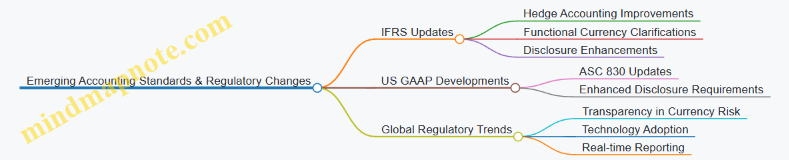
Detailed Explanation and Examples
IFRS Amendments on Hedge Accounting
The IASB has introduced amendments to IFRS 9 to simplify hedge accounting and align it more closely with risk management activities.
Example: A multinational company uses forward contracts to hedge forecasted foreign currency sales. Under the new IFRS 9 amendments, the company can apply hedge accounting more flexibly, recognizing the hedging instrument’s fair value changes in other comprehensive income (OCI) rather than profit or loss, reducing volatility.
This change helps better reflect the economic reality of the hedge and improves financial statement transparency.
US GAAP ASC 830 Updates
FASB’s recent updates require enhanced disclosures about the effects of foreign currency exchange rate changes on financial statements.
Example: An international manufacturing firm must now disclose the impact of exchange rate fluctuations on net income and comprehensive income separately, providing stakeholders with clearer insights into currency risk effects.
Regulatory Emphasis on Transparency and Technology
Regulators globally are pushing for more detailed disclosures on foreign currency exposures and encouraging the use of technology such as AI and blockchain for currency transaction tracking and risk management.
Example: A financial services company implements a blockchain-based system to record all foreign currency transactions, ensuring immutability and real-time auditability, which aligns with emerging regulatory expectations.
Mind Map: Practical Implications for Finance Teams
Best Practices for Adapting to Emerging Standards
- Continuous Education: Regular training sessions for accounting and finance teams on new standards.
- Policy Review: Periodic updates to internal accounting policies to reflect regulatory changes.
- Technology Integration: Invest in ERP and financial reporting tools that support new disclosure and measurement requirements.
- Stakeholder Communication: Proactively communicate changes and impacts to investors, auditors, and regulators.
Summary
Emerging accounting standards and regulatory changes are shaping the future of foreign currency transaction accounting by enhancing clarity, transparency, and alignment with business risk management. By understanding these developments and integrating best practices, finance professionals can ensure compliance and improve the strategic management of currency risks.
10.3 Examples: Early Adoption of New Technologies in Currency Accounting
As international finance continues to evolve, early adopters of new technologies in currency accounting gain significant advantages in accuracy, efficiency, and risk management. This section explores practical examples of how emerging technologies such as blockchain, artificial intelligence (AI), and real-time data analytics are transforming foreign currency accounting.
Mind Map: Technologies Transforming Currency Accounting
Example 1: Blockchain for Transparent Foreign Currency Transactions
Scenario: A multinational corporation (MNC) implements a blockchain-based ledger to record all foreign currency transactions across its subsidiaries.
- Benefits:
- Immutable transaction records increase auditability.
- Real-time visibility into currency flows reduces reconciliation time.
- Smart contracts automate settlement upon meeting predefined conditions.
Example: An MNC records a EUR to USD transaction on a blockchain platform. The transaction is timestamped and encrypted, ensuring no alterations. When the payment conditions are met, a smart contract automatically triggers the currency conversion and settlement, eliminating manual intervention and reducing settlement delays.
Example 2: AI-Driven Exchange Rate Forecasting and Risk Management
Scenario: An international finance team uses AI-powered software to predict exchange rate movements and optimize hedging strategies.
- Benefits:
- Improved accuracy in forecasting reduces unexpected currency losses.
- AI identifies patterns and anomalies in historical exchange rate data.
- Automated alerts enable proactive risk mitigation.
Example: The finance manager receives AI-generated insights predicting a potential depreciation of the GBP against the USD. Based on this, the team adjusts their hedging instruments, such as forward contracts, to lock in favorable rates, minimizing currency exposure.
Mind Map: AI Applications in Currency Accounting
Example 3: Real-Time Data Analytics for Currency Exposure Monitoring
Scenario: A global exporter integrates real-time analytics dashboards to monitor currency exposure across multiple markets.
- Benefits:
- Instant visibility into open foreign currency positions.
- Dynamic adjustment of hedging strategies based on live data.
- Enhanced decision-making with up-to-date financial metrics.
Example: The CFO uses a dashboard showing live USD, EUR, and JPY exposures. When the system detects an increasing exposure in JPY due to rising sales in Japan, it recommends adjusting currency swaps to mitigate risk.
Example 4: Robotic Process Automation (RPA) in Foreign Currency Journal Entries
Scenario: An accounting department deploys RPA bots to automate repetitive tasks such as recording foreign currency transactions and revaluations.
- Benefits:
- Reduced manual errors and increased processing speed.
- Consistent application of exchange rates and accounting policies.
- Frees up staff for higher-value analysis and strategy.
Example: At month-end, RPA bots automatically pull exchange rates from trusted sources, calculate gains or losses on foreign currency monetary items, and post the necessary journal entries, ensuring compliance and timeliness.
Mind Map: Benefits of Early Technology Adoption in Currency Accounting

Summary
Early adoption of technologies like blockchain, AI, real-time analytics, and RPA is reshaping foreign currency accounting. These innovations provide tangible benefits through improved transparency, predictive insights, operational efficiency, and stronger risk controls. Finance managers and accountants who embrace these tools position their organizations to navigate the complexities of international finance with greater confidence and agility.
10.4 Best Practices: Preparing for Future Challenges in International Finance
As international finance continues to evolve rapidly, accountants and international finance managers must proactively prepare for emerging challenges. This section outlines best practices to stay ahead, leveraging technology, enhancing skills, and adopting flexible strategies.
Embrace Continuous Learning and Skill Development
- Stay updated on evolving accounting standards related to foreign currency transactions (e.g., IFRS updates, new GAAP pronouncements).
- Develop expertise in emerging technologies such as blockchain, AI, and machine learning that impact currency accounting.
- Participate in industry webinars, certifications, and professional groups focused on international finance.
Example: A multinational corporation implemented quarterly training sessions on IFRS 17 and digital currency accounting to ensure their finance team remains compliant and knowledgeable.
Leverage Advanced Technology and Automation
- Implement ERP systems with integrated foreign currency modules to automate exchange rate updates and transaction revaluations.
- Use AI-driven analytics to predict currency fluctuations and assess risk exposure.
- Explore blockchain for transparent and immutable transaction records, especially for cross-border payments.
Example: An international finance manager used an AI-powered forecasting tool that analyzed historical currency trends and geopolitical events to optimize hedging strategies.
Develop Robust Risk Management and Hedging Strategies
- Regularly review and update hedging policies to reflect changing market conditions.
- Use a combination of financial instruments (forwards, options, swaps) tailored to specific transaction exposures.
- Perform stress testing and scenario analysis to prepare for extreme currency volatility.
Example: A company diversified its hedging portfolio by combining forward contracts and options, reducing the impact of sudden currency swings on its earnings.
Foster Cross-Functional Collaboration
- Collaborate closely with treasury, tax, legal, and IT departments to ensure cohesive foreign currency management.
- Share insights on currency risks and accounting impacts to align organizational strategies.
Example: The finance and treasury teams of a global firm held monthly alignment meetings to synchronize currency risk management with accounting treatments and tax implications.
Maintain Flexible and Scalable Accounting Policies
- Design accounting policies that can adapt to new currencies, digital assets, and regulatory changes.
- Regularly review policies for relevance and compliance.
Example: An international business updated its accounting policy to include guidance on cryptocurrency transactions, ensuring consistent treatment across subsidiaries.
Mind Map: Preparing for Future Challenges in International Finance
Mind Map: Technology Adoption in Foreign Currency Accounting

Example Scenario: Preparing for Digital Currency Integration
A multinational finance manager anticipates the growing use of digital currencies in international trade. To prepare:
- Conducts a gap analysis of current accounting policies regarding digital assets.
- Engages with auditors and regulators to understand compliance requirements.
- Implements a pilot blockchain-based payment system for a small subset of transactions.
- Trains the accounting team on digital currency recognition, measurement, and disclosure.
This proactive approach ensures smooth integration and compliance as digital currencies become more prevalent.
By adopting these best practices, accountants and international finance managers can effectively navigate the complexities of foreign currency transactions and position their organizations for future success in a dynamic global environment.
11. Summary and Key Takeaways
11.1 Recap of Core Principles and Best Practices
Foreign currency transactions are an integral part of international business and finance. Understanding the core principles and applying best practices ensures accurate financial reporting, compliance, and effective risk management. Below is a detailed recap with mind maps and examples to reinforce key concepts.
Core Principles of Accounting for Foreign Currency Transactions
Core Principles Mind Map
Best Practices Summary Mind Map
Best Practices Mind Map
Examples to Illustrate Core Principles and Best Practices
Example 1: Initial Recognition of a Foreign Currency Sale
A US-based company sells goods worth €10,000 to a German customer on March 1 when the EUR/USD spot rate is 1.10.
- Record revenue as $11,000 (10,000 × 1.10) on March 1.
- Document the exchange rate and transaction date.
Best Practice: Always use the spot rate on the transaction date for initial recognition to ensure accuracy.
Example 2: Subsequent Measurement and Exchange Differences
On March 31 (reporting date), the EUR/USD rate changes to 1.15. The €10,000 receivable is still outstanding.
- Revalue receivable at $11,500 (10,000 × 1.15).
- Recognize an exchange gain of $500 in profit or loss.
Best Practice: Revalue monetary items at the closing rate and recognize exchange differences promptly.
Example 3: Functional Currency Determination
A Canadian subsidiary of a US parent primarily conducts sales and expenses in CAD.
- Functional currency is CAD.
- Transactions recorded in CAD, then translated to USD for consolidation.
Best Practice: Determine functional currency based on primary economic environment to ensure relevant financial reporting.
Example 4: Hedge Accounting for a Forward Contract
A company expects to receive €50,000 in 3 months and enters a forward contract to sell €50,000 at a fixed rate.
- Document hedge relationship and risk management objective.
- Measure effectiveness periodically.
- Recognize gains/losses on the hedging instrument in OCI if cash flow hedge.
Best Practice: Maintain detailed documentation and conduct effectiveness testing to qualify for hedge accounting.
Summary
Accounting for foreign currency transactions requires careful attention to initial recognition, subsequent measurement, and consistent application of accounting standards. Implementing robust policies, leveraging technology, and managing currency risk through hedging are essential best practices. The examples above demonstrate practical application, helping accountants and international finance managers navigate complexities with confidence.
11.2 Practical Tips for Accountants and International Finance Managers
Managing foreign currency transactions effectively requires a blend of technical knowledge, strategic foresight, and practical execution. Below are actionable tips designed to help accountants and international finance managers navigate the complexities of foreign currency accounting with confidence.
Tip 1: Understand Your Functional Currency Thoroughly
- Why it matters: The functional currency determines how transactions are recorded and translated.
- Example: A US-based subsidiary operating primarily in euros should use the euro as its functional currency, even if its parent company reports in USD.
Tip 2: Maintain Accurate and Timely Documentation
- Why it matters: Exchange rates fluctuate daily; accurate documentation ensures correct recognition.
- Example: Record the spot rate on the transaction date and document the source (e.g., central bank rate).
Tip 3: Use Hedging Strategies to Manage Currency Risk
- Why it matters: Minimizes impact of exchange rate volatility on financial results.
- Example: A company expecting a payment in GBP in 3 months uses a forward contract to lock in the exchange rate.
Tip 4: Regularly Reconcile Foreign Currency Balances
- Why it matters: Ensures accuracy of monetary items and timely recognition of exchange differences.
- Example: Monthly reconciliation of accounts receivable in foreign currency to identify discrepancies early.
Tip 5: Leverage Technology and Automation
- Why it matters: Reduces manual errors and improves efficiency.
- Example: Using ERP modules that automatically pull daily exchange rates and apply them to transactions.
Tip 6: Stay Updated on Accounting Standards and Regulatory Changes
- Why it matters: Ensures compliance and avoids restatements or penalties.
- Example: Monitoring IFRS updates related to foreign currency translation and hedge accounting.
Tip 7: Foster Cross-Functional Collaboration
- Why it matters: Coordination between accounting, treasury, and operations enhances accuracy and risk management.
- Example: Treasury informs accounting of hedging contracts to ensure proper accounting treatment.
Tip 8: Provide Continuous Training and Development
- Why it matters: Keeps teams knowledgeable about evolving practices and tools.
- Example: Quarterly workshops on foreign currency accounting updates and software usage.
Summary Example: Applying Practical Tips
Scenario: An international finance manager at a manufacturing firm is preparing the monthly financial close.
- Confirms the subsidiary’s functional currency is correctly set to the local currency.
- Retrieves the official exchange rates from the central bank and documents them.
- Coordinates with treasury to confirm any forward contracts in place.
- Uses the ERP system to automatically revalue monetary items at month-end.
- Reconciles foreign currency balances and investigates any discrepancies.
- Reviews recent IFRS updates to ensure compliance.
- Shares findings and updates with the accounting team and treasury.
- Attends a training session on new hedge accounting rules.
By following these practical tips, the finance manager ensures accurate, compliant, and efficient foreign currency transaction accounting.
These practical tips, supported by clear examples and mind maps, empower accountants and international finance managers to handle foreign currency transactions with greater confidence and precision.
11.3 Recommended Resources and Tools for Ongoing Learning
To stay current and proficient in accounting for foreign currency transactions, continuous learning and leveraging the right resources and tools are essential. This section provides a curated list of recommended resources, educational platforms, and software tools, complemented by mind maps and practical examples to facilitate understanding.
A. Educational Resources
-
Accounting Standards and Guidance
- IFRS Foundation Website: Official updates and detailed guidance on IAS 21 “The Effects of Changes in Foreign Exchange Rates”.
- FASB Website: Access to US GAAP standards related to foreign currency transactions.
-
Online Courses and Webinars
- Coursera & edX: Courses on international accounting and foreign currency management.
- AICPA Webinars: Specialized sessions on foreign currency accounting and hedging.
-
Books and Publications
- International Accounting by Timothy Doupnik and Hector Perera – comprehensive coverage including foreign currency topics.
- Foreign Currency Accounting: A Practical Guide by David Alexander.
-
Professional Associations
- IMA (Institute of Management Accountants): Resources and certification programs.
- CFA Institute: For finance managers focusing on international finance.
B. Software Tools for Accounting and Currency Management
| Tool Name | Purpose | Example Use Case |
|---|---|---|
| SAP ERP | Comprehensive financial management system | Automating foreign currency transaction entries and revaluation |
| Oracle Financials | Enterprise accounting and consolidation | Managing multi-currency consolidation and translation adjustments |
| XE Currency Tools | Real-time exchange rate tracking | Monitoring exchange rates for timely transaction recording |
| Bloomberg Terminal | Financial data and analytics | Analyzing currency market trends for hedging decisions |
C. Mind Maps
Below are mind maps designed to visually organize key concepts and workflows related to foreign currency accounting.
Mind Map 1: Foreign Currency Transaction Accounting Workflow

Mind Map 2: Best Practices for Managing Foreign Currency Risk
D. Practical Examples
Example 1: Using ERP to Automate Exchange Rate Revaluation
A multinational company uses SAP ERP to automatically revalue its foreign currency monetary items at each reporting date. The system pulls daily exchange rates from a trusted financial data provider and posts the resulting exchange gains or losses directly to the profit and loss account, ensuring accuracy and compliance.
Example 2: Leveraging Online Courses for Team Training
An international finance manager enrolls their team in a Coursera course on IFRS standards related to foreign currency. This shared learning experience helps standardize knowledge and improves the team’s ability to handle complex currency transactions consistently.
E. Summary Table of Resources
| Resource Type | Name/Platform | Description | Link/Access |
|---|---|---|---|
| Standards | IFRS Foundation | Official accounting standards | https://www.ifrs.org |
| Standards | FASB | US GAAP standards | https://www.fasb.org |
| Online Courses | Coursera | Courses on international accounting | https://www.coursera.org |
| Books | International Accounting | Comprehensive textbook | Available on Amazon & libraries |
| Software | SAP ERP | Enterprise accounting system | https://www.sap.com |
| Financial Data Tools | Bloomberg Terminal | Market data and analytics | Subscription required |
By integrating these resources and tools into your ongoing learning strategy, accountants and international finance managers can enhance their expertise, improve accuracy in foreign currency accounting, and stay ahead in the dynamic field of international finance.
11.4 Final Example: Comprehensive Walkthrough of a Foreign Currency Transaction Accounting Cycle
To consolidate the concepts covered throughout this blog, this section provides a detailed, step-by-step example of accounting for a foreign currency transaction from initial recognition to reporting, including exchange rate fluctuations and settlement.
Scenario Overview:
A US-based company, GlobalTech Inc., purchases equipment from a supplier in Germany for €100,000 on March 1, 2024. Payment terms are 60 days. The exchange rate on March 1 is 1 EUR = 1.10 USD. On the reporting date, March 31, 2024, the exchange rate is 1 EUR = 1.15 USD. The payment is made on April 30, 2024, when the exchange rate is 1 EUR = 1.12 USD.
Step 1: Initial Recognition (March 1, 2024)
- Transaction: Purchase of equipment for €100,000
- Exchange Rate: 1 EUR = 1.10 USD
Journal Entry:
| Account | Debit (USD) | Credit (USD) |
|---|---|---|
| Equipment | 110,000 | |
| Accounts Payable (EUR) | 110,000 |
Explanation: The equipment is recorded at the spot exchange rate on the transaction date.
Step 2: Reporting Date Revaluation (March 31, 2024)
- Outstanding Payable: €100,000
- Exchange Rate on Reporting Date: 1 EUR = 1.15 USD
Revalued Payable: 100,000 × 1.15 = 115,000 USD
Exchange Difference: 115,000 - 110,000 = 5,000 USD (loss)
Journal Entry:
| Account | Debit (USD) | Credit (USD) |
|---|---|---|
| Exchange Loss (P&L) | 5,000 | |
| Accounts Payable (EUR) | 5,000 |
Explanation: The payable is revalued at the reporting date exchange rate, recognizing a foreign exchange loss.
Step 3: Payment Settlement (April 30, 2024)
- Payment: €100,000
- Exchange Rate on Payment Date: 1 EUR = 1.12 USD
Payment Amount in USD: 100,000 × 1.12 = 112,000 USD
Accounts Payable Balance: 115,000 USD (after revaluation)
Exchange Difference on Settlement: 115,000 - 112,000 = 3,000 USD (gain)
Journal Entry:
| Account | Debit (USD) | Credit (USD) |
|---|---|---|
| Accounts Payable (EUR) | 115,000 | |
| Cash | 112,000 | |
| Exchange Gain (P&L) | 3,000 |
Explanation: The payment is made at a lower USD equivalent than the revalued payable, resulting in a foreign exchange gain.
Mind Map: Foreign Currency Transaction Accounting Cycle
Additional Example: Sale in Foreign Currency
Scenario: GlobalTech sells software licenses to a UK client for £50,000 on May 1, 2024. Exchange rate on May 1 is 1 GBP = 1.30 USD. Payment due in 30 days. On May 31, 2024, exchange rate is 1 GBP = 1.25 USD. Payment received on June 1, 2024, at 1 GBP = 1.28 USD.
Initial Recognition:
- Debit Accounts Receivable $65,000 (50,000 × 1.30)
- Credit Revenue $65,000
Revaluation at May 31:
- Accounts Receivable revalued to $62,500 (50,000 × 1.25)
- Exchange loss of $2,500 recognized
Settlement on June 1:
- Cash received $64,000 (50,000 × 1.28)
- Exchange gain of $1,500 recognized
Mind Map: Foreign Currency Sale Transaction
Summary
This comprehensive walkthrough illustrates the full accounting cycle for foreign currency transactions, emphasizing:
- Accurate initial measurement at spot rate
- Revaluation at reporting dates to reflect current exchange rates
- Recognition of exchange differences in profit or loss
- Proper settlement accounting reflecting actual payment rates
By following these steps and best practices, accountants and international finance managers can ensure compliance, transparency, and effective management of foreign currency risks.