Cash Flow Management
1. Introduction to Cash Flow Management
1.1 Understanding Cash Flow: Definition and Importance
Cash flow is the movement of money into and out of a business over a specific period. It represents the actual liquidity available to a company to meet its obligations, invest in growth, and sustain operations. Unlike profit, which is an accounting measure of earnings, cash flow focuses solely on the cash that is physically received and paid out.
Why is Cash Flow Important?
- Liquidity Management: Ensures the business can pay its bills, salaries, and suppliers on time.
- Business Sustainability: Positive cash flow is critical for ongoing operations and avoiding insolvency.
- Investment and Growth: Cash availability allows for reinvestment in new projects, inventory, or technology.
- Creditworthiness: Lenders and investors assess cash flow to gauge financial health.
Mind Map: Core Concepts of Cash Flow
Example 1: Retail Store Cash Flow Scenario
Imagine a retail store that sells seasonal products. During the holiday season, the store experiences high sales, resulting in significant cash inflows. However, it also needs to purchase inventory in advance and pay staff salaries and rent, which are cash outflows.
- December: High sales generate $100,000 in cash inflows.
- November: The store spends $60,000 on inventory and $20,000 on operating expenses.
If the store does not manage its cash flow properly, it might run out of cash before the holiday sales peak, even though it is profitable on paper.
Mind Map: Cash Flow Example Breakdown
Example 2: Financial Controller Perspective
A financial controller in a retail company monitors cash flow daily to ensure there is enough liquidity to cover payroll and supplier payments. They use cash flow statements and forecasting tools to anticipate periods of tight cash availability and arrange for short-term credit lines if necessary.
- Best Practice: Regularly updating cash flow forecasts based on actual sales and expenses.
- Benefit: Avoids surprises and enables proactive management.
Mind Map: Role of Financial Controller in Cash Flow
Summary
Understanding cash flow is fundamental for accountants and financial controllers in finance and retail sectors. It goes beyond profit to focus on the actual cash available, which determines a company’s ability to operate, grow, and survive. By mastering cash flow concepts and monitoring, professionals can ensure their organizations remain financially healthy and agile.
1.2 Key Components of Cash Flow: Inflows and Outflows
Effective cash flow management starts with a clear understanding of its two fundamental components: cash inflows and cash outflows. These elements represent the movement of money into and out of a business, and managing them well is critical for maintaining liquidity and financial health.
Cash Inflows
Cash inflows are the funds received by a business. They increase the cash balance and provide the resources needed to cover expenses, invest, and grow.
Common Sources of Cash Inflows:
- Sales Revenue: Money received from selling goods or services.
- Accounts Receivable Collections: Payments collected from customers who previously bought on credit.
- Loans and Financing: Funds obtained through borrowing.
- Asset Sales: Cash generated from selling company assets.
- Investment Income: Dividends, interest, or returns from investments.
Mind Map: Cash Inflows
Example:
A retail store sells $50,000 worth of merchandise in a month. Of this, $35,000 is collected immediately, and $15,000 is on credit to be collected next month. Additionally, the store receives a $2,000 loan from the bank to support expansion.
- Immediate cash inflow: $35,000
- Accounts receivable expected next month: $15,000
- Loan proceeds: $2,000
Cash Outflows
Cash outflows represent the money leaving the business. These are expenses and payments that reduce the cash balance.
Common Types of Cash Outflows:
- Operating Expenses: Rent, utilities, salaries, marketing, and other day-to-day costs.
- Cost of Goods Sold (COGS): Payments to suppliers for inventory or raw materials.
- Loan Repayments: Principal and interest payments on borrowed funds.
- Capital Expenditures: Purchases of long-term assets like equipment or property.
- Taxes and Fees: Government levies and compliance costs.
Mind Map: Cash Outflows
Example:
Continuing with the retail store example, the business pays $20,000 to suppliers for inventory, $8,000 in salaries, $3,000 in rent, and $1,000 in utilities during the month. It also repays $500 in loan interest.
- Supplier payments: $20,000
- Salaries: $8,000
- Rent: $3,000
- Utilities: $1,000
- Loan interest: $500
Integrated Example: Monthly Cash Flow Snapshot
| Description | Amount (USD) | Type |
|---|---|---|
| Sales collected | 35,000 | Inflow |
| Accounts receivable (next month) | 15,000 | Inflow (future) |
| Loan proceeds | 2,000 | Inflow |
| Supplier payments | 20,000 | Outflow |
| Salaries | 8,000 | Outflow |
| Rent | 3,000 | Outflow |
| Utilities | 1,000 | Outflow |
| Loan interest | 500 | Outflow |
Net cash flow for the month:
= (35,000 + 2,000) - (20,000 + 8,000 + 3,000 + 1,000 + 500) = 37,000 - 32,500 = $4,500 positive cash flow
Why Understanding Inflows and Outflows Matters
- Liquidity Management: Knowing when cash comes in and goes out helps avoid shortfalls.
- Planning and Forecasting: Accurate categorization improves cash flow projections.
- Decision Making: Helps prioritize payments and manage credit terms.
- Identifying Problem Areas: For example, slow receivables or high expenses.
Summary
Understanding cash inflows and outflows is foundational for accountants and financial controllers in finance and retail sectors. By categorizing and monitoring these components, professionals can maintain healthy cash balances, plan effectively, and support business sustainability.
1.3 The Role of Cash Flow Management in Finance and Retail
Cash flow management is a critical function that ensures a business has enough liquidity to meet its obligations, invest in growth, and navigate uncertainties. In both finance and retail sectors, effective cash flow management plays a pivotal role in maintaining operational stability and driving strategic decisions.
Why Cash Flow Management Matters in Finance and Retail
- Liquidity Maintenance: Ensures the business can pay suppliers, employees, and creditors on time.
- Operational Continuity: Prevents disruptions caused by cash shortages.
- Investment and Growth: Frees up resources for expansion, marketing, and technology upgrades.
- Risk Mitigation: Helps anticipate and manage financial risks.
Mind Map: Core Roles of Cash Flow Management
Role in Finance Sector
In finance, cash flow management is foundational. Financial controllers and accountants rely on it to:
- Monitor and report liquidity positions.
- Manage working capital effectively.
- Ensure compliance with financial regulations.
- Support budgeting and forecasting activities.
Example: A financial controller at a mid-sized investment firm uses cash flow reports to decide when to liquidate short-term assets to cover upcoming liabilities, avoiding penalties and maintaining creditworthiness.
Role in Retail Sector
Retail businesses face unique cash flow challenges due to:
- High volume of daily transactions.
- Seasonal fluctuations in sales.
- Inventory management complexities.
Effective cash flow management helps retailers:
- Optimize inventory purchases to avoid overstocking or stockouts.
- Manage supplier payments to maintain good relationships.
- Plan for seasonal demand spikes.
Example: A retail store manager implements a cash flow forecast to align inventory purchases with expected holiday season sales, preventing excess stock and improving cash availability.
Mind Map: Cash Flow Management in Retail
Integrated Example: Finance and Retail Collaboration
Consider a retail chain expanding to new locations. The finance team and retail managers collaborate on cash flow management:
- Finance team provides cash flow forecasts highlighting available capital.
- Retail managers adjust inventory and staffing plans based on cash availability.
- Both teams monitor actual cash flow against forecasts to make real-time adjustments.
This integrated approach ensures the expansion is financially sustainable and operationally smooth.
Summary
Cash flow management acts as the lifeblood of both finance and retail organizations. It supports day-to-day operations, strategic initiatives, and risk mitigation. For accountants and financial controllers, mastering cash flow management means enabling their organizations to thrive even in volatile market conditions.
1.4 Common Cash Flow Challenges Faced by Accountants and Financial Controllers
Cash flow management is a critical responsibility for accountants and financial controllers, especially in the finance and retail sectors where cash inflows and outflows can be highly variable. Despite best efforts, several common challenges often arise that can complicate maintaining a healthy cash flow.
Key Challenges:
Delayed Receivables
One of the most frequent challenges is delayed customer payments. For example, a retail business might invoice customers with net 30 terms, but many customers pay late, causing cash inflows to be unpredictable.
Example: A retail chain issues invoices totaling $100,000 monthly but only collects $70,000 on time. This 30% delay forces the finance team to scramble for short-term financing or delay supplier payments.
Best Practice: Implement automated invoicing and reminders, and consider early payment discounts to encourage timely payments.
Unpredictable Sales
Retail sales often fluctuate due to seasonality or market trends, making cash flow forecasting difficult.
Example: A fashion retailer experiences a surge in sales during holiday seasons but sees a steep decline in the off-season, leading to cash shortages.
Best Practice: Use historical sales data to build seasonal cash flow models and maintain a cash reserve for low-sales periods.
High Inventory Costs
Excess inventory ties up cash that could be used elsewhere.
Example: A retailer stocks up on winter apparel but fails to sell it all, resulting in s and cash flow strain.
Best Practice: Adopt just-in-time inventory practices and monitor inventory turnover ratios closely.
Expense Management
Unexpected or poorly controlled expenses can disrupt cash flow.
Example: A retail store faces sudden equipment repair costs that were not budgeted, forcing a cash outflow spike.
Best Practice: Maintain an emergency fund and regularly review expense categories to identify cost-saving opportunities.
Financing Constraints
Access to affordable financing is often limited, especially for smaller businesses.
Example: A financial controller struggles to secure a line of credit due to strict lending criteria, limiting the company’s ability to smooth cash flow gaps.
Best Practice: Build strong banking relationships early and explore alternative financing options like invoice factoring.
Poor Forecasting
Inaccurate or outdated cash flow forecasts can lead to misinformed decisions.
Example: A company relies on quarterly forecasts that do not reflect recent market changes, resulting in unexpected cash shortages.
Best Practice: Implement rolling forecasts updated monthly or weekly using real-time data.
Supplier Payment Terms
Short payment terms or penalties for late payments can pressure cash outflows.
Example: A retailer must pay suppliers within 15 days but only collects from customers in 30 days, creating a cash flow mismatch.
Best Practice: Negotiate extended payment terms or stagger payments to better align with receivables.
Economic Uncertainty
Inflation, regulatory changes, or economic downturns can unpredictably impact cash flow.
Example: Rising costs due to inflation increase operating expenses, squeezing cash reserves.
Best Practice: Conduct scenario planning and maintain flexible budgets to adapt quickly.
Summary Mind Map
By understanding these common challenges and applying best practices with practical examples, accountants and financial controllers can better anticipate issues and maintain a healthy cash flow, ensuring business stability and growth.
1.5 Overview of Best Practices in Cash Flow Management
Effective cash flow management is essential for maintaining the financial health of any business, especially within the finance and retail sectors. This section provides an integrated overview of best practices, supported by clear examples and mind maps to help accountants and financial controllers implement these strategies with confidence.
Best Practices Mind Map
Forecasting
Best Practice: Develop accurate cash flow forecasts to anticipate cash shortages or surpluses.
Example: A retail chain uses historical sales data and seasonal trends to create monthly forecasts. For instance, during the holiday season, they anticipate increased cash inflows and adjust inventory purchases accordingly.
Receivables Management
Best Practice: Set clear payment terms and encourage early payments to accelerate cash inflows.
Example: An accounting firm offers a 2% discount if clients pay invoices within 10 days instead of the standard 30 days. This incentivizes quicker payments and improves cash availability.
Payables Management
Best Practice: Negotiate extended payment terms with suppliers without damaging relationships.
Example: A retail store negotiates 60-day payment terms instead of 30 days with key suppliers, allowing more time to convert inventory into sales before paying.
Inventory Control
Best Practice: Optimize inventory levels to free up cash tied in stock.
Example: Implementing a Just-In-Time (JIT) inventory system, a retailer reduces excess stock, lowering storage costs and improving cash flow.
Expense Management
Best Practice: Regularly review expenses to identify and eliminate unnecessary costs.
Example: A financial controller audits monthly expenses and identifies redundant software subscriptions, canceling them to save cash.
Financing
Best Practice: Use short-term financing options strategically to bridge cash flow gaps.
Example: A retail business uses invoice financing to access cash immediately after sales, rather than waiting for customer payments.
Monitoring & Reporting
Best Practice: Track key cash flow metrics and create real-time dashboards for proactive management.
Example: A finance team develops a dashboard showing daily cash inflows and outflows, enabling quick decisions to avoid overdrafts.
Risk Management
Best Practice: Prepare contingency plans and use scenario analysis to manage cash flow risks.
Example: During an economic downturn, a retailer models worst-case cash flow scenarios and establishes a reserve fund to cover three months of expenses.
Integrated Example Mind Map
By integrating these best practices, accountants and financial controllers can create a robust cash flow management system that not only ensures liquidity but also supports strategic growth and operational efficiency.
2. Cash Flow Forecasting Techniques
2.1 Importance of Accurate Cash Flow Forecasting
Accurate cash flow forecasting is a cornerstone of effective financial management, especially for accountants and financial controllers in the finance and retail sectors. It enables businesses to anticipate cash shortages or surpluses, make informed decisions, and maintain financial stability.
Why Accurate Cash Flow Forecasting Matters
- Ensures Liquidity: Helps maintain sufficient cash to meet day-to-day obligations such as payroll, supplier payments, and operational expenses.
- Supports Strategic Planning: Provides insights into when to invest, expand, or hold back based on projected cash availability.
- Avoids Financial Distress: Early identification of cash shortfalls allows proactive measures like securing financing or adjusting expenses.
- Improves Stakeholder Confidence: Demonstrates financial control to investors, lenders, and management.
- Optimizes Working Capital: Balances receivables, payables, and inventory to maximize cash efficiency.
Mind Map: Key Benefits of Accurate Cash Flow Forecasting
Example 1: Avoiding a Cash Shortfall in Retail
A mid-sized retail chain used historical sales data to forecast cash inflows and outflows for the upcoming quarter. The forecast revealed a potential cash shortfall in July due to seasonal inventory purchases and slower sales. Armed with this insight, the financial controller arranged a short-term line of credit and negotiated extended payment terms with suppliers. As a result, the company maintained smooth operations without disruption.
Example 2: Strategic Investment Timing
An accounting team at a finance company used accurate cash flow forecasting to identify a surplus expected in Q4. Instead of letting the cash sit idle, the team advised management to invest in upgrading IT infrastructure. This timely decision improved operational efficiency and positioned the company for growth.
Mind Map: Consequences of Inaccurate Cash Flow Forecasting
Practical Tips for Enhancing Forecast Accuracy
- Use multiple data sources including sales trends, payment histories, and market conditions.
- Update forecasts regularly to reflect actual performance and changing circumstances.
- Involve cross-functional teams to gather comprehensive input.
- Incorporate seasonal and cyclical factors relevant to retail and finance.
- Leverage forecasting software with predictive analytics capabilities.
Example 3: Regular Forecast Updates in Practice
A financial controller at a retail company updated the cash flow forecast weekly instead of monthly. This practice allowed the team to quickly identify a sudden drop in receivables due to delayed customer payments. Prompt action was taken to accelerate collections, preventing a potential cash crunch.
Accurate cash flow forecasting is not just a financial exercise; it is a strategic tool that empowers accountants and financial controllers to safeguard the financial health of their organizations and seize growth opportunities with confidence.
2.2 Short-term vs Long-term Cash Flow Forecasting
Cash flow forecasting is a critical tool for accountants and financial controllers to ensure that a business maintains sufficient liquidity to meet its obligations. Understanding the distinction between short-term and long-term cash flow forecasting is essential for effective financial planning and risk management.
What is Short-term Cash Flow Forecasting?
Short-term cash flow forecasting typically covers a period ranging from daily up to 3 months. It focuses on immediate cash inflows and outflows, helping businesses manage day-to-day liquidity needs.
Key Characteristics:
- Time horizon: Daily, weekly, or monthly (up to 3 months)
- Focus on operational cash movements
- Helps avoid short-term cash shortages
- Supports tactical decisions like managing payables and receivables
Example: A retail store forecasts cash flow for the next 30 days to ensure it can pay suppliers on time and cover payroll. It tracks daily sales, expected customer payments, and upcoming bills.
What is Long-term Cash Flow Forecasting?
Long-term cash flow forecasting extends beyond 3 months, often up to 1-3 years or more. It is strategic in nature, used for planning major investments, financing, and growth initiatives.
Key Characteristics:
- Time horizon: Quarterly, annually, or multi-year
- Focus on strategic financial planning
- Helps in capital budgeting and financing decisions
- Incorporates assumptions about market trends, expansion, and economic conditions
Example: A retail chain prepares a 2-year cash flow forecast to evaluate the feasibility of opening new stores and securing a loan. It includes projected sales growth, capital expenditures, and debt repayments.
Mind Map: Short-term vs Long-term Cash Flow Forecasting
Integrating Both Forecasts for Effective Cash Flow Management
While short-term forecasts help manage immediate liquidity, long-term forecasts provide a roadmap for sustainable growth. Combining both approaches allows financial controllers to balance operational needs with strategic goals.
Example: A financial controller uses a rolling 13-week short-term forecast to monitor weekly cash positions and a 3-year long-term forecast to plan for upcoming capital investments. When the short-term forecast signals a cash crunch, they adjust payment schedules or seek short-term financing, while the long-term forecast guides decisions on store openings.
Practical Example: Short-term vs Long-term Forecasting in a Retail Business
Scenario: A mid-sized retail company experiences seasonal fluctuations. During the holiday season, cash inflows spike, but inventory purchases and staffing costs also increase.
- Short-term Forecast: The accountant prepares a weekly cash flow forecast for the next 12 weeks to ensure sufficient cash for inventory purchases and holiday payroll.
- Long-term Forecast: The financial controller develops a 3-year forecast considering expansion into new markets and the impact of e-commerce trends.
Outcome: By monitoring short-term cash flow, the company avoids overdrafts during peak season. The long-term forecast helps secure financing for new store openings, aligning growth with cash availability.
Summary Table: Differences Between Short-term and Long-term Cash Flow Forecasting
| Aspect | Short-term Forecasting | Long-term Forecasting |
|---|---|---|
| Time Horizon | Daily to 3 months | 3 months to several years |
| Focus | Operational liquidity | Strategic financial planning |
| Data Used | Actual cash transactions, sales | Assumptions, projections, trends |
| Purpose | Manage immediate cash needs | Plan investments and financing |
| Frequency | Weekly or daily updates | Quarterly or annual updates |
| Example | 30-day cash flow for payroll | 3-year forecast for expansion |
Tips for Accountants and Financial Controllers
- Use short-term forecasts to identify cash shortages early and take corrective actions such as adjusting payment terms or securing short-term credit.
- Develop long-term forecasts to support strategic decisions and communicate financial needs to stakeholders.
- Regularly update both forecasts to reflect actual performance and changing market conditions.
- Leverage software tools that integrate short-term and long-term forecasting for seamless cash flow management.
By mastering both short-term and long-term cash flow forecasting, finance professionals in retail and other sectors can ensure their organizations remain financially healthy and well-prepared for future challenges and opportunities.
2.3 Step-by-Step Guide to Building a Cash Flow Forecast
Building a reliable cash flow forecast is essential for accountants and financial controllers to anticipate liquidity needs, manage working capital, and make informed financial decisions. This step-by-step guide will walk you through the process of creating an effective cash flow forecast, complete with practical examples and mind maps to visualize the workflow.
Step 1: Define the Forecast Period
Decide the time horizon for your forecast. Common periods include:
- Short-term: Weekly or monthly forecasts (ideal for operational cash flow management)
- Long-term: Quarterly or annual forecasts (useful for strategic planning)
Example: A retail business preparing for seasonal sales might use a weekly forecast for the next 3 months.
Step 2: Gather Historical Cash Flow Data
Collect past cash inflows and outflows data to identify trends and seasonality.
Example: Review the last 12 months of bank statements, sales reports, and expense records.
Step 3: Identify Cash Inflows
List all sources of cash receipts, such as:
- Customer payments (sales revenue)
- Loan proceeds
- Asset sales
- Interest income
Example: A retail store expects $50,000 in sales revenue monthly, with 70% collected within the same month and 30% in the following month.
Step 4: Identify Cash Outflows
List all expected cash payments, including:
- Supplier payments
- Payroll
- Rent and utilities
- Loan repayments
- Taxes
- Capital expenditures
Example: Monthly supplier payments total $30,000, payroll is $15,000, and rent is $5,000.
Step 5: Estimate Timing of Cash Flows
Determine when cash inflows and outflows will occur to avoid timing mismatches.
Example: Customer payments are received 30 days after invoicing; supplier payments are due within 45 days.
Step 6: Build the Forecast Model
Create a spreadsheet or use software to map inflows and outflows over the forecast period.
Mind Map: Cash Flow Forecast Model Structure
Example: Using the data, calculate net cash flow for each month and update the closing cash balance accordingly.
Step 7: Incorporate Assumptions and Adjustments
Document assumptions such as payment delays, seasonal fluctuations, or expected changes in sales.
Example: Assume a 10% increase in sales during holiday months and a 5-day delay in supplier payments.
Step 8: Validate and Review the Forecast
Cross-check the forecast against actual results periodically and adjust assumptions as needed.
Example: Compare forecasted cash inflows with actual receipts monthly to refine accuracy.
Step 9: Use the Forecast for Decision Making
Leverage the forecast to plan for:
- Managing working capital
- Scheduling payments
- Securing financing if needed
- Identifying potential cash shortages early
Example: If the forecast shows a cash shortfall in June, the financial controller arranges a short-term credit line in advance.
Practical Example: Monthly Cash Flow Forecast for a Retail Business
| Month | Opening Balance | Cash Inflows | Cash Outflows | Net Cash Flow | Closing Balance |
|---|---|---|---|---|---|
| January | $20,000 | $60,000 | $50,000 | $10,000 | $30,000 |
| February | $30,000 | $55,000 | $52,000 | $3,000 | $33,000 |
| March | $33,000 | $70,000 | $60,000 | $10,000 | $43,000 |
Note: The closing balance of each month becomes the opening balance of the next.
Additional Mind Map: Workflow for Building a Cash Flow Forecast
By following these steps and continuously refining your forecast with real data and updated assumptions, accountants and financial controllers can maintain a clear picture of their organization’s cash position, enabling proactive and confident financial management.
2.4 Using Historical Data and Trends for Forecasting
Accurate cash flow forecasting is essential for effective financial management, especially in finance and retail sectors where cash inflows and outflows can be highly variable. One of the most reliable ways to enhance the accuracy of your cash flow forecasts is by leveraging historical data and identifying trends over time. This section explores how to use historical data and trends in cash flow forecasting, supported by practical examples and mind maps.
Why Use Historical Data for Cash Flow Forecasting?
- Foundation for Predictions: Historical cash flow data provides a factual basis for estimating future cash movements.
- Identifying Patterns: Seasonal fluctuations, recurring expenses, and payment behaviors become visible.
- Improved Accuracy: Reduces guesswork by grounding forecasts in real past performance.
Steps to Use Historical Data and Trends in Forecasting
-
Collect Relevant Historical Data:
- Gather at least 12 months of cash inflow and outflow data.
- Include sales data, payment receipts, supplier payments, payroll, and other expenses.
-
Clean and Organize Data:
- Remove anomalies or one-time events that could skew trends.
- Categorize data by type (e.g., sales, operating expenses, capital expenditures).
-
Analyze Seasonal and Cyclical Trends:
- Identify months or quarters with consistently higher or lower cash flows.
- Understand industry-specific cycles (e.g., holiday sales spikes in retail).
-
Calculate Moving Averages and Growth Rates:
- Use moving averages to smooth out short-term fluctuations.
- Calculate month-over-month or year-over-year growth rates to project trends.
-
Incorporate External Factors:
- Adjust forecasts based on market conditions, economic indicators, or planned business changes.
-
Validate Forecasts Against Historical Outcomes:
- Compare forecasted cash flows with actual past results to refine assumptions.
Mind Map: Using Historical Data for Cash Flow Forecasting
Practical Example: Forecasting Cash Flow for a Retail Store Using Historical Data
Scenario: A retail store wants to forecast cash flow for the next quarter using the past 12 months of data.
Step 1: Data Collection
- Monthly sales revenue, supplier payments, payroll, rent, utilities, and marketing expenses were collected.
Step 2: Data Cleaning
- A one-time large equipment purchase was excluded from recurring expenses.
Step 3: Trend Analysis
- Sales showed a consistent 20% increase in November and December due to holiday shopping.
- Moving average of monthly sales was calculated to smooth fluctuations.
- Payroll expenses remained stable but increased by 10% in December due to seasonal hires.
Step 4: Forecasting
- November and December sales were projected with a 20% increase over the average monthly sales.
- Payroll expenses were adjusted upward for December.
- Supplier payments were forecasted based on average payment cycles.
Step 5: Validation
- The forecast was compared with the previous year’s actual cash flow for the same quarter, showing a 5% variance, which was acceptable.
Mind Map: Retail Store Cash Flow Forecasting Example
Additional Tips for Using Historical Data Effectively
- Use Granular Data: Weekly or daily data can reveal more precise trends than monthly aggregates.
- Segment Data by Product or Service: Different product lines may have distinct cash flow patterns.
- Incorporate Customer Payment Behavior: Analyze how quickly customers pay invoices to forecast receivables.
- Leverage Visualization Tools: Graphs and charts help identify trends and anomalies easily.
Summary
Using historical data and trends is a cornerstone of reliable cash flow forecasting. By systematically collecting, cleaning, and analyzing past cash flow data, accountants and financial controllers can create forecasts that reflect real business patterns. Incorporating seasonal trends, smoothing techniques like moving averages, and validating forecasts against actual results ensures forecasts are both realistic and actionable. This approach empowers finance professionals in retail and other sectors to make informed decisions that maintain healthy cash flow and support business growth.
2.5 Practical Example: Creating a Monthly Cash Flow Forecast for a Retail Business
Creating a monthly cash flow forecast is essential for retail businesses to anticipate cash shortages, plan for expenses, and make informed financial decisions. This section walks through a detailed, step-by-step example of building a cash flow forecast, complete with mind maps and practical illustrations.
Step 1: Gather Historical Data
Start by collecting historical data on cash inflows and outflows from previous months. This includes sales revenue, customer payments, supplier payments, operating expenses, and other cash movements.
Example:
- January sales: $50,000
- February sales: $55,000
- March sales: $52,000
- Average monthly sales: $52,333
Step 2: Identify Cash Inflows
Cash inflows typically include:
- Cash sales
- Credit sales collected
- Other income (e.g., interest, asset sales)
Mind Map: Cash Inflows
Example:
- Cash sales: 40% of total sales collected immediately
- Credit sales: 60% collected the following month
For April forecast:
- Cash sales = 40% * $53,000 (estimated sales) = $21,200
- Credit sales collected from March sales = 60% * $52,000 = $31,200
- Total cash inflows for April = $21,200 + $31,200 = $52,400
Step 3: Identify Cash Outflows
Cash outflows include:
- Payments to suppliers
- Operating expenses (rent, utilities, salaries)
- Loan repayments
- Capital expenditures
Mind Map: Cash Outflows
Example:
- Supplier payments: 50% paid in the month of purchase, 50% paid next month
- Operating expenses for April estimated at $15,000
- Loan repayment: $2,000
Supplier payments for April:
- 50% of April purchases (assumed $20,000) = $10,000
- 50% of March purchases (assumed $18,000) = $9,000
- Total supplier payments = $19,000
Total cash outflows for April = $19,000 + $15,000 + $2,000 = $36,000
Step 4: Calculate Net Cash Flow
Net cash flow = Total cash inflows - Total cash outflows
Example:
- Total inflows (April) = $52,400
- Total outflows (April) = $36,000
- Net cash flow = $52,400 - $36,000 = $16,400
Step 5: Consider Opening Cash Balance
Add the opening cash balance at the beginning of the month to the net cash flow to estimate the closing cash balance.
Example:
- Opening cash balance (April 1) = $10,000
- Closing cash balance (April 30) = $10,000 + $16,400 = $26,400
Step 6: Build the Monthly Cash Flow Forecast Table
| Description | Amount ($) |
|---|---|
| Opening Cash Balance | 10,000 |
| Cash Inflows | |
| Cash Sales | 21,200 |
| Credit Sales Collected | 31,200 |
| Total Inflows | 52,400 |
| Cash Outflows | |
| Supplier Payments | 19,000 |
| Operating Expenses | 15,000 |
| Loan Repayments | 2,000 |
| Total Outflows | 36,000 |
| Net Cash Flow | 16,400 |
| Closing Cash Balance | 26,400 |
Step 7: Analyze and Adjust
Use the forecast to identify potential cash shortfalls or surpluses. For example, if closing cash balance is projected to be low, consider:
- Negotiating extended payment terms with suppliers
- Accelerating receivables collection
- Reducing discretionary expenses
Mind Map: Cash Flow Adjustment Strategies
Summary
Creating a monthly cash flow forecast involves systematically estimating cash inflows and outflows based on historical data and expected changes. The example above demonstrates how a retail business can forecast cash flow for April, providing a clear picture of liquidity and enabling proactive financial management.
By regularly updating forecasts and integrating best practices such as early payment incentives and supplier negotiations, accountants and financial controllers can maintain healthy cash flow and support business growth.
2.6 Tools and Software for Effective Cash Flow Forecasting
Effective cash flow forecasting relies heavily on the right tools and software that streamline data collection, analysis, and reporting. For accountants and financial controllers in finance and retail sectors, leveraging these technologies can significantly enhance accuracy, save time, and provide actionable insights.
Key Features to Look for in Cash Flow Forecasting Tools
- Automated Data Integration: Connects with accounting, sales, and banking systems to pull real-time data.
- Scenario Planning: Allows users to create multiple cash flow scenarios based on different assumptions.
- User-Friendly Dashboards: Visualizes cash inflows and outflows clearly for quick decision-making.
- Alerts and Notifications: Warns about potential cash shortages or overdue receivables.
- Collaboration Capabilities: Enables multiple stakeholders to contribute and review forecasts.
Popular Tools and Software Examples
| Tool Name | Description | Example Use Case |
|---|---|---|
| Float | Integrates with accounting software like Xero, QuickBooks; offers real-time cash flow views. | A retail store uses Float to monitor daily cash balances and adjust inventory purchases accordingly. |
| Fathom | Provides advanced financial analysis and forecasting with scenario modeling. | A financial controller creates multiple cash flow scenarios to prepare for seasonal sales fluctuations. |
| Pulse | Focuses on cash flow forecasting with customizable reports and alerts. | An accountant sets up alerts for overdue invoices to accelerate receivables collection. |
| PlanGuru | Offers budgeting, forecasting, and performance review tools. | A retail chain uses PlanGuru to combine sales forecasts with expense budgets for comprehensive cash flow planning. |
| Microsoft Excel + Add-ins | Widely used with customizable templates and add-ins for forecasting automation. | A financial controller builds a tailored cash flow model using Excel and automates data imports with Power Query. |
Mind Map: Selecting the Right Cash Flow Forecasting Tool
Example: Using Float for Retail Cash Flow Forecasting
- Setup: Connect Float to the retail business’s QuickBooks account.
- Data Sync: Automatically import historical sales, expenses, and bank transactions.
- Forecast Creation: Float generates a 13-week rolling cash flow forecast.
- Scenario Planning: The financial controller models the impact of a planned marketing campaign on cash inflows.
- Alerts: The system notifies the team of a projected cash shortfall two weeks ahead.
- Action: Adjust payment schedules and negotiate supplier terms to mitigate the shortfall.
Mind Map: Workflow Using Cash Flow Forecasting Software
Tips for Maximizing Software Effectiveness
- Regular Updates: Keep data synced daily or weekly to maintain forecast accuracy.
- Training: Ensure finance teams are trained on software features and best practices.
- Customization: Tailor dashboards and reports to highlight KPIs relevant to your retail or finance operations.
- Integration: Connect forecasting tools with ERP and CRM systems for holistic financial visibility.
- Review Cycles: Establish regular forecast review meetings to adjust assumptions and strategies.
By carefully selecting and effectively using cash flow forecasting tools, accountants and financial controllers can transform raw financial data into strategic insights, enabling proactive cash management and stronger financial health for their organizations.
3. Managing Receivables to Improve Cash Flow
3.1 Best Practices for Credit Management
Effective credit management is crucial for maintaining healthy cash flow, especially for accountants and financial controllers in the finance and retail sectors. Proper credit management ensures that your business minimizes bad debts, accelerates cash inflows, and maintains strong customer relationships.
Key Best Practices for Credit Management
Example 1: Establishing Clear Credit Policies in a Retail Business
A mid-sized retail chain sets a standard credit term of 30 days with a credit limit of $10,000 for new customers. They communicate these terms upfront during onboarding and include them on all invoices. Customers who consistently pay on time are eligible for extended terms of 45 days and higher credit limits, incentivizing good payment behavior.
Example 2: Using Credit Assessments to Minimize Risk
Before extending credit to a new wholesale customer, the finance team requests financial statements and reviews credit bureau reports. Based on the assessment, they approve a conservative credit limit of $5,000. This prevents overexposure and protects cash flow.
Example 3: Accelerating Receivables with Early Payment Discounts
A retailer offers a 2% discount if invoices are paid within 10 days instead of the usual 30. This encourages customers to pay faster, improving cash inflows. For example, a $1,000 invoice paid early nets $980 but improves liquidity significantly.
Mind Map: Credit Management Workflow
Mind Map: Benefits of Effective Credit Management
Practical Tips
- Always document credit agreements in writing.
- Use credit insurance for high-risk customers.
- Regularly communicate with customers about their account status.
- Integrate credit management with overall cash flow forecasting.
By implementing these best practices, accountants and financial controllers can significantly improve their organization’s cash flow stability and reduce the risk of payment defaults.
3.2 Setting Clear Payment Terms and Conditions
Effective cash flow management begins with establishing clear payment terms and conditions. These terms define when and how customers are expected to pay, directly impacting the timing of cash inflows. Ambiguity or poorly communicated terms can lead to delayed payments, disputes, and ultimately cash flow challenges.
Why Clear Payment Terms Matter
- Reduce Payment Delays: Clear terms set expectations upfront, minimizing confusion.
- Improve Customer Relationships: Transparent terms foster trust and professionalism.
- Enhance Cash Flow Predictability: Knowing when payments will arrive helps in forecasting.
- Mitigate Disputes: Well-defined conditions reduce disagreements over invoices.
Key Elements of Payment Terms and Conditions
Best Practices for Setting Payment Terms
-
Define Clear Due Dates: Specify exact payment deadlines (e.g., “Net 30 days” means payment due 30 days after invoice date).
-
Communicate Terms Upfront: Include terms in contracts, purchase orders, and invoices.
-
Offer Multiple Payment Options: Facilitate faster payments by accepting various methods.
-
Incorporate Incentives and Penalties: Encourage early payments with discounts (e.g., 2% off if paid within 10 days) and discourage late payments with fees.
-
Specify Currency and Taxes: Avoid confusion in international transactions by clarifying currency and tax responsibilities.
-
Provide Clear Invoicing Instructions: Detail what information invoices must contain to be processed.
-
Establish Dispute Resolution Process: Outline steps and contacts for handling payment disagreements.
Practical Example: Setting Payment Terms for a Retail Supplier
Scenario: A retail supplier wants to set payment terms that encourage timely payments while maintaining good client relationships.
- Payment Terms: Net 30 days from invoice date.
- Early Payment Discount: 2% discount if paid within 10 days.
- Late Payment Penalty: 1.5% monthly interest on overdue balances.
- Payment Methods Accepted: Bank transfer, credit card, and digital wallets.
- Invoice Frequency: Monthly, with detailed itemized invoices.
- Currency: USD, taxes included as per local regulations.
- Dispute Resolution: Customers must notify within 10 days of invoice receipt; disputes resolved within 30 days.
Outcome: This clear structure helps the supplier predict cash inflows and reduces late payments.
Mind Map: Example Payment Terms Breakdown
Additional Example: Simplified Payment Terms for Small Retailers
- Payment Due: Upon receipt of invoice.
- Payment Methods: Cash, credit card.
- No Discounts or Penalties: To keep terms simple.
- Invoice Delivery: At point of sale or via email immediately.
This approach suits small retailers with frequent, low-value transactions where simplicity aids faster payments.
Tips for Accountants and Financial Controllers
- Regularly review and update payment terms to reflect market conditions.
- Train sales and customer service teams to communicate terms clearly.
- Use automated invoicing systems to embed terms and track compliance.
- Monitor payment patterns and adjust terms or incentives accordingly.
Summary
Setting clear payment terms and conditions is a foundational best practice in cash flow management. By defining precise due dates, accepted payment methods, discounts, penalties, and dispute processes, finance professionals can reduce payment delays, improve cash flow predictability, and maintain strong customer relationships.
3.3 Strategies to Accelerate Receivables Collection
Efficient receivables collection is crucial for maintaining healthy cash flow, especially in finance and retail sectors where timely cash inflows support ongoing operations and growth. Accelerating receivables collection reduces the days sales outstanding (DSO), improves liquidity, and minimizes the risk of bad debts.
Key Strategies to Accelerate Receivables Collection
Clear and Transparent Payment Terms
Setting clear payment terms upfront helps customers understand their obligations and reduces confusion that can delay payments.
Example: A retail company includes payment terms such as “Net 30 days” and clearly states a 2% penalty for payments delayed beyond 30 days on every invoice. This clarity encourages customers to prioritize payments.
Early Payment Incentives
Offering discounts or rewards for early payments motivates customers to pay before the due date.
Example: A finance firm offers a 1.5% discount if payment is made within 10 days instead of the standard 30 days. This practice not only accelerates cash inflow but also builds goodwill.
Automated and Timely Invoicing
Automating invoicing ensures invoices are sent promptly and reduces human errors.
Example: A retail chain uses cloud-based invoicing software that automatically generates and emails invoices immediately after a sale, reducing delays caused by manual processing.
Proactive Follow-up and Reminders
Regular, polite reminders help keep payments top of mind for customers.
Example: An accounting team sets up an automated reminder system that sends an email 7 days before the due date, on the due date, and a follow-up call 7 days after if payment is not received.
Flexible Payment Options
Providing multiple payment methods and installment plans can remove barriers to payment.
Example: A retail business accepts credit cards, bank transfers, and digital wallets, allowing customers to choose their preferred payment method. They also offer installment plans for large orders, making payments manageable.
Conducting Credit Checks and Setting Limits
Assessing customer creditworthiness before extending credit reduces the risk of late or non-payment.
Example: A finance company runs credit checks on new clients and sets credit limits based on their financial health, ensuring exposure is controlled.
Efficient Dispute Resolution
Quickly addressing invoice disputes prevents delays in payment.
Example: A retail firm assigns a dedicated team to handle billing queries and disputes, responding within 24 hours to resolve issues and keep payments on track.
Summary Mind Map
By integrating these strategies, accountants and financial controllers can significantly improve cash inflows, reduce outstanding receivables, and strengthen overall cash flow management.
3.4 Practical Example: Implementing Early Payment Discounts in Retail
Early payment discounts are a strategic tool used by retailers to accelerate cash inflows by incentivizing customers or clients to pay their invoices ahead of the due date. This practice not only improves cash flow but also reduces the risk of late payments and bad debts.
What is an Early Payment Discount?
An early payment discount is a reduction in the invoice amount offered to customers who pay before the agreed payment terms expire. For example, a retailer might offer a 2% discount if payment is made within 10 days instead of the usual 30 days.
Why Use Early Payment Discounts?
- Accelerate cash inflows: Improves liquidity and working capital.
- Reduce credit risk: Encourages timely payments, lowering the chance of defaults.
- Strengthen customer relationships: Provides value to customers who pay promptly.
Step-by-Step Implementation in Retail
-
Analyze Current Payment Terms and Cash Flow Needs
- Review existing payment terms and average collection periods.
- Identify cash flow gaps or periods of tight liquidity.
-
Determine Discount Rate and Time Frame
- Common practice: 2% discount if paid within 10 days (2/10 Net 30).
- Ensure discount amount balances the cost of offering it versus cash flow benefits.
-
Communicate Terms Clearly
- Update invoices to prominently display early payment discount terms.
- Inform customers via email, website, or account managers.
-
Monitor and Track Payments
- Use accounting software to track who takes advantage of discounts.
- Analyze impact on cash flow and profitability.
-
Adjust Strategy as Needed
- If uptake is low, consider increasing discount or shortening the payment window.
- If too many customers use the discount, assess impact on margins.
Mind Map: Implementing Early Payment Discounts
Example Scenario: Retail Clothing Store
Background: A retail clothing chain typically offers net 30 payment terms to wholesale buyers. The average collection period is 35 days, causing occasional cash flow shortages during peak inventory purchase periods.
Implementation:
- The financial controller proposes a 2% early payment discount if invoices are paid within 10 days.
- Invoices are updated to include: “2% discount if paid within 10 days, otherwise net 30.”
- Customers are informed via email and account managers.
Results after 3 months:
- 40% of customers take advantage of the discount.
- Average collection period reduces from 35 days to 25 days.
- Cash flow improves, enabling timely inventory purchases without additional financing.
- The cost of discounts is offset by savings on interest and improved supplier terms.
Mind Map: Example Scenario Breakdown
Additional Tips for Accountants and Financial Controllers
- Evaluate Customer Segments: Offer discounts selectively to customers with good payment history or high invoice volumes.
- Use Technology: Automate discount calculations and reminders through accounting software.
- Monitor Profit Margins: Ensure discounts do not erode profitability; consider the trade-off between margin and cash flow.
- Legal and Contractual Considerations: Ensure discount terms comply with contracts and local regulations.
Summary
Implementing early payment discounts in retail is a practical and effective cash flow management technique. By carefully designing discount terms, communicating clearly, and monitoring results, financial controllers can accelerate receivables, reduce credit risk, and ultimately strengthen the financial health of their retail operations.
3.5 Using Technology to Automate Invoicing and Follow-ups
Efficient invoicing and timely follow-ups are critical components of effective cash flow management. Manual processes can lead to delays, errors, and missed payments, which negatively impact cash inflows. Leveraging technology to automate these tasks not only reduces administrative burden but also accelerates cash collection and improves accuracy.
Benefits of Automating Invoicing and Follow-ups
- Speed: Automated systems generate and send invoices instantly after a sale or service delivery.
- Accuracy: Reduces human errors in invoice details, calculations, and data entry.
- Consistency: Ensures invoices and reminders are sent on schedule without fail.
- Tracking: Provides real-time visibility into invoice status and payment progress.
- Improved Cash Flow: Faster invoicing and follow-ups lead to quicker payments.
Key Features to Look for in Automation Tools
- Invoice creation and customization
- Automated invoice delivery (email, portal, etc.)
- Scheduled payment reminders and follow-ups
- Integration with accounting and ERP systems
- Payment gateway integration for online payments
- Reporting and analytics dashboards
Mind Map: Automating Invoicing and Follow-ups
Practical Example: Implementing Automated Invoicing in a Retail Business
Scenario: A mid-sized retail chain struggles with delayed payments due to manual invoicing and inconsistent follow-ups.
Solution: They adopt an invoicing automation tool integrated with their ERP system.
Steps Taken:
- Invoice Templates: Customized templates reflecting branding and legal requirements.
- Auto-generation: Invoices auto-created immediately after order fulfillment.
- Automated Delivery: Invoices emailed to customers instantly.
- Payment Reminders: Automated reminders sent 7 days before due date, on due date, and 7 days after if unpaid.
- Escalation: If payment is overdue by 14 days, alerts sent to the finance team for manual follow-up.
Outcome:
- Invoice processing time reduced by 70%.
- Average days sales outstanding (DSO) decreased from 45 to 30 days.
- Cash flow improved due to faster collections.
Mind Map: Retail Business Automated Invoicing Workflow
Tools and Platforms to Consider
- QuickBooks: Offers automated invoicing, reminders, and integrates with payment gateways.
- Xero: Cloud-based accounting with automated billing and follow-ups.
- FreshBooks: User-friendly invoicing automation with customizable reminders.
- Zoho Invoice: Automation with multi-channel delivery and CRM integration.
- SAP Concur: For larger enterprises needing robust automation and analytics.
Tips for Successful Automation
- Ensure data accuracy before automating to avoid errors.
- Customize messaging to maintain a professional and personal tone.
- Monitor automation reports regularly to identify bottlenecks.
- Train finance teams on using automation tools effectively.
- Combine automation with human touch for complex or high-value accounts.
By integrating technology to automate invoicing and follow-ups, accountants and financial controllers in finance and retail sectors can significantly enhance cash flow management, reduce administrative overhead, and foster better customer payment behavior.
3.6 Handling Late Payments and Bad Debts Effectively
Managing late payments and bad debts is crucial for maintaining healthy cash flow, especially in finance and retail sectors where cash inflows directly impact operational stability. This section explores practical strategies, supported by examples and mind maps, to help accountants and financial controllers minimize the risks and impacts of delayed payments and uncollectible debts.
Understanding Late Payments and Bad Debts
- Late Payments: When customers or clients fail to pay invoices by the due date.
- Bad Debts: Amounts that are deemed uncollectible after exhaustive recovery efforts.
Both can strain cash flow, increase borrowing needs, and affect profitability.
Mind Map: Causes of Late Payments and Bad Debts
Best Practices for Handling Late Payments
-
Clear Payment Terms and Communication
- Define payment deadlines, penalties, and incentives upfront.
- Example: A retail company includes a 2% early payment discount if paid within 10 days, encouraging prompt payment.
-
Automated Invoicing and Reminders
- Use software to send invoices promptly and automated reminders before and after due dates.
- Example: Financial controllers implement an automated system that sends reminders at 5 days before due date, on due date, and 3 days after.
-
Flexible Payment Options
- Offer multiple payment methods (credit card, bank transfer, digital wallets).
- Example: A retailer adds mobile payment options, reducing friction and speeding up collections.
-
Early Engagement on Overdue Accounts
- Contact customers immediately after missed payments to understand issues.
- Example: An accountant calls clients within 48 hours of a missed payment to negotiate payment plans.
-
Incentivize Early Payments and Penalize Late Ones
- Discounts for early payments and interest or fees for late payments.
- Example: A retail chain charges a 1.5% monthly late fee after 30 days overdue.
Mind Map: Steps to Manage Late Payments
Handling Bad Debts Effectively
-
Rigorous Credit Assessment Before Sale
- Evaluate customer creditworthiness using credit reports and payment history.
- Example: A financial controller requires all new retail clients to pass a credit check before extending payment terms.
-
Regular Review of Accounts Receivable Aging
- Identify overdue accounts early and classify risk levels.
- Example: Weekly reports highlight invoices overdue by 30, 60, and 90+ days for prioritized action.
-
Establish a Clear Bad Debt Policy
- Define thresholds and timelines for writing off bad debts.
- Example: Debts unpaid after 120 days with no response are reviewed for write-off.
-
Use of Collection Agencies and Legal Action
- Outsource difficult collections or pursue legal remedies when cost-effective.
- Example: A retail business engages a collection agency for debts over $5,000 unpaid after 90 days.
-
Provisioning and Financial Reporting
- Create provisions for expected bad debts to reflect realistic financial positions.
- Example: Monthly adjustments to the allowance for doubtful accounts based on aging analysis.
Mind Map: Bad Debt Management Framework
Practical Example: Retail Chain Handling Late Payments and Bad Debts
Scenario: A mid-sized retail chain experiences increasing late payments from wholesale clients, affecting monthly cash flow.
Actions Taken:
- Implemented automated invoicing with payment reminders.
- Introduced early payment discounts (2% if paid within 10 days).
- Conducted credit checks on new clients and reviewed terms for existing ones.
- Set up a dedicated collections team to follow up on overdue accounts within 7 days of due date.
- Established a bad debt policy to write off debts unpaid after 150 days.
Outcome:
- Reduced average days sales outstanding (DSO) from 60 to 35 days.
- Decreased bad debt write-offs by 40% within one year.
- Improved cash flow predictability and reduced reliance on short-term financing.
Summary
Effectively handling late payments and bad debts requires a proactive, structured approach combining clear policies, technology, communication, and continuous monitoring. By integrating these best practices, accountants and financial controllers can safeguard cash flow, reduce financial risks, and contribute to the overall financial health of their organizations.
4. Controlling Payables Without Jeopardizing Supplier Relationships
4.1 Understanding Payment Terms and Negotiation Techniques
Effective management of payables is crucial for maintaining healthy cash flow, especially in finance and retail sectors where timing of payments can significantly impact liquidity. Understanding payment terms and mastering negotiation techniques empower accountants and financial controllers to optimize cash outflows without damaging supplier relationships.
What Are Payment Terms?
Payment terms define the conditions under which a buyer agrees to pay a supplier for goods or services. These terms specify:
- Payment period: The number of days allowed to pay the invoice (e.g., Net 30, Net 60).
- Discounts: Incentives for early payment (e.g., 2/10 Net 30 means 2% discount if paid within 10 days, otherwise full payment due in 30 days).
- Penalties: Late payment fees or interest charges.
Mind Map: Components of Payment Terms
Common Payment Terms Explained
| Term | Description | Example |
|---|---|---|
| Net 30 | Full payment due within 30 days of invoice | Invoice dated Jan 1, due Jan 31 |
| 2/10 Net 30 | 2% discount if paid within 10 days, else full in 30 days | Pay by Jan 11 for discount, else Jan 31 full payment |
| Due on Receipt | Payment due immediately upon receiving invoice | Invoice received Jan 1, payment due immediately |
Why Are Payment Terms Important?
- Cash Flow Timing: They determine when cash leaves your business.
- Supplier Relationships: Clear terms prevent disputes.
- Negotiation Leverage: Flexible terms can improve working capital.
Negotiation Techniques to Optimize Payment Terms
Negotiating payment terms is a strategic skill. Here are some effective techniques:
- Understand Supplier Needs: Know their cash flow pressures and flexibility.
- Leverage Purchase Volume: Larger or repeat orders can justify extended terms.
- Propose Win-Win Solutions: For example, offer faster payment in exchange for discounts.
- Use Market Benchmarks: Reference industry standards to support your requests.
- Build Strong Relationships: Trust facilitates better negotiations.
- Be Transparent: Share your cash flow constraints honestly.
Mind Map: Payment Terms Negotiation Techniques
Practical Example: Negotiating Extended Payment Terms with a Supplier
Scenario: A retail company regularly orders inventory from a supplier with standard Net 15 payment terms, but the company’s cash flow cycle requires more time to convert inventory into sales.
Steps Taken:
- The financial controller reviews payment history and confirms timely payments.
- They prepare data showing consistent order volume and prompt payments.
- During negotiation, they propose extending terms to Net 45, explaining the cash flow cycle.
- To balance the supplier’s risk, they offer to increase order volume by 10%.
- Supplier agrees to Net 45 terms, improving the retailer’s cash flow without harming the supplier’s business.
Outcome: The retailer gains more breathing room to manage cash outflows, while the supplier benefits from increased sales.
Additional Tips for Negotiating Payment Terms
- Always get negotiated terms in writing.
- Review and renegotiate terms periodically.
- Consider partial payments if full extension is not possible.
- Use technology to track payment deadlines and avoid penalties.
Summary
Understanding payment terms and mastering negotiation techniques are vital for financial controllers and accountants aiming to optimize cash flow. By clearly defining terms and strategically negotiating with suppliers, businesses can improve liquidity while maintaining strong supplier relationships.
References:
- Example: 2/10 Net 30 payment term explained Investopedia
- Negotiation strategies for payment terms Harvard Business Review
4.2 Prioritizing Payments to Optimize Cash Outflows
Efficiently managing payables is crucial for maintaining a healthy cash flow, especially in finance and retail sectors where timing and relationships matter. Prioritizing payments involves strategically deciding which bills to pay first to optimize cash outflows without damaging supplier relationships or incurring penalties.
Why Prioritize Payments?
- Maintain Supplier Relationships: Timely payments ensure trust and may lead to better terms.
- Avoid Late Fees and Penalties: Prioritizing helps prevent unnecessary costs.
- Maximize Cash Availability: Delaying non-critical payments preserves cash for urgent needs.
- Leverage Discounts: Early payments can sometimes unlock discounts.
Key Factors to Consider When Prioritizing Payments
Step-by-Step Approach to Prioritize Payments
- List All Payables: Gather all outstanding invoices with due dates and terms.
- Categorize Suppliers: Identify strategic suppliers vs. less critical ones.
- Analyze Payment Terms: Note discounts, due dates, and penalties.
- Assess Cash Position: Review current and forecasted cash availability.
- Rank Payments: Prioritize based on urgency, cost implications, and relationship impact.
- Schedule Payments: Align payments with cash flow forecasts.
Practical Example: Prioritizing Payments in a Retail Business
Scenario: A retail chain has $50,000 available in cash and $70,000 in payables due this month. The payables include:
| Supplier | Amount | Due Date | Early Payment Discount | Penalty for Late Payment | Relationship Importance |
|---|---|---|---|---|---|
| Inventory Supplier | $30,000 | 10th May | 2% if paid by 5th May | 5% penalty after 10th | High |
| Utilities | $5,000 | 15th May | None | Service cut-off | Medium |
| Marketing Agency | $10,000 | 20th May | None | None | Low |
| Office Supplies | $25,000 | 25th May | 1% if paid by 20th May | 3% penalty after 25th | Medium |
Prioritization:
- Pay Inventory Supplier early to capture 2% discount and maintain strong relationship.
- Pay Utilities on or before 15th to avoid service disruption.
- Delay Office Supplies payment close to 25th to maximize cash availability but before penalty.
- Schedule Marketing Agency payment last as no penalties or discounts apply.
Mind Map: Payment Prioritization Example
Tips for Accountants and Financial Controllers
- Automate Payables Management: Use software to flag priority payments and due dates.
- Communicate with Suppliers: Negotiate payment terms where possible.
- Regularly Review Cash Flow: Adjust payment priorities based on updated forecasts.
- Document Payment Policies: Ensure consistent prioritization across teams.
By strategically prioritizing payments, finance professionals can optimize cash outflows, maintain strong supplier relationships, and improve overall financial health.
4.3 Practical Example: Negotiating Extended Payment Terms with Suppliers
Negotiating extended payment terms with suppliers is a strategic approach to improving cash flow without compromising supplier relationships. This practice allows businesses, especially in retail and finance sectors, to delay cash outflows, thereby freeing up working capital for other operational needs.
Why Negotiate Extended Payment Terms?
- Improve liquidity: More time to collect receivables before paying suppliers.
- Enhance cash flow stability: Helps manage timing mismatches between inflows and outflows.
- Build stronger supplier partnerships: Transparent negotiations can foster trust.
Step-by-Step Negotiation Process
Example Scenario: Retail Business Negotiates with Supplier
Context: A mid-sized retail chain is experiencing seasonal cash flow pressure and wants to extend payment terms from 30 to 60 days with a key supplier.
Step 1: Preparation
- The finance controller reviews the current payment schedule and cash flow forecasts.
- They identify that extending payment terms by 30 days could ease short-term cash constraints.
- Research shows the supplier has a stable financial position.
Step 2: Proposal
- The controller drafts a proposal highlighting:
- Commitment to increase order volume by 15% over the next quarter.
- Benefits of a long-term partnership.
Step 3: Communication
- The controller schedules a video call with the supplier’s account manager.
- Presents the proposal emphasizing mutual benefits.
Step 4: Negotiation
- Supplier expresses concern about cash flow impact.
- Controller offers to pay 50% of invoices within 30 days and the remaining 50% within 60 days.
- Supplier agrees to trial this arrangement for 3 months.
Step 5: Agreement
- Both parties sign an addendum to the contract reflecting the new terms.
Step 6: Follow-up
- Controller monitors payments and supplier satisfaction.
- After successful trial, full 60-day terms are adopted.
Mind Map: Negotiation Outcome Options
Additional Tips for Successful Negotiation
- Build rapport: Establish trust before discussing terms.
- Be transparent: Share legitimate reasons for requesting extension.
- Offer value: Propose incentives like larger orders or faster payments on select invoices.
- Document everything: Ensure all agreed terms are clearly recorded.
- Stay flexible: Be open to compromise to maintain good relationships.
Summary
Negotiating extended payment terms is a practical and effective method to optimize cash flow. By preparing thoroughly, communicating clearly, and offering mutual benefits, financial controllers and accountants can secure terms that support business liquidity while preserving supplier partnerships.
4.4 Leveraging Early Payment Discounts Without Straining Cash Flow
Early payment discounts are a valuable tool for improving a company’s profitability by reducing expenses. However, taking advantage of these discounts requires careful cash flow management to avoid liquidity issues. This section explores best practices and practical examples to help accountants and financial controllers leverage early payment discounts effectively without compromising cash flow stability.
Understanding Early Payment Discounts
Early payment discounts are incentives offered by suppliers to encourage buyers to pay invoices before the due date. Common terms include “2/10 net 30,” meaning a 2% discount if paid within 10 days, otherwise full payment is due in 30 days.
Benefits:
- Cost savings through reduced invoice amounts
- Strengthened supplier relationships
- Potential for improved credit terms in the future
Risks:
- Cash flow strain if payments are made too early without sufficient liquidity
- Opportunity cost of using cash that could be allocated elsewhere
Mind Map: Key Considerations for Leveraging Early Payment Discounts
Best Practices with Examples
-
Forecast Cash Flow Accurately Before Committing to Early Payments
Example: A retail company forecasts a cash inflow of $100,000 in 7 days but has an early payment discount deadline in 5 days. Instead of paying early and risking a shortfall, they negotiate with the supplier to extend the discount period by 3 days, aligning payment with cash availability.
-
Calculate the Effective Annualized Return of the Discount
Example: A supplier offers 2% discount if paid in 10 days (2/10 net 30). The cost of capital is 8% annually.
- Discount = 2%
- Days saved = 20 days (30 - 10)
- Annualized return = (2% / 98%) * (365 / 20) ≈ 37.24%
Since 37.24% > 8%, taking the discount is financially beneficial if cash is available.
-
Prioritize Payments to Suppliers Offering the Highest Discounts
Example: A financial controller reviews multiple invoices and prioritizes paying a supplier offering 3% discount over another offering 1%, maximizing savings without increasing cash outflow.
-
Use Payment Automation Tools to Ensure Timely Payments
Example: An accounting team implements an automated accounts payable system that flags invoices eligible for early payment discounts and schedules payments accordingly, reducing manual errors and missed discounts.
-
Negotiate Flexible Terms or Partial Discounts
Example: A retailer negotiates with a supplier to split payments, paying 50% early to capture half the discount and the remainder on the standard due date, easing cash flow pressure.
Mind Map: Step-by-Step Approach to Implement Early Payment Discounts
Practical Example: Retail Chain Leveraging Early Payment Discounts
Scenario: A retail chain receives invoices totaling $500,000 monthly with various early payment discount terms. The finance team forecasts cash inflows and identifies two weeks each month with surplus cash.
Actions:
- They map out all discount deadlines and prioritize payments within the surplus cash periods.
- For suppliers with high discounts but early deadlines, they negotiate extended discount periods.
- Implement an automated payment system to schedule payments precisely.
Outcome:
- The company captures $8,000 in discounts monthly without overdrawing cash accounts.
- Supplier relationships improve due to consistent and timely payments.
Summary
Leveraging early payment discounts can significantly reduce costs, but it requires a disciplined approach to cash flow management. By forecasting cash availability, prioritizing discounts with the highest returns, negotiating flexible terms, and utilizing automation, accountants and financial controllers can maximize savings without risking liquidity.
4.5 Using Payables Automation to Avoid Late Fees and Improve Accuracy
Managing payables efficiently is crucial for maintaining healthy cash flow and strong supplier relationships. Manual processes often lead to errors, missed deadlines, and late fees, which can strain finances and damage credibility. Payables automation offers a solution by streamlining invoice processing, approvals, and payments, reducing errors, and ensuring timely payments.
What is Payables Automation?
Payables automation refers to the use of software solutions to automate the entire accounts payable process—from invoice receipt and validation to approval workflows and payment execution.
Key Benefits:
- Reduces manual data entry errors
- Accelerates invoice processing times
- Ensures compliance with payment terms
- Improves cash flow visibility
- Minimizes late payment penalties
Mind Map: Benefits of Payables Automation
How Payables Automation Works
- Invoice Capture: Invoices are received electronically or scanned and converted into digital data using OCR (Optical Character Recognition).
- Validation: The system cross-checks invoice data against purchase orders and contracts to ensure accuracy.
- Approval Workflow: Automated routing sends invoices to the appropriate approvers based on predefined rules.
- Payment Scheduling: Once approved, payments are scheduled according to due dates, optimizing cash flow.
- Payment Execution: Payments are processed electronically via ACH, wire transfer, or other methods.
- Reporting: Dashboards provide real-time visibility into payables status and cash flow impact.
Practical Example: Implementing Payables Automation in a Retail Finance Department
Scenario: A retail chain was facing frequent late payment fees due to manual invoice processing delays and lost paperwork.
Solution: They implemented an accounts payable automation platform integrated with their ERP system.
Results:
- Invoice processing time reduced from 10 days to 2 days.
- Late fees dropped by 90% within the first quarter.
- Early payment discounts increased by 25% due to timely payments.
- Staff reallocated from manual data entry to strategic financial analysis.
Mind Map: Steps to Implement Payables Automation
Tips for Maximizing the Benefits of Payables Automation
- Encourage suppliers to submit electronic invoices: This reduces manual entry and speeds up processing.
- Set up automated reminders and alerts: Notify approvers of pending invoices to avoid delays.
- Leverage early payment discount opportunities: Automation helps identify and act on these promptly.
- Integrate with cash flow forecasting tools: Provides a holistic view of upcoming cash outflows.
- Regularly review and update approval workflows: Ensure they remain efficient and aligned with organizational changes.
Example Mind Map: Avoiding Late Fees Through Automation
By adopting payables automation, accountants and financial controllers in retail and finance sectors can significantly reduce errors, avoid costly late fees, and improve overall cash flow management. The integration of automation tools not only streamlines operations but also empowers teams to focus on strategic financial planning and supplier relationship management.
4.6 Balancing Payables with Cash Flow Needs in Retail Operations
Balancing payables with cash flow needs is a critical challenge for retail operations, where maintaining liquidity while honoring supplier commitments can directly impact business continuity and profitability. Effective management ensures that retailers can meet their obligations without straining their cash reserves, enabling smooth operations and fostering strong supplier relationships.
Key Considerations in Balancing Payables and Cash Flow
- Payment Terms Optimization: Negotiating favorable payment terms (e.g., net 30, net 60) to align outflows with inflows.
- Cash Flow Forecasting: Anticipating cash availability to schedule payments strategically.
- Prioritization of Payables: Identifying critical suppliers and prioritizing payments accordingly.
- Utilizing Early Payment Discounts: Weighing the benefits of discounts against cash availability.
- Automation and Scheduling: Leveraging technology to optimize payment timing and avoid late fees.
Mind Map: Balancing Payables with Cash Flow Needs
Practical Example: Scheduling Payables to Match Cash Inflows
Scenario: A retail store receives major customer payments on the 10th and 25th of each month but has supplier invoices due on the 5th, 15th, and 20th.
Approach:
- Negotiate with suppliers for payment terms that allow payment after the 10th or 25th.
- For suppliers insisting on earlier payment, prioritize payments based on the criticality of goods supplied.
- Use cash flow forecasting to confirm available funds before scheduling payments.
- Example: Delay payment due on the 15th to the 12th, just after the 10th customer payment, ensuring sufficient cash.
Outcome: This alignment prevents cash shortages and avoids late payment penalties.
Mind Map: Practical Payables Scheduling Example
Best Practices for Retail Financial Controllers
- Maintain a Rolling Cash Flow Forecast: Update forecasts weekly to reflect changes in sales and payables.
- Segment Suppliers by Importance: Classify suppliers into tiers (critical, important, discretionary) to prioritize payments.
- Leverage Payment Automation Tools: Use ERP or accounting software to schedule payments optimally and avoid human error.
- Negotiate Payment Terms Proactively: Build strong supplier relationships to gain flexibility during tight cash periods.
- Monitor Early Payment Discounts Carefully: Only take discounts when cash flow permits without jeopardizing liquidity.
- Communicate Transparently: Keep suppliers informed about payment plans to maintain trust.
Example: Using Automation to Balance Payables
A retail chain implemented an automated payment system integrated with their cash flow forecast. The system:
- Flags payments due within the next 7 days.
- Suggests optimal payment dates based on forecasted cash availability.
- Automatically prioritizes payments to critical suppliers.
Result: The company reduced late payments by 30% and improved cash flow predictability.
Summary
Balancing payables with cash flow needs in retail operations requires a strategic approach combining negotiation, forecasting, prioritization, and technology. By aligning payment schedules with cash inflows, leveraging automation, and maintaining open supplier communication, retail financial controllers can optimize liquidity, avoid penalties, and strengthen supplier partnerships.
5. Inventory Management and Its Impact on Cash Flow
5.1 The Relationship Between Inventory Levels and Cash Flow
Managing inventory effectively is crucial for maintaining healthy cash flow, especially in retail businesses where inventory represents a significant portion of working capital. Excess inventory ties up cash that could otherwise be used for operational expenses, investments, or debt reduction. Conversely, insufficient inventory can lead to stockouts, lost sales, and dissatisfied customers, which negatively impact revenue and cash inflows.
Why Inventory Levels Matter to Cash Flow
- Cash Conversion Cycle Impact: Inventory is a key component of the cash conversion cycle (CCC), which measures how quickly a company converts its investments in inventory and other resources into cash flows from sales.
- Working Capital Management: Inventory ties up working capital. Higher inventory means more cash is locked in goods that have not yet been sold.
- Storage and Holding Costs: Excess inventory increases storage costs, insurance, and risk of obsolescence, all of which reduce net cash flow.
- Sales and Revenue: Too little inventory can cause missed sales opportunities, directly reducing cash inflows.
Mind Map: Inventory Levels and Cash Flow Relationship
Practical Example: Retail Clothing Store
Imagine a retail clothing store that maintains an inventory worth $500,000. If the store holds excess winter jackets after the season ends, these jackets represent cash tied up in unsold goods. The store cannot use this cash to pay suppliers, invest in marketing, or cover operational costs.
-
Scenario 1: High Inventory
- The store orders 1,000 winter jackets anticipating high demand.
- Only 600 jackets sell during the season.
- 400 jackets remain unsold, tying up $40,000 in inventory (assuming $100 per jacket).
- Additional storage and costs reduce cash flow further.
-
Scenario 2: Optimized Inventory
- The store uses historical sales data and trends to order 700 jackets.
- All jackets sell by season end.
- Cash is freed up sooner, improving liquidity and enabling reinvestment.
Mind Map: Inventory Management Impact on Cash Flow
Key Takeaways
- Maintaining optimal inventory levels is a balancing act between meeting customer demand and preserving cash flow.
- Excess inventory leads to cash being locked in non-liquid assets and increases costs.
- Insufficient inventory risks lost sales and damages customer relationships.
- Using data-driven forecasting and inventory management techniques like JIT can improve cash flow.
By understanding and managing the relationship between inventory levels and cash flow, accountants and financial controllers in retail can make informed decisions that enhance liquidity and overall financial health.
5.2 Best Practices for Inventory Optimization
Effective inventory optimization is crucial for maintaining healthy cash flow, especially in retail where excess stock ties up capital and insufficient stock leads to lost sales. Below are best practices, supported by practical examples and mind maps to help visualize the concepts.
Key Best Practices for Inventory Optimization
Demand Forecasting
Understanding customer demand is the foundation of inventory optimization. Use historical sales data, analyze seasonality, and monitor market trends to anticipate inventory needs.
Example: A retail clothing store analyzes past 3 years of winter jacket sales and notices a 20% increase every November. They increase inventory orders accordingly before the season, avoiding stockouts and excess post-season inventory.
Inventory Classification (ABC Analysis)
Classify inventory based on value and turnover rate:
- A items: High value, low quantity (e.g., premium electronics)
- B items: Moderate value and quantity
- C items: Low value, high quantity (e.g., accessories)
Focus tighter controls and frequent reviews on A items.
Example: A retailer identifies that 10% of SKUs (A items) account for 70% of sales revenue. They prioritize monitoring and reorder processes for these items to optimize cash flow.
Reorder Point Management
Set reorder points based on lead time and safety stock to avoid stockouts without overstocking.
- Safety Stock: Buffer inventory to cover demand variability
- Lead Time: Time between ordering and receiving stock
Example: A retailer selling electronics sets reorder points 10 days before stock runs out, considering supplier lead time of 7 days plus 3 days safety stock buffer.
Just-In-Time (JIT) Inventory
Reduce inventory holding costs by receiving goods only as needed.
- Requires strong supplier relationships
- Frequent deliveries
Example: A retail chain partners with local suppliers to receive daily fresh produce deliveries, minimizing spoilage and cash tied in inventory.
Technology Utilization
Leverage inventory management software with real-time tracking and analytics.
- Automated reorder alerts
- Integration with sales data
Example: A retailer uses an integrated POS and inventory system that automatically updates stock levels and triggers reorder notifications, reducing manual errors and improving cash flow.
Continuous Improvement
Regularly audit inventory and analyze performance metrics like turnover ratio and carrying costs.
- Identify slow-moving items
- Adjust purchasing strategies
Example: Quarterly reviews reveal certain SKUs have low turnover; the retailer runs promotions to clear stock and adjusts future orders accordingly.
Summary
Optimizing inventory involves a blend of accurate forecasting, classification, timing, technology, and ongoing analysis. By applying these best practices, accountants and financial controllers in retail can significantly improve cash flow by minimizing excess stock and avoiding stockouts.
For further reading, consider exploring case studies on JIT implementation and advanced forecasting techniques tailored for retail environments.
5.3 Practical Example: Implementing Just-In-Time Inventory in Retail
Just-In-Time (JIT) inventory management is a strategy aimed at reducing inventory carrying costs by receiving goods only as they are needed in the production process or for sale. For retail businesses, this means minimizing stock levels while still meeting customer demand efficiently.
What is Just-In-Time Inventory?
JIT inventory focuses on ordering and receiving inventory just before it is needed for sale, thereby reducing excess stock, minimizing storage costs, and improving cash flow.
Benefits of JIT in Retail:
- Reduced Inventory Holding Costs: Less money tied up in unsold stock.
- Improved Cash Flow: Capital is freed up for other operational needs.
- Reduced Waste: Less risk of obsolete or expired products.
- Increased Efficiency: Streamlined inventory processes.
Step-by-Step Example: Implementing JIT in a Retail Clothing Store
-
Analyze Sales Data and Demand Patterns
- Use historical sales data to identify fast-moving and slow-moving items.
- Forecast demand for each product category.
-
Establish Strong Supplier Relationships
- Negotiate reliable and frequent deliveries.
- Set clear expectations for lead times.
-
Set Minimum Stock Levels (Reorder Points)
- Determine the minimum quantity to keep on hand before reordering.
-
Implement Inventory Tracking Systems
- Use POS and inventory management software to monitor stock in real-time.
-
Schedule Frequent, Smaller Deliveries
- Shift from bulk ordering to more frequent, smaller shipments aligned with sales velocity.
-
Train Staff and Monitor Performance
- Educate employees on JIT principles and monitor inventory turnover rates.
Mind Map: Just-In-Time Inventory Implementation in Retail
Example Scenario:
Retailer: Trendy Threads, a mid-sized clothing store.
Challenge: Overstock of seasonal items leading to cash flow constraints and storage issues.
Solution: Implement JIT inventory management.
- Trendy Threads analyzed their sales data and identified that summer dresses sell quickly in June and July but slow down afterward.
- They negotiated with suppliers to deliver smaller batches weekly instead of monthly bulk orders.
- Set reorder points based on average weekly sales plus a small safety stock.
- Integrated their POS system with inventory software to get real-time stock updates.
- Trained staff to monitor stock levels daily and place orders accordingly.
Result:
- Reduced inventory holding costs by 30%.
- Improved cash flow by freeing up capital previously tied in excess stock.
- Decreased s on unsold seasonal items by 25%.
Additional Tips:
- Use Technology: Automate reorder alerts to avoid stockouts.
- Maintain Safety Stock: Keep a small buffer to handle unexpected demand spikes.
- Collaborate Closely with Suppliers: Share sales forecasts to help suppliers plan production.
Mind Map: Benefits and Challenges of JIT
By carefully implementing JIT inventory management, retail businesses like Trendy Threads can optimize their inventory levels, reduce costs, and improve overall cash flow, making it a highly effective cash flow management practice.
5.4 Using Inventory Turnover Ratios to Monitor Performance
What is Inventory Turnover Ratio?
Inventory Turnover Ratio is a key financial metric that measures how many times a company’s inventory is sold and replaced over a specific period, typically a year. It provides insights into inventory management efficiency and cash flow implications.
Formula:
Inventory Turnover Ratio = Cost of Goods Sold (COGS) / Average Inventory
Where:
- COGS is the total cost of inventory sold during the period.
- Average Inventory is usually calculated as (Beginning Inventory + Ending Inventory) / 2.
Why is Inventory Turnover Important for Cash Flow Management?
- Improves cash flow: Higher turnover means inventory is sold quickly, converting stock into cash faster.
- Reduces holding costs: Lower inventory levels reduce storage, insurance, and obsolescence costs.
- Indicates demand: Helps identify if inventory levels align with customer demand.
- Prevents overstocking or stockouts: Balances inventory to avoid tying up cash unnecessarily or losing sales.
Mind Map: Key Concepts of Inventory Turnover Ratio
How to Calculate Inventory Turnover Ratio: Step-by-Step Example
Scenario: A retail clothing store has:
- Cost of Goods Sold (COGS) for the year: $500,000
- Beginning Inventory: $80,000
- Ending Inventory: $120,000
Step 1: Calculate Average Inventory
Average Inventory = (80,000 + 120,000) / 2 = 100,000
Step 2: Calculate Inventory Turnover Ratio
Inventory Turnover Ratio = 500,000 / 100,000 = 5
Interpretation: The store sold and replaced its inventory 5 times during the year.
Mind Map: Calculation Example Breakdown
Interpreting Inventory Turnover Ratios
| Turnover Ratio | Meaning | Cash Flow Implication |
|---|---|---|
| High (e.g., 8+) | Efficient inventory management, fast sales | Positive cash flow, less capital tied in inventory |
| Moderate (e.g., 4-7) | Balanced inventory levels | Stable cash flow |
| Low (e.g., below 4) | Slow-moving inventory, possible overstock | Negative cash flow, cash tied up in inventory |
Example: A retailer with a turnover ratio of 2 may have excess inventory, leading to cash flow constraints due to capital locked in unsold stock.
Practical Example: Using Inventory Turnover to Improve Retail Cash Flow
Situation: A retailer notices cash flow issues despite steady sales. The financial controller calculates the inventory turnover ratio and finds it is 2, indicating slow inventory movement.
Action Plan:
- Identify slow-moving products.
- Implement promotions or discounts to clear excess stock.
- Adjust purchasing to better match demand.
- Introduce Just-In-Time inventory practices.
Result: After 6 months, the turnover ratio improves to 6, freeing up cash previously tied in inventory and improving liquidity.
Mind Map: Practical Application Steps
Tips for Accountants and Financial Controllers
- Regularly calculate and monitor inventory turnover ratios monthly or quarterly.
- Benchmark against industry standards to identify performance gaps.
- Use turnover data to inform purchasing and sales strategies.
- Combine with other metrics like Days Sales of Inventory (DSI) for deeper insights.
- Communicate findings clearly to retail managers to align operational decisions.
Summary
Using inventory turnover ratios is a powerful way to monitor inventory performance and its impact on cash flow. By understanding and applying this metric, accountants and financial controllers in retail can make informed decisions that optimize inventory levels, reduce costs, and improve liquidity.
5.5 Technology Solutions for Real-Time Inventory Tracking
Effective inventory management is crucial for maintaining healthy cash flow, especially in retail where stock levels directly impact sales and operational costs. Real-time inventory tracking technologies enable businesses to monitor stock levels instantly, reduce stockouts or overstock situations, and improve decision-making.
Key Technology Solutions for Real-Time Inventory Tracking
-
Barcode Scanning Systems
- Use barcode labels on products.
- Scanners update inventory counts instantly when items are received, sold, or moved.
- Example: A retail store uses handheld barcode scanners at checkout and receiving docks to update inventory in real time, reducing manual errors.
-
Radio Frequency Identification (RFID)
- Uses RFID tags and readers to track inventory automatically.
- Enables faster scanning of multiple items simultaneously without line-of-sight.
- Example: A fashion retailer tags all garments with RFID; as items move through the supply chain or are sold, inventory is updated automatically.
-
Cloud-Based Inventory Management Software
- Centralizes inventory data accessible from multiple locations/devices.
- Integrates with POS, e-commerce, and supply chain systems.
- Example: A multi-store retailer uses cloud software to monitor stock levels across all outlets, enabling timely transfers and replenishments.
-
Internet of Things (IoT) Sensors
- Sensors monitor inventory conditions and levels in warehouses.
- Can detect temperature, humidity, or movement, useful for sensitive products.
- Example: A grocery retailer uses IoT sensors to track perishable goods and trigger alerts for stock replenishment or spoilage.
-
Mobile Inventory Apps
- Allow staff to update inventory data on the go.
- Facilitate cycle counts and spot checks without paperwork.
- Example: Warehouse employees use mobile apps to scan and update stock counts during inventory audits, improving accuracy and speed.
Mind Map: Technology Solutions for Real-Time Inventory Tracking
Example Scenario: Implementing Real-Time Inventory Tracking in a Retail Store
Background: A mid-sized electronics retailer faced frequent stock discrepancies leading to lost sales and excess inventory.
Solution: They implemented a barcode scanning system integrated with cloud-based inventory software and provided mobile apps for staff.
Process:
- Every product was tagged with a barcode.
- Sales associates scanned items at checkout, instantly updating inventory.
- Receiving staff scanned incoming shipments to update stock.
- Managers accessed real-time inventory dashboards remotely.
Outcome:
- Stock accuracy improved by 30% within three months.
- Reduced stockouts and overstock situations.
- Enhanced ability to plan promotions and reorder stock efficiently.
Benefits of Real-Time Inventory Tracking Technologies
- Improved Accuracy: Minimizes human errors in stock counts.
- Faster Decision-Making: Instant data helps in timely purchasing and sales strategies.
- Cost Savings: Reduces carrying costs by avoiding excess inventory.
- Enhanced Customer Satisfaction: Ensures product availability and faster service.
- Scalability: Supports multi-location retail operations seamlessly.
Tips for Selecting Technology Solutions
- Assess business size and complexity.
- Consider integration capabilities with existing systems.
- Evaluate ease of use for staff.
- Factor in costs and ROI.
- Prioritize solutions offering real-time data and automation.
By leveraging these technology solutions, accountants and financial controllers in retail can gain better control over inventory, directly supporting improved cash flow management through optimized stock levels and reduced operational inefficiencies.
5.6 Managing Seasonal Inventory Fluctuations to Maintain Healthy Cash Flow
Seasonal inventory fluctuations are a common challenge in retail and finance sectors, where demand varies significantly during different times of the year. Properly managing these fluctuations is crucial to maintaining a healthy cash flow, avoiding overstocking or stockouts, and optimizing working capital.
Understanding Seasonal Inventory Fluctuations
Seasonal inventory fluctuations occur when demand for products rises or falls predictably during certain periods, such as holidays, back-to-school seasons, or summer sales. Retailers must anticipate these changes to adjust inventory levels accordingly.
Example: A clothing retailer experiences high demand for winter coats from October to December but low demand in spring and summer. Overstocking in off-season months ties up cash unnecessarily.
Best Practices for Managing Seasonal Inventory Fluctuations
-
Accurate Demand Forecasting
- Use historical sales data to predict seasonal demand.
- Incorporate market trends and economic indicators.
-
Flexible Inventory Planning
- Adopt just-in-time (JIT) inventory methods to reduce holding costs.
- Establish relationships with suppliers for quick replenishment.
-
Promotional Strategies
- Plan sales and discounts to clear seasonal inventory before demand drops.
- Bundle slow-moving items with popular products.
-
Cash Flow Alignment
- Schedule major inventory purchases to align with expected cash inflows.
- Avoid large upfront payments during low cash flow periods.
-
Use of Technology
- Implement inventory management systems with seasonal analytics.
- Automate reorder points based on seasonal trends.
Mind Map: Managing Seasonal Inventory Fluctuations
Practical Example: Seasonal Inventory Management in a Retail Store
Scenario: A toy retailer prepares for the holiday season (November-December), which accounts for 60% of annual sales.
- Forecasting: Using last 3 years’ sales data, the retailer predicts a 10% increase in holiday demand.
- Inventory Planning: Orders are placed in September with suppliers offering flexible payment terms to delay cash outflow.
- Promotions: Early November launches a “Pre-Holiday Sale” to start moving inventory gradually.
- Cash Flow Management: Cash inflows from October sales are reserved to fund November-December purchases.
- Technology: The retailer uses an inventory system that triggers reorder alerts when stock drops below seasonal thresholds.
Outcome: The retailer avoids overstocking, maintains sufficient inventory for peak demand, and preserves cash flow by timing purchases and payments effectively.
Mind Map: Seasonal Inventory Cash Flow Alignment
Additional Tips
- Safety Stock: Maintain a buffer stock for unexpected demand spikes but avoid excessive inventory.
- Supplier Collaboration: Work closely with suppliers to enable flexible order quantities and delivery schedules.
- Cross-Functional Teams: Involve finance, procurement, and sales teams in inventory planning to balance cash flow and sales targets.
By integrating these strategies, accountants and financial controllers can effectively manage seasonal inventory fluctuations, ensuring that cash flow remains stable and the business is well-positioned to meet customer demand without financial strain.
6. Expense Management Strategies
6.1 Identifying and Categorizing Fixed vs Variable Expenses
Effective cash flow management begins with a clear understanding of your expenses. For accountants and financial controllers in finance and retail sectors, distinguishing between fixed and variable expenses is crucial for budgeting, forecasting, and controlling cash outflows.
What Are Fixed Expenses?
Fixed expenses are costs that remain constant regardless of the level of goods or services produced or sold. These expenses do not fluctuate with business activity in the short term and are often contractual or recurring.
Examples of Fixed Expenses:
- Rent or lease payments for retail stores or office space
- Salaries of permanent staff
- Insurance premiums
- Loan repayments
- Depreciation
What Are Variable Expenses?
Variable expenses change directly in proportion to the level of business activity. When sales increase, variable expenses typically increase; when sales decrease, these expenses reduce accordingly.
Examples of Variable Expenses:
- Cost of goods sold (COGS) such as raw materials or merchandise
- Sales commissions
- Utility costs that vary with usage (e.g., electricity for manufacturing equipment)
- Shipping and delivery costs
- Packaging materials
Mind Map: Categorizing Expenses
Why Categorize Expenses?
- Budgeting: Helps in creating accurate budgets by forecasting fixed costs and estimating variable costs based on expected sales.
- Cash Flow Forecasting: Enables better prediction of cash outflows under different sales scenarios.
- Cost Control: Identifies which expenses can be controlled or reduced when cash flow is tight.
- Decision Making: Supports strategic decisions such as pricing, discounting, and cost-cutting.
Practical Example: Retail Clothing Store
Scenario: A retail clothing store wants to analyze its expenses to improve cash flow management.
-
Fixed Expenses:
- Monthly rent for the store: $5,000
- Salaries for full-time staff: $8,000
- Insurance: $500
- Loan repayment: $1,200
-
Variable Expenses:
- Cost of purchasing inventory (clothes): varies with sales volume
- Sales commissions: 5% of sales
- Utilities: $300 base + $0.10 per kWh used (usage varies with store traffic)
- Packaging and bags: depends on number of sales
Insight: If sales drop during a slow season, variable expenses like inventory purchases and commissions will reduce, but fixed expenses like rent and salaries remain, impacting cash flow.
Mind Map: Expense Impact on Cash Flow
Tips for Accountants and Financial Controllers
- Review Contracts: Identify fixed commitments such as leases and loan terms.
- Analyze Past Financial Data: Use historical expense data to classify costs accurately.
- Separate Mixed Expenses: Some expenses have fixed and variable components (e.g., utilities). Break them down accordingly.
- Regularly Update Expense Categories: Business changes may shift expenses from fixed to variable or vice versa.
Mixed Expense Example: Utilities
- Base charge (fixed): $300/month
- Usage charge (variable): $0.10 per kWh
By analyzing utility bills over time, accountants can estimate the fixed portion and variable portion, improving forecasting accuracy.
Summary
Identifying and categorizing fixed vs variable expenses is foundational for effective cash flow management. It empowers finance professionals to forecast cash needs accurately, control costs strategically, and make informed decisions that sustain business health.
6.2 Techniques for Reducing Unnecessary Expenses
Effectively reducing unnecessary expenses is a critical component of maintaining healthy cash flow, especially for accountants and financial controllers in the finance and retail sectors. By identifying and controlling avoidable costs, businesses can improve profitability and free up cash for strategic investments.
Key Techniques for Reducing Unnecessary Expenses
Below is a mind map summarizing the main techniques:
Conduct an Expense Audit
Example: A retail chain reviews its monthly expenses and identifies that multiple small subscriptions for marketing tools are underutilized. By consolidating to a single platform, they reduce costs by 30%.
- Step 1: Gather all expense reports for the last 6-12 months.
- Step 2: Categorize expenses into essential and non-essential.
- Step 3: Identify recurring charges that can be eliminated or renegotiated.
Vendor Management and Negotiation
Example: A financial services firm negotiates with their office supply vendor to secure a 10% discount by committing to a longer contract and consolidating orders.
- Regularly review vendor contracts.
- Consolidate purchases to leverage volume discounts.
- Explore alternative suppliers offering better terms.
Process Optimization and Automation
Example: An accounting department automates invoice processing using software, reducing manual labor costs and errors, saving approximately 15 hours per week.
- Identify repetitive manual tasks.
- Implement automation tools such as RPA (Robotic Process Automation).
- Streamline approval workflows to reduce delays and costs.
Energy and Resource Efficiency
Example: A retail store installs LED lighting and motion sensors, reducing electricity bills by 20% annually.
- Conduct an energy audit.
- Switch to energy-efficient equipment.
- Encourage staff to minimize resource waste.
Managing Employee-Related Costs
Example: A finance department reduces overtime by better workload planning and cross-training employees, saving on overtime premiums.
- Monitor overtime and identify causes.
- Optimize shift scheduling.
- Promote flexible work arrangements to reduce office overhead.
Technology and Software Rationalization
Example: A retail company audits its software subscriptions and cancels duplicate licenses, saving thousands annually.
- Review all software subscriptions quarterly.
- Eliminate redundant or rarely used tools.
- Negotiate enterprise licenses for cost savings.
Implementing Budget Controls
Example: A financial controller sets departmental spending limits and requires approvals for expenses above thresholds, reducing unplanned expenditures.
- Establish clear budgets.
- Require multi-level approvals for large expenses.
- Monitor actual spending against budgets regularly.
Summary Mind Map
By applying these techniques, accountants and financial controllers can systematically identify and reduce unnecessary expenses, directly improving cash flow and supporting the financial health of their organizations.
6.3 Practical Example: Cost-Cutting Measures in a Retail Store
Effective cost-cutting is essential for maintaining healthy cash flow in retail stores. By strategically reducing expenses without compromising customer experience or operational efficiency, financial controllers and accountants can significantly improve the store’s profitability and cash position. Below, we explore practical cost-cutting measures with clear examples and mind maps to visualize the approach.
Key Areas for Cost-Cutting in Retail Stores
Staffing Optimization
Example: A retail store noticed high overtime costs and inconsistent staffing levels. By implementing a workforce management system, they optimized employee schedules based on peak hours and sales data. Additionally, cross-training employees enabled flexible role assignments, reducing the need for extra hires.
- Result: 15% reduction in labor costs within 3 months.
Inventory Management
Example: The store was holding excess seasonal inventory, tying up cash. By adopting a Just-In-Time (JIT) inventory system, they reduced stock levels and negotiated better payment terms with suppliers.
- Result: Reduced inventory holding costs by 20%, freeing up cash flow.
Utilities and Energy Costs
Example: The store replaced traditional lighting with LED bulbs and installed smart thermostats to regulate heating and cooling. Regular maintenance of HVAC systems was scheduled to improve efficiency.
- Result: Utility bills decreased by 12% annually.
Marketing Spend Efficiency
Example: Instead of broad traditional advertising, the store shifted focus to targeted digital marketing campaigns and leveraged social media influencers to reach local customers. They also implemented a referral program rewarding existing customers.
- Result: Marketing ROI improved by 25%, with lower overall spend.
Operational Improvements
Example: The store automated inventory tracking and checkout processes, reducing manual errors and labor hours. They also switched to eco-friendly, cost-effective packaging materials.
- Result: Operational costs cut by 10%, with improved customer satisfaction.
Summary Table of Cost-Cutting Measures and Impact
| Area | Measure Implemented | Example Outcome | Cash Flow Impact |
|---|---|---|---|
| Staffing | Optimized scheduling & cross-training | 15% labor cost reduction | Increased cash availability |
| Inventory | Just-In-Time & supplier negotiation | 20% inventory cost reduction | Improved liquidity |
| Utilities | LED lighting & smart thermostats | 12% lower utility bills | Reduced fixed expenses |
| Marketing | Shift to digital & referral program | 25% better marketing ROI | Lower marketing spend |
| Operations | Automation & packaging optimization | 10% operational cost savings | Enhanced operational cash flow |
Final Thoughts
Cost-cutting in retail requires a balanced approach that safeguards customer experience and operational effectiveness. By focusing on these practical measures and continuously monitoring their impact, financial controllers and accountants can drive sustainable improvements in cash flow management.
Regularly revisiting these areas with updated data and technology adoption ensures that cost savings are maximized without unintended negative consequences.
6.4 Implementing Budget Controls and Approval Processes
Effective budget controls and approval processes are essential for maintaining financial discipline and ensuring that expenditures align with the company’s strategic goals. For accountants and financial controllers in finance and retail sectors, implementing structured budget controls helps prevent overspending, improves cash flow predictability, and supports informed decision-making.
What Are Budget Controls?
Budget controls are mechanisms and policies that monitor, regulate, and authorize spending within predefined limits. They ensure that all expenses are planned, justified, and approved before funds are disbursed.
Why Are Approval Processes Important?
Approval processes create accountability by requiring designated personnel to review and authorize expenditures. This reduces the risk of unauthorized spending and helps maintain transparency.
Key Components of Budget Controls and Approval Processes
Step-by-Step Guide to Implementing Budget Controls and Approval Processes
-
Define Spending Policies and Limits
- Establish clear spending limits for different departments or expense categories.
- Example: Retail stores may set a monthly marketing budget cap of $10,000.
-
Design an Approval Hierarchy
- Determine who can approve expenses at various levels (e.g., team leads, department heads, CFO).
- Example: Purchases under $1,000 require manager approval; above $1,000 require CFO approval.
-
Develop Standardized Request Forms
- Create templates for expense requests that include purpose, amount, and supporting documentation.
-
Implement Review and Verification Procedures
- Ensure requests are checked for accuracy, compliance with policies, and budget availability.
-
Leverage Technology for Automation
- Use budgeting and workflow software to automate submission, routing, and tracking of approvals.
-
Monitor and Report
- Regularly review budget vs actual spending and investigate variances.
- Maintain audit trails for accountability.
Practical Example: Implementing Budget Controls in a Retail Chain
Scenario: A retail chain wants to control store-level expenses to improve cash flow.
- Policy: Each store has a monthly operating expense budget of $50,000.
- Approval Process:
- Store manager submits expense requests via an online form.
- Requests under $2,000 are auto-approved if within budget.
- Requests above $2,000 require regional manager approval.
- All requests are reviewed monthly by the finance team.
Outcome: This process reduced unauthorized spending by 30% and improved cash flow forecasting accuracy.
Mind Map: Approval Workflow Example
Tips for Successful Implementation
- Communicate Clearly: Ensure all employees understand budget policies and approval steps.
- Train Approvers: Equip managers with guidelines to evaluate requests effectively.
- Use Real-Time Data: Integrate budget controls with financial systems for up-to-date information.
- Review Regularly: Update policies and limits based on business needs and performance.
By embedding robust budget controls and approval processes, finance and retail professionals can safeguard cash flow, reduce wasteful spending, and foster a culture of financial accountability.
6.5 Monitoring Expense Trends to Anticipate Cash Flow Issues
Effective cash flow management requires vigilant monitoring of expense trends. By understanding how expenses evolve over time, accountants and financial controllers can anticipate potential cash flow issues before they become critical. This proactive approach enables timely decision-making and strategic adjustments.
Why Monitor Expense Trends?
- Early Detection: Spot rising costs that may strain cash reserves.
- Budget Accuracy: Refine budgets based on actual spending patterns.
- Cost Control: Identify areas where expenses can be optimized or reduced.
- Cash Flow Forecasting: Improve the reliability of cash flow projections.
Key Steps to Monitor Expense Trends
-
Collect and Categorize Expense Data
- Break down expenses into fixed, variable, and discretionary categories.
- Use accounting software to track expenses by department, project, or cost center.
-
Analyze Historical Expense Patterns
- Compare monthly, quarterly, and yearly expenses.
- Identify seasonal fluctuations or one-off spikes.
-
Visualize Expense Trends
- Use charts and graphs to spot trends easily.
- Highlight anomalies or unexpected increases.
-
Set Thresholds and Alerts
- Define acceptable variance limits for each expense category.
- Automate alerts when expenses exceed these thresholds.
-
Review and Adjust Budgets Regularly
- Update budgets based on trend analysis.
- Communicate changes to relevant teams.
Mind Map: Monitoring Expense Trends
Practical Example: Retail Store Expense Monitoring
Scenario: A retail chain notices that their utility expenses have been steadily increasing over the past six months, impacting their cash flow.
Steps Taken:
- The financial controller extracts monthly utility bills and categorizes them under fixed expenses.
- A line chart is created showing utility expenses over the last 12 months, revealing a 15% increase during winter months.
- An alert is set to notify the finance team if utility expenses exceed the budget by more than 5%.
- Investigation reveals inefficient heating systems in some stores.
- The company invests in energy-efficient upgrades, reducing utility costs by 10% in the following quarter.
Outcome: Early detection and action helped prevent a potential cash flow squeeze during a critical sales period.
Mind Map: Retail Store Utility Expense Monitoring Example
Tools and Techniques
- Accounting Software: QuickBooks, Xero, or SAP for detailed expense tracking.
- Spreadsheets: Excel or Google Sheets with pivot tables and conditional formatting.
- Business Intelligence Tools: Power BI or Tableau for advanced visualization.
- Automated Alerts: Set up within ERP systems or via email notifications.
Additional Tips
- Regularly compare actual expenses against budgeted amounts.
- Engage department heads in reviewing expense trends.
- Document reasons for significant expense changes to inform future forecasts.
- Use rolling averages to smooth out irregularities and better identify trends.
By consistently monitoring expense trends with these practices, financial controllers and accountants can anticipate cash flow challenges early, enabling more strategic financial management and healthier business operations.
6.6 Using Expense Management Software for Better Control
Effective expense management is crucial for maintaining healthy cash flow, especially in finance and retail sectors where controlling costs directly impacts profitability. Expense management software offers powerful tools to automate, track, and analyze expenses, providing financial controllers and accountants with better control and visibility.
Why Use Expense Management Software?
- Automation: Reduces manual data entry and errors.
- Real-time Tracking: Monitor expenses as they occur.
- Policy Compliance: Enforce company spending policies automatically.
- Reporting & Analytics: Generate detailed reports to identify trends and cost-saving opportunities.
Key Features of Expense Management Software
Practical Example: Implementing Expense Management Software in a Retail Chain
Scenario: A retail chain with multiple stores struggled with delayed expense reporting and inconsistent policy enforcement.
Solution: They implemented an expense management software that allowed employees to submit expenses via mobile app with photo receipts. Automated workflows routed expenses to managers for quick approval.
Outcome:
- Expense report submission time reduced by 50%.
- Policy violations decreased by 30% due to automated controls.
- Finance team saved 20 hours per week previously spent on manual reconciliation.
How Expense Management Software Improves Cash Flow Control
Tips for Selecting the Right Expense Management Software
- User-Friendly Interface: Ensure ease of use for employees and finance teams.
- Mobile Accessibility: Support for on-the-go expense submissions.
- Integration Capabilities: Seamless connection with existing accounting and ERP systems.
- Customization: Ability to tailor approval workflows and policies.
- Scalability: Suitable for growing retail operations.
Example Tools Popular in Finance and Retail
| Software | Key Strengths | Example Use Case |
|---|---|---|
| Expensify | Mobile receipt capture, automation | Retail employees submit expenses from stores |
| Concur | Comprehensive policy enforcement | Large finance teams managing complex budgets |
| Zoho Expense | Integration with Zoho ecosystem | Small to medium retail businesses |
| Certify | User-friendly with strong reporting | Mid-sized companies needing detailed analytics |
Summary
Using expense management software empowers accountants and financial controllers to maintain tighter control over expenses, reduce errors, and improve compliance. This leads to more accurate cash flow forecasting and healthier financial operations in both finance and retail sectors.
For a hands-on start, consider running a pilot program with one store or department to measure improvements before full-scale implementation.
7. Financing Options to Support Cash Flow
7.1 Overview of Short-Term Financing Solutions
Short-term financing solutions are critical tools for accountants and financial controllers in the finance and retail sectors to manage cash flow fluctuations, cover unexpected expenses, or seize immediate business opportunities. These financing options typically have repayment terms of less than one year and are designed to provide quick access to working capital.
Key Types of Short-Term Financing Solutions
Lines of Credit
A line of credit (LOC) is a flexible borrowing option where a lender extends a maximum credit limit that the business can draw from as needed. Interest is paid only on the amount borrowed, not the entire credit limit.
Example: A retail company facing seasonal demand spikes uses a $100,000 LOC to purchase additional inventory in Q4. They draw $50,000, repay it after sales, and only pay interest on the $50,000.
Invoice Financing
Invoice financing allows businesses to borrow money against their outstanding invoices. This improves cash flow by converting receivables into immediate cash.
Example: A finance firm has $200,000 in unpaid invoices due in 30 days. They use invoice factoring to receive 85% upfront ($170,000) immediately, paying the remainder minus fees when customers pay.
Trade Credit
Trade credit is an agreement where suppliers allow the business to pay for goods or services at a later date, typically 30-90 days.
Example: A retail store orders $30,000 worth of merchandise with 60-day payment terms, allowing them to sell products before payment is due, improving cash flow.
Short-Term Loans
These are loans with fixed amounts and terms usually ranging from a few weeks to a year. They provide lump-sum capital for immediate needs.
Example: A finance company takes a 6-month short-term loan of $50,000 to cover payroll during a slow revenue period.
Overdrafts
An overdraft facility allows a business to withdraw more money than is available in its bank account up to an agreed limit, providing a buffer for short-term cash shortages.
Example: A retail business with a $20,000 overdraft uses it to cover daily operating expenses when sales temporarily dip.
Merchant Cash Advances
This financing method provides a lump sum in exchange for a percentage of future credit/debit card sales.
Example: A retail store receives a $25,000 advance and agrees to repay 10% of daily card sales until the advance and fees are paid off.
Summary Table of Short-Term Financing Solutions
| Financing Type | Typical Term | Key Benefits | Example Use Case |
|---|---|---|---|
| Line of Credit | Revolving, <1 year | Flexible borrowing, pay interest only on used amount | Seasonal inventory purchase |
| Invoice Financing | Usually <90 days | Immediate cash, improves liquidity | Finance firm converting receivables to cash |
| Trade Credit | 30-90 days | Interest-free short-term credit | Retailer delaying payment to suppliers |
| Short-Term Loans | Weeks to 1 year | Lump sum for immediate needs | Payroll coverage during slow periods |
| Overdrafts | On demand | Quick access to funds | Covering daily cash shortages |
| Merchant Cash Advances | Varies | Repayment tied to sales volume | Retailer repaying via daily card sales |
Practical Example: Using Multiple Short-Term Financing Solutions
A retail business anticipates a holiday season surge but lacks sufficient cash. They:
- Draw $80,000 from their line of credit to stock up on inventory.
- Use invoice factoring to receive immediate cash on $50,000 of outstanding invoices.
- Negotiate 60-day trade credit terms with suppliers to delay payments.
By combining these solutions, they maintain smooth operations without straining cash flow.
Best Practices for Selecting Short-Term Financing
- Assess Cash Flow Needs: Understand timing and amount of cash required.
- Compare Costs: Evaluate interest rates, fees, and repayment flexibility.
- Consider Impact on Credit: Avoid over-leveraging that could harm credit ratings.
- Use Financing Strategically: Align borrowing with specific cash flow gaps or opportunities.
Short-term financing solutions are essential tools for effective cash flow management. By understanding the options and applying best practices, accountants and financial controllers can ensure their organizations maintain liquidity and operational stability.
7.2 Using Lines of Credit and Overdrafts Wisely
Effective use of lines of credit (LOC) and overdrafts can be a powerful tool for managing short-term cash flow fluctuations in finance and retail sectors. However, misuse or overreliance on these facilities can lead to increased costs and financial stress. This section explores best practices for leveraging these financial instruments wisely, supported by practical examples and mind maps.
Understanding Lines of Credit and Overdrafts
- Line of Credit (LOC): A pre-approved borrowing limit from a financial institution that a business can draw upon as needed, repay, and redraw.
- Overdraft: A facility linked to a business bank account allowing withdrawals beyond the available balance up to an agreed limit, typically for short-term liquidity needs.
Best Practices for Using Lines of Credit and Overdrafts Wisely
Assess Your Cash Flow Needs Accurately
- Use detailed cash flow forecasts to determine when and how much to draw.
- Avoid drawing funds unnecessarily to minimize interest costs.
Understand the Cost Structure
- Compare interest rates, fees, and repayment terms for LOC and overdrafts.
- Factor in any penalties for late payments or exceeding limits.
Prioritize Repayment
- Treat LOC and overdraft repayments as a priority to avoid spiraling debt.
- Schedule repayments aligned with incoming cash flows.
Use as a Buffer, Not a Primary Funding Source
- Employ these facilities to smooth timing mismatches, not to fund ongoing operational losses.
Maintain Good Communication with Lenders
- Keep lenders informed about your business situation to negotiate terms if needed.
Monitor Usage Regularly
- Track utilization rates and review monthly statements to detect any irregularities.
Mind Map: Wise Use of Lines of Credit and Overdrafts
Practical Example 1: Retailer Managing Seasonal Demand
Scenario: A mid-sized retail chain experiences significant cash flow dips during off-season months but spikes during holiday sales.
Application:
- The retailer secures a $200,000 LOC.
- During slow months, they draw only what is necessary to cover payroll and inventory restocking.
- As holiday sales approach, they repay the drawn amount quickly using increased cash inflows.
- They avoid overdrafts by maintaining a buffer in their bank account.
Outcome: The retailer avoids costly overdraft fees and interest by using the LOC strategically, maintaining supplier payments on time and ensuring operational continuity.
Practical Example 2: Financial Controller Using Overdraft for Unexpected Expenses
Scenario: A financial controller at a retail company faces an unexpected urgent equipment repair costing $15,000.
Application:
- The company’s bank account has an overdraft facility of $20,000.
- The controller uses the overdraft to cover the repair immediately.
- They plan to repay the overdraft within 30 days using receivables collections.
Outcome: The repair is completed without disrupting operations, and the overdraft is cleared quickly, minimizing interest costs.
Mind Map: Decision Flow for Using LOC vs Overdraft
Summary
Using lines of credit and overdrafts wisely requires disciplined cash flow management, clear understanding of costs, and strategic planning. By integrating these tools as part of a broader cash flow strategy, accountants and financial controllers can effectively navigate liquidity challenges without incurring unnecessary financial burdens.
7.3 Practical Example: Leveraging Invoice Financing in Retail
Invoice financing is a powerful tool for retail businesses to improve cash flow by unlocking the value of outstanding invoices. This section explores how retail companies can use invoice financing effectively, supported by detailed examples and mind maps to illustrate the process.
What is Invoice Financing?
Invoice financing allows a business to borrow money against the amounts due from customers. Instead of waiting 30, 60, or even 90 days for customers to pay, retailers can receive immediate cash by selling or borrowing against their invoices.
Mind Map: Invoice Financing Overview
Step-by-Step Example: Retail Business Using Invoice Financing
Scenario: A mid-sized retail company, “FashionForward,” supplies boutique stores with seasonal apparel. Their payment terms are net 60 days, causing cash flow delays that limit their ability to restock inventory quickly.
Challenge: FashionForward needs cash to purchase new inventory ahead of the holiday season but is waiting on $150,000 in unpaid invoices.
Solution: They decide to use invoice factoring to accelerate cash inflows.
Process:
- FashionForward selects a factoring company.
- They submit $150,000 worth of outstanding invoices.
- The factoring company advances 85% upfront ($127,500).
- Once customers pay the factoring company, the remaining 15% minus fees is released.
Outcome:
- Immediate cash of $127,500 allows FashionForward to purchase inventory and meet demand.
- The factoring fee is 3% of invoice value ($4,500), considered a cost of improved cash flow.
Mind Map: Invoice Factoring Process at FashionForward
Additional Example: Invoice Discounting in Retail
Scenario: A specialty food retailer, “GourmetDelights,” prefers to maintain direct customer relationships and opts for invoice discounting.
Process:
- GourmetDelights borrows $100,000 against outstanding invoices.
- They continue to manage collections.
- Interest and fees are paid monthly.
Benefit: Maintains customer confidentiality and control over collections while improving cash flow.
Practical Tips for Retailers Using Invoice Financing
- Evaluate Costs vs Benefits: Calculate factoring fees or interest to ensure financing improves net cash flow.
- Choose the Right Type: Factoring suits businesses wanting to outsource collections; invoice discounting suits those wanting control.
- Communicate with Customers: Transparency can maintain trust if customers are aware of the financing arrangement.
- Integrate with Cash Flow Forecasting: Incorporate invoice financing impacts into forecasts for accurate planning.
Summary
Invoice financing offers retail businesses a flexible way to manage cash flow gaps caused by delayed customer payments. By understanding the types, costs, and processes involved, financial controllers and accountants can leverage this tool to support operational needs and growth.
7.4 Understanding the Cost and Risks of Different Financing Options
Managing cash flow often requires tapping into external financing sources. However, each financing option carries its own costs and risks that accountants and financial controllers must carefully evaluate before committing. This section breaks down the key financing options, their associated costs, risks, and practical examples to help you make informed decisions.
Financing Options Overview Mind Map
Lines of Credit
Cost:
- Interest rates typically variable and can be higher than traditional loans.
- Possible annual or maintenance fees.
Risks:
- Over-reliance can lead to a debt cycle.
- Variable interest rates may increase unexpectedly.
Example: A retail company uses a $100,000 line of credit to cover seasonal inventory purchases. Interest is charged only on the amount drawn. If the company draws $50,000 at a 7% annual interest rate, the monthly interest cost is approximately $291. However, if interest rates rise, costs increase.
Overdrafts
Cost:
- Interest charged on the overdrawn amount, often at a higher rate than lines of credit.
- Overdraft fees may apply.
Risks:
- Can lead to bank penalties if limits are exceeded.
- May harm credit rating if mismanaged.
Example: A financial controller authorizes an overdraft of $10,000 to manage unexpected supplier payments. The overdraft interest rate is 10% annually, resulting in about $83 monthly interest if fully utilized.
Invoice Financing (Factoring)
Cost:
- Fees typically range from 1% to 5% of the invoice value.
- Interest may apply if financing extends over time.
Risks:
- Potential damage to customer relationships if factoring is visible.
- Dependency on factoring can mask underlying cash flow issues.
Example: A retail business factors $50,000 worth of invoices at a 3% fee. The immediate cash received is $48,500, improving liquidity but reducing profit margins.
Term Loans
Cost:
- Fixed or variable interest rates.
- Origination fees and possible prepayment penalties.
Risks:
- Fixed repayment schedules can strain cash flow during downturns.
- Collateral requirements may risk company assets.
Example: A retailer takes a 5-year term loan of $200,000 at 6% interest to renovate stores. Monthly repayments are fixed, requiring disciplined cash flow management.
Equity Financing
Cost:
- Dilution of ownership and control.
- Potentially higher cost of capital compared to debt.
Risks:
- Loss of decision-making autonomy.
- Pressure from investors for growth and returns.
Example: A retail startup raises $500,000 by selling 20% equity. While no repayments are required, profits must be shared, and strategic decisions may require investor approval.
Leasing
Cost:
- Regular lease payments, often higher than loan repayments over time.
- Possible maintenance and service fees.
Risks:
- Long-term contracts may reduce flexibility.
- Ownership is not transferred, limiting asset value on balance sheet.
Example: A retail chain leases equipment for $2,000/month instead of purchasing. This preserves cash but results in higher cumulative costs over 5 years.
Cost vs Risk Mind Map
Practical Considerations
- Match financing duration with cash flow needs: Short-term financing suits temporary gaps; long-term financing supports growth investments.
- Evaluate total cost of financing: Include interest, fees, and indirect costs like operational impacts.
- Assess risk tolerance: Consider how financing affects liquidity, credit rating, and strategic control.
Summary Table
| Financing Option | Typical Cost Components | Key Risks | Suitable Use Case |
|---|---|---|---|
| Line of Credit | Variable interest, fees | Interest rate volatility, debt cycle | Seasonal cash flow fluctuations |
| Overdraft | High interest, overdraft fees | Penalties, credit impact | Emergency short-term liquidity |
| Invoice Financing | Fees (% of invoice), interest | Customer relationship, dependency | Accelerating receivables |
| Term Loans | Fixed/variable interest, fees | Fixed repayments, collateral risk | Capital investments, renovations |
| Equity Financing | Ownership dilution | Loss of control, investor pressure | Startups, growth funding |
| Leasing | Lease payments, service fees | Long-term cost, no asset ownership | Equipment use without upfront capital |
By understanding the costs and risks associated with each financing option, financial controllers and accountants can better align their cash flow strategies with the company’s financial health and growth objectives.
7.5 When to Consider Equity Financing for Cash Flow Support
Equity financing is a strategic option for businesses looking to support or improve their cash flow without incurring debt. It involves raising capital by selling shares of the company to investors, which can include venture capitalists, angel investors, or public shareholders. This section explores when equity financing is appropriate, its advantages and disadvantages, and practical examples to help accountants and financial controllers make informed decisions.
When to Consider Equity Financing
Equity financing should be considered under specific circumstances where traditional debt financing may not be ideal or sufficient. Here are key scenarios:
- Rapid Growth and Expansion Needs: When a retail business or finance company is scaling quickly and requires significant capital to fund inventory, technology upgrades, or market expansion.
- Insufficient Cash Flow for Debt Servicing: If cash flow projections indicate difficulty in meeting regular interest payments or principal repayments on loans.
- High Debt Levels: When the company’s existing debt ratio is high, making additional borrowing risky or expensive.
- Desire to Share Risk: Equity financing allows sharing financial risk with investors rather than bearing it solely.
- Lack of Collateral: If the business lacks sufficient assets to secure debt financing.
- Strategic Partnerships: Equity investors can bring expertise, networks, and credibility that support business growth.
Mind Map: When to Consider Equity Financing
Advantages of Equity Financing for Cash Flow
- No Repayment Obligation: Unlike loans, equity does not require fixed repayments, easing cash flow pressure.
- Improved Balance Sheet: Equity improves the debt-to-equity ratio, potentially enhancing creditworthiness.
- Access to Expertise: Investors often provide strategic guidance and industry connections.
- Flexibility: Funds can be used for diverse purposes without restrictive covenants.
Disadvantages to Consider
- Dilution of Ownership: Selling shares reduces existing owners’ control.
- Profit Sharing: Future profits must be shared with new shareholders.
- Time-Consuming Process: Raising equity can take longer than securing debt.
- Potential for Conflict: Investor expectations may differ from management’s vision.
Practical Example: Equity Financing in a Retail Expansion
Scenario: A mid-sized retail chain plans to open 10 new stores within a year but faces cash flow constraints due to upfront inventory purchases and lease commitments.
Challenge: Traditional bank loans require monthly repayments that strain current cash flow, and the company already has moderate debt.
Solution: The company opts for equity financing by issuing new shares to a private equity firm. The capital raised covers expansion costs without immediate repayment obligations.
Outcome: The retail chain successfully opens new stores, increases revenue streams, and improves cash flow over time. The private equity firm also provides operational expertise, helping optimize store performance.
Mind Map: Equity Financing Example Breakdown
Additional Example: Startup Using Equity to Manage Cash Flow
A fintech startup with unpredictable cash inflows from early customers struggles to maintain positive cash flow. Instead of taking on high-interest debt, the founders raise seed capital from angel investors. This equity injection provides runway to develop the product and build customer base without the pressure of monthly loan payments.
Key Considerations for Financial Controllers
- Evaluate current and projected cash flow to determine if debt servicing is feasible.
- Assess the impact of ownership dilution on control and decision-making.
- Consider investor alignment with company values and long-term goals.
- Analyze the cost of equity versus cost of debt in the context of cash flow.
- Plan for transparent communication with stakeholders about financing decisions.
Summary
Equity financing can be a powerful tool to support cash flow, especially when growth ambitions, cash constraints, or risk management considerations make debt financing less attractive. By understanding when and how to utilize equity financing, accountants and financial controllers can help their organizations maintain healthy cash flow while positioning for sustainable growth.
7.6 Integrating Financing Decisions into Cash Flow Planning
Effective cash flow management requires not only monitoring inflows and outflows but also strategically integrating financing decisions to ensure liquidity and operational stability. This section explores how accountants and financial controllers can incorporate financing options into their cash flow planning process to optimize working capital and mitigate cash shortages.
Understanding the Role of Financing in Cash Flow Planning
Financing decisions directly impact cash flow by providing additional liquidity or altering payment obligations. Integrating these decisions means aligning financing sources with cash flow forecasts, ensuring that borrowing or repayment schedules complement the timing of cash inflows and outflows.
Key considerations:
- Timing of financing inflows and outflows
- Cost of financing (interest, fees)
- Impact on cash flow ratios and liquidity
- Flexibility and repayment terms
Mind Map: Financing Integration into Cash Flow Planning
Practical Example: Leveraging a Line of Credit to Manage Seasonal Cash Flow
Scenario: A retail company experiences seasonal sales peaks during the holiday season but faces cash shortages in the months leading up to it due to inventory buildup.
Step 1: Forecast Cash Flow
- Predict cash outflows for inventory purchases 3 months before peak sales.
- Identify cash inflow timing from sales during and after the holiday season.
Step 2: Identify Financing Need
- Forecast shows a $200,000 cash shortfall in October and November.
Step 3: Financing Decision
- Secure a $250,000 line of credit with flexible drawdown and repayment terms.
Step 4: Integrate into Cash Flow Plan
- Draw $200,000 in October to cover inventory costs.
- Plan repayments starting January when sales revenue improves.
Step 5: Monitor and Adjust
- Monthly review to adjust drawdowns or repayments based on actual sales.
This integration ensures the company maintains liquidity without disrupting supplier payments or operational expenses.
Mind Map: Example Workflow for Financing Integration
Additional Tips for Accountants and Financial Controllers
- Scenario Planning: Use multiple cash flow scenarios (best case, worst case) to decide on appropriate financing buffers.
- Cost-Benefit Analysis: Always weigh the cost of financing against the benefits of maintaining liquidity.
- Communication: Keep open lines with lenders and internal stakeholders to renegotiate terms if cash flow conditions change.
- Documentation: Maintain clear records of financing agreements and their impact on cash flow forecasts.
By systematically integrating financing decisions into cash flow planning, finance professionals can proactively manage liquidity, reduce financial stress, and support sustainable business growth.
8. Cash Flow Monitoring and Reporting
8.1 Key Cash Flow Metrics and Ratios to Track
Effective cash flow management hinges on understanding and monitoring key metrics and ratios that provide insight into a company’s liquidity, operational efficiency, and financial health. For accountants and financial controllers in finance and retail sectors, these metrics are essential tools for making informed decisions and ensuring sustainable cash flow.
Operating Cash Flow (OCF)
- Definition: Cash generated from normal business operations.
- Formula:
Operating Cash Flow = Net Income + Non-Cash Expenses + Changes in Working Capital - Example: A retail company reports net income of $200,000, depreciation of $30,000, and an increase in accounts receivable of $10,000. Its OCF = $200,000 + $30,000 - $10,000 = $220,000.
Free Cash Flow (FCF)
- Definition: Cash available after capital expenditures to maintain or expand asset base.
- Formula:
Free Cash Flow = Operating Cash Flow - Capital Expenditures - Example: Using the above OCF of $220,000 and capital expenditures of $50,000, FCF = $220,000 - $50,000 = $170,000.
Cash Conversion Cycle (CCC)
- Definition: Time taken to convert inventory and other inputs into cash flows from sales.
- Formula:
CCC = Days Inventory Outstanding + Days Sales Outstanding - Days Payables Outstanding - Mind Map:
- Cash Conversion Cycle - Days Inventory Outstanding (DIO) - Average Inventory / Cost of Goods Sold * 365 - Days Sales Outstanding (DSO) - Average Accounts Receivable / Total Credit Sales * 365 - Days Payables Outstanding (DPO) - Average Accounts Payable / Cost of Goods Sold * 365
- Example:
- DIO = 45 days
- DSO = 30 days
- DPO = 40 days
- CCC = 45 + 30 - 40 = 35 days This means the company takes 35 days to convert its investments in inventory and receivables into cash.
Current Ratio
- Definition: Measures the ability to pay short-term obligations with current assets.
- Formula:
Current Ratio = Current Assets / Current Liabilities - Example: A retail business has current assets of $500,000 and current liabilities of $400,000. Current Ratio = 500,000 / 400,000 = 1.25 A ratio above 1 indicates good short-term financial health.
Quick Ratio (Acid-Test Ratio)
- Definition: Measures liquidity excluding inventory.
- Formula:
Quick Ratio = (Current Assets - Inventory) / Current Liabilities - Example: Current Assets = $500,000, Inventory = $150,000, Current Liabilities = $400,000 Quick Ratio = (500,000 - 150,000) / 400,000 = 350,000 / 400,000 = 0.875 Less than 1 may indicate liquidity risk.
Cash Flow Margin
- Definition: Percentage of revenue converted into operating cash flow.
- Formula:
Cash Flow Margin = Operating Cash Flow / Net Sales - Example: Operating Cash Flow = $220,000, Net Sales = $1,000,000 Cash Flow Margin = 220,000 / 1,000,000 = 22% Indicates strong cash generation relative to sales.
Debt Service Coverage Ratio (DSCR)
- Definition: Ability to cover debt obligations with operating cash flow.
- Formula:
DSCR = Operating Cash Flow / Total Debt Service - Example: Operating Cash Flow = $220,000, Debt Service (principal + interest) = $150,000 DSCR = 220,000 / 150,000 = 1.47 A DSCR above 1 means the company generates enough cash to cover debt.
Mind Map: Summary of Key Cash Flow Metrics
Practical Example: Monitoring Metrics for a Retail Financial Controller
Scenario: A retail financial controller monitors monthly cash flow metrics to identify liquidity issues early.
- The CCC has increased from 30 to 45 days due to slower receivables collection.
- Quick Ratio dropped below 1, signaling potential liquidity stress.
- Free Cash Flow declined due to higher capital expenditures.
Action:
- Implement stricter credit controls to reduce DSO.
- Negotiate better payment terms with suppliers to improve DPO.
- Review capital expenditure plans to align with cash flow.
By regularly tracking these metrics, the controller can proactively manage cash flow and maintain financial stability.
Conclusion
Tracking these key cash flow metrics and ratios provides accountants and financial controllers with actionable insights to optimize cash flow management. Using mind maps helps visualize relationships between metrics, making it easier to communicate findings and implement best practices effectively.
8.2 Designing Effective Cash Flow Reports for Stakeholders
Effective cash flow reports are essential tools for accountants and financial controllers to communicate the financial health and liquidity position of a business to various stakeholders, including management, investors, and operational teams. Designing these reports with clarity, relevance, and actionable insights ensures informed decision-making and proactive cash flow management.
Key Objectives of Cash Flow Reports
- Provide a clear snapshot of cash inflows and outflows over a specific period.
- Highlight cash flow trends and variances against forecasts or budgets.
- Identify potential cash shortages or surpluses early.
- Support strategic planning and operational adjustments.
Stakeholder-Centric Design Considerations
| Stakeholder | Focus Areas in Cash Flow Report | Reporting Frequency |
|---|---|---|
| Executive Management | High-level summaries, cash position, forecast accuracy | Monthly / Quarterly |
| Financial Controllers | Detailed cash inflows/outflows, variances, aging reports | Weekly / Monthly |
| Investors | Cash generation ability, liquidity ratios, trends | Quarterly / Annual |
| Operations Teams | Cash impact of operational activities, payment schedules | Weekly / Monthly |
Components of an Effective Cash Flow Report
-
Executive Summary:
- Concise overview of cash position.
- Key highlights such as significant variances or risks.
-
Cash Flow Statement:
- Breakdown of operating, investing, and financing cash flows.
-
Cash Flow Forecast vs Actual:
- Visual comparison (charts/graphs) showing forecasted vs actual cash flows.
-
Variance Analysis:
- Explanation of major differences between forecast and actual.
-
Cash Flow Ratios and Metrics:
- Current ratio, quick ratio, cash conversion cycle, etc.
-
Aging Reports:
- Receivables and payables aging to highlight collection/payment risks.
-
Actionable Insights & Recommendations:
- Suggested steps to improve cash flow or mitigate risks.
Mind Map: Designing Cash Flow Reports
Example 1: Monthly Cash Flow Report for Retail Chain
Executive Summary:
- Cash balance at month-end: $500,000 (10% above forecast)
- Positive variance due to faster receivables collection
Cash Flow Statement:
| Category | Forecast ($) | Actual ($) | Variance ($) |
|---|---|---|---|
| Operating Cash Inflows | 1,200,000 | 1,350,000 | +150,000 |
| Operating Cash Outflows | 1,100,000 | 1,150,000 | -50,000 |
| Investing Activities | -200,000 | -180,000 | +20,000 |
| Financing Activities | 0 | 0 | 0 |
Forecast vs Actual Chart:
- Line graph showing inflows and outflows over the month
Variance Analysis:
- Receivables collected 15% faster due to early payment incentives
- Slight increase in supplier payments due to seasonal inventory purchase
Key Ratios:
- Current Ratio: 1.8 (healthy liquidity)
- Cash Conversion Cycle: 45 days (improved by 5 days)
Aging Report Summary:
- 90% of receivables collected within 30 days
- Payables aging stable with no overdue payments
Recommendations:
- Continue early payment discounts
- Monitor supplier payment terms for potential renegotiation
Example 2: Weekly Cash Flow Snapshot for Financial Controllers
- Cash Position: $120,000 (5% below forecast)
- Top Variance Drivers:
- Delayed customer payments from two major accounts
- Unexpected utility expense increase
Visual Dashboard:
- Bar chart comparing weekly inflows and outflows
- Pie chart showing expense categories
Action Items:
- Follow-up with customers on overdue invoices
- Review utility contracts for cost-saving opportunities
Best Practices for Report Presentation
- Use clear, jargon-free language tailored to the audience.
- Incorporate visual aids like charts, graphs, and color coding to highlight key data.
- Keep reports concise but comprehensive enough to support decision-making.
- Automate data collection and report generation where possible to improve accuracy and timeliness.
- Include actionable insights rather than just raw data.
By designing cash flow reports that are tailored to stakeholder needs, visually engaging, and rich with actionable insights, accountants and financial controllers can significantly enhance the effectiveness of cash flow communication and support better financial management across finance and retail organizations.
8.3 Practical Example: Monthly Cash Flow Dashboard for Financial Controllers
A monthly cash flow dashboard is an essential tool for financial controllers to monitor, analyze, and communicate the organization’s cash position effectively. It consolidates key cash flow metrics into a visual, easy-to-understand format, enabling proactive decision-making.
Key Objectives of a Monthly Cash Flow Dashboard
- Provide a snapshot of cash inflows and outflows
- Highlight cash flow trends and variances
- Identify potential cash shortages or surpluses early
- Support strategic planning and operational adjustments
Components of an Effective Cash Flow Dashboard
Step-by-Step Example: Building a Monthly Cash Flow Dashboard
-
Data Collection:
- Extract data from accounting software (e.g., QuickBooks, SAP) for the current month.
- Collect bank statement summaries.
- Gather sales and receivables reports.
-
Key Metrics Calculation:
- Opening Cash Balance: Cash available at the start of the month.
- Total Cash Inflows: Sum of all cash receipts including sales and other income.
- Total Cash Outflows: Sum of all payments including expenses, payroll, and supplier payments.
- Net Cash Flow: Total Inflows - Total Outflows.
- Closing Cash Balance: Opening Balance + Net Cash Flow.
-
Visualization Setup:
- Use a spreadsheet or BI tool (e.g., Excel, Power BI, Tableau).
- Create line charts to show cash flow trends over the last 6 months.
- Bar charts comparing inflows vs outflows for the current month.
- Pie chart breaking down expenses by category.
-
Alerts and Insights:
- Set conditional formatting to highlight negative net cash flow.
- Add notes or flags for upcoming large payments.
Example Dashboard Snapshot (Table)
| Metric | Amount (USD) | Notes |
|---|---|---|
| Opening Cash Balance | 150,000 | Starting cash on 1st of month |
| Total Cash Inflows | 300,000 | Includes $50,000 from receivables |
| Total Cash Outflows | 280,000 | Payroll and supplier payments |
| Net Cash Flow | 20,000 | Positive cash flow |
| Closing Cash Balance | 170,000 | Cash available at month end |
Mind Map: Cash Flow Metrics and Alerts
Practical Tips for Financial Controllers
- Automate Data Integration: Connect your dashboard directly to accounting and banking systems to reduce manual errors and save time.
- Update Regularly: Refresh the dashboard weekly or bi-weekly to catch issues early.
- Customize Views: Tailor dashboard views for different stakeholders (e.g., detailed for accountants, summary for executives).
- Use Scenario Analysis: Include “what-if” scenarios to forecast the impact of delayed payments or unexpected expenses.
Real-World Example
A retail company implemented a monthly cash flow dashboard using Power BI. By visualizing cash inflows from daily sales and outflows like inventory purchases and payroll, the financial controller identified a recurring cash shortfall in the third week of each month. This insight led to renegotiating supplier payment terms and adjusting payroll schedules, resulting in improved cash flow stability.
Summary
A well-designed monthly cash flow dashboard empowers financial controllers to maintain a clear, real-time understanding of cash movements. By combining key metrics, visualizations, and alerts, it supports timely interventions and strategic financial management in both finance and retail sectors.
8.4 Using Real-Time Data for Proactive Cash Flow Management
In today’s fast-paced finance and retail environments, relying on static or delayed financial reports can hinder timely decision-making. Real-time data empowers accountants and financial controllers to monitor cash flow dynamically, enabling proactive management and rapid response to emerging issues.
Why Real-Time Data Matters for Cash Flow
- Immediate visibility: Understand current cash positions without waiting for month-end reports.
- Faster decision-making: Quickly adjust payment schedules, collections, or financing needs.
- Early problem detection: Identify cash shortages or surpluses before they impact operations.
Key Components of Real-Time Cash Flow Data
- Live bank balances and transactions
- Up-to-date accounts receivable and payable statuses
- Inventory levels and turnover rates
- Sales and revenue inflows
- Expense tracking and approvals
Mind Map: Real-Time Data Sources for Cash Flow Management
Practical Example: Using Real-Time Data in a Retail Chain
Scenario: A retail chain uses an integrated financial system that pulls live data from POS terminals, bank accounts, and supplier invoices.
- The finance team notices through the dashboard that daily sales are trending 15% below forecast.
- Simultaneously, accounts payable shows several large payments due within the week.
- Inventory data reveals some high-value stock is aging without movement.
Action: Using this real-time insight, the financial controller:
- Initiates targeted promotions to boost sales immediately.
- Negotiates with suppliers to extend payment terms, easing short-term cash outflows.
- Plans inventory s to free up cash tied in slow-moving stock.
Mind Map: Benefits of Real-Time Cash Flow Monitoring

Tools and Technologies Supporting Real-Time Cash Flow
- Cloud-based accounting software: QuickBooks Online, Xero
- Bank integration platforms: Plaid, Yodlee
- Business intelligence dashboards: Power BI, Tableau
- Automated invoicing and payment reminders: FreshBooks, Zoho Books
Example: Automated Alerts for Cash Flow Thresholds
A financial controller sets up automated alerts within their cash flow dashboard:
- Alert triggers if daily cash balance falls below $50,000.
- Notifications sent via email and mobile app.
- Enables immediate review and action, such as delaying discretionary expenses or arranging short-term financing.
Best Practices for Leveraging Real-Time Data
- Integrate systems: Ensure POS, accounting, bank, and inventory systems communicate seamlessly.
- Customize dashboards: Tailor views to highlight critical cash flow indicators.
- Set actionable alerts: Define thresholds that prompt timely interventions.
- Train teams: Equip finance and retail staff to interpret and act on real-time data.
- Review regularly: Use real-time insights to refine cash flow forecasts and strategies.
Summary
Utilizing real-time data transforms cash flow management from reactive to proactive. By continuously monitoring live financial information, accountants and financial controllers can anticipate challenges, optimize cash positions, and support sustainable business growth in the finance and retail sectors.
8.5 Identifying Early Warning Signs of Cash Flow Problems
Effective cash flow management requires vigilance and the ability to detect early warning signs before issues escalate. Recognizing these signals allows accountants and financial controllers to take proactive measures, ensuring business stability and avoiding liquidity crises.
Key Early Warning Signs of Cash Flow Problems
- Delayed Customer Payments
- Increasing Accounts Receivable Days
- Declining Sales or Revenue
- Rising Inventory Levels
- Frequent Overdrafts or Use of Credit Lines
- Late Payments to Suppliers
- Unplanned Expense Increases
- Negative Cash Flow from Operating Activities
Mind Map: Early Warning Signs of Cash Flow Problems
Detailed Explanation and Examples
Delayed Customer Payments
Description: Customers taking longer than usual to pay invoices can strain cash flow.
Example: A retail business notices that its average collection period has increased from 30 to 50 days over the last quarter, delaying cash inflows and forcing reliance on short-term borrowing.
Best Practice: Implement stricter credit policies and automate invoice reminders to encourage timely payments.
Increasing Accounts Receivable Days (Days Sales Outstanding - DSO)
Description: A rising DSO indicates slower cash collection.
Example: A financial controller observes DSO climbing steadily, signaling that receivables are aging and cash is tied up longer than planned.
Best Practice: Regularly monitor DSO and segment customers by payment behavior to prioritize collection efforts.
Declining Sales or Revenue
Description: Reduced sales directly impact cash inflows.
Example: A seasonal dip in retail sales leads to lower cash receipts, but fixed expenses remain constant, creating a cash shortfall.
Best Practice: Forecast sales accurately and adjust expense budgets accordingly during low periods.
Rising Inventory Levels
Description: Excess inventory ties up cash that could be used elsewhere.
Example: A retailer overestimates demand and accumulates unsold stock, reducing available cash for operations.
Best Practice: Use inventory turnover ratios and just-in-time inventory practices to optimize stock levels.
Frequent Overdrafts or Use of Credit Lines
Description: Regularly dipping into overdrafts or maxing credit lines signals cash shortages.
Example: A business repeatedly uses its overdraft facility to cover payroll, indicating poor cash flow timing.
Best Practice: Improve cash flow forecasting and maintain a cash buffer to avoid emergency borrowing.
Late Payments to Suppliers
Description: Delaying payments can damage supplier relationships and incur penalties.
Example: A retailer delays paying suppliers to manage cash shortages, risking supply chain disruptions.
Best Practice: Prioritize payables and negotiate payment terms to align with cash inflows.
Unplanned Expense Increases
Description: Unexpected costs reduce available cash.
Example: Sudden equipment repairs or increased utility bills strain the cash budget.
Best Practice: Maintain contingency reserves and regularly review expense categories.
Negative Cash Flow from Operating Activities
Description: Operating activities consistently consuming more cash than they generate is a critical warning.
Example: A financial controller notes that operating cash flow has been negative for several months, indicating underlying operational inefficiencies.
Best Practice: Analyze cash flow statements monthly to identify and address root causes.
Mind Map: Actions to Take When Early Warning Signs Appear
Summary
Identifying early warning signs of cash flow problems is essential for maintaining financial health in finance and retail sectors. By monitoring key indicators such as delayed payments, inventory levels, and operating cash flow, accountants and financial controllers can implement timely corrective actions. Using mind maps and practical examples helps visualize these concepts and apply best practices effectively.
8.6 Best Practices for Communicating Cash Flow Status to Management
Effective communication of cash flow status to management is critical for informed decision-making and maintaining financial health. As accountants and financial controllers, your role is to present complex cash flow information clearly, concisely, and in a way that highlights key insights and actionable points.
Key Best Practices:
-
Use Clear and Concise Language
- Avoid jargon and overly technical terms.
- Focus on what management needs to know, not every detail.
-
Visualize Data with Dashboards and Charts
- Use graphs to show trends, comparisons, and forecasts.
- Highlight variances and anomalies visually.
-
Provide Context and Interpretation
- Explain what the numbers mean for the business.
- Link cash flow status to business objectives and risks.
-
Regular and Timely Reporting
- Establish a consistent reporting schedule (weekly, monthly).
- Provide updates promptly after closing periods.
-
Highlight Key Metrics and KPIs
- Focus on metrics like Operating Cash Flow, Free Cash Flow, Cash Conversion Cycle.
- Use benchmarks and targets for comparison.
-
Include Actionable Recommendations
- Suggest steps to improve cash flow or mitigate risks.
- Prioritize recommendations based on impact and feasibility.
-
Tailor Communication to the Audience
- Understand management’s level of financial expertise.
- Customize reports to their interests and concerns.
-
Encourage Two-Way Communication
- Invite questions and feedback.
- Use meetings or calls to discuss reports in detail.
Mind Map: Best Practices for Communicating Cash Flow Status
Example 1: Monthly Cash Flow Summary Email to Management
Subject: Monthly Cash Flow Summary – April 2024
Body:
Dear Team,
Please find below the summary of our cash flow status for April 2024:
- Operating Cash Flow: $450,000 (5% above forecast)
- Free Cash Flow: $320,000 (10% below target due to increased inventory purchases)
- Cash Conversion Cycle: 45 days (improved by 3 days from last month)
Key Insights:
- Strong sales collections have boosted operating cash flow.
- Inventory buildup ahead of seasonal demand has temporarily reduced free cash flow.
- Efforts to accelerate receivables are showing positive results.
Recommendations:
- Monitor inventory levels closely over the next two months.
- Continue offering early payment discounts to key customers.
Please let me know if you would like a detailed report or a meeting to discuss further.
Best regards,
[Your Name]
Example 2: Cash Flow Dashboard Snapshot for Executive Meeting
| Metric | Current Month | Previous Month | Target | Status |
|---|---|---|---|---|
| Operating Cash Flow | $450,000 | $430,000 | $430,000 | ✅ Above Target |
| Free Cash Flow | $320,000 | $350,000 | $360,000 | ⚠️ Below Target |
| Cash Conversion Cycle | 45 days | 48 days | 50 days | ✅ Improved |
Visuals:
- Line chart showing Operating Cash Flow trend over 6 months
- Bar chart comparing Free Cash Flow vs Target
Interpretation:
- Operating cash flow is trending positively due to improved collections.
- Free cash flow dip is linked to strategic inventory investment.
- Cash conversion cycle improvement indicates better working capital management.
Mind Map: Example Communication Flow
Tips for Enhancing Communication
- Use storytelling techniques to connect numbers with business narratives.
- Leverage color coding (green/yellow/red) to indicate status at a glance.
- Prepare an executive summary for quick reading.
- Use bullet points and avoid dense paragraphs.
- Provide downloadable reports or interactive dashboards for deeper dives.
By following these best practices, accountants and financial controllers can ensure that management receives clear, actionable, and timely cash flow information, enabling better strategic decisions and stronger financial control.
9. Risk Management in Cash Flow
9.1 Identifying Risks That Impact Cash Flow
Effective cash flow management begins with a clear understanding of the various risks that can disrupt the inflow and outflow of cash. For accountants and financial controllers in finance and retail sectors, identifying these risks early enables proactive strategies to mitigate their impact.
Key Categories of Cash Flow Risks
Detailed Explanation and Examples
-
External Risks
- Economic Downturns: A recession can reduce consumer spending, causing slower sales and delayed payments. For example, a retail chain may experience a drop in foot traffic, leading to reduced cash inflows.
- Market Volatility: Sudden changes in commodity prices or stock markets can affect costs and financing. For instance, a finance company exposed to fluctuating interest rates may see increased borrowing costs.
- Regulatory Changes: New tax laws or compliance requirements can increase expenses unexpectedly.
- Supply Chain Disruptions: Delays or shortages can halt sales or increase costs, impacting cash flow.
-
Internal Risks
- Poor Receivables Management: Slow collection cycles or high levels of overdue invoices reduce available cash. Example: A retailer extending generous credit terms without follow-up may face cash shortages.
- Inventory Overstock or Stockouts: Overstock ties up cash unnecessarily, while stockouts can lead to lost sales.
- Unexpected Expenses: Emergency repairs or legal costs can disrupt planned cash outflows.
- Inefficient Payment Processes: Manual or delayed payments can cause late fees or strained supplier relationships.
-
Financial Risks
- Credit Risk from Customers: Customers defaulting on payments directly reduce cash inflows.
- Interest Rate Fluctuations: Variable-rate loans can increase debt servicing costs.
- Currency Exchange Risks: For companies dealing internationally, currency swings can affect cash flow.
-
Operational Risks
- System Failures: Downtime in POS or accounting systems can delay invoicing and payments.
- Fraud or Theft: Internal fraud can drain cash reserves.
- Human Error: Mistakes in cash handling or reporting can cause discrepancies.
-
Seasonal and Cyclical Risks
- Seasonal Sales Variations: Retailers often experience cash flow peaks and troughs aligned with holidays or seasons.
- Industry-Specific Cycles: Finance companies may see fluctuations based on market cycles.
Mind Map: Example of Risk Identification for a Retail Business
Practical Example
A mid-sized retail company noticed a sudden cash crunch during Q4. Upon risk identification, they found:
- Increased customer payment delays due to economic uncertainty (Credit Risk).
- Overstock of winter inventory tying up cash (Inventory Risk).
- Supplier shipment delays caused by logistics disruptions (Supply Chain Risk).
By mapping these risks, the financial controller implemented stricter credit controls, optimized inventory ordering, and diversified suppliers to mitigate future cash flow disruptions.
Summary
Identifying risks that impact cash flow requires a holistic view encompassing external market conditions, internal processes, financial exposures, operational vulnerabilities, and seasonal patterns. Using mind maps helps visualize and categorize these risks, enabling accountants and financial controllers to develop targeted mitigation strategies that safeguard cash flow stability.
9.2 Developing Contingency Plans for Cash Flow Disruptions
Cash flow disruptions can occur unexpectedly due to various internal and external factors such as delayed customer payments, supply chain interruptions, economic downturns, or unforeseen expenses. Developing a robust contingency plan is essential for accountants and financial controllers in finance and retail sectors to ensure business continuity and financial stability.
What is a Contingency Plan?
A contingency plan is a proactive strategy designed to prepare for potential cash flow challenges by outlining specific actions to mitigate risks and maintain liquidity during disruptions.
Key Steps to Develop a Contingency Plan for Cash Flow Disruptions
-
Identify Potential Cash Flow Risks
- Delayed receivables
- Sudden increase in expenses
- Inventory overstock or stockouts
- Supplier payment delays
- Market fluctuations
-
Assess Impact and Probability
- Prioritize risks based on likelihood and potential impact on cash flow.
-
Define Trigger Points
- Establish financial thresholds or events that activate the contingency plan (e.g., cash reserves fall below 10% of monthly expenses).
-
Develop Response Strategies
- Short-term financing options
- Expense reduction measures
- Accelerated receivables collection
- Inventory adjustments
-
Assign Roles and Responsibilities
- Clearly define who will execute each part of the plan.
-
Communicate the Plan
- Ensure all relevant stakeholders understand the contingency measures.
-
Test and Review Regularly
- Conduct simulations and update the plan based on changing business conditions.
Mind Map: Contingency Planning for Cash Flow Disruptions
Practical Example: Contingency Plan in a Retail Business
Scenario: A mid-sized retail chain experiences a sudden drop in customer footfall due to an economic downturn, causing slower sales and delayed receivables.
Contingency Plan Actions:
- Trigger: Cash reserves drop below 15% of monthly operating expenses.
- Response:
- Activate a line of credit previously arranged with the bank to cover short-term cash needs.
- Implement early payment discounts to encourage faster customer payments.
- Freeze all non-essential capital expenditures.
- Negotiate extended payment terms with key suppliers to delay cash outflows.
- Launch a clearance sale to convert excess inventory into cash quickly.
- Roles:
- Financial Controller monitors cash reserves daily.
- Accounts receivable team sends automated payment reminders.
- Procurement negotiates with suppliers.
- Marketing runs clearance campaigns.
Outcome: The retail chain maintains liquidity, avoids missed payments, and stabilizes cash flow until sales recover.
Additional Mind Map: Response Strategies Breakdown
Tips for Effective Contingency Planning
- Maintain updated cash flow forecasts to detect early signs of disruption.
- Build strong relationships with financial institutions for quick access to funding.
- Keep an emergency cash reserve equivalent to at least 3 months of operating expenses.
- Use technology to automate monitoring and alerts for cash flow anomalies.
- Train finance and retail teams on contingency protocols to ensure swift execution.
Developing and maintaining a comprehensive contingency plan enables finance professionals and retail controllers to navigate cash flow disruptions confidently, safeguarding the organization’s financial health and operational continuity.
9.3 Practical Example: Managing Cash Flow Risks During Retail Market Downturns
Retail market downturns can severely impact cash flow, making it critical for accountants and financial controllers to proactively manage risks. This section explores practical strategies and examples to safeguard cash flow during challenging economic periods.
Understanding Cash Flow Risks in a Retail Downturn
Retail downturns typically lead to reduced sales, increased inventory holding costs, delayed receivables, and pressure on payables. These factors can create a cash crunch if not managed carefully.
Mind Map: Key Cash Flow Risks During Retail Downturns
Best Practices to Manage Cash Flow Risks
-
Enhance Cash Flow Forecasting: Increase forecast frequency (weekly or biweekly) to capture rapid market changes.
-
Optimize Inventory Levels: Shift to just-in-time inventory to reduce holding costs and avoid obsolete stock.
-
Tighten Credit Controls: Review customer credit limits and accelerate collections.
-
Negotiate Payment Terms: Work with suppliers to extend payment terms or secure discounts.
-
Control Operating Expenses: Identify non-essential expenses and implement cost-saving measures.
-
Maintain a Cash Reserve: Build or preserve a cash buffer to cover unexpected shortfalls.
Mind Map: Cash Flow Risk Mitigation Strategies
Practical Example: Retailer “FashionForward” Navigating a Market Downturn
Background: FashionForward, a mid-sized apparel retailer, experienced a 25% drop in sales during an economic slowdown. The company faced rising inventory costs and delayed payments from wholesale customers.
Actions Taken:
-
Enhanced Forecasting: Shifted from monthly to weekly cash flow forecasts, incorporating multiple downturn scenarios.
-
Inventory Optimization: Implemented just-in-time purchasing and launched targeted clearance promotions to reduce excess stock.
-
Receivables Management: Introduced early payment discounts of 2% for payments within 10 days and tightened credit checks for new wholesale clients.
-
Supplier Negotiations: Successfully negotiated 30-day extended payment terms with key suppliers, easing immediate cash outflows.
-
Expense Controls: Paused non-critical marketing campaigns and delayed store renovations.
-
Cash Reserve: Drew on an existing line of credit to maintain liquidity during the worst sales months.
Outcome:
By proactively managing these areas, FashionForward maintained positive cash flow throughout the downturn, avoided layoffs, and positioned itself for a strong recovery.
Mind Map: FashionForward’s Cash Flow Management During Downturn
Additional Tips for Financial Controllers
-
Scenario Planning: Always prepare best-case, expected, and worst-case cash flow scenarios.
-
Communication: Maintain transparent communication with suppliers and lenders to build trust.
-
Technology Use: Leverage cash flow management software for real-time insights.
-
Cross-Functional Collaboration: Work closely with sales, procurement, and operations teams to align cash flow strategies.
Summary
Managing cash flow risks during retail market downturns requires a multi-faceted approach combining forecasting, operational adjustments, and strategic negotiations. By learning from practical examples like FashionForward and utilizing structured risk mitigation strategies, accountants and financial controllers can safeguard their organizations’ liquidity and resilience.
9.4 Insurance and Hedging Strategies to Protect Cash Flow
Managing cash flow effectively requires not only forecasting and controlling inflows and outflows but also protecting the business from unforeseen risks that can disrupt liquidity. Insurance and hedging strategies are essential tools that accountants and financial controllers in finance and retail sectors can leverage to safeguard cash flow.
Understanding Insurance as a Cash Flow Protection Tool
Insurance transfers certain risks from the business to an insurer, providing financial compensation in case of specific adverse events. This helps stabilize cash flow by avoiding large unexpected expenses.
Key Insurance Types Relevant to Cash Flow:
- Business Interruption Insurance: Covers lost income and operating expenses when business operations are disrupted due to covered events (e.g., fire, natural disasters).
- Credit Insurance: Protects against non-payment by customers, ensuring receivables are covered.
- Property Insurance: Covers repair or replacement costs of physical assets, preventing sudden cash outflows.
- Liability Insurance: Protects against legal claims that could result in significant payouts.
Example: A retail chain suffers a fire in one of its stores. Thanks to business interruption insurance, the company receives compensation for lost sales during closure, maintaining steady cash flow despite the disruption.
Hedging Strategies: Mitigating Financial Risks
Hedging involves using financial instruments or market strategies to offset potential losses in cash flow caused by fluctuations in prices, interest rates, or currency exchange rates.
Common Hedging Instruments:
- Forward Contracts: Agreements to buy/sell assets at a predetermined price on a future date, stabilizing costs or revenues.
- Options: Contracts giving the right, but not obligation, to buy/sell assets at a set price.
- Swaps: Agreements to exchange cash flows or liabilities, often used to manage interest rate or currency risks.
Example: A retailer importing goods from Europe faces currency risk due to EUR/USD fluctuations. By entering a forward contract to fix the exchange rate, the company ensures predictable cash outflows for purchasing inventory.
Mind Map: Insurance Strategies to Protect Cash Flow
Mind Map: Hedging Strategies for Cash Flow Stability
Integrated Example: Combining Insurance and Hedging
A financial controller at a retail company anticipates risks from both operational disruptions and currency fluctuations. They implement:
- Business interruption insurance to cover potential store closures.
- Credit insurance to protect against major customer defaults.
- Forward contracts to hedge currency exposure on imported inventory.
This multi-layered approach ensures that even if a supplier delays shipments or a natural disaster occurs, the company’s cash flow remains protected and predictable.
Best Practices for Implementing Insurance and Hedging
- Risk Assessment: Identify the most significant risks impacting cash flow.
- Cost-Benefit Analysis: Evaluate insurance premiums and hedging costs versus potential cash flow disruptions.
- Regular Review: Continuously monitor and adjust coverage and hedging positions as market conditions and business needs evolve.
- Collaboration: Work closely with risk management, procurement, and treasury teams to align strategies.
By thoughtfully applying insurance and hedging strategies, accountants and financial controllers can create a robust financial defense that protects cash flow against volatility and unexpected events, ensuring business continuity and financial stability.
9.5 Scenario Planning and Stress Testing Cash Flow Models
Scenario planning and stress testing are critical techniques for accountants and financial controllers to ensure robust cash flow management. These methods help anticipate potential disruptions, evaluate the resilience of cash flow models, and prepare actionable strategies to mitigate risks.
What is Scenario Planning?
Scenario planning involves creating multiple plausible future states based on varying assumptions about key business drivers. It enables finance professionals to visualize how different conditions impact cash flow.
What is Stress Testing?
Stress testing involves applying extreme but plausible adverse conditions to cash flow models to evaluate how the business would perform under pressure.
Mind Map: Scenario Planning Process
Mind Map: Stress Testing Framework
Step-by-Step Example: Scenario Planning for a Retail Business
Context: A mid-sized retail chain wants to evaluate how different market conditions affect its monthly cash flow.
-
Define Key Variables:
- Monthly sales revenue
- Average collection period (days to receive payment)
- Inventory purchase costs
- Operating expenses
-
Develop Scenarios:
- Base Case: Sales grow by 5%, payment terms stable, costs steady.
- Best Case: Sales grow by 15%, faster payment collection, supplier discounts.
- Worst Case: Sales drop by 20%, payment delays increase by 30 days, supplier costs rise by 10%.
-
Model Impact:
- Using historical data and assumptions, build cash flow projections for each scenario.
-
Analyze Results:
- Base Case: Positive cash flow maintained.
- Best Case: Strong cash reserves build up.
- Worst Case: Cash flow turns negative in month 3, risk of liquidity issues.
-
Action Plan:
- For worst case, plan to reduce discretionary expenses, negotiate extended payment terms with suppliers, and prepare a line of credit.
Example: Stress Testing Cash Flow Model
Scenario: Simulate a sudden 25% drop in sales combined with a 45-day delay in customer payments.
- Step 1: Adjust sales revenue downward by 25% in the cash flow model.
- Step 2: Increase accounts receivable days from 30 to 75 days.
- Step 3: Observe cash flow impact over the next 6 months.
Outcome:
- Cash reserves deplete by month 4.
- Operating expenses exceed cash inflows.
Mitigation:
- Activate credit facilities.
- Temporarily reduce inventory purchases.
- Implement aggressive receivables collection campaigns.
Best Practices for Scenario Planning and Stress Testing
- Use Realistic and Diverse Scenarios: Avoid overly optimistic or pessimistic extremes; include a range of plausible outcomes.
- Involve Cross-Functional Teams: Collaborate with sales, procurement, and operations to validate assumptions.
- Update Models Regularly: Reflect changes in market conditions and internal operations.
- Document Assumptions Clearly: Ensure transparency and ease of review.
- Integrate with Strategic Planning: Use insights to inform budgeting and risk management.
Summary
Scenario planning and stress testing empower accountants and financial controllers to anticipate cash flow challenges and build resilience. By systematically modeling different futures and testing vulnerabilities, finance teams can safeguard liquidity, optimize decision-making, and support sustainable business growth.
9.6 Building a Culture of Cash Flow Awareness in Finance Teams
Creating a culture of cash flow awareness within finance teams is essential for ensuring that every member understands the critical role cash flow plays in the health and sustainability of the business. This section explores actionable steps, practical examples, and mind maps to help accountants and financial controllers foster this culture effectively.
Why Build a Culture of Cash Flow Awareness?
- Proactive Decision-Making: Teams anticipate cash flow issues before they become crises.
- Enhanced Collaboration: Encourages communication across departments to manage cash inflows and outflows.
- Improved Financial Health: Sustained focus on cash flow leads to better liquidity management.
Key Components to Foster Cash Flow Awareness
Mind Map: Components of Cash Flow Awareness Culture
Education & Training
Best Practice: Conduct regular training sessions focused on cash flow fundamentals, forecasting techniques, and the impact of operational decisions on liquidity.
Example: A retail company holds monthly “Cash Flow Clinics” where finance team members analyze recent cash flow reports, discuss variances, and role-play scenarios such as delayed receivables or unexpected expenses.
Transparent Reporting
Best Practice: Implement real-time cash flow dashboards accessible to the finance team and relevant stakeholders.
Example: Financial controllers use a cloud-based dashboard showing daily cash inflows and outflows, enabling immediate action if cash reserves dip below a threshold.
Mind Map: Transparent Reporting Tools
Cross-Functional Collaboration
Best Practice: Encourage finance teams to work closely with sales, procurement, and operations to align cash flow goals.
Example: The finance team collaborates with sales to forecast cash inflows based on upcoming promotions and with procurement to schedule payments aligned with cash availability.
Incentives & Accountability
Best Practice: Tie part of performance evaluations and incentives to cash flow management metrics.
Example: Accountants receive recognition for reducing days sales outstanding (DSO) or successfully negotiating extended payment terms with suppliers, directly impacting cash flow.
Communication
Best Practice: Establish open communication channels where team members can share insights, concerns, and suggestions related to cash flow.
Example: Weekly finance huddles include a “Cash Flow Spotlight” segment where team members highlight recent cash flow wins or challenges.
Mind Map: Communication Strategies
Practical Implementation Example
Scenario: A retail finance team noticed recurring cash shortages at month-end.
Action Steps:
- Training: Organized workshops explaining the timing of cash inflows and outflows.
- Dashboard: Developed a real-time cash flow dashboard accessible to all finance members.
- Collaboration: Set up weekly meetings with sales to improve receivables forecasting.
- Incentives: Introduced a monthly award for the team member who contributed most to improving cash flow.
- Communication: Created a shared chat channel dedicated to cash flow discussions.
Outcome: Within three months, the team reduced cash shortages by 40%, improved forecasting accuracy, and increased overall cash flow visibility.
Summary
Building a culture of cash flow awareness requires a holistic approach combining education, transparency, collaboration, accountability, and communication. By embedding these principles into daily finance operations, accountants and financial controllers can drive better cash flow management and contribute significantly to their organization’s financial resilience.
10. Case Studies and Real-World Examples
10.1 Case Study: Successful Cash Flow Turnaround in a Retail Chain
Background
RetailCo, a mid-sized retail chain specializing in apparel and accessories, faced severe cash flow problems in 2022. Despite steady sales, the company struggled with delayed receivables, high inventory costs, and rising operational expenses. This case study explores how RetailCo implemented strategic cash flow management practices to achieve a successful turnaround within 12 months.
Initial Challenges
- Delayed Receivables: Customers and wholesale partners were slow to pay, causing cash inflow delays.
- Excess Inventory: Overstocked seasonal items tied up significant cash.
- High Operating Expenses: Fixed costs such as rent and utilities were inflexible.
- Lack of Forecasting: No reliable cash flow forecasting system was in place.
Step 1: Comprehensive Cash Flow Analysis
RetailCo’s finance team began by mapping out all cash inflows and outflows to identify bottlenecks.
Example: They discovered that 40% of receivables were overdue beyond 60 days, significantly impacting liquidity.
Step 2: Improving Receivables Collection
- Implemented Clear Payment Terms: RetailCo introduced net 30-day terms with penalties for late payments.
- Early Payment Incentives: Offered 2% discount for payments within 10 days.
- Automated Invoicing System: Reduced manual errors and sped up billing.
Example: Within 3 months, average receivable days dropped from 65 to 35, improving cash inflow predictability.
Step 3: Inventory Optimization
- Adopted Just-In-Time (JIT) Inventory: Reduced excess stock by ordering based on demand forecasts.
- Seasonal Inventory Clearance: Aggressive promotions helped convert slow-moving stock into cash.
- Inventory Turnover Monitoring: Weekly reports tracked performance.
Example: Inventory holding costs decreased by 25%, freeing up cash previously tied in stock.
Step 4: Expense Control and Negotiation
- Fixed Cost Review: Negotiated rent reductions and deferred non-essential maintenance.
- Variable Expense Management: Introduced tighter budget controls on marketing and utilities.
- Supplier Payment Terms: Negotiated extended payment terms from 30 to 45 days.
Example: Monthly operating expenses reduced by 15%, improving net cash flow.
Step 5: Cash Flow Forecasting and Monitoring
- Implemented Monthly Cash Flow Forecasts: Used historical data and adjusted for seasonal trends.
- Real-Time Dashboard: Enabled finance team and management to monitor cash position daily.
- Early Warning System: Flagged potential shortfalls 30 days in advance.
Example: Forecast accuracy improved from 60% to 90%, allowing proactive management decisions.
Results After 12 Months
| Metric | Before Turnaround | After Turnaround |
|---|---|---|
| Average Receivable Days | 65 | 35 |
| Inventory Holding Costs | High | Reduced by 25% |
| Operating Expenses | High | Reduced by 15% |
| Cash Flow Forecast Accuracy | 60% | 90% |
| Liquidity Position | Critical | Stable |
RetailCo successfully reversed its cash flow crisis, stabilized liquidity, and positioned itself for sustainable growth.
Key Takeaways
- Holistic Approach: Addressing receivables, inventory, expenses, and forecasting together drives meaningful impact.
- Automation & Technology: Leveraging software tools accelerates processes and improves accuracy.
- Negotiation Skills: Proactively renegotiating terms with suppliers and landlords can ease cash pressure.
- Continuous Monitoring: Real-time dashboards and early warnings enable timely interventions.
This case study exemplifies how retail finance professionals, particularly accountants and financial controllers, can apply integrated cash flow management practices to transform business outcomes.
10.2 Case Study: Implementing Automated Cash Flow Forecasting in Finance
Introduction
In this case study, we explore how a mid-sized finance company successfully implemented an automated cash flow forecasting system. The goal was to improve accuracy, reduce manual effort, and enable proactive decision-making. This example is particularly relevant for financial controllers and accountants aiming to modernize their cash flow processes.
Background
The company, FinServe Ltd., faced challenges with their traditional cash flow forecasting methods:
- Manual data entry prone to errors
- Time-consuming consolidation of multiple data sources
- Inability to produce timely forecasts leading to reactive cash management
To address these issues, FinServe decided to adopt an automated forecasting solution integrated with their existing ERP and accounting software.
Implementation Steps
Assessing Current Processes
- Mapped existing cash flow forecasting workflows
- Identified data sources: accounts receivable, accounts payable, payroll, and bank statements
- Determined pain points and bottlenecks
Selecting the Right Tool
- Evaluated software options focusing on automation, integration, and user-friendliness
- Chose a cloud-based forecasting platform with AI-driven predictive analytics
Data Integration
- Connected ERP, accounting software, and bank feeds to the forecasting tool
- Established automated data imports and real-time updates
Customizing Forecast Models
- Configured forecasting horizons: weekly, monthly, quarterly
- Incorporated historical cash flow patterns and seasonality
- Set up alerts for cash shortfalls and surpluses
Training and Change Management
- Conducted workshops for finance team members
- Developed documentation and best practice guides
Monitoring and Continuous Improvement
- Regularly reviewed forecast accuracy
- Adjusted parameters based on feedback and changing business conditions
Mind Map: Automated Cash Flow Forecasting Implementation
Example: Weekly Cash Flow Forecast Automation
Before automation, FinServe’s finance team spent 8 hours weekly compiling cash flow data manually. Post-implementation:
- Data from receivables, payables, and payroll automatically updated daily
- AI algorithms predicted cash inflows and outflows for the upcoming week
- System generated a dashboard highlighting potential cash shortages two weeks in advance
Result: The team reduced manual effort by 75% and improved forecast accuracy by 20%, enabling earlier corrective actions such as adjusting payment schedules.
Benefits Realized
| Benefit | Description | Example Outcome |
|---|---|---|
| Increased Accuracy | Reduced human error through automation | Forecast error margin dropped from 15% to 12% |
| Time Savings | Automated data consolidation and processing | Weekly forecast prep time cut from 8 to 2 hours |
| Proactive Cash Management | Early alerts for cash shortfalls and surpluses | Enabled negotiation of payment terms ahead of time |
| Enhanced Reporting | Real-time dashboards for stakeholders | CFO received daily cash flow snapshots |
Mind Map: Benefits of Automated Cash Flow Forecasting

Lessons Learned
- Data Quality is Crucial: Automation amplifies the impact of poor data; rigorous data cleansing was essential.
- Stakeholder Buy-In: Early involvement of finance and IT teams ensured smoother adoption.
- Continuous Training: Ongoing education helped users leverage advanced forecasting features.
- Flexibility: Customizable models allowed adaptation to changing business needs.
Conclusion
FinServe Ltd.’s journey demonstrates that implementing automated cash flow forecasting can transform finance operations by enhancing accuracy, saving time, and enabling strategic cash management. Accountants and financial controllers in finance and retail sectors can replicate this approach by carefully selecting tools, integrating data sources, and fostering a culture of continuous improvement.
Additional Example: Retail Sector Adaptation
A retail company implemented a similar automated forecasting system but integrated POS (point-of-sale) data to capture real-time sales trends. This allowed them to adjust cash flow forecasts dynamically based on daily sales fluctuations, improving inventory purchasing decisions and reducing cash tied up in excess stock.
This case study highlights the power of automation combined with intelligent forecasting to drive better financial outcomes.
10.3 Lessons Learned from Cash Flow Failures in Retail Businesses
Cash flow failures are a common pitfall in retail businesses, often leading to operational disruptions, missed opportunities, or even insolvency. Understanding the root causes and extracting lessons from these failures is crucial for accountants and financial controllers to safeguard their organizations.
Key Lessons Learned
Inadequate Cash Flow Forecasting
Many retail businesses fail because they underestimate the importance of accurate and timely cash flow forecasting. Without a clear picture of expected inflows and outflows, businesses can run into unexpected cash shortages.
Example: A mid-sized retail chain expanded rapidly but did not update its cash flow forecasts to reflect increased inventory purchases and staffing costs. This led to a sudden cash crunch during a slow sales period.
Poor Receivables Management
Delayed collections or lax credit policies can severely impact cash inflows, creating a gap between revenue recognition and actual cash availability.
Example: A boutique retailer extended generous credit terms to customers without strict follow-up, resulting in a backlog of unpaid invoices and strained cash reserves.
Overinvestment in Inventory
Excessive inventory ties up cash that could otherwise be used for operational expenses or investments, especially when inventory turnover is slow.
Example: A seasonal apparel store stocked up heavily before the season but faced poor sales due to changing trends, leaving cash trapped in unsold goods.
Lack of Expense Control
Unmonitored or uncontrolled expenses can quickly erode cash reserves, especially fixed costs that remain constant regardless of sales performance.
Example: A retail outlet maintained high rental and utility expenses without adjusting for reduced foot traffic during economic downturns, leading to persistent negative cash flow.
Ignoring Payment Terms and Supplier Relationships
Failing to negotiate or manage payables effectively can result in missed opportunities to optimize cash outflows.
Example: A retailer paid suppliers immediately without leveraging available payment terms, missing out on potential cash flow benefits.
Mind Map: Causes of Cash Flow Failures in Retail
Mind Map: Strategies to Avoid Cash Flow Failures
Practical Examples of Recovery from Cash Flow Failures
-
Example 1: Implementing Rolling Cash Flow Forecasts A retail business suffering from unexpected cash shortages adopted a rolling 13-week cash flow forecast. This allowed them to anticipate shortfalls and arrange short-term financing proactively.
-
Example 2: Tightening Credit Policies After facing delayed payments, a retailer introduced stricter credit checks and offered early payment discounts. This improved receivables turnover and stabilized cash inflows.
-
Example 3: Inventory Rationalization A fashion retailer analyzed slow-moving stock and implemented clearance sales combined with leaner purchasing strategies, freeing up cash tied in inventory.
-
Example 4: Expense Audit and Reduction A store conducted a thorough expense audit, identifying non-essential subscriptions and renegotiating lease terms, which reduced fixed costs and improved cash flow.
Summary
Cash flow failures in retail often stem from a combination of forecasting inaccuracies, poor receivables and payables management, inventory mismanagement, and uncontrolled expenses. By learning from these failures, financial controllers and accountants can implement robust practices such as dynamic forecasting, disciplined credit management, inventory optimization, and strategic expense control to maintain healthy cash flow.
Actionable Takeaways
- Regularly update and stress-test cash flow forecasts.
- Establish and enforce clear credit policies.
- Monitor inventory turnover and avoid overstocking.
- Conduct periodic expense reviews to identify savings.
- Negotiate supplier payment terms to optimize cash outflows.
By embedding these lessons into daily financial management, retail businesses can better navigate cash flow challenges and sustain long-term growth.
10.4 Comparative Analysis of Cash Flow Strategies Across Retail Sectors
Effective cash flow management varies significantly across different retail sectors due to unique operational models, customer behaviors, and supply chain dynamics. This section explores the comparative analysis of cash flow strategies employed in key retail sectors such as Grocery, Apparel, Electronics, and Specialty Stores. Through detailed mind maps and practical examples, we will uncover how each sector optimizes cash flow to maintain financial health.
Mind Map: Key Cash Flow Drivers by Retail Sector
Grocery Retail Sector
Cash Flow Characteristics:
- Extremely high inventory turnover with daily replenishment.
- Low profit margins necessitate tight control over expenses.
- Cash sales dominate, improving immediate inflows.
- Supplier relationships often allow negotiated payment terms.
Best Practices:
- Just-in-Time Inventory: Minimizes cash tied up in stock.
- Automated Reordering Systems: Ensures stock availability without overstocking.
- Negotiated Supplier Terms: Extending payables to improve cash outflows.
Example: A regional grocery chain implemented an automated inventory system that reduced average inventory holding from 15 days to 7 days. This freed up $500,000 in cash, which was redirected to marketing campaigns, increasing sales by 8%.
Apparel Retail Sector
Cash Flow Characteristics:
- Seasonal sales cycles create fluctuating cash flow.
- Higher margins than grocery but slower inventory turnover.
- Returns and promotions impact cash inflows.
- Payment terms with suppliers can be extended to match sales cycles.
Best Practices:
- Seasonal Cash Flow Forecasting: Aligning cash inflows with inventory purchases.
- Early Payment Discounts: Leveraging discounts during peak cash periods.
- Returns Management: Streamlining processes to minimize cash flow disruption.
Example: An apparel retailer used detailed seasonal forecasting to delay 30% of inventory purchases until after the initial sales surge, improving cash reserves during off-peak months.
Electronics Retail Sector
Cash Flow Characteristics:
- High-value inventory requires significant cash investment.
- Rapid product obsolescence risks inventory write-downs.
- Warranty and service obligations create future cash outflows.
- Supplier financing and leasing options are common.
Best Practices:
- Supplier Financing: Using vendor credit to reduce upfront cash outflows.
- Dynamic Pricing Strategies: Accelerating sales of aging inventory.
- Warranty Reserve Management: Setting aside cash for future service costs.
Example: An electronics retailer negotiated a supplier financing agreement that deferred 60% of inventory payment by 90 days, improving short-term liquidity and enabling a promotional campaign that increased sales by 12%.
Specialty Stores
Cash Flow Characteristics:
- Niche products with variable demand.
- Custom orders can delay cash inflows.
- Customer loyalty programs may offer deferred payment options.
- Payment terms vary widely depending on product and customer.
Best Practices:
- Flexible Payment Terms: Tailored to customer profiles to balance cash inflows.
- Inventory Customization: Minimizing stock by producing on demand.
- Loyalty Program Management: Ensuring programs do not negatively impact cash flow.
Example: A specialty furniture retailer adopted a made-to-order model, reducing inventory holding costs by 40% and improving cash flow by aligning production with confirmed sales.
Mind Map: Comparative Cash Flow Strategy Benefits and Challenges
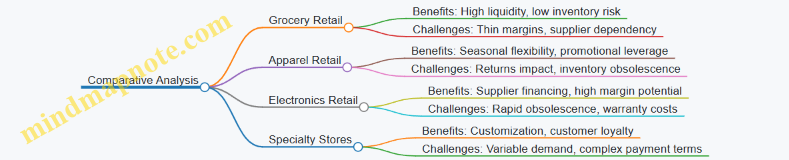
Summary Table: Cash Flow Strategy Comparison
| Retail Sector | Key Strategy | Example Practice | Impact on Cash Flow |
|---|---|---|---|
| Grocery | Just-in-Time Inventory | Automated Reordering | Reduced inventory holding, improved liquidity |
| Apparel | Seasonal Forecasting | Delayed Inventory Purchases | Better cash reserve management |
| Electronics | Supplier Financing | Deferred Payment Terms | Improved short-term liquidity |
| Specialty Stores | Made-to-Order Production | Custom Orders | Reduced inventory costs, aligned cash inflows |
Conclusion
Understanding the nuances of cash flow strategies across retail sectors enables accountants and financial controllers to tailor their approaches effectively. While grocery retailers benefit from rapid inventory turnover and supplier negotiations, apparel retailers must focus on seasonal forecasting and returns management. Electronics retailers leverage supplier financing and dynamic pricing, whereas specialty stores optimize cash flow through customization and flexible payment terms. Integrating these sector-specific strategies with best practices ensures robust cash flow management aligned with operational realities.
10.5 Practical Tips from Leading Financial Controllers on Cash Flow Management
Financial controllers play a pivotal role in ensuring the financial health of an organization by managing cash flow effectively. Drawing from their extensive experience, here are practical tips that have proven successful in optimizing cash flow management, accompanied by illustrative examples and mind maps to visualize key concepts.
Tip 1: Maintain a Rolling Cash Flow Forecast
Why: A rolling forecast updated regularly (weekly or monthly) helps anticipate cash shortages or surpluses, enabling proactive decision-making.
Example: A retail company updates its cash flow forecast every Friday, incorporating latest sales data and supplier payment schedules. This allows them to adjust inventory purchases dynamically, avoiding cash crunches during slow sales periods.
Mind Map:
Tip 2: Prioritize Cash Collections with Clear Payment Terms
Why: Clear, enforceable payment terms reduce days sales outstanding (DSO) and improve cash inflows.
Example: A financial controller at a retail chain introduced a policy offering a 2% discount for payments made within 10 days. This incentivized customers to pay early, reducing average DSO from 45 to 30 days.
Mind Map:
Tip 3: Leverage Technology for Automation
Why: Automating invoicing, payment reminders, and reconciliations reduces errors and accelerates cash flow processes.
Example: Implementing an automated invoicing system enabled a retail finance team to send invoices immediately after shipment, reducing billing cycle time by 40%. Automated reminders decreased late payments by 25%.
Mind Map:
Tip 4: Negotiate Flexible Payment Terms with Suppliers
Why: Extending payables without damaging supplier relationships improves cash availability.
Example: A financial controller negotiated a 60-day payment term with key suppliers instead of the standard 30 days, aligning outflows better with inflows during peak seasons.
Mind Map:
Tip 5: Monitor and Manage Inventory Levels Closely
Why: Excess inventory ties up cash unnecessarily, while stockouts can hurt sales.
Example: By implementing a just-in-time inventory system, a retail company reduced inventory holding by 20%, freeing up cash for other operational needs.
Mind Map:
Tip 6: Establish a Cash Reserve for Emergencies
Why: Having a contingency fund cushions against unexpected cash flow disruptions.
Example: A financial controller recommended maintaining a cash reserve equivalent to one month’s operating expenses, which helped the company navigate a sudden supplier delay without halting operations.
Mind Map:
Tip 7: Foster Cross-Departmental Collaboration
Why: Cash flow management is more effective when finance teams collaborate with sales, procurement, and operations.
Example: Regular meetings between finance and sales teams enabled better alignment of sales promotions with cash flow forecasts, preventing overextension of credit.
Mind Map:
Summary Table of Practical Tips
| Tip Number | Practical Tip | Key Benefit | Example Highlight |
|---|---|---|---|
| 1 | Maintain Rolling Cash Flow Forecast | Proactive cash management | Weekly updates with sales data |
| 2 | Prioritize Cash Collections | Faster receivables collection | Early payment discounts reduce DSO |
| 3 | Leverage Technology for Automation | Reduced errors and delays | Automated invoicing cuts billing time |
| 4 | Negotiate Flexible Supplier Terms | Improved cash retention | Extended payment terms to 60 days |
| 5 | Monitor and Manage Inventory Levels | Reduced working capital | Just-in-time inventory reduces stock |
| 6 | Establish a Cash Reserve | Financial stability | Reserve covers one month’s expenses |
| 7 | Foster Cross-Departmental Collaboration | Holistic cash flow visibility | Finance and sales alignment meetings |
By integrating these practical tips into daily cash flow management routines, financial controllers can significantly enhance their organization’s liquidity, reduce financial risks, and support sustainable growth.
10.6 Summary of Key Takeaways and Actionable Insights
Effective cash flow management is essential for the financial health and sustainability of any business, especially within the finance and retail sectors. Below is a comprehensive summary of the key takeaways from this blog, paired with actionable insights and illustrative examples.
Mind Map: Core Pillars of Cash Flow Management
Key Takeaways & Actionable Insights
Accurate Cash Flow Forecasting is Foundational
- Takeaway: Forecasting helps anticipate cash shortages and surpluses.
- Action: Use historical data and seasonality trends to build monthly forecasts.
- Example: A retail store forecasts a cash shortfall in December due to holiday inventory purchases and plans a short-term credit line accordingly.
Accelerate Receivables to Improve Liquidity
- Takeaway: Faster collections improve available cash.
- Action: Implement early payment discounts and automate invoicing.
- Example: A finance company offers a 2% discount for payments within 10 days, increasing early payments by 15%.
Manage Payables Strategically Without Damaging Supplier Relations
- Takeaway: Negotiating payment terms can ease cash outflows.
- Action: Prioritize payments and negotiate extended terms where possible.
- Example: A retail chain negotiates 60-day payment terms instead of 30 days, improving cash availability without supplier friction.
Optimize Inventory to Free Up Cash
- Takeaway: Excess inventory ties up cash unnecessarily.
- Action: Adopt Just-In-Time inventory and monitor turnover ratios.
- Example: A retailer reduces inventory holding by 20% through better demand forecasting, releasing cash for other uses.
Control Expenses Rigorously
- Takeaway: Expense management directly impacts cash flow.
- Action: Categorize expenses and cut non-essential costs.
- Example: A retail store reduces utility expenses by switching to energy-efficient lighting, saving 8% monthly.
Leverage Financing Wisely
- Takeaway: Financing can bridge cash flow gaps but must be used prudently.
- Action: Use invoice financing or lines of credit only when necessary and understand costs.
- Example: A retailer uses invoice financing to cover a temporary cash gap caused by delayed customer payments.
Monitor Cash Flow Continuously
- Takeaway: Real-time monitoring enables proactive management.
- Action: Develop dashboards tracking key metrics like cash conversion cycle and liquidity ratios.
- Example: A financial controller uses a dashboard to identify a rising accounts receivable period and acts to accelerate collections.
Prepare for Risks and Uncertainties
- Takeaway: Contingency plans protect against unexpected disruptions.
- Action: Conduct scenario planning and maintain cash reserves.
- Example: During a market downturn, a retailer activates its contingency plan by reducing discretionary spending and drawing on a credit line.
Mind Map: Action Plan for Accountants and Financial Controllers
Final Example: Integrated Cash Flow Management in Practice
Scenario: A mid-sized retail company faces cash flow pressure during a slow sales quarter.
- Forecasting: The finance team updates the cash flow forecast weekly to monitor liquidity.
- Receivables: They introduce a 1.5% early payment discount, increasing cash inflows.
- Payables: The company negotiates with suppliers to extend payment terms from 30 to 45 days.
- Inventory: They reduce overstock by 15% using improved demand forecasting.
- Expenses: Non-essential marketing expenses are temporarily cut.
- Financing: A short-term line of credit is arranged as a safety net.
- Monitoring: A dashboard tracks cash position daily, alerting the team to any deviations.
- Risk Management: Contingency plans are reviewed and updated.
Result: The company maintains positive cash flow, avoids costly emergency financing, and positions itself for growth when sales pick up.
By integrating these best practices and insights, accountants and financial controllers can confidently manage cash flow, ensuring their organizations remain financially agile and resilient.
11. Future Trends in Cash Flow Management
11.1 Impact of Digital Transformation on Cash Flow Processes
Digital transformation is reshaping how organizations manage their cash flow, particularly in finance and retail sectors. By leveraging advanced digital tools and technologies, companies can streamline cash flow processes, improve accuracy, and make more informed decisions. This section explores the multifaceted impact of digital transformation on cash flow management, supported by practical examples and mind maps to visualize key concepts.
Key Areas of Impact
Automation of Routine Tasks
Digital tools automate repetitive cash flow tasks, reducing manual errors and freeing up finance teams for strategic activities.
Example: A retail company implements an automated invoicing system that generates and sends invoices immediately after sales. This reduces delays in billing and accelerates receivables collection.
Real-Time Data Access
Access to real-time cash flow data allows financial controllers to monitor liquidity continuously and respond promptly to cash shortages or surpluses.
Example: A financial controller uses a cloud-based dashboard that aggregates bank balances, outstanding receivables, and payables, updating every hour to provide an accurate cash position.
Enhanced Forecasting Accuracy
Artificial intelligence and machine learning analyze historical data and external factors to generate more precise cash flow forecasts.
Example: A retail chain uses AI-powered forecasting software that considers seasonality, promotions, and supplier payment terms to predict cash inflows and outflows with 95% accuracy.
Integration of Financial Systems
Seamless integration between ERP, banking, and payment systems ensures data consistency and reduces reconciliation time.
Example: An accountant integrates the company’s ERP with bank APIs, enabling automatic bank statement imports and reconciliation, reducing manual effort by 70%.
System Integration Flow
ERP System ↔ Bank API ↔ Payment Gateway
- Automatic data sync
- Real-time transaction updates
- Streamlined reconciliation
Improved Collaboration
Cloud-based platforms enable finance teams, sales, procurement, and suppliers to collaborate effectively on cash flow-related activities.
Example: A financial controller shares a live cash flow dashboard with procurement and sales teams, enabling coordinated decisions on payment schedules and discount offers.
Risk Management
Digital transformation enhances risk detection through automated alerts and compliance checks.
Example: Fraud detection algorithms flag unusual payment patterns, allowing early intervention before cash flow is impacted.
Customer and Supplier Experience
Digital invoicing and payment portals improve transparency and speed, positively affecting cash flow.
Example: A retailer implements an online payment portal for suppliers and customers, reducing payment cycles by 15 days on average.
Summary
Digital transformation fundamentally changes cash flow management by automating processes, improving data accuracy, enhancing forecasting, and fostering collaboration. For accountants and financial controllers in finance and retail, embracing these technologies leads to more efficient cash flow cycles, reduced risks, and better decision-making.
Actionable Tips
- Evaluate current cash flow processes for automation opportunities.
- Invest in integrated financial systems that support real-time data.
- Leverage AI tools for forecasting and risk detection.
- Foster cross-department collaboration using cloud platforms.
- Continuously monitor emerging digital trends to stay ahead.
11.2 Role of Artificial Intelligence and Machine Learning in Forecasting
Artificial Intelligence (AI) and Machine Learning (ML) are revolutionizing cash flow forecasting by enabling more accurate, dynamic, and insightful predictions. These technologies analyze vast amounts of historical and real-time data to identify patterns, trends, and anomalies that traditional forecasting methods might miss.
How AI and ML Enhance Cash Flow Forecasting
- Data Integration: AI can combine data from multiple sources such as sales, invoices, market trends, and economic indicators to create a holistic view.
- Pattern Recognition: ML algorithms detect complex patterns in cash inflows and outflows, improving forecast accuracy.
- Anomaly Detection: AI flags unusual transactions or deviations early, helping prevent cash flow surprises.
- Adaptive Learning: ML models continuously learn from new data, refining forecasts over time.
- Scenario Analysis: AI can simulate various scenarios (e.g., changes in sales volume, supplier delays) to assess potential cash flow impacts.
Mind Map: AI and ML in Cash Flow Forecasting
Practical Example 1: AI-Driven Cash Flow Forecasting in a Retail Chain
A retail chain implemented an AI-powered forecasting tool that integrated sales data, seasonal trends, supplier payment schedules, and promotional campaigns. The ML model identified that cash inflows typically surged two weeks after promotional events, but also detected a recurring delay in supplier payments during holiday seasons.
Outcome:
- Forecast accuracy improved by 25% compared to manual methods.
- The finance team proactively adjusted payment schedules to avoid cash shortages.
- Early alerts on supplier delays allowed renegotiation of terms, preserving liquidity.
Mind Map: AI Forecasting Workflow in Retail
Practical Example 2: Machine Learning for Dynamic Forecast Updates in Finance
A financial controller at a mid-sized retail company used an ML model that updated cash flow forecasts daily by analyzing real-time sales, payment receipts, and expense data. The model adapted to sudden changes such as unexpected supplier discounts or delayed customer payments.
Outcome:
- Enabled just-in-time financing decisions, reducing reliance on costly credit lines.
- Improved cash reserves management by predicting short-term cash shortages with 90% accuracy.
- Reduced manual forecasting effort by 60%, freeing up time for strategic analysis.
Mind Map: Benefits of ML-Driven Dynamic Forecasting
Key Considerations for Implementation
- Data Quality: AI and ML models require clean, comprehensive, and timely data.
- Integration: Seamless integration with existing ERP and accounting systems is critical.
- Expertise: Skilled data scientists and finance professionals should collaborate.
- Transparency: Models should provide explainable outputs to build trust.
- Continuous Improvement: Regularly retrain models with new data to maintain accuracy.
Summary
AI and ML are powerful tools that transform cash flow forecasting from a static, manual process into a dynamic, data-driven discipline. By leveraging these technologies, accountants and financial controllers in finance and retail sectors can gain deeper insights, anticipate risks earlier, and make more informed decisions to maintain healthy cash flow.
For further reading:
- “AI in Financial Forecasting: Trends and Applications”
- “Machine Learning Techniques for Cash Flow Prediction”
- Case studies on AI adoption in retail finance
11.3 Emerging Payment Technologies and Their Effect on Cash Flow
Emerging payment technologies are transforming how businesses manage cash flow, especially in the finance and retail sectors. These innovations not only streamline payment processes but also improve liquidity, reduce transaction times, and enhance forecasting accuracy. For accountants and financial controllers, understanding these technologies is crucial to optimizing cash flow management.
Key Emerging Payment Technologies
- Digital Wallets and Mobile Payments
- Real-Time Payments (RTP)
- Blockchain and Cryptocurrencies
- Buy Now, Pay Later (BNPL)
- Contactless Payments and NFC Technology
- Automated Clearing House (ACH) Improvements
Mind Map: Emerging Payment Technologies Impacting Cash Flow
Digital Wallets and Mobile Payments
Digital wallets like Apple Pay and Google Pay enable customers to pay instantly using their smartphones. For retailers, this means faster payment collection and reduced reliance on cash, which can be time-consuming to handle and deposit.
Example: A retail store integrating Apple Pay notices a 20% reduction in checkout time, improving customer throughput and accelerating cash inflows.
Effect on Cash Flow: Faster payments improve liquidity and reduce the risk of delayed receivables.
Real-Time Payments (RTP)
RTP systems allow businesses to receive funds instantly, rather than waiting days for traditional bank transfers.
Example: A finance company uses The Clearing House RTP network to receive client payments immediately, enabling more accurate daily cash flow forecasting.
Effect on Cash Flow: Immediate availability of funds enhances working capital management and reduces the need for short-term borrowing.
Blockchain and Cryptocurrencies
Blockchain technology offers secure, transparent, and often lower-cost payment options. Some retailers accept cryptocurrencies like Bitcoin, which can open new customer segments.
Example: A boutique retailer accepts Bitcoin payments, attracting tech-savvy customers and reducing credit card processing fees.
Effect on Cash Flow: While crypto payments can be volatile, they reduce transaction fees and speed up settlement times.
Buy Now, Pay Later (BNPL)
BNPL services allow customers to defer payments while the retailer receives funds upfront from the BNPL provider.
Example: A fashion retailer partners with Klarna, increasing sales by 30% due to flexible payment options.
Effect on Cash Flow: Retailers receive immediate payment improving cash inflows, but must manage fees charged by BNPL providers.
Contactless Payments and NFC Technology
Contactless cards and NFC-enabled devices speed up transactions, reducing queues and improving customer satisfaction.
Example: A grocery chain implements contactless payments, cutting average transaction time by 15 seconds per customer.
Effect on Cash Flow: Faster transactions increase sales volume and accelerate cash inflows.
Automated Clearing House (ACH) Improvements
Same-day ACH and other enhancements reduce the time for electronic payments to clear.
Example: A wholesale distributor uses same-day ACH to pay suppliers, negotiating better terms due to reliable and timely payments.
Effect on Cash Flow: Reduces payment delays, improves supplier relationships, and optimizes cash outflows.
Mind Map: Effects of Emerging Payment Technologies on Cash Flow
Practical Example: Integrating RTP and Digital Wallets in Retail
A mid-sized retail chain integrated RTP for supplier payments and enabled digital wallet payments at checkout. This resulted in:
- 25% faster supplier payments, unlocking early payment discounts.
- 30% increase in customer payment speed, reducing daily cash handling.
- Improved cash flow forecasting due to real-time payment visibility.
This integration allowed the financial controller to reduce short-term borrowing by 15%, directly improving the company’s liquidity position.
Summary
Emerging payment technologies offer powerful tools for accountants and financial controllers to enhance cash flow management. By adopting these innovations, businesses can accelerate cash inflows, reduce costs, improve forecasting, and strengthen supplier and customer relationships. However, it is essential to balance benefits with potential risks such as fees, volatility, and implementation challenges.
Staying informed and proactive about payment technology trends will position finance professionals to optimize cash flow and support sustainable business growth.
11.4 Sustainability and Cash Flow: Integrating ESG Considerations
As businesses increasingly prioritize Environmental, Social, and Governance (ESG) factors, integrating sustainability into cash flow management has become a critical practice for accountants and financial controllers, especially within the finance and retail sectors. This section explores how ESG considerations impact cash flow and offers practical examples and mind maps to help professionals embed sustainability into their financial processes.
Understanding the Link Between Sustainability and Cash Flow
Sustainability initiatives can influence cash flow both positively and negatively. While some investments in green technologies or social programs may increase short-term expenses, they often lead to long-term cost savings, improved brand reputation, and access to new financing opportunities.
Key impacts on cash flow include:
- Operational savings through energy efficiency and waste reduction
- Revenue growth by attracting eco-conscious consumers
- Access to sustainable financing with favorable terms
- Regulatory compliance costs and potential penalties
- Risk mitigation against environmental or social disruptions
Mind Map: ESG Integration in Cash Flow Management
Best Practices for Integrating ESG into Cash Flow
-
Incorporate ESG Metrics into Cash Flow Forecasts
- Adjust cash flow models to include expected costs and savings from sustainability initiatives.
- Example: A retail chain forecasts reduced electricity costs after installing solar panels, improving long-term cash inflows.
-
Evaluate the ROI of Sustainability Investments
- Analyze payback periods and cash flow impacts of green projects.
- Example: An accountant assesses the upfront cost of LED lighting against monthly savings to justify the investment.
-
Leverage Sustainable Financing Options
- Use green bonds or loans with lower interest rates tied to ESG performance.
- Example: A financial controller secures a green loan to finance eco-friendly store renovations, reducing financing costs.
-
Monitor Regulatory Changes and Incentives
- Stay updated on government grants, tax credits, or penalties affecting cash flow.
- Example: A retailer claims tax credits for electric vehicle charging stations, positively impacting cash inflows.
-
Engage Cross-Functional Teams
- Collaborate with sustainability officers to align financial planning with ESG goals.
- Example: Finance teams work with operations to forecast cash flow impacts of waste reduction programs.
Practical Example: Implementing ESG in a Retail Cash Flow Model
Scenario: A mid-sized retail company plans to reduce its carbon footprint by investing in energy-efficient HVAC systems and launching a community recycling program.
- Initial Investment: $150,000 (outflow)
- Expected Annual Savings: $30,000 in energy costs
- Community Program Cost: $10,000 annually
- Brand Impact: Estimated 5% increase in sales due to improved reputation
Cash Flow Integration:
- Year 1: Outflow of $160,000 ($150,000 + $10,000)
- Year 2 onwards: Inflow increase from sales + $30,000 savings - $10,000 program cost
This integration helps the financial controller forecast improved net cash flow from Year 2, supporting the sustainability investment decision.
Mind Map: Cash Flow Impact of Sustainability Initiatives
Conclusion
Integrating ESG considerations into cash flow management is no longer optional but essential for modern finance and retail professionals. By understanding the financial implications of sustainability initiatives, leveraging appropriate financing, and collaborating across departments, accountants and financial controllers can ensure that their organizations not only meet ESG goals but also maintain healthy and predictable cash flows.
Additional Resources
- Green Finance Guide for Financial Controllers
- ESG Reporting Frameworks and Cash Flow Alignment
- Case Studies on Sustainable Retail Cash Flow Management
11.5 Preparing for Economic Uncertainty with Advanced Cash Flow Strategies
Economic uncertainty poses significant challenges to maintaining healthy cash flow, especially for finance professionals and controllers in the retail sector. Preparing for these fluctuations requires advanced strategies that not only safeguard liquidity but also enable agility and resilience.
Understanding Economic Uncertainty and Its Impact on Cash Flow
- Economic downturns can reduce consumer spending, delay receivables, and disrupt supply chains.
- Inflation and interest rate volatility can increase costs and financing expenses.
- Unpredictable market conditions demand proactive cash flow management to avoid liquidity crises.
Advanced Cash Flow Strategies to Mitigate Risks
Dynamic Cash Flow Forecasting
- Incorporate multiple economic scenarios (best case, base case, worst case).
- Use rolling forecasts updated frequently to reflect real-time changes.
Building and Maintaining Cash Reserves
- Maintain a minimum cash buffer equivalent to 3-6 months of operating expenses.
- Example: A retail chain with monthly expenses of $500,000 keeps $1.5M to $3M in liquid assets.
Diversifying Revenue Streams
- Explore omnichannel sales (online, in-store, wholesale) to reduce dependency on one source.
- Example: A retailer expands into subscription services to create predictable cash inflows.
Flexible Payment Terms
- Negotiate variable payment terms with suppliers and customers to improve cash timing.
- Example: Extending supplier payment terms from 30 to 60 days during downturns.
Scenario Planning and Stress Testing
- Simulate cash flow under various economic shocks (e.g., 20% sales drop, supply delays).
- Identify vulnerabilities and develop contingency plans.
Leveraging Technology and Automation
- Implement AI-driven forecasting tools to detect early warning signs.
- Automate receivables follow-up to accelerate collections.
Cost Structure Optimization
- Shift fixed costs to variable costs where possible to increase flexibility.
- Example: Outsourcing logistics instead of owning a fleet reduces fixed overhead.
Mind Map: Advanced Cash Flow Strategies for Economic Uncertainty
Practical Example: Retailer Preparing for a Recession
Background: A mid-sized retail company anticipates a potential recession impacting consumer spending.
Actions Taken:
- Developed three cash flow forecasts: optimistic, moderate, and pessimistic.
- Increased cash reserves by delaying non-essential capital expenditures.
- Negotiated extended payment terms with key suppliers, moving from 30 to 60 days.
- Launched an online subscription box service to generate steady monthly revenue.
- Conducted stress tests simulating a 25% drop in sales and identified a potential cash shortfall in month 4.
- Implemented AI-powered cash flow monitoring software to receive alerts on deviations.
- Outsourced warehousing to reduce fixed costs.
Outcome: The company maintained positive cash flow throughout the downturn, avoided emergency financing, and positioned itself for growth as the economy recovered.
Additional Mind Map: Scenario Planning Process
Key Takeaways
- Preparing for economic uncertainty requires a multi-faceted approach combining forecasting, liquidity management, and operational flexibility.
- Scenario planning and stress testing empower finance teams to anticipate challenges and respond proactively.
- Leveraging technology enhances accuracy and responsiveness in cash flow management.
- Real-world examples demonstrate how these strategies can be practically implemented in retail environments.
By embedding these advanced strategies into your cash flow management practices, accountants and financial controllers can better navigate economic uncertainties and safeguard their organizations’ financial health.
11.6 Continuous Improvement: Adapting Best Practices for the Future
Continuous improvement in cash flow management is essential for accountants and financial controllers to stay ahead in the dynamic finance and retail sectors. As market conditions, technologies, and customer behaviors evolve, so must the strategies and best practices that underpin effective cash flow management.
Why Continuous Improvement Matters
- Adaptability: Enables businesses to respond quickly to changing economic conditions and internal challenges.
- Efficiency: Streamlines processes to reduce errors, delays, and unnecessary costs.
- Sustainability: Supports long-term financial health by maintaining positive cash flow.
Key Areas for Continuous Improvement
Adapting to Market and Regulatory Changes
- Example: A retail company noticed a shift in consumer payment preferences towards digital wallets. By integrating digital payment solutions, they accelerated receivables and improved cash inflows.
- Best Practice: Regularly review market trends and regulatory updates to adjust payment terms, invoicing methods, and credit policies accordingly.
Leveraging Technology for Continuous Improvement
- Example: A financial controller implemented AI-driven cash flow forecasting software that analyzed historical sales data and external factors like seasonality and economic indicators, improving forecast accuracy by 20%.
- Best Practice: Invest in scalable technology solutions that provide real-time data and predictive analytics to make informed cash flow decisions.
Process Optimization Through Feedback Loops
- Example: A retail chain established monthly cross-functional meetings between finance, sales, and procurement teams to review cash flow reports and identify bottlenecks, leading to a 15% reduction in overdue receivables.
- Best Practice: Create structured feedback mechanisms to continuously evaluate and refine cash flow processes.
Enhancing Collaboration Across Departments
- Example: By collaborating closely with suppliers, a retailer negotiated flexible payment terms aligned with their cash flow cycles, improving working capital management.
- Best Practice: Foster transparent communication channels and joint planning sessions among finance, operations, and suppliers.
Continuous Training and Knowledge Sharing
- Example: A financial controller organized quarterly workshops on emerging cash flow management tools and techniques, resulting in increased team proficiency and adoption of best practices.
- Best Practice: Encourage ongoing professional development and create platforms for sharing insights and lessons learned.
Practical Steps to Implement Continuous Improvement
- Conduct Regular Cash Flow Audits: Identify inefficiencies and areas for enhancement.
- Set Measurable Goals: Define KPIs such as Days Sales Outstanding (DSO) or cash conversion cycle targets.
- Leverage Technology: Adopt tools that support automation and advanced analytics.
- Engage Stakeholders: Involve cross-functional teams and external partners in improvement initiatives.
- Monitor and Adjust: Use real-time data to track progress and pivot strategies as needed.
Summary
Continuous improvement in cash flow management is a proactive journey that requires openness to change, investment in technology, collaborative culture, and commitment to learning. By embedding these principles, accountants and financial controllers can future-proof their cash flow strategies, ensuring resilience and sustained financial health in the evolving finance and retail landscapes.
12. Conclusion and Practical Implementation Guide
12.1 Recap of Best Practices in Cash Flow Management
Effective cash flow management is crucial for the financial health and sustainability of any business, especially within the finance and retail sectors. Below is a comprehensive recap of the best practices, illustrated with mind maps and practical examples to reinforce understanding.
Mind Map: Core Areas of Cash Flow Management
Cash Flow Forecasting
Best Practice: Develop accurate, dynamic cash flow forecasts using both short-term and long-term perspectives.
Example: A retail business creates a monthly cash flow forecast incorporating sales seasonality and supplier payment schedules. By analyzing last year’s holiday sales spike, they adjust inventory purchases and staffing costs accordingly to avoid cash shortages.
Managing Receivables
Best Practice: Set clear payment terms, actively manage credit, and accelerate collections.
Example: A financial controller implements early payment discounts of 2% if invoices are paid within 10 days. This incentivizes customers to pay sooner, improving cash inflows and reducing days sales outstanding (DSO).
Controlling Payables
Best Practice: Negotiate favorable payment terms and prioritize payments without damaging supplier relationships.
Example: A retail chain negotiates extended payment terms from 30 to 45 days with key suppliers, easing immediate cash outflows during peak inventory purchase periods.
Inventory Management
Best Practice: Optimize inventory levels to balance availability with cash tied up in stock.
Example: Implementing a Just-In-Time (JIT) inventory system, a retailer reduces excess stock and frees up cash, while maintaining product availability during high-demand periods.
Expense Management
Best Practice: Identify fixed and variable expenses, reduce unnecessary costs, and enforce budget controls.
Example: A financial controller reviews utility expenses and switches to energy-efficient lighting, reducing monthly fixed costs and improving cash flow.
Financing Options
Best Practice: Use short-term financing strategically to bridge cash flow gaps without incurring excessive costs.
Example: A retail business uses invoice financing to access cash tied up in outstanding invoices, allowing timely payment of payroll and suppliers.
Monitoring and Reporting
Best Practice: Regularly track key cash flow metrics and use dashboards for real-time visibility.
Example: A financial controller sets up a monthly cash flow dashboard highlighting inflows, outflows, and net cash position, enabling proactive management and early problem detection.
Risk Management
Best Practice: Identify potential cash flow risks and develop contingency plans.
Example: During a market downturn, a retailer activates a contingency plan that includes reducing discretionary expenses and accessing a pre-approved line of credit to maintain liquidity.
Mind Map: Practical Examples Summary

Final Thoughts
Mastering these best practices enables accountants and financial controllers to maintain healthy cash flow, avoid liquidity crises, and support sustainable growth. Integrating forecasting, receivables and payables management, inventory control, expense oversight, financing strategies, and risk mitigation into a cohesive cash flow management framework is key to success in the finance and retail sectors.
12.2 Step-by-Step Implementation Checklist for Accountants and Financial Controllers
Effective cash flow management requires a structured approach that accountants and financial controllers can systematically follow. This checklist breaks down the implementation process into clear, actionable steps, supported by mind maps and practical examples to ensure clarity and ease of adoption.
Step 1: Assess Current Cash Flow Situation
- Review historical cash flow statements to identify patterns, peaks, and troughs.
- Identify key cash inflows and outflows.
- Pinpoint cash flow bottlenecks or recurring issues.
Mind Map: Assess Current Cash Flow
Example:
A retail company notices that cash inflows dip significantly in January and July due to seasonal sales cycles. Late payments from a major client also contribute to cash shortages.
Step 2: Establish Clear Cash Flow Goals
- Define short-term and long-term cash flow objectives.
- Set measurable targets such as maintaining a minimum cash reserve or reducing receivables days.
Mind Map: Set Cash Flow Goals
Example:
Financial controllers set a goal to reduce Days Sales Outstanding (DSO) from 45 to 30 days within six months to improve liquidity.
Step 3: Develop a Detailed Cash Flow Forecast
- Use historical data and upcoming commitments to build forecasts.
- Include all expected inflows and outflows.
- Update forecasts regularly (weekly/monthly).
Mind Map: Develop Cash Flow Forecast
Example:
An accountant creates a rolling 13-week cash flow forecast, incorporating expected sales, supplier payments, payroll, and loan repayments.
Step 4: Optimize Receivables Management
- Review credit policies and payment terms.
- Implement automated invoicing and reminders.
- Offer early payment incentives.
Mind Map: Optimize Receivables
Example:
A retail finance team introduces a 2% discount for invoices paid within 10 days, resulting in a 15% improvement in early payments.
Step 5: Control Payables Strategically
- Negotiate favorable payment terms with suppliers.
- Prioritize payments based on cash availability and supplier importance.
- Use payables automation to avoid late fees.
Mind Map: Control Payables
Example:
The financial controller negotiates 60-day payment terms with key suppliers, easing short-term cash flow pressure without damaging relationships.
Step 6: Manage Inventory Efficiently
- Analyze inventory turnover rates.
- Implement Just-In-Time (JIT) inventory where feasible.
- Avoid overstocking to free up cash.
Mind Map: Manage Inventory
Example:
A retail chain adopts JIT inventory for high-value electronics, reducing holding costs and improving cash availability.
Step 7: Monitor and Control Expenses
- Categorize expenses into fixed and variable.
- Identify cost-saving opportunities.
- Implement budget controls and approvals.
Mind Map: Monitor Expenses
Example:
The finance team identifies recurring subscriptions that are underutilized and cancels them, saving 5% of monthly expenses.
Step 8: Leverage Financing Options Wisely
- Evaluate short-term financing tools (lines of credit, invoice financing).
- Assess cost vs benefit before utilization.
- Integrate financing plans into cash flow forecasts.
Mind Map: Leverage Financing
Example:
A retailer uses invoice financing during peak seasons to cover inventory purchases, repaying the facility as receivables come in.
Step 9: Implement Regular Cash Flow Reporting
- Design dashboards highlighting key metrics.
- Schedule regular reviews with management.
- Use reports to identify trends and adjust strategies.
Mind Map: Cash Flow Reporting
Example:
Financial controllers present a monthly cash flow dashboard to the executive team, enabling proactive decision-making.
Step 10: Foster a Cash Flow Conscious Culture
- Train finance and operational teams on cash flow importance.
- Encourage cross-department collaboration.
- Promote accountability for cash flow impacts.
Mind Map: Cash Flow Culture
Example:
A retail company holds quarterly cash flow workshops for department heads, aligning all teams on cash management goals.
Summary Checklist
| Step | Action Item | Example |
|---|---|---|
| 1 | Assess current cash flow | Identify seasonal dips and late payments |
| 2 | Set clear cash flow goals | Reduce DSO from 45 to 30 days |
| 3 | Develop cash flow forecast | Rolling 13-week forecast |
| 4 | Optimize receivables | Early payment discounts |
| 5 | Control payables | Negotiate 60-day terms |
| 6 | Manage inventory | Implement JIT inventory |
| 7 | Monitor expenses | Cancel underutilized subscriptions |
| 8 | Leverage financing | Use invoice financing seasonally |
| 9 | Implement reporting | Monthly cash flow dashboards |
| 10 | Foster culture | Quarterly cash flow workshops |
By following this step-by-step checklist, accountants and financial controllers in finance and retail sectors can systematically improve their cash flow management practices, leading to healthier liquidity and stronger financial stability.
12.3 Tips for Building Cross-Functional Collaboration to Improve Cash Flow
Effective cash flow management is not solely the responsibility of the finance team. It requires active collaboration across multiple departments such as sales, procurement, operations, and customer service. Building strong cross-functional collaboration helps identify cash flow bottlenecks early, align goals, and implement best practices seamlessly.
Why Cross-Functional Collaboration Matters for Cash Flow
- Holistic View: Different departments hold pieces of the cash flow puzzle. Sales influence receivables, procurement affects payables, and operations impact inventory and expenses.
- Aligned Objectives: Ensures everyone works toward common financial goals rather than siloed targets.
- Faster Problem Resolution: Early identification and joint problem-solving reduce cash flow risks.
Key Tips for Building Cross-Functional Collaboration
-
Establish Clear Communication Channels
- Schedule regular cross-departmental meetings focused on cash flow updates.
- Use collaborative tools like Slack, Microsoft Teams, or dedicated cash flow dashboards.
-
Define Roles and Responsibilities
- Clarify who owns which part of the cash flow process (e.g., sales owns invoicing accuracy, procurement manages supplier terms).
- Create RACI matrices to avoid confusion.
-
Set Shared Cash Flow Goals and KPIs
- Develop measurable targets such as Days Sales Outstanding (DSO), Days Payable Outstanding (DPO), and inventory turnover.
- Share these KPIs transparently across teams.
-
Leverage Technology for Transparency
- Implement integrated ERP or cash flow management software accessible to relevant departments.
- Use real-time dashboards to track cash inflows and outflows.
-
Encourage Joint Problem-Solving Sessions
- When cash flow issues arise, bring together representatives from impacted departments to brainstorm solutions.
-
Provide Training and Awareness
- Conduct workshops explaining how each department’s actions affect cash flow.
- Share success stories and case studies to motivate teams.
-
Recognize and Reward Collaborative Efforts
- Acknowledge teams or individuals who contribute to improved cash flow through collaboration.
Mind Map: Cross-Functional Collaboration for Cash Flow Improvement
Practical Example: Improving Cash Flow through Collaboration in a Retail Company
Scenario: The finance team notices increasing delays in receivables, impacting cash flow.
Cross-Functional Actions:
- Sales Team: Collaborates with finance to review customer payment terms and identify clients with frequent late payments.
- Customer Service: Engages with customers to resolve disputes quickly that delay payments.
- IT Department: Implements automated invoicing and payment reminders.
- Procurement: Adjusts supplier payment schedules to better align with receivable cycles.
Outcome:
- Reduction in Days Sales Outstanding by 15% within 3 months.
- Improved cash inflows stabilize working capital.
Mind Map: Example Workflow for Collaborative Cash Flow Improvement
By fostering a culture of collaboration and transparency, accountants and financial controllers can significantly enhance cash flow management, reduce risks, and contribute to the overall financial health of their organizations.
12.4 Resources and Tools for Ongoing Cash Flow Improvement
Effective cash flow management requires not only best practices but also the right resources and tools to support continuous monitoring, forecasting, and optimization. Below is a comprehensive guide to essential resources and tools, complemented by mind maps and practical examples tailored for accountants and financial controllers in finance and retail sectors.
Cash Flow Management Software
Modern software solutions automate and streamline cash flow processes, providing real-time insights and forecasting capabilities.
- Examples:
- Float: Integrates with accounting software to provide dynamic cash flow forecasting.
- Pulse: Focuses on cash flow tracking and forecasting with scenario planning.
- QuickBooks Cash Flow Planner: Embedded within QuickBooks for seamless accounting and cash flow management.
Example: A retail financial controller uses Float to visualize weekly cash inflows and outflows, enabling proactive adjustments to inventory purchases.
Accounting and ERP Systems
Integrated accounting and ERP systems provide foundational data for cash flow analysis.
- Examples:
- SAP Business One: ERP with robust financial management modules.
- Oracle NetSuite: Cloud ERP offering real-time financial analytics.
- Xero: Cloud accounting with cash flow dashboard features.
Example: An accountant in a retail chain leverages NetSuite’s real-time dashboards to monitor payables and receivables, improving payment timing.
Spreadsheet Templates and Models
Customizable spreadsheet templates remain a flexible and cost-effective tool for cash flow forecasting and scenario analysis.
- Examples:
- Microsoft Excel Cash Flow Forecast Template: Includes sections for inflows, outflows, and net cash position.
- Google Sheets Collaborative Cash Flow Model: Enables team collaboration and real-time updates.
Example: A financial controller creates a rolling 13-week cash flow forecast in Excel to anticipate short-term liquidity needs.
Mind Map: Core Resources for Cash Flow Improvement
Educational Resources
Continuous learning is vital for mastering cash flow management.
- Online Courses: Coursera’s “Financial Management” and LinkedIn Learning’s “Cash Flow Analysis”.
- Webinars: Industry-specific webinars hosted by retail finance experts.
- Books: “Financial Intelligence for Entrepreneurs” by Karen Berman and Joe Knight.
Example: An accountant attends a webinar on cash flow forecasting techniques tailored for retail businesses, gaining insights on integrating sales seasonality.
Banking and Financing Tools
Access to appropriate financing products can stabilize cash flow during fluctuations.
- Examples:
- Business lines of credit
- Invoice factoring and discounting platforms
- Merchant cash advances
Example: A retail financial controller uses invoice factoring to accelerate receivables, improving liquidity during peak inventory purchase periods.
Mind Map: Tools and Techniques for Cash Flow Monitoring
Collaboration and Communication Platforms
Effective cash flow management often requires cross-departmental collaboration.
- Examples:
- Microsoft Teams and Slack for communication
- SharePoint and Google Drive for document sharing
Example: The finance team uses Microsoft Teams to coordinate with procurement and sales, ensuring alignment on payment schedules and cash flow forecasts.
Practical Tips for Selecting Tools
- Prioritize integration capabilities with existing accounting systems.
- Choose user-friendly interfaces to encourage adoption.
- Ensure real-time data access for timely decision-making.
- Consider scalability to support business growth.
Summary
Leveraging a combination of software, educational resources, financing options, and collaborative platforms empowers accountants and financial controllers to maintain robust cash flow management. Regularly updating these resources and adapting to new technologies will sustain ongoing improvement and financial health.
By integrating these resources and tools into daily workflows, finance professionals in retail can transform cash flow management from a reactive task into a strategic advantage.
12.5 Encouraging a Proactive Cash Flow Culture in Finance and Retail Teams
A proactive cash flow culture is essential for sustaining healthy financial operations, especially in dynamic sectors like finance and retail. Encouraging this culture means embedding cash flow awareness into everyday decision-making, fostering collaboration, and empowering teams to anticipate and manage cash flow challenges before they escalate.
Why Foster a Proactive Cash Flow Culture?
- Early Problem Detection: Teams spot potential cash shortages or surpluses early.
- Improved Decision-Making: Cash flow considerations become part of strategic and operational choices.
- Enhanced Collaboration: Finance and retail teams work together to optimize cash inflows and outflows.
- Greater Accountability: Everyone understands their role in maintaining cash health.
Key Elements to Build a Proactive Cash Flow Culture
Practical Steps and Examples
-
Regular Training and Education
- Conduct monthly workshops explaining cash flow concepts tailored for retail and finance teams.
- Example: A retail store holds quarterly sessions where accountants explain how inventory purchases impact cash flow, helping store managers make informed buying decisions.
-
Transparent and Frequent Reporting
- Share weekly cash flow snapshots with all relevant teams.
- Example: Financial controllers send a simple, color-coded cash flow dashboard every Monday highlighting expected inflows, outflows, and potential gaps.
-
Cross-Functional Collaboration Meetings
- Schedule bi-weekly meetings between finance, sales, procurement, and operations to discuss cash flow impacts.
- Example: A retail chain’s finance team collaborates with procurement to adjust order quantities based on cash flow forecasts, avoiding overstocking.
-
Implement Real-Time Monitoring Tools
- Use dashboards that update cash flow data live, accessible to both finance and retail managers.
- Example: A financial controller uses cloud-based software that alerts store managers when cash reserves dip below a threshold, prompting immediate action.
-
Define Roles and Accountability
- Assign cash flow responsibilities clearly across teams.
- Example: Sales managers are accountable for accelerating receivables by encouraging early payments; procurement managers focus on negotiating better payment terms.
-
Incentivize Positive Cash Flow Behaviors
- Reward teams that contribute to improved cash flow metrics.
- Example: A retail company offers bonuses to store managers who reduce inventory holding costs without impacting sales.
-
Establish Feedback and Continuous Improvement Loops
- Regularly review cash flow outcomes and adjust strategies.
- Example: After a seasonal sales period, finance and retail teams analyze cash flow variances and update forecasting assumptions accordingly.
Mind Map: Practical Implementation Flow
Example Scenario: Proactive Cash Flow in Action
Situation: A retail company notices a recurring cash crunch during holiday seasons due to high inventory purchases and delayed receivables.
Proactive Culture Actions:
- Finance educates retail managers on cash flow impact of inventory timing.
- Cross-department meetings adjust purchase schedules to better align with expected sales.
- Real-time dashboards alert teams to cash flow dips.
- Incentives encourage early payment campaigns with customers.
Result: The company smooths out cash flow fluctuations, reduces emergency borrowing, and improves profitability.
Summary
Encouraging a proactive cash flow culture requires commitment to education, transparency, collaboration, accountability, and continuous improvement. By embedding these principles into daily operations, finance and retail teams can work synergistically to maintain robust cash flow, anticipate challenges, and seize opportunities for growth.
12.6 Final Thoughts and Next Steps
Effective cash flow management is the cornerstone of financial stability and growth for any organization, especially within the finance and retail sectors. As accountants and financial controllers, your role in implementing best practices and fostering a proactive cash flow culture cannot be overstated. This final section consolidates key insights and provides actionable next steps to empower you in mastering cash flow management.
Key Takeaways
- Cash flow is the lifeblood of business: Without sufficient liquidity, even profitable businesses can face operational challenges.
- Forecasting is fundamental: Accurate and dynamic cash flow forecasting enables informed decision-making.
- Receivables and payables must be managed strategically: Accelerate collections and optimize payment schedules to maintain healthy cash balances.
- Inventory and expense control directly impact cash flow: Efficient inventory management and cost control reduce unnecessary cash outflows.
- Leverage technology: Automation and real-time data improve accuracy and responsiveness.
- Risk management is essential: Prepare for uncertainties with contingency plans and scenario analysis.
Mind Map: Core Pillars of Cash Flow Management
Practical Example: Implementing a Cash Flow Improvement Plan
Scenario: A mid-sized retail company faces seasonal cash shortages despite strong sales.
Steps Taken:
- Forecasting: Developed a rolling 12-month cash flow forecast incorporating seasonal sales trends.
- Receivables: Introduced early payment discounts and automated invoicing to speed collections.
- Payables: Negotiated extended payment terms with key suppliers to better align outflows with inflows.
- Inventory: Adopted Just-In-Time inventory to reduce excess stock and free up cash.
- Expense Management: Conducted a detailed review of variable expenses and implemented cost-saving measures.
- Financing: Secured a revolving line of credit as a buffer for unexpected cash needs.
- Monitoring: Established weekly cash flow reporting and alerts for potential shortfalls.
Outcome: The company improved liquidity, reduced reliance on emergency financing, and maintained smooth operations throughout peak and off-peak seasons.
Next Steps: A Step-by-Step Implementation Checklist
- Assess Current Cash Flow Processes: Identify gaps and bottlenecks.
- Engage Stakeholders: Collaborate with sales, procurement, and operations teams.
- Develop or Refine Cash Flow Forecasts: Use historical data and realistic assumptions.
- Optimize Receivables and Payables: Review credit policies and payment terms.
- Control Inventory and Expenses: Implement inventory management techniques and expense controls.
- Leverage Technology: Adopt software tools for automation and reporting.
- Establish Risk Management Protocols: Prepare contingency plans and conduct scenario analyses.
- Monitor Regularly: Set up dashboards and key performance indicators.
- Communicate Transparently: Keep management and teams informed.
- Continuously Improve: Review and adjust strategies based on performance and market changes.
Mind Map: Next Steps for Accountants and Financial Controllers
Final Encouragement
Mastering cash flow management is an ongoing journey that requires vigilance, collaboration, and adaptability. By embedding these best practices into your daily workflows and fostering a culture that values cash flow awareness, you will not only safeguard your organization’s financial health but also unlock opportunities for growth and innovation.
Remember, proactive cash flow management is not just a finance function—it’s a strategic advantage.