Financial Statement Consolidation Techniques
1. Introduction to Financial Statement Consolidation
1.1 Overview of Consolidation in Corporate Finance
Financial statement consolidation is a critical process in corporate finance where the financials of a parent company and its subsidiaries are combined to present a single set of financial statements. This unified view helps stakeholders understand the overall financial health and performance of the entire corporate group rather than individual entities.
What is Financial Statement Consolidation?
Consolidation involves aggregating the assets, liabilities, equity, income, expenses, and cash flows of the parent company and its subsidiaries, eliminating intercompany transactions and balances to avoid double counting.
Example: If Company A owns 100% of Company B, and Company B sells goods worth $100,000 to Company A, this intercompany sale must be eliminated during consolidation to avoid inflating revenue and expenses.
Why is Consolidation Important?
- Provides a holistic financial picture: Investors, creditors, and regulators get a clear understanding of the entire corporate group.
- Ensures compliance: Many accounting standards (e.g., IFRS, GAAP) require consolidated financial statements.
- Improves decision-making: Management can assess group-wide performance and risks.
Key Components of Consolidation
Types of Entities Involved
- Parent Company: Controls one or more subsidiaries.
- Subsidiaries: Entities controlled by the parent, typically through majority ownership.
- Associates and Joint Ventures: Entities where the parent has significant influence or joint control, often consolidated using equity or proportionate methods.
Consolidation Process Overview
Simple Example of Consolidation
Scenario:
- Parent Co owns 80% of Subsidiary Co.
- Parent Co’s assets: $1,000,000; liabilities: $400,000.
- Subsidiary Co’s assets: $500,000; liabilities: $200,000.
Step 1: Combine Assets and Liabilities
- Total assets before elimination: $1,000,000 + $500,000 = $1,500,000
- Total liabilities before elimination: $400,000 + $200,000 = $600,000
Step 2: Eliminate Investment in Subsidiary
- Parent’s investment in Subsidiary is eliminated against Subsidiary’s equity.
Step 3: Recognize Non-controlling Interest (NCI)
- NCI owns 20%, so NCI’s share of net assets = 20% x (Subsidiary’s net assets $300,000) = $60,000
Result:
- Consolidated net assets = Parent’s net assets + Subsidiary’s net assets - elimination + NCI
This simplified example illustrates the core consolidation mechanics.
Mind Map: Benefits of Consolidation
Summary
Financial statement consolidation is foundational for presenting a true and fair view of a corporate group’s financial position. By understanding the entities involved, the process steps, and the rationale behind consolidation, accountants and financial controllers can ensure accurate and compliant reporting.
Next, we will explore the preparatory steps required before consolidation, including data gathering and harmonization.
1.2 Importance of Consolidated Financial Statements for Accountants and Controllers
Consolidated financial statements are a critical component in corporate finance, especially for accountants and financial controllers managing multiple entities within a corporate group. These statements provide a comprehensive view of the financial health and performance of the entire group as a single economic entity, rather than as separate individual companies.
Why Consolidated Financial Statements Matter
- Holistic Financial View: They combine the financial data of parent companies and their subsidiaries, offering a complete picture of the group’s financial position.
- Regulatory Compliance: Many accounting standards (e.g., IFRS 10, ASC 810) require consolidation to ensure transparency and comparability.
- Stakeholder Communication: Investors, creditors, and regulators rely on consolidated statements to make informed decisions.
- Performance Measurement: Helps in assessing the overall profitability and financial stability of the group.
- Risk Management: Identifies intercompany risks and exposures that might be hidden in separate financials.
Mind Map: Importance of Consolidated Financial Statements
Practical Example: Why Consolidation is Essential
Scenario: A parent company, Alpha Corp, owns 100% of Beta Ltd. Individually, Beta Ltd reports a profit of $500,000, and Alpha Corp reports a profit of $1,000,000. However, Beta Ltd sold inventory worth $200,000 to Alpha Corp, which Alpha has not yet sold to external customers.
- Without consolidation, Alpha Corp’s financials show $1,000,000 profit, and Beta Ltd’s $500,000 profit separately.
- Consolidation eliminates the intercompany sale to avoid double counting revenue and profit.
- The consolidated profit reflects the true economic profit of the group, which might be less than the sum of individual profits due to unrealized intercompany profit.
This example highlights how consolidated financial statements prevent misleading financial results and provide a more accurate picture.
Mind Map: Example of Intercompany Transactions Impact
Role of Accountants and Controllers
- Ensuring Accuracy: Accountants must accurately identify and eliminate intercompany transactions.
- Compliance Monitoring: Controllers ensure consolidation complies with accounting standards.
- Data Integration: They coordinate data collection from all subsidiaries for timely consolidation.
- Analysis and Reporting: Provide insights based on consolidated data to support strategic decisions.
Mind Map: Roles of Accountants and Controllers in Consolidation
Summary
Consolidated financial statements are indispensable for providing a transparent, accurate, and comprehensive financial overview of a corporate group. For accountants and financial controllers, mastering consolidation techniques ensures regulatory compliance, enhances stakeholder trust, and supports effective financial management and decision-making.
1.3 Key Terminology and Concepts Explained with Simple Examples
Understanding financial statement consolidation begins with mastering key terminology and foundational concepts. This section breaks down these terms with clear definitions and practical examples to ensure clarity for accountants and financial controllers.
Key Terminology Mind Map
Concept 1: Consolidation
Definition: Consolidation is the process of combining the financial statements of a parent company and its subsidiaries into one comprehensive set of financial statements.
Example:
- Parent Co. owns 100% of Subsidiary Co.
- Parent Co.’s revenue: $1,000,000
- Subsidiary Co.’s revenue: $500,000
Consolidated Revenue: $1,500,000 (before intercompany eliminations)
Concept 2: Control
Definition: Control is the power to govern the financial and operating policies of an entity to obtain benefits from its activities.
Example:
- Parent Co. owns 80% of Subsidiary Co.
- Parent Co. appoints majority of the board members.
- Parent Co. has control and must consolidate Subsidiary Co.
Concept 3: Non-controlling Interest (NCI)
Definition: NCI represents the equity in a subsidiary not attributable to the parent company.
Example:
- Parent Co. owns 75% of Subsidiary Co.
- NCI owns 25%.
- Subsidiary’s net assets: $400,000
NCI Share: 25% × $400,000 = $100,000
Concept 4: Intercompany Transactions
Definition: Transactions between entities within the consolidated group that must be eliminated to avoid double counting.
Example:
- Parent sells inventory to Subsidiary for $50,000.
- Inventory still held by Subsidiary at year-end.
Elimination: Remove $50,000 intercompany sale and related profit.
Concept 5: Goodwill
Definition: Goodwill arises when the purchase price paid for a subsidiary exceeds the fair value of its net identifiable assets.
Example:
- Purchase price: $1,200,000
- Fair value of net assets: $1,000,000
Goodwill: $1,200,000 - $1,000,000 = $200,000
Concept 6: Equity Method
Definition: Used when the investor has significant influence (typically 20-50%) but not control over the investee.
Example:
- Parent owns 30% of Associate Co.
- Associate Co.’s net income: $100,000
Parent’s share: 30% × $100,000 = $30,000 (recognized as income)
Concept 7: Full Consolidation Method
Definition: The parent includes 100% of the subsidiary’s assets, liabilities, income, and expenses in the consolidated financial statements.
Example:
- Parent Co. assets: $2,000,000
- Subsidiary Co. assets: $1,000,000
Consolidated assets: $3,000,000 (before eliminations)
Concept 8: Elimination Entries
Definition: Journal entries made to remove the effects of intercompany transactions and balances.
Example:
- Intercompany receivable/payable of $100,000 between Parent and Subsidiary.
Elimination Entry: Debit intercompany payable $100,000, Credit intercompany receivable $100,000.
Summary
Mastering these terms and concepts is essential for accurate and compliant financial statement consolidation. The examples provided illustrate how these ideas apply in practical scenarios, helping accountants and financial controllers confidently navigate consolidation processes.
1.4 Regulatory Frameworks and Standards Governing Consolidation
Financial statement consolidation is governed by a variety of regulatory frameworks and accounting standards designed to ensure transparency, consistency, and comparability across entities. Understanding these frameworks is essential for accountants and financial controllers to prepare consolidated financial statements that comply with legal and professional requirements.
Key Regulatory Frameworks
- International Financial Reporting Standards (IFRS)
- Generally Accepted Accounting Principles (GAAP)
- Local Regulatory Requirements
Mind Map: Overview of Regulatory Frameworks Governing Consolidation
International Financial Reporting Standards (IFRS)
IFRS 10 - Consolidated Financial Statements is the cornerstone standard for consolidation under IFRS. It defines control as the basis for consolidation, where an investor controls an investee if it has:
- Power over the investee
- Exposure or rights to variable returns from its involvement
- The ability to use its power to affect those returns
Example:
Company A owns 60% of Company B’s voting shares and has the power to appoint the majority of the board members. Company A consolidates Company B’s financial statements fully, including all assets, liabilities, income, and expenses.
IFRS 3 - Business Combinations complements IFRS 10 by providing guidance on accounting for acquisitions, including recognition of goodwill.
IAS 28 - Investments in Associates and Joint Ventures applies when the investor has significant influence but not control (typically 20%-50% ownership), requiring equity method accounting instead of full consolidation.
Mind Map: IFRS Consolidation Standards
US Generally Accepted Accounting Principles (US GAAP)
US GAAP consolidation is primarily governed by ASC 810 - Consolidation, which also focuses on control but includes specific guidance on variable interest entities (VIEs).
Example:
Company X owns 40% of Company Y but has a contractual agreement giving it decision-making rights and exposure to variable returns. Under ASC 810, Company X consolidates Company Y as a VIE.
ASC 805 - Business Combinations provides acquisition accounting guidance similar to IFRS 3.
Mind Map: US GAAP Consolidation Standards
Local Regulatory Requirements
Many countries have their own GAAP or regulatory requirements that may differ from IFRS or US GAAP. Accountants must be aware of:
- Local consolidation thresholds
- Reporting currency requirements
- Specific disclosure mandates
Example:
In Country Z, local GAAP requires consolidation only if ownership exceeds 50% and mandates disclosure of intercompany transactions separately.
Practical Example: Applying IFRS 10 Consolidation Principles
Scenario:
- ParentCo owns 75% of SubsidiaryCo.
- SubsidiaryCo has a 100% owned sub-subsidiary, SubSubCo.
- ParentCo also has a 30% investment in AssociateCo.
Consolidation Approach:
- Fully consolidate SubsidiaryCo and SubSubCo financials.
- Use equity method for AssociateCo.
Example Entries:
- Eliminate intercompany sales between ParentCo and SubsidiaryCo.
- Recognize non-controlling interest (25%) in SubsidiaryCo’s net assets.
Summary
Understanding and applying the correct regulatory framework is critical for accurate consolidation. IFRS and US GAAP provide comprehensive guidance, but local regulations may add complexity. Accountants and financial controllers should stay updated on these standards and apply them consistently with practical examples to ensure compliance and transparency.
2. Preparing for Consolidation: Data Gathering and Preliminary Steps
2.1 Identifying Entities to be Consolidated: Subsidiaries, Associates, and Joint Ventures
Understanding which entities to consolidate is a foundational step in preparing consolidated financial statements. This section will clarify the types of entities—subsidiaries, associates, and joint ventures—that typically require consolidation or equity method accounting, supported by practical examples and mind maps to visualize relationships.
Key Definitions
- Subsidiary: An entity controlled by the parent company, usually through ownership of more than 50% of voting rights.
- Associate: An entity over which the investor has significant influence but not control, typically ownership between 20% and 50%.
- Joint Venture: A contractual arrangement where two or more parties have joint control over an entity.
Mind Map: Types of Entities in Consolidation
Identifying Subsidiaries
Control is the primary factor. Control means the parent has the power to govern financial and operating policies.
Example:
Company A owns 75% of Company B’s voting shares.
- Company B is a subsidiary of Company A.
- Company A must fully consolidate Company B’s financials.
Mind Map:
Identifying Associates
Significant influence is usually indicated by ownership between 20% and 50%, or other factors like board representation.
Example:
Company X owns 30% of Company Y and has a seat on its board.
- Company Y is an associate of Company X.
- Company X applies the equity method to account for its investment.
Mind Map:
Identifying Joint Ventures
Joint control exists when decisions require unanimous consent of the parties sharing control.
Example:
Company M and Company N form a joint venture, each owning 50%, and jointly control operations.
- The joint venture is accounted for using equity or proportionate consolidation.
Mind Map:
Practical Example: Entity Identification Scenario
Scenario:
- ParentCo owns 80% of SubCo.
- ParentCo owns 35% of AssocCo with board representation.
- ParentCo and PartnerCo each own 50% of JVCo, governed by a joint agreement.
Consolidation Approach:
- SubCo: Full consolidation.
- AssocCo: Equity method.
- JVCo: Equity or proportionate consolidation depending on accounting policy.
Summary Table
| Entity Type | Ownership % | Control/Influence | Accounting Method |
|---|---|---|---|
| Subsidiary | >50% | Control | Full consolidation |
| Associate | 20%-50% | Significant influence | Equity method |
| Joint Venture | Varies | Joint control | Equity or proportionate |
By clearly identifying these entities, accountants and financial controllers can apply the correct consolidation technique, ensuring compliance and accuracy in financial reporting.
2.2 Collecting and Standardizing Financial Data Across Entities
In the consolidation process, collecting and standardizing financial data from multiple entities is a critical step. Each subsidiary or business unit may maintain its financial records in different formats, currencies, accounting policies, or systems. To create a coherent consolidated financial statement, accountants and financial controllers must ensure that all data is harmonized and comparable.
Key Objectives:
- Gather accurate and complete financial data from all entities.
- Standardize data formats and accounting policies.
- Ensure consistency in reporting periods and currency.
Step 1: Data Collection
Sources of Financial Data:
- General Ledgers
- Trial Balances
- Subsidiary Financial Statements
- ERP Systems
- Spreadsheets or Manual Records
Best Practice: Establish a centralized data collection protocol with clear deadlines and formats to avoid delays and inconsistencies.
Step 2: Standardizing Data Formats
Financial data often comes in various formats. Standardization involves:
- Converting all data into a uniform chart of accounts.
- Using consistent file formats (e.g., Excel templates, CSV files).
- Aligning reporting periods (e.g., fiscal year vs. calendar year).
Example:
| Entity | Reporting Period | Currency | Chart of Accounts Format |
|---|---|---|---|
| Subsidiary A | Jan-Dec 2023 | USD | Custom Account Codes |
| Subsidiary B | Apr-Mar 2023 | EUR | Local Chart of Accounts |
Solution: Convert Subsidiary B’s data to Jan-Dec 2023 period and map local account codes to the parent company’s standard chart of accounts.
Step 3: Harmonizing Accounting Policies
Differences in accounting policies can distort consolidated results. Common areas requiring alignment include:
- Revenue recognition
- Depreciation methods
- Inventory valuation
- Lease accounting
Best Practice: Document policy differences and adjust subsidiary figures to conform with the parent company’s policies.
Example:
Subsidiary C uses straight-line depreciation, while the parent uses declining balance. Adjust Subsidiary C’s depreciation expense to reflect the parent’s method before consolidation.
Mind Map: Data Collection and Standardization Process
Step 4: Currency Standardization
When entities operate in different currencies, financial data must be converted into the parent company’s reporting currency.
Best Practices:
- Use consistent exchange rates (e.g., closing rates for balance sheet items, average rates for income statement items).
- Document the source and date of exchange rates.
Example:
Subsidiary D reports revenue of EUR 1,000,000. The parent’s reporting currency is USD. Using an average exchange rate of 1 EUR = 1.1 USD, revenue is converted to USD 1,100,000.
Example Walkthrough: Standardizing Trial Balance Data
| Account Code | Account Description | Subsidiary A (USD) | Subsidiary B (EUR) | Subsidiary B (USD Equivalent) |
|---|---|---|---|---|
| 4000 | Sales Revenue | 2,000,000 | 1,500,000 | 1,650,000 |
| 5000 | Cost of Goods Sold | 1,200,000 | 900,000 | 990,000 |
| 6000 | Operating Expenses | 400,000 | 350,000 | 385,000 |
Subsidiary B’s figures converted using 1 EUR = 1.1 USD.
Next, map Subsidiary B’s account codes to the parent’s chart of accounts and adjust for any accounting policy differences before consolidation.
Summary
Collecting and standardizing financial data across entities requires meticulous planning and execution. By establishing clear protocols, aligning formats, harmonizing accounting policies, and managing currency differences, accountants and financial controllers can ensure a smooth consolidation process that produces reliable and comparable financial statements.
2.3 Handling Different Accounting Policies: Harmonization Best Practices
When consolidating financial statements from multiple entities, one of the most critical challenges is handling differences in accounting policies. Each subsidiary or associate may follow different accounting treatments due to local regulations, industry practices, or historical choices. Harmonizing these policies ensures that the consolidated financial statements present a true and fair view of the group’s financial position.
Why Harmonization is Essential
- Ensures comparability across entities
- Prevents distortion of consolidated results
- Complies with applicable accounting standards (e.g., IFRS, GAAP)
Common Areas of Policy Differences
- Revenue recognition
- Depreciation methods and useful lives
- Inventory valuation methods (FIFO, LIFO, weighted average)
- Treatment of leases
- Recognition of provisions and contingencies
Harmonization Best Practices
Identify Policy Differences Early
- Conduct a detailed review of each entity’s accounting policies.
- Use a standardized checklist to capture key policy areas.
Establish a Group Accounting Policy Manual
- Define uniform accounting policies aligned with the parent company’s framework.
- Communicate these policies clearly to all subsidiaries.
Adjust Financial Statements for Policy Differences
- Restate subsidiary financials to align with group policies before consolidation.
- Document all adjustments with clear explanations.
Use Reconciliation Schedules
- Prepare schedules showing adjustments from local policies to group policies.
- Include examples and calculations for transparency.
Continuous Training and Monitoring
- Train local finance teams on group policies.
- Monitor compliance regularly and update policies as needed.
Mind Map: Handling Different Accounting Policies
Example 1: Harmonizing Depreciation Methods
Scenario:
- Subsidiary A uses straight-line depreciation over 5 years for machinery.
- Subsidiary B uses declining balance depreciation over 5 years.
Group Policy: Straight-line depreciation over 5 years.
Adjustment:
- Calculate the depreciation expense for Subsidiary B using straight-line method.
- Adjust Subsidiary B’s accumulated depreciation and net book value accordingly.
Illustration:
| Year | Declining Balance Depreciation (Subsidiary B) | Straight-Line Depreciation (Group Policy) | Adjustment Needed |
|---|---|---|---|
| 1 | $40,000 | $20,000 | -$20,000 |
| 2 | $24,000 | $20,000 | -$4,000 |
Adjustment entry: Debit Accumulated Depreciation $24,000, Credit Depreciation Expense $24,000 to align with group policy.
Example 2: Inventory Valuation Differences
Scenario:
- Subsidiary X values inventory using FIFO.
- Subsidiary Y uses weighted average cost.
Group Policy: FIFO.
Adjustment:
- Revalue Subsidiary Y’s inventory using FIFO prices.
- Adjust cost of goods sold and inventory balances accordingly.
Illustration:
| Item | Inventory Value (Weighted Average) | Inventory Value (FIFO) | Adjustment |
|---|---|---|---|
| A | $100,000 | $110,000 | +$10,000 |
| B | $50,000 | $48,000 | -$2,000 |
Adjustment entry: Debit Inventory $8,000, Credit Cost of Goods Sold $8,000.
Mind Map: Example Workflow for Policy Harmonization
Summary
Harmonizing accounting policies is a foundational step in financial statement consolidation. By systematically identifying differences, applying consistent group policies, and documenting adjustments with clear examples, accountants and financial controllers can ensure accurate and compliant consolidated financial statements. Regular training and monitoring further reinforce the integrity of the consolidation process.
2.4 Practical Example: Preparing a Consolidation Data Checklist
Consolidation begins with gathering accurate, consistent, and complete financial data from all entities involved. A well-prepared checklist ensures that no critical information is missed and that the consolidation process runs smoothly. Below, we provide a detailed example of a consolidation data checklist, accompanied by mind maps to visualize the key components.
Consolidation Data Checklist Overview
| Data Category | Description | Example / Notes |
|---|---|---|
| Entity Identification | List of entities to consolidate | Parent company, subsidiaries, associates |
| Financial Statements | Trial balances, income statements, balance sheets | Latest monthly/quarterly/year-end reports |
| Accounting Policies | Documentation of accounting methods used | Depreciation methods, revenue recognition |
| Intercompany Transactions | Details of sales, loans, dividends between entities | Intercompany sales invoices, loan agreements |
| Ownership Percentages | Percentage ownership and control details | Parent owns 80% of Subsidiary A |
| Foreign Currency Info | Functional currencies and exchange rates | Subsidiary B reports in EUR, Parent in USD |
| Adjustments & Eliminations | Planned consolidation adjustments | Intercompany eliminations, goodwill adjustments |
| Non-controlling Interests | Details on minority shareholders | 20% minority interest in Subsidiary A |
Mind Map: Key Components of Consolidation Data Checklist
Step-by-Step Example: Preparing the Checklist for a Hypothetical Group
Scenario:
- Parent Co owns 85% of Subsidiary A and 60% of Subsidiary B.
- Subsidiary A uses USD as functional currency; Subsidiary B uses EUR.
- Intercompany sales exist between Parent Co and Subsidiary A.
- Subsidiary B has a loan from Parent Co.
Checklist Preparation:
-
Entity Identification:
- Parent Co
- Subsidiary A (85% owned)
- Subsidiary B (60% owned)
-
Financial Statements:
- Obtain trial balances and financial statements for all three entities for the reporting period.
-
Accounting Policies:
- Confirm depreciation methods used by each entity.
- Verify revenue recognition policies are consistent or note differences.
-
Intercompany Transactions:
- List intercompany sales invoices between Parent Co and Subsidiary A.
- Obtain loan agreements and interest schedules for loan from Parent Co to Subsidiary B.
-
Ownership Percentages:
- Document ownership stakes: 85% for Subsidiary A, 60% for Subsidiary B.
-
Foreign Currency Info:
- Note Subsidiary B’s functional currency is EUR; Parent Co and Subsidiary A use USD.
- Collect exchange rates for consolidation date.
-
Adjustments & Eliminations:
- Plan to eliminate intercompany sales and loan balances.
- Identify goodwill arising from acquisition of Subsidiary A and B.
-
Non-controlling Interests:
- Calculate 15% minority interest in Subsidiary A.
- Calculate 40% minority interest in Subsidiary B.
Mind Map: Example Checklist for Hypothetical Group
Tips for Accountants and Financial Controllers
- Standardize Data Formats: Ensure all entities submit data in a consistent format to simplify consolidation.
- Maintain a Centralized Repository: Use shared platforms or consolidation software to store and track checklist items.
- Regular Updates: Update the checklist periodically to reflect changes in ownership, accounting policies, or intercompany arrangements.
- Cross-Functional Collaboration: Work closely with operational teams to verify intercompany transactions and ownership details.
By following this practical example and using the checklist and mind maps, accountants and financial controllers can streamline the consolidation preparation process, reduce errors, and ensure compliance with accounting standards.
3. Consolidation Methods and When to Apply Them
3.1 Full Consolidation Method: Principles and Practical Application
Overview
The Full Consolidation Method is the primary technique used when a parent company has control over a subsidiary, typically defined as owning more than 50% of the voting rights. This method involves combining 100% of the subsidiary’s assets, liabilities, income, and expenses with those of the parent company, regardless of the percentage of ownership.
Key Principles of Full Consolidation
- Control: Parent company must have control over the subsidiary.
- 100% Consolidation: All assets, liabilities, revenues, and expenses of the subsidiary are included in the consolidated financial statements.
- Non-controlling Interest (NCI): The portion of equity and profit not owned by the parent is presented separately.
- Elimination of Intercompany Transactions: All transactions between parent and subsidiary are eliminated to avoid double counting.
Mind Map: Full Consolidation Method Principles
Step-by-Step Practical Application
- Identify the Parent and Subsidiary: Confirm control and ownership percentage.
- Aggregate Financial Statements: Add together the assets, liabilities, income, and expenses of both entities line by line.
- Eliminate Intercompany Balances and Transactions: Remove any transactions between the parent and subsidiary.
- Calculate and Present Non-controlling Interest: Determine the minority interest share in equity and profit.
- Adjust for Fair Value and Goodwill: Recognize any fair value adjustments and goodwill arising from acquisition.
Example Scenario
ParentCo owns 80% of SubCo. The financial statements for the year ended are as follows:
| Item | ParentCo (in $) | SubCo (in $) |
|---|---|---|
| Assets | 1,000,000 | 500,000 |
| Liabilities | 400,000 | 200,000 |
| Revenue | 800,000 | 300,000 |
| Expenses | 600,000 | 250,000 |
| Dividends Paid to Parent | - | 40,000 |
Step 1: Aggregate Assets and Liabilities
- Total Assets = 1,000,000 + 500,000 = 1,500,000
- Total Liabilities = 400,000 + 200,000 = 600,000
Step 2: Aggregate Income Statement
- Total Revenue = 800,000 + 300,000 = 1,100,000
- Total Expenses = 600,000 + 250,000 = 850,000
Step 3: Eliminate Intercompany Dividends
- Dividends paid by SubCo to ParentCo (40,000) are eliminated.
Step 4: Calculate Non-controlling Interest (NCI)
- NCI Ownership = 20%
- NCI in Net Assets = 20% × (500,000 - 200,000) = 20% × 300,000 = 60,000
- NCI in Profit = 20% × (300,000 - 250,000) = 20% × 50,000 = 10,000
Step 5: Present Consolidated Financials
| Item | Consolidated Amount ($) |
|---|---|
| Assets | 1,500,000 |
| Liabilities | 600,000 |
| Equity (Parent’s Share) | 840,000 (1,500,000 - 600,000 - 60,000 NCI) |
| Non-controlling Interest | 60,000 |
| Revenue | 1,100,000 |
| Expenses | 850,000 |
| Net Income | 250,000 (1,100,000 - 850,000) |
Mind Map: Practical Application Workflow
Additional Example: Intercompany Sales Elimination
Suppose ParentCo sold inventory to SubCo for $50,000, which SubCo still holds at year-end. The inventory includes an unrealized profit of $10,000.
- Step 1: Eliminate intercompany sales and purchases of $50,000.
- Step 2: Remove unrealized profit of $10,000 from consolidated profit.
This ensures the consolidated financials reflect only profits realized outside the group.
Summary
The Full Consolidation Method provides a comprehensive view of the financial position and performance of a corporate group by combining all controlled entities. Proper elimination of intercompany transactions and recognition of non-controlling interests are critical to presenting accurate consolidated financial statements.
This method is essential for accountants and financial controllers to master, ensuring compliance with accounting standards such as IFRS 10 and ASC 810.
3.2 Equity Method: Step-by-Step Guide with Illustrative Examples
The equity method is a consolidation technique used when an investor has significant influence over an investee, typically indicated by ownership of 20% to 50% of the voting stock. Unlike full consolidation, the investor recognizes their share of the investee’s profits or losses in their own financial statements without combining line-by-line balances.
Understanding the Equity Method
- The investor records the initial investment at cost.
- Subsequently, the carrying amount is adjusted for the investor’s share of the investee’s profits or losses.
- Dividends received reduce the carrying amount of the investment.
Mind Map: Equity Method Overview
Step-by-Step Guide
-
Initial Recognition
- Record the investment at purchase cost.
-
Recognize Share of Profit or Loss
- Adjust investment value by investor’s percentage share of investee’s net income or loss.
-
Record Dividends Received
- Reduce investment carrying amount by dividends declared by investee.
-
Adjust for Other Comprehensive Income (OCI) Items
- If applicable, adjust for investor’s share of investee’s OCI.
-
Impairment Testing
- Test investment for impairment if indicators arise.
Illustrative Example 1: Basic Equity Method Application
Scenario:
- Company A purchases 30% of Company B for $500,000.
- Company B reports net income of $100,000 for the year.
- Company B declares dividends of $20,000.
Step 1: Initial Investment
- Debit Investment in Company B $500,000
Step 2: Recognize Share of Profit
- Share of profit = 30% × $100,000 = $30,000
- Debit Investment in Company B $30,000
- Credit Investment Income $30,000
Step 3: Record Dividends Received
- Dividends = 30% × $20,000 = $6,000
- Debit Cash $6,000
- Credit Investment in Company B $6,000
Investment carrying amount at year-end:
$500,000 + $30,000 - $6,000 = $524,000
Mind Map: Equity Method Transaction Flow
Illustrative Example 2: Equity Method with OCI Adjustment
Scenario:
- Company X owns 40% of Company Y.
- Company Y reports net income of $200,000.
- Company Y reports OCI (unrealized gain on available-for-sale securities) of $50,000.
- Dividends declared: $30,000.
Step 1: Initial Investment
- Assume initial investment recorded at $800,000.
Step 2: Recognize Share of Profit
- 40% × $200,000 = $80,000
Step 3: Recognize Share of OCI
- 40% × $50,000 = $20,000
Step 4: Record Dividends Received
- 40% × $30,000 = $12,000
Journal Entries:
-
Share of Profit:
- Debit Investment in Company Y $80,000
- Credit Investment Income $80,000
-
Share of OCI:
- Debit Investment in Company Y $20,000
- Credit OCI Reserve $20,000
-
Dividends Received:
- Debit Cash $12,000
- Credit Investment in Company Y $12,000
Investment carrying amount:
$800,000 + $80,000 + $20,000 - $12,000 = $888,000
Common Considerations and Best Practices
- Significant Influence Indicators: Board representation, participation in policy decisions, material transactions.
- Consistent Application: Apply equity method consistently across reporting periods.
- Disclosure: Clearly disclose investment details, share of profit/loss, and carrying amounts.
- Impairment: Regularly assess investment for impairment; write down if necessary.
Summary Table: Equity Method vs. Other Consolidation Methods
| Aspect | Equity Method | Full Consolidation | Proportionate Consolidation |
|---|---|---|---|
| Ownership % | 20% - 50% | >50% | Joint control (usually 50%) |
| Control Level | Significant influence | Control | Joint control |
| Financial Statement Impact | Investment recorded as single line item; share of profit/loss recognized | Full line-by-line consolidation | Proportionate share of assets/liabilities included |
This step-by-step guide, combined with practical examples and mind maps, aims to clarify the equity method’s application for accountants and financial controllers, ensuring accurate and compliant financial reporting.
3.3 Proportionate Consolidation: Use Cases and Calculation Examples
What is Proportionate Consolidation?
Proportionate consolidation is a method used to consolidate the financial statements of a joint venture by including the investor’s share of each of the assets, liabilities, income, and expenses of the joint venture. Unlike full consolidation, where 100% of the subsidiary’s financials are included, or the equity method, where only the investor’s share of net income is recognized, proportionate consolidation reflects only the proportionate interest.
When is Proportionate Consolidation Used?
- Joint Ventures with Shared Control: Typically applied when two or more parties have joint control over an entity.
- Regulatory Requirements: Some accounting frameworks (e.g., IFRS before IFRS 11) allowed or required this method for joint ventures.
- Transparent Representation: When investors want to show their share of assets and liabilities explicitly rather than just net income.
Mind Map: Proportionate Consolidation Overview
Step-by-Step Calculation Example
Scenario: Company A and Company B form a joint venture, JV Co., with 60% and 40% ownership respectively. JV Co. reports the following for the year:
| Item | Amount (USD) |
|---|---|
| Total Assets | 1,000,000 |
| Total Liabilities | 400,000 |
| Revenue | 800,000 |
| Expenses | 600,000 |
Objective: Company A wants to prepare its consolidated financial statements using proportionate consolidation.
Step 1: Calculate Company A’s Share of Assets and Liabilities
- Assets: 1,000,000 * 60% = 600,000
- Liabilities: 400,000 * 60% = 240,000
Step 2: Calculate Company A’s Share of Income and Expenses
- Revenue: 800,000 * 60% = 480,000
- Expenses: 600,000 * 60% = 360,000
Step 3: Incorporate into Consolidated Financial Statements
- Add 600,000 to consolidated assets
- Add 240,000 to consolidated liabilities
- Add 480,000 to consolidated revenue
- Add 360,000 to consolidated expenses
Result: Company A’s consolidated statements reflect only its 60% share of JV Co.’s financials.
Mind Map: Calculation Process
Practical Example: Consolidation Journal Entries
Assuming Company A uses proportionate consolidation, the journal entries to record the JV’s financials would be:
| Date | Account | Debit (USD) | Credit (USD) |
|---|---|---|---|
| Year-End | Investment in JV (Asset) | 600,000 | |
| Year-End | Liabilities (Proportionate) | 240,000 | |
| Year-End | Revenue (Proportionate) | 480,000 | |
| Year-End | Expenses (Proportionate) | 360,000 |
This reflects the proportional share of the joint venture’s financial position and performance.
Advantages of Proportionate Consolidation
- Provides a clear picture of the investor’s share of assets and liabilities.
- Useful for joint ventures where control is shared equally or near equally.
- Enhances transparency for stakeholders.
Disadvantages
- Can lead to double counting if multiple investors consolidate the same joint venture.
- More complex and time-consuming than the equity method.
- IFRS 11 has largely replaced this method with the equity method for joint ventures.
Summary
Proportionate consolidation is a useful technique for reflecting an investor’s share in joint ventures by proportionally including assets, liabilities, income, and expenses. While it offers transparency and detailed financial representation, it requires careful application to avoid double counting and complexity. Accountants and financial controllers should evaluate the ownership structure and regulatory requirements before applying this method.
For further reading, consider exploring IFRS 11 “Joint Arrangements” which provides guidance on accounting for joint ventures and the move away from proportionate consolidation.
3.4 Choosing the Appropriate Method Based on Ownership and Control
When consolidating financial statements, selecting the appropriate consolidation method is crucial and depends primarily on the degree of ownership and the level of control or influence the parent company has over the investee. This section will guide you through the decision-making process with clear mind maps and practical examples.
Understanding Ownership and Control Levels
| Ownership Percentage | Control Level | Typical Consolidation Method |
|---|---|---|
| > 50% | Control (majority ownership) | Full Consolidation |
| 20% - 50% | Significant influence | Equity Method |
| < 20% | No significant influence | Cost Method or Fair Value |
Mind Map: Consolidation Method Decision Tree
Detailed Explanation of Control and Influence
- Control: The power to govern the financial and operating policies of an entity to obtain benefits from its activities. Usually implies ownership of more than 50% of voting rights.
- Significant Influence: The power to participate in financial and operating policy decisions but not control them, typically ownership between 20% and 50%.
- No Significant Influence: Ownership below 20%, where the investor cannot influence decisions.
Practical Example 1: Full Consolidation
Scenario: Company A owns 75% of Company B.
- Since Company A has majority ownership and control, it must fully consolidate Company B’s financial statements.
- All assets, liabilities, revenues, and expenses of Company B are combined line-by-line with Company A’s.
- Non-controlling interest (25%) is shown separately in equity.
Mind Map:
Practical Example 2: Equity Method
Scenario: Company X owns 30% of Company Y.
- Company X has significant influence but not control.
- Use the equity method: initially record investment at cost, then adjust for share of Company Y’s profits or losses.
Example Calculation:
- Initial investment: $1,000,000
- Company Y reports net income of $200,000
- Company X recognizes $60,000 (30% of $200,000) as income, increasing the investment value.
Mind Map:
Practical Example 3: Cost or Fair Value Method
Scenario: Company M owns 10% of Company N.
- Company M does not have significant influence.
- Investment is recorded at cost or fair value.
- Dividends received are recognized as income.
Mind Map:
Summary Mind Map: Ownership vs. Consolidation Method
Key Takeaways
- Always assess the level of control or influence before choosing the consolidation method.
- Full consolidation is mandatory when control exists, regardless of ownership percentage if control can be demonstrated.
- The equity method applies when significant influence is present but control is absent.
- Investments without significant influence are accounted for using the cost or fair value method.
- Proper documentation and rationale for the chosen method are essential for audit and compliance purposes.
By following this structured approach, accountants and financial controllers can ensure accurate and compliant consolidation of financial statements.
4. Eliminations and Adjustments in Consolidation
4.1 Intercompany Transactions: Identification and Elimination Techniques
Intercompany transactions occur when two or more entities within the same corporate group engage in financial dealings with each other. These transactions must be carefully identified and eliminated during the consolidation process to avoid overstating revenues, expenses, assets, or liabilities in the consolidated financial statements.
Why Identify and Eliminate Intercompany Transactions?
- Avoid Double Counting: Revenues recorded by one entity as sales may appear as expenses or purchases in another, inflating consolidated totals.
- Present True Financial Position: Intercompany balances and transactions do not represent external economic events and should be removed.
- Compliance: Accounting standards such as IFRS and GAAP require elimination of intercompany transactions.
Types of Intercompany Transactions
Step 1: Identification of Intercompany Transactions
- Review Trial Balances: Look for receivables and payables between group entities.
- Analyze Revenue and Expense Accounts: Identify sales or service income that corresponds to purchases or expenses in other entities.
- Examine Loan Agreements and Interest Entries: Intercompany loans often generate interest income and expense.
- Check Dividend Declarations: Dividends paid by subsidiaries to parent or other group companies.
Example:
Company A sells inventory worth $100,000 to Company B (both subsidiaries of Parent Co.). Company A records $100,000 as sales revenue; Company B records $100,000 as inventory purchase.
Step 2: Elimination Techniques
Basic Principle: For every intercompany transaction, eliminate the corresponding revenue and expense, asset and liability, or equity entries.
-
Eliminate Intercompany Sales and Purchases
- Debit Sales Revenue (Seller)
- Credit Cost of Goods Sold or Purchases (Buyer)
-
Eliminate Intercompany Receivables and Payables
- Debit Accounts Payable (Buyer)
- Credit Accounts Receivable (Seller)
-
Eliminate Intercompany Loans and Interest
- Debit Interest Income (Lender)
- Credit Interest Expense (Borrower)
- Debit Loan Payable (Borrower)
- Credit Loan Receivable (Lender)
-
Eliminate Intercompany Dividends
- Debit Dividend Income (Recipient)
- Credit Dividends Declared (Payer)
Practical Example: Intercompany Sales Elimination
| Account | Company A (Seller) | Company B (Buyer) |
|---|---|---|
| Sales Revenue | $100,000 | |
| Cost of Goods Sold | ||
| Inventory | $100,000 | |
| Accounts Receivable | $100,000 | |
| Accounts Payable | $100,000 |
Elimination Journal Entries:
| Debit | Credit | Amount |
|---|---|---|
| Sales Revenue (Company A) | Cost of Goods Sold (Company B) | $100,000 |
| Accounts Receivable (Company A) | Accounts Payable (Company B) | $100,000 |
This removes the intercompany sales and corresponding receivables/payables from the consolidated statements.
Handling Intercompany Profit in Inventory
If Company B has not sold the inventory to an external party by the reporting date, the unrealized profit included in inventory must be eliminated.
Example:
- Company A sells inventory to Company B for $120,000.
- Cost to Company A was $100,000.
- Unrealized profit = $20,000.
Elimination Entry:
| Debit | Credit | Amount |
|---|---|---|
| Cost of Goods Sold (Company A) | Inventory (Company B) | $20,000 |
This adjustment ensures inventory is recorded at original cost, not inflated by intercompany profit.
Tips and Best Practices
- Maintain a detailed intercompany transaction register.
- Regularly reconcile intercompany balances between entities.
- Use consistent coding or tagging in accounting systems to identify intercompany transactions.
- Automate elimination entries where possible to reduce errors.
By thoroughly identifying and eliminating intercompany transactions, accountants and financial controllers ensure the consolidated financial statements present a fair and accurate view of the group’s financial position and performance.
4.2 Eliminating Intercompany Sales and Purchases with Example Entries
Introduction
Intercompany sales and purchases occur when one entity within a corporate group sells goods or services to another entity within the same group. For consolidated financial statements, these transactions must be eliminated to avoid overstating revenue, expenses, assets, or liabilities.
Why Eliminate Intercompany Sales and Purchases?
- Prevent double counting of revenue and expenses.
- Avoid inflated asset values (e.g., inventory) due to intercompany profits.
- Present a true and fair view of the group’s financial position and performance.
Mind Map: Intercompany Sales and Purchases Elimination
Step 1: Identify Intercompany Transactions
- Review trial balances and supporting schedules.
- Identify sales recorded by one entity and corresponding purchases recorded by the other.
Step 2: Eliminate Sales and Purchases
The basic elimination entry removes the sales and purchase amounts recorded between entities.
Journal Entry:
| Account | Debit | Credit |
|---|---|---|
| Sales Revenue | XXX | |
| Cost of Goods Sold (COGS) | XXX |
This entry removes the revenue and expense related to intercompany sales.
Step 3: Eliminate Intercompany Receivables and Payables
Since the sale creates receivables and payables between entities, these must also be eliminated.
Journal Entry:
| Account | Debit | Credit |
|---|---|---|
| Accounts Payable | XXX | |
| Accounts Receivable | XXX |
Example 1: Simple Intercompany Sale
Scenario:
- Parent sells inventory to Subsidiary for $50,000.
- The inventory cost to Parent was $40,000.
- Subsidiary records purchase and payable; Parent records sale and receivable.
Elimination Entries:
- Eliminate Sales and COGS:
| Account | Debit | Credit |
|---|---|---|
| Sales Revenue | 50,000 | |
| Cost of Goods Sold | 50,000 |
- Eliminate Receivables and Payables:
| Account | Debit | Credit |
|---|---|---|
| Accounts Payable | 50,000 | |
| Accounts Receivable | 50,000 |
Result: The consolidated financial statements do not reflect the intercompany sale or related receivables/payables.
Step 4: Adjust for Unrealized Profit in Ending Inventory
If the subsidiary has not yet sold the inventory purchased from the parent, the profit embedded in inventory must be eliminated to avoid overstating assets and profits.
Calculation:
- Profit = Sale Price - Cost = $50,000 - $40,000 = $10,000
- Ending inventory at subsidiary includes $50,000 purchase price.
- Unrealized profit portion = $10,000 (assuming all inventory remains unsold).
Journal Entry to eliminate unrealized profit:
| Account | Debit | Credit |
|---|---|---|
| Cost of Goods Sold | 10,000 | |
| Inventory | 10,000 |
This reduces inventory and increases COGS, removing the unrealized profit.
Mind Map: Unrealized Profit Elimination
Example 2: Intercompany Sale with Partial Inventory Remaining
Scenario:
- Parent sells inventory to Subsidiary for $50,000 (cost $40,000).
- Subsidiary sold half the inventory to an external party.
Steps:
- Inventory remaining = $25,000 (half of $50,000)
- Unrealized profit in remaining inventory = (Profit margin 20%) * $25,000 = $5,000
Elimination Entries:
- Eliminate full intercompany sales and purchases as in Example 1.
- Eliminate unrealized profit:
| Account | Debit | Credit |
|---|---|---|
| Cost of Goods Sold | 5,000 | |
| Inventory | 5,000 |
Summary of Best Practices
- Always reconcile intercompany sales and purchases before consolidation.
- Eliminate both revenue/expense and receivables/payables.
- Adjust for unrealized profits in ending inventory to avoid overstated profits.
- Document all elimination entries clearly for audit trails.
Additional Tips
- Use consolidation software to automate identification and elimination.
- Regularly update intercompany transaction schedules.
- Coordinate closely with operational teams to understand inventory movement.
By following these steps and examples, accountants and financial controllers can ensure accurate and compliant consolidated financial statements free from intercompany distortions.
4.3 Handling Intercompany Loans and Interest: Practical Adjustments
Intercompany loans and the related interest transactions are common in corporate groups where subsidiaries or divisions lend funds to each other. Proper handling and elimination of these transactions during consolidation are crucial to avoid overstating assets, liabilities, income, or expenses.
Key Concepts
- Intercompany Loan: A loan extended from one group entity to another.
- Interest Income/Expense: The interest accrued on the intercompany loan.
- Elimination: Removing the effects of intercompany loans and interest from consolidated financial statements to avoid double counting.
Why Eliminate Intercompany Loans and Interest?
- To prevent overstating the group’s assets and liabilities.
- To avoid inflating income or expenses through intercompany interest.
- To present a true and fair view of the group’s financial position.
Step-by-Step Process for Handling Intercompany Loans and Interest
Practical Example 1: Basic Intercompany Loan Elimination
Scenario:
- Parent Company A lends $500,000 to Subsidiary B.
- Subsidiary B records a loan payable of $500,000.
- Parent Company A records a loan receivable of $500,000.
- Interest rate is 5% per annum.
- Interest accrued for the year is $25,000.
Entries before consolidation:
| Entity | Account | Debit ($) | Credit ($) |
|---|---|---|---|
| Parent A | Loan Receivable | 500,000 | |
| Parent A | Interest Income | 25,000 | |
| Subsidiary B | Cash | 500,000 | |
| Subsidiary B | Loan Payable | 500,000 | |
| Subsidiary B | Interest Expense | 25,000 |
Consolidation Adjustments:
- Eliminate loan receivable and loan payable: Debit Loan Payable $500,000, Credit Loan Receivable $500,000.
- Eliminate interest income and interest expense: Debit Interest Income $25,000, Credit Interest Expense $25,000.
Result:
The consolidated balance sheet and income statement do not reflect the intercompany loan or interest, avoiding double counting.
Practical Example 2: Accrued but Unpaid Interest
Scenario:
- Interest of $10,000 has accrued but not yet paid by Subsidiary B to Parent A at year-end.
Entries before consolidation:
| Entity | Account | Debit ($) | Credit ($) |
|---|---|---|---|
| Subsidiary B | Interest Expense | 10,000 | |
| Subsidiary B | Interest Payable | 10,000 | |
| Parent A | Interest Receivable | 10,000 | |
| Parent A | Interest Income | 10,000 |
Consolidation Adjustments:
- Eliminate interest receivable and interest payable: Debit Interest Payable $10,000, Credit Interest Receivable $10,000.
- Eliminate interest income and interest expense: Debit Interest Income $10,000, Credit Interest Expense $10,000.
Practical Example 3: Foreign Currency Intercompany Loan
Scenario:
- Parent Company A (USD) lends €400,000 to Subsidiary B (EUR).
- Exchange rate at loan inception: 1 EUR = 1.1 USD.
- Loan recorded as $440,000 in Parent A books.
- Subsidiary B records €400,000 loan payable.
- At reporting date, exchange rate is 1 EUR = 1.2 USD.
Considerations:
- Subsidiary B’s loan payable in USD equivalent is $480,000.
- Foreign exchange differences arise and must be accounted for.
Consolidation Adjustments:
- Eliminate loan balances using the exchange rate at reporting date.
- Recognize foreign exchange gains or losses appropriately.
Best Practices for Accountants and Financial Controllers
- Maintain a detailed register of all intercompany loans including terms, balances, and interest rates.
- Reconcile intercompany loan balances regularly between entities.
- Ensure interest accruals are recorded timely and accurately.
- Use consistent foreign exchange rates for translation and elimination.
- Document all consolidation elimination entries clearly for audit trails.
Summary
Proper handling of intercompany loans and interest ensures the consolidated financial statements present an accurate financial position and performance of the group. Eliminations prevent double counting of assets, liabilities, income, and expenses. Incorporating foreign currency considerations and accrued interest adjustments adds complexity but is essential for compliance and transparency.
4.4 Eliminating Intercompany Dividends and Investments: Best Practices
When consolidating financial statements, one critical step is eliminating intercompany dividends and investments to avoid double counting and misrepresenting the consolidated financial position. This section covers best practices for this process, supported by clear examples and mind maps to aid understanding.
Why Eliminate Intercompany Dividends and Investments?
- Intercompany dividends represent payments from a subsidiary to the parent or between entities within the group.
- If not eliminated, these dividends inflate income and equity figures in consolidated statements.
- Investments in subsidiaries are recorded on the parent’s books but must be removed to avoid duplication since the subsidiary’s assets and equity are consolidated.
Best Practices Overview
Mind Map: Eliminating Intercompany Dividends and Investments
Step-by-Step Elimination Process
-
Identify Intercompany Dividends
- Review subsidiary financials for dividends declared to parent or other group entities.
- Confirm amounts and timing.
-
Identify Investments in Subsidiaries
- Locate investment balances on the parent company’s balance sheet.
- These typically represent the parent’s share of the subsidiary’s equity.
-
Prepare Elimination Journal Entries
- Debit dividend income on the parent’s books.
- Credit dividends payable or cash on the subsidiary’s books.
- Debit investment in subsidiary account.
- Credit equity accounts to remove subsidiary equity from parent’s books.
-
Adjust for Non-controlling Interests (NCI)
- Only eliminate the parent’s share of dividends and investments.
- NCI portion remains in consolidated equity.
-
Reconcile and Review
- Ensure elimination entries balance.
- Check that consolidated retained earnings and equity reflect accurate group position.
Example 1: Basic Elimination of Intercompany Dividend
Scenario:
- Parent owns 100% of Subsidiary.
- Subsidiary declares and pays a $50,000 dividend to Parent.
- Parent records dividend income; Subsidiary records dividend payable.
Elimination Entries:
| Account | Debit ($) | Credit ($) |
|---|---|---|
| Dividend Income (Parent) | 50,000 | |
| Dividends Payable (Subsidiary) | 50,000 |
Effect: Removes intercompany dividend income and payable from consolidated statements.
Example 2: Eliminating Investment in Subsidiary and Dividends with Partial Ownership
Scenario:
- Parent owns 80% of Subsidiary.
- Investment in Subsidiary on Parent’s books: $400,000.
- Subsidiary declares dividends of $100,000; Parent’s share is $80,000.
Elimination Entries:
| Account | Debit ($) | Credit ($) |
|---|---|---|
| Dividend Income (Parent) | 80,000 | |
| Dividends Payable (Subsidiary) | 80,000 | |
| Investment in Subsidiary | 400,000 | |
| Equity - Subsidiary (80% share) | 400,000 |
Note: The $400,000 elimination corresponds to the parent’s investment, removing the double counting of subsidiary equity.
Mind Map: Journal Entries for Elimination
Journal Entries Mind Map
Additional Tips
- Maintain Detailed Schedules: Track all intercompany dividends and investments with supporting documentation.
- Coordinate Closely Between Entities: Ensure dividend declarations and payments are communicated timely.
- Use Consolidation Software: Automate elimination entries to reduce errors and increase efficiency.
- Regularly Review NCI Calculations: Ensure the correct portion of dividends and investments are eliminated.
By following these best practices and applying the elimination techniques with clear examples, accountants and financial controllers can ensure consolidated financial statements accurately reflect the group’s financial position without overstatement or duplication.
4.5 Case Study: Step-by-Step Intercompany Elimination Process
In this section, we will walk through a detailed case study illustrating the intercompany elimination process during financial statement consolidation. This example is designed to help accountants and financial controllers understand the practical application of elimination techniques to ensure accurate consolidated financial statements.
Background:
Company A (Parent) owns 100% of Company B (Subsidiary). During the financial year, the following intercompany transactions occurred:
- Company A sold inventory to Company B for $100,000. The inventory had a cost of $70,000.
- Company B owes Company A $20,000 as an intercompany loan.
- Company A declared dividends of $10,000 to Company B.
Our goal is to eliminate the effects of these intercompany transactions to avoid overstating revenues, expenses, assets, liabilities, and equity in the consolidated financial statements.
Step 1: Identify Intercompany Transactions
Step 2: Eliminate Intercompany Sales and Purchases
- Why? To avoid double counting revenue and expenses within the group.
- How? Remove the sales recorded by Company A and the corresponding purchases recorded by Company B.
Journal Entry:
| Account | Debit | Credit |
|---|---|---|
| Sales (Company A) | $100,000 | |
| Purchases (Company B) | $100,000 |
Adjust for Unrealized Profit:
Since the inventory was sold at $100,000 with a cost of $70,000, there is an unrealized profit of $30,000 ($100,000 - $70,000) still in Company B’s ending inventory.
- This profit must be eliminated to avoid overstating inventory and profit.
Journal Entry:
| Account | Debit | Credit |
|---|---|---|
| Cost of Goods Sold | $30,000 | |
| Inventory (Company B) | $30,000 |
Step 3: Eliminate Intercompany Loans and Interest
- Why? To remove intercompany balances that do not represent external obligations.
Journal Entry:
| Account | Debit | Credit |
|---|---|---|
| Loan Payable (Company B) | $20,000 | |
| Loan Receivable (Company A) | $20,000 |
Note: If interest was accrued on this loan, similar elimination entries would be required.
Step 4: Eliminate Intercompany Dividends
- Why? Dividends paid within the group do not represent income from external sources.
Journal Entry:
| Account | Debit | Credit |
|---|---|---|
| Dividend Income (Company A) | $10,000 | |
| Dividends Declared (Company B) | $10,000 |
Step 5: Consolidation Worksheet Summary
Complete Example of Consolidation Entries
| Entry Description | Debit | Credit |
|---|---|---|
| Eliminate intercompany sales | $100,000 | |
| Eliminate intercompany purchases | $100,000 | |
| Eliminate unrealized profit in inventory | $30,000 | |
| Reduce inventory for unrealized profit | $30,000 | |
| Eliminate intercompany loan payable | $20,000 | |
| Eliminate intercompany loan receivable | $20,000 | |
| Eliminate intercompany dividend income | $10,000 | |
| Eliminate intercompany dividends declared | $10,000 |
Key Takeaways:
- Always identify all intercompany transactions before consolidation.
- Eliminate intercompany sales and purchases to prevent revenue and expense inflation.
- Adjust for unrealized profits in ending inventory to avoid overstated assets and income.
- Remove intercompany loans and related interest to avoid overstating liabilities and assets.
- Eliminate intercompany dividends to prevent double counting of income.
By following these steps, accountants and financial controllers can ensure that consolidated financial statements accurately reflect the financial position and performance of the corporate group without internal distortions.
This case study provides a clear, practical framework for performing intercompany eliminations, supported by mind maps and journal entry examples to facilitate understanding and application.
5. Consolidation of Income Statements
5.1 Combining Revenues and Expenses Across Entities
When consolidating financial statements, one of the key steps is to combine the revenues and expenses of all entities within the group to present a unified income statement. This process ensures that the consolidated financial statements reflect the true economic performance of the entire group rather than individual entities.
Key Concepts in Combining Revenues and Expenses
- Aggregation: Summing up revenues and expenses from all subsidiaries and parent companies.
- Elimination of Intercompany Transactions: Removing revenues and expenses arising from transactions between group entities to avoid double counting.
- Adjustments for Accounting Policy Differences: Harmonizing revenue recognition and expense recording methods across entities.
- Recognition of Non-controlling Interests: Allocating the share of profit or loss attributable to minority shareholders.
Mind Map: Combining Revenues and Expenses Across Entities
Step-by-Step Process
- Aggregate Revenues: Add up all revenue figures from each entity’s income statement.
- Aggregate Expenses: Similarly, sum all expenses from each entity.
- Identify Intercompany Transactions: Review transactions such as sales, services, or interest between entities.
- Eliminate Intercompany Revenues and Expenses: Remove these from the aggregated totals to prevent overstating the group’s performance.
- Adjust for Accounting Policy Differences: If subsidiaries use different revenue recognition methods, adjust to a consistent policy.
- Calculate Non-controlling Interests: Determine the portion of profit or loss attributable to minority shareholders and present separately.
Example: Combining Revenues and Expenses for Two Entities
Scenario:
-
Parent Company (Entity A) and Subsidiary (Entity B).
-
Entity A Revenue: $1,000,000
-
Entity B Revenue: $600,000
-
Intercompany Sales from Entity A to Entity B: $100,000
-
Entity A Expenses: $700,000
-
Entity B Expenses: $400,000
-
Intercompany Purchases (which are Entity B’s expenses) from Entity A: $100,000
Step 1: Aggregate Revenues
- Total Revenue before elimination = $1,000,000 + $600,000 = $1,600,000
Step 2: Aggregate Expenses
- Total Expenses before elimination = $700,000 + $400,000 = $1,100,000
Step 3: Eliminate Intercompany Transactions
- Intercompany sales/revenue = $100,000
- Intercompany expenses (purchases) = $100,000
Step 4: Adjusted Consolidated Figures
- Consolidated Revenue = $1,600,000 - $100,000 = $1,500,000
- Consolidated Expenses = $1,100,000 - $100,000 = $1,000,000
Resulting Consolidated Net Income:
- $1,500,000 (Revenue) - $1,000,000 (Expenses) = $500,000
Mind Map: Example Walkthrough
Best Practices
- Maintain Detailed Intercompany Transaction Records: To ensure accurate eliminations.
- Standardize Accounting Policies: Across entities to minimize adjustments.
- Use Consolidation Software: To automate aggregation and elimination processes.
- Regular Reconciliation: Between entities’ financials to identify discrepancies early.
Combining revenues and expenses is foundational to preparing consolidated income statements that accurately reflect the financial health of the corporate group. By following systematic steps and applying best practices, accountants and financial controllers can ensure transparency and compliance in consolidated reporting.
5.2 Adjusting for Intercompany Profit in Inventory and Fixed Assets
When consolidating financial statements, one critical adjustment is eliminating intercompany profits embedded in inventory and fixed assets. These profits arise when one group entity sells goods or assets to another at a markup. If not adjusted, consolidated financials will overstate profits and asset values.
Why Adjust for Intercompany Profit?
- Avoid Overstated Profits: Intercompany sales create unrealized profits that inflate consolidated net income.
- Accurate Asset Valuation: Inventory and fixed assets on the consolidated balance sheet must reflect cost to the group, not marked-up prices.
- Compliance: Ensures adherence to accounting standards like IFRS and GAAP.
Mind Map: Intercompany Profit Adjustment Overview
Adjusting Intercompany Profit in Inventory
When one entity sells inventory to another within the group at a profit, the profit portion included in ending inventory must be eliminated because it is unrealized from the group’s perspective.
Example:
- Entity A sells inventory to Entity B for $120,000.
- The cost to Entity A was $100,000.
- Entity B has $40,000 of this inventory still on hand at year-end.
Step 1: Calculate Unrealized Profit in Ending Inventory
Unrealized Profit = Ending Inventory from Intercompany Sales × Markup Percentage
Markup Percentage = (Selling Price - Cost) / Selling Price = (120,000 - 100,000) / 120,000 = 16.67%
Unrealized Profit = $40,000 × 16.67% = $6,668
Step 2: Adjust Consolidated Financials
- Reduce ending inventory by $6,668.
- Reduce consolidated profit by $6,668.
Journal Entry:
| Account | Debit | Credit |
|---|---|---|
| Cost of Goods Sold (COGS) | 6,668 | |
| Inventory | 6,668 |
This entry reduces inventory and increases COGS, eliminating unrealized profit.
Mind Map: Inventory Profit Adjustment Process
Adjusting Intercompany Profit in Fixed Assets
When fixed assets are sold between group entities at a profit, the profit must be eliminated, and depreciation adjusted to reflect the asset’s original cost to the group.
Example:
- Entity X sells a machine to Entity Y for $150,000.
- The machine’s carrying amount on Entity X’s books was $120,000.
- The machine has a remaining useful life of 5 years.
Step 1: Calculate Unrealized Profit
Unrealized Profit = Selling Price - Carrying Amount = $150,000 - $120,000 = $30,000
Step 2: Adjust Asset Value and Depreciation
- Reduce the asset’s carrying amount on consolidation by $30,000.
- Adjust depreciation expense to remove the effect of the inflated asset value.
Annual Depreciation Adjustment = Unrealized Profit / Remaining Useful Life = $30,000 / 5 = $6,000
Journal Entries:
| Account | Debit | Credit |
|---|---|---|
| Accumulated Depreciation | 6,000 | |
| Depreciation Expense | 6,000 |
(To reverse excess depreciation)
| Account | Debit | Credit |
|---|---|---|
| Fixed Assets | 30,000 | |
| Gain on Sale of Asset | 30,000 |
(To eliminate unrealized profit and adjust asset value)
Mind Map: Fixed Asset Profit Adjustment Process
Summary Table: Key Steps and Effects
| Adjustment Area | Key Calculation | Journal Entry Impact | Effect on Consolidated Financials |
|---|---|---|---|
| Inventory | Unrealized Profit in Ending Inv | Debit COGS / Credit Inventory | Reduces inventory and profit |
| Fixed Assets | Unrealized Profit on Sale | Debit Fixed Assets / Credit Gain on Sale | Corrects asset value and eliminates profit |
| Depreciation Adjustment | Debit Accumulated Depreciation / Credit Depreciation Expense | Removes excess depreciation expense |
Practical Tips for Accountants and Controllers
- Maintain detailed intercompany transaction schedules.
- Regularly reconcile intercompany balances.
- Use consolidation software to automate elimination entries.
- Document assumptions and calculations for audit trails.
By carefully adjusting for intercompany profits in inventory and fixed assets, accountants and financial controllers ensure that consolidated financial statements present a true and fair view of the group’s financial position and performance.
5.3 Recognizing Non-controlling Interests in Consolidated Profit
When consolidating financial statements, one critical aspect is the recognition of Non-controlling Interests (NCI) in the consolidated profit. NCI represents the portion of equity (and profit or loss) in a subsidiary not attributable, directly or indirectly, to the parent company.
What is Non-controlling Interest?
Non-controlling Interest (also called minority interest) arises when a parent company owns less than 100% of a subsidiary. The portion of the subsidiary’s net assets and profit that belongs to other shareholders must be separately identified in the consolidated financial statements.
Why Recognize NCI in Consolidated Profit?
- To fairly present the economic interest of all shareholders.
- To comply with accounting standards such as IFRS 10 and ASC 810.
- To avoid overstating the parent’s share of profit.
Mind Map: Key Concepts of Non-controlling Interest Recognition
How to Calculate NCI in Consolidated Profit
- Determine the subsidiary’s net profit for the period.
- Identify the percentage of ownership held by non-controlling shareholders.
- Multiply the subsidiary’s net profit by the NCI percentage.
- Present this amount as the NCI share of profit in the consolidated income statement.
Example 1: Basic NCI Profit Recognition
Scenario:
- Parent owns 80% of Subsidiary.
- Subsidiary’s net profit for the year: $500,000.
Calculation:
- NCI percentage = 20% (100% - 80%)
- NCI share of profit = $500,000 × 20% = $100,000
Presentation:
- Consolidated income statement shows total profit including subsidiary’s full profit.
- $100,000 is deducted as NCI share of profit to reflect the portion not owned by the parent.
Mind Map: Steps to Recognize NCI in Profit
Example 2: NCI with Partial Ownership and Different Profit Allocations
Scenario:
- Parent owns 75% of Subsidiary.
- Subsidiary’s net profit: $400,000.
- Subsidiary has preferred dividends of $40,000 to be paid before profit allocation.
Calculation:
- Adjusted profit available to shareholders = $400,000 - $40,000 = $360,000
- NCI share = 25% × $360,000 = $90,000
Note: Preferred dividends reduce the profit available to common shareholders, which affects NCI calculation.
Presentation in Consolidated Financial Statements
- Income Statement: Show consolidated profit including 100% of subsidiary profit.
- Deduct NCI share of profit as a separate line item below consolidated profit.
- Balance Sheet: NCI is presented within equity, separately from parent equity.
Mind Map: Presentation of NCI in Financial Statements
Best Practices for Accountants and Financial Controllers
- Always verify ownership percentages and any changes during the reporting period.
- Adjust for any preferred dividends or other profit allocations before calculating NCI share.
- Clearly disclose NCI amounts and methods used in notes to the financial statements.
- Use consistent measurement methods for NCI across reporting periods.
Summary
Recognizing Non-controlling Interests in consolidated profit ensures transparency and accuracy in financial reporting. By calculating the NCI share of subsidiary profits and presenting it separately, accountants and financial controllers provide a clear picture of ownership and profit distribution, aligning with accounting standards and stakeholder expectations.
5.4 Example Walkthrough: Consolidating Income Statements with Adjustments
Consolidating income statements involves combining the revenues, expenses, gains, and losses of parent and subsidiary companies while making necessary adjustments such as eliminating intercompany transactions and recognizing non-controlling interests. This section provides a detailed example walkthrough, complete with mind maps and step-by-step explanations.
Mind Map: Key Steps in Consolidating Income Statements
Step 1: Combine Revenues and Expenses
Assume the following simplified income statements for Parent Co. and Subsidiary Co. (both in $000s):
| Account | Parent Co. | Subsidiary Co. |
|---|---|---|
| Revenue | 1,200 | 800 |
| Cost of Goods Sold (COGS) | 700 | 500 |
| Operating Expenses | 300 | 200 |
| Interest Expense | 50 | 20 |
| Net Income | 150 | 80 |
Combined (Before Adjustments):
| Account | Combined Total |
|---|---|
| Revenue | 2,000 |
| COGS | 1,200 |
| Operating Expenses | 500 |
| Interest Expense | 70 |
| Net Income | 230 |
Step 2: Eliminate Intercompany Transactions
Suppose Parent Co. sold goods worth $100,000 to Subsidiary Co. during the year. This sale is included in Parent’s revenue and Subsidiary’s COGS. To avoid double counting, these intercompany sales and corresponding expenses must be eliminated.
Elimination Entries:
- Eliminate $100,000 from Parent’s Revenue
- Eliminate $100,000 from Subsidiary’s COGS
Adjusted Combined Totals:
| Account | Adjusted Total | |
|---|---|---|
| Revenue | 1,900 | (2,000 - 100) |
| COGS | 1,100 | (1,200 - 100) |
| Operating Expenses | 500 | |
| Interest Expense | 70 | |
| Net Income | 230 | (unchanged here, will adjust later) |
Step 3: Adjust for Unrealized Profit in Inventory
Assume Subsidiary Co. has $30,000 of inventory purchased from Parent Co. at a markup of 20%. The unrealized profit embedded in this inventory must be eliminated.
Calculations:
- Cost to Subsidiary = $30,000
- Markup = 20%, so cost to Parent = $30,000 / 1.20 = $25,000
- Unrealized Profit = $30,000 - $25,000 = $5,000
Adjustment:
- Reduce Subsidiary’s COGS by $5,000 to eliminate unrealized profit.
Adjusted COGS:
| Account | Adjusted COGS |
|---|---|
| COGS | 1,100 - 5,000 = 1,095,000 (in thousands: 1,095) |
Step 4: Recognize Non-controlling Interests (NCI)
Assume Parent Co. owns 80% of Subsidiary Co. The remaining 20% is NCI. We need to allocate the Subsidiary’s net income portion attributable to NCI.
Subsidiary Net Income:
- Before adjustments: $80,000
- Adjustments: Eliminated intercompany sales and unrealized profit affect net income.
Let’s calculate Subsidiary’s adjusted net income:
| Account | Subsidiary Amount | Adjustment | Adjusted Amount |
|---|---|---|---|
| Revenue | 800 | -100 | 700 |
| COGS | 500 | -100 - 5 | 395 |
| Operating Expenses | 200 | 0 | 200 |
| Interest Expense | 20 | 0 | 20 |
| Net Income | 80 | +5 | 85 |
Note: Unrealized profit reduces COGS, increasing net income by $5,000.
NCI Share:
- 20% × $85,000 = $17,000
Parent’s Share:
- 80% × $85,000 = $68,000
Step 5: Finalize Consolidated Income Statement
| Account | Amount ($000) | |
|---|---|---|
| Revenue | 1,900 | |
| COGS | 1,095 | |
| Gross Profit | 805 | (1,900 - 1,095) |
| Operating Expenses | 500 | |
| Operating Income | 305 | (805 - 500) |
| Interest Expense | 70 | |
| Income Before Tax | 235 | (305 - 70) |
| Net Income | 235 |
Allocation:
- Parent’s Share of Net Income: $150,000 (Parent Co. standalone) + $68,000 (Subsidiary’s adjusted share) = $218,000
- Non-controlling Interest: $17,000
Mind Map: Summary of Adjustments
Key Takeaways
- Always eliminate intercompany transactions to avoid double counting.
- Adjust for unrealized profits in inventory to reflect true economic profit.
- Recognize non-controlling interests to fairly present ownership shares.
- Use a systematic approach to ensure accuracy and compliance.
This example demonstrates the practical steps accountants and financial controllers should follow when consolidating income statements, ensuring transparency and accuracy in financial reporting.
6. Consolidation of Balance Sheets
6.1 Combining Assets and Liabilities: Key Considerations
When consolidating financial statements, combining assets and liabilities from multiple entities into a single, unified balance sheet is a critical step. This process requires careful attention to ensure accuracy, compliance with accounting standards, and meaningful financial reporting.
Key Considerations When Combining Assets and Liabilities
-
Elimination of Intercompany Balances:
- Intercompany receivables and payables must be eliminated to avoid double counting.
- Example: If Subsidiary A owes Subsidiary B $100,000, this amount should be removed from consolidated assets and liabilities.
-
Uniform Accounting Policies:
- Ensure all entities use consistent accounting policies for asset and liability recognition.
- Differences must be adjusted before consolidation.
-
Valuation Consistency:
- Assets and liabilities should be measured on the same basis across entities (e.g., fair value, historical cost).
-
Non-controlling Interests:
- Liabilities and equity attributable to minority shareholders must be separately identified.
-
Goodwill and Intangible Assets:
- Recognize goodwill arising from acquisition and adjust intangible assets accordingly.
-
Timing Differences:
- Align reporting dates or make adjustments for transactions occurring between reporting dates.
Mind Map: Combining Assets and Liabilities
Example 1: Eliminating Intercompany Payables and Receivables
Scenario:
- Parent Company has a receivable of $200,000 from Subsidiary.
- Subsidiary has a payable of $200,000 to Parent.
Consolidation Step:
- Eliminate $200,000 from both assets (receivables) and liabilities (payables) in the consolidated balance sheet.
Result:
- Prevents overstatement of assets and liabilities.
Example 2: Aligning Accounting Policies for Fixed Assets
Scenario:
- Parent uses straight-line depreciation.
- Subsidiary uses declining balance method.
Consolidation Step:
- Adjust Subsidiary’s depreciation expense and accumulated depreciation to straight-line method before consolidation.
Result:
- Ensures comparability and consistency in asset values.
Mind Map: Asset and Liability Adjustments
Example 3: Recognizing Non-controlling Interests in Liabilities and Equity
Scenario:
- Parent owns 80% of Subsidiary.
- Subsidiary’s equity totals $1,000,000.
Consolidation Step:
- Recognize $200,000 (20%) as non-controlling interest in consolidated equity.
Result:
- Reflects minority shareholders’ stake accurately.
Summary
Combining assets and liabilities during consolidation requires eliminating intercompany balances, harmonizing accounting policies, ensuring consistent valuation, recognizing non-controlling interests, and adjusting for timing differences. Applying these key considerations helps produce accurate and compliant consolidated financial statements.
For accountants and financial controllers, mastering these techniques with practical examples ensures clarity and reliability in consolidated reporting.
6.2 Treatment of Goodwill and Other Intangibles in Consolidation
When consolidating financial statements, the treatment of goodwill and other intangible assets is a critical area that requires careful attention. These assets often arise during business combinations and can significantly impact the consolidated balance sheet and future earnings.
Understanding Goodwill in Consolidation
Goodwill represents the excess of the purchase consideration paid over the fair value of the identifiable net assets acquired in a business combination. It is an intangible asset that reflects factors such as brand reputation, customer relationships, and synergies expected from the acquisition.
Mind Map: Goodwill in Consolidation
Step-by-Step Process for Goodwill Calculation
- Identify Purchase Consideration: The total amount paid to acquire the subsidiary.
- Determine Fair Value of Identifiable Net Assets: Assets minus liabilities at fair value.
- Calculate Goodwill: Purchase Consideration - Fair Value of Net Assets.
Example:
Company A acquires 100% of Company B for $1,200,000. The fair value of Company B’s identifiable net assets is $1,000,000.
- Goodwill = $1,200,000 - $1,000,000 = $200,000
This $200,000 is recorded as goodwill on the consolidated balance sheet.
Treatment of Other Intangible Assets
Other intangible assets include trademarks, patents, customer lists, software, and non-compete agreements. These assets may be separately identifiable and recognized at fair value during consolidation.
Mind Map: Other Intangible Assets
Accounting for Goodwill and Intangibles in Consolidation
- Initial Recognition: Both goodwill and other intangibles are recognized at acquisition date at fair value.
- Subsequent Measurement:
- Goodwill is not amortized but tested annually for impairment.
- Finite-lived intangibles are amortized over their estimated useful lives.
- Indefinite-lived intangibles are tested annually for impairment.
Example: Amortization of Intangible Asset
Company A acquires a patent valued at $100,000 with a useful life of 10 years.
- Annual amortization expense = $100,000 / 10 = $10,000
This amortization reduces the carrying amount of the patent and is recorded as an expense in the consolidated income statement.
Impairment Testing
Goodwill and indefinite-lived intangibles require annual impairment testing to ensure their carrying amounts do not exceed recoverable amounts.
Mind Map: Impairment Testing
Example:
If the recoverable amount of goodwill is estimated at $150,000 but carrying amount is $200,000, an impairment loss of $50,000 must be recognized.
Practical Example: Consolidation Entry for Goodwill and Intangibles
Assume Company A acquires Company B for $1,500,000. The fair value of net assets is $1,200,000, including a patent valued at $100,000.
Journal Entry on Acquisition:
| Account | Debit | Credit |
|---|---|---|
| Identifiable Net Assets | $1,200,000 | |
| Goodwill | $300,000 | |
| Cash / Consideration Paid | $1,500,000 |
Subsequent Amortization of Patent:
| Account | Debit | Credit |
|---|---|---|
| Amortization Expense | $10,000 | |
| Accumulated Amortization | $10,000 |
Best Practices for Accountants and Financial Controllers
- Accurate Valuation: Engage valuation experts to determine fair values of intangibles.
- Consistent Policy Application: Apply uniform amortization and impairment policies across entities.
- Documentation: Maintain detailed records of assumptions and calculations.
- Regular Review: Conduct annual impairment tests and update useful life estimates as needed.
Summary
The treatment of goodwill and other intangible assets in consolidation involves recognizing these assets at fair value during acquisition, amortizing finite-lived intangibles, and performing regular impairment tests. Proper understanding and application of these principles ensure accurate and compliant consolidated financial statements.
6.3 Accounting for Non-controlling Interests in Equity
Introduction
Non-controlling interests (NCI), also known as minority interests, represent the portion of equity ownership in a subsidiary not attributable to the parent company. Proper accounting for NCI is crucial in consolidated financial statements to reflect the interests of all shareholders accurately.
What is Non-controlling Interest?
- Definition: The equity in a subsidiary not owned by the parent.
- Significance: Shows the claim of minority shareholders on the subsidiary’s net assets and profits.
Presentation of Non-controlling Interests in Consolidated Equity
- NCI is presented within equity, separately from the parent shareholders’ equity.
- It includes:
- The NCI’s share of the subsidiary’s net assets at acquisition.
- Adjustments for post-acquisition changes in equity.
Mind Map: Components of Non-controlling Interests
Measurement of Non-controlling Interests
Two common methods to measure NCI at acquisition:
-
Fair Value Method
- NCI is measured at fair value, including goodwill.
- Reflects the market value of the minority stake.
-
Proportionate Share Method
- NCI is measured as the proportionate share of the subsidiary’s identifiable net assets.
- Does not include goodwill.
Example 1: Measuring NCI at Acquisition
Scenario:
- Parent acquires 80% of Subsidiary for $800,000.
- Fair value of NCI (20%) is $220,000.
- Subsidiary’s net assets at acquisition are $900,000.
Calculations:
- Using Fair Value Method:
- NCI = $220,000
- Using Proportionate Share Method:
- NCI = 20% × $900,000 = $180,000
Implications:
- The choice affects goodwill calculation and equity presentation.
Accounting Entries for Non-controlling Interests
-
At acquisition:
- Debit identifiable net assets
- Credit NCI (measured as above)
- Credit Parent’s investment
-
Post-acquisition:
- Allocate subsidiary’s profit/loss between parent and NCI
- Adjust NCI for dividends paid to minority shareholders
Mind Map: Post-Acquisition Accounting for NCI
Example 2: Allocating Subsidiary Profit to NCI
Scenario:
- Subsidiary reports net income of $100,000 for the year.
- NCI owns 20%.
Calculation:
- NCI share = 20% × $100,000 = $20,000
Journal Entry:
- Debit Consolidated Income Statement $20,000 (reducing parent’s share)
- Credit NCI in Equity $20,000
Example 3: Dividends Paid to Non-controlling Interests
Scenario:
- Subsidiary declares dividends of $50,000.
- NCI owns 20%, so NCI dividends = $10,000.
Journal Entry:
- Debit NCI in Equity $10,000
- Credit Cash $10,000
Key Best Practices
- Clearly disclose the method used to measure NCI.
- Consistently apply the chosen measurement method.
- Ensure accurate allocation of profits, losses, and dividends.
- Present NCI separately in consolidated equity for transparency.
Summary
Accounting for non-controlling interests ensures that consolidated financial statements fairly represent the interests of all shareholders. By understanding measurement methods, allocation of profits/losses, and presentation requirements, accountants and financial controllers can maintain compliance and provide clear financial insights.
6.4 Practical Example: Consolidated Balance Sheet Preparation
In this section, we will walk through a detailed, step-by-step example of preparing a consolidated balance sheet. This example will help accountants and financial controllers understand how to combine the balance sheets of a parent company and its subsidiary, apply necessary eliminations, and reflect non-controlling interests.
Scenario Overview
Parent Company (Alpha Corp) owns 80% of Subsidiary (Beta Ltd). Both companies use the same reporting date and currency.
| Item | Alpha Corp (Parent) | Beta Ltd (Subsidiary) |
|---|---|---|
| Cash | $100,000 | $50,000 |
| Accounts Receivable | $200,000 | $80,000 |
| Inventory | $300,000 | $120,000 |
| Property, Plant & Equipment (PPE) | $1,000,000 | $400,000 |
| Goodwill | $0 | $50,000 |
| Accounts Payable | $150,000 | $60,000 |
| Long-term Debt | $500,000 | $200,000 |
| Equity (Common Stock + Retained Earnings) | $950,000 | $440,000 |
Step 1: Combine Assets and Liabilities
Start by summing the line items of the parent and subsidiary.
Mind Map: Combining Assets and Liabilities
| Item | Combined Total |
|---|---|
| Cash | $150,000 |
| Accounts Receivable | $280,000 |
| Inventory | $420,000 |
| PPE | $1,400,000 |
| Goodwill | $50,000 |
| Accounts Payable | $210,000 |
| Long-term Debt | $700,000 |
Step 2: Eliminate Investment in Subsidiary Against Equity
The parent’s investment in Beta Ltd is recorded as an asset on its books. To avoid double counting, eliminate this investment against Beta Ltd’s equity.
- Assume Alpha Corp’s investment in Beta Ltd is $400,000 (80% of Beta Ltd’s equity of $500,000).
Mind Map: Investment Elimination
| Item | Amount |
|---|---|
| Investment in Beta Ltd (on Alpha’s books) | $400,000 |
| Beta Ltd Equity (80%) | $400,000 |
Elimination entry:
- Debit Equity (Common Stock + Retained Earnings) of Beta Ltd: $400,000
- Credit Investment in Subsidiary (asset account on Alpha’s books): $400,000
Step 3: Recognize Non-controlling Interest (NCI)
Since Alpha Corp owns 80%, the remaining 20% belongs to non-controlling interests.
- Calculate NCI as 20% of Beta Ltd’s equity: 20% × $500,000 = $100,000
Mind Map: Non-controlling Interest
Step 4: Prepare Consolidated Balance Sheet
| Assets | Amount ($) |
|---|---|
| Cash | 150,000 |
| Accounts Receivable | 280,000 |
| Inventory | 420,000 |
| Property, Plant & Equipment | 1,400,000 |
| Goodwill | 50,000 |
| Total Assets | 2,300,000 |
| Liabilities and Equity | Amount ($) |
|---|---|
| Accounts Payable | 210,000 |
| Long-term Debt | 700,000 |
| Equity (Alpha Corp) | 950,000 |
| Non-controlling Interest | 100,000 |
| Total Liabilities & Equity | 2,300,000 |
Note:
- The equity section reflects Alpha Corp’s equity plus the NCI.
- Investment in subsidiary is eliminated.
Step 5: Mind Map Summary of Consolidated Balance Sheet Preparation
Mind Map: Consolidated Balance Sheet Preparation
Additional Example: Intercompany Payables Elimination
If Alpha Corp owed Beta Ltd $30,000 (intercompany payable/receivable), this must be eliminated.
| Item | Alpha Corp | Beta Ltd |
|---|---|---|
| Intercompany Payable | $30,000 | - |
| Intercompany Receivable | - | $30,000 |
Elimination:
- Debit Intercompany Payable $30,000
- Credit Intercompany Receivable $30,000
This ensures no artificial inflation of liabilities or assets.
Key Best Practices
- Always align reporting dates and currencies before consolidation.
- Maintain detailed schedules for intercompany eliminations.
- Document assumptions used in goodwill and NCI calculations.
- Use reconciliation checklists to verify totals balance.
By following this structured approach and applying these best practices, accountants and financial controllers can confidently prepare accurate and compliant consolidated balance sheets.
7. Foreign Currency Translation in Consolidation
7.1 Understanding Functional and Presentation Currencies
In the realm of financial statement consolidation, understanding the distinction between functional currency and presentation currency is crucial for accurate reporting and compliance with accounting standards such as IFRS and US GAAP.
What is Functional Currency?
The functional currency is the currency of the primary economic environment in which an entity operates. It reflects the currency:
- In which the entity primarily generates and expends cash
- That influences sales prices for goods and services
- In which labor, material, and other costs are denominated
Key Point: The functional currency is determined by the underlying economic environment of the entity.
What is Presentation Currency?
The presentation currency is the currency in which the consolidated financial statements are presented. This may or may not be the same as the functional currency.
- Often, the parent company chooses the presentation currency for consolidated reporting.
- Presentation currency is the currency used to report the financial results to external stakeholders.
Why the Distinction Matters
- Entities operating in different countries may have different functional currencies.
- Consolidation requires translating subsidiary financial statements from their functional currencies into the parent’s presentation currency.
- Exchange rate fluctuations impact the consolidated financial statements.
Mind Map: Functional vs Presentation Currency
Example 1: Determining Functional Currency
Scenario:
- A subsidiary in Germany sells products primarily in Euros.
- Most expenses (labor, materials) are paid in Euros.
- Sales contracts and pricing are set in Euros.
Conclusion:
- The functional currency of the subsidiary is the Euro (EUR).
Example 2: Presentation Currency Choice
Scenario:
- The parent company is based in the United States and reports in US Dollars (USD).
- The German subsidiary’s functional currency is Euro (EUR).
Consolidation Step:
- The subsidiary’s financial statements (in EUR) must be translated into USD for consolidation.
Mind Map: Translation Process Overview
Practical Tips for Accountants and Financial Controllers
- Always confirm the functional currency based on economic indicators, not just the country of operation.
- Maintain documentation supporting the determination of functional currency.
- Use consistent exchange rates for translation to avoid discrepancies.
- Monitor exchange rate fluctuations and their impact on consolidated equity.
Summary
Understanding the difference between functional and presentation currencies is foundational for accurate financial statement consolidation. The functional currency reflects the economic environment of each entity, while the presentation currency is the currency chosen for consolidated reporting. Proper identification and translation ensure compliance and provide meaningful financial information to stakeholders.
7.2 Translation Methods: Current Rate vs. Temporal Method
When consolidating financial statements of foreign subsidiaries, one of the critical challenges is translating the subsidiary’s financial data from its functional currency into the parent company’s presentation currency. Two primary translation methods are used: the Current Rate Method and the Temporal Method. Understanding when and how to apply each method is essential for accountants and financial controllers to ensure accurate and compliant consolidated financial statements.
Overview of Translation Methods
| Aspect | Current Rate Method | Temporal Method |
|---|---|---|
| Functional Currency Use | Subsidiary’s functional currency | Parent’s functional currency or local currency |
| Translation Rate for Assets & Liabilities | Assets & liabilities translated at current exchange rate at balance sheet date | Monetary assets & liabilities at current rate; non-monetary at historical rate |
| Income Statement Items | Translated at average exchange rate for the period | Translated at historical rates or average rates depending on nature |
| Exchange Differences | Reported in Other Comprehensive Income (OCI) as Cumulative Translation Adjustment (CTA) | Recognized in Profit or Loss (P&L) |
Current Rate Method
The Current Rate Method is typically used when the foreign subsidiary operates relatively independently and its functional currency differs from the parent’s currency. This method translates all assets and liabilities at the current exchange rate (the rate at the balance sheet date), while income statement items are translated at the average exchange rate for the reporting period.
Key Points:
- Non-monetary assets and liabilities are translated at the current rate, not historical.
- Exchange differences arising from translation are recorded in equity under Other Comprehensive Income (OCI) as a Cumulative Translation Adjustment (CTA).
Mind Map: Current Rate Method
Example:
A subsidiary in Europe has the following balances (in EUR) at year-end:
- Cash: €100,000
- Equipment: €500,000
- Equity: €400,000
- Revenue for the year: €1,000,000
Exchange rates:
- Beginning of year: 1 EUR = 1.10 USD
- Average rate for the year: 1 EUR = 1.15 USD
- End of year rate: 1 EUR = 1.20 USD
Translation:
- Cash: €100,000 × 1.20 = $120,000
- Equipment: €500,000 × 1.20 = $600,000
- Equity: €400,000 × 1.10 = $440,000 (historical rate)
- Revenue: €1,000,000 × 1.15 = $1,150,000
Exchange difference from translating net assets is recorded in OCI.
Temporal Method
The Temporal Method is used when the foreign operation’s functional currency is the same as the parent’s currency or when the subsidiary’s operations are closely integrated with the parent. Under this method, monetary assets and liabilities are translated at the current exchange rate, but non-monetary assets and liabilities (like inventory, fixed assets) and equity are translated at historical rates.
Income statement items related to non-monetary assets (e.g., depreciation, cost of goods sold) are translated at historical rates, while monetary-related items (e.g., interest, gains/losses on monetary items) use current or average rates.
Exchange differences are recognized in the Profit or Loss statement, impacting net income.
Mind Map: Temporal Method
Example:
Using the same subsidiary example, assume the functional currency is the parent’s currency (USD). The balances are:
- Cash (monetary): €100,000
- Equipment (non-monetary): €500,000
- Equity: €400,000
- Revenue: €1,000,000
Exchange rates:
- Historical rate for equipment and equity: 1 EUR = 1.10 USD
- Average rate for revenue: 1 EUR = 1.15 USD
- Current rate for cash: 1 EUR = 1.20 USD
Translation:
- Cash: €100,000 × 1.20 = $120,000
- Equipment: €500,000 × 1.10 = $550,000
- Equity: €400,000 × 1.10 = $440,000
- Revenue: €1,000,000 × 1.15 = $1,150,000
Exchange differences from monetary items are recorded in P&L, affecting net income.
Summary Comparison Mind Map
Best Practices for Accountants and Financial Controllers
- Assess Functional Currency Carefully: Determine the subsidiary’s functional currency to select the appropriate translation method.
- Consistent Application: Apply the chosen method consistently across reporting periods.
- Document Exchange Rates: Maintain clear records of historical, average, and current exchange rates used.
- Disclose Translation Effects: Clearly disclose exchange differences and their impact on equity or profit/loss.
- Use Examples for Training: Leverage simple examples like those above to train accounting teams on translation impacts.
By mastering these translation methods and understanding their impact on consolidated financial statements, accountants and financial controllers can ensure accurate reporting and compliance with IFRS and GAAP standards.
7.3 Handling Exchange Differences and Their Impact on Consolidated Statements
When consolidating financial statements of foreign subsidiaries, exchange differences arise due to fluctuations in currency exchange rates between the subsidiary’s functional currency and the parent company’s presentation currency. Proper handling of these exchange differences is critical to ensure accurate and compliant consolidated financial statements.
Understanding Exchange Differences
Exchange differences occur because assets, liabilities, income, and expenses are recorded in the subsidiary’s functional currency but must be translated into the parent’s presentation currency for consolidation. These differences can impact both the balance sheet and income statement.
Mind Map: Types of Exchange Differences
Transactional Exchange Differences
These occur when a foreign currency transaction is settled at a rate different from the rate initially recorded. For example, if a subsidiary owes $100,000 USD and the exchange rate changes between the transaction date and settlement date, the difference is recognized in the income statement.
Example:
- On January 1, a subsidiary records a payable of USD 100,000 when the exchange rate is 1 USD = 0.85 EUR → Payable = EUR 85,000
- On settlement date, exchange rate is 1 USD = 0.80 EUR → Payable = EUR 80,000
- Exchange difference = EUR 5,000 (gain) recognized in profit or loss
Translational Exchange Differences
These arise when translating the entire financial statements of a foreign subsidiary into the parent’s presentation currency. The key points include:
- Assets and liabilities are translated at the closing rate at the balance sheet date.
- Income and expenses are translated at the exchange rates at the dates of the transactions or an average rate.
- The resulting exchange differences do not affect profit or loss but are recorded in Other Comprehensive Income (OCI) and accumulated in a separate component of equity called the Cumulative Translation Adjustment (CTA).
Example:
- Subsidiary’s net assets in functional currency = 1,000,000 JPY
- Exchange rate at acquisition = 1 USD = 100 JPY → Net assets = USD 10,000
- Exchange rate at reporting date = 1 USD = 110 JPY → Net assets = USD 9,091
- Translation difference = USD (909) recorded in OCI
Mind Map: Impact of Exchange Differences on Consolidated Statements
Practical Steps for Handling Exchange Differences
- Identify the functional currency of each subsidiary.
- Translate income and expenses at average exchange rates for the period.
- Translate assets and liabilities at the closing exchange rate.
- Recognize transactional exchange differences in profit or loss.
- Record translational exchange differences in OCI under equity.
- Disclose the Cumulative Translation Adjustment in the consolidated statement of changes in equity.
Example Walkthrough: Consolidation with Exchange Differences
| Item | Subsidiary Currency | Exchange Rate (Subsidiary to Parent) | Parent Currency Amount |
|---|---|---|---|
| Assets (closing rate) | 1,000,000 JPY | 110 | 9,091 USD |
| Liabilities (closing rate) | 400,000 JPY | 110 | 3,636 USD |
| Equity at acquisition | 600,000 JPY | 100 | 6,000 USD |
| Net income (average rate) | 50,000 JPY | 105 | 476 USD |
- Step 1: Translate net assets at closing rate: 9,091 - 3,636 = 5,455 USD
- Step 2: Compare with equity at acquisition (6,000 USD) → translation difference = (545 USD) loss
- Step 3: Record translation difference in OCI, not in profit or loss
- Step 4: Translate net income at average rate and include in consolidated income statement
Summary
Handling exchange differences correctly ensures that consolidated financial statements reflect true economic reality without distorting profit or equity. Accountants and financial controllers must distinguish between transactional and translational differences, applying appropriate recognition and disclosure methods.
Additional Resources
- IAS 21 - The Effects of Changes in Foreign Exchange Rates
- IFRS Foundation Illustrative Examples on Foreign Currency Translation
7.4 Example: Translating Foreign Subsidiary Financials Step-by-Step
When consolidating financial statements of a multinational corporation, translating the financials of foreign subsidiaries into the parent company’s presentation currency is a critical step. This section walks you through a detailed example, illustrating the process with clear explanations and mind maps.
Step 1: Identify the Functional and Presentation Currencies
- Functional Currency: The currency of the primary economic environment in which the subsidiary operates.
- Presentation Currency: The currency in which the consolidated financial statements are presented (usually the parent company’s currency).
Example:
- Parent company is based in the USA; presentation currency is USD.
- Subsidiary operates in Germany; functional currency is EUR.
Step 2: Choose the Appropriate Translation Method
- Current Rate Method: Assets and liabilities translated at the closing rate; income statement items at average rates.
- Temporal Method: Monetary items translated at closing rate; non-monetary items at historical rates; income statement items based on related asset/liability rates.
For most foreign subsidiaries with a functional currency different from the presentation currency, the Current Rate Method is used.
Step 3: Gather Exchange Rates
| Date | Exchange Rate (EUR to USD) |
|---|---|
| Beginning of Year (Historical) | 1.10 |
| Average Rate for Year | 1.15 |
| End of Year (Closing) | 1.20 |
Step 4: Translate the Balance Sheet
| Account | Amount (EUR) | Exchange Rate | Amount (USD) |
|---|---|---|---|
| Cash | 100,000 | 1.20 | 120,000 |
| Accounts Receivable | 200,000 | 1.20 | 240,000 |
| Inventory | 150,000 | 1.20 | 180,000 |
| Property, Plant & Equipment (PPE) | 500,000 | 1.10 (Historical) | 550,000 |
| Accounts Payable | 120,000 | 1.20 | 144,000 |
| Long-term Debt | 300,000 | 1.20 | 360,000 |
| Equity | 530,000 | 1.10 (Historical) | 583,000 |
Notes:
- Monetary assets/liabilities (cash, receivables, payables, debt) translated at closing rate (1.20).
- Non-monetary assets and equity translated at historical rates (1.10).
Step 5: Translate the Income Statement
| Account | Amount (EUR) | Exchange Rate (Average) | Amount (USD) |
|---|---|---|---|
| Revenue | 1,000,000 | 1.15 | 1,150,000 |
| Cost of Goods Sold | 600,000 | 1.15 | 690,000 |
| Operating Expenses | 200,000 | 1.15 | 230,000 |
| Interest Expense | 30,000 | 1.15 | 34,500 |
| Net Income | 170,000 | 1.15 | 195,500 |
Note: Income statement items are translated at the average exchange rate for the period.
Step 6: Recognize and Record the Translation Adjustment
- The difference arising from translating equity at historical rates and assets/liabilities at closing rates results in a Cumulative Translation Adjustment (CTA).
Calculation:
- Total translated assets = 120,000 + 240,000 + 180,000 + 550,000 = 1,090,000 USD
- Total translated liabilities = 144,000 + 360,000 = 504,000 USD
- Equity translated = 583,000 USD
Equity per accounting equation: Assets - Liabilities = Equity 1,090,000 - 504,000 = 586,000 USD
Difference (CTA) = 586,000 - 583,000 = 3,000 USD (credit)
Step 7: Consolidate Translated Financials
- Combine the translated subsidiary financials with the parent company’s financials.
- Include the CTA in equity under Other Comprehensive Income.
Summary Mind Map
This step-by-step example demonstrates how to accurately translate foreign subsidiary financial statements, ensuring compliance with accounting standards and providing clarity for accountants and financial controllers managing multinational consolidations.
8. Consolidation Software and Automation Tools
8.1 Overview of Popular Consolidation Software Solutions
Financial statement consolidation can be a complex and time-consuming process, especially for organizations with multiple subsidiaries, diverse accounting systems, and complex ownership structures. To streamline this process, many finance teams rely on specialized consolidation software solutions designed to automate eliminations, standardize data, and generate compliant consolidated financial statements efficiently.
Why Use Consolidation Software?
- Accuracy: Automates elimination of intercompany transactions and adjustments, reducing manual errors.
- Efficiency: Speeds up the consolidation cycle, enabling faster reporting.
- Compliance: Helps ensure adherence to IFRS, GAAP, and other regulatory standards.
- Audit Trail: Maintains detailed logs of adjustments and changes for transparency.
Popular Consolidation Software Solutions
Below is a mind map illustrating some of the leading consolidation software options widely used by accountants and financial controllers:
Example: Using Oracle Hyperion Financial Management (HFM) for Consolidation
Scenario: A multinational corporation with subsidiaries in Europe, Asia, and North America wants to consolidate quarterly financial statements.
How HFM Helps:
- Imports trial balances from each subsidiary’s ERP system.
- Automatically eliminates intercompany sales and balances.
- Applies currency translation based on predefined exchange rates.
- Generates consolidated income statement, balance sheet, and cash flow statements.
- Provides drill-down capabilities to review subsidiary-level details.
Best Practice: Set up standardized data templates for subsidiaries to ensure consistent data input, reducing reconciliation time.
Example: Automating Intercompany Eliminations with BlackLine
Scenario: A financial controller struggles with manual elimination of intercompany loans and dividends across multiple entities.
How BlackLine Helps:
- Automatically matches intercompany transactions based on predefined rules.
- Flags discrepancies for review.
- Posts elimination journal entries directly into the consolidation system.
- Tracks workflow status and approvals.
Best Practice: Regularly update intercompany matching rules to reflect changes in business relationships and transaction types.
Summary Mind Map: Key Features to Look for in Consolidation Software
Final Thoughts
Choosing the right consolidation software depends on your organization’s size, complexity, existing systems, and reporting requirements. For accountants and financial controllers, leveraging these tools not only reduces the risk of errors but also frees up valuable time to focus on analysis and decision-making.
When evaluating software, consider running pilot projects or demos with your finance team to ensure the solution aligns with your consolidation workflows and best practices.
8.2 Benefits of Automation in Consolidation Processes
Automation in financial statement consolidation has become a game-changer for accountants and financial controllers. By leveraging technology, organizations can streamline complex consolidation tasks, reduce errors, and improve overall efficiency. Below, we explore the key benefits of automation in consolidation processes, supported by mind maps and practical examples.
Key Benefits of Automation in Consolidation
Efficiency Gains
Automation drastically reduces the time required to consolidate financial statements. Manual consolidation often involves repetitive data entry, cross-checking, and reconciliation, which can take days or weeks.
Example: A multinational corporation with 15 subsidiaries used to spend 10 days closing consolidation books manually. After implementing an automated consolidation tool, the process time was reduced to 2 days, allowing the finance team to focus on analysis rather than data gathering.
Improved Accuracy
Manual consolidation is prone to errors such as incorrect eliminations, misclassifications, or inconsistent currency translations. Automation enforces validation rules and standardizes processes, minimizing these risks.
Example: An accounting team noticed frequent discrepancies in intercompany loan eliminations. After automating the process, the system flagged mismatches automatically, reducing errors by 90%.
Enhanced Compliance
Automated consolidation tools often come with built-in compliance checks aligned with IFRS, GAAP, or other regulatory frameworks. This ensures that financial statements meet legal requirements and reduces the risk of non-compliance.
Example: A financial controller used an automated system that generated audit-ready reports with all required disclosures, saving time during external audits and ensuring regulatory adherence.
Cost Savings
By reducing manual labor and minimizing errors that lead to costly restatements or audit adjustments, automation helps organizations save money.
Example: A mid-sized company reduced its consolidation team size by 30% after adopting automation, reallocating resources to strategic financial planning.
Scalability and Flexibility
Automation tools can easily handle an increasing number of subsidiaries, complex ownership structures, and multiple currencies without additional manual effort.
Example: A growing conglomerate expanded from 5 to 25 entities. Their automated consolidation system scaled seamlessly, handling new entities and complex joint ventures without delays.
Transparency and Auditability
Automation provides clear audit trails and data lineage, making it easier for auditors and controllers to trace transactions and adjustments.
Example: During an external audit, a company demonstrated full transparency by providing automated logs showing every consolidation adjustment, significantly speeding up the audit process.
Summary
Automation in financial statement consolidation empowers accountants and financial controllers to deliver faster, more accurate, and compliant consolidated reports. By embracing automation, organizations can reduce costs, scale efficiently, and enhance transparency.
Final Practical Example: Automating Intercompany Eliminations
Scenario: A corporation has multiple subsidiaries with intercompany sales and loans.
Manual Process: Accountants manually identify and eliminate intercompany transactions, often leading to delays and errors.
Automated Process: Using consolidation software, intercompany transactions are automatically detected and eliminated based on predefined rules.
Outcome: The finance team saves hours each period, reduces errors, and produces audit-ready consolidated statements with minimal manual intervention.
This example illustrates how automation not only improves accuracy but also frees up valuable time for strategic financial activities.
8.3 Best Practices for Implementing Consolidation Tools
Implementing consolidation tools effectively can significantly streamline the financial consolidation process, reduce errors, and improve reporting accuracy. Below are detailed best practices to guide accountants and financial controllers through a successful implementation.
Define Clear Objectives and Requirements
Before selecting or implementing any consolidation software, clearly outline what you want to achieve. This includes:
- Automating intercompany eliminations
- Handling multi-currency translations
- Managing complex ownership structures
- Generating compliant reports
Example: A multinational corporation wants to reduce manual consolidation time by 50% and improve accuracy in foreign currency translation.
Involve Key Stakeholders Early
Engage finance teams, IT, and external auditors early in the process to ensure the tool meets all functional and compliance needs.
Example: Holding workshops with accountants and controllers to gather input on pain points and desired features before tool selection.
Choose Scalable and Flexible Software
Select tools that can grow with your organization and adapt to changes in reporting standards or corporate structure.
Example: A tool that supports IFRS and GAAP, and can easily add new entities or handle divestitures.
Prioritize Data Integration and Quality
Ensure the tool can integrate seamlessly with existing ERP and accounting systems to pull accurate, up-to-date data.
Example: Using APIs or connectors to automatically import trial balances from subsidiaries.
Establish Robust Data Validation and Controls
Implement validation rules and audit trails within the tool to catch errors early and maintain data integrity.
Example: Setting up automated checks for intercompany balances to ensure they reconcile before consolidation.
Provide Comprehensive Training and Support
Train finance teams thoroughly on the tool’s functionalities and best practices to maximize adoption and efficiency.
Example: Conducting hands-on workshops and creating user manuals tailored to your organization’s processes.
Plan for Regular Updates and Continuous Improvement
Keep the software updated with the latest features and regulatory changes, and continuously refine consolidation workflows.
Example: Scheduling quarterly reviews to assess tool performance and incorporate user feedback.
Mind Map: Best Practices for Implementing Consolidation Tools
Example Scenario: Implementing a Consolidation Tool in a Growing Corporate Group
Background: A corporate group with 10 subsidiaries across 4 countries struggled with manual consolidation, leading to delays and errors.
Implementation Steps:
- Defined goals: reduce consolidation time by 60%, improve accuracy, and support multi-currency.
- Engaged finance, IT, and external auditors to gather requirements.
- Selected a cloud-based consolidation tool with strong ERP integration.
- Set up automated data imports and validation rules for intercompany eliminations.
- Delivered training sessions to all finance users.
- Established quarterly review meetings to monitor progress and update processes.
Outcome:
- Consolidation cycle reduced from 15 days to 6 days.
- Significant reduction in reconciliation errors.
- Improved transparency and audit readiness.
By following these best practices, accountants and financial controllers can ensure a smooth implementation of consolidation tools that enhance accuracy, efficiency, and compliance in financial reporting.
8.4 Example: Automating Intercompany Eliminations Using Software
Automating intercompany eliminations is a critical step in streamlining the consolidation process, reducing errors, and saving valuable time for accountants and financial controllers. This section provides a detailed example of how to automate these eliminations using consolidation software, accompanied by mind maps to visualize the workflow.
Understanding Intercompany Eliminations
Intercompany eliminations involve removing transactions and balances between entities within the same corporate group to avoid double counting in consolidated financial statements. Common eliminations include:
- Intercompany sales and purchases
- Intercompany loans and interest
- Intercompany dividends and investments
Step 1: Data Preparation and Import
Before automation, ensure that all subsidiary financial data is collected, standardized, and imported into the consolidation software.
Example:
Company A and Company B are subsidiaries. Company A sold goods worth $100,000 to Company B. This transaction appears as revenue in Company A and as inventory purchase in Company B. Both companies report these figures in their trial balances.
Step 2: Setting Up Intercompany Accounts in Software
Most consolidation tools allow you to define intercompany accounts to track transactions that require elimination.
Example:
In the software, map Company A’s “Intercompany Sales” account and Company B’s “Intercompany Purchases” account as linked accounts for elimination.
Step 3: Creating Elimination Rules
Automation relies on rules that instruct the software how to identify and eliminate intercompany transactions.
Example:
Create a rule that automatically eliminates any matching debit and credit entries between Company A and Company B’s intercompany sales and purchases accounts for the same period.
Step 4: Running the Automation Process
Once rules are set, run the elimination process. The software will:
- Identify matching intercompany transactions
- Generate elimination journal entries
- Update consolidated trial balances
Example:
The software identifies the $100,000 sale from Company A to Company B and automatically generates elimination entries:
- Debit: Intercompany Sales (Company A) $100,000
- Credit: Intercompany Purchases (Company B) $100,000
These entries remove the intercompany revenue and expense from the consolidated statements.
Step 5: Reviewing and Adjusting
After automation, review the elimination reports and exceptions to ensure accuracy.
Example:
If the software flags a transaction where amounts do not match exactly, the accountant can manually review and adjust or update the elimination rule to capture such cases.
Summary Table: Automation Example
| Step | Action | Software Feature Used | Example Outcome |
|---|---|---|---|
| Data Preparation | Import and standardize trial balances | Data Import & Validation | Company A and B data loaded and mapped |
| Setup Intercompany | Define and link intercompany accounts | Account Mapping | Intercompany sales and purchases linked |
| Create Rules | Define elimination criteria | Rule Engine | Rule to eliminate matching transactions |
| Run Automation | Execute elimination process | Automation Module | $100,000 intercompany sale eliminated |
| Review & Adjust | Analyze reports and refine rules | Reporting & Workflow | Exceptions handled, final approval obtained |
Final Thoughts
Automating intercompany eliminations not only enhances accuracy but also frees up time for accountants and financial controllers to focus on analysis and decision-making. By following the structured approach above and leveraging consolidation software capabilities, organizations can achieve efficient and reliable consolidated financial reporting.
9. Common Challenges and How to Overcome Them
9.1 Dealing with Incomplete or Inconsistent Data
In the consolidation process, one of the most common and challenging issues accountants and financial controllers face is dealing with incomplete or inconsistent data from various subsidiaries or entities. This section explores practical approaches and best practices to identify, address, and prevent these data problems, ensuring accurate and reliable consolidated financial statements.
Understanding the Problem
Incomplete or inconsistent data can arise due to multiple reasons:
- Different accounting systems or software used by subsidiaries
- Timing differences in reporting periods
- Variations in accounting policies or interpretations
- Human errors or omissions in data entry
- Lack of communication or coordination between entities
These issues can lead to inaccurate consolidation, misstatements, and delays in reporting.
Mind Map: Causes and Effects of Incomplete/Inconsistent Data
Best Practices to Address Incomplete or Inconsistent Data
Establish a Centralized Data Collection Process
- Create a standardized data submission template for all entities.
- Define clear deadlines and responsibilities.
- Use cloud-based platforms or consolidation software to centralize data.
Harmonize Accounting Policies
- Conduct a policy review to identify differences.
- Provide training and guidelines to subsidiaries.
- Adjust financials to align with group policies before consolidation.
Implement Data Validation and Reconciliation Procedures
- Use automated checks to identify missing or inconsistent data.
- Perform reconciliations between intercompany accounts.
- Investigate and resolve discrepancies promptly.
Maintain Clear Communication Channels
- Schedule regular meetings with subsidiary finance teams.
- Use collaborative tools for real-time issue tracking.
Document and Track Issues
- Maintain an issue log for incomplete or inconsistent data.
- Assign owners and deadlines for resolution.
Mind Map: Best Practices for Handling Data Issues
Practical Example: Resolving Incomplete Data in Intercompany Sales
Scenario:
Subsidiary A reports intercompany sales to Subsidiary B, but Subsidiary B’s purchase records are missing for the same period. This inconsistency causes difficulty in eliminating intercompany transactions during consolidation.
Steps to Resolve:
-
Identify the Gap:
- Use reconciliation reports to detect missing purchase data.
-
Communicate with Subsidiary B:
- Request missing purchase invoices and supporting documents.
-
Validate Data:
- Cross-check dates, amounts, and counterparties.
-
Adjust Records:
- If purchases were not recorded, Subsidiary B updates its ledger.
-
Document Resolution:
- Log the issue and resolution steps for audit trail.
Outcome:
Accurate elimination of intercompany sales and purchases, ensuring consolidated revenue and expenses are correctly stated.
Mind Map: Example Workflow for Resolving Incomplete Intercompany Data
Additional Tips
- Use Checklists: Develop comprehensive checklists for data completeness before consolidation.
- Leverage Technology: Employ data analytics tools to detect anomalies early.
- Continuous Improvement: Regularly review and refine data collection and validation processes.
By proactively managing incomplete and inconsistent data, accountants and financial controllers can significantly improve the accuracy and timeliness of consolidated financial statements, ultimately supporting better corporate decision-making.
9.2 Managing Complex Ownership Structures
Managing complex ownership structures is one of the most challenging aspects of financial statement consolidation. These structures often involve multiple layers of subsidiaries, cross-holdings, varying ownership percentages, and different types of investments such as joint ventures and associates. Properly navigating these complexities ensures accurate consolidation, compliance with accounting standards, and clear financial reporting.
Understanding Complex Ownership Structures
Complex ownership structures can include:
- Multi-tiered subsidiaries: Parent companies owning subsidiaries, which in turn own other subsidiaries.
- Cross-holdings: Entities owning shares in each other, creating circular ownership.
- Joint ventures and associates: Entities where control or significant influence is shared.
- Non-controlling interests: Minority shareholders with partial ownership.
Mind Map: Components of Complex Ownership Structures
Challenges in Consolidating Complex Structures
- Identifying Control and Ownership Percentages: Determining which entities to consolidate fully, proportionately, or by equity method.
- Eliminating Intercompany Transactions Across Multiple Layers: Ensuring no double counting or omission.
- Handling Circular Ownership: Avoiding overstatement of equity and assets.
- Allocating Non-controlling Interests Accurately: Reflecting minority shareholders’ claims.
Best Practices for Managing Complex Ownership Structures
Create a Detailed Ownership Map
Visualize the entire ownership chain with ownership percentages clearly indicated. This helps identify control and consolidation boundaries.
Example: Ownership Map
Determine Consolidation Method per Entity
- Full Consolidation: Entities where Parent has control (>50% ownership or control by other means).
- Equity Method: Entities with significant influence (20%-50% ownership).
- Proportionate Consolidation: Sometimes used for joint ventures depending on standards.
Example:
| Entity | Ownership % | Control Type | Consolidation Method |
|---|---|---|---|
| Subsidiary A | 80% | Control | Full Consolidation |
| Sub-subsidiary A1 | 60% | Control via Subsidiary A | Full Consolidation |
| Subsidiary B | 50% | Joint Control | Proportionate or Equity |
| Joint Venture JV1 | 50% | Joint Control | Proportionate Consolidation |
| Associate C | 30% | Significant Influence | Equity Method |
Eliminate Intercompany Transactions Layer by Layer
Start from the lowest tier and move upward, eliminating intercompany sales, loans, dividends, and investments at each level.
Mind Map: Intercompany Elimination Process
Address Circular Ownership
When entities own shares in each other, adjust equity and investments to avoid double counting. This often requires iterative calculations.
Example:
- Entity X owns 30% of Entity Y
- Entity Y owns 20% of Entity X
Approach:
- Calculate net ownership after eliminating cross-holdings.
- Adjust equity and investment balances accordingly.
Accurately Calculate and Present Non-controlling Interests (NCI)
- Calculate NCI based on ownership percentage not held by the parent.
- Include NCI in consolidated equity and profit/loss.
Example Calculation:
- Subsidiary A ownership by Parent: 80%
- NCI: 20%
- Subsidiary A net income: $1,000,000
- NCI share of net income = 20% x $1,000,000 = $200,000
Practical Example: Consolidating a Multi-tiered Structure
Scenario:
- Parent owns 100% of Subsidiary A
- Subsidiary A owns 60% of Sub-subsidiary A1
- Parent owns 50% of Subsidiary B (joint control)
- Subsidiary B owns 50% of Joint Venture JV1
Step 1: Consolidate Subsidiary A and Sub-subsidiary A1 fully.
Step 2: Consolidate Subsidiary B and JV1 proportionately or by equity method depending on control.
Step 3: Eliminate intercompany transactions between Parent, Subsidiary A, and Sub-subsidiary A1.
Step 4: Calculate and present NCI for Sub-subsidiary A1 (40%) and Subsidiary B (50%).
Step 5: Prepare consolidated financial statements reflecting all eliminations and adjustments.
Summary
Managing complex ownership structures requires a systematic approach:
- Map ownership clearly
- Apply correct consolidation methods
- Eliminate intercompany transactions carefully
- Address circular ownership
- Calculate non-controlling interests precisely
By following these best practices with clear documentation and visualization, accountants and financial controllers can ensure accurate and compliant consolidated financial statements.
9.3 Addressing Timing Differences in Reporting Periods
When consolidating financial statements from multiple entities, one common challenge is dealing with differences in reporting periods. Subsidiaries or associated companies may have fiscal year-ends that do not align with the parent company’s reporting date. This timing difference can lead to discrepancies in financial data, impacting the accuracy and comparability of consolidated statements.
Understanding Timing Differences
Timing differences occur when the financial statements of entities included in consolidation are prepared for different reporting periods. For example, the parent company might close its books on December 31, while a subsidiary closes on September 30.
Why does this matter?
- Financial data may not reflect the same economic period.
- Events occurring after the subsidiary’s reporting date but before the parent’s may not be captured.
- Intercompany transactions may be recorded in different periods.
Best Practices to Address Timing Differences
-
Adjust Subsidiary Financials to Parent’s Reporting Date
- Prepare interim financial statements for the subsidiary covering the period from its year-end to the parent’s year-end.
- Adjust for significant events occurring in the gap period.
-
Use Management Accounts or Interim Reports
- If interim financials are not available, use management accounts to estimate performance and financial position.
-
Disclose the Timing Difference
- Clearly disclose any differences in reporting periods and the adjustments made.
-
Align Accounting Policies and Estimates
- Ensure consistent accounting policies are applied when adjusting for timing differences.
Mind Map: Addressing Timing Differences in Reporting Periods
Example 1: Subsidiary Year-End September 30 vs Parent Year-End December 31
Scenario:
- Parent company closes books on December 31.
- Subsidiary closes books on September 30.
- Subsidiary reports net income of $300,000 for the year ending September 30.
Steps to Adjust:
- Obtain interim financials for the subsidiary from October 1 to December 31.
- Subsidiary reports net income of $75,000 for this 3-month period.
- Consolidate subsidiary net income as $375,000 ($300,000 + $75,000) for the full year aligned with the parent.
Impact:
- Ensures income reflects the full 12-month period.
- Avoids under- or overstating consolidated profits.
Example 2: Material Event After Subsidiary Year-End
Scenario:
- Subsidiary’s year-end: September 30.
- Parent’s year-end: December 31.
- On November 15, subsidiary sells a major asset.
Adjustment Approach:
- Since the sale occurred after the subsidiary’s reporting date but before the parent’s, adjust the consolidated financials to reflect this event.
- Prepare an adjusting journal entry to include the gain or loss from the asset sale in the consolidated statements.
Result:
- Consolidated statements present a more accurate financial position and performance.
Mind Map: Interim Financial Adjustments
Summary
Addressing timing differences in reporting periods is critical for accurate consolidation. By obtaining interim financial information, adjusting for significant events, and maintaining consistent accounting policies, accountants and financial controllers can ensure consolidated financial statements truly reflect the group’s financial position and performance.
Clear disclosure of these adjustments also enhances transparency and compliance with accounting standards.
9.4 Practical Tips: Troubleshooting Consolidation Errors
Financial statement consolidation is a complex process that often encounters errors due to the intricacies of combining multiple entities’ financial data. Below are practical tips to identify, troubleshoot, and resolve common consolidation errors, supported by mind maps and examples.
Common Sources of Consolidation Errors
Tip 1: Validate Source Data Consistency
- Check completeness: Ensure all subsidiaries and entities’ financial data are included.
- Reconcile trial balances: Compare individual entity trial balances against consolidation inputs.
- Example:
- If Subsidiary A reports $1,000,000 revenue but the consolidation input shows $900,000, investigate missing invoices or data entry errors.
Tip 2: Verify Intercompany Eliminations
- Identify all intercompany transactions: Sales, loans, interest, dividends.
- Ensure elimination entries are posted: Both sides of the transaction must be eliminated.
- Example:
- Subsidiary B sold inventory worth $50,000 to Subsidiary C. If this sale is not eliminated, consolidated revenue and expenses will be overstated.
Tip 3: Check Ownership Percentages and Non-controlling Interests
-
Confirm ownership percentages: Use legal documents and shareholder registers.
-
Calculate non-controlling interest (NCI) correctly: NCI affects equity and profit allocation.
-
Example:
- Parent owns 80% of Subsidiary D. If NCI is mistakenly calculated as 10%, the consolidated equity and profit distribution will be incorrect.
Tip 4: Address Currency Translation Issues
-
Use correct exchange rates: Closing rates for balance sheet, average rates for income statement.
-
Apply appropriate translation methods: Current rate method vs. temporal method.
-
Example:
- Subsidiary E reports in EUR, but consolidation is in USD. Using last year’s exchange rate instead of the current period rate will distort consolidated figures.
Tip 5: Reconcile Consolidated Trial Balance
-
Perform a line-by-line reconciliation: Match consolidated balances with adjusted entity balances.
-
Investigate variances: Trace back to source entries or elimination adjustments.
-
Example:
- A $20,000 variance in consolidated accounts payable may be due to an uneliminated intercompany payable.
Tip 6: Leverage Software Validation and Audit Trails
-
Use built-in validation tools: Many consolidation software packages have error-checking features.
-
Review audit trails: Track changes and adjustments to identify when and where errors occurred.
-
Example:
- If a consolidation adjustment was overwritten, audit trails can help pinpoint the responsible user and timing.
Tip 7: Document and Communicate Errors Clearly
- Maintain detailed documentation: Record error types, causes, and resolutions.
- Communicate with stakeholders: Ensure all team members understand the issues and corrective actions.
Summary Mind Map: Troubleshooting Consolidation Errors
By following these practical tips and systematically analyzing each consolidation component, accountants and financial controllers can efficiently troubleshoot and resolve consolidation errors, ensuring accurate and compliant consolidated financial statements.
10. Disclosure Requirements and Reporting
10.1 Key Disclosure Requirements for Consolidated Financial Statements
Financial statement consolidation is not only about combining financial data but also about transparent and comprehensive disclosure to ensure stakeholders understand the consolidated entity’s financial position and performance. This section outlines the essential disclosure requirements, supported by mind maps and practical examples to clarify each point.
Mind Map: Key Disclosure Areas in Consolidated Financial Statements
Basis of Consolidation
What to disclose:
- A detailed list of all entities included in the consolidation, specifying subsidiaries, associates, and joint ventures.
- Ownership percentages and the nature of control or significant influence.
- Explanation of any changes in the consolidation scope during the reporting period.
Example:
“The consolidated financial statements include the parent company and its 100% owned subsidiaries: Alpha Ltd, Beta Inc., and Gamma LLC. Control is established through majority voting rights. During the year, Delta Corp was acquired and included from July 1, 2023.”
Accounting Policies
What to disclose:
- The consolidation method applied (full consolidation, equity method, proportionate consolidation).
- Any adjustments made to align accounting policies across entities.
Example:
“Subsidiaries are consolidated using the full consolidation method. Associates are accounted for using the equity method. All entities follow IFRS accounting policies, with adjustments made to align differing revenue recognition policies.”
Non-controlling Interests (NCI)
What to disclose:
- The amount of NCI presented separately in equity.
- The share of profit or loss and other comprehensive income attributable to NCI.
- Changes in ownership interests without loss of control.
Example:
“Non-controlling interests represent 25% ownership in Beta Inc., amounting to $2 million in equity. The NCI share of profit for the year was $500,000.”
Intercompany Eliminations
What to disclose:
- Types of intercompany transactions eliminated (sales, loans, dividends).
- The impact of these eliminations on consolidated financial statements.
Example:
“Intercompany sales of $1.2 million and intercompany loans of $500,000 were eliminated during consolidation to avoid double counting.”
Goodwill and Intangible Assets
What to disclose:
- The carrying amount of goodwill and intangible assets recognized in consolidation.
- Methods and assumptions used for impairment testing.
Example:
“Goodwill of $3 million arising from the acquisition of Delta Corp is tested annually for impairment using discounted cash flow models. No impairment loss was recognized during the year.”
Foreign Currency Translation
What to disclose:
- The functional and presentation currencies of consolidated entities.
- The translation methods applied and treatment of exchange differences.
Example:
“Subsidiaries operating in foreign currencies translate their financial statements using the current rate method. Exchange differences of $200,000 were recognized in other comprehensive income.”
Contingencies and Commitments
What to disclose:
- Any contingent liabilities or commitments arising from consolidated entities.
Example:
“The group has contingent liabilities of $1 million related to pending litigation in Gamma LLC, disclosed in Note 15.”
Subsequent Events
What to disclose:
- Events occurring after the reporting date that affect the consolidated financial position.
Example:
“After the reporting period, the group entered into a binding agreement to acquire Epsilon Ltd, which will be consolidated from the next financial year.”
Segment Information
What to disclose:
- Financial information by business segment or geographical area, as applicable.
Example:
“The group operates in two main segments: manufacturing and services. Segment revenues and profit before tax are disclosed in Note 10.”
Summary
Effective disclosure in consolidated financial statements enhances transparency and provides users with a clear understanding of the group’s financial health. Accountants and financial controllers should ensure all key areas are comprehensively covered, supported by clear examples and consistent presentation.
For further reading, see the related sections on intercompany eliminations (Section 4) and foreign currency translation (Section 7) for deeper insights into specific disclosures.
10.2 Presenting Non-controlling Interests and Minority Shareholders
Understanding Non-controlling Interests (NCI)
Non-controlling interests (NCI), also known as minority interests, represent the portion of equity ownership in a subsidiary not attributable to the parent company. When consolidating financial statements, it is essential to present NCI separately to reflect the interests of shareholders other than the parent.
Why Present NCI Separately?
- Transparency: Clearly shows the ownership split between the parent and other shareholders.
- Accurate Equity Representation: Ensures consolidated equity reflects all stakeholders.
- Compliance: Aligns with IFRS (IAS 27, IFRS 10) and US GAAP requirements.
Key Presentation Areas for NCI
- Balance Sheet (Statement of Financial Position): NCI is presented within equity but separately from the parent’s equity.
- Income Statement: NCI share of profit or loss is shown separately, often as “Profit attributable to non-controlling interests.”
- Statement of Changes in Equity: Shows movements in NCI during the period.
Mind Map: Presentation of Non-controlling Interests
Example 1: Balance Sheet Presentation
Assume Parent Co. owns 80% of Subsidiary Ltd., and the remaining 20% is held by minority shareholders.
| Equity Section | Amount (USD) |
|---|---|
| Parent Equity | 1,000,000 |
| Non-controlling Interests (20%) | 250,000 |
| Total Equity | 1,250,000 |
Here, the NCI is shown as a separate line within equity, reflecting the 20% ownership by minority shareholders.
Example 2: Income Statement Presentation
Subsidiary Ltd. reports a net profit of $100,000 for the period.
- Parent Co.’s share (80%): $80,000
- Non-controlling interests’ share (20%): $20,000
The consolidated income statement will show:
| Income Statement Item | Amount (USD) | ||
|---|---|---|---|
| Profit for the period | 100,000 | ||
| Attributable to: - Parent shareholders | 80,000 | - Non-controlling interests | 20,000 |
Example 3: Statement of Changes in Equity (Excerpt)
| Description | Parent Equity (USD) | NCI (USD) | Total Equity (USD) |
|---|---|---|---|
| Opening balance | 900,000 | 200,000 | 1,100,000 |
| Profit for the period | 80,000 | 20,000 | 100,000 |
| Dividends paid | (50,000) | (10,000) | (60,000) |
| Closing balance | 930,000 | 210,000 | 1,140,000 |
Best Practices for Presenting NCI
- Clear Labeling: Always label NCI clearly in financial statements to avoid confusion.
- Consistent Treatment: Apply the same method for NCI presentation across all periods.
- Disclosure: Provide detailed notes explaining the nature and rights of NCI holders.
- Accurate Allocation: Ensure profit, loss, and equity allocations to NCI are calculated based on ownership percentages.
Mind Map: Best Practices for NCI Presentation
Summary
Presenting non-controlling interests transparently and accurately is vital for providing a true and fair view of consolidated financial statements. By separating NCI in equity and profit/loss, and supporting disclosures, accountants and financial controllers can ensure compliance and enhance stakeholder understanding.
For further reading, consult IFRS 10 and IAS 27 for detailed guidance on non-controlling interests presentation.
10.3 Notes to Consolidated Financial Statements: What to Include
The notes to consolidated financial statements are an essential component that provides detailed explanations and additional context to the figures presented in the main financial statements. These notes ensure transparency, enhance understanding, and comply with regulatory requirements.
Key Elements to Include in Notes
-
Basis of Consolidation
- Description of entities included in consolidation (subsidiaries, associates, joint ventures).
- Consolidation methods applied (full consolidation, equity method, proportionate consolidation).
- Date of consolidation and any changes during the reporting period.
-
Accounting Policies
- Significant accounting policies applied consistently across all entities.
- Policies related to revenue recognition, inventory valuation, depreciation, foreign currency translation, etc.
-
Intercompany Eliminations
- Explanation of how intercompany transactions and balances were eliminated.
- Description of any remaining balances or exceptions.
-
Non-controlling Interests (NCI)
- Details on the measurement and presentation of NCI.
- Share of profit or loss attributable to NCI.
-
Goodwill and Intangible Assets
- Explanation of goodwill arising on consolidation.
- Impairment testing policies and results.
-
Foreign Currency Translation
- Functional currency of the parent and subsidiaries.
- Translation methods used and treatment of exchange differences.
-
Significant Estimates and Judgments
- Areas requiring management judgment such as impairment, provisions, fair value measurements.
-
Contingent Liabilities and Commitments
- Disclosures on guarantees, litigations, and other contingent items.
-
Subsequent Events
- Events after the reporting period that affect the consolidated financial position.
Mind Map: Notes to Consolidated Financial Statements
Practical Example: Notes Extract from a Consolidated Financial Statement
Note X: Basis of Consolidation
The consolidated financial statements include the financial statements of ParentCo and its subsidiaries as of December 31, 2023. Subsidiaries are entities controlled by ParentCo, where control is defined as the power to govern the financial and operating policies. The full consolidation method is applied, combining 100% of the assets, liabilities, income, and expenses of subsidiaries.
Note Y: Intercompany Eliminations
All intercompany balances, transactions, income, and expenses have been eliminated in full. This includes intercompany sales amounting to $5 million and intercompany loans totaling $2 million. No material intercompany balances remain at year-end.
Note Z: Non-controlling Interests
Non-controlling interests represent 20% ownership in Subsidiary A. NCI is measured at the proportionate share of the subsidiary’s net assets. The share of profit attributable to NCI for the year is $500,000.
Note AA: Goodwill
Goodwill of $3 million arose from the acquisition of Subsidiary B in 2021. Goodwill is tested annually for impairment. No impairment loss was recognized during the year.
Note BB: Foreign Currency Translation
The functional currency of ParentCo is USD. Subsidiary C operates primarily in EUR, which is its functional currency. Subsidiary C’s financial statements are translated into USD using the current rate method. Exchange differences arising from translation are recorded in other comprehensive income.
Mind Map: Practical Example Notes Breakdown
Best Practices for Drafting Notes
- Use clear, concise language avoiding jargon.
- Provide quantitative details alongside qualitative explanations.
- Ensure consistency with figures in the financial statements.
- Update notes annually to reflect changes in consolidation scope or policies.
- Include cross-references to related notes or sections.
By carefully crafting the notes to consolidated financial statements, accountants and financial controllers can significantly improve the clarity, transparency, and compliance of their financial reporting.
10.4 Example: Drafting Clear and Compliant Disclosure Notes
Financial statement disclosures are critical for providing transparency and context to the consolidated financial statements. Clear and compliant disclosure notes help stakeholders understand the basis of consolidation, significant accounting policies, and any key judgments or estimates made.
Key Components of Disclosure Notes in Consolidated Financial Statements
Disclosure Notes Mind Map
Example Disclosure Note: Basis of Consolidation
Basis of Consolidation
The consolidated financial statements include the financial statements of ParentCo and its subsidiaries as of December 31, 2023. Subsidiaries are entities controlled by ParentCo, where control is defined as the power to govern the financial and operating policies to obtain benefits from their activities. Control is presumed when ParentCo holds more than 50% of the voting rights unless otherwise demonstrated.
All intercompany transactions, balances, income, and expenses have been eliminated in full.
Example Disclosure Note: Non-controlling Interests
Non-controlling Interests
Non-controlling interests represent the equity in subsidiaries not attributable, directly or indirectly, to ParentCo. These interests are presented separately in the consolidated statement of financial position within equity and in the consolidated statement of profit or loss and other comprehensive income.
The share of profit or loss and other comprehensive income attributable to non-controlling interests is disclosed separately.
Example Disclosure Note: Significant Accounting Policies – Foreign Currency Translation
Foreign Currency Translation
The financial statements of subsidiaries with functional currencies different from the presentation currency (USD) are translated using the current rate method. Assets and liabilities are translated at the closing exchange rate at the reporting date, while income and expenses are translated at average exchange rates for the period. Exchange differences arising from translation are recognized in other comprehensive income and accumulated in a separate component of equity.
Example Disclosure Note: Judgments and Estimates
Judgments and Estimates
The preparation of consolidated financial statements requires management to make judgments, estimates, and assumptions that affect the application of accounting policies and reported amounts of assets, liabilities, income, and expenses.
Key areas involving significant judgments include:
- Determination of control over investees
- Valuation and impairment testing of goodwill
- Recognition and measurement of deferred tax assets
Actual results may differ from these estimates.
Mind Map: Structuring a Disclosure Note
Practical Tips for Drafting Disclosure Notes
- Use clear, concise language avoiding jargon.
- Organize notes logically with headings and subheadings.
- Provide quantitative and qualitative information.
- Include examples or references to related financial statement line items.
- Ensure compliance with IFRS or GAAP disclosure requirements.
Final Example: Consolidated Disclosure Note Extract
Note X: Consolidation and Significant Accounting Policies
The consolidated financial statements comprise ParentCo and its subsidiaries as at December 31, 2023. Subsidiaries are entities controlled by ParentCo, where control is defined as the power to govern financial and operating policies to obtain benefits. Control is presumed when ParentCo owns more than 50% of voting rights.
Intercompany balances and transactions, including unrealized profits, have been eliminated in full.
Non-controlling interests are presented within equity separately from ParentCo’s equity and are measured at their proportionate share of the acquiree’s identifiable net assets.
Foreign currency transactions are translated into USD using the average exchange rates for the period. Monetary assets and liabilities denominated in foreign currencies are translated at the closing rate. Exchange differences are recognized in other comprehensive income.
Management applies significant judgment in determining control, assessing impairment of goodwill, and estimating deferred tax assets. These judgments are based on historical experience and other factors considered reasonable under the circumstances.
By integrating these examples and mind maps, accountants and financial controllers can draft disclosure notes that are not only compliant but also enhance the clarity and usefulness of consolidated financial statements.
11. Case Studies: Real-World Applications of Consolidation Techniques
11.1 Consolidation in a Multinational Manufacturing Group
Consolidating financial statements for a multinational manufacturing group involves unique complexities due to diverse operations, multiple currencies, intercompany transactions, and varying regulatory environments. This section explores a detailed example of such a consolidation process, highlighting best practices and illustrating key concepts with mind maps and practical examples.
Overview of the Multinational Manufacturing Group
- Parent Company: Global Manufacturing Inc. (GMI)
- Subsidiaries:
- GMI USA (manufacturing and sales)
- GMI Germany (manufacturing and R&D)
- GMI China (manufacturing and distribution)
- Joint Venture: GMI & Local Partner JV in Brazil (assembly and sales)
Each entity maintains its own accounting system, functional currency, and reporting calendar.
Mind Map: Key Consolidation Components for Multinational Manufacturing Group
Step 1: Identifying Entities and Ownership
- GMI owns 100% of USA, Germany, and China subsidiaries.
- GMI holds 60% in the Brazil JV; the remaining 40% is held by a local partner.
Best Practice: Clearly define control and ownership percentages to determine consolidation method.
Example:
- Full consolidation for USA, Germany, China.
- Equity method for Brazil JV (due to joint control).
Step 2: Currency Translation
- Functional currencies:
- USA: USD
- Germany: EUR
- China: CNY
- Brazil JV: BRL
- Presentation currency: USD
Best Practice: Use the current rate method for balance sheet items and average rate for income statement items.
Example:
- Translate Germany’s EUR financials to USD using the closing exchange rate for assets/liabilities and average rate for revenues/expenses.
Mind Map: Currency Translation Process
Step 3: Intercompany Transactions and Eliminations
- Intercompany sales between GMI USA and GMI China for components.
- Loans from GMI Germany to GMI China.
- Dividends declared by subsidiaries to GMI.
Best Practice: Maintain detailed intercompany schedules and reconcile transactions monthly.
Example elimination entry:
- Eliminate intercompany sales of $2 million between USA and China.
- Remove unrealized profit on inventory of $200,000 still held by China.
Journal Entry:
Dr. Sales (USA) 2,000,000
  Cr. Cost of Goods Sold (China) 2,000,000
Dr. Cost of Goods Sold 200,000
  Cr. Inventory 200,000
Step 4: Recognizing Non-controlling Interests (NCI)
- Brazil JV has 40% NCI.
Best Practice: Calculate NCI share of net assets and net income.
Example:
- Brazil JV net assets: $5 million
- NCI share: 40% x $5 million = $2 million
- Brazil JV net income: $1 million
- NCI share of income: 40% x $1 million = $400,000
Step 5: Goodwill Calculation
- GMI acquired China subsidiary for $10 million.
- Fair value of net assets at acquisition: $8 million.
Goodwill = Purchase Price - Fair Value of Net Assets = $2 million
Best Practice: Test goodwill annually for impairment.
Step 6: Consolidated Financial Statements Preparation
- Combine translated financials of all subsidiaries.
- Apply eliminations and adjustments.
- Include NCI in equity section.
- Present consolidated income statement, balance sheet, and cash flow statement.
Practical Example: Simplified Consolidated Balance Sheet (USD)
| Account | GMI Parent | USA Subsidiary | Germany Subsidiary | China Subsidiary | Brazil JV (Equity Method) | Eliminations | Consolidated Total |
|---|---|---|---|---|---|---|---|
| Assets | 50,000,000 | 20,000,000 | 15,000,000 | 10,000,000 | 5,000,000 | (2,000,000) | 98,000,000 |
| Liabilities | 20,000,000 | 8,000,000 | 6,000,000 | 4,000,000 | 0 | (1,000,000) | 37,000,000 |
| Equity (incl. NCI) | 30,000,000 | 12,000,000 | 9,000,000 | 6,000,000 | 5,000,000 | (1,000,000) | 61,000,000 |
Summary
Consolidating a multinational manufacturing group requires meticulous attention to ownership structures, currency translation, intercompany eliminations, and minority interests. By following best practices such as detailed intercompany reconciliation, consistent translation methods, and clear documentation, accountants and financial controllers can produce accurate and compliant consolidated financial statements that reflect the true financial position of the group.
11.2 Consolidation Challenges in a Financial Services Holding Company
Financial services holding companies often face unique and complex challenges when consolidating financial statements due to the nature of their operations, regulatory environment, and diverse subsidiaries. This section explores these challenges in detail, supported by mind maps and practical examples to help accountants and financial controllers navigate the consolidation process effectively.
Key Consolidation Challenges
Regulatory Complexity
Financial services holding companies operate under stringent regulatory frameworks that vary by country and sector (banking, insurance, asset management). Consolidation must reflect compliance with these regulations, which often require additional disclosures and adjustments.
Example: A holding company with subsidiaries in the US, EU, and Asia must consolidate under IFRS but also consider local regulatory capital requirements like Basel III for banks and Solvency II for insurers. This requires adjustments to capital adequacy and risk-weighted assets before consolidation.
Diverse Subsidiary Structures
Unlike manufacturing groups, financial services groups often have subsidiaries with vastly different business models and financial statement structures.
Mind Map:

Example: When consolidating, the holding company must align accounting policies for loan loss provisions in banks with claim reserves in insurance, ensuring consistent treatment of liabilities and risk exposures.
Intercompany Transactions
Intercompany loans, deposits, and investment transfers are frequent and complex in financial groups, requiring meticulous elimination to avoid overstating assets, liabilities, income, or expenses.
Example: A bank subsidiary lends $10 million to an insurance subsidiary. Both entities record this loan and deposit respectively. During consolidation, these balances must be eliminated to avoid double counting.
Mind Map:
Valuation and Fair Value Adjustments
Financial instruments held by subsidiaries require fair value measurement, which can differ based on market conditions and accounting standards.
Example: An asset management subsidiary holds derivatives that must be marked to market. Differences in valuation models between subsidiaries can lead to inconsistent asset values that need harmonization during consolidation.
Risk and Capital Adequacy Considerations
Consolidation must reflect the group’s overall risk profile and capital adequacy, which is critical for regulatory reporting and internal management.
Example: Capital buffers held by subsidiaries might be restricted locally and not available for the group. Adjustments are necessary to present an accurate consolidated capital position.
Currency Translation Issues
Financial services groups often operate globally, creating challenges in translating foreign subsidiaries’ financials into the parent company’s presentation currency.
Example: A European bank subsidiary reports in EUR, while the holding company reports in USD. Exchange rate fluctuations affect reported equity and income, requiring careful application of translation methods.
Timing Differences in Reporting
Subsidiaries may have different fiscal year-ends or reporting periods, complicating consolidation.
Example: An insurance subsidiary closes its books on March 31, while the holding company closes on December 31. Adjustments are needed to align financial periods.
Data Integration and Systems
Consolidation requires integrating data from multiple accounting systems, often with varying formats and controls.
Example: The bank uses a core banking system, while the insurance subsidiary uses a policy administration system. Data extraction and validation processes must be robust to ensure accurate consolidation.
Practical Example: Intercompany Loan Elimination
Scenario:
- Bank Subsidiary A lends $5 million to Insurance Subsidiary B.
- Bank records a loan receivable; Insurance records a loan payable.
Consolidation Entry:
- Debit Loan Payable (Insurance) $5 million
- Credit Loan Receivable (Bank) $5 million
This eliminates the intercompany loan from the consolidated balance sheet.
Summary Mind Map

By understanding and addressing these challenges with clear processes, harmonized policies, and appropriate technology, financial services holding companies can achieve accurate and compliant consolidated financial statements.
11.3 Practical Example: Consolidation of a Joint Venture in the Energy Sector
In this section, we will explore a detailed, practical example of consolidating financial statements for a joint venture (JV) in the energy sector. This example will help accountants and financial controllers understand the unique challenges and best practices involved in JV consolidation.
Background:
Company A and Company B form a joint venture, Energy JV Ltd, to develop and operate a renewable energy plant. Company A owns 60% and Company B owns 40% of the JV.
- Company A and Company B prepare their individual financial statements.
- Energy JV Ltd prepares its own financial statements.
- Both parent companies need to consolidate their share of the JV into their financial statements using the equity method.
Step 1: Understanding the Ownership and Control
- Joint Control: Both companies share control over Energy JV Ltd.
- Equity Method Application: Since neither parent has full control, the equity method is used instead of full consolidation.
Step 2: Financial Data Overview (Simplified)
| Item | Energy JV Ltd (100%) |
|---|---|
| Revenue | $10,000,000 |
| Expenses | $7,000,000 |
| Net Income | $3,000,000 |
| Assets | $50,000,000 |
| Liabilities | $20,000,000 |
| Equity | $30,000,000 |
Step 3: Equity Method Consolidation Entries for Company A (60% Ownership)
- Initial Investment: Assume Company A invested $18,000,000 (60% of equity).
- Share of Net Income: 60% × $3,000,000 = $1,800,000
- Dividends Received: Assume $600,000 dividends paid by JV.
Journal Entries for Company A:
| Date | Account | Debit ($) | Credit ($) |
|---|---|---|---|
| Initial | Investment in Energy JV Ltd | 18,000,000 | |
| Investment | Cash | 18,000,000 | |
| Period End | Investment in Energy JV Ltd | 1,800,000 | |
| Investment | Share of Profit from JV | 1,800,000 | |
| Dividend | Cash | 360,000 | |
| Dividend | Investment in Energy JV Ltd | 360,000 |
Note: Dividends reduce the carrying amount of the investment.
Step 4: Mind Map - Equity Method Consolidation Process
Step 5: Handling Differences in Accounting Policies
Suppose Energy JV Ltd uses straight-line depreciation for its plant assets, but Company A uses an accelerated method.
Best Practice:
- Adjust Energy JV Ltd’s net income to align with Company A’s accounting policies before applying the equity method.
Example Adjustment:
- Energy JV Ltd reports $500,000 depreciation expense.
- Company A’s accelerated method would result in $700,000 depreciation.
- Adjust net income by reducing $200,000 (700,000 - 500,000).
Adjusted net income for consolidation = $3,000,000 - $200,000 = $2,800,000
Company A’s share = 60% × $2,800,000 = $1,680,000
Step 6: Mind Map - Adjusting for Accounting Policy Differences
Step 7: Reporting in Consolidated Financial Statements
Company A’s Consolidated Balance Sheet:
- Investment in Energy JV Ltd reported as a single line item under non-current assets.
Company A’s Consolidated Income Statement:
- Share of profit from JV reported as a single line item (e.g., “Share of profit from joint ventures”).
Step 8: Common Challenges and Solutions
| Challenge | Solution / Best Practice |
|---|---|
| Timing differences in reporting | Align reporting periods or make appropriate adjustments |
| Currency differences | Translate JV financials using appropriate exchange rates |
| Complex ownership changes | Reassess control and ownership percentages regularly |
| Intercompany transactions | Eliminate if JV transactions with parent or other entities |
Step 9: Summary
- Joint ventures require equity method consolidation.
- Adjustments for accounting policy differences are critical.
- Dividends reduce investment carrying value.
- Clear disclosure of JV investments and share of profits is required.
This practical example illustrates the step-by-step approach to consolidating a joint venture in the energy sector, emphasizing best practices and real-world considerations for accountants and financial controllers.
11.4 Lessons Learned and Best Practices from Each Case
In this section, we synthesize the key insights and best practices derived from the real-world case studies discussed earlier. These lessons are essential for accountants and financial controllers aiming to master financial statement consolidation in diverse corporate environments.
Key Lessons Learned
-
Thorough Data Validation is Crucial: In all cases, discrepancies in data from subsidiaries or joint ventures led to delays and errors. Establishing strong data validation protocols early on prevents costly rework.
-
Clear Ownership Structure Mapping: Complex ownership structures, especially in multinational groups, require detailed mapping to determine consolidation scope and method accurately.
-
Intercompany Eliminations Demand Attention: Intercompany transactions are a major source of consolidation errors. Rigorous identification and elimination processes are non-negotiable.
-
Currency Translation Needs Consistency: For multinational entities, consistent application of currency translation methods avoids misstatements and ensures comparability.
-
Automation Enhances Accuracy and Efficiency: Leveraging consolidation software reduces manual errors and accelerates the consolidation cycle.
-
Effective Communication Across Entities: Regular communication between parent and subsidiary finance teams is vital to resolve issues promptly and align accounting policies.
Best Practices Mind Map
Example 1: Multinational Manufacturing Group
Lesson: The group struggled initially with inconsistent accounting policies across subsidiaries, leading to reconciliation issues.
Best Practice: Implement a centralized policy manual and conduct training sessions to harmonize accounting treatments.
Example: The parent company introduced a quarterly webinar series to align subsidiaries on revenue recognition policies, resulting in a 30% reduction in consolidation adjustments related to revenue.
Example 2: Financial Services Holding Company
Lesson: Complex intercompany loans created confusion in elimination entries.
Best Practice: Maintain a detailed intercompany loan register and automate elimination entries through consolidation software.
Example: By integrating the loan register with their consolidation tool, the company automated elimination of intercompany interest, reducing manual errors by 40%.
Example 3: Joint Venture in the Energy Sector
Lesson: Currency translation differences caused volatility in consolidated equity.
Best Practice: Adopt a consistent currency translation method and hedge significant foreign currency exposures.
Example: The joint venture applied the current rate method uniformly and used forward contracts to hedge currency risk, stabilizing equity fluctuations in consolidated statements.
Summary Table of Lessons and Best Practices
| Case Study | Key Challenge | Best Practice Implemented | Outcome/Benefit |
|---|---|---|---|
| Multinational Manufacturing | Inconsistent accounting policies | Centralized policy manual & training | 30% fewer revenue-related adjustments |
| Financial Services Holding Co. | Complex intercompany loans | Intercompany loan register & automation | 40% reduction in manual errors |
| Energy Sector Joint Venture | Currency translation volatility | Consistent translation & currency hedging | Stabilized equity in consolidated reports |
By integrating these lessons and best practices into your consolidation processes, you can enhance accuracy, efficiency, and compliance, ultimately producing reliable consolidated financial statements that support informed decision-making.
12. Future Trends in Financial Statement Consolidation
12.1 Impact of IFRS and GAAP Convergence on Consolidation Practices
The convergence of International Financial Reporting Standards (IFRS) and Generally Accepted Accounting Principles (GAAP) has been a significant development in global accounting. For accountants and financial controllers involved in financial statement consolidation, understanding this convergence is critical to ensure compliance, consistency, and comparability across multinational entities.
What is IFRS and GAAP Convergence?
IFRS and GAAP convergence refers to the ongoing efforts by the International Accounting Standards Board (IASB) and the Financial Accounting Standards Board (FASB) to align accounting standards globally. The goal is to reduce differences between IFRS (used widely outside the U.S.) and U.S. GAAP (used primarily in the U.S.), making consolidated financial statements more comparable and transparent.
Why Does Convergence Matter for Consolidation?
- Consistency in Reporting: Entities operating across borders can prepare consolidated statements using similar principles.
- Reduced Complexity: Harmonized standards simplify the consolidation process, especially for multinational corporations.
- Improved Transparency: Investors and regulators benefit from clearer, comparable financial information.
Key Areas of Impact on Consolidation Practices
Below is a mind map outlining the main areas where IFRS and GAAP convergence affects consolidation:
Example: Control Definition Alignment
Scenario: A U.S.-based parent company owns 45% of a foreign subsidiary but has contractual rights to appoint the majority of the board and direct key operating decisions.
- Under GAAP, the parent may consolidate the subsidiary based on variable interest entity (VIE) rules or control through voting rights.
- Under IFRS, the focus is on whether the parent has power over the investee, exposure to variable returns, and ability to use power to affect returns.
Convergence Impact: Both frameworks now emphasize the substance of control over legal ownership, leading to consistent consolidation decisions.
Example: Non-controlling Interest Measurement
Scenario: A parent company acquires 80% of a subsidiary.
- Under IFRS, the NCI can be measured at either fair value or the proportionate share of net assets.
- Under GAAP, NCI is measured at fair value.
Convergence Impact: GAAP has moved closer to IFRS by allowing more flexibility in measuring NCI, reducing differences in consolidated equity presentation.
Practical Tips for Accountants and Controllers
- Stay updated on joint IASB-FASB projects related to consolidation.
- Review and align consolidation policies to reflect converged standards.
- Train teams on new definitions of control and measurement methods.
- Use illustrative examples and case studies to understand subtle differences.
- Leverage software tools that incorporate updated standards for consolidation.
Summary Mind Map: Steps to Adapt Consolidation Practices Post-Convergence
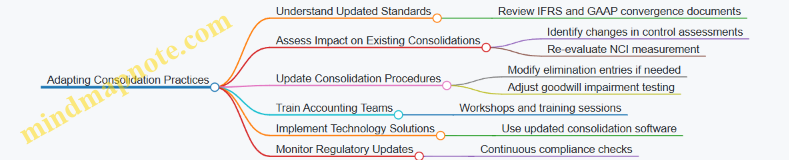
The convergence of IFRS and GAAP is a dynamic process that significantly influences consolidation practices. By embracing these changes, accountants and financial controllers can enhance the accuracy, transparency, and comparability of consolidated financial statements across global entities.
12.2 Role of Artificial Intelligence and Machine Learning in Consolidation
Financial statement consolidation is a complex, detail-oriented process that requires accuracy, consistency, and efficiency. Artificial Intelligence (AI) and Machine Learning (ML) are transforming this landscape by automating repetitive tasks, improving data accuracy, and providing predictive insights. This section explores how AI and ML integrate into consolidation workflows, their benefits, challenges, and practical examples.
Understanding AI and ML in Financial Consolidation
- Artificial Intelligence (AI): Computer systems designed to perform tasks that typically require human intelligence, such as pattern recognition, decision-making, and language understanding.
- Machine Learning (ML): A subset of AI that uses algorithms to identify patterns in data and improve performance over time without explicit programming.
Mind Map: AI & ML Applications in Financial Consolidation
Practical Examples of AI and ML in Consolidation
Example 1: Automated Data Extraction and Validation
A multinational corporation uses AI-powered Optical Character Recognition (OCR) combined with ML algorithms to extract financial data from subsidiaries’ reports in various formats (PDFs, spreadsheets, ERP systems). The system flags anomalies such as missing entries or unusual variances compared to prior periods, reducing manual review time by 70%.
Example 2: Intelligent Intercompany Transaction Matching
Using ML clustering techniques, a financial controller’s team identifies intercompany sales and purchases by analyzing transaction descriptions, amounts, and dates across entities. The system automatically suggests eliminations, reducing errors and speeding up the consolidation process.
Example 3: Predictive Currency Translation Adjustments
An AI model forecasts exchange rate movements based on historical data and macroeconomic indicators. This enables the finance team to proactively adjust consolidated financial statements and manage foreign currency risks more effectively.
Benefits of AI and ML in Financial Consolidation
- Increased Efficiency: Automation reduces manual workload and accelerates consolidation cycles.
- Improved Accuracy: AI algorithms detect anomalies and inconsistencies that might be missed by humans.
- Enhanced Compliance: Automated checks ensure adherence to accounting standards and regulatory requirements.
- Scalability: Systems adapt easily to growing numbers of subsidiaries and complex ownership structures.
- Insight Generation: Predictive analytics provide valuable foresight for decision-making.
Challenges and Considerations
- Data Quality: AI/ML effectiveness depends on clean, consistent data inputs.
- Integration Complexity: Aligning AI tools with existing ERP and consolidation software can be challenging.
- Change Management: Training and adapting finance teams to new technologies is essential.
- Regulatory Acceptance: Ensuring AI-driven processes meet audit and compliance standards.
Mind Map: Implementation Roadmap for AI/ML in Consolidation
Final Thoughts
AI and ML are no longer futuristic concepts but practical tools reshaping financial statement consolidation. By embracing these technologies, accountants and financial controllers can enhance accuracy, reduce cycle times, and gain deeper insights — ultimately supporting more strategic financial management within corporate finance.
12.3 Emerging Challenges with Increasing Corporate Complexity
As corporations grow and diversify, the complexity of their structures increases exponentially. This complexity presents significant challenges in the consolidation of financial statements, especially for accountants and financial controllers who must ensure accuracy, compliance, and timely reporting. Below, we explore the key emerging challenges and provide practical examples and mind maps to help visualize and address these issues.
Multi-layered Ownership Structures
Large corporations often have subsidiaries that themselves own other subsidiaries, creating multi-tiered ownership hierarchies. This complicates the consolidation process because each layer may have different ownership percentages, requiring careful calculation of non-controlling interests and equity eliminations.
Example:
- Parent Company A owns 80% of Subsidiary B.
- Subsidiary B owns 60% of Subsidiary C.
In consolidation, Parent Company A must consolidate Subsidiary B fully and Subsidiary C proportionally, considering indirect ownership (80% * 60% = 48%).
Mind Map:
Diverse Business Segments and Geographic Spread
Corporations operating across multiple industries and countries face challenges in harmonizing accounting policies, currency translation, and regulatory compliance.
Example:
A corporation with a manufacturing subsidiary in Germany and a retail subsidiary in Brazil must consolidate financials prepared under IFRS and local GAAP, respectively, and translate Brazilian Real financials into Euros.
Mind Map:
Complex Intercompany Transactions
With multiple subsidiaries, intercompany transactions become frequent and varied, including sales, loans, royalties, and management fees. Tracking and eliminating these transactions accurately is critical but increasingly difficult.
Example:
Subsidiary X sells inventory to Subsidiary Y, which then sells to Subsidiary Z. Each transaction involves different pricing and payment terms, requiring layered elimination entries.
Mind Map:
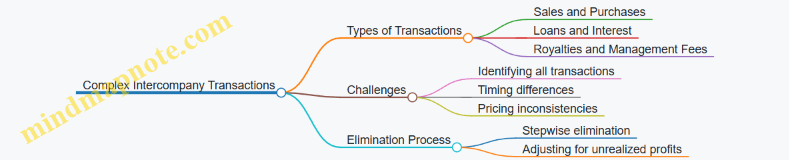
Timing Differences and Reporting Period Misalignment
Subsidiaries may have different fiscal year-ends or interim reporting periods, complicating the consolidation timeline and requiring adjustments for timing differences.
Example:
Subsidiary A closes its books on December 31, while Subsidiary B closes on March 31. Consolidation as of December 31 requires adjusting Subsidiary B’s financials to reflect the earlier date.
Mind Map:
Increased Regulatory and Compliance Burden
As complexity grows, so does the need to comply with multiple regulatory frameworks, including tax laws, securities regulations, and international accounting standards.
Example:
A multinational corporation must comply with SEC regulations in the US, local tax authorities in Asia, and IFRS disclosures in Europe, requiring a robust compliance framework integrated with consolidation.
Mind Map:
Practical Tips to Address These Challenges
- Implement Robust Consolidation Software: Use tools that can handle multi-tiered ownership and automate intercompany eliminations.
- Standardize Accounting Policies: Develop group-wide policies to minimize adjustments.
- Regular Communication: Maintain close coordination between subsidiaries’ finance teams.
- Training and Development: Equip accountants with skills to manage complex consolidations.
- Early Planning for Reporting Dates: Align reporting periods where possible or prepare adjustment templates.
Summary
Increasing corporate complexity introduces multi-dimensional challenges in financial statement consolidation. Understanding these challenges through structured visualization like mind maps and real-world examples helps accountants and financial controllers navigate the consolidation process more effectively, ensuring accurate, compliant, and timely financial reporting.
12.4 Preparing for the Future: Skills and Tools Accountants Should Develop
As the landscape of financial statement consolidation evolves, accountants and financial controllers must proactively develop new skills and adopt advanced tools to stay ahead. This section explores the essential competencies and technologies that will empower finance professionals to handle increasingly complex consolidation tasks efficiently and accurately.
Key Skills for Future-Ready Accountants
-
Advanced Data Analytics and Interpretation
- Ability to analyze large datasets from multiple entities.
- Use of visualization tools to identify trends and anomalies in consolidated data.
-
Proficiency in Automation and AI Tools
- Understanding of robotic process automation (RPA) for routine consolidation tasks.
- Familiarity with AI-driven tools that can detect errors or suggest adjustments.
-
Strong Knowledge of IFRS and GAAP Updates
- Keeping up-to-date with evolving accounting standards affecting consolidation.
- Interpreting new rules and applying them correctly in consolidation.
-
Cross-functional Communication and Collaboration
- Working effectively with IT, legal, and operational teams.
- Explaining complex consolidation concepts to non-finance stakeholders.
-
Project Management and Change Management Skills
- Leading consolidation system implementations or upgrades.
- Managing transitions to new consolidation methodologies or software.
Essential Tools for Modern Consolidation
-
Consolidation Software with AI Capabilities
- Example: Oracle Hyperion Financial Management with AI-powered data validation.
-
Cloud-Based Financial Platforms
- Enable real-time data access and collaboration across global entities.
-
Data Visualization Tools
- Example: Tableau or Power BI for presenting consolidated financial insights.
-
Robotic Process Automation (RPA)
- Automate repetitive tasks such as intercompany eliminations and reconciliations.
-
Collaborative Workflow Platforms
- Example: Microsoft Teams integrated with financial systems for seamless communication.
Mind Map: Future Skills for Accountants in Consolidation
Mind Map: Essential Tools for Financial Statement Consolidation
Practical Example: Leveraging AI for Intercompany Eliminations
Scenario: A multinational corporation struggles with manual intercompany eliminations across 15 subsidiaries, leading to delays and errors.
Solution: Implement an AI-powered consolidation tool that automatically identifies intercompany transactions by matching invoice numbers, amounts, and counterparties.
Outcome:
- Reduction in manual reconciliation time by 60%.
- Significant decrease in elimination errors.
- Faster close cycle, enabling timely reporting.
Practical Example: Upskilling Through Data Analytics Training
Scenario: A financial controller notices recurring discrepancies in consolidated reports due to inconsistent data interpretation.
Action: The controller enrolls in an advanced data analytics course focusing on financial data visualization and anomaly detection.
Result:
- Improved ability to detect consolidation inconsistencies early.
- Enhanced reporting clarity for senior management.
- Greater confidence in handling complex consolidation scenarios.
Summary
To prepare for the future, accountants and financial controllers must embrace continuous learning and technological adoption. Developing advanced analytical skills, mastering automation tools, and maintaining up-to-date knowledge of accounting standards will be critical. By integrating these skills and tools, finance professionals can ensure accurate, efficient, and insightful consolidated financial reporting in an increasingly complex corporate environment.
13. Summary and Practical Takeaways
13.1 Recap of Key Consolidation Techniques and Best Practices
Financial statement consolidation is a critical process for accountants and financial controllers managing corporate groups. This section summarizes the essential techniques and best practices covered throughout the blog, reinforced with clear examples and mind maps to aid understanding.
Mind Map: Overview of Consolidation Techniques
Key Consolidation Techniques Recap
-
Preparation and Data Standardization
- Collect financial data from all entities involved.
- Harmonize accounting policies to ensure consistency.
- Example: If Subsidiary A uses FIFO inventory method and Subsidiary B uses LIFO, adjust Subsidiary B’s inventory figures to FIFO for consolidation.
-
Choosing the Appropriate Consolidation Method
- Full Consolidation: Used when control exceeds 50% ownership.
- Example: Parent owns 80% of Subsidiary; consolidate 100% of Subsidiary’s assets and liabilities.
- Equity Method: Applied for significant influence (20%-50%).
- Example: Parent owns 30% of Associate; recognize share of profit/loss in income statement.
- Proportionate Consolidation: Used for joint ventures where control is shared.
- Example: 50/50 joint venture; consolidate 50% of assets, liabilities, income, and expenses.
- Full Consolidation: Used when control exceeds 50% ownership.
-
Intercompany Eliminations
- Eliminate intercompany sales, purchases, loans, and dividends to avoid double counting.
- Example: Parent sells inventory to Subsidiary at a profit; eliminate unrealized profit on ending inventory.
-
Consolidation of Income Statements and Balance Sheets
- Combine line items across entities after eliminations.
- Recognize non-controlling interest (NCI) separately in equity and profit.
- Example: Subsidiary’s net income is $100,000; NCI owns 20%, so $20,000 is attributed to NCI.
-
Foreign Currency Translation
- Translate foreign subsidiary financials using appropriate methods (current rate or temporal).
- Record exchange differences in other comprehensive income or profit/loss.
- Example: Subsidiary’s assets translated at closing rate; income statement items at average rate.
-
Disclosure and Reporting
- Clearly disclose consolidation methods, NCI, and intercompany eliminations.
- Provide notes explaining significant adjustments.
Mind Map: Best Practices for Effective Consolidation
Best Practices with Examples
-
Early Data Collection:
- Start gathering financial data well before reporting deadlines.
- Example: Set monthly cut-off dates for subsidiaries to submit trial balances.
-
Consistent Accounting Policies:
- Align depreciation methods, revenue recognition, and inventory valuation.
- Example: Convert all subsidiaries’ depreciation to straight-line method for consolidation.
-
Detailed Intercompany Transaction Tracking:
- Maintain schedules of intercompany balances and transactions.
- Example: Use intercompany reconciliation reports to identify mismatches.
-
Use of Automation Tools:
- Implement consolidation software to reduce manual errors.
- Example: Automate elimination entries for intercompany sales using consolidation software.
-
Regular Reconciliation:
- Reconcile intercompany accounts monthly to avoid year-end surprises.
- Example: Compare intercompany receivables and payables between entities.
-
Clear Documentation:
- Document assumptions, adjustments, and methods used.
- Example: Maintain a consolidation workbook with detailed notes.
-
Training and Skill Development:
- Keep finance teams updated on IFRS/GAAP changes and consolidation techniques.
- Example: Conduct quarterly workshops on new consolidation standards.
Final Example: Simplified Consolidation Recap
| Step | Description | Example |
|---|---|---|
| Data Collection | Gather trial balances from Parent and Subsidiary | Parent and Subsidiary submit trial balances by 5th of each month |
| Policy Harmonization | Adjust Subsidiary’s inventory valuation method | Convert Subsidiary’s LIFO inventory to FIFO |
| Full Consolidation | Combine 100% of Subsidiary’s financials | Parent owns 85% of Subsidiary; consolidate full amounts |
| Intercompany Eliminations | Remove intercompany sales and loans | Eliminate $50,000 intercompany sales and related profit |
| Non-controlling Interest | Allocate profit and equity to minority shareholders | NCI owns 15%, allocate $30,000 of net income accordingly |
| Currency Translation | Translate foreign subsidiary financials | Use closing rate for balance sheet, average rate for income statement |
| Disclosure | Prepare notes explaining consolidation methods | Disclose elimination entries and NCI treatment |
This recap serves as a handy reference for accountants and financial controllers to ensure accuracy, compliance, and efficiency in financial statement consolidation.
13.2 Checklist for Effective Financial Statement Consolidation
To ensure a smooth and accurate consolidation process, accountants and financial controllers can rely on a comprehensive checklist that covers all critical steps and best practices. This checklist helps avoid common pitfalls and ensures compliance with accounting standards.
Financial Statement Consolidation Checklist
Entity Identification
- Confirm all subsidiaries, associates, and joint ventures to be consolidated
- Verify ownership percentages and control status
Data Collection & Standardization
- Gather financial statements from all entities
- Ensure all statements are prepared for the same reporting period
- Standardize accounting policies and chart of accounts
Method Selection
- Determine appropriate consolidation method (Full, Equity, Proportionate)
- Document rationale for method choice
Intercompany Eliminations
- Identify all intercompany transactions (sales, loans, dividends)
- Eliminate intercompany balances and transactions
- Adjust for unrealized profits in inventory and fixed assets
Foreign Currency Translation
- Identify functional and presentation currencies
- Apply correct translation method (current rate, temporal)
- Record exchange differences appropriately
Non-controlling Interests
- Calculate and present non-controlling interests in equity and profit
Goodwill and Intangibles
- Recognize goodwill on acquisition
- Test goodwill for impairment regularly
Review & Reconciliation
- Reconcile consolidated trial balance
- Review elimination entries for accuracy
Disclosure & Reporting
- Prepare required disclosures for consolidated financial statements
- Include notes on consolidation policies, non-controlling interests, and intercompany eliminations
Documentation & Audit Trail
- Maintain detailed working papers
- Document assumptions and judgments
Mind Map: Consolidation Process Overview
Example: Applying the Checklist in Practice
Scenario: A corporate group consists of a parent company (100% ownership) and two subsidiaries: Subsidiary A (80% ownership) and Subsidiary B (60% ownership). Both subsidiaries operate in different countries with different functional currencies.
Step-by-step application:
-
Entity Identification: Confirm the ownership percentages and control status. Subsidiary A and B are consolidated fully; non-controlling interests are recognized for 20% of Subsidiary A and 40% of Subsidiary B.
-
Data Collection: Collect financial statements from parent and subsidiaries for the same reporting period. Ensure Subsidiary B’s financials are translated from its functional currency.
-
Method Selection: Full consolidation method is selected for both subsidiaries.
-
Intercompany Eliminations: Identify intercompany sales between parent and Subsidiary A. Eliminate these sales and corresponding cost of goods sold.
-
Foreign Currency Translation: Translate Subsidiary B’s financials using the current rate method. Record exchange differences in other comprehensive income.
-
Non-controlling Interests: Calculate NCI share of net assets and profit for both subsidiaries.
-
Goodwill: Recognize goodwill on acquisition of Subsidiary B and test for impairment.
-
Review & Reconciliation: Reconcile consolidated trial balance and verify elimination entries.
-
Disclosure: Prepare notes explaining consolidation policies, NCI, and foreign currency translation.
-
Documentation: Maintain working papers detailing all adjustments and assumptions.
Mind Map: Intercompany Eliminations Checklist
By following this checklist and using visual mind maps, accountants and financial controllers can systematically approach financial statement consolidation, ensuring accuracy, compliance, and clarity throughout the process.
13.3 Common Pitfalls to Avoid in Consolidation Processes
Financial statement consolidation is a complex process that requires meticulous attention to detail. Even experienced accountants and financial controllers can encounter pitfalls that may compromise the accuracy and reliability of consolidated financial statements. Below, we explore the most common pitfalls and provide practical examples and mind maps to help you avoid them.
Pitfall 1: Incomplete Identification of Entities to Consolidate
Failing to identify all subsidiaries, associates, or joint ventures that require consolidation can lead to incomplete financial statements.
Example: A parent company owns 80% of Subsidiary A and 45% of Associate B. The accountant consolidates Subsidiary A fully but omits Associate B, which should be accounted for using the equity method.
Mind Map:
Pitfall 2: Failure to Eliminate Intercompany Transactions
Intercompany sales, loans, dividends, and expenses must be eliminated to avoid double counting.
Example: Subsidiary A sells inventory to Subsidiary B at a profit. If this intercompany sale is not eliminated, consolidated revenue and profit will be overstated.
Mind Map:
Pitfall 3: Ignoring Differences in Accounting Policies
Entities within a group may use different accounting policies, which must be harmonized before consolidation.
Example: Subsidiary A uses straight-line depreciation while Subsidiary B uses declining balance. Without adjustments, consolidated depreciation expense will be inconsistent.
Mind Map:
Pitfall 4: Incorrect Treatment of Non-controlling Interests (NCI)
Misclassifying or miscalculating NCI can distort equity and profit allocation.
Example: A parent owns 75% of a subsidiary. The remaining 25% NCI must be presented separately in equity and profit. Incorrectly attributing 100% of profit to the parent inflates earnings.
Mind Map:
Pitfall 5: Mishandling Foreign Currency Translation
Improper translation of foreign subsidiaries’ financials can lead to inaccurate consolidated statements.
Example: A subsidiary reports in EUR, but the parent reports in USD. Using the temporal method instead of the current rate method for a foreign operation can misstate assets and equity.
Mind Map:
Pitfall 6: Timing Differences in Reporting Periods
Consolidating entities with different year-ends without proper adjustments can cause mismatches.
Example: Parent company’s year-end is December 31, but a subsidiary’s financials are prepared as of September 30. Without adjusting for the three-month gap, the consolidated statements may be misleading.
Mind Map:
Pitfall 7: Overlooking Goodwill Impairment Testing
Failing to test goodwill for impairment annually can lead to overstated assets.
Example: Goodwill arising from a business combination is not tested for impairment after a decline in subsidiary performance, violating accounting standards.
Mind Map:
Summary Table of Common Pitfalls
| Pitfall | Description | Example Scenario | Best Practice |
|---|---|---|---|
| Incomplete Entity Identification | Missing subsidiaries or associates | Omitting an associate from consolidation | Maintain updated ownership register |
| Intercompany Transaction Errors | Not eliminating intercompany sales or loans | Double counting revenue from intercompany sales | Perform thorough elimination reconciliations |
| Accounting Policy Differences | Unadjusted differences in accounting methods | Different depreciation methods used | Harmonize policies before consolidation |
| Non-controlling Interest Errors | Misclassifying or ignoring NCI | Attributing 100% profit to parent | Correctly calculate and present NCI |
| Foreign Currency Translation | Using wrong translation method | Using temporal method instead of current rate | Apply appropriate currency translation method |
| Timing Differences | Different reporting periods without adjustment | Subsidiary financials outdated by months | Adjust subsidiary data to parent’s period |
| Goodwill Impairment | Missing annual impairment testing | Ignoring decline in subsidiary value | Conduct annual impairment tests |
By being aware of these common pitfalls and applying the best practices illustrated above, accountants and financial controllers can ensure the accuracy and compliance of their consolidated financial statements.
13.4 Final Example: End-to-End Consolidation Walkthrough
In this section, we will walk through a comprehensive example of financial statement consolidation, integrating all the key techniques and best practices discussed throughout this blog. This end-to-end example will help you visualize the consolidation process from start to finish, including data gathering, elimination of intercompany transactions, currency translation, and preparation of consolidated financial statements.
Scenario Overview
Parent Company: Alpha Corp (100% ownership of Beta Ltd.)
Subsidiary: Beta Ltd.
Both companies have prepared their individual financial statements for the year ending December 31, 2023. Alpha Corp uses USD as its functional and presentation currency, while Beta Ltd. reports in EUR.
Step 1: Gather Individual Financial Statements
| Item | Alpha Corp (USD) | Beta Ltd. (EUR) |
|---|---|---|
| Revenue | 1,200,000 | 800,000 |
| Cost of Goods Sold | 700,000 | 500,000 |
| Operating Expenses | 300,000 | 200,000 |
| Net Income | 200,000 | 100,000 |
| Assets | 3,000,000 | 1,500,000 |
| Liabilities | 1,200,000 | 600,000 |
| Equity | 1,800,000 | 900,000 |
Step 2: Currency Translation of Beta Ltd.’s Financials
Assuming the following exchange rates:
- Average rate for income statement items: 1 EUR = 1.10 USD
- Closing rate for balance sheet items: 1 EUR = 1.15 USD
Translated Income Statement (USD):
| Item | Beta Ltd. (EUR) | Exchange Rate | Beta Ltd. (USD) |
|---|---|---|---|
| Revenue | 800,000 | 1.10 | 880,000 |
| Cost of Goods Sold | 500,000 | 1.10 | 550,000 |
| Operating Expenses | 200,000 | 1.10 | 220,000 |
| Net Income | 100,000 | 1.10 | 110,000 |
Translated Balance Sheet (USD):
| Item | Beta Ltd. (EUR) | Exchange Rate | Beta Ltd. (USD) |
|---|---|---|---|
| Assets | 1,500,000 | 1.15 | 1,725,000 |
| Liabilities | 600,000 | 1.15 | 690,000 |
| Equity | 900,000 | 1.15 | 1,035,000 |
Step 3: Identify and Eliminate Intercompany Transactions
Assume the following intercompany transactions during the year:
- Alpha Corp sold inventory to Beta Ltd. for $150,000 (cost to Alpha Corp: $120,000).
- Beta Ltd. owes Alpha Corp $50,000 as an intercompany loan.
- Interest on the intercompany loan of $5,000 was accrued by Beta Ltd.
Mind Map: Intercompany Eliminations
Elimination Entries:
| Entry Description | Debit (USD) | Credit (USD) |
|---|---|---|
| Eliminate intercompany sales | 150,000 | |
| Eliminate intercompany purchases (COGS) | 120,000 | |
| Adjust unrealized profit in ending inventory* | 30,000 | |
| Eliminate intercompany loan receivable | 50,000 | |
| Eliminate intercompany loan payable | 50,000 | |
| Eliminate accrued interest expense | 5,000 | |
| Eliminate accrued interest income | 5,000 |
*Assuming $30,000 of the inventory remains unsold at year-end, the unrealized profit is $150,000 - $120,000 = $30,000.
Step 4: Combine Financial Statements
Consolidated Income Statement (USD):
| Item | Alpha Corp | Beta Ltd. (translated) | Subtotal | Eliminations | Consolidated Total |
|---|---|---|---|---|---|
| Revenue | 1,200,000 | 880,000 | 2,080,000 | (150,000) | 1,930,000 |
| Cost of Goods Sold | 700,000 | 550,000 | 1,250,000 | (120,000) | 1,130,000 |
| Operating Expenses | 300,000 | 220,000 | 520,000 | 0 | 520,000 |
| Unrealized Profit Adj. | 0 | 0 | 0 | (30,000) | (30,000) |
| Net Income | 200,000 | 110,000 | 310,000 | (5,000) | 305,000 |
Notes: The $5,000 elimination of accrued interest is reflected in net income adjustments.
Consolidated Balance Sheet (USD):
| Item | Alpha Corp | Beta Ltd. (translated) | Subtotal | Eliminations | Consolidated Total |
|---|---|---|---|---|---|
| Assets | 3,000,000 | 1,725,000 | 4,725,000 | (50,000) | 4,675,000 |
| Liabilities | 1,200,000 | 690,000 | 1,890,000 | (50,000) | 1,840,000 |
| Equity | 1,800,000 | 1,035,000 | 2,835,000 | 0 | 2,835,000 |
Step 5: Recognize Goodwill or Gain from Acquisition
Assuming Alpha Corp acquired Beta Ltd. at book value, no goodwill arises in this example. If there were a difference between purchase price and net assets, goodwill or gain would be calculated and recorded accordingly.
Step 6: Final Review and Disclosure
- Confirm all intercompany eliminations are complete.
- Verify currency translation adjustments are properly recorded.
- Prepare disclosure notes explaining consolidation policies, intercompany transactions, and currency translation methods.
Mind Map: End-to-End Consolidation Process
Summary
This walkthrough illustrates how to consolidate financial statements by:
- Translating foreign subsidiary financials using appropriate exchange rates.
- Eliminating intercompany transactions to avoid double counting.
- Adjusting for unrealized profits in inventory.
- Combining income statements and balance sheets into a single consolidated statement.
- Ensuring compliance with accounting standards and preparing disclosures.
By following this structured approach, accountants and financial controllers can confidently prepare accurate and compliant consolidated financial statements.
End of 13.4 Final Example: End-to-End Consolidation Walkthrough