Accounting for Business Restructuring
1. Introduction to Business Restructuring Accounting
1.1 Understanding Business Restructuring: Definitions and Types
Business restructuring is a strategic process undertaken by companies to significantly modify their operational, financial, or organizational structure. The goal is often to improve efficiency, address financial difficulties, adapt to market changes, or prepare for growth opportunities.
Definition of Business Restructuring
Business restructuring involves reorganizing the legal, ownership, operational, or other structures of a company. This can include changes in debt arrangements, asset reallocation, workforce adjustments, or shifts in business focus.
Example: A manufacturing company facing declining sales may restructure by closing underperforming plants and shifting production to more cost-effective locations.
Types of Business Restructuring
Business restructuring can be broadly categorized into several types, each with distinct objectives and accounting implications:
Business Restructuring Types Mind Map
Operational Restructuring
Focuses on improving the efficiency of business operations.
- Example: A retail chain reduces its store count and automates inventory management to cut costs.
- Accounting Impact: Recognition of restructuring costs such as severance pay and asset impairments.
Financial Restructuring
Involves modifying the company’s capital structure to improve liquidity or solvency.
- Example: A company refinances its high-interest debt with lower-interest loans and issues new equity to strengthen its balance sheet.
- Accounting Impact: Changes in debt valuation, recognition of refinancing costs, and equity transactions.
Organizational Restructuring
Changes in the company’s ownership or business units.
- Example: A corporation spins off a subsidiary to focus on core business areas.
- Accounting Impact: Derecognition of assets/liabilities, gain or loss on disposal, and consolidation adjustments.
Legal Restructuring
Actions taken to comply with legal requirements or to protect the company during financial distress.
- Example: Filing for bankruptcy protection to reorganize debts.
- Accounting Impact: Recognition of provisions, impairment of assets, and disclosure requirements.
Integrated Example: Mid-Sized Tech Company Restructuring
A mid-sized technology company faced with declining profits undertakes a comprehensive restructuring:
- Operational: Lays off 15% of staff and closes two underperforming offices.
- Financial: Refinances existing debt to reduce interest expenses.
- Organizational: Sells a non-core business unit.
- Legal: Renegotiates supplier contracts to improve terms.
Each of these actions requires careful accounting treatment to ensure accurate financial reporting and compliance.
Summary Mind Map
Understanding these definitions and types lays the foundation for effective accounting practices throughout the restructuring process.
1.2 The Role of Accountants and Restructuring Advisors
In the complex process of business restructuring, accountants and restructuring advisors play pivotal roles that ensure financial accuracy, regulatory compliance, and strategic guidance. Their collaboration is essential to navigate the financial, operational, and legal challenges that arise during restructuring.
Key Responsibilities of Accountants in Restructuring
- Financial Assessment and Analysis: Evaluate the company’s current financial health, identify liabilities, assets, and cash flow constraints.
- Cost Recognition and Allocation: Accurately identify restructuring costs and ensure they are recorded in the appropriate accounting periods.
- Provisioning and Liabilities: Establish and monitor provisions for restructuring-related liabilities such as severance, lease terminations, and asset impairments.
- Compliance and Reporting: Ensure adherence to accounting standards (e.g., IFRS, GAAP) and prepare transparent financial disclosures.
- Internal Controls and Audit Support: Maintain robust controls to prevent errors or fraud and support internal/external audits.
Key Responsibilities of Restructuring Advisors
- Strategic Planning: Develop and recommend restructuring strategies aligned with business objectives.
- Stakeholder Management: Liaise with creditors, investors, employees, and regulators to facilitate smooth restructuring.
- Operational Restructuring: Advise on operational changes such as divestitures, downsizing, or process improvements.
- Financial Modeling and Forecasting: Create models to predict outcomes of restructuring scenarios.
- Risk Management: Identify and mitigate risks associated with restructuring activities.
Mind Map: Roles and Interactions of Accountants and Restructuring Advisors
Example 1: Collaborative Cost Recognition
Scenario: A manufacturing company plans to close one of its plants as part of restructuring.
- The accountant calculates the estimated severance pay, lease termination penalties, and asset write-downs, ensuring these costs are recognized in the correct accounting period.
- The restructuring advisor provides the timeline and strategic rationale for the closure, helping the accountant understand when costs will be incurred.
Outcome: Together, they ensure that the financial statements accurately reflect the restructuring costs, providing stakeholders with a clear picture.
Mind Map: Cost Recognition Workflow
Example 2: Stakeholder Communication Support
Scenario: During a corporate restructuring, management needs to communicate financial impacts to investors.
- The accountant prepares detailed financial reports and disclosures highlighting restructuring expenses and provisions.
- The restructuring advisor crafts the narrative explaining the strategic benefits and expected outcomes.
Outcome: The combined effort results in transparent, credible communication that builds investor confidence.
Mind Map: Stakeholder Communication Roles
Summary
Accountants and restructuring advisors each bring specialized expertise that, when integrated, drive successful business restructuring. Accountants focus on the precise financial mechanics and compliance, while restructuring advisors provide strategic direction and stakeholder engagement. Their partnership ensures restructuring efforts are both financially sound and strategically effective.
1.3 Overview of Accounting Standards Relevant to Restructuring
Business restructuring involves complex accounting considerations governed by various accounting standards. Understanding these standards ensures accurate recognition, measurement, and disclosure of restructuring activities.
Key Accounting Standards for Restructuring
-
IFRS (International Financial Reporting Standards)
- IAS 37: Provisions, Contingent Liabilities and Contingent Assets
- IAS 36: Impairment of Assets
- IFRS 3: Business Combinations (when restructuring occurs post-acquisition)
- IAS 19: Employee Benefits
-
US GAAP (Generally Accepted Accounting Principles)
- ASC 420: Exit or Disposal Cost Obligations
- ASC 360: Property, Plant, and Equipment (Impairment)
- ASC 712: Compensation—Nonretirement Postemployment Benefits
Mind Map: Accounting Standards Landscape for Restructuring
IAS 37: Provisions, Contingent Liabilities and Contingent Assets
-
Purpose: Defines when and how to recognize provisions, including restructuring provisions.
-
Recognition Criteria: A provision is recognized when:
- There is a present obligation (legal or constructive) as a result of a past event.
- It is probable that an outflow of resources will be required to settle the obligation.
- The amount can be reliably estimated.
-
Example: A company decides to close a manufacturing plant. It has a legal obligation to pay severance to employees and dismantle equipment.
- The company recognizes a restructuring provision for estimated severance costs and dismantling expenses.
- The provision is measured at the best estimate of the expenditure required.
ASC 420: Exit or Disposal Cost Obligations (US GAAP)
-
Scope: Addresses costs associated with exit or disposal activities, including restructuring.
-
Recognition: Liabilities are recognized when the entity has committed to an exit plan and can reasonably estimate costs.
-
Example: A corporation announces a plant closure and commits to a detailed plan. It recognizes a liability for employee termination benefits and lease termination costs.
IAS 36: Impairment of Assets
-
Purpose: Ensures assets are carried at no more than their recoverable amount.
-
Relevance to Restructuring: Restructuring often triggers impairment tests for assets related to the restructuring.
-
Example: After announcing a restructuring, a company tests its machinery for impairment. The recoverable amount is lower than carrying value, so an impairment loss is recognized.
IAS 19: Employee Benefits
-
Termination Benefits: Recognized when the entity is demonstrably committed to a termination plan.
-
Measurement: Based on the best estimate of the cost to settle the obligation.
-
Example: A company offers voluntary early retirement packages. The expected cost is recognized as a liability when the offer is accepted.
Practical Example Integrating Standards
Scenario:
A company decides to restructure by closing one of its divisions, resulting in employee layoffs, asset disposals, and contract terminations.
| Accounting Aspect | Relevant Standard | Action Taken |
|---|---|---|
| Recognition of restructuring costs | IAS 37 / ASC 420 | Recognize provisions/liabilities for severance, contract termination, and dismantling costs. |
| Asset impairment | IAS 36 / ASC 360 | Test assets for impairment and recognize losses if recoverable amount is lower. |
| Employee termination benefits | IAS 19 / ASC 712 | Recognize termination benefits when commitment to plan exists. |
Mind Map: Applying Accounting Standards in a Restructuring Scenario
Summary
Understanding and applying the relevant accounting standards is critical for accurate and compliant financial reporting during business restructuring. Both IFRS and US GAAP provide detailed guidance on recognizing provisions, liabilities, impairments, and employee benefits related to restructuring activities. Accountants and restructuring advisors must carefully evaluate the facts and circumstances to determine when and how to apply these standards, ensuring transparent and reliable financial statements.
1.4 Importance of Accurate Accounting in Restructuring Processes
Accurate accounting during business restructuring is critical for ensuring transparency, compliance, and informed decision-making. Restructuring often involves complex financial transactions, cost allocations, and reporting requirements that, if mishandled, can lead to misstatements, regulatory penalties, or misguided strategic decisions.
Why Accurate Accounting Matters
- Regulatory Compliance: Restructuring activities must comply with accounting standards such as IFRS and GAAP. Accurate accounting ensures that provisions, impairments, and costs are recognized properly.
- Stakeholder Confidence: Investors, creditors, and employees rely on accurate financial information to assess the company’s health and future prospects.
- Effective Decision-Making: Management depends on precise accounting data to evaluate restructuring impacts and adjust strategies accordingly.
- Tax Implications: Proper accounting affects tax liabilities and opportunities for deductions related to restructuring costs.
- Audit Readiness: Transparent and well-documented accounting facilitates smoother audits and reduces the risk of financial restatements.
Mind Map: Key Reasons for Accurate Accounting in Restructuring
Example 1: Misstated Severance Costs Impacting Financial Statements
A company undergoing restructuring underestimated severance costs by excluding certain employee benefits. This led to an understatement of restructuring liabilities by $500,000 in the financial statements. As a result, the company faced regulatory scrutiny and had to restate its earnings, damaging investor confidence.
Lesson: Accurate estimation and recording of all restructuring-related costs, including fringe benefits, is essential.
Mind Map: Components of Accurate Restructuring Cost Accounting
Example 2: Transparent Reporting Builds Stakeholder Trust
During a large-scale restructuring, a company provided detailed disclosures about the nature, timing, and expected costs of restructuring activities in its financial statements. This transparency reassured investors and creditors, helping maintain the company’s credit rating and access to capital.
Lesson: Clear and comprehensive disclosure of restructuring accounting enhances stakeholder confidence.
Mind Map: Benefits of Accurate Accounting in Restructuring
Summary
Accurate accounting in restructuring processes is not just a compliance exercise but a strategic enabler. It ensures that all costs and liabilities are properly recognized and reported, supports effective communication with stakeholders, and provides management with reliable data to navigate the complexities of restructuring successfully.
By integrating best practices and maintaining rigorous accounting standards, accountants and restructuring advisors can significantly contribute to the success and sustainability of the restructuring effort.
1.5 Case Study: A Mid-Sized Company’s Restructuring Journey
Background
ABC Manufacturing Ltd., a mid-sized company specializing in automotive parts, faced significant market pressure due to increased competition and rising operational costs. To remain competitive, the company embarked on a comprehensive restructuring plan aimed at streamlining operations, reducing costs, and repositioning its product portfolio.
Restructuring Objectives
- Reduce operational costs by 15% within 12 months
- Divest non-core business units
- Optimize workforce size
- Improve cash flow and liquidity
Mind Map: Key Components of ABC Manufacturing’s Restructuring
Step 1: Identifying Restructuring Costs
ABC Manufacturing identified the following restructuring costs:
- Severance payments for 50 employees
- Lease termination penalties for one facility
- Costs related to asset impairments on machinery
Example:
The company calculated severance pay based on contractual obligations: 3 months’ salary per employee. For 50 employees with an average monthly salary of $4,000, the total severance cost was:
50 employees x $4,000 x 3 months = $600,000
Step 2: Accounting for Provisions
The company recognized a restructuring provision for expected costs that met recognition criteria under IFRS:
- Present obligation from detailed formal plan
- Reliable estimate of costs
Example:
ABC Manufacturing recorded a provision of $600,000 for severance and $150,000 for lease termination penalties.
Journal entry:
| Account | Debit | Credit |
|---|---|---|
| Restructuring Expense | $750,000 | |
| Provision for Restructuring | $750,000 |
Step 3: Asset Write-Downs
Machinery in the divested unit was impaired due to reduced market value.
Example:
Book value: $1,200,000
Recoverable amount: $800,000
Impairment loss: $400,000
Journal entry:
| Account | Debit | Credit |
|---|---|---|
| Impairment Loss | $400,000 | |
| Accumulated Depreciation | $400,000 |
Step 4: Financial Reporting and Disclosure
ABC Manufacturing disclosed the restructuring costs and provisions in the notes to the financial statements, explaining:
- Nature and reason for restructuring
- Amounts recognized in the period
- Expected timing of cash outflows
Example Disclosure Extract:
“During the fiscal year, the company initiated a restructuring plan to improve operational efficiency. Restructuring expenses of $750,000 were recognized, primarily relating to employee termination benefits and lease penalties. The company expects to settle these obligations within the next 12 months.”
Mind Map: Accounting Flow for ABC Manufacturing’s Restructuring
Lessons Learned
- Early identification and measurement of costs ensure accurate financial reporting.
- Clear documentation supports provision recognition and audit processes.
- Transparent disclosures build stakeholder trust during restructuring.
This case study illustrates how accountants and restructuring advisors can apply best practices in real-world scenarios, ensuring compliance and clarity throughout the restructuring journey.
2. Planning and Preparing for Restructuring Accounting
2.1 Identifying Financial and Operational Triggers for Restructuring
Business restructuring is often initiated in response to specific financial and operational triggers that indicate the need for change. Recognizing these triggers early allows accountants and restructuring advisors to plan and implement effective restructuring strategies that align with the company’s goals.
Financial Triggers
Financial triggers are indicators related to a company’s financial health that suggest restructuring may be necessary. These include:
- Declining Profit Margins: Continuous reduction in profit margins signals inefficiencies or increased costs.
- Cash Flow Problems: Persistent negative cash flow or liquidity issues that threaten operational viability.
- High Debt Levels: Excessive leverage causing financial strain or inability to meet debt obligations.
- Poor Return on Assets (ROA): Assets not generating expected returns, indicating underutilization.
- Negative Earnings Before Interest and Taxes (EBIT): Consistent losses at the operating level.
Example:
A manufacturing company experiences a 15% year-over-year decline in profit margins over three consecutive quarters, coupled with increasing accounts payable and delayed supplier payments. These financial signs trigger a review for potential restructuring.
Operational Triggers
Operational triggers relate to inefficiencies or changes in the business environment impacting operations:
- Outdated Technology or Processes: Legacy systems causing delays and higher costs.
- Overcapacity or Underutilization: Facilities or workforce not aligned with current demand.
- Market Changes: Shifts in customer preferences or competitive landscape.
- Regulatory Changes: New laws requiring operational adjustments.
- Management or Organizational Issues: Ineffective leadership or structural misalignment.
Example:
A retail chain notices declining foot traffic due to the rise of e-commerce, leading to underutilized stores and excess inventory. This operational trigger prompts consideration of store closures and supply chain restructuring.
Mind Map: Financial Triggers for Restructuring
Mind Map: Operational Triggers for Restructuring
Integrated Mind Map: Identifying Restructuring Triggers
Best Practice: Early Detection and Continuous Monitoring
- Establish key financial and operational KPIs relevant to your industry.
- Use dashboards to monitor these KPIs in real-time.
- Conduct periodic reviews with cross-functional teams to interpret data.
- Document triggers and potential impacts to inform restructuring decisions.
Example:
An accounting team sets up a dashboard tracking cash conversion cycle, debt-to-equity ratio, and inventory turnover. When the cash conversion cycle extends beyond 90 days, it triggers a deeper operational review, leading to a restructuring plan focused on improving working capital.
Summary
Identifying financial and operational triggers is a foundational step in the restructuring process. By understanding and monitoring these indicators, accountants and restructuring advisors can proactively recommend restructuring actions that mitigate risks and position the company for sustainable success.
2.2 Establishing a Restructuring Accounting Framework
Establishing a robust restructuring accounting framework is essential to ensure that all financial aspects of a restructuring initiative are accurately captured, reported, and managed. This framework acts as the backbone for consistent accounting treatment, compliance with relevant standards, and transparent communication with stakeholders.
Key Components of a Restructuring Accounting Framework
Below is a mind map illustrating the core components:
Step-by-Step Approach to Establish the Framework
-
Define Objectives and Scope
- Clarify the goals of the restructuring accounting framework.
- Determine which restructuring activities and costs will be covered.
-
Assign Roles and Responsibilities
- Identify key personnel: accountants, restructuring advisors, finance managers.
- Establish decision-making and approval hierarchies.
-
Develop Accounting Policies
- Align with IFRS (e.g., IAS 37) or US GAAP standards.
- Specify recognition criteria for restructuring costs and provisions.
-
Design Cost Identification and Tracking Processes
- Create cost categories.
- Set up cost centers or project codes in accounting systems.
-
Establish Provision Recognition and Measurement Procedures
- Define how and when provisions are recognized.
- Develop estimation methods for uncertain costs.
-
Implement Reporting and Disclosure Protocols
- Determine internal and external reporting requirements.
- Prepare templates for financial statement notes.
-
Integrate Systems and Controls
- Configure ERP or accounting software to capture restructuring transactions.
- Set up controls to ensure data accuracy and completeness.
-
Train Staff and Communicate Framework
- Conduct training sessions.
- Provide documentation and support materials.
Example: Framework Implementation in a Manufacturing Company
Scenario: A manufacturing company plans to close one of its plants and relocate operations. The finance team needs a restructuring accounting framework to manage related costs.
- Governance: CFO appoints a restructuring accounting lead and forms a cross-functional team.
- Policies: The team adopts IFRS guidelines and defines severance pay and asset impairment recognition.
- Cost Tracking: New cost centers for plant closure, employee termination, and equipment write-down are created.
- Provisioning: Provisions for lease termination and environmental cleanup are estimated based on contracts and expert assessments.
- Reporting: Monthly internal reports and quarterly disclosures are established.
- Systems: ERP configured to tag restructuring costs.
- Training: Workshops conducted for accounting and HR teams.
Mind Map: Cost Identification & Classification
Practical Example: Recognizing Severance Costs
- Situation: Company decides to lay off 50 employees.
- Action: Calculate severance pay based on contractual obligations.
- Accounting Treatment: Recognize severance costs as a liability and expense in the period when the restructuring plan is communicated and employees are notified.
- Documentation: Maintain termination letters, severance agreements, and board approvals.
Summary
Establishing a restructuring accounting framework ensures clarity, consistency, and compliance throughout the restructuring process. By integrating governance, policies, cost tracking, provisioning, reporting, and systems, organizations can effectively manage the financial complexities of restructuring initiatives.
2.3 Best Practice: Creating a Restructuring Accounting Checklist
Creating a comprehensive restructuring accounting checklist is a critical best practice that ensures all financial aspects of a restructuring initiative are systematically identified, tracked, and managed. This checklist acts as a roadmap for accountants and restructuring advisors to maintain accuracy, compliance, and transparency throughout the process.
Why Use a Restructuring Accounting Checklist?
- Consistency: Ensures uniform treatment of restructuring items across periods and teams.
- Compliance: Helps adhere to accounting standards such as IFRS and GAAP.
- Efficiency: Streamlines data collection and reporting.
- Risk Mitigation: Reduces the chance of missing key accounting entries or disclosures.
Key Components of a Restructuring Accounting Checklist
Restructuring Accounting Checklist Mind Map
Example: Sample Restructuring Accounting Checklist for a Manufacturing Company
| Checklist Item | Description | Responsible Party | Status |
|---|---|---|---|
| Identify restructuring triggers | Review financials and operational inefficiencies | CFO / Restructuring Team | Completed |
| Define restructuring scope | Determine departments and assets affected | Project Manager | In Progress |
| Estimate employee termination costs | Calculate severance and benefits | HR / Accounting | Pending |
| Assess asset impairments | Review fixed assets for impairment indicators | Accounting / Valuation Team | Pending |
| Document provision assumptions | Prepare detailed notes on assumptions used | Accounting | Pending |
| Record journal entries | Post restructuring costs and provisions | Accounting | Pending |
| Prepare financial statement notes | Draft disclosures related to restructuring | Accounting / Legal | Pending |
| Coordinate tax treatment | Confirm tax deductibility and deferred tax impacts | Tax Department | Pending |
| Monitor actual vs. budgeted costs | Track and report variances | Restructuring Team | Ongoing |
Practical Example: Using the Checklist to Record Employee Termination Benefits
- Identify: HR provides a list of employees affected and severance packages.
- Estimate: Accounting calculates total termination benefits based on contracts.
- Provision Recognition: Confirm that the termination plan meets criteria for provision recognition under IFRS.
- Documentation: Attach HR communications and legal approvals as evidence.
- Journal Entry: Debit restructuring expense and credit provision liability.
- Disclosure: Include details in financial statement notes.
- Monitoring: Track actual payments and adjust provisions accordingly.
By systematically following a restructuring accounting checklist, accountants and restructuring advisors can ensure that all financial elements are accurately captured and reported, reducing risk and enhancing stakeholder confidence.
2.4 Coordinating Between Finance, Legal, and Operational Teams
Effective coordination between finance, legal, and operational teams is critical during business restructuring to ensure seamless accounting practices, compliance, and operational continuity. Each team brings unique expertise and perspectives that, when aligned, contribute to a successful restructuring process.
Why Coordination Matters
- Finance Team: Responsible for accurate accounting, budgeting, forecasting, and financial reporting related to restructuring costs.
- Legal Team: Ensures compliance with laws and regulations, manages contracts, employee agreements, and potential litigation risks.
- Operational Team: Implements restructuring plans on the ground, manages workforce changes, and oversees operational adjustments.
Lack of coordination can lead to misstatements in financial reports, legal penalties, or operational disruptions.
Mind Map: Coordination Workflow
Best Practices for Coordination
-
Establish Cross-Functional Steering Committee
- Include representatives from finance, legal, and operations.
- Hold weekly meetings to review progress, risks, and issues.
-
Define Clear Roles and Responsibilities
- Use RACI (Responsible, Accountable, Consulted, Informed) matrices.
- Example: Finance is responsible for cost tracking; legal is accountable for compliance.
-
Implement Shared Documentation Platforms
- Use cloud-based tools (e.g., SharePoint, Google Drive) for real-time updates.
- Maintain version control on restructuring plans and financial data.
-
Develop Integrated Timelines and Milestones
- Align financial reporting deadlines with legal compliance dates and operational milestones.
-
Use Scenario Planning and Joint Risk Assessments
- Collaborate on identifying potential financial, legal, and operational risks.
- Develop mitigation strategies collectively.
Mind Map: Best Practices for Coordination
Example: Coordinating Severance Payment Accounting
Scenario: A company plans to lay off 100 employees as part of restructuring. Coordination is needed to ensure proper accounting and legal compliance.
- Finance: Calculates severance costs, accrues expenses in the correct period, and forecasts cash flow impact.
- Legal: Reviews severance agreements to ensure compliance with labor laws and minimizes litigation risk.
- Operations: Communicates layoffs to employees, manages exit processes, and ensures operational continuity.
Coordination Steps:
- Legal provides templates for severance agreements to finance and operations.
- Finance shares cost estimates and accrual schedules with legal and operations.
- Operations provides timelines for employee exits to finance for accurate period reporting.
- Weekly meetings track progress, resolve discrepancies, and update all teams.
Mind Map: Severance Payment Coordination Example
Additional Tips
- Use Clear Communication Language: Avoid jargon when possible to ensure all teams understand key points.
- Document Decisions: Keep records of all decisions and agreements to support audit trails.
- Leverage Technology: Utilize project management tools (e.g., Asana, Trello) to track tasks and deadlines.
By fostering strong collaboration between finance, legal, and operational teams, organizations can navigate the complexities of restructuring accounting more effectively, reduce risks, and improve transparency throughout the process.
2.5 Example: Setting Up a Restructuring Accounting Team in a Corporate Environment
Setting up a restructuring accounting team is a critical step in ensuring that the financial aspects of business restructuring are managed efficiently and accurately. This example will walk through the key components, roles, responsibilities, and best practices involved in establishing such a team within a corporate environment.
Key Objectives of the Restructuring Accounting Team
- Accurately capture and report restructuring costs
- Ensure compliance with accounting standards (IFRS, GAAP)
- Coordinate with cross-functional teams (legal, HR, operations)
- Provide timely financial insights to management and stakeholders
Step 1: Define Team Structure and Roles
Example:
- Team Lead / Manager: Oversees the entire restructuring accounting process, liaises with senior management.
- Senior Accountant: Handles complex accounting treatments, ensures compliance.
- Cost Analysts: Track and analyze restructuring expenses.
- Provision Specialists: Manage recognition and adjustments of provisions.
- Tax Accountant: Coordinates tax implications and filings.
- Data Analyst: Supports data collection and reporting.
- IT/ERP Specialist: Ensures systems support restructuring accounting needs.
- Compliance Officer: Monitors adherence to regulations and internal policies.
Step 2: Establish Communication Channels
Example:
- Weekly meetings to review restructuring cost updates and challenges.
- Collaborative workshops with HR to align on employee termination benefits accounting.
- Use of cloud-based platforms (e.g., SharePoint, Google Drive) for document sharing.
Step 3: Develop Accounting Policies and Procedures
Example:
- Policy states severance payments are recognized when a formal plan is approved and communicated.
- Provisions for facility closure costs require documented management commitment and reliable estimates.
Step 4: Implement Systems and Tools
Example:
- Configure the ERP system to create a dedicated restructuring cost center to segregate expenses.
- Develop dashboards that track actual vs budgeted restructuring costs in real-time.
Step 5: Training and Continuous Improvement
- Conduct training sessions on restructuring accounting standards and internal policies.
- Encourage feedback loops to identify process bottlenecks.
- Regularly update the team on regulatory changes and best practices.
Real-World Scenario Example
Company: XYZ Corp, a multinational manufacturing firm undergoing a major restructuring to streamline operations.
Action:
- XYZ Corp formed a restructuring accounting team led by a senior finance manager.
- The team included accountants specializing in cost tracking, provisions, and tax.
- They established weekly coordination meetings with HR and legal to align on employee-related costs.
- The ERP system was updated to track restructuring expenses separately.
- Policies were documented to ensure consistent recognition of restructuring costs.
- Monthly reports were generated for the executive committee to monitor financial impact.
Outcome:
- Improved accuracy in capturing restructuring costs.
- Enhanced transparency and timely reporting.
- Better compliance with accounting standards and tax regulations.
Summary
Setting up a restructuring accounting team requires careful planning of team roles, communication strategies, accounting policies, and system integrations. By following these best practices and learning from real-world examples, companies can ensure their restructuring efforts are financially well-managed and compliant.
3. Recognizing and Measuring Restructuring Costs
3.1 Types of Restructuring Costs: Direct vs Indirect
When a business undergoes restructuring, understanding the nature of costs involved is crucial for accurate accounting and financial reporting. Restructuring costs can broadly be classified into Direct Costs and Indirect Costs. This distinction helps accountants and restructuring advisors allocate expenses properly, ensuring compliance with accounting standards and providing clear insights into the financial impact of restructuring.
Mind Map: Overview of Restructuring Costs
Direct Costs
Direct costs are expenses that are explicitly and clearly attributable to the restructuring event. These costs are typically identifiable, measurable, and directly linked to the restructuring activities.
Common Examples of Direct Costs:
-
Employee Termination Benefits: Severance pay, pension contributions, and other benefits paid to employees who are laid off as part of the restructuring.
-
Contract Termination Costs: Penalties or fees paid to terminate leases, supplier contracts, or service agreements early.
-
Asset Write-Downs and Impairments: Reducing the book value of assets that are no longer useful or have lost value due to restructuring (e.g., closing a manufacturing plant).
-
Relocation Expenses: Costs incurred when moving operations, such as transportation of equipment or employee relocation allowances.
Example 1: Severance Pay Calculation
A company decides to lay off 20 employees as part of its restructuring. Each employee is entitled to 3 months of severance pay, with an average monthly salary of $4,000.
- Severance Pay = 20 employees × 3 months × $4,000 = $240,000
This $240,000 is a direct restructuring cost and should be recognized in the period when the restructuring plan is approved and communicated.
Indirect Costs
Indirect costs are less tangible and not directly attributable to restructuring but arise as a consequence of the process. These costs are often harder to quantify and may include opportunity costs or inefficiencies.
Common Examples of Indirect Costs:
-
Lost Productivity: Disruptions caused by restructuring may reduce workforce efficiency temporarily.
-
Management Time: Time spent by senior management on planning and executing restructuring instead of regular business activities.
-
Training and Recruitment: Costs related to hiring new employees or retraining remaining staff to adapt to new roles.
-
Temporary Operational Inefficiencies: Increased operational costs due to process changes or system upgrades.
Example 2: Management Time Cost Estimation
Senior management spends approximately 200 hours over 3 months on restructuring activities. If the average fully loaded hourly cost of management time is $150:
- Management Time Cost = 200 hours × $150 = $30,000
While important for internal decision-making, this cost is typically not recognized as a restructuring provision under accounting standards but should be monitored for internal reporting.
Mind Map: Direct vs Indirect Costs Comparison
Best Practice Tips for Accountants and Restructuring Advisors
-
Separate Direct and Indirect Costs: Maintain clear documentation distinguishing direct costs eligible for provision recognition from indirect costs.
-
Use Clear Criteria for Recognition: Follow accounting standards (e.g., IFRS IAS 37 or US GAAP ASC 420) to determine which costs qualify as restructuring provisions.
-
Document Assumptions and Estimates: For costs like severance pay or contract termination, keep detailed calculations and approvals.
-
Monitor Indirect Costs Internally: Even if not recognized in financial statements, track indirect costs to assess restructuring impact on operations.
-
Communicate with Stakeholders: Provide transparent explanations about the nature of restructuring costs and their treatment.
By understanding and categorizing restructuring costs into direct and indirect, accountants and restructuring advisors can ensure accurate financial reporting and provide valuable insights during the restructuring process.
3.2 Accounting for Employee Termination Benefits
Employee termination benefits are a critical component of restructuring costs and require careful accounting to ensure compliance with relevant standards and accurate financial reporting. This section explores the principles, best practices, and practical examples to help accountants and restructuring advisors manage these benefits effectively.
What Are Employee Termination Benefits?
Employee termination benefits refer to payments and other benefits provided to employees as a result of termination of employment before the normal retirement date. These may include:
- Severance pay
- Notice period payments
- Outplacement services
- Pension enhancements
- Other post-employment benefits
Accounting Standards Overview
- IFRS (IAS 19): Requires recognition of termination benefits when the entity is demonstrably committed to either terminating the employment of employees before the normal retirement date or providing termination benefits as a result of an offer made to encourage voluntary redundancy.
- US GAAP (ASC 712): Similar guidance requiring recognition when the termination benefits are probable and can be reasonably estimated.
Mind Map: Key Steps in Accounting for Employee Termination Benefits
Best Practices
- Establish a Formal Termination Plan: Document the plan clearly, including the number of affected employees, timing, and benefit amounts.
- Communicate Early and Clearly: Ensure employees are informed promptly to meet recognition criteria.
- Estimate Costs Accurately: Include all components such as severance, accrued benefits, and related taxes.
- Recognize Expense and Liability in the Correct Period: Align with accounting standards to avoid misstating financials.
- Maintain Detailed Documentation: For audit trails and future reference.
Example 1: Calculating Severance Pay
Scenario: A company plans to lay off 10 employees. Each employee is entitled to 3 months’ salary as severance. The average monthly salary is $5,000.
Calculation:
- Severance per employee = 3 months × $5,000 = $15,000
- Total severance liability = 10 employees × $15,000 = $150,000
Accounting Treatment:
- Recognize a restructuring expense of $150,000 in the period when the plan is communicated.
- Record a liability for $150,000 until payments are made.
Journal Entry:
| Account | Debit | Credit |
|---|---|---|
| Restructuring Expense | $150,000 | |
| Accrued Termination Liability | $150,000 |
Mind Map: Journal Entries for Termination Benefits
Example 2: Salary Continuation Benefits
Scenario: Instead of lump-sum severance, a company agrees to continue paying salaries for 2 months post-termination for 5 employees, each earning $4,000 monthly.
Calculation:
- Total salary continuation = 5 employees × 2 months × $4,000 = $40,000
Accounting Treatment:
- Recognize the $40,000 as a liability and expense when the termination plan is communicated.
- Expense is recognized over the 2-month period as payments are made.
Journal Entries:
- At recognition:
| Account | Debit | Credit |
|---|---|---|
| Restructuring Expense | $40,000 | |
| Accrued Termination Liability | $40,000 |
- Monthly payment (each month):
| Account | Debit | Credit |
|---|---|---|
| Accrued Termination Liability | $20,000 | |
| Cash/Bank | $20,000 |
Common Challenges
- Estimating Costs for Voluntary Redundancies: Uncertainty in employee acceptance rates.
- Timing of Recognition: Ensuring the plan is sufficiently detailed and communicated.
- Tax Implications: Differing tax treatments can affect net costs.
Summary
Accounting for employee termination benefits requires a clear understanding of the termination plan, accurate cost estimation, and timely recognition in financial statements. By following best practices and leveraging detailed examples, accountants and restructuring advisors can ensure compliance and provide transparent reporting during business restructuring.
3.3 Best Practice: Allocating Costs to the Correct Accounting Periods
Accurately allocating restructuring costs to the correct accounting periods is critical to ensure financial statements fairly represent the company’s financial position and performance. Misallocation can lead to misstated earnings, regulatory issues, and misinformed decision-making.
Key Principles for Cost Allocation
- Matching Principle: Expenses should be recognized in the same period as the related revenues or events that triggered them.
- Accrual Basis Accounting: Costs must be recorded when incurred, not necessarily when paid.
- Materiality: Focus on significant restructuring costs that impact financial statements materially.
Mind Map: Steps to Allocate Restructuring Costs Correctly
Example 1: Employee Severance Costs
A company announces on December 15 that it will lay off 50 employees effective January 31. Severance payments will be made in February.
- When to recognize the cost?
- According to IAS 37, a constructive obligation arises when the company has a detailed formal plan and has communicated it to affected employees.
- Since the announcement was made in December and employees were informed, the obligation exists in December.
- Severance costs should be accrued in December, even though payments occur in February.
Accounting Entry in December:
| Account | Debit | Credit |
|---|---|---|
| Restructuring Expense | $500,000 | |
| Provision for Severance | $500,000 |
Payment in February:
| Account | Debit | Credit |
|---|---|---|
| Provision for Severance | $500,000 | |
| Cash | $500,000 |
Mind Map: Timing Considerations for Severance Costs
Example 2: Asset Write-Downs
A company decides in Q4 to close a manufacturing plant. The plant’s book value is $2 million, but the recoverable amount is estimated at $1.2 million.
- When to recognize the impairment?
- The impairment loss should be recognized in the period when the decision is made and supported by evidence.
- If the decision and supporting data are available in Q4, the write-down is recorded in Q4.
Accounting Entry in Q4:
| Account | Debit | Credit |
|---|---|---|
| Impairment Loss | $800,000 | |
| Accumulated Depreciation | $800,000 |
Mind Map: Allocating Asset Write-Downs
Practical Tips for Accountants and Restructuring Advisors
- Maintain Detailed Documentation: Keep records of management decisions, communications, and approvals to support timing of cost recognition.
- Regularly Review Provisions: Update estimates and adjust provisions as new information becomes available.
- Coordinate with Legal and HR: Ensure alignment on timing of obligations, especially for employee-related costs.
- Use Clear Accounting Policies: Define and communicate policies on restructuring cost recognition to ensure consistency.
By following these best practices and applying the matching and accrual principles, accountants and restructuring advisors can ensure restructuring costs are allocated accurately, providing stakeholders with transparent and reliable financial information.
3.4 Practical Example: Calculating Severance Pay and Related Expenses
When a company undergoes restructuring, one of the most significant costs is severance pay to employees who are laid off. Accurately calculating severance pay and related expenses is crucial for proper accounting and financial reporting.
Step 1: Identify Eligible Employees
- Determine which employees are affected by the restructuring.
- Review employment contracts and company policies to understand severance entitlements.
Step 2: Understand Severance Pay Components
- Basic Severance Pay: Usually based on tenure and salary.
- Accrued Benefits: Unused vacation, bonuses, or other owed compensation.
- Additional Benefits: Outplacement services, extended health benefits, etc.
Step 3: Calculate Severance Pay
-
Formula example:
Severance Pay = (Monthly Salary) x (Number of Months of Severance Based on Tenure) -
Example:
Employee Monthly Salary Years of Service Severance Months Severance Pay John Doe $5,000 4 4 $20,000
Step 4: Calculate Related Expenses
- Accrued Vacation Pay: Calculate unused vacation days multiplied by daily pay rate.
- Bonus Pay: If applicable, pro-rated bonuses.
- Other Benefits: Estimate costs for extended health coverage or outplacement.
Step 5: Aggregate Total Severance Costs
- Sum severance pay and all related expenses for each employee.
Mind Map: Severance Pay Calculation Process
Example Scenario
Company ABC is restructuring and needs to calculate severance pay for three employees:
| Employee | Monthly Salary | Years of Service | Unused Vacation Days | Bonus Eligibility | Additional Benefits Cost |
|---|---|---|---|---|---|
| Alice Smith | $6,000 | 5 | 10 | Yes | $1,000 |
| Bob Jones | $4,500 | 3 | 5 | No | $500 |
| Carol Lee | $7,000 | 7 | 15 | Yes | $1,200 |
Company Policy: 1 month severance per year of service.
Calculations:
-
Alice Smith:
- Severance Pay = $6,000 x 5 = $30,000
- Vacation Pay = (Monthly Salary / 22 working days) x 10 days = ($6,000 / 22) x 10 ≈ $2,727
- Bonus (assume $3,000 pro-rated) = $3,000
- Additional Benefits = $1,000
- Total Severance Cost = $30,000 + $2,727 + $3,000 + $1,000 = $36,727
-
Bob Jones:
- Severance Pay = $4,500 x 3 = $13,500
- Vacation Pay = ($4,500 / 22) x 5 ≈ $1,023
- Bonus = $0
- Additional Benefits = $500
- Total Severance Cost = $13,500 + $1,023 + $0 + $500 = $15,023
-
Carol Lee:
- Severance Pay = $7,000 x 7 = $49,000
- Vacation Pay = ($7,000 / 22) x 15 ≈ $4,773
- Bonus (assume $4,000 pro-rated) = $4,000
- Additional Benefits = $1,200
- Total Severance Cost = $49,000 + $4,773 + $4,000 + $1,200 = $58,973
Mind Map: Example Scenario Breakdown
Best Practices for Accounting Severance Pay
- Document Assumptions: Clearly record the basis for severance calculations.
- Use Consistent Policies: Apply company policies uniformly across all employees.
- Review Contracts: Check for any special severance clauses.
- Accrue Costs Timely: Recognize severance expenses in the period when the restructuring decision is made.
- Disclose Transparently: Include severance costs and assumptions in financial statement notes.
By following these steps and using clear examples, accountants and restructuring advisors can ensure accurate and compliant accounting for severance pay and related expenses during business restructuring.
3.5 Treatment of Asset Write-Downs and Impairments During Restructuring
When a business undergoes restructuring, one critical accounting consideration is the treatment of asset write-downs and impairments. These adjustments reflect a reduction in the recoverable value of assets, ensuring that the financial statements present a true and fair view of the company’s financial position.
Understanding Asset Write-Downs and Impairments
- Asset Write-Down: A reduction in the book value of an asset when its market value falls below its carrying amount, but the asset is still expected to generate future economic benefits.
- Asset Impairment: A more formal recognition that the carrying amount of an asset exceeds its recoverable amount, requiring an impairment loss to be recognized.
Why Asset Write-Downs and Impairments Occur During Restructuring
- Disposal or closure of business units leading to underutilized or obsolete assets.
- Changes in market conditions reducing asset value.
- Technological obsolescence.
- Strategic shifts in business focus.
Mind Map: Asset Write-Downs and Impairments in Restructuring
Best Practices for Accounting Asset Write-Downs and Impairments
- Early Identification: Regularly review assets for impairment indicators, especially during restructuring phases.
- Accurate Measurement: Use appropriate valuation techniques to determine recoverable amounts.
- Documentation: Maintain detailed records of assumptions, calculations, and decisions.
- Consistent Application: Apply accounting policies consistently across similar assets.
- Transparent Disclosure: Clearly disclose impairment losses and write-downs in financial statements.
Example 1: Write-Down of Manufacturing Equipment
Scenario: A company decides to close one of its manufacturing plants as part of restructuring. The plant’s specialized equipment has a carrying amount of $2 million. Due to the closure, the equipment’s fair value less costs to sell is estimated at $1.2 million.
Accounting Treatment:
- Recognize an impairment loss of $800,000 ($2 million - $1.2 million).
- Debit Impairment Loss (P&L) $800,000.
- Credit Equipment (Asset) $800,000.
Impact: The company’s net income decreases by $800,000, reflecting the reduced asset value.
Example 2: Impairment of Goodwill After Restructuring
Scenario: During restructuring, a business unit is downsized, and the goodwill allocated to that unit is tested for impairment. The carrying amount of goodwill is $5 million, but the recoverable amount is assessed at $3 million.
Accounting Treatment:
- Recognize an impairment loss of $2 million.
- Debit Impairment Loss (P&L) $2 million.
- Credit Goodwill $2 million.
Impact: This write-down reflects the diminished value of acquired goodwill due to restructuring.
Mind Map: Steps to Account for Asset Impairments
Additional Considerations
- Reversals: Under IFRS, impairment losses on assets (except goodwill) can be reversed if recoverable amounts increase.
- Group Reporting: Impairments may affect consolidated financial statements and require careful allocation.
- Tax Implications: Impairment losses may impact deferred tax calculations.
Summary
Accounting for asset write-downs and impairments during restructuring is essential to reflect the economic realities of the business. By following best practices and applying consistent methodologies, accountants and restructuring advisors can ensure transparent, accurate financial reporting that supports informed decision-making.
4. Accounting for Restructuring Provisions and Liabilities
4.1 Defining Provisions Under IFRS and GAAP
Understanding provisions is critical in accounting for business restructuring as they represent liabilities of uncertain timing or amount. Both IFRS and GAAP provide guidance on recognizing and measuring provisions, but there are nuanced differences.
What is a Provision?
A provision is a liability of uncertain timing or amount. It is recognized when:
- There is a present obligation (legal or constructive) as a result of a past event.
- It is probable that an outflow of resources embodying economic benefits will be required to settle the obligation.
- A reliable estimate can be made of the amount of the obligation.
Provisions Under IFRS (IAS 37)
- Scope: Covers provisions, contingent liabilities, and contingent assets.
- Recognition Criteria:
- Present obligation from a past event (obligating event).
- Probable outflow of resources.
- Reliable estimate can be made.
- Measurement: Best estimate of the expenditure required to settle the obligation.
- Examples: Restructuring provisions, warranty provisions.
Provisions Under US GAAP
- Scope: No specific standard named “provisions,” but similar concepts covered under ASC 450 (Contingencies).
- Recognition Criteria:
- Loss is probable (likely to occur).
- Loss amount can be reasonably estimated.
- Measurement: Best estimate or minimum amount in a range of loss.
- Examples: Restructuring accruals, asset retirement obligations.
Mind Map: Provisions Under IFRS and GAAP
Example 1: Recognizing a Restructuring Provision Under IFRS
Scenario: A company decides to close a manufacturing plant. The decision is communicated to employees, and the company has a detailed formal plan.
- Obligating Event: Board approval and communication to employees.
- Present Obligation: Legal or constructive obligation to pay severance and close the plant.
- Probable Outflow: Severance payments, contract termination costs.
- Reliable Estimate: Based on employee contracts and closure costs.
Accounting Treatment:
- Recognize a provision for the estimated costs in the period the decision is made.
Example 2: Recognizing a Restructuring Accrual Under US GAAP
Scenario: Similar to above, a company plans layoffs and plant closure.
- Loss is Probable: Management has committed to the plan.
- Reasonable Estimate: Severance costs can be estimated.
Accounting Treatment:
- Accrue the restructuring costs when the plan is committed and communicated.
Key Differences Summary
| Aspect | IFRS (IAS 37) | US GAAP (ASC 450) |
|---|---|---|
| Terminology | Provisions | Loss Contingencies / Accruals |
| Recognition Threshold | Probable (more likely than not) | Probable (likely to occur) |
| Measurement | Best estimate of expenditure | Best estimate or minimum in a range |
| Examples | Restructuring provisions, warranties | Restructuring accruals, asset retirement |
Best Practice Tips
- Documentation: Maintain clear evidence of the obligating event and estimates.
- Conservatism: Use prudent estimates but avoid overstatement.
- Review: Regularly reassess provisions as new information arises.
- Coordination: Work closely with legal and operational teams to identify obligations early.
By understanding these definitions and criteria, accountants and restructuring advisors can ensure accurate and compliant recognition of provisions during restructuring, providing stakeholders with transparent and reliable financial information.
4.2 Criteria for Recognizing Restructuring Provisions
Recognizing restructuring provisions accurately is critical for ensuring financial statements reflect the true economic impact of restructuring activities. Provisions are liabilities of uncertain timing or amount, and their recognition must comply with accounting standards such as IFRS (IAS 37) and US GAAP.
Key Criteria for Recognizing Restructuring Provisions
To recognize a restructuring provision, the following criteria must be met:
-
Present Obligation (Legal or Constructive)
- There must be a present obligation resulting from a past event.
- This obligation can be legal (contractual or statutory) or constructive (an established pattern of past practice or public commitment).
-
Probable Outflow of Resources
- It must be probable (more likely than not) that an outflow of resources embodying economic benefits will be required to settle the obligation.
-
Reliable Estimate of the Obligation
- The amount of the obligation can be estimated reliably.
Mind Map: Criteria for Recognizing Restructuring Provisions
Detailed Explanation
-
Present Obligation:
- A company must have a clear obligation to restructure. For example, if the board has approved a detailed restructuring plan and communicated it to affected parties, a constructive obligation exists.
- Example: A company announces closure of a manufacturing plant by year-end, creating a constructive obligation to pay severance and other closure costs.
-
Probable Outflow:
- The company should expect that it will have to pay costs related to the restructuring, such as employee termination benefits, contract termination penalties, or asset write-downs.
- Example: If the company expects to pay severance to 100 employees, it is probable that cash outflows will occur.
-
Reliable Estimate:
- The company must be able to estimate the costs with reasonable accuracy.
- Example: Severance pay can be calculated based on employee contracts and local labor laws.
Practical Example: Recognizing a Provision for Facility Closure
Scenario: A retail chain decides to close 5 stores due to poor performance. The board approves the closure plan on March 1st and publicly announces it on March 5th. The company expects to incur costs related to lease termination, employee severance, and asset write-downs.
Application of Criteria:
| Criterion | Application in Scenario | Result |
|---|---|---|
| Present Obligation | Board approval and public announcement create obligation | Met |
| Probable Outflow | Lease penalties, severance, asset write-downs expected | Met |
| Reliable Estimate | Lease terms known; severance calculated per contracts | Met |
Conclusion: The company should recognize a restructuring provision as of March 1st for the estimated costs.
Mind Map: Example - Facility Closure Provision
Additional Considerations
-
Exclusions:
- Future operating losses or costs associated with ongoing activities are not recognized as provisions.
- Example: Costs to run the remaining stores are not part of the provision.
-
Timing:
- Provisions should be recognized when the criteria are met, not necessarily when payments are made.
-
Documentation:
- Maintain detailed documentation of the restructuring plan, approvals, and cost estimates to support provision recognition.
By rigorously applying these criteria, accountants and restructuring advisors ensure that restructuring provisions are recognized appropriately, enhancing the transparency and reliability of financial reporting.
4.3 Best Practice: Documentation and Evidence for Provision Recognition
Proper documentation and evidence are critical when recognizing restructuring provisions to ensure compliance with accounting standards such as IFRS (IAS 37) and US GAAP. This section outlines best practices to establish a robust audit trail and support the recognition of provisions.
Key Elements of Documentation for Provision Recognition
- Detailed Description of the Restructuring Plan
- Nature and scope of restructuring activities
- Timeline and key milestones
- Management Approval Evidence
- Board resolutions or formal management sign-offs
- Minutes of meetings discussing the restructuring
- Obligating Event Identification
- Specific event triggering the obligation (e.g., contract termination, employee notification)
- Cost Estimates and Calculations
- Breakdown of expected costs (severance, lease termination, asset write-downs)
- Basis for estimates (quotes, historical data, expert opinions)
- Supporting Correspondence and Contracts
- Letters to employees or suppliers
- Termination agreements
- Accounting Judgments and Assumptions
- Rationale for recognition or non-recognition
- Discount rates applied if any
Mind Map: Documentation Components for Provision Recognition
Example: Documenting a Provision for Employee Termination Benefits
Scenario: A company plans to downsize and has formally approved a plan to terminate 50 employees.
- Restructuring Plan: Documented plan outlining the number of employees affected, timeline for termination, and expected cost savings.
- Management Approval: Board meeting minutes approving the downsizing plan dated March 15, 2024.
- Obligating Event: Notification letters sent to employees on March 20, 2024, creating a present obligation.
- Cost Estimates: Severance pay calculated based on contractual obligations and local labor laws, totaling $500,000.
- Supporting Evidence: Copies of termination letters and severance agreements.
- Accounting Judgment: Decision to recognize the provision in March 2024 financials based on the obligating event.
This documentation supports the recognition of the provision in compliance with accounting standards.
Mind Map: Example Documentation Flow for Employee Termination Provision
Additional Tips for Best Practice
- Maintain version control of all documents.
- Use standardized templates for restructuring plans and cost estimates.
- Ensure cross-functional review by finance, legal, and HR teams.
- Keep a centralized repository accessible for auditors and management.
- Regularly update documentation as new information arises or estimates change.
By following these best practices, accountants and restructuring advisors can ensure that provisions are recognized accurately and defensibly, minimizing audit risks and enhancing transparency.
4.4 Example: Recording a Provision for Facility Closure Costs
When a company decides to close a facility as part of its restructuring plan, it must recognize a provision for the associated closure costs if certain criteria are met. This section walks through an example of how to record such a provision, integrating best practices and clear explanations.
Step 1: Identify the Obligation
A provision can only be recognized when there is a present obligation (legal or constructive) as a result of a past event, and it is probable that an outflow of resources will be required to settle the obligation.
Example:
- Company XYZ decides on March 31, 2024, to close one of its manufacturing plants by September 30, 2024.
- The decision is communicated to employees and suppliers, creating a constructive obligation.
Step 2: Estimate the Costs
Estimate all direct costs related to the closure, such as:
- Employee termination benefits
- Contract termination penalties
- Decommissioning and cleanup costs
- Asset write-downs (though these are accounted separately)
Example:
- Severance pay for 50 employees: $500,000
- Contract termination penalties: $100,000
- Cleanup and decommissioning: $150,000
Total estimated closure cost: $750,000
Step 3: Measure the Provision
The provision should be measured at the best estimate of the expenditure required to settle the present obligation at the reporting date.
Step 4: Record the Provision in the Accounting System
Journal Entry Example:
| Account | Debit ($) | Credit ($) |
|---|---|---|
| Restructuring Expense | 750,000 | |
| Provision for Facility Closure | 750,000 |
This entry recognizes the restructuring expense in the income statement and the provision liability on the balance sheet.
Step 5: Disclose the Provision
In the notes to the financial statements, disclose:
- Nature of the obligation
- Expected timing of outflows
- Uncertainties about the amount or timing
Mind Map: Recording a Provision for Facility Closure Costs
Additional Example: Adjusting the Provision
Suppose by June 30, 2024, new information shows cleanup costs will be $200,000 instead of $150,000.
Adjustment Journal Entry:
| Account | Debit ($) | Credit ($) |
|---|---|---|
| Restructuring Expense | 50,000 | |
| Provision for Facility Closure | 50,000 |
This increases the provision and expense accordingly.
Best Practices Summary
- Ensure the obligation is present and clearly documented.
- Use realistic, supportable estimates for costs.
- Regularly review and adjust provisions as new information arises.
- Maintain clear audit trails for decisions and calculations.
- Provide transparent disclosures to stakeholders.
This example illustrates how accountants and restructuring advisors can systematically approach the recognition and measurement of provisions for facility closure costs, ensuring compliance with accounting standards and providing clear, actionable financial information.
4.5 Monitoring and Adjusting Provisions Over Time
In the context of business restructuring, provisions represent estimated liabilities for costs such as employee termination benefits, contract termination penalties, or facility closure expenses. However, these provisions are not static; they require continuous monitoring and adjustment to reflect the most accurate financial position of the company.
Why Monitoring and Adjusting Provisions is Critical
- Accuracy in Financial Reporting: Ensures that the financial statements reflect the current best estimate of liabilities.
- Compliance: Aligns with accounting standards such as IFRS (IAS 37) and US GAAP which require provisions to be reviewed at each reporting date.
- Decision Making: Provides management with up-to-date information to make informed decisions during restructuring.
Key Steps in Monitoring and Adjusting Provisions
Practical Example: Monitoring a Facility Closure Provision
Scenario: A company has recognized a provision of $2 million for closing one of its manufacturing plants. The initial estimate included costs for employee severance, contract terminations, and environmental cleanup.
| Reporting Date | Updated Estimate | Reason for Change | Provision Adjustment | New Provision Balance |
|---|---|---|---|---|
| Jan 1 | $2,000,000 | Initial recognition | +$2,000,000 | $2,000,000 |
| Apr 1 | $2,200,000 | Increased cleanup costs | +$200,000 | $2,200,000 |
| Jul 1 | $1,800,000 | Contract renegotiation savings | -$400,000 | $1,800,000 |
| Oct 1 | $1,800,000 | No change | $0 | $1,800,000 |
Explanation:
- At each quarter, the company reviews the provision based on new information.
- When cleanup costs increased, the provision was adjusted upwards.
- Contract renegotiations reduced expected costs, leading to a downward adjustment.
- Documentation is maintained for each adjustment to support audit trails.
Best Practices for Monitoring and Adjusting Provisions
Example: Adjusting Employee Termination Provisions
Initial Provision: $500,000 estimated for severance payments.
Update: After negotiations, severance packages are reduced by 10%.
Adjustment Entry:
- Debit Provision for Employee Termination Benefits $50,000
- Credit Profit & Loss $50,000 (reversal of excess provision)
This adjustment ensures the financial statements are not overstated and reflect the current expected outflow.
Summary
Monitoring and adjusting provisions over time is an essential part of restructuring accounting. It ensures that liabilities are neither understated nor overstated, maintaining the integrity of financial reporting and supporting effective management decisions. By following a structured approach with regular reviews, cross-functional collaboration, and thorough documentation, companies can manage their restructuring provisions efficiently and transparently.
5. Financial Reporting and Disclosure Requirements
5.1 Key Disclosure Requirements for Restructuring Activities
When a company undergoes restructuring, transparent and comprehensive disclosure in financial statements is crucial. This ensures stakeholders understand the financial impact, risks, and future outlook related to the restructuring process. Below, we explore the key disclosure requirements, supported by mind maps and practical examples.
Key Disclosure Areas for Restructuring Activities
Mind Map: Overview of Disclosure Requirements
Disclosure Requirements Mind Map
Example: Disclosure Note for a Restructuring Activity
XYZ Corporation undertook a restructuring plan in 2023 to streamline operations and reduce costs. The following disclosure note is an example of best practice:
Note X: Restructuring Activities
During the year ended December 31, 2023, XYZ Corporation initiated a restructuring plan aimed at consolidating manufacturing facilities and reducing workforce by 15%. The restructuring is expected to improve operational efficiency and reduce annual costs by approximately $10 million starting 2024.
Accounting Policies: Restructuring costs are recognized when a detailed formal plan is approved by management and communicated to affected employees. Provisions are measured at the best estimate of the expenditure required to settle the obligation.
Amounts Recognized:
- Employee termination benefits: $4.5 million
- Asset impairments: $2.0 million
- Contract termination costs: $1.0 million
- Other costs: $0.5 million
Provisions:
- Opening balance: $0
- Additions: $8.0 million
- Utilizations: $1.5 million
- Closing balance: $6.5 million
Timing and Uncertainties: The majority of restructuring costs are expected to be incurred within the next 12 months. Estimates are subject to change based on employee negotiations and asset disposal outcomes.
Impact on Financial Statements: The restructuring costs have been recognized in the income statement under operating expenses, resulting in a $8.0 million charge for the year.
Comparative Information: No restructuring activities were reported in the prior year.
Commitments: The company has contractual obligations related to lease terminations amounting to $0.8 million.
Mind Map: Example Disclosure Breakdown
Best Practices Summary
- Disclose the nature and rationale of restructuring clearly to provide context.
- Explain accounting policies to clarify recognition and measurement.
- Provide a detailed breakdown of costs and provisions.
- Highlight timing and uncertainties to inform about future cash flows and risks.
- Show the impact on financial statements transparently.
- Include comparative information for trend analysis.
- Disclose any commitments or contingencies related to restructuring.
- Update disclosures for subsequent events affecting restructuring.
By following these disclosure requirements and integrating clear examples, accountants and restructuring advisors can ensure that financial statements provide a full and transparent picture of restructuring activities, enhancing stakeholder confidence and compliance with accounting standards.
5.2 Best Practice: Transparent Reporting to Stakeholders
Transparent reporting during business restructuring is critical to maintaining trust and credibility with stakeholders such as investors, creditors, employees, and regulators. It ensures that all parties have a clear understanding of the financial impact, progress, and future outlook of the restructuring process.
Key Principles of Transparent Reporting
- Clarity: Use clear, jargon-free language to explain restructuring activities and their financial effects.
- Completeness: Disclose all relevant information, including assumptions, estimates, and uncertainties.
- Timeliness: Provide updates regularly to keep stakeholders informed throughout the restructuring.
- Consistency: Maintain consistent reporting formats and metrics to allow comparability over time.
Mind Map: Elements of Transparent Restructuring Reporting
Example: Transparent Disclosure in Financial Statements
A company undergoing restructuring includes the following note in its financial statements:
“During the fiscal year, the company initiated a restructuring plan aimed at streamlining operations and reducing costs. Restructuring expenses of $5 million were recognized, primarily related to employee severance and facility closures. Provisions of $3 million have been established for expected future costs. Management anticipates annual cost savings of approximately $8 million starting next fiscal year. These estimates are subject to change based on ongoing operational adjustments.”
This example demonstrates clarity by specifying amounts, completeness by detailing cost types, and future outlook by projecting savings.
Mind Map: Stakeholder-Specific Reporting Considerations
Example: Investor Presentation Slide
Slide Title: Restructuring Update and Financial Impact
- Overview of restructuring objectives
- Summary of costs incurred to date: $5M
- Expected annual savings: $8M
- Timeline for completion: 12 months
- Risks: Potential delays due to market conditions
This slide uses concise bullet points and quantifiable data to keep investors well-informed.
Best Practice Tips for Transparent Reporting
- Use Visual Aids: Charts, graphs, and timelines help stakeholders grasp complex information quickly.
- Regular Updates: Schedule quarterly or monthly updates depending on restructuring pace.
- Engage Stakeholders: Provide forums for questions and feedback to address concerns.
- Audit and Review: Ensure all reported data is verified and consistent with accounting records.
Summary
Transparent reporting is not just about compliance but fostering trust and enabling informed decision-making. By clearly communicating the financial impacts, progress, and future expectations of restructuring, accountants and restructuring advisors can help stakeholders navigate change confidently.
5.3 Example: Drafting Notes to Financial Statements on Restructuring
Drafting notes to financial statements regarding restructuring activities is a critical step to ensure transparency and compliance with accounting standards such as IFRS and GAAP. These notes provide stakeholders with detailed insights into the nature, timing, and financial impact of restructuring initiatives.
Key Components of Restructuring Notes
- Description of the Restructuring Plan: Outline the business rationale, scope, and objectives.
- Nature of Costs Recognized: Detail types of costs such as employee termination benefits, asset write-downs, and contract termination costs.
- Accounting Policies Applied: Explain how costs and provisions were recognized and measured.
- Amounts Recognized in the Reporting Period: Quantify expenses and provisions related to restructuring.
- Expected Timing of Cash Outflows: Provide estimates of when costs will be settled.
- Changes in Provisions: Reconcile opening and closing balances of restructuring provisions.
Mind Map: Structure of Restructuring Notes
Example Note to Financial Statements (Simplified)
Note X: Restructuring Activities
During the fiscal year ended December 31, 2023, the Company initiated a restructuring plan aimed at streamlining operations and reducing costs in response to market challenges. The plan involves workforce reductions, closure of two manufacturing facilities, and termination of certain contracts.
Costs Recognized:
The Company recognized restructuring expenses totaling $5.2 million, comprising:
- Employee termination benefits of $3.1 million
- Asset impairments of $1.4 million
- Contract termination costs of $0.7 million
Accounting Policies:
Restructuring costs are recognized when a detailed formal plan is approved by management and communicated to affected parties. Employee termination benefits are recognized in accordance with IAS 19 / ASC 712 when the obligation arises.
Provisions:
A restructuring provision of $4.8 million was recorded as of December 31, 2023, representing management’s best estimate of future cash outflows related to the plan. The provision is expected to be utilized over the next 12 months.
Movement in Restructuring Provisions:
Description Amount ($ million) Opening balance 0.0 Provisions recognized 4.8 Utilized (1.2) Reversals 0.0 Closing balance 3.6
Mind Map: Example Note Breakdown
Additional Practical Tips for Drafting Notes
- Use clear, concise language avoiding jargon.
- Quantify all material amounts and provide comparative figures where possible.
- Explain assumptions and judgments made in estimating provisions.
- Highlight any significant changes from prior periods.
- Ensure consistency with the figures reported in the primary financial statements.
Mini Case Example: Small Retail Chain Restructuring Note
Note Y: Restructuring Costs
In Q2 2023, the Company closed 5 underperforming stores as part of a restructuring initiative. Costs incurred include $0.5 million in employee severance and $0.2 million in lease termination penalties.
The Company recognized a restructuring provision of $0.6 million at June 30, 2023, reflecting expected future costs related to the closures.
By integrating these elements and examples, accountants and restructuring advisors can draft comprehensive, transparent notes that enhance stakeholder understanding and meet regulatory requirements.
5.4 Impact of Restructuring on Income Statements and Balance Sheets
Business restructuring significantly affects both the income statement and the balance sheet. Understanding these impacts helps accountants and restructuring advisors accurately reflect the financial position and performance of the company during and after restructuring.
Impact on Income Statement
Restructuring activities typically lead to one-time or non-recurring expenses that can distort the normal operating results if not properly accounted for. Key impacts include:
- Restructuring Charges: These include costs such as severance pay, contract termination fees, relocation expenses, and asset write-downs.
- Impairment Losses: Assets that are no longer useful or have reduced value due to restructuring may be impaired and recognized as losses.
- Changes in Operating Expenses: Some restructuring efforts aim to reduce ongoing expenses, which may reflect in future periods.
Mind Map: Income Statement Impact of Restructuring
Example:
A company decides to close one of its manufacturing plants. The restructuring charges include:
- Severance pay of $500,000
- Contract termination fees of $100,000
- Asset impairment loss of $1,200,000 on plant equipment
Income Statement Impact:
| Description | Amount (USD) |
|---|---|
| Severance Pay | 500,000 |
| Contract Termination Fees | 100,000 |
| Asset Impairment Loss | 1,200,000 |
| Total Restructuring Charges | 1,800,000 |
These charges are recorded as a separate line item or included within operating expenses, depending on reporting policies.
Impact on Balance Sheet
Restructuring affects the balance sheet primarily through:
- Recognition of Provisions: Liabilities for expected restructuring costs are recognized as provisions.
- Asset Write-downs: Impaired assets reduce the carrying amount of fixed assets.
- Changes in Working Capital: Payments related to restructuring may affect cash and other current assets/liabilities.
Mind Map: Balance Sheet Impact of Restructuring
Example:
Continuing from the previous example, the company recognizes a provision for severance pay and contract termination fees before payment:
| Balance Sheet Item | Amount (USD) |
|---|---|
| Provision for Severance Pay | 500,000 |
| Provision for Contract Fees | 100,000 |
| Asset Write-down | 1,200,000 |
Journal Entries:
- To recognize provisions:
Dr Restructuring Expense 600,000
  Cr Provision for Restructuring Liabilities 600,000
- To record asset impairment:
Dr Impairment Loss 1,200,000
  Cr Accumulated Depreciation / Asset Account 1,200,000
When payments are made:
Dr Provision for Restructuring Liabilities 600,000
  Cr Cash 600,000
Integrated Example: Full Impact on Financial Statements
| Financial Statement | Item | Amount (USD) | Effect |
|---|---|---|---|
| Income Statement | Restructuring Charges | 1,800,000 | Expense Increase |
| Balance Sheet | Provisions | 600,000 | Liability Increase |
| Balance Sheet | Asset Write-down | 1,200,000 | Asset Decrease |
This example illustrates how restructuring costs flow through the financial statements, impacting profitability and financial position.
Best Practices
- Separate Disclosure: Clearly disclose restructuring costs separately in financial statements to enhance transparency.
- Accurate Provisioning: Ensure provisions are recognized only when criteria under accounting standards are met.
- Consistent Treatment: Apply consistent accounting policies across periods to allow comparability.
- Regular Review: Update provisions and asset valuations regularly to reflect current estimates.
By carefully accounting for restructuring impacts on income statements and balance sheets, accountants and restructuring advisors provide stakeholders with a clear and accurate picture of the company’s financial health during transformative periods.
5.5 Handling Restatements and Prior Period Adjustments
In the context of business restructuring, accurate financial reporting is critical. However, restructuring activities often reveal the need to revisit previously issued financial statements due to errors, changes in accounting estimates, or new information. This section explores how to handle restatements and prior period adjustments effectively, ensuring compliance and transparency.
What are Restatements and Prior Period Adjustments?
- Restatements: Corrections of errors in previously issued financial statements that materially affect the statements.
- Prior Period Adjustments: Adjustments made to correct errors or reflect changes in accounting principles related to prior periods.
Both require careful accounting treatment and clear disclosure to maintain stakeholder trust.
Mind Map: Overview of Restatements and Prior Period Adjustments
Why Do Restatements Occur in Restructuring?
- Discovery of previously unrecognized liabilities or provisions.
- Errors in estimating restructuring costs (e.g., severance, asset impairments).
- Changes in accounting policies adopted to better reflect restructuring impacts.
- New information about restructuring outcomes affecting prior periods.
Accounting Treatment
-
Identify the Error or Change:
- Determine if the issue is an error or a change in accounting principle.
-
Quantify the Impact:
- Measure the financial effect on prior periods.
-
Restate Prior Period Financial Statements:
- Adjust comparative figures presented in the current period’s financial statements.
-
Adjust Opening Balances:
- Modify opening balances of assets, liabilities, and equity for the earliest period presented.
-
Disclose Clearly:
- Explain the nature, cause, and financial impact of the restatement or adjustment.
Mind Map: Steps to Handle Restatements
Example: Restatement Due to Underestimated Restructuring Costs
Scenario: A company undergoing restructuring initially estimated severance costs at $2 million. After finalizing employee terminations, actual costs totaled $3 million. The $1 million difference relates to a prior period.
Accounting Action:
- The company restates prior period financial statements to reflect the additional $1 million expense.
- Adjusts opening retained earnings for the earliest period presented.
- Discloses the nature of the restatement, its cause, and the financial impact in the notes.
Disclosure Example:
“During the current period, the Company identified an underestimation of severance costs related to restructuring activities in the prior fiscal year. As a result, the prior year financial statements have been restated to increase restructuring expenses by $1 million, reducing retained earnings accordingly.”
Best Practices for Handling Restatements and Prior Period Adjustments
- Early Detection: Implement robust internal controls and frequent reviews during restructuring.
- Clear Documentation: Maintain detailed records of all restructuring estimates, assumptions, and changes.
- Transparent Communication: Inform auditors, regulators, and stakeholders promptly.
- Consistent Application: Follow relevant accounting standards (e.g., IAS 8, ASC 250) rigorously.
- Training: Equip accounting and restructuring teams with knowledge on restatement procedures.
Mind Map: Best Practices Summary
By following these guidelines, accountants and restructuring advisors can ensure that restatements and prior period adjustments are handled professionally, maintaining the integrity and reliability of financial reporting throughout the restructuring process.
6. Tax Implications of Business Restructuring
6.1 Understanding Tax Treatment of Restructuring Costs
Business restructuring often involves significant costs, and understanding their tax treatment is crucial for accountants and restructuring advisors to optimize tax outcomes and ensure compliance. This section explores the key principles, categories, and examples related to the tax treatment of restructuring costs.
Key Concepts in Tax Treatment of Restructuring Costs
- Deductibility: Whether restructuring costs can be deducted immediately or must be capitalized.
- Timing: When expenses are recognized for tax purposes.
- Classification: Differentiating between ordinary business expenses and capital expenditures.
- Jurisdictional Variations: Tax treatment may vary by country or region.
Mind Map: Tax Treatment of Restructuring Costs
Categories of Restructuring Costs and Their Tax Treatment
-
Employee Termination Benefits
- Generally deductible when paid or accrued.
- Example: Severance payments made to laid-off employees are usually deductible in the tax year they are paid.
-
Lease and Contract Termination Costs
- Deductible if they represent ordinary business expenses.
- Example: Penalties paid for early termination of a lease can be deducted as incurred.
-
Professional Fees (Legal, Consulting, Accounting)
- Deductible if directly related to restructuring activities.
- Example: Fees paid to restructuring advisors are deductible as business expenses.
-
Asset Write-downs and Impairments
- Typically not deductible; treated as capital losses or adjustments to asset basis.
- Example: Writing down obsolete equipment value is not immediately deductible; it affects depreciation.
-
Relocation and Facility Costs
- May require capitalization depending on nature.
- Example: Costs to renovate a new facility are capitalized and depreciated over time.
Mind Map: Examples of Deductible vs Capitalized Costs
Practical Example 1: Severance Pay Deductibility
Scenario: A company lays off 50 employees and pays severance totaling $500,000.
Tax Treatment: The $500,000 severance payments are deductible in the tax year they are paid, reducing taxable income.
Accounting Note: Ensure severance costs are properly documented and accrued if unpaid at year-end.
Practical Example 2: Lease Termination Penalty
Scenario: A business terminates a lease early and pays a $100,000 penalty.
Tax Treatment: The penalty is deductible as an ordinary business expense in the year paid.
Accounting Note: Record the penalty as an expense in the income statement.
Practical Example 3: Asset Write-Down
Scenario: A company writes down machinery by $200,000 due to obsolescence.
Tax Treatment: The write-down is not immediately deductible; instead, it reduces the asset’s tax basis, affecting future depreciation.
Accounting Note: Reflect impairment loss in financial statements but understand limited immediate tax benefit.
Best Practices for Managing Tax Treatment of Restructuring Costs
- Coordinate with Tax Advisors: Engage tax professionals early to understand jurisdiction-specific rules.
- Maintain Detailed Documentation: Keep records of all restructuring costs and their nature.
- Separate Costs by Category: Distinguish deductible expenses from capitalized costs.
- Monitor Timing of Payments: Align accounting and tax recognition to optimize deductions.
- Review Tax Regulations Regularly: Stay updated on changes affecting restructuring tax treatment.
Understanding the tax treatment of restructuring costs enables accountants and restructuring advisors to accurately forecast tax liabilities, optimize cash flow, and ensure compliance with tax laws during complex restructuring events.
6.2 Best Practice: Coordinating Tax and Accounting Teams
Effective coordination between tax and accounting teams is critical during business restructuring to ensure compliance, optimize tax outcomes, and maintain accurate financial records. Misalignment can lead to missed tax benefits, inaccurate financial statements, or regulatory penalties.
Why Coordination Matters
- Compliance: Tax rules and accounting standards often differ; coordination ensures both are met.
- Optimization: Joint planning can identify tax-efficient restructuring strategies.
- Accuracy: Aligning financial reporting with tax filings avoids discrepancies.
Key Coordination Areas
Best Practice Steps
-
Early Collaboration:
- Engage tax advisors at the initial restructuring planning phase.
- Example: A company planning layoffs involves tax experts early to evaluate severance pay deductibility.
-
Shared Documentation:
- Use cloud-based platforms (e.g., SharePoint, Google Drive) for real-time updates.
- Example: Both teams update a shared spreadsheet tracking restructuring costs and tax treatments.
-
Regular Coordination Meetings:
- Schedule weekly or bi-weekly calls to discuss progress and challenges.
- Example: Discussing changes in tax legislation that affect restructuring provisions.
-
Unified Data and Assumptions:
- Agree on key assumptions such as discount rates, timelines, and cost estimates.
- Example: Both teams use the same severance cost projections to avoid mismatches.
-
Joint Review of Financial Statements and Tax Returns:
- Cross-check entries related to restructuring to ensure consistency.
- Example: Reconciling the restructuring provision recorded in financial statements with the tax deduction claimed.
-
Training and Knowledge Sharing:
- Conduct workshops to update teams on relevant accounting standards (e.g., IFRS, GAAP) and tax rules.
- Example: A session on the tax implications of asset impairments during restructuring.
Example Scenario: Coordinated Approach in a Facility Closure
-
Situation: A manufacturing company closes a plant, incurring severance costs, asset write-downs, and environmental remediation expenses.
-
Coordination Actions:
- Tax team evaluates which costs are immediately deductible vs. capitalized.
- Accounting team records provisions and impairment losses per accounting standards.
- Both teams agree on timing and amount of expenses to ensure tax filings and financial reports align.
-
Outcome:
- Accurate financial statements reflecting restructuring costs.
- Optimized tax deductions minimizing cash outflow.
Summary Mind Map
By embedding these coordination practices, restructuring advisors and accountants can ensure a smoother restructuring process, reduce risks, and enhance the financial and tax outcomes for the business.
6.3 Example: Tax Deductibility of Severance Payments
When a company undergoes restructuring, severance payments to terminated employees often represent a significant expense. Understanding the tax deductibility of these payments is crucial for accurate financial planning and compliance.
What Are Severance Payments?
Severance payments are compensation paid to employees upon termination, often including:
- Salary continuation
- Lump-sum payments
- Benefits continuation
- Outplacement services
Tax Deductibility Basics
Generally, severance payments are deductible as a business expense if they meet certain criteria under tax regulations. The deductibility depends on:
- The nature of the payment
- Timing of the payment
- Compliance with local tax laws
Mind Map: Factors Affecting Tax Deductibility of Severance Payments
Example Scenario 1: Deductible Severance Payment
Company A decides to restructure and terminates 10 employees. Each employee receives a severance package equivalent to 3 months’ salary paid as a lump sum within the same fiscal year.
- Total severance expense: $300,000
- Paid within the fiscal year
- Proper documentation and contracts in place
Tax Treatment:
- The entire $300,000 is deductible in the current fiscal year as a business expense.
Example Scenario 2: Severance Payment With Timing Differences
Company B accrues severance liabilities of $200,000 in the current fiscal year but pays out the amounts in the next fiscal year.
- Accrual accounting recognizes the expense in the current year
- Tax authorities may require deduction only when payment is made
Tax Treatment:
- For accounting purposes, expense recognized in Year 1
- For tax purposes, deduction allowed in Year 2 when payment occurs
Mind Map: Timing and Tax Deductibility
Best Practice Tips
- Maintain clear documentation of severance agreements.
- Consult local tax regulations to confirm deductibility rules.
- Coordinate with tax advisors to optimize timing of payments.
- Ensure severance payments are reasonable and consistent with company policy.
Summary
Severance payments are generally tax-deductible if they are ordinary and necessary business expenses, properly documented, and comply with timing rules. Understanding these nuances helps accountants and restructuring advisors optimize tax outcomes during business restructuring.
6.4 Managing Deferred Tax Assets and Liabilities
Deferred tax assets (DTAs) and deferred tax liabilities (DTLs) arise due to temporary differences between the accounting treatment of certain items and their tax treatment. In the context of business restructuring, these differences often become more pronounced due to accelerated expenses, asset write-downs, or changes in tax bases.
Understanding Deferred Tax in Restructuring
- Deferred Tax Asset (DTA): Occurs when the company has deductible temporary differences or carryforwards that will reduce future taxable income.
- Deferred Tax Liability (DTL): Arises when taxable temporary differences cause future tax payments to increase.
Mind Map: Key Concepts of Deferred Tax in Restructuring
Example 1: Recognizing a Deferred Tax Asset from Restructuring Costs
Scenario: A company accrues $1 million in severance costs during restructuring, but tax authorities allow deduction only when paid.
- Accounting treatment: Expense recognized immediately.
- Tax treatment: Deduction deferred until payment.
Temporary difference: $1 million deductible in future periods.
Deferred tax asset calculation:
- Tax rate: 30%
- DTA = $1,000,000 × 30% = $300,000
Accounting entry:
- Debit Deferred Tax Asset $300,000
- Credit Income Tax Expense $300,000
This reflects the future tax benefit expected when severance costs become deductible.
Mind Map: Deferred Tax Asset Recognition Process
Example 2: Deferred Tax Liability from Asset Write-Down
Scenario: During restructuring, a company writes down machinery by $2 million for accounting purposes, but tax depreciation remains unchanged.
- Accounting book value decreases by $2 million.
- Tax base remains at original cost.
Temporary difference: $2 million taxable in future periods.
Deferred tax liability calculation:
- Tax rate: 30%
- DTL = $2,000,000 × 30% = $600,000
Accounting entry:
- Debit Income Tax Expense $600,000
- Credit Deferred Tax Liability $600,000
This reflects the future tax payable when the asset is disposed or depreciated for tax purposes.
Mind Map: Deferred Tax Liability Recognition Process
Best Practices for Managing Deferred Tax Assets and Liabilities in Restructuring
- Comprehensive Identification: Regularly identify all temporary differences arising from restructuring activities.
- Collaboration: Work closely with tax advisors to understand tax treatments and potential changes.
- Documentation: Maintain detailed documentation supporting recognition and measurement assumptions.
- Regular Review: Periodically reassess DTAs for recoverability, especially in volatile restructuring environments.
- Conservative Recognition: Recognize DTAs only when there is convincing evidence of future taxable profits.
- Clear Disclosure: Transparently disclose deferred tax impacts in financial statements to inform stakeholders.
Summary
Managing deferred tax assets and liabilities during business restructuring requires careful analysis of temporary differences, collaboration with tax professionals, and diligent documentation. By applying best practices and understanding the timing differences between accounting and tax treatments, accountants and restructuring advisors can ensure accurate financial reporting and optimize tax outcomes.
6.5 Case Study: Tax Planning in a Corporate Restructuring
Introduction
Tax planning is a critical component of any corporate restructuring. Effective tax planning ensures that the company minimizes tax liabilities while complying with all relevant tax laws and regulations. This case study explores a hypothetical scenario where a mid-sized manufacturing company, “ABC Manufacturing Ltd.”, undergoes a restructuring to improve operational efficiency and reduce costs.
Background
ABC Manufacturing Ltd. has decided to restructure by closing one of its underperforming plants and consolidating operations into two remaining facilities. The restructuring involves employee layoffs, asset disposals, and renegotiation of supplier contracts.
The company’s finance and tax teams collaborate to develop a tax-efficient restructuring plan.
Tax Planning Objectives
- Maximize tax deductions related to restructuring costs.
- Optimize timing of expense recognition to align with tax periods.
- Manage deferred tax assets and liabilities effectively.
- Ensure compliance with local and international tax regulations.
Mind Map: Tax Planning Considerations in Restructuring
Example 1: Tax Deductibility of Severance Payments
ABC Manufacturing plans to lay off 50 employees. Severance payments are estimated at $2 million.
Tax Treatment:
- Severance payments are generally deductible in the tax year they are paid or accrued, depending on jurisdiction.
- The company coordinates with tax advisors to ensure payments are recognized in the appropriate tax period to maximize deductions.
Best Practice:
- Maintain detailed records of severance agreements.
- Confirm local tax rules on deductibility timing.
Example 2: Asset Write-Down and Tax Implications
The plant closure requires ABC Manufacturing to write down machinery with a book value of $5 million to a recoverable amount of $2 million.
Tax Treatment:
- The $3 million impairment loss may be deductible for tax purposes, reducing taxable income.
- However, tax authorities may require adjustments or disallowances.
Best Practice:
- Perform a thorough tax impact analysis before recording impairments.
- Document the rationale and calculations supporting the impairment.
Mind Map: Deferred Tax Management
Example 3: Timing of Expense Recognition
ABC Manufacturing negotiates early termination fees with suppliers totaling $500,000.
Tax Treatment:
- Early recognition of these fees as expenses can accelerate tax deductions.
- However, the company must align recognition with accounting standards and tax rules.
Best Practice:
- Collaborate between accounting and tax teams to determine optimal timing.
- Ensure consistent treatment in financial reporting and tax filings.
Summary and Lessons Learned
- Early and integrated tax planning is essential to optimize tax outcomes during restructuring.
- Detailed documentation supports tax positions and facilitates audits.
- Coordination between accounting, tax, and legal teams ensures compliance and efficiency.
- Monitoring deferred tax assets and liabilities helps manage future tax impacts.
Final Mind Map: Comprehensive Tax Planning Workflow
This case study illustrates how thoughtful tax planning can significantly impact the financial success of a corporate restructuring. Accountants and restructuring advisors should leverage such integrated approaches to support their organizations effectively.
7. Integrating Restructuring Accounting into Financial Systems
7.1 Best Practice: Leveraging ERP Systems for Restructuring Accounting
Enterprise Resource Planning (ERP) systems are powerful tools that integrate core business processes, including finance, operations, and human resources. When it comes to business restructuring, leveraging ERP systems effectively can streamline accounting processes, improve accuracy, and provide real-time insights.
Why Use ERP Systems for Restructuring Accounting?
- Centralized Data Management: Consolidates financial data from multiple departments, ensuring consistency.
- Automation: Reduces manual data entry and errors, speeding up the recognition and tracking of restructuring costs.
- Real-Time Reporting: Enables quick access to financial reports and dashboards tailored to restructuring activities.
- Audit Trail: Maintains detailed logs for compliance and transparency.
Key Features to Utilize in ERP for Restructuring Accounting
Best Practices for Leveraging ERP Systems
-
Set Up Dedicated Restructuring Cost Centers:
- Create specific cost centers or projects within the ERP to track restructuring expenses separately.
- Example: A manufacturing company sets up a “Plant Closure” cost center to monitor all related costs.
-
Automate Expense Recognition and Provisions:
- Use ERP workflows to automatically recognize restructuring expenses as they occur.
- Example: When HR processes employee termination, the ERP automatically records severance costs against the restructuring project.
-
Customize Reporting Dashboards:
- Develop dashboards that display key restructuring metrics such as total costs incurred, remaining provisions, and forecasted expenses.
- Example: A CFO reviews a dashboard showing monthly restructuring spend versus budget.
-
Maintain Strong Audit Trails:
- Ensure all restructuring transactions are logged with user details and timestamps.
- Example: During an audit, the company can trace who approved a large asset write-down.
-
Integrate Cross-Functional Data:
- Link HR, procurement, and finance modules to capture all restructuring-related activities.
- Example: Procurement data on contract terminations feeds into restructuring cost calculations.
Example Scenario: Using ERP to Track a Corporate Restructuring
Company: ABC Corp, a retail chain undergoing store closures and workforce reductions.
Implementation:
- ABC Corp creates a restructuring project in their ERP system named “2024 Store Closures.”
- HR inputs employee termination data, triggering automatic severance cost entries.
- Facilities management logs asset impairments and lease termination penalties.
- Finance reviews real-time reports on restructuring expenses, comparing actuals to budget.
- Automated alerts notify managers when costs approach predefined thresholds.
Outcome:
- ABC Corp achieves accurate, timely accounting of restructuring costs.
- The ERP system provides transparency to stakeholders and supports compliance with accounting standards.
Summary
Leveraging ERP systems for restructuring accounting is a best practice that enhances accuracy, efficiency, and transparency. By setting up dedicated cost centers, automating processes, customizing reports, and maintaining audit trails, accountants and restructuring advisors can better manage the complex financial aspects of restructuring initiatives.
7.2 Setting Up Restructuring Cost Centers and Tracking Mechanisms
Effective accounting for business restructuring requires precise tracking of all related costs. One of the best practices is to establish dedicated restructuring cost centers within your financial system. This approach enables clear segregation of restructuring expenses from regular operational costs, facilitating better analysis, reporting, and decision-making.
What is a Cost Center?
A cost center is a distinct unit within an organization where costs can be accumulated and monitored. For restructuring, setting up specific cost centers allows the finance team to capture all expenses related to the restructuring initiative.
Benefits of Setting Up Restructuring Cost Centers
- Clear Visibility: Isolate restructuring costs for accurate financial reporting.
- Improved Budget Control: Monitor spending against restructuring budgets.
- Simplified Audit Trail: Facilitate audits with well-documented cost allocations.
- Enhanced Decision Making: Provide management with detailed cost insights.
Step-by-Step Guide to Setting Up Restructuring Cost Centers
-
Identify Restructuring Activities:
- Employee severance and benefits
- Facility closures or relocations
- Asset write-downs
- Consulting and legal fees
-
Define Cost Center Structure:
- Create a parent cost center named “Restructuring Initiative [Year/Project]”
- Under the parent, create sub-cost centers for each major activity (e.g., “Severance Costs”, “Facility Closure”, “Consulting Fees”)
-
Configure Accounting System:
- Set up cost centers in your ERP or accounting software
- Assign responsible personnel for each cost center
-
Establish Tracking Mechanisms:
- Link purchase orders, invoices, and payroll entries to the appropriate cost centers
- Use tagging or coding systems for expenses related to restructuring
-
Regular Monitoring and Reporting:
- Generate periodic reports to track actual vs. budgeted costs
- Adjust forecasts and budgets based on real-time data
Mind Map: Setting Up Restructuring Cost Centers
Example: Setting Up Cost Centers in Practice
Scenario: A corporation undergoing restructuring in 2024 wants to track all related costs separately.
- Parent Cost Center: “Restructuring 2024”
- Sub-Cost Centers:
- “Employee Severance”
- “Facility Closure”
- “Legal and Consulting”
- “Asset Impairment”
Implementation:
- The accounting team configures these cost centers in the ERP system.
- Payroll entries for severance payments are charged to “Employee Severance.”
- Invoices from consultants assisting with the restructuring are coded to “Legal and Consulting.”
- Asset write-downs are recorded under “Asset Impairment.”
Outcome:
- Monthly reports show detailed restructuring expenses.
- Management can easily identify overspending in any category.
Tracking Mechanisms: Best Practices
- Use Unique Codes: Assign unique identifiers to restructuring cost centers for easy data entry and retrieval.
- Automate Expense Allocation: Where possible, automate linking of expenses to cost centers to reduce errors.
- Regular Reconciliation: Periodically reconcile cost center balances with supporting documentation.
- Cross-Functional Collaboration: Ensure coordination between finance, HR, and operations for accurate cost capture.
Mind Map: Tracking Mechanisms
Example: Tracking Severance Costs
Context: The HR department processes severance payments for laid-off employees.
- Each severance payment is entered into the payroll system with the restructuring cost center code.
- The finance team runs a weekly report to verify all severance payments are correctly allocated.
- Any discrepancies are flagged and corrected promptly.
This ensures that severance costs are accurately reflected in the restructuring financial reports.
Summary
Setting up restructuring cost centers and robust tracking mechanisms is a foundational best practice for accountants and restructuring advisors. It ensures transparency, accountability, and precision in managing restructuring expenses, ultimately supporting better financial control and stakeholder communication.
7.3 Example: Using Accounting Software to Monitor Restructuring Expenses
In the complex process of business restructuring, accurately tracking and monitoring expenses is crucial for financial control and reporting. Accounting software can streamline this process by providing real-time visibility, automated tracking, and detailed reporting capabilities. Below, we explore how to effectively use accounting software to monitor restructuring expenses with practical examples and mind maps.
Key Features to Utilize in Accounting Software for Restructuring
Mind Map: Key Features for Monitoring Restructuring Expenses
Step-by-Step Example: Setting Up and Monitoring Restructuring Expenses
Scenario: A mid-sized manufacturing company is undergoing restructuring involving employee layoffs, facility closures, and asset write-downs. The accounting team uses an ERP accounting software (e.g., SAP, Oracle NetSuite, or QuickBooks Enterprise) to monitor expenses.
-
Create a Dedicated Restructuring Cost Center:
- Set up a new cost center named “Restructuring 2024”.
- Assign all restructuring-related expenses to this cost center for easy tracking.
-
Define Expense Categories:
- Employee Termination Costs
- Facility Closure Costs
- Asset Impairment Charges
- Consulting and Legal Fees
-
Input Budget Estimates:
- Enter the estimated restructuring budget for each category.
- Example: Employee Termination Costs budgeted at $500,000.
-
Record Actual Expenses:
- As invoices and payroll adjustments occur, record expenses against the restructuring cost center and appropriate categories.
- Example: Severance payments totaling $120,000 recorded under Employee Termination Costs.
-
Automate Recurring Entries:
- Set up recurring journal entries for predictable monthly restructuring expenses, such as lease termination fees.
-
Generate Reports and Dashboards:
- Use built-in reporting tools to generate weekly expense summaries.
- Compare actual expenses against budget to identify variances.
-
Review and Adjust:
- Analyze reports to adjust budgets or reclassify expenses if necessary.
Mind Map: Monitoring Process Workflow
Practical Example: Expense Entry
| Date | Description | Category | Cost Center | Amount |
|---|---|---|---|---|
| 2024-05-01 | Severance Payment to Employee | Employee Termination | Restructuring 2024 | $25,000 |
| 2024-05-03 | Legal Fees for Closure | Consulting and Legal Fees | Restructuring 2024 | $10,000 |
| 2024-05-10 | Asset Write-Down | Asset Impairment | Restructuring 2024 | $50,000 |
Benefits of Using Accounting Software for Restructuring Expenses
- Centralized Data: All restructuring expenses are consolidated in one place, simplifying analysis.
- Real-Time Visibility: Managers can monitor expenses as they occur, enabling timely decision-making.
- Improved Accuracy: Automated entries and predefined categories reduce errors.
- Enhanced Reporting: Customizable reports help communicate financial impact to stakeholders.
- Audit Readiness: Detailed audit trails and documentation support compliance requirements.
By leveraging accounting software effectively, accountants and restructuring advisors can maintain tight control over restructuring expenses, ensuring transparency and supporting successful business transformation.
7.4 Ensuring Data Accuracy and Audit Trails
In the context of business restructuring accounting, ensuring data accuracy and maintaining robust audit trails are critical to uphold the integrity of financial information, facilitate compliance, and support transparent decision-making. This section explores best practices, practical examples, and mind maps to help accountants and restructuring advisors implement effective controls.
Importance of Data Accuracy and Audit Trails
- Accurate data ensures reliable financial reporting, which is essential during restructuring when stakeholders scrutinize costs and provisions.
- Audit trails provide a chronological record of accounting entries, adjustments, and approvals, enabling traceability and accountability.
Best Practices for Ensuring Data Accuracy
- Implement Validation Controls: Use automated checks in accounting systems to validate data entries (e.g., correct cost center codes, valid dates).
- Segregation of Duties: Separate responsibilities among team members to reduce errors and fraud risk.
- Regular Reconciliations: Periodically reconcile restructuring-related accounts with supporting documentation.
- Standardized Data Entry Procedures: Develop templates and guidelines for consistent data capture.
- Training and Awareness: Educate staff on the importance of accuracy and how to avoid common mistakes.
Best Practices for Maintaining Audit Trails
- Automated Logging: Enable system features that automatically record changes, including user ID, timestamp, and nature of change.
- Document Attachments: Link supporting documents (contracts, approvals) directly to accounting entries.
- Version Control: Maintain versions of key documents and records to track modifications over time.
- Access Controls: Restrict editing rights to authorized personnel only.
- Periodic Reviews: Conduct internal audits to verify completeness and integrity of audit trails.
Mind Map: Ensuring Data Accuracy
Mind Map: Maintaining Audit Trails
Practical Example 1: Automated Validation in ERP System
A restructuring advisor uses an ERP system configured to require that all restructuring cost entries must include a valid project code and approval reference. When a user attempts to save an entry without these fields, the system rejects the input and prompts for correction. This reduces data entry errors and ensures completeness.
Practical Example 2: Audit Trail Documentation for Facility Closure Costs
During a facility closure restructuring, the accounting team records all related expenses in a dedicated cost center. Each entry includes attached scanned copies of vendor invoices and management approval emails. The ERP system logs every modification with user ID and timestamp. During an internal audit, the team easily traces each expense back to its source documents, demonstrating compliance and transparency.
Summary
Ensuring data accuracy and maintaining comprehensive audit trails are foundational to trustworthy restructuring accounting. By combining automated system controls, clear procedures, and diligent documentation, accountants and restructuring advisors can deliver reliable financial information that withstands scrutiny and supports effective restructuring outcomes.
7.5 Reporting Tools and Dashboards for Restructuring Metrics
Effective reporting tools and dashboards are critical for monitoring the progress and impact of business restructuring initiatives. They enable accountants and restructuring advisors to visualize key metrics, track costs, and communicate insights to stakeholders in real time.
Key Components of Restructuring Reporting Dashboards
- Cost Tracking: Monitor actual vs. budgeted restructuring expenses.
- Provision Status: Track recognized provisions and adjustments.
- Timeline Progress: Visualize milestones and deadlines.
- Impact Analysis: Show financial and operational outcomes.
- Risk Indicators: Highlight potential overruns or delays.
Mind Map: Core Elements of a Restructuring Dashboard
Example: Using Power BI to Build a Restructuring Dashboard
Scenario: A restructuring advisor needs to present a dashboard summarizing severance costs, provision balances, and timeline progress for a corporate client.
Steps:
- Data Integration: Import data from ERP and accounting systems, including cost centers and provision accounts.
- Visualization Setup: Create charts such as:
- Bar chart comparing budgeted vs. actual severance costs by department.
- Line graph showing provision balance changes over time.
- Gantt chart illustrating key restructuring milestones.
- Interactive Filters: Enable filtering by time period, cost category, and business unit.
- Alerts: Set conditional formatting to highlight cost overruns exceeding 10%.
Outcome: The dashboard provides a clear, real-time view of restructuring financials, enabling proactive decision-making.
Mind Map: Reporting Workflow for Restructuring Metrics
Best Practices for Reporting Tools and Dashboards
- Automate Data Feeds: Reduce manual errors by linking dashboards directly to financial systems.
- Use Clear Visuals: Employ charts and graphs that simplify complex data.
- Customize for Audience: Tailor dashboards for executives, finance teams, and operational managers.
- Regular Updates: Keep data current to reflect the latest restructuring status.
- Include Narrative: Supplement visuals with brief explanations for context.
Example: KPI Set for Restructuring Dashboards
| KPI | Description | Example Value |
|---|---|---|
| Total Restructuring Cost | Sum of all restructuring-related expenses | $2.5 million |
| Severance Cost % | Percentage of total cost attributed to severance | 45% |
| Provision Utilization | Amount of provisions used vs. recognized | 80% |
| Timeline Adherence | Percentage of milestones completed on schedule | 90% |
| Cost Variance | Difference between budgeted and actual costs | -5% (under budget) |
Example: Sample Mind Map for KPI Breakdown
By integrating these reporting tools and dashboards, accountants and restructuring advisors can maintain transparency, improve decision-making, and demonstrate the financial impact of restructuring efforts clearly and effectively.
8. Managing Stakeholder Communication Through Accounting Insights
8.1 Best Practice: Using Accounting Data to Support Communication Strategies
Effective communication during business restructuring is critical to maintaining stakeholder trust and ensuring smooth transitions. Accounting data plays a pivotal role in supporting these communication strategies by providing transparent, accurate, and timely financial insights.
Why Use Accounting Data in Communication?
- Builds Credibility: Transparent financial data enhances trust among investors, employees, and creditors.
- Supports Decision-Making: Clear financial insights help stakeholders understand the rationale behind restructuring decisions.
- Mitigates Rumors: Accurate data reduces misinformation and speculation.
Key Components of Accounting Data for Communication
- Cost breakdowns (severance, asset impairments, operational savings)
- Provisions and liabilities related to restructuring
- Impact on income statements and balance sheets
- Forecasted vs actual financial outcomes
Mind Map: Accounting Data Supporting Communication Strategies
Mind Map: Stakeholder-Specific Communication Using Accounting Data

Practical Example 1: Presenting Restructuring Costs to Investors
Scenario: A company undergoing restructuring needs to communicate the financial impact to its investors during a quarterly earnings call.
Approach:
- Prepare a detailed breakdown of restructuring costs (e.g., $5M severance, $3M asset write-downs).
- Use charts to show how these costs affect net income and EBITDA.
- Explain the expected long-term benefits, such as $10M annual savings post-restructuring.
Outcome: Investors gain a clear understanding of short-term costs versus long-term gains, reducing uncertainty.
Practical Example 2: Communicating with Employees Using Accounting Data
Scenario: Employees are concerned about job security during restructuring.
Approach:
- Share anonymized data on restructuring provisions related to workforce changes.
- Highlight cost-saving initiatives that do not impact headcount.
- Use simple visuals to explain how restructuring aims to stabilize finances.
Outcome: Employees feel informed and reassured, reducing anxiety and rumors.
Tips for Accountants and Restructuring Advisors
- Collaborate closely with communication teams to translate complex accounting data into clear messages.
- Use dashboards and infographics to make data accessible.
- Regularly update stakeholders with the latest financial information.
- Maintain consistency in messaging to avoid confusion.
By integrating accounting data into communication strategies, companies can foster transparency, build trust, and facilitate smoother restructuring processes.
8.2 Example: Presenting Restructuring Financial Impact to Investors
When presenting the financial impact of a business restructuring to investors, clarity, transparency, and strategic framing are essential. Investors seek to understand not only the costs involved but also the expected benefits and the timeline for recovery. This section provides a detailed example of how accountants and restructuring advisors can effectively communicate these points using structured presentations, supported by mind maps and practical examples.
Key Components to Present:
- Overview of the Restructuring Initiative
- Breakdown of Restructuring Costs
- Expected Financial Benefits and Cost Savings
- Impact on Financial Statements
- Timeline and Milestones
- Risks and Mitigation Strategies
Mind Map: Structuring the Presentation to Investors
Example Presentation Narrative:
Introduction: “Our company has embarked on a strategic restructuring to streamline operations and improve profitability. This initiative is expected to position us better for long-term growth in a competitive market.”
Financial Overview: “The total estimated restructuring cost is $15 million, which includes $8 million in employee termination benefits, $4 million in asset impairments, and $3 million related to facility closures. These costs are primarily one-time and will be recognized in the current fiscal year.”
Benefits and Savings: “Post-restructuring, we anticipate annual cost savings of approximately $10 million through reduced payroll expenses and improved operational efficiencies. Additionally, the restructuring will enable us to focus resources on higher-margin business segments.”
Financial Statement Impact: “The restructuring charges will reduce our net income in the short term; however, the balance sheet will reflect a leaner asset base with lower fixed costs. Cash flow from operations is expected to improve starting next year as savings materialize.”
Timeline: “The restructuring activities will be completed within 12 months, with key milestones including workforce reduction by Q2 and facility closures by Q3. We expect to reach the break-even point on restructuring costs within 18 months.”
Risks and Mitigation: “We acknowledge risks such as potential cost overruns and operational disruptions during the transition. To mitigate these, we have established a cross-functional task force to monitor progress and manage contingencies.”
Supporting Mind Map: Financial Impact Breakdown
Practical Example: Slide Layout for Investor Presentation
| Slide Title | Content Summary |
|---|---|
| 1. Executive Summary | Brief overview of restructuring purpose and expected outcomes |
| 2. Restructuring Costs | Detailed breakdown with charts and tables |
| 3. Financial Benefits | Projected cost savings and efficiency gains |
| 4. Impact on Financials | Income statement, balance sheet, and cash flow effects |
| 5. Timeline and Milestones | Gantt chart showing key dates |
| 6. Risk Management | Identified risks and mitigation plans |
| 7. Q&A | Open floor for investor questions |
Tips for Effective Communication:
- Use clear visuals like charts, graphs, and mind maps to simplify complex data.
- Be transparent about both costs and benefits to build trust.
- Highlight strategic rationale alongside financial figures.
- Prepare to address investor concerns about risks and timelines.
- Provide follow-up materials for detailed review.
By integrating structured narratives, visual mind maps, and practical examples, accountants and restructuring advisors can deliver compelling presentations that align investor expectations with the company’s restructuring strategy.
8.3 Collaborating with Legal and PR Teams for Consistent Messaging
Effective communication during business restructuring is critical to maintaining stakeholder trust and minimizing reputational risks. Accountants and restructuring advisors must work closely with legal and public relations (PR) teams to ensure that all messaging is consistent, accurate, and compliant with regulatory requirements.
Why Collaboration is Essential
- Legal Team: Ensures compliance with laws, manages disclosure risks, and mitigates potential litigation.
- PR Team: Crafts clear, empathetic, and strategic messaging to internal and external audiences.
- Accounting Team: Provides accurate financial data and insights that form the backbone of all communications.
Mind Map: Collaboration Workflow
Best Practices for Collaboration
-
Establish a Cross-Functional Task Force:
- Include representatives from accounting, legal, and PR.
- Schedule regular alignment meetings.
-
Develop a Unified Messaging Framework:
- Agree on key messages and financial facts.
- Ensure legal vetting before public release.
-
Maintain Confidentiality and Compliance:
- Legal team to define what can be disclosed.
- PR team to tailor messages within legal boundaries.
-
Use Clear and Consistent Language:
- Avoid jargon or ambiguous terms.
- Align financial terminology with PR narratives.
-
Prepare for Q&A and Potential Issues:
- Anticipate stakeholder questions.
- Coordinate responses across teams.
Example Scenario: Announcing a Facility Closure
Context: A company is closing one of its manufacturing plants as part of restructuring.
- Accounting Team: Calculates the financial impact including severance costs, asset write-downs, and provisions.
- Legal Team: Reviews disclosure documents to ensure compliance with securities laws and labor regulations.
- PR Team: Crafts a message emphasizing the strategic rationale, support for affected employees, and future company direction.
Collaboration Outcome:
- A press release is drafted with input from all teams.
- Financial disclosures in quarterly reports are aligned with the public announcement.
- Internal communications are prepared to support employee engagement.
Mind Map: Messaging Components for Facility Closure
Additional Example: Coordinated Response to Investor Queries
- Investor Question: “How will the restructuring affect earnings next quarter?”
- Accounting Response: Provides detailed projections and assumptions.
- Legal Review: Ensures projections comply with forward-looking statement regulations.
- PR Messaging: Frames the response to maintain investor confidence without overpromising.
By fostering close collaboration between accounting, legal, and PR teams, organizations can deliver consistent, transparent, and legally compliant messages that support successful restructuring outcomes.
8.4 Handling Confidentiality and Sensitive Information
In the context of business restructuring, handling confidentiality and sensitive information is paramount. Accountants and restructuring advisors often deal with data that, if disclosed prematurely or improperly, can lead to legal issues, loss of competitive advantage, or damage to stakeholder trust. This section explores best practices for managing confidentiality, supported by practical examples and mind maps to visualize key concepts.
Why Confidentiality Matters in Restructuring
- Protects competitive positioning
- Complies with legal and regulatory requirements
- Maintains stakeholder trust
- Prevents misinformation and market speculation
Key Areas of Sensitive Information
- Employee data (severance, termination details)
- Financial forecasts and projections
- Contractual agreements and negotiations
- Strategic plans and operational changes
Best Practices for Handling Confidential Information
-
Establish Clear Confidentiality Policies
- Define what constitutes sensitive information
- Set guidelines on who can access specific data
- Use confidentiality agreements (NDAs) with internal and external parties
-
Access Controls and Data Security
- Implement role-based access in financial systems
- Use encryption for digital communications and storage
- Regularly audit access logs
-
Communication Protocols
- Limit information sharing to need-to-know basis
- Use secure channels for sensitive discussions
- Train teams on confidentiality obligations
-
Documentation and Record-Keeping
- Maintain records of information shared and with whom
- Document approvals for disclosure
-
Legal and Compliance Coordination
- Collaborate with legal teams to ensure compliance
- Understand jurisdiction-specific confidentiality laws
Mind Map: Handling Confidentiality in Restructuring
Example 1: Confidential Severance Negotiations
A restructuring advisor is negotiating severance packages with a group of employees. To protect confidentiality:
- Only HR, legal, and select finance team members have access to the severance terms.
- Communications are conducted via encrypted email.
- A confidentiality agreement is signed by all parties involved.
- Records of all communications and approvals are maintained.
This prevents leaks that might cause unrest among other employees or damage the company’s reputation.
Example 2: Financial Forecast Disclosure
During restructuring, financial forecasts projecting losses are sensitive. To handle this:
- Forecasts are shared only with the executive team and board members.
- Access to digital files is restricted through password protection and role-based permissions.
- Any external consultants sign NDAs before receiving data.
- Verbal discussions occur in private meeting rooms with no recording devices allowed.
Mind Map: Confidentiality Workflow Example
Additional Tips
- Regularly train all team members on confidentiality policies.
- Use watermarking on sensitive documents to discourage unauthorized sharing.
- Have a clear incident response plan if a confidentiality breach occurs.
By integrating these practices, accountants and restructuring advisors can effectively safeguard sensitive information, ensuring the restructuring process proceeds smoothly and securely.
8.5 Feedback Loops: Using Stakeholder Input to Refine Accounting Practices
In the context of business restructuring, establishing effective feedback loops with stakeholders is crucial for continuously improving accounting practices. Stakeholders—including investors, creditors, employees, management, and regulators—offer valuable insights that can help accountants and restructuring advisors identify gaps, enhance transparency, and align accounting methods with evolving business realities.
Why Feedback Loops Matter
- Improved Accuracy: Stakeholder feedback can highlight discrepancies or overlooked costs.
- Enhanced Transparency: Open communication builds trust and reduces misunderstandings.
- Adaptive Practices: Feedback helps adapt accounting treatments to new challenges or regulatory changes.
Key Stakeholders and Their Input
Stakeholder Feedback Mind Map
Best Practices for Incorporating Feedback
- Regular Communication Channels: Establish scheduled meetings, surveys, and reporting sessions.
- Transparent Reporting: Share preliminary accounting results and assumptions for review.
- Documenting Feedback: Maintain detailed records of stakeholder comments and concerns.
- Collaborative Problem-Solving: Engage stakeholders in resolving accounting ambiguities.
- Continuous Training: Update accounting teams based on feedback-driven insights.
Example: Refining Severance Cost Accounting Based on Employee and Management Feedback
- Initial Approach: Severance costs were estimated using standard formulas without considering unique employee contract terms.
- Feedback Received: Employees highlighted variations in contract clauses; management noted upcoming changes in workforce composition.
- Action Taken: Accounting team revised cost estimates to include contract-specific terms and anticipated workforce changes.
- Outcome: More accurate severance provisions and improved stakeholder confidence.
Feedback Loop Example Mind Map
Tools to Facilitate Feedback Loops
- Surveys and Questionnaires: Collect structured input from diverse stakeholders.
- Collaborative Platforms: Use tools like Microsoft Teams or Slack for real-time discussions.
- Accounting Dashboards: Share live data visualizations to prompt feedback.
- Workshops and Focus Groups: Deep-dive sessions to explore complex issues.
Summary
Feedback loops are essential in refining accounting practices during business restructuring. By actively engaging stakeholders, accountants and restructuring advisors can ensure that financial reporting is accurate, transparent, and aligned with stakeholder expectations. This iterative process not only improves accounting quality but also strengthens relationships and supports successful restructuring outcomes.
9. Post-Restructuring Accounting and Performance Monitoring
9.1 Best Practice: Tracking Restructuring Outcomes Against Projections
Tracking restructuring outcomes against initial projections is a critical best practice for accountants and restructuring advisors. It ensures that the anticipated benefits of the restructuring—such as cost savings, efficiency improvements, and financial stabilization—are realized and deviations are identified early for corrective action.
Why Track Outcomes Against Projections?
- Validate assumptions: Confirm if the original financial and operational assumptions hold true.
- Identify gaps: Detect areas where actual results diverge from projections.
- Inform stakeholders: Provide transparent updates to management, investors, and creditors.
- Improve future planning: Use insights to refine future restructuring initiatives.
Key Components to Track
Step-by-Step Process
-
Establish Clear Metrics and KPIs
- Define measurable targets aligned with restructuring goals.
- Example: Target $2M annual cost reduction by Q4.
-
Set Up Regular Monitoring Intervals
- Monthly or quarterly reviews to compare actuals vs. projections.
- Example: Monthly review of severance costs vs. budget.
-
Use Integrated Financial Systems
- Leverage ERP or accounting software to automate data collection.
- Example: Tracking restructuring cost centers in SAP.
-
Analyze Variances
- Investigate causes of over- or under-performance.
- Example: Higher-than-expected legal fees due to contract disputes.
-
Report Findings to Stakeholders
- Prepare clear, concise reports with visual aids.
- Example: Dashboard showing cumulative cost savings vs. target.
-
Adjust Plans as Needed
- Use insights to refine restructuring actions or projections.
- Example: Extending timeline for facility closure due to regulatory delays.
Example: Tracking Cost Savings in a Manufacturing Restructuring
Scenario: A manufacturing company projected $3M in annual cost savings by reducing workforce and consolidating plants.
| Metric | Projection | Actual (6 months) | Variance | Notes |
|---|---|---|---|---|
| Workforce Reduction (%) | 15% | 12% | -3% | Hiring freeze delayed some layoffs |
| Cost Savings ($) | $1.5M | $1.2M | -$0.3M | Severance costs higher than expected |
| Plant Consolidation | 2 plants | 1 plant | -1 | Regulatory approval delayed closure |
Action Taken: Adjusted projections and accelerated automation investments to compensate.
Mind Map: Example of Variance Analysis
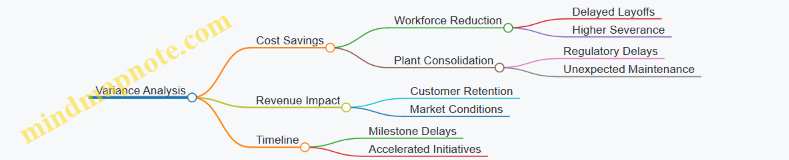
Tips for Effective Tracking
- Maintain clear documentation of original projections and assumptions.
- Engage cross-functional teams to get comprehensive insights.
- Use visual tools like dashboards and mind maps to communicate progress.
- Be proactive in addressing negative variances.
By systematically tracking restructuring outcomes against projections, accountants and restructuring advisors can provide valuable insights that drive successful restructuring initiatives and build stakeholder confidence.
9.2 Example: Analyzing Cost Savings and Efficiency Gains
In the post-restructuring phase, analyzing cost savings and efficiency gains is crucial to validate the success of the restructuring efforts and to provide insights for continuous improvement. This section provides a detailed example of how accountants and restructuring advisors can approach this analysis, supported by mind maps to visualize key concepts.
Step 1: Identify Key Cost Categories Impacted by Restructuring
Before diving into numbers, it’s important to categorize costs to understand where savings have occurred. Typical categories include:
- Personnel Costs (e.g., severance, payroll reductions)
- Facility Costs (e.g., lease terminations, utility savings)
- Operational Costs (e.g., process improvements, outsourcing)
- Asset Costs (e.g., disposals, impairments)
Mind Map: Cost Categories Impacted by Restructuring

Step 2: Collect Pre- and Post-Restructuring Financial Data
Gather financial data from periods before and after restructuring to enable comparison. For example:
| Cost Category | Pre-Restructuring (Year 1) | Post-Restructuring (Year 2) | Savings |
|---|---|---|---|
| Personnel Costs | $5,000,000 | $3,500,000 | $1,500,000 |
| Facility Costs | $1,200,000 | $800,000 | $400,000 |
| Operational Costs | $2,000,000 | $1,600,000 | $400,000 |
| Asset Costs | $500,000 | $450,000 | $50,000 |
| Total | $8,700,000 | $6,350,000 | $2,350,000 |
Step 3: Calculate Efficiency Gains
Efficiency gains often go beyond direct cost savings and include productivity improvements, faster turnaround times, or higher output with fewer resources. For example, if restructuring led to automation in the production line:
- Pre-restructuring output: 10,000 units/month
- Post-restructuring output: 12,000 units/month
- Labor hours reduced from 1,000 to 800 hours/month
Mind Map: Efficiency Gains Analysis
Calculate labor productivity:
- Pre-restructuring productivity = 10,000 units / 1,000 hours = 10 units/hour
- Post-restructuring productivity = 12,000 units / 800 hours = 15 units/hour
This represents a 50% increase in labor productivity.
Step 4: Integrate Cost Savings and Efficiency Gains into Financial Reporting
Use the analyzed data to update financial forecasts and communicate results to stakeholders. For example:
- Highlight total cost savings of $2.35 million
- Emphasize 50% labor productivity improvement
- Show impact on gross margin and EBITDA
Step 5: Example Narrative for Stakeholder Reporting
“Following the restructuring initiative completed in Q4 Year 1, the company realized significant cost savings totaling $2.35 million in Year 2, primarily driven by reductions in personnel and facility costs. Additionally, operational efficiencies increased labor productivity by 50%, as automation and process improvements enabled higher output with fewer labor hours. These gains contributed to a 7% improvement in gross margin and a 10% increase in EBITDA compared to the prior year.”
Summary Mind Map
Mind Map: Post-Restructuring Analysis Overview
By following this structured approach, accountants and restructuring advisors can provide clear, data-driven insights into the financial and operational benefits realized from restructuring, supporting informed decision-making and continuous improvement.
9.3 Adjusting Financial Forecasts Based on Restructuring Results
After completing a business restructuring initiative, it is critical for accountants and restructuring advisors to revisit and adjust the company’s financial forecasts. This ensures that future projections accurately reflect the new operational realities, cost structures, and strategic direction.
Why Adjust Financial Forecasts?
- Reflect actual cost savings and expenses realized during restructuring
- Incorporate changes in revenue streams due to altered business models
- Update assumptions around capital expenditures and working capital needs
- Align forecasts with revised organizational goals and market conditions
Step-by-Step Approach to Adjusting Forecasts
-
Review Actual Restructuring Outcomes
- Compare planned vs. actual restructuring costs
- Assess realized savings in operating expenses
- Identify any unexpected costs or delays
-
Analyze Impact on Revenue and Operations
- Evaluate changes in product lines, service offerings, or market reach
- Consider effects on customer retention and acquisition
-
Update Key Financial Drivers
- Adjust assumptions related to cost of goods sold (COGS), SG&A, and capital expenditures
- Recalculate depreciation and amortization schedules if asset base changed
-
Revise Cash Flow Projections
- Incorporate timing of restructuring payments and savings
- Adjust working capital assumptions based on new operational processes
-
Validate Forecasts with Stakeholders
- Collaborate with operational teams and management
- Ensure forecasts are realistic and aligned with strategic plans
Mind Map: Adjusting Financial Forecasts
Example: Adjusting Forecasts for a Manufacturing Company
Background: A manufacturing company undertook restructuring to close two plants and consolidate production. The initial forecast estimated $5 million in restructuring costs and $3 million annual savings.
Actual Results:
- Restructuring costs: $6 million (due to higher severance and equipment write-offs)
- Annual savings: $2.5 million (slightly lower due to transition inefficiencies)
Adjustments:
- Increase restructuring expense line in the forecast to $6 million.
- Reduce expected annual savings to $2.5 million.
- Update depreciation schedules to reflect asset disposals.
- Adjust cash flow timing to account for delayed payments.
Outcome: The revised forecast provides a more accurate basis for budgeting and investor communication.
Best Practices
- Maintain detailed documentation of restructuring outcomes to support forecast adjustments.
- Use scenario analysis to model optimistic, realistic, and pessimistic outcomes.
- Continuously monitor actual performance against revised forecasts and update as necessary.
Additional Mind Map: Scenario Analysis in Forecast Adjustments
By systematically adjusting financial forecasts based on restructuring results, accountants and restructuring advisors can provide stakeholders with a clear, realistic view of the company’s financial future, enabling better decision-making and strategic planning.
9.4 Lessons Learned: Documenting Accounting Challenges and Solutions
In the aftermath of a business restructuring, documenting lessons learned is crucial for refining accounting processes and preparing for future restructuring events. This section explores common accounting challenges encountered during restructuring and practical solutions, supported by illustrative examples and mind maps to visualize key concepts.
Common Accounting Challenges in Restructuring
- Accurate Cost Allocation: Difficulty in identifying and segregating restructuring costs from regular operating expenses.
- Provision Recognition: Challenges in determining when and how much to recognize as provisions under accounting standards.
- Timing Issues: Ensuring costs are recognized in the correct accounting periods to avoid misstated financial results.
- Data Integration: Consolidating data from multiple departments and systems for comprehensive reporting.
- Disclosure Complexity: Balancing transparency with confidentiality in financial statement notes.
Solutions and Best Practices
- Establish Clear Accounting Policies: Define what constitutes restructuring costs and provisions upfront.
- Use Detailed Checklists: Track all restructuring activities and related costs systematically.
- Implement Cross-Functional Collaboration: Engage finance, legal, HR, and operations teams early.
- Leverage Technology: Utilize ERP and accounting software to automate tracking and reporting.
- Maintain Comprehensive Documentation: Keep records of assumptions, estimates, and management decisions.
Mind Map: Accounting Challenges and Solutions in Restructuring
Example 1: Resolving Cost Allocation Ambiguity
Scenario: A company struggled to separate restructuring-related consulting fees from normal advisory expenses, leading to misstated restructuring costs.
Solution: The accounting team introduced a dedicated cost center specifically for restructuring activities. All invoices and expenses related to restructuring were routed through this cost center, enabling precise tracking and reporting.
Outcome: Improved accuracy in financial statements and clearer communication with stakeholders.
Mind Map: Cost Allocation Solution Workflow
Example 2: Provision Recognition Challenges
Scenario: The finance team was uncertain about when to recognize provisions for lease termination penalties during restructuring.
Solution: They referred to IFRS guidelines and determined that provisions should be recognized when there is a present obligation resulting from a past event and it is probable that an outflow of resources will be required. They documented management’s decisions and supporting evidence thoroughly.
Outcome: Compliance with accounting standards and reduced risk of audit adjustments.
Mind Map: Provision Recognition Decision Tree
Final Recommendations
- Create a Lessons Learned Repository: Maintain a centralized document or database capturing challenges, solutions, and outcomes.
- Conduct Post-Restructuring Reviews: Regularly review accounting processes and update policies accordingly.
- Train Teams: Use documented lessons to train accounting and restructuring teams.
- Engage External Advisors: When in doubt, consult with auditors or restructuring specialists.
By systematically documenting challenges and solutions, organizations can enhance the accuracy, transparency, and efficiency of restructuring accounting in future projects.
9.5 Preparing for Future Restructuring Events
Preparing for future restructuring events is a critical component of resilient financial management. By learning from past experiences and establishing robust frameworks, accountants and restructuring advisors can ensure smoother transitions and more accurate accounting in subsequent restructuring efforts.
Key Steps to Prepare for Future Restructuring
Example: Post-Restructuring Review and Playbook Development
A multinational manufacturing firm completed a major restructuring involving plant closures and workforce reductions. After the restructuring, the accounting team led a post-mortem analysis that uncovered delays in recognizing provisions due to unclear documentation and inconsistent communication between departments.
Based on these insights, the team developed a detailed restructuring playbook that included:
- Step-by-step accounting procedures for recognizing restructuring costs
- Standardized templates for severance calculations and asset impairments
- Defined timelines for financial disclosures
- Roles assigned to finance, HR, and legal teams for coordinated action
This playbook was integrated into the company’s ERP system, enabling quicker and more accurate accounting for any future restructuring.
Mind Map: Post-Mortem Analysis Focus Areas
Example: Early Warning System Implementation
An accounting team at a retail company implemented an early warning system by monitoring key financial ratios such as debt-to-equity, liquidity ratios, and cash flow trends. When these indicators crossed predefined thresholds, alerts were triggered prompting a restructuring readiness review.
This proactive approach allowed the company to prepare accounting provisions and engage restructuring advisors well before financial distress became critical, resulting in more controlled and transparent financial reporting.
Mind Map: Early Warning System Components
Best Practice: Continuous Training and Scenario Planning
Regular training sessions on the latest accounting standards and restructuring best practices ensure that the accounting team remains prepared. Scenario planning exercises simulate different restructuring situations, helping teams anticipate accounting challenges and refine their response strategies.
Summary
Preparing for future restructuring events requires a proactive, structured approach that combines lessons learned, standardized procedures, early detection mechanisms, and continuous improvement. By embedding these practices into the organizational culture, accountants and restructuring advisors can significantly enhance the accuracy, transparency, and efficiency of restructuring accounting in any future scenario.
10. Advanced Topics and Emerging Trends in Restructuring Accounting
10.1 Accounting for Digital Transformation and Restructuring
Digital transformation is reshaping how businesses operate, often triggering or coinciding with restructuring initiatives. Accounting for these changes requires a nuanced understanding of both the technological shifts and their financial implications.
Understanding Digital Transformation in the Context of Restructuring
Digital transformation involves integrating digital technology into all areas of a business, fundamentally changing how value is delivered to customers. When combined with restructuring, it often leads to:
- Reallocation of resources
- Changes in workforce composition
- New asset classes (e.g., software, cloud infrastructure)
- Modified cost structures
Mind Map: Key Accounting Considerations in Digital Transformation Restructuring
Best Practices for Accounting During Digital Transformation Restructuring
-
Asset Identification and Valuation
- Carefully identify which digital assets qualify for capitalization under accounting standards (e.g., IFRS IAS 38, ASC 350).
- Example: Capitalizing internally developed software costs only after the project reaches the application development stage.
-
Impairment Testing
- Regularly test legacy IT infrastructure and software for impairment as digital transformation may render them obsolete.
- Example: A company writes down the value of on-premise servers replaced by cloud solutions.
-
Cost Allocation and Timing
- Distinguish between research costs (expensed) and development costs (capitalized).
- Example: Employee hours spent on prototyping a new digital platform are expensed, while hours spent coding the final product are capitalized.
-
Restructuring Provisions
- Recognize provisions for costs directly related to digital transformation restructuring, such as severance for IT staff or contract termination fees.
- Example: Recording a provision for early termination fees on legacy software licenses.
-
Revenue Recognition Adjustments
- Adapt revenue recognition policies to reflect new business models, such as SaaS subscriptions.
- Example: Recognizing revenue ratably over the subscription period rather than upfront.
-
Enhanced Disclosure
- Provide clear disclosures about the nature, timing, and financial impact of digital transformation restructuring.
- Example: Notes explaining the impact of digital investments on operating expenses and future growth.
Example Scenario: Accounting for a Digital Transformation Restructuring
Company Background: A traditional retail company embarks on a digital transformation to develop an e-commerce platform, leading to restructuring including closing some physical stores and reallocating staff.
Accounting Actions:
- Capitalization: Costs related to developing the e-commerce platform software after the feasibility stage are capitalized.
- Impairment: Write-down of store equipment and IT systems in closed stores.
- Restructuring Provisions: Recognize severance costs for store employees and contract termination fees for leases.
- Revenue Recognition: Shift from recognizing revenue at point-of-sale to recognizing subscription fees for premium online membership.
- Disclosure: Detailed notes on restructuring costs, digital asset capitalization, and expected future benefits.
Mind Map: Example Scenario Breakdown
Summary
Accounting for digital transformation within restructuring requires a strategic approach that balances compliance with accounting standards and the dynamic nature of technology-driven change. By applying best practices such as careful asset classification, timely impairment testing, accurate cost recognition, and transparent disclosure, accountants and restructuring advisors can provide stakeholders with a clear financial picture during transformative periods.
10.2 Best Practice: Incorporating Sustainability Considerations in Restructuring
Incorporating sustainability considerations into business restructuring is no longer optional—it is a strategic imperative. Accountants and restructuring advisors must integrate environmental, social, and governance (ESG) factors into their accounting frameworks to ensure long-term value creation and compliance with emerging regulations.
Why Sustainability Matters in Restructuring
- Aligns restructuring goals with corporate social responsibility (CSR).
- Enhances reputation and stakeholder trust.
- Mitigates risks related to environmental liabilities and social backlash.
- Opens access to sustainable financing and investment.
Key Sustainability Considerations in Restructuring Accounting
Mind Map: Sustainability Considerations in Restructuring
Integrating Sustainability into Accounting Practices
-
Identify Sustainability-Related Costs and Liabilities
- Example: A manufacturing company restructuring may need to account for costs to safely decommission a plant with hazardous waste.
- Best Practice: Collaborate with environmental experts to quantify remediation costs accurately.
-
Adjust Asset Valuations Considering Environmental Risks
- Example: Impairment of assets exposed to climate risks, such as flood-prone facilities.
- Best Practice: Use scenario analysis to estimate potential losses and reflect them in financial statements.
-
Incorporate Social Costs into Restructuring Provisions
- Example: Budgeting for employee retraining programs to support workforce transition.
- Best Practice: Recognize these costs upfront to avoid unexpected expenses later.
-
Enhance Disclosure and Transparency
- Example: Disclosing sustainability-related restructuring impacts in financial statement notes.
- Best Practice: Align disclosures with frameworks like SASB, GRI, or TCFD.
Mind Map: Steps to Incorporate Sustainability in Restructuring Accounting

Practical Example: Sustainable Restructuring in a Retail Chain
A retail chain undergoing restructuring decided to close several stores. Instead of simply recognizing closure costs, the accounting team incorporated sustainability considerations:
- Environmental: Estimated costs for recycling fixtures and responsibly disposing of electronic waste.
- Social: Allocated funds for employee retraining and community job placement programs.
- Governance: Enhanced disclosures on these initiatives in financial reports.
This approach not only ensured compliance but also improved the company’s brand image and stakeholder relations.
Tips for Accountants and Restructuring Advisors
- Engage cross-functional teams including sustainability officers early in the restructuring process.
- Use integrated reporting tools that combine financial and ESG data.
- Stay updated on evolving sustainability regulations and standards.
- Document assumptions and methodologies used to quantify sustainability impacts.
In conclusion, embedding sustainability considerations into restructuring accounting practices is a best practice that supports resilient, responsible, and forward-looking business transformations.
10.3 Example: Accounting for Restructuring in Mergers and Acquisitions
When companies merge or one acquires another, restructuring accounting becomes a critical component of the financial integration process. This section explores how restructuring costs are identified, measured, and reported in the context of M&A, supported by practical examples and mind maps to clarify the process.
Understanding Restructuring in M&A
In mergers and acquisitions, restructuring often involves:
- Integration of operations
- Workforce rationalization
- Facility consolidations
- Systems and process harmonization
These activities generate restructuring costs that must be accounted for accurately to reflect the true financial impact.
Mind Map: Key Components of Restructuring Accounting in M&A
Example Scenario: Acquisition of TechCo by MegaCorp
Background: MegaCorp acquires TechCo to expand its technology portfolio. Post-acquisition, MegaCorp plans to restructure TechCo’s operations, including closing one of TechCo’s manufacturing plants and reducing headcount.
Step 1: Identifying Restructuring Costs
- Severance pay for 100 employees
- Costs to terminate lease agreements on the manufacturing plant
- Asset impairment on plant machinery
Step 2: Measuring Costs
- Severance pay: $2 million (based on employment contracts)
- Lease termination penalties: $500,000
- Asset impairment: $1.5 million (fair value less costs to sell)
Step 3: Recognition
- MegaCorp recognizes a restructuring provision only when:
- There is a detailed formal plan communicated to those affected
- The costs can be reliably estimated
Step 4: Accounting Entries
- Dr Restructuring Expense $4 million
- Cr Provision for Restructuring $4 million
Step 5: Disclosure
- MegaCorp discloses the nature and expected timing of restructuring costs in the notes to financial statements.
Mind Map: Accounting Flow for Restructuring Costs in M&A
Best Practices for Restructuring Accounting in M&A
- Early Identification: Engage accounting and restructuring advisors early to identify potential costs.
- Clear Documentation: Maintain detailed records of plans, communications, and cost estimates.
- Consistent Application: Apply accounting standards consistently across entities.
- Transparent Disclosure: Provide clear and comprehensive disclosures to stakeholders.
Additional Example: Integration of Retail Chains
When Retailer A acquires Retailer B, they plan to close overlapping stores. The restructuring accounting involves:
- Calculating lease termination penalties
- Estimating employee severance
- Writing down inventory and fixed assets
By following the same recognition and measurement principles, Retailer A ensures accurate financial reporting and stakeholder trust.
In summary, accounting for restructuring in M&A requires a structured approach to identify, measure, recognize, and disclose costs. Using clear examples and mind maps helps accountants and restructuring advisors navigate complex transactions with confidence.
10.4 The Role of Artificial Intelligence in Restructuring Accounting
Artificial Intelligence (AI) is transforming the landscape of accounting, especially in complex areas like business restructuring. AI tools can enhance accuracy, speed, and insights, enabling accountants and restructuring advisors to make more informed decisions and streamline processes.
How AI Supports Restructuring Accounting
- Automated Data Processing: AI can quickly analyze vast amounts of financial data, identifying restructuring-related costs and liabilities without manual intervention.
- Predictive Analytics: AI models forecast the financial impact of restructuring initiatives, helping advisors anticipate outcomes and adjust strategies.
- Risk Detection: AI algorithms detect anomalies or potential compliance issues in restructuring accounting entries.
- Natural Language Processing (NLP): AI can interpret contracts, legal documents, and financial disclosures to extract relevant restructuring information.
- Process Automation: Routine tasks such as journal entries, provision calculations, and report generation can be automated.
Mind Map: AI Applications in Restructuring Accounting
Example 1: Automated Identification of Restructuring Costs
A large corporation undergoing restructuring uses an AI-powered accounting system that scans invoices, payroll records, and contracts to automatically identify costs related to severance, facility closures, and asset impairments. This reduces manual errors and accelerates the recognition of restructuring expenses in the correct accounting periods.
Example 2: Predictive Analytics for Provision Estimation
A restructuring advisor employs AI-driven predictive models to estimate the likely costs of employee termination benefits based on historical data, current contracts, and market trends. The model provides a range of probable outcomes, allowing the company to set more accurate provisions and avoid under- or over-estimation.
Mind Map: AI-Driven Workflow in Restructuring Accounting
Best Practices for Integrating AI in Restructuring Accounting
- Start with Clean, Structured Data: AI effectiveness depends on data quality. Ensure financial and operational data are accurate and well-organized.
- Combine AI with Expert Judgment: Use AI outputs as decision-support tools, not replacements for professional expertise.
- Maintain Transparency: Document AI methodologies and assumptions for auditability and stakeholder confidence.
- Regularly Update AI Models: Reflect changes in accounting standards, restructuring strategies, and market conditions.
- Train Staff: Equip accountants and advisors with skills to interpret AI insights and manage AI tools.
Example 3: NLP for Disclosure Compliance
During a restructuring, an AI-powered NLP tool scans draft financial statements and notes to ensure all required disclosures about restructuring provisions, costs, and impacts are included and comply with IFRS and GAAP standards. This reduces the risk of incomplete or inaccurate reporting.
Future Outlook
As AI technologies evolve, their role in restructuring accounting will deepen, potentially including real-time restructuring impact simulations, enhanced fraud detection, and integration with blockchain for immutable audit trails. Accountants and restructuring advisors who embrace AI will gain a competitive edge in delivering timely, accurate, and insightful restructuring accounting services.
10.5 Future Outlook: Regulatory Changes and Their Impact
As the global business environment evolves, regulatory frameworks governing accounting for business restructuring are also undergoing significant changes. Staying ahead of these changes is critical for accountants and restructuring advisors to ensure compliance, optimize financial reporting, and support strategic decision-making.
Key Regulatory Trends Impacting Restructuring Accounting
IFRS and GAAP Updates
- IFRS 3 and IAS 37: Recent clarifications emphasize more rigorous recognition criteria for restructuring provisions, requiring stronger evidence and detailed disclosures.
- ASC 420: The US GAAP standard is evolving to demand more transparency around exit costs and obligations.
Example: A multinational company undergoing a plant closure must now provide more granular disclosures on the timing and measurement of provisions under IAS 37, including the expected cash outflows and assumptions used.
Sustainability and ESG Reporting Integration
Regulators are increasingly requiring companies to disclose environmental, social, and governance (ESG) impacts of restructuring activities.
Best Practice: Incorporate ESG risk assessments into restructuring accounting to identify potential liabilities such as environmental remediation costs or social impact obligations.
Example: A corporation restructuring its supply chain must account not only for severance and asset write-downs but also for potential environmental cleanup costs linked to facility closures.
Digital and Real-Time Reporting
The push for digital financial reporting means restructuring disclosures must be tagged and formatted for automated systems, enhancing transparency and comparability.
Example: Using XBRL (eXtensible Business Reporting Language), a company tags restructuring provisions and related notes, enabling regulators and investors to analyze restructuring impacts more efficiently.
Tax Regulation Changes
Tax authorities are revising rules around the deductibility of restructuring expenses and transfer pricing adjustments, affecting deferred tax calculations.
Example: A restructuring advisor must reassess deferred tax assets related to severance payments after a change in tax law limits deductibility to a certain threshold.
Mind Map: Navigating Future Regulatory Changes
Practical Steps for Accountants and Restructuring Advisors
- Continuous Education: Regularly update knowledge on IFRS, GAAP, and local regulatory changes.
- Policy Review: Proactively revise internal accounting policies to align with emerging standards.
- Technology Adoption: Invest in digital reporting tools to streamline compliance.
- Cross-Functional Collaboration: Work closely with tax, legal, and sustainability teams to capture all restructuring impacts.
- Scenario Planning: Use forecasting models to assess how regulatory changes might affect future restructuring costs and disclosures.
Conclusion
Regulatory changes will continue to shape how restructuring accounting is performed and reported. By anticipating these shifts and integrating best practices with technology and collaboration, accountants and restructuring advisors can ensure compliance, enhance transparency, and add strategic value during business transformations.