Financial Due Diligence for M&A
1. Introduction to Financial Due Diligence in M&A
1.1 Understanding the Role of Financial Due Diligence
Financial due diligence (FDD) is a critical process in mergers and acquisitions (M&A) that involves a thorough investigation and analysis of the target company’s financial health. It aims to validate the financial information presented, uncover risks, and provide insights to support informed decision-making.
Why is Financial Due Diligence Important?
- Risk Mitigation: Identifies hidden liabilities, financial irregularities, or inconsistencies that could impact the deal.
- Valuation Accuracy: Ensures the purchase price reflects the true economic value of the target.
- Deal Structuring: Helps tailor terms, warranties, and indemnities based on financial findings.
- Post-Deal Planning: Provides a foundation for integration and performance monitoring.
Core Objectives of Financial Due Diligence
- Verify historical financial statements for accuracy and completeness.
- Assess the quality and sustainability of earnings.
- Analyze working capital requirements and cash flow dynamics.
- Identify off-balance sheet liabilities and debt obligations.
- Evaluate tax compliance and potential exposures.
- Review internal controls and financial reporting systems.
Mind Map: Role of Financial Due Diligence
Example: Uncovering Hidden Liabilities in a Tech Acquisition
A financial analyst was part of the due diligence team evaluating a mid-sized software company. The initial financial statements showed strong profitability and healthy cash flows. However, during the due diligence process, the team discovered:
- Several pending lawsuits related to intellectual property claims not disclosed in the financials.
- Deferred revenue recognition policies that inflated current earnings.
- Significant customer concentration risk with 40% of revenue coming from one client.
These findings led to a renegotiation of the purchase price and inclusion of specific indemnity clauses to protect the buyer. Without thorough financial due diligence, these risks could have resulted in substantial post-acquisition losses.
Mind Map: Example Breakdown
Summary
Financial due diligence serves as the financial backbone of any M&A transaction. It empowers accountants and financial analysts to uncover the true financial condition of the target company, enabling stakeholders to make well-informed decisions, negotiate better terms, and plan for successful integration.
1.2 Key Objectives and Outcomes
Financial due diligence (FDD) is a critical step in the M&A process, designed to provide buyers and investors with a clear, comprehensive understanding of the target company’s financial health. The key objectives and outcomes of FDD ensure informed decision-making, risk mitigation, and value optimization.
Key Objectives of Financial Due Diligence
-
Verify Financial Accuracy and Integrity
- Confirm that the financial statements accurately reflect the company’s performance and position.
- Identify any discrepancies, misstatements, or aggressive accounting practices.
-
Assess Historical Financial Performance
- Analyze revenue trends, profitability, cash flows, and expense patterns.
- Understand seasonality, cyclicality, and growth drivers.
-
Evaluate Quality of Earnings (QoE)
- Distinguish between recurring and non-recurring earnings.
- Adjust earnings to reflect sustainable profitability.
-
Identify Liabilities and Risks
- Uncover off-balance sheet liabilities, contingent liabilities, and debt obligations.
- Assess tax exposures, legal risks, and compliance issues.
-
Analyze Working Capital and Cash Flow
- Determine the adequacy of working capital to support ongoing operations.
- Evaluate cash flow generation and liquidity position.
-
Validate Forecasts and Projections
- Review assumptions underlying financial forecasts.
- Test the reasonableness and robustness of projections.
-
Support Valuation and Deal Structuring
- Provide insights to adjust purchase price or negotiate terms.
- Identify potential earn-outs or contingent payments based on financial performance.
Expected Outcomes of Financial Due Diligence
-
Comprehensive Financial Report
- A detailed document summarizing findings, risks, and opportunities.
- Clear presentation of adjustments to financial statements.
-
Risk Identification and Mitigation Plan
- Highlighted financial risks with recommended actions.
- Strategies to address or negotiate risks in the deal.
-
Informed Deal Valuation
- Adjusted earnings and cash flows used to refine valuation models.
- Identification of value drivers and potential deal breakers.
-
Enhanced Negotiation Position
- Data-driven insights to support price negotiations.
- Evidence to justify warranties, indemnities, or price adjustments.
-
Post-Deal Integration Guidance
- Recommendations for financial controls and reporting improvements.
- Identification of integration challenges related to finance.
Mind Map: Key Objectives of Financial Due Diligence
Mind Map: Expected Outcomes of Financial Due Diligence
Example: How Financial Due Diligence Influenced a Mid-Market Manufacturing Acquisition
A private equity firm was considering acquiring a mid-sized manufacturing company. Initial financial statements showed steady revenue growth and healthy margins. However, through financial due diligence, the following insights emerged:
- Revenue Recognition Issues: The target had recognized revenue prematurely on long-term contracts, inflating current year sales.
- Non-Recurring Expenses: Several one-time restructuring costs were buried in operating expenses, masking true profitability.
- Working Capital Deficiency: The company’s working capital was below industry norms, indicating potential liquidity issues post-acquisition.
- Undisclosed Contingent Liability: A pending lawsuit with potential financial impact was not reflected in the financials.
Outcome:
- The buyer adjusted the Quality of Earnings to exclude premature revenue and normalize expenses.
- Working capital requirements were factored into the deal price, reducing the purchase price accordingly.
- The contingent liability was incorporated into risk mitigation clauses.
This due diligence process enabled the buyer to negotiate a fairer price, structure appropriate protections, and plan for integration challenges.
By clearly understanding the key objectives and expected outcomes of financial due diligence, accountants and financial analysts can better prepare for and execute this critical phase in M&A, ultimately driving successful transactions and value creation.
1.3 Overview of the M&A Process and Due Diligence Timing
Mergers and Acquisitions (M&A) involve a series of structured steps designed to ensure that both parties—the buyer and the seller—reach a mutually beneficial agreement. Financial due diligence plays a critical role during this process, providing insights into the target company’s financial health and uncovering potential risks.
The Typical M&A Process
Below is a high-level overview of the M&A process, highlighting where financial due diligence fits in:
Timing of Financial Due Diligence
Financial due diligence typically occurs after the buyer has identified a target and made an indicative offer but before signing the definitive agreement. This timing is crucial because:
- It allows the buyer to validate assumptions made during valuation.
- It uncovers financial risks or liabilities that could affect the deal terms.
- It informs negotiation strategies and price adjustments.
Detailed Steps in Financial Due Diligence Timing
Example: Timing Impact in a Software Company Acquisition
A financial analyst working on the acquisition of a mid-sized SaaS company received an indicative offer accepted by the seller. The due diligence team was granted access to detailed financial records only after this stage. During the due diligence phase, the team discovered that a significant portion of the revenue was generated from short-term contracts with high churn rates, which was not fully reflected in the initial valuation.
Because the due diligence occurred before the definitive agreement, the buyer was able to renegotiate the purchase price downward to reflect the risk of revenue volatility.
Best Practices for Managing Due Diligence Timing
- Early Engagement: Engage financial analysts and accountants early to prepare for data requests.
- Clear Timelines: Establish clear deadlines for data delivery and analysis to avoid delays.
- Confidentiality Agreements: Ensure NDAs are in place to facilitate smooth data sharing.
- Iterative Reviews: Conduct interim reviews to identify issues early and adjust scope if needed.
Summary
Understanding the M&A process and the precise timing of financial due diligence is essential for accountants and financial analysts to effectively manage their roles. Proper timing ensures that due diligence findings can influence deal terms and reduce post-transaction surprises.
For a quick recap, here is a consolidated mind map combining the M&A process and due diligence timing:
This structured approach helps financial professionals align their efforts with the overall M&A timeline, ensuring due diligence delivers maximum value.
1.4 Common Challenges and Risks in Financial Due Diligence
Financial due diligence is a critical step in the M&A process, but it is fraught with challenges and risks that can impact the accuracy and reliability of the findings. Understanding these common pitfalls helps accountants and financial analysts navigate the process more effectively and mitigate potential deal risks.
Key Challenges and Risks
Data Quality Issues
Poor data quality is one of the most frequent challenges. Targets may have incomplete or inconsistent financial records, making it difficult to form an accurate picture.
Example: A financial analyst reviewing a mid-sized manufacturing company discovered that the target used different revenue recognition policies across subsidiaries, leading to inconsistent top-line figures. Reconciling these differences required additional time and expert consultation.
Time Constraints
Due diligence often occurs under tight deadlines, limiting the depth of analysis.
Example: In a competitive bidding situation, the due diligence team had only two weeks to review three years of financials. This compressed timeline forced prioritization of high-risk areas but increased the chance of missing subtle financial risks.
Hidden Liabilities
Off-balance sheet liabilities or contingent risks can be overlooked if documentation is incomplete or unclear.
Example: During due diligence on a private equity target, the team uncovered a significant pending lawsuit that was not disclosed in financial statements, posing a potential multi-million dollar risk.
Revenue Recognition Risks
Targets may use aggressive accounting to inflate revenues or hide expenses.
Example: A retail company recognized revenue upon shipment rather than delivery, leading to inflated quarterly sales. Adjusting for this practice lowered the quality of earnings and impacted valuation.
Working Capital Fluctuations
Seasonal or unusual working capital patterns can distort normalized financial performance.
Example: A food distributor’s inventory spiked before a major holiday season, inflating working capital needs. Without adjusting for seasonality, the buyer risked overestimating ongoing capital requirements.
Forecast Reliability
Projections may be overly optimistic or lack a sound basis, leading to valuation risks.
Example: A SaaS company’s forecast assumed 50% annual growth without historical precedent. Due diligence highlighted the need for stress testing and scenario analysis to assess downside risks.
Cultural & Communication Barriers
Cross-border deals often face challenges due to differences in accounting standards, language, and business culture.
Example: In an acquisition of a European firm by a US-based buyer, differences between IFRS and GAAP accounting standards required careful reconciliation to ensure comparability.
Integration Uncertainties
Post-deal integration risks related to systems compatibility and control weaknesses can affect financial outcomes.
Example: The due diligence team identified that the target’s ERP system was outdated and incompatible with the buyer’s platform, posing risks for financial consolidation and reporting post-acquisition.
Summary
Financial due diligence demands a comprehensive approach to identify and mitigate these challenges. By anticipating common risks such as data quality issues, hidden liabilities, and forecast uncertainties, financial analysts and accountants can provide valuable insights that protect deal value and support informed decision-making.
1.5 Example: How Due Diligence Uncovered Hidden Liabilities in a Tech Acquisition
Financial due diligence is critical in M&A transactions, especially in the tech sector where intangible assets and complex contracts often mask underlying risks. This example illustrates how a thorough due diligence process uncovered hidden liabilities that significantly impacted the deal.
Background
A mid-sized software company (Acquirer) was interested in acquiring a promising tech startup (Target) specializing in cloud-based solutions. The Target showed strong revenue growth and an impressive client list, making it an attractive acquisition candidate.
Initial Financial Overview
- Revenue: $50 million (growing at 30% YoY)
- EBITDA: $8 million
- Balance Sheet: Appeared clean with minimal debt
- Cash Flow: Positive and stable
Due Diligence Process Highlights
The Acquirer’s financial analysts and accountants initiated a comprehensive due diligence process focusing on:
- Contractual obligations
- Off-balance sheet liabilities
- Revenue recognition policies
- Pending litigation and contingent liabilities
Mind Map: Key Areas Explored During Due Diligence
Discovery of Hidden Liabilities
-
Unrecognized Deferred Revenue:
- Several large customer contracts included clauses for refunds and service credits that were not properly accounted for.
- Example: A $2 million contract had a clause allowing customers to claim refunds if uptime fell below 99.9%, which had occurred multiple times.
-
Pending Litigation:
- The Target was involved in a patent infringement lawsuit with potential damages estimated at $5 million.
- This was not disclosed in financial statements but surfaced through legal due diligence.
-
Off-Balance Sheet Lease Obligations:
- The startup had several long-term leases for office equipment and data centers that were not recorded as liabilities.
- Total lease commitments amounted to $1.2 million over the next three years.
-
Aggressive Revenue Recognition:
- Revenue from multi-year contracts was recognized upfront rather than ratably, inflating short-term revenue.
- This practice overstated EBITDA by approximately 15%.
Mind Map: Impact of Hidden Liabilities on Deal Valuation
Outcome and Lessons Learned
- Valuation Adjustment: The Acquirer revised the valuation downward by $7 million to account for the identified liabilities.
- Deal Structuring: Included an escrow holdback to cover potential litigation costs.
- Improved Contract Review: Implemented stricter contract review processes for future acquisitions.
Example Summary Table
| Hidden Liability Type | Estimated Impact | Description |
|---|---|---|
| Deferred Revenue | $2 million | Refund clauses not accounted for |
| Pending Litigation | $5 million | Patent infringement lawsuit undisclosed |
| Off-Balance Sheet Leases | $1.2 million | Long-term lease commitments omitted |
| Aggressive Revenue Recognition | EBITDA overstated by 15% | Revenue recognized upfront instead of ratably |
Final Thoughts
This example underscores the importance of a meticulous financial due diligence process in uncovering hidden liabilities that can materially affect the valuation and risk profile of a tech acquisition. Accountants and financial analysts must look beyond surface-level financials, scrutinize contracts, and collaborate with legal and operational teams to ensure a comprehensive risk assessment.
By integrating detailed examples and mind maps, this section equips finance professionals with practical insights on uncovering hidden risks during M&A due diligence.
2. Preparing for Financial Due Diligence
2.1 Assembling the Due Diligence Team: Roles and Expertise
Financial due diligence is a complex and multidisciplinary process that requires a well-structured team with diverse expertise to ensure a thorough evaluation of the target company. Assembling the right team is critical to uncovering financial risks, validating assumptions, and providing actionable insights to support the M&A decision-making process.
Key Roles in the Financial Due Diligence Team
Below is a mind map illustrating the core roles typically involved in a financial due diligence team:
Detailed Role Descriptions and Expertise
-
Lead Financial Analyst
- Acts as the project manager for the due diligence process.
- Coordinates between different specialists and ensures deadlines are met.
- Synthesizes findings into a cohesive report.
-
Accountants
- Deep dive into the target’s historical financial statements.
- Verify accounting policies and identify any aggressive or unusual practices.
- Example: An accountant might discover that a target company is capitalizing expenses that should be expensed, inflating profits.
-
Tax Specialists
- Review tax filings and compliance history.
- Identify potential tax liabilities or exposures.
- Example: A tax specialist may find that the target has unresolved tax disputes that could result in significant penalties.
-
Legal Advisors
- Examine contracts, leases, and other legal documents.
- Identify contingent liabilities such as pending lawsuits or regulatory fines.
- Example: Legal advisors might uncover a pending litigation that could impact the company’s valuation.
-
Industry Experts
- Provide context on industry norms and benchmarks.
- Help interpret financial metrics relative to competitors.
- Example: An industry expert might highlight that the target’s inventory turnover is unusually low compared to peers, signaling potential operational inefficiencies.
-
IT/Systems Analysts
- Assess the robustness of the target’s financial reporting systems.
- Identify risks related to data accuracy and control weaknesses.
- Example: An IT analyst might discover that financial data is manually compiled, increasing the risk of errors.
-
Valuation Experts
- Translate due diligence findings into valuation impacts.
- Develop models incorporating risks, adjustments, and synergies.
- Example: Valuation experts might adjust the purchase price based on working capital deficiencies identified during due diligence.
Example: Assembling a Due Diligence Team for a Mid-Sized Manufacturing Acquisition
Imagine a financial analyst working on a $150 million acquisition of a mid-sized manufacturing company. The team assembled includes:
- Lead Financial Analyst: Coordinates the process and synthesizes results.
- Two Accountants: One focuses on revenue and cost recognition; the other on balance sheet items.
- Tax Specialist: Reviews international tax exposure due to overseas operations.
- Legal Advisor: Assesses environmental liabilities and contract risks.
- Industry Expert: Provides benchmarking on manufacturing KPIs.
- IT Analyst: Evaluates ERP system reliability.
- Valuation Expert: Models adjustments based on findings.
This multidisciplinary team ensures all financial aspects are thoroughly vetted, reducing surprises post-acquisition.
Mind Map: Example Team Structure for Manufacturing M&A
Best Practices for Team Assembly
- Define Clear Roles and Responsibilities: Avoid overlap and ensure accountability.
- Leverage External Experts When Needed: For specialized areas like tax or legal, external consultants can add value.
- Ensure Effective Communication: Regular updates and collaborative tools help synchronize efforts.
- Tailor Team Composition to Deal Complexity: Larger or cross-border deals may require more specialists.
- Include Stakeholders Early: Engage deal sponsors and corporate finance teams to align expectations.
By carefully assembling a due diligence team with the right mix of expertise and clear roles, organizations can significantly enhance the quality and effectiveness of their financial due diligence process, ultimately supporting better-informed M&A decisions.
2.2 Defining Scope and Objectives Based on Deal Type
Financial due diligence is not a one-size-fits-all process. The scope and objectives must be tailored to the specific type of M&A deal to ensure that the analysis is relevant, efficient, and insightful. This section explores how to define the scope and objectives effectively by understanding the nuances of different deal types.
Understanding Deal Types and Their Impact on Due Diligence Scope
Different deal types present unique risks, opportunities, and financial considerations. Below is a mind map outlining common deal types and key focus areas for financial due diligence:
Setting Objectives Based on Deal Type
-
Strategic Acquisition
- Objective: Validate revenue streams and identify synergy potential.
- Example: In acquiring a competitor, focus on overlapping costs and revenue channels to estimate cost savings and incremental sales.
-
Financial Buyout (Private Equity)
- Objective: Assess cash flow predictability and debt servicing capacity.
- Example: For a buyout, detailed working capital analysis ensures the company can sustain operations post-leverage.
-
Distressed Asset Purchase
- Objective: Identify hidden liabilities and evaluate turnaround feasibility.
- Example: Due diligence revealed significant off-balance sheet liabilities, impacting the purchase price negotiation.
-
Cross-Border Acquisition
- Objective: Understand tax implications, currency exposure, and compliance risks.
- Example: An acquisition in Europe required deep dive into VAT structures and foreign exchange hedging.
-
Minority Investment
- Objective: Evaluate financial transparency and governance to protect minority interests.
- Example: Financial due diligence focused on cash flow sufficiency and shareholder agreements.
Mind Map: Defining Scope and Objectives
Example: Tailoring Scope for a Cross-Border Acquisition
Scenario: A U.S.-based company is acquiring a manufacturing firm in Germany.
Scope Definition:
- Focus on currency risk analysis due to EUR/USD fluctuations.
- Detailed review of German tax laws, including VAT and corporate tax.
- Compliance with EU financial reporting standards.
- Assessment of transfer pricing policies.
Objectives:
- Ensure accurate valuation considering tax and currency impacts.
- Identify potential regulatory hurdles.
- Evaluate financial controls aligned with local practices.
Practical Tips for Defining Scope and Objectives
- Engage Deal Stakeholders Early: Understand their priorities and concerns.
- Review Preliminary Data: Early financials can highlight areas needing deeper focus.
- Leverage Industry Benchmarks: Tailor scope using sector-specific risks.
- Be Flexible: Adjust scope as new information emerges during due diligence.
By carefully defining the scope and objectives based on the deal type, accountants and financial analysts can focus their efforts on the most critical financial aspects, enabling more accurate risk assessment and value creation in M&A transactions.
2.3 Gathering Preliminary Financial Information and Documentation
Financial due diligence begins with collecting a comprehensive set of preliminary financial documents and data. This foundational step ensures that the due diligence team has access to accurate and relevant information to perform a thorough analysis. Below, we explore best practices, key documents to request, and examples to illustrate the process.
Key Objectives in Gathering Preliminary Financial Information
- Establish a clear understanding of the target’s financial health.
- Identify any gaps or inconsistencies early.
- Prepare for deeper analysis in subsequent due diligence phases.
Mind Map: Preliminary Financial Information Gathering
Best Practices for Document Collection
-
Create a Document Request List: Develop a detailed checklist tailored to the industry and deal specifics. This helps avoid missing critical documents.
-
Use Virtual Data Rooms (VDRs): Secure digital platforms facilitate organized document sharing and version control.
-
Prioritize Documents by Materiality: Focus first on documents that have the highest impact on valuation and risk assessment.
-
Engage with the Target’s Finance Team: Early collaboration can clarify ambiguities and speed up document retrieval.
-
Verify Document Authenticity: Cross-check documents for consistency and completeness.
Example: Gathering Preliminary Financial Information in a Manufacturing Acquisition
Scenario: An acquiring company is evaluating a mid-sized manufacturing firm.
- The due diligence team requests the last 5 years of audited financial statements to analyze profitability trends.
- Monthly management accounts for the current year are collected to assess recent performance.
- Accounts receivable aging reports reveal a growing number of overdue invoices, signaling potential cash flow issues.
- Loan agreements are reviewed to understand debt covenants and maturity schedules.
- Inventory reports highlight obsolete stock, which could impact working capital.
By gathering these documents early, the team uncovers potential risks such as cash flow constraints and inventory write-downs, allowing them to adjust their analysis and negotiation strategy accordingly.
Mind Map: Example Document Collection Workflow
Tips for Accountants and Financial Analysts
- Be Detail-Oriented: Small discrepancies in preliminary documents can indicate larger issues.
- Understand Industry Nuances: Certain industries require specific documents (e.g., royalty agreements in pharmaceuticals).
- Maintain Clear Communication: Regular updates with the deal team and target company reduce delays.
In summary, gathering preliminary financial information and documentation is a critical first step in financial due diligence. It sets the stage for a focused and effective analysis, enabling the identification of risks and opportunities early in the M&A process.
2.4 Setting Timelines and Communication Protocols
Effective financial due diligence hinges not only on thorough analysis but also on well-structured timelines and clear communication protocols. This ensures that all stakeholders remain aligned, deadlines are met, and potential issues are flagged early.
Importance of Timelines in Financial Due Diligence
- Keeps the process on track within the M&A deal schedule
- Allows sufficient time for detailed analysis without rushing
- Helps coordinate multiple teams and external advisors
- Enables timely identification of deal breakers or risks
Key Steps to Set Timelines
Example: Timeline Breakdown for a 6-Week Due Diligence Process
| Week | Activities |
|---|---|
| 1 | Kick-off meeting, document request, initial data gathering |
| 2 | Review historical financials, identify gaps |
| 3 | Quality of Earnings analysis, working capital assessment |
| 4 | Debt and liabilities review, tax due diligence |
| 5 | Forecast validation, financial controls evaluation |
| 6 | Final report preparation, presentation to stakeholders |
Communication Protocols: Ensuring Clear and Efficient Information Flow
- Define primary points of contact for each team (accountants, financial analysts, legal, tax, etc.)
- Establish preferred communication channels (email, project management tools, video calls)
- Schedule regular status update meetings (e.g., twice weekly)
- Use centralized data rooms for document sharing and version control
- Set escalation procedures for urgent issues
Example: Communication Protocol in Practice
- Kick-off Call: All stakeholders join a video conference to align on objectives and timelines.
- Weekly Status Emails: Due diligence lead sends a summary of progress, outstanding items, and next steps.
- Shared Data Room: All financial documents uploaded and organized by category with access controls.
- Ad Hoc Meetings: Scheduled immediately if critical risks or discrepancies are identified.
Best Practices
- Set realistic but firm deadlines: Avoid over-optimistic timelines that compromise quality.
- Document all communications: Maintain an audit trail for accountability.
- Use visual project management tools: Gantt charts or Kanban boards help track progress.
- Encourage open communication: Foster a culture where team members feel comfortable raising concerns early.
Summary Mind Map
By carefully setting timelines and establishing robust communication protocols, financial due diligence teams can navigate the complexities of M&A transactions more effectively, ensuring thorough analysis and timely decision-making.
2.5 Example: Structuring a Due Diligence Plan for a Cross-Border Acquisition
Cross-border acquisitions introduce additional layers of complexity to financial due diligence due to differences in regulatory environments, accounting standards, tax laws, and cultural nuances. Structuring an effective due diligence plan is critical to identify risks and opportunities accurately.
Key Components of a Cross-Border Due Diligence Plan
Step 1: Assemble a Multidisciplinary Team
- Financial Analysts & Accountants: To analyze financial statements and accounting practices.
- Legal Experts: To navigate local laws, contracts, and regulatory compliance.
- Tax Advisors: To assess tax implications including transfer pricing and local tax laws.
- Cultural Consultants: To understand business practices and cultural differences.
Example: For a US company acquiring a German firm, the team included a US CPA, a German tax advisor, and a legal expert familiar with EU regulations.
Step 2: Define the Scope and Objectives
- Identify which financial areas require deep dive (e.g., revenue recognition, debt structure).
- Determine regulatory and tax areas of concern.
- Set clear objectives such as uncovering hidden liabilities or validating cash flow forecasts.
Example: The team decided to focus on verifying compliance with IFRS versus US GAAP differences impacting reported earnings.
Step 3: Gather and Organize Documentation
- Request financial statements for the past 3-5 years.
- Obtain tax filings, audit reports, contracts, and debt agreements.
- Use a virtual data room to centralize documents.
Example: The acquiring company used a secure virtual data room to share documents with team members across different time zones.
Step 4: Establish Timelines and Communication Protocols
- Set realistic deadlines considering time zone differences.
- Schedule regular update meetings.
- Define escalation paths for urgent issues.
Example: Weekly video calls were scheduled at overlapping business hours between the US and Germany to ensure smooth communication.
Step 5: Conduct Financial Analysis with Local Context
- Adjust financial analysis for currency fluctuations.
- Consider local accounting standards and reconcile with acquirer’s standards.
- Analyze working capital cycles that may differ due to local business practices.
Example: The team adjusted revenue figures for EUR/USD exchange rate volatility and identified that German payment terms extended receivables beyond typical US norms.
Step 6: Address Tax and Regulatory Risks
- Review local tax compliance and potential liabilities.
- Assess transfer pricing policies to avoid double taxation.
- Evaluate regulatory approvals required for the acquisition.
Example: The tax advisor identified potential VAT refund delays that could impact cash flow post-acquisition.
Step 7: Compile Findings and Recommendations
- Summarize key financial risks and opportunities.
- Highlight any adjustments needed in valuation.
- Provide recommendations for post-acquisition integration.
Example: The final report recommended a purchase price adjustment due to identified contingent liabilities related to local labor laws.
Summary Mind Map of the Example Plan
By following this structured approach, accountants and financial analysts can ensure a thorough and context-aware financial due diligence process that mitigates risks and supports informed decision-making in cross-border M&A transactions.
3. Analyzing Historical Financial Performance
3.1 Reviewing Income Statements, Balance Sheets, and Cash Flow Statements
Financial due diligence starts with a thorough review of the target company’s core financial statements: the Income Statement, Balance Sheet, and Cash Flow Statement. These documents provide a comprehensive view of the company’s financial health, operational performance, and liquidity.
Income Statement Review
The Income Statement (also called Profit & Loss Statement) shows the company’s revenues, expenses, and profits over a specific period. Key areas to focus on include:
- Revenue Trends: Analyze revenue growth rates, seasonality, and consistency.
- Cost of Goods Sold (COGS): Understand direct costs and their relation to revenue.
- Operating Expenses: Scrutinize SG&A, R&D, and other overheads.
- Profit Margins: Gross margin, operating margin, and net margin trends.
- Non-Recurring Items: Identify one-time gains or losses that may distort profitability.
Mind Map: Income Statement Review
Example:
A retail company shows a 20% revenue increase year-over-year, but a detailed review reveals that 5% of this growth came from a one-time government subsidy. Adjusting for this, the sustainable growth rate is 15%, which is a more realistic figure for valuation.
Balance Sheet Review
The Balance Sheet provides a snapshot of the company’s assets, liabilities, and equity at a specific point in time. Key focus areas include:
- Assets: Current assets (cash, receivables, inventory) and long-term assets (property, equipment, intangibles).
- Liabilities: Current liabilities (payables, short-term debt) and long-term liabilities (loans, deferred taxes).
- Equity: Shareholder’s equity and retained earnings.
- Working Capital: Current assets minus current liabilities.
- Unusual Items: Off-balance sheet liabilities, contingent liabilities.
Mind Map: Balance Sheet Review
Example:
During due diligence of a manufacturing firm, the balance sheet review uncovered a large amount of obsolete inventory that was not properly written down. This inflated current assets and working capital, requiring an adjustment that reduced the company’s net asset value.
Cash Flow Statement Review
The Cash Flow Statement reconciles net income to actual cash generated or used, divided into three sections:
- Operating Activities: Cash generated from core business operations.
- Investing Activities: Cash used for or generated from investments in assets.
- Financing Activities: Cash flows related to debt, equity, and dividends.
Key points to analyze:
- Cash Conversion: How well net income converts into operating cash flow.
- CapEx Trends: Capital expenditures and their impact on cash.
- Debt Repayments and Issuances: Financing cash flow patterns.
- Free Cash Flow: Operating cash flow minus CapEx, indicating cash available for growth or debt repayment.
Mind Map: Cash Flow Statement Review
Example:
A SaaS company reports strong net income but negative operating cash flow due to increasing accounts receivable and deferred revenue. This signals potential cash collection issues that must be addressed before finalizing the deal.
Integrated Example: How Reviewing All Three Statements Provides a Complete Picture
Consider a target company with growing revenues and profits (Income Statement), but a balance sheet showing increasing accounts receivable and inventory (Balance Sheet), and a cash flow statement revealing negative operating cash flow. This combination suggests that while the company is profitable on paper, it may be facing liquidity challenges due to slow collections and inventory buildup. Such insights help financial analysts and accountants identify risks, adjust valuations, and negotiate deal terms effectively.
Summary
Reviewing the Income Statement, Balance Sheet, and Cash Flow Statement in tandem is essential for uncovering the true financial condition of an M&A target. Using structured approaches, supported by mind maps and real-world examples, helps ensure a thorough and insightful due diligence process.
3.2 Identifying Revenue Trends and Seasonality
Understanding revenue trends and seasonality is crucial in financial due diligence as it helps accountants and financial analysts assess the stability, growth potential, and risk factors associated with a target company’s revenue streams. This section will guide you through best practices, supported by mind maps and practical examples, to effectively identify and analyze these patterns.
What Are Revenue Trends?
Revenue trends refer to the general direction in which a company’s revenue is moving over a period of time. This can be upward (growth), downward (decline), or flat (stagnation).
What Is Seasonality?
Seasonality refers to predictable fluctuations in revenue that occur at regular intervals due to factors such as holidays, weather, or industry-specific cycles.
Mind Map: Revenue Trends and Seasonality Analysis
Step-by-Step Approach to Identifying Revenue Trends and Seasonality
Collect Historical Revenue Data
Gather at least 3-5 years of monthly or quarterly revenue data to capture sufficient detail for trend and seasonality analysis.
Visualize Revenue Over Time
Plot revenue figures on a time series graph to visually inspect for upward/downward trends and recurring seasonal patterns.
Calculate Growth Rates
Compute year-over-year (YoY) and quarter-over-quarter (QoQ) growth rates to quantify trends.
Identify Seasonality Patterns
Look for recurring peaks and troughs at the same periods each year. For example, retail companies may see spikes during holiday seasons.
Use Statistical Tools
Apply moving averages or seasonal decomposition of time series (STL) to separate trend, seasonal, and residual components.
Benchmark Against Industry
Compare the target’s revenue patterns with industry peers to understand if observed seasonality is typical or unusual.
Assess Impact on Forecasts
Adjust future revenue projections to account for identified trends and seasonality, ensuring realistic cash flow estimates.
Example 1: Retail Company Seasonal Revenue
Scenario: A retail company shows strong revenue spikes in Q4 every year.
- Observation: Revenue jumps by 40% in Q4 compared to other quarters.
- Analysis: This aligns with holiday shopping seasonality.
- Action: Financial analysts adjust cash flow forecasts to reflect this seasonality, ensuring working capital is sufficient during peak periods.
- Retail Revenue
- Q1: Baseline
- Q2: Slight increase (10%)
- Q3: Stable
- Q4: Significant spike (40%)
- Seasonality Driver: Holiday shopping
- Forecast Adjustment: Increase Q4 revenue projections
Example 2: SaaS Company with Steady Growth but Quarterly Fluctuations
Scenario: A SaaS company has steady annual revenue growth but shows quarterly dips in Q2 and Q3.
- Observation: Q2 and Q3 revenues are 15% lower than Q1 and Q4.
- Analysis: This may be due to customer budgeting cycles or contract renewals.
- Action: Analysts incorporate these seasonal dips into valuation models and advise on cash flow management.
- SaaS Revenue
- Q1: Strong
- Q2: Dip (-15%)
- Q3: Dip (-15%)
- Q4: Strong
- Seasonality Driver: Customer budgeting cycles
- Forecast Adjustment: Incorporate dips in mid-year quarters
Mind Map: Analytical Techniques for Revenue Trends and Seasonality
Best Practices
- Always corroborate quantitative findings with qualitative insights from management interviews.
- Use multiple years of data to avoid misinterpreting short-term fluctuations as trends.
- Consider macroeconomic and industry-specific factors that may influence seasonality.
- Document assumptions and adjustments clearly in due diligence reports.
By systematically identifying revenue trends and seasonality, financial analysts and accountants can provide more accurate valuations, better risk assessments, and informed recommendations during M&A transactions.
3.3 Assessing Profitability and Margin Stability
Assessing profitability and margin stability is a critical component of financial due diligence in M&A. It helps financial analysts and accountants understand the true earning power of the target company and evaluate how sustainable its profit margins are over time. This section will guide you through best practices, supported by clear examples and mind maps to visualize the process.
Key Concepts in Profitability and Margin Stability
- Profitability refers to the company’s ability to generate earnings relative to its revenue, assets, or equity.
- Margins (Gross, Operating, and Net) provide insight into how efficiently the company manages costs and expenses.
- Margin Stability assesses whether these margins are consistent or volatile over time, indicating risk or reliability.
Step 1: Analyze Profit Margins Over Multiple Periods
Start by reviewing the gross profit margin, operating profit margin (EBIT margin), and net profit margin for at least the past 3-5 years.
Example:
- A retail company shows a gross margin fluctuating between 35% and 40% over five years, but the operating margin swings from 5% to 12%. This volatility in operating margin may indicate inconsistent control over operating expenses or irregular one-time costs.
Step 2: Identify Drivers of Profitability
Break down revenue streams and cost components to understand what influences margins.
- Revenue Mix: Are profits concentrated in a few products or diversified?
- Cost Structure: Fixed vs. variable costs impact margin stability.
- Pricing Power: Ability to pass costs to customers.
Example:
- A software company’s high gross margin (80%) is stable due to recurring subscription revenue, but operating margin fluctuates due to variable R&D expenses tied to new product development cycles.
Step 3: Adjust for Non-Recurring and One-Time Items
Exclude unusual gains or losses that distort profitability.
- Restructuring costs
- Legal settlements
- Asset sales
Example:
- A manufacturing firm’s net margin dipped in one year due to a $2 million restructuring charge. Adjusting for this, the normalized net margin shows a stable trend.
Step 4: Benchmark Against Industry Peers
Compare margins with competitors to assess relative performance and identify anomalies.
Example:
- A logistics company has a net margin of 4%, while the industry average is 7%. This signals potential inefficiencies or pricing pressures.
Step 5: Evaluate Margin Stability Using Statistical Measures
Calculate standard deviation or coefficient of variation of margins over time to quantify volatility.
Example:
- Company A’s operating margin standard deviation is 1.5%, indicating stable margins.
- Company B’s standard deviation is 7%, signaling high volatility and risk.
Summary Mind Map
Final Example: Comprehensive Assessment
A financial analyst is evaluating a target company in the consumer goods sector:
- Historical gross margins average 45% with minor fluctuations.
- Operating margins vary between 10% and 15%, with a one-time legal expense causing a dip in year 3.
- Revenue is diversified across three product lines, with stable pricing power.
- Benchmarking shows margins slightly above industry averages.
- Statistical analysis reveals low margin volatility.
Conclusion: The target demonstrates strong and stable profitability, supporting a confident valuation.
By following these steps and utilizing the mind maps and examples, accountants and financial analysts can effectively assess profitability and margin stability during financial due diligence, enabling more informed M&A decisions.
3.4 Evaluating Working Capital and Capital Expenditures
Evaluating working capital and capital expenditures (CapEx) is a critical component of financial due diligence in M&A transactions. These elements directly affect the target company’s liquidity, operational efficiency, and long-term growth potential. Understanding their dynamics helps buyers assess the true financial health and future cash flow requirements of the business.
Understanding Working Capital
Working capital represents the difference between current assets and current liabilities. It is a measure of a company’s short-term liquidity and operational efficiency.
Key Components:
- Current Assets: Cash, accounts receivable, inventory, and other short-term assets
- Current Liabilities: Accounts payable, accrued expenses, short-term debt
Why It Matters:
- Adequate working capital ensures smooth day-to-day operations.
- Excess working capital might indicate inefficient use of resources.
- Deficient working capital can signal liquidity problems.
Understanding Capital Expenditures (CapEx)
CapEx refers to funds used by a company to acquire, upgrade, or maintain physical assets such as property, industrial buildings, or equipment.
Types of CapEx:
- Maintenance CapEx: To sustain current operations
- Growth CapEx: To expand capacity or enter new markets
Why It Matters:
- High CapEx requirements can impact free cash flow.
- Understanding CapEx trends helps forecast future cash needs.
Mind Map: Evaluating Working Capital
Mind Map: Evaluating Capital Expenditures
Best Practices for Evaluating Working Capital and CapEx
-
Normalize Working Capital: Adjust for non-recurring items or seasonal effects to get a true picture of operational liquidity.
-
Benchmarking: Compare working capital ratios and CapEx levels against industry peers to identify anomalies.
-
Trend Analysis: Examine historical trends over multiple periods to detect improvements or deteriorations.
-
CapEx Sustainability: Differentiate between maintenance and growth CapEx to understand ongoing cash requirements.
-
Link to Cash Flow: Analyze how working capital changes and CapEx affect free cash flow and financing needs.
Example 1: Detecting Working Capital Issues in a Manufacturing Target
A manufacturing company showed strong revenue growth, but during due diligence, the buyer noticed a significant increase in accounts receivable days and inventory levels over the past two years. The working capital analysis revealed that the company was tying up excessive cash in inventory and slow-paying customers, impacting liquidity.
Action:
- The buyer adjusted the purchase price to reflect the additional working capital needed post-acquisition.
- Negotiated a working capital target in the purchase agreement to protect against future fluctuations.
Example 2: Assessing CapEx Impact in a Retail Acquisition
A retail chain had consistently high CapEx spending, but due diligence uncovered that a large portion was growth CapEx related to new store openings rather than maintenance.
Implications:
- The buyer forecasted higher future capital needs to sustain expansion.
- Adjusted valuation models to incorporate these increased cash outflows.
Mind Map: Example 2 Summary
Summary
Evaluating working capital and capital expenditures provides vital insights into a target company’s operational efficiency and future cash flow demands. By carefully analyzing these components, financial analysts and accountants can identify risks, adjust valuations, and structure deals that reflect the true financial position of the business.
3.5 Example: Detecting Revenue Recognition Issues in a Retail Target
Financial due diligence often uncovers critical insights about the target company’s revenue recognition practices. In retail, where sales volume and timing can fluctuate significantly, detecting revenue recognition issues is vital to ensure the accuracy of reported revenues and the sustainability of earnings.
Background
A financial analyst was engaged to perform due diligence on a mid-sized retail chain prior to acquisition. The target reported strong revenue growth over the past three years, attracting the buyer’s interest. However, during the due diligence process, the analyst suspected potential revenue recognition irregularities that could impact valuation.
Step 1: Understanding Revenue Recognition Policies
The analyst began by reviewing the retail target’s revenue recognition policies documented in the financial statements and accounting manuals.
- Key focus areas:
- Timing of revenue recognition (point of sale, delivery, or shipment)
- Treatment of returns and allowances
- Recognition of promotional discounts and rebates
- Handling of gift cards and loyalty programs
Step 2: Analyzing Sales Trends and Patterns
The analyst performed a detailed analysis of sales data over multiple periods, looking for anomalies or unusual patterns.
- Mind Map: Sales Trend Analysis
- Example: The analyst noticed a significant spike in sales in the last week of the fiscal year, followed by an unusually low return rate in the subsequent period.
Step 3: Testing Cut-Off Procedures
Revenue cut-off testing ensures that sales are recorded in the correct accounting period.
-
The analyst selected sales transactions recorded just before and after the fiscal year-end.
-
Verified supporting documents such as invoices, shipping documents, and delivery confirmations.
-
Mind Map: Cut-Off Testing Process
- Example: Several sales recorded in the last two days of the fiscal year had shipping dates after the year-end, indicating premature revenue recognition.
Step 4: Reviewing Returns and Allowances
Returns can significantly affect net revenue. The analyst examined how returns were accounted for and whether provisions were adequate.
-
Compared historical return rates with provisions for returns.
-
Analyzed timing of returns relative to sales recognition.
-
Example: The target had a policy of recognizing revenue net of estimated returns, but the provision was consistently lower than actual returns, inflating net revenue.
Step 5: Evaluating Promotional Discounts and Gift Cards
Promotional activities can complicate revenue recognition.
-
Assessed whether discounts were properly recorded and deducted from gross sales.
-
Reviewed accounting treatment of gift card sales and breakage estimates.
-
Example: The target recognized gift card sales as revenue immediately, without estimating breakage, overstating revenue.
Step 6: Summarizing Findings and Impact
-
The analyst compiled findings showing:
- Premature revenue recognition due to improper cut-off.
- Understated returns provision leading to inflated net sales.
- Incorrect treatment of gift card revenue.
-
Financial Impact: Adjustments reduced reported revenue by 5% and net income by 8%, impacting valuation and negotiation.
Summary Mind Map: Detecting Revenue Recognition Issues
Conclusion
This example highlights the importance of a meticulous approach to revenue recognition during financial due diligence in retail M&A. By combining policy review, data analytics, and transaction testing, financial analysts can uncover hidden risks that materially affect deal valuation and decision-making.
4. Quality of Earnings (QoE) Analysis
4.1 Defining Quality of Earnings and Its Importance
What is Quality of Earnings (QoE)?
Quality of Earnings refers to the degree to which a company’s earnings are derived from sustainable, core business operations rather than from one-time events, accounting adjustments, or non-recurring items. It measures the reliability and accuracy of reported earnings as an indicator of future financial performance.
Why is Quality of Earnings Important in M&A?
- Accurate Valuation: Helps buyers understand the true earning power of the target company.
- Risk Identification: Detects earnings manipulation, aggressive accounting, or unsustainable revenue streams.
- Deal Structuring: Influences negotiation on price adjustments, earn-outs, and warranties.
- Post-Deal Planning: Provides insight into cash flow predictability and integration planning.
Mind Map: Understanding Quality of Earnings
Components of Quality of Earnings
-
Revenue Quality: Are revenues recurring and backed by contracts or customer relationships? For example, subscription-based revenues are typically higher quality than one-off sales.
-
Expense Quality: Are expenses properly matched to revenues? Are there any unusual cost deferrals or capitalization?
-
Non-Recurring Items: Identifying gains or losses from asset sales, restructuring costs, or litigation settlements that distort earnings.
-
Accounting Policies: Aggressive revenue recognition, changes in depreciation methods, or inventory valuation can inflate earnings.
Example: Understanding QoE in Practice
Scenario: A manufacturing company reports a net income of $10 million for the year. However, upon closer inspection:
- $2 million came from the sale of a subsidiary (non-recurring).
- $1 million was due to a one-time tax benefit.
- Revenue recognition included $0.5 million from a contract signed but not yet delivered.
QoE Analysis:
- Adjusted earnings = $10M - $2M (subsidiary sale) - $1M (tax benefit) - $0.5M (unrealized revenue) = $6.5M
This adjusted figure better reflects the sustainable earnings and helps the buyer assess the true earning power.
Mind Map: Example Breakdown of QoE Adjustments
Summary
Quality of Earnings analysis is a critical step in financial due diligence that ensures reported earnings reflect the true, sustainable profitability of a business. By dissecting earnings into recurring and non-recurring components and evaluating accounting policies, financial analysts and accountants can provide invaluable insights that protect deal value and inform negotiation strategies.
4.2 Adjusting for Non-Recurring and One-Time Items
Financial due diligence aims to present a clear picture of a company’s sustainable earnings. One critical step in this process is adjusting the financial statements to exclude non-recurring and one-time items that can distort the true profitability of the business.
What Are Non-Recurring and One-Time Items?
- Non-Recurring Items: Expenses or revenues that are unusual and not expected to happen regularly, such as restructuring costs, legal settlements, or gains from asset sales.
- One-Time Items: Similar to non-recurring items but often refer to events that happen once in the company’s history, like a major write-off or a one-off tax credit.
Why Adjust for These Items?
- To avoid overestimating or underestimating the company’s ongoing earning power.
- To provide a normalized earnings figure that better reflects future performance.
- To ensure fair valuation and informed decision-making during M&A.
Mind Map: Identifying and Adjusting Non-Recurring and One-Time Items
Step-by-Step Adjustment Process
-
Review Financial Statements and Notes: Carefully examine the income statement, balance sheet, cash flow statement, and accompanying notes to identify unusual items.
-
Consult Management: Engage with management to understand the nature and frequency of these items.
-
Classify Items: Determine if the item is truly non-recurring or one-time, or if it might recur in the future.
-
Quantify Impact: Calculate the financial impact of these items on earnings.
-
Adjust Earnings: Remove or add back these items to arrive at normalized earnings.
-
Document Adjustments: Clearly explain each adjustment with supporting evidence.
Example 1: Restructuring Costs
Scenario: A manufacturing company incurred $2 million in restructuring costs related to closing a plant.
- These costs are non-recurring and unlikely to happen again.
- Adjusted Earnings Calculation:
- Reported Operating Income: $10 million
- Less Restructuring Costs: $2 million
- Normalized Operating Income: $12 million
Impact: The normalized earnings reflect the company’s ongoing profitability without the distortion of one-time restructuring expenses.
Example 2: Gain on Sale of Equipment
Scenario: A company sold old machinery and recorded a gain of $500,000.
- This gain is a one-time event and should be excluded from operating earnings.
- Adjusted Earnings Calculation:
- Reported Net Income: $5 million
- Less Gain on Sale: $0.5 million
- Normalized Net Income: $4.5 million
Impact: Excluding this gain provides a clearer picture of the company’s core earnings.
Mind Map: Common Non-Recurring and One-Time Items
Best Practices for Adjusting Non-Recurring Items
- Be Conservative: Only adjust items that are clearly non-recurring.
- Consistency: Apply the same criteria across periods for comparability.
- Transparency: Fully disclose all adjustments and assumptions.
- Cross-Verification: Use external data or industry benchmarks to validate adjustments.
Example 3: Legal Settlement
Scenario: A company paid $1.2 million for a legal settlement related to a past product liability case.
- This is a non-recurring expense.
- Adjusted Earnings Calculation:
- Reported EBITDA: $8 million
- Add Back Legal Settlement: $1.2 million
- Normalized EBITDA: $9.2 million
Impact: Normalizing EBITDA gives a better indication of future earnings potential.
Summary
Adjusting for non-recurring and one-time items is essential in financial due diligence to ensure that the earnings used for valuation and decision-making reflect the sustainable operating performance of the target company. By carefully identifying, quantifying, and documenting these adjustments, accountants and financial analysts can provide more accurate and reliable insights during the M&A process.
4.3 Normalizing Earnings for Sustainable Cash Flow
Normalizing earnings is a critical step in financial due diligence aimed at adjusting reported earnings to reflect the true, sustainable cash-generating ability of a business. This process removes anomalies, one-time events, and accounting distortions that could mislead investors or acquirers about the ongoing profitability of the target company.
What is Earnings Normalization?
Earnings normalization involves adjusting financial statements to exclude:
- Non-recurring revenues or expenses
- Unusual or infrequent items
- Owner-specific expenses or benefits
- Accounting policy differences
The goal is to present a clearer picture of the company’s core operating performance.
Why Normalize Earnings?
- To estimate sustainable cash flows for valuation
- To ensure comparability across periods and companies
- To identify true earning power unaffected by temporary factors
Mind Map: Key Components of Earnings Normalization
Step-by-Step Process to Normalize Earnings
-
Identify Non-Recurring Items
- Review income statement for unusual gains/losses.
- Example: A $500,000 legal settlement expense in the last fiscal year.
-
Adjust Owner-Related Expenses
- Separate personal expenses charged to the business.
- Example: Owner’s personal car lease paid by the company ($30,000/year).
-
Review Accounting Policies
- Compare with industry norms.
- Example: Accelerated depreciation inflating expenses in early years.
-
Exclude Non-Cash Charges
- Add back stock-based compensation if it distorts cash flow.
-
Recalculate Adjusted EBITDA or Net Income
Example: Normalizing Earnings for a Manufacturing Company
| Description | Amount (USD) | Adjustment Type | Adjustment (USD) | Normalized Amount (USD) |
|---|---|---|---|---|
| Reported Net Income | 2,000,000 | - | - | 2,000,000 |
| One-time restructuring expense | (300,000) | Add back non-recurring | +300,000 | |
| Owner’s personal travel expenses | (50,000) | Add back owner-related | +50,000 | |
| Stock-based compensation | (100,000) | Add back non-cash | +100,000 | |
| Adjusted Net Income (Normalized) | 2,350,000 |
This normalized net income of $2.35 million better reflects the sustainable earnings power of the business.
Mind Map: Benefits of Normalized Earnings in M&A
Practical Tips for Accountants and Financial Analysts
- Always corroborate adjustments with supporting documentation.
- Discuss normalization assumptions with management.
- Use normalized earnings as a baseline for cash flow projections.
- Document all adjustments clearly in due diligence reports.
By carefully normalizing earnings, financial analysts and accountants ensure that M&A stakeholders have a realistic understanding of the target’s sustainable cash flow, which is essential for sound investment decisions.
4.4 Identifying Aggressive Accounting Practices
Aggressive accounting practices refer to strategies used by companies to present their financial statements in a more favorable light than the underlying economic reality justifies. These practices can distort earnings, inflate asset values, or understate liabilities, potentially misleading investors and acquirers during M&A transactions.
Understanding and identifying aggressive accounting is crucial in financial due diligence to ensure that the valuation and risk assessment of the target company are accurate.
Common Types of Aggressive Accounting Practices
-
Revenue Recognition Manipulation
- Recognizing revenue prematurely before delivery or completion
- Recording fictitious sales or channel stuffing
-
Expense Capitalization
- Capitalizing expenses that should be recognized immediately
- Delaying expense recognition to inflate profits
-
Off-Balance Sheet Financing
- Using special purpose entities (SPEs) to hide debt or liabilities
-
Manipulating Reserves and Provisions
- Understating bad debt reserves or warranty provisions
- Overstating reserves in good years to smooth earnings
-
Inventory Valuation Issues
- Overstating inventory values or using inappropriate costing methods
Mind Map: Identifying Aggressive Accounting Practices
How to Detect Aggressive Accounting Practices
-
Analyze Revenue Patterns:
- Look for unusual spikes in revenue near quarter or year-end.
- Compare revenue growth rates with industry peers.
- Check for large sales returns or allowances after reporting periods.
-
Review Expense Treatment:
- Examine capitalization policies and compare with industry norms.
- Identify large or unusual capitalized expenses.
-
Scrutinize Off-Balance Sheet Items:
- Review footnotes and disclosures for SPEs or related party transactions.
- Assess contingent liabilities and guarantees.
-
Evaluate Reserves and Provisions:
- Analyze changes in reserves relative to revenue and expenses.
- Look for inconsistencies or sudden changes in estimates.
-
Inventory Assessment:
- Perform inventory turnover analysis.
- Confirm inventory existence and valuation methods.
-
Check Accounting Policy Changes:
- Identify recent changes in accounting methods or estimates.
- Assess the impact of changes on financial results.
Example 1: Revenue Recognition Manipulation in a Software Company
A software company reported a 40% revenue increase in the last quarter, significantly above industry growth. Upon detailed review, it was found that the company recognized revenue for multi-year contracts upfront instead of ratably over the contract term. This premature recognition inflated current earnings and misrepresented cash flow sustainability.
Best Practice: Adjust revenue recognition to match the contract delivery and service period to reflect sustainable earnings.
Example 2: Expense Capitalization in a Manufacturing Firm
During due diligence, it was discovered that the target company capitalized routine maintenance costs as capital expenditures, artificially boosting asset values and deferring expenses. This practice inflated profits and distorted asset turnover ratios.
Best Practice: Reclassify improperly capitalized expenses to the income statement to reflect true operating costs.
Example 3: Off-Balance Sheet Liabilities in a Retail Chain
The target company used special purpose entities to finance store leases, keeping significant liabilities off the balance sheet. This obscured the true debt levels and risk exposure.
Best Practice: Consolidate SPEs and include all related liabilities in the financial analysis to assess true leverage.
Summary
Identifying aggressive accounting practices requires a combination of analytical techniques, skepticism, and detailed review of financial statements, disclosures, and supporting documentation. Incorporating these checks into the financial due diligence process helps uncover hidden risks and ensures a fair valuation.
Additional Mind Map: Due Diligence Steps to Identify Aggressive Accounting
By integrating these approaches, accountants and financial analysts can effectively identify aggressive accounting practices and mitigate associated risks during M&A transactions.
4.5 Example: QoE Adjustments Revealing True Profitability in a Manufacturing Firm
Financial due diligence often hinges on accurately assessing the Quality of Earnings (QoE) to reveal the true profitability of a target company. In this example, we explore how QoE adjustments uncovered the real earnings picture of a mid-sized manufacturing firm undergoing an acquisition.
Background
The manufacturing firm reported a net income of $5 million for the last fiscal year. At first glance, this appeared attractive to the potential acquirer. However, a detailed QoE analysis was necessary to ensure the earnings were sustainable and free from distortions caused by non-recurring items or accounting policies.
Step 1: Identifying Non-Recurring and One-Time Items
The due diligence team reviewed the income statement and identified several items that required adjustment:
- One-time legal settlement expense: $1.2 million incurred due to a patent dispute.
- Non-recurring government grant income: $0.8 million received for a temporary subsidy.
- Inventory write-down: $0.5 million related to obsolete raw materials.
- Unusual bonus payments: $0.3 million paid as a special incentive to management.
Step 2: Adjusting Earnings
The QoE adjustments involved removing or normalizing these items to reflect sustainable earnings:
- Add back the legal settlement expense since it is non-recurring.
- Subtract the government grant income as it is not expected to recur.
- Adjust inventory write-down to reflect normal inventory valuation.
- Normalize bonus payments to standard levels.
Step 3: Calculating Adjusted Earnings
| Item | Amount (USD) | Adjustment Type | Effect on Earnings |
|---|---|---|---|
| Reported Net Income | 5,000,000 | - | Base figure |
| Legal Settlement Expense | 1,200,000 | Add back (non-recurring) | +1,200,000 |
| Government Grant Income | 800,000 | Subtract (non-recurring) | -800,000 |
| Inventory Write-down | 500,000 | Adjust to normal level | +500,000 (reversal) |
| Unusual Bonus Payments | 300,000 | Normalize | -200,000 (reduce by 200k) |
Adjusted Net Income: 5,000,000 + 1,200,000 - 800,000 + 500,000 - 200,000 = $5,700,000
Step 4: Mind Map of QoE Adjustment Process
Step 5: Additional Example - Revenue Recognition Adjustment
During the QoE review, the team also discovered that the manufacturing firm had recognized $600,000 of revenue prematurely by shipping goods before customer acceptance. This aggressive revenue recognition inflated earnings.
Adjustment: Subtract $600,000 from revenue and related net income.
Revised Adjusted Net Income: $5,700,000 - $600,000 = $5,100,000
Step 6: Final QoE Summary
| Description | Amount (USD) |
|---|---|
| Reported Net Income | 5,000,000 |
| Adjustments (Add back) | +1,200,000 |
| Adjustments (Subtract) | -1,600,000 |
| Final Adjusted Net Income | 5,100,000 |
Step 7: Insights and Implications
- The QoE adjustments revealed that the manufacturing firm’s true earnings were slightly higher than reported after removing one-time expenses but lower after correcting aggressive revenue recognition.
- This adjusted figure provides a more reliable basis for valuation and negotiation.
- The acquirer can now factor in the sustainability of earnings and avoid overpaying based on inflated profits.
Step 8: Mind Map - Impact of QoE Adjustments on Deal Valuation
This example underscores the importance of thorough QoE analysis in M&A financial due diligence, especially in manufacturing firms where inventory management, revenue recognition, and one-time items can significantly distort reported earnings.
5. Working Capital Assessment
5.1 Understanding Components of Working Capital
Working capital is a critical financial metric that represents the difference between a company’s current assets and current liabilities. It reflects the liquidity available to run day-to-day operations and is a key focus area during financial due diligence in M&A transactions.
What is Working Capital?
Working capital = Current Assets - Current Liabilities
- Current Assets: Assets expected to be converted into cash or used up within one year.
- Current Liabilities: Obligations due to be settled within one year.
Maintaining an optimal level of working capital ensures that the company can meet its short-term obligations without facing liquidity issues.
Components of Working Capital
Below is a mind map illustrating the main components of working capital:
Detailed Explanation of Each Component
-
Cash and Cash Equivalents: The most liquid assets, including cash on hand and short-term investments.
-
Accounts Receivable: Money owed by customers for goods or services delivered. Important to assess the quality and collectability.
-
Inventory: Goods held for sale or used in production. Includes raw materials, work-in-progress, and finished goods.
-
Prepaid Expenses: Payments made in advance for goods or services to be received in the future.
-
Accounts Payable: Amounts the company owes to suppliers or vendors for goods and services received.
-
Short-term Debt: Loans and borrowings due within one year.
-
Accrued Expenses: Expenses incurred but not yet paid, such as wages, taxes, and utilities.
-
Current Portion of Long-term Debt: The portion of long-term debt due within the next 12 months.
Example: Working Capital Breakdown for a Manufacturing Company
| Component | Amount (USD) |
|---|---|
| Cash and Cash Equivalents | 500,000 |
| Accounts Receivable | 1,200,000 |
| Inventory | 2,000,000 |
| Prepaid Expenses | 150,000 |
| Total Current Assets | 3,850,000 |
| Accounts Payable | 1,100,000 |
| Short-term Debt | 400,000 |
| Accrued Expenses | 300,000 |
| Current Portion of Long-term Debt | 200,000 |
| Total Current Liabilities | 2,000,000 |
| Working Capital | 1,850,000 |
This positive working capital indicates the company has sufficient short-term assets to cover its short-term liabilities.
Why Understanding Working Capital Matters in M&A
- Liquidity Assessment: Ensures the target company can sustain operations without additional financing.
- Valuation Impact: Working capital levels can affect deal pricing; excess or deficient working capital often leads to price adjustments.
- Operational Efficiency: Analyzing components like receivables and inventory turnover helps identify operational strengths or weaknesses.
Example Scenario: Identifying Working Capital Issues
During due diligence, a financial analyst notices that accounts receivable have significantly increased while sales remained flat. This could indicate collection problems, which may impact cash flow post-acquisition.
Mind Map: Signs of Working Capital Issues
Addressing these issues early helps buyers negotiate better terms or plan corrective actions post-deal.
Understanding the components of working capital and their implications is foundational to effective financial due diligence, enabling accountants and financial analysts to uncover hidden risks and value drivers in M&A transactions.
5.2 Benchmarking Working Capital Against Industry Standards
Benchmarking working capital against industry standards is a critical step in financial due diligence during M&A transactions. It helps financial analysts and accountants understand whether the target company’s working capital management is efficient, identify potential liquidity risks, and assess if the company is over-invested or under-invested in current assets.
What is Working Capital Benchmarking?
Working capital benchmarking involves comparing the target company’s working capital components—such as accounts receivable, inventory, and accounts payable—to industry averages or best practices. This comparison provides insights into operational efficiency and cash flow management.
Why Benchmark Working Capital?
- Identify liquidity gaps: Detect if the company might face cash shortages.
- Assess operational efficiency: Understand if receivables and inventory turnover are aligned with industry norms.
- Inform valuation: Working capital deviations can impact deal pricing.
- Negotiate terms: Highlight areas for price adjustments or working capital targets.
Key Working Capital Components to Benchmark
- Accounts Receivable (AR): Days Sales Outstanding (DSO)
- Inventory: Days Inventory Outstanding (DIO)
- Accounts Payable (AP): Days Payable Outstanding (DPO)
- Net Working Capital (NWC): (Current Assets - Current Liabilities) excluding cash and debt
Mind Map: Working Capital Benchmarking Process
Step-by-Step Benchmarking Example
Scenario: A financial analyst is evaluating a manufacturing company as a potential acquisition target.
-
Collect Data:
- Target’s DSO = 60 days
- Target’s DIO = 90 days
- Target’s DPO = 45 days
-
Gather Industry Benchmarks:
- Industry average DSO = 45 days
- Industry average DIO = 60 days
- Industry average DPO = 50 days
-
Compare and Analyze:
- DSO is 15 days higher than industry average → slower collections
- DIO is 30 days higher → excess inventory or slow turnover
- DPO is slightly lower → paying suppliers faster than peers
-
Implications:
- Higher DSO and DIO tie up more cash in working capital.
- Lower DPO means less favorable payment terms.
- Overall, the company may require more cash to operate than peers.
-
Negotiation:
- Buyer may request a working capital adjustment or improvement plan.
Mind Map: Impact of Working Capital Deviations
Best Practices for Benchmarking Working Capital
- Use multiple data sources: industry reports, competitor financials, and historical trends.
- Normalize data for seasonality and one-time events.
- Consider company size and geographic factors.
- Analyze trends over multiple periods rather than a single snapshot.
- Collaborate with operational teams to understand causes behind deviations.
Additional Example: Retail Sector
A retail target has an unusually low DIO compared to industry peers (20 days vs. 40 days). This could indicate efficient inventory management or potential stockouts affecting sales. Further investigation revealed the company uses just-in-time inventory, reducing holding costs but increasing supply chain risk.
Summary
Benchmarking working capital against industry standards is indispensable for uncovering hidden cash flow issues and operational inefficiencies. By combining quantitative metrics with qualitative insights, financial analysts and accountants can provide actionable recommendations that influence deal valuation and post-acquisition integration strategies.
5.3 Analyzing Seasonal Fluctuations and Trends
Financial due diligence requires a deep understanding of how seasonal fluctuations and trends impact a target company’s working capital and overall financial health. Seasonal patterns can significantly affect revenue, expenses, inventory levels, and cash flow, which in turn influence valuation and deal structuring.
Why Analyze Seasonal Fluctuations?
- Cash Flow Management: Identifying periods of cash shortages or surpluses.
- Working Capital Planning: Understanding inventory build-up or receivables spikes.
- Valuation Accuracy: Adjusting earnings and cash flow forecasts to reflect seasonality.
- Risk Mitigation: Anticipating risks related to cyclical demand or supply chain bottlenecks.
Key Areas to Analyze
Step-by-Step Approach to Analyze Seasonality
- Collect Historical Financial Data: Gather monthly or quarterly financial statements for at least 2-3 years.
- Identify Patterns: Use trend analysis and visualize data to spot recurring peaks and troughs.
- Adjust for Non-Seasonal Events: Remove anomalies such as one-time sales or extraordinary expenses.
- Benchmark Against Industry: Compare seasonal patterns with industry peers to validate findings.
- Quantify Impact on Working Capital: Calculate how seasonality affects inventory buildup, receivables, and payables.
- Incorporate Findings into Forecasts: Adjust projections to reflect realistic seasonal cash flow and capital needs.
Example 1: Retail Company Seasonal Sales Impact
A retail company experiences a significant surge in sales during the holiday season (Q4). This leads to:
- Increased inventory purchases in Q3 to prepare for demand.
- Higher accounts payable due to supplier payments.
- Elevated accounts receivable in Q4 from credit sales.
Impact on Working Capital:
- Working capital requirements spike in Q3 and Q4.
- Cash flow tightens post-holiday season due to delayed receivables.
Due Diligence Insight:
- The buyer negotiates a working capital adjustment clause to account for this seasonal buildup.
Example 2: Agricultural Business with Harvest Season
An agricultural supplier’s revenue peaks during harvest months (September-November). Key observations:
- Capital expenditures increase before harvest for equipment maintenance.
- Receivables peak post-harvest as farmers pay after selling crops.
- Inventory levels drop sharply after harvest.
Due Diligence Action:
- Adjust working capital forecasts to reflect low inventory and receivables outside harvest season.
- Assess if financing arrangements cover cash flow gaps during off-season.
Tools and Techniques
- Seasonal Index Calculation: Quantify the relative strength of each period compared to average.
- Moving Averages and Smoothing: Reduce noise to better identify trends.
- Cash Conversion Cycle Analysis: Understand how seasonality affects the time to convert investments into cash.
- Visualization: Use line charts, heat maps, and bar graphs for clear communication.
Best Practices
- Always use granular data (monthly or weekly) to capture seasonality accurately.
- Cross-verify seasonal trends with operational teams for qualitative insights.
- Incorporate macroeconomic and industry-specific seasonal factors.
- Document assumptions and adjustments transparently in due diligence reports.
By thoroughly analyzing seasonal fluctuations and trends, financial analysts and accountants can provide a more accurate picture of a target company’s working capital needs and cash flow dynamics, enabling better-informed M&A decisions.
5.4 Impact of Working Capital on Deal Valuation and Financing
Working capital plays a critical role in mergers and acquisitions (M&A) because it directly affects the target company’s liquidity, operational efficiency, and ultimately the valuation and financing structure of the deal. Understanding how working capital impacts these areas helps accountants and financial analysts negotiate better terms and anticipate post-deal financial needs.
What is Working Capital?
Working capital is the difference between a company’s current assets and current liabilities. It represents the short-term liquidity available to run day-to-day operations.
- Formula:
Working Capital = Current Assets - Current Liabilities
Why Working Capital Matters in M&A
- Liquidity Indicator: Adequate working capital ensures the company can meet its short-term obligations without additional financing.
- Operational Efficiency: Efficient working capital management indicates smooth operations and good cash flow management.
- Valuation Driver: Variations in working capital can lead to adjustments in deal price.
- Financing Implications: Working capital needs influence the amount and structure of financing required post-acquisition.
Mind Map: Impact of Working Capital on Deal Valuation and Financing
How Working Capital Affects Deal Valuation
-
Purchase Price Adjustments (PPA):
- Deals often include a target working capital level agreed upon by buyer and seller.
- If actual working capital at closing is below this target, the purchase price may be reduced.
- Conversely, excess working capital may increase the price.
-
Earn-Outs and Contingent Payments:
- Working capital performance post-closing can influence earn-out calculations.
-
Normalization of Working Capital:
- Adjustments are made to remove unusual or non-recurring items to reflect sustainable working capital.
Example 1: Purchase Price Adjustment Based on Working Capital Deficiency
Scenario:
- Target working capital agreed: $5 million
- Actual working capital at closing: $4 million
- Deal value: $100 million
Impact:
- Working capital is $1 million below target.
- Purchase price is adjusted down by $1 million.
This adjustment protects the buyer from having to inject additional cash immediately after closing to fund operations.
How Working Capital Influences Financing
-
Working Capital Facility:
- Buyers may arrange revolving credit facilities to cover working capital needs.
-
Cash Flow Forecasting:
- Accurate working capital analysis informs cash flow projections and debt servicing ability.
-
Capital Structure Decisions:
- Higher working capital requirements may necessitate more short-term financing.
Example 2: Financing Impact Due to Seasonal Working Capital Needs
Scenario:
- A retail target has significant inventory buildup before holiday season.
- Working capital spikes by $3 million seasonally.
Financing Implication:
- Buyer arranges a seasonal working capital loan to cover the temporary increase.
- Failure to account for this could lead to liquidity crunch post-acquisition.
Best Practices for Managing Working Capital Impact in M&A
- Benchmarking: Compare working capital levels to industry peers to set realistic targets.
- Clear SPA Definitions: Define what constitutes working capital and excluded items explicitly.
- Normalization: Adjust for non-recurring items to reflect true operational needs.
- Scenario Analysis: Model different working capital outcomes and their impact on valuation and financing.
Mind Map: Best Practices for Working Capital in M&A
Summary
Working capital is a pivotal factor in M&A deal valuation and financing. Proper analysis and negotiation around working capital targets can protect buyers from unexpected cash needs and ensure sellers receive fair value. Accountants and financial analysts must carefully assess working capital components, normalize figures, and incorporate findings into pricing and financing decisions to facilitate successful transactions.
5.5 Example: Negotiating Purchase Price Based on Working Capital Deficiency
In mergers and acquisitions, working capital is a critical component that directly impacts the purchase price. A deficiency in working capital can signal that the target company may require additional cash injections post-acquisition to maintain normal operations. This section explores how financial analysts and accountants can identify working capital deficiencies and leverage these findings to negotiate a fair purchase price.
Understanding Working Capital Deficiency
Working capital is calculated as:
Working Capital = Current Assets - Current Liabilities
A deficiency occurs when the actual working capital is below the target or agreed-upon level, often stipulated in the purchase agreement.
Mind Map: Key Concepts in Working Capital Deficiency Negotiation
Step-by-Step Example
Scenario:
A financial analyst is reviewing the working capital of a manufacturing company targeted for acquisition. The purchase agreement specifies a target working capital of $5 million based on historical averages.
Findings:
- Actual working capital at closing date: $3.5 million
- Deficiency: $1.5 million
Analysis:
- The deficiency indicates the company has $1.5 million less in liquid assets relative to short-term liabilities than expected.
- This shortfall may require the buyer to inject additional funds immediately after closing to maintain operations.
Negotiation Approach:
- The buyer uses the due diligence report highlighting the deficiency to request a purchase price reduction of $1.5 million.
- Alternatively, the buyer proposes an escrow arrangement where $1.5 million is held temporarily to cover any working capital shortfall.
Mind Map: Negotiation Approaches Based on Working Capital Deficiency
Additional Example: Seasonal Business Impact
A retail company experiences seasonal fluctuations in inventory and receivables. The target working capital is set based on peak season levels ($8 million), but the acquisition closes during off-peak season when working capital is $6 million.
Challenge:
- The deficiency appears as $2 million but is due to normal seasonality.
Solution:
- Adjust working capital targets to reflect seasonality.
- Negotiate a working capital true-up mechanism post-closing to account for seasonal variations.
Best Practices for Negotiating Based on Working Capital Deficiency
- Perform Thorough Due Diligence: Analyze detailed schedules of current assets and liabilities.
- Understand Industry Norms: Benchmark working capital requirements against industry peers.
- Define Clear Working Capital Targets: Specify calculation methods and timing in the purchase agreement.
- Include True-Up Clauses: Allow post-closing adjustments based on actual working capital.
- Use Escrow or Holdback Mechanisms: Protect buyer interests against deficiencies.
Summary
Working capital deficiency is a common and critical issue in M&A transactions. By carefully analyzing working capital levels and understanding their impact on cash flow and operations, financial analysts and accountants can effectively negotiate purchase price adjustments or other protective mechanisms. This ensures the buyer is not disadvantaged by unexpected liquidity shortfalls post-acquisition.
For further reading, refer to Section 5.3 on Seasonal Fluctuations and Trends, and Section 11 on Valuation Implications of Financial Due Diligence Findings.
6. Debt and Liability Review
6.1 Identifying All Forms of Debt and Off-Balance Sheet Liabilities
Financial due diligence requires a comprehensive understanding of a target company’s debt structure and any off-balance sheet liabilities. These obligations can significantly impact the valuation, risk profile, and post-acquisition financial health of the business. This section explores best practices for identifying all forms of debt and off-balance sheet liabilities, supported by clear examples and mind maps to visualize the process.
What Constitutes Debt and Off-Balance Sheet Liabilities?
- Debt: Any financial obligation that requires repayment, including loans, bonds, notes payable, and credit facilities.
- Off-Balance Sheet Liabilities: Obligations not recorded on the balance sheet but still represent potential claims against the company, such as operating leases, guarantees, contingent liabilities, and special purpose entities.
Best Practices for Identification
-
Review Financial Statements Thoroughly
- Examine the balance sheet for recorded debt items.
- Analyze footnotes and disclosures for additional debt or contingent liabilities.
-
Analyze Contractual Agreements
- Loan agreements, lease contracts, guarantees, and letters of credit.
-
Interview Key Personnel
- CFO, treasury, legal, and accounting teams to uncover undocumented or informal obligations.
-
Use Data Analytics and Cross-Referencing
- Compare accounts payable, accrued expenses, and cash flow statements for hidden liabilities.
-
Investigate Off-Balance Sheet Items
- Operating leases (pre-IFRS 16/ASC 842), joint ventures, special purpose vehicles (SPVs), and guarantees.
Mind Map: Identifying Debt and Off-Balance Sheet Liabilities
Example 1: Uncovering Hidden Debt in a Manufacturing Company
A financial analyst reviewing a manufacturing target noticed the balance sheet showed minimal long-term debt. However, footnotes revealed significant finance lease obligations related to equipment leases, which were not classified as debt but had debt-like characteristics. By treating these leases as debt, the analyst adjusted the company’s leverage ratios, impacting the valuation and financing terms.
Example 2: Off-Balance Sheet Guarantees in a Service Firm
During due diligence of a service company, the team discovered the company had provided guarantees for a joint venture’s bank loans. These guarantees were not recorded on the balance sheet but represented a potential liability if the joint venture defaulted. Identifying this off-balance sheet liability allowed the acquirer to negotiate indemnity clauses and adjust the purchase price accordingly.
Example 3: Contingent Liabilities from Pending Litigation
A target company was involved in ongoing litigation that was not fully disclosed on the balance sheet. Through legal review and management interviews, the due diligence team identified this contingent liability. They estimated the potential financial impact and factored it into the risk assessment and deal structuring.
Summary
Identifying all forms of debt and off-balance sheet liabilities is critical to understanding the true financial obligations of a target company. Employing a multi-faceted approach—combining financial statement analysis, contract review, management interviews, and legal scrutiny—ensures no hidden liabilities are overlooked. This thoroughness safeguards the acquirer from unexpected financial risks post-transaction.
Key Takeaway: Always look beyond the balance sheet. Footnotes, contracts, and conversations often reveal the full spectrum of financial obligations.
6.2 Evaluating Debt Covenants and Compliance
Financial due diligence in M&A requires a thorough evaluation of the target company’s debt covenants and compliance status. Debt covenants are contractual clauses in loan agreements that impose certain restrictions or obligations on the borrower to protect the lender’s interests. Understanding these covenants and verifying compliance is critical because breaches can trigger defaults, accelerate repayments, or lead to renegotiations that impact deal value.
What Are Debt Covenants?
Debt covenants typically fall into two categories:
- Affirmative Covenants: Actions the borrower must take (e.g., timely financial reporting, maintaining insurance).
- Negative Covenants: Restrictions on certain activities (e.g., limits on additional borrowing, asset sales).
Why Evaluate Debt Covenants?
- To identify potential risks of covenant breaches.
- To understand constraints on the target’s financial and operational flexibility.
- To assess implications for post-acquisition financing and integration.
Mind Map: Debt Covenants Evaluation
Steps to Evaluate Debt Covenants and Compliance
-
Obtain All Loan Agreements and Amendments: Collect all relevant debt documents including credit agreements, indentures, and any amendments.
-
Identify All Covenant Clauses: Extract and categorize covenants into affirmative and negative types.
-
Analyze Financial Covenants: Focus on financial ratio requirements such as:
- Debt-to-Equity Ratio: Maximum allowable leverage.
- Interest Coverage Ratio: Minimum EBITDA-to-interest expense ratio.
- Current Ratio: Minimum liquidity requirement.
-
Review Historical Compliance: Examine financial statements and lender communications to verify if the target has complied with covenants historically.
-
Check for Waivers or Amendments: Determine if any breaches were waived or if covenants were amended, which may indicate financial stress.
-
Assess Potential Risks: Identify covenants that may be at risk of breach post-transaction due to changes in capital structure or operations.
-
Engage Legal and Credit Experts: Collaborate with legal counsel and credit analysts to interpret complex clauses and implications.
Example 1: Identifying a Covenant Breach in a Manufacturing Company
A manufacturing target has a loan agreement with a covenant requiring a minimum interest coverage ratio of 3.0x. During due diligence, the financial analyst discovers the company’s EBITDA has declined due to rising raw material costs, pushing the interest coverage ratio down to 2.5x in the latest quarter.
- Implication: This breach could trigger a default, allowing lenders to demand immediate repayment or renegotiate terms.
- Action: The acquiring company negotiates with lenders to obtain a waiver or restructures the deal price to reflect this risk.
Mind Map: Interest Coverage Ratio Breach
Example 2: Restrictive Negative Covenant Impacting Growth
A target company’s loan agreement includes a negative covenant restricting additional debt beyond $5 million. The company plans to invest $10 million in new equipment post-acquisition, which requires financing.
- Implication: The covenant limits the ability to finance growth initiatives.
- Action: Due diligence flags this restriction early, enabling the acquirer to:
- Negotiate covenant amendments with lenders pre-closing.
- Structure the acquisition financing to stay within limits.
- Reassess investment timing or alternative financing options.
Mind Map: Negative Covenant Restricting Additional Debt
Best Practices for Evaluating Debt Covenants
- Use a Checklist: Maintain a standardized checklist of common covenants to ensure comprehensive review.
- Cross-Functional Collaboration: Work closely with legal, tax, and operational teams to understand all implications.
- Scenario Analysis: Model financial scenarios to test covenant compliance under different post-deal conditions.
- Document Findings Clearly: Summarize covenant terms, compliance status, and risks in due diligence reports.
- Plan for Remediation: Develop strategies to address potential breaches, including lender negotiations or deal structuring.
Summary
Evaluating debt covenants and compliance is a critical component of financial due diligence in M&A. It helps uncover hidden risks that could jeopardize the transaction or post-acquisition performance. Through detailed document review, financial analysis, and collaboration with experts, acquirers can identify covenant constraints and proactively manage them to safeguard deal success.
6.3 Assessing Contingent Liabilities and Legal Risks
Financial due diligence in M&A requires a thorough assessment of contingent liabilities and legal risks that could impact the valuation and future financial health of the target company. Contingent liabilities are potential obligations that may arise depending on the outcome of uncertain future events, often related to legal disputes, warranties, or regulatory compliance.
Understanding Contingent Liabilities
Contingent liabilities are not recorded on the balance sheet but must be disclosed in the notes if they are probable and the amount can be reasonably estimated. They can include:
- Pending lawsuits or litigation
- Product warranties and guarantees
- Environmental liabilities
- Tax disputes
- Guarantees on behalf of third parties
Mind Map: Types of Contingent Liabilities
Key Steps to Assess Contingent Liabilities and Legal Risks
- Review Legal Documents and Disclosures: Examine all pending or threatened litigation, regulatory investigations, and contractual obligations.
- Consult with Legal Counsel: Engage external or internal legal experts to evaluate the likelihood and potential financial impact of claims.
- Analyze Historical Reserves: Review the adequacy of reserves set aside for contingent liabilities in the financial statements.
- Evaluate Impact on Deal Valuation: Quantify potential liabilities and consider their effect on purchase price adjustments or indemnity clauses.
- Identify Disclosure Gaps: Ensure all material contingent liabilities are properly disclosed to avoid post-deal surprises.
Mind Map: Assessment Process for Contingent Liabilities
Example 1: Litigation Risk in a Manufacturing Acquisition
A manufacturing company being acquired was involved in a pending lawsuit related to alleged product defects. The legal counsel assessed the probability of loss as “reasonably possible” with a potential financial exposure of $5 million. The target company had only reserved $1 million for this liability.
Best Practice: The acquiring firm adjusted the purchase price to reflect the $4 million shortfall in reserves and negotiated indemnity protections to mitigate future risk.
Example 2: Environmental Liability in a Real Estate Deal
During due diligence for a real estate acquisition, it was discovered that the property had contamination issues requiring costly remediation. The environmental liability was not fully disclosed in the financial statements.
Best Practice: The acquirer commissioned an independent environmental audit and included an escrow holdback in the deal structure to cover potential cleanup costs.
Example 3: Tax Contingent Liability in a Cross-Border Acquisition
A cross-border target company faced a tax dispute with local authorities regarding transfer pricing adjustments. The dispute could result in significant penalties and back taxes.
Best Practice: The due diligence team worked with tax advisors to estimate the contingent liability and factored this into the valuation, while also negotiating seller warranties related to tax exposures.
Summary
Assessing contingent liabilities and legal risks is critical to uncover hidden financial exposures that could materially affect the success of an M&A transaction. A systematic approach combining document review, expert consultation, financial analysis, and strategic negotiation ensures that these risks are identified, quantified, and managed effectively.
Remember: Always integrate findings into the overall due diligence report with clear explanations and recommendations for risk mitigation.
6.4 Impact of Debt Structure on Post-Deal Financial Health
Understanding the debt structure of a target company is critical in assessing the post-deal financial health and sustainability of the combined entity. Debt influences cash flow, risk profile, creditworthiness, and the ability to invest in growth or weather downturns. This section explores how different aspects of debt structure affect post-acquisition financial stability, supported by detailed mind maps and practical examples.
Key Components of Debt Structure Impact
Types of Debt and Their Implications
- Senior Debt: Usually has priority in claims and lower interest rates but comes with strict covenants. Post-deal, this debt can limit financial flexibility.
- Subordinated Debt: Higher interest rates and riskier; affects cost of capital and may increase financial strain.
- Revolving Credit Facilities: Provide liquidity buffers but can be costly if overused.
- Bonds: Fixed interest obligations that impact cash flow predictability.
- Off-Balance Sheet Debt: Hidden liabilities that can surprise acquirers and deteriorate financial health.
Example: A manufacturing company acquired by a private equity firm had significant subordinated debt with balloon payments due shortly after closing. This created a cash flow crunch, forcing the acquirer to refinance at higher rates, increasing overall financial risk.
Debt Terms and Covenants
Debt covenants restrict operational and financial decisions post-acquisition. Violating covenants can trigger defaults or accelerated repayments.
Example: In an acquisition of a retail chain, the target’s debt included a covenant limiting capital expenditures. Post-deal, the acquirer’s planned store renovations were delayed, impacting growth projections.
Impact on Financial Ratios and Creditworthiness
- Leverage Ratios (Debt/EBITDA): High leverage can signal risk and limit borrowing capacity.
- Interest Coverage Ratio: Measures ability to meet interest payments; low ratios indicate vulnerability.
- Liquidity Ratios: Reflect short-term financial health and ability to cover obligations.
Example: An acquisition increased the combined entity’s Debt/EBITDA ratio from 2.5x to 5x, raising concerns among lenders and leading to a downgrade in credit rating, which increased borrowing costs.
Post-Deal Financial Health Considerations
- Refinancing Needs: Debt maturities shortly after closing may require refinancing under less favorable terms.
- Cash Flow Constraints: High debt service obligations reduce free cash flow for operations and investments.
- Risk of Default: Elevated leverage and covenant breaches increase default risk.
- Credit Rating Impact: Changes in debt profile affect credit ratings, influencing future financing costs.
Example: A telecom acquisition involved a large amount of short-term debt that had to be refinanced in a rising interest rate environment, increasing annual interest expenses by 20%, squeezing margins and delaying planned network upgrades.
Summary
The debt structure of a target company plays a pivotal role in shaping the post-deal financial health. Thorough analysis of debt types, terms, covenants, and their impact on financial ratios enables acquirers to anticipate challenges, negotiate better terms, and plan integration strategies effectively. Ignoring these factors can lead to unexpected cash flow problems, increased risk, and diminished value realization.
Additional Example: Debt Structure Impact in a Cross-Border Acquisition
A US-based financial services firm acquired a European competitor with a complex debt structure including multiple currencies and variable interest rates. Post-deal, currency fluctuations increased debt servicing costs unexpectedly. The acquirer had to implement hedging strategies and renegotiate some debt terms to stabilize financial health.
This example highlights the importance of understanding not just the debt amount but also the structure and external factors influencing post-deal outcomes.
6.5 Example: Discovering Undisclosed Debt in a Private Equity Target
In financial due diligence, uncovering undisclosed debt is critical because it directly impacts the valuation, risk profile, and future cash flow obligations of the target company. This example illustrates how a financial analyst identified hidden liabilities during the due diligence process on a private equity target.
Background
A private equity firm was considering acquiring a mid-sized manufacturing company. The target’s financial statements showed a moderate debt level, which appeared manageable. However, during due diligence, the financial analyst suspected there might be additional liabilities not reflected in the official balance sheet.
Step 1: Initial Red Flags
- Inconsistent Cash Flow Patterns: Operating cash flows were weaker than expected compared to net income.
- Unusual Vendor Relationships: Several suppliers had extended credit terms unusually long for the industry.
- Off-Balance Sheet Entities: The target had multiple subsidiaries and joint ventures.
Step 2: Deep Dive into Financial Records
The analyst performed the following checks:
- Bank Confirmations: Sent direct confirmation requests to all banks and financial institutions to verify outstanding loans and credit lines.
- Review of Contracts: Examined lease agreements, loan covenants, and supplier contracts for embedded financing arrangements.
- Subsidiary Financials: Requested financial statements of subsidiaries and related parties.
Step 3: Discovery of Undisclosed Debt
- Vendor Financing: Found that a key supplier had provided vendor financing amounting to $3 million, structured as a long-term payable but not classified as debt.
- Lease Obligations: Operating leases with significant future payment commitments were not capitalized, effectively hiding liabilities.
- Guarantees and Contingent Liabilities: The target had guaranteed loans of a related party, which posed potential financial risk.
Mind Map: Identifying Undisclosed Debt
Step 4: Impact on Valuation and Negotiation
- The $3 million vendor financing and lease obligations increased the company’s debt by approximately 15%.
- The private equity firm recalculated the enterprise value, adjusting for the higher leverage.
- Negotiations led to a purchase price reduction and inclusion of indemnity clauses to protect against contingent liabilities.
Step 5: Lessons Learned and Best Practices
- Always Verify Through Third-Party Confirmations: Bank and supplier confirmations are essential to uncover hidden liabilities.
- Review All Contracts Thoroughly: Financing arrangements can be embedded in leases or vendor agreements.
- Analyze Subsidiary and Related Party Transactions: Off-balance sheet entities may hide financial risks.
- Use Cash Flow Analysis as a Diagnostic Tool: Discrepancies between cash flow and net income can signal undisclosed debt.
Additional Example: Lease Accounting Impact
A company had multiple operating leases for equipment and facilities, with annual payments totaling $1.2 million. Under previous accounting standards, these were off-balance sheet. However, IFRS 16 and ASC 842 require capitalization of leases, which revealed an additional $8 million liability, significantly affecting leverage ratios and debt covenants.
This example underscores the importance of a comprehensive and skeptical approach to financial due diligence, especially in private equity transactions where undisclosed debt can materially affect deal economics and post-acquisition performance.
7. Cash Flow and Liquidity Analysis
7.1 Differentiating Between Operating, Investing, and Financing Cash Flows
Understanding cash flows is critical in financial due diligence for M&A because it provides insight into how a company generates and uses cash, which directly impacts valuation and risk assessment. Cash flows are categorized into three main types: Operating, Investing, and Financing activities. Each category reflects different aspects of a company’s financial health.
Operating Cash Flows (OCF)
Operating cash flows represent the cash generated or consumed by the core business operations. This includes cash receipts from customers and cash payments to suppliers and employees.
Key components:
- Cash received from sales of goods or services
- Cash paid for inventory, salaries, rent, utilities
- Interest and taxes paid (sometimes classified separately depending on accounting standards)
Example: A retail company receives $1,000,000 from customers and pays $600,000 for inventory and operating expenses. The net operating cash flow is $400,000.
Investing Cash Flows (ICF)
Investing cash flows relate to the acquisition and disposal of long-term assets and investments.
Key components:
- Purchase or sale of property, plant, and equipment (PP&E)
- Acquisition or sale of subsidiaries or investments
- Loans made to or collected from other entities
Example: A manufacturing firm buys new machinery for $200,000 and sells an old vehicle for $50,000. The net investing cash flow is -$150,000.
Financing Cash Flows (FCF)
Financing cash flows involve transactions with the company’s owners and creditors to fund the business.
Key components:
- Proceeds from issuing equity or debt
- Repayment of loans or bonds
- Dividends paid to shareholders
Example: A company issues new shares raising $500,000 and repays a bank loan of $300,000. The net financing cash flow is $200,000.
Mind Map: Cash Flow Categories
Integrated Example: Understanding Cash Flows in Due Diligence
Imagine a target company with the following cash flow summary for the last fiscal year:
| Activity Type | Cash Inflows | Cash Outflows | Net Cash Flow |
|---|---|---|---|
| Operating | $2,000,000 | $1,500,000 | $500,000 |
| Investing | $100,000 | $400,000 | -$300,000 |
| Financing | $600,000 | $700,000 | -$100,000 |
Interpretation:
- Positive operating cash flow ($500,000) indicates the core business is generating cash.
- Negative investing cash flow (-$300,000) suggests the company is investing in growth assets.
- Negative financing cash flow (-$100,000) shows more debt repayment or dividends than new financing.
This breakdown helps financial analysts assess sustainability and risk. For example, if operating cash flow were negative, it might signal operational issues.
Best Practice Tips
- Always reconcile net income with operating cash flows to identify non-cash items or working capital changes.
- Analyze investing cash flows to understand growth strategy or asset disposals.
- Review financing cash flows to assess capital structure changes and financial flexibility.
Additional Mind Map: Cash Flow Analysis in M&A Due Diligence
By clearly differentiating these cash flow types and understanding their implications, accountants and financial analysts can provide deeper insights during M&A due diligence, helping to uncover hidden risks and validate valuation assumptions.
7.2 Forecasting Future Cash Flows Based on Historical Data
Forecasting future cash flows is a critical component of financial due diligence in M&A. It helps buyers and financial analysts assess the target company’s ability to generate cash, meet obligations, and create value post-acquisition. Using historical data as the foundation, analysts can create reliable projections that inform valuation, deal structuring, and risk assessment.
Key Steps in Forecasting Future Cash Flows
Collect and Analyze Historical Cash Flow Data
Start by gathering at least 3-5 years of historical financial statements, focusing on cash flow statements. Break down cash flows into:
- Operating Activities: Core business cash generation
- Investing Activities: Capital expenditures, asset sales
- Financing Activities: Debt repayments, equity transactions
Example:
A manufacturing company’s historical cash flow shows consistent positive operating cash flow but fluctuating investing cash flow due to irregular capital expenditures. This pattern suggests stable core operations with variable investment cycles.
Identify and Adjust for Non-Recurring and One-Time Items
Historical cash flows may include unusual items that distort future expectations. Adjust for:
- Litigation settlements
- Asset sales or purchases
- Restructuring costs
Example:
In a retail acquisition, a $2 million cash inflow from the sale of a property in Year 3 inflated investing cash flow. For forecasting, this should be excluded to avoid overestimating future investing cash flows.
Analyze Seasonality and Cyclicality
Many businesses experience seasonal fluctuations affecting cash flows. Recognize these patterns to improve forecast accuracy.
Example:
An apparel company sees 40% of its annual sales in Q4 due to holiday shopping. Forecasting should reflect higher cash inflows in Q4 and adjust working capital needs accordingly.
Select Appropriate Forecasting Techniques
- Trend Analysis: Project cash flows based on historical growth rates.
- Regression Models: Use statistical relationships between cash flow drivers and cash flow amounts.
- Scenario Analysis: Develop best-case, base-case, and worst-case cash flow scenarios.
Example:
A SaaS company’s operating cash flow has grown 15% annually over 5 years. Using trend analysis, forecasted operating cash flow for next year is calculated by applying this growth rate to the most recent year.
Validate Forecasts with Industry Benchmarks and Management Assumptions
Cross-check forecasts against industry averages and discuss assumptions with management to ensure realism.
Example:
If management projects 25% growth but industry average is 10%, analysts should probe the drivers behind this optimism and adjust forecasts if necessary.
Perform Sensitivity Analysis
Test how changes in key variables (sales growth, margins, capital expenditures) impact cash flow forecasts.
Example:
For a logistics firm, sensitivity analysis might show that a 5% decrease in fuel costs improves operating cash flow by 8%, highlighting a key risk factor.
Integrated Example: Forecasting Cash Flows for a Mid-Sized Tech Firm
The team removes IPO-related cash outflows from historical data, normalizes R&D capitalization policies, and applies a 12% growth trend to operating cash flows. Seasonality is incorporated by adjusting quarterly forecasts. Scenario analysis evaluates different capital expenditure levels based on product development cycles. Validation against industry benchmarks and management input ensures forecast credibility. Sensitivity analysis highlights how small changes in growth or R&D spend impact overall cash flow.
Summary
Forecasting future cash flows based on historical data involves a structured approach:
- Collect and clean historical cash flow data
- Adjust for anomalies and seasonality
- Apply appropriate forecasting techniques
- Validate assumptions with benchmarks and management
- Conduct sensitivity analysis to understand risks
This process equips financial analysts and accountants with a robust foundation to support M&A valuation and decision-making.
Remember: Accurate cash flow forecasting is not just about numbers but understanding the business context behind those numbers.
7.3 Assessing Liquidity Ratios and Cash Management Practices
Assessing liquidity ratios and cash management practices is a critical component of financial due diligence in M&A. It helps determine the target company’s ability to meet short-term obligations and manage cash flows effectively, which directly impacts the stability and operational continuity post-acquisition.
Understanding Liquidity Ratios
Liquidity ratios measure a company’s capacity to pay off its short-term liabilities with its short-term assets. Key liquidity ratios include:
- Current Ratio: Current Assets / Current Liabilities
- Quick Ratio (Acid-Test Ratio): (Current Assets - Inventory) / Current Liabilities
- Cash Ratio: Cash and Cash Equivalents / Current Liabilities
These ratios provide insights into the company’s short-term financial health and operational efficiency.
Mind Map: Key Liquidity Ratios
Evaluating Cash Management Practices
Effective cash management ensures the company maintains sufficient liquidity to meet obligations, invest in growth, and buffer against uncertainties. Key areas to evaluate include:
- Cash Collection Cycles: Speed and efficiency of converting receivables into cash.
- Payment Terms: Negotiated terms with suppliers and creditors.
- Cash Forecasting: Accuracy and reliability of cash flow projections.
- Banking Relationships: Access to credit lines and overdraft facilities.
- Treasury Policies: Controls around cash handling, investments, and disbursements.
Mind Map: Cash Management Practices
Example 1: Assessing Liquidity Ratios in a Manufacturing Target
A manufacturing company under review shows the following:
- Current Assets: $5 million
- Current Liabilities: $4 million
- Inventory: $1.5 million
- Cash and Cash Equivalents: $0.8 million
Calculations:
- Current Ratio = 5M / 4M = 1.25 (healthy liquidity)
- Quick Ratio = (5M - 1.5M) / 4M = 3.5M / 4M = 0.875 (acceptable but close to caution zone)
- Cash Ratio = 0.8M / 4M = 0.2 (low cash buffer)
Interpretation: While the company appears liquid on the surface, the low cash ratio indicates limited immediate cash availability, potentially increasing risk if receivables slow down.
Example 2: Cash Management Practices Revealing Risk
During due diligence of a retail chain, the team discovers:
- Average Days Sales Outstanding (DSO) is 75 days, significantly higher than the industry average of 45 days.
- Supplier payment terms are 30 days.
- Cash forecasting is done quarterly with no short-term updates.
Implications: The company collects cash slowly but must pay suppliers faster, creating a cash flow mismatch. Lack of frequent forecasting increases risk of liquidity shortfalls.
Recommendations include negotiating better payment terms and implementing rolling cash forecasts.
Best Practices for Due Diligence on Liquidity and Cash Management
- Benchmark ratios against industry peers to contextualize findings.
- Analyze trends over multiple periods to detect improving or deteriorating liquidity.
- Review aging schedules for receivables and payables to identify collection or payment issues.
- Evaluate cash flow forecasts for realism and alignment with historical performance.
- Assess the robustness of treasury controls to prevent fraud and mismanagement.
Mind Map: Due Diligence Best Practices for Liquidity
By thoroughly assessing liquidity ratios and cash management practices, financial analysts and accountants can identify potential liquidity risks, validate the target’s financial stability, and provide actionable insights to inform deal structuring and negotiation.
7.4 Identifying Cash Flow Risks and Opportunities
Effective identification of cash flow risks and opportunities is critical during financial due diligence to ensure the acquiring company understands the target’s liquidity position and potential financial pitfalls or growth levers. This section explores how to spot these risks and opportunities with practical examples and mind maps to clarify the concepts.
Key Areas to Identify Cash Flow Risks
- Revenue Concentration Risk: Overreliance on a few customers can jeopardize cash inflows if one or more customers delay payments or leave.
- Receivables Collection Issues: Slow or inconsistent collection cycles can create cash shortages.
- Inventory Management: Excess inventory ties up cash and may lead to obsolescence.
- Capital Expenditure Commitments: Large, unexpected capex can strain cash reserves.
- Debt Obligations and Covenants: Upcoming debt repayments or covenant breaches can trigger liquidity crises.
- Seasonality and Cyclicality: Predictable fluctuations in cash flow require careful planning.
- Contingent Liabilities: Potential cash outflows from lawsuits or guarantees.
Key Areas to Identify Cash Flow Opportunities
- Improving Receivables Turnover: Accelerating collections can boost liquidity.
- Optimizing Payables: Extending payment terms without damaging supplier relationships.
- Working Capital Improvements: Reducing inventory or better managing payables and receivables.
- Cost Reduction Initiatives: Lowering operating expenses to improve free cash flow.
- Revenue Growth Opportunities: New contracts or markets that enhance cash inflows.
- Tax Credits and Incentives: Leveraging available tax benefits to improve net cash.
Mind Map: Cash Flow Risks
Mind Map: Cash Flow Opportunities
Example 1: Identifying Cash Flow Risks in a Manufacturing Company
During due diligence of a mid-sized manufacturing company, the financial analyst noticed that 60% of sales came from just two customers. Further analysis revealed that one of these customers had recently delayed payments by 90 days, causing a significant increase in accounts receivable aging and straining the company’s cash flow.
Additionally, the company had a large inventory buildup due to overproduction, tying up cash unnecessarily. Capital expenditure plans for new machinery were also not fully disclosed, posing a risk of unexpected cash outflows post-acquisition.
Outcome: The acquirer negotiated a price adjustment and included clauses to mitigate risks related to customer concentration and capex.
Example 2: Discovering Cash Flow Opportunities in a SaaS Business
In a SaaS company acquisition, the due diligence team identified that the target had a high churn rate but also a growing pipeline of enterprise clients. By improving contract renewal processes and incentivizing annual prepayments, the company could accelerate cash inflows.
Furthermore, the company was paying vendors on a net-30 basis but had the leverage to negotiate net-60 terms due to strong supplier relationships, improving short-term liquidity.
Outcome: The acquirer planned to implement these improvements immediately post-deal to enhance cash flow and reduce working capital needs.
Practical Steps to Identify Risks and Opportunities
- Analyze Cash Flow Statements: Look for irregularities or trends in operating, investing, and financing activities.
- Review Accounts Receivable Aging Reports: Identify slow-paying customers or disputed amounts.
- Evaluate Inventory Turnover Ratios: Spot excess or obsolete inventory.
- Examine Payables Terms: Check for opportunities to extend payment terms.
- Assess Capital Expenditure Plans: Verify disclosed vs. planned capex.
- Interview Management: Understand seasonality, customer relationships, and upcoming contracts.
- Use Scenario Analysis: Model cash flow under different assumptions to test resilience.
Summary
Identifying cash flow risks and opportunities requires a holistic review of financial data, operational practices, and market conditions. Integrating these insights into the due diligence process helps buyers negotiate better terms, plan integration effectively, and ultimately safeguard or enhance the value of the acquisition.
7.5 Example: Cash Flow Analysis Revealing Hidden Working Capital Constraints
In financial due diligence, cash flow analysis is a critical tool to uncover hidden issues that may not be immediately apparent from the balance sheet or income statement alone. One common hidden challenge is working capital constraints that can significantly impact the target company’s liquidity and operational flexibility post-acquisition.
Understanding the Scenario
Imagine a mid-sized manufacturing company, “ABC Manufacturing,” undergoing an acquisition. At first glance, ABC’s financial statements show healthy revenues and profits. However, a detailed cash flow analysis reveals recurring cash shortages during certain months, despite reported profitability.
Step-by-Step Cash Flow Analysis to Identify Working Capital Constraints
-
Review Operating Cash Flows:
- Analyze the cash flow from operating activities over the past 12 months.
- Identify months with negative or unusually low cash inflows.
-
Break Down Working Capital Components:
- Examine changes in accounts receivable, accounts payable, and inventory.
- Look for patterns such as increasing receivables or inventory buildup without corresponding cash collections.
-
Assess Payment Terms and Collection Cycles:
- Review customer payment terms and actual collection periods.
- Check supplier payment terms and timing.
-
Identify Seasonal or Cyclical Trends:
- Determine if cash flow issues correlate with seasonal demand or production cycles.
-
Calculate the Cash Conversion Cycle (CCC):
- CCC = Days Inventory Outstanding + Days Sales Outstanding - Days Payables Outstanding.
- A lengthening CCC indicates more cash tied up in working capital.
Mind Map: Cash Flow Analysis to Detect Working Capital Constraints
Practical Example: ABC Manufacturing
| Month | Net Income | Operating Cash Flow | Accounts Receivable | Inventory | Accounts Payable | Notes |
|---|---|---|---|---|---|---|
| Jan | $500,000 | $300,000 | $1,200,000 | $800,000 | $600,000 | High receivables, slow collections |
| Feb | $520,000 | $250,000 | $1,300,000 | $850,000 | $620,000 | Inventory buildup |
| Mar | $480,000 | $100,000 | $1,400,000 | $900,000 | $610,000 | Cash flow tight due to receivables |
- Despite consistent net income, operating cash flow is declining.
- Accounts receivable is increasing, indicating slower collections.
- Inventory is rising, tying up cash.
- Accounts payable remains relatively stable, indicating limited supplier credit.
Insights and Implications
- The company’s cash is increasingly tied up in working capital, especially receivables and inventory.
- Slow collections and inventory buildup create liquidity constraints.
- The stable accounts payable suggests the company is not leveraging supplier credit to ease cash flow.
Recommendations for Due Diligence and Deal Structuring
- Negotiate Working Capital Adjustments: Include clauses to adjust purchase price based on normalized working capital levels.
- Plan Post-Acquisition Cash Management: Implement tighter credit control and inventory management.
- Stress Test Cash Flows: Model scenarios with delayed collections or inventory liquidation challenges.
Mind Map: Addressing Hidden Working Capital Constraints
Summary
This example underscores the importance of going beyond surface-level financial metrics during M&A due diligence. A thorough cash flow analysis can reveal hidden working capital constraints that impact the target’s liquidity and the overall success of the transaction. For accountants and financial analysts, integrating such analysis into due diligence processes ensures more accurate valuation, better risk management, and smoother post-deal integration.
8. Tax Due Diligence Considerations
8.1 Reviewing Historical Tax Compliance and Filings
Financial due diligence in M&A requires a thorough review of the target company’s historical tax compliance and filings. This step is critical to identify any potential tax risks, liabilities, or exposures that could impact the transaction’s valuation or post-deal financial health.
Key Objectives:
- Verify accuracy and completeness of past tax filings
- Identify any late filings, penalties, or disputes with tax authorities
- Assess consistency in tax treatment and accounting policies
- Detect potential tax exposures or contingencies
Mind Map: Reviewing Historical Tax Compliance and Filings
Detailed Explanation:
-
Tax Filings Review
- Collect and analyze all relevant tax returns for the past 3-5 years, including corporate income tax, sales tax, payroll tax, VAT/GST, and property taxes.
- Confirm that filings have been submitted on time and in accordance with jurisdictional requirements.
- Example: In an acquisition of a retail chain, missing sales tax filings in certain states led to a significant contingent liability.
-
Compliance Verification
- Cross-check tax returns against financial statements to ensure consistency.
- Review any reconciliations prepared by the target company.
- Example: A financial analyst discovered discrepancies between reported income on tax returns and audited financial statements, indicating potential underreporting.
-
Tax Payments and Penalties
- Review payment history to identify any late payments, penalties, or interest charges.
- Understand if the company has entered into any payment plans with tax authorities.
- Example: A company had recurring late payroll tax payments resulting in escalating penalties that were not disclosed upfront.
-
Tax Disputes and Audits
- Investigate any ongoing or past tax audits, assessments, or disputes.
- Review correspondence and resolutions to understand potential exposures.
- Example: During due diligence, an open audit on transfer pricing adjustments was uncovered, posing a risk of additional tax liabilities.
-
Tax Accounting Policies
- Assess whether the company’s tax accounting policies align with accounting standards (GAAP or IFRS).
- Review deferred tax assets and liabilities for reasonableness.
- Example: Deferred tax assets were overstated due to aggressive recognition of tax loss carryforwards.
-
Identifying Potential Risks
- Look for signs of unreported income, misclassified expenses, or unclaimed tax credits.
- Evaluate the risk of back taxes due to non-compliance or errors.
- Example: A manufacturing target failed to claim R&D tax credits properly, missing out on significant tax savings.
-
Documentation and Record-Keeping
- Ensure all tax filings are supported by adequate documentation.
- Review internal tax memos and correspondence with tax advisors.
- Example: Lack of supporting documentation for certain deductions raised red flags during due diligence.
Example Scenario:
During the financial due diligence of a mid-sized software company, the financial analyst discovered that the company had not filed VAT returns for one of its European subsidiaries for two consecutive quarters. This oversight was due to a misunderstanding of local tax regulations. The analyst worked with tax specialists to estimate the potential VAT liability, including penalties and interest, which amounted to a $500,000 contingent liability. This finding was critical in renegotiating the purchase price and structuring an escrow to cover potential tax exposures.
Best Practices:
- Engage tax specialists familiar with the target’s jurisdictions.
- Use checklists to ensure completeness of tax filings review.
- Incorporate tax compliance findings into risk assessment and valuation models.
- Maintain clear documentation of all findings and communications.
By thoroughly reviewing historical tax compliance and filings, accountants and financial analysts can uncover hidden tax risks, ensure accurate valuation, and support informed decision-making in M&A transactions.
8.2 Identifying Potential Tax Liabilities and Risks
Financial due diligence in M&A must rigorously identify potential tax liabilities and risks to avoid unexpected financial burdens post-transaction. This section explores best practices and examples to help accountants and financial analysts uncover tax-related issues effectively.
Key Areas to Identify Potential Tax Liabilities and Risks
- Historical Tax Compliance: Review past tax returns, audits, and correspondence with tax authorities.
- Unpaid or Underpaid Taxes: Identify any outstanding tax obligations or underreported income.
- Contingent Tax Liabilities: Look for potential liabilities from disputes, audits, or changes in tax law.
- Transfer Pricing Risks: Evaluate intercompany transactions for compliance with arm’s length principles.
- Tax Credits and Incentives: Verify the legitimacy and sustainability of claimed credits.
- Indirect Taxes: Assess VAT, sales tax, customs duties, and other indirect tax exposures.
- Employee-Related Taxes: Check payroll tax compliance and benefits taxation.
Mind Map: Identifying Tax Liabilities and Risks
Best Practices
-
Comprehensive Document Review: Obtain and analyze at least 3-5 years of tax returns, audit reports, and correspondence with tax authorities.
-
Engage Tax Specialists Early: Involve tax experts familiar with the target’s jurisdiction and industry to spot nuanced risks.
-
Use Checklists and Questionnaires: Deploy detailed tax due diligence checklists to ensure no area is overlooked.
-
Analyze Tax Positions and Reserves: Review the adequacy of tax reserves for uncertain tax positions.
-
Evaluate Impact of Tax Law Changes: Consider recent or upcoming tax legislation that could affect liabilities.
-
Cross-Verify with Financial Statements: Reconcile tax provisions and liabilities with accounting records.
Example 1: Uncovering Unpaid Payroll Taxes in a Manufacturing Target
During due diligence of a mid-sized manufacturing company, the financial analyst discovered discrepancies between payroll tax filings and payroll expense records. Further investigation revealed unpaid payroll taxes amounting to $500,000 due to misclassification of contractors as employees. This finding led to renegotiation of the purchase price and a holdback to cover potential penalties.
Example 2: Transfer Pricing Risk in a Multinational Acquisition
A financial analyst reviewing a cross-border acquisition identified that the target company lacked adequate transfer pricing documentation for intercompany sales. This posed a risk of significant adjustments and penalties from tax authorities. The buyer required the seller to prepare compliant documentation and set aside a contingency reserve before closing.
Mind Map: Example - Transfer Pricing Risk Analysis
Example 3: Identifying Contingent Tax Liability from Pending Audit
In a retail sector acquisition, the due diligence team uncovered an ongoing tax audit related to sales tax collection practices. The audit could result in a $1 million liability if the tax authority’s position prevailed. The buyer negotiated an indemnity clause and escrow arrangement to mitigate this risk.
Summary
Identifying potential tax liabilities and risks is critical in financial due diligence to prevent unexpected costs and ensure accurate valuation. By systematically reviewing historical compliance, engaging tax experts, and analyzing specific risk areas such as transfer pricing and contingent liabilities, accountants and financial analysts can provide valuable insights that protect the buyer’s interests.
Pro Tip: Always document findings clearly and communicate potential tax risks early in the deal process to allow for informed negotiation and structuring.
8.3 Evaluating Tax Structuring and Optimization Opportunities
When conducting financial due diligence for M&A transactions, evaluating tax structuring and optimization opportunities is a critical step. This process helps identify ways to legally minimize tax liabilities, improve cash flow, and enhance the overall value of the deal. It also ensures that the transaction is structured efficiently from a tax perspective, avoiding unexpected tax costs post-acquisition.
Key Areas to Evaluate in Tax Structuring and Optimization
-
Entity Structure Optimization
- Assess the current corporate structure of the target.
- Explore benefits of restructuring (e.g., converting partnerships to corporations).
- Consider jurisdictional tax advantages.
-
Transaction Structure
- Asset purchase vs. stock purchase implications.
- Impact on tax basis, depreciation, and amortization.
- Potential for step-up in basis.
-
Utilization of Tax Attributes
- Net Operating Losses (NOLs) and their carryforward/carryback potential.
- Tax credits and incentives.
-
Intercompany Transactions and Transfer Pricing
- Review pricing policies for compliance and optimization.
-
International Tax Considerations
- Withholding taxes, treaties, and repatriation strategies.
-
Indirect Taxes
- VAT/GST implications and optimization.
Mind Map: Tax Structuring and Optimization Opportunities
Example 1: Choosing Between Asset and Stock Purchase
A financial analyst is evaluating a potential acquisition of a manufacturing company. The seller prefers a stock purchase for simplicity, but the buyer is interested in an asset purchase to get a step-up in the tax basis of assets, which allows higher depreciation deductions.
Best Practice:
- Conduct a detailed tax impact analysis comparing both structures.
- Consider the seller’s tax position and willingness.
- Negotiate deal terms to optimize tax outcomes for both parties.
Outcome: The buyer negotiated an asset purchase with a partial indemnity clause for tax liabilities, resulting in significant tax savings through accelerated depreciation.
Example 2: Utilizing Net Operating Losses (NOLs)
During due diligence of a tech startup, the financial analyst discovers substantial NOLs carried forward from previous years.
Best Practice:
- Verify the validity and usability of NOLs under current tax laws.
- Assess limitations on NOL utilization post-acquisition (e.g., Section 382 limitations in the U.S.).
- Structure the deal to maximize NOL utilization.
Outcome: The buyer structured the acquisition to maintain continuity of ownership, preserving the ability to use the NOLs and reducing future taxable income.
Example 3: International Tax Optimization
A corporate accountant is reviewing a cross-border acquisition involving subsidiaries in multiple countries.
Best Practice:
- Analyze withholding tax rates on dividends, interest, and royalties.
- Review applicable tax treaties to reduce withholding taxes.
- Consider establishing a holding company in a favorable jurisdiction.
Outcome: By restructuring the ownership through a holding company in a treaty-favorable country, the buyer reduced withholding taxes by 15%, improving post-deal cash flows.
Summary
Evaluating tax structuring and optimization opportunities during financial due diligence enables buyers to:
- Minimize tax liabilities legally.
- Improve cash flow and deal economics.
- Avoid surprises related to tax compliance and exposures.
- Enhance negotiation leverage by understanding tax impacts.
Integrating these evaluations early in the M&A process ensures a smoother transaction and maximizes value creation.
8.4 Impact of Tax Issues on Deal Structuring and Valuation
Tax considerations play a critical role in shaping the structure of a merger or acquisition (M&A) deal and directly influence the valuation of the target company. Ignoring or underestimating tax issues can lead to unexpected liabilities, reduced deal value, or suboptimal deal structures. This section explores how tax issues impact deal structuring and valuation, supported by mind maps and practical examples.
Key Tax Issues Affecting Deal Structuring and Valuation
How Tax Issues Influence Deal Structuring
-
Choice Between Asset Purchase and Stock Purchase
- Asset Purchase: Buyer acquires specific assets and liabilities; often allows for a step-up in tax basis, enabling higher depreciation deductions.
- Stock Purchase: Buyer acquires shares; generally no step-up in asset basis, but simpler for the seller.
-
Use of Tax-Efficient Entities and Jurisdictions
- Structuring the deal through holding companies or favorable tax jurisdictions to minimize tax leakage.
-
Allocation of Purchase Price
- Allocation affects future depreciation, amortization, and tax liabilities.
-
Handling of Net Operating Losses (NOLs)
- Limitations on NOL utilization post-acquisition can affect valuation.
-
Treatment of Contingent Tax Liabilities
- Potential tax exposures may require indemnities or price adjustments.
Mind Map: Tax Impact on Deal Structuring
Mind Map: Tax Impact on Valuation
Practical Examples
Example 1: Asset Purchase vs. Stock Purchase Impact
A financial buyer is acquiring a manufacturing company. The buyer prefers an asset purchase to get a step-up in the tax basis of the acquired assets, allowing for increased depreciation and reducing taxable income in future years. However, the seller prefers a stock purchase to avoid double taxation and simplify the transaction.
- Impact: The buyer may offer a lower purchase price in a stock purchase due to the lack of tax benefits.
- Best Practice: Negotiate a deal structure balancing tax benefits and seller preferences, possibly including price adjustments.
Example 2: Net Operating Losses (NOLs) Limitations
A target company has significant NOLs carried forward. Post-acquisition, IRS Section 382 limits the amount of NOLs usable annually due to ownership change.
- Impact: The buyer cannot fully utilize the NOLs to offset future taxable income, reducing the value of these tax assets.
- Best Practice: Adjust valuation downward to reflect limited NOL utilization or structure the deal to minimize ownership change impact.
Example 3: Cross-Border Tax Considerations
An acquiring company based in the U.S. is purchasing a European subsidiary. Transfer pricing rules and withholding taxes on dividends and interest payments are critical.
- Impact: Increased tax costs reduce expected cash flows and affect valuation.
- Best Practice: Conduct thorough tax due diligence on international tax compliance and plan for tax-efficient financing and repatriation strategies.
Example 4: Contingent Tax Liabilities
During due diligence, undisclosed tax audits and potential liabilities are discovered.
- Impact: Buyer negotiates indemnities and escrow arrangements to protect against future tax claims.
- Best Practice: Incorporate tax risk mitigation clauses in the purchase agreement and adjust purchase price accordingly.
Summary
Tax issues are integral to deal structuring and valuation in M&A transactions. A comprehensive tax due diligence process helps identify risks and opportunities, enabling informed decisions on transaction structure, purchase price, and post-deal integration. Accountants and financial analysts must collaborate closely with tax advisors to optimize deal outcomes and avoid costly surprises.
8.5 Example: Uncovering Tax Exposure in an International Acquisition
When conducting financial due diligence for an international acquisition, uncovering potential tax exposures is critical to avoid unexpected liabilities post-transaction. This example illustrates how a multinational corporation identified significant tax risks during the acquisition of a foreign subsidiary.
Scenario Overview
A U.S.-based technology firm planned to acquire a European software company to expand its footprint in the EU market. During the financial due diligence phase, the acquiring firm’s tax and finance teams focused on identifying any tax exposures that could impact the deal valuation or future cash flows.
Step 1: Initial Tax Documentation Review
- Corporate Tax Returns: Reviewed the last 5 years of corporate tax filings in the target’s home country and other jurisdictions where it operated.
- Transfer Pricing Documentation: Examined intercompany pricing policies and compliance with OECD guidelines.
- VAT and Indirect Taxes: Assessed VAT filings and any outstanding disputes or audits.
- Tax Audits and Correspondence: Analyzed ongoing or past tax audits and any unresolved tax disputes.
Step 2: Identifying Key Tax Exposure Areas
Step 3: Deep Dive into Transfer Pricing
The due diligence team discovered that the target company had not updated its transfer pricing documentation in over 3 years, despite significant changes in its business model and intercompany transactions. This posed a risk of non-compliance with local tax authorities, potentially leading to adjustments and penalties.
Example:
- The target charged below-market prices for software licenses to its related entities in low-tax jurisdictions.
- This could trigger tax authorities to reallocate profits and impose additional taxes.
Step 4: VAT Compliance Issues
The team identified discrepancies in VAT filings related to cross-border sales:
- Certain transactions were incorrectly classified as exempt, leading to underpayment.
- There were pending VAT audits with potential liabilities estimated at €500,000.
Step 5: Impact Assessment and Quantification
The tax team quantified potential exposures:
Step 6: Recommendations and Deal Impact
- Price Adjustment: Negotiated a purchase price reduction to reflect the uncovered tax risks.
- Escrow Arrangement: Established an escrow fund to cover potential tax liabilities arising post-acquisition.
- Post-Acquisition Action Plan: Recommended immediate update of transfer pricing documentation and proactive engagement with tax authorities.
Key Takeaways
- International acquisitions require thorough tax due diligence across multiple jurisdictions.
- Transfer pricing and VAT are common areas where tax exposures arise.
- Quantifying potential liabilities enables informed negotiation and risk mitigation.
- Early identification of tax risks helps prevent costly surprises after closing.
This example underscores the importance of integrating tax due diligence into the broader financial due diligence process, especially in cross-border M&A transactions where tax laws and compliance requirements vary significantly.
9. Financial Controls and Reporting Systems Evaluation
9.1 Assessing Internal Controls Over Financial Reporting
Financial due diligence is incomplete without a thorough assessment of the target company’s internal controls over financial reporting (ICFR). Strong internal controls ensure the accuracy, reliability, and timeliness of financial statements, reducing the risk of material misstatements and fraud.
What Are Internal Controls Over Financial Reporting?
Internal controls over financial reporting are processes designed to provide reasonable assurance regarding the reliability of financial reporting and the preparation of financial statements in accordance with applicable accounting standards.
Key Objectives of ICFR Assessment
- Verify accuracy and completeness of financial data
- Ensure compliance with accounting policies and regulations
- Detect and prevent fraud or errors
- Support reliable financial disclosures
Mind Map: Components of Internal Controls Over Financial Reporting
Steps to Assess Internal Controls Over Financial Reporting
-
Understand the Control Environment
- Evaluate tone at the top: Does management emphasize integrity and ethical behavior?
- Review organizational structure and lines of authority.
- Example: In a manufacturing firm, management regularly communicates the importance of accurate financial reporting during monthly meetings, reinforcing a strong control environment.
-
Identify and Assess Risks
- Identify areas prone to errors or fraud (e.g., revenue recognition, inventory valuation).
- Example: A retail company’s rapid expansion increases risk in inventory controls due to multiple new locations.
-
Evaluate Control Activities
- Test key controls such as approval workflows, reconciliations, and segregation of duties.
- Example: In a financial services firm, segregation of duties is tested by verifying that the person authorizing payments is different from the one recording transactions.
-
Review Information and Communication Systems
- Assess the reliability of financial reporting systems and the flow of information.
- Example: A SaaS company uses an integrated ERP system that automatically flags unusual transactions for review.
-
Examine Monitoring Activities
- Determine how the company monitors controls and addresses deficiencies.
- Example: A healthcare provider conducts quarterly internal audits and promptly reports control weaknesses to senior management.
Mind Map: Common Control Weaknesses to Look For
Example: Control Weakness Leading to Revenue Overstatement
Scenario: During due diligence of a mid-sized software company, the financial analyst discovered that the same individual was responsible for both recording sales and approving customer contracts. This lack of segregation of duties created an opportunity to record fictitious sales.
Impact: The company’s revenue was overstated by 15% in the prior fiscal year, which was only uncovered after detailed testing and interviews.
Best Practice: Implement segregation of duties where contract approvals and revenue recording are handled by different personnel, coupled with periodic independent reviews.
Best Practices for Effective ICFR Assessment
- Use a risk-based approach focusing on high-risk areas.
- Perform walkthroughs of key processes to understand controls.
- Test controls through sampling and substantive procedures.
- Document findings clearly, highlighting deficiencies and potential impacts.
- Communicate results promptly to management and stakeholders.
Mind Map: Due Diligence Checklist for ICFR
By systematically assessing internal controls over financial reporting, accountants and financial analysts can identify potential risks that may affect the valuation and success of an M&A transaction. This process not only uncovers hidden issues but also provides insights into the target’s financial discipline and governance culture.
9.2 Evaluating ERP Systems and Data Integrity
Financial due diligence is incomplete without a thorough evaluation of the target company’s Enterprise Resource Planning (ERP) systems and the integrity of the data they generate. ERP systems are the backbone of financial reporting, operational efficiency, and decision-making. Poorly configured or outdated ERP systems can lead to inaccurate financial data, which can mislead buyers and result in costly post-deal surprises.
Key Areas to Evaluate in ERP Systems
ERP Systems Evaluation Mind Map
Evaluating Data Integrity
Data integrity ensures that financial data is accurate, consistent, and reliable throughout its lifecycle. Key factors to assess include:
- Data Entry Controls: Are there automated validations to prevent incorrect or incomplete data?
- Reconciliation Processes: How often are system data reconciled with external sources (e.g., bank statements)?
- Audit Trails: Does the system maintain detailed logs of changes, including who made them and when?
- Error Handling: How are data errors detected and corrected?
Data Integrity Mind Map
Best Practices for ERP and Data Integrity Evaluation
- Perform System Walkthroughs: Engage IT and finance teams to walk through the ERP system workflows.
- Review User Access and Permissions: Ensure segregation of duties to reduce fraud risk.
- Test Data Samples: Select random transactions and trace them from source to financial reports.
- Assess Integration Points: Verify how the ERP integrates with other systems like CRM, payroll, and inventory.
- Evaluate Reporting Accuracy: Compare ERP-generated reports with manual reconciliations.
- Check for Customizations: Excessive customizations can complicate upgrades and increase error risk.
Example: Evaluating ERP Data Integrity in a Manufacturing Company
A financial analyst conducting due diligence on a mid-sized manufacturing firm discovered discrepancies between the ERP system’s inventory valuation reports and physical stock counts. Upon deeper investigation:
- The ERP system was heavily customized, causing some automated inventory updates to fail.
- User access controls were lax, allowing unauthorized personnel to adjust inventory records.
- Audit trails were incomplete, making it difficult to track changes.
Outcome: The analyst recommended a valuation adjustment to account for potential inventory overstatement and advised the buyer to invest in ERP system upgrades and stricter controls post-acquisition.
Example: Cloud-Based ERP and Data Integrity Benefits
In another case, a SaaS company used a cloud-based ERP system with built-in validation rules and real-time reporting. During due diligence:
- Data entry errors were minimal due to automated checks.
- User roles were clearly defined, with enforced segregation of duties.
- The system maintained comprehensive audit logs accessible to auditors.
Outcome: The strong ERP controls increased buyer confidence, supporting a higher valuation and smoother transaction.
Summary
Evaluating ERP systems and data integrity is critical in financial due diligence to ensure the reliability of financial information. A well-functioning ERP system with strong data controls reduces risk, supports accurate valuation, and facilitates post-deal integration.
For accountants and financial analysts, combining technical ERP assessments with financial expertise creates a comprehensive due diligence approach that uncovers hidden risks and opportunities.
9.3 Identifying Gaps in Financial Processes and Controls
Financial due diligence is not only about verifying numbers but also about understanding the robustness of the financial processes and internal controls that generate those numbers. Identifying gaps in these areas is critical to uncover risks that may affect the accuracy of financial reporting, compliance, and ultimately, the valuation and success of the M&A transaction.
Key Areas to Assess When Identifying Gaps
- Process Documentation & Standardization
- Segregation of Duties
- Authorization and Approval Controls
- Reconciliation Procedures
- Access Controls and Security
- Financial Reporting Accuracy and Timeliness
- Compliance with Accounting Standards and Policies
Mind Map: Identifying Gaps in Financial Processes and Controls
Common Examples of Gaps and Their Implications
-
Lack of Segregation of Duties
- Example: In a mid-sized manufacturing company, the same individual was responsible for both approving vendor invoices and processing payments. This gap led to duplicate payments and potential fraud risks.
- Best Practice: Implement role separation where invoice approval and payment processing are handled by different personnel with oversight.
-
Inadequate Reconciliation Procedures
- Example: A retail chain did not perform regular bank reconciliations, resulting in undetected cash shortages and accounting errors.
- Best Practice: Establish monthly reconciliations with documented review and timely resolution of discrepancies.
-
Missing Process Documentation
- Example: A technology startup lacked formal documentation for revenue recognition processes, causing inconsistent application and audit challenges.
- Best Practice: Develop and maintain detailed process manuals to ensure consistency and compliance.
-
Excessive User Access Rights
- Example: In a financial services firm, several employees had full access to the accounting system, increasing the risk of unauthorized data manipulation.
- Best Practice: Conduct periodic access reviews and apply the principle of least privilege.
How to Identify These Gaps During Due Diligence
- Interviews and Walkthroughs: Engage with finance and accounting staff to understand workflows and controls.
- Process Observation: Observe actual transaction processing and control activities.
- Review of Documentation: Examine process manuals, control matrices, and prior audit reports.
- Testing Controls: Perform sample testing of controls such as approvals, reconciliations, and access logs.
- Data Analytics: Use data analysis to detect anomalies, duplicate transactions, or unusual patterns.
Example Scenario: Identifying Control Gaps in a Target Company
During due diligence of a mid-market consumer goods company, the financial analyst discovered:
- No formal policy on expense approvals, leading to inconsistent approvals.
- Monthly bank reconciliations were performed but lacked documented review.
- The same employee managed accounts receivable invoicing and collections.
- Financial close process extended beyond 20 days, delaying reporting.
Impact: These gaps raised concerns about potential misstatements, fraud risk, and operational inefficiencies.
Recommendation: The acquiring company negotiated additional warranties and planned to implement stronger controls post-acquisition.
Summary
Identifying gaps in financial processes and controls is a critical component of financial due diligence. It helps uncover hidden risks, ensures reliability of financial information, and informs negotiation and integration strategies. By combining structured assessment frameworks, practical testing, and real-world examples, accountants and financial analysts can provide invaluable insights that protect deal value and support successful M&A outcomes.
9.4 Recommendations for Post-Acquisition Integration
Post-acquisition integration is a critical phase where the insights gained from financial due diligence translate into actionable steps to ensure a smooth transition and value realization. Effective integration of financial controls and reporting systems minimizes risk, enhances transparency, and supports strategic goals.
Key Recommendations for Post-Acquisition Integration
-
Establish Clear Governance and Accountability
- Define roles and responsibilities for financial reporting and controls.
- Set up an integration steering committee including finance leaders from both entities.
-
Harmonize Financial Reporting Systems
- Assess compatibility of ERP and accounting software.
- Plan for system consolidation or interface solutions to ensure data consistency.
-
Standardize Internal Controls and Policies
- Align control frameworks to the acquiring company’s standards.
- Address identified control weaknesses from due diligence.
-
Implement Robust Data Reconciliation Processes
- Regularly reconcile intercompany transactions and balances.
- Use automated tools to detect discrepancies early.
-
Train and Communicate with Finance Teams
- Conduct training sessions on new systems and policies.
- Maintain open communication channels to address integration challenges.
-
Monitor and Audit Integration Progress
- Establish KPIs to track integration milestones.
- Schedule periodic audits to ensure compliance and control effectiveness.
Mind Map: Post-Acquisition Integration Recommendations
Example: Integrating Financial Controls in a Manufacturing Acquisition
A mid-sized manufacturing company acquired a smaller competitor with outdated financial systems and weak internal controls. Due diligence revealed risks including inconsistent inventory valuation and inadequate segregation of duties.
Post-Acquisition Actions:
- The acquiring company established a cross-functional integration team led by the CFO.
- They implemented their ERP system across the acquired entity within 90 days, ensuring real-time financial reporting.
- Control policies were standardized, including mandatory dual approvals for inventory adjustments.
- Regular training sessions were held for the acquired finance team to familiarize them with new processes.
- Monthly reconciliation reports were automated to flag discrepancies early.
- Quarterly audits were scheduled to monitor compliance and progress.
Outcome:
Within six months, the acquired company’s financial reporting accuracy improved significantly, enabling better cash flow management and supporting strategic decision-making.
Example: Communication Strategy During Integration
In a cross-border acquisition, cultural differences and remote working posed challenges for integrating finance teams.
Recommendations Implemented:
- Weekly virtual meetings were established to discuss integration progress and address concerns.
- A dedicated intranet portal was created to share documentation, FAQs, and training materials.
- Finance leaders from both companies participated in joint workshops to build rapport and align expectations.
This proactive communication approach reduced misunderstandings and accelerated the adoption of new financial controls.
Summary
Successful post-acquisition integration of financial controls and reporting systems requires a structured approach focused on governance, system harmonization, control standardization, effective communication, and continuous monitoring. Leveraging the findings from financial due diligence ensures that risks are mitigated early and the combined entity operates efficiently and transparently.
9.5 Example: Control Weaknesses Leading to Revenue Overstatement
Financial controls are critical in ensuring the accuracy and reliability of reported revenues. Weaknesses in these controls can lead to material misstatements, including revenue overstatement, which can mislead stakeholders and distort the valuation in an M&A transaction. This section explores a detailed example illustrating how control weaknesses contributed to revenue overstatement, along with mind maps to visualize the key concepts.
Background
A mid-sized manufacturing company was undergoing financial due diligence as part of a potential acquisition. Initial financial statements showed consistent revenue growth and strong profitability. However, during the due diligence process, the financial analyst team identified discrepancies between reported revenues and underlying transactional data.
Identified Control Weaknesses
- Inadequate Segregation of Duties: The same employee was responsible for recording sales and approving credit memos, increasing the risk of manipulation.
- Lack of Automated Revenue Recognition Controls: Revenue was manually recorded without system-enforced checks, leading to inconsistent application of revenue recognition policies.
- Insufficient Review and Approval Processes: Monthly revenue reports were not independently reviewed by senior management or internal audit.
- Poor Documentation and Audit Trail: Supporting documents for sales transactions were incomplete or missing, making verification difficult.
Impact on Revenue Reporting
Due to these weaknesses, the company inadvertently or intentionally overstated revenue by recognizing sales prematurely and failing to adjust for returns or discounts properly. This inflated revenue figures by approximately 8% in the last fiscal year.
Mind Map: Control Weaknesses Leading to Revenue Overstatement
Example Scenario: Manual Sales Entry Leading to Overstatement
- Sales Entry: A sales clerk manually enters a sale of $100,000 for a product shipment.
- Credit Memo Approval: The same clerk approves a $15,000 credit memo for a customer return but delays entering it until after the reporting period.
- Revenue Recognition: Revenue is recognized at $100,000 without adjusting for the pending return.
- Lack of Review: No supervisor or internal audit reviews the timing or accuracy of these entries.
- Result: The financial statements report $15,000 more in revenue than actually earned.
Best Practices to Prevent Such Weaknesses
- Segregate Duties: Ensure different individuals handle sales recording, credit approvals, and reconciliations.
- Automate Revenue Recognition: Implement ERP systems with built-in controls to enforce consistent revenue policies.
- Independent Reviews: Establish periodic reviews by senior management or internal audit.
- Maintain Complete Documentation: Enforce strict documentation standards for all sales transactions.
Mind Map: Best Practices to Mitigate Revenue Overstatement Risks
Conclusion
This example highlights how control weaknesses, especially in segregation of duties and review processes, can lead to significant revenue overstatement. For accountants and financial analysts involved in M&A due diligence, identifying such weaknesses is crucial to ensure accurate valuation and risk assessment. Implementing robust controls and leveraging technology can mitigate these risks effectively.
10. Forecast and Projections Review
10.1 Validating Assumptions Behind Financial Projections
Financial projections are critical components of M&A due diligence, as they influence valuation, deal structuring, and risk assessment. However, projections are only as reliable as the assumptions underpinning them. Validating these assumptions ensures that forecasts are realistic, achievable, and aligned with historical and market data.
Key Steps to Validate Assumptions:
- Understand the Basis of Assumptions
- Compare with Historical Performance
- Benchmark Against Industry and Market Data
- Assess Macroeconomic and Sector Trends
- Engage with Management for Clarifications
- Stress Test Assumptions Under Different Scenarios
Mind Map: Validating Financial Projection Assumptions
Understand the Basis of Assumptions
Start by reviewing the rationale behind each assumption. For example, if revenue growth is projected at 15% annually, understand if this is driven by new contracts, market expansion, or price increases. Ask for supporting documents such as sales pipeline reports, signed contracts, or market research.
Example: A SaaS company projects 20% annual revenue growth based on entering new geographic markets. Validating this requires examining market size, competitive landscape, and current sales traction in those regions.
Compare with Historical Performance
Analyze the target’s historical financials to see if the projections align with past trends. Large deviations should be justified.
Example: If a manufacturing firm historically grew revenue by 5% annually but projects 15% growth, investigate whether there are new product lines or capacity expansions to support this.
Benchmark Against Industry and Market Data
Use third-party industry reports and competitor data to benchmark assumptions.
Example: An energy company forecasts a 10% increase in demand, but industry reports suggest a flat or declining trend due to regulatory changes. This discrepancy signals a need for deeper review.
Assess Macroeconomic and Sector Trends
Consider external factors such as inflation, interest rates, and economic growth that could impact projections.
Example: A retail business projects margin expansion, but rising inflation and labor costs in the region may pressure margins instead.
Engage with Management for Clarifications
Interview management to understand qualitative factors behind assumptions, such as planned investments, operational improvements, or strategic initiatives.
Example: Management claims cost savings from a new ERP system will improve margins by 3%. Request implementation timelines and pilot results to validate this.
Stress Test Assumptions Under Different Scenarios
Create sensitivity analyses to see how projections change with variations in key assumptions.
Mind Map: Scenario Analysis
Example: Testing how a 5% drop in sales volume affects EBITDA can reveal vulnerabilities.
Integrated Example: Validating Projections for a SaaS Company
- Assumption: 25% annual revenue growth driven by new customer acquisition and upselling.
- Validation Steps:
- Historical growth averaged 18% over past 3 years.
- Market research shows SaaS sector growing at 20% annually.
- Management provides sales pipeline with $5M in committed contracts.
- Sensitivity analysis shows revenue growth below 15% reduces EBITDA by 30%.
Outcome: Assumptions are aggressive but supported by market data and sales pipeline; however, risk exists if customer acquisition slows.
Summary
Validating assumptions behind financial projections is a multi-faceted process involving quantitative analysis, qualitative insights, and scenario testing. By systematically challenging assumptions, financial analysts and accountants can provide more accurate valuations and reduce deal risk.
10.2 Stress Testing Forecasts Under Different Scenarios
Stress testing financial forecasts is a critical step in financial due diligence during M&A transactions. It involves evaluating how a target company’s projected financial performance holds up under various adverse or alternative scenarios. This process helps identify vulnerabilities, assess risk exposure, and improve the robustness of decision-making.
Why Stress Testing Matters
- Risk Identification: Understand potential downside risks that could impact deal value.
- Decision Support: Provides a basis for negotiating terms, pricing, and deal structure.
- Preparedness: Helps prepare integration and contingency plans post-acquisition.
Key Steps in Stress Testing Forecasts
Developing Scenarios
- Base Case: The management’s most likely forecast.
- Best Case: Optimistic assumptions such as higher sales growth or cost savings.
- Worst Case: Pessimistic assumptions like revenue decline or increased expenses.
- Tail Risk: Extreme but plausible events (e.g., regulatory changes, market crashes).
Example: Stress Testing Revenue Growth
Assume a SaaS company forecasts 20% annual revenue growth over the next 3 years.
- Base Case: 20% growth
- Best Case: 30% growth due to new product launch
- Worst Case: 10% growth due to increased competition
- Tail Risk: 0% growth or decline due to market disruption
Impact Analysis:
- Calculate EBITDA and cash flow under each scenario.
- Assess if debt covenants remain intact.
- Identify if additional financing might be needed.
Sensitivity Analysis
Focuses on changing one key variable at a time to see its impact.
Example: How does a 5% decrease in gross margin affect net income?
Scenario Analysis
Considers multiple variables changing simultaneously.
Example: Worst case scenario combines:
- Revenue growth drops to 10%
- Operating expenses increase by 15%
- Capital expenditures increase by 20%
Monte Carlo Simulation
Uses probability distributions to model uncertainty across multiple variables simultaneously, producing a range of possible outcomes.
Example: Simulate 10,000 iterations varying revenue growth between 5%-25%, cost growth between 2%-10%, and capex between 5%-15%.
Outputs a probability distribution of EBITDA and cash flow, helping quantify risk.
Practical Example: SaaS Company Stress Test
| Scenario | Revenue Growth | Operating Expenses Growth | EBITDA Margin | Cash Flow Impact | Debt Coverage Ratio |
|---|---|---|---|---|---|
| Base Case | 20% | 5% | 30% | Stable | 1.5x |
| Best Case | 30% | 3% | 35% | Improved | 2.0x |
| Worst Case | 10% | 15% | 20% | Reduced | 1.0x |
| Tail Risk | 0% | 20% | 10% | Negative | 0.7x |
Insights:
- Worst and tail risk scenarios show potential covenant breaches.
- Negotiations can include price adjustments or earn-outs linked to performance.
- Integration plans should include cost control measures.
Best Practices
- Use realistic and data-driven assumptions.
- Involve cross-functional teams for scenario development.
- Document assumptions and rationale clearly.
- Update stress tests as new information emerges.
Stress testing forecasts is not about predicting the future perfectly but about preparing for uncertainty and making informed decisions that safeguard investment value.
10.3 Aligning Projections with Market and Industry Trends
Aligning financial projections with market and industry trends is a critical step in ensuring the reliability and accuracy of forecasts during financial due diligence. This process helps validate assumptions, identify potential risks, and uncover growth opportunities that might not be immediately evident from historical data alone.
Why Align Projections with Market and Industry Trends?
- Validate Assumptions: Ensure that revenue growth, cost structures, and capital expenditures reflect realistic market conditions.
- Identify Risks: Detect external threats such as regulatory changes, competitive pressures, or economic downturns.
- Spot Opportunities: Recognize emerging trends or technologies that could accelerate growth.
- Improve Credibility: Strengthen the confidence of stakeholders and investors in the projections.
Key Steps to Align Projections
Detailed Explanation of Components
-
Market Analysis:
- Evaluate the target company’s market size and growth potential.
- Analyze competitors’ performance and market share.
- Example: If the target operates in the renewable energy sector, check industry reports forecasting a 10% annual growth rate versus the company’s projected 20% growth. Adjust projections or seek justification for the premium growth.
-
Economic Indicators:
- Consider macroeconomic factors like GDP growth, inflation, and interest rates that impact demand and costs.
- Example: A projected increase in consumer spending should be aligned with actual GDP growth forecasts. If GDP is expected to slow down, aggressive revenue growth projections may be unrealistic.
-
Regulatory Environment:
- Identify upcoming regulations that could increase costs or restrict operations.
- Example: New environmental regulations may require additional capital expenditures or increase operating costs, which should be reflected in projections.
-
Technological Trends:
- Assess how technology adoption or disruption affects the target’s products or services.
- Example: A software company projecting growth from legacy products should consider the risk of obsolescence due to emerging technologies.
-
Customer Behavior:
- Analyze changes in customer preferences, demand cycles, and segmentation.
- Example: A retail target projecting growth in brick-and-mortar sales must consider the shift toward e-commerce.
-
Historical Performance:
- Compare projections with historical trends to identify inconsistencies.
- Example: If historical revenue growth has been 5% annually, a sudden jump to 25% needs strong market or strategic rationale.
-
Scenario Analysis:
- Develop multiple forecast scenarios to capture uncertainty.
- Example: Create a base case aligned with current trends, a best case assuming accelerated market adoption, and a worst case reflecting economic downturn.
Example: Aligning Projections in a SaaS Company Acquisition
- Context: The target SaaS company projects 30% annual revenue growth over the next 3 years.
- Market Trend: Industry reports forecast SaaS market growth at 18% annually.
- Competitive Landscape: Several competitors are launching similar products, increasing price competition.
- Economic Factors: Moderate GDP growth expected, but rising inflation may increase operating costs.
Analysis:
- The 30% growth projection exceeds market growth by a significant margin.
- Competitive pressures suggest potential margin compression.
- Inflation impact on costs is not reflected in projections.
Action:
- Adjust revenue growth to a more conservative 20%, justified by the company’s innovative features.
- Increase operating expense projections by 5% to account for inflation.
- Include a sensitivity analysis showing impact of slower growth and higher costs.
Additional Mind Map: Scenario Analysis for Projection Alignment
Best Practices
- Use multiple data sources: industry reports, economic forecasts, competitor analysis.
- Engage subject matter experts to validate assumptions.
- Regularly update projections as market conditions evolve.
- Document rationale for any deviations from market trends.
Aligning projections with market and industry trends is essential to produce realistic, defendable forecasts that support sound M&A decision-making. By integrating quantitative data and qualitative insights, financial analysts and accountants can uncover potential risks and opportunities, ultimately contributing to a successful transaction outcome.
10.4 Incorporating Synergies and Cost Savings in Forecasts
Incorporating synergies and cost savings into financial forecasts is a critical step in M&A due diligence. Synergies represent the additional value created when two companies combine, often through cost reductions, revenue enhancements, or operational efficiencies. Accurately reflecting these in forecasts ensures realistic valuation and better deal structuring.
Understanding Synergies
Synergies typically fall into two broad categories:
- Cost Synergies: Savings from reduced expenses such as headcount reduction, consolidated operations, or improved purchasing power.
- Revenue Synergies: Increased revenues from cross-selling, expanded market reach, or enhanced product offerings.
Mind Map: Types of Synergies
Steps to Incorporate Synergies and Cost Savings in Forecasts
- Identify Potential Synergies: Collaborate with operational teams to list all realistic synergy opportunities.
- Quantify Synergies: Estimate the financial impact of each synergy, using historical data and benchmarks.
- Validate Assumptions: Ensure synergy estimates are conservative and supported by evidence.
- Incorporate Timing: Determine when synergies will realistically materialize post-deal.
- Adjust Forecasts: Reflect synergies in revenue, cost, and cash flow projections.
- Stress Test: Model scenarios with varying synergy realization rates to assess impact.
Mind Map: Incorporation Process
Example 1: Cost Synergy in a Manufacturing Acquisition
A manufacturing company acquiring a smaller competitor expects to save $2 million annually by consolidating two production facilities. The due diligence team:
- Identified overlapping facilities.
- Estimated $1.5 million in fixed cost savings and $0.5 million in variable cost reductions.
- Planned a phased closure over 12 months.
- Incorporated these savings starting in Q3 of Year 1 in the forecast.
- Modeled scenarios with 80%, 100%, and 120% realization to understand valuation impact.
This approach provided a realistic and defendable forecast, aiding negotiation.
Example 2: Revenue Synergy in a SaaS Merger
Two SaaS companies merging anticipate cross-selling opportunities that could increase annual recurring revenue by 15% over three years. The financial analyst:
- Analyzed customer overlap and complementary products.
- Estimated incremental revenue growth of $3 million by Year 3.
- Assumed gradual ramp-up with 5% increase in Year 1, 10% in Year 2, and full 15% by Year 3.
- Adjusted sales forecasts accordingly.
- Included sensitivity analysis to test lower adoption rates.
This detailed synergy incorporation helped set realistic investor expectations.
Best Practices
- Be Conservative: Avoid overestimating synergies to prevent inflated valuations.
- Use Data-Driven Estimates: Leverage historical performance and industry benchmarks.
- Engage Cross-Functional Teams: Operations, sales, and finance input improves accuracy.
- Document Assumptions Clearly: Transparency aids stakeholder confidence.
- Monitor Post-Deal Realization: Track synergy achievement and update forecasts as needed.
In summary, thoughtfully incorporating synergies and cost savings into forecasts bridges the gap between theoretical deal value and practical financial outcomes, enabling more informed decision-making during M&A transactions.
10.5 Example: Challenging Overly Optimistic Projections in a SaaS Deal
In the fast-paced SaaS (Software as a Service) industry, financial projections often reflect aggressive growth assumptions. This example demonstrates how financial analysts and accountants can critically evaluate and challenge overly optimistic projections during due diligence to ensure realistic deal valuations.
Context:
A mid-sized SaaS company is being acquired by a larger tech firm. The target’s management has presented a 5-year financial forecast showing a 40% annual revenue growth rate, driven by rapid customer acquisition and high retention rates.
Step 1: Understand the Projection Assumptions
- Customer Growth Rate: 35% annually
- Average Revenue Per User (ARPU) Increase: 5% annually
- Churn Rate: 3% monthly (very low for the industry)
- Operating Expenses: Growing at 20% annually
Step 2: Mind Map - Key Areas to Challenge Projections
Step 3: Applying Best Practices with Examples
A. Historical Performance vs. Projections
- Historical revenue growth averaged 20% over the past 3 years.
- Management projects 40% growth, doubling historical rates.
- Example: Analysts questioned if recent growth was due to a one-time contract or sustainable trends.
B. Customer Acquisition and Churn
- Industry average churn is 5-7% monthly; target claims 3% monthly.
- Example: Analysts reviewed customer contracts and found a significant portion were short-term, indicating potential higher churn.
C. ARPU Growth
- Projected 5% ARPU increase annually assumes successful upselling.
- Example: Sales team interviews revealed limited upsell pipeline, suggesting ARPU growth may be overstated.
D. Operating Expenses Scaling
- Operating expenses projected to grow slower than revenue, implying improving margins.
- Example: Analysts identified planned investments in infrastructure not reflected in expense forecasts.
Step 4: Mind Map - Sensitivity Analysis on Key Variables
Step 5: Recommendations and Negotiation Points
- Adjust revenue growth assumptions to align closer with historical trends and validated sales pipeline.
- Use industry-standard churn rates unless strong evidence supports lower churn.
- Incorporate realistic ARPU growth based on sales capabilities.
- Reflect planned operating expenses accurately.
- Propose earn-out structures tied to achieving specific revenue or churn milestones.
Summary
Challenging overly optimistic SaaS projections requires a detailed, methodical approach combining historical data analysis, industry benchmarking, and scenario testing. By applying these best practices, financial analysts and accountants can provide a grounded view of the target’s financial outlook, protecting the acquirer from valuation risks.
Additional Example: SaaS Projection Adjustment Table
| Metric | Management Projection | Adjusted Estimate | Rationale |
|---|---|---|---|
| Revenue Growth (Annual) | 40% | 25% | Historical growth and market saturation |
| Monthly Churn Rate | 3% | 6% | Industry average and contract review |
| ARPU Growth (Annual) | 5% | 3% | Sales pipeline and upsell limitations |
| Operating Expense Growth | 20% | 28% | Planned infrastructure investments |
This table can be used to re-run valuation models and support negotiation discussions.
11. Valuation Implications of Financial Due Diligence Findings
11.1 Linking Due Diligence Outcomes to Deal Valuation Adjustments
Financial due diligence is a critical step in the M&A process that directly influences the valuation of the target company. The insights gained from a thorough financial review often reveal risks, opportunities, and adjustments that must be reflected in the deal price to ensure a fair transaction for both buyer and seller.
Why Link Due Diligence Findings to Valuation?
- Risk Mitigation: Identifying financial risks allows buyers to adjust the price downward or negotiate protective clauses.
- Value Recognition: Discovering hidden assets or revenue streams can justify a higher valuation.
- Negotiation Leverage: Concrete financial evidence supports price discussions.
Key Areas Where Due Diligence Impacts Valuation
How to Adjust Valuation Based on Findings
- Price Reductions: If due diligence uncovers overstated earnings or hidden liabilities, the purchase price should be reduced accordingly.
- Escrow/Earn-Outs: To manage uncertainty, a portion of the price can be held in escrow or tied to future performance.
- Revised Projections: Adjust financial forecasts to reflect normalized earnings and risks, impacting discounted cash flow (DCF) valuations.
- Debt Adjustments: Include undisclosed debt in enterprise value calculations.
Example: Revenue Recognition Issue Impacting Valuation
Scenario: During due diligence of a retail company, it was discovered that $5 million of revenue was prematurely recognized from sales returns that had not yet expired.
Impact: Adjusted earnings decreased by $5 million, reducing EBITDA by 10%.
Valuation Adjustment: Using an EBITDA multiple of 8x, the deal price was adjusted downward by $40 million (8 x $5 million).
Negotiation Outcome: The buyer negotiated a $40 million price reduction, protecting against overpayment.
Example: Working Capital Deficiency Leading to Price Adjustment
Scenario: The target’s normalized working capital requirement was $15 million, but the seller’s balance sheet showed only $10 million.
Impact: The buyer would need to inject an additional $5 million post-closing to maintain operations.
Valuation Adjustment: The purchase price was reduced by $5 million to reflect this cash shortfall.
Mind Map: Linking Due Diligence Findings to Valuation Adjustments
Best Practices
- Quantify Impact: Always translate qualitative findings into quantitative adjustments.
- Collaborate with Valuation Experts: Ensure finance and valuation teams work closely.
- Document Assumptions: Maintain transparency on how adjustments were calculated.
- Communicate Clearly: Present findings and valuation impacts clearly to stakeholders.
Linking due diligence outcomes to valuation adjustments is essential to achieving a fair deal price that reflects the true financial health and risks of the target company. By integrating detailed financial insights into valuation models, buyers and sellers can negotiate with confidence and reduce post-deal surprises.
11.2 Structuring Earn-Outs and Contingent Consideration
Introduction
In mergers and acquisitions (M&A), earn-outs and contingent considerations are powerful tools used to bridge valuation gaps between buyers and sellers. They align incentives by tying part of the purchase price to the future performance of the acquired business. Proper structuring is critical to ensure fairness, clarity, and to minimize disputes post-transaction.
What are Earn-Outs and Contingent Consideration?
- Earn-Out: A contractual provision where the seller receives additional compensation based on the business achieving specified financial or operational targets after closing.
- Contingent Consideration: A broader term that includes earn-outs but can also cover other conditions like regulatory approvals or milestone achievements.
Why Use Earn-Outs?
- Valuation Gap Bridging: When buyer and seller disagree on future prospects.
- Risk Sharing: Buyer mitigates risk by paying only if targets are met.
- Incentivizing Sellers: Encourages sellers (often management) to stay engaged and drive performance.
Key Components of Earn-Out Structuring
Defining Clear Performance Targets
- Financial Metrics: Revenue, EBITDA, net income, cash flow.
- Operational Metrics: Customer retention, product launches, regulatory approvals.
- Example: “Seller will receive 20% of EBITDA above $5 million for the next 3 years.”
Setting the Measurement Period
- Typically 1 to 3 years post-closing.
- Should balance enough time to realize performance but not too long to create uncertainty.
Payment Terms and Timing
- Lump sum vs. periodic payments.
- Payment triggers (annual, quarterly).
- Interest on delayed payments.
Governance and Reporting
- Regular financial reporting requirements.
- Access rights for buyer to verify performance.
- Dispute resolution mechanisms (arbitration, third-party audits).
Caps, Floors, and Clawbacks
- Caps: Maximum amount payable to limit buyer exposure.
- Floors: Minimum performance thresholds.
- Clawbacks: Conditions under which payments can be reclaimed if targets were misstated.
Mind Map: Earn-Out Agreement Structure
Example Scenario
Context: A buyer is acquiring a SaaS company but is concerned about customer churn and recurring revenue sustainability.
Earn-Out Structure:
- Performance Target: Achieve at least $10 million in Annual Recurring Revenue (ARR) by year 2 post-closing.
- Measurement Period: 2 years.
- Payment: Seller receives 15% of ARR exceeding $10 million, paid annually.
- Caps: Total earn-out capped at $3 million.
- Reporting: Quarterly financial reports with buyer audit rights.
- Dispute Resolution: Independent auditor appointed if disagreements arise.
Outcome: This structure aligns seller incentives to reduce churn and grow ARR, while protecting buyer from overpaying if targets are not met.
Best Practices
- Use measurable and objective metrics to reduce ambiguity.
- Define clear timing and payment schedules.
- Include robust reporting and audit rights.
- Anticipate and plan for dispute resolution.
- Consider tax implications for both parties.
Common Pitfalls to Avoid
- Vague or subjective performance targets.
- Overly long measurement periods causing uncertainty.
- Lack of clarity on calculation methods.
- Ignoring potential conflicts in governance.
Summary
Structuring earn-outs and contingent consideration thoughtfully can unlock value and facilitate deal closure. By clearly defining targets, timelines, payments, and governance, both buyers and sellers can achieve a fair and transparent agreement that supports post-deal success.
11.3 Negotiating Price Adjustments Based on Financial Risks
When engaging in mergers and acquisitions (M&A), financial due diligence often uncovers risks that can materially impact the value of the target company. Negotiating price adjustments based on these financial risks is a critical step to ensure the buyer pays a fair price reflecting the true economic value and risk profile of the deal.
Understanding Price Adjustments
Price adjustments are mechanisms in the purchase agreement that allow the buyer and seller to modify the deal price based on specific financial findings or future events. These adjustments protect the buyer from overpaying due to undisclosed liabilities, inaccurate financial statements, or other risks uncovered during due diligence.
Common Types of Price Adjustments
- Working Capital Adjustments: Adjust purchase price based on the target’s net working capital at closing relative to an agreed benchmark.
- Debt and Liability Adjustments: Adjust price to reflect actual debt levels or contingent liabilities discovered.
- Quality of Earnings Adjustments: Adjust for non-recurring or aggressive accounting items impacting sustainable earnings.
- Tax Adjustments: Reflect tax exposures or benefits identified.
Mind Map: Key Financial Risks Impacting Price Negotiations
Negotiation Strategies
-
Quantify Risks Clearly: Use due diligence data to quantify the financial impact of identified risks. For example, if undisclosed debt of $2M is found, this should be reflected in the price.
-
Establish Adjustment Mechanisms: Agree on formulas or escrow arrangements to adjust price post-closing based on actual financial outcomes.
-
Use Earn-Outs or Contingent Payments: Link part of the purchase price to future performance milestones to mitigate risk.
-
Leverage Comparative Market Data: Use industry benchmarks to argue for fair adjustments.
-
Maintain Open Communication: Transparent discussions help build trust and facilitate agreement.
Mind Map: Negotiation Approaches for Price Adjustments
Example 1: Working Capital Adjustment Negotiation
Scenario: Due diligence reveals the target’s working capital at closing is $1.5M below the agreed benchmark.
Negotiation: Buyer requests a dollar-for-dollar price reduction of $1.5M. Seller counters with a partial adjustment citing seasonal fluctuations.
Resolution: Parties agree on a compromise adjustment of $1.2M, with an escrow holdback of $300K to cover any post-closing working capital fluctuations.
Example 2: Undisclosed Debt Impacting Price
Scenario: Post due diligence, buyer discovers $3M of off-balance sheet debt not previously disclosed.
Negotiation: Buyer demands a price reduction equal to the debt amount plus interest to cover repayment risk.
Resolution: Seller agrees to reduce the purchase price by $3M and to indemnify the buyer against any further undisclosed liabilities.
Example 3: Quality of Earnings Adjustment
Scenario: Due diligence identifies $500K in one-time consulting fees that inflated earnings.
Negotiation: Buyer proposes adjusting earnings downward by $500K to reflect normalized earnings.
Resolution: Parties agree to reduce the purchase price based on the adjusted earnings multiple, resulting in a $450K price reduction.
Best Practices Summary
- Document all identified financial risks with supporting evidence.
- Use clear, objective formulas for adjustments to avoid future disputes.
- Consider escrow or holdback arrangements to manage post-closing uncertainties.
- Be prepared to walk away if price adjustments do not adequately reflect risks.
- Engage experienced financial and legal advisors to structure adjustment clauses.
Negotiating price adjustments based on financial risks is a nuanced process that balances protecting the buyer’s investment and maintaining a fair deal for the seller. By leveraging thorough due diligence, clear quantification, and collaborative negotiation tactics, both parties can achieve a mutually beneficial outcome.
11.4 Communicating Findings to Stakeholders and Negotiators
Effective communication of financial due diligence findings is critical to ensuring that all parties involved in an M&A transaction—whether internal stakeholders, external advisors, or negotiators—are aligned and informed. Clear, concise, and well-structured communication can influence deal terms, mitigate risks, and facilitate smoother negotiations.
Key Principles for Communicating Findings
- Clarity: Avoid jargon; use straightforward language.
- Relevance: Tailor information to the audience’s interests and expertise.
- Transparency: Highlight both risks and opportunities.
- Actionability: Provide recommendations or implications for decision-making.
- Visual Support: Use charts, tables, and mind maps to enhance understanding.
Mind Map: Communication Framework for Due Diligence Findings
Tailoring Communication by Audience
| Audience | Focus Areas | Communication Style | Example Scenario |
|---|---|---|---|
| Executive Leadership | High-level risks & opportunities, valuation impact | Concise, strategic, visual summaries | Presenting key financial risks affecting deal price |
| Finance Team | Detailed financial data, assumptions | Technical, data-driven | Sharing working capital analysis for integration planning |
| Legal Counsel | Contingent liabilities, compliance risks | Precise, risk-focused | Highlighting undisclosed liabilities discovered during due diligence |
| Negotiators | Deal impact, negotiation levers | Persuasive, clear, actionable | Demonstrating how QoE adjustments justify price renegotiation |
Example: Communicating QoE Adjustments to Negotiators
Scenario: The due diligence team identified $3 million of non-recurring expenses that inflated reported earnings.
Communication Approach:
- Executive Summary: “Adjusted earnings reveal a sustainable EBITDA of $12 million versus reported $15 million, impacting valuation.”
- Visual Aid: Bar chart comparing reported EBITDA vs. adjusted EBITDA.
- Recommendation: “Consider a price adjustment or earn-out tied to sustainable earnings.”
Mind Map:

Best Practices for Presentations and Reports
- Start with an Executive Summary highlighting the most critical findings.
- Use visualizations such as graphs, pie charts, and mind maps to simplify complex data.
- Provide context for financial metrics (e.g., industry benchmarks).
- Clearly state risks and opportunities with potential financial impact.
- Include recommendations or next steps to guide decision-making.
- Allow time for Q&A to address concerns and clarify points.
Example: Visual Summary Slide for Stakeholders
Visual Summary: Key Financial Risks
- Revenue Recognition
- Potential overstatement by 8%
- Working Capital
- Seasonal fluctuations impacting liquidity
- Debt Structure
- Undisclosed off-balance sheet liabilities
[Bar Chart] Impact on EBITDA
[Pie Chart] Distribution of Identified Risks
Recommendations:
- Adjust purchase price by estimated risk exposure
- Conduct further legal review on liabilities
Handling Sensitive or Negative Findings
- Be transparent but tactful.
- Frame risks as manageable with mitigation strategies.
- Emphasize due diligence as a value-adding process.
Example: When uncovering contingent liabilities, communicate:
“While we identified potential contingent liabilities amounting to $2 million, these are subject to ongoing litigation. We recommend negotiating indemnity clauses and conducting further legal review to mitigate exposure.”
Summary
Communicating financial due diligence findings effectively requires a structured approach tailored to the audience, supported by clear visuals and actionable insights. This ensures stakeholders and negotiators fully understand the financial realities of the target company, enabling informed decision-making and successful deal outcomes.
11.5 Example: Using Due Diligence to Negotiate a Price Reduction
Financial due diligence often uncovers critical insights that can significantly impact the negotiation phase of an M&A deal. One of the most tangible outcomes is the ability to negotiate a price reduction based on identified financial risks or discrepancies.
Scenario Overview
Imagine a financial analyst is conducting due diligence on a mid-sized manufacturing company targeted for acquisition. The initial purchase price was set at $100 million based on preliminary financial statements and management projections.
During the due diligence process, the team uncovers several issues:
- Revenue Recognition Concerns: Certain revenues were recognized prematurely, inflating the current year’s sales by $5 million.
- Working Capital Deficiency: The target’s working capital is $3 million below industry benchmarks, indicating potential liquidity issues.
- Undisclosed Contingent Liabilities: Pending legal claims estimated at $2 million were not fully accounted for.
These findings suggest the target’s financial health is weaker than initially presented, providing grounds for price renegotiation.
Mind Map: Key Findings Impacting Price Negotiation
Step-by-Step Negotiation Approach
-
Quantify the Financial Impact:
- Adjust earnings by removing $5 million of prematurely recognized revenue.
- Factor in the $3 million working capital shortfall affecting liquidity.
- Account for the $2 million contingent liabilities as a potential future cash outflow.
-
Calculate Adjusted Enterprise Value:
- Original Price: $100 million
- Less Revenue Adjustment Impact: $5 million
- Less Working Capital Deficiency: $3 million
- Less Contingent Liabilities: $2 million
- Adjusted Price Target: $90 million
-
Prepare Supporting Documentation:
- Detailed due diligence report highlighting findings.
- Financial models showing impact on cash flow and profitability.
-
Engage in Negotiation:
- Present findings clearly and objectively.
- Emphasize risks and uncertainties uncovered.
- Propose the adjusted price based on quantified impacts.
-
Negotiate Terms:
- Consider earn-outs or escrow arrangements for contingent liabilities.
- Discuss warranties and indemnities related to financial disclosures.
Mind Map: Negotiation Strategy and Outcomes
Real-World Example
In a recent acquisition of a healthcare equipment supplier, the buyer’s financial analyst uncovered that the target had recognized $7 million in sales from contracts that were unlikely to be fulfilled within the fiscal year. Additionally, the working capital was $4 million below the industry average, and there were pending warranty claims estimated at $1.5 million.
By presenting these findings, the buyer successfully negotiated a $10 million price reduction and established an escrow fund of $2 million to cover potential warranty claims. This adjustment not only protected the buyer from immediate financial exposure but also aligned the purchase price more closely with the target’s true financial position.
Summary
Using financial due diligence findings to negotiate a price reduction involves:
- Thoroughly identifying and quantifying financial risks.
- Communicating findings clearly with supporting data.
- Proposing a fair price adjustment reflecting uncovered issues.
- Considering alternative deal structures to manage risk.
This approach ensures that buyers do not overpay and that sellers are held accountable for accurate financial disclosures, ultimately leading to more successful and transparent M&A transactions.
12. Reporting and Documentation Best Practices
12.1 Structuring a Comprehensive Due Diligence Report
A well-structured due diligence report is critical for communicating findings clearly and effectively to stakeholders involved in the M&A process. The report should be comprehensive yet concise, highlighting key financial insights, risks, and opportunities uncovered during the due diligence phase.
Key Components of a Comprehensive Due Diligence Report
Executive Summary
- Purpose: Provide a snapshot of the most critical findings and their implications on the transaction.
- Best Practice: Use bullet points and clear language to summarize complex financial data.
Example:
“The target company demonstrated consistent revenue growth of 12% annually over the past three years; however, working capital levels are below industry benchmarks, indicating potential liquidity constraints post-acquisition.”
Company Overview
- Briefly describe the target’s business model, market position, and any relevant industry context.
- Helps readers unfamiliar with the target understand the financial context.
Example:
“The target operates in the SaaS sector, serving mid-market clients with subscription-based software solutions. Market growth is projected at 15% annually.”
Financial Analysis
- Detailed review of historical financial statements, quality of earnings, working capital, debt, and liabilities.
- Use charts and tables to present trends and key ratios.
Example:
“After adjusting for a one-time legal settlement expense of $2M, normalized EBITDA margins improved from 18% to 22%, indicating stronger operational profitability than initially reported.”
Risk Assessment
- Identify financial, operational, and tax risks.
- Highlight any contingent liabilities or compliance issues.
Example:
“The due diligence uncovered a pending tax audit that could result in a $1.5M liability, which has not been accounted for in the financial statements.”
Valuation Considerations
- Discuss how due diligence findings affect valuation.
- Include any recommended adjustments or earn-out structures.
Example:
“Given the working capital deficiency identified, a purchase price adjustment of $3M is recommended to mitigate liquidity risk.”
Recommendations
- Provide actionable advice on deal structuring, negotiation points, and integration.
Example:
“Recommend including a clawback clause tied to post-closing working capital levels to protect buyer interests.”
Appendices
- Attach detailed financial schedules, supporting documents, and data tables.
- Ensure transparency and allow for deeper analysis by stakeholders.
Additional Tips for Effective Report Structuring
- Clarity: Use clear headings, subheadings, and bullet points.
- Visual Aids: Incorporate charts, graphs, and mind maps to simplify complex data.
- Consistency: Maintain uniform formatting and terminology throughout.
- Executive Focus: Tailor the report to the audience, emphasizing what matters most to decision-makers.
Example Mind Map for Report Flow

By following this structured approach, accountants and financial analysts can produce due diligence reports that not only uncover critical financial insights but also facilitate informed decision-making and smooth deal execution.
12.2 Highlighting Key Risks and Opportunities Clearly
In financial due diligence, clearly highlighting key risks and opportunities is critical to ensuring that decision-makers fully understand the potential impact on the transaction. This section focuses on best practices to effectively communicate these insights in a clear, structured, and actionable manner.
Best Practices for Highlighting Key Risks and Opportunities
- Categorize Risks and Opportunities: Group findings into logical categories such as financial, operational, legal, tax, and market-related.
- Prioritize by Impact and Likelihood: Use a risk matrix to rank risks and opportunities based on their potential financial impact and probability.
- Use Clear, Concise Language: Avoid jargon and present findings in straightforward terms.
- Quantify Where Possible: Attach dollar values or percentage impacts to risks and opportunities to provide tangible context.
- Visualize Data: Use charts, tables, and mind maps to make complex information easier to digest.
- Provide Actionable Recommendations: Suggest mitigation strategies for risks and ways to capitalize on opportunities.
Mind Map: Categorizing Key Risks and Opportunities
Example: Highlighting Risks and Opportunities in a Due Diligence Report
Risk: The target company has a history of aggressive revenue recognition practices, which may inflate reported earnings.
- Impact: Potential overstatement of revenue by 8-10% annually.
- Likelihood: High, based on accounting policy review and sample testing.
- Recommendation: Adjust earnings downward in valuation and implement stricter revenue recognition controls post-acquisition.
Opportunity: The target’s recent investment in automation technology is expected to reduce operating expenses by 12% within 18 months.
- Impact: Potential increase in EBITDA margin by 3 percentage points.
- Likelihood: Medium, contingent on successful integration.
- Recommendation: Prioritize integration of automation systems and monitor cost savings closely.
Mind Map: Risk Prioritization Matrix
Tips for Visual Presentation
- Use color coding (e.g., red for high risks, green for opportunities) to draw attention.
- Incorporate summary tables that list risks/opportunities alongside impact, likelihood, and recommended actions.
- Include graphs or bar charts to illustrate financial impacts quantitatively.
Example: Summary Table for Risks and Opportunities
| Category | Risk/Opportunity | Impact (USD) | Likelihood | Recommendation |
|---|---|---|---|---|
| Financial Risk | Undisclosed Debt | $3M liability | High | Adjust valuation; require disclosure |
| Operational Risk | Weak Internal Controls | Potential fraud | Medium | Strengthen controls post-close |
| Market Opportunity | Cost Synergies from Integration | $1.5M annual save | Medium | Accelerate integration efforts |
By following these practices and leveraging visual tools like mind maps and tables, financial analysts and accountants can ensure that key risks and opportunities are communicated clearly, enabling informed decision-making and smoother negotiations during M&A transactions.
12.3 Using Visual Aids and Data Analytics for Clarity
In financial due diligence, presenting complex financial data clearly and effectively is crucial for enabling stakeholders—such as accountants, financial analysts, and corporate decision-makers—to quickly grasp key insights and risks. Visual aids and data analytics tools transform raw numbers into intuitive, actionable information.
Why Use Visual Aids and Data Analytics?
- Simplify Complexity: Financial statements and due diligence findings often involve voluminous data. Visual aids distill this into digestible formats.
- Highlight Trends and Anomalies: Graphs and charts make it easier to spot patterns, outliers, or irregularities.
- Enhance Communication: Visuals support clearer storytelling and facilitate better discussions among deal teams.
- Support Data-Driven Decisions: Analytics tools provide quantitative backing for qualitative assessments.
Common Visual Aids in Financial Due Diligence
-
Bar and Column Charts
- Useful for comparing revenues, expenses, or margins across periods or business units.
- Example: A bar chart showing quarterly revenue growth to highlight seasonality.
-
Line Graphs
- Ideal for illustrating trends over time, such as cash flow or debt levels.
- Example: Line graph depicting EBITDA margin trends over the last 5 years.
-
Pie Charts
- Show proportional data like revenue breakdown by product line or geography.
- Example: Pie chart illustrating the percentage contribution of different customer segments.
-
Waterfall Charts
- Demonstrate how individual factors contribute to a total change, such as adjustments in Quality of Earnings.
- Example: Waterfall chart breaking down adjustments from reported net income to normalized earnings.
-
Heat Maps
- Visualize intensity or concentration of data points, such as risk levels across departments.
- Example: Heat map showing areas of financial risk based on audit findings.
-
Dashboards
- Interactive collections of charts and KPIs providing real-time snapshots.
- Example: Dashboard summarizing key financial metrics and due diligence flags.
Integrating Data Analytics
Data analytics enhances due diligence by automating data processing, identifying anomalies, and enabling scenario analysis.
- Trend Analysis: Using statistical tools to detect revenue or expense trends beyond simple visual inspection.
- Ratio Analysis Automation: Quickly calculating and benchmarking financial ratios against industry standards.
- Anomaly Detection: Algorithms flag unusual transactions or accounting entries for deeper review.
- Scenario Modeling: Simulating the impact of different assumptions on forecasts and valuations.
Mind Maps to Organize Visual Aids and Analytics
Practical Examples
Example 1: Using a Waterfall Chart to Explain Quality of Earnings Adjustments
- The due diligence team prepares a waterfall chart illustrating how reported net income is adjusted for non-recurring expenses, one-time gains, and accounting policy differences to arrive at normalized earnings.
- This visual clearly shows stakeholders the impact of each adjustment, making the financial health more transparent.
Example 2: Heat Map for Risk Assessment
- A heat map is created to visualize the concentration of financial risks across different business units.
- Units with higher risk scores are highlighted in red, prompting focused discussions on mitigation strategies.
Example 3: Interactive Dashboard for Real-Time Financial Monitoring
- The team builds a dashboard combining KPIs such as working capital ratios, debt levels, and cash flow metrics.
- Stakeholders can filter by time periods or business segments to explore data dynamically, improving decision-making agility.
Best Practices
- Choose the right visual aid for the data type and message.
- Keep visuals simple and uncluttered.
- Use consistent color schemes to represent similar data points.
- Combine visuals with concise narrative explanations.
- Leverage software tools like Excel, Tableau, Power BI, or Python libraries for advanced analytics.
By integrating visual aids and data analytics thoughtfully, financial due diligence reports become powerful tools that not only inform but also engage and persuade, ultimately supporting more confident M&A decisions.
12.4 Ensuring Confidentiality and Compliance in Reporting
When conducting financial due diligence for M&A transactions, maintaining confidentiality and ensuring compliance in reporting is paramount. Sensitive financial data, proprietary business information, and strategic insights are often shared during the process. Mishandling this information can lead to legal repercussions, loss of competitive advantage, and damage to reputations.
Key Principles of Confidentiality and Compliance
- Data Protection: Safeguard all financial documents and communications.
- Access Control: Limit information access to authorized personnel only.
- Regulatory Compliance: Adhere to relevant laws such as GDPR, SOX, and industry-specific regulations.
- Clear Communication: Define confidentiality obligations with all parties involved.
- Secure Reporting: Use encrypted and secure channels for report distribution.
Mind Map: Confidentiality and Compliance in Financial Due Diligence Reporting
Best Practices with Examples
-
Implementing NDAs (Non-Disclosure Agreements)
Before sharing any financial data, all parties (including accountants, financial analysts, advisors, and third-party consultants) should sign NDAs. This legally binds them to confidentiality.
Example: In a recent acquisition of a healthcare company, the buyer’s finance team required all consultants to sign NDAs before accessing the virtual data room. This prevented sensitive patient billing data from being leaked.
-
Using Virtual Data Rooms (VDRs) with Access Controls
VDRs provide a secure environment where documents can be uploaded, viewed, and tracked. Access can be restricted by user role, and all activity is logged.
Example: During a cross-border M&A deal, the financial due diligence team used a VDR that restricted access to financial statements only to senior analysts, while junior team members could only view summary reports.
-
Encrypting Reports and Communications
Financial reports should be encrypted when sent via email or stored on cloud platforms. Using tools like PGP encryption or secure file transfer protocols ensures data integrity.
Example: An accounting firm encrypted all due diligence reports before emailing them to the client’s board members, preventing interception by unauthorized parties.
-
Adhering to Regulatory Requirements
Compliance with regulations such as GDPR (for EU data), SOX (for US public companies), and industry-specific rules is critical. This includes proper data handling, retention, and breach notification protocols.
Example: In a deal involving a European target company, the due diligence team ensured all personal data was anonymized in reports to comply with GDPR.
-
Maintaining Audit Trails
Keeping detailed logs of who accessed what information and when helps in accountability and forensic investigations if breaches occur.
Example: The financial analyst team maintained audit logs within the VDR, which later helped identify and resolve an unauthorized access attempt.
Mind Map: Steps to Ensure Confidentiality and Compliance
Summary
Ensuring confidentiality and compliance in financial due diligence reporting is a multi-layered process that involves legal agreements, secure technology, strict access controls, and adherence to regulatory frameworks. By integrating these best practices, accountants and financial analysts can protect sensitive information, build trust with stakeholders, and support successful M&A transactions.
Additional Example: Confidentiality Breach and Its Consequences
A mid-sized manufacturing company was in the process of being acquired. Due diligence reports containing sensitive financial weaknesses were accidentally shared with a competitor due to improper email handling. This breach led to a loss of negotiation leverage and a significant drop in the purchase price. The buyer’s team subsequently implemented stricter confidentiality protocols, including mandatory encryption and use of VDRs, to prevent future incidents.
12.5 Example: Effective Reporting Leading to Informed Decision-Making
Effective reporting in financial due diligence is critical to ensuring that all stakeholders—from accountants and financial analysts to corporate executives and deal negotiators—have a clear, actionable understanding of the financial health and risks associated with an M&A target. This section explores how a well-structured due diligence report can drive informed decision-making through clarity, transparency, and strategic insights.
Key Elements of Effective Financial Due Diligence Reporting
- Clear Executive Summary: Concise overview highlighting key findings, risks, and opportunities.
- Detailed Financial Analysis: Comprehensive breakdown of historical performance, QoE, working capital, debt, and cash flow.
- Risk Identification: Explicit call-outs of financial red flags and contingent liabilities.
- Visual Aids: Use of charts, graphs, and mind maps to simplify complex data.
- Actionable Recommendations: Practical next steps for negotiation, valuation adjustments, or integration.
Mind Map: Components of an Effective Due Diligence Report
Real-World Example: TechCorp Acquisition
Scenario: A financial analyst team conducted due diligence on TechCorp, a fast-growing software company. Their report uncovered several critical insights:
- Revenue Recognition Risks: Identified aggressive revenue recognition practices inflating short-term income.
- Working Capital Deficiency: Seasonal cash flow issues that could impact liquidity post-acquisition.
- Undisclosed Debt: Off-balance sheet leases not initially disclosed.
Reporting Approach:
- The executive summary clearly flagged these risks with potential financial impacts quantified.
- Visual charts illustrated revenue spikes coinciding with contract renewals, highlighting seasonality.
- A mind map was included to show the interrelation between working capital, cash flow, and debt obligations.
- Recommendations suggested negotiating price adjustments and post-deal monitoring strategies.
Outcome: The acquirer used the report to renegotiate the purchase price, incorporating an earn-out clause tied to revenue sustainability. The clarity and actionable insights in the report ensured all parties understood the financial realities, reducing post-deal surprises.
Mind Map: Reporting Impact on Decision-Making
Tips for Creating Effective Due Diligence Reports
- Tailor the Report to the Audience: Use technical depth for financial analysts, but keep summaries accessible for executives.
- Leverage Visuals: Graphs and mind maps reduce cognitive load and highlight relationships.
- Be Objective and Balanced: Present both strengths and weaknesses to build credibility.
- Quantify Risks: Wherever possible, attach financial values to risks and opportunities.
- Provide Clear Recommendations: Guide decision-makers on next steps rather than just presenting data.
Summary
Effective financial due diligence reporting transforms complex financial data into clear, actionable intelligence. By integrating structured summaries, detailed analysis, visual aids like mind maps, and real-world examples, reports empower accountants and financial analysts to drive informed, confident M&A decisions that protect value and mitigate risk.
13. Post-Deal Integration and Monitoring
13.1 Translating Due Diligence Insights into Integration Plans
Financial due diligence uncovers critical insights about the target company’s financial health, risks, and opportunities. Translating these insights into actionable integration plans is essential to realize the full value of the acquisition and mitigate potential pitfalls. This section explores how to effectively convert due diligence findings into a structured integration roadmap.
Key Steps to Translate Due Diligence Insights into Integration Plans
- Identify Critical Financial Findings: Pinpoint major risks, opportunities, and anomalies uncovered during due diligence.
- Prioritize Integration Focus Areas: Based on impact and urgency, decide which financial areas require immediate attention.
- Develop Actionable Objectives: Define clear goals for each focus area, such as improving cash flow, addressing liabilities, or harmonizing accounting policies.
- Assign Responsibilities: Allocate tasks to integration team members with relevant expertise.
- Set Timelines and Milestones: Establish deadlines and checkpoints to monitor progress.
- Monitor and Adjust: Continuously track integration outcomes and refine plans as needed.
Mind Map: Translating Due Diligence Insights into Integration Plans
Example 1: Addressing Revenue Recognition Issues
Due Diligence Finding: The target company recognized revenue prematurely, inflating short-term earnings.
Integration Plan:
- Objective: Align revenue recognition policies with acquirer’s accounting standards.
- Actions:
- Conduct joint workshops with finance teams to review policies.
- Update ERP systems to reflect new revenue recognition rules.
- Train accounting staff on compliance requirements.
- Timeline: Complete within first 3 months post-close.
- Responsibility: CFO and finance integration lead.
Example 2: Working Capital Optimization
Due Diligence Finding: Target’s working capital was significantly higher than industry benchmarks, tying up unnecessary cash.
Integration Plan:
- Objective: Reduce working capital to industry norms to free up cash.
- Actions:
- Review inventory management and implement just-in-time practices.
- Tighten accounts receivable collection policies.
- Negotiate extended payment terms with suppliers.
- Timeline: Phased approach over 6 months.
- Responsibility: Treasury and operations teams.
Mind Map: Integration Plan Example for Working Capital
Best Practices
- Integrate Due Diligence and Integration Teams Early: Encourage collaboration to ensure smooth knowledge transfer.
- Use Data-Driven Decision Making: Leverage due diligence data to quantify integration priorities.
- Maintain Clear Communication: Keep stakeholders informed on integration progress and challenges.
- Be Flexible: Adapt integration plans as new information or challenges arise.
Translating financial due diligence insights into detailed integration plans ensures that the acquirer can proactively manage risks, capitalize on opportunities, and achieve the strategic objectives of the M&A transaction.
13.2 Establishing Financial Monitoring and Controls Post-Acquisition
Post-acquisition, one of the critical steps to ensure the success of the merger or acquisition is establishing robust financial monitoring and controls. This process helps maintain financial integrity, ensures compliance, and supports the realization of projected synergies.
Why Financial Monitoring and Controls Matter
- Risk Mitigation: Early detection of financial discrepancies or irregularities.
- Performance Tracking: Measuring actual performance against forecasts and budgets.
- Compliance: Ensuring adherence to regulatory and internal policies.
- Integration Support: Facilitating smooth financial consolidation and reporting.
Key Components of Financial Monitoring and Controls
Best Practices for Establishing Financial Monitoring and Controls
Define Clear Roles and Responsibilities
- Assign ownership for financial processes.
- Example: The CFO oversees overall financial health, while controllers manage day-to-day reporting.
Implement Segregation of Duties
- Separate responsibilities for authorization, recording, and custody of assets.
- Example: The person approving payments should not be the one reconciling bank statements.
Standardize Financial Reporting
- Develop standardized templates and timelines.
- Example: Monthly consolidated financial statements with variance explanations.
Use Technology to Automate Controls
- Leverage ERP systems and financial dashboards.
- Example: Automated alerts for unusual transactions or budget overruns.
Conduct Regular Internal Audits and Control Testing
- Schedule periodic reviews to test control effectiveness.
- Example: Quarterly audits focusing on high-risk areas like revenue recognition.
Establish Continuous Training and Communication
- Keep teams updated on policies and control changes.
- Example: Monthly training sessions on updated compliance requirements.
Example: Post-Acquisition Financial Controls in a Manufacturing Company
After acquiring a mid-sized manufacturing firm, the acquiring company implemented the following controls:
- Centralized Financial Reporting: All subsidiaries submitted monthly reports using a unified ERP system.
- Segregation of Duties: Payment processing was split between the accounts payable team and finance controllers.
- Automated Alerts: The system flagged any expense exceeding 10% of the monthly budget.
- Regular Variance Analysis: Monthly meetings reviewed deviations from forecasts, enabling quick corrective actions.
This approach helped detect an overstatement of inventory values early, preventing potential financial misstatements.
Mind Map: Steps to Establish Financial Monitoring Post-Acquisition
Example: Using Data Analytics for Financial Monitoring
A financial analyst team used data analytics tools post-acquisition to monitor cash flow patterns. By setting up dashboards that tracked daily cash inflows and outflows, they quickly identified a recurring delay in customer payments from a newly acquired business unit. This insight led to targeted credit control improvements, enhancing liquidity and reducing working capital requirements.
Summary
Establishing effective financial monitoring and controls after an acquisition is essential to safeguard the investment, ensure accurate financial reporting, and support strategic goals. By combining clear processes, technology, and continuous oversight, organizations can navigate post-deal complexities with confidence.
13.3 Tracking Synergy Realization and Financial Performance
In the post-merger integration phase, tracking synergy realization and financial performance is critical to ensure that the anticipated benefits of the deal are actually achieved. Synergies—whether cost savings, revenue enhancements, or operational efficiencies—are often a key driver behind the valuation and rationale for an M&A transaction. However, without systematic tracking, organizations risk missing targets, leading to value erosion.
Why Track Synergy Realization?
- Validate Deal Thesis: Confirm that the financial and strategic assumptions made during due diligence hold true.
- Identify Gaps Early: Detect areas where synergy capture is lagging and take corrective actions.
- Inform Stakeholders: Provide transparency to investors, management, and employees.
- Optimize Resource Allocation: Focus efforts and capital on high-impact synergy opportunities.
Key Components of Synergy Tracking
Best Practices for Tracking Synergies
-
Define Clear KPIs: Establish measurable key performance indicators aligned with each synergy type.
- Example: Track percentage reduction in procurement costs or incremental revenue from cross-selling.
-
Baseline and Target Setting: Document pre-deal baseline metrics and set realistic, time-bound targets.
- Example: Baseline operating expenses of $50M with a target to reduce by 10% within 12 months.
-
Create a Centralized Dashboard: Use financial reporting tools or BI platforms to consolidate synergy metrics.
- Example: A dashboard showing monthly cost savings by department and cumulative progress against targets.
-
Regular Review Cadence: Schedule monthly or quarterly synergy review meetings with cross-functional teams.
- Example: Finance and operations teams meet monthly to review synergy capture status and challenges.
-
Assign Accountability: Designate synergy owners responsible for delivering and reporting on specific synergy streams.
- Example: Procurement lead accountable for cost synergy realization in supplier contracts.
-
Integrate with Financial Reporting: Link synergy tracking with overall financial performance reporting to assess impact on margins and cash flow.
Example: Tracking Synergy Realization in a Manufacturing Merger
A manufacturing company acquired a competitor with expected synergies of $15 million annually, primarily from procurement savings and headcount reductions.
- Step 1: Baseline procurement spend was $100 million; target was a 10% reduction ($10 million savings) within 18 months.
- Step 2: Headcount reduction target was 5% of combined workforce, aiming to save $5 million in salaries.
- Step 3: Monthly dashboards were created showing procurement spend trends and headcount changes.
- Step 4: KPIs included procurement cost as a % of revenue and monthly headcount numbers.
- Step 5: Monthly synergy review meetings identified delays in supplier contract renegotiations, prompting escalation.
- Outcome: After 12 months, procurement savings reached $7 million, headcount reductions saved $3.5 million, with corrective actions underway to close the gap.
Mind Map: Financial Performance Tracking Post-M&A
Example: Using Financial KPIs to Monitor Post-Deal Performance
A financial analyst team implemented a monthly financial performance report post-acquisition that included:
- Revenue Growth Rate: Compared actual sales growth against projections.
- EBITDA Margin: Monitored margin improvements reflecting synergy capture.
- Operating Cash Flow: Ensured cash generation aligned with business plan.
When EBITDA margins were below target, the team investigated operational inefficiencies and worked with operations to optimize production schedules, resulting in margin improvement over the next quarter.
Conclusion
Tracking synergy realization and financial performance is an ongoing process that requires disciplined measurement, clear accountability, and transparent communication. By embedding these practices into post-merger operations, companies can maximize deal value and ensure the financial goals of the M&A are met.
13.4 Lessons Learned and Continuous Improvement for Future Deals
Financial due diligence is a critical component of successful M&A transactions. Post-deal reflections and continuous improvement ensure that organizations refine their processes, minimize risks, and maximize value in future deals. This section explores key lessons learned from past due diligence exercises and actionable strategies for continuous improvement.
Key Lessons Learned from Financial Due Diligence
-
Thoroughness Prevents Surprises
- Incomplete or rushed due diligence often leads to overlooked liabilities or inflated valuations.
- Example: A financial analyst missed deferred tax liabilities in a manufacturing acquisition, leading to unexpected cash outflows post-close.
-
Cross-Functional Collaboration is Essential
- Integrating insights from legal, tax, operational, and IT teams uncovers hidden risks.
- Example: Collaboration between finance and legal teams revealed contingent litigation costs that impacted deal pricing.
-
Data Quality and Accessibility Matter
- Poor data organization delays the process and increases errors.
- Example: A target company’s disorganized ERP system caused delays and forced reliance on manual reconciliations.
-
Scenario Planning Enhances Preparedness
- Stress-testing financial projections under various market conditions helps anticipate risks.
- Example: Stress testing revealed that a retail target’s cash flow was highly sensitive to seasonal sales fluctuations.
-
Clear Communication Drives Better Decisions
- Transparent reporting of findings, risks, and assumptions aids stakeholders in making informed decisions.
- Example: A well-structured due diligence report enabled the acquirer to negotiate a price adjustment effectively.
Continuous Improvement Strategies
-
Establish a Post-Deal Review Process
- Conduct formal debriefs with all stakeholders to discuss what worked and what didn’t.
- Document lessons learned and update due diligence checklists accordingly.
-
Leverage Technology and Automation
- Implement data analytics tools to identify anomalies faster.
- Use virtual data rooms with standardized templates to improve data accessibility.
-
Enhance Training and Knowledge Sharing
- Regularly train teams on emerging risks, accounting standards, and industry-specific issues.
- Create knowledge repositories with case studies and best practices.
-
Refine Risk Assessment Frameworks
- Develop more granular risk scoring models based on historical deal outcomes.
- Incorporate ESG and regulatory risks as part of the financial due diligence.
-
Improve Cross-Functional Integration
- Foster early involvement of tax, legal, and operational experts.
- Schedule joint workshops to align on key risk areas and mitigation plans.
Mind Maps
Mind Map 1: Lessons Learned from Financial Due Diligence
Mind Map 2: Continuous Improvement Strategies
Example: Implementing Continuous Improvement After a SaaS Acquisition
A financial analyst team completed due diligence on a SaaS company acquisition. Post-deal, they identified that revenue recognition policies were more aggressive than initially understood, causing restatements. The team held a post-mortem meeting, documenting this oversight and updating their due diligence checklist to include deeper revenue recognition testing for subscription models.
They also introduced a new data analytics tool to automate the detection of unusual revenue spikes and engaged tax and legal teams earlier in the process for future deals. Over the next three acquisitions, these improvements reduced due diligence cycle times by 20% and improved risk identification accuracy.
By systematically capturing lessons learned and embedding continuous improvement practices, finance professionals can enhance the effectiveness of financial due diligence, reduce deal risks, and contribute to more successful M&A outcomes.
13.5 Example: Successful Integration Driven by Due Diligence Findings
Financial due diligence is not just about identifying risks; it is a critical enabler for a smooth and successful post-merger integration (PMI). This example illustrates how thorough financial due diligence directly contributed to a seamless integration process, maximizing value and minimizing surprises.
Background
A mid-sized manufacturing company (BuyerCo) acquired a smaller competitor (TargetCo) to expand its product line and geographic reach. The deal was valued at $150 million. Prior to closing, BuyerCo’s financial due diligence team uncovered several key insights that shaped the integration strategy.
Key Due Diligence Findings
- Working Capital Deficiency: TargetCo had a seasonal working capital shortfall during Q4, which was not initially apparent.
- Revenue Concentration Risk: 40% of TargetCo’s revenue came from two major clients.
- Legacy IT Systems: TargetCo’s financial reporting relied on outdated ERP systems with limited automation.
- Unrealized Cost Synergies: Significant overlap in procurement and logistics functions between BuyerCo and TargetCo.
Integration Strategy Informed by Findings
Mind Map: Integration Strategy Based on Due Diligence Findings

Implementation Highlights
-
Working Capital Management: BuyerCo established a rolling 13-week cash flow forecast to anticipate seasonal dips. They negotiated extended payment terms with suppliers and accelerated receivables collection from TargetCo’s major clients.
-
Customer Risk Mitigation: Cross-functional teams were created to maintain strong relationships with the two major clients, ensuring contract renewals and exploring diversification opportunities.
-
IT and Reporting Upgrade: A phased migration plan was executed to transfer TargetCo’s financial data into BuyerCo’s ERP system, improving reporting accuracy and timeliness.
-
Cost Synergies Realization: Procurement teams were merged within 3 months post-close, resulting in a 10% reduction in supplier costs. Logistics routes were optimized, reducing transportation expenses by 8%.
Outcomes
- Improved Cash Flow: Working capital issues were mitigated, improving liquidity and reducing the need for external financing.
- Revenue Stability: Client retention remained above 95%, and new client acquisition efforts reduced revenue concentration to 30% within a year.
- Enhanced Financial Reporting: Monthly close cycles shortened from 15 days to 7 days.
- Cost Savings: Achieved $3 million in annual cost synergies, exceeding initial projections.
Lessons Learned
Mind Map: Lessons Learned from Integration
Summary
This example underscores how detailed financial due diligence findings can directly inform and drive a successful integration plan. By anticipating working capital needs, addressing client concentration risks, upgrading financial systems, and identifying cost synergies, BuyerCo was able to integrate TargetCo smoothly, protect value, and accelerate synergy realization.
For accountants and financial analysts involved in M&A, this case highlights the critical bridge between due diligence insights and actionable integration strategies that deliver tangible business results.
14. Emerging Trends and Technologies in Financial Due Diligence
14.1 Leveraging Data Analytics and AI for Enhanced Due Diligence
Financial due diligence has traditionally relied on manual review of financial statements, spreadsheets, and documents. However, with the advent of data analytics and artificial intelligence (AI), accountants and financial analysts can now perform deeper, faster, and more accurate due diligence. This section explores how these technologies enhance the due diligence process, supported by practical examples and mind maps to visualize concepts.
What is Data Analytics and AI in Financial Due Diligence?
- Data Analytics: The process of examining large datasets to uncover patterns, trends, and anomalies.
- Artificial Intelligence: Machine learning algorithms and models that can learn from data, identify patterns, and make predictions or classifications.
Together, these tools help automate repetitive tasks, detect risks, and provide predictive insights.
Benefits of Leveraging Data Analytics and AI
- Speed: Rapid processing of vast amounts of financial data.
- Accuracy: Reduced human error and improved detection of anomalies.
- Depth: Ability to analyze unstructured data such as emails, contracts, and invoices.
- Predictive Insights: Forecasting financial performance and risks.
Mind Map: Leveraging Data Analytics and AI in Due Diligence
Key Applications and Examples
-
Anomaly Detection in Financial Transactions
- AI algorithms scan thousands of transactions to identify unusual patterns such as duplicate invoices, irregular payment amounts, or suspicious vendor activity.
- Example: In a recent M&A deal involving a manufacturing company, AI detected a series of duplicate payments to a vendor, uncovering potential fraud that manual review missed.
-
Natural Language Processing (NLP) for Contract Review
- NLP tools analyze contract clauses to identify unusual terms, contingent liabilities, or hidden obligations.
- Example: During due diligence of a software firm, NLP flagged non-standard termination clauses in customer contracts that could impact future revenue.
-
Predictive Analytics for Revenue Forecasting
- Machine learning models use historical sales data combined with market trends to generate more accurate revenue forecasts.
- Example: An AI-driven forecast model adjusted revenue projections downward after detecting declining sales trends in a key product line, influencing negotiation strategy.
-
Automated Risk Scoring
- AI systems assign risk scores to different financial areas based on historical data and industry benchmarks.
- Example: A financial analyst used automated risk scoring to prioritize areas for deeper investigation, focusing on segments with the highest risk scores.
Mind Map: AI-Driven Anomaly Detection Workflow
Best Practices for Implementing Data Analytics and AI in Due Diligence
- Start with Clean, Structured Data: Ensure data quality before analysis to avoid misleading results.
- Combine AI Insights with Expert Judgment: Use AI as a tool to augment, not replace, human expertise.
- Maintain Transparency: Understand AI model assumptions and limitations.
- Invest in Training: Equip due diligence teams with skills to interpret AI outputs.
- Pilot Projects: Begin with small-scale implementations to demonstrate value.
Summary
Leveraging data analytics and AI in financial due diligence transforms the process from a manual, time-consuming task into a dynamic, insightful exercise. By automating data processing, detecting anomalies, and forecasting risks, these technologies empower accountants and financial analysts to make more informed decisions, reduce deal risks, and negotiate better terms.
Additional Example: AI in Action
A private equity firm used AI-powered due diligence tools during an acquisition of a retail chain. The AI system analyzed point-of-sale data, supplier contracts, and customer reviews to identify hidden risks such as supplier concentration and declining customer satisfaction trends. This comprehensive insight allowed the firm to adjust the purchase price and plan targeted post-acquisition improvements.
14.2 Impact of ESG Factors on Financial Due Diligence
Environmental, Social, and Governance (ESG) factors have become increasingly critical in the financial due diligence process for mergers and acquisitions (M&A). Integrating ESG considerations helps uncover risks and opportunities that traditional financial analysis might overlook, ultimately influencing deal valuation, risk assessment, and post-deal integration.
Why ESG Matters in Financial Due Diligence
- Risk Mitigation: ESG issues such as regulatory non-compliance, environmental liabilities, or poor labor practices can lead to fines, lawsuits, or reputational damage.
- Value Creation: Companies with strong ESG performance often demonstrate operational efficiencies, better stakeholder relationships, and long-term sustainability.
- Investor Expectations: Increasingly, investors and lenders require ESG transparency and may adjust financing terms based on ESG risks.
Key ESG Areas to Assess During Due Diligence
Integrating ESG into Financial Analysis
-
Environmental: Quantify potential costs related to environmental cleanup, carbon taxes, or penalties. For example, a manufacturing target with outdated waste disposal methods may face significant remediation costs.
-
Social: Evaluate employee turnover rates, labor disputes, or community opposition that could disrupt operations or increase costs. For instance, a retail company with poor labor relations may experience strikes impacting revenue.
-
Governance: Assess the robustness of internal controls, compliance programs, and ethical standards. Weak governance can increase fraud risk or regulatory penalties.
Example: ESG Impact on Valuation in a Mining Acquisition
A financial analyst conducting due diligence on a mining company identified several ESG red flags:
- The company operated in a region with strict environmental regulations but lacked proper waste management systems.
- There were ongoing disputes with local communities over land use.
- Governance practices were weak, with limited board oversight.
Financial Implications:
- Estimated environmental remediation costs of $15 million.
- Potential fines and operational shutdown risks valued at $10 million.
- Increased cost of capital due to governance concerns.
Outcome:
- The buyer negotiated a $20 million price reduction and included ESG-related covenants in the purchase agreement.
ESG Due Diligence Best Practices
Example: Social Factor Assessment in a Retail Chain Acquisition
During due diligence on a retail chain, the financial analyst examined social factors:
- High employee turnover (30% annually) compared to industry average (15%).
- Several pending lawsuits related to workplace discrimination.
- Lack of diversity in management positions.
Financial Impact:
- Increased recruitment and training costs estimated at $2 million annually.
- Potential legal settlements and reputational damage risks.
Action Taken:
- The buyer factored these costs into the valuation and developed a post-acquisition plan to improve HR policies.
Conclusion
Incorporating ESG factors into financial due diligence enriches the analysis by uncovering hidden risks and value drivers. For accountants and financial analysts, developing expertise in ESG assessment is becoming essential to support informed M&A decisions and sustainable deal outcomes.
14.3 Remote Due Diligence and Virtual Data Rooms
In recent years, especially accelerated by global events such as the COVID-19 pandemic, remote due diligence has become a critical component of the M&A process. Traditional on-site due diligence, where teams physically review documents and meet with management, has shifted towards digital environments enabled by Virtual Data Rooms (VDRs). This section explores best practices, challenges, and examples of conducting financial due diligence remotely using VDRs.
What is Remote Due Diligence?
Remote due diligence refers to the process of reviewing and analyzing a target company’s financial and operational information without physical presence, relying on digital tools and communication platforms.
What is a Virtual Data Room (VDR)?
A VDR is a secure online repository where companies upload sensitive documents for review by authorized parties during M&A transactions. It facilitates controlled access, document tracking, and collaboration.
Mind Map: Remote Due Diligence Overview
Best Practices for Remote Due Diligence Using VDRs
Structured Document Organization
Organize documents in a logical folder structure that mirrors the due diligence checklist. For example, separate folders for financial statements, tax records, contracts, and compliance documents.
Example: A financial analyst reviewing a manufacturing target finds it easier to navigate when financial statements are grouped by year and type (audited vs. unaudited) rather than a random upload.
Granular Access Controls
Limit access to sensitive documents based on role and need-to-know basis. This protects confidentiality and reduces information overload.
Example: Accountants may have full access to detailed financial ledgers, while financial analysts focus on summary reports and forecasts.
Audit Trails and Activity Tracking
Use VDR features to monitor who accessed which documents and when. This helps identify areas of interest or concern and ensures accountability.
Example: During a review, the deal team notices repeated access to a particular contract, signaling a potential risk area to investigate further.
Effective Communication Channels
Integrate Q&A modules within the VDR or use dedicated communication tools to clarify doubts promptly.
Example: A financial analyst posts a question about a discrepancy in working capital figures directly in the VDR Q&A section, receiving timely clarification from the seller’s finance team.
Training and Support
Ensure all participants are familiar with the VDR platform to maximize efficiency and reduce delays.
Example: Before the due diligence kickoff, the lead accountant conducts a short webinar demonstrating how to navigate the VDR and use its features.
Mind Map: Virtual Data Room Features & Benefits
Challenges and Solutions
| Challenge | Description | Solution / Best Practice |
|---|---|---|
| Data Security Risks | Risk of unauthorized access or data leaks | Use VDRs with strong encryption, access controls, and audit trails |
| Document Overload | Large volumes of documents can overwhelm reviewers | Pre-filter documents, organize logically, and highlight key files |
| Time Zone and Communication | Global teams may face delays and misunderstandings | Schedule regular cross-time-zone meetings and use asynchronous Q&A |
| Technology Adoption | Users unfamiliar with VDR tools may face inefficiencies | Provide training sessions and user guides |
Example Scenario: Remote Due Diligence in Action
Context: A financial analyst team is conducting due diligence on a European software company acquisition. Due to travel restrictions, the entire process is remote.
Process:
- The seller uploads all requested financial documents into a VDR with well-structured folders.
- The buyer’s team is granted role-based access; accountants get detailed ledgers, analysts get summary reports.
- The team uses the VDR’s Q&A feature to ask questions about unusual revenue spikes.
- Audit logs reveal heavy activity around certain contracts, prompting deeper review.
- Weekly video calls are scheduled to discuss findings and clarify issues.
Outcome: The remote due diligence process uncovers a revenue recognition issue that impacts valuation. The deal terms are renegotiated accordingly.
Summary
Remote due diligence supported by Virtual Data Rooms has transformed the M&A landscape by enabling secure, efficient, and collaborative financial reviews without geographic constraints. By adopting best practices such as structured document management, granular access controls, and integrated communication tools, finance professionals can mitigate risks and enhance deal outcomes even in a fully remote environment.
14.4 Future Outlook: Automation and Real-Time Financial Insights
As financial due diligence continues to evolve, automation and real-time financial insights are becoming critical components that reshape how accountants and financial analysts approach M&A transactions. This section explores the future outlook of these technologies, their benefits, challenges, and practical examples demonstrating their transformative impact.
The Rise of Automation in Financial Due Diligence
Automation leverages software, artificial intelligence (AI), and machine learning (ML) to streamline repetitive and data-intensive tasks. This reduces manual errors, accelerates analysis, and frees up professionals to focus on strategic decision-making.
Key Areas of Automation:
- Data Extraction and Validation
- Financial Statement Reconciliation
- Anomaly Detection
- Report Generation
Real-Time Financial Insights: Definition and Importance
Real-time financial insights refer to the ability to access, analyze, and interpret financial data instantly as it is generated or updated. This capability enables faster decision-making, proactive risk management, and dynamic deal adjustments.
Mind Map: Automation and Real-Time Financial Insights in M&A Due Diligence
Practical Examples
Example 1: Automated Data Extraction and Validation
A financial analyst working on a large M&A deal used AI-powered tools to automatically extract financial data from thousands of invoices, contracts, and bank statements. The system cross-validated these documents against the target company’s ERP data, flagging discrepancies instantly. This automation reduced the due diligence timeline by 40% and uncovered an unreported liability that would have otherwise been missed.
Example 2: Real-Time Dashboard for Liquidity Monitoring
During the due diligence phase of a manufacturing acquisition, the team implemented a real-time financial dashboard connected directly to the target’s accounting system. This dashboard provided up-to-the-minute insights on cash flow, working capital, and debt levels. When a sudden drop in liquidity was detected, the team quickly investigated and adjusted the valuation assumptions, preventing potential post-deal surprises.
Example 3: AI-Driven Anomaly Detection
An AI tool scanned historical financial statements of a SaaS company to identify unusual revenue spikes and expense patterns. The system highlighted several aggressive revenue recognition practices during quarter-ends. This insight prompted deeper investigation, leading to a renegotiation of deal terms and inclusion of specific earn-out clauses.
Mind Map: Benefits vs. Challenges of Automation & Real-Time Insights
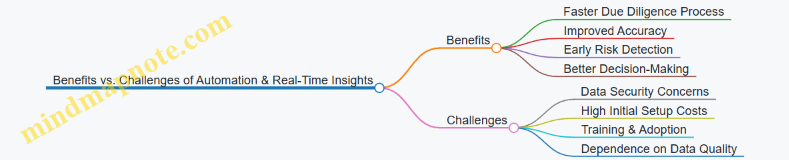
Preparing for the Future
To harness the power of automation and real-time insights, finance professionals should:
- Invest in scalable and secure data integration platforms.
- Develop skills in data analytics and AI tools.
- Collaborate closely with IT and data teams.
- Establish protocols for data governance and privacy.
Conclusion
Automation and real-time financial insights are not just futuristic concepts—they are rapidly becoming standard practice in financial due diligence for M&A. By embracing these technologies, accountants and financial analysts can enhance accuracy, speed, and strategic value in deal evaluation, ultimately driving better outcomes for their organizations.
14.5 Example: Using AI Tools to Identify Financial Anomalies Quickly
In the fast-paced world of M&A, identifying financial anomalies early can be the difference between a successful acquisition and costly surprises. Artificial Intelligence (AI) tools have revolutionized financial due diligence by enabling accountants and financial analysts to detect irregularities with unprecedented speed and accuracy.
What Are Financial Anomalies?
Financial anomalies refer to unusual patterns or transactions in financial data that deviate from expected behavior. These can include:
- Unexplained spikes or drops in revenue or expenses
- Irregularities in accounts receivable or payable
- Unusual journal entries or adjustments
- Discrepancies in cash flow statements
Detecting these anomalies manually is time-consuming and prone to human error, especially with large datasets.
How AI Tools Help Identify Anomalies
AI tools use machine learning algorithms, pattern recognition, and statistical analysis to scan vast amounts of financial data quickly. They learn from historical data to establish “normal” behavior and flag deviations that warrant further investigation.
Key Features of AI Anomaly Detection Tools:
- Automated Data Processing: Rapid ingestion and normalization of diverse financial data sources.
- Pattern Recognition: Identifies complex patterns beyond simple threshold breaches.
- Adaptive Learning: Continuously improves detection accuracy based on feedback.
- Visualization Dashboards: Presents anomalies with intuitive charts and heatmaps.
Mind Map: AI-Driven Financial Anomaly Detection Process
Practical Example: Detecting Revenue Recognition Anomalies
Scenario: A financial analyst is reviewing the revenue streams of a target company in the software sector. The company has multiple subscription plans and seasonal promotions.
Traditional Approach: Manually reviewing monthly revenue reports and cross-checking with contracts and invoices.
AI-Enabled Approach: Using an AI tool that analyzes transaction data, subscription renewals, and payment timings to detect anomalies.
Outcome:
- The AI flagged a sudden 25% revenue spike in a quarter without corresponding increases in customer count or contract renewals.
- Further investigation revealed premature revenue recognition from a large client contract that had not yet been fulfilled.
- This anomaly prompted renegotiation of deal terms and adjustment of valuation.
Mind Map: Revenue Anomaly Detection Workflow
Additional Examples of AI-Driven Anomaly Detection in Financial Due Diligence
- Expense Fraud Detection: AI flagged repeated small vendor payments just below approval thresholds, indicating potential fraudulent activity.
- Cash Flow Irregularities: Time-series AI models detected unusual delays in cash collections during a period of stable sales, signaling potential liquidity issues.
- Inventory Valuation Issues: AI identified discrepancies between inventory turnover rates and reported inventory values, suggesting overstatement.
Best Practices When Using AI Tools for Anomaly Detection
- Combine AI Insights with Expert Judgment: AI flags anomalies but human expertise is essential to interpret context.
- Ensure Data Quality: Garbage in, garbage out — clean and accurate data is critical.
- Customize Models to Industry and Company Specifics: Tailor AI models to reflect unique business cycles and accounting policies.
- Maintain Transparency: Document AI methodologies and assumptions for auditability.
Conclusion
AI tools empower accountants and financial analysts to uncover hidden financial anomalies rapidly, improving the quality and reliability of financial due diligence in M&A. By integrating AI-driven insights with traditional analysis, deal teams can mitigate risks and make more informed decisions.
For further reading, explore case studies on AI applications in financial due diligence and emerging software solutions tailored for M&A professionals.
15. Case Studies and Real-World Applications
15.1 Case Study 1: Due Diligence in a High-Growth Technology Acquisition
Background
A leading software company, TechNova Inc., planned to acquire CloudSync Solutions, a high-growth cloud storage startup. The acquisition aimed to expand TechNova’s product portfolio and leverage CloudSync’s innovative technology and rapidly growing customer base.
Objectives of Financial Due Diligence
- Validate CloudSync’s reported financial performance and growth claims.
- Identify any hidden liabilities or risks that could affect valuation.
- Assess the sustainability of revenue streams and profitability.
- Evaluate working capital needs and cash flow dynamics.
Step 1: Analyzing Historical Financial Performance
- Revenue Growth Verification: CloudSync reported a 150% year-over-year revenue growth over the last two years.
- Example: Due diligence team reviewed subscription contracts and billing records to confirm recurring revenue.
- Findings: Verified strong recurring revenue but identified a concentration of 40% revenue from top 3 clients, posing customer concentration risk.
Step 2: Quality of Earnings (QoE) Analysis
- Adjusted earnings to exclude one-time grants and R&D tax credits that inflated net income.
- Example: CloudSync had a $2M government grant recorded as income; this was excluded to reflect sustainable earnings.
- Outcome: Adjusted EBITDA was 20% lower than reported, providing a more realistic profitability picture.
Step 3: Working Capital Assessment
- Evaluated accounts receivable aging; found 15% of receivables over 90 days, indicating potential collection issues.
- Example: TechNova negotiated a working capital adjustment clause in the purchase agreement to mitigate this risk.
Step 4: Debt and Liability Review
- CloudSync had minimal debt but significant lease obligations for office space and data centers.
- Example: Lease commitments were disclosed but not fully reflected on the balance sheet, requiring adjustments under IFRS 16.
Step 5: Cash Flow and Liquidity Analysis
- Assessed cash burn rate given rapid growth and investment in R&D.
- Example: Monthly cash burn was $500K; runway estimated at 12 months without additional funding.
Step 6: Forecast and Projections Review
- Reviewed management’s 3-year projections showing continued 100%+ growth.
- Stress-tested assumptions for customer churn and market competition.
- Example: Adjusted projections to a more conservative 60% growth rate to reflect market risks.
Key Takeaways and Best Practices
- Customer Concentration Risk: Always verify revenue sources and client diversification.
- Adjust for Non-Recurring Items: Normalize earnings to reflect sustainable profitability.
- Working Capital Scrutiny: Aging receivables can signal collection risks impacting liquidity.
- Lease Obligations: Consider off-balance sheet commitments under new accounting standards.
- Cash Flow Management: Understand burn rate and runway, especially for high-growth startups.
- Realistic Forecasting: Challenge overly optimistic projections with scenario analysis.
Conclusion
The financial due diligence process enabled TechNova to uncover critical insights about CloudSync’s financial health and risks. These findings informed negotiation strategies, including purchase price adjustments and contractual protections, ultimately contributing to a successful acquisition aligned with TechNova’s strategic goals.
15.2 Case Study 2: Financial Due Diligence in a Distressed Asset Purchase
Overview
In this case study, we explore the financial due diligence process involved in acquiring a distressed manufacturing company. The target company was facing liquidity issues, declining revenues, and operational inefficiencies. The acquiring firm aimed to identify hidden risks, assess the true financial health, and uncover opportunities for turnaround.
Objectives of Due Diligence in Distressed Asset Purchase
- Assess solvency and liquidity status
- Identify contingent liabilities and off-balance sheet risks
- Evaluate working capital needs and cash flow sustainability
- Understand the impact of debt restructuring or refinancing
- Validate asset valuations and impairment risks
Mind Map: Key Areas of Financial Due Diligence in Distressed Asset Purchase
Step 1: Liquidity and Cash Flow Analysis
The due diligence team started by analyzing the target’s cash flow statements over the past 24 months. They discovered:
- Negative operating cash flows for 6 consecutive quarters
- Working capital deficits driven by slow receivables collection
- High inventory levels with signs of obsolescence
Example: The target had $2 million in accounts receivable overdue by more than 90 days, indicating potential collection issues. This was critical since the acquirer needed to forecast realistic cash inflows to support operations post-acquisition.
Step 2: Debt and Liability Review
The target had multiple outstanding loans with restrictive covenants. The due diligence revealed:
- $15 million in senior secured debt with a covenant requiring a minimum interest coverage ratio
- Several off-balance sheet lease obligations
- Pending lawsuits that could lead to contingent liabilities
Example: One covenant breach was imminent due to declining EBITDA, which could trigger acceleration of debt repayment. This risk was factored into the negotiation to seek price adjustments and restructuring agreements.
Step 3: Revenue and Profitability Assessment
Revenue had declined by 25% year-over-year due to loss of key customers and market contraction. The team:
- Adjusted earnings for one-time restructuring expenses
- Identified non-recurring legal settlements inflating costs
- Analyzed customer concentration risks
Example: A $500,000 legal settlement was recorded as an operating expense, which was excluded in the normalized earnings calculation to reflect sustainable profitability.
Step 4: Asset Valuation and Impairment
The fixed asset register was reviewed to identify impairments:
- Several manufacturing machines were obsolete and overvalued on the books
- Inventory included slow-moving parts with potential write-downs
Example: An impairment of $1.2 million was recommended on machinery that had no resale value and was unlikely to be used in future operations.
Step 5: Operational Efficiency and Cost Structure
The team analyzed cost drivers and overheads:
- High fixed costs with limited flexibility
- Opportunities to reduce SG&A expenses by consolidating functions
Example: The target’s administrative expenses were 15% higher than industry benchmarks, suggesting potential for cost savings post-acquisition.
Mind Map: Due Diligence Findings and Impact on Deal Negotiation
Outcome and Lessons Learned
- The acquirer negotiated a 20% price reduction based on identified risks.
- An earn-out clause was included, tied to achieving specific EBITDA targets post-acquisition.
- Debt restructuring was initiated pre-closing to avoid covenant breaches.
- Post-deal integration prioritized working capital improvements and cost optimization.
This case highlights the critical importance of thorough financial due diligence in distressed asset purchases. Understanding the nuances of liquidity, debt, and asset quality can significantly influence deal terms and post-acquisition success.
Summary Table: Key Financial Metrics Before and After Adjustments
| Metric | Reported | Adjusted | Notes |
|---|---|---|---|
| EBITDA | $3.5M | $4.0M | Excluded $0.5M one-time legal expense |
| Operating Cash Flow | -$1.2M | -$1.2M | Negative cash flow trend confirmed |
| Working Capital | -$0.8M | -$0.8M | Deficit impacting liquidity |
| Debt Outstanding | $15M | $15M | Covenant breach risk identified |
| Asset Impairment | N/A | $1.2M | Machinery write-down recommended |
This detailed financial due diligence enabled the acquiring company to make an informed decision, mitigate risks, and plan a successful turnaround strategy.
15.3 Case Study 3: Cross-Border M&A Financial Due Diligence Challenges
Cross-border mergers and acquisitions introduce a unique set of financial due diligence challenges that require specialized attention. These challenges stem from differences in regulatory environments, accounting standards, currency risks, cultural factors, and geopolitical considerations. This case study explores these complexities through a real-world example and provides practical insights and best practices for accountants and financial analysts.
Key Challenges in Cross-Border Financial Due Diligence
Real-World Example: Acquisition of a European Manufacturing Firm by a US-Based Corporation
Background: A US-based manufacturing company planned to acquire a mid-sized European competitor to expand its footprint in the EU market. The target operated under IFRS, while the acquirer used US GAAP. The deal involved multiple currencies (EUR and USD) and complex tax structures.
Challenges Identified:
-
Accounting Standards Reconciliation: The target’s revenue recognition policies included long-term contracts recognized on a percentage-of-completion basis under IFRS, which differed from the acquirer’s completed-contract method under US GAAP.
-
Currency Risk: The target’s financials were reported in EUR, but the acquirer’s reporting currency was USD. Exchange rate volatility posed risks to valuation and future cash flows.
-
Tax Exposure: The target had operations in multiple EU countries with varying tax rates and transfer pricing policies, raising concerns about potential tax liabilities and compliance risks.
-
Regulatory Compliance: Differences in labor laws and environmental regulations required additional financial provisions.
-
Data Quality: Some financial records were maintained manually, leading to concerns about accuracy and completeness.
Best Practices Applied
Mind Map: Accounting Standards Reconciliation Process
Example: Currency Risk Sensitivity Analysis
The acquirer modeled the impact of a 10% depreciation of EUR against USD on the target’s EBITDA and cash flow forecasts. This analysis revealed a potential $5 million reduction in EBITDA, prompting the negotiation of currency hedging clauses in the purchase agreement.
Lessons Learned
- Early involvement of local experts can uncover hidden financial and regulatory risks.
- Reconciling accounting standards is critical to avoid overpaying based on inflated earnings.
- Currency risk must be quantified and mitigated through contractual or financial instruments.
- Tax complexities require thorough review to prevent unexpected liabilities.
- Data quality issues can delay the process; investing in data validation upfront saves time.
- Clear communication and documentation throughout the process facilitate smoother negotiations and integration.
Summary
Cross-border M&A financial due diligence demands a multifaceted approach combining technical accounting expertise, local market knowledge, and strategic risk management. By applying best practices and leveraging detailed analysis, financial analysts and accountants can provide invaluable insights that protect deal value and enable successful integration.
15.4 Case Study 4: Private Equity Buyout Financial Due Diligence
Overview
Private equity (PE) buyouts involve acquiring a controlling interest in a company, often with significant leverage. Financial due diligence in PE buyouts is critical to validate the investment thesis, assess risks, and identify value creation opportunities. This case study explores a mid-market PE firm’s buyout of a manufacturing company, highlighting key due diligence steps, challenges, and best practices.
Mind Map: Key Focus Areas in PE Buyout Financial Due Diligence
Step 1: Quality of Earnings (QoE) Analysis
The PE firm started by analyzing the target’s earnings to ensure reported profits reflected sustainable cash generation. They identified several non-recurring items:
- One-time legal settlement expense of $1.2 million in the prior year.
- Owner’s discretionary expenses, including personal travel and entertainment, totaling $300,000 annually.
Example: By adjusting for these, the normalized EBITDA increased from $8.5 million to $10 million, providing a clearer picture of operational profitability.
Step 2: Working Capital Assessment
The due diligence team reviewed the target’s working capital trends over the last three years. They noticed:
- Inventory levels spiked during Q4 due to seasonal demand.
- Accounts receivable days were higher than industry average by 10 days.
Example: The PE firm benchmarked working capital against similar manufacturing firms and negotiated a working capital adjustment in the purchase agreement to reflect normalized levels.
Step 3: Debt and Leverage Review
The target had $25 million in existing debt with restrictive covenants. The PE firm:
- Analyzed covenant terms to assess risk of breach post-buyout.
- Evaluated refinancing options to optimize capital structure.
Example: They discovered a covenant requiring a minimum interest coverage ratio of 3.0x, which the target was barely meeting. This insight led to structuring the deal with a cash reserve to avoid covenant breaches.
Step 4: Cash Flow and CapEx Analysis
The team forecasted free cash flow by:
- Reviewing historical operating cash flow.
- Adjusting for necessary capital expenditures to maintain equipment.
Example: Historical CapEx was $2 million annually, but management projected $3 million due to planned expansion. The PE firm stress-tested cash flows under both scenarios to ensure debt serviceability.
Step 5: Tax Due Diligence
The tax review uncovered:
- Deferred tax liabilities related to accelerated depreciation.
- No significant tax compliance issues.
Example: The PE firm factored the deferred tax liabilities into the valuation and planned for tax-efficient deal structuring.
Step 6: Financial Controls and Reporting
The target’s internal controls were found to be basic but functional. The ERP system was outdated, causing delays in monthly close.
Example: The PE firm allocated budget post-acquisition to upgrade financial systems to improve reporting accuracy and timeliness.
Step 7: Forecast and Projections Review
The management’s projections showed 10% annual revenue growth. The PE firm:
- Validated assumptions against market trends.
- Conducted scenario analysis including downside cases.
Example: They adjusted projections downward by 2% to account for potential market headwinds, ensuring conservative valuation.
Summary and Lessons Learned
This PE buyout financial due diligence highlighted the importance of:
- Normalizing earnings to reflect true operational performance.
- Deep working capital analysis to avoid surprises in cash requirements.
- Understanding debt covenants to mitigate refinancing risks.
- Stress-testing cash flows under various scenarios.
- Factoring tax liabilities and compliance into deal structuring.
- Evaluating financial controls to plan for integration improvements.
By integrating these best practices with thorough analysis, the PE firm was able to negotiate favorable terms, structure the deal prudently, and set a foundation for post-acquisition value creation.
15.5 Lessons Learned and Best Practices from Case Studies
Financial due diligence in M&A is a complex, multifaceted process that requires meticulous attention to detail, collaboration, and strategic thinking. Drawing from the case studies presented earlier, this section distills key lessons learned and best practices that accountants and financial analysts can apply to enhance the effectiveness of their due diligence efforts.
Key Lessons Learned
-
Thoroughness Prevents Surprises
- In the high-growth technology acquisition case, incomplete revenue recognition analysis initially masked deferred revenue liabilities. This underscores the importance of deep dives into revenue streams and accounting policies.
-
Early Identification of Risks Saves Costs
- The distressed asset purchase revealed hidden contingent liabilities only after deal signing, leading to renegotiation. Early identification through comprehensive liability reviews can prevent costly post-deal disputes.
-
Cross-Border Complexities Demand Specialized Expertise
- The cross-border M&A case highlighted challenges with tax compliance and currency risk. Engaging local experts and understanding jurisdiction-specific regulations is critical.
-
Integration Planning Should Begin During Due Diligence
- The private equity buyout case showed that due diligence findings on internal controls directly informed integration strategies, reducing post-acquisition surprises.
-
Use of Technology Enhances Accuracy and Efficiency
- Leveraging AI tools in anomaly detection expedited the identification of financial inconsistencies, as seen in the SaaS deal example.
Best Practices Mind Map
Detailed Examples of Best Practices
-
Thorough Documentation
- Example: In the manufacturing firm case, detailed notes on adjustments to earnings helped clarify the rationale behind QoE adjustments, facilitating smoother negotiations.
-
Cross-Functional Collaboration
- Example: During the international acquisition, tax experts identified transfer pricing risks that financial analysts alone might have missed.
-
Risk Identification & Prioritization
- Example: Using a risk heat map, the team prioritized working capital fluctuations as a top risk in the retail target, focusing resources accordingly.
-
Use of Technology
- Example: AI-driven anomaly detection flagged unusual expense patterns in the SaaS company, prompting further investigation.
-
Scenario Analysis
- Example: Stress testing projections under a recession scenario revealed vulnerabilities in the target’s cash flow, influencing deal terms.
-
Clear Reporting
- Example: Visual dashboards summarizing key financial metrics enabled executives to quickly grasp critical issues in the private equity buyout.
-
Continuous Learning
- Example: Post-deal reviews led to refining due diligence checklists, improving efficiency in subsequent transactions.
Mind Map: Lessons Learned from Case Studies
Conclusion
The synthesis of these lessons and best practices demonstrates that successful financial due diligence is not just about number crunching but about strategic insight, collaboration, and leveraging technology. By applying these principles, accountants and financial analysts can significantly de-risk M&A transactions and contribute to value creation post-acquisition.